PERSONAL PLAN TOENHANCE BRAIN FUNCTION
Improving your brain through constant practice and
checking your health it is crucial especially the different
adjustments and coping abilities. The brain continues working even
when you are at asleep. The brain works in a slower pace and if
the brain stops life cease to exist. To comprehend situational
problems and to train one's brain to handle these challenges, will
give an assurance of making right and logical decisions. True
enough, if you are consistent in being stagnant and refuse to learn
new things, you are the risk of eliciting your capacity to improve.
(In Praise of the Idle Mind; Davis, 2019)
3.
What is Thinking?
Thinking – it involves manipulating mental representation and prevents us
from making a mistake ( Robertson, 1999 ).
A . CRITICAL THINKING - requires logic and coherence as we try to
analyze, synthesize, evaluate, and interpret information rather than simply apply
technical abilities. ( Andolina, 2001).
- we try to evaluate , formulate good arguments, we arrange information in a
coherent way by making connection to other ideas, considering alternative
sources and assessing their implications, looking for cause and effect and
making generalizations.
Metacognition - it refers to the awareness and knowledge about one’s own
thought process and the ability to use the knowledge in managing one’s own
thinking processes, such as problem solving and comprehension ( Bruning,
Schraw, Norby, & Ronning, 2004 )
4.
B. CREATIVE THINKING– the production of effective novelty through the operation
of our mental processes. (Halford, 2004 ). Creativity depends not only our ability to do things but
to represent what has been done. Creative thinking must be able to represent relations. A
creative person can see relationship of things around through art, music, dance and movement,
and other forms of creative activity.
ENHANCING CREATIVITY THROUGH MIND MAPPING
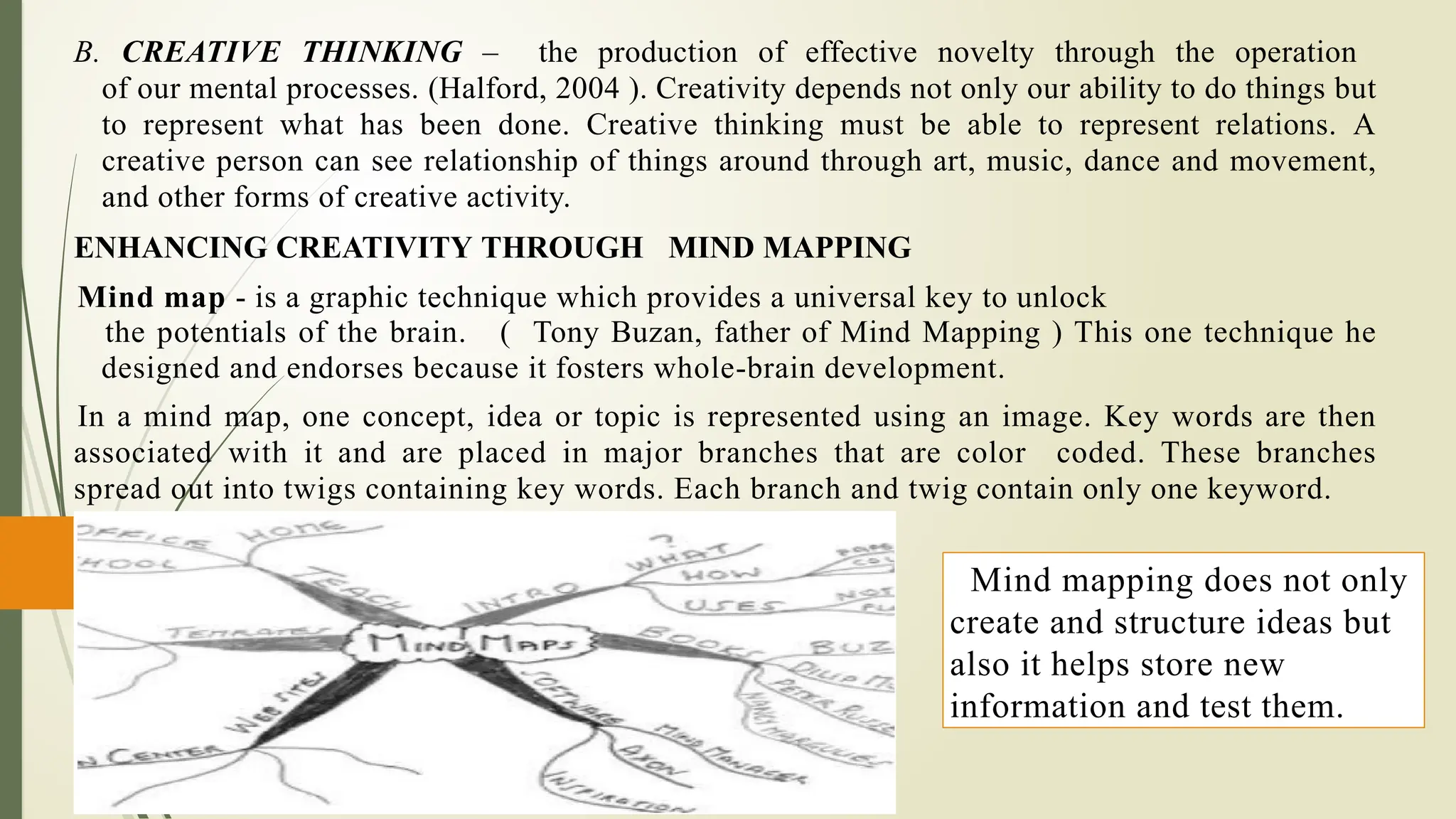
Mind map - is a graphic technique which provides a universal key to unlock
the potentials of the brain. ( Tony Buzan, father of Mind Mapping ) This one technique he
designed and endorses because it fosters whole-brain development.
In a mind map, one concept, idea or topic is represented using an image. Key words are then
associated with it and are placed in major branches that are color coded. These branches
spread out into twigs containing key words. Each branch and twig contain only one keyword.
Mind mapping does not only
create and structure ideas but
also it helps store new
information and test them.
5.
UNDERSTANDING THE INTESITYAND DIFFERENTIATION
OF EMOTIONS
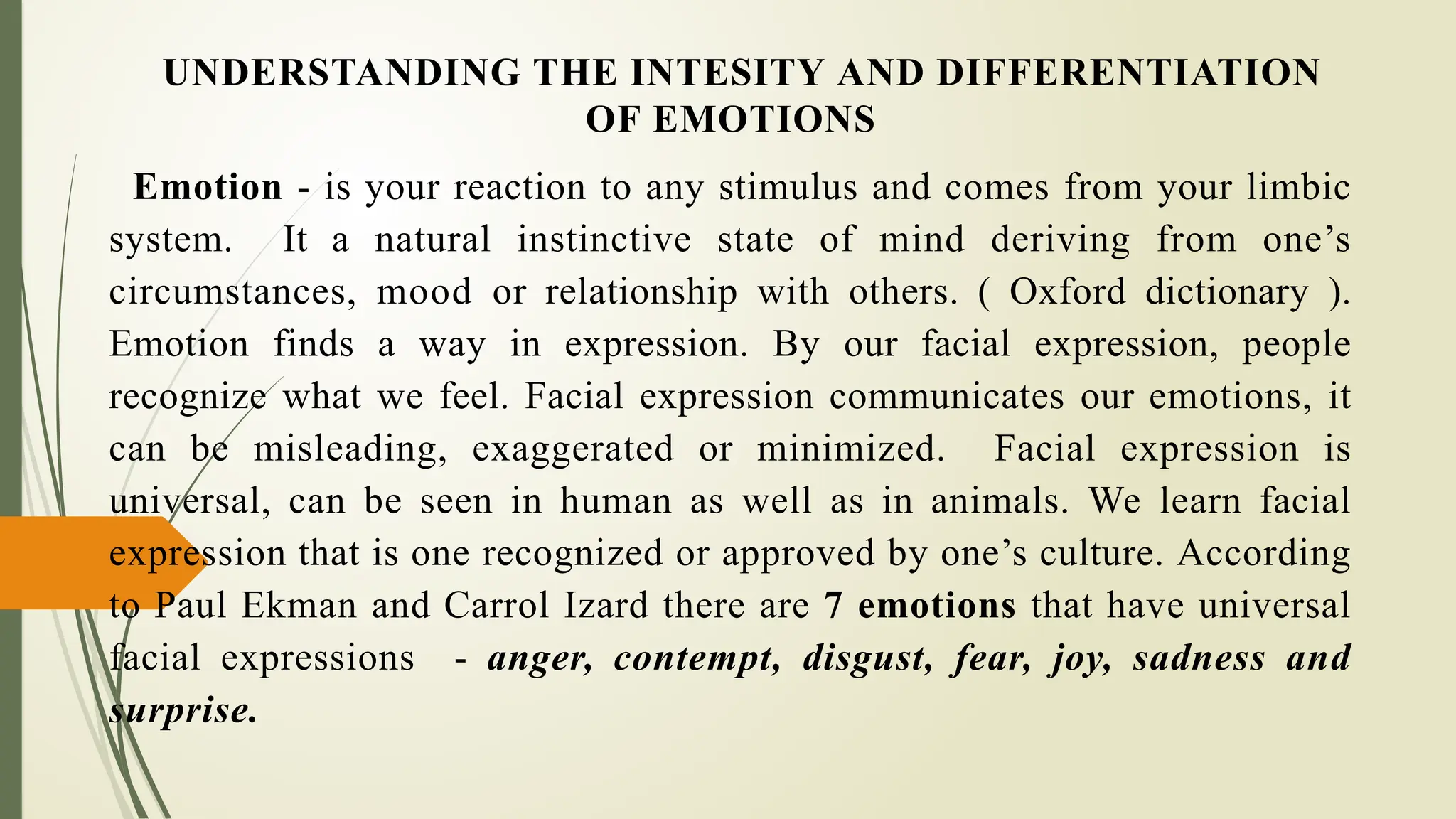
Emotion - is your reaction to any stimulus and comes from your limbic
system. It a natural instinctive state of mind deriving from one’s
circumstances, mood or relationship with others. ( Oxford dictionary ).
Emotion finds a way in expression. By our facial expression, people
recognize what we feel. Facial expression communicates our emotions, it
can be misleading, exaggerated or minimized. Facial expression is
universal, can be seen in human as well as in animals. We learn facial
expression that is one recognized or approved by one’s culture. According
to Paul Ekman and Carrol Izard there are 7 emotions that have universal
facial expressions - anger, contempt, disgust, fear, joy, sadness and
surprise.
6.
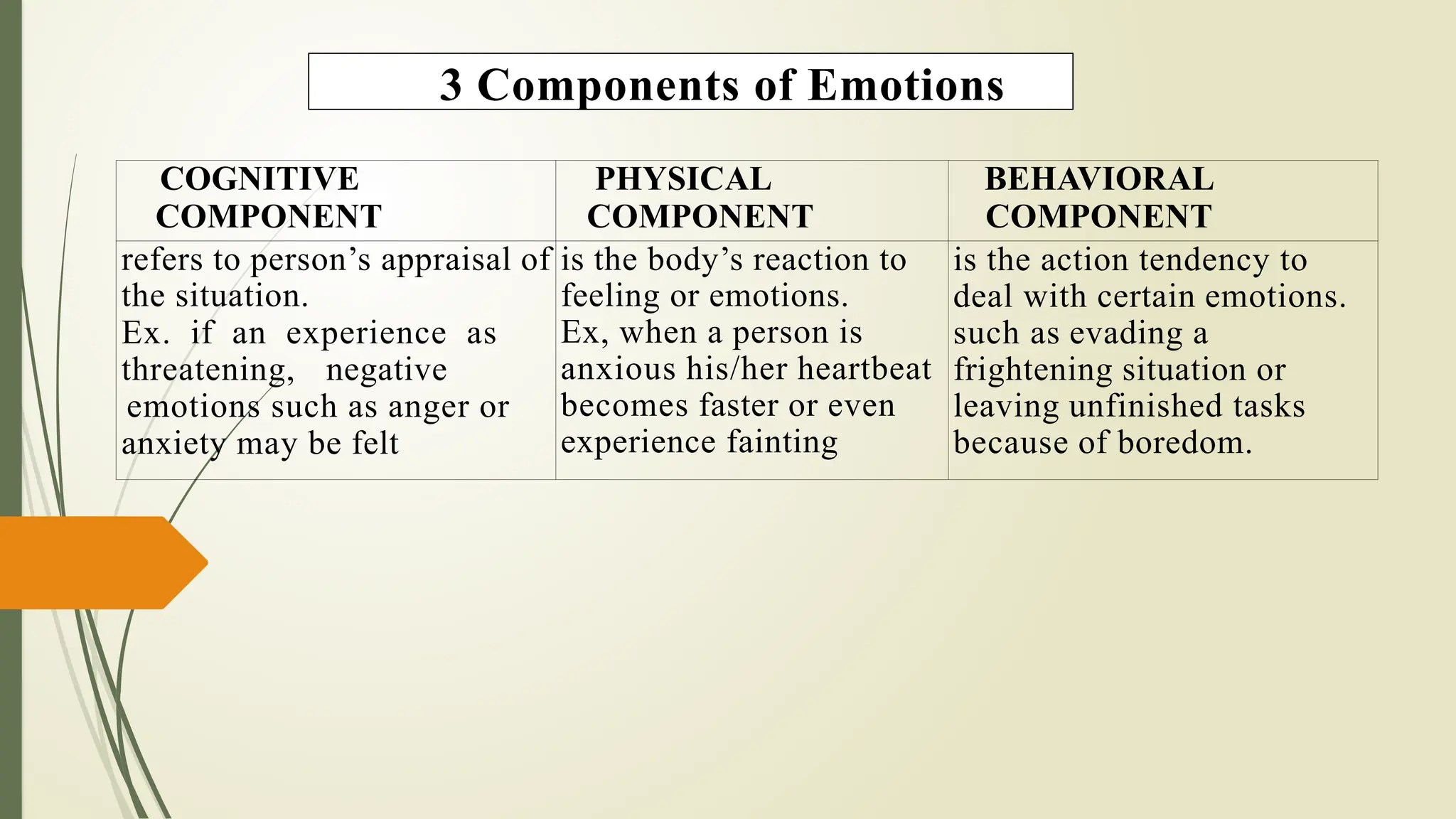
3 Components ofEmotions
COGNITIVE
COMPONENT
PHYSICAL
COMPONENT
BEHAVIORAL
COMPONENT
refers to person’s appraisal of
the situation.
Ex. if an experience as
threatening, negative
emotions such as anger or
anxiety may be felt
is the body’s reaction to
feeling or emotions.
Ex, when a person is
anxious his/her heartbeat
becomes faster or even
experience fainting
is the action tendency to
deal with certain emotions.
such as evading a
frightening situation or
leaving unfinished tasks
because of boredom.
7.
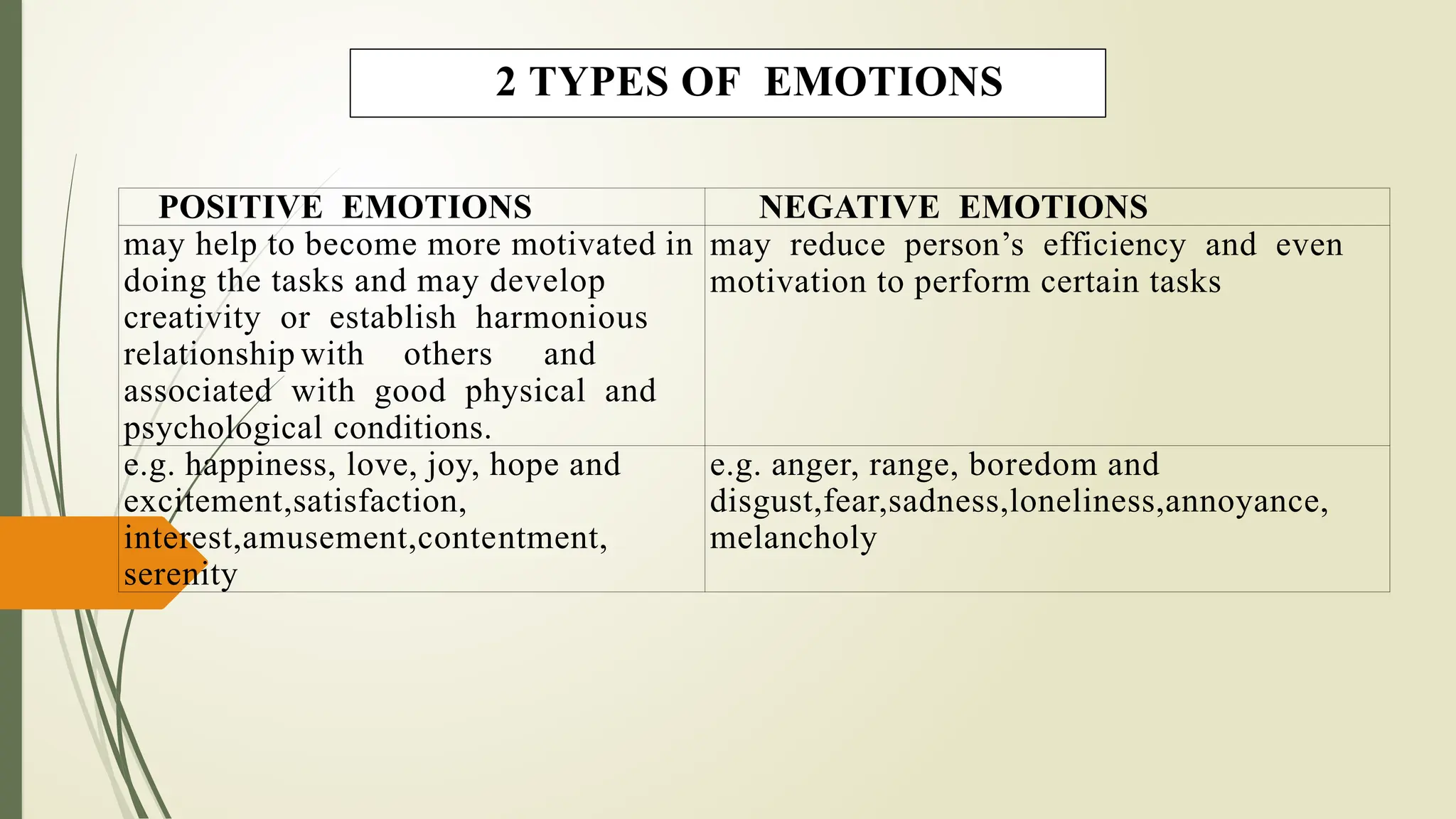
POSITIVE EMOTIONS NEGATIVEEMOTIONS
may help to become more motivated in
doing the tasks and may develop
creativity or establish harmonious
relationship with others and
associated with good physical and
psychological conditions.
may reduce person’s efficiency and even
motivation to perform certain tasks
e.g. happiness, love, joy, hope and
excitement,satisfaction,
interest,amusement,contentment,
serenity
e.g. anger, range, boredom and
disgust,fear,sadness,loneliness,annoyance,
melancholy
2 TYPES OF EMOTIONS
8.
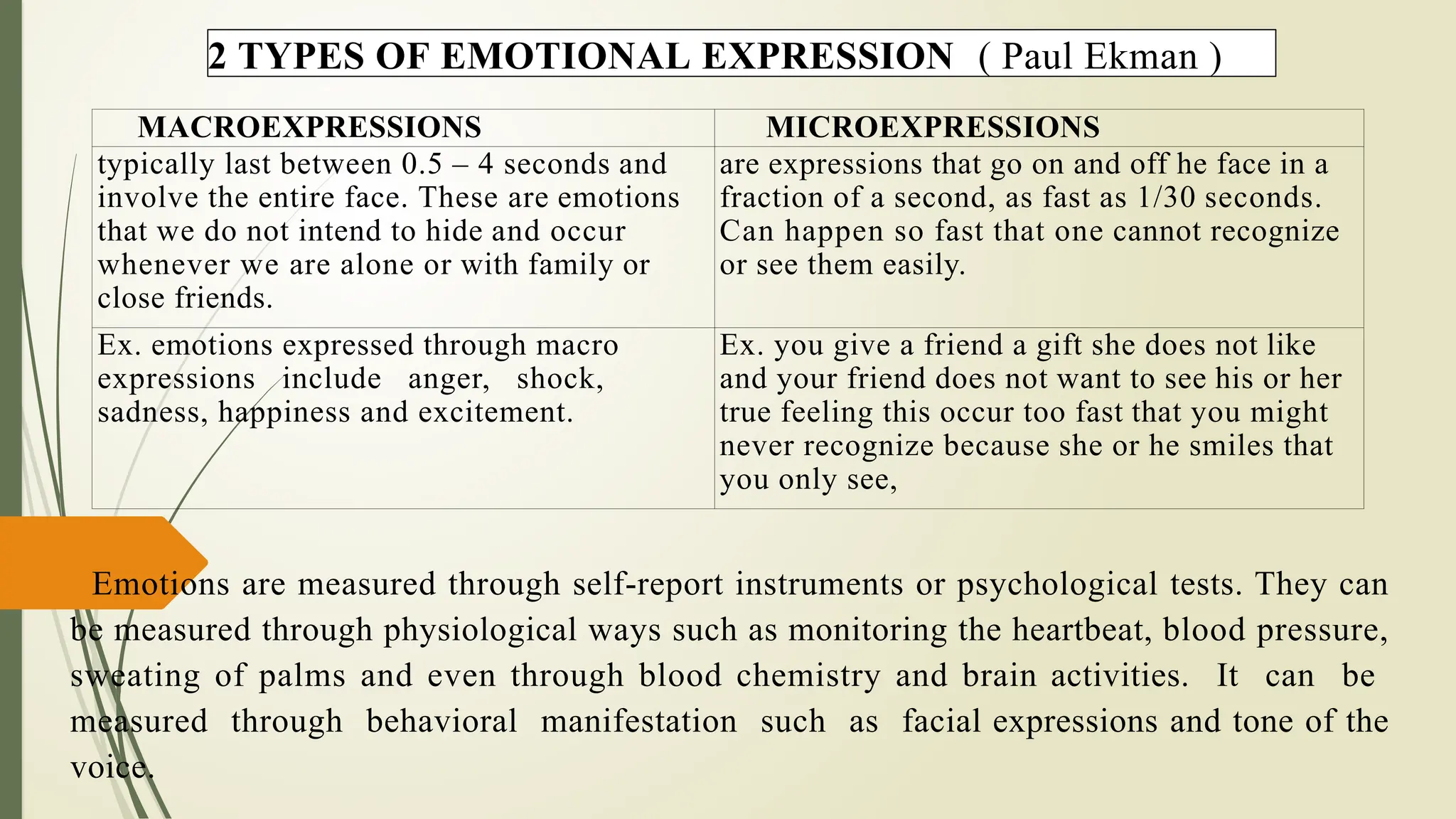
2 TYPES OFEMOTIONAL EXPRESSION ( Paul Ekman )
Emotions are measured through self-report instruments or psychological tests. They can
be measured through physiological ways such as monitoring the heartbeat, blood pressure,
sweating of palms and even through blood chemistry and brain activities. It can be
measured through behavioral manifestation such as facial expressions and tone of the
voice.
MACROEXPRESSIONS MICROEXPRESSIONS
typically last between 0.5 – 4 seconds and
involve the entire face. These are emotions
that we do not intend to hide and occur
whenever we are alone or with family or
close friends.
are expressions that go on and off he face in a
fraction of a second, as fast as 1/30 seconds.
Can happen so fast that one cannot recognize
or see them easily.
Ex. emotions expressed through macro
expressions include anger, shock,
sadness, happiness and excitement.
Ex. you give a friend a gift she does not like
and your friend does not want to see his or her
true feeling this occur too fast that you might
never recognize because she or he smiles that
you only see,
9.
• Emotions tellyou something is wrong – when you fell that something is not
right,listen to your body. Your intuition may be guiding you on what to do. Your
feelings of unease or discomfort can alert you on a potential danger of misfortune
these feelings are prompting you to respond and guide you not to make hasty
decisions.
• Emotions allow you to maintain and develop your relationships into meaningful
ones. Shame, guilt, and pride are negative ones. Emotions allow us to realize that
we have done wrong to our family, friends, neighbors and thus we make an apology
for such actions. Positive emotions such as being loved, feeling accepted or
understood warms the heart and makes relationship valuable.
• Emotions create opportunities to see things meaningfully. We see the purpose of
our lives and we become more capable of making and doing our choices.
• Emotions bring out feelings of self-respect and self-worth. The more that you feel
good about yourself, the more open you are for the many opportunities and
challenges in life. Live your life to the fullest and celebrate your emotions.