Substance Abuse
INTRODUCTION
Substance use refer to condition arising from the abuse of alcohol,
psychoactive drugs and other chemicals such as volatile solvents.
ABUSE- It refer to maladaptive pattern of substance use that impairs health
in a broad sense.
ADDICTION
Addiction is a physiologic and psychologic dependence on alcohol or other drugs of abuse.
DEPENDENCE
It refers to certain physiological and psychological phenomenon induced by the repeated taking of
a substance.
TOLERANCE
It is a state in which after repeated administration ,a drug produce decreased effect, or increasing
doses are required to produce the same effect.
DEFINITION OF SUBSTANCE ABUSE
ACCORDING TO R SREEVANI
“Maladaptive recurring use of a substance accompanied by repeated
detrimental effect as a result of continued use’’
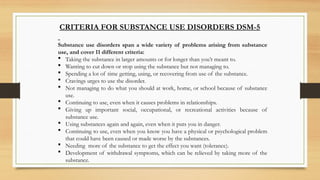
CRITERIA FOR SUBSTANCE USE DISORDERS DSM-5
Substance use disorders span a wide variety of problems arising from substance
use, and cover 11 different criteria:
 Taking the substance in larger amounts or for longer than you’r meant to.
 Wanting to cut down or stop using the substance but not managing to.
 Spending a lot of time getting, using, or recovering from use of the substance.
 Cravings urges to use the disorder.
 Not managing to do what you should at work, home, or school because of substance
use.
 Continuing to use, even when it causes problems in relationships.
 Giving up important social, occupational, or recreational activities because of
substance use.
 Using substances again and again, even when it puts you in danger.
 Continuing to use, even when you know you have a physical or psychological problem
that could have been caused or made worse by the substances.
 Needing more of the substance to get the effect you want (tolerance).
 Development of withdrawal symptoms, which can be relieved by taking more of the
substance.
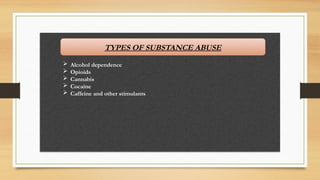
TYPES OF SUBSTANCE ABUSE
 Alcohol dependence
 Opioids
 Cannabis
 Cocaine
 Caffeine and other stimulants
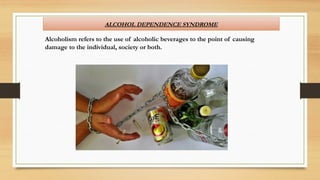
ALCOHOL DEPENDENCE SYNDROME
Alcoholism refers to the use of alcoholic beverages to the point of causing
damage to the individual, society or both.
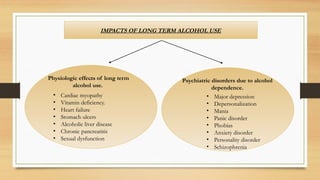
IMPACTS OF LONG TERM ALCOHOL USE
Psychiatric disorders due to alcohol
dependence.
• Major depression
• Depersonalization
• Mania
• Panic disorder
• Phobias
• Anxiety disorder
• Personality disorder
• Schizophrenia
.
Physiologic effects of long term
alcohol use.
• Cardiac myopathy
• Vitamin deficiency.
• Heart failure
• Stomach ulcers
• Alcoholic liver disease
• Chronic pancreatitis
• Sexual dysfunction
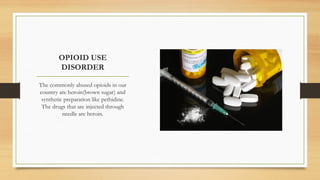
OPIOID USE
DISORDER
The commonly abused opioids in our
country are heroin(brown sugar) and
synthetic preparation like pethidine.
The drugs that are injected through
needle are heroin.
CANNABIS USE DISORDER
Cannabis is derived from the plant cannabissative,which grows in the wild all
around the world. It is used in various form such as
• Bhang
• Ganja
COCAINE USE DISORDER
Common street name is ‘crack’ it can be administered orally, intranasally by
smoking.
BARBITURATES
These are sedatives and are used for the sedation of aggevated patients to
relief pain.
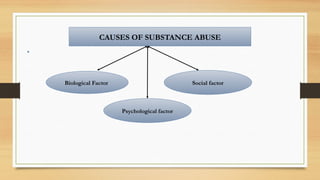
CAUSES OF SUBSTANCE ABUSE
Biological Factor
Psychological factor
Social factor
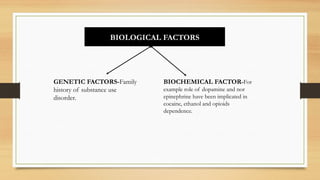
BIOLOGICAL FACTORS
GENETIC FACTORS-Family
history of substance use
disorder.
BIOCHEMICAL FACTOR-For
example role of dopamine and nor
epinephrine have been implicated in
cocaine, ethanol and opioids
dependence.
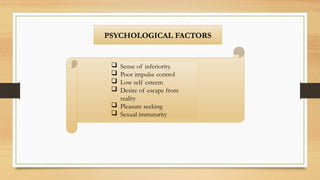
PSYCHOLOGICAL FACTORS
 Sense of inferiority.
 Poor impulse control
 Low self esteem
 Desire of escape from
reality
 Pleasure seeking
 Sexual immaturity
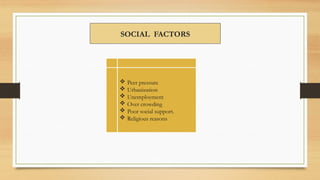
SOCIAL FACTORS
 Peer pressure
 Urbanization
 Unemployment
 Over crowding
 Poor social support.
 Religious reasons
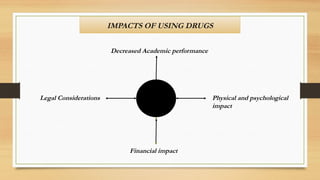
IMPACTS OF USING DRUGS
Decreased Academic performance
Physical and psychological
impact
Financial impact
Legal Considerations
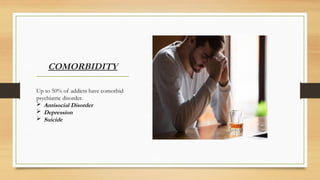
COMORBIDITY
Up to 50% of addicts have comorbid
psychiatric disorder.
 Antisocial Disorder
 Depression
 Suicide
SCREENING AND ASSESSMENT
• SCREENING – Screening is the
process of identifying individuals who
have or may be at risk for a substance use
disorder.
• ASSESSMENT-Assessments are used
to clarify the nature of substance use
behavior to help determine appropriate
treatment. Assessments usually require
specialized skills , and are longer to
administer than screeners.
SCREENING TOOLS
1. DRUG ABUSE SCREEN TEST(DAST 10)-This test contains 10 yes or no questions about how
much and how often you take drugs. The answers are scored on a point system. A score of 8 or
more may indicate a drug problem.
2. CUT DOWN ANNOYED, GUILTY, EYE OPENER(CAGE)-This also contains yes or no
questions. Two or more yes answers may indicate a drug problem .
3. CAR, RELAX, ALONE FORGET, FRIENDS, TROUBLE(CRAFT)- This test is designed for
teens and includes yes or no questions about drug and alcohol use. Two or more yes answers to
these questions may indicate a drug problem.
TREATMENT
PSYCHOLOGICAL
MEDICATION
• Behavioral interventions
• Group therapy
• Individual therapy
• Self help recovery groups
• Aversion therapies
• Family therapy
• Cognitive behavioral
therapy.
A number of medicines have
been approved for the treatment
of substance abuse, such as
BUPRENORPHINE and
METHADONE.
DATA ACCORDING TO THE NATIONAL SURVEY ON DRUG USE AND
HEALTH (NSDUH) , CONDUCTED BY THE SUBSTANCE ABUSE AND
MENTAL HEALTH SERVICES ADMINISTRATION (SAMHSA).
Among people aged 12 or older in 2019, 60.1%(165.4 million) used substance .
ALCOHOL- Among people aged 12 or older in 2019 , 50.8% (139.7 million ) used Alcohol.
TOBACCO- Among people aged 12 or older in 2019, 21.1%(58.1 million) used tobacco.
OTHER ILLICIT DRUGS- Among people aged 12 or older in 2019, 14% used illicit
drugs .
ABOUT TREATMENT-
 Among people aged 12 or older in 2019, 2.1 million received substance use treatment at a Self
Help Group.
 1.7 million received treatment at a mental health centre as an outpatient.
 1.0 million received treatment at rehab facility as an inpatient.

Substance Abuse Power point presentation

  • 1.
  • 2.
    INTRODUCTION Substance use referto condition arising from the abuse of alcohol, psychoactive drugs and other chemicals such as volatile solvents. ABUSE- It refer to maladaptive pattern of substance use that impairs health in a broad sense.
  • 3.
    ADDICTION Addiction is aphysiologic and psychologic dependence on alcohol or other drugs of abuse. DEPENDENCE It refers to certain physiological and psychological phenomenon induced by the repeated taking of a substance. TOLERANCE It is a state in which after repeated administration ,a drug produce decreased effect, or increasing doses are required to produce the same effect.
  • 4.
    DEFINITION OF SUBSTANCEABUSE ACCORDING TO R SREEVANI “Maladaptive recurring use of a substance accompanied by repeated detrimental effect as a result of continued use’’
  • 5.
    CRITERIA FOR SUBSTANCEUSE DISORDERS DSM-5 Substance use disorders span a wide variety of problems arising from substance use, and cover 11 different criteria:  Taking the substance in larger amounts or for longer than you’r meant to.  Wanting to cut down or stop using the substance but not managing to.  Spending a lot of time getting, using, or recovering from use of the substance.  Cravings urges to use the disorder.  Not managing to do what you should at work, home, or school because of substance use.  Continuing to use, even when it causes problems in relationships.  Giving up important social, occupational, or recreational activities because of substance use.  Using substances again and again, even when it puts you in danger.  Continuing to use, even when you know you have a physical or psychological problem that could have been caused or made worse by the substances.  Needing more of the substance to get the effect you want (tolerance).  Development of withdrawal symptoms, which can be relieved by taking more of the substance.
  • 6.
    TYPES OF SUBSTANCEABUSE  Alcohol dependence  Opioids  Cannabis  Cocaine  Caffeine and other stimulants
  • 7.
    ALCOHOL DEPENDENCE SYNDROME Alcoholismrefers to the use of alcoholic beverages to the point of causing damage to the individual, society or both.
  • 8.
    IMPACTS OF LONGTERM ALCOHOL USE Psychiatric disorders due to alcohol dependence. • Major depression • Depersonalization • Mania • Panic disorder • Phobias • Anxiety disorder • Personality disorder • Schizophrenia . Physiologic effects of long term alcohol use. • Cardiac myopathy • Vitamin deficiency. • Heart failure • Stomach ulcers • Alcoholic liver disease • Chronic pancreatitis • Sexual dysfunction
  • 9.
    OPIOID USE DISORDER The commonlyabused opioids in our country are heroin(brown sugar) and synthetic preparation like pethidine. The drugs that are injected through needle are heroin.
  • 10.
    CANNABIS USE DISORDER Cannabisis derived from the plant cannabissative,which grows in the wild all around the world. It is used in various form such as • Bhang • Ganja
  • 11.
    COCAINE USE DISORDER Commonstreet name is ‘crack’ it can be administered orally, intranasally by smoking. BARBITURATES These are sedatives and are used for the sedation of aggevated patients to relief pain.
  • 12.
    CAUSES OF SUBSTANCEABUSE Biological Factor Psychological factor Social factor
  • 13.
    BIOLOGICAL FACTORS GENETIC FACTORS-Family historyof substance use disorder. BIOCHEMICAL FACTOR-For example role of dopamine and nor epinephrine have been implicated in cocaine, ethanol and opioids dependence.
  • 14.
    PSYCHOLOGICAL FACTORS  Senseof inferiority.  Poor impulse control  Low self esteem  Desire of escape from reality  Pleasure seeking  Sexual immaturity
  • 15.
    SOCIAL FACTORS  Peerpressure  Urbanization  Unemployment  Over crowding  Poor social support.  Religious reasons
  • 16.
    IMPACTS OF USINGDRUGS Decreased Academic performance Physical and psychological impact Financial impact Legal Considerations
  • 17.
    COMORBIDITY Up to 50%of addicts have comorbid psychiatric disorder.  Antisocial Disorder  Depression  Suicide
  • 18.
    SCREENING AND ASSESSMENT •SCREENING – Screening is the process of identifying individuals who have or may be at risk for a substance use disorder. • ASSESSMENT-Assessments are used to clarify the nature of substance use behavior to help determine appropriate treatment. Assessments usually require specialized skills , and are longer to administer than screeners.
  • 19.
    SCREENING TOOLS 1. DRUGABUSE SCREEN TEST(DAST 10)-This test contains 10 yes or no questions about how much and how often you take drugs. The answers are scored on a point system. A score of 8 or more may indicate a drug problem. 2. CUT DOWN ANNOYED, GUILTY, EYE OPENER(CAGE)-This also contains yes or no questions. Two or more yes answers may indicate a drug problem . 3. CAR, RELAX, ALONE FORGET, FRIENDS, TROUBLE(CRAFT)- This test is designed for teens and includes yes or no questions about drug and alcohol use. Two or more yes answers to these questions may indicate a drug problem.
  • 20.
    TREATMENT PSYCHOLOGICAL MEDICATION • Behavioral interventions •Group therapy • Individual therapy • Self help recovery groups • Aversion therapies • Family therapy • Cognitive behavioral therapy. A number of medicines have been approved for the treatment of substance abuse, such as BUPRENORPHINE and METHADONE.
  • 21.
    DATA ACCORDING TOTHE NATIONAL SURVEY ON DRUG USE AND HEALTH (NSDUH) , CONDUCTED BY THE SUBSTANCE ABUSE AND MENTAL HEALTH SERVICES ADMINISTRATION (SAMHSA). Among people aged 12 or older in 2019, 60.1%(165.4 million) used substance . ALCOHOL- Among people aged 12 or older in 2019 , 50.8% (139.7 million ) used Alcohol. TOBACCO- Among people aged 12 or older in 2019, 21.1%(58.1 million) used tobacco. OTHER ILLICIT DRUGS- Among people aged 12 or older in 2019, 14% used illicit drugs . ABOUT TREATMENT-  Among people aged 12 or older in 2019, 2.1 million received substance use treatment at a Self Help Group.  1.7 million received treatment at a mental health centre as an outpatient.  1.0 million received treatment at rehab facility as an inpatient.