Anxiety
/aNGˈzīədē/
(noun)
a feeling of worry, nervousness, or
unease, typically about an imminent
event or something with an
uncertain outcome.
What is Anxiety?
Anxiety is actually an automatic, "built-
in" response to perceived threats that
allows us to do what is necessary to
protect ourselves whenever we
encounter danger. Often called "fight-or-
flight arousal", this response involves a
series of changes in our bodies that
prepare us to take immediate action to
deal with a threat or crisis
(AnxietyHappens.com, 2015)
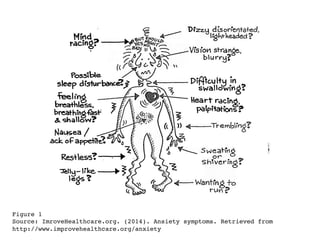
Figure 1
Source: ImroveHealthcare.org. (2014). Ansiety symptoms. Retrieved from
http://www.improvehealthcare.org/anxiety
The longer your fight or flight response
remains active, the more draining,
physically and emotionally (Bailey, 2010)
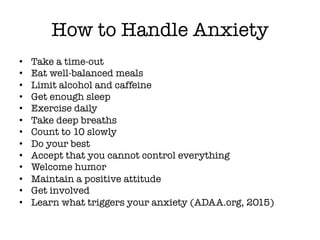
How to Handle Anxiety
• Take a time-out
• Eat well-balanced meals
• Limit alcohol and caffeine
• Get enough sleep
• Exercise daily
• Take deep breaths
• Count to 10 slowly
• Do your best
• Accept that you cannot control everything
• Welcome humor
• Maintain a positive attitude
• Get involved
• Learn what triggers your anxiety (ADAA.org, 2015)
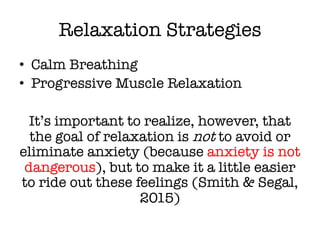
Relaxation Strategies
• Calm Breathing
• Progressive Muscle Relaxation
It’s important to realize, however, that
the goal of relaxation is not to avoid or
eliminate anxiety (because anxiety is not
dangerous), but to make it a little easier
to ride out these feelings (Smith & Segal,
2015)
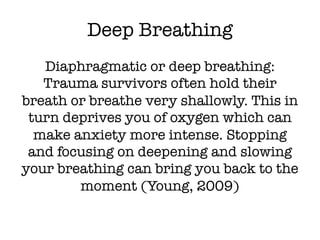
Deep Breathing
Diaphragmatic or deep breathing:
Trauma survivors often hold their
breath or breathe very shallowly. This in
turn deprives you of oxygen which can
make anxiety more intense. Stopping
and focusing on deepening and slowing
your breathing can bring you back to the
moment (Young, 2009)
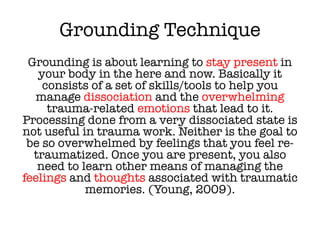
Grounding Technique
Grounding is about learning to stay present in
your body in the here and now. Basically it
consists of a set of skills/tools to help you
manage dissociation and the overwhelming
trauma-related emotions that lead to it.
Processing done from a very dissociated state is
not useful in trauma work. Neither is the goal to
be so overwhelmed by feelings that you feel re-
traumatized. Once you are present, you also
need to learn other means of managing the
feelings and thoughts associated with traumatic
memories. (Young, 2009).
Grounding Technique
Grounding often takes the form of
focusing on the present by tuning into it
via all your senses. For example, one
technique could involve focusing on a
sound you hear right now, a physical
sensation and/or something you see.
Describe each in as much detail as
possible (Young, 2009).
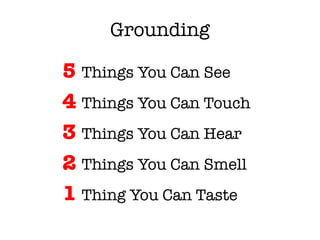
Grounding
5 Things You Can See
4 Things You Can Touch
3 Things You Can Hear
2 Things You Can Smell
1 Thing You Can Taste
Realistic Thinking
Effectively managing negative
emotions involves identifying
negative thinking and replacing it
with realistic and balanced thinking
(GlassIsEmpty, 2014).
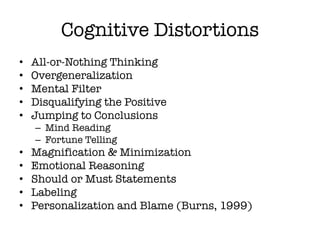
Cognitive Distortions
• All-or-Nothing Thinking
• Overgeneralization
• Mental Filter
• Disqualifying the Positive
• Jumping to Conclusions
– Mind Reading
– Fortune Telling
• Magnification & Minimization
• Emotional Reasoning
• Should or Must Statements
• Labeling
• Personalization and Blame (Burns, 1999)
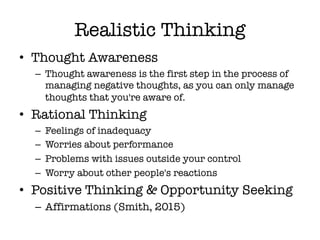
• Thought Awareness
– Thought awareness is the first step in the process of
managing negative thoughts, as you can only manage
thoughts that you're aware of.
• Rational Thinking
– Feelings of inadequacy
– Worries about performance
– Problems with issues outside your control
– Worry about other people's reactions
• Positive Thinking & Opportunity Seeking
– Affirmations (Smith, 2015)
Realistic Thinking
Affirmations
Affirmations are positive,
specific statements that
help you to overcome self-
sabotaging, negative
thoughts. They help you
visualize, and believe in,
what you're affirming to
yourself, helping you to
make positive changes to
your life (Smith, 2015).
Remember, affirmations are
positive statements that help you
challenge and overcome negative
thinking and self-sabotaging
behaviors (Smith, 2015).
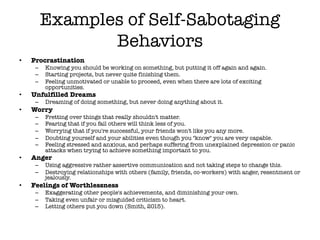
Examples of Self-Sabotaging
Behaviors
• Procrastination
– Knowing you should be working on something, but putting it off again and again.
– Starting projects, but never quite finishing them.
– Feeling unmotivated or unable to proceed, even when there are lots of exciting
opportunities.
• Unfulfilled Dreams
– Dreaming of doing something, but never doing anything about it.
• Worry
– Fretting over things that really shouldn't matter.
– Fearing that if you fail others will think less of you.
– Worrying that if you're successful, your friends won't like you any more.
– Doubting yourself and your abilities even though you "know" you are very capable.
– Feeling stressed and anxious, and perhaps suffering from unexplained depression or panic
attacks when trying to achieve something important to you.
• Anger
– Using aggressive rather assertive communication and not taking steps to change this.
– Destroying relationships with others (family, friends, co-workers) with anger, resentment or
jealously.
• Feelings of Worthlessness
– Exaggerating other people's achievements, and diminishing your own.
– Taking even unfair or misguided criticism to heart.
– Letting others put you down (Smith, 2015).
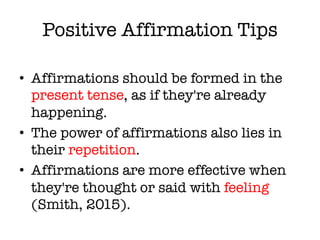
Positive Affirmation Tips
• Affirmations should be formed in the
present tense, as if they're already
happening.
• The power of affirmations also lies in
their repetition.
• Affirmations are more effective when
they're thought or said with feeling
(Smith, 2015).
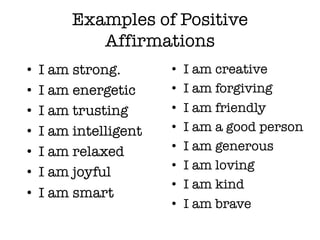
Examples of Positive
Affirmations
• I am strong.
• I am energetic
• I am trusting
• I am intelligent
• I am relaxed
• I am joyful
• I am smart
• I am creative
• I am forgiving
• I am friendly
• I am a good person
• I am generous
• I am loving
• I am kind
• I am brave
References
• ADAA.org. (2015). Tips to manage anxiety and stress.
Retrieved from http://www.adaa.org/tips-manage-anxiety-and-
stress
• AnxietyHappens.com. (2015) The flight-or-fight response.
Retrieved from
http://www.anxietyhappens.com/WhyAnxiety/fight_or_flight_
response.htm
• Bailey, E. (2010). What is “fight or flight” and how does it relate
to anxiety? Retrieved from
http://www.healthcentral.com/anxiety/c/1443/119324/flight-
anxiety/#sthash.6mdoCwNT.dpuf
• GlassIsEmpty. (2014). Realistic thinking strategies. Retrieved
from https://glassempty.wordpress.com/2014/07/17/realistic-
thinking-self-help-strategies/
• NIHClinicalCenter. (2012). TIPS – Deep breathing exercise
(companion to anxiety video). [YouTube]. Retrieved from
https://www.youtube.com/watch?v=ExvXmsr--M
References
• Smith, C. (2015). Thought awareness, rational thinking,
and positive thinking. Retrieved from
http://www.mindtools.com/pages/article/newTCS_06.ht
m
• Smith, C. (2015). Using affirmations: Harnessing positive
thinking. Retrieved from
http://www.mindtools.com/pages/article/affirmations.ht
m
• Smith, M. & Segal, R. (2015). How to stop worrying: Self-
help strategies for anxiety relief. Retrieved from
http://www.helpguide.org/articles/anxiety/how-to-stop-
worrying.htm
• Young, K. (2009). Staying present during trauma
therapy: Grounding techniques. Retrieved from
https://drkathleenyoung.wordpress.com/2009/09/08/sta
ying-present-during-trauma-therapy-grounding-
techniques/

Anxiety

  • 1.
    Anxiety /aNGˈzīədē/ (noun) a feeling ofworry, nervousness, or unease, typically about an imminent event or something with an uncertain outcome.
  • 2.
    What is Anxiety? Anxietyis actually an automatic, "built- in" response to perceived threats that allows us to do what is necessary to protect ourselves whenever we encounter danger. Often called "fight-or- flight arousal", this response involves a series of changes in our bodies that prepare us to take immediate action to deal with a threat or crisis (AnxietyHappens.com, 2015)
  • 3.
    Figure 1 Source: ImroveHealthcare.org.(2014). Ansiety symptoms. Retrieved from http://www.improvehealthcare.org/anxiety
  • 4.
    The longer yourfight or flight response remains active, the more draining, physically and emotionally (Bailey, 2010)
  • 5.
    How to HandleAnxiety • Take a time-out • Eat well-balanced meals • Limit alcohol and caffeine • Get enough sleep • Exercise daily • Take deep breaths • Count to 10 slowly • Do your best • Accept that you cannot control everything • Welcome humor • Maintain a positive attitude • Get involved • Learn what triggers your anxiety (ADAA.org, 2015)
  • 6.
    Relaxation Strategies • CalmBreathing • Progressive Muscle Relaxation It’s important to realize, however, that the goal of relaxation is not to avoid or eliminate anxiety (because anxiety is not dangerous), but to make it a little easier to ride out these feelings (Smith & Segal, 2015)
  • 7.
    Deep Breathing Diaphragmatic ordeep breathing: Trauma survivors often hold their breath or breathe very shallowly. This in turn deprives you of oxygen which can make anxiety more intense. Stopping and focusing on deepening and slowing your breathing can bring you back to the moment (Young, 2009)
  • 8.
    Grounding Technique Grounding isabout learning to stay present in your body in the here and now. Basically it consists of a set of skills/tools to help you manage dissociation and the overwhelming trauma-related emotions that lead to it. Processing done from a very dissociated state is not useful in trauma work. Neither is the goal to be so overwhelmed by feelings that you feel re- traumatized. Once you are present, you also need to learn other means of managing the feelings and thoughts associated with traumatic memories. (Young, 2009).
  • 9.
    Grounding Technique Grounding oftentakes the form of focusing on the present by tuning into it via all your senses. For example, one technique could involve focusing on a sound you hear right now, a physical sensation and/or something you see. Describe each in as much detail as possible (Young, 2009).
  • 10.
    Grounding 5 Things YouCan See 4 Things You Can Touch 3 Things You Can Hear 2 Things You Can Smell 1 Thing You Can Taste
  • 11.
    Realistic Thinking Effectively managingnegative emotions involves identifying negative thinking and replacing it with realistic and balanced thinking (GlassIsEmpty, 2014).
  • 12.
    Cognitive Distortions • All-or-NothingThinking • Overgeneralization • Mental Filter • Disqualifying the Positive • Jumping to Conclusions – Mind Reading – Fortune Telling • Magnification & Minimization • Emotional Reasoning • Should or Must Statements • Labeling • Personalization and Blame (Burns, 1999)
  • 13.
    • Thought Awareness –Thought awareness is the first step in the process of managing negative thoughts, as you can only manage thoughts that you're aware of. • Rational Thinking – Feelings of inadequacy – Worries about performance – Problems with issues outside your control – Worry about other people's reactions • Positive Thinking & Opportunity Seeking – Affirmations (Smith, 2015) Realistic Thinking
  • 14.
    Affirmations Affirmations are positive, specificstatements that help you to overcome self- sabotaging, negative thoughts. They help you visualize, and believe in, what you're affirming to yourself, helping you to make positive changes to your life (Smith, 2015).
  • 15.
    Remember, affirmations are positivestatements that help you challenge and overcome negative thinking and self-sabotaging behaviors (Smith, 2015).
  • 16.
    Examples of Self-Sabotaging Behaviors •Procrastination – Knowing you should be working on something, but putting it off again and again. – Starting projects, but never quite finishing them. – Feeling unmotivated or unable to proceed, even when there are lots of exciting opportunities. • Unfulfilled Dreams – Dreaming of doing something, but never doing anything about it. • Worry – Fretting over things that really shouldn't matter. – Fearing that if you fail others will think less of you. – Worrying that if you're successful, your friends won't like you any more. – Doubting yourself and your abilities even though you "know" you are very capable. – Feeling stressed and anxious, and perhaps suffering from unexplained depression or panic attacks when trying to achieve something important to you. • Anger – Using aggressive rather assertive communication and not taking steps to change this. – Destroying relationships with others (family, friends, co-workers) with anger, resentment or jealously. • Feelings of Worthlessness – Exaggerating other people's achievements, and diminishing your own. – Taking even unfair or misguided criticism to heart. – Letting others put you down (Smith, 2015).
  • 17.
    Positive Affirmation Tips •Affirmations should be formed in the present tense, as if they're already happening. • The power of affirmations also lies in their repetition. • Affirmations are more effective when they're thought or said with feeling (Smith, 2015).
  • 18.
    Examples of Positive Affirmations •I am strong. • I am energetic • I am trusting • I am intelligent • I am relaxed • I am joyful • I am smart • I am creative • I am forgiving • I am friendly • I am a good person • I am generous • I am loving • I am kind • I am brave
  • 19.
    References • ADAA.org. (2015).Tips to manage anxiety and stress. Retrieved from http://www.adaa.org/tips-manage-anxiety-and- stress • AnxietyHappens.com. (2015) The flight-or-fight response. Retrieved from http://www.anxietyhappens.com/WhyAnxiety/fight_or_flight_ response.htm • Bailey, E. (2010). What is “fight or flight” and how does it relate to anxiety? Retrieved from http://www.healthcentral.com/anxiety/c/1443/119324/flight- anxiety/#sthash.6mdoCwNT.dpuf • GlassIsEmpty. (2014). Realistic thinking strategies. Retrieved from https://glassempty.wordpress.com/2014/07/17/realistic- thinking-self-help-strategies/ • NIHClinicalCenter. (2012). TIPS – Deep breathing exercise (companion to anxiety video). [YouTube]. Retrieved from https://www.youtube.com/watch?v=ExvXmsr--M
  • 20.
    References • Smith, C.(2015). Thought awareness, rational thinking, and positive thinking. Retrieved from http://www.mindtools.com/pages/article/newTCS_06.ht m • Smith, C. (2015). Using affirmations: Harnessing positive thinking. Retrieved from http://www.mindtools.com/pages/article/affirmations.ht m • Smith, M. & Segal, R. (2015). How to stop worrying: Self- help strategies for anxiety relief. Retrieved from http://www.helpguide.org/articles/anxiety/how-to-stop- worrying.htm • Young, K. (2009). Staying present during trauma therapy: Grounding techniques. Retrieved from https://drkathleenyoung.wordpress.com/2009/09/08/sta ying-present-during-trauma-therapy-grounding- techniques/