Emotional States and Health
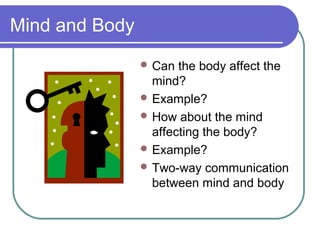
Mind and Body
                 Can  the body affect the
                  mind?
                 Example?
                 How about the mind
                  affecting the body?
                 Example?
                 Two-way communication
                  between mind and body
Psychosomatic Medicine
                Psyche   (mind)
                Soma (body)
                Butterflies in the
                 stomach
                Anxious before giving
                 speech
                Indigestion, nausea
                Stress may contribute
                 to getting an ulcer.
Reducing the effects of stress
  Stress is less harmful if
  Have some control (even if just belief).
  Predictable (“going to feel a little pinch”).
  Know the duration.
  Coping mechanism.
  Some way to relieve stress.
  Positive attitude.
  Active participant in process.
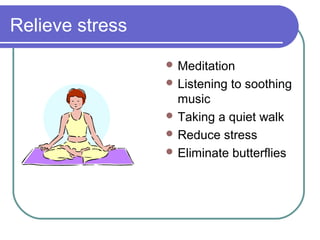
Relieve stress
                  Meditation
                  Listening   to soothing
                   music
                  Taking a quiet walk
                  Reduce stress
                  Eliminate butterflies
Affects on long-term health
  Attitude towards illness
   can affect healing.
  Thought, beliefs and
   emotions have major
   impact on physical
   health.
  Link between mind and
   body is the immune
   system.
The Immune System

  Cellsthat protect the body against
  intruders such as viruses and bacteria.
  Like a police force
      Too weak and criminals (viruses etc.) run wild
              Ex: Opportunistic diseases seen with HIV-AIDS
      Too strong and it attacks law-abiding citizens:
         The body’s own cells (Autoimmune disease)
              Ex. Rheumatoid arthritis
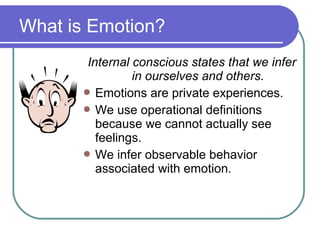
What is Emotion?
       Internal conscious states that we infer
                in ourselves and others.
        Emotions are private experiences.
        We use operational definitions
         because we cannot actually see
         feelings.
        We infer observable behavior
         associated with emotion.
Emotions are
Multidimensional
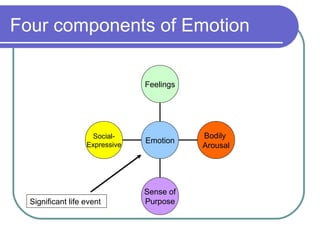
Four components of Emotion

                                Feelings


                     Social-               Bodily
                   Expressive
                                Emotion
                                           Arousal


                                Sense of
  Significant life event        Purpose
Feeling component

  Emotions    are subjective feelings
  Make us feel in a particular way.
  Anger or joy.
  Meaning and personal significance.
  Vary in intensity and quality.
  Rooted in mental processes
   (labeling).
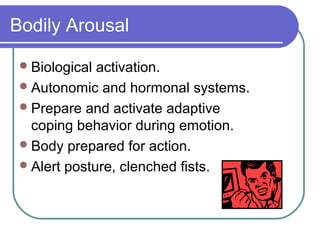
Bodily Arousal

  Biological activation.
  Autonomic and hormonal systems.
  Prepare and activate adaptive
   coping behavior during emotion.
  Body prepared for action.
  Alert posture, clenched fists.
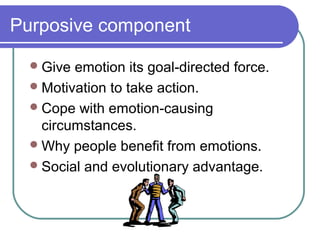
Purposive component

   Give emotion its goal-directed force.
   Motivation to take action.
   Cope with emotion-causing
    circumstances.
   Why people benefit from emotions.
   Social and evolutionary advantage.
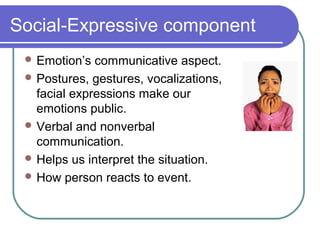
Social-Expressive component
  Emotion’s  communicative aspect.
  Postures, gestures, vocalizations,
   facial expressions make our
   emotions public.
  Verbal and nonverbal
   communication.
  Helps us interpret the situation.
  How person reacts to event.
Emotions read in the face


   The Japanese Female Facial Expression (JAFFE) Database
Aspect of Emotional Intelligence
  Peter Salovey (Yale)
  John Mayer (U of NH)
  Four branch ability model of
   emotional intelligence
  Mayer-Salovey-Caruso
   Emotional Intelligence Test
  MSCEIT
Identifying Emotions (Branch 1)

  Skillsneeded to perceive and express
   feelings.
  Recognizing facial expressions.
  Non-verbal communication.
  Tell when someone is being authentic.
  Express accurate emotions for situation.
  Foundation for other branches.
Identifying Emotions (MSCEIT)
Facilitating Emotions (Branch 2)

  Using  emotions to facilitate thinking.
  Improve problem solving and boost
   creativity.
  Emotional component to motivation.
  “Care enough to send the very best.”
  Using emotion to help make decisions.
Facilitation (MSCEIT)

  What mood(s) might be helpful to feel when
   meeting in-laws for the very first time?
                     Not Useful           Useful
   a) Tension              1    2      3   4   5
  b) Surprise             1    2      3   4   5
  c) Joy                   1    2     3   4   5
Understanding emotions (Branch 3)

  Understanding   complex and conflicting
   emotions.
  Emotions and behavioral consequences.
  Read a situation and respond correctly.
  Some emotional responses are
   maladaptive.
  Jealousy and envy are destructive.
Understanding Emotions (MSCEIT)

   Tom felt anxious, and became a bit
   stressed when he thought about all the
   work he needed to do. When his supervisor
   brought him an additional project, he felt
   ____. (Select the best choice.)

   a) Overwhelmed
  b) Depressed
  c) Ashamed
  d) Self Conscious
  e) Jittery
Managing emotions (Branch 4)

  Developing  mood regulation skills.
  Productive ways to change mood.
  Avoid over and under regulation.
  Seek natural means rather than alcohol,
   tobacco or other drugs.
  Stress coping strategies.
  Use optimistic explanatory style.
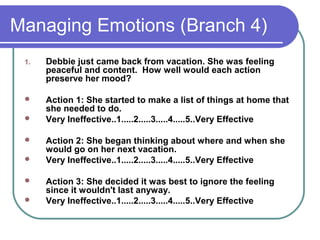
Managing Emotions (Branch 4)
 1.   Debbie just came back from vacation. She was feeling
      peaceful and content. How well would each action
      preserve her mood?

     Action 1: She started to make a list of things at home that
      she needed to do.
     Very Ineffective..1.....2.....3.....4.....5..Very Effective

     Action 2: She began thinking about where and when she
      would go on her next vacation.
     Very Ineffective..1.....2.....3.....4.....5..Very Effective

     Action 3: She decided it was best to ignore the feeling
      since it wouldn't last anyway.
     Very Ineffective..1.....2.....3.....4.....5..Very Effective
Emotional States and Physical
Health
   Salovey et at
   American Psychologist (1/2000)
Healing through laughter
   Norman Cousins
   Anatomy of an Illness (1979)
   Life-threatening inflammatory
    disease
   Cartoons and Marx Brothers
   10 mins of laughing gave him 2
    hrs of pain-free sleep
   Laughter reduced inflammation
   Healing power of positive mood
Emotional states and immunity

  Negative   emotional states associated
   with unhealthy physical states.
  Positive emotional states associated
   with healthier states.
  Cardiovascular and immune systems.
  S-IgA = secretory immunoglobulin A
  First line of defense in the immune
   system
S-IgA levels and emotion
               Increased   occurrence of
                desirable events predicts
                higher S-IgA.
               Positive moods boost the
                immune system.
               Negative moods lower S-
                IgA levels.
               Undesirable events
                suppress immune system.
               Negative moods increase
                susceptibility to illness.
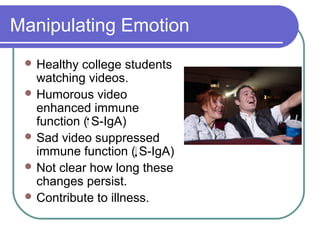
Manipulating Emotion
  Healthy  college students
   watching videos.
  Humorous video
   enhanced immune
   function ( S-IgA)
  Sad video suppressed
   immune function ( S-IgA)
  Not clear how long these
   changes persist.
  Contribute to illness.
Coping styles and illness
  People  dealing with severe stressors more
   susceptible to illness.
  Negative emotional states reduce immune
   function.
  Coping styles could aid healing.
  Pennebaker: helping people process and
   confront traumatic life events improves health.
  Talk about illness, release pent-up negative
   emotions.
Emotion and environment
            Positive  emotional states
             signal a safe environment.
            Negative states signal an alert.
            Something is wrong and must
             be corrected.
            Function of pain.
            It hurts; get help.
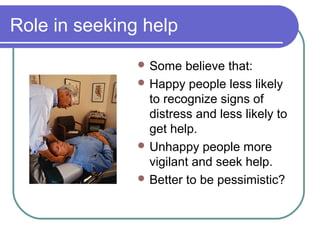
Role in seeking help
                Some   believe that:
                Happy people less likely
                 to recognize signs of
                 distress and less likely to
                 get help.
                Unhappy people more
                 vigilant and seek help.
                Better to be pessimistic?
Processing health information
    Other evidence that:
    Positive outlook may make it
     easier to process threatening
     information (diagnosis).
    Seek help.
    Negative outlook may cause a
     person not recognize new
     symptoms as threatening.
    Not seek help.
Optimistic outlook
  Positive emotional states provide
   resilience.
  Strength to confront illness.
  Personal resources to seek solutions.
  Creativity in thought and action.
  Focus on and plan for future outcomes.
  Belief that you will get well.
  Do what you can to support recovery.
Healthy heart surgery
    Men undergoing cardiac
     bypass surgery.
    Optimistic men better able to
     focus on postoperative goals.
    5 years post surgery, optimists
     had healthier habits.
    Diet and exercise programs
    Scheier et al. (1989)
Role of health care worker
           One  who inspires hope in others.
           Freud: patient’s expectations
            “colored by hope and faith and
            an effective force in all our
            attempts at treatment and cure.”
           Positive mood comes from a
            renewal of hope.
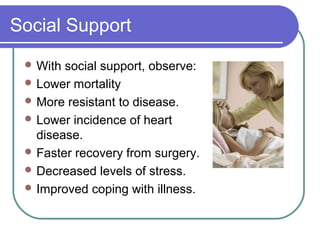
Social Support
  With social support, observe:
  Lower mortality
  More resistant to disease.
  Lower incidence of heart
   disease.
  Faster recovery from surgery.
  Decreased levels of stress.
  Improved coping with illness.
Affect on Health

  1. Buffering hypothesis:
  Social support buffers individual from
   stressful life event. Only when needed.
  2. Direct effect:
  Social support promotes well-being at all
   times. Not just under stress.
  Both are possible, depending on the
   nature of the stressor.
Role of Social Support
           Mediated   by emotional experience.
           Know that help will be provided if
            needed.
           Less likely to feel lonely and
            depressed.
           Positive outlook on life more likely
            to get social support.
           Develop and maintain social
            network.
Spirituality

   Also plays a role in
    wellness and
    recovery from illness.
   A topic for later
    discussion.

Emotional intelligence

  • 1.
  • 2.
    Mind and Body  Can the body affect the mind?  Example?  How about the mind affecting the body?  Example?  Two-way communication between mind and body
  • 3.
    Psychosomatic Medicine  Psyche (mind)  Soma (body)  Butterflies in the stomach  Anxious before giving speech  Indigestion, nausea  Stress may contribute to getting an ulcer.
  • 4.
    Reducing the effectsof stress  Stress is less harmful if  Have some control (even if just belief).  Predictable (“going to feel a little pinch”).  Know the duration.  Coping mechanism.  Some way to relieve stress.  Positive attitude.  Active participant in process.
  • 5.
    Relieve stress  Meditation  Listening to soothing music  Taking a quiet walk  Reduce stress  Eliminate butterflies
  • 6.
    Affects on long-termhealth  Attitude towards illness can affect healing.  Thought, beliefs and emotions have major impact on physical health.  Link between mind and body is the immune system.
  • 7.
    The Immune System  Cellsthat protect the body against intruders such as viruses and bacteria.  Like a police force  Too weak and criminals (viruses etc.) run wild  Ex: Opportunistic diseases seen with HIV-AIDS  Too strong and it attacks law-abiding citizens:  The body’s own cells (Autoimmune disease)  Ex. Rheumatoid arthritis
  • 8.
    What is Emotion? Internal conscious states that we infer in ourselves and others.  Emotions are private experiences.  We use operational definitions because we cannot actually see feelings.  We infer observable behavior associated with emotion.
  • 9.
  • 10.
    Four components ofEmotion Feelings Social- Bodily Expressive Emotion Arousal Sense of Significant life event Purpose
  • 11.
    Feeling component Emotions are subjective feelings  Make us feel in a particular way.  Anger or joy.  Meaning and personal significance.  Vary in intensity and quality.  Rooted in mental processes (labeling).
  • 12.
    Bodily Arousal Biological activation.  Autonomic and hormonal systems.  Prepare and activate adaptive coping behavior during emotion.  Body prepared for action.  Alert posture, clenched fists.
  • 13.
    Purposive component  Give emotion its goal-directed force.  Motivation to take action.  Cope with emotion-causing circumstances.  Why people benefit from emotions.  Social and evolutionary advantage.
  • 14.
    Social-Expressive component Emotion’s communicative aspect.  Postures, gestures, vocalizations, facial expressions make our emotions public.  Verbal and nonverbal communication.  Helps us interpret the situation.  How person reacts to event.
  • 15.
    Emotions read inthe face The Japanese Female Facial Expression (JAFFE) Database
  • 16.
    Aspect of EmotionalIntelligence  Peter Salovey (Yale)  John Mayer (U of NH)  Four branch ability model of emotional intelligence  Mayer-Salovey-Caruso Emotional Intelligence Test  MSCEIT
  • 17.
    Identifying Emotions (Branch1)  Skillsneeded to perceive and express feelings.  Recognizing facial expressions.  Non-verbal communication.  Tell when someone is being authentic.  Express accurate emotions for situation.  Foundation for other branches.
  • 18.
  • 19.
    Facilitating Emotions (Branch2)  Using emotions to facilitate thinking.  Improve problem solving and boost creativity.  Emotional component to motivation.  “Care enough to send the very best.”  Using emotion to help make decisions.
  • 20.
    Facilitation (MSCEIT) What mood(s) might be helpful to feel when meeting in-laws for the very first time?  Not Useful Useful a) Tension 1 2 3 4 5  b) Surprise 1 2 3 4 5  c) Joy 1 2 3 4 5
  • 21.
    Understanding emotions (Branch3)  Understanding complex and conflicting emotions.  Emotions and behavioral consequences.  Read a situation and respond correctly.  Some emotional responses are maladaptive.  Jealousy and envy are destructive.
  • 22.
    Understanding Emotions (MSCEIT) Tom felt anxious, and became a bit stressed when he thought about all the work he needed to do. When his supervisor brought him an additional project, he felt ____. (Select the best choice.) a) Overwhelmed  b) Depressed  c) Ashamed  d) Self Conscious  e) Jittery
  • 23.
    Managing emotions (Branch4)  Developing mood regulation skills.  Productive ways to change mood.  Avoid over and under regulation.  Seek natural means rather than alcohol, tobacco or other drugs.  Stress coping strategies.  Use optimistic explanatory style.
  • 24.
    Managing Emotions (Branch4) 1. Debbie just came back from vacation. She was feeling peaceful and content. How well would each action preserve her mood?  Action 1: She started to make a list of things at home that she needed to do.  Very Ineffective..1.....2.....3.....4.....5..Very Effective  Action 2: She began thinking about where and when she would go on her next vacation.  Very Ineffective..1.....2.....3.....4.....5..Very Effective  Action 3: She decided it was best to ignore the feeling since it wouldn't last anyway.  Very Ineffective..1.....2.....3.....4.....5..Very Effective
  • 25.
    Emotional States andPhysical Health Salovey et at American Psychologist (1/2000)
  • 26.
    Healing through laughter  Norman Cousins  Anatomy of an Illness (1979)  Life-threatening inflammatory disease  Cartoons and Marx Brothers  10 mins of laughing gave him 2 hrs of pain-free sleep  Laughter reduced inflammation  Healing power of positive mood
  • 27.
    Emotional states andimmunity  Negative emotional states associated with unhealthy physical states.  Positive emotional states associated with healthier states.  Cardiovascular and immune systems.  S-IgA = secretory immunoglobulin A  First line of defense in the immune system
  • 28.
    S-IgA levels andemotion  Increased occurrence of desirable events predicts higher S-IgA.  Positive moods boost the immune system.  Negative moods lower S- IgA levels.  Undesirable events suppress immune system.  Negative moods increase susceptibility to illness.
  • 29.
    Manipulating Emotion Healthy college students watching videos.  Humorous video enhanced immune function ( S-IgA)  Sad video suppressed immune function ( S-IgA)  Not clear how long these changes persist.  Contribute to illness.
  • 30.
    Coping styles andillness  People dealing with severe stressors more susceptible to illness.  Negative emotional states reduce immune function.  Coping styles could aid healing.  Pennebaker: helping people process and confront traumatic life events improves health.  Talk about illness, release pent-up negative emotions.
  • 31.
    Emotion and environment  Positive emotional states signal a safe environment.  Negative states signal an alert.  Something is wrong and must be corrected.  Function of pain.  It hurts; get help.
  • 32.
    Role in seekinghelp  Some believe that:  Happy people less likely to recognize signs of distress and less likely to get help.  Unhappy people more vigilant and seek help.  Better to be pessimistic?
  • 33.
    Processing health information  Other evidence that:  Positive outlook may make it easier to process threatening information (diagnosis).  Seek help.  Negative outlook may cause a person not recognize new symptoms as threatening.  Not seek help.
  • 34.
    Optimistic outlook Positive emotional states provide resilience.  Strength to confront illness.  Personal resources to seek solutions.  Creativity in thought and action.  Focus on and plan for future outcomes.  Belief that you will get well.  Do what you can to support recovery.
  • 35.
    Healthy heart surgery  Men undergoing cardiac bypass surgery.  Optimistic men better able to focus on postoperative goals.  5 years post surgery, optimists had healthier habits.  Diet and exercise programs  Scheier et al. (1989)
  • 36.
    Role of healthcare worker  One who inspires hope in others.  Freud: patient’s expectations “colored by hope and faith and an effective force in all our attempts at treatment and cure.”  Positive mood comes from a renewal of hope.
  • 37.
    Social Support With social support, observe:  Lower mortality  More resistant to disease.  Lower incidence of heart disease.  Faster recovery from surgery.  Decreased levels of stress.  Improved coping with illness.
  • 38.
    Affect on Health  1. Buffering hypothesis:  Social support buffers individual from stressful life event. Only when needed.  2. Direct effect:  Social support promotes well-being at all times. Not just under stress.  Both are possible, depending on the nature of the stressor.
  • 39.
    Role of SocialSupport  Mediated by emotional experience.  Know that help will be provided if needed.  Less likely to feel lonely and depressed.  Positive outlook on life more likely to get social support.  Develop and maintain social network.
  • 40.
    Spirituality Also plays a role in wellness and recovery from illness.  A topic for later discussion.

Editor's Notes

  • #9 We cannot know for sure if any other species has emotion Operational definition is a constructed definition using parameters to describe what fits the definition and what doesn’t. ex. Op. def. of joy might include: smiling, laughing, not a blank stare