EMPTY NEST
SYNDROME
PRESENTED BY: MANEESHA JAMES
1ST MSc Psychology
OVERVIEW
•
•
•
•
•
•
•
•
•

Introduction
Definition
Signs & Symptoms
Prevalence
Causes
Those who are at risk of empty nest syndrome
Treatment
How to cope up with “Empty nest syndrome”
Positive & Negative aspects of “ Empty nest
syndrome”
• Conclusion
• References
Introduction
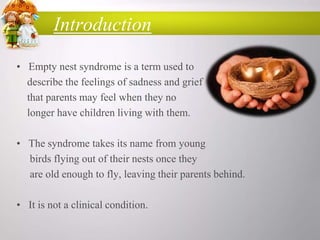
• Empty nest syndrome is a term used to
describe the feelings of sadness and grief
that parents may feel when they no
longer have children living with them.

• The syndrome takes its name from young
birds flying out of their nests once they
are old enough to fly, leaving their parents behind.
• It is not a clinical condition.
Introduction
• The term “Empty nest syndrome” was first
introduced in 1914 by the writer Dorothy
Canfield,
• And the term clinically identified and popularized
in 1970‟s.
• Empty nest syndrome can have a significant
impact on a parent's health and relationships.
• Clinical approaches to the “empty nest
syndrome” have often linked it‟s symptoms to
women‟s physical changes at midlife,
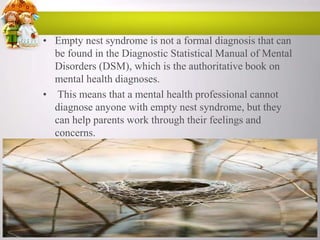
• Empty nest syndrome is not a formal diagnosis that can
be found in the Diagnostic Statistical Manual of Mental
Disorders (DSM), which is the authoritative book on
mental health diagnoses.
• This means that a mental health professional cannot
diagnose anyone with empty nest syndrome, but they
can help parents work through their feelings and
concerns.
Definition

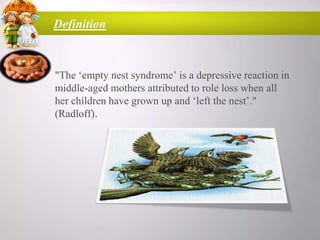
• "The „empty nest syndrome‟ is a depressive reaction in
middle-aged mothers attributed to role loss when all
her children have grown up and „left the nest‟."
(Radloff).
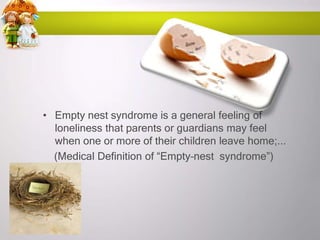
• Empty nest syndrome is a general feeling of
loneliness that parents or guardians may feel
when one or more of their children leave home;...
(Medical Definition of “Empty–nest syndrome”)
• "The empty nest syndrome is clinically defined as the
„temporal association of clinical depression with the
cessation of child-rearing‟. It also has been defined as the
„sense of loss when grown children leave home‟. Also
associated with the term is the notion of a „profound
inability of the parent to cope‟. Research on various
aspects of post-parenthood, however usually reserves the
term „empty nest syndrome‟ for the severe depression
mentioned first. Nevertheless, negative affect associated
with the empty nest syndrome is often reported in lesser
degrees by mothers and fathers who are not clinically
depressed." (Roberts and Lewis.).
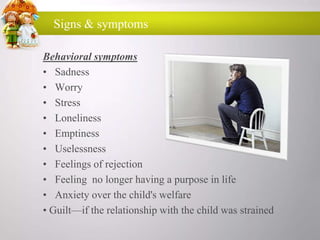
Signs & symptoms
Behavioral symptoms
• Sadness
• Worry
• Stress
• Loneliness
• Emptiness
• Uselessness
• Feelings of rejection
• Feeling no longer having a purpose in life
• Anxiety over the child's welfare
• Guilt—if the relationship with the child was strained
Parents may experience symptoms associated with
clinical depression, including:
• Difficulty concentrating
• Inability to seek or derive pleasure
• Excessive worry or anxiety
• Indecision
• Parents who experience empty nest syndrome often
questioned themselves?
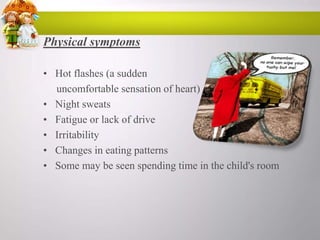
Physical symptoms
• Hot flashes (a sudden
uncomfortable sensation of heart)
• Night sweats
• Fatigue or lack of drive
• Irritability
• Changes in eating patterns
• Some may be seen spending time in the child's room
Prevalence

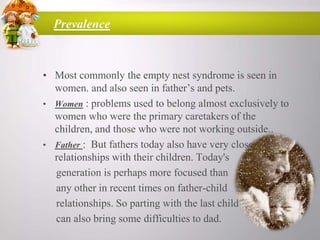
• Most commonly the empty nest syndrome is seen in
women. and also seen in father‟s and pets.
• Women : problems used to belong almost exclusively to
women who were the primary caretakers of the
children, and those who were not working outside..
• Father : But fathers today also have very close
relationships with their children. Today's
generation is perhaps more focused than
any other in recent times on father-child
relationships. So parting with the last child
can also bring some difficulties to dad.
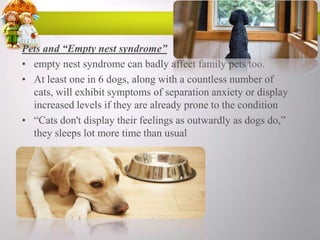
Pets and “Empty nest syndrome”
• empty nest syndrome can badly affect family pets too.
• At least one in 6 dogs, along with a countless number of
cats, will exhibit symptoms of separation anxiety or display
increased levels if they are already prone to the condition
• “Cats don't display their feelings as outwardly as dogs do,”
they sleeps lot more time than usual
Cause
• feelings of sadness and grief that parents may feel
when they no longer have children living with them.
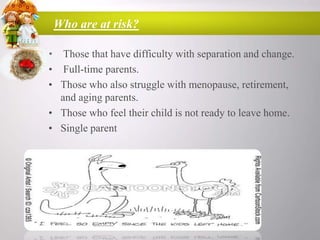
Who are at risk?
• Those that have difficulty with separation and change.
• Full-time parents.
• Those who also struggle with menopause, retirement,
and aging parents.
• Those who feel their child is not ready to leave home.
• Single parent
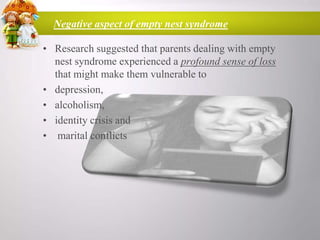
Negative aspect of empty nest syndrome
• Research suggested that parents dealing with empty
nest syndrome experienced a profound sense of loss
that might make them vulnerable to
• depression,
• alcoholism,
• identity crisis and
• marital conflicts
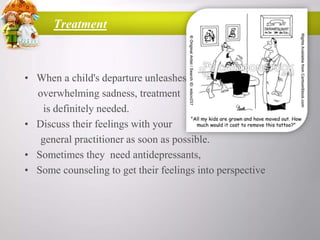
Treatment

• When a child's departure unleashes
overwhelming sadness, treatment
is definitely needed.
• Discuss their feelings with your
general practitioner as soon as possible.
• Sometimes they need antidepressants,
• Some counseling to get their feelings into perspective
• Time and energy that they directed toward their child
can now be spent on different areas of their life.
• This might be an right time to explore or return to
hobbies, leisure activities or career pursuits.
• This also marks a time to adjust to their new role in their
child's life as well as changes in your identity as a
parent. The relationship with
their child may become more
peers like,
• Suggest them to prepare for an empty nest while your
children are still living with them.
• Develop friendships, hobbies, career, and educational
opportunities.
• Make plans with the family while everyone is still
under the same roof,
• Plan family vacations, enjoy long talks, and take time
off from work.
• And make specific plans for the extra money, time, and
space that will become available when children are no
longer dependent on parents and living at home
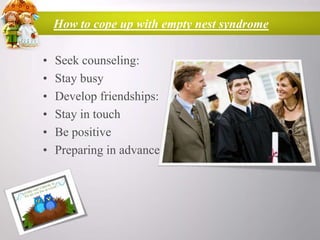
How to cope up with empty nest syndrome
•
•
•
•
•
•

Seek counseling:
Stay busy
Develop friendships:
Stay in touch
Be positive
Preparing in advance
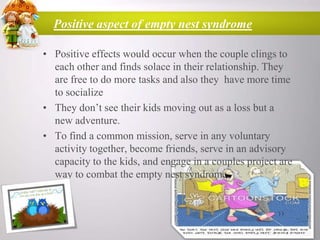
Positive aspect of empty nest syndrome
• Positive effects would occur when the couple clings to
each other and finds solace in their relationship. They
are free to do more tasks and also they have more time
to socialize
• They don‟t see their kids moving out as a loss but a
new adventure.
• To find a common mission, serve in any voluntary
activity together, become friends, serve in an advisory
capacity to the kids, and engage in a couples project are
way to combat the empty nest syndrome.
•
•
•
•
•
•
•

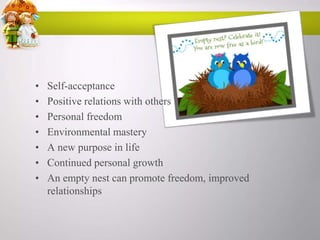
Self-acceptance
Positive relations with others
Personal freedom
Environmental mastery
A new purpose in life
Continued personal growth
An empty nest can promote freedom, improved
relationships
Conclusion

• Especially in transition period of development of a
society, many mothers may not be prepared for
separation from their children. Psychologically less
sophisticated and less educated mothers may have
narrow repertoire of coping strategies in such periods.
• These mothers will be vulnerable to complicated empty
nest syndrome. In absence of adequate family support,
the suffering parents will not get proper attention, care
and treatment
Reference
Pomerance, L. M. (n.d.). The empty nest syndrome is not
a mental disorder. Menopause Counseling.
Retrieved from
http://www.menopausecounseling.com/art4.htm.
TODAY.com© iStockphoto.com/Eric Vega).
visit www.betterhealth.vic.gov.au
www.emptynestsupport.com
www.apa.org
http://www.apa.org/monitor/apr03/pluses.aspx
©
2013 NBCNews.com Reprints.
Encyclopedia. Empty nest syndrome. [Online]. [cited Jan
2009]Available from:
URL:http://en.wikipedia.org/wiki/Empty_nest_syn
drome.
Psychology Today‟s Diagnosis Dictionary. Empty nest
syndrome.[online]. [cited Jan 2009] Available
from:
URL:http://wwwpsychologytoday.com/conditions/emptyn
est.html..
http://www.oprah.com/relationships/The-End-ofEmpty-Nest Syndrome#ixzz2eURyhqAD.
Empty nest syndrome.

Empty nest syndrome.

  • 1.
    EMPTY NEST SYNDROME PRESENTED BY:MANEESHA JAMES 1ST MSc Psychology
  • 2.
    OVERVIEW • • • • • • • • • Introduction Definition Signs & Symptoms Prevalence Causes Thosewho are at risk of empty nest syndrome Treatment How to cope up with “Empty nest syndrome” Positive & Negative aspects of “ Empty nest syndrome” • Conclusion • References
  • 3.
    Introduction • Empty nestsyndrome is a term used to describe the feelings of sadness and grief that parents may feel when they no longer have children living with them. • The syndrome takes its name from young birds flying out of their nests once they are old enough to fly, leaving their parents behind. • It is not a clinical condition.
  • 4.
    Introduction • The term“Empty nest syndrome” was first introduced in 1914 by the writer Dorothy Canfield, • And the term clinically identified and popularized in 1970‟s. • Empty nest syndrome can have a significant impact on a parent's health and relationships. • Clinical approaches to the “empty nest syndrome” have often linked it‟s symptoms to women‟s physical changes at midlife,
  • 5.
    • Empty nestsyndrome is not a formal diagnosis that can be found in the Diagnostic Statistical Manual of Mental Disorders (DSM), which is the authoritative book on mental health diagnoses. • This means that a mental health professional cannot diagnose anyone with empty nest syndrome, but they can help parents work through their feelings and concerns.
  • 6.
    Definition • "The „emptynest syndrome‟ is a depressive reaction in middle-aged mothers attributed to role loss when all her children have grown up and „left the nest‟." (Radloff).
  • 7.
    • Empty nestsyndrome is a general feeling of loneliness that parents or guardians may feel when one or more of their children leave home;... (Medical Definition of “Empty–nest syndrome”)
  • 8.
    • "The emptynest syndrome is clinically defined as the „temporal association of clinical depression with the cessation of child-rearing‟. It also has been defined as the „sense of loss when grown children leave home‟. Also associated with the term is the notion of a „profound inability of the parent to cope‟. Research on various aspects of post-parenthood, however usually reserves the term „empty nest syndrome‟ for the severe depression mentioned first. Nevertheless, negative affect associated with the empty nest syndrome is often reported in lesser degrees by mothers and fathers who are not clinically depressed." (Roberts and Lewis.).
  • 9.
    Signs & symptoms Behavioralsymptoms • Sadness • Worry • Stress • Loneliness • Emptiness • Uselessness • Feelings of rejection • Feeling no longer having a purpose in life • Anxiety over the child's welfare • Guilt—if the relationship with the child was strained
  • 10.
    Parents may experiencesymptoms associated with clinical depression, including: • Difficulty concentrating • Inability to seek or derive pleasure • Excessive worry or anxiety • Indecision • Parents who experience empty nest syndrome often questioned themselves?
  • 11.
    Physical symptoms • Hotflashes (a sudden uncomfortable sensation of heart) • Night sweats • Fatigue or lack of drive • Irritability • Changes in eating patterns • Some may be seen spending time in the child's room
  • 12.
    Prevalence • Most commonlythe empty nest syndrome is seen in women. and also seen in father‟s and pets. • Women : problems used to belong almost exclusively to women who were the primary caretakers of the children, and those who were not working outside.. • Father : But fathers today also have very close relationships with their children. Today's generation is perhaps more focused than any other in recent times on father-child relationships. So parting with the last child can also bring some difficulties to dad.
  • 13.
    Pets and “Emptynest syndrome” • empty nest syndrome can badly affect family pets too. • At least one in 6 dogs, along with a countless number of cats, will exhibit symptoms of separation anxiety or display increased levels if they are already prone to the condition • “Cats don't display their feelings as outwardly as dogs do,” they sleeps lot more time than usual
  • 14.
    Cause • feelings ofsadness and grief that parents may feel when they no longer have children living with them.
  • 15.
    Who are atrisk? • Those that have difficulty with separation and change. • Full-time parents. • Those who also struggle with menopause, retirement, and aging parents. • Those who feel their child is not ready to leave home. • Single parent
  • 16.
    Negative aspect ofempty nest syndrome • Research suggested that parents dealing with empty nest syndrome experienced a profound sense of loss that might make them vulnerable to • depression, • alcoholism, • identity crisis and • marital conflicts
  • 17.
    Treatment • When achild's departure unleashes overwhelming sadness, treatment is definitely needed. • Discuss their feelings with your general practitioner as soon as possible. • Sometimes they need antidepressants, • Some counseling to get their feelings into perspective
  • 18.
    • Time andenergy that they directed toward their child can now be spent on different areas of their life. • This might be an right time to explore or return to hobbies, leisure activities or career pursuits. • This also marks a time to adjust to their new role in their child's life as well as changes in your identity as a parent. The relationship with their child may become more peers like,
  • 19.
    • Suggest themto prepare for an empty nest while your children are still living with them. • Develop friendships, hobbies, career, and educational opportunities. • Make plans with the family while everyone is still under the same roof, • Plan family vacations, enjoy long talks, and take time off from work. • And make specific plans for the extra money, time, and space that will become available when children are no longer dependent on parents and living at home
  • 20.
    How to copeup with empty nest syndrome • • • • • • Seek counseling: Stay busy Develop friendships: Stay in touch Be positive Preparing in advance
  • 21.
    Positive aspect ofempty nest syndrome • Positive effects would occur when the couple clings to each other and finds solace in their relationship. They are free to do more tasks and also they have more time to socialize • They don‟t see their kids moving out as a loss but a new adventure. • To find a common mission, serve in any voluntary activity together, become friends, serve in an advisory capacity to the kids, and engage in a couples project are way to combat the empty nest syndrome.
  • 22.
    • • • • • • • Self-acceptance Positive relations withothers Personal freedom Environmental mastery A new purpose in life Continued personal growth An empty nest can promote freedom, improved relationships
  • 23.
    Conclusion • Especially intransition period of development of a society, many mothers may not be prepared for separation from their children. Psychologically less sophisticated and less educated mothers may have narrow repertoire of coping strategies in such periods. • These mothers will be vulnerable to complicated empty nest syndrome. In absence of adequate family support, the suffering parents will not get proper attention, care and treatment
  • 24.
    Reference Pomerance, L. M.(n.d.). The empty nest syndrome is not a mental disorder. Menopause Counseling. Retrieved from http://www.menopausecounseling.com/art4.htm. TODAY.com© iStockphoto.com/Eric Vega). visit www.betterhealth.vic.gov.au www.emptynestsupport.com www.apa.org http://www.apa.org/monitor/apr03/pluses.aspx © 2013 NBCNews.com Reprints.
  • 25.
    Encyclopedia. Empty nestsyndrome. [Online]. [cited Jan 2009]Available from: URL:http://en.wikipedia.org/wiki/Empty_nest_syn drome. Psychology Today‟s Diagnosis Dictionary. Empty nest syndrome.[online]. [cited Jan 2009] Available from: URL:http://wwwpsychologytoday.com/conditions/emptyn est.html.. http://www.oprah.com/relationships/The-End-ofEmpty-Nest Syndrome#ixzz2eURyhqAD.