Mind Maximisation

Webinar, December 2012 – Presented by Andrew Stead


                                                 l    Sustenance For Life
Outcomes and Content                                 “Happiness is
Outcomes
                                                     the meaning and
•  Highlight the brains flaws and the impact on our   purpose of life,
   Happiness
•  Examine how neuroscience can help increase our
                                                     the whole aim
   Well-being and Resilience
                        and end of
                                                     human
•  Adopt techniques designed to help you lead a
   happier life

Contents
                                                     existence.”
•  The Operations of the Brain
                      Aristotle
•  What Can Be Done?
•  Positive Psychology
•  Putting it into Practice
                                                       l
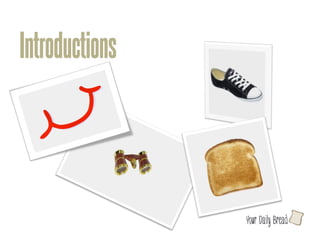
Introductions


                l
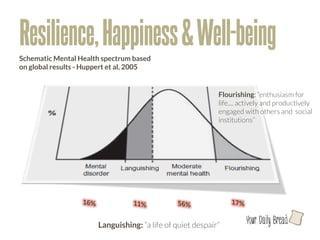
Resilience, Happiness & Well-being
Schematic Mental Health spectrum based
on global results - Huppert et al, 2005


                                                               Flourishing: “enthusiasm for
                                                               life.... actively and productively
                                                               engaged with others and social
                                                               institutions”


                                                                         l
                        Languishing: “a life of quiet despair”
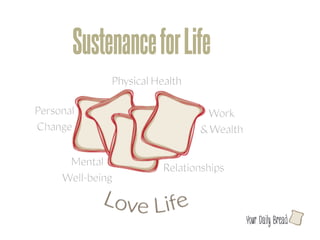
Sustenance for Life


                      l
What Your Daily Bread is not –
‘The 5 Pauls’


                                 l
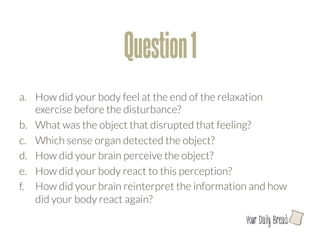
Question 1
a.  How did your body feel at the end of the relaxation
    exercise before the disturbance?
b.  What was the object that disrupted that feeling?
c.  Which sense organ detected the object?
d.  How did your brain perceive the object? 
e.  How did your body react to this perception?
f.  How did your brain reinterpret the information and how
    did your body react again?
                                                 l
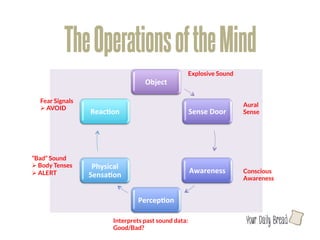
The Operations of the Mind
                                                           Explosive Sound
                                        Object	
  

   Fear Signals 
                                                                               Aural
   Ø  AVOID
                    Reac3on	
                              Sense	
  Door	
     Sense


“Bad” Sound 
Ø  Body Tenses
     Physical	
  
Ø  ALERT
                                                 Awareness	
         Conscious
                    Sensa3on	
                                                 Awareness


                                     Percep3on	
  

                             Interprets past sound data:                        l
                             Good/Bad?
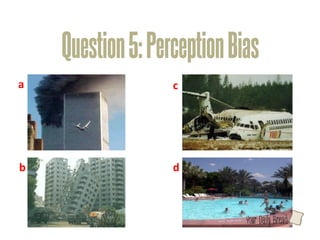
Question 5: Perception Bias
a	
                    c	


b                      d


                                 l
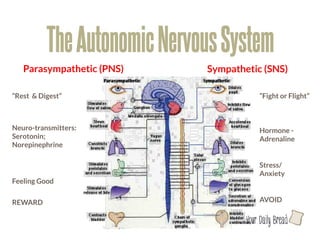
The Autonomic Nervous System
   Parasympathetic (PNS)
     Sympathetic (SNS)

“Rest & Digest”
                          “Fight or Flight”


Neuro-transmitters: 
                     Hormone -
Serotonin;
                               Adrenaline
Norepinephrine

                                          Stress/
                                          Anxiety
Feeling Good

REWARD
                                   AVOID


                                      l
Reaction Bias
•  Inappropriate Threat Response

•  Response Automation and Reinforcement

•  Physically Addictive

•  Double Trouble: Present AND Historic Memory


                                            l
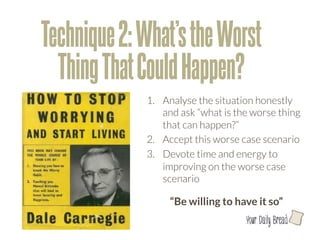
Technique 2: What’s the Worst
  Thing That Could Happen?
             1.  Analyse the situation honestly
                 and ask “what is the worse thing
                 that can happen?”
             2.  Accept this worse case scenario
             3.  Devote time and energy to
                 improving on the worse case
                 scenario

                  “Be willing to have it so”
                                    l
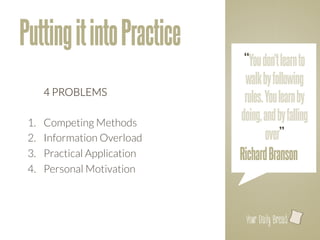
Putting it into Practice
                                 “You don't learn to
                                 walk by following
       
4 PROBLEMS
                                 rules. You learn by
 
 1.    Competing Methods 
                                doing, and by falling
 2.    Information Overload
            over”
 3.    Practical Application
   Richard Branson
 4.    Personal Motivation 


                                 l
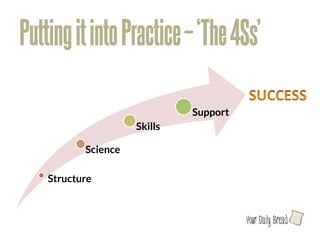
Putting it into Practice – ‘The 4Ss’

                                 Support
                       Skills

            Science

    Structure


                                            l
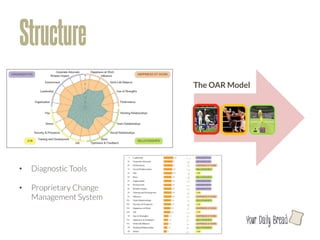
Structure
                          The OAR Model


•    Diagnostic Tools

•    Proprietary Change
     Management System


                                       l
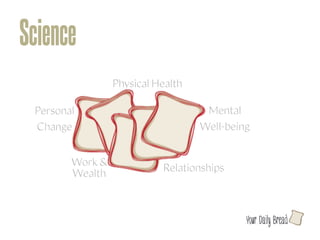
Science


          l
Skills
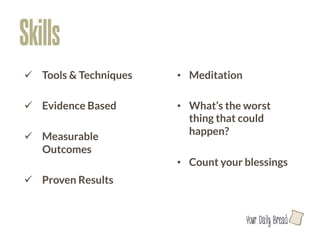
    ü  Tools & Techniques
   •  Meditation

    ü  Evidence Based
       •  What’s the worst
                                 thing that could
    ü  Measurable               happen?
        Outcomes
                              •  Count your blessings
    ü  Proven Results 


                                               l
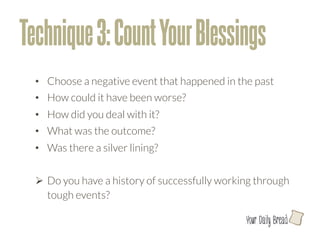
Technique 3: Count Your Blessings
  •  Choose a negative event that happened in the past
  •  How could it have been worse?
  •  How did you deal with it? 
  •  What was the outcome?
  •  Was there a silver lining?


  Ø  Do you have a history of successfully working through
      tough events? 

                                                 l
Support


          l
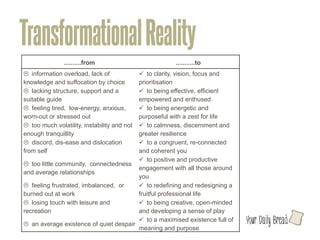
Transformational Reality
               ..........from	
                           ...........to	
  
L information overload, lack of             ü to clarity, vision, focus and
knowledge and suffocation by choice 	
       prioritisation	
  
L lacking structure, support and a          ü to being effective, efficient
suitable guide 	
                            empowered and enthused	
  
L feeling tired, low-energy, anxious,       ü to being energetic and
worn-out or stressed out	
                   purposeful with a zest for life	
  
L too much volatility, instability and not  ü to calmness, discernment and
enough tranquillity	
                        greater resilience 	
  
L discord, dis-ease and dislocation         ü to a congruent, re-connected
from self 	
                                 and coherent you	
  
                                             ü to positive and productive
L too little community, connectedness
                                             engagement with all those around
and average relationships 	
  
                                             you 	
  
L feeling frustrated, imbalanced, or        ü to redefining and redesigning a
burned out at work 	
                        fruitful professional life	
  
L losing touch with leisure and             ü to being creative, open-minded
recreation 	
                                and developing a sense of play	
  
                                             ü to a maximised existence full of   l
L an average existence of quiet despair	
  
                                             meaning and purpose	
  
Any Questions?   “Happiness is not
                 something ready
                 made. It comes from
                 your own actions”
                 Dalai Lama


                   l
Discovery Session


                    l
Sustenance for Life
                       “The knowledge,
                       application and
                      changes you make
                       will be with you
                           forever”
                      Programme Participant


                       l
Next Month


             l
l


                              Sustenance For Life

+44 (0)207 828 2955
info@your-daily-bread.com
   yourdailybread1
   @yourdailybread1
                                                    l
WWW.YOUR-DAILY-BREAD.CO.UK

Mind maximisation

  • 1.
    Mind Maximisation Webinar, December2012 – Presented by Andrew Stead l Sustenance For Life
  • 2.
    Outcomes and Content “Happiness is Outcomes the meaning and •  Highlight the brains flaws and the impact on our purpose of life, Happiness •  Examine how neuroscience can help increase our the whole aim Well-being and Resilience and end of human •  Adopt techniques designed to help you lead a happier life Contents existence.” •  The Operations of the Brain Aristotle •  What Can Be Done? •  Positive Psychology •  Putting it into Practice l
  • 3.
  • 4.
    Resilience, Happiness &Well-being Schematic Mental Health spectrum based on global results - Huppert et al, 2005 Flourishing: “enthusiasm for life.... actively and productively engaged with others and social institutions” l Languishing: “a life of quiet despair”
  • 5.
  • 6.
    What Your DailyBread is not – ‘The 5 Pauls’ l
  • 7.
    Question 1 a.  Howdid your body feel at the end of the relaxation exercise before the disturbance? b.  What was the object that disrupted that feeling? c.  Which sense organ detected the object? d.  How did your brain perceive the object? e.  How did your body react to this perception? f.  How did your brain reinterpret the information and how did your body react again? l
  • 8.
    The Operations ofthe Mind Explosive Sound Object   Fear Signals Aural Ø  AVOID Reac3on   Sense  Door   Sense “Bad” Sound Ø  Body Tenses Physical   Ø  ALERT Awareness   Conscious Sensa3on   Awareness Percep3on   Interprets past sound data: l Good/Bad?
  • 9.
    Question 5: PerceptionBias a   c   b d l
  • 10.
    The Autonomic NervousSystem Parasympathetic (PNS) Sympathetic (SNS) “Rest & Digest” “Fight or Flight” Neuro-transmitters: Hormone - Serotonin; Adrenaline Norepinephrine Stress/ Anxiety Feeling Good REWARD AVOID l
  • 11.
    Reaction Bias •  InappropriateThreat Response •  Response Automation and Reinforcement •  Physically Addictive •  Double Trouble: Present AND Historic Memory l
  • 12.
    Technique 2: What’sthe Worst Thing That Could Happen? 1.  Analyse the situation honestly and ask “what is the worse thing that can happen?” 2.  Accept this worse case scenario 3.  Devote time and energy to improving on the worse case scenario “Be willing to have it so” l
  • 13.
    Putting it intoPractice “You don't learn to walk by following 4 PROBLEMS rules. You learn by 1.  Competing Methods doing, and by falling 2.  Information Overload over” 3.  Practical Application Richard Branson 4.  Personal Motivation l
  • 14.
    Putting it intoPractice – ‘The 4Ss’ Support Skills Science Structure l
  • 15.
    Structure The OAR Model •  Diagnostic Tools •  Proprietary Change Management System l
  • 16.
  • 17.
    Skills ü  Tools & Techniques •  Meditation ü  Evidence Based •  What’s the worst thing that could ü  Measurable happen? Outcomes •  Count your blessings ü  Proven Results l
  • 18.
    Technique 3: CountYour Blessings •  Choose a negative event that happened in the past •  How could it have been worse? •  How did you deal with it? •  What was the outcome? •  Was there a silver lining? Ø  Do you have a history of successfully working through tough events? l
  • 19.
  • 20.
    Transformational Reality ..........from   ...........to   L information overload, lack of ü to clarity, vision, focus and knowledge and suffocation by choice   prioritisation   L lacking structure, support and a ü to being effective, efficient suitable guide   empowered and enthused   L feeling tired, low-energy, anxious, ü to being energetic and worn-out or stressed out   purposeful with a zest for life   L too much volatility, instability and not ü to calmness, discernment and enough tranquillity   greater resilience   L discord, dis-ease and dislocation ü to a congruent, re-connected from self   and coherent you   ü to positive and productive L too little community, connectedness engagement with all those around and average relationships   you   L feeling frustrated, imbalanced, or ü to redefining and redesigning a burned out at work   fruitful professional life   L losing touch with leisure and ü to being creative, open-minded recreation   and developing a sense of play   ü to a maximised existence full of l L an average existence of quiet despair   meaning and purpose  
  • 21.
    Any Questions? “Happiness is not something ready made. It comes from your own actions” Dalai Lama l
  • 22.
  • 23.
    Sustenance for Life “The knowledge, application and changes you make will be with you forever” Programme Participant l
  • 24.
  • 25.
    l Sustenance For Life +44 (0)207 828 2955 info@your-daily-bread.com yourdailybread1 @yourdailybread1 l WWW.YOUR-DAILY-BREAD.CO.UK