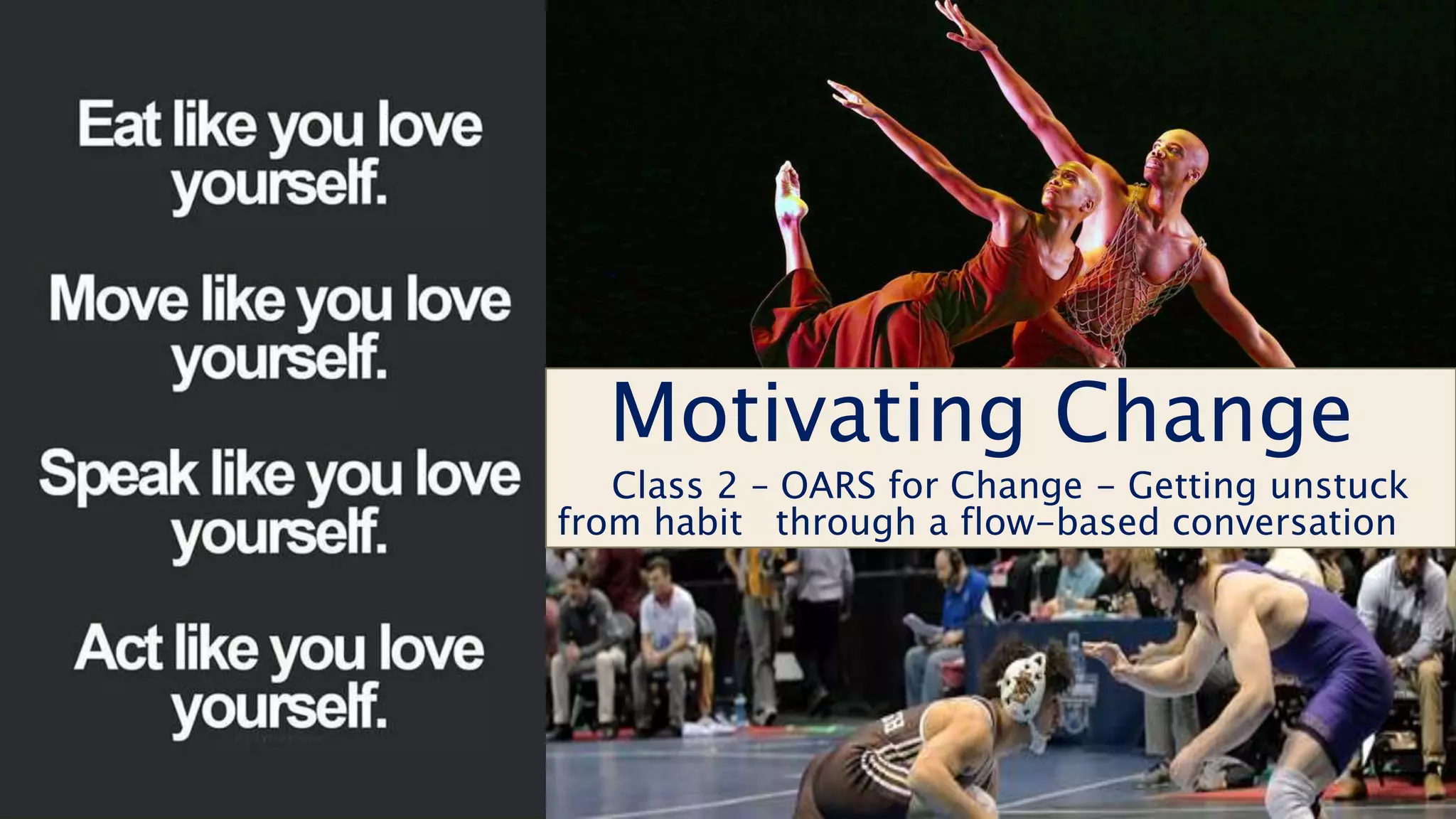
Motivating Change
Class 2 – OARS for Change - Getting unstuck
from habit through a flow-based conversation
CLASS OUTLINE
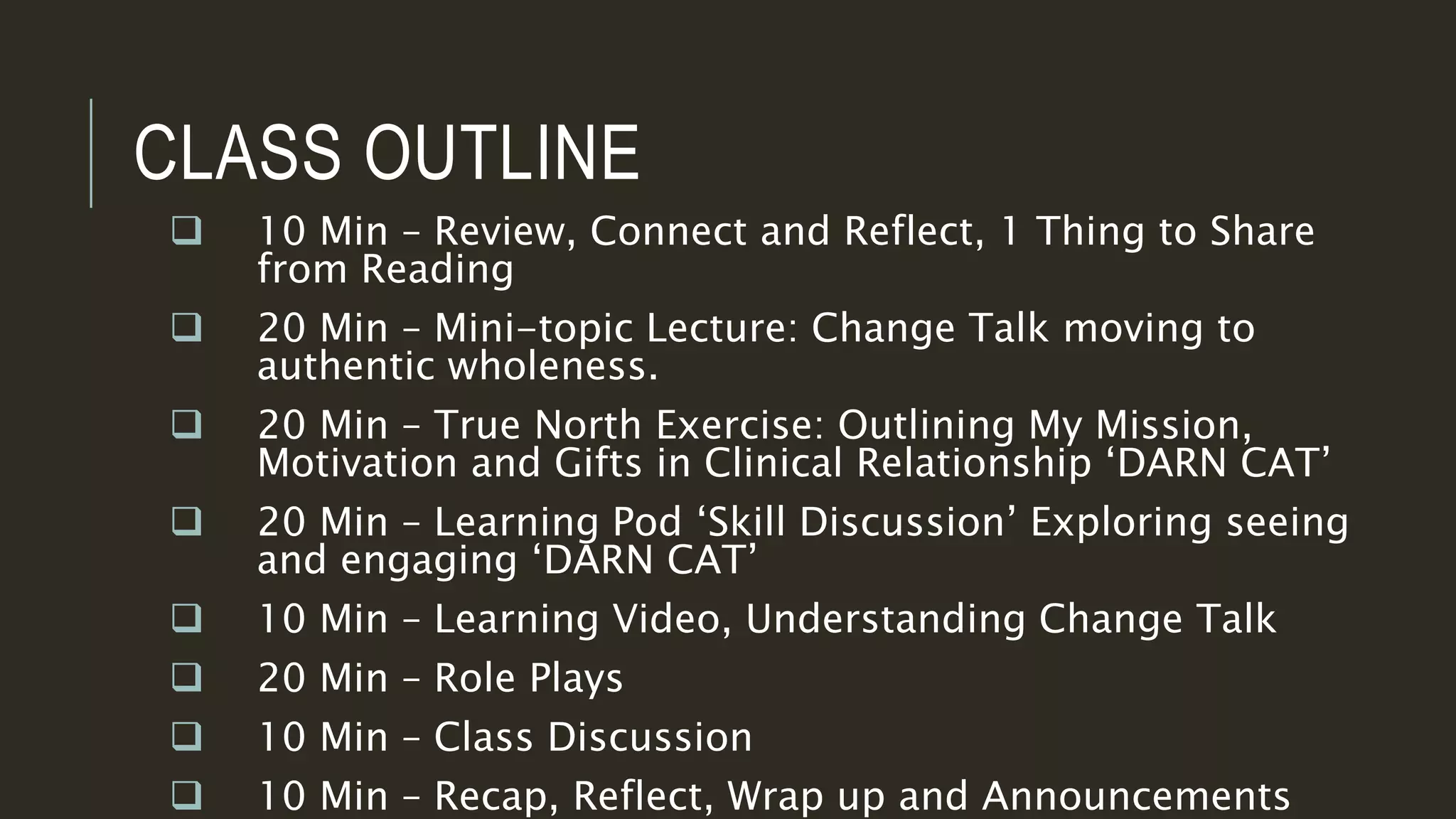
 10 Min – Review, Connect and Reflect, 1 Thing to Share
from Reading
 20 Min – Mini-topic Lecture: Change Talk moving to
authentic wholeness.
 20 Min – True North Exercise: Outlining My Mission,
Motivation and Gifts in Clinical Relationship ‘DARN CAT’
 20 Min – Learning Pod ‘Skill Discussion’ Exploring seeing
and engaging ‘DARN CAT’
 10 Min – Learning Video, Understanding Change Talk
 20 Min – Role Plays
 10 Min – Class Discussion
 10 Min – Recap, Reflect, Wrap up and Announcements
CONNECT
AND
REFLECT
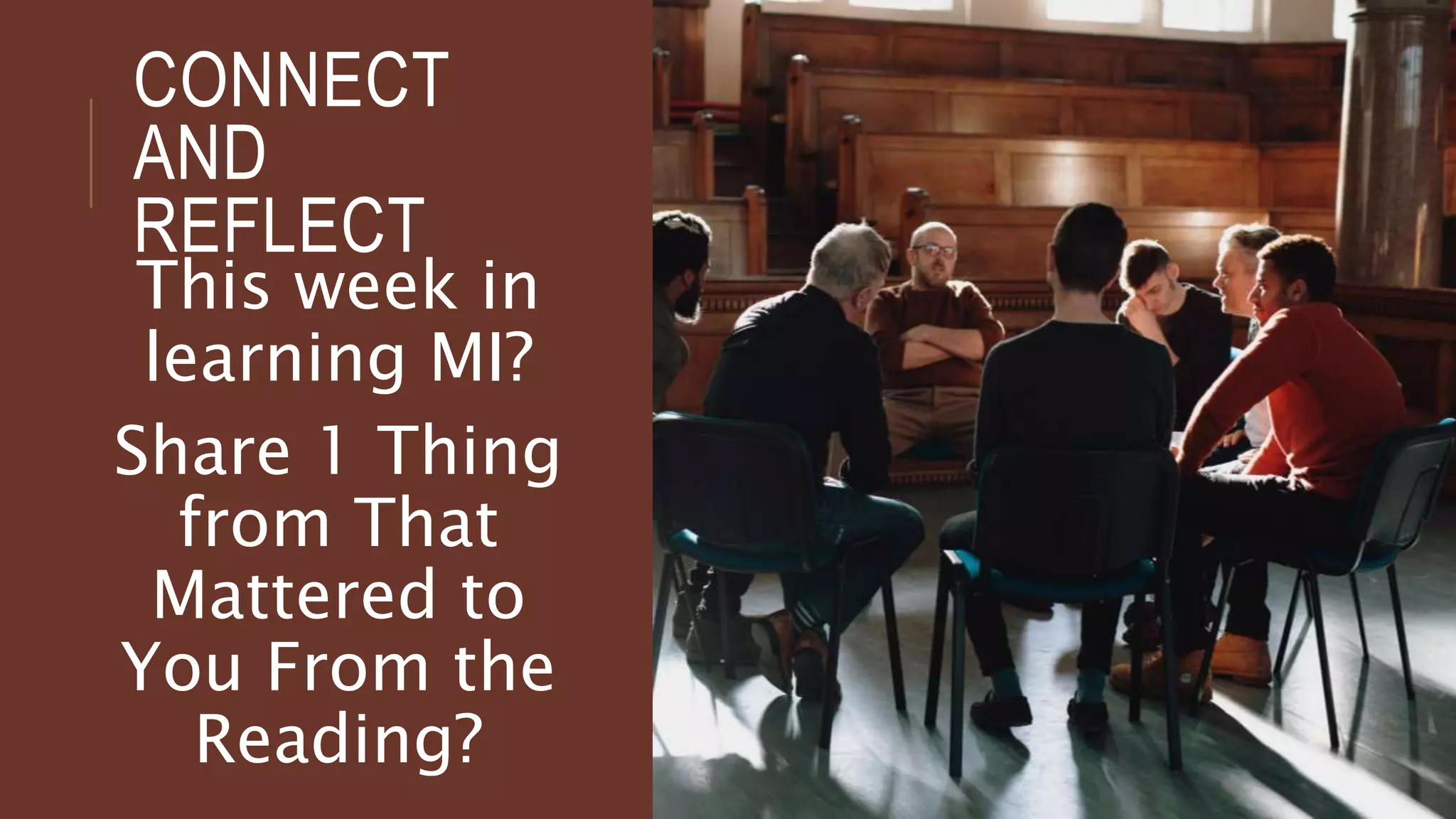
This week in
learning MI?
Share 1 Thing
from That
Mattered to
You From the
Reading?
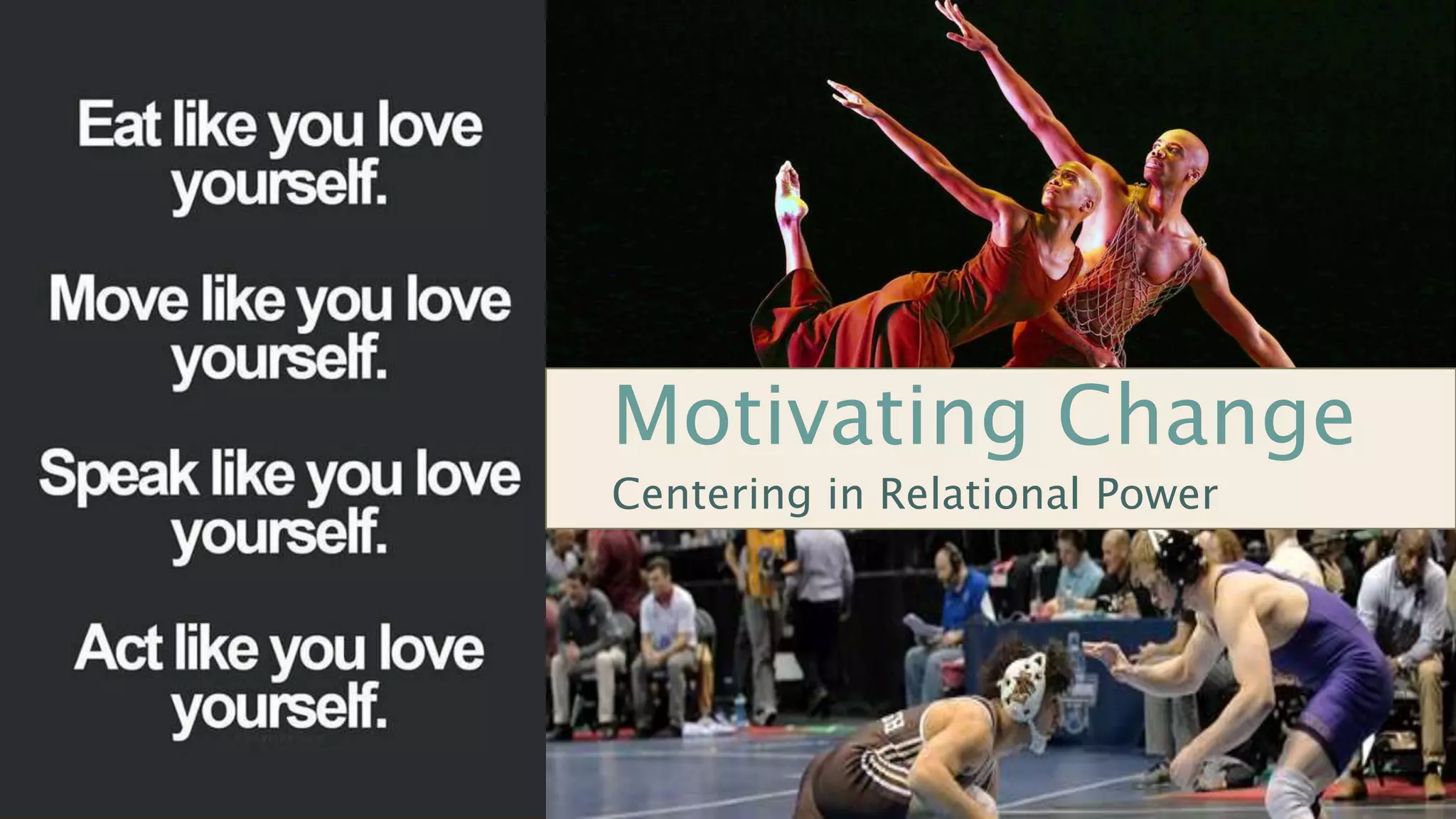
Motivating Change
Centering in Relational Power
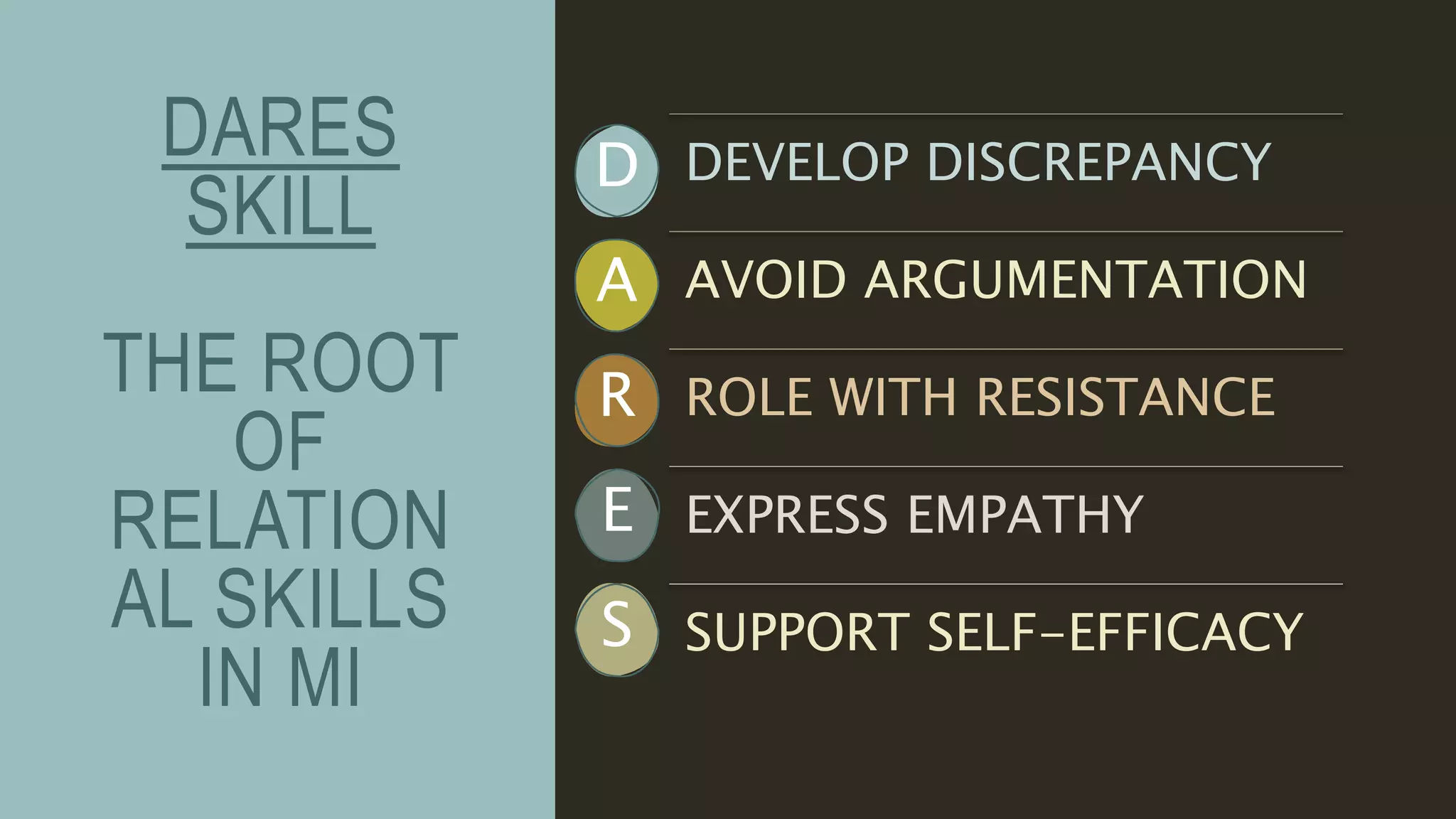
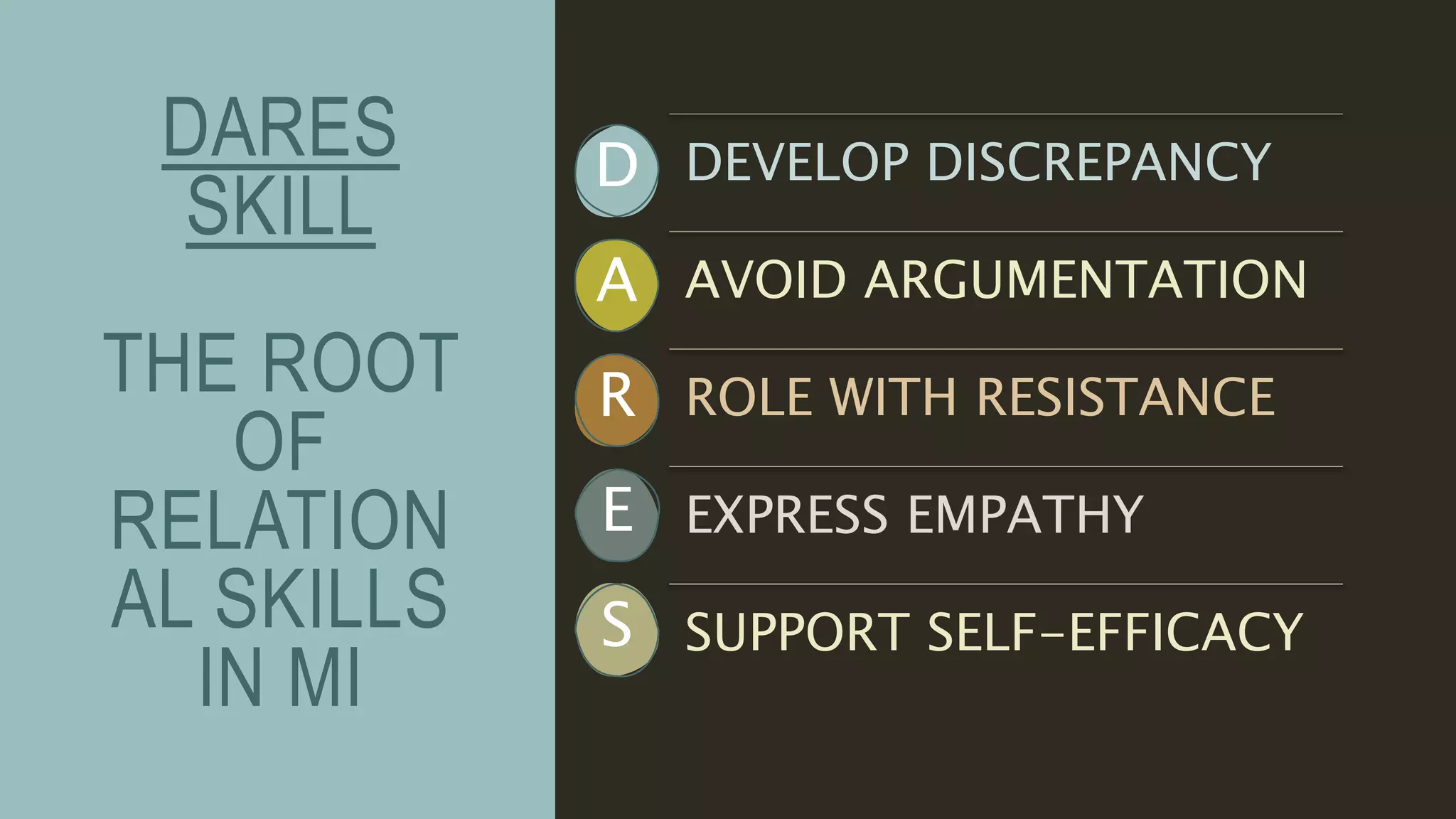
DARES
SKILL
THE ROOT
OF
RELATION
AL SKILLS
IN MI
DEVELOP DISCREPANCY
AVOID ARGUMENTATION
ROLE WITH RESISTANCE
EXPRESS EMPATHY
SUPPORT SELF-EFFICACY
D
A
R
E
S
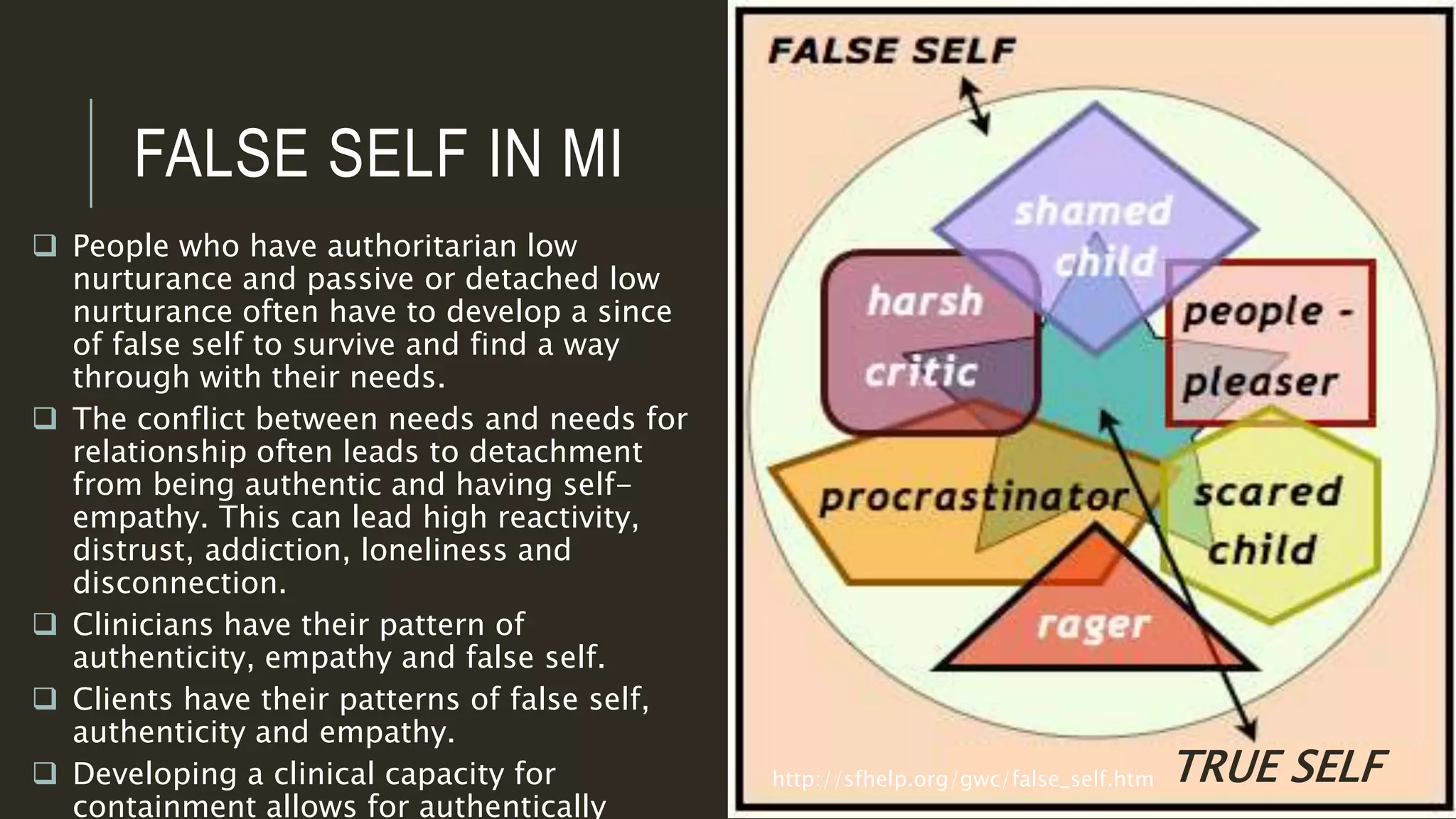
FALSE SELF IN MI
 People who have authoritarian low
nurturance and passive or detached low
nurturance often have to develop a since
of false self to survive and find a way
through with their needs.
 The conflict between needs and needs for
relationship often leads to detachment
from being authentic and having self-
empathy. This can lead high reactivity,
distrust, addiction, loneliness and
disconnection.
 Clinicians have their pattern of
authenticity, empathy and false self.
 Clients have their patterns of false self,
authenticity and empathy.
 Developing a clinical capacity for
containment allows for authentically
TRUE SELF
http://sfhelp.org/gwc/false_self.htm
Creative Tension and
Relationships that Change: There
are two core values that drive the
MI relationship and it’s the
creative tension between these
values that leads to a relationship
that fosters change. These values
are Empathy and and Authenticity.
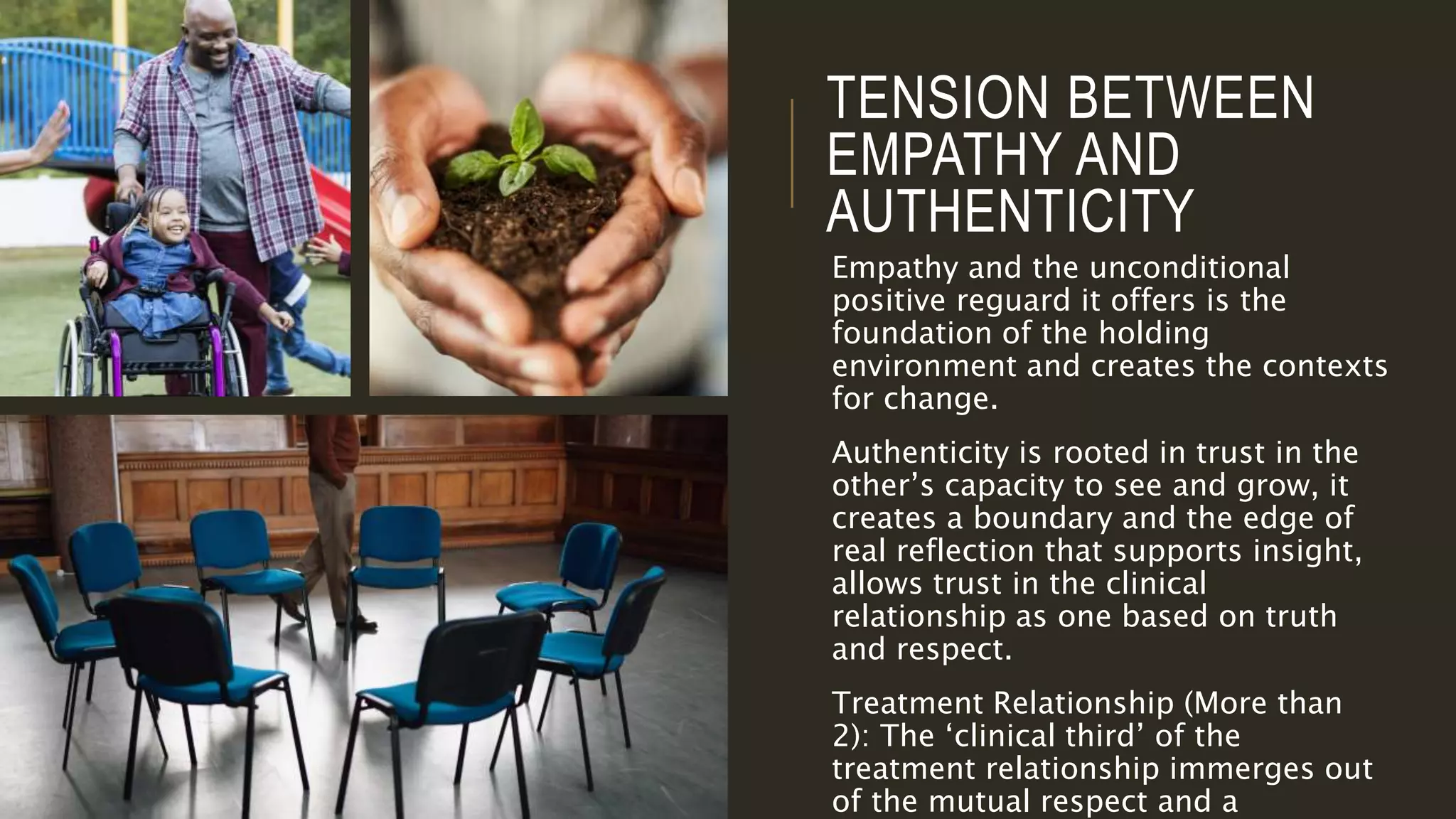
TENSION BETWEEN
EMPATHY AND
AUTHENTICITY
Empathy and the unconditional
positive reguard it offers is the
foundation of the holding
environment and creates the contexts
for change.
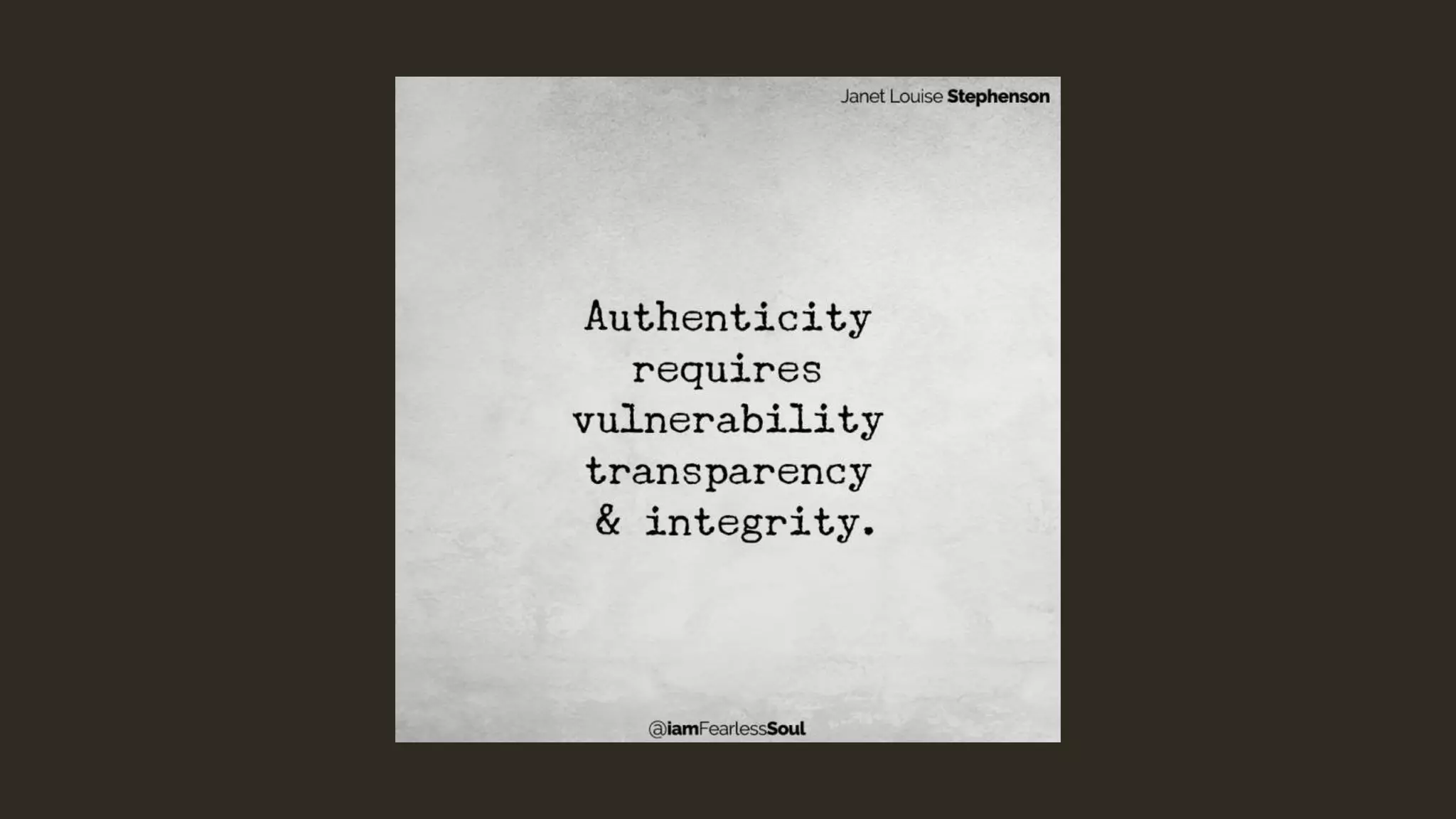
Authenticity is rooted in trust in the
other’s capacity to see and grow, it
creates a boundary and the edge of
real reflection that supports insight,
allows trust in the clinical
relationship as one based on truth
and respect.
Treatment Relationship (More than
2): The ‘clinical third’ of the
treatment relationship immerges out
of the mutual respect and a
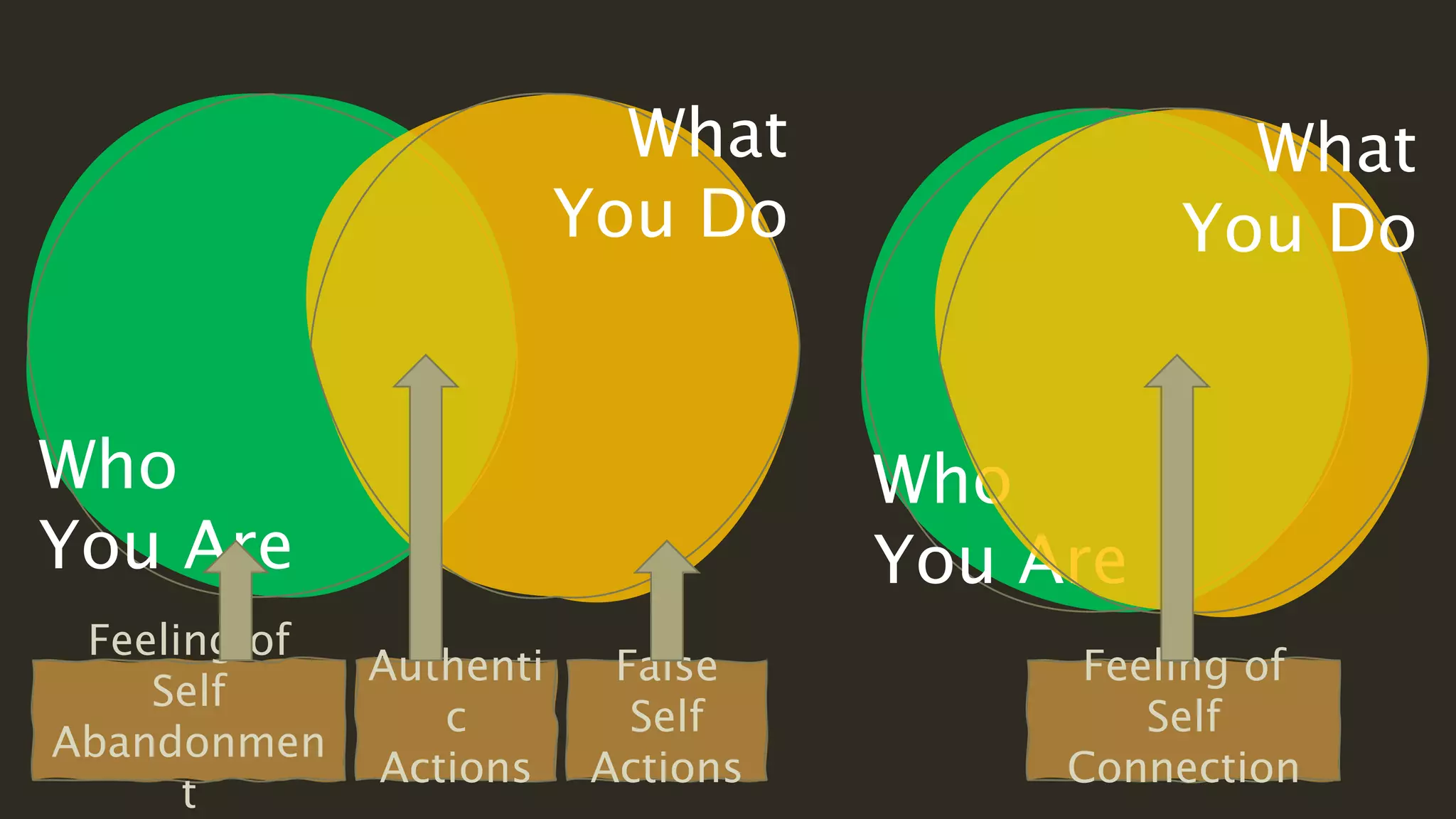
Who
You Are
What
You Do
Who
You Are
What
You Do
Authenti
c
Actions
False
Self
Actions
Feeling of
Self
Abandonmen
t
Feeling of
Self
Connection
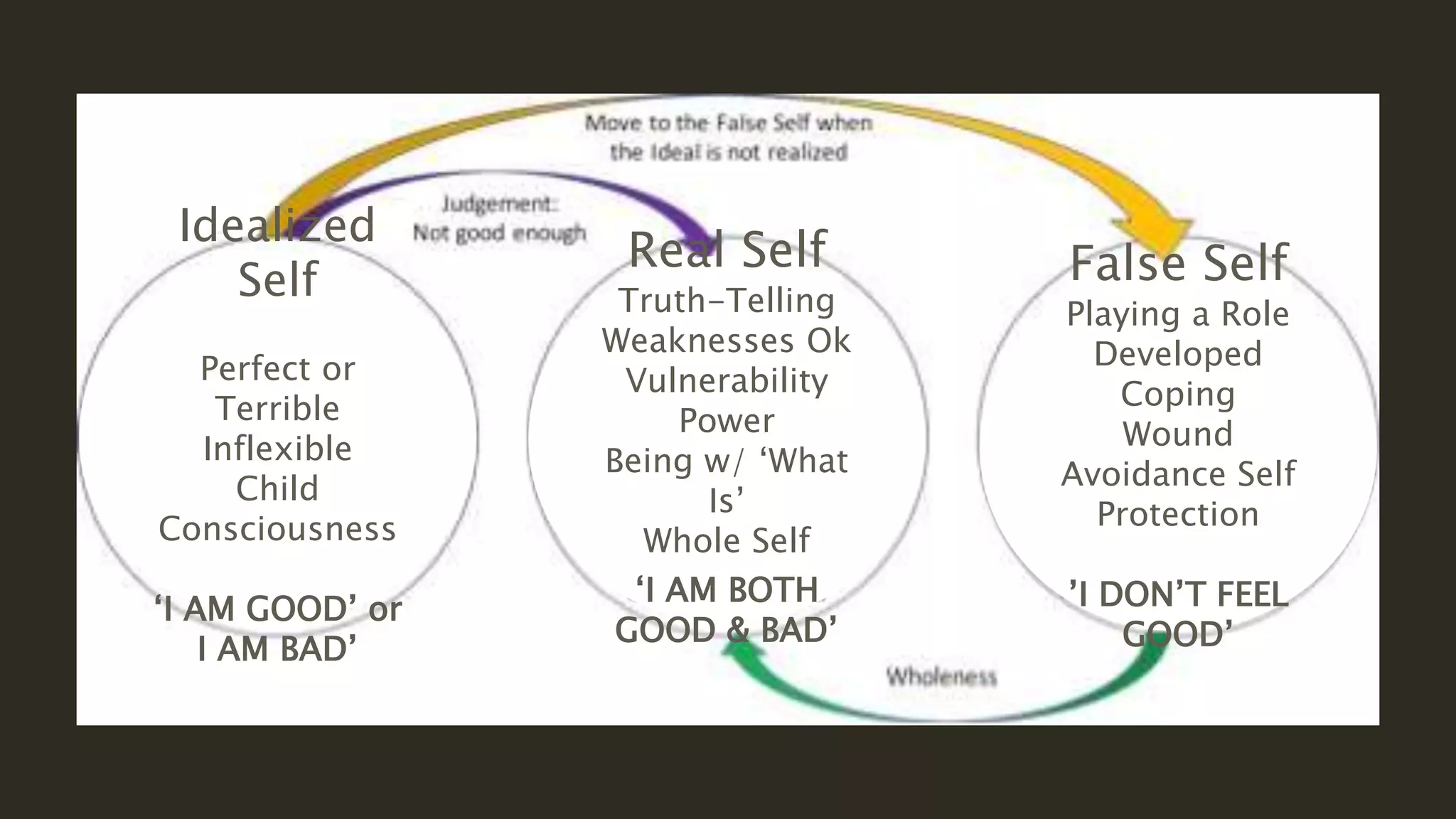
Real Self
Truth-Telling
Weaknesses Ok
Vulnerability
Power
Being w/ ‘What
Is’
Whole Self
‘I AM BOTH
GOOD & BAD’
False Self
Playing a Role
Developed
Coping
Wound
Avoidance Self
Protection
’I DON’T FEEL
GOOD’
Idealized
Self
Perfect or
Terrible
Inflexible
Child
Consciousness
‘I AM GOOD’ or
I AM BAD’
DARES
SKILL
THE ROOT
OF
RELATION
AL SKILLS
IN MI
DEVELOP DISCREPANCY
AVOID ARGUMENTATION
ROLE WITH RESISTANCE
EXPRESS EMPATHY
SUPPORT SELF-EFFICACY
D
A
R
E
S
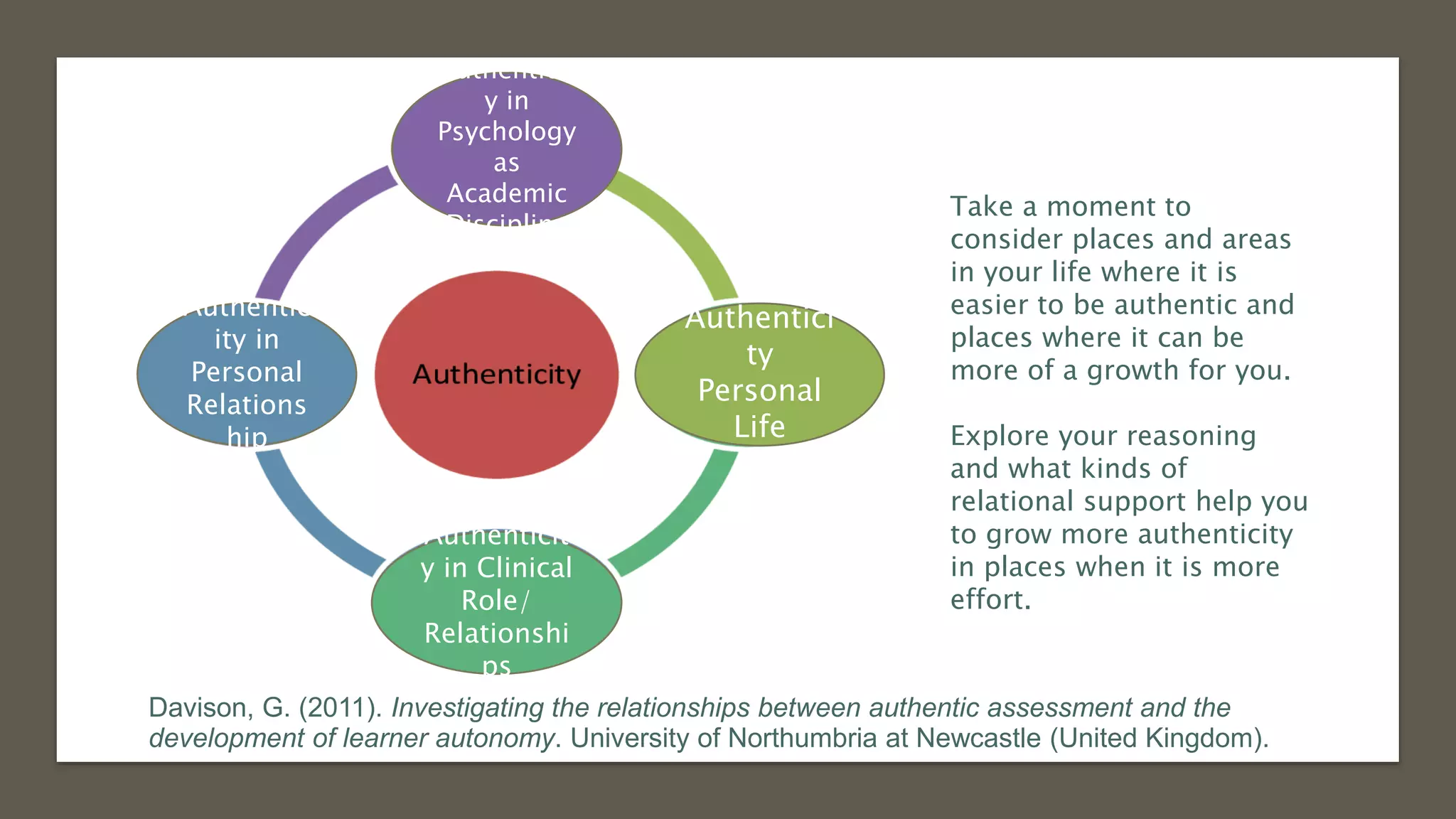
Davison, G. (2011). Investigating the relationships between authentic assessment and the
development of learner autonomy. University of Northumbria at Newcastle (United Kingdom).
Take a moment to
consider places and areas
in your life where it is
easier to be authentic and
places where it can be
more of a growth for you.
Explore your reasoning
and what kinds of
relational support help you
to grow more authenticity
in places when it is more
effort.
Authentic
ity in
Personal
Relations
hip
Authenticit
y in Clinical
Role/
Relationshi
ps
Authenticit
y in
Psychology
as
Academic
Discipline
Authentici
ty
Personal
Life
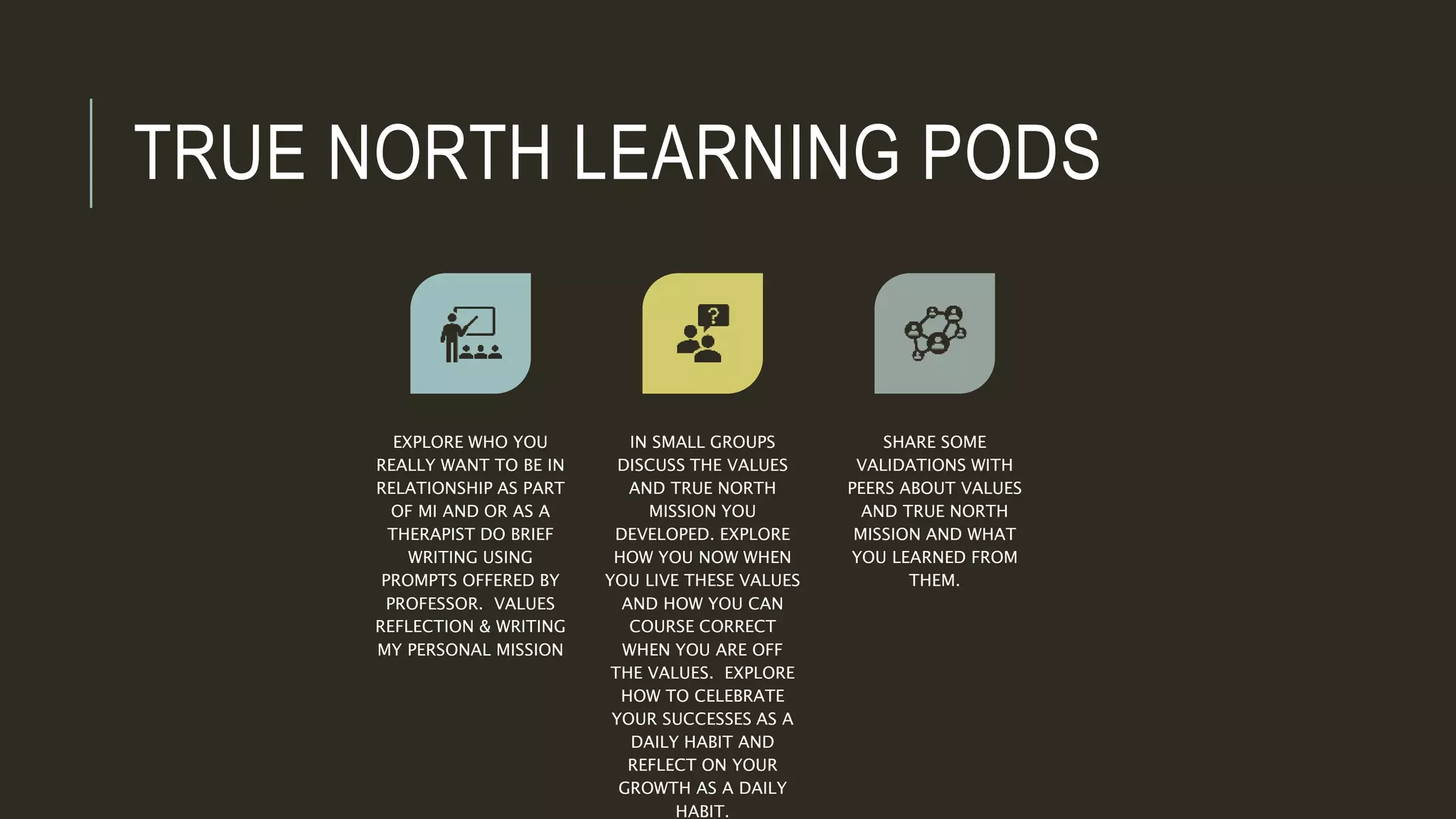
TRUE NORTH LEARNING PODS
EXPLORE WHO YOU
REALLY WANT TO BE IN
RELATIONSHIP AS PART
OF MI AND OR AS A
THERAPIST DO BRIEF
WRITING USING
PROMPTS OFFERED BY
PROFESSOR. VALUES
REFLECTION & WRITING
MY PERSONAL MISSION
IN SMALL GROUPS
DISCUSS THE VALUES
AND TRUE NORTH
MISSION YOU
DEVELOPED. EXPLORE
HOW YOU NOW WHEN
YOU LIVE THESE VALUES
AND HOW YOU CAN
COURSE CORRECT
WHEN YOU ARE OFF
THE VALUES. EXPLORE
HOW TO CELEBRATE
YOUR SUCCESSES AS A
DAILY HABIT AND
REFLECT ON YOUR
GROWTH AS A DAILY
HABIT.
SHARE SOME
VALIDATIONS WITH
PEERS ABOUT VALUES
AND TRUE NORTH
MISSION AND WHAT
YOU LEARNED FROM
THEM.
LEARNING PODS
OARS PRACTICE
Small group
learning and
development.
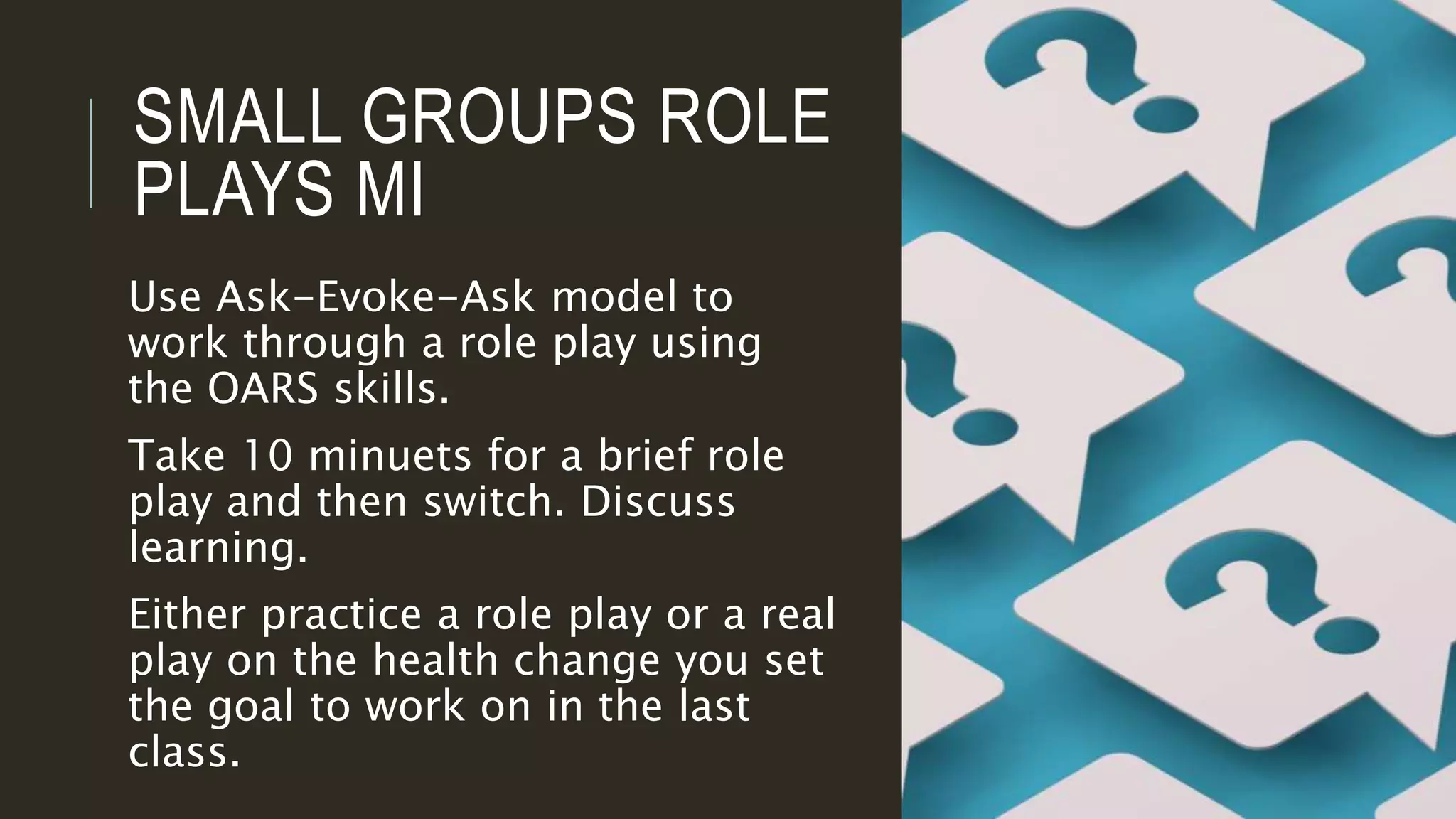
SMALL GROUPS ROLE
PLAYS MI
Use Ask-Evoke-Ask model to
work through a role play using
the OARS skills.
Take 10 minuets for a brief role
play and then switch. Discuss
learning.
Either practice a role play or a real
play on the health change you set
the goal to work on in the last
class.
Self Evaluation Form… Committments
for Change.
What are you able to commit to for
exploring and increasing MI Skills in
your patient interactions?
CLOSE AND REFLECTION
Working on Embodying these Skills in Life
REFERENCES
1. Link: https://youtu.be/XsmY1VVxUIE
2. Link: https://youtu.be/T_iBbEr5e4M
3. Davison, G. (2011). Investigating the relationships between authentic
assessment and the development of learner autonomy. University of
Northumbria at Newcastle (United Kingdom).
4. Saitz, Richard. “How to Increase Motivation - Boston University.” Boston
University , BU, https://www.bumc.bu.edu/care/files/2012/07/09-
SAITZ-MI.pdf.
5. William Miller & Stephen Rollnick. Motivational interviewing: Helping
people change (3rd edition). (2013). New York, NY: Guilford Press.
6. Wyatt, J. G., Soukup, S. M., & Blomquist, M. E. (2021). Motivational
Interviewing Skills.
7. Link Skills Overview:
https://iod.unh.edu/sites/default/files/motivational_interviewing_tips_for
_working_with_youth-oars.pdf

Motivational Interviewing: Foundational Relationships for Building Change (Lecture 3).pptx

  • 1.
    Motivating Change Class 2– OARS for Change - Getting unstuck from habit through a flow-based conversation
  • 2.
    CLASS OUTLINE  10Min – Review, Connect and Reflect, 1 Thing to Share from Reading  20 Min – Mini-topic Lecture: Change Talk moving to authentic wholeness.  20 Min – True North Exercise: Outlining My Mission, Motivation and Gifts in Clinical Relationship ‘DARN CAT’  20 Min – Learning Pod ‘Skill Discussion’ Exploring seeing and engaging ‘DARN CAT’  10 Min – Learning Video, Understanding Change Talk  20 Min – Role Plays  10 Min – Class Discussion  10 Min – Recap, Reflect, Wrap up and Announcements
  • 3.
    CONNECT AND REFLECT This week in learningMI? Share 1 Thing from That Mattered to You From the Reading?
  • 4.
  • 6.
    DARES SKILL THE ROOT OF RELATION AL SKILLS INMI DEVELOP DISCREPANCY AVOID ARGUMENTATION ROLE WITH RESISTANCE EXPRESS EMPATHY SUPPORT SELF-EFFICACY D A R E S
  • 8.
    FALSE SELF INMI  People who have authoritarian low nurturance and passive or detached low nurturance often have to develop a since of false self to survive and find a way through with their needs.  The conflict between needs and needs for relationship often leads to detachment from being authentic and having self- empathy. This can lead high reactivity, distrust, addiction, loneliness and disconnection.  Clinicians have their pattern of authenticity, empathy and false self.  Clients have their patterns of false self, authenticity and empathy.  Developing a clinical capacity for containment allows for authentically TRUE SELF http://sfhelp.org/gwc/false_self.htm
  • 9.
    Creative Tension and Relationshipsthat Change: There are two core values that drive the MI relationship and it’s the creative tension between these values that leads to a relationship that fosters change. These values are Empathy and and Authenticity.
  • 10.
    TENSION BETWEEN EMPATHY AND AUTHENTICITY Empathyand the unconditional positive reguard it offers is the foundation of the holding environment and creates the contexts for change. Authenticity is rooted in trust in the other’s capacity to see and grow, it creates a boundary and the edge of real reflection that supports insight, allows trust in the clinical relationship as one based on truth and respect. Treatment Relationship (More than 2): The ‘clinical third’ of the treatment relationship immerges out of the mutual respect and a
  • 12.
    Who You Are What You Do Who YouAre What You Do Authenti c Actions False Self Actions Feeling of Self Abandonmen t Feeling of Self Connection
  • 13.
    Real Self Truth-Telling Weaknesses Ok Vulnerability Power Beingw/ ‘What Is’ Whole Self ‘I AM BOTH GOOD & BAD’ False Self Playing a Role Developed Coping Wound Avoidance Self Protection ’I DON’T FEEL GOOD’ Idealized Self Perfect or Terrible Inflexible Child Consciousness ‘I AM GOOD’ or I AM BAD’
  • 14.
    DARES SKILL THE ROOT OF RELATION AL SKILLS INMI DEVELOP DISCREPANCY AVOID ARGUMENTATION ROLE WITH RESISTANCE EXPRESS EMPATHY SUPPORT SELF-EFFICACY D A R E S
  • 15.
    Davison, G. (2011).Investigating the relationships between authentic assessment and the development of learner autonomy. University of Northumbria at Newcastle (United Kingdom). Take a moment to consider places and areas in your life where it is easier to be authentic and places where it can be more of a growth for you. Explore your reasoning and what kinds of relational support help you to grow more authenticity in places when it is more effort. Authentic ity in Personal Relations hip Authenticit y in Clinical Role/ Relationshi ps Authenticit y in Psychology as Academic Discipline Authentici ty Personal Life
  • 16.
    TRUE NORTH LEARNINGPODS EXPLORE WHO YOU REALLY WANT TO BE IN RELATIONSHIP AS PART OF MI AND OR AS A THERAPIST DO BRIEF WRITING USING PROMPTS OFFERED BY PROFESSOR. VALUES REFLECTION & WRITING MY PERSONAL MISSION IN SMALL GROUPS DISCUSS THE VALUES AND TRUE NORTH MISSION YOU DEVELOPED. EXPLORE HOW YOU NOW WHEN YOU LIVE THESE VALUES AND HOW YOU CAN COURSE CORRECT WHEN YOU ARE OFF THE VALUES. EXPLORE HOW TO CELEBRATE YOUR SUCCESSES AS A DAILY HABIT AND REFLECT ON YOUR GROWTH AS A DAILY HABIT. SHARE SOME VALIDATIONS WITH PEERS ABOUT VALUES AND TRUE NORTH MISSION AND WHAT YOU LEARNED FROM THEM.
  • 17.
    LEARNING PODS OARS PRACTICE Smallgroup learning and development.
  • 19.
    SMALL GROUPS ROLE PLAYSMI Use Ask-Evoke-Ask model to work through a role play using the OARS skills. Take 10 minuets for a brief role play and then switch. Discuss learning. Either practice a role play or a real play on the health change you set the goal to work on in the last class.
  • 20.
    Self Evaluation Form…Committments for Change. What are you able to commit to for exploring and increasing MI Skills in your patient interactions?
  • 21.
    CLOSE AND REFLECTION Workingon Embodying these Skills in Life
  • 22.
    REFERENCES 1. Link: https://youtu.be/XsmY1VVxUIE 2.Link: https://youtu.be/T_iBbEr5e4M 3. Davison, G. (2011). Investigating the relationships between authentic assessment and the development of learner autonomy. University of Northumbria at Newcastle (United Kingdom). 4. Saitz, Richard. “How to Increase Motivation - Boston University.” Boston University , BU, https://www.bumc.bu.edu/care/files/2012/07/09- SAITZ-MI.pdf. 5. William Miller & Stephen Rollnick. Motivational interviewing: Helping people change (3rd edition). (2013). New York, NY: Guilford Press. 6. Wyatt, J. G., Soukup, S. M., & Blomquist, M. E. (2021). Motivational Interviewing Skills. 7. Link Skills Overview: https://iod.unh.edu/sites/default/files/motivational_interviewing_tips_for _working_with_youth-oars.pdf