GASTRO INTESTINAL
AGENT
ANTIMICROBIAL AGENT
PROF. TAUFIK MULLA
Asst. Professor
Dept. of Pharmaceutics
SPBC College of Pharmacy
INTRODUCTION
To reduce the risk of infection and to minimize the transfer of microbes
from person to person, routinely need to measure some points like hospital
disinfection, sterilization of instrument and surgical handwash.
These are the agent which are used to kill or inhibit the growth of
pathogenic microorganism called as antimicrobial agent.
Example of antimicrobial agent :-
Antiseptic Disinfectant Germicides
Bacteriostatic Bactericide Sanitizer
Fungicide Virusicide Sterilization
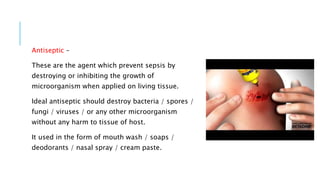
Antiseptic –
These are the agent which prevent sepsis by
destroying or inhibiting the growth of
microorganism when applied on living tissue.
Ideal antiseptic should destroy bacteria / spores /
fungi / viruses / or any other microorganism
without any harm to tissue of host.
It used in the form of mouth wash / soaps /
deodorants / nasal spray / cream paste.
Disinfectant –
These are the substance which prevent infection by
the destruction of pathogenic microorganism when
apply on inanimate object / non living tissue.
Disinfectant mostly used for home and hospital
sanitation. It also destroy non-pathogenic
microorganism.
Also it used for cleaning of hospital instrument /
room / surgical instrument / glassware / home
equipment.
Germicide –
These are the substance which kill microorganism. The term used like
below –
Bactericide – the agent which kill bacteria.
Fungicide – the agent which kill fungus.
Virusicide – the agent which kill viruses.
Bacteriostatic – the agent which only prevent the growth of bacteria.
Sanitizer –
These are the disinfectant used to maintain public health standard
called as sanitizer.
The agent which reduce the bacterial count to safe level on food
handling equipment, eating utensil, drinking utensil by cleaning and
washing.
Sterilization –
It’s a process of complete destruction of all living microorganism
including bacterial spore. It can be done by various method like
physical / chemical method.
MECHANISM OF ACTION OF
ANTIMICROBIALS
For systemic infection antimicrobial agent are used called as
antibiotics.
Inorganic antimicrobial agent used only for topical infection which
posses following mechanism :-
1. Oxidation
2. Halogenation
3. Protein precipitation
1. OXIDATION
Reducing group is present in most of protein. Which required for the
growth and survival of microbes.
These reducing agent get oxidized by oxidizing agent which change
the shape and confirmation of protein, because of that its function
get changed and which leads to destruction of protein.
Oxidizing agent are generally non metal and anion. (peroxide / metal
peroxide / permanganate / halogen)
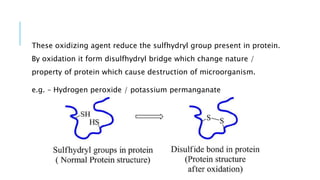
These oxidizing agent reduce the sulfhydryl group present in protein.
By oxidation it form disulfhydryl bridge which change nature /
property of protein which cause destruction of microorganism.
e.g. – Hydrogen peroxide / potassium permanganate
2. HALOGENATION
Most of the enzyme are protein in nature.
Protein molecule composed of various amino acid which connect through
peptide linkage.
Halogenation occur with antiseptic.
These agent serve as source of chlorination for primary and secondary
amide.
Here the same reaction take place, chlorination of peptide linkage of protein
molecule which change the function of specific protein.
Hypochlorite ion chlorinate peptide linkage.
3. PROTEIN PRECIPITATION
Astringent are the compound which work on protein precipitation and
it form protective layer on the surface of skin and it stop bleeding by
contracting blood vessels.
Mechanism Action –
Metal cation have protein precipitation action. If dilute solution of
metal ion used over tissue leads to shrinkage of the skin take place
which called as astringent effect.
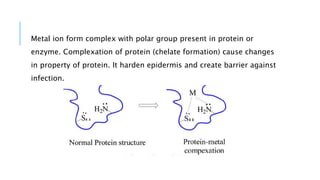
Metal ion form complex with polar group present in protein or
enzyme. Complexation of protein (chelate formation) cause changes
in property of protein. It harden epidermis and create barrier against
infection.
CLASSIFICATION OF ANTIMICROBIAL
AGENT
ON THE BASIS OF MECHANISM
1. Oxidation Mechanism
Hydrogen Peroxide
Potassium Permanganate
Sodium Perborate
2. Halogenation Mechanism
Iodine and its preparation
Povidone-iodine solution
Potassium iodide
3. Protein Precipitation Mechanism
Boric acid
Borax
Silver nitrate
Mercury oxide
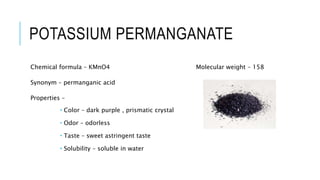
POTASSIUM PERMANGANATE
Chemical formula – KMnO4 Molecular weight – 158
Synonym – permanganic acid
Properties –
 Color – dark purple , prismatic crystal
 Odor – odorless
 Taste – sweet astringent taste
 Solubility – soluble in water
Method of preparation -
It prepared by mixing solution of potassium hydroxide with powdered
manganese dioxide and potassium chlorate. The mixture is boiled.
Evaporate to yield the residue.
6KOH + 3MnO2 + KClO3 3K2MnO4 + KCl + 3H2O
Potassium Manganese Potassium Potassium Potassium
Hydroxide dioxide chlorate manganate chloride
Now pass chlorine gas through potassium manganate solution.
2K2MnO4 + 3Cl2 6KMnO4 + 6KCl
Potassium Chlorine gas Potassium
Manganate Permanganate
Uses –
It used as a topical antimicrobial agent
Solution used as a antiseptic in mouth wash and cleaning of ulcer.
Used in treatment of urethritis.
Used as antidote
Commonly used as antiseptic in veterinary practice
Used in bath for eczema and acute dermatoses patient.
Solution used as antifungal and antibacterial action.
HYDROGEN PEROXIDE
Chemical formula – H2O2 Molecular
weight – 34.01
Properties –
 Color – colorless
 Odor – odorless
 Taste – slightly acidic taste
 Solubility – miscible in water
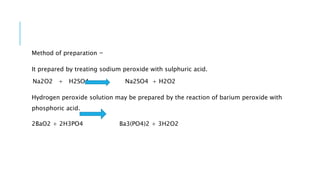
Method of preparation -
It prepared by treating sodium peroxide with sulphuric acid.
Na2O2 + H2SO4 Na2SO4 + H2O2
Hydrogen peroxide solution may be prepared by the reaction of barium peroxide with
phosphoric acid.
2BaO2 + 2H3PO4 Ba3(PO4)2 + 3H2O2
Assay –
Hydrogen peroxide and potassium permanganate both are oxidizing agent and
reduce each other with the evolution of gaseous oxygen. Hydrogen peroxide reduces
KMnO4 solution and cause its decolorization. At the end point, excess drop of
KMnO4, gives pink color, KMnO4 itself work as a indicator. The assay is based upon
volumetric titration.
Take 10 ml of sample is diluted to 250ml with water in volumetric flask. Take 25 ml
of this solution, add 10 ml of 5 N H2SO4, then titrated with 0.1 N KMnO4 until pink
Uses –
 Used as strong antiseptic.
 It destroy all pathogenic bacteria.
 6% solution used as a disinfectant.
 It used to clean wound and cut.
 It used to remove ear wax.
 Used as antidote for phosphorus and cyanide poisoning.
 1.6% solution used as deodorant , gargles and mouth wash.
 Used for bleaching the hair.
BORIC ACID
Chemical formula – H3BO3 Molecular
weight – 61.83
Synonym – Boracic acid / orthoboric acid
Properties –
 Color – colorless / white crystalline powder
 Odor – odorless
 Taste – slightly acidic or bitter taste
 Solubility – soluble in water and alcohol
Method of preparation –
In laboratory prepared by adding mixture of concentrated sulphuric acid and water to
a boiling solution of borax.
Na2B4O7 + 5H2O + H2SO4 Na2SO4 + 4H3BO3
Filter the solution, crystal of boric acid are separated and washed it until become free
from sulphate ion.
Uses –
 Used as local antimicrobial agent
 Used in preparation of dusting powder, antiseptic cream, ointment
 Used as bacteriostatic and fungistatic.
 Aqueous solution in con. Of 2.5 – 4.5% used as eye wash, mouth wash
and skin lotion.
 Used as emollient antiseptic ointment in treatment of diaper rashes.
 Used in preparation of buffer solution for topical medicament to maintain
acidic pH.
CHLORINATED LIME
Chemical formula – Ca(OCl)Cl,CaOCl2 Molecular
weight – 136.98
Synonym – Bleaching powder / calcium hypochlorite
Properties –
 Color – dull white hygroscopic powder
 Odor – characteristic odor
 Solubility – soluble in water
 Slightly acidic in water and alcohol.
Method of preparation –
It is prepared by action of chlorine on calcium hydroxide. Calcium hydroxide is
spread on the shelves on specific container. Chlorine gas introduced at the top of
chamber.
Ca(OH)2 + Cl2 Ca(OCl)Cl + H2O
The process take around 12 to 24 hours.
Assay –
Assay based on redox type of titration. Chlorinated lime liberate the available
chlorine as Cl2 gas by the action of acid. This free chlorine is allowed to react with
potassium iodide to liberate iodine. Quantity of liberated iodine is estimated by
titration with 0.1 N Na2S2O3.
Take 4gm sample add water to dissolve it and transfer it in 1 liter flask and make
volume upto mark with water. Take 100 ml of this solution and transfer in another
flask. Titrated it with 3gm KI. And acidified with acetic acid. Liberated iodine titrate
against 0.1N sodium thiosulphate by using starch as indicator.
Uses –
 It having bactericidal effect.
 Used as disinfectant in wound
 Used as cleaning agent for toilet, drain
 Used as ingredient in preparation of detergent
 Act as powerful bleaching agent
 Used in decolorizing dye

ANTIMICROBIAL AGENT

  • 1.
    GASTRO INTESTINAL AGENT ANTIMICROBIAL AGENT PROF.TAUFIK MULLA Asst. Professor Dept. of Pharmaceutics SPBC College of Pharmacy
  • 2.
    INTRODUCTION To reduce therisk of infection and to minimize the transfer of microbes from person to person, routinely need to measure some points like hospital disinfection, sterilization of instrument and surgical handwash. These are the agent which are used to kill or inhibit the growth of pathogenic microorganism called as antimicrobial agent. Example of antimicrobial agent :- Antiseptic Disinfectant Germicides Bacteriostatic Bactericide Sanitizer Fungicide Virusicide Sterilization
  • 3.
    Antiseptic – These arethe agent which prevent sepsis by destroying or inhibiting the growth of microorganism when applied on living tissue. Ideal antiseptic should destroy bacteria / spores / fungi / viruses / or any other microorganism without any harm to tissue of host. It used in the form of mouth wash / soaps / deodorants / nasal spray / cream paste.
  • 4.
    Disinfectant – These arethe substance which prevent infection by the destruction of pathogenic microorganism when apply on inanimate object / non living tissue. Disinfectant mostly used for home and hospital sanitation. It also destroy non-pathogenic microorganism. Also it used for cleaning of hospital instrument / room / surgical instrument / glassware / home equipment.
  • 5.
    Germicide – These arethe substance which kill microorganism. The term used like below – Bactericide – the agent which kill bacteria. Fungicide – the agent which kill fungus. Virusicide – the agent which kill viruses. Bacteriostatic – the agent which only prevent the growth of bacteria.
  • 6.
    Sanitizer – These arethe disinfectant used to maintain public health standard called as sanitizer. The agent which reduce the bacterial count to safe level on food handling equipment, eating utensil, drinking utensil by cleaning and washing.
  • 7.
    Sterilization – It’s aprocess of complete destruction of all living microorganism including bacterial spore. It can be done by various method like physical / chemical method.
  • 8.
    MECHANISM OF ACTIONOF ANTIMICROBIALS For systemic infection antimicrobial agent are used called as antibiotics. Inorganic antimicrobial agent used only for topical infection which posses following mechanism :- 1. Oxidation 2. Halogenation 3. Protein precipitation
  • 9.
    1. OXIDATION Reducing groupis present in most of protein. Which required for the growth and survival of microbes. These reducing agent get oxidized by oxidizing agent which change the shape and confirmation of protein, because of that its function get changed and which leads to destruction of protein. Oxidizing agent are generally non metal and anion. (peroxide / metal peroxide / permanganate / halogen)
  • 10.
    These oxidizing agentreduce the sulfhydryl group present in protein. By oxidation it form disulfhydryl bridge which change nature / property of protein which cause destruction of microorganism. e.g. – Hydrogen peroxide / potassium permanganate
  • 11.
    2. HALOGENATION Most ofthe enzyme are protein in nature. Protein molecule composed of various amino acid which connect through peptide linkage. Halogenation occur with antiseptic. These agent serve as source of chlorination for primary and secondary amide. Here the same reaction take place, chlorination of peptide linkage of protein molecule which change the function of specific protein. Hypochlorite ion chlorinate peptide linkage.
  • 13.
    3. PROTEIN PRECIPITATION Astringentare the compound which work on protein precipitation and it form protective layer on the surface of skin and it stop bleeding by contracting blood vessels. Mechanism Action – Metal cation have protein precipitation action. If dilute solution of metal ion used over tissue leads to shrinkage of the skin take place which called as astringent effect.
  • 14.
    Metal ion formcomplex with polar group present in protein or enzyme. Complexation of protein (chelate formation) cause changes in property of protein. It harden epidermis and create barrier against infection.
  • 15.
    CLASSIFICATION OF ANTIMICROBIAL AGENT ONTHE BASIS OF MECHANISM 1. Oxidation Mechanism Hydrogen Peroxide Potassium Permanganate Sodium Perborate 2. Halogenation Mechanism Iodine and its preparation Povidone-iodine solution Potassium iodide 3. Protein Precipitation Mechanism Boric acid Borax Silver nitrate Mercury oxide
  • 16.
    POTASSIUM PERMANGANATE Chemical formula– KMnO4 Molecular weight – 158 Synonym – permanganic acid Properties –  Color – dark purple , prismatic crystal  Odor – odorless  Taste – sweet astringent taste  Solubility – soluble in water
  • 17.
    Method of preparation- It prepared by mixing solution of potassium hydroxide with powdered manganese dioxide and potassium chlorate. The mixture is boiled. Evaporate to yield the residue. 6KOH + 3MnO2 + KClO3 3K2MnO4 + KCl + 3H2O Potassium Manganese Potassium Potassium Potassium Hydroxide dioxide chlorate manganate chloride Now pass chlorine gas through potassium manganate solution. 2K2MnO4 + 3Cl2 6KMnO4 + 6KCl Potassium Chlorine gas Potassium Manganate Permanganate
  • 18.
    Uses – It usedas a topical antimicrobial agent Solution used as a antiseptic in mouth wash and cleaning of ulcer. Used in treatment of urethritis. Used as antidote Commonly used as antiseptic in veterinary practice Used in bath for eczema and acute dermatoses patient. Solution used as antifungal and antibacterial action.
  • 19.
    HYDROGEN PEROXIDE Chemical formula– H2O2 Molecular weight – 34.01 Properties –  Color – colorless  Odor – odorless  Taste – slightly acidic taste  Solubility – miscible in water
  • 20.
    Method of preparation- It prepared by treating sodium peroxide with sulphuric acid. Na2O2 + H2SO4 Na2SO4 + H2O2 Hydrogen peroxide solution may be prepared by the reaction of barium peroxide with phosphoric acid. 2BaO2 + 2H3PO4 Ba3(PO4)2 + 3H2O2
  • 21.
    Assay – Hydrogen peroxideand potassium permanganate both are oxidizing agent and reduce each other with the evolution of gaseous oxygen. Hydrogen peroxide reduces KMnO4 solution and cause its decolorization. At the end point, excess drop of KMnO4, gives pink color, KMnO4 itself work as a indicator. The assay is based upon volumetric titration. Take 10 ml of sample is diluted to 250ml with water in volumetric flask. Take 25 ml of this solution, add 10 ml of 5 N H2SO4, then titrated with 0.1 N KMnO4 until pink
  • 22.
    Uses –  Usedas strong antiseptic.  It destroy all pathogenic bacteria.  6% solution used as a disinfectant.  It used to clean wound and cut.  It used to remove ear wax.  Used as antidote for phosphorus and cyanide poisoning.  1.6% solution used as deodorant , gargles and mouth wash.  Used for bleaching the hair.
  • 23.
    BORIC ACID Chemical formula– H3BO3 Molecular weight – 61.83 Synonym – Boracic acid / orthoboric acid Properties –  Color – colorless / white crystalline powder  Odor – odorless  Taste – slightly acidic or bitter taste  Solubility – soluble in water and alcohol
  • 24.
    Method of preparation– In laboratory prepared by adding mixture of concentrated sulphuric acid and water to a boiling solution of borax. Na2B4O7 + 5H2O + H2SO4 Na2SO4 + 4H3BO3 Filter the solution, crystal of boric acid are separated and washed it until become free from sulphate ion.
  • 25.
    Uses –  Usedas local antimicrobial agent  Used in preparation of dusting powder, antiseptic cream, ointment  Used as bacteriostatic and fungistatic.  Aqueous solution in con. Of 2.5 – 4.5% used as eye wash, mouth wash and skin lotion.  Used as emollient antiseptic ointment in treatment of diaper rashes.  Used in preparation of buffer solution for topical medicament to maintain acidic pH.
  • 26.
    CHLORINATED LIME Chemical formula– Ca(OCl)Cl,CaOCl2 Molecular weight – 136.98 Synonym – Bleaching powder / calcium hypochlorite Properties –  Color – dull white hygroscopic powder  Odor – characteristic odor  Solubility – soluble in water  Slightly acidic in water and alcohol.
  • 27.
    Method of preparation– It is prepared by action of chlorine on calcium hydroxide. Calcium hydroxide is spread on the shelves on specific container. Chlorine gas introduced at the top of chamber. Ca(OH)2 + Cl2 Ca(OCl)Cl + H2O The process take around 12 to 24 hours.
  • 28.
    Assay – Assay basedon redox type of titration. Chlorinated lime liberate the available chlorine as Cl2 gas by the action of acid. This free chlorine is allowed to react with potassium iodide to liberate iodine. Quantity of liberated iodine is estimated by titration with 0.1 N Na2S2O3. Take 4gm sample add water to dissolve it and transfer it in 1 liter flask and make volume upto mark with water. Take 100 ml of this solution and transfer in another flask. Titrated it with 3gm KI. And acidified with acetic acid. Liberated iodine titrate against 0.1N sodium thiosulphate by using starch as indicator.
  • 29.
    Uses –  Ithaving bactericidal effect.  Used as disinfectant in wound  Used as cleaning agent for toilet, drain  Used as ingredient in preparation of detergent  Act as powerful bleaching agent  Used in decolorizing dye