Patent Process: Filing
to Grant
Dr. Ashwani Dhingra
Associate Professor
GGSCOP, Yamunanagar
Types of Application
1. Ordinary Application
2. Convention Application
3. PCT International Application
4. PCT National Phase Application
5. Application for Patent of Addition
6. Divisional Application
1. Ordinary Application
• It refers to a patent application which doesn’t claim any
priority of application made or without reference to any
other existing application under process with the Patent
office.
• May be with a Provisional Specification or a Complete
Specification
2. Convention Application
• Refers to the application filed by an applicant claiming priority date based on
a similar application filed in one of the convention country. The applicant
should file the application in an Indian Patent Office within twelve months
from the date of first filing of a similar application in the convention country
• The applicant of convention application shall furnish when required by the
Controller, copies of specification or documents certified by the chief of the
Patent Office of the convention country.
• A translation of the said documents has to be furnished if the same is not in
English.
3. PCT International Application
• In this, the applicant gains an international filing date in all
the designated countries conferring the late entry (upto 31
months) to the national offices without affecting the priority
date.
• best and most comprehensive method for applicants
seeking protection for the inventions in many countries.
• The Indian Patent Office is a receiving office for
international applications too.
4. PCT National Phase Application
• An international application, as mentioned above, can enter the
national phase within 31 months from the international filing date.
Called the PCT National Phase Application,
• this application filed before the Controller in the Indian Patent Office
claims the priority and international filing date.
• The title, description, drawings, abstract and claims filed with the
application shall be taken as the complete specification for the
purposes of filing in India.
5. Application for Patent of Addition
• Application for Patent of Addition comes into play when an applicant feels
that his/her invention is a slight modification on the invention for which
he/she has already applied for/has patent in India. There is no need to pay
separate renewal fee for the patent of addition during the term of the main
patent and expires along with the main patent unless it is made independent.
6. Divisional Application
• In certain cases, either on his own request or on request of the Controller,
when the application made by the applicant claims more than one invention,
he may divide the application and file two or more applications as applicable
for each of his/her invention.
• Applications are divided when there is lack of unity of invention
• The priority date for all the divisional application would be same as the one
claimed by the parent application.
Documents required for filing of A Patent Application
1. Application for Grant of Patent in Form 1 in duplicate;
2. Proof of right [Sec7(2)] to file the application from the inventor.
3. Complete/Provisional specification in Form 2 in duplicate
4. Statement and Undertaking in Form 3
5. Power of Attorney in Form 26 (in original, if filed through patent agent)
6. Declaration of Inventor-ship in Form 5 (only in case of an Indian
Application
7. Certified true copy of the Priority document (in case priority is claimed)
8. Requisite Statutory fees
Other Requirements
Signature of the applicant / authorized person / Patent Agent along with name and
date in the appropriate space provided in the forms.
 The Specification signed by the agent/applicant with date on the last page of the
Specification.
The drawing sheets signed by applicant/agent in the right hand bottom corner.
Invention using biological material: permission from the National Biodiversity
Authority any time before the grant of the patent.
Other Requirements
• Language: Hindi or English
• Strong, durable white paper of size A4
• Top and left hand margin- 4 cm (min)
• Bottom and right hand margin: 3 cm(min)
• Desirable line spacing 1.5 or 2 in non-script type font (e.g., Arial, Times Roman, or
Courier)
• Preferably font size 12
• Printing only upon one side of the paper
• Numbering in consecutive arabic numerals in the centre of the bottom of the sheet
• Contain the numbering to every 5th line of each page of the description and each page
of the claims at right half of the left margin.
Specification
(Section 9, 10, Rule 13.)
• Techno-legal document
• Containing full scientific details of the invention and claims to the patent
rights.
• Fully and particularly describe various features constituting the invention.
• May be a Provisional or a complete Specification.
• The Specification is to be submitted in Form-2 along with the Application in
Form-1 and other documents in duplicate
Specification
• The first page of Form 2 contain:
a) Title of the invention;
b) Name, address and nationality of each of the applicants for the Patent; and
c) Preamble to the description.
Contents of Specification
• Title of the invention
• Field of the invention
• Background of the invention (PRIOR ART)
• Object of the invention
• Summary of the invention
• Brief description of drawings, if any
• Detailed description of the invention
• Examples
• Claims- not required in provisional
• Abstract- not required in provisional
Contents of Provisional Specification
 Contains the title and description of the invention and shall
start with a preamble –
‘The following Specification describes the invention.’
 Claims may not be included in the Provisional Specification
 Should contain as much information as the applicant has at
the time of filing.
 Provisional Specification cannot be filed for Divisional,
Convention or a PCT National Phase Application
Complete Specification
Techno-legal document which fully and particularly describes the invention
Discloses the best method of performing the invention.
Complete Specification should be drafted with utmost care without any ambiguity.
Starts with the preamble-
‘The following Specification particularly describes the invention and the manner in
which it is to be performed.’
Complete Specification
Sec 10(4)
Every complete specification shall:
 fully and particularly describe the invention and its operation or use and the
method by which it is performed;
 disclose the best method of performing the invention which is known to
the applicant for which he is entitled to claim protection
 end with a claim or set of claims defining the scope of the invention
 make reference to deposit of the biological material in the international
depository authority, if applicable
 be accompanied by an abstract.
Opposition Proceedings
• Administrative process which allows third parties to formally challenge the validity
of a-
• pending patent application ("pre-grant opposition")
• of a granted patent ("post-grant opposition")
• India has both systems
Pre Grant Opposition
Section 25(1)
• any person may challenge the application of grant of patent and inform to
the controller of Patents for opposition, in writing against the grant of a
patent after the application for a patent has been published but before the
grant of a patent
Grounds for Opposition
• Wrongfully obtaining the invention
• anticipation by prior publication
• anticipation by prior date, Prior claiming in India
• Prior public knowledge or public use in India
• Obviousness and lack of inventive step
• non patentable subject matter
• insufficiency of description of the invention
• non-disclosure of information as per the requirement or providing materially false information by an
applicant
• Patent application not filed within 12 months of filing the first application in a convention country
• nondisclosure/ wrong mention of source of biological material
• Invention anticipated with regard to traditional knowledge of any community, anywhere in the world.
Post grant opposition Sec. 25(2)
• May be filed at any time after the grant of patent but before the expiry of a
period of one year from the date of publication of grant of the patent.
• Any person interested may give notice of opposition to the Controller
• Indian patent act defines "person interested" as including a person engaged
in, or in promoting, research in the same filed as that to which the invention
relates. In addition, interested person may also include any organization that
has a manufacturing or trading/ financial interest in the goods related to the
patented product.
• Similar grounds as that of pre-grant opposition
Novartis AG vs. Natco Pharma Ltd (Gleevec)
• An application for patent was filed in India on 17th July, 1998 by Novartis AG,
Switzerland, claiming Switzerland priority date of 18th July, 1997.
• Upon publication, the grant of patent was opposed by Natco Pharma Ltd.,
India on 26th May, 2005.
• The grounds for opposition were:
Anticipation by prior publication
Lack of inventive step
Non-patentability under section 3(d)
Wrongfully claiming the priority
• Controller ruled that the above patent application cannot proceed for grant of
patent.
Examination and issue of FER
• Examination on filing request for examination (within 48 months from date of filing
or date of priority)
• First come first serve basis
• Examiner allotted based on field of invention
• Examiner performs search and checks on criteria of novelty, inventive step, industrial
application and also for exclusion under sec 3 and sec 4
• Examiner will issue an Examination Report to the applicant, stating the grounds for
objections. The first such examination report is called the First Examination Report
(FER).
FER Response
• The patent applicant needs to successfully overcome the objections to receive a
patent grant.
• The whole process may involve responding to examination reports, appearing for
hearing, etc.
• The total time needed to put an application in order for the grant is 6 months (earlier
12 months) from the date on which the FER is issued to the applicant.
• However, this 6 month period can be extended for a period of 3 months by the
applicant by filing a request for an extension of time
Grant and Maintenance
• If all objections are successfully met with and application found to be in order for
grant, patent is granted as expeditiously as possible with the seal of the Patent Office.
• The grant of patent is published in the Patent Journal and Letters Patent is issued
• To keep patent in force, annual maintenance fee has to be paid
• Non paying of maintenance fee- patent lapsed, may be restored
Rights of Patentee
Patent right is a grant of exclusive rights to the owner, to exclude others from -
• making,
• offering for sale,
• selling or
• importing patented invention.
Sec 48, Patents Act, 1970
Subject to the other provisions contained in this Act and the conditions specified in
section 47, a patent granted under this Act shall confer upon the patentee—
• (a) where the subject matter of the patent is a product, the exclusive right to prevent
third parties, who do not have his consent, from the act of making, using, offering
for sale, selling or importing for those purposes that product in India;
• (b) where the subject matter of the patent is a process, the exclusive right to prevent
third parties, who do not have his consent, from the act of using that process, and
from the act of using, offering for sale, selling or importing for those purposes the
product obtained directly by that process in India:
Obligations of Patentee
1. To encourage and secure working of invention to fullest extent without undue delay.
2. Not to use monopoly to unfairly prejudice interest of public.
3. Failure to discharge duties reasonably, would lead to revocation of patent.
4. To furnish periodical statements to Controller, as to extend to which invention has
been worked.
5. Failure to provide statement to Controller is a punishable offence
Revocation of patent
• A revocation petition can be filed in the Intellectual Property Appellate Board by the
interested person or the Central Government, or it can be filed as a counter-claim in
a suit for infringement at the High Court
• Grounds (sec. 64)
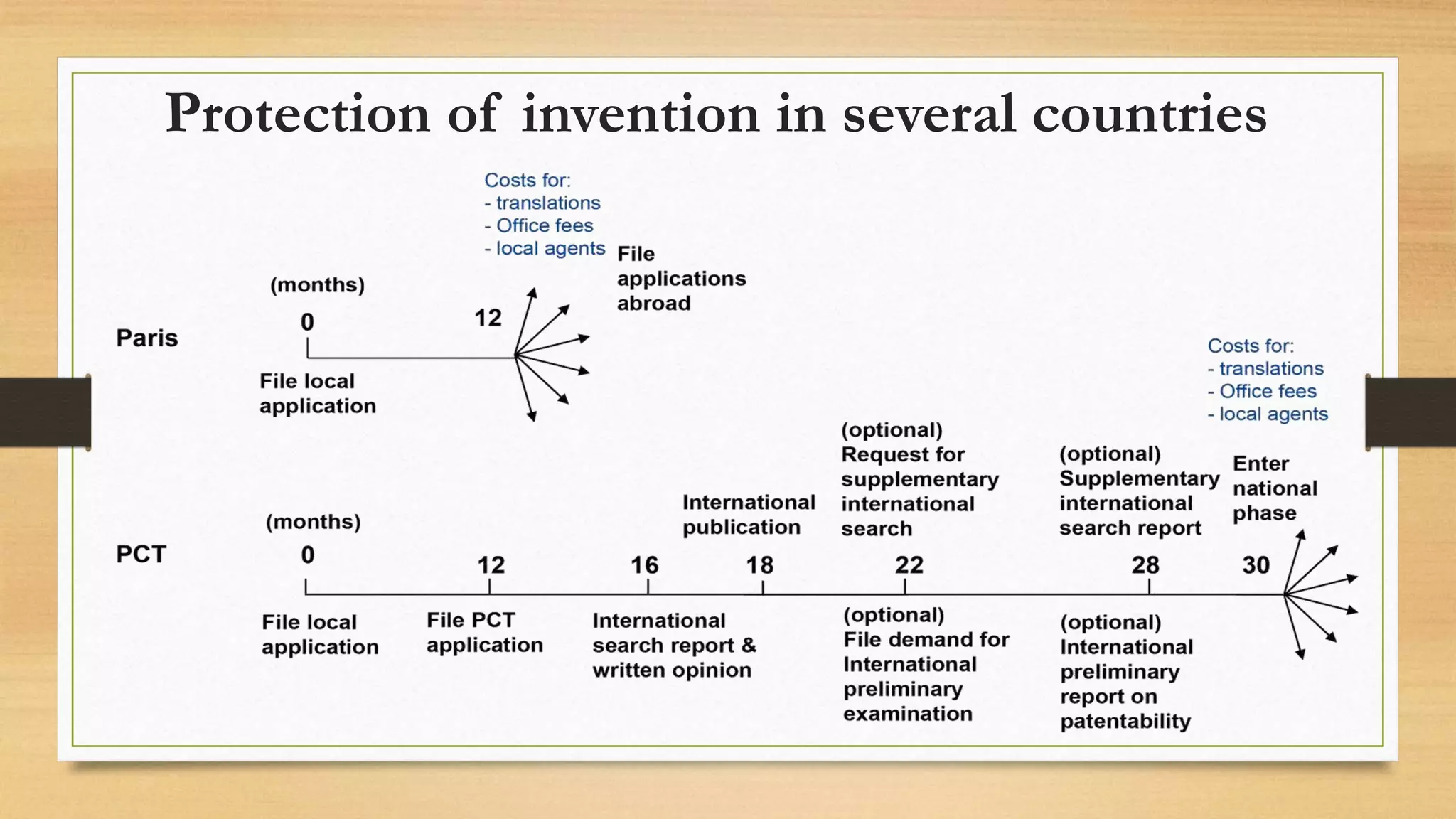
Protection of invention in several countries
Patent Process: Filing to Grant

Patent Process: Filing to Grant

  • 1.
    Patent Process: Filing toGrant Dr. Ashwani Dhingra Associate Professor GGSCOP, Yamunanagar
  • 2.
    Types of Application 1.Ordinary Application 2. Convention Application 3. PCT International Application 4. PCT National Phase Application 5. Application for Patent of Addition 6. Divisional Application
  • 3.
    1. Ordinary Application •It refers to a patent application which doesn’t claim any priority of application made or without reference to any other existing application under process with the Patent office. • May be with a Provisional Specification or a Complete Specification
  • 4.
    2. Convention Application •Refers to the application filed by an applicant claiming priority date based on a similar application filed in one of the convention country. The applicant should file the application in an Indian Patent Office within twelve months from the date of first filing of a similar application in the convention country • The applicant of convention application shall furnish when required by the Controller, copies of specification or documents certified by the chief of the Patent Office of the convention country. • A translation of the said documents has to be furnished if the same is not in English.
  • 5.
    3. PCT InternationalApplication • In this, the applicant gains an international filing date in all the designated countries conferring the late entry (upto 31 months) to the national offices without affecting the priority date. • best and most comprehensive method for applicants seeking protection for the inventions in many countries. • The Indian Patent Office is a receiving office for international applications too.
  • 6.
    4. PCT NationalPhase Application • An international application, as mentioned above, can enter the national phase within 31 months from the international filing date. Called the PCT National Phase Application, • this application filed before the Controller in the Indian Patent Office claims the priority and international filing date. • The title, description, drawings, abstract and claims filed with the application shall be taken as the complete specification for the purposes of filing in India.
  • 7.
    5. Application forPatent of Addition • Application for Patent of Addition comes into play when an applicant feels that his/her invention is a slight modification on the invention for which he/she has already applied for/has patent in India. There is no need to pay separate renewal fee for the patent of addition during the term of the main patent and expires along with the main patent unless it is made independent.
  • 8.
    6. Divisional Application •In certain cases, either on his own request or on request of the Controller, when the application made by the applicant claims more than one invention, he may divide the application and file two or more applications as applicable for each of his/her invention. • Applications are divided when there is lack of unity of invention • The priority date for all the divisional application would be same as the one claimed by the parent application.
  • 9.
    Documents required forfiling of A Patent Application 1. Application for Grant of Patent in Form 1 in duplicate; 2. Proof of right [Sec7(2)] to file the application from the inventor. 3. Complete/Provisional specification in Form 2 in duplicate 4. Statement and Undertaking in Form 3 5. Power of Attorney in Form 26 (in original, if filed through patent agent) 6. Declaration of Inventor-ship in Form 5 (only in case of an Indian Application 7. Certified true copy of the Priority document (in case priority is claimed) 8. Requisite Statutory fees
  • 10.
    Other Requirements Signature ofthe applicant / authorized person / Patent Agent along with name and date in the appropriate space provided in the forms.  The Specification signed by the agent/applicant with date on the last page of the Specification. The drawing sheets signed by applicant/agent in the right hand bottom corner. Invention using biological material: permission from the National Biodiversity Authority any time before the grant of the patent.
  • 11.
    Other Requirements • Language:Hindi or English • Strong, durable white paper of size A4 • Top and left hand margin- 4 cm (min) • Bottom and right hand margin: 3 cm(min) • Desirable line spacing 1.5 or 2 in non-script type font (e.g., Arial, Times Roman, or Courier) • Preferably font size 12 • Printing only upon one side of the paper • Numbering in consecutive arabic numerals in the centre of the bottom of the sheet • Contain the numbering to every 5th line of each page of the description and each page of the claims at right half of the left margin.
  • 13.
    Specification (Section 9, 10,Rule 13.) • Techno-legal document • Containing full scientific details of the invention and claims to the patent rights. • Fully and particularly describe various features constituting the invention. • May be a Provisional or a complete Specification. • The Specification is to be submitted in Form-2 along with the Application in Form-1 and other documents in duplicate
  • 14.
    Specification • The firstpage of Form 2 contain: a) Title of the invention; b) Name, address and nationality of each of the applicants for the Patent; and c) Preamble to the description.
  • 15.
    Contents of Specification •Title of the invention • Field of the invention • Background of the invention (PRIOR ART) • Object of the invention • Summary of the invention • Brief description of drawings, if any • Detailed description of the invention • Examples • Claims- not required in provisional • Abstract- not required in provisional
  • 16.
    Contents of ProvisionalSpecification  Contains the title and description of the invention and shall start with a preamble – ‘The following Specification describes the invention.’  Claims may not be included in the Provisional Specification  Should contain as much information as the applicant has at the time of filing.  Provisional Specification cannot be filed for Divisional, Convention or a PCT National Phase Application
  • 17.
    Complete Specification Techno-legal documentwhich fully and particularly describes the invention Discloses the best method of performing the invention. Complete Specification should be drafted with utmost care without any ambiguity. Starts with the preamble- ‘The following Specification particularly describes the invention and the manner in which it is to be performed.’
  • 18.
    Complete Specification Sec 10(4) Everycomplete specification shall:  fully and particularly describe the invention and its operation or use and the method by which it is performed;  disclose the best method of performing the invention which is known to the applicant for which he is entitled to claim protection  end with a claim or set of claims defining the scope of the invention  make reference to deposit of the biological material in the international depository authority, if applicable  be accompanied by an abstract.
  • 19.
    Opposition Proceedings • Administrativeprocess which allows third parties to formally challenge the validity of a- • pending patent application ("pre-grant opposition") • of a granted patent ("post-grant opposition") • India has both systems
  • 20.
    Pre Grant Opposition Section25(1) • any person may challenge the application of grant of patent and inform to the controller of Patents for opposition, in writing against the grant of a patent after the application for a patent has been published but before the grant of a patent
  • 21.
    Grounds for Opposition •Wrongfully obtaining the invention • anticipation by prior publication • anticipation by prior date, Prior claiming in India • Prior public knowledge or public use in India • Obviousness and lack of inventive step • non patentable subject matter • insufficiency of description of the invention • non-disclosure of information as per the requirement or providing materially false information by an applicant • Patent application not filed within 12 months of filing the first application in a convention country • nondisclosure/ wrong mention of source of biological material • Invention anticipated with regard to traditional knowledge of any community, anywhere in the world.
  • 22.
    Post grant oppositionSec. 25(2) • May be filed at any time after the grant of patent but before the expiry of a period of one year from the date of publication of grant of the patent. • Any person interested may give notice of opposition to the Controller • Indian patent act defines "person interested" as including a person engaged in, or in promoting, research in the same filed as that to which the invention relates. In addition, interested person may also include any organization that has a manufacturing or trading/ financial interest in the goods related to the patented product. • Similar grounds as that of pre-grant opposition
  • 23.
    Novartis AG vs.Natco Pharma Ltd (Gleevec) • An application for patent was filed in India on 17th July, 1998 by Novartis AG, Switzerland, claiming Switzerland priority date of 18th July, 1997. • Upon publication, the grant of patent was opposed by Natco Pharma Ltd., India on 26th May, 2005. • The grounds for opposition were: Anticipation by prior publication Lack of inventive step Non-patentability under section 3(d) Wrongfully claiming the priority • Controller ruled that the above patent application cannot proceed for grant of patent.
  • 24.
    Examination and issueof FER • Examination on filing request for examination (within 48 months from date of filing or date of priority) • First come first serve basis • Examiner allotted based on field of invention • Examiner performs search and checks on criteria of novelty, inventive step, industrial application and also for exclusion under sec 3 and sec 4 • Examiner will issue an Examination Report to the applicant, stating the grounds for objections. The first such examination report is called the First Examination Report (FER).
  • 25.
    FER Response • Thepatent applicant needs to successfully overcome the objections to receive a patent grant. • The whole process may involve responding to examination reports, appearing for hearing, etc. • The total time needed to put an application in order for the grant is 6 months (earlier 12 months) from the date on which the FER is issued to the applicant. • However, this 6 month period can be extended for a period of 3 months by the applicant by filing a request for an extension of time
  • 26.
    Grant and Maintenance •If all objections are successfully met with and application found to be in order for grant, patent is granted as expeditiously as possible with the seal of the Patent Office. • The grant of patent is published in the Patent Journal and Letters Patent is issued • To keep patent in force, annual maintenance fee has to be paid • Non paying of maintenance fee- patent lapsed, may be restored
  • 27.
    Rights of Patentee Patentright is a grant of exclusive rights to the owner, to exclude others from - • making, • offering for sale, • selling or • importing patented invention.
  • 28.
    Sec 48, PatentsAct, 1970 Subject to the other provisions contained in this Act and the conditions specified in section 47, a patent granted under this Act shall confer upon the patentee— • (a) where the subject matter of the patent is a product, the exclusive right to prevent third parties, who do not have his consent, from the act of making, using, offering for sale, selling or importing for those purposes that product in India; • (b) where the subject matter of the patent is a process, the exclusive right to prevent third parties, who do not have his consent, from the act of using that process, and from the act of using, offering for sale, selling or importing for those purposes the product obtained directly by that process in India:
  • 29.
    Obligations of Patentee 1.To encourage and secure working of invention to fullest extent without undue delay. 2. Not to use monopoly to unfairly prejudice interest of public. 3. Failure to discharge duties reasonably, would lead to revocation of patent. 4. To furnish periodical statements to Controller, as to extend to which invention has been worked. 5. Failure to provide statement to Controller is a punishable offence
  • 30.
    Revocation of patent •A revocation petition can be filed in the Intellectual Property Appellate Board by the interested person or the Central Government, or it can be filed as a counter-claim in a suit for infringement at the High Court • Grounds (sec. 64)
  • 31.
    Protection of inventionin several countries