JAI MATA DI SHREE KRISHAN SHARNAM MAMAH
STUDY MATERIAL FOR PHARMACY STUDENTS
Gout
 Gout is usually characterized by recurrent attacks of inflammatory
arthritis—a red, tender, hot, and swollen joint. Pain typically comes on
rapidly in less than twelve hours.
 The joint at the base of the big toe is affected in about half of cases.
 It may also result in tophi, kidney stones, or urate nephropathy.
 The underlying mechanism involves elevated levels of uric acid in
the blood.
 At high levels, the uric acid crystallizes and the crystals deposit in
joints, tendons and surrounding tissues, an attack of gout occurs.
 It is a metabolic disorder.
 In detail It is a disorder of purine metabolism.
 Uric acid is produced in the body when the body breaks up
the materials called as purines. Purines are naturally
occurring chemical substances found in certain foods,
mainly organ meat and seafood. Uric acid can also be
increased by alcoholic drinks, particularly beer, and by
some fruit juices that are rich in fructose.
 Gout occurs when its (Purines) final metabolite, uric acid,
crystallizes in the form of monosodium
urate, precipitating and forming deposits (tophi) in joints,
on tendons and in the surrounding tissues (deposit in
synovial fluid present in b/w joints).
Gout
Purine base
Metabolism
Increase
uric acid
Increased uric acid Crystals
deposit in joints, tendons
and surrounding tissues, (in
synovial fluid)
Gout
 Means gout is Characterized by hyperuriceamia.
Note
 Joints are lubricated by synovial fluid.
 In healthy person urine, uric acid is present.
cause
 Uric acid, present in the blood is cleared by kidneys into the urine. When there
is too much uric acid, the kidney cannot clear the entire load, resulting in its
build up in the blood. The excess uric acid in the blood then becomes crystals
in the joints and surrounding tissues, causing inflammation, swelling and pain.
 The crystallization of uric acid, often related to relatively high levels in
the blood, is the underlying cause of gout. (This can occur because diet,
genetic predisposition, or under excretion of urate, the salts of uric acid.)
 Under excretion of uric acid by the kidney is the primary cause of
hyperuricemia. Or overproduction of uric acid is another cause (Less
common).
 About 10% of people with hyperuricemia develop gout at some point in their
lifetimes.
 When levels are between 415 and 530 μmol/l (7 and 8.9 mg/dl), the risk is 0.5%
per year, while in those with a level greater than 535 μmol/l (9 mg/dL), the risk
is 4.5% per year.
Risk Factors
 Dietary factors: Consumption of meat, seafood, alcohol (especially beer),
beverages containing fructose (fruit sugar).
 Overweight and obesity: When the body weight is more, there are higher
amounts of uric acid produced from metabolism.
 Some medical disease: Some diseases are known to increase the risk
of gout development including diabetes, metabolic syndrome, untreated
hypertension, heart and kidney diseases.
 Some medicines: Some drugs can increase the uric acid levels in blood
including thiazide diuretics (used for high blood pressure), low-dose aspirin
(used in heart diseases) and anti-rejection medications (used after organ
transplantations).
 Family history: If there is an immediate family member with gout, you may be
at a higher risk of developing gout.
 Age and gender: The incidence of gout is higher in males than in females, as
they have lower uric acid levels. Men also get gout at an earlier age (30-50 years)
compared to women. In women, gout is seen mostly after menopause.
Signs and symptoms
 Gout can present in multiple ways, although the most
usual is a recurrent attack of acute inflammatory
arthritis (a red, tender, hot, swollen
joint). The metatarsal-phalangeal joint at the base of
the big toe is affected most often. Other joints, such as
the heels, knees, wrists and fingers, may also be
affected.
 Joint pain usually begins over 2–4 hours and during
the night. This is mainly due to lower body
temperature.
Long-standing elevated uric acid levels (hyperuricemia) may result in
other symptoms, including hard, painless deposits of uric acid crystals
known as tophi.
Extensive tophi may lead to chronic arthritis due to bone erosion.
Elevated levels of uric acid may also lead to crystals precipitating in
the kidneys, resulting in stone formation and subsequent urate
nephropathy.
Diagnosis
 Some of the tests that may be done to diagnose the gout
include:
 Blood tests: Tests for uric acid and creatinine levels in the
blood may be recommended. Uric acid may be elevated.
 X-ray of the joint: X-ray of the joint may help in ruling out
other causes of joint inflammation.
 Joint fluid testing: The doctor may advise to undergo a test
wherein a needle is inserted into the affected joint to
collect the fluid sample for examination. The fluid when
tested may reveal uric acid crystals.
 Dual energy CT scan: This test can detect uric acid crystals
in a joint but it is a costly investigation.
Gout presenting in the metatarsal-
phalangeal joint of the big toe: Note the
slight redness of the skin overlying the
joint.
Gout on X-rays of a left foot. The
typical location is the big toe joint.
Note also the soft tissue swelling at
the lateral border of the foot.
Spiked rods of uric acid crystals from
a synovial fluid sample photographed
under a microscope with polarized light.
Formation of uric acid crystals in the joints
is associated with gout.
Uric acid
Treatment and Prevention
 Treatment with nonsteroidal anti-inflammatory
drugs (NSAIDs), steroids, or colchicine improves
symptoms.
 Once the acute attack subsides, levels of uric acid can be
lowered via lifestyle changes
and
 In those with frequent attacks, allopurinol or probenecid
provides long-term prevention. Taking vitamin C and
eating a diet high in low fat dairy products may be
preventive.
 Gout was historically known as "the disease of kings" or
"rich man's disease“.
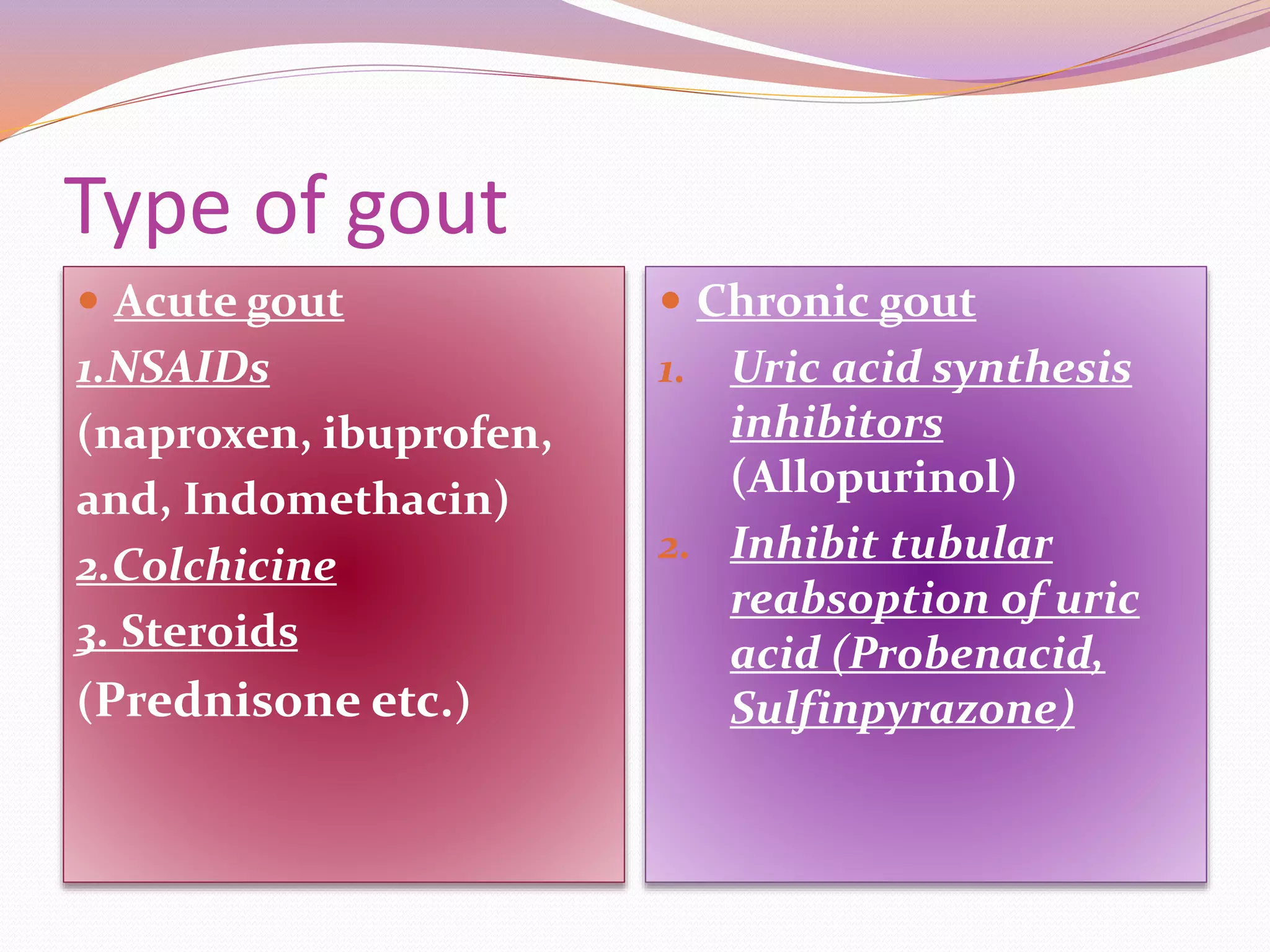
Type of gout
 Acute gout
1.NSAIDs
(naproxen, ibuprofen,
and, Indomethacin)
2.Colchicine
3. Steroids
(Prednisone etc.)
 Chronic gout
1. Uric acid synthesis
inhibitors
(Allopurinol)
2. Inhibit tubular
reabsoption of uric
acid (Probenacid,
Sulfinpyrazone)
Acute Gout
 The cause of gout is build up of uric acid in the blood,
which then accumulates in the joints as crystals,
leading to acute attacks characterised by inflammation
and severe pain called Acute gout.
Non steroidal Anti inflammatory Drugs
 NSAIDs reduce the inflammation and pain in the joint.
 Examples include naproxen, ibuprofen, and indomethacin.
MOAs of NSAIDs
NSAIDs inhibits COX
Inhibit PG synthesis ( specially decrease PGE2 synthesis)
NSAIDs reduce the inflammation and pain in the joint.
Colchicine
 Colchicine acts by interfering with many steps in the inflammatory
process (mainly act by METAPHASE arrest of, multiplying
inflammatory cells, at inflammation site) of gouty arthritis and can
help in reducing the inflammation and pain in gout.
MOAs of Colchicine
Side effects of Colchicine
The drug has many side effects such as
 nausea, vomiting and
 diarrhoea.
Corticosteroids:
 These drugs act by inhibiting the process of inflammation
and may control gout inflammation and pain.
 They may be prescribed as pills or as injections given into
the joint.
 Corticosteroids are generally reserved for people who can't
take either NSAIDs or colchicine.
 Corticosteroids should be taken under close supervision of
the physician because they can cause many adverse effects
when used for long-term.
 E.g. prednisone
MOA of Corticosteroids
Inhibit Phaspholipase A2
Decrease Arachidinoic acid synthesis
Decrease prostaglandine (PGs) synthesis and leukotirine (LTs) synthesis
Side effects of corticosteroids may include
 mood changes,
 increased blood sugar levels and
 elevated blood pressure.
Chronic Gout
 Allopurinol is a drug that belongs to a class of medications
called xanthine oxidase inhibitors.
 Allopurinol is prescribed for the treatment of
chronic gout and is used to prevent rather than treat gout
attacks.
 The medication works by blocking uric acid production.
Uric acid is a waste product normally present in the blood
as a result of the breakdown of purines.
 Excessive amounts of uric acid can cause crystals to form in
the joints, which can lead to gout.
Allopurinol (uric acid synthesis inhibitors)
MOAs of Allopurinol
Allopurinol
Xanthine oxidase
Alloxanthine
Purine base
( Adenine and Guanine)
Xanthine oxidase
Irreversibly inhibits Xanthine oxidase
Decrease Uric acid
 Allopurinol also called as suicidal inhibitor.
 Becose at the place of purine base Allopurinol metabolized by
Xanthine oxidase and decrease uric acid concontration
Note: Secondary gout or Drug induced gout
Anticancer drugs
(Chemotherapy, Radiotherapy-
X- Rays)
Destroy
cancer cells
Break down of
purine base
Increase
uric acid
Secondary
Hyperuricaemia
Secondary gout or
Drug induced gout
 Thiazide (medium efficacy diuretic)– when used for long term in
treatment as Antihypertensive Agent then s/e is Hyperuricaemia
Long term thiazide therapy induced secondary gout or secondary
Hyperuricaemia prevented with Allopurinol
Drug interaction
 That’s why Anticancer drugs are always administered with Allopurinol
for prophylaxis.
Azathioprine 6 mercaptopurinMetabolism
Both drug metabolized by Xanthine oxidase
 Allopurinol due to inhibition of Xanthine oxidase, potentiate the effect
of Azathioprine and 6- mercaptopurine
 So Dr decrease the effect of Azathioprine and 6 m.p.
 Means allopurinol decrease the side effect of Azathioprine and 6 m.p.
Uses of allopurinol
 Allopurinol is prescribed to
 prevent chronic gout attacks,
 manage high uric acid levels caused by cancer
medications (Secondary Hyperuricaemia), and
 to treat kidney stones.
Uricosuric Drugs
 Uricosurics are often used in the treatment of gout, a disease in which
uric acid crystals form deposits in the joints.
 By decreasing plasma uric acid levels, uricosurics help dissolve these
crystals, while limiting the formation of new ones.
 However, the increased uric acid levels in urine can contribute
to kidney stones. Thus, use of these drugs is contraindicated in persons
already with a high urine concentration of uric acid (hyperuricosuria).
 In borderline cases, enough water to produce 2 liters of urine per day
may be sufficient to permit use of an uricosuric drug.
 By their mechanism of action, some uricosurics (such as probenecid)
increase the blood plasma concentration of certain other drugs and
their metabolic products. Assessment of drug interactions is very
important when using uricosuric drugs in the presence of other
medications.
MOA of uricosuric Drugs
Uricosuric drugs
Increase the loss of Uric acid in
Urine
Inhibit competitively renal tubular
re- absorption of Uric acid
Uricosuric drugs are substances that increase the excretion
of uric acid in the urine, thus reducing the concentration of
uric acid in blood plasma. In general, this effect is achieved by
action on the proximal tubule of the kidney.
Adverse effects
 Probenecid :
 Headache
 joint pain, redness, or swelling
 loss of appetite
 nausea or vomiting (mild)
 Sulfinpyrazone:
 Joint pain, redness, and/or swelling
 nausea or vomiting
 stomach pain
Anti gout

Anti gout

  • 1.
    JAI MATA DISHREE KRISHAN SHARNAM MAMAH STUDY MATERIAL FOR PHARMACY STUDENTS
  • 2.
    Gout  Gout isusually characterized by recurrent attacks of inflammatory arthritis—a red, tender, hot, and swollen joint. Pain typically comes on rapidly in less than twelve hours.  The joint at the base of the big toe is affected in about half of cases.  It may also result in tophi, kidney stones, or urate nephropathy.  The underlying mechanism involves elevated levels of uric acid in the blood.  At high levels, the uric acid crystallizes and the crystals deposit in joints, tendons and surrounding tissues, an attack of gout occurs.
  • 3.
     It isa metabolic disorder.  In detail It is a disorder of purine metabolism.  Uric acid is produced in the body when the body breaks up the materials called as purines. Purines are naturally occurring chemical substances found in certain foods, mainly organ meat and seafood. Uric acid can also be increased by alcoholic drinks, particularly beer, and by some fruit juices that are rich in fructose.  Gout occurs when its (Purines) final metabolite, uric acid, crystallizes in the form of monosodium urate, precipitating and forming deposits (tophi) in joints, on tendons and in the surrounding tissues (deposit in synovial fluid present in b/w joints).
  • 4.
    Gout Purine base Metabolism Increase uric acid Increaseduric acid Crystals deposit in joints, tendons and surrounding tissues, (in synovial fluid) Gout  Means gout is Characterized by hyperuriceamia. Note  Joints are lubricated by synovial fluid.  In healthy person urine, uric acid is present.
  • 6.
    cause  Uric acid,present in the blood is cleared by kidneys into the urine. When there is too much uric acid, the kidney cannot clear the entire load, resulting in its build up in the blood. The excess uric acid in the blood then becomes crystals in the joints and surrounding tissues, causing inflammation, swelling and pain.  The crystallization of uric acid, often related to relatively high levels in the blood, is the underlying cause of gout. (This can occur because diet, genetic predisposition, or under excretion of urate, the salts of uric acid.)  Under excretion of uric acid by the kidney is the primary cause of hyperuricemia. Or overproduction of uric acid is another cause (Less common).  About 10% of people with hyperuricemia develop gout at some point in their lifetimes.  When levels are between 415 and 530 μmol/l (7 and 8.9 mg/dl), the risk is 0.5% per year, while in those with a level greater than 535 μmol/l (9 mg/dL), the risk is 4.5% per year.
  • 7.
    Risk Factors  Dietaryfactors: Consumption of meat, seafood, alcohol (especially beer), beverages containing fructose (fruit sugar).  Overweight and obesity: When the body weight is more, there are higher amounts of uric acid produced from metabolism.  Some medical disease: Some diseases are known to increase the risk of gout development including diabetes, metabolic syndrome, untreated hypertension, heart and kidney diseases.  Some medicines: Some drugs can increase the uric acid levels in blood including thiazide diuretics (used for high blood pressure), low-dose aspirin (used in heart diseases) and anti-rejection medications (used after organ transplantations).  Family history: If there is an immediate family member with gout, you may be at a higher risk of developing gout.  Age and gender: The incidence of gout is higher in males than in females, as they have lower uric acid levels. Men also get gout at an earlier age (30-50 years) compared to women. In women, gout is seen mostly after menopause.
  • 8.
    Signs and symptoms Gout can present in multiple ways, although the most usual is a recurrent attack of acute inflammatory arthritis (a red, tender, hot, swollen joint). The metatarsal-phalangeal joint at the base of the big toe is affected most often. Other joints, such as the heels, knees, wrists and fingers, may also be affected.  Joint pain usually begins over 2–4 hours and during the night. This is mainly due to lower body temperature.
  • 9.
    Long-standing elevated uricacid levels (hyperuricemia) may result in other symptoms, including hard, painless deposits of uric acid crystals known as tophi. Extensive tophi may lead to chronic arthritis due to bone erosion. Elevated levels of uric acid may also lead to crystals precipitating in the kidneys, resulting in stone formation and subsequent urate nephropathy.
  • 11.
    Diagnosis  Some ofthe tests that may be done to diagnose the gout include:  Blood tests: Tests for uric acid and creatinine levels in the blood may be recommended. Uric acid may be elevated.  X-ray of the joint: X-ray of the joint may help in ruling out other causes of joint inflammation.  Joint fluid testing: The doctor may advise to undergo a test wherein a needle is inserted into the affected joint to collect the fluid sample for examination. The fluid when tested may reveal uric acid crystals.  Dual energy CT scan: This test can detect uric acid crystals in a joint but it is a costly investigation.
  • 12.
    Gout presenting inthe metatarsal- phalangeal joint of the big toe: Note the slight redness of the skin overlying the joint. Gout on X-rays of a left foot. The typical location is the big toe joint. Note also the soft tissue swelling at the lateral border of the foot. Spiked rods of uric acid crystals from a synovial fluid sample photographed under a microscope with polarized light. Formation of uric acid crystals in the joints is associated with gout. Uric acid
  • 13.
    Treatment and Prevention Treatment with nonsteroidal anti-inflammatory drugs (NSAIDs), steroids, or colchicine improves symptoms.  Once the acute attack subsides, levels of uric acid can be lowered via lifestyle changes and  In those with frequent attacks, allopurinol or probenecid provides long-term prevention. Taking vitamin C and eating a diet high in low fat dairy products may be preventive.  Gout was historically known as "the disease of kings" or "rich man's disease“.
  • 14.
    Type of gout Acute gout 1.NSAIDs (naproxen, ibuprofen, and, Indomethacin) 2.Colchicine 3. Steroids (Prednisone etc.)  Chronic gout 1. Uric acid synthesis inhibitors (Allopurinol) 2. Inhibit tubular reabsoption of uric acid (Probenacid, Sulfinpyrazone)
  • 15.
    Acute Gout  Thecause of gout is build up of uric acid in the blood, which then accumulates in the joints as crystals, leading to acute attacks characterised by inflammation and severe pain called Acute gout. Non steroidal Anti inflammatory Drugs  NSAIDs reduce the inflammation and pain in the joint.  Examples include naproxen, ibuprofen, and indomethacin.
  • 16.
    MOAs of NSAIDs NSAIDsinhibits COX Inhibit PG synthesis ( specially decrease PGE2 synthesis) NSAIDs reduce the inflammation and pain in the joint.
  • 17.
    Colchicine  Colchicine actsby interfering with many steps in the inflammatory process (mainly act by METAPHASE arrest of, multiplying inflammatory cells, at inflammation site) of gouty arthritis and can help in reducing the inflammation and pain in gout. MOAs of Colchicine Side effects of Colchicine The drug has many side effects such as  nausea, vomiting and  diarrhoea.
  • 18.
    Corticosteroids:  These drugsact by inhibiting the process of inflammation and may control gout inflammation and pain.  They may be prescribed as pills or as injections given into the joint.  Corticosteroids are generally reserved for people who can't take either NSAIDs or colchicine.  Corticosteroids should be taken under close supervision of the physician because they can cause many adverse effects when used for long-term.  E.g. prednisone
  • 19.
    MOA of Corticosteroids InhibitPhaspholipase A2 Decrease Arachidinoic acid synthesis Decrease prostaglandine (PGs) synthesis and leukotirine (LTs) synthesis Side effects of corticosteroids may include  mood changes,  increased blood sugar levels and  elevated blood pressure.
  • 20.
    Chronic Gout  Allopurinolis a drug that belongs to a class of medications called xanthine oxidase inhibitors.  Allopurinol is prescribed for the treatment of chronic gout and is used to prevent rather than treat gout attacks.  The medication works by blocking uric acid production. Uric acid is a waste product normally present in the blood as a result of the breakdown of purines.  Excessive amounts of uric acid can cause crystals to form in the joints, which can lead to gout. Allopurinol (uric acid synthesis inhibitors)
  • 21.
    MOAs of Allopurinol Allopurinol Xanthineoxidase Alloxanthine Purine base ( Adenine and Guanine) Xanthine oxidase Irreversibly inhibits Xanthine oxidase Decrease Uric acid  Allopurinol also called as suicidal inhibitor.  Becose at the place of purine base Allopurinol metabolized by Xanthine oxidase and decrease uric acid concontration
  • 22.
    Note: Secondary goutor Drug induced gout Anticancer drugs (Chemotherapy, Radiotherapy- X- Rays) Destroy cancer cells Break down of purine base Increase uric acid Secondary Hyperuricaemia Secondary gout or Drug induced gout  Thiazide (medium efficacy diuretic)– when used for long term in treatment as Antihypertensive Agent then s/e is Hyperuricaemia Long term thiazide therapy induced secondary gout or secondary Hyperuricaemia prevented with Allopurinol
  • 23.
    Drug interaction  That’swhy Anticancer drugs are always administered with Allopurinol for prophylaxis. Azathioprine 6 mercaptopurinMetabolism Both drug metabolized by Xanthine oxidase  Allopurinol due to inhibition of Xanthine oxidase, potentiate the effect of Azathioprine and 6- mercaptopurine  So Dr decrease the effect of Azathioprine and 6 m.p.  Means allopurinol decrease the side effect of Azathioprine and 6 m.p.
  • 24.
    Uses of allopurinol Allopurinol is prescribed to  prevent chronic gout attacks,  manage high uric acid levels caused by cancer medications (Secondary Hyperuricaemia), and  to treat kidney stones.
  • 25.
    Uricosuric Drugs  Uricosuricsare often used in the treatment of gout, a disease in which uric acid crystals form deposits in the joints.  By decreasing plasma uric acid levels, uricosurics help dissolve these crystals, while limiting the formation of new ones.  However, the increased uric acid levels in urine can contribute to kidney stones. Thus, use of these drugs is contraindicated in persons already with a high urine concentration of uric acid (hyperuricosuria).  In borderline cases, enough water to produce 2 liters of urine per day may be sufficient to permit use of an uricosuric drug.  By their mechanism of action, some uricosurics (such as probenecid) increase the blood plasma concentration of certain other drugs and their metabolic products. Assessment of drug interactions is very important when using uricosuric drugs in the presence of other medications.
  • 26.
    MOA of uricosuricDrugs Uricosuric drugs Increase the loss of Uric acid in Urine Inhibit competitively renal tubular re- absorption of Uric acid Uricosuric drugs are substances that increase the excretion of uric acid in the urine, thus reducing the concentration of uric acid in blood plasma. In general, this effect is achieved by action on the proximal tubule of the kidney.
  • 27.
    Adverse effects  Probenecid:  Headache  joint pain, redness, or swelling  loss of appetite  nausea or vomiting (mild)  Sulfinpyrazone:  Joint pain, redness, and/or swelling  nausea or vomiting  stomach pain