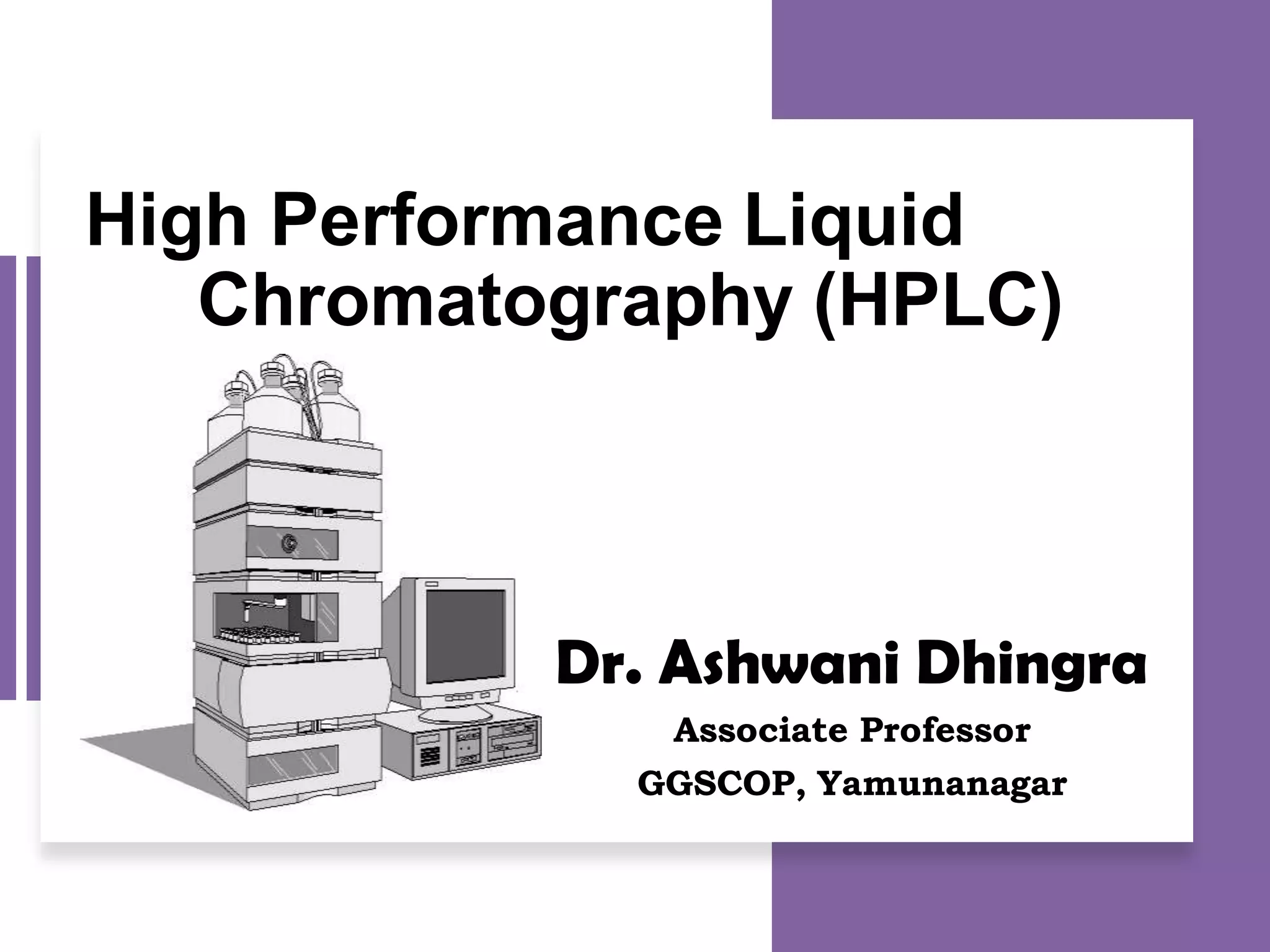

High Performance Liquid
Chromatography (HPLC)
Dr. Ashwani Dhingra
Associate Professor
GGSCOP, Yamunanagar
Chromatography
Chromatography is a separation technique which is used to
separate a mixture of compounds into its individual
components based on certain physical and chemical
properties.
Some important terms:
• Mobile phase: The solvent system which
carries the mixture to be separated.
• Stationary phase: Immobile surface which is particulate in
nature. This is the region over which the compound gets
separated.
Principle
• The process involves the interaction of
the compounds in the analyte
(which travels along with a mobile
phase) across an immobile surface
(stationary phase).
• The compounds bind at specific
regions of stationary phase based on
certain physical and chemical
properties. These bound molecules are
then eluted with a suitable buffer and
the same are collected with time.
These includes :-
• Polarity
• Charge
• Molecular weight
• Present of functional group
Introduction
• HPLC is a form of liquid chromatography used to
separate compounds that are dissolved in solution.
• HPLC instruments consist of a reservoir of mobile phase,
a pump, an injector, a separation column, and a detector.
• Compounds are separated by injecting a sample mixture
onto the column. The different component in the mixture pass
through the column at differentiates due to differences in their
partition behavior between the mobile phase and the stationary
phase.
• The mobile phase must be degassed to eliminate the formation
of air bubbles.
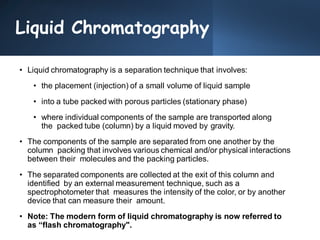
Liquid Chromatography
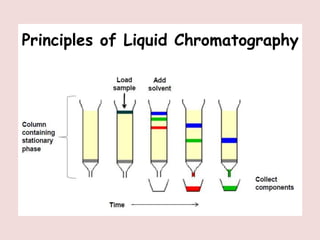
• Liquid chromatography is a separation technique that involves:
• the placement (injection) of a small volume of liquid sample
• into a tube packed with porous particles (stationary phase)
• where individual components of the sample are transported along
the packed tube (column) by a liquid moved by gravity.
• The components of the sample are separated from one another by the
column packing that involves various chemical and/or physical interactions
between their molecules and the packing particles.
• The separated components are collected at the exit of this column and
identified by an external measurement technique, such as a
spectrophotometer that measures the intensity of the color, or by another
device that can measure their amount.
• Note: The modern form of liquid chromatography is now referred to
as “flash chromatography".
Principles of Liquid Chromatography
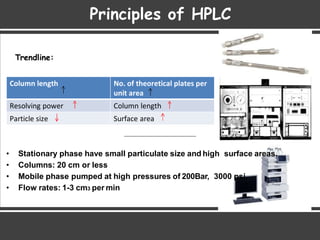
Principles of HPLC
• Stationary phase have small particulate size and high surface areas.
• Columns: 20 cm or less
• Mobile phase pumped at high pressures of 200Bar, 3000 psi.
• Flow rates: 1-3 cm3 per min
Trendline:
Column length​ No. of theoretical plates per
unit area​
Resolving power​ Column length​
Particle size​ Surface area​
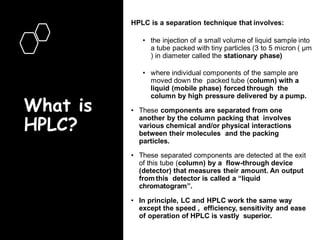
What is
HPLC?
HPLC is a separation technique that involves:
• the injection of a small volume of liquid sample into
a tube packed with tiny particles (3 to 5 micron ( μm
) in diameter called the stationary phase)
• where individual components of the sample are
moved down the packed tube (column) with a
liquid (mobile phase) forced through the
column by high pressure delivered by a pump.
• These components are separated from one
another by the column packing that involves
various chemical and/or physical interactions
between their molecules and the packing
particles.
• These separated components are detected at the exit
of this tube (column) by a flow-through device
(detector) that measures their amount. An output
from this detector is called a “liquid
chromatogram”.
• In principle, LC and HPLC work the same way
except the speed , efficiency, sensitivity and ease
of operation of HPLC is vastly superior.
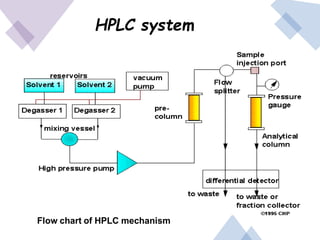
HPLC system
Flow chart of HPLC mechanism
COMPOSITION OF A LIQUID
CHROMATOGRAPH SYSTEM
• Solvent
• Solvent Delivery System (Pump) Injector
• Sample Column Detector
• Waste Collector
• Recorder (Data Collection)
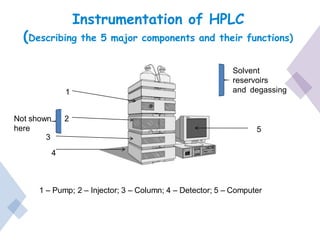
Instrumentation of HPLC
(Describing the 5 major components and their functions)
Solvent
reservoirs
and degassing
1 – Pump; 2 – Injector; 3 – Column; 4 – Detector; 5 – Computer
1
5
Not shown 2
here
3
4
Pump
• The role of the pump is to force a
liquid (called the mobile
phase) through the liquid
chromatograph at a specific flow rate,
expressed in milliliters per min (mL
/min).
• Normal flow rates in HPLC are in
the 1-to 2-mL/min range.
• Typical pumps can reach
pressures in the range of 6000-
9000 psi (400-to 600-bar).
• During the chromatographic experiment,
a pump can deliver a constant mobile
phase composition (isocratic) or an
increasing mobile phase composition
(gradient).
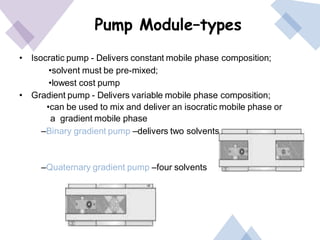
Pump Module–types
• Isocratic pump - Delivers constant mobile phase composition;
•solvent must be pre-mixed;
•lowest cost pump
• Gradient pump - Delivers variable mobile phase composition;
•can be used to mix and deliver an isocratic mobile phase or
a gradient mobile phase
–Binary gradient pump –delivers two solvents
–Quaternary gradient pump –four solvents
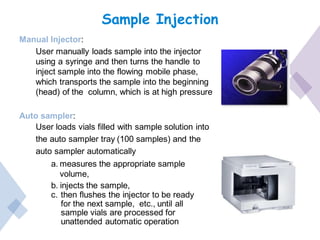
Sample Injection
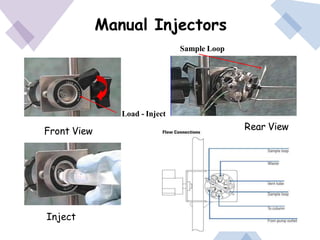
Manual Injector:
User manually loads sample into the injector
using a syringe and then turns the handle to
inject sample into the flowing mobile phase,
which transports the sample into the beginning
(head) of the column, which is at high pressure
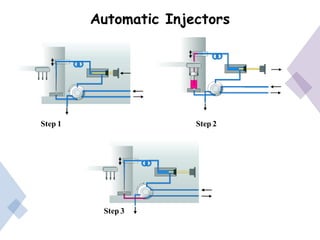
Auto sampler:
User loads vials filled with sample solution into
the auto sampler tray (100 samples) and the
auto sampler automatically
a. measures the appropriate sample
volume,
b. injects the sample,
c. then flushes the injector to be ready
for the next sample, etc., until all
sample vials are processed for
unattended automatic operation
Manual Injectors
Inject
Front View Rear View
Sample Loop
Load - Inject
Automatic Injectors
Step 1 Step 2
Step 3
• Considered the “heart of the
chromatograph” the column’s
stationary phase separates the sample
components of interest using various
physical and chemical parameters.
• The small particles inside the
column are what cause the
high back pressure at normal
flow rates.
• The pump must push hard to
move the mobile phase through
the column and this resistance
causes a high pressure within
the chromatograph.
Column
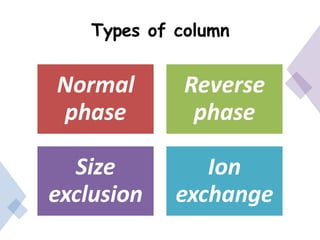
Types of column
Normal
phase
Reverse
phase
Size
exclusion
Ion
exchange
Normal
phase
In this column type, the
retention is governed by the
interaction of the polar
parts of the stationary
phase and solute.
For retention to occur in
normal phase, the packing
must be more polar than
the mobile phase with
respect to the sample
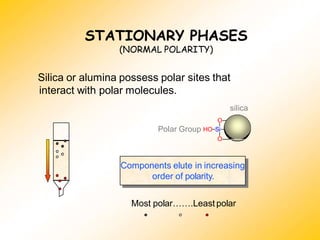
STATIONARY PHASES
(NORMAL POLARITY)
Most polar…….Least polar
Components elute in increasing
order of polarity.
O
Polar Group HO Si
O
Silica or alumina possess polar sites that
interact with polar molecules.
silica
Reverse phase
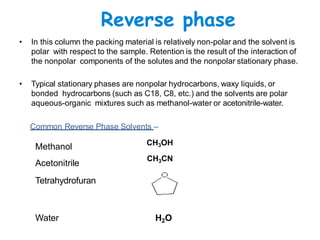
• In this column the packing material is relatively non-polar and the solvent is
polar with respect to the sample. Retention is the result of the interaction of
the nonpolar components of the solutes and the nonpolar stationary phase.
• Typical stationary phases are nonpolar hydrocarbons, waxy liquids, or
bonded hydrocarbons (such as C18, C8, etc.) and the solvents are polar
aqueous-organic mixtures such as methanol-water or acetonitrile-water.
Common Reverse Phase Solvents –
Methanol
Acetonitrile
Tetrahydrofuran
Water
CH3OH
CH3CN
H2O
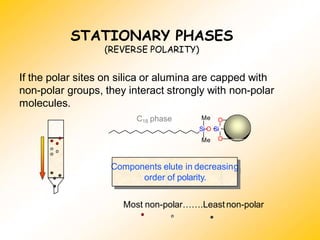
STATIONARY PHASES
(REVERSE POLARITY)
Most non-polar…….Least non-polar
C g
omponents elute in decreasin
order of polarity.
C18 phase
If the polar sites on silica or alumina are capped with
non-polar groups, they interact strongly with non-polar
molecules.
silica
Me
Me
Si O Si
O
O
Size
exclusion
In size exclusion the HPLC column
is consisted of substances which
have controlled pore sizes and is
able to be filtered in an ordinarily
phase according to its molecular
size.
Small molecules penetrate into
the pores within the packing
while larger molecules only
partially penetrate the pores. The
large molecules elute before the
smaller molecules.
25
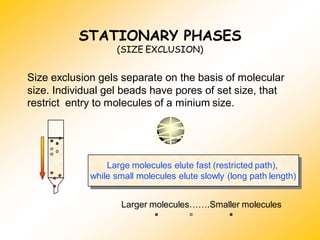
STATIONARY PHASES
(SIZE EXCLUSION)
Size exclusion gels separate on the basis of molecular
size. Individual gel beads have pores of set size, that
restrict entry to molecules of a minium size.
Larger molecules…….Smaller molecules
Large molecules elute fast (restricted path),
while small molecules elute slowly (long path length)
Ion
exchange
In this column type the sample
components are separated based
upon attractive ionic forces
between molecules carrying
charged groups of opposite charge
to those charges on the stationary
phase.
Separations are made between a
polar mobile liquid, usually water
containing salts or small amounts
of alcohols, and a stationary phase
containing either acidic or basic
fixed sites.
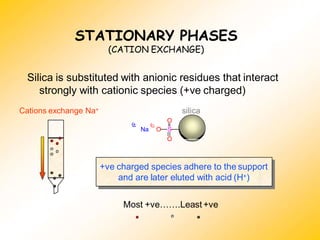
STATIONARY PHASES
(CATION EXCHANGE)
Most +ve…….Least+ve
+ve charged species adhere to the support
and are later eluted with acid (H+)
Silica is substituted with anionic residues that interact
strongly with cationic species (+ve charged)
Cations exchange Na+ silica
O
Na O S
O
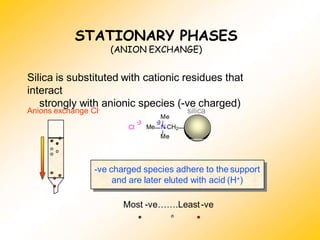
Silica is substituted with cationic residues that
interact
strongly with anionic species (-ve charged)
Most -ve…….Least-ve
-ve charged species adhere to the support
and are later eluted with acid (H+)
Anions exchange Cl- silica
Me
Me N CH2
Me
Cl
STATIONARY PHASES
(ANION EXCHANGE)
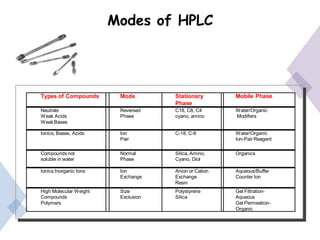
Types of Compounds Mode Stationary
Phase
Mobile Phase
Neutrals
Weak Acids
WeakBases
Reversed
Phase
C18, C8, C4
cyano, amino
Water/Organic
Modifiers
Ionics, Bases, Acids Ion
Pair
C-18, C-8 Water/Organic
Ion-Pair Reagent
Compounds not
soluble in water
Normal
Phase
Silica, Amino,
Cyano, Diol
Organics
Ionics Inorganic Ions Ion
Exchange
Anion or Cation
Exchange
Resin
Aqueous/Buffer
Counter Ion
High Molecular Weight
Compounds
Polymers
Size
Exclusion
Polystyrene
Silica
Gel Filtration-
Aqueous
Gel Permeation-
Organic
Modes of HPLC
Separations
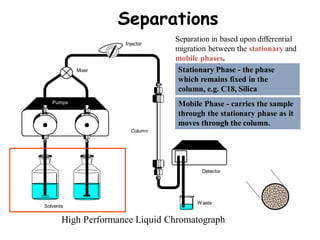
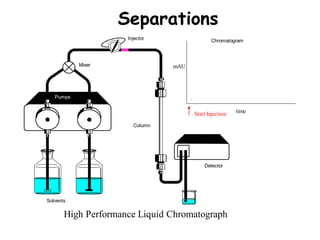
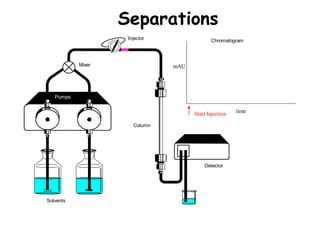
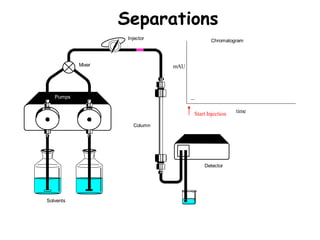
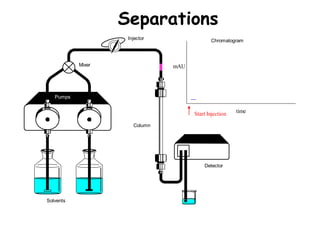
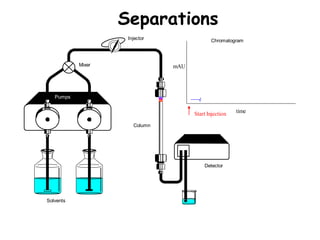
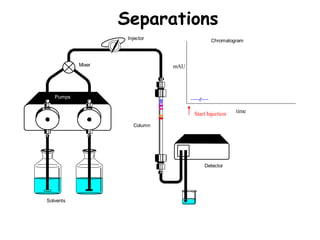
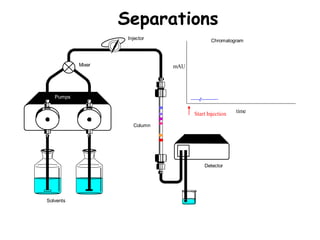
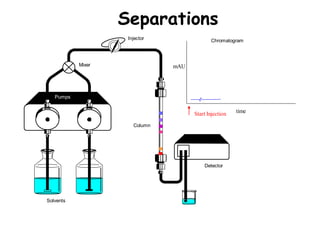
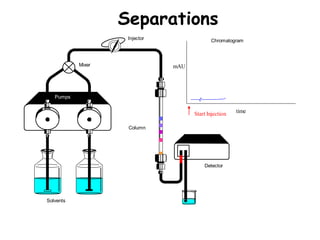
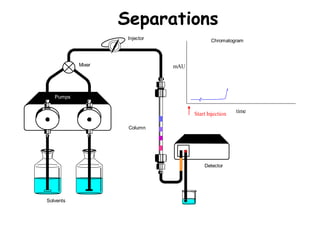
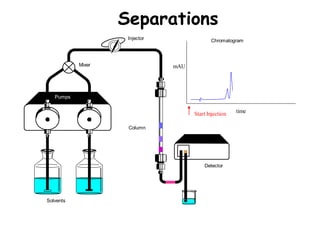
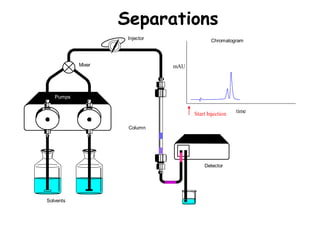
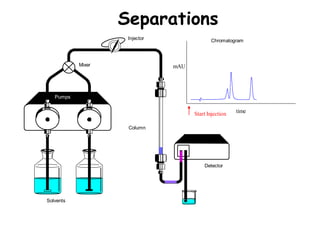
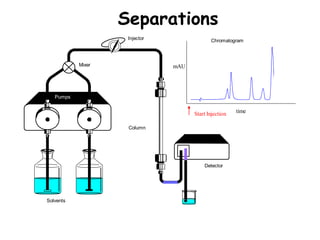
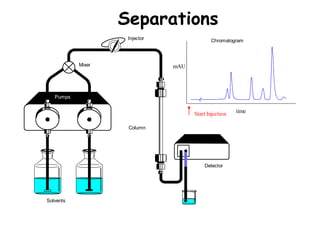
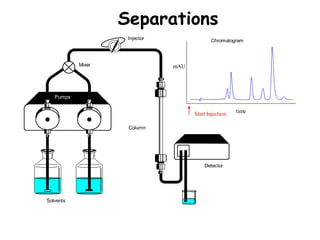
Separation in based upon differential
migration between the stationary and
mobile phases.
Stationary Phase - the phase
which remains fixed in the
column, e.g. C18, Silica
Mobile Phase - carries the sample
through the stationary phase as it
moves through the column.
Injector
Detector
Column
Solvents
Mixer
Pumps
High Performance Liquid Chromatograph
Waste
Injector
Detector
Column
Solvents
Mixer
Pumps
Chromatogram
Start Injection
mAU
time
High Performance Liquid Chromatograph
Separations
Injector
Detector
Column
Solvents
Mixer
Pumps
Chromatogram
Start Injection
mAU
time
Separations
Injector
Detector
Column
Solvents
Pumps
Mixer
Chromatogram
Start Injection
mAU
time
Separations
Injector
Detector
Column
Solvents
Pumps
Mixer
Chromatogram
Start Injection
mAU
time
Separations
Injector
Detector
Column
Solvents
Pumps
Mixer
Chromatogram
Start Injection
mAU
time
Separations
Injector
Detector
Column
Solvents
Pumps
Mixer
Chromatogram
Start Injection
mAU
time
Separations
Injector
Detector
Column
Solvents
Pumps
Mixer
Chromatogram
Start Injection
mAU
time
Separations
Injector
Detector
Column
Solvents
Pumps
Mixer
Chromatogram
Start Injection
mAU
time
Separations
Injector
Detector
Column
Solvents
Pumps
Mixer
Chromatogram
Start Injection
mAU
time
Separations
Injector
Detector
Column
Solvents
Pumps
Mixer
Chromatogram
Start Injection
mAU
time
Separations
Injector
Detector
Column
Solvents
Pumps
Mixer
Chromatogram
Start Injection
mAU
time
Separations
Injector
Detector
Column
Solvents
Pumps
Mixer
Chromatogram
Start Injection
mAU
time
Separations
Injector
Detector
Column
Solvents
Pumps
Mixer
Chromatogram
Start Injection
mAU
time
Separations
Injector
Detector
Column
Solvents
Pumps
Mixer
Chromatogram
Start Injection
mAU
time
Separations
Injector
Detector
Column
Solvents
Pumps
Mixer
Chromatogram
Start Injection
mAU
time
Separations
Injector
Detector
Column
Solvents
Pumps
Mixer
Chromatogram
Start Injection
mAU
time
Separations
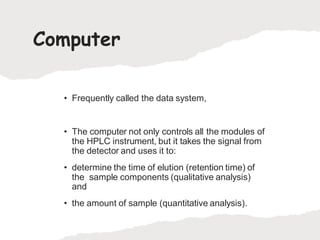
Computer
• Frequently called the data system,
• The computer not only controls all the modules of
the HPLC instrument, but it takes the signal from
the detector and uses it to:
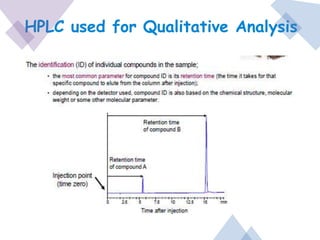
• determine the time of elution (retention time) of
the sample components (qualitative analysis)
and
• the amount of sample (quantitative analysis).
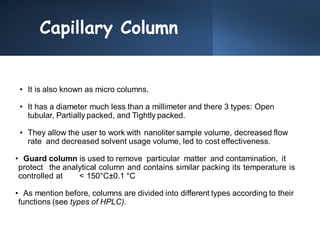
Capillary Column
• It is also known as micro columns.
• It has a diameter much less than a millimeter and there 3 types: Open
tubular, Partially packed, and Tightly packed.
• They allow the user to work with nanoliter sample volume, decreased flow
rate and decreased solvent usage volume, led to cost effectiveness.
• Guard column is used to remove particular matter and contamination, it
protect the analytical column and contains similar packing its temperature is
controlled at < 150°C±0.1 °C
• As mention before, columns are divided into different types according to their
functions (see types of HPLC).
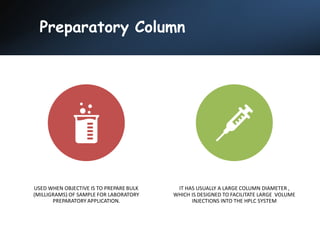
Preparatory Column
USED WHEN OBJECTIVE IS TO PREPARE BULK
(MILLIGRAMS) OF SAMPLE FOR LABORATORY
PREPARATORY APPLICATION.
IT HAS USUALLY A LARGE COLUMN DIAMETER ,
WHICH IS DESIGNED TO FACILITATE LARGE VOLUME
INJECTIONS INTO THE HPLC SYSTEM
Detector
• The detector can see (detect) the individual molecules that
come out (elute) from the column.
• A detector serves to measure the amount of those
molecules so that the chemist can quantitatively
analyze the sample components.
• The detector provides an output to a recorder or
computer that results in the liquid chromatogram
(i.e., the graph of the detector response).
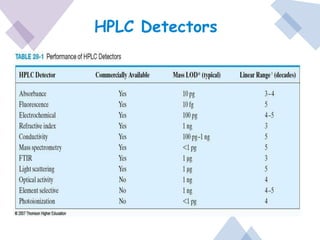
HPLC Detectors
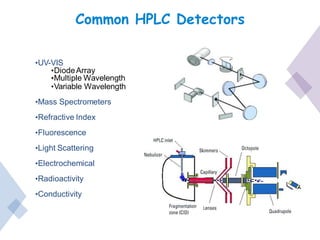
Common HPLC Detectors
•UV-VIS
•DiodeArray
•Multiple Wavelength
•Variable Wavelength
•Mass Spectrometers
•Refractive Index
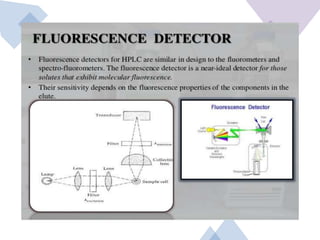
•Fluorescence
•Light Scattering
•Electrochemical
•Radioactivity
•Conductivity
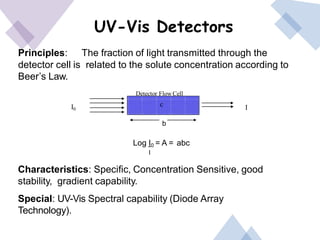
UV-Vis Detectors
Principles: The fraction of light transmitted through the
detector cell is related to the solute concentration according to
Beer’s Law.
b
Log I0 = A = abc
I
Characteristics: Specific, Concentration Sensitive, good
stability, gradient capability.
Special: UV-Vis Spectral capability (Diode Array
Technology).
I0
Detector Flow Cell
c I
Electrochemical Detectors
• Gold for carbohydrates.
• Platinum for chlorite, sulfate, hydrazine, etc.
• Carbon for phenols, amines.
• Silver for chloride, bromide, cyanide.
Applications
Separation and analysis of non-volatile or thermally unstable compounds
HPLC is optimum for the separation of chemical and biological compounds that
are non-volatile.
NOTE: If a compound is volatile (i.e. a gas, fragrance, hydrocarbon in gasoline, etc.),
gas chromatography is a better separation technique.
Typical non-volatile compounds are:
• Pharmaceuticals like aspirin, ibuprofen, or acetaminophen (Tylenol)
• Salts like sodium chloride and potassium phosphate
• Proteins like egg white or blood protein
• Organic chemicals like polymers (e.g. polystyrene, polyethylene)
• Heavy hydrocarbons like asphalt or motor oil
• Many natural products such as ginseng, herbal medicines, plant extracts
• Thermally unstable compounds such as trinitrotoluene (TNT), enzymes
PARAMETERS
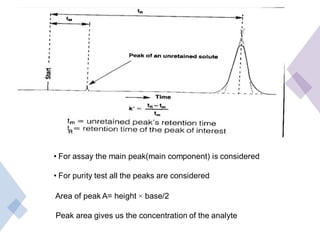
Retention time (RT)
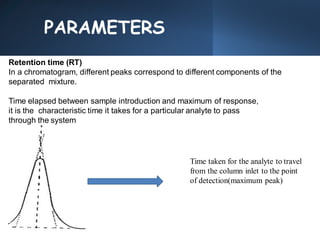
In a chromatogram, different peaks correspond to different components of the
separated mixture.
Time elapsed between sample introduction and maximum of response,
it is the characteristic time it takes for a particular analyte to pass
through the system
Time taken for the analyte to travel
from the column inlet to the point
of detection(maximum peak)
• For assay the main peak(main component) is considered
• For purity test all the peaks are considered
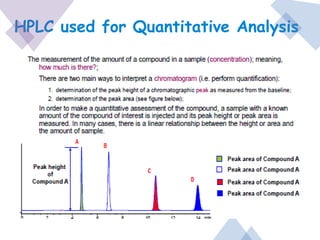
Area of peak A= height × base/2
Peak area gives us the concentration of the analyte
2.Retention volume
Retention volume is the volume of carrier gas required to elute 50% of the component
from the column. It is the product of retention time and flow rate.
Retention volume = Retention time × flow rate
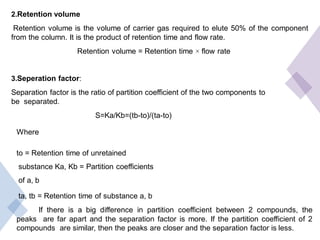
3.Seperation factor:
Separation factor is the ratio of partition coefficient of the two components to
be separated.
S=Ka/Kb=(tb-to)/(ta-to)
Where
to = Retention time of unretained
substance Ka, Kb = Partition coefficients
of a, b
ta, tb = Retention time of substance a, b
If there is a big difference in partition coefficient between 2 compounds, the
peaks are far apart and the separation factor is more. If the partition coefficient of 2
compounds are similar, then the peaks are closer and the separation factor is less.
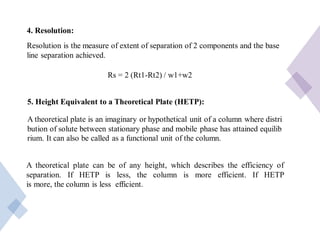
4. Resolution:
Resolution is the measure of extent of separation of 2 components and the base
line separation achieved.
Rs = 2 (Rt1-Rt2) / w1+w2
5. Height Equivalent to a Theoretical Plate (HETP):
A theoretical plate is an imaginary or hypothetical unit of a column where distri
bution of solute between stationary phase and mobile phase has attained equilib
rium. It can also be called as a functional unit of the column.
A theoretical plate can be of any height, which describes the efficiency of
separation. If HETP is less, the column is more efficient. If HETP
is more, the column is less efficient.
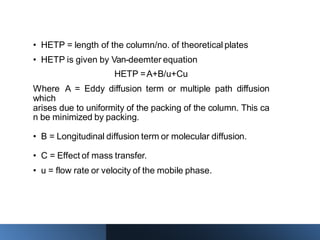
• HETP = length of the column/no. of theoretical plates
• HETP is given by Van-deemter equation
HETP =A+B/u+Cu
Where A = Eddy diffusion term or multiple path diffusion
which
arises due to uniformity of the packing of the column. This ca
n be minimized by packing.
• B = Longitudinal diffusion term or molecular diffusion.
• C = Effect of mass transfer.
• u = flow rate or velocity of the mobile phase.
Efficiency
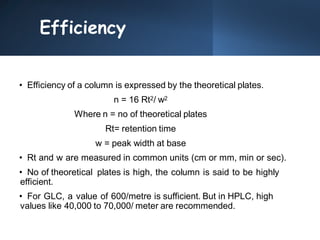
• Efficiency of a column is expressed by the theoretical plates.
n = 16 Rt2/ w2
Where n = no of theoretical plates
Rt= retention time
w = peak width at base
• Rt and w are measured in common units (cm or mm, min or sec).
• No of theoretical plates is high, the column is said to be highly
efficient.
• For GLC, a value of 600/metre is sufficient. But in HPLC, high
values like 40,000 to 70,000/ meter are recommended.
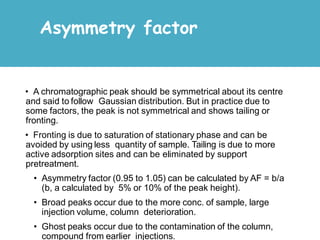
• A chromatographic peak should be symmetrical about its centre
and said to follow Gaussian distribution. But in practice due to
some factors, the peak is not symmetrical and shows tailing or
fronting.
• Fronting is due to saturation of stationary phase and can be
avoided by using less quantity of sample. Tailing is due to more
active adsorption sites and can be eliminated by support
pretreatment.
• Asymmetry factor (0.95 to 1.05) can be calculated by AF = b/a
(b, a calculated by 5% or 10% of the peak height).
• Broad peaks occur due to the more conc. of sample, large
injection volume, column deterioration.
• Ghost peaks occur due to the contamination of the column,
compound from earlier injections.
Asymmetry factor
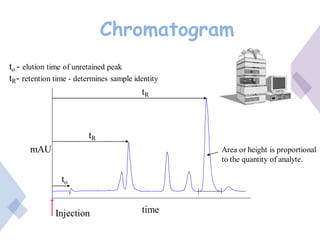
Chromatogram
to - elution time of unretained peak
tR- retention time - determines sample identity
tR
mAU Area or height is proportional
to the quantity of analyte.
Injection time
to
tR
HPLC used for Qualitative Analysis
HPLC used for Quantitative Analysis
Uses
This technique is used for -
• chemistry and biochemistry research analysis of complex mixtures
• purifying chemical compounds
• developing processes for synthesizing chemical compounds
• isolating natural products, or predicting
physical properties.
• It is also used in quality control to ensure the purity of raw materials, to
control and improve process yields, to quantify assays of final products, or
to evaluate product stability and monitor degradation.
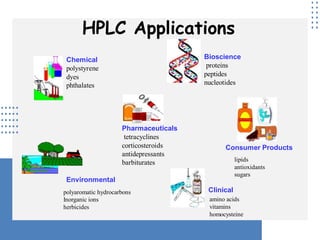
HPLC Applications
Chemical
polystyrene
dyes
phthalates
Environmental
polyaromatic hydrocarbons
Inorganic ions
herbicides
Pharmaceuticals
tetracyclines
corticosteroids
antidepressants
barbiturates
Bioscience
proteins
peptides
nucleotides
Consumer Products
lipids
antioxidants
sugars
Clinical
amino acids
vitamins
homocysteine
Dr. Ashwani Dhingra
Associate Professor
GGSCOP, Yamunanagar
THANK YOU!

High Performance Liquid Chromatography

  • 1.
    High Performance Liquid Chromatography(HPLC) Dr. Ashwani Dhingra Associate Professor GGSCOP, Yamunanagar
  • 2.
    Chromatography Chromatography is aseparation technique which is used to separate a mixture of compounds into its individual components based on certain physical and chemical properties. Some important terms: • Mobile phase: The solvent system which carries the mixture to be separated. • Stationary phase: Immobile surface which is particulate in nature. This is the region over which the compound gets separated.
  • 3.
    Principle • The processinvolves the interaction of the compounds in the analyte (which travels along with a mobile phase) across an immobile surface (stationary phase). • The compounds bind at specific regions of stationary phase based on certain physical and chemical properties. These bound molecules are then eluted with a suitable buffer and the same are collected with time. These includes :- • Polarity • Charge • Molecular weight • Present of functional group
  • 4.
    Introduction • HPLC isa form of liquid chromatography used to separate compounds that are dissolved in solution. • HPLC instruments consist of a reservoir of mobile phase, a pump, an injector, a separation column, and a detector. • Compounds are separated by injecting a sample mixture onto the column. The different component in the mixture pass through the column at differentiates due to differences in their partition behavior between the mobile phase and the stationary phase. • The mobile phase must be degassed to eliminate the formation of air bubbles.
  • 5.
    Liquid Chromatography • Liquidchromatography is a separation technique that involves: • the placement (injection) of a small volume of liquid sample • into a tube packed with porous particles (stationary phase) • where individual components of the sample are transported along the packed tube (column) by a liquid moved by gravity. • The components of the sample are separated from one another by the column packing that involves various chemical and/or physical interactions between their molecules and the packing particles. • The separated components are collected at the exit of this column and identified by an external measurement technique, such as a spectrophotometer that measures the intensity of the color, or by another device that can measure their amount. • Note: The modern form of liquid chromatography is now referred to as “flash chromatography".
  • 6.
    Principles of LiquidChromatography
  • 7.
    Principles of HPLC •Stationary phase have small particulate size and high surface areas. • Columns: 20 cm or less • Mobile phase pumped at high pressures of 200Bar, 3000 psi. • Flow rates: 1-3 cm3 per min Trendline: Column length​ No. of theoretical plates per unit area​ Resolving power​ Column length​ Particle size​ Surface area​
  • 8.
    What is HPLC? HPLC isa separation technique that involves: • the injection of a small volume of liquid sample into a tube packed with tiny particles (3 to 5 micron ( μm ) in diameter called the stationary phase) • where individual components of the sample are moved down the packed tube (column) with a liquid (mobile phase) forced through the column by high pressure delivered by a pump. • These components are separated from one another by the column packing that involves various chemical and/or physical interactions between their molecules and the packing particles. • These separated components are detected at the exit of this tube (column) by a flow-through device (detector) that measures their amount. An output from this detector is called a “liquid chromatogram”. • In principle, LC and HPLC work the same way except the speed , efficiency, sensitivity and ease of operation of HPLC is vastly superior.
  • 9.
    HPLC system Flow chartof HPLC mechanism
  • 10.
    COMPOSITION OF ALIQUID CHROMATOGRAPH SYSTEM • Solvent • Solvent Delivery System (Pump) Injector • Sample Column Detector • Waste Collector • Recorder (Data Collection)
  • 11.
    Instrumentation of HPLC (Describingthe 5 major components and their functions) Solvent reservoirs and degassing 1 – Pump; 2 – Injector; 3 – Column; 4 – Detector; 5 – Computer 1 5 Not shown 2 here 3 4
  • 12.
    Pump • The roleof the pump is to force a liquid (called the mobile phase) through the liquid chromatograph at a specific flow rate, expressed in milliliters per min (mL /min). • Normal flow rates in HPLC are in the 1-to 2-mL/min range. • Typical pumps can reach pressures in the range of 6000- 9000 psi (400-to 600-bar). • During the chromatographic experiment, a pump can deliver a constant mobile phase composition (isocratic) or an increasing mobile phase composition (gradient).
  • 13.
    Pump Module–types • Isocraticpump - Delivers constant mobile phase composition; •solvent must be pre-mixed; •lowest cost pump • Gradient pump - Delivers variable mobile phase composition; •can be used to mix and deliver an isocratic mobile phase or a gradient mobile phase –Binary gradient pump –delivers two solvents –Quaternary gradient pump –four solvents
  • 14.
    Sample Injection Manual Injector: Usermanually loads sample into the injector using a syringe and then turns the handle to inject sample into the flowing mobile phase, which transports the sample into the beginning (head) of the column, which is at high pressure Auto sampler: User loads vials filled with sample solution into the auto sampler tray (100 samples) and the auto sampler automatically a. measures the appropriate sample volume, b. injects the sample, c. then flushes the injector to be ready for the next sample, etc., until all sample vials are processed for unattended automatic operation
  • 15.
    Manual Injectors Inject Front ViewRear View Sample Loop Load - Inject
  • 16.
  • 17.
    • Considered the“heart of the chromatograph” the column’s stationary phase separates the sample components of interest using various physical and chemical parameters. • The small particles inside the column are what cause the high back pressure at normal flow rates. • The pump must push hard to move the mobile phase through the column and this resistance causes a high pressure within the chromatograph. Column
  • 18.
  • 19.
    Normal phase In this columntype, the retention is governed by the interaction of the polar parts of the stationary phase and solute. For retention to occur in normal phase, the packing must be more polar than the mobile phase with respect to the sample
  • 20.
    STATIONARY PHASES (NORMAL POLARITY) Mostpolar…….Least polar Components elute in increasing order of polarity. O Polar Group HO Si O Silica or alumina possess polar sites that interact with polar molecules. silica
  • 21.
    Reverse phase • Inthis column the packing material is relatively non-polar and the solvent is polar with respect to the sample. Retention is the result of the interaction of the nonpolar components of the solutes and the nonpolar stationary phase. • Typical stationary phases are nonpolar hydrocarbons, waxy liquids, or bonded hydrocarbons (such as C18, C8, etc.) and the solvents are polar aqueous-organic mixtures such as methanol-water or acetonitrile-water. Common Reverse Phase Solvents – Methanol Acetonitrile Tetrahydrofuran Water CH3OH CH3CN H2O
  • 22.
    STATIONARY PHASES (REVERSE POLARITY) Mostnon-polar…….Least non-polar C g omponents elute in decreasin order of polarity. C18 phase If the polar sites on silica or alumina are capped with non-polar groups, they interact strongly with non-polar molecules. silica Me Me Si O Si O O
  • 23.
    Size exclusion In size exclusionthe HPLC column is consisted of substances which have controlled pore sizes and is able to be filtered in an ordinarily phase according to its molecular size. Small molecules penetrate into the pores within the packing while larger molecules only partially penetrate the pores. The large molecules elute before the smaller molecules.
  • 24.
    25 STATIONARY PHASES (SIZE EXCLUSION) Sizeexclusion gels separate on the basis of molecular size. Individual gel beads have pores of set size, that restrict entry to molecules of a minium size. Larger molecules…….Smaller molecules Large molecules elute fast (restricted path), while small molecules elute slowly (long path length)
  • 25.
    Ion exchange In this columntype the sample components are separated based upon attractive ionic forces between molecules carrying charged groups of opposite charge to those charges on the stationary phase. Separations are made between a polar mobile liquid, usually water containing salts or small amounts of alcohols, and a stationary phase containing either acidic or basic fixed sites.
  • 26.
    STATIONARY PHASES (CATION EXCHANGE) Most+ve…….Least+ve +ve charged species adhere to the support and are later eluted with acid (H+) Silica is substituted with anionic residues that interact strongly with cationic species (+ve charged) Cations exchange Na+ silica O Na O S O
  • 27.
    Silica is substitutedwith cationic residues that interact strongly with anionic species (-ve charged) Most -ve…….Least-ve -ve charged species adhere to the support and are later eluted with acid (H+) Anions exchange Cl- silica Me Me N CH2 Me Cl STATIONARY PHASES (ANION EXCHANGE)
  • 28.
    Types of CompoundsMode Stationary Phase Mobile Phase Neutrals Weak Acids WeakBases Reversed Phase C18, C8, C4 cyano, amino Water/Organic Modifiers Ionics, Bases, Acids Ion Pair C-18, C-8 Water/Organic Ion-Pair Reagent Compounds not soluble in water Normal Phase Silica, Amino, Cyano, Diol Organics Ionics Inorganic Ions Ion Exchange Anion or Cation Exchange Resin Aqueous/Buffer Counter Ion High Molecular Weight Compounds Polymers Size Exclusion Polystyrene Silica Gel Filtration- Aqueous Gel Permeation- Organic Modes of HPLC
  • 29.
    Separations Separation in basedupon differential migration between the stationary and mobile phases. Stationary Phase - the phase which remains fixed in the column, e.g. C18, Silica Mobile Phase - carries the sample through the stationary phase as it moves through the column. Injector Detector Column Solvents Mixer Pumps High Performance Liquid Chromatograph Waste
  • 30.
  • 31.
  • 32.
  • 33.
  • 34.
  • 35.
  • 36.
  • 37.
  • 38.
  • 39.
  • 40.
  • 41.
  • 42.
  • 43.
  • 44.
  • 45.
  • 46.
    Computer • Frequently calledthe data system, • The computer not only controls all the modules of the HPLC instrument, but it takes the signal from the detector and uses it to: • determine the time of elution (retention time) of the sample components (qualitative analysis) and • the amount of sample (quantitative analysis).
  • 47.
    Capillary Column • Itis also known as micro columns. • It has a diameter much less than a millimeter and there 3 types: Open tubular, Partially packed, and Tightly packed. • They allow the user to work with nanoliter sample volume, decreased flow rate and decreased solvent usage volume, led to cost effectiveness. • Guard column is used to remove particular matter and contamination, it protect the analytical column and contains similar packing its temperature is controlled at < 150°C±0.1 °C • As mention before, columns are divided into different types according to their functions (see types of HPLC).
  • 48.
    Preparatory Column USED WHENOBJECTIVE IS TO PREPARE BULK (MILLIGRAMS) OF SAMPLE FOR LABORATORY PREPARATORY APPLICATION. IT HAS USUALLY A LARGE COLUMN DIAMETER , WHICH IS DESIGNED TO FACILITATE LARGE VOLUME INJECTIONS INTO THE HPLC SYSTEM
  • 49.
    Detector • The detectorcan see (detect) the individual molecules that come out (elute) from the column. • A detector serves to measure the amount of those molecules so that the chemist can quantitatively analyze the sample components. • The detector provides an output to a recorder or computer that results in the liquid chromatogram (i.e., the graph of the detector response).
  • 50.
  • 51.
    Common HPLC Detectors •UV-VIS •DiodeArray •MultipleWavelength •Variable Wavelength •Mass Spectrometers •Refractive Index •Fluorescence •Light Scattering •Electrochemical •Radioactivity •Conductivity
  • 52.
    UV-Vis Detectors Principles: Thefraction of light transmitted through the detector cell is related to the solute concentration according to Beer’s Law. b Log I0 = A = abc I Characteristics: Specific, Concentration Sensitive, good stability, gradient capability. Special: UV-Vis Spectral capability (Diode Array Technology). I0 Detector Flow Cell c I
  • 54.
    Electrochemical Detectors • Goldfor carbohydrates. • Platinum for chlorite, sulfate, hydrazine, etc. • Carbon for phenols, amines. • Silver for chloride, bromide, cyanide.
  • 55.
    Applications Separation and analysisof non-volatile or thermally unstable compounds HPLC is optimum for the separation of chemical and biological compounds that are non-volatile. NOTE: If a compound is volatile (i.e. a gas, fragrance, hydrocarbon in gasoline, etc.), gas chromatography is a better separation technique. Typical non-volatile compounds are: • Pharmaceuticals like aspirin, ibuprofen, or acetaminophen (Tylenol) • Salts like sodium chloride and potassium phosphate • Proteins like egg white or blood protein • Organic chemicals like polymers (e.g. polystyrene, polyethylene) • Heavy hydrocarbons like asphalt or motor oil • Many natural products such as ginseng, herbal medicines, plant extracts • Thermally unstable compounds such as trinitrotoluene (TNT), enzymes
  • 56.
    PARAMETERS Retention time (RT) Ina chromatogram, different peaks correspond to different components of the separated mixture. Time elapsed between sample introduction and maximum of response, it is the characteristic time it takes for a particular analyte to pass through the system Time taken for the analyte to travel from the column inlet to the point of detection(maximum peak)
  • 57.
    • For assaythe main peak(main component) is considered • For purity test all the peaks are considered Area of peak A= height × base/2 Peak area gives us the concentration of the analyte
  • 58.
    2.Retention volume Retention volumeis the volume of carrier gas required to elute 50% of the component from the column. It is the product of retention time and flow rate. Retention volume = Retention time × flow rate 3.Seperation factor: Separation factor is the ratio of partition coefficient of the two components to be separated. S=Ka/Kb=(tb-to)/(ta-to) Where to = Retention time of unretained substance Ka, Kb = Partition coefficients of a, b ta, tb = Retention time of substance a, b If there is a big difference in partition coefficient between 2 compounds, the peaks are far apart and the separation factor is more. If the partition coefficient of 2 compounds are similar, then the peaks are closer and the separation factor is less.
  • 59.
    4. Resolution: Resolution isthe measure of extent of separation of 2 components and the base line separation achieved. Rs = 2 (Rt1-Rt2) / w1+w2 5. Height Equivalent to a Theoretical Plate (HETP): A theoretical plate is an imaginary or hypothetical unit of a column where distri bution of solute between stationary phase and mobile phase has attained equilib rium. It can also be called as a functional unit of the column. A theoretical plate can be of any height, which describes the efficiency of separation. If HETP is less, the column is more efficient. If HETP is more, the column is less efficient.
  • 60.
    • HETP =length of the column/no. of theoretical plates • HETP is given by Van-deemter equation HETP =A+B/u+Cu Where A = Eddy diffusion term or multiple path diffusion which arises due to uniformity of the packing of the column. This ca n be minimized by packing. • B = Longitudinal diffusion term or molecular diffusion. • C = Effect of mass transfer. • u = flow rate or velocity of the mobile phase.
  • 61.
    Efficiency • Efficiency ofa column is expressed by the theoretical plates. n = 16 Rt2/ w2 Where n = no of theoretical plates Rt= retention time w = peak width at base • Rt and w are measured in common units (cm or mm, min or sec). • No of theoretical plates is high, the column is said to be highly efficient. • For GLC, a value of 600/metre is sufficient. But in HPLC, high values like 40,000 to 70,000/ meter are recommended.
  • 62.
    • A chromatographicpeak should be symmetrical about its centre and said to follow Gaussian distribution. But in practice due to some factors, the peak is not symmetrical and shows tailing or fronting. • Fronting is due to saturation of stationary phase and can be avoided by using less quantity of sample. Tailing is due to more active adsorption sites and can be eliminated by support pretreatment. • Asymmetry factor (0.95 to 1.05) can be calculated by AF = b/a (b, a calculated by 5% or 10% of the peak height). • Broad peaks occur due to the more conc. of sample, large injection volume, column deterioration. • Ghost peaks occur due to the contamination of the column, compound from earlier injections. Asymmetry factor
  • 63.
    Chromatogram to - elutiontime of unretained peak tR- retention time - determines sample identity tR mAU Area or height is proportional to the quantity of analyte. Injection time to tR
  • 64.
    HPLC used forQualitative Analysis
  • 65.
    HPLC used forQuantitative Analysis
  • 66.
    Uses This technique isused for - • chemistry and biochemistry research analysis of complex mixtures • purifying chemical compounds • developing processes for synthesizing chemical compounds • isolating natural products, or predicting physical properties. • It is also used in quality control to ensure the purity of raw materials, to control and improve process yields, to quantify assays of final products, or to evaluate product stability and monitor degradation.
  • 67.
    HPLC Applications Chemical polystyrene dyes phthalates Environmental polyaromatic hydrocarbons Inorganicions herbicides Pharmaceuticals tetracyclines corticosteroids antidepressants barbiturates Bioscience proteins peptides nucleotides Consumer Products lipids antioxidants sugars Clinical amino acids vitamins homocysteine
  • 68.
    Dr. Ashwani Dhingra AssociateProfessor GGSCOP, Yamunanagar THANK YOU!