Unit I: Modern meat processing techniques
By:
Dr. R. K. Jaiswal
Asstt. Prof.-cum-Jr. Scientist
Dept. of LPT
Bihar Veterinary College
Bihar Animal Sciences University
Patna-800014 (Bihar)
LPT 602: MEAT PROCESSING , PACKAGING,
QUALITY CONTROL AND MARKETING
MODERN PROCESSING TECHNOLOGIES IN
COMMINUTION OF MEAT
Comminution of meat (less noble cuts), trimmings from noble cuts of meat,
offals and fat result in the following useful effects:
• Uniformity in size and shape, rendering them more attractive.
• Breaking up of connective tissue making it less obtrusive
• Mincing fat and meat together, so as to make large to moderate to large
proportions of fat less obtrusive
• Comminuted lean meat binds the whole mixture together especially in the
presence of salt.
• The texture and eating quality of the products are therefore superior to
the raw materials used and are hence more desirable to consumers.
• Comminuted meat products may be further classified as coarsely ground
or finely ground meat products (emulsion based meat products).
• The different technologies utilised in comminution of meat include
Mincing, Milling Chopping, and Flaking.
Mincing
• Mincing or grinding, the first step in development of comminuted meat
products usually, is undertaken in a mincer, which consist of screw
conveyor housed in a chamber, and a rotating inner plate of knives at one
end of the conveyor. Considerable pressure is put on the meat in the
screw feed chamber.
• Tearing occurs between the screw flights and the chamber.
• Final comminution occurs when portions of the meat extruded through
the rotating inner plate of knives are either passed on through holes in the
fixed outer plate or sheared off as the holes pass out of register.
• Thus, there is great tearing, pressure and great shearing and the meat is
not cut cleanly or finely.
• Connective tissue is fairly well divided in a sharp mincer, but may be
troublesome in a blunt one.
• Minced meat can be used for development of coarse ground meat
products, or may be further chopped in a bowl chopper to produce
emulsion based meat products.
Meat Mincer
Milling
• A miller is used for milling of meat and a miller is very
similar to meat mincer, except that :
• There is no feed screw; the plates are mounted horizontally
and fed by the weight of material above.
• A rotating knife which moves at much higher speed;
• Some cutting or tearing action in the space between the
plates as well as at the edges of the holes in them.
• There is finer comminution than in a mincer and the
operation is much faster.
• The fineness of comminution and intimate mixing, when
used with fatty materials, these machines may be referred
to as emulsifiers.
• These are extremely suitable to manufacture patties.
Chopping
• Chopping is undertaken in chopper, which are of two types – Rotary
Bowl Chopper and Stationary Chopper
• A rotary bowl chopper consists of three or more curved knives
rotating at high speed in vertical plane close to the surface of a
curved bowl which itself rotates slowly in a horizontal plane. In
addition to the vigorous cutting action of the knives, the massaging
effect of the side of the knives on the mass of chopped meat may
be important.
• Satisfactory chopping temperatures range from -1 ° C to + 22 ° C.
• Colder temperatures lead to damage to knives; while warmer
temperatures lead to over chopping of fatty tissue and release of
free fat.
• Advanced designs possess the property of chopping under vacuum.
• Chopping is finally undertaken to produce the emulsion to
manufacture emulsion based meat products.
Flaking
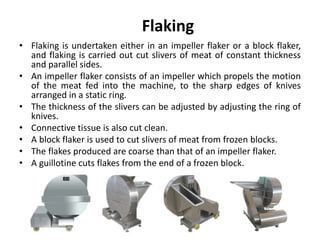
• Flaking is undertaken either in an impeller flaker or a block flaker,
and flaking is carried out cut slivers of meat of constant thickness
and parallel sides.
• An impeller flaker consists of an impeller which propels the motion
of the meat fed into the machine, to the sharp edges of knives
arranged in a static ring.
• The thickness of the slivers can be adjusted by adjusting the ring of
knives.
• Connective tissue is also cut clean.
• A block flaker is used to cut slivers of meat from frozen blocks.
• The flakes produced are coarse than that of an impeller flaker.
• A guillotine cuts flakes from the end of a frozen block.
MODERN PROCESSING
TECHNOLOGIES IN CURING OF MEAT
Massaging
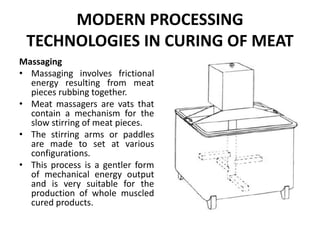
• Massaging involves frictional
energy resulting from meat
pieces rubbing together.
• Meat massagers are vats that
contain a mechanism for the
slow stirring of meat pieces.
• The stirring arms or paddles
are made to set at various
configurations.
• This process is a gentler form
of mechanical energy output
and is very suitable for the
production of whole muscled
cured products.
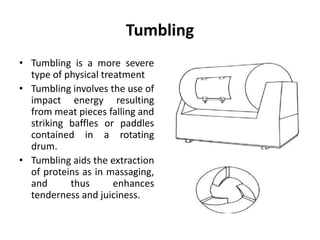
Tumbling
• Tumbling is a more severe
type of physical treatment
• Tumbling involves the use of
impact energy resulting
from meat pieces falling and
striking baffles or paddles
contained in a rotating
drum.
• Tumbling aids the extraction
of proteins as in massaging,
and thus enhances
tenderness and juiciness.
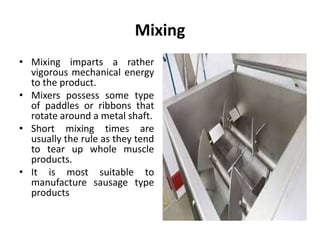
Mixing
• Mixing imparts a rather
vigorous mechanical energy
to the product.
• Mixers possess some type
of paddles or ribbons that
rotate around a metal shaft.
• Short mixing times are
usually the rule as they tend
to tear up whole muscle
products.
• It is most suitable to
manufacture sausage type
products

Modern_meat_processnbving_techniques.pptx

  • 1.
    Unit I: Modernmeat processing techniques By: Dr. R. K. Jaiswal Asstt. Prof.-cum-Jr. Scientist Dept. of LPT Bihar Veterinary College Bihar Animal Sciences University Patna-800014 (Bihar) LPT 602: MEAT PROCESSING , PACKAGING, QUALITY CONTROL AND MARKETING
  • 2.
    MODERN PROCESSING TECHNOLOGIESIN COMMINUTION OF MEAT Comminution of meat (less noble cuts), trimmings from noble cuts of meat, offals and fat result in the following useful effects: • Uniformity in size and shape, rendering them more attractive. • Breaking up of connective tissue making it less obtrusive • Mincing fat and meat together, so as to make large to moderate to large proportions of fat less obtrusive • Comminuted lean meat binds the whole mixture together especially in the presence of salt. • The texture and eating quality of the products are therefore superior to the raw materials used and are hence more desirable to consumers. • Comminuted meat products may be further classified as coarsely ground or finely ground meat products (emulsion based meat products). • The different technologies utilised in comminution of meat include Mincing, Milling Chopping, and Flaking.
  • 3.
    Mincing • Mincing orgrinding, the first step in development of comminuted meat products usually, is undertaken in a mincer, which consist of screw conveyor housed in a chamber, and a rotating inner plate of knives at one end of the conveyor. Considerable pressure is put on the meat in the screw feed chamber. • Tearing occurs between the screw flights and the chamber. • Final comminution occurs when portions of the meat extruded through the rotating inner plate of knives are either passed on through holes in the fixed outer plate or sheared off as the holes pass out of register. • Thus, there is great tearing, pressure and great shearing and the meat is not cut cleanly or finely. • Connective tissue is fairly well divided in a sharp mincer, but may be troublesome in a blunt one. • Minced meat can be used for development of coarse ground meat products, or may be further chopped in a bowl chopper to produce emulsion based meat products.
  • 4.
  • 5.
    Milling • A milleris used for milling of meat and a miller is very similar to meat mincer, except that : • There is no feed screw; the plates are mounted horizontally and fed by the weight of material above. • A rotating knife which moves at much higher speed; • Some cutting or tearing action in the space between the plates as well as at the edges of the holes in them. • There is finer comminution than in a mincer and the operation is much faster. • The fineness of comminution and intimate mixing, when used with fatty materials, these machines may be referred to as emulsifiers. • These are extremely suitable to manufacture patties.
  • 6.
    Chopping • Chopping isundertaken in chopper, which are of two types – Rotary Bowl Chopper and Stationary Chopper • A rotary bowl chopper consists of three or more curved knives rotating at high speed in vertical plane close to the surface of a curved bowl which itself rotates slowly in a horizontal plane. In addition to the vigorous cutting action of the knives, the massaging effect of the side of the knives on the mass of chopped meat may be important. • Satisfactory chopping temperatures range from -1 ° C to + 22 ° C. • Colder temperatures lead to damage to knives; while warmer temperatures lead to over chopping of fatty tissue and release of free fat. • Advanced designs possess the property of chopping under vacuum. • Chopping is finally undertaken to produce the emulsion to manufacture emulsion based meat products.
  • 8.
    Flaking • Flaking isundertaken either in an impeller flaker or a block flaker, and flaking is carried out cut slivers of meat of constant thickness and parallel sides. • An impeller flaker consists of an impeller which propels the motion of the meat fed into the machine, to the sharp edges of knives arranged in a static ring. • The thickness of the slivers can be adjusted by adjusting the ring of knives. • Connective tissue is also cut clean. • A block flaker is used to cut slivers of meat from frozen blocks. • The flakes produced are coarse than that of an impeller flaker. • A guillotine cuts flakes from the end of a frozen block.
  • 9.
    MODERN PROCESSING TECHNOLOGIES INCURING OF MEAT Massaging • Massaging involves frictional energy resulting from meat pieces rubbing together. • Meat massagers are vats that contain a mechanism for the slow stirring of meat pieces. • The stirring arms or paddles are made to set at various configurations. • This process is a gentler form of mechanical energy output and is very suitable for the production of whole muscled cured products.
  • 10.
    Tumbling • Tumbling isa more severe type of physical treatment • Tumbling involves the use of impact energy resulting from meat pieces falling and striking baffles or paddles contained in a rotating drum. • Tumbling aids the extraction of proteins as in massaging, and thus enhances tenderness and juiciness.
  • 11.
    Mixing • Mixing impartsa rather vigorous mechanical energy to the product. • Mixers possess some type of paddles or ribbons that rotate around a metal shaft. • Short mixing times are usually the rule as they tend to tear up whole muscle products. • It is most suitable to manufacture sausage type products