Anthrax – a biological weapon
John Priyanth
UOJ
a gram-positive
aerobic
Bacillus
with both a spore-
forming and vegetative
form
Bacillus anthracis
Anthrax spores can survive in their dormant
state for decades
And germinate when they come into contact
with a host
Grams stain
• Developed by Danish scientist Hans
Christian Gram
• A method to differentiate two types of
bacteria based on the structural
differences in their cell walls.
• Gram-positive bacteria retain the crystal
violet dye do so because of a thick layer of
peptidoglycan
• Gram-negative bacteria do not retain the
violet dye and are colored red or pink
Back to track ……….
• Anthrax spores are resistant to drying, heat,
ultraviolet light, gamma radiation, and many
disinfectants.
• Spores are induced to germinate into their
vegetative form under favourable conditions
• When nutrients are exhausted or the
environment is unfavorable, sporulation
occurs
• While most mammals are susceptible,
anthrax is typically a disease of ruminants
and humans
Inadequate livestock vaccination coverage and
lack of awareness of the risk of anthrax
transmission from animal to humans are some
major reasons for the unintentional spread of
this epidemic
• In Cattles Infection is usually acquired
through the ingestion of contaminated soil,
fodder or compound feed.
Clinical symptoms
• Sudden death (often within 2 or 3 hours of
being apparently normal) is by far the
most common sign.
• After death blood may not clot, resulting in a
small amount of bloody discharge from the
nose, mouth and other openings.
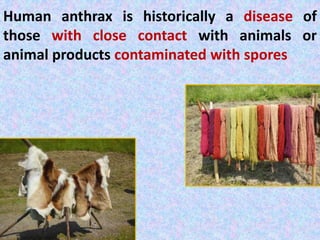
Human anthrax is historically a disease of
those with close contact with animals or
animal products contaminated with spores
Hence it was known by the name as “Wool
sorter’s” disease
The term anthrax is derived from the Greek
anthracites
meaning coal like, referring to the typical
black eschar seen in the cutaneous form of
the disease.
An Eschar is a dry, dark scab or falling away of
dead skin, typically caused by a burn, an insect
bite, or infection with anthrax
The natural reservoirs of anthrax are
domesticated herbivores
especially cattle, sheep, and goats
Pathogenicity
The pathogenicity of anthrax is due to both
the exotoxins it secretes and the capsule it
forms.
Each encoded by a separate plasmid (pX01 and
pX02, respectively).
The plasmids are circular, extra chromosomal,
double-stranded DNA molecules.
• PX01codes for three toxin elements
(protective antigen, lethal factor, and edema
factor)
which combine to form two binary toxins,
i. edema toxin (edema factor + protective
antigen)and
ii. lethal toxin (lethal factor + protective antigen)
• Edema toxin acts to upset cellular water
homeostasis, which results in the
massive edema characteristic of the
disease.
• lethal toxin induces macrophage
secretion of tumor necrosis factor-alpha
and interleukin-1-beta, which mediate
the systemic shock state.
Disease Transmission:
• Anthrax cannot be directly transmitted
from human‐to‐human contact.
• It is transmitted by the transfer of
spores to potential hosts or by exposure
to airborne anthrax spores
• It requires direct contact, inhalation, or
ingestion of anthrax cells or spores to acquire
an infection.
• Contact with anthrax bacterial cells or
endospores can happen in a variety of
ways:
• Anthrax can enter the body in three
ways: through
I. the respiratory tract,
II. the gastrointestinal tract, and
III. the bloodstream
• Anthrax in the bloodstream, commonly
known as cutaneous anthrax, occurs in
ninety-five percent of all anthrax cases
• People who develop cutaneous anthrax
usually work with infected animals
A lesion appears at the site of anthrax
inoculation.
Although cutaneous anthrax is not extremely
fatal, twenty percent of untreated patients die.
Gastroenteric anthrax occurs when people eat
the undercooked meat of anthrax infested
animals.
• People who are infected with gastrointestinal
anthrax face digestive troubles and lesions in
the mouth and throat.
• This anthrax, although rare, is about fifty
percent fatal if untreated.
These may develop into severe abdominal
pain, vomiting blood, and bloody diarrhea
eventually leading to sepsis and death
Early symptoms
include
•nausea,
•vomiting,
•anorexia, and
•fever;
•Inhalation anthrax, is the most fatal, resulting
in death of ninety percent of untreated
patients.
• In respiratory anthrax, victims initially
experience flu-like symptoms which
then lead to a breakdown in the
respiratory system.
• Symptoms of inhalation anthrax often begin
with fever, headache, cough, shortness of
breath, and chest pain
• Fever and shock may occur later
• Recently, another
type of anthrax
infection has been
identified in
heroin-injecting
drug users in
northern Europe.
• Symptoms may be similar to those
of cutaneous anthrax, but there may be
infection deep under the skin or in the
muscle where the drug was injected.
• Lots of other more common bacteria can
cause skin and injection site infections,
• so a skin or injection site infection in a drug
user does not necessarily mean the person has
anthrax.
• Injection anthrax can spread throughout the
body faster and be harder to recognize and
treat.
• Bacillus anthracis, or anthrax, has recently
become a greatly feared pandemic
The breakout of anthrax on American soil in
October of 2001 opened the world's eyes to
the possibilities of bioterrorism of anthrax
The 2001 anthrax attacks, also known
as Amerithrax from its Federal Bureau of
Investigation (FBI) case name occurred within
the United States over the course of several
weeks beginning on September 18, 2001
Letters containing anthrax spores were
mailed to several news media offices
and two Democratic U.S. Senators,
killing five people and infecting 17
others
• The history of anthrax dates back to
biblical times in ancient Egypt
• In 16th Century B.C., the Israelites were
under the control of powerful Ramses II
• According to Bible, a series of plagues
fell upon Egypt in attempt to free the
Israelites. One of these plagues
involved the death of the cattle, sheep,
and goats
• Many historians believed the cause of
death was due to anthrax inhalation
The first non-livestock case of anthrax
occurred in the early 19th Century
After coming into contact with anthrax
infected animals, many farmers were
cutaneously inoculated with anthrax
This outbreak sparked the scientific research of
anthrax
Written documentation of anthrax began
with Robert Koch's discovery of the bacteria
that caused anthrax.
• Using Koch’s discoveries, 20th Century
scientists began developing weaponized
anthrax
• Due to the spores’ durability, anthrax has
been a very favorable biological weapon
What makes Anthrax a popular
biological warfare agent
• Many countries have a
weaponized version of
anthrax because anthrax’s
stability
• The spore form of anthrax can easily be
loaded as a powder in a freeze-dried
condition.
• From there, terrorists can force anthrax
into an aerosol form.
• Then, the aerosol would be released in a
heavily populated area and everyone
who breathed would breathe anthrax
spores
• Because inhalation anthrax is ninety percent
fatal, bioterrorists favor the use of
aerosolized anthrax.
• Anthrax is a very simple biological agent to
make because of its low cost, high stability,
and its accessibility
Although anthrax is a very lethal disease,
antibiotics do have an effect on Bacillus
anthracis
If treated immediately, anthrax victims can
reduce their risk of death by going to a doctor
and getting a series antibiotics
• Some known agents effective against anthrax
are
 penicillin,
 ciprofloxacin,
 doxycycline, and
 erythromycin
• These antibiotics prevent anthrax from
further damaging the human body by
inhibiting the dangerous symptoms caused
by anthrax.
Vaccination
There are only two vaccines for the anthrax
disease
One vaccinations consists of a weakened strain
of Bacillus anthracis
• The vaccine is commonly known as Anthrax
Vaccine Adsorbed
• It is widespread among soldiers and
veterinarians
Another anthrax vaccination uses a live spore
version of the bacteria
A weakened spore is injected into a person in
an attempt to build self-immunization
• However, the spore vaccination’s serious side
effects inhibit its use in the world.
There is currently no recommendation for mass
immunization against anthrax
However, in the event of a bioterrorist event,
vaccination is recommended concurrently with
antibiotics for both prophylaxis and treatment.
Bioterrorism
• A bioterrorism attack is the deliberate
release of viruses, bacteria, toxins or other
harmful agents used to cause illness or death
in people, animals, or plants.
The agents are typically found in nature,
but it is possible that they could be mutated or
altered to
increase their ability to cause disease,
make them resistant to current medicines
Increase their ability to be spread into the
environment
• Biological agents can be spread through
the air, water, or in food.
• Terrorists tend to use biological agents
because they are extremely difficult to
detect and do not cause illness for
several hours to several days
History of Anthrax as a bioweapon
• First incident was recorded in the first world war
• In 1937, Japan tested different biological weapons,
including anthrax
• On April 2, 1979, anthrax was accidently leaked in a
Soviet factory
• In 1993, an aerosol containing Bacillus anthracis was
released from a cooling tower of c company’s
headquarters,Japan
The lastest anthrax attacks date back to
september 2001 when anthrax spores were
mailed to US authorities
• Skin testing
• Blood tests
• Chest X-ray or computerized tomography
(CT) scan
• Stool testing
If suspected of Anthrax infection, following
tests could be done to confirm
The ability to protect against the use of
biological weapons is becoming recognized as
one of the paramount security issues faced by
several nations
The need for protective measures against
bioterrorism was dramatically evident in
the aftermath of the September 11, 2001
terrorist attacks on the United States
There are various protective measures to
bioterrorism that can be divided into three
general categories.
These are strategic, tactical, and personal
measures.
Strategic deterrence can involve international
cooperation
Tactical measures involve the use of devices or
weapons to detect or eliminate potential
biological weapons
Prevention of Anthrax
Taking antibiotic medications for anthrax
together with proper vaccination confer
protection against the Anthrax epidemic.
However still If you live or travel in a
country where anthrax is common and herd
animals aren't routinely vaccinated, avoid
contact with livestock and animal skins as
much as possible
Also avoid eating meat that hasn't been
properly cooked
Even in developed countries, it's important
to handle any dead animal with care
&
to take precautions when working with or
processing imported hides, fur or wool
Preping for a Bioterrorism attack
• The threat of bioterrorism is fundamentally
different from other threats we face, such as
conventional explosives or even a chemical
or nuclear weapon
• By its very nature, the bioweapons threat,
with its close links to naturally occurring
infectious agents and disease, requires a
different strategy
• The two most important tools used by public
health officials will be isolation and
quarantine
• Isolation is keeping people known to be ill
away from other people and Quarantine is
keeping people who may have been exposed
away from other people
• If there has been a bioterrorism attack, the
first important step is to get information
immediately from the news media as to the
right course of action
• For some terrorist attacks, it may be correct
to try and leave the area; however, for other
events, it may be more appropriate to shelter
in place
Reference
• Alison Young and Tom Vanden Brook.Egregious safety failures at Army lab
led to anthrax mistakes. (2016.Jan 15).Retrived from
http://www.usatoday.com/story/news/nation/2016/01/15/military-
bioterrorism-lab-safety/78752876/
• Dimitrios G. Bouzianas . Medical countermeasures to protect humans from
anthrax bioterrorism.Trends in Microbiology .(2009, November );11: 522–
528
• Jason Hayes. Anthrax, Ricin, or Smallpox: Which Are the Deadliest
BioterrorismAgents?.(2013,Apr 24). Retrieved From
http://www.healthmap.org/site/diseasedaily/article/anthrax-ricin-or-
smallpox-which-are-deadliest-bioterrorism-agents-42413
• Sean V. Shadomy, Rita M. Traxler, Chung K. Marston,Anthrax .(2015,July
10).Retrieved from
http://wwwnc.cdc.gov/travel/yellowbook/2016/infectious-diseases-
related-to-travel/anthrax
• Stefan riedel, Anthrax: a continuing concern in the era of
bioterrorism.BUMC proceedings 2005;18:234–243

Anthrax

  • 1.
    Anthrax – abiological weapon John Priyanth UOJ
  • 2.
    a gram-positive aerobic Bacillus with botha spore- forming and vegetative form Bacillus anthracis
  • 3.
    Anthrax spores cansurvive in their dormant state for decades And germinate when they come into contact with a host
  • 4.
    Grams stain • Developedby Danish scientist Hans Christian Gram • A method to differentiate two types of bacteria based on the structural differences in their cell walls.
  • 5.
    • Gram-positive bacteriaretain the crystal violet dye do so because of a thick layer of peptidoglycan • Gram-negative bacteria do not retain the violet dye and are colored red or pink
  • 6.
    Back to track………. • Anthrax spores are resistant to drying, heat, ultraviolet light, gamma radiation, and many disinfectants.
  • 7.
    • Spores areinduced to germinate into their vegetative form under favourable conditions • When nutrients are exhausted or the environment is unfavorable, sporulation occurs
  • 8.
    • While mostmammals are susceptible, anthrax is typically a disease of ruminants and humans
  • 9.
    Inadequate livestock vaccinationcoverage and lack of awareness of the risk of anthrax transmission from animal to humans are some major reasons for the unintentional spread of this epidemic
  • 10.
    • In CattlesInfection is usually acquired through the ingestion of contaminated soil, fodder or compound feed.
  • 11.
    Clinical symptoms • Suddendeath (often within 2 or 3 hours of being apparently normal) is by far the most common sign.
  • 12.
    • After deathblood may not clot, resulting in a small amount of bloody discharge from the nose, mouth and other openings.
  • 13.
    Human anthrax ishistorically a disease of those with close contact with animals or animal products contaminated with spores
  • 14.
    Hence it wasknown by the name as “Wool sorter’s” disease
  • 15.
    The term anthraxis derived from the Greek anthracites meaning coal like, referring to the typical black eschar seen in the cutaneous form of the disease.
  • 16.
    An Eschar isa dry, dark scab or falling away of dead skin, typically caused by a burn, an insect bite, or infection with anthrax
  • 17.
    The natural reservoirsof anthrax are domesticated herbivores especially cattle, sheep, and goats
  • 18.
    Pathogenicity The pathogenicity ofanthrax is due to both the exotoxins it secretes and the capsule it forms.
  • 19.
    Each encoded bya separate plasmid (pX01 and pX02, respectively). The plasmids are circular, extra chromosomal, double-stranded DNA molecules.
  • 20.
    • PX01codes forthree toxin elements (protective antigen, lethal factor, and edema factor)
  • 21.
    which combine toform two binary toxins, i. edema toxin (edema factor + protective antigen)and ii. lethal toxin (lethal factor + protective antigen)
  • 22.
    • Edema toxinacts to upset cellular water homeostasis, which results in the massive edema characteristic of the disease.
  • 23.
    • lethal toxininduces macrophage secretion of tumor necrosis factor-alpha and interleukin-1-beta, which mediate the systemic shock state.
  • 24.
    Disease Transmission: • Anthraxcannot be directly transmitted from human‐to‐human contact. • It is transmitted by the transfer of spores to potential hosts or by exposure to airborne anthrax spores
  • 25.
    • It requiresdirect contact, inhalation, or ingestion of anthrax cells or spores to acquire an infection.
  • 26.
    • Contact withanthrax bacterial cells or endospores can happen in a variety of ways:
  • 27.
    • Anthrax canenter the body in three ways: through I. the respiratory tract, II. the gastrointestinal tract, and III. the bloodstream
  • 28.
    • Anthrax inthe bloodstream, commonly known as cutaneous anthrax, occurs in ninety-five percent of all anthrax cases
  • 29.
    • People whodevelop cutaneous anthrax usually work with infected animals
  • 30.
    A lesion appearsat the site of anthrax inoculation. Although cutaneous anthrax is not extremely fatal, twenty percent of untreated patients die.
  • 31.
    Gastroenteric anthrax occurswhen people eat the undercooked meat of anthrax infested animals.
  • 32.
    • People whoare infected with gastrointestinal anthrax face digestive troubles and lesions in the mouth and throat. • This anthrax, although rare, is about fifty percent fatal if untreated.
  • 33.
    These may developinto severe abdominal pain, vomiting blood, and bloody diarrhea eventually leading to sepsis and death Early symptoms include •nausea, •vomiting, •anorexia, and •fever;
  • 34.
    •Inhalation anthrax, isthe most fatal, resulting in death of ninety percent of untreated patients.
  • 35.
    • In respiratoryanthrax, victims initially experience flu-like symptoms which then lead to a breakdown in the respiratory system.
  • 36.
    • Symptoms ofinhalation anthrax often begin with fever, headache, cough, shortness of breath, and chest pain • Fever and shock may occur later
  • 37.
    • Recently, another typeof anthrax infection has been identified in heroin-injecting drug users in northern Europe.
  • 38.
    • Symptoms maybe similar to those of cutaneous anthrax, but there may be infection deep under the skin or in the muscle where the drug was injected.
  • 39.
    • Lots ofother more common bacteria can cause skin and injection site infections, • so a skin or injection site infection in a drug user does not necessarily mean the person has anthrax. • Injection anthrax can spread throughout the body faster and be harder to recognize and treat.
  • 40.
    • Bacillus anthracis,or anthrax, has recently become a greatly feared pandemic The breakout of anthrax on American soil in October of 2001 opened the world's eyes to the possibilities of bioterrorism of anthrax
  • 41.
    The 2001 anthraxattacks, also known as Amerithrax from its Federal Bureau of Investigation (FBI) case name occurred within the United States over the course of several weeks beginning on September 18, 2001
  • 42.
    Letters containing anthraxspores were mailed to several news media offices and two Democratic U.S. Senators, killing five people and infecting 17 others
  • 44.
    • The historyof anthrax dates back to biblical times in ancient Egypt • In 16th Century B.C., the Israelites were under the control of powerful Ramses II
  • 45.
    • According toBible, a series of plagues fell upon Egypt in attempt to free the Israelites. One of these plagues involved the death of the cattle, sheep, and goats
  • 46.
    • Many historiansbelieved the cause of death was due to anthrax inhalation
  • 47.
    The first non-livestockcase of anthrax occurred in the early 19th Century After coming into contact with anthrax infected animals, many farmers were cutaneously inoculated with anthrax
  • 48.
    This outbreak sparkedthe scientific research of anthrax
  • 49.
    Written documentation ofanthrax began with Robert Koch's discovery of the bacteria that caused anthrax.
  • 50.
    • Using Koch’sdiscoveries, 20th Century scientists began developing weaponized anthrax • Due to the spores’ durability, anthrax has been a very favorable biological weapon
  • 51.
    What makes Anthraxa popular biological warfare agent • Many countries have a weaponized version of anthrax because anthrax’s stability
  • 52.
    • The sporeform of anthrax can easily be loaded as a powder in a freeze-dried condition.
  • 53.
    • From there,terrorists can force anthrax into an aerosol form. • Then, the aerosol would be released in a heavily populated area and everyone who breathed would breathe anthrax spores
  • 54.
    • Because inhalationanthrax is ninety percent fatal, bioterrorists favor the use of aerosolized anthrax. • Anthrax is a very simple biological agent to make because of its low cost, high stability, and its accessibility
  • 55.
    Although anthrax isa very lethal disease, antibiotics do have an effect on Bacillus anthracis If treated immediately, anthrax victims can reduce their risk of death by going to a doctor and getting a series antibiotics
  • 56.
    • Some knownagents effective against anthrax are  penicillin,  ciprofloxacin,  doxycycline, and  erythromycin
  • 57.
    • These antibioticsprevent anthrax from further damaging the human body by inhibiting the dangerous symptoms caused by anthrax.
  • 58.
    Vaccination There are onlytwo vaccines for the anthrax disease One vaccinations consists of a weakened strain of Bacillus anthracis
  • 59.
    • The vaccineis commonly known as Anthrax Vaccine Adsorbed • It is widespread among soldiers and veterinarians
  • 60.
    Another anthrax vaccinationuses a live spore version of the bacteria A weakened spore is injected into a person in an attempt to build self-immunization
  • 61.
    • However, thespore vaccination’s serious side effects inhibit its use in the world.
  • 62.
    There is currentlyno recommendation for mass immunization against anthrax
  • 63.
    However, in theevent of a bioterrorist event, vaccination is recommended concurrently with antibiotics for both prophylaxis and treatment.
  • 64.
    Bioterrorism • A bioterrorismattack is the deliberate release of viruses, bacteria, toxins or other harmful agents used to cause illness or death in people, animals, or plants.
  • 65.
    The agents aretypically found in nature, but it is possible that they could be mutated or altered to increase their ability to cause disease,
  • 66.
    make them resistantto current medicines
  • 67.
    Increase their abilityto be spread into the environment
  • 68.
    • Biological agentscan be spread through the air, water, or in food. • Terrorists tend to use biological agents because they are extremely difficult to detect and do not cause illness for several hours to several days
  • 69.
    History of Anthraxas a bioweapon • First incident was recorded in the first world war • In 1937, Japan tested different biological weapons, including anthrax • On April 2, 1979, anthrax was accidently leaked in a Soviet factory • In 1993, an aerosol containing Bacillus anthracis was released from a cooling tower of c company’s headquarters,Japan
  • 70.
    The lastest anthraxattacks date back to september 2001 when anthrax spores were mailed to US authorities
  • 71.
    • Skin testing •Blood tests • Chest X-ray or computerized tomography (CT) scan • Stool testing If suspected of Anthrax infection, following tests could be done to confirm
  • 72.
    The ability toprotect against the use of biological weapons is becoming recognized as one of the paramount security issues faced by several nations
  • 73.
    The need forprotective measures against bioterrorism was dramatically evident in the aftermath of the September 11, 2001 terrorist attacks on the United States
  • 74.
    There are variousprotective measures to bioterrorism that can be divided into three general categories. These are strategic, tactical, and personal measures.
  • 75.
    Strategic deterrence caninvolve international cooperation
  • 76.
    Tactical measures involvethe use of devices or weapons to detect or eliminate potential biological weapons
  • 77.
    Prevention of Anthrax Takingantibiotic medications for anthrax together with proper vaccination confer protection against the Anthrax epidemic.
  • 78.
    However still Ifyou live or travel in a country where anthrax is common and herd animals aren't routinely vaccinated, avoid contact with livestock and animal skins as much as possible
  • 79.
    Also avoid eatingmeat that hasn't been properly cooked
  • 80.
    Even in developedcountries, it's important to handle any dead animal with care & to take precautions when working with or processing imported hides, fur or wool
  • 81.
    Preping for aBioterrorism attack • The threat of bioterrorism is fundamentally different from other threats we face, such as conventional explosives or even a chemical or nuclear weapon
  • 82.
    • By itsvery nature, the bioweapons threat, with its close links to naturally occurring infectious agents and disease, requires a different strategy
  • 83.
    • The twomost important tools used by public health officials will be isolation and quarantine • Isolation is keeping people known to be ill away from other people and Quarantine is keeping people who may have been exposed away from other people
  • 84.
    • If therehas been a bioterrorism attack, the first important step is to get information immediately from the news media as to the right course of action • For some terrorist attacks, it may be correct to try and leave the area; however, for other events, it may be more appropriate to shelter in place
  • 85.
    Reference • Alison Youngand Tom Vanden Brook.Egregious safety failures at Army lab led to anthrax mistakes. (2016.Jan 15).Retrived from http://www.usatoday.com/story/news/nation/2016/01/15/military- bioterrorism-lab-safety/78752876/ • Dimitrios G. Bouzianas . Medical countermeasures to protect humans from anthrax bioterrorism.Trends in Microbiology .(2009, November );11: 522– 528 • Jason Hayes. Anthrax, Ricin, or Smallpox: Which Are the Deadliest BioterrorismAgents?.(2013,Apr 24). Retrieved From http://www.healthmap.org/site/diseasedaily/article/anthrax-ricin-or- smallpox-which-are-deadliest-bioterrorism-agents-42413 • Sean V. Shadomy, Rita M. Traxler, Chung K. Marston,Anthrax .(2015,July 10).Retrieved from http://wwwnc.cdc.gov/travel/yellowbook/2016/infectious-diseases- related-to-travel/anthrax • Stefan riedel, Anthrax: a continuing concern in the era of bioterrorism.BUMC proceedings 2005;18:234–243