Prepared by
Swaliha C K
Assistant Professor
Senghundhar College of Pharmacy
CONTENTS:
1. Definition
2. Types
3. Epidemiology
4. Risk factors
5. Etiology
6. Etiopathogenesis
7. Pathophysiology
8. Clinical manifestations
9. Diagnosis
10. Management:
Non-pharmacological
Pharmacological
DEFINITION
•Angina pectoris is chest pain or discomfort that occurs
when the heart muscle doesn’t get enough blood.
•Angina pectoris is chest pain resulting from
myocardial ischemia (inadequate blood supply to the
myocardium).
TYPES
 STABLE OR TYPICAL ANGINA
 PRINZMETAL’S VARIANTANGINA(VASOSPASTIC)
 UNSTABLE OR CRESCENDO ANGINA
 ANGINA DECUBITUS(NOCTURNALANGINA)
STABLE ANGINA
•Most common angina
•Occurs during emotional stress, heavy exercise etc
•Easily predictable
•Treated using nitroglycerin
•Also due to atherosclerosis
VARIANT ANGINA
•Also called prinzmetal angina
•Occurs in rest also
•Due to spasm of coronary artery
UNSTABE ANGINA
•Uncommon or atypical type
•Occurs in exercise or also during rest
•Prolonged angina may lead to myocardial infraction
•Unpredictale.
EPIDEMIOLOGY
• Angina due to ischemic heart disease affects
approximately 112 million people (1.6% of the
population)
 slightly more common in men than women (1.7% to
1.5%)
 The prevalence of angina rises with increasing age
RISK FACTORS
MODIFIABLE RISK FACTORS
• Cigarette smoking
• High blood cholesterol or triglyceride level
• Lack of exercise
• Obesity
• Stress
• Alcohol
NON – MODIFIABLE FACTORS
•Family history of heart disease
•Old age
•Extreme cold or heat
ETIOLOGY
• Supply-demand
mismatch
Factors that decrease
supply
 Coronary vessel disorders
• Atherosclerosis
• Arterial spasm
• Coronary arteritis
Circulatory disorders
•Hypertension
•Aortic stenosis
•Aortic insufficiency
Blood disorders
•Anemia
•Hypoxemia
•Polycythemia
Factors that increase demand
 Increased cardiac output
•Exercise
•Emotion
•Digestion of a large meal
Increased myocardial need for oxygen
•Damaged myocardium
•Myocardial hypertrophy
ETIOPATHOGENESIS:
 CoronaryAtherosclerosis
 Superadded changes in coronary atherosclerosis
 Non-atherosclerotic causes.
PATHOPHYSIOLOGY
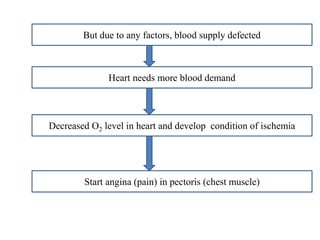
Due to any cause
Increased O2 demand in the body
Increase the heart workload
Heart needs more blood supply
Then coronary artery will dilate and supply more blood to heart
Heart needs more blood demand
Decreased O2 level in heart and develop condition of ischemia
Start angina (pain) in pectoris (chest muscle)
But due to any factors, blood supply defected
CLINICAL MANIFESTATIONS
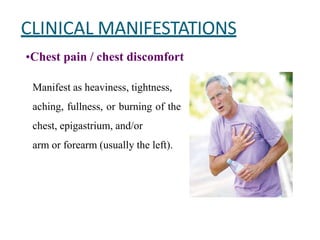
•Chest pain / chest discomfort
Manifest as heaviness, tightness,
aching, fullness, or burning of the
chest, epigastrium, and/or
arm or forearm (usually the left).
• Myocardial infraction
• Dyspnea
• Shortness of breath
• Fatigue
• Increased sweating
• Weakness
• pluse rate and the blood pressureincreases
• Palpitation
DIAGNOSTIC MEASURES
 History
 Physical examination
 ECG
 Laboratory studies
• Serial cardiac
biomarkers
• Hemoglobin
• Serum chemistry
• Lipid profile
 Chest Radiography
 Angiography
 Radioisotope Imaging
MANAGEMENT
•A for aspirin and anti anginal
therapy
•B for beta-blocker therapy and
blood pressure control
•C for cigarettes and cholesterol
•D for diet and diabetes
•E for education & exercise
NON- PHARMACOLOGICAL TREATMENT
•Smoking cessation
•Lipid lowering
•Control of hypertension
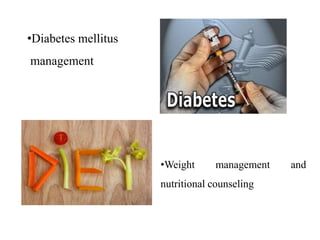
•Diabetes mellitus
management
•Weight management and
nutritional counseling
•Psychosocial management
•Activity management
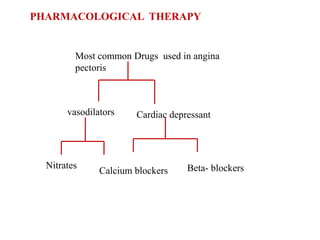
Most common Drugs used in angina
pectoris
vasodilators Cardiac depressant
Nitrates
Calcium blockers Beta- blockers
PHARMACOLOGICAL THERAPY
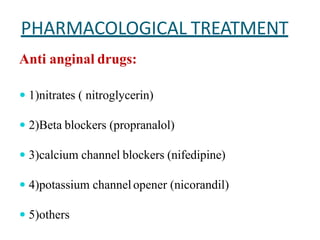
PHARMACOLOGICAL TREATMENT
Anti anginal drugs:
 1)nitrates ( nitroglycerin)
 2)Beta blockers (propranalol)
 3)calcium channel blockers (nifedipine)
 4)potassium channelopener (nicorandil)
 5)others
THANK YOU

Angina pectoris