


INTRODUCTION
Scientific evidences shows that advance age
,especially after the 35 year women's who conceive
are at greater risk of pregnancies complication. Age
of mother has an influence on the pregnancy and
fetus. Advanced maternal age is defined as any
expectant mother of age 35 years or above by the
time she delivers. Majority of women over the age of
35 years have healthy pregnancies and healthy
babies.
MATERNAL AGE:
The age of the mother at the time of delivery. Advanced
maternal age is usually defined as age 35 or more at
delivery. Advanced maternal age predisposes to Down
syndrome (trisomy 21). The risk of having a Down
syndrome baby rises with maternal age.
According to M.J. Simmons
RISKS ASSOCIATED WITH HAVING A BABY AFTER 35 YEAR
All pregnancies come with risks; of advanced maternal age:
Preeclampsia.
Gestational diabetes.
Premature birth or low birth weight.
Expecting twins.
Expecting twins.
Miscarriage.
Down syndrome or other genetic disorders.
Cesarean section (c-section).
Stillbirth. - A stillbirth is the death or loss of a baby before or during
delivery
Higher risk of genetic abnormalities: As maternal age
increases there is an increased risk of Down's syndrome
and other chromosomal abnormalities. Advanced maternal
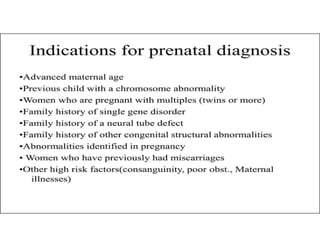
age is one of the indications for prenatal testing.
Decreased fertility: In women, fertility begins to decrease
from beginning in their early thirties. The conception is
delayed in women older than 35 years when compared to
those younger than 35
Risk of twins: Advanced maternal age is as sociated with higher risk
of having a naturally conceived (without fertility treatment) twin
pregnancy.
Diseases associated with advanced age: As age increases, the risk
of developing diabetes or high blood pressure, during pregnancy
also increases.
also increases.
Gynecological problems : - such as pelvic infection, tubal damage,
endometriosis, fibroids, ovulation problems, etc. tend to increase
with age and interfere with fertility
A teratogenic agents is a substance that
interferes with normal fetal development
and causes congenital disabilities. Drugs,
alcohol, chemicals and toxic substances
are examples of teratogens. Teratogens
can also increase the risk for miscarriage,
preterm labor or stillbirth
 Teratogenic agents caused deferent congenital abnormality during a
pregnancy.
 During the Pregnancy used women drinking alcohol also likely has a
harmful effect on embryonic brain developments at all times of
gestation.
Fetal hydantoin syndrome is a characteristic pattern of mental and
physical birth defects that results from maternal use of the anti-
seizure (anticonvulsant) drug phenytoin (Dilantin) during
pregnancy.
Fetal hydantoin syndrome is a characteristic pattern of mental and
physical birth defects that results from maternal use of the anti-
seizure (anticonvulsant) drug phenytoin (Dilantin) during
pregnancy.
VITAMIN A
Used in vitamin A during pregnancy Isotretinoin is
responsible for a syndrome including malformations of the
central nervous system, heart and thymus, together with
craniofacial defects.
Vitamin A is fat soluble, human body stores excess amounts
in the liver. This accumulation can have toxic effects on the
body and lead to liver damage. It can even cause birth
defects. For example, excessive amounts of vitamin A during
pregnancy has been shown to cause congenital birth
abnormalities.
Thalidomide Used during pregnancy suffering from
women's Hemangiomas are common growths of blood
vessels found on skin due to effect birth defect .
GRACIOUS COLLEGE OF NURSING
PRENATAL TESTING AND DIAGNOSIS
PRESENTED BY
OM VERMA
ASSISTANT PROFESSOR
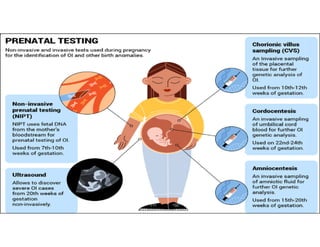
Prenatal testing consists of prenatal
screening and prenatal diagnosis, which
are aspects of prenatal care that focus on
detecting problems with the pregnancy as
early as possible. Purpose: detecting
problems with the pregnancy
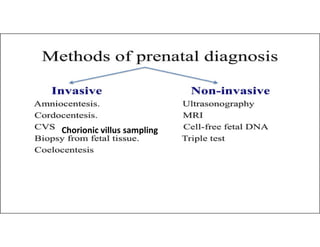
Chorionic villus sampling
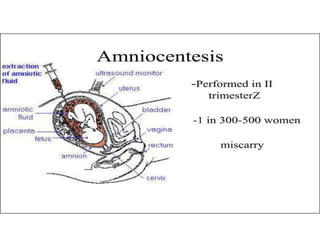
AMNIOCENTESIS
It is a prenatal testing procedure usually performed
during the second or third trimester of pregnancy. It
can diagnose certain chromosomal conditions (such
as Down syndrome) or genetic conditions (such as
cystic fibrosis). During amniocentesis, your healthcare
provider uses a thin needle to remove a small amount
of amniotic fluid from the sac surrounding the fetus.
This fluid sample then gets tested in a laboratory.
CORDOCENTESIS
it is an invasive prenatal procedure. It can
obtain a sample of blood from a
fetus's umbilical cord to detect blood disorders,
infections and genetic mutations. It can also be
used to deliver medications or blood
transfusions to a fetus.
CHORIONIC VILLUS SAMPLING (CVS),
OR CHORIONIC VILLUS BIOPSY,
It is a prenatal test that involves taking a
sample of tissue from the placenta to
test for chromosomal abnormalities and
certain other genetic problems.
FETAL TISSUE BIOPSY
Invasive procedure to obtain fetal
tissue such as skin, muscle, or liver.
Use. Diagnosis of specific inherited
disorders when gene mutation
COELOCENTESIS,
which involves aspiration of fluid from the extraembryonic
coelom, can be per- formed between 6 and 12 weeks'
gestation . During a culdocentesis a long thin needle is inserted
through the vaginal wall just below the uterus and a sample is
taken of the fluid within the abdominal cavity. Culdocentesis
is a procedure that checks for abnormal fluid in the space just
behind the vagina
NON- INVASIVE
NON- INVASIVE
PROCEDURE
CELL-FREE DNA SCREENING
it is a test that can determine if a woman has
a higher chance of having a fetus with Down
syndrome (trisomy 21), trisomy 18, trisomy 13
or an abnormality in the sex chromosomes (X
and Y chromosomes). With this test, a sample
of the woman's blood is taken after 10 weeks
of pregnancy.
TRIPLE SCREENING TEST
it is a blood test that measures three things
called alpha-fetoprotein, human chorionic
gonadotropin and unconjugated estriol. The
results of the blood test can help doctor see if
baby may be at higher risk for certain birth
defects.
PRENATAL TESTING AND DIAGNOSIS.pdf

PRENATAL TESTING AND DIAGNOSIS.pdf

  • 2.
    INTRODUCTION Scientific evidences showsthat advance age ,especially after the 35 year women's who conceive are at greater risk of pregnancies complication. Age of mother has an influence on the pregnancy and of mother has an influence on the pregnancy and fetus. Advanced maternal age is defined as any expectant mother of age 35 years or above by the time she delivers. Majority of women over the age of 35 years have healthy pregnancies and healthy babies.
  • 3.
    MATERNAL AGE: The ageof the mother at the time of delivery. Advanced maternal age is usually defined as age 35 or more at delivery. Advanced maternal age predisposes to Down syndrome (trisomy 21). The risk of having a Down syndrome (trisomy 21). The risk of having a Down syndrome baby rises with maternal age. According to M.J. Simmons
  • 4.
    RISKS ASSOCIATED WITHHAVING A BABY AFTER 35 YEAR All pregnancies come with risks; of advanced maternal age: Preeclampsia. Gestational diabetes. Premature birth or low birth weight. Expecting twins. Expecting twins. Miscarriage. Down syndrome or other genetic disorders. Cesarean section (c-section). Stillbirth. - A stillbirth is the death or loss of a baby before or during delivery
  • 5.
    Higher risk ofgenetic abnormalities: As maternal age increases there is an increased risk of Down's syndrome and other chromosomal abnormalities. Advanced maternal age is one of the indications for prenatal testing. Decreased fertility: In women, fertility begins to decrease Decreased fertility: In women, fertility begins to decrease from beginning in their early thirties. The conception is delayed in women older than 35 years when compared to those younger than 35
  • 6.
    Risk of twins:Advanced maternal age is as sociated with higher risk of having a naturally conceived (without fertility treatment) twin pregnancy. Diseases associated with advanced age: As age increases, the risk of developing diabetes or high blood pressure, during pregnancy also increases. also increases. Gynecological problems : - such as pelvic infection, tubal damage, endometriosis, fibroids, ovulation problems, etc. tend to increase with age and interfere with fertility
  • 10.
    A teratogenic agentsis a substance that interferes with normal fetal development and causes congenital disabilities. Drugs, alcohol, chemicals and toxic substances alcohol, chemicals and toxic substances are examples of teratogens. Teratogens can also increase the risk for miscarriage, preterm labor or stillbirth
  • 11.
     Teratogenic agentscaused deferent congenital abnormality during a pregnancy.
  • 15.
     During thePregnancy used women drinking alcohol also likely has a harmful effect on embryonic brain developments at all times of gestation.
  • 18.
    Fetal hydantoin syndromeis a characteristic pattern of mental and physical birth defects that results from maternal use of the anti- seizure (anticonvulsant) drug phenytoin (Dilantin) during pregnancy.
  • 19.
    Fetal hydantoin syndromeis a characteristic pattern of mental and physical birth defects that results from maternal use of the anti- seizure (anticonvulsant) drug phenytoin (Dilantin) during pregnancy.
  • 20.
    VITAMIN A Used invitamin A during pregnancy Isotretinoin is responsible for a syndrome including malformations of the central nervous system, heart and thymus, together with craniofacial defects. Vitamin A is fat soluble, human body stores excess amounts in the liver. This accumulation can have toxic effects on the in the liver. This accumulation can have toxic effects on the body and lead to liver damage. It can even cause birth defects. For example, excessive amounts of vitamin A during pregnancy has been shown to cause congenital birth abnormalities.
  • 21.
    Thalidomide Used duringpregnancy suffering from women's Hemangiomas are common growths of blood vessels found on skin due to effect birth defect .
  • 22.
    GRACIOUS COLLEGE OFNURSING PRENATAL TESTING AND DIAGNOSIS PRESENTED BY OM VERMA ASSISTANT PROFESSOR
  • 24.
    Prenatal testing consistsof prenatal screening and prenatal diagnosis, which are aspects of prenatal care that focus on detecting problems with the pregnancy as detecting problems with the pregnancy as early as possible. Purpose: detecting problems with the pregnancy
  • 28.
  • 29.
    AMNIOCENTESIS It is aprenatal testing procedure usually performed during the second or third trimester of pregnancy. It can diagnose certain chromosomal conditions (such as Down syndrome) or genetic conditions (such as as Down syndrome) or genetic conditions (such as cystic fibrosis). During amniocentesis, your healthcare provider uses a thin needle to remove a small amount of amniotic fluid from the sac surrounding the fetus. This fluid sample then gets tested in a laboratory.
  • 31.
    CORDOCENTESIS it is aninvasive prenatal procedure. It can obtain a sample of blood from a fetus's umbilical cord to detect blood disorders, fetus's umbilical cord to detect blood disorders, infections and genetic mutations. It can also be used to deliver medications or blood transfusions to a fetus.
  • 32.
    CHORIONIC VILLUS SAMPLING(CVS), OR CHORIONIC VILLUS BIOPSY, It is a prenatal test that involves taking a sample of tissue from the placenta to sample of tissue from the placenta to test for chromosomal abnormalities and certain other genetic problems.
  • 33.
    FETAL TISSUE BIOPSY Invasiveprocedure to obtain fetal tissue such as skin, muscle, or liver. tissue such as skin, muscle, or liver. Use. Diagnosis of specific inherited disorders when gene mutation
  • 34.
    COELOCENTESIS, which involves aspirationof fluid from the extraembryonic coelom, can be per- formed between 6 and 12 weeks' gestation . During a culdocentesis a long thin needle is inserted gestation . During a culdocentesis a long thin needle is inserted through the vaginal wall just below the uterus and a sample is taken of the fluid within the abdominal cavity. Culdocentesis is a procedure that checks for abnormal fluid in the space just behind the vagina
  • 35.
  • 38.
    CELL-FREE DNA SCREENING itis a test that can determine if a woman has a higher chance of having a fetus with Down syndrome (trisomy 21), trisomy 18, trisomy 13 syndrome (trisomy 21), trisomy 18, trisomy 13 or an abnormality in the sex chromosomes (X and Y chromosomes). With this test, a sample of the woman's blood is taken after 10 weeks of pregnancy.
  • 39.
    TRIPLE SCREENING TEST itis a blood test that measures three things called alpha-fetoprotein, human chorionic gonadotropin and unconjugated estriol. The gonadotropin and unconjugated estriol. The results of the blood test can help doctor see if baby may be at higher risk for certain birth defects.