STROKE
DEFINITION Stroke is defined as abrupt onset of a neurologic deficit that is attributable to a focal vascular cause.
INTRODUCTION Stroke is second leading killer worldwide Stroke is a neurological damage caused by reduction of blood flow to the brain .The part of the brain damaged from loss of oxygen is called  infarct It is also called  brain attack
EPIDEMIOLOGY It is occurs in more than 70,00000 individuals per year and results in 1,50000 deaths. 75% of stroke occurs in elderly patients of age more than 65 years
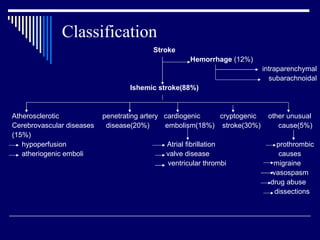
Classification Stroke Hemorrhage  (12%)  intraparenchymal subarachnoidal Ishemic stroke(88%) Atherosclerotic  penetrating artery  cardiogenic  cryptogenic  other unusual Cerebrovascular diseases  disease(20%)  embolism(18%)  stroke(30%)  cause(5%) (15%) hypoperfusion  Atrial fibrillation  prothrombic  atheriogenic emboli  valve disease  causes ventricular thrombi  migraine vasospasm drug abuse dissections
ETIOLOGY 1)  Non modifiable risk factors   Age Gender Race Family history of stroke Low birth weight 2)  Modifiable Hypertension Atrial fibrillation Diabetes  Cigratte smoking, alcohol Sickle cell disease Post menopausal hormone therapy
3)  Potentially modifiable   Oral contraceptives Migraine Drug and alcohol abuse Hemostatic and inflammatory factors Sleep disorder
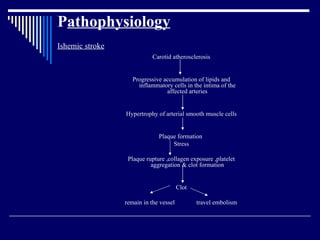
P athophysiology Ishemic stroke Carotid atherosclerosis Progressive accumulation of lipids and inflammatory cells in the intima of the affected arteries Hypertrophy of arterial smooth muscle cells Plaque formation  Stress Plaque rupture ,collagen exposure ,platelet aggregation & clot formation Clot remain in the vessel  travel embolism
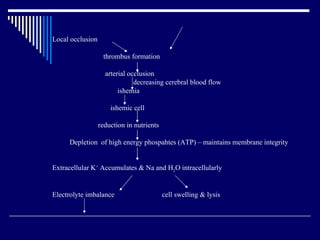
Local occlusion thrombus formation arterial occlusion decreasing cerebral blood flow ishemia ishemic cell reduction in nutrients Depletion  of high energy phospahtes (ATP) – maintains membrane integrity Extracellular K +  Accumulates & Na and H 2 O intracellularly  Electrolyte imbalance  cell swelling & lysis
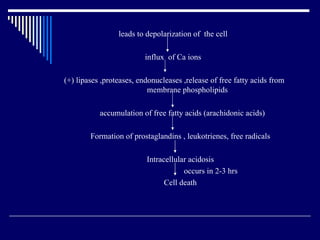
leads to depolarization of  the cell  influx  of Ca ions (+) lipases ,proteases, endonucleases ,release of free fatty acids from  membrane phospholipids accumulation of free fatty acids (arachidonic acids) Formation of prostaglandins , leukotrienes, free radicals  Intracellular acidosis  occurs in 2-3 hrs Cell death
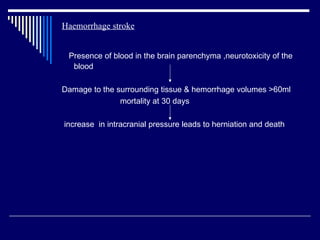
Haemorrhage stroke Presence of blood in the brain parenchyma ,neurotoxicity of the blood Damage to the surrounding tissue & hemorrhage volumes >60ml mortality at 30 days  increase  in intracranial pressure leads to herniation and death
SIGNS AND SYMPTOMS Sudden numbness or weakness of face ,arm or leg especially affecting only one side of the body Confusion trouble in speaking or in understanding others Visual disturbances in one or both eyes means blurred or double vision  Dizziness ,loss of balance and difficulty in walking and coordination  Severe headache without apparent cause Dysarthria.
DIAGNOSIS EEG,ECG( Atrial fibrillation) MRI CT Scan-hyperintensity (white) –heamorrhage areas normal or hypointense (dark)-infarction areas Carotid doppler –stenosis in carotid arteries Laboratory findings 1) Complete blood count 2)  Coagulation test- protein c deficiency, anti -phospholipid  antibody 3) Blood lipid test 4) Measure of cardiac enzymes like troponin, creatinine kinase LDH isoenzymes
Management  1)  Pharmacological  Acute ischemic stroke plasminogen activator (alteplase) with in 3 hrs of onset .  Dose -0.9 mg/kg I.V aspirin within 48 hrs of onset . Dose -160-325 mg daily started within 48 hrs Secondary prevention of ischemic stroke antiplatelet therapy aspirin 50-325 mg daily clopidogrel 75 mg daily aspirin 25 mg +dipyridamole 200 mg twice daily  Anti hypertensive agent Statin therapy AF , Cardiac source of embolism –warfarin (INR-2.5) Heamorrhage stroke Nimodipine( Ca channel blockers) Carotid  stenting
2)  Non pharmacological treatment Speech therapy Psychological therapy Stroke rehabilitation  physical therapy occupational therapy 3)  Surgical   carotid endarterectomy EC/IC bypass surgery Dipping Detachable coil technique
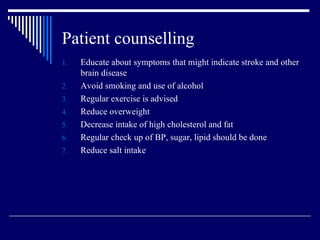
Patient counselling Educate about symptoms that might indicate stroke and other brain disease Avoid smoking and use of alcohol  Regular exercise is advised Reduce overweight Decrease intake of high cholesterol and fat Regular check up of BP, sugar, lipid should be done Reduce salt intake

Stroke

  • 1.
  • 2.
    DEFINITION Stroke isdefined as abrupt onset of a neurologic deficit that is attributable to a focal vascular cause.
  • 3.
    INTRODUCTION Stroke issecond leading killer worldwide Stroke is a neurological damage caused by reduction of blood flow to the brain .The part of the brain damaged from loss of oxygen is called infarct It is also called brain attack
  • 4.
    EPIDEMIOLOGY It isoccurs in more than 70,00000 individuals per year and results in 1,50000 deaths. 75% of stroke occurs in elderly patients of age more than 65 years
  • 5.
    Classification Stroke Hemorrhage (12%) intraparenchymal subarachnoidal Ishemic stroke(88%) Atherosclerotic penetrating artery cardiogenic cryptogenic other unusual Cerebrovascular diseases disease(20%) embolism(18%) stroke(30%) cause(5%) (15%) hypoperfusion Atrial fibrillation prothrombic atheriogenic emboli valve disease causes ventricular thrombi migraine vasospasm drug abuse dissections
  • 6.
    ETIOLOGY 1) Non modifiable risk factors Age Gender Race Family history of stroke Low birth weight 2) Modifiable Hypertension Atrial fibrillation Diabetes Cigratte smoking, alcohol Sickle cell disease Post menopausal hormone therapy
  • 7.
    3) Potentiallymodifiable Oral contraceptives Migraine Drug and alcohol abuse Hemostatic and inflammatory factors Sleep disorder
  • 8.
    P athophysiology Ishemicstroke Carotid atherosclerosis Progressive accumulation of lipids and inflammatory cells in the intima of the affected arteries Hypertrophy of arterial smooth muscle cells Plaque formation Stress Plaque rupture ,collagen exposure ,platelet aggregation & clot formation Clot remain in the vessel travel embolism
  • 9.
    Local occlusion thrombusformation arterial occlusion decreasing cerebral blood flow ishemia ishemic cell reduction in nutrients Depletion of high energy phospahtes (ATP) – maintains membrane integrity Extracellular K + Accumulates & Na and H 2 O intracellularly Electrolyte imbalance cell swelling & lysis
  • 10.
    leads to depolarizationof the cell influx of Ca ions (+) lipases ,proteases, endonucleases ,release of free fatty acids from membrane phospholipids accumulation of free fatty acids (arachidonic acids) Formation of prostaglandins , leukotrienes, free radicals Intracellular acidosis occurs in 2-3 hrs Cell death
  • 11.
    Haemorrhage stroke Presenceof blood in the brain parenchyma ,neurotoxicity of the blood Damage to the surrounding tissue & hemorrhage volumes >60ml mortality at 30 days increase in intracranial pressure leads to herniation and death
  • 12.
    SIGNS AND SYMPTOMSSudden numbness or weakness of face ,arm or leg especially affecting only one side of the body Confusion trouble in speaking or in understanding others Visual disturbances in one or both eyes means blurred or double vision Dizziness ,loss of balance and difficulty in walking and coordination Severe headache without apparent cause Dysarthria.
  • 13.
    DIAGNOSIS EEG,ECG( Atrialfibrillation) MRI CT Scan-hyperintensity (white) –heamorrhage areas normal or hypointense (dark)-infarction areas Carotid doppler –stenosis in carotid arteries Laboratory findings 1) Complete blood count 2) Coagulation test- protein c deficiency, anti -phospholipid antibody 3) Blood lipid test 4) Measure of cardiac enzymes like troponin, creatinine kinase LDH isoenzymes
  • 14.
    Management 1) Pharmacological Acute ischemic stroke plasminogen activator (alteplase) with in 3 hrs of onset . Dose -0.9 mg/kg I.V aspirin within 48 hrs of onset . Dose -160-325 mg daily started within 48 hrs Secondary prevention of ischemic stroke antiplatelet therapy aspirin 50-325 mg daily clopidogrel 75 mg daily aspirin 25 mg +dipyridamole 200 mg twice daily Anti hypertensive agent Statin therapy AF , Cardiac source of embolism –warfarin (INR-2.5) Heamorrhage stroke Nimodipine( Ca channel blockers) Carotid stenting
  • 15.
    2) Nonpharmacological treatment Speech therapy Psychological therapy Stroke rehabilitation physical therapy occupational therapy 3) Surgical carotid endarterectomy EC/IC bypass surgery Dipping Detachable coil technique
  • 16.
    Patient counselling Educateabout symptoms that might indicate stroke and other brain disease Avoid smoking and use of alcohol Regular exercise is advised Reduce overweight Decrease intake of high cholesterol and fat Regular check up of BP, sugar, lipid should be done Reduce salt intake