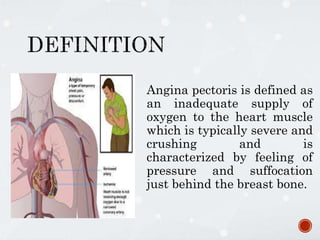
Angina pectoris is defined as
an inadequate supply of
oxygen to the heart muscle
which is typically severe and
crushing and is
characterized by feeling of
pressure and suffocation
just behind the breast bone.
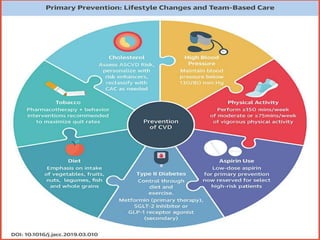
 High cholesterol level
 High blood pressure
 Smoking
 Uncontrolled diabetes mellitus
 Obesity
 Metabolic syndrome
 Lack of physical activity
 Age
 Cold climate
Hyperhomocysteinemia
Strong emotions
Consumption of heavy meals
Sexual activity
Stimulants
Coronary artery disease
Due to etiological and risk factors
Blockage of coronary artery
Imbalance between myocardial oxygen demand
and supply
Myocardial ischemia
Deprived glucose in myocardial cell for aerobic
metabolism
Production of lactic acid and its accumulation
Lactic acid irritates myocardial nerve fiber
Transmits pain message to cardiac nerve and
upper thoracic posterior root
Angina pectoris
Substernal/ precordial pain
ONSET: quickly/slowly
LOCATION: retrosternal/ slightly left to
sternal
RADIATION: Left shoulder , upper arm
and may travel down the inner aspect of
left arm to the elbow wrist and 4th or 5th
finger. May radiate to right shoulder, neck,
jaw or epigastric region.
DURATION: Last less than 5 minutes.
Attacks precipitated by heavy meal /
extreme anger may last 15-20 minutes.
SENSATION: squeezing, burning pressing,
choking, aching or bursting pressure.
SEVERITY: mild to moderately severe
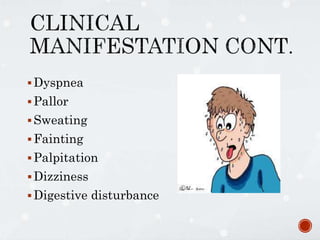
Dyspnea
Pallor
Sweating
Fainting
Palpitation
Dizziness
Digestive disturbance
 STABLE ANGINA:
Chest pain occurs intermittently
Over a long period
Triggered by: exertion, emotion
Same pattern of onset, duration and intensity of

symptoms
 UNSTABLE ANGINA
Paroxysmal chest pain
Occurs even on rest/ sleep
Attacks characteristically increases in number, duration
and severity
Triggered by: unpredictable degree of exertion, emotion.
Requires immediate hospitalisation
 PRINZMETAL ANGINA:
Occurs at rest as a response to spasm of major
coronary artery
Rare form
Can occur during rapid eye movement sleep when
myocardial oxygen consumption increases.
It may relieve by rest
 ANGINA DECUBITUS
Occurs when person is lying down
Occurs because gravity redistributes fluids in body
which makes heart work harder
Relieved by sitting or standing
 NOCTURNAL ANGINA
Occurs at night
 INTRACTABLE ANGINA: chronic incapacitating
angina that does not response to interventions
 POST INFARCTION ANGINA: pain occurs after MI
when residual ischemia may cause episodes of
angina
Health history
Physical examination
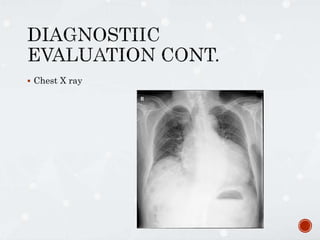
 Chest X ray
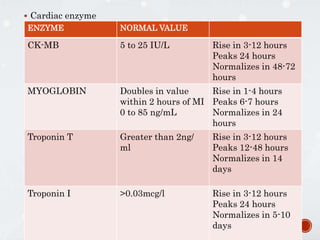
 Cardiac enzyme
ENZYME NORMAL VALUE
CK-MB 5 to 25 IU/L Rise in 3-12 hours
Peaks 24 hours
Normalizes in 48-72
hours
MYOGLOBIN Doubles in value
within 2 hours of MI
0 to 85 ng/mL
Rise in 1-4 hours
Peaks 6-7 hours
Normalizes in 24
hours
Troponin T Greater than 2ng/
ml
Rise in 3-12 hours
Peaks 12-48 hours
Normalizes in 14
days
Troponin I >0.03mcg/l Rise in 3-12 hours
Peaks 24 hours
Normalizes in 5-10
days
4/20/2020 16MYOCARDIAL INFARCTION
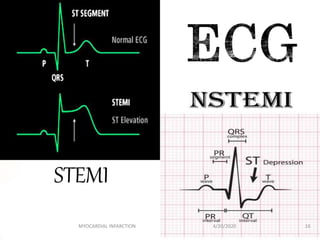
STEMI
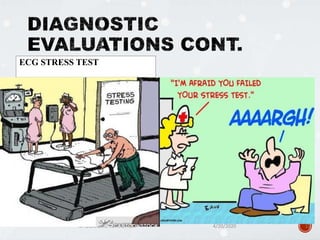
ECG STRESS TEST
4/20/2020MYOCARDIAL INFARCTION 17
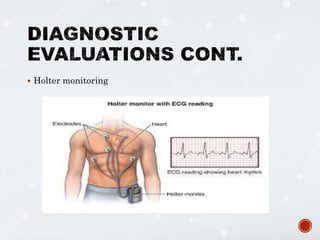
 Holter monitoring
DIAGNOSTIC
EVALUATIONS CONT.
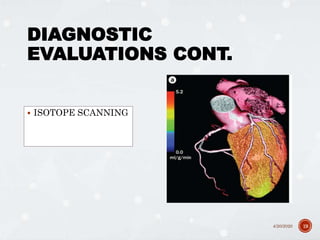
 ISOTOPE SCANNING
4/20/2020 19
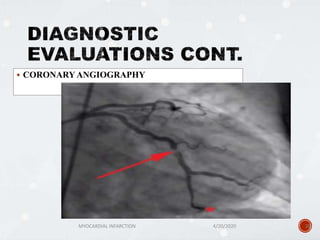
 CORONARYANGIOGRAPHY
4/20/2020MYOCARDIAL INFARCTION 20
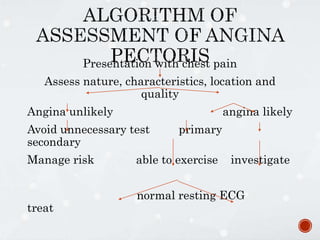
Presentation with chest pain
Assess nature, characteristics, location and
quality
Angina unlikely angina likely
Avoid unnecessary test primary
secondary
Manage risk able to exercise investigate
normal resting ECG
treat
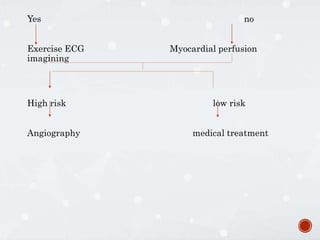
Yes no
Exercise ECG Myocardial perfusion
imagining
High risk low risk
Angiography medical treatment
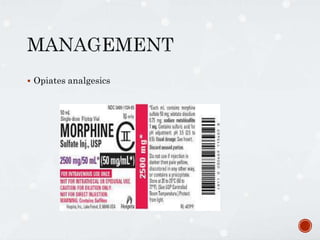
 Opiates analgesics
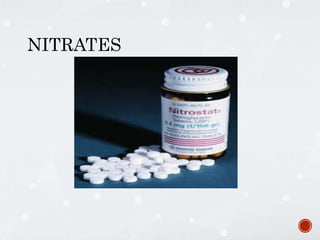
NITRATES
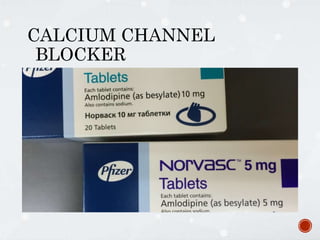
CALCIUM CHANNEL
BLOCKER
Establish and maintain airway
Anticipate need for intubation
Administer oxygen
Start 2 IV lines
Loosen clothes
Monitor cardiac rate and rhythm
Monitor vital signs
Take 12 lead ECG
Be prepared to perform CPR
Assess severity and location of pain
Obtain past heath history
Assess indication and contraindication of
thrombolytic therapy
 Acute pain related to oxygen supply and demand imbalance
as evidenced by pain score
 Decreased cardiac output related to decrease cardiac
contractility and dysrhythmias as evidenced by ECG
monitoring
 Activity intolerance related to cardiac dysfunction, changes
in oxygen supply and consumption as evidenced by
shortness of breath
 Anxiety related to chest pain, fear of death as evidenced by
facial expression
 A pilot project was done to examine the clinical
effects of long-term low-dose androgens in men with
angina. Forty-six men with stable angina completed
a 2-week, single-blind placebo run-in, followed by
double-blind randomization to 5 mg testosterone
daily by transdermal patch or matching placebo for
12 weeks, in addition to their current medication.
 Time to 1-mm ST-segment depression on treadmill
exercise testing and hormone levels were measured
and quality of life was assessed by SF-36 at baseline
and after 4 and 12 weeks of treatment.
 Active treatment resulted in a 2-fold increase in
androgen levels and an increase in time to 1-mm ST-
segment depression from 309±27 seconds at baseline to
343±26 seconds after 4 weeks and to 361±22 seconds
after 12 weeks.
 This change was statistically significant compared with
that seen in the placebo group; P=0.02 .
 The magnitude of the response was greater in those with
lower baseline levels of bioavailable testosterone
(r=−0.455, P<0.05).
 There were significant improvements in pain perception
(P=0.026) and role limitation resulting from physical
problems (P=0.024) in the testosterone-treated group.
 Low-dose supplemental testosterone treatment in men
with chronic stable angina reduces exercise-induced
myocardial ischemia.
Angina pectoris

Angina pectoris

  • 2.
    Angina pectoris isdefined as an inadequate supply of oxygen to the heart muscle which is typically severe and crushing and is characterized by feeling of pressure and suffocation just behind the breast bone.
  • 3.
     High cholesterollevel  High blood pressure  Smoking  Uncontrolled diabetes mellitus  Obesity  Metabolic syndrome  Lack of physical activity  Age  Cold climate
  • 4.
    Hyperhomocysteinemia Strong emotions Consumption ofheavy meals Sexual activity Stimulants Coronary artery disease
  • 5.
    Due to etiologicaland risk factors Blockage of coronary artery Imbalance between myocardial oxygen demand and supply Myocardial ischemia Deprived glucose in myocardial cell for aerobic metabolism Production of lactic acid and its accumulation Lactic acid irritates myocardial nerve fiber Transmits pain message to cardiac nerve and upper thoracic posterior root Angina pectoris
  • 6.
    Substernal/ precordial pain ONSET:quickly/slowly LOCATION: retrosternal/ slightly left to sternal RADIATION: Left shoulder , upper arm and may travel down the inner aspect of left arm to the elbow wrist and 4th or 5th finger. May radiate to right shoulder, neck, jaw or epigastric region. DURATION: Last less than 5 minutes. Attacks precipitated by heavy meal / extreme anger may last 15-20 minutes.
  • 7.
    SENSATION: squeezing, burningpressing, choking, aching or bursting pressure. SEVERITY: mild to moderately severe
  • 8.
  • 10.
     STABLE ANGINA: Chestpain occurs intermittently Over a long period Triggered by: exertion, emotion Same pattern of onset, duration and intensity of symptoms  UNSTABLE ANGINA Paroxysmal chest pain Occurs even on rest/ sleep Attacks characteristically increases in number, duration and severity Triggered by: unpredictable degree of exertion, emotion. Requires immediate hospitalisation
  • 11.
     PRINZMETAL ANGINA: Occursat rest as a response to spasm of major coronary artery Rare form Can occur during rapid eye movement sleep when myocardial oxygen consumption increases. It may relieve by rest
  • 12.
     ANGINA DECUBITUS Occurswhen person is lying down Occurs because gravity redistributes fluids in body which makes heart work harder Relieved by sitting or standing  NOCTURNAL ANGINA Occurs at night  INTRACTABLE ANGINA: chronic incapacitating angina that does not response to interventions  POST INFARCTION ANGINA: pain occurs after MI when residual ischemia may cause episodes of angina
  • 13.
  • 14.
  • 15.
     Cardiac enzyme ENZYMENORMAL VALUE CK-MB 5 to 25 IU/L Rise in 3-12 hours Peaks 24 hours Normalizes in 48-72 hours MYOGLOBIN Doubles in value within 2 hours of MI 0 to 85 ng/mL Rise in 1-4 hours Peaks 6-7 hours Normalizes in 24 hours Troponin T Greater than 2ng/ ml Rise in 3-12 hours Peaks 12-48 hours Normalizes in 14 days Troponin I >0.03mcg/l Rise in 3-12 hours Peaks 24 hours Normalizes in 5-10 days
  • 16.
  • 17.
  • 18.
  • 19.
  • 20.
  • 21.
    Presentation with chestpain Assess nature, characteristics, location and quality Angina unlikely angina likely Avoid unnecessary test primary secondary Manage risk able to exercise investigate normal resting ECG treat
  • 22.
    Yes no Exercise ECGMyocardial perfusion imagining High risk low risk Angiography medical treatment
  • 23.
  • 25.
  • 26.
  • 28.
    Establish and maintainairway Anticipate need for intubation Administer oxygen Start 2 IV lines Loosen clothes Monitor cardiac rate and rhythm
  • 29.
    Monitor vital signs Take12 lead ECG Be prepared to perform CPR Assess severity and location of pain Obtain past heath history Assess indication and contraindication of thrombolytic therapy
  • 30.
     Acute painrelated to oxygen supply and demand imbalance as evidenced by pain score  Decreased cardiac output related to decrease cardiac contractility and dysrhythmias as evidenced by ECG monitoring  Activity intolerance related to cardiac dysfunction, changes in oxygen supply and consumption as evidenced by shortness of breath  Anxiety related to chest pain, fear of death as evidenced by facial expression
  • 32.
     A pilotproject was done to examine the clinical effects of long-term low-dose androgens in men with angina. Forty-six men with stable angina completed a 2-week, single-blind placebo run-in, followed by double-blind randomization to 5 mg testosterone daily by transdermal patch or matching placebo for 12 weeks, in addition to their current medication.  Time to 1-mm ST-segment depression on treadmill exercise testing and hormone levels were measured and quality of life was assessed by SF-36 at baseline and after 4 and 12 weeks of treatment.
  • 33.
     Active treatmentresulted in a 2-fold increase in androgen levels and an increase in time to 1-mm ST- segment depression from 309±27 seconds at baseline to 343±26 seconds after 4 weeks and to 361±22 seconds after 12 weeks.  This change was statistically significant compared with that seen in the placebo group; P=0.02 .  The magnitude of the response was greater in those with lower baseline levels of bioavailable testosterone (r=−0.455, P<0.05).  There were significant improvements in pain perception (P=0.026) and role limitation resulting from physical problems (P=0.024) in the testosterone-treated group.  Low-dose supplemental testosterone treatment in men with chronic stable angina reduces exercise-induced myocardial ischemia.