Pathfinder
  PATHFINDER GLOBAL
        Global School,
     SCHOOL, PATAUDI
        Pataudi :
PRESENTATION ON
ANGER MANAGEMENT IN STUDENTS
   Presentation by: Divyashu Sharma
 Presentation by:   School Counsellor
 Divyashu Sharma
 (School Counsellor)                1
INTRODUCTION
   Do you find yourself fuming when someone
    cuts you off in traffic?
   Does your blood pressure go through the roof
    when your child refuses to cooperate?
   Or any situation makes you angry in daily
    life.


                                                   2
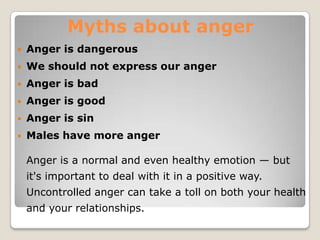
Myths about anger
   Anger is dangerous
   We should not express our anger
   Anger is bad
   Anger is good
   Anger is sin
   Males have more anger

    Anger is a normal and even healthy emotion — but
    it's important to deal with it in a positive way.
    Uncontrolled anger can take a toll on both your health
    and your relationships.
4
Negative effects Positive effects
of anger         of anger
   Bodily system becomes
                                 •   Energize us to do something
    rigid and impure
                                 •   Enable us to assertive
   We damage or abuse others
                                 •   Help us to survive
   Broken relationship
                                 •   It is a way of communication
“Holding on to anger is like
    grasping a hot coal with the • Motivate us to take action
    intent of throwing it at
    someone else; you are the
                                 Nobody makes you angry without
    one who gets burned.” -
                                     your concern
    Buddha
Causes of anger
    High expectation
    Faulty perception and thinking
    Personality factor
    Poor communication skills
    Poor emotional control

 “Anger will never disappear so long as thoughts of
   resentment are cherished in the mind. Anger will
   disappear just as soon as thoughts of resentment
   are forgotten.” -Buddha
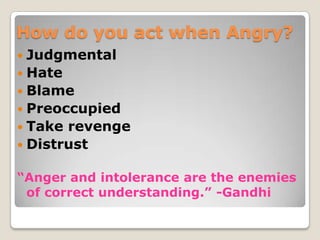
How do you act when Angry?
 Judgmental
 Hate
 Blame
 Preoccupied
 Take revenge
 Distrust

“Anger and intolerance are the enemies
 of correct understanding.” -Gandhi
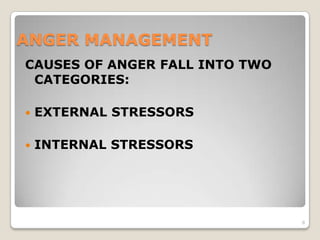
ANGER MANAGEMENT
CAUSES OF ANGER FALL INTO TWO
 CATEGORIES:

   EXTERNAL STRESSORS

   INTERNAL STRESSORS


                                8
ANGER MANAGEMENT
EXTERNAL STRESSOR
MAY BE MAJOR LIFE EVENTS:
   MOVING
   DEATH OF SPOUSE, FAMILY MEMBER OR FRIEND
   DIVORCE

MAY BE CAUSED BY EVERYDAY PRESSURES SUCH AS:
•FINANCIAL
•DEADLINES
•ARGUMENTS
•FAMILY CONCERNS
•LACK OF SLEEP                                 9
ANGER MANAGEMENT
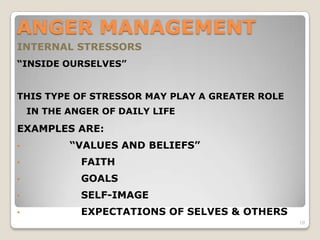
INTERNAL STRESSORS
“INSIDE OURSELVES”


THIS TYPE OF STRESSOR MAY PLAY A GREATER ROLE
    IN THE ANGER OF DAILY LIFE
EXAMPLES ARE:
•          “VALUES AND BELIEFS”
•            FAITH
•            GOALS
•            SELF-IMAGE
•            EXPECTATIONS OF SELVES & OTHERS
                                                10
ANGER MANAGEMENT
ANGER
   DRIVEN BY HORMONES

   HORMONES ACT LIKE A CONDUCTOR

   HORMONES INNERVATE BODY SYSTEMS/
    ORGANS


                                    11
ANGER MANAGEMENT
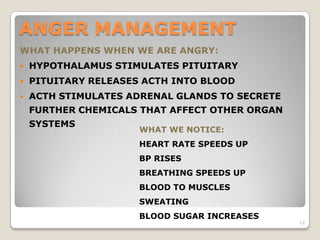
WHAT HAPPENS WHEN WE ARE ANGRY:
   HYPOTHALAMUS STIMULATES PITUITARY
   PITUITARY RELEASES ACTH INTO BLOOD
   ACTH STIMULATES ADRENAL GLANDS TO SECRETE
    FURTHER CHEMICALS THAT AFFECT OTHER ORGAN
    SYSTEMS
                      WHAT WE NOTICE:
                      HEART RATE SPEEDS UP
                      BP RISES
                      BREATHING SPEEDS UP
                      BLOOD TO MUSCLES
                      SWEATING
                      BLOOD SUGAR INCREASES
                                                12
ANGER MANAGEMENT
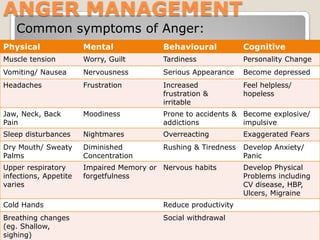
   Common symptoms of Anger:
Physical               Mental             Behavioural           Cognitive
Muscle tension         Worry, Guilt       Tardiness             Personality Change
Vomiting/ Nausea       Nervousness        Serious Appearance    Become depressed
Headaches              Frustration        Increased             Feel helpless/
                                          frustration &         hopeless
                                          irritable
Jaw, Neck, Back        Moodiness          Prone to accidents & Become explosive/
Pain                                      addictions           impulsive
Sleep disturbances     Nightmares         Overreacting          Exaggerated Fears
Dry Mouth/ Sweaty      Diminished         Rushing & Tiredness   Develop Anxiety/
Palms                  Concentration                            Panic
Upper respiratory      Impaired Memory or Nervous habits        Develop Physical
infections, Appetite   forgetfulness                            Problems including
varies                                                          CV disease, HBP,
                                                                Ulcers, Migraine
Cold Hands                                Reduce productivity
Breathing changes                         Social withdrawal
                                                                                 13
(eg. Shallow,
sighing)
Anger Management
 How Do I Do It?


               14
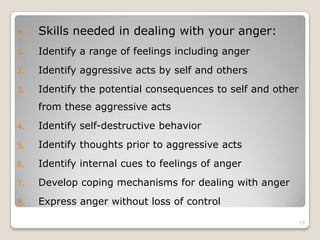
    Skills needed in dealing with your anger:
1.   Identify a range of feelings including anger
2.   Identify aggressive acts by self and others
3.   Identify the potential consequences to self and other
     from these aggressive acts
4.   Identify self-destructive behavior
5.   Identify thoughts prior to aggressive acts
6.   Identify internal cues to feelings of anger
7.   Develop coping mechanisms for dealing with anger
8.   Express anger without loss of control
                                                             15
ANGER MANAGEMENT
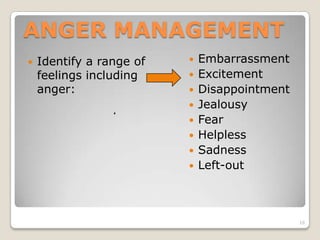
   Identify a range of      Embarrassment
    feelings including       Excitement
    anger:                   Disappointment
                             Jealousy
                             Fear
                             Helpless
                             Sadness
                             Left-out


                                               16
ANGER MANAGEMENT
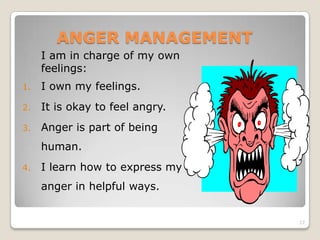
     I am in charge of my own
     feelings:
1.   I own my feelings.
2.   It is okay to feel angry.
3.   Anger is part of being
     human.
4.   I learn how to express my
     anger in helpful ways.


                                 17
ANGER MANAGEMENT
                           Throw something
                           Kick someone or
   Identify aggressive
                            something
    acts shown by self     Get in someone’s face
    and others:            Shoving, grabbing, hitting
                           Break something
                           Call someone names
                           Give someone a dirty look
                           Silent treatment
                           Get others to “gang up”
                           Spread rumors


                                                    18
ANGER MANAGEMENT
 I choose to feel good about
 myself through expressing
 my feelings.
1.I   express angry feelings in
 ways that are fair to others
 and me.
2.I   use fair words…e.g. “I feel
 when you”

                                    19
ANGER   MANAGEMENT
             The more I learn to take care of
              my anger the more powerful I
              become.
          1. I   need to control what I do with
              my anger.
          2. I   control how I let my anger out.
          3. I   practice cooling off.
          4. I   watch my thoughts.

                                              20
ANGER MANAGEMENT
   Identify potential    Physical harm to
    consequences of        someone or self
                          Destruction of property
    your anger to
    others and            Loss of family/friends

    yourself…what can     Loss of job

    that mean for you?    Loss of social privileges
                          Going to jail
                          Getting a bad
                           reputation


                                                       21
ANGER MANAGEMENT

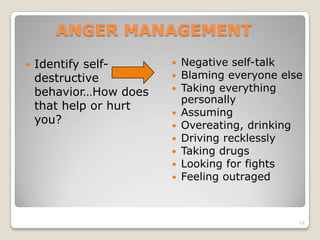
   Identify self-       Negative self-talk
    destructive          Blaming everyone else
    behavior…How does    Taking everything
                          personally
    that help or hurt
                         Assuming
    you?                 Overeating, drinking
                         Driving recklessly
                         Taking drugs
                         Looking for fights
                         Feeling outraged


                                              22
ANGER MANAGEMENT
    I stop blaming others and
     myself.
1.   Blaming only keeps people
     upset.
2.   Blaming is a way of not
     respecting people.
3.   I express my feelings and
     then try to work things out.


                                    23
ANGER MANAGEMENT
   Identify thoughts        You did that on purpose…
    prior to aggressive      You wanted to hurt me…
    acts:
                             You deserve this…
                             You never even asked me…
                             You’re being unreasonable…
                             You think you’re so good…
                             I’ll show you…
                             You started it…
                             There’s no justice…

                                                           24
ANGER MANAGEMENT
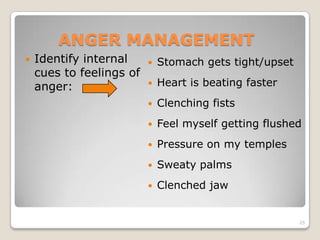
   Identify internal        Stomach gets tight/upset
    cues to feelings of
    anger:                   Heart is beating faster
                             Clenching fists
                             Feel myself getting flushed
                             Pressure on my temples
                             Sweaty palms
                             Clenched jaw


                                                         25
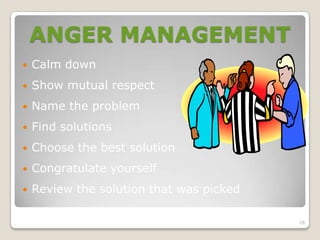
ANGER MANAGEMENT
   Calm down
   Show mutual respect
   Name the problem
   Find solutions
   Choose the best solution
   Congratulate yourself
   Review the solution that was picked

                                          26
ANGER MANAGEMENT

LOVE, PRAY, FORGIVE

  REALIZE THAT MOST STRESS
COMES FROM WITHIN, NOT WITHOUT.

  TAKE TIME TO SMELL THE FLOWERS
AND TASTE THE STRAWBERRIES.


                                  27
28

Anger management in students

  • 1.
    Pathfinder PATHFINDERGLOBAL Global School, SCHOOL, PATAUDI Pataudi : PRESENTATION ON ANGER MANAGEMENT IN STUDENTS Presentation by: Divyashu Sharma Presentation by: School Counsellor Divyashu Sharma (School Counsellor) 1
  • 2.
    INTRODUCTION  Do you find yourself fuming when someone cuts you off in traffic?  Does your blood pressure go through the roof when your child refuses to cooperate?  Or any situation makes you angry in daily life. 2
  • 3.
    Myths about anger  Anger is dangerous  We should not express our anger  Anger is bad  Anger is good  Anger is sin  Males have more anger Anger is a normal and even healthy emotion — but it's important to deal with it in a positive way. Uncontrolled anger can take a toll on both your health and your relationships.
  • 4.
  • 5.
    Negative effects Positiveeffects of anger of anger  Bodily system becomes • Energize us to do something rigid and impure • Enable us to assertive  We damage or abuse others • Help us to survive  Broken relationship • It is a way of communication “Holding on to anger is like grasping a hot coal with the • Motivate us to take action intent of throwing it at someone else; you are the Nobody makes you angry without one who gets burned.” - your concern Buddha
  • 6.
    Causes of anger  High expectation  Faulty perception and thinking  Personality factor  Poor communication skills  Poor emotional control “Anger will never disappear so long as thoughts of resentment are cherished in the mind. Anger will disappear just as soon as thoughts of resentment are forgotten.” -Buddha
  • 7.
    How do youact when Angry?  Judgmental  Hate  Blame  Preoccupied  Take revenge  Distrust “Anger and intolerance are the enemies of correct understanding.” -Gandhi
  • 8.
    ANGER MANAGEMENT CAUSES OFANGER FALL INTO TWO CATEGORIES:  EXTERNAL STRESSORS  INTERNAL STRESSORS 8
  • 9.
    ANGER MANAGEMENT EXTERNAL STRESSOR MAYBE MAJOR LIFE EVENTS:  MOVING  DEATH OF SPOUSE, FAMILY MEMBER OR FRIEND  DIVORCE MAY BE CAUSED BY EVERYDAY PRESSURES SUCH AS: •FINANCIAL •DEADLINES •ARGUMENTS •FAMILY CONCERNS •LACK OF SLEEP 9
  • 10.
    ANGER MANAGEMENT INTERNAL STRESSORS “INSIDEOURSELVES” THIS TYPE OF STRESSOR MAY PLAY A GREATER ROLE IN THE ANGER OF DAILY LIFE EXAMPLES ARE: • “VALUES AND BELIEFS” • FAITH • GOALS • SELF-IMAGE • EXPECTATIONS OF SELVES & OTHERS 10
  • 11.
    ANGER MANAGEMENT ANGER  DRIVEN BY HORMONES  HORMONES ACT LIKE A CONDUCTOR  HORMONES INNERVATE BODY SYSTEMS/ ORGANS 11
  • 12.
    ANGER MANAGEMENT WHAT HAPPENSWHEN WE ARE ANGRY:  HYPOTHALAMUS STIMULATES PITUITARY  PITUITARY RELEASES ACTH INTO BLOOD  ACTH STIMULATES ADRENAL GLANDS TO SECRETE FURTHER CHEMICALS THAT AFFECT OTHER ORGAN SYSTEMS WHAT WE NOTICE: HEART RATE SPEEDS UP BP RISES BREATHING SPEEDS UP BLOOD TO MUSCLES SWEATING BLOOD SUGAR INCREASES 12
  • 13.
    ANGER MANAGEMENT Common symptoms of Anger: Physical Mental Behavioural Cognitive Muscle tension Worry, Guilt Tardiness Personality Change Vomiting/ Nausea Nervousness Serious Appearance Become depressed Headaches Frustration Increased Feel helpless/ frustration & hopeless irritable Jaw, Neck, Back Moodiness Prone to accidents & Become explosive/ Pain addictions impulsive Sleep disturbances Nightmares Overreacting Exaggerated Fears Dry Mouth/ Sweaty Diminished Rushing & Tiredness Develop Anxiety/ Palms Concentration Panic Upper respiratory Impaired Memory or Nervous habits Develop Physical infections, Appetite forgetfulness Problems including varies CV disease, HBP, Ulcers, Migraine Cold Hands Reduce productivity Breathing changes Social withdrawal 13 (eg. Shallow, sighing)
  • 14.
    Anger Management HowDo I Do It? 14
  • 15.
    Skills needed in dealing with your anger: 1. Identify a range of feelings including anger 2. Identify aggressive acts by self and others 3. Identify the potential consequences to self and other from these aggressive acts 4. Identify self-destructive behavior 5. Identify thoughts prior to aggressive acts 6. Identify internal cues to feelings of anger 7. Develop coping mechanisms for dealing with anger 8. Express anger without loss of control 15
  • 16.
    ANGER MANAGEMENT  Identify a range of  Embarrassment feelings including  Excitement anger:  Disappointment  Jealousy  Fear  Helpless  Sadness  Left-out 16
  • 17.
    ANGER MANAGEMENT I am in charge of my own feelings: 1. I own my feelings. 2. It is okay to feel angry. 3. Anger is part of being human. 4. I learn how to express my anger in helpful ways. 17
  • 18.
    ANGER MANAGEMENT  Throw something  Kick someone or  Identify aggressive something acts shown by self  Get in someone’s face and others:  Shoving, grabbing, hitting  Break something  Call someone names  Give someone a dirty look  Silent treatment  Get others to “gang up”  Spread rumors 18
  • 19.
    ANGER MANAGEMENT Ichoose to feel good about myself through expressing my feelings. 1.I express angry feelings in ways that are fair to others and me. 2.I use fair words…e.g. “I feel when you” 19
  • 20.
    ANGER MANAGEMENT  The more I learn to take care of my anger the more powerful I become. 1. I need to control what I do with my anger. 2. I control how I let my anger out. 3. I practice cooling off. 4. I watch my thoughts. 20
  • 21.
    ANGER MANAGEMENT  Identify potential  Physical harm to consequences of someone or self  Destruction of property your anger to others and  Loss of family/friends yourself…what can  Loss of job that mean for you?  Loss of social privileges  Going to jail  Getting a bad reputation 21
  • 22.
    ANGER MANAGEMENT  Identify self-  Negative self-talk destructive  Blaming everyone else behavior…How does  Taking everything personally that help or hurt  Assuming you?  Overeating, drinking  Driving recklessly  Taking drugs  Looking for fights  Feeling outraged 22
  • 23.
    ANGER MANAGEMENT  I stop blaming others and myself. 1. Blaming only keeps people upset. 2. Blaming is a way of not respecting people. 3. I express my feelings and then try to work things out. 23
  • 24.
    ANGER MANAGEMENT  Identify thoughts  You did that on purpose… prior to aggressive  You wanted to hurt me… acts:  You deserve this…  You never even asked me…  You’re being unreasonable…  You think you’re so good…  I’ll show you…  You started it…  There’s no justice… 24
  • 25.
    ANGER MANAGEMENT  Identify internal  Stomach gets tight/upset cues to feelings of anger:  Heart is beating faster  Clenching fists  Feel myself getting flushed  Pressure on my temples  Sweaty palms  Clenched jaw 25
  • 26.
    ANGER MANAGEMENT  Calm down  Show mutual respect  Name the problem  Find solutions  Choose the best solution  Congratulate yourself  Review the solution that was picked 26
  • 27.
    ANGER MANAGEMENT LOVE, PRAY,FORGIVE REALIZE THAT MOST STRESS COMES FROM WITHIN, NOT WITHOUT. TAKE TIME TO SMELL THE FLOWERS AND TASTE THE STRAWBERRIES. 27
  • 28.