CHAPTER – 7 MANAGING ANGER  FOR  SELF GROWTH
ANGER MANAGEMENT  WORKSHOP PRESENTED BY   PROF. ABHA SINGH  AMITY INSTITUTE OF BEHAVIOURAL & ALLIED SCIENCES SECTOR – 44, NOIDA
ANGER MANAGEMENT Objective: To differentiate anger from other emotions. To understand constructive and destructive aspects of anger (case study). To enable students imbibe anger control techniques. Content: I. Introduction Defining Anger, Degrees of Anger, Types of Anger II.   Anger Management Techniques  Relaxation, RET, Distraction methods and  Other methods III. Teaching Methodology Lecture, Group work & Presentation, Case study & Discussion, Experiential learning.
“ To be angry with the right person to the right extent and at the right moment and with the right object and in the right way - that is not easy” Aristotle
Anger Anger is  A powerful emotion that you can harness Neither inherently bad nor good Judged by its function as it is expressed Often expressed ‘hand-me-down’, the ways you learned, which can be unlearned and  relearned. The powerful motivational driver that can be transformational contd
Two Myths About Anger You can express your anger whenever and however you wish.  You can repress your anger and never have to feel it yourself.
ANGER A secondary emotion, reflecting some unmet expectation or need. A potential feedback tool that can enhance your understanding of your needs and expectations. A double edged sword. -  When it is focused on a vision, it can create a constructive change. -  When focused on guilt, it creates indulgence in self-pity and depression.
DEGREE OF ANGER Anger is “an emotional state that varies in intensity from mild irritation to intense fury and rage”.
Aggression  is an intentional desire to harm someone. Rage  is when anger explodes into completely irrational behaviour and there is loss of self-control.
Hostility  is a chronic state of anger and antipathy toward people. Anger  is temporary and episodic reaction to a frustrating situation whereas hostility is a personality characteristic
ANGER STYLES  Anger out  Anger in Expressing anger assertively (Healthy Anger)
ANGER OUT Anger feelings directed toward other persons or things  SOME REASONS  No choice Appear powerful Hide other emotions Uncomfortable in close relationships
ANGER-OUT SIGNS  ASSAULTIVE  Physical & verbal cruelty Rage Slapping Shouting Kicking Hitting Threaten with knife & gun AGGRESSION Overly critical Fault finding Name – calling Accusing Nagging Whining Sarcasm Prejudice  Flashes of temper
CONSEQUENCES Possible physical destruction Impairs relationships  Compromises physical & mental  health Legal ramifications. Heart Disease
ANGER IN Anger that is directed inwards towards oneself. SOME REASONS Fear of hurting/offending Fear of being disliked or rejected. Fear of loosing control Feeling its inappropriate to be angry Unable to cope with strong intense emotions  Fear of damaging or losing relationship.
ANGER-IN SIGNS Withdrawal  Quiet remoteness  Silence  Little communication  Guilt  Tiredness  Anxiety Addictive behaviour – drinking, over-eating or drugs Depression
CONSEQUENCES Hypertension Anxiety Depression Accident proneness. Passive – aggressive personality Cynical and hostile behaviour Cancer
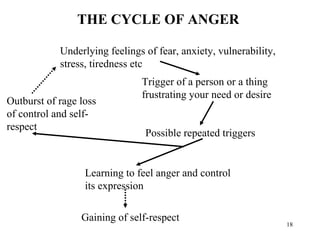
THE CYCLE OF ANGER Underlying feelings of fear, anxiety, vulnerability, stress, tiredness etc Trigger of a person or a thing frustrating your need or desire Outburst of rage loss of control and self-respect Possible repeated triggers Learning to feel anger and control its expression Gaining of self-respect
Two important steps in breaking the cycle of anger. To recognize what our underlying feelings are and to treat ourselves with extra care and love at these times. To learn how to feel our anger and to focus it towards the right place.
How Does Anger Feel? Anger feels uncomfortable. Physical Symptoms of anger can include: thumping heart tightening of throat or chest indigestion and/or hunger some of the symptoms of irritable bowel syndrome prickling at back of head. Feeling of pain in chest/heart area headache weary feeling in the body.
STRATEGIES  DON’T Hit, push, shove, hold, or threaten. Stand up and yell. Make faces or make fun of others. Swear or call people names. Get stuck in the past. Say “forget it”, “Tough”, “Who cares”, So what” Interrupt. Always have to get the last word. Have to win every battle.
DO Sit down and talk. Stick to one issue at a time. Take timeouts before you lose control. Listen to what the other person is saying. Attack problems, not people. Be open to discussion & compromise. Be flexible. Be responsible for what you say & do. State your feelings.
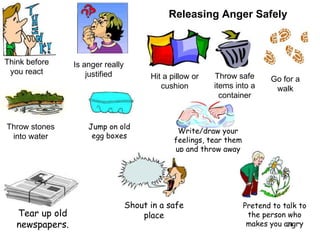
STRATEGY TO CONTROL ANGER Keep your voice low Breath slowly, relaxation techniques Count to ten Think before you react. Hit a pillow or cushion  Throw safe items into a container Go for a walk Write/draw your feelings, tear them up & throw away. Tear up old newspapers Shout in a safe place. Pretend to talk to the person who makes you angry Remember, it is healthy to let anger out in a safe way.
Think before you react Is anger really justified Releasing Anger Safely Hit a pillow or cushion Throw safe items into a container Go for a walk Throw stones into water Jump on old egg boxes Write/draw your feelings, tear them up and throw away Tear up old newspapers. Shout in a safe place Pretend to talk to the person who makes you angry
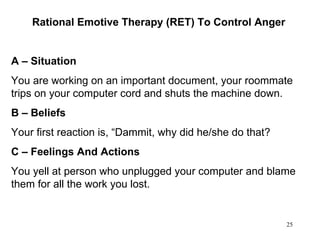
Rational Emotive Therapy (RET) To Control Anger A – Situation You are working on an important document, your roommate trips on your computer cord and shuts the machine down. B – Beliefs Your first reaction is, “Dammit, why did he/she do that?  C – Feelings And Actions You yell at person who unplugged your computer and blame them for all the work you lost.
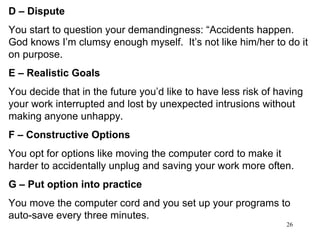
D – Dispute   You start to question your demandingness: “Accidents happen.  God knows I’m clumsy enough myself.  It’s not like him/her to do it on purpose. E – Realistic Goals You decide that in the future you’d like to have less risk of having your work interrupted and lost by unexpected intrusions without making anyone unhappy. F – Constructive Options You opt for options like moving the computer cord to make it harder to accidentally unplug and saving your work more often. G – Put option into practice  You move the computer cord and you set up your programs to auto-save every three minutes.
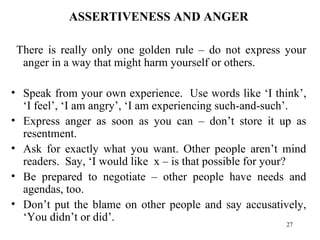
ASSERTIVENESS AND ANGER There is really only one golden rule – do not express your anger in a way that might harm yourself or others. Speak from your own experience.  Use words like ‘I think’, ‘I feel’, ‘I am angry’, ‘I am experiencing such-and-such’. Express anger as soon as you can – don’t store it up as resentment. Ask for exactly what you want. Other people aren’t mind readers.  Say, ‘I would like  x – is that possible for your? Be prepared to negotiate – other people have needs and agendas, too. Don’t put the blame on other people and say accusatively, ‘You didn’t or did’.
Find the true target of your anger – but don’t always accuse them of it.  Don’t allow your anger to come out sideways. Find a safe way of expressing your anger. This might include speaking to an empty chair, beating a cushion, going for a long walk, playing a highly competitive game of squash. Take responsibility for your own life and happiness. If you can practice the above, you will find your anger is much cleaner and less contaminated by other emotions such as vindictiveness, violence, resentment and fear.  You will also find that the anger of other people is much easier to deal with as these
RELAXATION TECHNIQUES Meditation Breathing Technique Muscle Relaxation Exercise
ANCIENT WISDOM ON ANGER : Bhagavad Gita Vedanta and  Atharva Veda
ANCIENT WISDOM ON ANGER  When a man thinks of objects attachment for them arises,  From attachment, desire is born and thwarted desire arises  anger , From anger comes delusion, From delusion loss of memory occurs, From loss of memory occurs the destruction of discrimination of choice And from destruction of discrimination one perishes
Verses from Bhagavad Gita Chapter II.62, 63 trace the cause and effects of anger in 8 steps as follows: Brooding over the sense objects  >  Attachment  >  Desire  >  Anger (Unfulfilled desire)  >  Delusion  >  Loss of memory  >  Power of discrimination  >  One Perishes
Practice Indian Philosophy (Vedanta) To be Effective Personally & Professionally  Healthy philosophy of life with  a balanced and matured mind (Service orientation and concern for the people should be in the centre) Clear idea about his/her goal and role at individual, organizational and social level. Quality of a good physician who is always empathic, objective and takes an appropriate action. 16 PF
“ Cast off anger from your heart like an arrow from the bow, so that you may again be friends and live together in harmony” Atharva Veda
INNER WORK Referring to the ‘Look Back on Anger’ exercise, what do you do with anger that isn’t justified?  Do you translate it into depression, resentment or some other emotions? How do you feel about your anger? What anger do you allow yourself to express and how do you express it? What would you like to change about the way you express your anger? What do you feel about other people’s anger? Does it frighten you?  Does it make you anger? Are you prepared to take responsibility for your anger?  If not, who should?
Message for all my dear students (future leaders) “ We believe success is not determined by how we are doing compared with others, but how we are doing compared with what we are capable of doing.  Self-aware individual competes with oneself. They better their own records and keep moving constantly for personal and professional growth” Prof. Abha Singh, Jt. Dir. (AIBAS)

Anger Management

  • 1.
    CHAPTER – 7MANAGING ANGER FOR SELF GROWTH
  • 2.
    ANGER MANAGEMENT WORKSHOP PRESENTED BY PROF. ABHA SINGH AMITY INSTITUTE OF BEHAVIOURAL & ALLIED SCIENCES SECTOR – 44, NOIDA
  • 3.
    ANGER MANAGEMENT Objective:To differentiate anger from other emotions. To understand constructive and destructive aspects of anger (case study). To enable students imbibe anger control techniques. Content: I. Introduction Defining Anger, Degrees of Anger, Types of Anger II. Anger Management Techniques Relaxation, RET, Distraction methods and Other methods III. Teaching Methodology Lecture, Group work & Presentation, Case study & Discussion, Experiential learning.
  • 4.
    “ To beangry with the right person to the right extent and at the right moment and with the right object and in the right way - that is not easy” Aristotle
  • 5.
    Anger Anger is A powerful emotion that you can harness Neither inherently bad nor good Judged by its function as it is expressed Often expressed ‘hand-me-down’, the ways you learned, which can be unlearned and relearned. The powerful motivational driver that can be transformational contd
  • 6.
    Two Myths AboutAnger You can express your anger whenever and however you wish. You can repress your anger and never have to feel it yourself.
  • 7.
    ANGER A secondaryemotion, reflecting some unmet expectation or need. A potential feedback tool that can enhance your understanding of your needs and expectations. A double edged sword. - When it is focused on a vision, it can create a constructive change. - When focused on guilt, it creates indulgence in self-pity and depression.
  • 8.
    DEGREE OF ANGERAnger is “an emotional state that varies in intensity from mild irritation to intense fury and rage”.
  • 9.
    Aggression isan intentional desire to harm someone. Rage is when anger explodes into completely irrational behaviour and there is loss of self-control.
  • 10.
    Hostility isa chronic state of anger and antipathy toward people. Anger is temporary and episodic reaction to a frustrating situation whereas hostility is a personality characteristic
  • 11.
    ANGER STYLES Anger out Anger in Expressing anger assertively (Healthy Anger)
  • 12.
    ANGER OUT Angerfeelings directed toward other persons or things SOME REASONS No choice Appear powerful Hide other emotions Uncomfortable in close relationships
  • 13.
    ANGER-OUT SIGNS ASSAULTIVE Physical & verbal cruelty Rage Slapping Shouting Kicking Hitting Threaten with knife & gun AGGRESSION Overly critical Fault finding Name – calling Accusing Nagging Whining Sarcasm Prejudice Flashes of temper
  • 14.
    CONSEQUENCES Possible physicaldestruction Impairs relationships Compromises physical & mental health Legal ramifications. Heart Disease
  • 15.
    ANGER IN Angerthat is directed inwards towards oneself. SOME REASONS Fear of hurting/offending Fear of being disliked or rejected. Fear of loosing control Feeling its inappropriate to be angry Unable to cope with strong intense emotions Fear of damaging or losing relationship.
  • 16.
    ANGER-IN SIGNS Withdrawal Quiet remoteness Silence Little communication Guilt Tiredness Anxiety Addictive behaviour – drinking, over-eating or drugs Depression
  • 17.
    CONSEQUENCES Hypertension AnxietyDepression Accident proneness. Passive – aggressive personality Cynical and hostile behaviour Cancer
  • 18.
    THE CYCLE OFANGER Underlying feelings of fear, anxiety, vulnerability, stress, tiredness etc Trigger of a person or a thing frustrating your need or desire Outburst of rage loss of control and self-respect Possible repeated triggers Learning to feel anger and control its expression Gaining of self-respect
  • 19.
    Two important stepsin breaking the cycle of anger. To recognize what our underlying feelings are and to treat ourselves with extra care and love at these times. To learn how to feel our anger and to focus it towards the right place.
  • 20.
    How Does AngerFeel? Anger feels uncomfortable. Physical Symptoms of anger can include: thumping heart tightening of throat or chest indigestion and/or hunger some of the symptoms of irritable bowel syndrome prickling at back of head. Feeling of pain in chest/heart area headache weary feeling in the body.
  • 21.
    STRATEGIES DON’THit, push, shove, hold, or threaten. Stand up and yell. Make faces or make fun of others. Swear or call people names. Get stuck in the past. Say “forget it”, “Tough”, “Who cares”, So what” Interrupt. Always have to get the last word. Have to win every battle.
  • 22.
    DO Sit downand talk. Stick to one issue at a time. Take timeouts before you lose control. Listen to what the other person is saying. Attack problems, not people. Be open to discussion & compromise. Be flexible. Be responsible for what you say & do. State your feelings.
  • 23.
    STRATEGY TO CONTROLANGER Keep your voice low Breath slowly, relaxation techniques Count to ten Think before you react. Hit a pillow or cushion Throw safe items into a container Go for a walk Write/draw your feelings, tear them up & throw away. Tear up old newspapers Shout in a safe place. Pretend to talk to the person who makes you angry Remember, it is healthy to let anger out in a safe way.
  • 24.
    Think before youreact Is anger really justified Releasing Anger Safely Hit a pillow or cushion Throw safe items into a container Go for a walk Throw stones into water Jump on old egg boxes Write/draw your feelings, tear them up and throw away Tear up old newspapers. Shout in a safe place Pretend to talk to the person who makes you angry
  • 25.
    Rational Emotive Therapy(RET) To Control Anger A – Situation You are working on an important document, your roommate trips on your computer cord and shuts the machine down. B – Beliefs Your first reaction is, “Dammit, why did he/she do that? C – Feelings And Actions You yell at person who unplugged your computer and blame them for all the work you lost.
  • 26.
    D – Dispute You start to question your demandingness: “Accidents happen. God knows I’m clumsy enough myself. It’s not like him/her to do it on purpose. E – Realistic Goals You decide that in the future you’d like to have less risk of having your work interrupted and lost by unexpected intrusions without making anyone unhappy. F – Constructive Options You opt for options like moving the computer cord to make it harder to accidentally unplug and saving your work more often. G – Put option into practice You move the computer cord and you set up your programs to auto-save every three minutes.
  • 27.
    ASSERTIVENESS AND ANGERThere is really only one golden rule – do not express your anger in a way that might harm yourself or others. Speak from your own experience. Use words like ‘I think’, ‘I feel’, ‘I am angry’, ‘I am experiencing such-and-such’. Express anger as soon as you can – don’t store it up as resentment. Ask for exactly what you want. Other people aren’t mind readers. Say, ‘I would like x – is that possible for your? Be prepared to negotiate – other people have needs and agendas, too. Don’t put the blame on other people and say accusatively, ‘You didn’t or did’.
  • 28.
    Find the truetarget of your anger – but don’t always accuse them of it. Don’t allow your anger to come out sideways. Find a safe way of expressing your anger. This might include speaking to an empty chair, beating a cushion, going for a long walk, playing a highly competitive game of squash. Take responsibility for your own life and happiness. If you can practice the above, you will find your anger is much cleaner and less contaminated by other emotions such as vindictiveness, violence, resentment and fear. You will also find that the anger of other people is much easier to deal with as these
  • 29.
    RELAXATION TECHNIQUES MeditationBreathing Technique Muscle Relaxation Exercise
  • 30.
    ANCIENT WISDOM ONANGER : Bhagavad Gita Vedanta and Atharva Veda
  • 31.
    ANCIENT WISDOM ONANGER When a man thinks of objects attachment for them arises, From attachment, desire is born and thwarted desire arises anger , From anger comes delusion, From delusion loss of memory occurs, From loss of memory occurs the destruction of discrimination of choice And from destruction of discrimination one perishes
  • 32.
    Verses from BhagavadGita Chapter II.62, 63 trace the cause and effects of anger in 8 steps as follows: Brooding over the sense objects > Attachment > Desire > Anger (Unfulfilled desire) > Delusion > Loss of memory > Power of discrimination > One Perishes
  • 33.
    Practice Indian Philosophy(Vedanta) To be Effective Personally & Professionally Healthy philosophy of life with a balanced and matured mind (Service orientation and concern for the people should be in the centre) Clear idea about his/her goal and role at individual, organizational and social level. Quality of a good physician who is always empathic, objective and takes an appropriate action. 16 PF
  • 34.
    “ Cast offanger from your heart like an arrow from the bow, so that you may again be friends and live together in harmony” Atharva Veda
  • 35.
    INNER WORK Referringto the ‘Look Back on Anger’ exercise, what do you do with anger that isn’t justified? Do you translate it into depression, resentment or some other emotions? How do you feel about your anger? What anger do you allow yourself to express and how do you express it? What would you like to change about the way you express your anger? What do you feel about other people’s anger? Does it frighten you? Does it make you anger? Are you prepared to take responsibility for your anger? If not, who should?
  • 36.
    Message for allmy dear students (future leaders) “ We believe success is not determined by how we are doing compared with others, but how we are doing compared with what we are capable of doing. Self-aware individual competes with oneself. They better their own records and keep moving constantly for personal and professional growth” Prof. Abha Singh, Jt. Dir. (AIBAS)