Presented by-
Jasleen Kaur Brar
INTRODUCTION
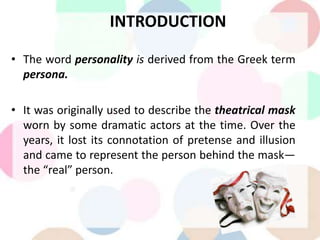
• The word personality is derived from the Greek term
persona.
• It was originally used to describe the theatrical mask
worn by some dramatic actors at the time. Over the
years, it lost its connotation of pretense and illusion
and came to represent the person behind the mask—
the “real” person.
• The Diagnostic and Statistical Manual of
Mental Disorders, Fourth Edition, Text Revision
(DSM-IV-TR) (American Psychiatric Association
[APA], 2000) defines personality traits as
“enduring patterns of perceiving, relating to,
and thinking about the environment and
oneself that are exhibited in a wide range of
social and personal contexts.”
Personality Disorders
• Personality disorders occur when these traits
become inflexible and maladaptive and cause
either significant functional impairment or
subjective distress.
• A personality disorder is an enduring pattern of
inner experience and behavior that deviates
markedly from the expectations of the individual’s
culture, is pervasive and inflexible, has an onset in
adolescence or early adulthood, is stable with time,
and leads to distress or impairment (American
Psychiatric Association [APA], 2000, p. 685).
Personality disorder subtypes classified
in DSM-IV TR
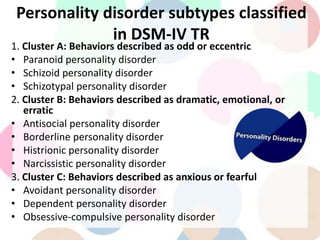
1. Cluster A: Behaviors described as odd or eccentric
• Paranoid personality disorder
• Schizoid personality disorder
• Schizotypal personality disorder
2. Cluster B: Behaviors described as dramatic, emotional, or
erratic
• Antisocial personality disorder
• Borderline personality disorder
• Histrionic personality disorder
• Narcissistic personality disorder
3. Cluster C: Behaviors described as anxious or fearful
• Avoidant personality disorder
• Dependent personality disorder
• Obsessive-compulsive personality disorder
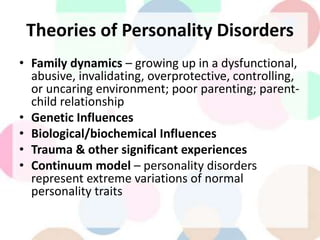
Theories of Personality Disorders
• Family dynamics – growing up in a dysfunctional,
abusive, invalidating, overprotective, controlling,
or uncaring environment; poor parenting; parent-
child relationship
• Genetic Influences
• Biological/biochemical Influences
• Trauma & other significant experiences
• Continuum model – personality disorders
represent extreme variations of normal
personality traits
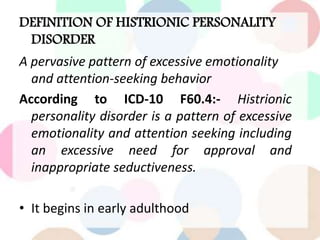
DEFINITION OF HISTRIONIC PERSONALITY
DISORDER
A pervasive pattern of excessive emotionality
and attention-seeking behavior
According to ICD-10 F60.4:- Histrionic
personality disorder is a pattern of excessive
emotionality and attention seeking including
an excessive need for approval and
inappropriate seductiveness.
• It begins in early adulthood
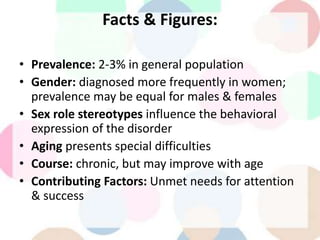
Facts & Figures:
• Prevalence: 2-3% in general population
• Gender: diagnosed more frequently in women;
prevalence may be equal for males & females
• Sex role stereotypes influence the behavioral
expression of the disorder
• Aging presents special difficulties
• Course: chronic, but may improve with age
• Contributing Factors: Unmet needs for attention
& success
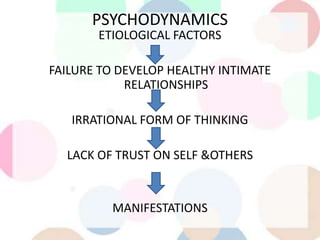
ETIOLOGICAL FACTORS
FAILURE TO DEVELOP HEALTHY INTIMATE
RELATIONSHIPS
IRRATIONAL FORM OF THINKING
LACK OF TRUST ON SELF &OTHERS
MANIFESTATIONS
PSYCHODYNAMICS
MANIFESTATIONS
 Pervasive and excessive pattern of emotionality and
attention seeking, i.e. constant seeking of
reassurance or approval.
 Individuals are lively, excessive dramatics with
exaggerated display of emotions.
 Enthusiastic and flirtatious.
 Inappropriately seductive appearance or behavior.
• Excessive concern with physical appearance.
• Self centeredness, self indulgent and intensely
dependent on others.
• Low tolerance of frustration or delayed
gratification.
• Rapidly shifting emotional states that may
appear shallow
 Opinions are easily influenced by other people,
but difficult to back-up details.
 Tendency to believe that relationships are more
intimate than they actually are.
 Makes rash decisions.
 Threaten or attempts suicide to get attention.
 Inappropriately sexually provocative. Express
strong emotions with an impressionistic style.
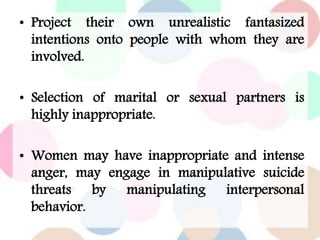
• Project their own unrealistic fantasized
intentions onto people with whom they are
involved.
• Selection of marital or sexual partners is
highly inappropriate.
• Women may have inappropriate and intense
anger, may engage in manipulative suicide
threats by manipulating interpersonal
behavior.
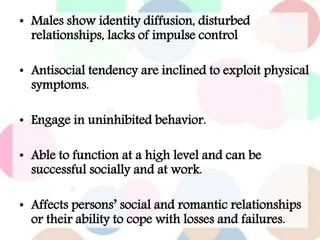
• Males show identity diffusion, disturbed
relationships, lacks of impulse control
• Antisocial tendency are inclined to exploit physical
symptoms.
• Engage in uninhibited behavior.
• Able to function at a high level and can be
successful socially and at work.
• Affects persons’ social and romantic relationships
or their ability to cope with losses and failures.
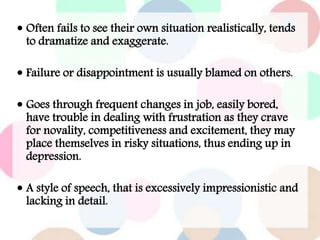
 Often fails to see their own situation realistically, tends
to dramatize and exaggerate.
 Failure or disappointment is usually blamed on others.
 Goes through frequent changes in job, easily bored,
have trouble in dealing with frustration as they crave
for novality, competitiveness and excitement, they may
place themselves in risky situations, thus ending up in
depression.
 A style of speech, that is excessively impressionistic and
lacking in detail.
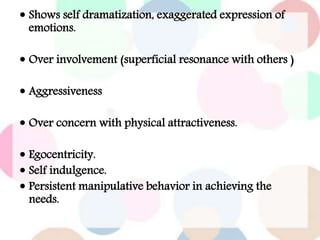
 Shows self dramatization, exaggerated expression of
emotions.
 Over involvement (superficial resonance with others )
 Aggressiveness
 Over concern with physical attractiveness.
 Egocentricity.
 Self indulgence.
 Persistent manipulative behavior in achieving the
needs.
Criteria of Histrionic Personality
Disorder (DSM IV-TR)
• A pervasive pattern of excessive emotionality and attention
seeking, beginning by early adulthood and present in a
variety of contexts, as indicated by five (or more) of the
following:
(1) is uncomfortable in situations in which he or she is not the
center of attention
(2) interaction with others is often characterized by
inappropriate sexually seductive or provocative behavior
(3) displays rapidly shifting and shallow expression of
emotions
(4) consistently uses physical appearance to draw attention to
self
(5) has a style of speech that is excessively
impressionistic and lacking in detail
(6) shows self-dramatization, theatricality, and
exaggerated expression of emotion
(7) is suggestible, i.e., easily influenced by others
or circumstances
(8) considers relationships to be more intimate
than they actually are
Mnemonic
 A mnemonic that can be used to remember the criteria
for histrionic personality disorder is PRAISE ME:
 P - provocative (or seductive) behavior
 R - relationships, considered more intimate than they
are
 A - attention, must be at center of
 I - influenced easily
 S - speech (style) - wants to impress, lacks detail
 E - emotional lability, shallowness
 M - make-up - physical appearance used to draw
attention to self
 E - exaggerated emotions - theatrical
ICD 10 Creteria
• A. The general criteria of personality disorder (F60) must be
met.
• B. At least four of the following must be present:
(1) Self-dramatization, theatricality, or exaggerated expression
of emotions.
(2) Suggestibility, easily influenced by others or by
circumstances.
(3) Shallow and labile affectivity.
(4) Continually seeks excitement and activities in which the
subject is the centre of attention.
(5) Inappropriately seductive in appearance or behaviour.
(6) Overly concerned with physical attractiveness.
Dual diagnoses
• HPD has been associated with alcoholism and
with higher rates of somatization
disorder , conversion disorder , and major
depressive disorder .
• Personality disorders such as borderline,
narcissistic, antisocial, and dependent can
occur with HPD.
Diagnosis
• Observation of appearance, behaviour
• Collection of history
• Psychological evaluation
TREATMENT
Psychotherapy based on case report method
aimed at self development through resolution
of conflict.
Dynamic therapy remains the treatment of
choice to externalize patient’s inner emotions
in treatment of histrionic PD.
In this therapy interpretation of pathological
relationships may evoke intense feelings of
anxiety, which have to be handled
respectfully without humiliating the patients.
•Self help groups and therapeutic community
setting is more productive than
institutionalization in producing a change.
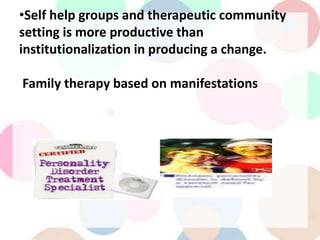
Family therapy based on manifestations
Complications:
• Individuals with this disorder may have
difficulty achieving emotional intimacy in
romantic relationships. Without being aware of
it, they often act out a role (e.g., "victim" or
"princess").
• They may seek to control their partner through
emotional manipulation or seductiveness on one
level, whereas displaying a marked dependency
on them at another level.
• Impaired relationships with same-sex friends
because of their sexually provocative behavior or
their demands for constant attention.
• They crave novelty, stimulation, and
excitement and have a tendency to become
bored with their usual routine.
• They often initiate a job or project with great
enthusiasm, their interest may lag quickly.
• The Diagnostic actual risk of suicide is not
known, but individuals with this disorder are
at increased risk for suicidal gestures and
threats to get attention
Defence Mechanisms use
--Denial
--Identification
--Somatization
--Repression
--Acting out
--Fantasy of love and attention
--Dissociation
--Regression
Histrionic personality disorder

Histrionic personality disorder

  • 1.
  • 2.
    INTRODUCTION • The wordpersonality is derived from the Greek term persona. • It was originally used to describe the theatrical mask worn by some dramatic actors at the time. Over the years, it lost its connotation of pretense and illusion and came to represent the person behind the mask— the “real” person.
  • 3.
    • The Diagnosticand Statistical Manual of Mental Disorders, Fourth Edition, Text Revision (DSM-IV-TR) (American Psychiatric Association [APA], 2000) defines personality traits as “enduring patterns of perceiving, relating to, and thinking about the environment and oneself that are exhibited in a wide range of social and personal contexts.”
  • 4.
    Personality Disorders • Personalitydisorders occur when these traits become inflexible and maladaptive and cause either significant functional impairment or subjective distress. • A personality disorder is an enduring pattern of inner experience and behavior that deviates markedly from the expectations of the individual’s culture, is pervasive and inflexible, has an onset in adolescence or early adulthood, is stable with time, and leads to distress or impairment (American Psychiatric Association [APA], 2000, p. 685).
  • 5.
    Personality disorder subtypesclassified in DSM-IV TR 1. Cluster A: Behaviors described as odd or eccentric • Paranoid personality disorder • Schizoid personality disorder • Schizotypal personality disorder 2. Cluster B: Behaviors described as dramatic, emotional, or erratic • Antisocial personality disorder • Borderline personality disorder • Histrionic personality disorder • Narcissistic personality disorder 3. Cluster C: Behaviors described as anxious or fearful • Avoidant personality disorder • Dependent personality disorder • Obsessive-compulsive personality disorder
  • 6.
    Theories of PersonalityDisorders • Family dynamics – growing up in a dysfunctional, abusive, invalidating, overprotective, controlling, or uncaring environment; poor parenting; parent- child relationship • Genetic Influences • Biological/biochemical Influences • Trauma & other significant experiences • Continuum model – personality disorders represent extreme variations of normal personality traits
  • 8.
    DEFINITION OF HISTRIONICPERSONALITY DISORDER A pervasive pattern of excessive emotionality and attention-seeking behavior According to ICD-10 F60.4:- Histrionic personality disorder is a pattern of excessive emotionality and attention seeking including an excessive need for approval and inappropriate seductiveness. • It begins in early adulthood
  • 9.
    Facts & Figures: •Prevalence: 2-3% in general population • Gender: diagnosed more frequently in women; prevalence may be equal for males & females • Sex role stereotypes influence the behavioral expression of the disorder • Aging presents special difficulties • Course: chronic, but may improve with age • Contributing Factors: Unmet needs for attention & success
  • 10.
    ETIOLOGICAL FACTORS FAILURE TODEVELOP HEALTHY INTIMATE RELATIONSHIPS IRRATIONAL FORM OF THINKING LACK OF TRUST ON SELF &OTHERS MANIFESTATIONS PSYCHODYNAMICS
  • 11.
    MANIFESTATIONS  Pervasive andexcessive pattern of emotionality and attention seeking, i.e. constant seeking of reassurance or approval.  Individuals are lively, excessive dramatics with exaggerated display of emotions.  Enthusiastic and flirtatious.  Inappropriately seductive appearance or behavior.
  • 12.
    • Excessive concernwith physical appearance. • Self centeredness, self indulgent and intensely dependent on others. • Low tolerance of frustration or delayed gratification. • Rapidly shifting emotional states that may appear shallow
  • 13.
     Opinions areeasily influenced by other people, but difficult to back-up details.  Tendency to believe that relationships are more intimate than they actually are.  Makes rash decisions.  Threaten or attempts suicide to get attention.  Inappropriately sexually provocative. Express strong emotions with an impressionistic style.
  • 14.
    • Project theirown unrealistic fantasized intentions onto people with whom they are involved. • Selection of marital or sexual partners is highly inappropriate. • Women may have inappropriate and intense anger, may engage in manipulative suicide threats by manipulating interpersonal behavior.
  • 15.
    • Males showidentity diffusion, disturbed relationships, lacks of impulse control • Antisocial tendency are inclined to exploit physical symptoms. • Engage in uninhibited behavior. • Able to function at a high level and can be successful socially and at work. • Affects persons’ social and romantic relationships or their ability to cope with losses and failures.
  • 16.
     Often failsto see their own situation realistically, tends to dramatize and exaggerate.  Failure or disappointment is usually blamed on others.  Goes through frequent changes in job, easily bored, have trouble in dealing with frustration as they crave for novality, competitiveness and excitement, they may place themselves in risky situations, thus ending up in depression.  A style of speech, that is excessively impressionistic and lacking in detail.
  • 17.
     Shows selfdramatization, exaggerated expression of emotions.  Over involvement (superficial resonance with others )  Aggressiveness  Over concern with physical attractiveness.  Egocentricity.  Self indulgence.  Persistent manipulative behavior in achieving the needs.
  • 18.
    Criteria of HistrionicPersonality Disorder (DSM IV-TR) • A pervasive pattern of excessive emotionality and attention seeking, beginning by early adulthood and present in a variety of contexts, as indicated by five (or more) of the following: (1) is uncomfortable in situations in which he or she is not the center of attention (2) interaction with others is often characterized by inappropriate sexually seductive or provocative behavior (3) displays rapidly shifting and shallow expression of emotions (4) consistently uses physical appearance to draw attention to self
  • 19.
    (5) has astyle of speech that is excessively impressionistic and lacking in detail (6) shows self-dramatization, theatricality, and exaggerated expression of emotion (7) is suggestible, i.e., easily influenced by others or circumstances (8) considers relationships to be more intimate than they actually are
  • 20.
    Mnemonic  A mnemonicthat can be used to remember the criteria for histrionic personality disorder is PRAISE ME:  P - provocative (or seductive) behavior  R - relationships, considered more intimate than they are  A - attention, must be at center of  I - influenced easily  S - speech (style) - wants to impress, lacks detail  E - emotional lability, shallowness  M - make-up - physical appearance used to draw attention to self  E - exaggerated emotions - theatrical
  • 21.
    ICD 10 Creteria •A. The general criteria of personality disorder (F60) must be met. • B. At least four of the following must be present: (1) Self-dramatization, theatricality, or exaggerated expression of emotions. (2) Suggestibility, easily influenced by others or by circumstances. (3) Shallow and labile affectivity. (4) Continually seeks excitement and activities in which the subject is the centre of attention. (5) Inappropriately seductive in appearance or behaviour. (6) Overly concerned with physical attractiveness.
  • 22.
    Dual diagnoses • HPDhas been associated with alcoholism and with higher rates of somatization disorder , conversion disorder , and major depressive disorder . • Personality disorders such as borderline, narcissistic, antisocial, and dependent can occur with HPD.
  • 23.
    Diagnosis • Observation ofappearance, behaviour • Collection of history • Psychological evaluation
  • 24.
    TREATMENT Psychotherapy based oncase report method aimed at self development through resolution of conflict. Dynamic therapy remains the treatment of choice to externalize patient’s inner emotions in treatment of histrionic PD. In this therapy interpretation of pathological relationships may evoke intense feelings of anxiety, which have to be handled respectfully without humiliating the patients.
  • 25.
    •Self help groupsand therapeutic community setting is more productive than institutionalization in producing a change. Family therapy based on manifestations
  • 26.
    Complications: • Individuals withthis disorder may have difficulty achieving emotional intimacy in romantic relationships. Without being aware of it, they often act out a role (e.g., "victim" or "princess"). • They may seek to control their partner through emotional manipulation or seductiveness on one level, whereas displaying a marked dependency on them at another level. • Impaired relationships with same-sex friends because of their sexually provocative behavior or their demands for constant attention.
  • 27.
    • They cravenovelty, stimulation, and excitement and have a tendency to become bored with their usual routine. • They often initiate a job or project with great enthusiasm, their interest may lag quickly. • The Diagnostic actual risk of suicide is not known, but individuals with this disorder are at increased risk for suicidal gestures and threats to get attention
  • 28.
    Defence Mechanisms use --Denial --Identification --Somatization --Repression --Actingout --Fantasy of love and attention --Dissociation --Regression