Anger Management
People who fly into a rage always make a bad
landing.
-Will Rogers
Content
• Introduction
• Vicious circle of anger
• How You Feel (Emotional Signs)
• Skills needed in dealing with your anger
• Difference between anger and aggression
• Five-Step Approach to Managing Anger
• Relaxation techniques
• Summary
Introduction
• Anger management is the process of learning to
recognize signs that you're becoming angry, and
taking action to calm down and deal with the
situation in a positive way.
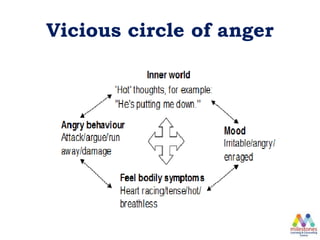
Vicious circle of anger
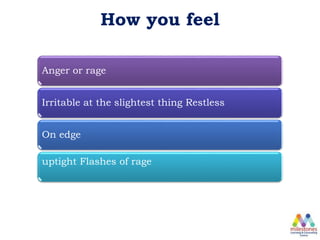
How you feel
Anger or rage
Irritable at the slightest thing Restless
On edge
uptight Flashes of rage
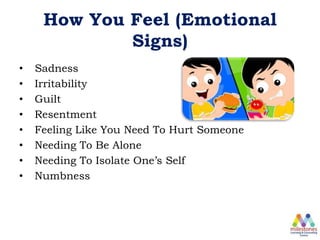
How You Feel (Emotional
Signs)
• Sadness
• Irritability
• Guilt
• Resentment
• Feeling Like You Need To Hurt Someone
• Needing To Be Alone
• Needing To Isolate One’s Self
• Numbness
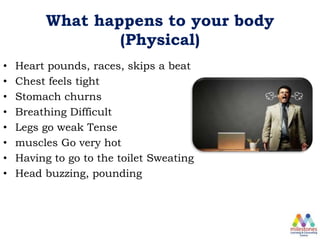
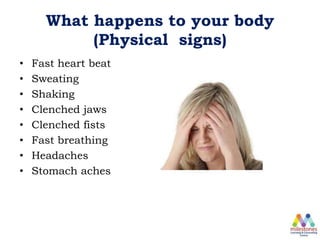
What happens to your body
(Physical)
• Heart pounds, races, skips a beat
• Chest feels tight
• Stomach churns
• Breathing Difficult
• Legs go weak Tense
• muscles Go very hot
• Having to go to the toilet Sweating
• Head buzzing, pounding
What happens to your body
(Physical signs)
• Fast heart beat
• Sweating
• Shaking
• Clenched jaws
• Clenched fists
• Fast breathing
• Headaches
• Stomach aches
What you do (Behavioural signs)
• Snappy and irritable behaviour
• Shout and argue
• Hit out
• Leave the situation
• Throw/hit an object, slam door, etc
• Attack someone
• Say something unkind
• Cry
• Push someone
• Do nothing, bottle it up
• Get drunk/smoke/take drugs
• Hurt yourself
Impact of anger (Mental
Signs)
• Difficulty Concentrating
• Obsessing On The Situation
• Thinking Vengeful Thoughts
• Cynicism
Controlling the physical
symptoms of anger
• Reducing physical symptoms
• Controlling breathing
• Controlling angry behaviours
• Stress less lifestyle
• Communication
• Long term beliefs
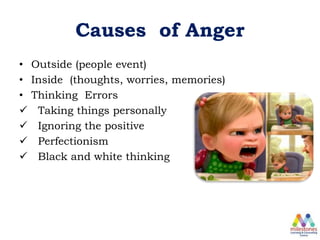
Causes of Anger
• Outside (people event)
• Inside (thoughts, worries, memories)
• Thinking Errors
 Taking things personally
 Ignoring the positive
 Perfectionism
 Black and white thinking
Skills needed in dealing with
your anger
1. Identify a range of feelings including anger
2. Identify aggressive acts by self and others
3. Identify the potential consequences to self and
other from these aggressive acts
4. Identify self-destructive behavior
5. Identify thoughts prior to aggressive acts
6. Identify internal cues to feelings of anger
7. Develop coping mechanisms for dealing with
anger
8. Express anger without loss of control
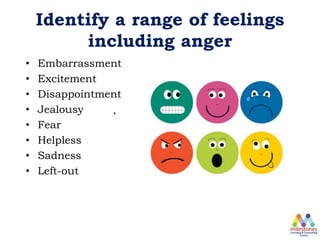
Identify a range of feelings
including anger
• Embarrassment
• Excitement
• Disappointment
• Jealousy
• Fear
• Helpless
• Sadness
• Left-out
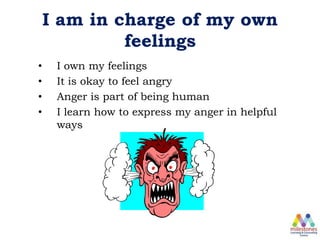
I am in charge of my own
feelings
• I own my feelings
• It is okay to feel angry
• Anger is part of being human
• I learn how to express my anger in helpful
ways
Identify aggressive acts
shown by self and others
• Throw something
• Kick someone or something
• Get in someone’s face
• Shoving, grabbing, hitting
• Break something
• Call someone names
• Give someone a dirty look
• Silent treatment
• Get others to “gang up”
• Spread rumors
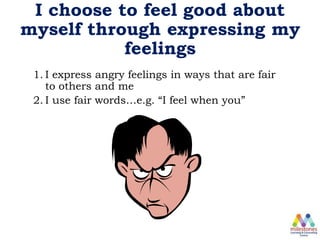
I choose to feel good about
myself through expressing my
feelings
1. I express angry feelings in ways that are fair
to others and me
2. I use fair words…e.g. “I feel when you”
The more I learn to take care
of my anger the more
powerful I become
• I need to control what I do with my
anger
• I control how I let my anger out
• I practice cooling off
• I watch my thoughts
Difference between Anger and
Aggression
Anger
• Anger is an emotion
• It is ok to be angry
Aggression
• Aggression is acting
out inappropriately
and is not ok
• Learn to check your
aggression and express
your anger
appropriately
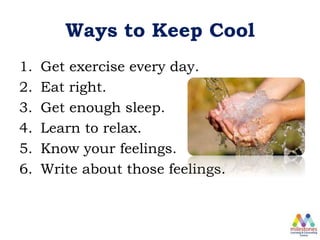
Ways to Keep Cool
1. Get exercise every day.
2. Eat right.
3. Get enough sleep.
4. Learn to relax.
5. Know your feelings.
6. Write about those feelings.
Ways to Keep Cool
7. Find a quiet place.
8. Take a time out.
9. Find fun distractions.
10. Make good decisions about what you see
and hear.
11. Choose friends who make you feel good.
12. Learn to forgive and forget.
Identify potential
consequences of your anger
to others and yourself
• Physical harm to someone or self
• Destruction of property
• Loss of family/friends
• Loss of job
• Loss of social privileges
• Going to jail
• Getting a bad reputation
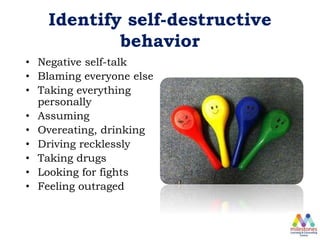
Identify self-destructive
behavior
• Negative self-talk
• Blaming everyone else
• Taking everything
personally
• Assuming
• Overeating, drinking
• Driving recklessly
• Taking drugs
• Looking for fights
• Feeling outraged
I stop blaming others and
myself
• Blaming only keeps people upset
• Blaming is a way of not respecting people
• I express my feelings and then try to work
things out
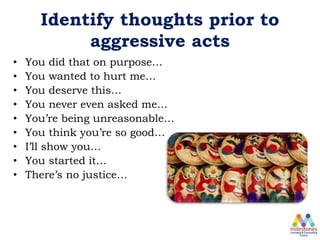
Identify thoughts prior to
aggressive acts
• You did that on purpose…
• You wanted to hurt me…
• You deserve this…
• You never even asked me…
• You’re being unreasonable…
• You think you’re so good…
• I’ll show you…
• You started it…
• There’s no justice…
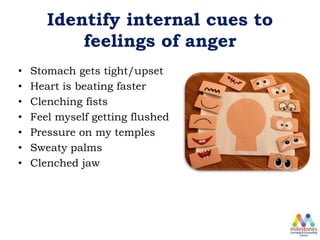
Identify internal cues to
feelings of anger
• Stomach gets tight/upset
• Heart is beating faster
• Clenching fists
• Feel myself getting flushed
• Pressure on my temples
• Sweaty palms
• Clenched jaw
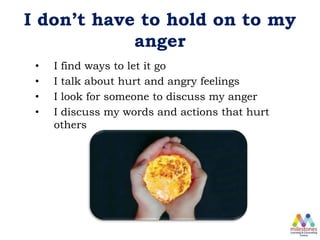
I don’t have to hold on to my
anger
• I find ways to let it go
• I talk about hurt and angry feelings
• I look for someone to discuss my anger
• I discuss my words and actions that hurt
others
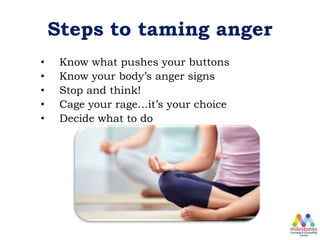
Steps to taming anger
• Know what pushes your buttons
• Know your body’s anger signs
• Stop and think!
• Cage your rage…it’s your choice
• Decide what to do
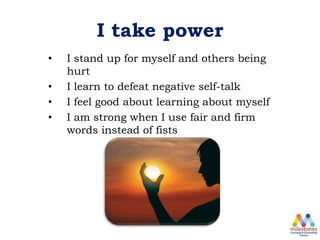
I take power
• I stand up for myself and others being
hurt
• I learn to defeat negative self-talk
• I feel good about learning about myself
• I am strong when I use fair and firm
words instead of fists
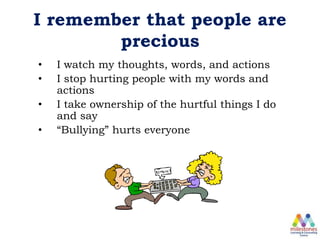
I remember that people are
precious
• I watch my thoughts, words, and actions
• I stop hurting people with my words and
actions
• I take ownership of the hurtful things I do
and say
• “Bullying” hurts everyone
Five-Step Approach to
Managing Anger
• Identify the problem (self-awareness)
• Think of potential solutions before responding (self-
control)
• Consider the consequences of each solution (think
it through).
• Make a decision (pick one of your options).
• Check your progress.
Other ways to reduce anger
• Exercise
• Listen to music (with your headphones on)
• Write down your thoughts and emotions
• Draw
• Meditate or practice deep breathing
• Talk about your feelings with someone you trust
• Distract yourself
Coping Thoughts
• Walk away
• Exercise
• Talk to someone who you are not feeling angry
with
• Distract yourself
• Count 10 breaths
• Write about it
• Come back and deal with it later when you feel
calm
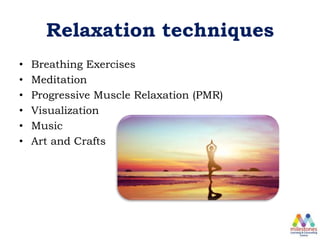
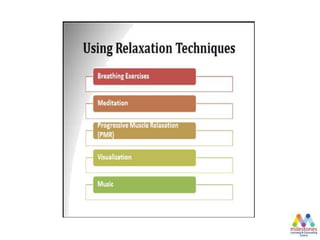
Relaxation techniques
• Breathing Exercises
• Meditation
• Progressive Muscle Relaxation (PMR)
• Visualization
• Music
• Art and Crafts
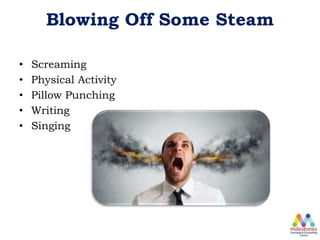
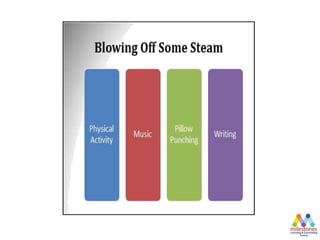
Blowing Off Some Steam
• Screaming
• Physical Activity
• Pillow Punching
• Writing
• Singing
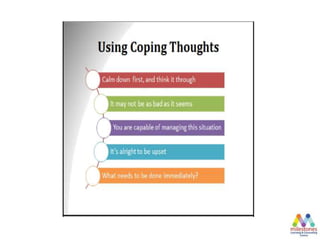
Mental Script for Anger
Control
• Calm Down First, And Think This Through.
• I Am Capable Of Managing This Situation.
• It’s Alright To Be Upset
• Damage Control/
• Solution-focused Mode).
• Bad Things/
• Mistakes Do Happen/
• Nothings Says That Things Will Go Right All The
Time.
• I Have Managed Anger Successfully Before And I
Will Again.
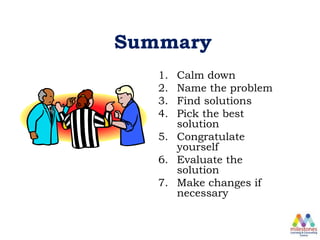
Summary
1. Calm down
2. Name the problem
3. Find solutions
4. Pick the best
solution
5. Congratulate
yourself
6. Evaluate the
solution
7. Make changes if
necessary
ACTIVITY
Symptoms of Anger
• How do you know when you are angry? All of us
have symptoms of anger – physical and mental
signs that tell us we are angry.
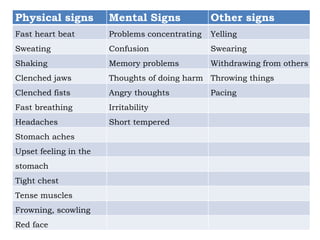
Physical signs Mental Signs Other signs
Fast heart beat Problems concentrating Yelling
Sweating Confusion Swearing
Shaking Memory problems Withdrawing from others
Clenched jaws Thoughts of doing harm Throwing things
Clenched fists Angry thoughts Pacing
Fast breathing Irritability
Headaches Short tempered
Stomach aches
Upset feeling in the
stomach
Tight chest
Tense muscles
Frowning, scowling
Red face
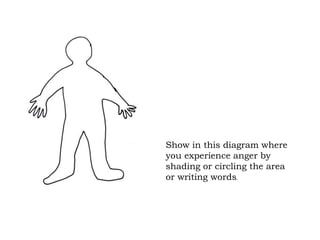
Show in this diagram where
you experience anger by
shading or circling the area
or writing words.
Questions About Your Anger
• How do you know when you are
angry?
_____________________________________
_____________________________________
_____________________________________
_____________________________________
Questions About Your Anger
• Where in your body do you feel anger?
List your physical signs of being
angry.
_____________________________________
_____________________________________
_____________________________________
_____________________________________
Questions About Your Anger
• What is the first sign of anger you
notice? List your early warning signs
that tell you when you are starting to
become angry.
_____________________________________
_____________________________________
_____________________________________
_____________________________________
Questions About Your Anger
• What makes you angry? List all the
things you can think of... all the way
from small annoyances to big
problems.
_____________________________________
_____________________________________
_____________________________________
_____________________________________
Questions
Milestones

Anger Management triggers relaxation tec

  • 1.
    Anger Management People whofly into a rage always make a bad landing. -Will Rogers
  • 2.
    Content • Introduction • Viciouscircle of anger • How You Feel (Emotional Signs) • Skills needed in dealing with your anger • Difference between anger and aggression • Five-Step Approach to Managing Anger • Relaxation techniques • Summary
  • 3.
    Introduction • Anger managementis the process of learning to recognize signs that you're becoming angry, and taking action to calm down and deal with the situation in a positive way.
  • 5.
  • 6.
    How you feel Angeror rage Irritable at the slightest thing Restless On edge uptight Flashes of rage
  • 7.
    How You Feel(Emotional Signs) • Sadness • Irritability • Guilt • Resentment • Feeling Like You Need To Hurt Someone • Needing To Be Alone • Needing To Isolate One’s Self • Numbness
  • 8.
    What happens toyour body (Physical) • Heart pounds, races, skips a beat • Chest feels tight • Stomach churns • Breathing Difficult • Legs go weak Tense • muscles Go very hot • Having to go to the toilet Sweating • Head buzzing, pounding
  • 9.
    What happens toyour body (Physical signs) • Fast heart beat • Sweating • Shaking • Clenched jaws • Clenched fists • Fast breathing • Headaches • Stomach aches
  • 10.
    What you do(Behavioural signs) • Snappy and irritable behaviour • Shout and argue • Hit out • Leave the situation • Throw/hit an object, slam door, etc • Attack someone • Say something unkind • Cry • Push someone • Do nothing, bottle it up • Get drunk/smoke/take drugs • Hurt yourself
  • 11.
    Impact of anger(Mental Signs) • Difficulty Concentrating • Obsessing On The Situation • Thinking Vengeful Thoughts • Cynicism
  • 12.
    Controlling the physical symptomsof anger • Reducing physical symptoms • Controlling breathing • Controlling angry behaviours • Stress less lifestyle • Communication • Long term beliefs
  • 14.
    Causes of Anger •Outside (people event) • Inside (thoughts, worries, memories) • Thinking Errors  Taking things personally  Ignoring the positive  Perfectionism  Black and white thinking
  • 15.
    Skills needed indealing with your anger 1. Identify a range of feelings including anger 2. Identify aggressive acts by self and others 3. Identify the potential consequences to self and other from these aggressive acts 4. Identify self-destructive behavior 5. Identify thoughts prior to aggressive acts 6. Identify internal cues to feelings of anger 7. Develop coping mechanisms for dealing with anger 8. Express anger without loss of control
  • 16.
    Identify a rangeof feelings including anger • Embarrassment • Excitement • Disappointment • Jealousy • Fear • Helpless • Sadness • Left-out
  • 17.
    I am incharge of my own feelings • I own my feelings • It is okay to feel angry • Anger is part of being human • I learn how to express my anger in helpful ways
  • 18.
    Identify aggressive acts shownby self and others • Throw something • Kick someone or something • Get in someone’s face • Shoving, grabbing, hitting • Break something • Call someone names • Give someone a dirty look • Silent treatment • Get others to “gang up” • Spread rumors
  • 19.
    I choose tofeel good about myself through expressing my feelings 1. I express angry feelings in ways that are fair to others and me 2. I use fair words…e.g. “I feel when you”
  • 20.
    The more Ilearn to take care of my anger the more powerful I become • I need to control what I do with my anger • I control how I let my anger out • I practice cooling off • I watch my thoughts
  • 21.
    Difference between Angerand Aggression Anger • Anger is an emotion • It is ok to be angry Aggression • Aggression is acting out inappropriately and is not ok • Learn to check your aggression and express your anger appropriately
  • 22.
    Ways to KeepCool 1. Get exercise every day. 2. Eat right. 3. Get enough sleep. 4. Learn to relax. 5. Know your feelings. 6. Write about those feelings.
  • 23.
    Ways to KeepCool 7. Find a quiet place. 8. Take a time out. 9. Find fun distractions. 10. Make good decisions about what you see and hear. 11. Choose friends who make you feel good. 12. Learn to forgive and forget.
  • 24.
    Identify potential consequences ofyour anger to others and yourself • Physical harm to someone or self • Destruction of property • Loss of family/friends • Loss of job • Loss of social privileges • Going to jail • Getting a bad reputation
  • 25.
    Identify self-destructive behavior • Negativeself-talk • Blaming everyone else • Taking everything personally • Assuming • Overeating, drinking • Driving recklessly • Taking drugs • Looking for fights • Feeling outraged
  • 26.
    I stop blamingothers and myself • Blaming only keeps people upset • Blaming is a way of not respecting people • I express my feelings and then try to work things out
  • 27.
    Identify thoughts priorto aggressive acts • You did that on purpose… • You wanted to hurt me… • You deserve this… • You never even asked me… • You’re being unreasonable… • You think you’re so good… • I’ll show you… • You started it… • There’s no justice…
  • 28.
    Identify internal cuesto feelings of anger • Stomach gets tight/upset • Heart is beating faster • Clenching fists • Feel myself getting flushed • Pressure on my temples • Sweaty palms • Clenched jaw
  • 29.
    I don’t haveto hold on to my anger • I find ways to let it go • I talk about hurt and angry feelings • I look for someone to discuss my anger • I discuss my words and actions that hurt others
  • 30.
    Steps to taminganger • Know what pushes your buttons • Know your body’s anger signs • Stop and think! • Cage your rage…it’s your choice • Decide what to do
  • 31.
    I take power •I stand up for myself and others being hurt • I learn to defeat negative self-talk • I feel good about learning about myself • I am strong when I use fair and firm words instead of fists
  • 32.
    I remember thatpeople are precious • I watch my thoughts, words, and actions • I stop hurting people with my words and actions • I take ownership of the hurtful things I do and say • “Bullying” hurts everyone
  • 33.
    Five-Step Approach to ManagingAnger • Identify the problem (self-awareness) • Think of potential solutions before responding (self- control) • Consider the consequences of each solution (think it through). • Make a decision (pick one of your options). • Check your progress.
  • 34.
    Other ways toreduce anger • Exercise • Listen to music (with your headphones on) • Write down your thoughts and emotions • Draw • Meditate or practice deep breathing • Talk about your feelings with someone you trust • Distract yourself
  • 35.
    Coping Thoughts • Walkaway • Exercise • Talk to someone who you are not feeling angry with • Distract yourself • Count 10 breaths • Write about it • Come back and deal with it later when you feel calm
  • 37.
    Relaxation techniques • BreathingExercises • Meditation • Progressive Muscle Relaxation (PMR) • Visualization • Music • Art and Crafts
  • 39.
    Blowing Off SomeSteam • Screaming • Physical Activity • Pillow Punching • Writing • Singing
  • 41.
    Mental Script forAnger Control • Calm Down First, And Think This Through. • I Am Capable Of Managing This Situation. • It’s Alright To Be Upset • Damage Control/ • Solution-focused Mode). • Bad Things/ • Mistakes Do Happen/ • Nothings Says That Things Will Go Right All The Time. • I Have Managed Anger Successfully Before And I Will Again.
  • 42.
    Summary 1. Calm down 2.Name the problem 3. Find solutions 4. Pick the best solution 5. Congratulate yourself 6. Evaluate the solution 7. Make changes if necessary
  • 43.
  • 44.
    Symptoms of Anger •How do you know when you are angry? All of us have symptoms of anger – physical and mental signs that tell us we are angry.
  • 45.
    Physical signs MentalSigns Other signs Fast heart beat Problems concentrating Yelling Sweating Confusion Swearing Shaking Memory problems Withdrawing from others Clenched jaws Thoughts of doing harm Throwing things Clenched fists Angry thoughts Pacing Fast breathing Irritability Headaches Short tempered Stomach aches Upset feeling in the stomach Tight chest Tense muscles Frowning, scowling Red face
  • 46.
    Show in thisdiagram where you experience anger by shading or circling the area or writing words.
  • 47.
    Questions About YourAnger • How do you know when you are angry? _____________________________________ _____________________________________ _____________________________________ _____________________________________
  • 48.
    Questions About YourAnger • Where in your body do you feel anger? List your physical signs of being angry. _____________________________________ _____________________________________ _____________________________________ _____________________________________
  • 49.
    Questions About YourAnger • What is the first sign of anger you notice? List your early warning signs that tell you when you are starting to become angry. _____________________________________ _____________________________________ _____________________________________ _____________________________________
  • 50.
    Questions About YourAnger • What makes you angry? List all the things you can think of... all the way from small annoyances to big problems. _____________________________________ _____________________________________ _____________________________________ _____________________________________
  • 51.
  • 52.