Ancient Egypt
Location
• Nile River Valley down to the first cataract
Geographic Influences
• Isolation – flat land, protective deserts
• Nile River
  – “lifeline” or “gift from the gods”
  – Transportation, communication, and good
    agriculture despite the surrounding deserts
• Adaptations
  – Predictable floods
  – Used “basin irrigation” to retain water for
    farming when the flooding ended
•   When?
•   3200 BCE – 1000 BCE
•   Three time periods:
•   Old Kingdom – 2700-2200
•   Middle Kingdom – 2050 - 1800
•   New Kingdom – 1550 - 1100
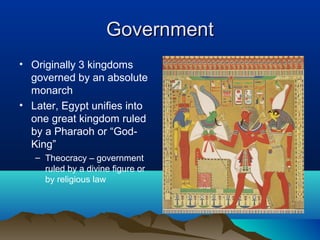
Government
• Originally 3 kingdoms
  governed by an absolute
  monarch
• Later, Egypt unifies into
  one great kingdom ruled
  by a Pharaoh or “God-
  King”
   – Theocracy – government
     ruled by a divine figure or
     by religious law
• Polytheistic
                             Religion   • Priests held spiritual and
                                          political power
                                            – And shaved all hair from their
                                              bodies
                                        • Aton – Sun god
                                        • Amon – god of Egypt
Nefirtiti worshipping Aton              • Osiris – god of the Dead
                                            – Weighs all human hearts on a
                                              scale. If lighter than a feather
                                              they are pure and will live
                                              forever. If heavier, the impure
                                              heart will be destroyed and
                                              eaten by the Devourer of
                                              Souls
                                        • Book of the Dead
                                            – Collection of prayers and
                                              meditations, seen as holy
                                              scriptures
                                        • Pure heart involved “Maat”
Picture from the Book of the Dead           – Virtues of good life, truth,
                                              justice, and order
View of Life, Death, and Change
• Egyptians believed:
  – Life should be traditional and enjoyed
  – Mummification – preserving the body for life
    after death
     • Ka – eternal spirit that lives on in Pharaohs
     • Pyramids were designed to provide a comfortable
       place in which to live (including drawings, jewelry
       and clothing)
  – Imagined the future life for pure souls to be
    much like the present
Cultural Accomplishments
• An advanced, progressive culture
  – Hieroglyphics
     • “sacred carving,” used clay and papyrus
  – The best ancient calendar (6 hours
    short of a true solar calendar year
  – Geometry
     • Used to survey lands
  – Medicine
     • Understood heart rates/pulses
     • Broken bones, fevers, treating wounds
     • Even used electric fish in pools for
       healing and therapy
• Women were respected, shared many rights
  with men
   – Including divorce and marriage
• Complex number system
   – Kept financial and tax records
• Very stratified society
   – Literacy a significant factor
   – Social mobility, even for slaves (esp. through service
     in the army or to the Pharaoh)
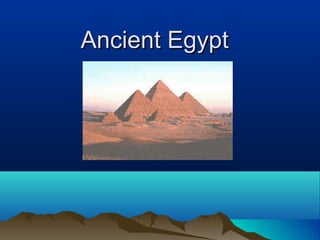
• Pyramids
•   Pyramids
    – Tombs for the Pharaohs
    – Perfectly symmetrical structures
    – Required over 2 million stones
        • Some stones weighed 200 tons
        • Some poured in molds like concrete
    – 80 pyramids in Egypt
        • Largest at Giza
    – Most treasures and mummies stolen by thieves
    – Probably willingly built by peasants
Significant People and Events
• King Menes – unified the 3 separate empires
  into the “Old Kingdom”
  – Capital at Memphis ~3100 BCE
• 3100-1600 BCE – “ups and downs”
  – Middle Kingdom emerges during high point
  – Pyramids built
  – Art and Architecture flourished
• New Kingdom 1570-1075 – True, great Egyptian
  empire and civilization
  – Desert not enough, Egyptians create buffer zone
Queen Hatshepsut
 • Ancestor of King Tut
 • Declares herself
   Pharoah
   – First female ruler of a
     civilization/empire
 • 22 yr reign
 • Killed (probably by
   her stepson
   Thutmose III)
Thutmose III
• Conquers Syria and
  Palestine
  – Height of the Egyptian
    empire
• Hebrews who had
  come willingly to
  Egypt are forced into
  slavery
  – (this sets up the LMPG
    thing)
•   ~1375 he tried to force Egypt to be
    monotheistic
     – “Aton is the only God”                         Akenaton
•   Moved the capital
     – Thebes to Akhetaton
•   Changed is name
     – From Amonhotep to Akenaton (not much better)
•   Replaced by King Tut
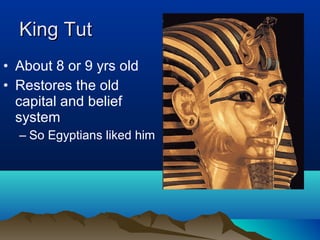
King Tut
• About 8 or 9 yrs old
• Restores the old
  capital and belief
  system
  – So Egyptians liked him
•   The 3,300-year-old mummy of the
    ancient King Tutankhamun lies
    exposed on a CT machine in Luxor,
    Egypt on Wednesday as Egyptian
    antiquities chief Zahi Hawass, left,
    looks on.
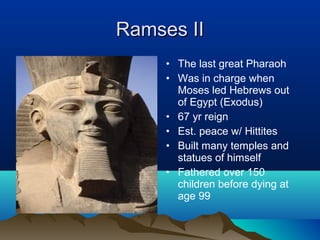
Ramses II
     • The last great Pharaoh
     • Was in charge when
       Moses led Hebrews out
       of Egypt (Exodus)
     • 67 yr reign
     • Est. peace w/ Hittites
     • Built many temples and
       statues of himself
     • Fathered over 150
       children before dying at
       age 99
• Luxor Album:
• https://picasaweb.google.com/1150515006931
New Kingdom Accomplishments
• Built the Valley of the Kings
   – Great temples and tombs beneath desert cliffs (less
     conspicuous than pyramids)
   – Near Thebes
   – King Tut, Ramses II, and others were inside
Success and Decline
• Desert protection helped
• Weren’t by outsiders challenged like
  Mesopotamia was
• Used Nile ingeniously
• Empire collapses due to
  – ineffective Pharaohs
  – Strengthening Assyrians and Persians
     • Who conquer Egypt c.1000 BCE
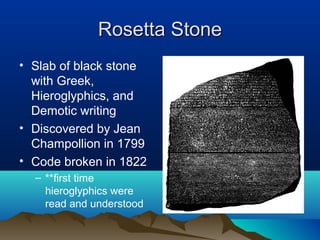
Rosetta Stone
• Slab of black stone
  with Greek,
  Hieroglyphics, and
  Demotic writing
• Discovered by Jean
  Champollion in 1799
• Code broken in 1822
  – **first time
    hieroglyphics were
    read and understood
Ancient egypt

Ancient egypt

  • 1.
  • 2.
    Location • Nile RiverValley down to the first cataract
  • 3.
    Geographic Influences • Isolation– flat land, protective deserts • Nile River – “lifeline” or “gift from the gods” – Transportation, communication, and good agriculture despite the surrounding deserts • Adaptations – Predictable floods – Used “basin irrigation” to retain water for farming when the flooding ended
  • 4.
    When? • 3200 BCE – 1000 BCE • Three time periods: • Old Kingdom – 2700-2200 • Middle Kingdom – 2050 - 1800 • New Kingdom – 1550 - 1100
  • 5.
    Government • Originally 3kingdoms governed by an absolute monarch • Later, Egypt unifies into one great kingdom ruled by a Pharaoh or “God- King” – Theocracy – government ruled by a divine figure or by religious law
  • 6.
    • Polytheistic Religion • Priests held spiritual and political power – And shaved all hair from their bodies • Aton – Sun god • Amon – god of Egypt Nefirtiti worshipping Aton • Osiris – god of the Dead – Weighs all human hearts on a scale. If lighter than a feather they are pure and will live forever. If heavier, the impure heart will be destroyed and eaten by the Devourer of Souls • Book of the Dead – Collection of prayers and meditations, seen as holy scriptures • Pure heart involved “Maat” Picture from the Book of the Dead – Virtues of good life, truth, justice, and order
  • 7.
    View of Life,Death, and Change • Egyptians believed: – Life should be traditional and enjoyed – Mummification – preserving the body for life after death • Ka – eternal spirit that lives on in Pharaohs • Pyramids were designed to provide a comfortable place in which to live (including drawings, jewelry and clothing) – Imagined the future life for pure souls to be much like the present
  • 13.
    Cultural Accomplishments • Anadvanced, progressive culture – Hieroglyphics • “sacred carving,” used clay and papyrus – The best ancient calendar (6 hours short of a true solar calendar year – Geometry • Used to survey lands – Medicine • Understood heart rates/pulses • Broken bones, fevers, treating wounds • Even used electric fish in pools for healing and therapy
  • 14.
    • Women wererespected, shared many rights with men – Including divorce and marriage • Complex number system – Kept financial and tax records • Very stratified society – Literacy a significant factor – Social mobility, even for slaves (esp. through service in the army or to the Pharaoh) • Pyramids
  • 15.
    Pyramids – Tombs for the Pharaohs – Perfectly symmetrical structures – Required over 2 million stones • Some stones weighed 200 tons • Some poured in molds like concrete – 80 pyramids in Egypt • Largest at Giza – Most treasures and mummies stolen by thieves – Probably willingly built by peasants
  • 17.
    Significant People andEvents • King Menes – unified the 3 separate empires into the “Old Kingdom” – Capital at Memphis ~3100 BCE • 3100-1600 BCE – “ups and downs” – Middle Kingdom emerges during high point – Pyramids built – Art and Architecture flourished • New Kingdom 1570-1075 – True, great Egyptian empire and civilization – Desert not enough, Egyptians create buffer zone
  • 18.
    Queen Hatshepsut •Ancestor of King Tut • Declares herself Pharoah – First female ruler of a civilization/empire • 22 yr reign • Killed (probably by her stepson Thutmose III)
  • 19.
    Thutmose III • ConquersSyria and Palestine – Height of the Egyptian empire • Hebrews who had come willingly to Egypt are forced into slavery – (this sets up the LMPG thing)
  • 20.
    ~1375 he tried to force Egypt to be monotheistic – “Aton is the only God” Akenaton • Moved the capital – Thebes to Akhetaton • Changed is name – From Amonhotep to Akenaton (not much better) • Replaced by King Tut
  • 21.
    King Tut • About8 or 9 yrs old • Restores the old capital and belief system – So Egyptians liked him
  • 22.
    The 3,300-year-old mummy of the ancient King Tutankhamun lies exposed on a CT machine in Luxor, Egypt on Wednesday as Egyptian antiquities chief Zahi Hawass, left, looks on.
  • 24.
    Ramses II • The last great Pharaoh • Was in charge when Moses led Hebrews out of Egypt (Exodus) • 67 yr reign • Est. peace w/ Hittites • Built many temples and statues of himself • Fathered over 150 children before dying at age 99
  • 27.
    • Luxor Album: •https://picasaweb.google.com/1150515006931
  • 28.
    New Kingdom Accomplishments •Built the Valley of the Kings – Great temples and tombs beneath desert cliffs (less conspicuous than pyramids) – Near Thebes – King Tut, Ramses II, and others were inside
  • 30.
    Success and Decline •Desert protection helped • Weren’t by outsiders challenged like Mesopotamia was • Used Nile ingeniously • Empire collapses due to – ineffective Pharaohs – Strengthening Assyrians and Persians • Who conquer Egypt c.1000 BCE
  • 31.
    Rosetta Stone • Slabof black stone with Greek, Hieroglyphics, and Demotic writing • Discovered by Jean Champollion in 1799 • Code broken in 1822 – **first time hieroglyphics were read and understood