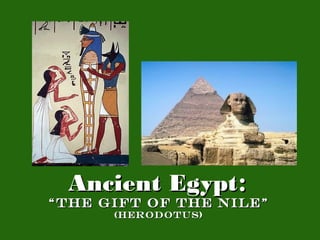
Ancient Egypt:
“The Gift of the Nile”
      (Herodotus)
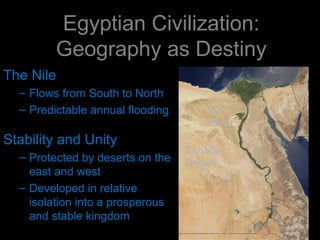
Egyptian Civilization:
         Geography as Destiny
The Nile
  – Flows from South to North
  – Predictable annual flooding       Nile
                                      River
Stability and Unity
                                  Sahara
  – Protected by deserts on the   Desert
    east and west
  – Developed in relative
    isolation into a prosperous
    and stable kingdom
A View of Egypt by Satellite
The Fertile Nile Valley
The Annual Flooding of the
          Nile
Nile Irrigation
More Benefits of Nile River
• The river served as a highway
  –   United villages along the river
  –   Travel was relatively easy on the river
  –   Currents carried barges downstream to the delta
  –   Sails used to catch winds to return upstream
• Additional benefits
  – River attracted wildlife and provided fish for
    hunting & sport
  – Papyrus grew along river
       • Used to make paper
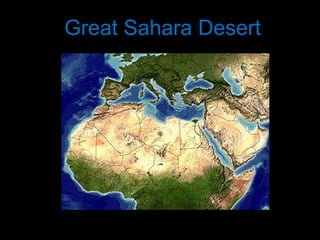
Bordered on the south, east and west by the
Sahara Desert, and on the north by the sea, ancient
   Egypt was protected from outside influences.
Great Sahara Desert
Ancient Egyptian History
     Periods             Tim F e
                            e ram
Nile Culture Begins      3900 B. C. E.
      Archaic         3100 – 2650 B. C. E.
   Old Kingdom        2575 – 2134 B. C. E.
 Middle Kingdom       2040 – 1640 B. C. E.
   New Kingdom        1532 – 1070 B. C. E.
    Late Period         750 – 332 B. C. E.
Greek Ptolemaic Era      332 – 30 B. C. E.

  Roman Period        30 B. C. E. – 395 C. E.
Menes:            Unifier of Upper & Lower
 Originally two kingdoms
 developed along the Nile
                          Egypt
        Lower Egypt
– Located along the northern Nile
– Good farmland
– Access to copper mines in Sinai
  Peninsula

        Upper Egypt
– Located along the southern Nile
– King Menes (~3000 BCE)
  conquered lower Egypt, unifying
  the kingdom and establishing the
  first dynasty
– Capital at Memphis
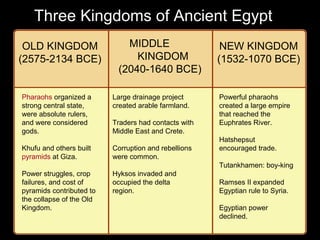
Three Kingdoms of Ancient Egypt
 OLD KINGDOM                 MIDDLE                    NEW KINGDOM
(2575-2134 BCE)                KINGDOM                (1532-1070 BCE)
                           (2040-1640 BCE)

Pharaohs organized a      Large drainage project      Powerful pharaohs
strong central state,     created arable farmland.    created a large empire
were absolute rulers,                                 that reached the
and were considered       Traders had contacts with   Euphrates River.
gods.                     Middle East and Crete.
                                                      Hatshepsut
Khufu and others built    Corruption and rebellions   encouraged trade.
pyramids at Giza.         were common.
                                                      Tutankhamen: boy-king
Power struggles, crop     Hyksos invaded and
failures, and cost of     occupied the delta          Ramses II expanded
pyramids contributed to   region.                     Egyptian rule to Syria.
the collapse of the Old
Kingdom.                                              Egyptian power
                                                      declined.
Achievements Government    Old                     Middle                   New
                          Pharaohs                 Corrupt government     Pharaohs created a
                          organized                suffered frequent      large empire
                          centralized state        rebellions


                          Built enormous            Land drained for      Traded with lands
                          tombs, the pyramids       farming               along eastern
                                                                          Mediterranean and
                                                                          Red Sea
Decline


                          Power struggles,
                          crop failures and cost   Hittites invaded and   Nubians, then others
                          of pyramids caused       conquered              invaded
                          collapse
Egyptian Social Hierarchy
Some Famous Egyptian
            Pharaohs
                  Tutankhamon
                  1336-1327 B. C. E.


 Thutmose
    III
1504-1450 B. C.
      E.
                                        Ramses II
                                       1279-1212 B. C.
                                             E.
Egyptian Priestly Class
Egyptian Nobility
Egyptian Scribe
Scenes of Ancient Egyptian
        Daily Life
Women in Egyptian Society
• Status of Women
  – Relatively high status for that time in history
  – Could buy and sell property
  – Could seek divorce (although rare)
  – Property inherited through female line
  – Role of wife & mother important
  – Girls did not attend school
  – A woman’s status increased
    when she had children
  – Sometimes women considered property,
     but were treated kindly
  – Queen might rule with pharaoh
  – If pharaoh had more than one wife, the first wife was most
    important
       • Her son would be the next pharaoh
An Egyptian Woman’s “Must-
          Haves”
                     Mirror


Perfume

           Whigs
Ancient Egyptian Housing
               Middle Class
               Homes


   Peasant
    Homes
Making Ancient Egyptian Beer
Making Ancient Egyptian
        W  ine
Education
• Original purpose of schools was
  to train priests
• Subjects taught
   –   Reading & writing
   –   Math
   –   Religious ceremonies & rituals
• Eventually temple schools
  provided more general education
• Usually schools attended only by
  the wealthy
• Girls did not attend school
   – Taught domestic skills at home
• Students took notes on scraps of
  pottery - Papyrus was expensive &
  only used by advanced students
• Strict discipline
Egyptian Math & Draftsmenship


1   10 100 1000 10,000 100,000 1,000,000


                       W number is this?
                        hat
Papyrus  Paper


                Hieratic Scroll
                    Piece

Papyrus Plant
Champollion & the Rosetta
               Stone


1822- French scholar Jean
Chapollion cracked the code of
hieroglyphics because he could
read Greek
Hieroglyphic
“Cartouche”
Hieroglyphics “Alphabet”
 24 “letters” + 700 phonetic symbols
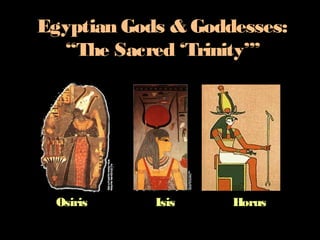
Egyptian Gods & Goddesses:
  “The Sacred ‘Trinity’”


 Osiris     Isis    Horus
The Circle of Life
Osiris
     – God of the underworld
     – Judges the dead
     – Rise & fall of the Nile believed to
       be the death & rebirth of Osiris
Set
     – God of chaos (desert) who killed
       Osiris
     – Believed to cause failed harvest
Isis
     – Wife of Osiris
     – Brought Osiris back to life
     – Nile floods and brings renewed
      life
Religion and Government
• About 2,000 gods in
  the Egyptian pantheon
• All powerful kings were
  believed to be human
  incarnations of gods
• Only the king could
  express the ultimate
  truth and justice, or
  ma’at
Preparations for the Underworld


                    ANUBIS weighs the
                    dead person’s heart
                    against a feather.


Priests protected
your KA, or soul-
spirit
Preparation for
   the Afterlife
Journey to the Underworld

                   The dead travel
                   on the “Solar
                   Bark.”


  A boat for the
      journey is
  provided for a
dead pharaoh in
       his tomb.
Egyptian Book of the Dead
The Final Judgement


Anubis     Horus   Osiris
Shabtis: The Pharaoh’s Servants
                 in the Afterlife
Stepped Pyramid at Saqqara
“Bent” Pyramid of King
       Sneferu
Giza Pyramid Complex
Plan of the Great Pyramid
         of Khufu
The Valley of the Kings
Archaeologist, Howard Carter
           (1922)
Entrance to King “Tut’s” Tomb
King Tutankhamon’s Death
          Mask


         1336-1327 B. C.
               E.
King Tutankhamon
King Tutankhamun’s Tomb
Treasures From Tut’s Tomb
The Valley of the Queens


1473-1458 B. C.   Temple of Queen Hatshepsut
      E.
Ankhenaton: First
   Monotheist?


                 1353-1335 B. C.
                       E.
The Ankh – The “Cross” of
          Life
Queen
  Nefertiti
(W of Ankhenaton)
  ife
Abu Simbel:
      Monument to Ramses II


1279-1213 B. C. E.
W Are These Strange
 ho
    People?
Comparison of Mesopotamia
                 and Egypt
                            Mesopotamia                              Egypt

Agriculture        +“Land between the rivers”         +”Gift of the Nile”
                   (Tigris and Euphrates forms        +Artificial irrigation
                   Fertile Crescent
                   +Artificial irrigation


Specialization     +Pottery, textiles, woodworking,   +Pottery, textiles, woodworking,
                   leather, brick making,             leather production, stonecutting,
                   stonecutting, masonry              masonry
Cities             -Numerous, densely populated       -Fewer cities with high
                   city-states (Ur and Babylon)       centralization (Memphis and
                                                      Thebes)
Social Hierarchy   -Noble class                       -Absolute authority of the
                   -Patriarchal                       pharaoh made a noble class
                   +Slaves                            unnecessary (had bureaucrats
                                                      instead)
                                                      -Patriarchal, but the presence of
                                                      Queen Hatsheput may indicate
                                                      greater opportunities for women
                                                      +Slaves
Comparison of Mesopotamia
         and Egypt (cont.)
                                  Mesopotamia                    Egypt


Religion and Education   -Polytheism                -Polytheism, but brief period of
                         -afterlife was bad         monotheism under Akhentan
                                                    -Afterlife and judgment - could
                                                    be good or bad (mummification)

New Technologies         -Superior in metallurgy    -Papyrus, shipbuilding,
                                                    pyramids
Economic exchange        -Trade by land and water   -Trade principally by water
                                                    along the Nile
                                                    -Trade more important because
                                                    Egypt lacked natural resources
                                                    beside the Nile

Art and Writing          -Cuneiform                 -Hieroglyphs (more pictorial
                                                    than cuneiform)

Ancient Egyptian Civilization

  • 1.
    Ancient Egypt: “The Giftof the Nile” (Herodotus)
  • 4.
    Egyptian Civilization: Geography as Destiny The Nile – Flows from South to North – Predictable annual flooding Nile River Stability and Unity Sahara – Protected by deserts on the Desert east and west – Developed in relative isolation into a prosperous and stable kingdom
  • 5.
    A View ofEgypt by Satellite
  • 6.
  • 7.
  • 8.
  • 9.
    More Benefits ofNile River • The river served as a highway – United villages along the river – Travel was relatively easy on the river – Currents carried barges downstream to the delta – Sails used to catch winds to return upstream • Additional benefits – River attracted wildlife and provided fish for hunting & sport – Papyrus grew along river • Used to make paper
  • 10.
    Bordered on thesouth, east and west by the Sahara Desert, and on the north by the sea, ancient Egypt was protected from outside influences.
  • 11.
  • 12.
    Ancient Egyptian History Periods Tim F e e ram Nile Culture Begins 3900 B. C. E. Archaic 3100 – 2650 B. C. E. Old Kingdom 2575 – 2134 B. C. E. Middle Kingdom 2040 – 1640 B. C. E. New Kingdom 1532 – 1070 B. C. E. Late Period 750 – 332 B. C. E. Greek Ptolemaic Era 332 – 30 B. C. E. Roman Period 30 B. C. E. – 395 C. E.
  • 13.
    Menes: Unifier of Upper & Lower Originally two kingdoms developed along the Nile Egypt Lower Egypt – Located along the northern Nile – Good farmland – Access to copper mines in Sinai Peninsula Upper Egypt – Located along the southern Nile – King Menes (~3000 BCE) conquered lower Egypt, unifying the kingdom and establishing the first dynasty – Capital at Memphis
  • 14.
    Three Kingdoms ofAncient Egypt OLD KINGDOM MIDDLE NEW KINGDOM (2575-2134 BCE) KINGDOM (1532-1070 BCE) (2040-1640 BCE) Pharaohs organized a Large drainage project Powerful pharaohs strong central state, created arable farmland. created a large empire were absolute rulers, that reached the and were considered Traders had contacts with Euphrates River. gods. Middle East and Crete. Hatshepsut Khufu and others built Corruption and rebellions encouraged trade. pyramids at Giza. were common. Tutankhamen: boy-king Power struggles, crop Hyksos invaded and failures, and cost of occupied the delta Ramses II expanded pyramids contributed to region. Egyptian rule to Syria. the collapse of the Old Kingdom. Egyptian power declined.
  • 15.
    Achievements Government Old Middle New Pharaohs Corrupt government Pharaohs created a organized suffered frequent large empire centralized state rebellions Built enormous Land drained for Traded with lands tombs, the pyramids farming along eastern Mediterranean and Red Sea Decline Power struggles, crop failures and cost Hittites invaded and Nubians, then others of pyramids caused conquered invaded collapse
  • 16.
  • 17.
    Some Famous Egyptian Pharaohs Tutankhamon 1336-1327 B. C. E. Thutmose III 1504-1450 B. C. E. Ramses II 1279-1212 B. C. E.
  • 18.
  • 19.
  • 20.
  • 21.
    Scenes of AncientEgyptian Daily Life
  • 22.
    Women in EgyptianSociety • Status of Women – Relatively high status for that time in history – Could buy and sell property – Could seek divorce (although rare) – Property inherited through female line – Role of wife & mother important – Girls did not attend school – A woman’s status increased when she had children – Sometimes women considered property, but were treated kindly – Queen might rule with pharaoh – If pharaoh had more than one wife, the first wife was most important • Her son would be the next pharaoh
  • 23.
    An Egyptian Woman’s“Must- Haves” Mirror Perfume Whigs
  • 24.
    Ancient Egyptian Housing Middle Class Homes Peasant Homes
  • 25.
  • 26.
  • 27.
    Education • Original purposeof schools was to train priests • Subjects taught – Reading & writing – Math – Religious ceremonies & rituals • Eventually temple schools provided more general education • Usually schools attended only by the wealthy • Girls did not attend school – Taught domestic skills at home • Students took notes on scraps of pottery - Papyrus was expensive & only used by advanced students • Strict discipline
  • 28.
    Egyptian Math &Draftsmenship 1 10 100 1000 10,000 100,000 1,000,000 W number is this? hat
  • 29.
    Papyrus  Paper Hieratic Scroll Piece Papyrus Plant
  • 30.
    Champollion & theRosetta Stone 1822- French scholar Jean Chapollion cracked the code of hieroglyphics because he could read Greek
  • 31.
  • 32.
    Hieroglyphics “Alphabet” 24“letters” + 700 phonetic symbols
  • 33.
    Egyptian Gods &Goddesses: “The Sacred ‘Trinity’” Osiris Isis Horus
  • 34.
    The Circle ofLife Osiris – God of the underworld – Judges the dead – Rise & fall of the Nile believed to be the death & rebirth of Osiris Set – God of chaos (desert) who killed Osiris – Believed to cause failed harvest Isis – Wife of Osiris – Brought Osiris back to life – Nile floods and brings renewed life
  • 35.
    Religion and Government •About 2,000 gods in the Egyptian pantheon • All powerful kings were believed to be human incarnations of gods • Only the king could express the ultimate truth and justice, or ma’at
  • 36.
    Preparations for theUnderworld ANUBIS weighs the dead person’s heart against a feather. Priests protected your KA, or soul- spirit
  • 37.
    Preparation for the Afterlife
  • 38.
    Journey to theUnderworld The dead travel on the “Solar Bark.” A boat for the journey is provided for a dead pharaoh in his tomb.
  • 39.
  • 40.
  • 41.
    Shabtis: The Pharaoh’sServants in the Afterlife
  • 42.
  • 43.
  • 44.
  • 45.
    Plan of theGreat Pyramid of Khufu
  • 46.
    The Valley ofthe Kings
  • 47.
  • 48.
    Entrance to King“Tut’s” Tomb
  • 49.
    King Tutankhamon’s Death Mask 1336-1327 B. C. E.
  • 50.
  • 51.
  • 52.
  • 53.
    The Valley ofthe Queens 1473-1458 B. C. Temple of Queen Hatshepsut E.
  • 54.
    Ankhenaton: First Monotheist? 1353-1335 B. C. E.
  • 55.
    The Ankh –The “Cross” of Life
  • 56.
    Queen Nefertiti (Wof Ankhenaton) ife
  • 57.
    Abu Simbel: Monument to Ramses II 1279-1213 B. C. E.
  • 58.
    W Are TheseStrange ho People?
  • 59.
    Comparison of Mesopotamia and Egypt Mesopotamia Egypt Agriculture +“Land between the rivers” +”Gift of the Nile” (Tigris and Euphrates forms +Artificial irrigation Fertile Crescent +Artificial irrigation Specialization +Pottery, textiles, woodworking, +Pottery, textiles, woodworking, leather, brick making, leather production, stonecutting, stonecutting, masonry masonry Cities -Numerous, densely populated -Fewer cities with high city-states (Ur and Babylon) centralization (Memphis and Thebes) Social Hierarchy -Noble class -Absolute authority of the -Patriarchal pharaoh made a noble class +Slaves unnecessary (had bureaucrats instead) -Patriarchal, but the presence of Queen Hatsheput may indicate greater opportunities for women +Slaves
  • 60.
    Comparison of Mesopotamia and Egypt (cont.) Mesopotamia Egypt Religion and Education -Polytheism -Polytheism, but brief period of -afterlife was bad monotheism under Akhentan -Afterlife and judgment - could be good or bad (mummification) New Technologies -Superior in metallurgy -Papyrus, shipbuilding, pyramids Economic exchange -Trade by land and water -Trade principally by water along the Nile -Trade more important because Egypt lacked natural resources beside the Nile Art and Writing -Cuneiform -Hieroglyphs (more pictorial than cuneiform)