Essential Question
•How have people
 benefitted by having an
 organized religion?
Learning Targets
•I can name the major Egyptian
 gods and goddesses and
 describe their realm of power.
•I can explain Egyptian religious
 practices.
EGYPTIAN RELIGION
NOTE SHEET


As we cover the material in class be sure to fill in the note
sheet with the correct information.
KEY TERMINOLOGY
Vocabulary that you need to know…
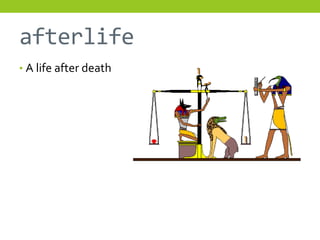
afterlife
• A life after death
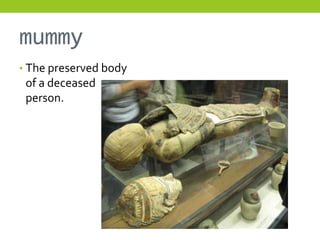
mummy
• The preserved body
 of a deceased
 person.
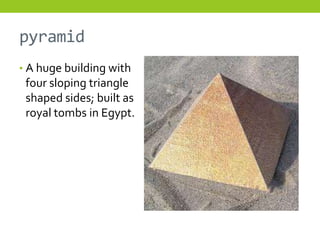
pyramid
• A huge building with
 four sloping triangle
 shaped sides; built as
 royal tombs in Egypt.
LEARNING TARGET #1
Name the major Egyptian gods and
goddesses and describe their area of
power.
The Egyptians were
polytheistic.
•What does    •They
polytheistic worshipped
mean again? more than
             one god.
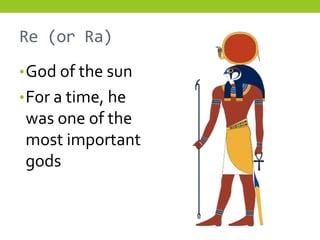
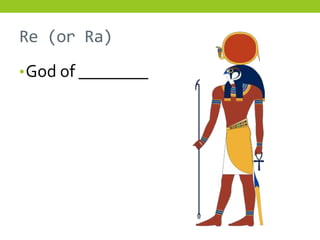
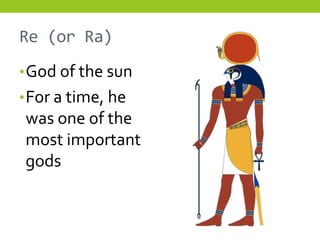
Re (or Ra)
• God of the sun
• For a time, he
was one of the
most important
gods
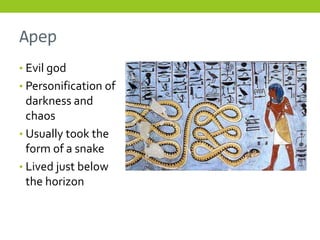
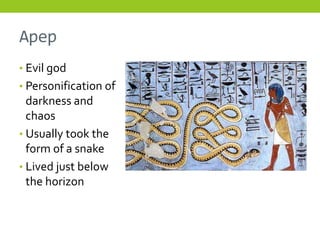
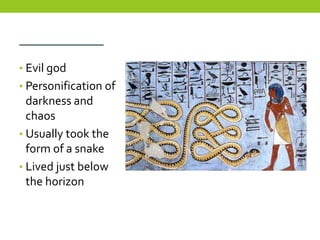
Apep
• Evil god
• Personification of
  darkness and
  chaos
• Usually took the
  form of a snake
• Lived just below
  the horizon
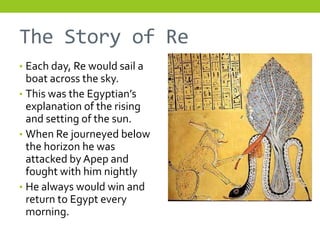
The Story of Re
• Each day, Re would sail a
  boat across the sky.
• This was the Egyptian’s
  explanation of the rising
  and setting of the sun.
• When Re journeyed below
  the horizon he was
  attacked by Apep and
  fought with him nightly
• He always would win and
  return to Egypt every
  morning.
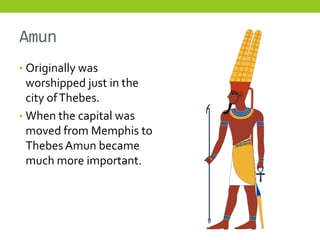
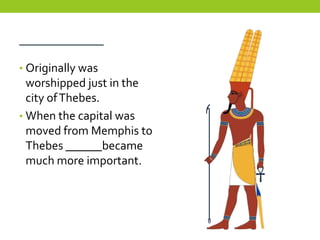
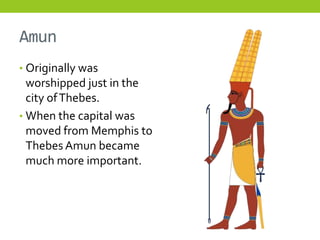
Amun
• Originally was
  worshipped just in the
  city of Thebes.
• When the capital was
  moved from Memphis to
  Thebes Amun became
  much more important.
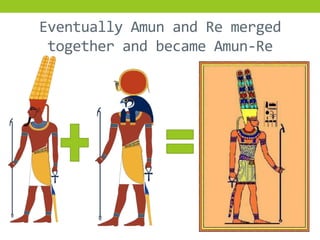
Eventually Amun and Re merged
 together and became Amun-Re
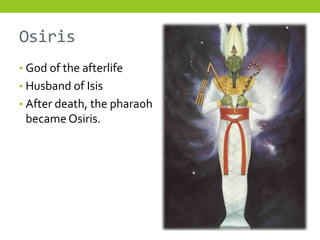
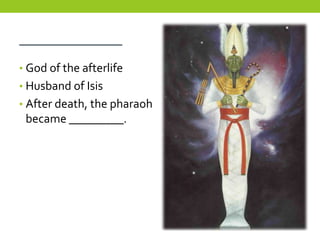
Osiris
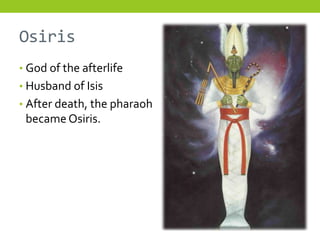
• God of the afterlife
• Husband of Isis
• After death, the pharaoh
 became Osiris.
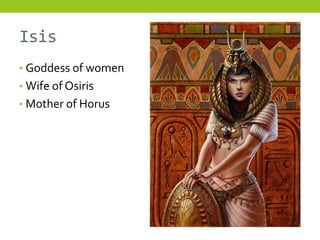
Isis
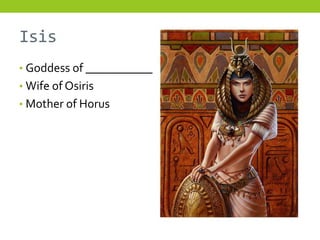
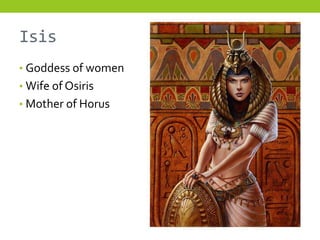
• Goddess of women
• Wife of Osiris
• Mother of Horus
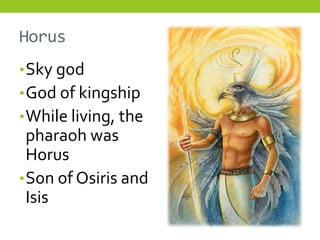
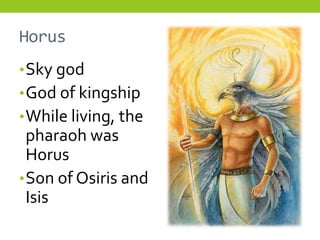
Horus
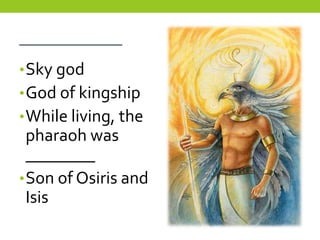
• Sky god
• God of kingship
• While living, the
  pharaoh was
  Horus
• Son of Osiris and
  Isis
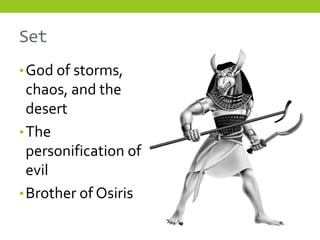
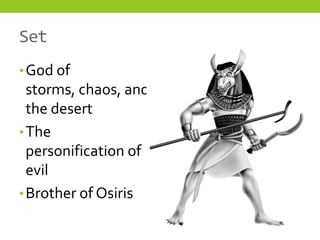
Set
• God of storms,
  chaos, and the
  desert
• The
  personification of
  evil
• Brother of Osiris
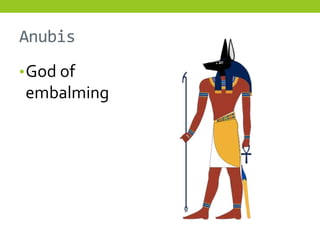
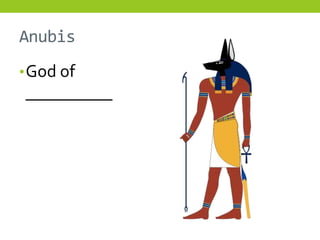
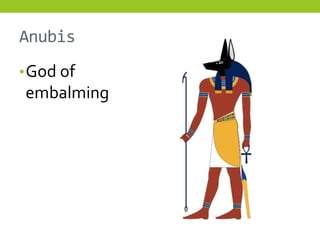
Anubis
• God of
embalming
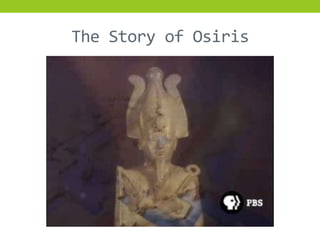
The Story of Osiris
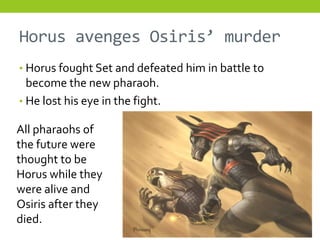
Horus avenges Osiris’ murder
• Horus fought Set and defeated him in battle to
  become the new pharaoh.
• He lost his eye in the fight.

All pharaohs of
the future were
thought to be
Horus while they
were alive and
Osiris after they
died.
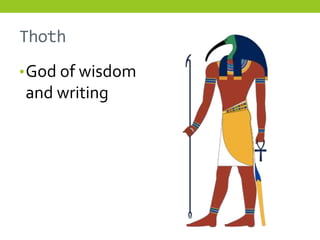
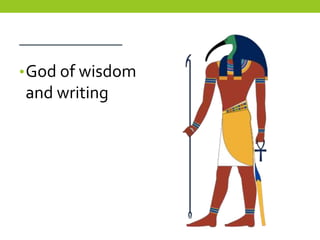
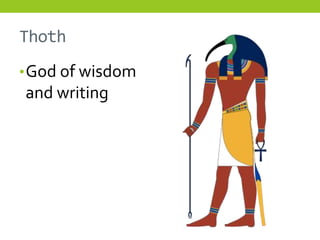
Thoth
• God of wisdom
and writing
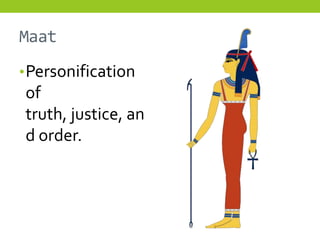
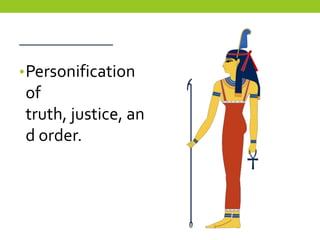
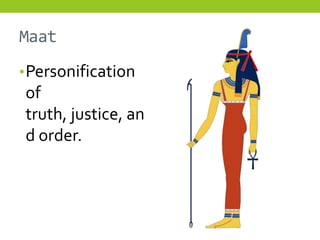
Maat
• Personification
of
truth, justice, an
d order.
ASSESSMENT
Did you meet our learning target?
Re (or Ra)
• God of ________
Re (or Ra)
• God of the sun
• For a time, he
was one of the
most important
gods
_________
• Originally was
  worshipped just in the
  city of Thebes.
• When the capital was
  moved from Memphis to
  Thebes ______became
  much more important.
Amun
• Originally was
  worshipped just in the
  city of Thebes.
• When the capital was
  moved from Memphis to
  Thebes Amun became
  much more important.
___________
• God of the afterlife
• Husband of Isis
• After death, the pharaoh
 became _________.
Osiris
• God of the afterlife
• Husband of Isis
• After death, the pharaoh
 became Osiris.
Isis
• Goddess of ___________
• Wife of Osiris
• Mother of Horus
Isis
• Goddess of women
• Wife of Osiris
• Mother of Horus
___________
• Sky god
• God of kingship
• While living, the
  pharaoh was
  ________
• Son of Osiris and
  Isis
Horus
• Sky god
• God of kingship
• While living, the
  pharaoh was
  Horus
• Son of Osiris and
  Isis
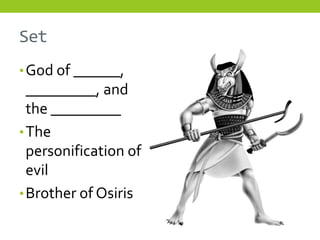
Set
• God of ______,
  _________, and
  the _________
• The
  personification of
  evil
• Brother of Osiris
Set
• God of
  storms, chaos, and
  the desert
• The
  personification of
  evil
• Brother of Osiris
Anubis
• God of
__________
Anubis
• God of
embalming
_________
• Evil god
• Personification of
  darkness and
  chaos
• Usually took the
  form of a snake
• Lived just below
  the horizon
Apep
• Evil god
• Personification of
  darkness and
  chaos
• Usually took the
  form of a snake
• Lived just below
  the horizon
___________
• God of wisdom
and writing
Thoth
• God of wisdom
and writing
__________
• Personification
of
truth, justice, an
d order.
Maat
• Personification
of
truth, justice, an
d order.
LEARNING TARGET #2
Explain Egyptian religious practices.
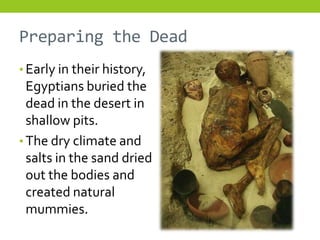
Preparing the Dead
• Early in their history,
  Egyptians buried the
  dead in the desert in
  shallow pits.
• The dry climate and
  salts in the sand dried
  out the bodies and
  created natural
  mummies.
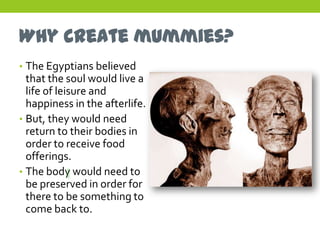
Why create mummies?
• The Egyptians believed
  that the soul would live a
  life of leisure and
  happiness in the afterlife.
• But, they would need
  return to their bodies in
  order to receive food
  offerings.
• The body would need to
  be preserved in order for
  there to be something to
  come back to.
How is a mummy created?
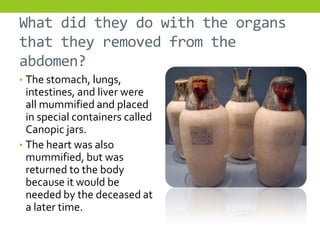
What did they do with the organs
that they removed from the
abdomen?
• The stomach, lungs,
  intestines, and liver were
  all mummified and placed
  in special containers called
  Canopic jars.
• The heart was also
  mummified, but was
  returned to the body
  because it would be
  needed by the deceased at
  a later time.
COOL MUMMIFICATION
SITE
http://www.childrensuniversity.manchester.ac.uk
/interactives/history/egypt/makeamummy/
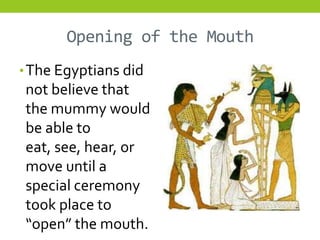
Opening of the Mouth
• The Egyptians did
not believe that
the mummy would
be able to
eat, see, hear, or
move until a
special ceremony
took place to
“open” the mouth.
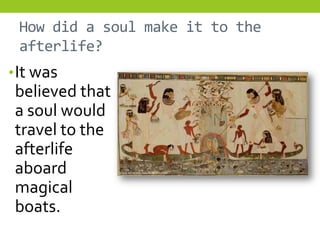
How did a soul make it to the
 afterlife?
• It was
 believed that
 a soul would
 travel to the
 afterlife
 aboard
 magical
 boats.
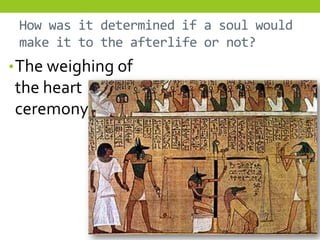
How was it determined if a soul would
 make it to the afterlife or not?
• The weighing of
the heart
ceremony
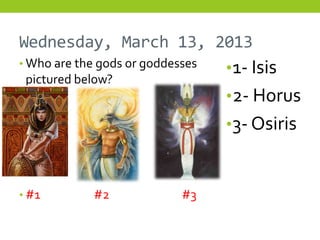
Wednesday, March 13, 2013
• Who are the gods or goddesses
                                  • 1- Isis
 pictured below?
                                  • 2- Horus
                                  • 3- Osiris


• #1         #2             #3
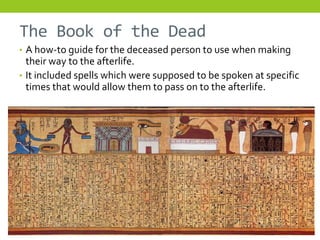
The Book of the Dead
• A how-to guide for the deceased person to use when making
  their way to the afterlife.
• It included spells which were supposed to be spoken at specific
  times that would allow them to pass on to the afterlife.
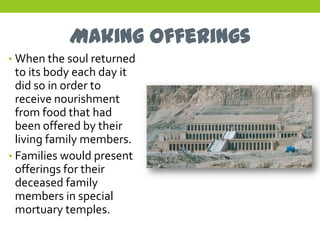
Making Offerings
• When the soul returned
  to its body each day it
  did so in order to
  receive nourishment
  from food that had
  been offered by their
  living family members.
• Families would present
  offerings for their
  deceased family
  members in special
  mortuary temples.
THE EGYPTIANS
WERE NOT ALWAYS
POLYTHEISTIC
The Rule of Akhenaten
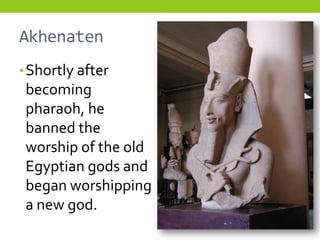
Akhenaten
• Shortly after
 becoming
 pharaoh, he
 banned the
 worship of the old
 Egyptian gods and
 began worshipping
 a new god.
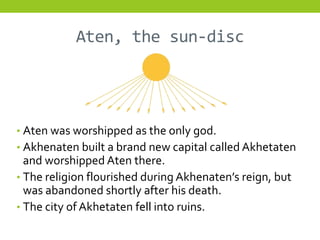
Aten, the sun-disc


• Aten was worshipped as the only god.
• Akhenaten built a brand new capital called Akhetaten
  and worshipped Aten there.
• The religion flourished during Akhenaten’s reign, but
  was abandoned shortly after his death.
• The city of Akhetaten fell into ruins.
ASSESSMENT
Did we meet our learning target?
How did the Egyptians practice
their religion?
• ____________________________________________________


• ____________________________________________________


• ____________________________________________________


• ____________________________________________________


• ____________________________________________________


• ____________________________________________________

Egyptian religion presentation

  • 1.
    Essential Question •How havepeople benefitted by having an organized religion?
  • 2.
    Learning Targets •I canname the major Egyptian gods and goddesses and describe their realm of power. •I can explain Egyptian religious practices.
  • 3.
    EGYPTIAN RELIGION NOTE SHEET Aswe cover the material in class be sure to fill in the note sheet with the correct information.
  • 4.
  • 5.
  • 6.
    mummy • The preservedbody of a deceased person.
  • 7.
    pyramid • A hugebuilding with four sloping triangle shaped sides; built as royal tombs in Egypt.
  • 8.
    LEARNING TARGET #1 Namethe major Egyptian gods and goddesses and describe their area of power.
  • 9.
    The Egyptians were polytheistic. •Whatdoes •They polytheistic worshipped mean again? more than one god.
  • 10.
    Re (or Ra) •God of the sun • For a time, he was one of the most important gods
  • 11.
    Apep • Evil god •Personification of darkness and chaos • Usually took the form of a snake • Lived just below the horizon
  • 12.
    The Story ofRe • Each day, Re would sail a boat across the sky. • This was the Egyptian’s explanation of the rising and setting of the sun. • When Re journeyed below the horizon he was attacked by Apep and fought with him nightly • He always would win and return to Egypt every morning.
  • 13.
    Amun • Originally was worshipped just in the city of Thebes. • When the capital was moved from Memphis to Thebes Amun became much more important.
  • 14.
    Eventually Amun andRe merged together and became Amun-Re
  • 15.
    Osiris • God ofthe afterlife • Husband of Isis • After death, the pharaoh became Osiris.
  • 16.
    Isis • Goddess ofwomen • Wife of Osiris • Mother of Horus
  • 17.
    Horus • Sky god •God of kingship • While living, the pharaoh was Horus • Son of Osiris and Isis
  • 18.
    Set • God ofstorms, chaos, and the desert • The personification of evil • Brother of Osiris
  • 19.
  • 20.
  • 21.
    Horus avenges Osiris’murder • Horus fought Set and defeated him in battle to become the new pharaoh. • He lost his eye in the fight. All pharaohs of the future were thought to be Horus while they were alive and Osiris after they died.
  • 22.
    Thoth • God ofwisdom and writing
  • 23.
  • 24.
    ASSESSMENT Did you meetour learning target?
  • 25.
    Re (or Ra) •God of ________
  • 26.
    Re (or Ra) •God of the sun • For a time, he was one of the most important gods
  • 27.
    _________ • Originally was worshipped just in the city of Thebes. • When the capital was moved from Memphis to Thebes ______became much more important.
  • 28.
    Amun • Originally was worshipped just in the city of Thebes. • When the capital was moved from Memphis to Thebes Amun became much more important.
  • 29.
    ___________ • God ofthe afterlife • Husband of Isis • After death, the pharaoh became _________.
  • 30.
    Osiris • God ofthe afterlife • Husband of Isis • After death, the pharaoh became Osiris.
  • 31.
    Isis • Goddess of___________ • Wife of Osiris • Mother of Horus
  • 32.
    Isis • Goddess ofwomen • Wife of Osiris • Mother of Horus
  • 33.
    ___________ • Sky god •God of kingship • While living, the pharaoh was ________ • Son of Osiris and Isis
  • 34.
    Horus • Sky god •God of kingship • While living, the pharaoh was Horus • Son of Osiris and Isis
  • 35.
    Set • God of______, _________, and the _________ • The personification of evil • Brother of Osiris
  • 36.
    Set • God of storms, chaos, and the desert • The personification of evil • Brother of Osiris
  • 37.
  • 38.
  • 39.
    _________ • Evil god •Personification of darkness and chaos • Usually took the form of a snake • Lived just below the horizon
  • 40.
    Apep • Evil god •Personification of darkness and chaos • Usually took the form of a snake • Lived just below the horizon
  • 41.
    ___________ • God ofwisdom and writing
  • 42.
    Thoth • God ofwisdom and writing
  • 43.
  • 44.
  • 45.
    LEARNING TARGET #2 ExplainEgyptian religious practices.
  • 46.
    Preparing the Dead •Early in their history, Egyptians buried the dead in the desert in shallow pits. • The dry climate and salts in the sand dried out the bodies and created natural mummies.
  • 47.
    Why create mummies? •The Egyptians believed that the soul would live a life of leisure and happiness in the afterlife. • But, they would need return to their bodies in order to receive food offerings. • The body would need to be preserved in order for there to be something to come back to.
  • 48.
    How is amummy created?
  • 49.
    What did theydo with the organs that they removed from the abdomen? • The stomach, lungs, intestines, and liver were all mummified and placed in special containers called Canopic jars. • The heart was also mummified, but was returned to the body because it would be needed by the deceased at a later time.
  • 50.
  • 51.
    Opening of theMouth • The Egyptians did not believe that the mummy would be able to eat, see, hear, or move until a special ceremony took place to “open” the mouth.
  • 52.
    How did asoul make it to the afterlife? • It was believed that a soul would travel to the afterlife aboard magical boats.
  • 53.
    How was itdetermined if a soul would make it to the afterlife or not? • The weighing of the heart ceremony
  • 54.
    Wednesday, March 13,2013 • Who are the gods or goddesses • 1- Isis pictured below? • 2- Horus • 3- Osiris • #1 #2 #3
  • 55.
    The Book ofthe Dead • A how-to guide for the deceased person to use when making their way to the afterlife. • It included spells which were supposed to be spoken at specific times that would allow them to pass on to the afterlife.
  • 56.
    Making Offerings • Whenthe soul returned to its body each day it did so in order to receive nourishment from food that had been offered by their living family members. • Families would present offerings for their deceased family members in special mortuary temples.
  • 57.
    THE EGYPTIANS WERE NOTALWAYS POLYTHEISTIC The Rule of Akhenaten
  • 58.
    Akhenaten • Shortly after becoming pharaoh, he banned the worship of the old Egyptian gods and began worshipping a new god.
  • 59.
    Aten, the sun-disc •Aten was worshipped as the only god. • Akhenaten built a brand new capital called Akhetaten and worshipped Aten there. • The religion flourished during Akhenaten’s reign, but was abandoned shortly after his death. • The city of Akhetaten fell into ruins.
  • 60.
    ASSESSMENT Did we meetour learning target?
  • 61.
    How did theEgyptians practice their religion? • ____________________________________________________ • ____________________________________________________ • ____________________________________________________ • ____________________________________________________ • ____________________________________________________ • ____________________________________________________