1
PARTIAL REQUIREMENT
2
S.Y. 2015—2016 FIRST SEMESTER
3
4
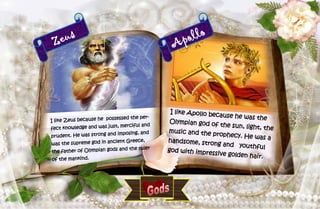
Zeus
I like Zeus because he possessed the per-
fect knowledge and was just, merciful and
prudent. He was strong and imposing, and
was the supreme god in ancient Greece,
the father of Olympian gods and the ruler
of the mankind.
Apollo
I like Apollo because he was theOlympian god of the sun, light, themusic and the prophecy. He was ahandsome, strong and youthfulgod with impressive golden hair.
5
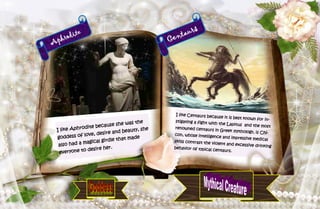
Aphrodite
I like Aphrodite because she was the
goddess of love, desire and beauty, she
also had a magical girdle that made
everyone to desire her.
Centaurs
I like Centaurs because it is best known for in-stigating a fight with the Lapitus and the mostrenowned centaurs in Greek mythology, is Chi-con, whose intelligence and impressive medicalskills contrast the violent and excessive drinkingbehavior of typical centaurs.
6
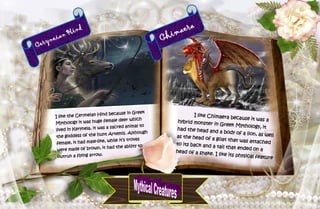
Ceryneian Hind
I like the Ceryneian Hind because in Greek
Mythology it was huge female deer which
lived in Kerynela, it was a sacred animal to
the goddess of the hunt Artemis. Although
female, it had male-like, while it’s troves
were made of brown, it had the ability to
outrun a flying arrow.
Chimaera
I like Chimaera because it was ahybrid monster in Greek Mythology, ithad the head and a body of a lion, as wellas the head of a goat that was attachedto its back and a tail that ended on ahead of a snake. I like its physical feature
7
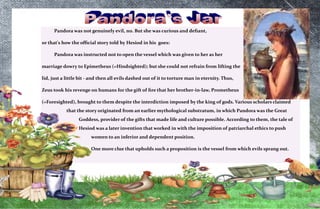
Pandora was not genuinely evil, no. But she was curious and defiant,
or that's how the official story told by Hesiod in his goes:
Pandora was instructed not to open the vessel which was given to her as her
marriage dowry to Epimetheus (=Hindsighted); but she could not refrain from lifting the
lid, just a little bit - and then all evils dashed out of it to torture man in eternity. Thus,
Zeus took his revenge on humans for the gift of fire that her brother-in-law, Prometheus
(=Foresighted), brought to them despite the interdiction imposed by the king of gods. Various scholars claimed
that the story originated from an earlier mythological substratum, in which Pandora was the Great
Goddess, provider of the gifts that made life and culture possible. According to them, the tale of
Hesiod was a later invention that worked in with the imposition of patriarchal ethics to push
women to an inferior and dependent position.
One more clue that upholds such a proposition is the vessel from which evils sprang out.
8
9
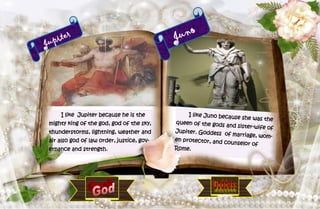
Jupiter
I like Jupiter because he is the
mighty king of the god, god of the sky,
thunderstorms, lightning, weather and
air also god of law order, justice, gov-
ernance and strength.
Juno
I like Juno because she was the
queen of the gods and sister-wife of
Jupiter. Goddess of marriage, wom-
en protector, and counselor of
Rome.
10
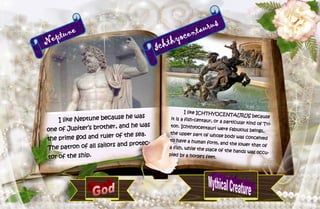
Neptune
I like Neptune because he was
one of Jupiter’s brother, and he was
the prime god and ruler of the sea.
The patron of all sailors and protec-
tor of the ship.
Ichthyocentaurus
I like ICHTHYOCENTAURUS becauseit is a fish-centaur, or a particular kind of Tri-ton. Ichthyocentauri were fabulous beings,the upper part of whose body was conceivedto have a human form, and the lower that ofa fish, while the place of the hands was occu-pied by a horse's feet.
11
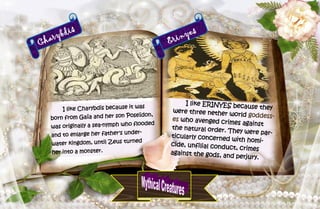
Charybdis
I like Charybdis because it was
born from Gaïa and her son Poseïdon,
was originally a sea-nymph who flooded
and to enlarge her father's under-
water kingdom, until Zeus turned
her into a monster.
Erinyes
I like ERINYES because theywere three nether world goddess-es who avenged crimes against
the natural order. They were par-ticularly concerned with homi-
cide, unfilial conduct, crimes
against the gods, and perjury.
12
According to Roman mythology, Romulus and Remus were the twin
sons of a woman named Rhea Silvia and the god of war Mars. Originally
from a mythical land called Alba Longa (located southeast of what would
become Rome), Rhea was the daughter of King Numitor. When the throne
was stolen by the king's younger brother Amulius, Rhea was forced to be-
come a Vestal Virgin. Amulius hoped that this would prevent her from hav-
ing any children to challenge his power.
Upon hearing that Rhea was pregnant, Amulius attempted to have the
twins drowned in the Tiber River. He had them placed inside a woven bas-
ket, believing that they would drown. Miraculously, Romulus and Remus
survived and washed ashore. The helpless infants were then found and
nurtured by a she-wolf. Eventually, a shepherd named Faustulus found
them and took them home.
The twins were raised by the shepherd and his wife. They became
shepherds themselves. However, once they were told of their tragic back-
ground, they attacked King Amulius and restored Numitor to the throne.
Romulus and Remus decided to found a town on the site where they had
been saved by the she-wolf. An argument between the twins led to the
death of Remus by his brother's hand. The reason for this death also re-
mains unclear.
13
14
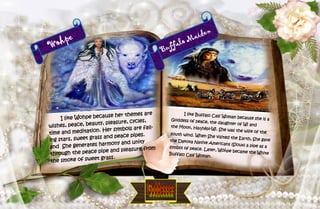
Wohpe
I like Wohpe because her themes are
wishes, peace, beauty, pleasure, cycles,
time and meditation. Her symbols are fall-
ing stars, sweet grass and peace pipes.
and She generates harmony and unity
through the peace pipe and pleasure from
the smoke of sweet grass.
Buffalo Maiden
I like Buffalo Calf Woman because she is aGoddess of peace, the daughter of Wi andthe Moon, Haŋhépi-Wi. She was the wife of thesouth wind. When She visited the Earth, She gavethe Dakota Native Americans (Sioux) a pipe as asymbol of peace. Later, Wóȟpe became the WhiteBuffalo Calf Woman.
15
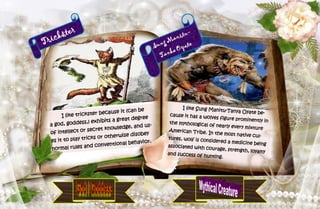
Trickster
I like trickster because it (can be
a god, goddess,) exhibits a great degree
of intellect or secret knowledge, and us-
es it to play tricks or otherwise disobey
normal rules and conventional behavior.
Sung Manitu-
Tanka Oyate
I like Sung Manitu-Tanya Oyate be-cause it has a wolves figure prominently inthe mythological of nearly every mixtureAmerican Tribe. In the most native cul-tures, wolf is considered a medicine beingassociated with courage, strength, loyaltyand success of hunting.
16
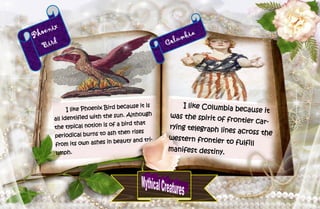
Phoenix
Bird
I like Phoenix Bird because it is
all identified with the sun. Although
the typical notion is of a bird that
periodical burns to ash then rises
from its own ashes in beauty and tri-
umph.
Columbia
I like Columbia because it
was the spirit of frontier car-
rying telegraph lines across the
western frontier to fulfill
manifest destiny.
17
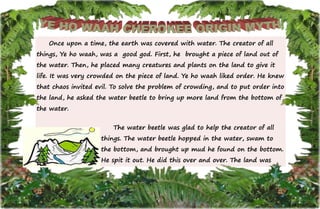
Once upon a time, the earth was covered with water. The creator of all
things, Ye ho waah, was a good god. First, he brought a piece of land out of
the water. Then, he placed many creatures and plants on the land to give it
life. It was very crowded on the piece of land. Ye ho waah liked order. He knew
that chaos invited evil. To solve the problem of crowding, and to put order into
the land, he asked the water beetle to bring up more land from the bottom of
the water.
The water beetle was glad to help the creator of all
things. The water beetle hopped in the water, swam to
the bottom, and brought up mud he found on the bottom.
He spit it out. He did this over and over. The land was
18
19
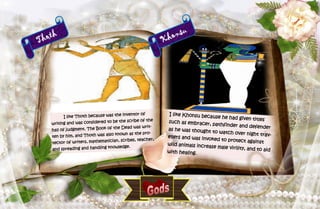
Thoth
I like Thoth because was the inventor of
writing and was considered to be the scribe of the
hall of judgment. The Book of the Dead was writ-
ten by him, and Thoth was also known as the pro-
tector of writers, mathematician, scribes, teacher,
and spreading and handling knowledge.
Khonsu
I like Khonsu because he had given titlessuch as embracer, pathfinder and defenderas he was thought to watch over night trav-ellers and was invoked to protect againstwild animals increase male virility, and to aidwith healing.
20
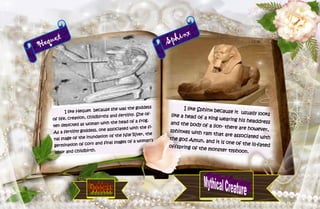
Hequet
I like Hequet because she was the goddess
of life, creation, childbirths and fertility. She of-
ten depicted as woman with the head of a frog.
As a fertility goddess, one associated with the fi-
nal stage of the inundation of the Nile River, the
germination of corn and final stages of a woman’s
labor and childbirth.
Sphinx
I like Sphinx because it usually lookslike a head of a king wearing his headdressand the body of a lion- there are however,sphinxes with ram that are associated withthe god Amun, and it is one of the ill-fatedoffspring of the monster typhoon.
21
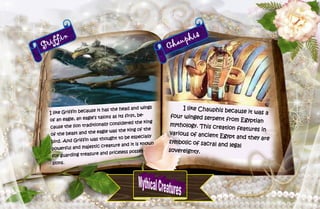
Griffin
I like Griffin because it has the head and wings
of an eagle, an eagle’s talons as its first, be-
cause the lion traditionally considered the king
of the beast and the eagle was the king of the
bird. And Griffin was thought to be especially
powerful and majestic creature and it is known
for guarding treasure and priceless posses-
sions.
Chauphis
I like Chauphis because it was a
four winged serpent from Egyptian
mythology. This creation features in
various of ancient Egypt and they are
symbolic of sacral and legal
sovereignty.
22
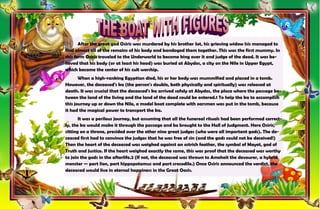
After the great god Osiris was murdered by his brother Set, his grieving widow Isis managed to
find almost all of the remains of his body and bandaged them together. This was the first mummy. In
this form Osiris traveled to the Underworld to become king over it and judge of the dead. It was be-
lieved that his body (or at least his head) was buried at Abydos, a city on the Nile in Upper Egypt,
which became the center of his cult worship.
When a high-ranking Egyptian died, his or her body was mummified and placed in a tomb.
However, the deceased's ka (the person's double, both physically and spiritually) was released at
death. It was crucial that the deceased's ka arrived safely at Abydos, the place where the passage be-
tween the land of the living and the land of the dead could be entered.1 To help the ka to accomplish
this journey up or down the Nile, a model boat complete with oarsmen was put in the tomb, because
it had the magical power to transport the ka.
It was a perilous journey, but assuming that all the funereal rituals had been performed correct-
ly, the ka would make it through the passage and be brought to the Hall of Judgment. Here Osiris,
sitting on a throne, presided over the other nine great judges (who were all important gods). The de-
ceased first had to convince the judges that he was free of sin (and the gods could not be deceived!)
Then the heart of the deceased was weighed against an ostrich feather, the symbol of Mayet, god of
Truth and Justice. If the heart weighed exactly the same, this was proof that the deceased was worthy
to join the gods in the afterlife.2 (If not, the deceased was thrown to Ameheit the devourer, a hybrid
monster — part lion, part hippopotamus and part crocodile.) Once Osiris announced the verdict, the
deceased would live in eternal happiness in the Great Oasis.
23
24
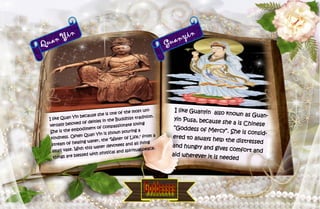
Quan Yin
I like Quan Yin because she is one of the most uni-
versally beloved of deities in the Buddhist tradition.
She is the embodiment of compassionate loving
kindness. Often Quan Yin is shown pouring a
stream of healing water, the "Water of Life," from a
small vase. With this water devotees and all living
things are blessed with physical and spiritual peace.
Guanyin
I like Guanyin also known as Guan-
yin Pusa, because she a is Chinese
“Goddess of Mercy”. She is consid-
ered to always help the distressed
and hungry and gives comfort and
aid wherever it is needed
25
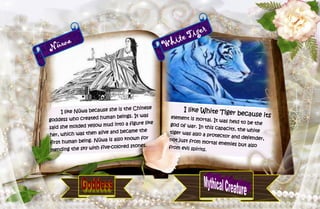
Nüwa
I like Nüwa because she is the Chinese
goddess who created human beings. It was
said she molded yellow mud into a figure like
her, which was then alive and became the
first human being. Nüwa is also known for
mending the sky with five-colored stones.
White Tiger
I like White Tiger because itselement is mortal. It was held to be thegod of war. In this capacity, the whitetiger was also a protector and defender,not just from mortal enemies but alsofrom evil spirits.
26
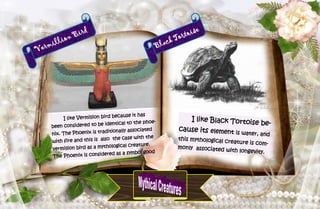
Vermillion Bird
I like Vermillion bird because it has
been considered to be identical to the phoe-
nix. The Phoenix is traditionally associated
with fire and this is also the case with the
vermillion bird as a mythological creature.
The Phoenix is considered as a symbol good
Black Tortoise
I like Black Tortoise be-
cause its element is water, and
this mythological creature is com-
monly associated with longevity.
27
In ancient times there was a king who wished to own a fast horse. He sent many men to inquire about such
horse and offered to pay up to a thousand gold pieces for the horse. Three years passed, and the men who were
sent out to buy those horses came back. But there was no horse bought. The king was worried and didn't know
what to do. This time the king's lesser official said, "Let me go and search for one of these fleet footed horses."
When he finally found one, it had just died. The lesser official still paid five hundred gold pieces for the head of
the horse. He took it back to the king. The king was furious. "I wanted a live one! What is the use of the head of a
dead horse? You waste my five hundred gold pieces." The official calmly answered, "Dead or alive even though it
cost five hundred gold pieces. Now the whole world knows that you sincerely are looking for a horse of this quality."
So before long a real fleet footed horse was brought to the palace and offered for sale and then after less than one
year, three more had been reached to the palace.
The wisdom behind this tale is if you want to reach or find or gain something
that you need help from others to achieve it, sometimes it's not enough just to let oth-
ers know about our desires. We need to make them feel that we really really want
that thing, if they can feel in their hearts that we sincerely and earnestly pursuit those
things, they'll be moved by our sincerity and persistence and begin to sincerely help us.
Sometimes we want to help someone but when we see that he doesn't show a strong
will to help himself that's very discouraging. This wisdom is very applicable in many
areas of our lives.
28
29
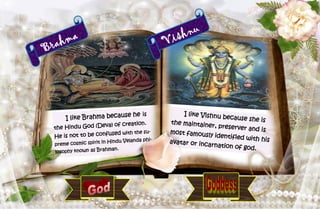
Brahma
I like Brahma because he is
the Hindu God (Deva) of creation.
He is not to be confused with the su-
preme cosmic spirit in Hindu Velanda phi-
losophy known as Brahman.
Vishnu
I like Vishnu because she isthe maintainer, preserver and ismost famously identified with hisavatar or incarnation of god.
30
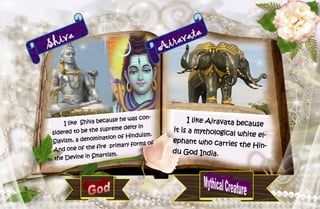
Shiva
I like Shiva because he was con-
sidered to be the supreme deity in
Slavism, a denomination of Hinduism.
And one of the fire primary forms of
the Devine in Smartism.
Airavata
I like Airavata because
it is a mythological white el-
ephant who carries the Hin-
du God India.
31
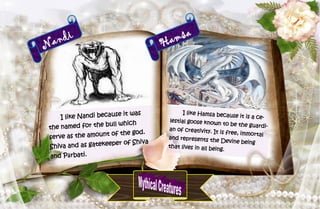
Nandi
I like Nandi because it was
the named for the bull which
serve as the amount of the god.
Shiva and as gatekeeper of Shiva
and Pārbati.
Hamsa
I like Hamsa because it is a ce-
lestial goose known to be the guardi-
an of creativity. It is free, immortal
and represents the Devine being
that lives in all being.
32
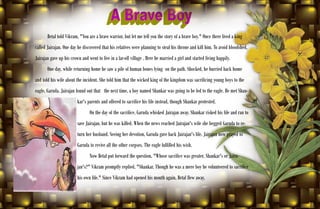
Betal told Vikram, "You are a brave warrior, but let me tell you the story of a brave boy." Once there lived a king
called Jairajan. One day he discovered that his relatives were planning to steal his throne and kill him. To avoid bloodshed,
Jairajan gave up his crown and went to live in a far-off village . Here he married a girl and started living happily.
One day, while returning home he saw a pile of human bones lying on the path. Shocked, he hurried back home
and told his wife about the incident. She told him that the wicked king of the kingdom was sacrificing young boys to the
eagle, Garuda. Jairajan found out that the next time, a boy named Shankar was going to be fed to the eagle. He met Shan-
kar's parents and offered to sacrifice his life instead, though Shankar protested.
On the day of the sacrifice, Garuda whisked Jairajan away. Shankar risked his life and ran to
save Jairajan, but he was killed. When the news reached Jairajan's wife she begged Garuda to re-
turn her husband. Seeing her devotion, Garuda gave back Jairajan's life. Jairajan now prayed to
Garuda to revive all the other corpses. The eagle fulfilled his wish.
Now Betal put forward the question, "Whose sacrifice was greater, Shankar's or Jaira-
jan's?" Vikram promptly replied, "Shankar. Though he was a mere boy he volunteered to sacrifice
his own life." Since Vikram had opened his mouth again, Betal flew away.
33
34
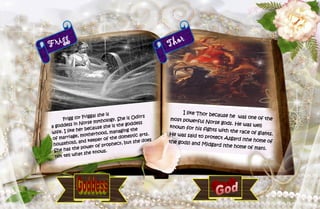
Frigg
Frigg (or Frigga) she is
a goddess in Norse mythology. She is Odin's
wife. I like her because she is the goddess
of marriage, motherhood, managing the
household, and keeper of the domestic arts.
She has the power of prophecy, but she does
not tell what she knows.
Thor
I like Thor because he was one of themost powerful Norse gods. He was wellknown for his fights with the race of giants.He was said to protect Asgard (the home ofthe gods) and Midgard (the home of man).
35
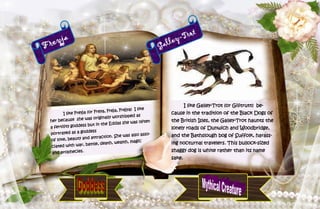
Freyja
I like Freyja (or Freya, Freja, Frejya) I like
her because she was originally worshipped as
a fertility goddess but in the Eddas she was often
portrayed as a goddess
of love, beauty and attraction. She was also asso-
ciated with war, battle, death, wealth, magic
and prophecies.
Galley-Trot
I like Galley-Trot (or Gilitrutt) be-
cause in the tradition of the Black Dogs of
the British Isles, the Galley-Trot haunts the
lonely roads of Dunwich and Woodbridge,
and the Bathslough bog of Suffolk, harass-
ing nocturnal travelers. This bullock-sized
shaggy dog is white rather than its name
sake.
36
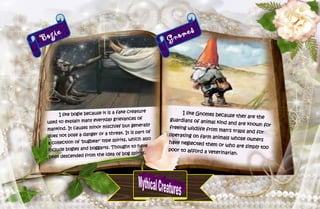
Bogie
I like bogie because it is a fake creature
used to explain many everyday grievances of
mankind. It causes minor mischief but generally
does not pose a danger or a threat. It is part of
a collection of 'bugbear' type spirits, which also
include bogles and boggarts. Thought to have
been descended from the idea of bog spirits.
Gnomes
I like Gnomes because they are the
guardians of animal kind and are known forfreeing wildlife from man's traps and for
operating on farm animals whose owners
have neglected them or who are simply toopoor to afford a veterinarian.
37
Thor was married to Sif, the lovely goddess. Sif had beautiful, long, golden hair. It was
something she took great pride of.
Loki, the mischievous fire-god, loved playing practical jokes on the gods. One night, Loki decid-
ed to cut off all Sif's hair.
What Loki didn't count on, was Thor's temper. When Thor found his wife weeping over the
lost of her golden hair, the thunder-god caught Loki and threatened to beat and break every
bone in Loki's body. Loki promised Thor to replaced Sif's beautiful hair with hair of gold.
Loki sought the master dwarven craftsmen, the sons of Ivaldi. The hair or wig was made out of
finely spun gold. The magical property of the gold hair was that it was alive like real hair,
which would grow naturally.
The sons of Ivaldi also created two other splendid gifts for the Aesir. They created the in-
destructible spear, called Gungnir, for Odin. They also created a magical ship for Freyr, which
was called Skidbladnir. The remarkable thing about Skidbladnir was that it was a collapsible
ship, which Freyr could fold up to a size smaller enough to carry in his pocket.
As Loki carried the gifts to the Aesir, Loki encountered another two dwarfs – Brokk and Ei-
ti. Loki boasted of the gifts and craftsmanship of the sons of Ivaldi. Loki made a wager on his
head that Brokk and Eiti and could not make better three gifts than those of the sons of Ivaldi.
Brokk and Eiti agreed to the wagers.
38
First, Eiti placed a pig's hide in the forge, he told his brother to keep working on the bel-
lows, until he completed the work. As they started working, a fly (Loki?) tried to distract Brokk
from blowing air into the forge fire, by biting into Brokk's left arm. Brokk ignored the fly and
continuously worked on the bellows. From the hide, bristles of gold sprout out and giving life
to a wild boar. The boar was called Gullinbursti, "golden bristles". The boar had the ability to
run faster than any horse, across the sky or over water. The gold bristle ensured that it was
bright enough to see where it was going, even at the darkness night.
During the second piece of work, the fly landed this time on Brokk's neck, nibbling harder than
before, but Brokk ignored the fly and kept working on the bellows. Eiti made a gold ring called
the Draupnir. The ring had the ability to make eight other rings of the same size, every ninth
night.
When they were working on a third item, the fly now landed between Brokk's eyes, and
nibbled on his eyelid. Blood dripped into his eye, so Brokk quickly rubbed the blood out of his
eye and swatted the fly away, before he continued to work the bellows. Eiti had placed a large
piece of iron in the forge and creating hammer called Mjollnir. Eiti told Brokk that he nearly ru-
ined this work. The only flaw of the hammer was that the handle was quite short.
The Mjollnir was the strongest weapon in the world. It would not fail to hit any target, either
struck at or thrown at. If the hammer were thrown, it would always return to its hands, after
striking its target.
39
`Eiti sent his brother with the gifts to Asgard. Loki and Brokk gave the gifts to the Aesir.
Odin, Thor and Freyr acted as judges over the gifts, to see which was the best of them all.
Loki gave the hair or wig of gold was given to Sif, to appease Thor's anger towards him. The
collapsible ship, Skidbladnir, was given to Freyr, and Loki gave irresistible spear, (Gungnir), to
Odin.
Brokk gave the boar with gold bristles (Gullinbursti) to Freyr, the gold ring (Draupnir) to
Odin, and the Mjollnir to Thor.
The three judges found that the Mjollnir was the best gift, since it gave the person greatest
chances against the giants at Ragnarok.
Losing the wagers, Loki tried to flee, but was caught by Thor. Odin decided that Loki losing
his head was a bit drastic, so Brokk decided upon a different measure. Brokk sealed Loki's
mouth shut with wire.
40
41
Bathala
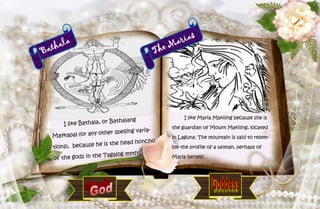
I like Bathala, or Bathalang
Maykapal (or any other spelling varia-
tions), because he is the head honcho
of the gods in the Tagalog myths.
The Marias
I like Maria Makiling because she is
the guardian of Mount Makiling, located
in Laguna. The mountain is said to resem-
ble the profile of a woman, perhaps of
Maria herself.
42
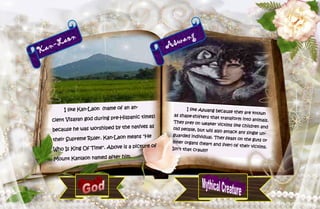
Kan-Laon
I like Kan-Laon (name of an an-
cient Visayan god during pre-Hispanic times)
because he was worshiped by the natives as
their Supreme Ruler. Kan-Laon means "He
Who Is King Of Time". Above is a picture of
Mount Kanlaon named after him.
Aswang
I like Aswang because they are knownas shape-shifters that transform into animals.They prey on weaker victims like children andold people, but will also attack any single un-guarded individual. They feast on the guts orinner organs (heart and liver) of their victims.Isn’t that crawly?
43
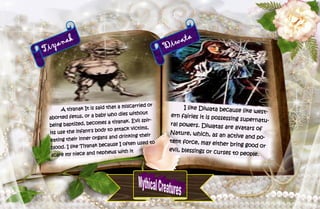
Tiyanak
A tiyanak It is said that a miscarried or
aborted fetus, or a baby who dies without
being baptized, becomes a tiyanak. Evil spir-
its use the infant's body to attack victims,
eating their inner organs and drinking their
blood. I like Tiyanak because I often used to
scare my niece and nephews with it
Diwata
I like Diwata because like west-
ern fairies it is possessing supernatu-
ral powers. Diwatas are avatars of
Nature, which, as an active and po-
tent force, may either bring good or
evil, blessings or curses to people.
44
There once lived on the island of Negros a princess named Anina who lived a very sheltered life.
One day, Anina overheard her father talking to the kingdom's chief priestess. The priestess was frantic about
a report that they could not find a single maiden who was unblemished.
Later, Anina asked her father what it was all about, and the king finally broke down. There had long been a
seven-headed dragon threatening the kingdom, and the monster could only be appeased if an unblemished maid-
en was sacrificed to it.
In fear, all the women in the kingdom had cut themselves to disqualify themselves from the sacrifice. Parents
cut their own baby girls so as to spare the infants from the sacrifice. But the king and the queen couldn't bring
themselves to mar their daughter's beauty, and so Anina was the only remaining unscarred female in the king-
dom.
Anina did not weep. Instead, she willingly offered herself for the sacrifice. Fortuitously, on the day she was to
be brought to the mountain where the dragon lived, a man calling himself Khan Laon appeared. (Khan in his lan-
guage meant a noble lord.) He said he came from a kingdom far away in order to slay the dragon and spare Anina's
life.
No one believed the dragon could be killed, but Khan Laon insisted that his ability to talk to animals would
help him. He asked the help of the ants, the bees and the eagles.
The ants swarmed over the dragon's body and crept under its scales to bite its
soft, unprotected flesh, while the bees stung the fourteen eyes of the dragon till it was
blind. The largest eagle carried Khan Laon to the mountain where he was able to easi-
ly chop off the seven heads of the writhing beast.
In gratitude, the king gave Khan Laon his daughter Anina to be his bride, and the
people named the mountain after the noble lord.
And that is how, according to the story, Mount Kanlaon got its name. That it is a
volcano is because of the spirt of the dead dragon.

Mythology and folklore

  • 1.
  • 2.
  • 3.
  • 4.
    4 Zeus I like Zeusbecause he possessed the per- fect knowledge and was just, merciful and prudent. He was strong and imposing, and was the supreme god in ancient Greece, the father of Olympian gods and the ruler of the mankind. Apollo I like Apollo because he was theOlympian god of the sun, light, themusic and the prophecy. He was ahandsome, strong and youthfulgod with impressive golden hair.
  • 5.
    5 Aphrodite I like Aphroditebecause she was the goddess of love, desire and beauty, she also had a magical girdle that made everyone to desire her. Centaurs I like Centaurs because it is best known for in-stigating a fight with the Lapitus and the mostrenowned centaurs in Greek mythology, is Chi-con, whose intelligence and impressive medicalskills contrast the violent and excessive drinkingbehavior of typical centaurs.
  • 6.
    6 Ceryneian Hind I likethe Ceryneian Hind because in Greek Mythology it was huge female deer which lived in Kerynela, it was a sacred animal to the goddess of the hunt Artemis. Although female, it had male-like, while it’s troves were made of brown, it had the ability to outrun a flying arrow. Chimaera I like Chimaera because it was ahybrid monster in Greek Mythology, ithad the head and a body of a lion, as wellas the head of a goat that was attachedto its back and a tail that ended on ahead of a snake. I like its physical feature
  • 7.
    7 Pandora was notgenuinely evil, no. But she was curious and defiant, or that's how the official story told by Hesiod in his goes: Pandora was instructed not to open the vessel which was given to her as her marriage dowry to Epimetheus (=Hindsighted); but she could not refrain from lifting the lid, just a little bit - and then all evils dashed out of it to torture man in eternity. Thus, Zeus took his revenge on humans for the gift of fire that her brother-in-law, Prometheus (=Foresighted), brought to them despite the interdiction imposed by the king of gods. Various scholars claimed that the story originated from an earlier mythological substratum, in which Pandora was the Great Goddess, provider of the gifts that made life and culture possible. According to them, the tale of Hesiod was a later invention that worked in with the imposition of patriarchal ethics to push women to an inferior and dependent position. One more clue that upholds such a proposition is the vessel from which evils sprang out.
  • 8.
  • 9.
    9 Jupiter I like Jupiterbecause he is the mighty king of the god, god of the sky, thunderstorms, lightning, weather and air also god of law order, justice, gov- ernance and strength. Juno I like Juno because she was the queen of the gods and sister-wife of Jupiter. Goddess of marriage, wom- en protector, and counselor of Rome.
  • 10.
    10 Neptune I like Neptunebecause he was one of Jupiter’s brother, and he was the prime god and ruler of the sea. The patron of all sailors and protec- tor of the ship. Ichthyocentaurus I like ICHTHYOCENTAURUS becauseit is a fish-centaur, or a particular kind of Tri-ton. Ichthyocentauri were fabulous beings,the upper part of whose body was conceivedto have a human form, and the lower that ofa fish, while the place of the hands was occu-pied by a horse's feet.
  • 11.
    11 Charybdis I like Charybdisbecause it was born from Gaïa and her son Poseïdon, was originally a sea-nymph who flooded and to enlarge her father's under- water kingdom, until Zeus turned her into a monster. Erinyes I like ERINYES because theywere three nether world goddess-es who avenged crimes against the natural order. They were par-ticularly concerned with homi- cide, unfilial conduct, crimes against the gods, and perjury.
  • 12.
    12 According to Romanmythology, Romulus and Remus were the twin sons of a woman named Rhea Silvia and the god of war Mars. Originally from a mythical land called Alba Longa (located southeast of what would become Rome), Rhea was the daughter of King Numitor. When the throne was stolen by the king's younger brother Amulius, Rhea was forced to be- come a Vestal Virgin. Amulius hoped that this would prevent her from hav- ing any children to challenge his power. Upon hearing that Rhea was pregnant, Amulius attempted to have the twins drowned in the Tiber River. He had them placed inside a woven bas- ket, believing that they would drown. Miraculously, Romulus and Remus survived and washed ashore. The helpless infants were then found and nurtured by a she-wolf. Eventually, a shepherd named Faustulus found them and took them home. The twins were raised by the shepherd and his wife. They became shepherds themselves. However, once they were told of their tragic back- ground, they attacked King Amulius and restored Numitor to the throne. Romulus and Remus decided to found a town on the site where they had been saved by the she-wolf. An argument between the twins led to the death of Remus by his brother's hand. The reason for this death also re- mains unclear.
  • 13.
  • 14.
    14 Wohpe I like Wohpebecause her themes are wishes, peace, beauty, pleasure, cycles, time and meditation. Her symbols are fall- ing stars, sweet grass and peace pipes. and She generates harmony and unity through the peace pipe and pleasure from the smoke of sweet grass. Buffalo Maiden I like Buffalo Calf Woman because she is aGoddess of peace, the daughter of Wi andthe Moon, Haŋhépi-Wi. She was the wife of thesouth wind. When She visited the Earth, She gavethe Dakota Native Americans (Sioux) a pipe as asymbol of peace. Later, Wóȟpe became the WhiteBuffalo Calf Woman.
  • 15.
    15 Trickster I like tricksterbecause it (can be a god, goddess,) exhibits a great degree of intellect or secret knowledge, and us- es it to play tricks or otherwise disobey normal rules and conventional behavior. Sung Manitu- Tanka Oyate I like Sung Manitu-Tanya Oyate be-cause it has a wolves figure prominently inthe mythological of nearly every mixtureAmerican Tribe. In the most native cul-tures, wolf is considered a medicine beingassociated with courage, strength, loyaltyand success of hunting.
  • 16.
    16 Phoenix Bird I like PhoenixBird because it is all identified with the sun. Although the typical notion is of a bird that periodical burns to ash then rises from its own ashes in beauty and tri- umph. Columbia I like Columbia because it was the spirit of frontier car- rying telegraph lines across the western frontier to fulfill manifest destiny.
  • 17.
    17 Once upon atime, the earth was covered with water. The creator of all things, Ye ho waah, was a good god. First, he brought a piece of land out of the water. Then, he placed many creatures and plants on the land to give it life. It was very crowded on the piece of land. Ye ho waah liked order. He knew that chaos invited evil. To solve the problem of crowding, and to put order into the land, he asked the water beetle to bring up more land from the bottom of the water. The water beetle was glad to help the creator of all things. The water beetle hopped in the water, swam to the bottom, and brought up mud he found on the bottom. He spit it out. He did this over and over. The land was
  • 18.
  • 19.
    19 Thoth I like Thothbecause was the inventor of writing and was considered to be the scribe of the hall of judgment. The Book of the Dead was writ- ten by him, and Thoth was also known as the pro- tector of writers, mathematician, scribes, teacher, and spreading and handling knowledge. Khonsu I like Khonsu because he had given titlessuch as embracer, pathfinder and defenderas he was thought to watch over night trav-ellers and was invoked to protect againstwild animals increase male virility, and to aidwith healing.
  • 20.
    20 Hequet I like Hequetbecause she was the goddess of life, creation, childbirths and fertility. She of- ten depicted as woman with the head of a frog. As a fertility goddess, one associated with the fi- nal stage of the inundation of the Nile River, the germination of corn and final stages of a woman’s labor and childbirth. Sphinx I like Sphinx because it usually lookslike a head of a king wearing his headdressand the body of a lion- there are however,sphinxes with ram that are associated withthe god Amun, and it is one of the ill-fatedoffspring of the monster typhoon.
  • 21.
    21 Griffin I like Griffinbecause it has the head and wings of an eagle, an eagle’s talons as its first, be- cause the lion traditionally considered the king of the beast and the eagle was the king of the bird. And Griffin was thought to be especially powerful and majestic creature and it is known for guarding treasure and priceless posses- sions. Chauphis I like Chauphis because it was a four winged serpent from Egyptian mythology. This creation features in various of ancient Egypt and they are symbolic of sacral and legal sovereignty.
  • 22.
    22 After the greatgod Osiris was murdered by his brother Set, his grieving widow Isis managed to find almost all of the remains of his body and bandaged them together. This was the first mummy. In this form Osiris traveled to the Underworld to become king over it and judge of the dead. It was be- lieved that his body (or at least his head) was buried at Abydos, a city on the Nile in Upper Egypt, which became the center of his cult worship. When a high-ranking Egyptian died, his or her body was mummified and placed in a tomb. However, the deceased's ka (the person's double, both physically and spiritually) was released at death. It was crucial that the deceased's ka arrived safely at Abydos, the place where the passage be- tween the land of the living and the land of the dead could be entered.1 To help the ka to accomplish this journey up or down the Nile, a model boat complete with oarsmen was put in the tomb, because it had the magical power to transport the ka. It was a perilous journey, but assuming that all the funereal rituals had been performed correct- ly, the ka would make it through the passage and be brought to the Hall of Judgment. Here Osiris, sitting on a throne, presided over the other nine great judges (who were all important gods). The de- ceased first had to convince the judges that he was free of sin (and the gods could not be deceived!) Then the heart of the deceased was weighed against an ostrich feather, the symbol of Mayet, god of Truth and Justice. If the heart weighed exactly the same, this was proof that the deceased was worthy to join the gods in the afterlife.2 (If not, the deceased was thrown to Ameheit the devourer, a hybrid monster — part lion, part hippopotamus and part crocodile.) Once Osiris announced the verdict, the deceased would live in eternal happiness in the Great Oasis.
  • 23.
  • 24.
    24 Quan Yin I likeQuan Yin because she is one of the most uni- versally beloved of deities in the Buddhist tradition. She is the embodiment of compassionate loving kindness. Often Quan Yin is shown pouring a stream of healing water, the "Water of Life," from a small vase. With this water devotees and all living things are blessed with physical and spiritual peace. Guanyin I like Guanyin also known as Guan- yin Pusa, because she a is Chinese “Goddess of Mercy”. She is consid- ered to always help the distressed and hungry and gives comfort and aid wherever it is needed
  • 25.
    25 Nüwa I like Nüwabecause she is the Chinese goddess who created human beings. It was said she molded yellow mud into a figure like her, which was then alive and became the first human being. Nüwa is also known for mending the sky with five-colored stones. White Tiger I like White Tiger because itselement is mortal. It was held to be thegod of war. In this capacity, the whitetiger was also a protector and defender,not just from mortal enemies but alsofrom evil spirits.
  • 26.
    26 Vermillion Bird I likeVermillion bird because it has been considered to be identical to the phoe- nix. The Phoenix is traditionally associated with fire and this is also the case with the vermillion bird as a mythological creature. The Phoenix is considered as a symbol good Black Tortoise I like Black Tortoise be- cause its element is water, and this mythological creature is com- monly associated with longevity.
  • 27.
    27 In ancient timesthere was a king who wished to own a fast horse. He sent many men to inquire about such horse and offered to pay up to a thousand gold pieces for the horse. Three years passed, and the men who were sent out to buy those horses came back. But there was no horse bought. The king was worried and didn't know what to do. This time the king's lesser official said, "Let me go and search for one of these fleet footed horses." When he finally found one, it had just died. The lesser official still paid five hundred gold pieces for the head of the horse. He took it back to the king. The king was furious. "I wanted a live one! What is the use of the head of a dead horse? You waste my five hundred gold pieces." The official calmly answered, "Dead or alive even though it cost five hundred gold pieces. Now the whole world knows that you sincerely are looking for a horse of this quality." So before long a real fleet footed horse was brought to the palace and offered for sale and then after less than one year, three more had been reached to the palace. The wisdom behind this tale is if you want to reach or find or gain something that you need help from others to achieve it, sometimes it's not enough just to let oth- ers know about our desires. We need to make them feel that we really really want that thing, if they can feel in their hearts that we sincerely and earnestly pursuit those things, they'll be moved by our sincerity and persistence and begin to sincerely help us. Sometimes we want to help someone but when we see that he doesn't show a strong will to help himself that's very discouraging. This wisdom is very applicable in many areas of our lives.
  • 28.
  • 29.
    29 Brahma I like Brahmabecause he is the Hindu God (Deva) of creation. He is not to be confused with the su- preme cosmic spirit in Hindu Velanda phi- losophy known as Brahman. Vishnu I like Vishnu because she isthe maintainer, preserver and ismost famously identified with hisavatar or incarnation of god.
  • 30.
    30 Shiva I like Shivabecause he was con- sidered to be the supreme deity in Slavism, a denomination of Hinduism. And one of the fire primary forms of the Devine in Smartism. Airavata I like Airavata because it is a mythological white el- ephant who carries the Hin- du God India.
  • 31.
    31 Nandi I like Nandibecause it was the named for the bull which serve as the amount of the god. Shiva and as gatekeeper of Shiva and Pārbati. Hamsa I like Hamsa because it is a ce- lestial goose known to be the guardi- an of creativity. It is free, immortal and represents the Devine being that lives in all being.
  • 32.
    32 Betal told Vikram,"You are a brave warrior, but let me tell you the story of a brave boy." Once there lived a king called Jairajan. One day he discovered that his relatives were planning to steal his throne and kill him. To avoid bloodshed, Jairajan gave up his crown and went to live in a far-off village . Here he married a girl and started living happily. One day, while returning home he saw a pile of human bones lying on the path. Shocked, he hurried back home and told his wife about the incident. She told him that the wicked king of the kingdom was sacrificing young boys to the eagle, Garuda. Jairajan found out that the next time, a boy named Shankar was going to be fed to the eagle. He met Shan- kar's parents and offered to sacrifice his life instead, though Shankar protested. On the day of the sacrifice, Garuda whisked Jairajan away. Shankar risked his life and ran to save Jairajan, but he was killed. When the news reached Jairajan's wife she begged Garuda to re- turn her husband. Seeing her devotion, Garuda gave back Jairajan's life. Jairajan now prayed to Garuda to revive all the other corpses. The eagle fulfilled his wish. Now Betal put forward the question, "Whose sacrifice was greater, Shankar's or Jaira- jan's?" Vikram promptly replied, "Shankar. Though he was a mere boy he volunteered to sacrifice his own life." Since Vikram had opened his mouth again, Betal flew away.
  • 33.
  • 34.
    34 Frigg Frigg (or Frigga)she is a goddess in Norse mythology. She is Odin's wife. I like her because she is the goddess of marriage, motherhood, managing the household, and keeper of the domestic arts. She has the power of prophecy, but she does not tell what she knows. Thor I like Thor because he was one of themost powerful Norse gods. He was wellknown for his fights with the race of giants.He was said to protect Asgard (the home ofthe gods) and Midgard (the home of man).
  • 35.
    35 Freyja I like Freyja(or Freya, Freja, Frejya) I like her because she was originally worshipped as a fertility goddess but in the Eddas she was often portrayed as a goddess of love, beauty and attraction. She was also asso- ciated with war, battle, death, wealth, magic and prophecies. Galley-Trot I like Galley-Trot (or Gilitrutt) be- cause in the tradition of the Black Dogs of the British Isles, the Galley-Trot haunts the lonely roads of Dunwich and Woodbridge, and the Bathslough bog of Suffolk, harass- ing nocturnal travelers. This bullock-sized shaggy dog is white rather than its name sake.
  • 36.
    36 Bogie I like bogiebecause it is a fake creature used to explain many everyday grievances of mankind. It causes minor mischief but generally does not pose a danger or a threat. It is part of a collection of 'bugbear' type spirits, which also include bogles and boggarts. Thought to have been descended from the idea of bog spirits. Gnomes I like Gnomes because they are the guardians of animal kind and are known forfreeing wildlife from man's traps and for operating on farm animals whose owners have neglected them or who are simply toopoor to afford a veterinarian.
  • 37.
    37 Thor was marriedto Sif, the lovely goddess. Sif had beautiful, long, golden hair. It was something she took great pride of. Loki, the mischievous fire-god, loved playing practical jokes on the gods. One night, Loki decid- ed to cut off all Sif's hair. What Loki didn't count on, was Thor's temper. When Thor found his wife weeping over the lost of her golden hair, the thunder-god caught Loki and threatened to beat and break every bone in Loki's body. Loki promised Thor to replaced Sif's beautiful hair with hair of gold. Loki sought the master dwarven craftsmen, the sons of Ivaldi. The hair or wig was made out of finely spun gold. The magical property of the gold hair was that it was alive like real hair, which would grow naturally. The sons of Ivaldi also created two other splendid gifts for the Aesir. They created the in- destructible spear, called Gungnir, for Odin. They also created a magical ship for Freyr, which was called Skidbladnir. The remarkable thing about Skidbladnir was that it was a collapsible ship, which Freyr could fold up to a size smaller enough to carry in his pocket. As Loki carried the gifts to the Aesir, Loki encountered another two dwarfs – Brokk and Ei- ti. Loki boasted of the gifts and craftsmanship of the sons of Ivaldi. Loki made a wager on his head that Brokk and Eiti and could not make better three gifts than those of the sons of Ivaldi. Brokk and Eiti agreed to the wagers.
  • 38.
    38 First, Eiti placeda pig's hide in the forge, he told his brother to keep working on the bel- lows, until he completed the work. As they started working, a fly (Loki?) tried to distract Brokk from blowing air into the forge fire, by biting into Brokk's left arm. Brokk ignored the fly and continuously worked on the bellows. From the hide, bristles of gold sprout out and giving life to a wild boar. The boar was called Gullinbursti, "golden bristles". The boar had the ability to run faster than any horse, across the sky or over water. The gold bristle ensured that it was bright enough to see where it was going, even at the darkness night. During the second piece of work, the fly landed this time on Brokk's neck, nibbling harder than before, but Brokk ignored the fly and kept working on the bellows. Eiti made a gold ring called the Draupnir. The ring had the ability to make eight other rings of the same size, every ninth night. When they were working on a third item, the fly now landed between Brokk's eyes, and nibbled on his eyelid. Blood dripped into his eye, so Brokk quickly rubbed the blood out of his eye and swatted the fly away, before he continued to work the bellows. Eiti had placed a large piece of iron in the forge and creating hammer called Mjollnir. Eiti told Brokk that he nearly ru- ined this work. The only flaw of the hammer was that the handle was quite short. The Mjollnir was the strongest weapon in the world. It would not fail to hit any target, either struck at or thrown at. If the hammer were thrown, it would always return to its hands, after striking its target.
  • 39.
    39 `Eiti sent hisbrother with the gifts to Asgard. Loki and Brokk gave the gifts to the Aesir. Odin, Thor and Freyr acted as judges over the gifts, to see which was the best of them all. Loki gave the hair or wig of gold was given to Sif, to appease Thor's anger towards him. The collapsible ship, Skidbladnir, was given to Freyr, and Loki gave irresistible spear, (Gungnir), to Odin. Brokk gave the boar with gold bristles (Gullinbursti) to Freyr, the gold ring (Draupnir) to Odin, and the Mjollnir to Thor. The three judges found that the Mjollnir was the best gift, since it gave the person greatest chances against the giants at Ragnarok. Losing the wagers, Loki tried to flee, but was caught by Thor. Odin decided that Loki losing his head was a bit drastic, so Brokk decided upon a different measure. Brokk sealed Loki's mouth shut with wire.
  • 40.
  • 41.
    41 Bathala I like Bathala,or Bathalang Maykapal (or any other spelling varia- tions), because he is the head honcho of the gods in the Tagalog myths. The Marias I like Maria Makiling because she is the guardian of Mount Makiling, located in Laguna. The mountain is said to resem- ble the profile of a woman, perhaps of Maria herself.
  • 42.
    42 Kan-Laon I like Kan-Laon(name of an an- cient Visayan god during pre-Hispanic times) because he was worshiped by the natives as their Supreme Ruler. Kan-Laon means "He Who Is King Of Time". Above is a picture of Mount Kanlaon named after him. Aswang I like Aswang because they are knownas shape-shifters that transform into animals.They prey on weaker victims like children andold people, but will also attack any single un-guarded individual. They feast on the guts orinner organs (heart and liver) of their victims.Isn’t that crawly?
  • 43.
    43 Tiyanak A tiyanak Itis said that a miscarried or aborted fetus, or a baby who dies without being baptized, becomes a tiyanak. Evil spir- its use the infant's body to attack victims, eating their inner organs and drinking their blood. I like Tiyanak because I often used to scare my niece and nephews with it Diwata I like Diwata because like west- ern fairies it is possessing supernatu- ral powers. Diwatas are avatars of Nature, which, as an active and po- tent force, may either bring good or evil, blessings or curses to people.
  • 44.
    44 There once livedon the island of Negros a princess named Anina who lived a very sheltered life. One day, Anina overheard her father talking to the kingdom's chief priestess. The priestess was frantic about a report that they could not find a single maiden who was unblemished. Later, Anina asked her father what it was all about, and the king finally broke down. There had long been a seven-headed dragon threatening the kingdom, and the monster could only be appeased if an unblemished maid- en was sacrificed to it. In fear, all the women in the kingdom had cut themselves to disqualify themselves from the sacrifice. Parents cut their own baby girls so as to spare the infants from the sacrifice. But the king and the queen couldn't bring themselves to mar their daughter's beauty, and so Anina was the only remaining unscarred female in the king- dom. Anina did not weep. Instead, she willingly offered herself for the sacrifice. Fortuitously, on the day she was to be brought to the mountain where the dragon lived, a man calling himself Khan Laon appeared. (Khan in his lan- guage meant a noble lord.) He said he came from a kingdom far away in order to slay the dragon and spare Anina's life. No one believed the dragon could be killed, but Khan Laon insisted that his ability to talk to animals would help him. He asked the help of the ants, the bees and the eagles. The ants swarmed over the dragon's body and crept under its scales to bite its soft, unprotected flesh, while the bees stung the fourteen eyes of the dragon till it was blind. The largest eagle carried Khan Laon to the mountain where he was able to easi- ly chop off the seven heads of the writhing beast. In gratitude, the king gave Khan Laon his daughter Anina to be his bride, and the people named the mountain after the noble lord. And that is how, according to the story, Mount Kanlaon got its name. That it is a volcano is because of the spirt of the dead dragon.