Chapter 2: The Ancient World Early Egyptian society HUM 250 Westwood College Prof. Tidwell
Guidelines Each slide will be up for only 3 minutes.  Ask Question as you have them. Breaks will be given. In class assignment and homework assignment will come at the end of this discussion.
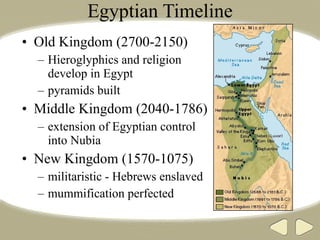
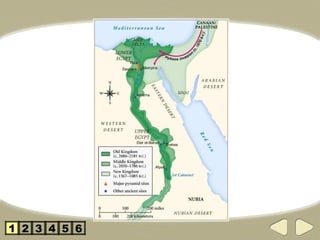
Egyptian Timeline Old Kingdom (2700-2150) Hieroglyphics and religion develop in Egypt pyramids built Middle Kingdom (2040-1786) extension of Egyptian control into Nubia New Kingdom (1570-1075) militaristic - Hebrews enslaved mummification perfected
Outline Geography Religion Gods Pyramids Mummies Government The Pharaoh Daily Life  Middle Kingdom  New Kingdom 2 3 4 5 1 6
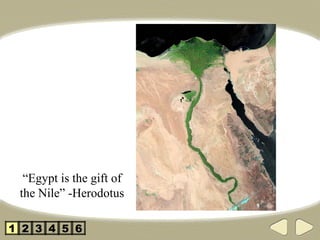
I. Geography River dominates Egyptian world/thought Surrounded by desert with occasional oasis Permits some trade  Defense from invasion Contributes to feeling of safety preserves artifacts 2 3 4 5 1 6
“ Egypt is the gift of the Nile” -Herodotus 2 3 4 5 1 6
2 3 4 5 1 6
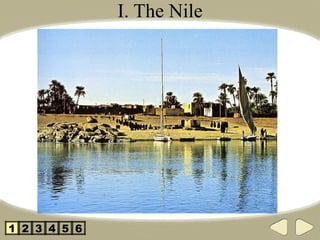
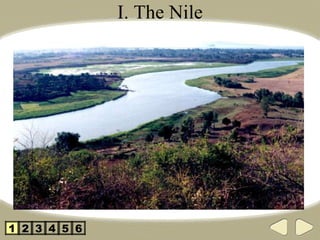
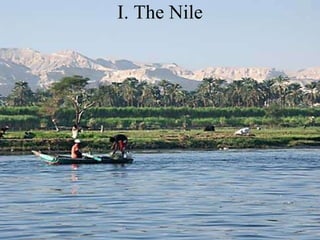
I. The Nile yearly flooding - no concern for soil depletion Predictable Irrigation systems Encourages  Trade Communication Political unity 2 3 4 5 1 6
I. The Nile 2 3 4 5 1 6
I. The Nile
I. The Nile Impact on religion divided life - living and dying. East (sunrise) is land of the living - cities, temples West (sunset) is land of the dead - tombs 2 3 4 5 1 6
Break!
II. Religion Omnipresence of religion Polytheistic interaction with the natural environment shows interrelated gods and goddesses yearly rebirth of Nile and daily rebirth of sun over 2000 gods Pharaoh as living god Afterlife Evolution of who has an afterlife Old vs. New Kingdom 2 3 4 5 1 6
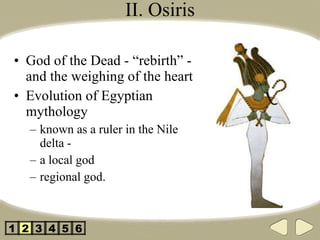
II. Osiris God of the Dead - “rebirth” - and the weighing of the heart Evolution of Egyptian mythology known as a ruler in the Nile delta -  a local god regional god. 2 3 4 5 1 6
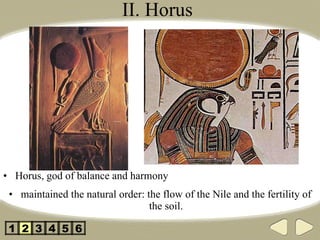
II. Horus Horus, god of balance and harmony maintained the natural order: the flow of the Nile and the fertility of the soil. 2 3 4 5 1 6
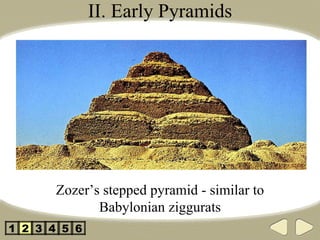
II. Early Pyramids Zozer’s stepped pyramid - similar to Babylonian ziggurats 2 3 4 5 1 6
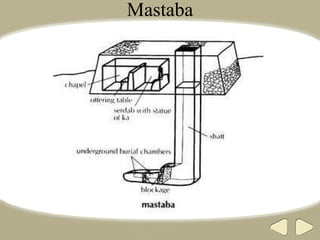
Why build Pyramids? Belief in the afterlife demanded:  Bodies be interred whole Material goods for use in afterlife be present The need to protect the bodies demands good burial tombs First were mastabas Then pyramids Then later
 hidden tombs
Mastaba
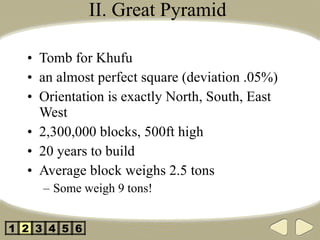
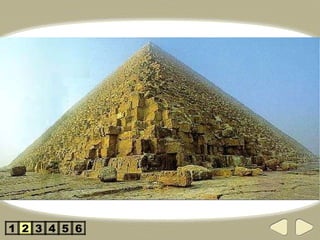
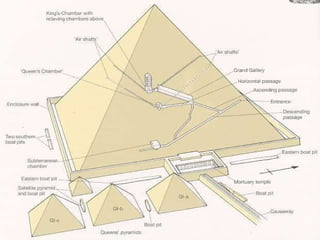
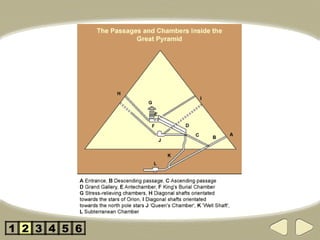
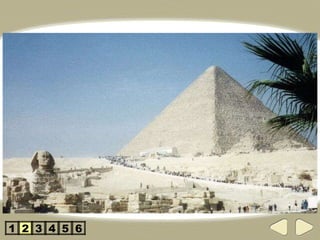
II. Great Pyramid  Tomb for Khufu an almost perfect square (deviation .05%)  Orientation is exactly North, South, East West  2,300,000 blocks, 500ft high  20 years to build Average block weighs 2.5 tons Some weigh 9 tons! 2 3 4 5 1 6
2 3 4 5 1 6
 
2 3 4 5 1 6
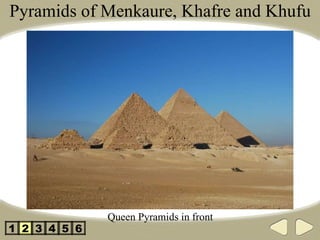
Pyramids of Menkaure, Khafre and Khufu Queen Pyramids in front 2 3 4 5 1 6
2 3 4 5 1 6
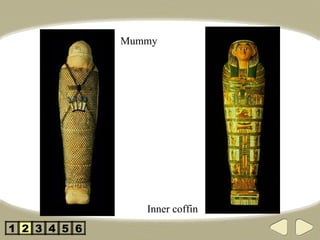
II. Mummies Not known when it started in Egypt Perfected by time of New Kingdom How to make a mummy: 70 steps 1) Removal of the brain through the nostrils 2) Removal of the intestines through an incision in the side 3) Sterilization of the body and intestines 4) Treating, cleaning, dehydrating the intestines 5) Packing the body with natron (a natural dehydrating agent) and leaving for 40 days 6) Removal of the natron agent 7) Packing the limbs with clay or sand 8) Packing the body with linen (soaked in resin), myrrh and cinnamon 9) Treating the body with ointments and finally wrapping with a fine linen gauze, not less than 1000 square yards . 2 3 4 5 1 6
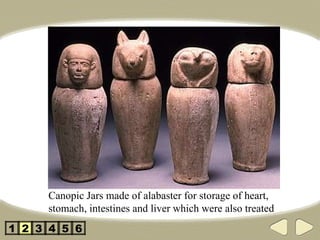
Canopic Jars made of alabaster for storage of heart, stomach, intestines and liver which were also treated 2 3 4 5 1 6
Inner coffin Mummy 2 3 4 5 1 6
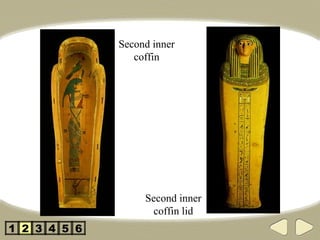
Second inner coffin lid Second inner coffin 2 3 4 5 1 6
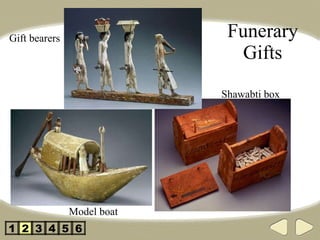
Funerary Gifts Shawabti box Gift bearers Model boat 2 3 4 5 1 6
2 3 4 5 1 6
Break!
III. The Pharaoh God-King - unlike Mesopotamia Temporal power owns all the land and people and what people posses law vs. Pharaoh's will irrigation no city walls 2 3 4 5 1 6
III. The Pharaoh God-King - unlike Mesopotamia Religious direct descendant of the Sun god controls access to the afterlife July-Sept, during floods life is controlled by the Pharaoh 365 day calendar. 2 3 4 5 1 6
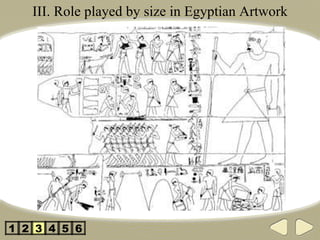
III. Role played by size in Egyptian Artwork 2 3 4 5 1 6
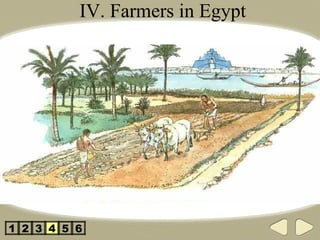
IV. Daily Life in Egypt Cosmetics, cleanliness (bathe 3 times a day), shaved bodies, wigs main food is beer and bread Grow many crops: emmer, barley, flax, lentils, onion, beans, and millet common building made of sun-dried mud bricks - up to three stories in height Four social classes - slaves on the bottom Most common job 
 farming 2 3 4 5 1 6
IV. Farmers in Egypt 2 3 4 5 1 6
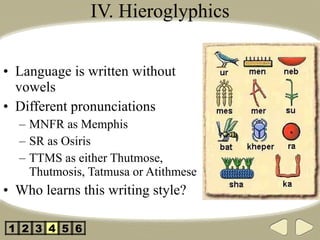
IV. Hieroglyphics Language is written without vowels Different pronunciations MNFR as Memphis SR as Osiris TTMS as either Thutmose, Thutmosis, Tatmusa or Atithmese Who learns this writing style? 2 3 4 5 1 6
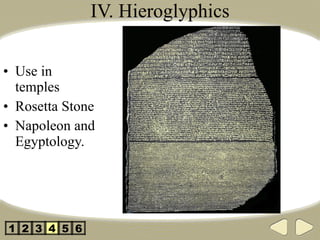
IV. Hieroglyphics Use in temples Rosetta Stone Napoleon and Egyptology. 2 3 4 5 1 6
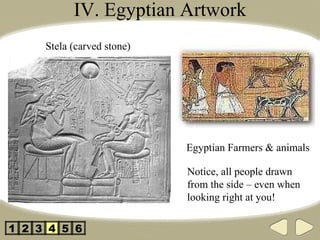
IV. Egyptian Artwork Egyptian Farmers & animals Stela (carved stone) 2 3 4 5 1 6 Notice, all people drawn from the side – even when looking right at you!
Break!
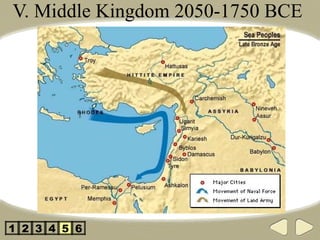
V. Middle Kingdom 2050-1750 BCE  End of civil wars, farming and trade return move capital south to Upper Egypt (Thebes) public improvements drain swamps, canal to Red Sea belief in afterlife expands to include common people tombs instead of pyramids better protection for mummies. 2 3 4 5 1 6
V. Middle Kingdom 2050-1750 BCE  2 3 4 5 1 6
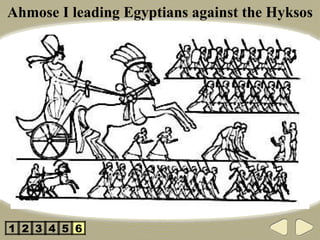
VI. New Kingdom 1550-1075 BCE Ahmose I expelled the invading Hyksos and reunited Egypt Known as the Empire period development of “public” and “private” zones at temples. 2 3 4 5 1 6
Ahmose I leading Egyptians against the Hyksos 2 3 4 5 1 6
VI. New Kingdom 1550-1075 BCE Characterized by a more militaristic and imperialistic nature incorporated chariot, bronze working, horses development of a professional army became a slave based economy fueled by war and expansion 2 3 4 5 1 6
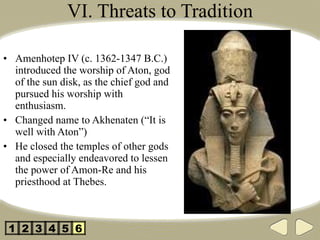
VI. Threats to Tradition Amenhotep IV (c. 1362-1347 B.C.) introduced the worship of Aton, god of the sun disk, as the chief god and pursued his worship with enthusiasm.  Changed name to Akhenaten (“It is well with Aton”)  He closed the temples of other gods and especially endeavored to lessen the power of Amon-Re and his priesthood at Thebes. 2 3 4 5 1 6
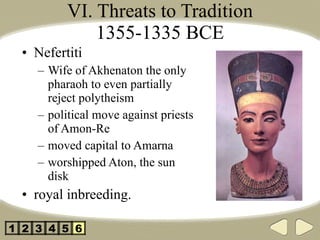
VI. Threats to Tradition 1355-1335 BCE Nefertiti Wife of Akhenaton the only pharaoh to even partially reject polytheism political move against priests of Amon-Re moved capital to Amarna worshipped Aton, the sun disk royal inbreeding. 2 3 4 5 1 6
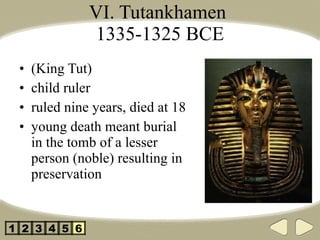
VI. Tutankhamen  1335-1325 BCE (King Tut) child ruler ruled nine years, died at 18 young death meant burial  in the tomb of a lesser person (noble) resulting in preservation 2 3 4 5 1 6
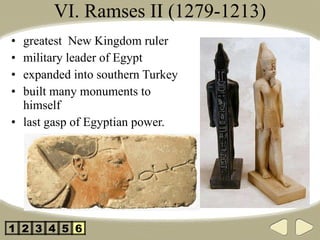
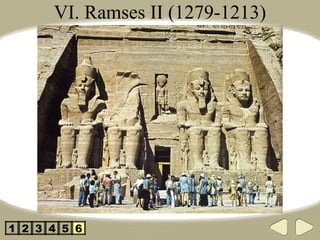
VI. Ramses II (1279-1213) greatest  New Kingdom ruler military leader of Egypt expanded into southern Turkey built many monuments to himself last gasp of Egyptian power. 2 3 4 5 1 6
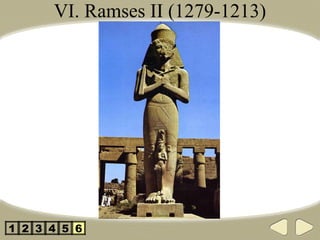
VI. Ramses II (1279-1213) 2 3 4 5 1 6
In-Class Assignemnt Please be sure to answer one of the question that follows.  Be sure to have your name, Class, and date in the top right corner of the page. This will due by the end of class and will not be accepted thereafter.  Be sure to support your reasoning as much as possible.
In- Class Assignment Explain the religious purpose or meaning of two works of Egyptian art. Evaluate the images of women in the art of the ancient world. Assess what roles and symbolic significance are attributed to women in these artistic guises, and compare briefly to other artistic or cultural images that you know.

Ancient world

  • 1.
    Chapter 2: TheAncient World Early Egyptian society HUM 250 Westwood College Prof. Tidwell
  • 2.
    Guidelines Each slidewill be up for only 3 minutes. Ask Question as you have them. Breaks will be given. In class assignment and homework assignment will come at the end of this discussion.
  • 3.
    Egyptian Timeline OldKingdom (2700-2150) Hieroglyphics and religion develop in Egypt pyramids built Middle Kingdom (2040-1786) extension of Egyptian control into Nubia New Kingdom (1570-1075) militaristic - Hebrews enslaved mummification perfected
  • 4.
    Outline Geography ReligionGods Pyramids Mummies Government The Pharaoh Daily Life Middle Kingdom New Kingdom 2 3 4 5 1 6
  • 5.
    I. Geography Riverdominates Egyptian world/thought Surrounded by desert with occasional oasis Permits some trade Defense from invasion Contributes to feeling of safety preserves artifacts 2 3 4 5 1 6
  • 6.
    “ Egypt isthe gift of the Nile” -Herodotus 2 3 4 5 1 6
  • 7.
    2 3 45 1 6
  • 8.
    I. The Nileyearly flooding - no concern for soil depletion Predictable Irrigation systems Encourages Trade Communication Political unity 2 3 4 5 1 6
  • 9.
    I. The Nile2 3 4 5 1 6
  • 10.
    I. The Nile2 3 4 5 1 6
  • 11.
  • 12.
    I. The NileImpact on religion divided life - living and dying. East (sunrise) is land of the living - cities, temples West (sunset) is land of the dead - tombs 2 3 4 5 1 6
  • 13.
  • 14.
    II. Religion Omnipresenceof religion Polytheistic interaction with the natural environment shows interrelated gods and goddesses yearly rebirth of Nile and daily rebirth of sun over 2000 gods Pharaoh as living god Afterlife Evolution of who has an afterlife Old vs. New Kingdom 2 3 4 5 1 6
  • 15.
    II. Osiris Godof the Dead - “rebirth” - and the weighing of the heart Evolution of Egyptian mythology known as a ruler in the Nile delta - a local god regional god. 2 3 4 5 1 6
  • 16.
    II. Horus Horus,god of balance and harmony maintained the natural order: the flow of the Nile and the fertility of the soil. 2 3 4 5 1 6
  • 17.
    II. Early PyramidsZozer’s stepped pyramid - similar to Babylonian ziggurats 2 3 4 5 1 6
  • 18.
    Why build Pyramids?Belief in the afterlife demanded: Bodies be interred whole Material goods for use in afterlife be present The need to protect the bodies demands good burial tombs First were mastabas Then pyramids Then later
 hidden tombs
  • 19.
  • 20.
    II. Great Pyramid Tomb for Khufu an almost perfect square (deviation .05%) Orientation is exactly North, South, East West 2,300,000 blocks, 500ft high 20 years to build Average block weighs 2.5 tons Some weigh 9 tons! 2 3 4 5 1 6
  • 21.
    2 3 45 1 6
  • 22.
  • 23.
    2 3 45 1 6
  • 24.
    Pyramids of Menkaure,Khafre and Khufu Queen Pyramids in front 2 3 4 5 1 6
  • 25.
    2 3 45 1 6
  • 26.
    II. Mummies Notknown when it started in Egypt Perfected by time of New Kingdom How to make a mummy: 70 steps 1) Removal of the brain through the nostrils 2) Removal of the intestines through an incision in the side 3) Sterilization of the body and intestines 4) Treating, cleaning, dehydrating the intestines 5) Packing the body with natron (a natural dehydrating agent) and leaving for 40 days 6) Removal of the natron agent 7) Packing the limbs with clay or sand 8) Packing the body with linen (soaked in resin), myrrh and cinnamon 9) Treating the body with ointments and finally wrapping with a fine linen gauze, not less than 1000 square yards . 2 3 4 5 1 6
  • 27.
    Canopic Jars madeof alabaster for storage of heart, stomach, intestines and liver which were also treated 2 3 4 5 1 6
  • 28.
    Inner coffin Mummy2 3 4 5 1 6
  • 29.
    Second inner coffinlid Second inner coffin 2 3 4 5 1 6
  • 30.
    Funerary Gifts Shawabtibox Gift bearers Model boat 2 3 4 5 1 6
  • 31.
    2 3 45 1 6
  • 32.
  • 33.
    III. The PharaohGod-King - unlike Mesopotamia Temporal power owns all the land and people and what people posses law vs. Pharaoh's will irrigation no city walls 2 3 4 5 1 6
  • 34.
    III. The PharaohGod-King - unlike Mesopotamia Religious direct descendant of the Sun god controls access to the afterlife July-Sept, during floods life is controlled by the Pharaoh 365 day calendar. 2 3 4 5 1 6
  • 35.
    III. Role playedby size in Egyptian Artwork 2 3 4 5 1 6
  • 36.
    IV. Daily Lifein Egypt Cosmetics, cleanliness (bathe 3 times a day), shaved bodies, wigs main food is beer and bread Grow many crops: emmer, barley, flax, lentils, onion, beans, and millet common building made of sun-dried mud bricks - up to three stories in height Four social classes - slaves on the bottom Most common job 
 farming 2 3 4 5 1 6
  • 37.
    IV. Farmers inEgypt 2 3 4 5 1 6
  • 38.
    IV. Hieroglyphics Languageis written without vowels Different pronunciations MNFR as Memphis SR as Osiris TTMS as either Thutmose, Thutmosis, Tatmusa or Atithmese Who learns this writing style? 2 3 4 5 1 6
  • 39.
    IV. Hieroglyphics Usein temples Rosetta Stone Napoleon and Egyptology. 2 3 4 5 1 6
  • 40.
    IV. Egyptian ArtworkEgyptian Farmers & animals Stela (carved stone) 2 3 4 5 1 6 Notice, all people drawn from the side – even when looking right at you!
  • 41.
  • 42.
    V. Middle Kingdom2050-1750 BCE End of civil wars, farming and trade return move capital south to Upper Egypt (Thebes) public improvements drain swamps, canal to Red Sea belief in afterlife expands to include common people tombs instead of pyramids better protection for mummies. 2 3 4 5 1 6
  • 43.
    V. Middle Kingdom2050-1750 BCE 2 3 4 5 1 6
  • 44.
    VI. New Kingdom1550-1075 BCE Ahmose I expelled the invading Hyksos and reunited Egypt Known as the Empire period development of “public” and “private” zones at temples. 2 3 4 5 1 6
  • 45.
    Ahmose I leadingEgyptians against the Hyksos 2 3 4 5 1 6
  • 46.
    VI. New Kingdom1550-1075 BCE Characterized by a more militaristic and imperialistic nature incorporated chariot, bronze working, horses development of a professional army became a slave based economy fueled by war and expansion 2 3 4 5 1 6
  • 47.
    VI. Threats toTradition Amenhotep IV (c. 1362-1347 B.C.) introduced the worship of Aton, god of the sun disk, as the chief god and pursued his worship with enthusiasm. Changed name to Akhenaten (“It is well with Aton”) He closed the temples of other gods and especially endeavored to lessen the power of Amon-Re and his priesthood at Thebes. 2 3 4 5 1 6
  • 48.
    VI. Threats toTradition 1355-1335 BCE Nefertiti Wife of Akhenaton the only pharaoh to even partially reject polytheism political move against priests of Amon-Re moved capital to Amarna worshipped Aton, the sun disk royal inbreeding. 2 3 4 5 1 6
  • 49.
    VI. Tutankhamen 1335-1325 BCE (King Tut) child ruler ruled nine years, died at 18 young death meant burial in the tomb of a lesser person (noble) resulting in preservation 2 3 4 5 1 6
  • 50.
    VI. Ramses II(1279-1213) greatest New Kingdom ruler military leader of Egypt expanded into southern Turkey built many monuments to himself last gasp of Egyptian power. 2 3 4 5 1 6
  • 51.
    VI. Ramses II(1279-1213) 2 3 4 5 1 6
  • 52.
    VI. Ramses II(1279-1213) 2 3 4 5 1 6
  • 53.
    In-Class Assignemnt Pleasebe sure to answer one of the question that follows. Be sure to have your name, Class, and date in the top right corner of the page. This will due by the end of class and will not be accepted thereafter. Be sure to support your reasoning as much as possible.
  • 54.
    In- Class AssignmentExplain the religious purpose or meaning of two works of Egyptian art. Evaluate the images of women in the art of the ancient world. Assess what roles and symbolic significance are attributed to women in these artistic guises, and compare briefly to other artistic or cultural images that you know.