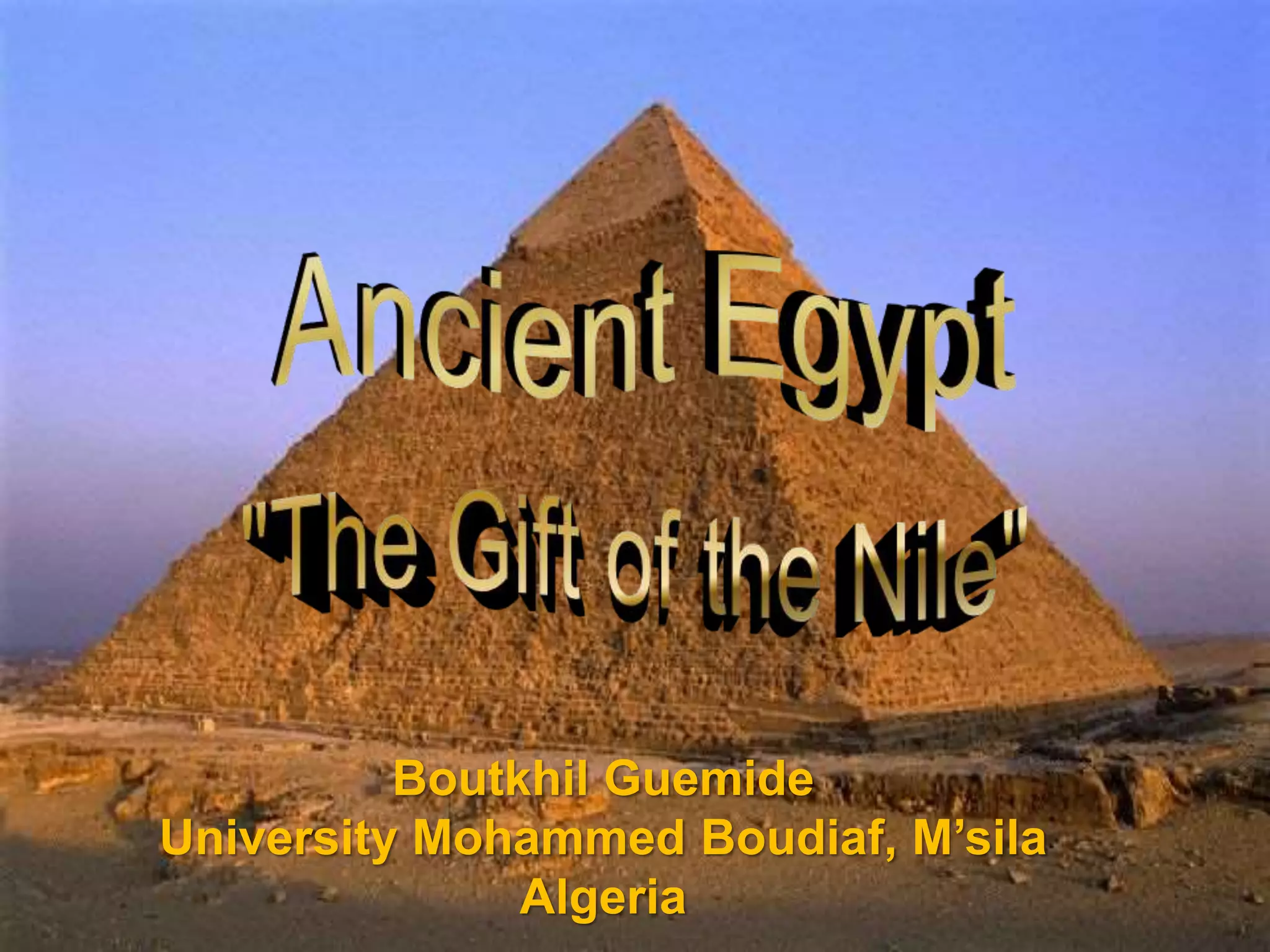
Boutkhil Guemide
University Mohammed Boudiaf, M’sila
Algeria
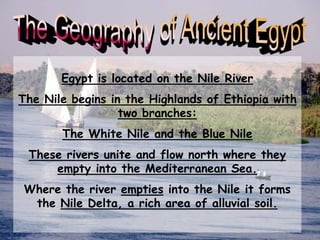
Egypt is located on the Nile River
The Nile begins in the Highlands of Ethiopia with
two branches:
The White Nile and the Blue Nile
These rivers unite and flow north where they
empty into the Mediterranean Sea.
Where the river empties into the Nile it forms
the Nile Delta, a rich area of alluvial soil.
The most important thing to the
Egyptians about The Nile was the
yearly flooding.
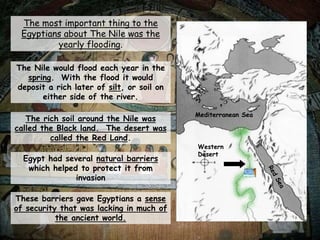
The Nile would flood each year in the
spring. With the flood it would
deposit a rich later of silt, or soil on
either side of the river.
The rich soil around the Nile was
called the Black land. The desert was
called the Red Land.
Egypt had several natural barriers
which helped to protect it from
invasion
These barriers gave Egyptians a sense
of security that was lacking in much of
the ancient world.
Mediterranean Sea
Western
Desert
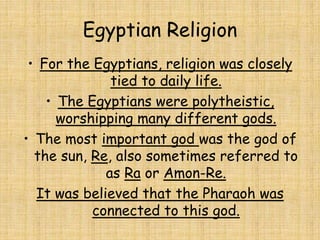
Egyptian Religion
• For the Egyptians, religion was closely
tied to daily life.
• The Egyptians were polytheistic,
worshipping many different gods.
• The most important god was the god of
the sun, Re, also sometimes referred to
as Ra or Amon-Re.
It was believed that the Pharaoh was
connected to this god.
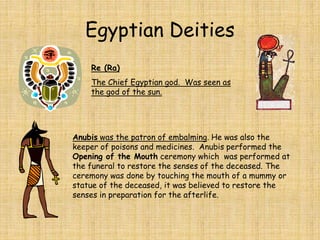
Egyptian Deities
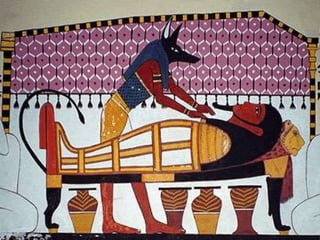
Anubis was the patron of embalming. He was also the
keeper of poisons and medicines. Anubis performed the
Opening of the Mouth ceremony which was performed at
the funeral to restore the senses of the deceased. The
ceremony was done by touching the mouth of a mummy or
statue of the deceased, it was believed to restore the
senses in preparation for the afterlife.
Re (Ra)
The Chief Egyptian god. Was seen as
the god of the sun.
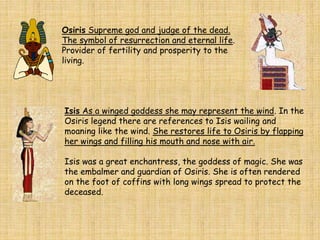
Osiris Supreme god and judge of the dead.
The symbol of resurrection and eternal life.
Provider of fertility and prosperity to the
living.
Isis As a winged goddess she may represent the wind. In the
Osiris legend there are references to Isis wailing and
moaning like the wind. She restores life to Osiris by flapping
her wings and filling his mouth and nose with air.
Isis was a great enchantress, the goddess of magic. She was
the embalmer and guardian of Osiris. She is often rendered
on the foot of coffins with long wings spread to protect the
deceased.
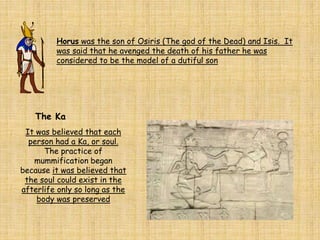
Horus was the son of Osiris (The god of the Dead) and Isis. It
was said that he avenged the death of his father he was
considered to be the model of a dutiful son
The Ka
It was believed that each
person had a Ka, or soul.
The practice of
mummification began
because it was believed that
the soul could exist in the
afterlife only so long as the
body was preserved
Egyptian History is
divided into three main
periods
•The Old Kingdom
•The Middle Kingdom
•The New Kingdom
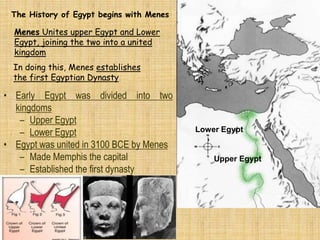
Upper Egypt
Lower Egypt
The History of Egypt begins with Menes
Menes Unites upper Egypt and Lower
Egypt, joining the two into a united
kingdom
In doing this, Menes establishes
the first Egyptian Dynasty
• Early Egypt was divided into two
kingdoms
– Upper Egypt
– Lower Egypt
• Egypt was united in 3100 BCE by Menes
– Made Memphis the capital
– Established the first dynasty
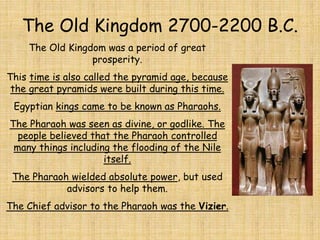
The Old Kingdom 2700-2200 B.C.
The Old Kingdom was a period of great
prosperity.
This time is also called the pyramid age, because
the great pyramids were built during this time.
Egyptian kings came to be known as Pharaohs.
The Pharaoh was seen as divine, or godlike. The
people believed that the Pharaoh controlled
many things including the flooding of the Nile
itself.
The Pharaoh wielded absolute power, but used
advisors to help them.
The Chief advisor to the Pharaoh was the Vizier.
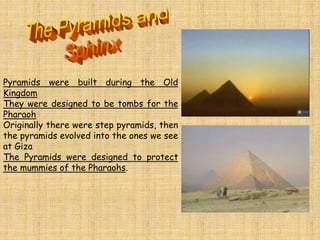
Pyramids were built during the Old
Kingdom
They were designed to be tombs for the
Pharaoh
Originally there were step pyramids, then
the pyramids evolved into the ones we see
at Giza
The Pyramids were designed to protect
the mummies of the Pharaohs.
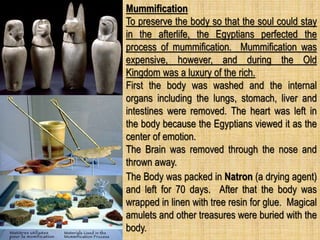
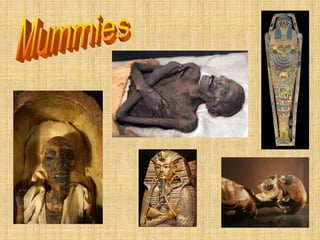
Mummification
To preserve the body so that the soul could stay
in the afterlife, the Egyptians perfected the
process of mummification. Mummification was
expensive, however, and during the Old
Kingdom was a luxury of the rich.
First the body was washed and the internal
organs including the lungs, stomach, liver and
intestines were removed. The heart was left in
the body because the Egyptians viewed it as the
center of emotion.
The Brain was removed through the nose and
thrown away.
The Body was packed in Natron (a drying agent)
and left for 70 days. After that the body was
wrapped in linen with tree resin for glue. Magical
amulets and other treasures were buried with the
body.
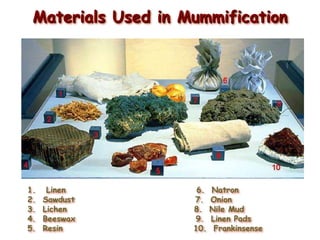
Materials Used in Mummification
1. Linen 6. Natron
2. Sawdust 7. Onion
3. Lichen 8. Nile Mud
4. Beeswax 9. Linen Pads
5. Resin 10. Frankinsense
After the fall of the Old Kingdom there was a period of
chaos for about 150 years
A new dynasty took over in Egypt, bringing a period of
stability.
Egypt expanded into Nubia to its south.
The government also sent troops into Palestine and Syria
and sent traders to Kush, Syria, Mesopotamia, and Crete
In the new kingdom the Pharaoh took new interest in the
common people. The Pharaoh also implemented many
public works projects.
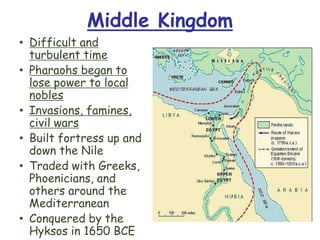
Middle Kingdom
• Difficult and
turbulent time
• Pharaohs began to
lose power to local
nobles
• Invasions, famines,
civil wars
• Built fortress up and
down the Nile
• Traded with Greeks,
Phoenicians, and
others around the
Mediterranean
• Conquered by the
Hyksos in 1650 BCE
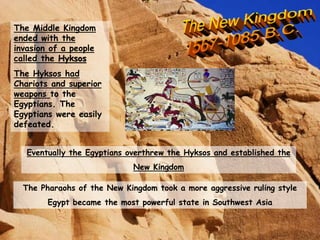
The Middle Kingdom
ended with the
invasion of a people
called the Hyksos
The Hyksos had
Chariots and superior
weapons to the
Egyptians. The
Egyptians were easily
defeated.
Eventually the Egyptians overthrew the Hyksos and established the
New Kingdom
The Pharaohs of the New Kingdom took a more aggressive ruling style
Egypt became the most powerful state in Southwest Asia
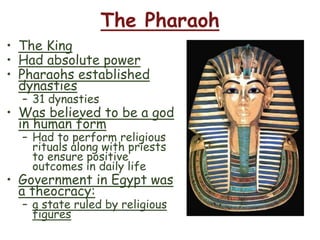
The Pharaoh
• The King
• Had absolute power
• Pharaohs established
dynasties
– 31 dynasties
• Was believed to be a god
in human form
– Had to perform religious
rituals along with priests
to ensure positive
outcomes in daily life
• Government in Egypt was
a theocracy:
– a state ruled by religious
figures
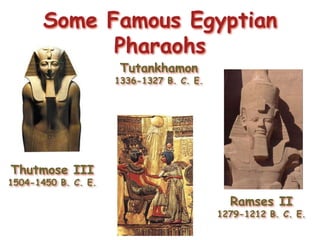
Some Famous Egyptian
Pharaohs
Thutmose III
1504-1450 B. C. E.
Ramses II
1279-1212 B. C. E.
Tutankhamon
1336-1327 B. C. E.
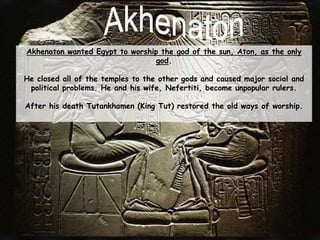
Akhenaton wanted Egypt to worship the god of the sun, Aton, as the only
god.
He closed all of the temples to the other gods and caused major social and
political problems. He and his wife, Nefertiti, become unpopular rulers.
After his death Tutankhamen (King Tut) restored the old ways of worship.
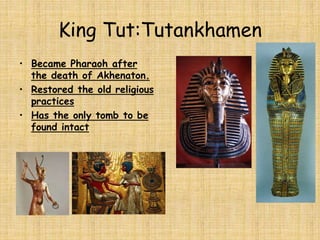
King Tut:Tutankhamen
• Became Pharaoh after
the death of Akhenaton.
• Restored the old religious
practices
• Has the only tomb to be
found intact
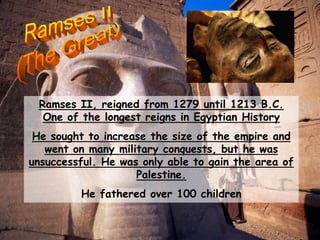
Ramses II, reigned from 1279 until 1213 B.C.
One of the longest reigns in Egyptian History
He sought to increase the size of the empire and
went on many military conquests, but he was
unsuccessful. He was only able to gain the area of
Palestine.
He fathered over 100 children
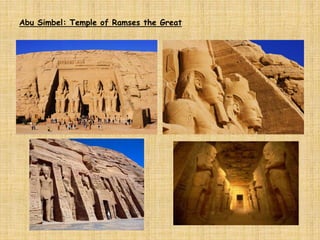
Abu Simbel: Temple of Ramses the Great
Decline
• Egypt fell into a period of
decline and foreign invasion.
• Egypt was ruled by many
different people and eventually
defeated by the Romans.
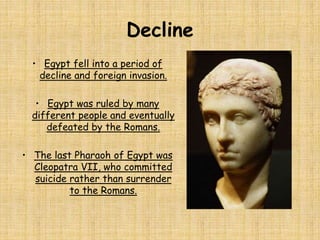
• The last Pharaoh of Egypt was
Cleopatra VII, who committed
suicide rather than surrender
to the Romans.
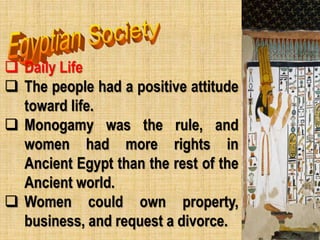
 Daily Life
 The people had a positive attitude
toward life.
 Monogamy was the rule, and
women had more rights in
Ancient Egypt than the rest of the
Ancient world.
 Women could own property,
business, and request a divorce.
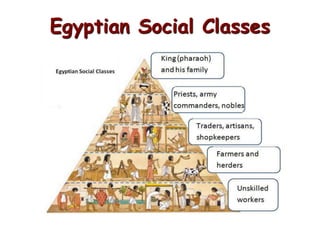
Egyptian Social Classes
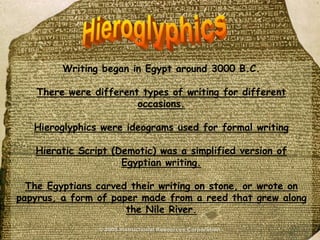
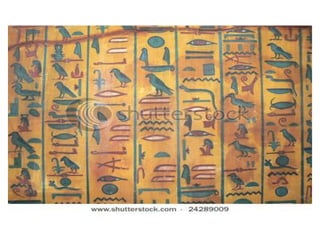
Writing began in Egypt around 3000 B.C.
There were different types of writing for different
occasions.
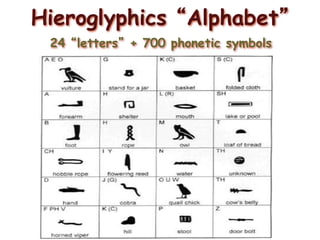
Hieroglyphics were ideograms used for formal writing
Hieratic Script (Demotic) was a simplified version of
Egyptian writing.
The Egyptians carved their writing on stone, or wrote on
papyrus, a form of paper made from a reed that grew along
the Nile River.
Hieroglyphics “Alphabet”
24 “letters” + 700 phonetic symbols
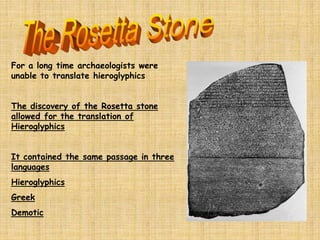
For a long time archaeologists were
unable to translate hieroglyphics
The discovery of the Rosetta stone
allowed for the translation of
Hieroglyphics
It contained the same passage in three
languages
Hieroglyphics
Greek
Demotic
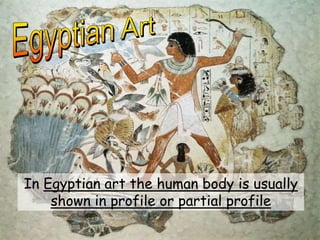
In Egyptian art the human body is usually
shown in profile or partial profile
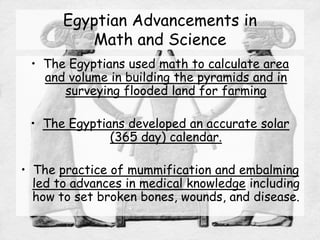
Egyptian Advancements in
Math and Science
• The Egyptians used math to calculate area
and volume in building the pyramids and in
surveying flooded land for farming
• The Egyptians developed an accurate solar
(365 day) calendar.
• The practice of mummification and embalming
led to advances in medical knowledge including
how to set broken bones, wounds, and disease.
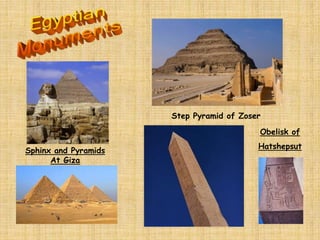
Sphinx and Pyramids
At Giza
Step Pyramid of Zoser
Obelisk of
Hatshepsut

Egypt: The Nile Civilization

  • 1.
    Boutkhil Guemide University MohammedBoudiaf, M’sila Algeria
  • 2.
    Egypt is locatedon the Nile River The Nile begins in the Highlands of Ethiopia with two branches: The White Nile and the Blue Nile These rivers unite and flow north where they empty into the Mediterranean Sea. Where the river empties into the Nile it forms the Nile Delta, a rich area of alluvial soil.
  • 3.
    The most importantthing to the Egyptians about The Nile was the yearly flooding. The Nile would flood each year in the spring. With the flood it would deposit a rich later of silt, or soil on either side of the river. The rich soil around the Nile was called the Black land. The desert was called the Red Land. Egypt had several natural barriers which helped to protect it from invasion These barriers gave Egyptians a sense of security that was lacking in much of the ancient world. Mediterranean Sea Western Desert
  • 4.
    Egyptian Religion • Forthe Egyptians, religion was closely tied to daily life. • The Egyptians were polytheistic, worshipping many different gods. • The most important god was the god of the sun, Re, also sometimes referred to as Ra or Amon-Re. It was believed that the Pharaoh was connected to this god.
  • 5.
    Egyptian Deities Anubis wasthe patron of embalming. He was also the keeper of poisons and medicines. Anubis performed the Opening of the Mouth ceremony which was performed at the funeral to restore the senses of the deceased. The ceremony was done by touching the mouth of a mummy or statue of the deceased, it was believed to restore the senses in preparation for the afterlife. Re (Ra) The Chief Egyptian god. Was seen as the god of the sun.
  • 6.
    Osiris Supreme godand judge of the dead. The symbol of resurrection and eternal life. Provider of fertility and prosperity to the living. Isis As a winged goddess she may represent the wind. In the Osiris legend there are references to Isis wailing and moaning like the wind. She restores life to Osiris by flapping her wings and filling his mouth and nose with air. Isis was a great enchantress, the goddess of magic. She was the embalmer and guardian of Osiris. She is often rendered on the foot of coffins with long wings spread to protect the deceased.
  • 7.
    Horus was theson of Osiris (The god of the Dead) and Isis. It was said that he avenged the death of his father he was considered to be the model of a dutiful son The Ka It was believed that each person had a Ka, or soul. The practice of mummification began because it was believed that the soul could exist in the afterlife only so long as the body was preserved
  • 8.
    Egyptian History is dividedinto three main periods •The Old Kingdom •The Middle Kingdom •The New Kingdom
  • 9.
    Upper Egypt Lower Egypt TheHistory of Egypt begins with Menes Menes Unites upper Egypt and Lower Egypt, joining the two into a united kingdom In doing this, Menes establishes the first Egyptian Dynasty • Early Egypt was divided into two kingdoms – Upper Egypt – Lower Egypt • Egypt was united in 3100 BCE by Menes – Made Memphis the capital – Established the first dynasty
  • 10.
    The Old Kingdom2700-2200 B.C. The Old Kingdom was a period of great prosperity. This time is also called the pyramid age, because the great pyramids were built during this time. Egyptian kings came to be known as Pharaohs. The Pharaoh was seen as divine, or godlike. The people believed that the Pharaoh controlled many things including the flooding of the Nile itself. The Pharaoh wielded absolute power, but used advisors to help them. The Chief advisor to the Pharaoh was the Vizier.
  • 11.
    Pyramids were builtduring the Old Kingdom They were designed to be tombs for the Pharaoh Originally there were step pyramids, then the pyramids evolved into the ones we see at Giza The Pyramids were designed to protect the mummies of the Pharaohs.
  • 12.
    Mummification To preserve thebody so that the soul could stay in the afterlife, the Egyptians perfected the process of mummification. Mummification was expensive, however, and during the Old Kingdom was a luxury of the rich. First the body was washed and the internal organs including the lungs, stomach, liver and intestines were removed. The heart was left in the body because the Egyptians viewed it as the center of emotion. The Brain was removed through the nose and thrown away. The Body was packed in Natron (a drying agent) and left for 70 days. After that the body was wrapped in linen with tree resin for glue. Magical amulets and other treasures were buried with the body.
  • 13.
    Materials Used inMummification 1. Linen 6. Natron 2. Sawdust 7. Onion 3. Lichen 8. Nile Mud 4. Beeswax 9. Linen Pads 5. Resin 10. Frankinsense
  • 16.
    After the fallof the Old Kingdom there was a period of chaos for about 150 years A new dynasty took over in Egypt, bringing a period of stability. Egypt expanded into Nubia to its south. The government also sent troops into Palestine and Syria and sent traders to Kush, Syria, Mesopotamia, and Crete In the new kingdom the Pharaoh took new interest in the common people. The Pharaoh also implemented many public works projects.
  • 17.
    Middle Kingdom • Difficultand turbulent time • Pharaohs began to lose power to local nobles • Invasions, famines, civil wars • Built fortress up and down the Nile • Traded with Greeks, Phoenicians, and others around the Mediterranean • Conquered by the Hyksos in 1650 BCE
  • 18.
    The Middle Kingdom endedwith the invasion of a people called the Hyksos The Hyksos had Chariots and superior weapons to the Egyptians. The Egyptians were easily defeated. Eventually the Egyptians overthrew the Hyksos and established the New Kingdom The Pharaohs of the New Kingdom took a more aggressive ruling style Egypt became the most powerful state in Southwest Asia
  • 19.
    The Pharaoh • TheKing • Had absolute power • Pharaohs established dynasties – 31 dynasties • Was believed to be a god in human form – Had to perform religious rituals along with priests to ensure positive outcomes in daily life • Government in Egypt was a theocracy: – a state ruled by religious figures
  • 20.
    Some Famous Egyptian Pharaohs ThutmoseIII 1504-1450 B. C. E. Ramses II 1279-1212 B. C. E. Tutankhamon 1336-1327 B. C. E.
  • 21.
    Akhenaton wanted Egyptto worship the god of the sun, Aton, as the only god. He closed all of the temples to the other gods and caused major social and political problems. He and his wife, Nefertiti, become unpopular rulers. After his death Tutankhamen (King Tut) restored the old ways of worship.
  • 22.
    King Tut:Tutankhamen • BecamePharaoh after the death of Akhenaton. • Restored the old religious practices • Has the only tomb to be found intact
  • 23.
    Ramses II, reignedfrom 1279 until 1213 B.C. One of the longest reigns in Egyptian History He sought to increase the size of the empire and went on many military conquests, but he was unsuccessful. He was only able to gain the area of Palestine. He fathered over 100 children
  • 24.
    Abu Simbel: Templeof Ramses the Great
  • 25.
    Decline • Egypt fellinto a period of decline and foreign invasion. • Egypt was ruled by many different people and eventually defeated by the Romans. • The last Pharaoh of Egypt was Cleopatra VII, who committed suicide rather than surrender to the Romans.
  • 26.
     Daily Life The people had a positive attitude toward life.  Monogamy was the rule, and women had more rights in Ancient Egypt than the rest of the Ancient world.  Women could own property, business, and request a divorce.
  • 27.
  • 28.
    Writing began inEgypt around 3000 B.C. There were different types of writing for different occasions. Hieroglyphics were ideograms used for formal writing Hieratic Script (Demotic) was a simplified version of Egyptian writing. The Egyptians carved their writing on stone, or wrote on papyrus, a form of paper made from a reed that grew along the Nile River.
  • 30.
  • 31.
    For a longtime archaeologists were unable to translate hieroglyphics The discovery of the Rosetta stone allowed for the translation of Hieroglyphics It contained the same passage in three languages Hieroglyphics Greek Demotic
  • 32.
    In Egyptian artthe human body is usually shown in profile or partial profile
  • 33.
    Egyptian Advancements in Mathand Science • The Egyptians used math to calculate area and volume in building the pyramids and in surveying flooded land for farming • The Egyptians developed an accurate solar (365 day) calendar. • The practice of mummification and embalming led to advances in medical knowledge including how to set broken bones, wounds, and disease.
  • 34.
    Sphinx and Pyramids AtGiza Step Pyramid of Zoser Obelisk of Hatshepsut