Ancient Civilization
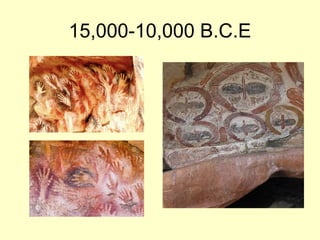
Neolithic Cave Paintings
• Visual art appears to have begun
  approximately 15,000-13,000 B.C.E.
• The oldest cave paintings have been
  discovered in France, Spain, Africa,
  Patagonia, Sicily, and others globally.
• Depict agricultural, fertility symbols, and
  some incorporate natural rock texture,
  shape, and coloring, even movement.
15,000-10,000 B.C.E
Death and Fertility
Sumer
  • Mesopotamia c.3200
    B.C.E
  • Religion dominated
    the culture; priests
    were the law,
    government officials,
    officiating at the
    temple
  • The temple was the
    cultural and spiritual
    “heart” of the city
The Gods and Religion
• The gods were
  responsible for the events
  in mortal life.
• The gods
  (Shamash/Marduk here)
  created the heavens and
  earth, gave men law
  (“eye for an eye”—lex
  talionis), agriculture, and
  humans, in turn, serve
  the gods, offering
  sacrifices of animals and
  food, prayer, and
  religious taxes.
Cuneiform and Gilgamesh


• Gilgamesh ruled c.2700 B.C.E. at Uruk
• Began in the Sumerian oral tradition, revised
  and refined by the Babylonians
• Contains many later repeated themes and motifs
  and serves a didactic function for Mesopotamia
Ancient Egypt
•   Like Mesopotamia, geography was pivotal in the development of
    Egyptian culture.
•   Upper Egypt follows the Nile almost 1,250 miles creating a narrow
    strip of fertile soil
•   In 280 B.C.E. Manetho wrote The History of Egypt categorizing the
    history into four dynastic periods and a Predynastic period:

    –   Old Kingdom: c. 2700 B.C.E
    –   Middle Kingdom: c. 1990 B.C.E.
    –   New Kingdom: c. 1570 B.C.E.
    –   Late Period: c. 1185 B.C.E.
Ancient Egypt
•   Also like the Babylonians,
    religion dominated Egyptian
    culture.
•   Astronomy, architecture,
    mathematics, literature, art and
    medicine were all directly
    involved with religious
    practices.
•   Initially, only the Pharaoh and
    royal family were immortal.
    Later, immortality after death
    would be ‘granted’ to nobles
    and commoners, for a price.
Ancient Egypt
       •   Egyptian society valued
           tradition above “progress” or
           reform; however, women were
           given relatively equal rights as
           men.
       •   Egyptian statuary and
           depictions are inflexible and
           formal, symbolic of the divine
           power and majesty contained
           in the pharaoh.
       •   Pharaoh was considered a
           “living god”, the incarnation of
           Horus, the son of Osiris and
           Isis and the god of the morning
           sun
Akhenaton, Nefertiti, and the
            Amarna Revolution
•   Amenhotep IV, ruled 1379 to
    1362 B.C.E., reformed
    Egyptian society and religion.
•   Adopting a religion of a single
    god, Aton-Ra, the sun god of
    creation, he changed his name
    to Akhenaton (“servant of
    Aton”).
•   He moved the capital from
    Thebes to Tel el-Amarna to
    escape the influence of the
    priesthood.
•   Nefertiti may have ruled at
    Akhenaton’s side as a co-ruler
    queen.
•   The Amarna period shifted the
    focus of Egyptian religion from
    the polytheistic pantheon to a
    single god who rules the
    universe, literally personified
    by the sun.
•   Art, literature, and society were
    less rigid, even domestic;
    reflecting Akhenaton’s
    emphasis on harmony, peace,
    and familial and spiritual love.
•   However, priests who had a
    vested interest in the old
    traditions branded Akhenaton
    a heretic and destroyed the
    new capital at Amarna, killing
    both pharaoh and queen and
    destroying all images of him
    they could find.
•   Tutankhamen (Tutankhaton)
    inherited his rule young and
    ruled 1347-1338 B.C.E., dying
    at age eighteen from a rear
    headblow. (confirmed by x-ray)
Persia
•   After 1500 B.C.E. the Near East began a period of empire building.
    In late 6th century B.C.E. Persia conquered the land from the Nile
    River to Indus River (Egypt to India)
•   Unified their extensive territories under a single “empire” broken into
    twenty provinces ruled by a divinely appointed king.
•   Also in the seventh or six century B.C.E. (or even earlier)
    Zarathustra (Zoroaster in Greek) began Zoroastrianism—another
    monotheistic faith.
•   This faith worships Ahura Mazda, god of light, justice, wisdom,
    goodness, and immortality. Zarathustra rejected magic, polytheism,
    and blood sacrifices; rather, salvation required the faithful to choose
    good over evil, personified by Angra Mainyu (or Ahriman), the
    destructive spirit of darkness and the evil and ignorant counterpart
    to Ahura Mazda.
•   In Zoroastrianism, to serve Mazda, one had to speak truth and be
    good to others; the reward was eternal paradise in a realm of light
    and goodness. Zarathustra also developed an eschatology when
    Ahura Mazda’s purpose for creation would be fulfilled, evil will be
    defeated, and good will triumph.
• Cyrus the Great allowed
  the Hebrews under the
  Diaspora to return to
  rebuild their temple to
  YHWH.
• They incorporated the
  architecture and artistry
  of all the Near-East in the
  Empire, the styles’
  different elements
  merged.
• Although Persia would
  later aggressively
  confront the Greek
  civilization, Greek
  thinkers spoke of
  Zoroastrians’ piety,
  discipline, and ethical
  concerns.

Ancient civilization

  • 1.
  • 2.
    Neolithic Cave Paintings •Visual art appears to have begun approximately 15,000-13,000 B.C.E. • The oldest cave paintings have been discovered in France, Spain, Africa, Patagonia, Sicily, and others globally. • Depict agricultural, fertility symbols, and some incorporate natural rock texture, shape, and coloring, even movement.
  • 3.
  • 5.
  • 6.
    Sumer •Mesopotamia c.3200 B.C.E • Religion dominated the culture; priests were the law, government officials, officiating at the temple • The temple was the cultural and spiritual “heart” of the city
  • 7.
    The Gods andReligion • The gods were responsible for the events in mortal life. • The gods (Shamash/Marduk here) created the heavens and earth, gave men law (“eye for an eye”—lex talionis), agriculture, and humans, in turn, serve the gods, offering sacrifices of animals and food, prayer, and religious taxes.
  • 8.
    Cuneiform and Gilgamesh •Gilgamesh ruled c.2700 B.C.E. at Uruk • Began in the Sumerian oral tradition, revised and refined by the Babylonians • Contains many later repeated themes and motifs and serves a didactic function for Mesopotamia
  • 9.
    Ancient Egypt • Like Mesopotamia, geography was pivotal in the development of Egyptian culture. • Upper Egypt follows the Nile almost 1,250 miles creating a narrow strip of fertile soil • In 280 B.C.E. Manetho wrote The History of Egypt categorizing the history into four dynastic periods and a Predynastic period: – Old Kingdom: c. 2700 B.C.E – Middle Kingdom: c. 1990 B.C.E. – New Kingdom: c. 1570 B.C.E. – Late Period: c. 1185 B.C.E.
  • 10.
    Ancient Egypt • Also like the Babylonians, religion dominated Egyptian culture. • Astronomy, architecture, mathematics, literature, art and medicine were all directly involved with religious practices. • Initially, only the Pharaoh and royal family were immortal. Later, immortality after death would be ‘granted’ to nobles and commoners, for a price.
  • 11.
    Ancient Egypt • Egyptian society valued tradition above “progress” or reform; however, women were given relatively equal rights as men. • Egyptian statuary and depictions are inflexible and formal, symbolic of the divine power and majesty contained in the pharaoh. • Pharaoh was considered a “living god”, the incarnation of Horus, the son of Osiris and Isis and the god of the morning sun
  • 12.
    Akhenaton, Nefertiti, andthe Amarna Revolution • Amenhotep IV, ruled 1379 to 1362 B.C.E., reformed Egyptian society and religion. • Adopting a religion of a single god, Aton-Ra, the sun god of creation, he changed his name to Akhenaton (“servant of Aton”). • He moved the capital from Thebes to Tel el-Amarna to escape the influence of the priesthood. • Nefertiti may have ruled at Akhenaton’s side as a co-ruler queen.
  • 13.
    The Amarna period shifted the focus of Egyptian religion from the polytheistic pantheon to a single god who rules the universe, literally personified by the sun. • Art, literature, and society were less rigid, even domestic; reflecting Akhenaton’s emphasis on harmony, peace, and familial and spiritual love. • However, priests who had a vested interest in the old traditions branded Akhenaton a heretic and destroyed the new capital at Amarna, killing both pharaoh and queen and destroying all images of him they could find. • Tutankhamen (Tutankhaton) inherited his rule young and ruled 1347-1338 B.C.E., dying at age eighteen from a rear headblow. (confirmed by x-ray)
  • 14.
    Persia • After 1500 B.C.E. the Near East began a period of empire building. In late 6th century B.C.E. Persia conquered the land from the Nile River to Indus River (Egypt to India) • Unified their extensive territories under a single “empire” broken into twenty provinces ruled by a divinely appointed king. • Also in the seventh or six century B.C.E. (or even earlier) Zarathustra (Zoroaster in Greek) began Zoroastrianism—another monotheistic faith. • This faith worships Ahura Mazda, god of light, justice, wisdom, goodness, and immortality. Zarathustra rejected magic, polytheism, and blood sacrifices; rather, salvation required the faithful to choose good over evil, personified by Angra Mainyu (or Ahriman), the destructive spirit of darkness and the evil and ignorant counterpart to Ahura Mazda. • In Zoroastrianism, to serve Mazda, one had to speak truth and be good to others; the reward was eternal paradise in a realm of light and goodness. Zarathustra also developed an eschatology when Ahura Mazda’s purpose for creation would be fulfilled, evil will be defeated, and good will triumph.
  • 15.
    • Cyrus theGreat allowed the Hebrews under the Diaspora to return to rebuild their temple to YHWH. • They incorporated the architecture and artistry of all the Near-East in the Empire, the styles’ different elements merged. • Although Persia would later aggressively confront the Greek civilization, Greek thinkers spoke of Zoroastrians’ piety, discipline, and ethical concerns.