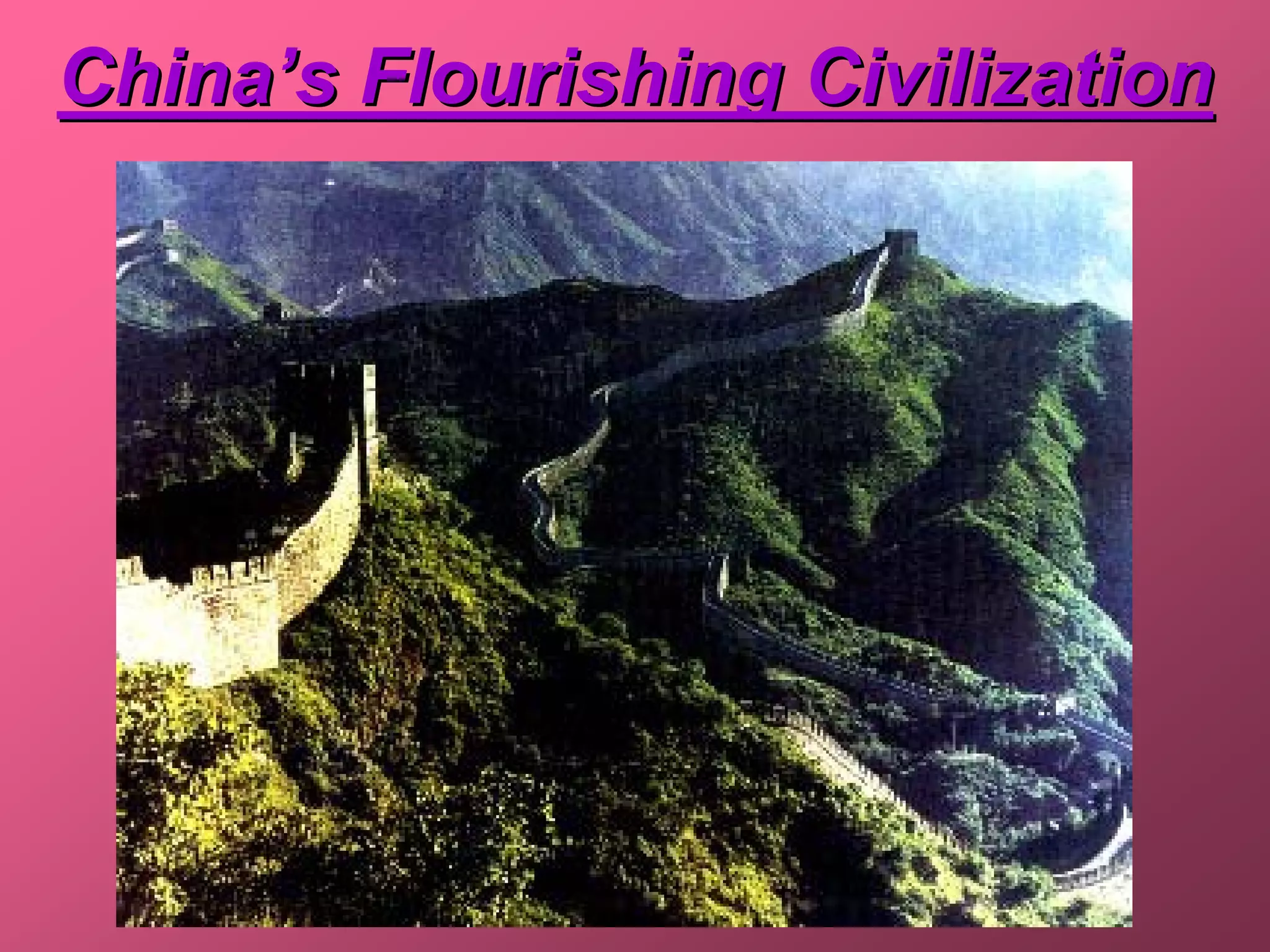
China’s Flourishing Civilization
China’s Geography
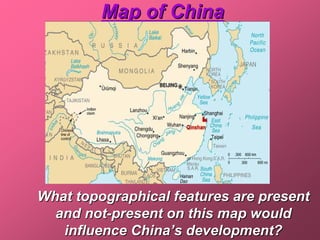
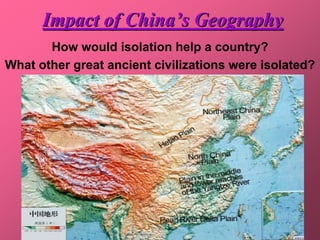
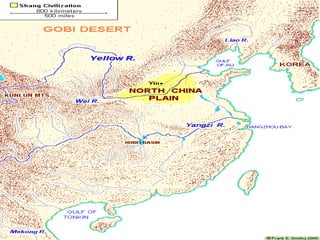
Map of China


What topographical features are present
  and not-present on this map would
   influence China’s development?
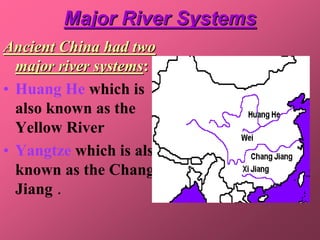
Major River Systems
Ancient China had two
  major river systems:
• Huang He which is
  also known as the
  Yellow River
• Yangtze which is also
  known as the Chang
  Jiang .
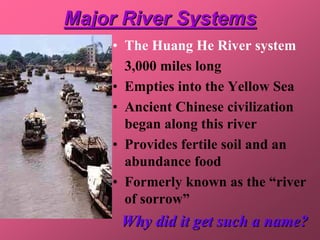
Major River Systems
    • The Huang He River system
      3,000 miles long
    • Empties into the Yellow Sea
    • Ancient Chinese civilization
      began along this river
    • Provides fertile soil and an
      abundance food
    • Formerly known as the “river
      of sorrow”
     Why did it get such a name?
Major River Systems
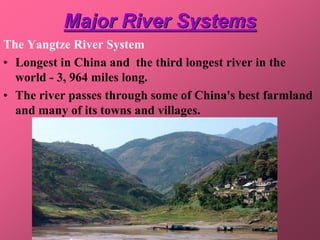
The Yangtze River System
• Longest in China and the third longest river in the
  world - 3, 964 miles long.
• The river passes through some of China's best farmland
  and many of its towns and villages.
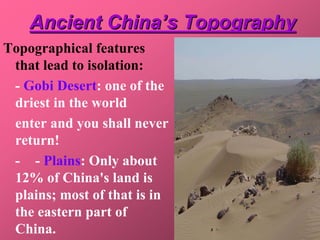
Ancient China’s Topography
Topographical features
 that lead to isolation:
 - Gobi Desert: one of the
 driest in the world
 enter and you shall never
 return!
 - - Plains: Only about
 12% of China's land is
 plains; most of that is in
 the eastern part of
 China.
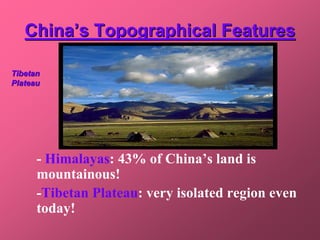
China’s Topographical Features

Tibetan
Plateau


      - Himalayas: 43% of China’s land is
      mountainous!
      -Tibetan Plateau: very isolated region even
      today!
Impact of China’s Geography
       How would isolation help a country?
What other great ancient civilizations were isolated?
Impact of China’s Geography
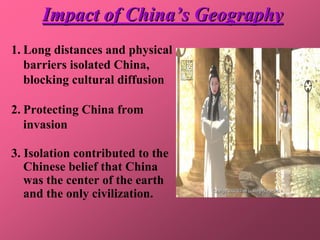
1. Long distances and physical
   barriers isolated China,
   blocking cultural diffusion

2. Protecting China from
   invasion

3. Isolation contributed to the
   Chinese belief that China
   was the center of the earth
   and the only civilization.
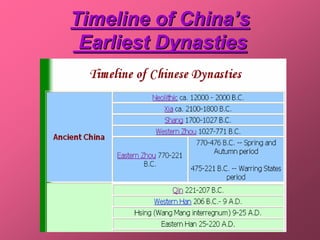
Timeline of China’s
 Earliest Dynasties
The Mystery Dynasty: Xia


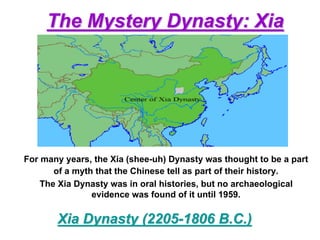
For many years, the Xia (shee-uh) Dynasty was thought to be a part
       of a myth that the Chinese tell as part of their history.
    The Xia Dynasty was in oral histories, but no archaeological
                evidence was found of it until 1959.

       Xia Dynasty (2205-1806 B.C.)
Evidence finally uncovered…
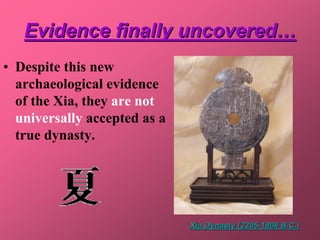
• Despite this new
  archaeological evidence
  of the Xia, they are not
  universally accepted as a
  true dynasty.


                              Xia Dynasty (2205-1806 B.C.)
Evidence finally uncovered…
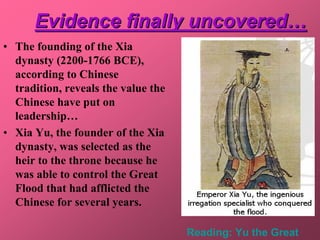
• The founding of the Xia
  dynasty (2200-1766 BCE),
  according to Chinese
  tradition, reveals the value the
  Chinese have put on
  leadership…
• Xia Yu, the founder of the Xia
  dynasty, was selected as the
  heir to the throne because he
  was able to control the Great
  Flood that had afflicted the
  Chinese for several years.

                                     Reading: Yu the Great
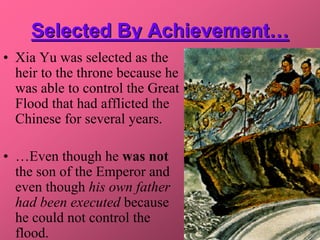
Selected By Achievement…
• Xia Yu was selected as the
  heir to the throne because he
  was able to control the Great
  Flood that had afflicted the
  Chinese for several years.

• …Even though he was not
  the son of the Emperor and
  even though his own father
  had been executed because
  he could not control the
  flood.
Daily Life
1.The Xia were agrarian people

2.The ruling families used elaborate and
  dramatic rituals to confirm their power to
  govern.
3.The rulers often acted as shamans,
  communicating with spirits for help and
  guidance.
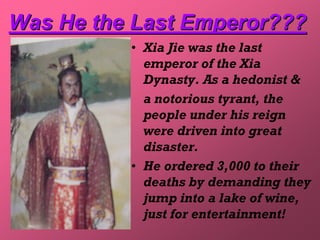
Was He the Last Emperor???
          • Xia Jie was the last
            emperor of the Xia
            Dynasty. As a hedonist &
            a notorious tyrant, the
            people under his reign
            were driven into great
            disaster.
          • He ordered 3,000 to their
            deaths by demanding they
            jump into a lake of wine,
            just for entertainment!
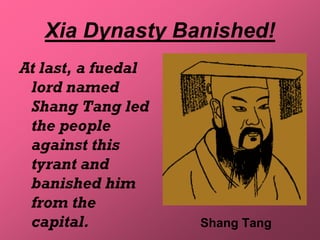
Xia Dynasty Banished!
At last, a fuedal
 lord named
 Shang Tang led
 the people
 against this
 tyrant and
 banished him
 from the
 capital.           Shang Tang
Chinese civilization
 took shape under
       the…
    Shang Dynasty
  1650 B.C.–1027 B.C.
What is needed to have a civilization?
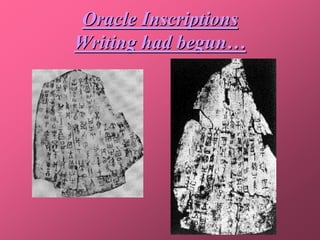
Oracle Inscriptions
Writing had begun…
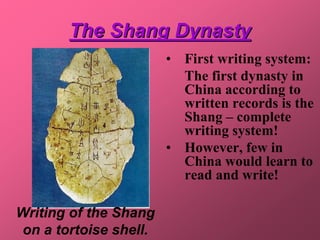
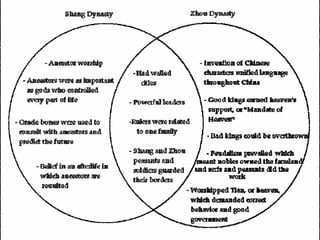
The Shang Dynasty
                        • First writing system:
                          The first dynasty in
                          China according to
                          written records is the
                          Shang – complete
                          writing system!
                        • However, few in
                          China would learn to
                          read and write!

Writing of the Shang
 on a tortoise shell.
Chinese Writing
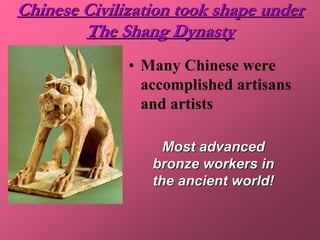
Chinese Civilization took shape under
        The Shang Dynasty
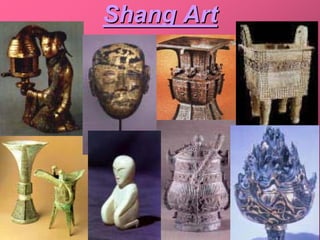
              • Many Chinese were
                accomplished artisans
                and artists

                   Most advanced
                 bronze workers in
                 the ancient world!
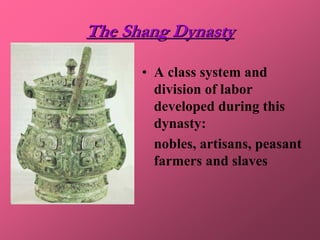
The Shang Dynasty

      • A class system and
        division of labor
        developed during this
        dynasty:
        nobles, artisans, peasant
        farmers and slaves
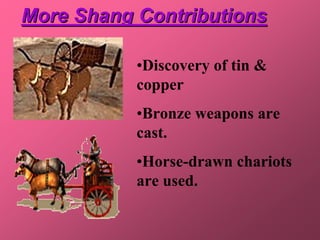
More Shang Contributions

           •Discovery of tin &
           copper
           •Bronze weapons are
           cast.
           •Horse-drawn chariots
           are used.
Shang Contributions
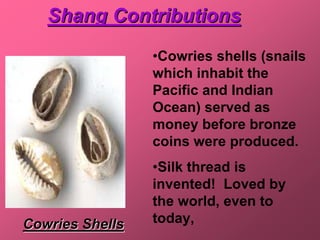
                 •Cowries shells (snails
                 which inhabit the
                 Pacific and Indian
                 Ocean) served as
                 money before bronze
                 coins were produced.
                 •Silk thread is
                 invented! Loved by
                 the world, even to
Cowries Shells   today,
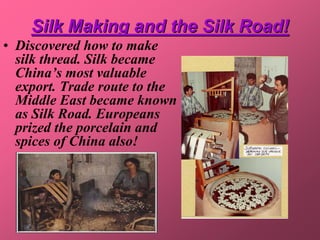
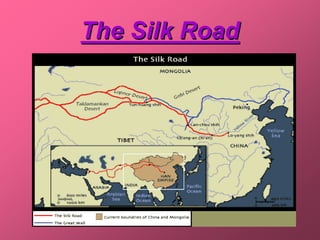
Silk Making and the Silk Road!
• Discovered how to make
  silk thread. Silk became
  China’s most valuable
  export. Trade route to the
  Middle East became known
  as Silk Road. Europeans
  prized the porcelain and
  spices of China also!
The Silk Road
Shang Art
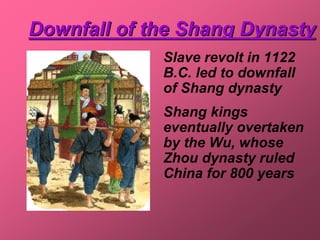
Downfall of the Shang Dynasty
             Slave revolt in 1122
             B.C. led to downfall
             of Shang dynasty
             Shang kings
             eventually overtaken
             by the Wu, whose
             Zhou dynasty ruled
             China for 800 years
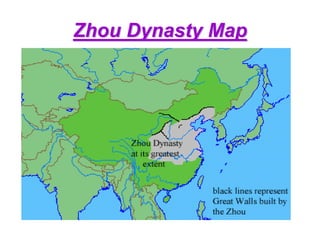
Zhou Dynasty Map
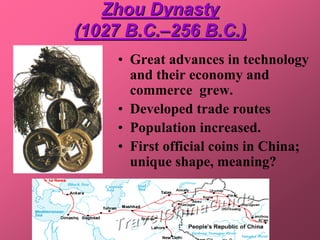
Zhou Dynasty
(1027 B.C.–256 B.C.)
     • Great advances in technology
       and their economy and
       commerce grew.
     • Developed trade routes
     • Population increased.
     • First official coins in China;
       unique shape, meaning?
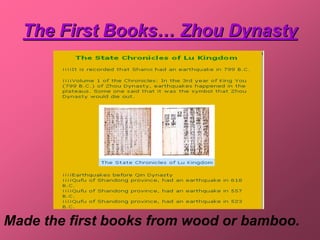
The First Books… Zhou Dynasty


Made the first books from wood or bamboo.
Zhou Dynasty
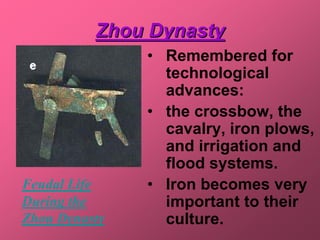
               • Remembered for
                 technological
                 advances:
               • the crossbow, the
                 cavalry, iron plows,
                 and irrigation and
                 flood systems.
Feudal Life    • Iron becomes very
During the       important to their
Zhou Dynasty     culture.
Zhou Dynasty
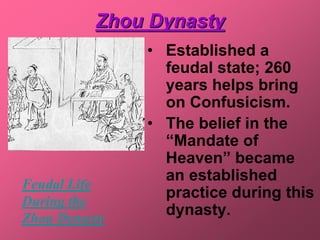
               • Established a
                 feudal state; 260
                 years helps bring
                 on Confusicism.
               • The belief in the
                 “Mandate of
                 Heaven” became
                 an established
Feudal Life
                 practice during this
During the
Zhou Dynasty
                 dynasty.
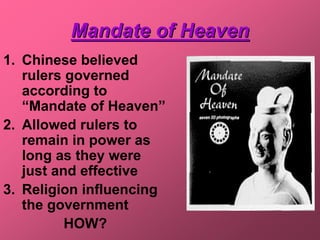
Mandate of Heaven
1. Chinese believed
   rulers governed
   according to
   “Mandate of Heaven”
2. Allowed rulers to
   remain in power as
   long as they were
   just and effective
3. Religion influencing
   the government
          HOW?
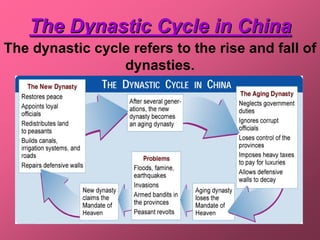
The Dynastic Cycle in China
The dynastic cycle refers to the rise and fall of
                 dynasties.
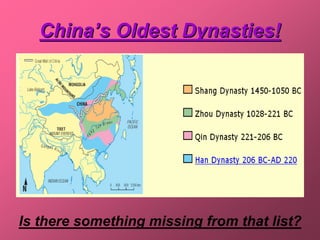
China’s Oldest Dynasties!


Is there something missing from that list?
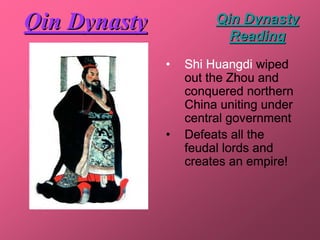
Qin Dynasty            Qin Dynasty
                         Reading
              •   Shi Huangdi wiped
                  out the Zhou and
                  conquered northern
                  China uniting under
                  central government
              •   Defeats all the
                  feudal lords and
                  creates an empire!
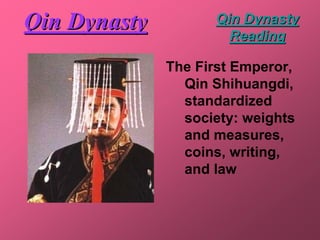
Qin Dynasty         Qin Dynasty
                      Reading

              The First Emperor,
                Qin Shihuangdi,
                standardized
                society: weights
                and measures,
                coins, writing,
                and law
Public Works Projects
    Dominated the Qin Dynasty
Many public works projects were also
   undertaken:
1. A Great Wall was built in the north, to
   protect against invasions.
2. Roads and irrigation canals were built
   throughout the country.
3. Developed farmlands the size of the state
   of Connecticut enough to feed the people
   and a large army.
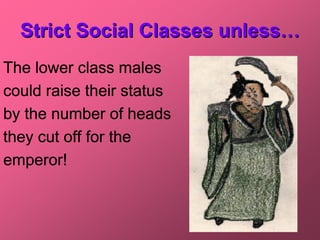
Strict Social Classes unless…
The lower class males
could raise their status
by the number of heads
they cut off for the
emperor!
Though his methods were brutal,
Shi Huangdi ushered in China’s
classical age.
 This period is called a
 classical civilization because
 it set patterns in government,
 philosophy, religion, science,
 and the arts that served as
 the framework for later
 cultures.
How Did Shi Huangdi Unite China?
 1. He replaced feudal states with military districts
    governed by loyal officials.
 2. He sent spies to report on local officials.
 3. He forced noble families to live in his capital so
    he could monitor them.
 4. He jailed, tortured, and killed those who
    opposed his rule.
 5. He had all books of philosophy and literature
    burned.
 6. He standardized weights & measures.
 7. He connected the various parts of the Great
    Wall and expanded it.
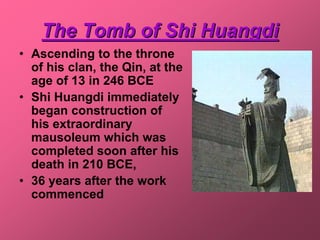
The Tomb of Shi Huangdi
• Ascending to the throne
  of his clan, the Qin, at the
  age of 13 in 246 BCE
• Shi Huangdi immediately
  began construction of
  his extraordinary
  mausoleum which was
  completed soon after his
  death in 210 BCE,
• 36 years after the work
  commenced
The Tomb of Shi Huangdi
• Located approximately 30 km
  outside of the present-day capital,
  X'ian (called Chang'an in ancient
  times
• The tomb of Qin Shi Huangdi
  remains a symbol of the infinite
  power and ego of China's first
  Emperor.
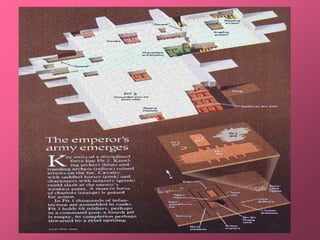
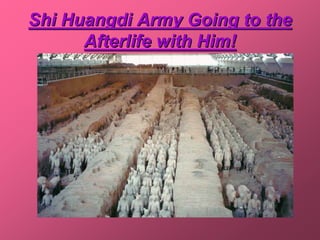
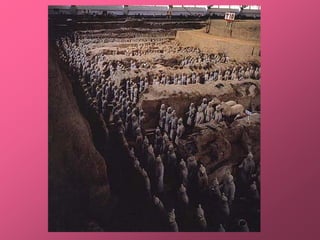
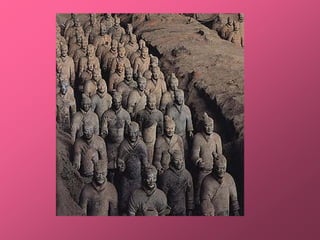
Shi Huangdi Army Going to the
      Afterlife with Him!
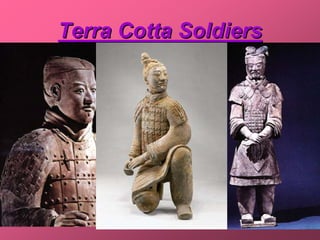
Terra Cotta Soldiers
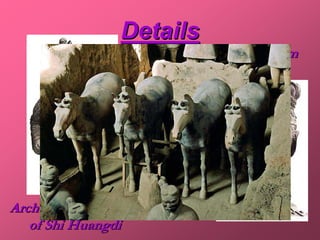
Details
                          Archer from
                           the Back


Archer from the tomb
   of Shi Huangdi
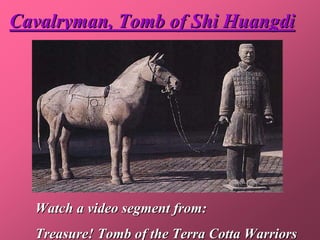
Cavalryman, Tomb of Shi Huangdi


  Watch a video segment from:
  Treasure! Tomb of the Terra Cotta Warriors
Early Chinese Life
Bibliography
1.    http://www.central.k12.ca.us/akers/dynasty.html
2.    http://www.mnsu.edu/emuseum/prehistory/china/map/map.html
3.    http://www.mnsu.edu/emuseum/prehistory/china/ancient_china/xia.html
4.    http://www.mnsu.edu/emuseum/prehistory/china/timeline.html
5.    http://www.yutopian.com/arts/xia/hfigure.html
6.    http://www.calgarycoin.com/reference/china/chicowryreal.jpg
7.    http://www.central.k12.ca.us/akers/religions.html
8.    http://www.brandongallery.com/category.asp?Tag=1
9.    http://international.tamu.edu/ipa/english/quake/relic/rlc03.html
10.   http://complit.la.psu.edu/chinese/studWork/The%20Great%20Wall%20of
      %20China.ppt
11.   http://international.tamu.edu/ipa/english/quake/relic/rlc03.html
12.   http://www.sandiego-online.com/forums/chinese/htmls/music.htm
13.   http://www.travelchinaguide.com/intro/religion/confucianism/index.htm
14.   http://www.edepot.com/taointro.html
Anc china10 2005

Anc china10 2005

  • 1.
  • 2.
  • 3.
    Map of China Whattopographical features are present and not-present on this map would influence China’s development?
  • 4.
    Major River Systems AncientChina had two major river systems: • Huang He which is also known as the Yellow River • Yangtze which is also known as the Chang Jiang .
  • 5.
    Major River Systems • The Huang He River system 3,000 miles long • Empties into the Yellow Sea • Ancient Chinese civilization began along this river • Provides fertile soil and an abundance food • Formerly known as the “river of sorrow” Why did it get such a name?
  • 6.
    Major River Systems TheYangtze River System • Longest in China and the third longest river in the world - 3, 964 miles long. • The river passes through some of China's best farmland and many of its towns and villages.
  • 7.
    Ancient China’s Topography Topographicalfeatures that lead to isolation: - Gobi Desert: one of the driest in the world enter and you shall never return! - - Plains: Only about 12% of China's land is plains; most of that is in the eastern part of China.
  • 8.
    China’s Topographical Features Tibetan Plateau - Himalayas: 43% of China’s land is mountainous! -Tibetan Plateau: very isolated region even today!
  • 9.
    Impact of China’sGeography How would isolation help a country? What other great ancient civilizations were isolated?
  • 10.
    Impact of China’sGeography 1. Long distances and physical barriers isolated China, blocking cultural diffusion 2. Protecting China from invasion 3. Isolation contributed to the Chinese belief that China was the center of the earth and the only civilization.
  • 11.
    Timeline of China’s Earliest Dynasties
  • 12.
    The Mystery Dynasty:Xia For many years, the Xia (shee-uh) Dynasty was thought to be a part of a myth that the Chinese tell as part of their history. The Xia Dynasty was in oral histories, but no archaeological evidence was found of it until 1959. Xia Dynasty (2205-1806 B.C.)
  • 13.
    Evidence finally uncovered… •Despite this new archaeological evidence of the Xia, they are not universally accepted as a true dynasty. Xia Dynasty (2205-1806 B.C.)
  • 14.
    Evidence finally uncovered… •The founding of the Xia dynasty (2200-1766 BCE), according to Chinese tradition, reveals the value the Chinese have put on leadership… • Xia Yu, the founder of the Xia dynasty, was selected as the heir to the throne because he was able to control the Great Flood that had afflicted the Chinese for several years. Reading: Yu the Great
  • 15.
    Selected By Achievement… •Xia Yu was selected as the heir to the throne because he was able to control the Great Flood that had afflicted the Chinese for several years. • …Even though he was not the son of the Emperor and even though his own father had been executed because he could not control the flood.
  • 16.
    Daily Life 1.The Xiawere agrarian people 2.The ruling families used elaborate and dramatic rituals to confirm their power to govern. 3.The rulers often acted as shamans, communicating with spirits for help and guidance.
  • 17.
    Was He theLast Emperor??? • Xia Jie was the last emperor of the Xia Dynasty. As a hedonist & a notorious tyrant, the people under his reign were driven into great disaster. • He ordered 3,000 to their deaths by demanding they jump into a lake of wine, just for entertainment!
  • 18.
    Xia Dynasty Banished! Atlast, a fuedal lord named Shang Tang led the people against this tyrant and banished him from the capital. Shang Tang
  • 19.
    Chinese civilization tookshape under the… Shang Dynasty 1650 B.C.–1027 B.C. What is needed to have a civilization?
  • 21.
  • 22.
    The Shang Dynasty • First writing system: The first dynasty in China according to written records is the Shang – complete writing system! • However, few in China would learn to read and write! Writing of the Shang on a tortoise shell.
  • 23.
  • 24.
    Chinese Civilization tookshape under The Shang Dynasty • Many Chinese were accomplished artisans and artists Most advanced bronze workers in the ancient world!
  • 25.
    The Shang Dynasty • A class system and division of labor developed during this dynasty: nobles, artisans, peasant farmers and slaves
  • 26.
    More Shang Contributions •Discovery of tin & copper •Bronze weapons are cast. •Horse-drawn chariots are used.
  • 27.
    Shang Contributions •Cowries shells (snails which inhabit the Pacific and Indian Ocean) served as money before bronze coins were produced. •Silk thread is invented! Loved by the world, even to Cowries Shells today,
  • 28.
    Silk Making andthe Silk Road! • Discovered how to make silk thread. Silk became China’s most valuable export. Trade route to the Middle East became known as Silk Road. Europeans prized the porcelain and spices of China also!
  • 29.
  • 30.
  • 31.
    Downfall of theShang Dynasty Slave revolt in 1122 B.C. led to downfall of Shang dynasty Shang kings eventually overtaken by the Wu, whose Zhou dynasty ruled China for 800 years
  • 32.
  • 33.
    Zhou Dynasty (1027 B.C.–256B.C.) • Great advances in technology and their economy and commerce grew. • Developed trade routes • Population increased. • First official coins in China; unique shape, meaning?
  • 34.
    The First Books…Zhou Dynasty Made the first books from wood or bamboo.
  • 35.
    Zhou Dynasty • Remembered for technological advances: • the crossbow, the cavalry, iron plows, and irrigation and flood systems. Feudal Life • Iron becomes very During the important to their Zhou Dynasty culture.
  • 36.
    Zhou Dynasty • Established a feudal state; 260 years helps bring on Confusicism. • The belief in the “Mandate of Heaven” became an established Feudal Life practice during this During the Zhou Dynasty dynasty.
  • 37.
    Mandate of Heaven 1.Chinese believed rulers governed according to “Mandate of Heaven” 2. Allowed rulers to remain in power as long as they were just and effective 3. Religion influencing the government HOW?
  • 38.
    The Dynastic Cyclein China The dynastic cycle refers to the rise and fall of dynasties.
  • 39.
    China’s Oldest Dynasties! Isthere something missing from that list?
  • 40.
    Qin Dynasty Qin Dynasty Reading • Shi Huangdi wiped out the Zhou and conquered northern China uniting under central government • Defeats all the feudal lords and creates an empire!
  • 41.
    Qin Dynasty Qin Dynasty Reading The First Emperor, Qin Shihuangdi, standardized society: weights and measures, coins, writing, and law
  • 42.
    Public Works Projects Dominated the Qin Dynasty Many public works projects were also undertaken: 1. A Great Wall was built in the north, to protect against invasions. 2. Roads and irrigation canals were built throughout the country. 3. Developed farmlands the size of the state of Connecticut enough to feed the people and a large army.
  • 43.
    Strict Social Classesunless… The lower class males could raise their status by the number of heads they cut off for the emperor!
  • 44.
    Though his methodswere brutal, Shi Huangdi ushered in China’s classical age. This period is called a classical civilization because it set patterns in government, philosophy, religion, science, and the arts that served as the framework for later cultures.
  • 45.
    How Did ShiHuangdi Unite China? 1. He replaced feudal states with military districts governed by loyal officials. 2. He sent spies to report on local officials. 3. He forced noble families to live in his capital so he could monitor them. 4. He jailed, tortured, and killed those who opposed his rule. 5. He had all books of philosophy and literature burned. 6. He standardized weights & measures. 7. He connected the various parts of the Great Wall and expanded it.
  • 46.
    The Tomb ofShi Huangdi • Ascending to the throne of his clan, the Qin, at the age of 13 in 246 BCE • Shi Huangdi immediately began construction of his extraordinary mausoleum which was completed soon after his death in 210 BCE, • 36 years after the work commenced
  • 47.
    The Tomb ofShi Huangdi • Located approximately 30 km outside of the present-day capital, X'ian (called Chang'an in ancient times • The tomb of Qin Shi Huangdi remains a symbol of the infinite power and ego of China's first Emperor.
  • 49.
    Shi Huangdi ArmyGoing to the Afterlife with Him!
  • 50.
  • 53.
    Details Archer from the Back Archer from the tomb of Shi Huangdi
  • 54.
    Cavalryman, Tomb ofShi Huangdi Watch a video segment from: Treasure! Tomb of the Terra Cotta Warriors
  • 55.
  • 56.
    Bibliography 1. http://www.central.k12.ca.us/akers/dynasty.html 2. http://www.mnsu.edu/emuseum/prehistory/china/map/map.html 3. http://www.mnsu.edu/emuseum/prehistory/china/ancient_china/xia.html 4. http://www.mnsu.edu/emuseum/prehistory/china/timeline.html 5. http://www.yutopian.com/arts/xia/hfigure.html 6. http://www.calgarycoin.com/reference/china/chicowryreal.jpg 7. http://www.central.k12.ca.us/akers/religions.html 8. http://www.brandongallery.com/category.asp?Tag=1 9. http://international.tamu.edu/ipa/english/quake/relic/rlc03.html 10. http://complit.la.psu.edu/chinese/studWork/The%20Great%20Wall%20of %20China.ppt 11. http://international.tamu.edu/ipa/english/quake/relic/rlc03.html 12. http://www.sandiego-online.com/forums/chinese/htmls/music.htm 13. http://www.travelchinaguide.com/intro/religion/confucianism/index.htm 14. http://www.edepot.com/taointro.html