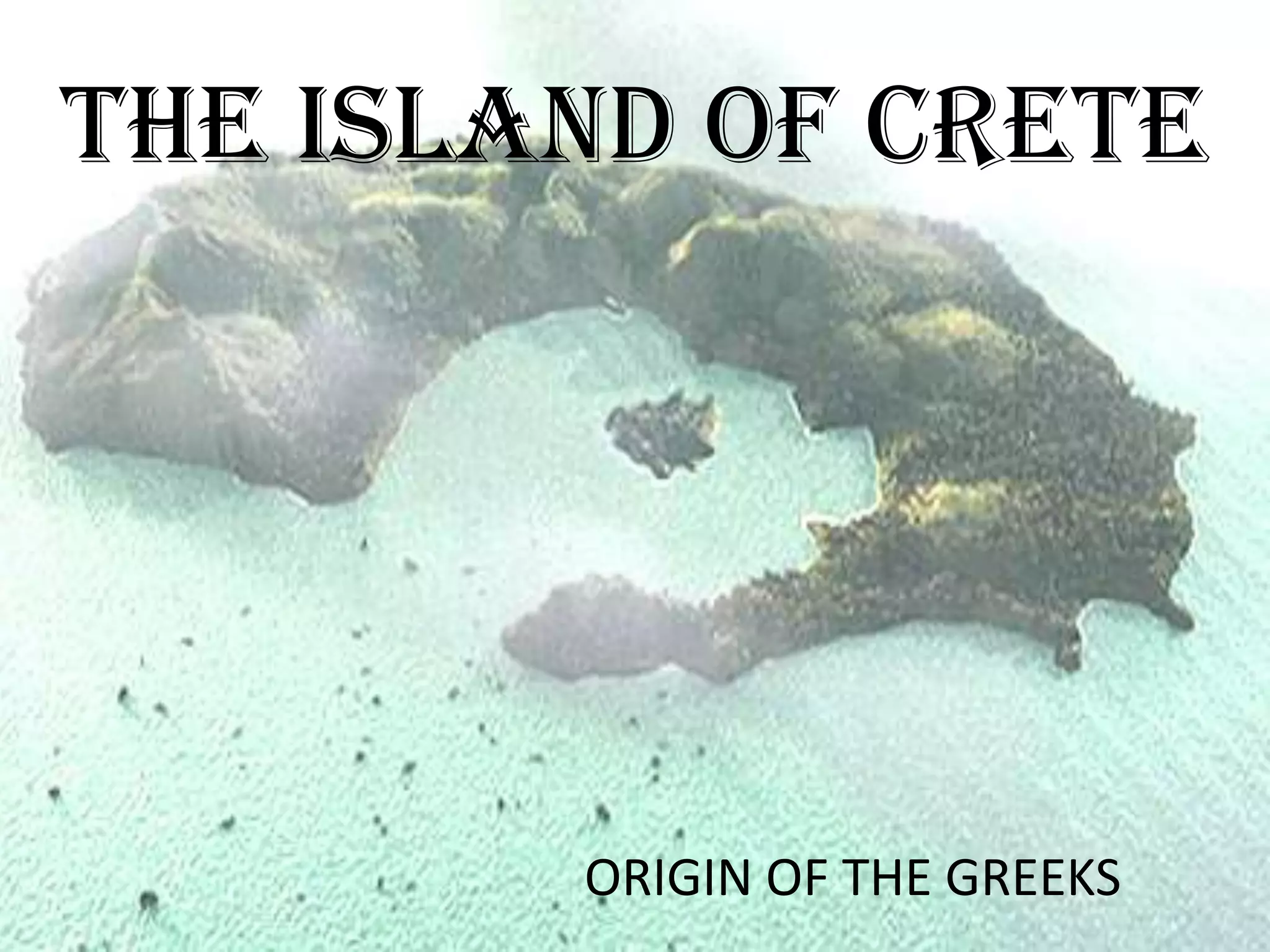
THE ISLAND OF CRETE


        ORIGIN OF THE GREEKS
PREHISHTORIC PERIOD
                                  6000BC-2600 BC

The earliest traces of human habitation in Crete go back to the Neolithic age. The
first inhabitants of the island lived in caves, which later became places of worship
and in houses with stone foundations and brick walls. These people were farmers
and shepherds. They used simple tools and utensils made of animal bones and
stone, many of which have been turned up during archaeological excavations.

We know very little about their religious beliefs. It is hypothesized that they
worshipped Goea, the goddess of fertility. Many figurines showing this female
form have been found in Crete and throughout the eastern Mediterranean basin.
For many centuries afterwards Mother was the most important symbol for the
cultures of the Mediterranean lands.
Minoan Civilization
 Around 1700 BC, a highly sophisticated
culture grew up on Crete: the Minoans.
What they thought, what stories they told,
how they narrated their history, are all lost
to us. All we have left are their palaces,
their incredibly developed visual art, and
their records
The Minoan civilization was a Bronze
Age civilization that arose on the island
of Crete.
It was rediscovered at the beginning of
the 20th century through the work of
GEOGRAPHY

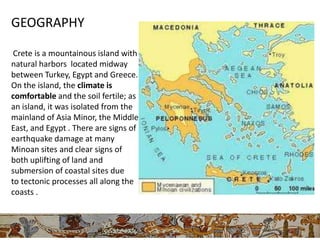
 Crete is a mountainous island with
natural harbors located midway
between Turkey, Egypt and Greece.
On the island, the climate is
comfortable and the soil fertile; as
an island, it was isolated from the
mainland of Asia Minor, the Middle
East, and Egypt . There are signs of
earthquake damage at many
Minoan sites and clear signs of
both uplifting of land and
submersion of coastal sites due
to tectonic processes all along the
coasts .
CHRONOLOGY AND HISTORY
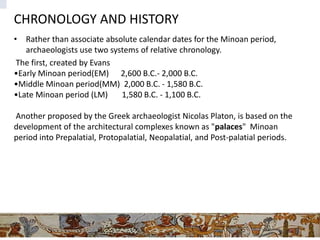
• Rather than associate absolute calendar dates for the Minoan period,
   archaeologists use two systems of relative chronology.
 The first, created by Evans
•Early Minoan period(EM) 2,600 B.C.- 2,000 B.C.
•Middle Minoan period(MM) 2,000 B.C. - 1,580 B.C.
•Late Minoan period (LM)     1,580 B.C. - 1,100 B.C.

Another proposed by the Greek archaeologist Nicolas Platon, is based on the
development of the architectural complexes known as "palaces" Minoan
period into Prepalatial, Protopalatial, Neopalatial, and Post-palatial periods.
TRADE
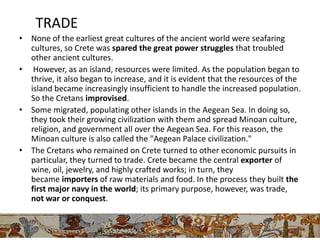
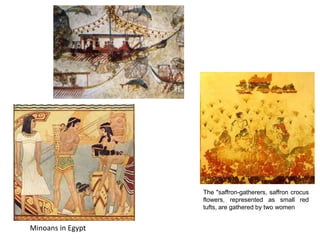
• None of the earliest great cultures of the ancient world were seafaring
  cultures, so Crete was spared the great power struggles that troubled
  other ancient cultures.
• However, as an island, resources were limited. As the population began to
  thrive, it also began to increase, and it is evident that the resources of the
  island became increasingly insufficient to handle the increased population.
  So the Cretans improvised.
• Some migrated, populating other islands in the Aegean Sea. In doing so,
  they took their growing civilization with them and spread Minoan culture,
  religion, and government all over the Aegean Sea. For this reason, the
  Minoan culture is also called the "Aegean Palace civilization."
• The Cretans who remained on Crete turned to other economic pursuits in
  particular, they turned to trade. Crete became the central exporter of
  wine, oil, jewelry, and highly crafted works; in turn, they
  became importers of raw materials and food. In the process they built the
  first major navy in the world; its primary purpose, however, was trade,
  not war or conquest.
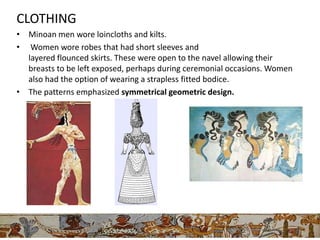
The "saffron-gatherers, saffron crocus
                   flowers, represented as small red
                   tufts, are gathered by two women


Minoans in Egypt
CLOTHING
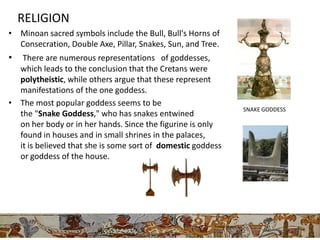
• Minoan men wore loincloths and kilts.
• Women wore robes that had short sleeves and
  layered flounced skirts. These were open to the navel allowing their
  breasts to be left exposed, perhaps during ceremonial occasions. Women
  also had the option of wearing a strapless fitted bodice.
• The patterns emphasized symmetrical geometric design.
RELIGION
• Minoan sacred symbols include the Bull, Bull's Horns of
  Consecration, Double Axe, Pillar, Snakes, Sun, and Tree.
•  There are numerous representations of goddesses,
  which leads to the conclusion that the Cretans were
  polytheistic, while others argue that these represent
  manifestations of the one goddess.
• The most popular goddess seems to be
                                                             SNAKE GODDESS
  the "Snake Goddess," who has snakes entwined
  on her body or in her hands. Since the figurine is only
  found in houses and in small shrines in the palaces,
  it is believed that she is some sort of domestic goddess
  or goddess of the house.


                                                             DEITY-MOTHER GODDESS
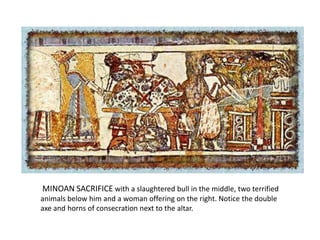
MINOAN SACRIFICE with a slaughtered bull in the middle, two terrified
animals below him and a woman offering on the right. Notice the double
axe and horns of consecration next to the altar.
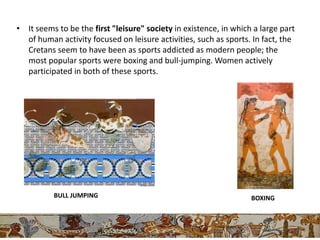
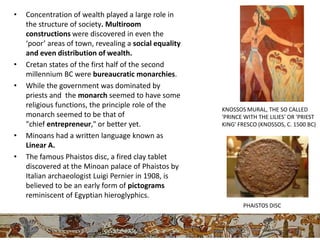
• It seems to be the first "leisure" society in existence, in which a large part
  of human activity focused on leisure activities, such as sports. In fact, the
  Cretans seem to have been as sports addicted as modern people; the
  most popular sports were boxing and bull-jumping. Women actively
  participated in both of these sports.


          BULL JUMPING                                             BOXING
•   Concentration of wealth played a large role in
    the structure of society. Multiroom
    constructions were discovered in even the
    ‘poor’ areas of town, revealing a social equality
    and even distribution of wealth.
•   Cretan states of the first half of the second
    millennium BC were bureaucratic monarchies.
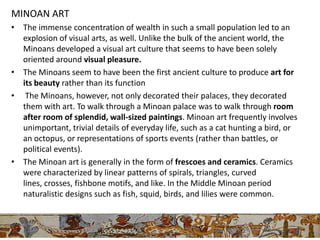
•   While the government was dominated by
    priests and the monarch seemed to have some
    religious functions, the principle role of the
                                                        KNOSSOS MURAL, THE SO CALLED
    monarch seemed to be that of                        'PRINCE WITH THE LILIES' OR 'PRIEST
    "chief entrepreneur," or better yet.                KING' FRESCO (KNOSSOS, C. 1500 BC)
•   Minoans had a written language known as
    Linear A.
•   The famous Phaistos disc, a fired clay tablet
    discovered at the Minoan palace of Phaistos by
    Italian archaeologist Luigi Pernier in 1908, is
    believed to be an early form of pictograms
    reminiscent of Egyptian hieroglyphics.
                                                               PHAISTOS DISC
MINOAN ART
• The immense concentration of wealth in such a small population led to an
  explosion of visual arts, as well. Unlike the bulk of the ancient world, the
  Minoans developed a visual art culture that seems to have been solely
  oriented around visual pleasure.
• The Minoans seem to have been the first ancient culture to produce art for
  its beauty rather than its function
• The Minoans, however, not only decorated their palaces, they decorated
  them with art. To walk through a Minoan palace was to walk through room
  after room of splendid, wall-sized paintings. Minoan art frequently involves
  unimportant, trivial details of everyday life, such as a cat hunting a bird, or
  an octopus, or representations of sports events (rather than battles, or
  political events).
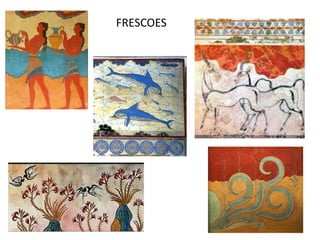
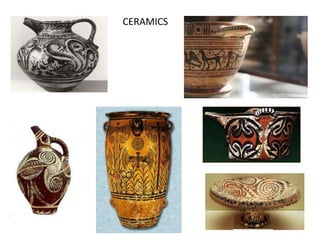
• The Minoan art is generally in the form of frescoes and ceramics. Ceramics
  were characterized by linear patterns of spirals, triangles, curved
  lines, crosses, fishbone motifs, and like. In the Middle Minoan period
  naturalistic designs such as fish, squid, birds, and lilies were common.
FRESCOES
CERAMICS
ARCHITECTURE
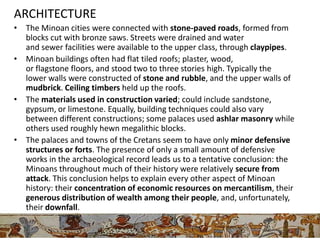
• The Minoan cities were connected with stone-paved roads, formed from
  blocks cut with bronze saws. Streets were drained and water
  and sewer facilities were available to the upper class, through claypipes.
• Minoan buildings often had flat tiled roofs; plaster, wood,
  or flagstone floors, and stood two to three stories high. Typically the
  lower walls were constructed of stone and rubble, and the upper walls of
  mudbrick. Ceiling timbers held up the roofs.
• The materials used in construction varied; could include sandstone,
  gypsum, or limestone. Equally, building techniques could also vary
  between different constructions; some palaces used ashlar masonry while
  others used roughly hewn megalithic blocks.
• The palaces and towns of the Cretans seem to have only minor defensive
  structures or forts. The presence of only a small amount of defensive
  works in the archaeological record leads us to a tentative conclusion: the
  Minoans throughout much of their history were relatively secure from
  attack. This conclusion helps to explain every other aspect of Minoan
  history: their concentration of economic resources on mercantilism, their
  generous distribution of wealth among their people, and, unfortunately,
  their downfall.
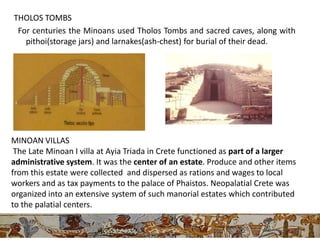
THOLOS TOMBS
 For centuries the Minoans used Tholos Tombs and sacred caves, along with
   pithoi(storage jars) and larnakes(ash-chest) for burial of their dead.


MINOAN VILLAS
 The Late Minoan I villa at Ayia Triada in Crete functioned as part of a larger
administrative system. It was the center of an estate. Produce and other items
from this estate were collected and dispersed as rations and wages to local
workers and as tax payments to the palace of Phaistos. Neopalatial Crete was
organized into an extensive system of such manorial estates which contributed
to the palatial centers.
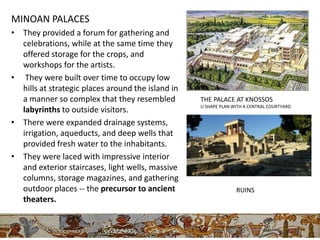
MINOAN PALACES
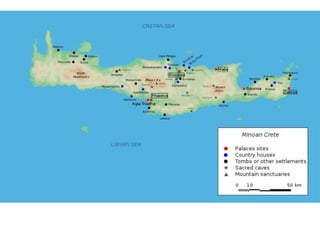
• They provided a forum for gathering and
  celebrations, while at the same time they
  offered storage for the crops, and
  workshops for the artists.
• They were built over time to occupy low
  hills at strategic places around the island in
  a manner so complex that they resembled          THE PALACE AT KNOSSOS
                                                   U SHAPE PLAN WITH A CENTRAL COURTYARD
  labyrinths to outside visitors.
• There were expanded drainage systems,
  irrigation, aqueducts, and deep wells that
  provided fresh water to the inhabitants.
• They were laced with impressive interior
  and exterior staircases, light wells, massive
  columns, storage magazines, and gathering
  outdoor places -- the precursor to ancient                     RUINS
  theaters.
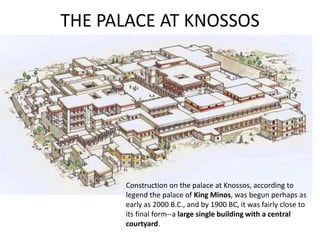
THE PALACE AT KNOSSOS


      Construction on the palace at Knossos, according to
      legend the palace of King Minos, was begun perhaps as
      early as 2000 B.C., and by 1900 BC, it was fairly close to
      its final form--a large single building with a central
      courtyard.
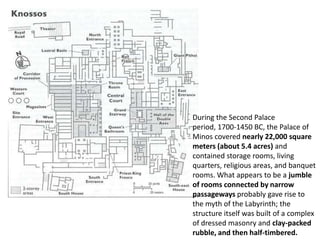
During the Second Palace
period, 1700-1450 BC, the Palace of
Minos covered nearly 22,000 square
meters (about 5.4 acres) and
contained storage rooms, living
quarters, religious areas, and banquet
rooms. What appears to be a jumble
of rooms connected by narrow
passageways probably gave rise to
the myth of the Labyrinth; the
structure itself was built of a complex
of dressed masonry and clay-packed
rubble, and then half-timbered.
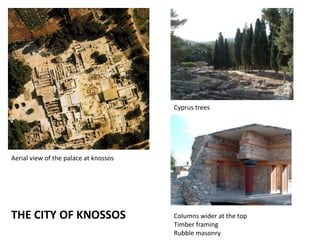
Cyprus trees


Aerial view of the palace at knossos


THE CITY OF KNOSSOS                    Columns wider at the top
                                       Timber framing
                                       Rubble masonry
DOWNFALL
• The island of Santorin, 70 miles north of Crete to the wealthy Minoan
  seaport of Akrotiri, a place where the wall paintings discovered portray
  their landscape with happy animals and farmers harvesting saffron. But the
  Minoans had built their prosperous city on one of the most dangerous
  islands on earth, next to the volcano Thera. Around 1600, B.C., Akrotiri was
  shaken by a violent earthquake. Some time later, an eruption occurred.
  The Theran eruption was one of largest in human history — blasting more
  than 10 million tons of ash, gas, and rock 25 miles into the atmosphere.
  Incredibly, despite Crete’s close proximity to the volcano, the debris from
  Thera largely missed the major Minoan towns.50 years later the civilzation
  was wiped out.
• Earthquakes and fires destroyed Knossos and the other palaces and the
  towns were deserted.


                                    http://alternativearchaeology.jigsy.com/minoan
                                   http://tokushinancienthistory.blogspot.com/

Minoan civilization

  • 1.
    THE ISLAND OFCRETE ORIGIN OF THE GREEKS
  • 2.
    PREHISHTORIC PERIOD 6000BC-2600 BC The earliest traces of human habitation in Crete go back to the Neolithic age. The first inhabitants of the island lived in caves, which later became places of worship and in houses with stone foundations and brick walls. These people were farmers and shepherds. They used simple tools and utensils made of animal bones and stone, many of which have been turned up during archaeological excavations. We know very little about their religious beliefs. It is hypothesized that they worshipped Goea, the goddess of fertility. Many figurines showing this female form have been found in Crete and throughout the eastern Mediterranean basin. For many centuries afterwards Mother was the most important symbol for the cultures of the Mediterranean lands.
  • 3.
    Minoan Civilization Around1700 BC, a highly sophisticated culture grew up on Crete: the Minoans. What they thought, what stories they told, how they narrated their history, are all lost to us. All we have left are their palaces, their incredibly developed visual art, and their records The Minoan civilization was a Bronze Age civilization that arose on the island of Crete. It was rediscovered at the beginning of the 20th century through the work of
  • 4.
    GEOGRAPHY Crete isa mountainous island with natural harbors located midway between Turkey, Egypt and Greece. On the island, the climate is comfortable and the soil fertile; as an island, it was isolated from the mainland of Asia Minor, the Middle East, and Egypt . There are signs of earthquake damage at many Minoan sites and clear signs of both uplifting of land and submersion of coastal sites due to tectonic processes all along the coasts .
  • 5.
    CHRONOLOGY AND HISTORY •Rather than associate absolute calendar dates for the Minoan period, archaeologists use two systems of relative chronology. The first, created by Evans •Early Minoan period(EM) 2,600 B.C.- 2,000 B.C. •Middle Minoan period(MM) 2,000 B.C. - 1,580 B.C. •Late Minoan period (LM) 1,580 B.C. - 1,100 B.C. Another proposed by the Greek archaeologist Nicolas Platon, is based on the development of the architectural complexes known as "palaces" Minoan period into Prepalatial, Protopalatial, Neopalatial, and Post-palatial periods.
  • 7.
    TRADE • None ofthe earliest great cultures of the ancient world were seafaring cultures, so Crete was spared the great power struggles that troubled other ancient cultures. • However, as an island, resources were limited. As the population began to thrive, it also began to increase, and it is evident that the resources of the island became increasingly insufficient to handle the increased population. So the Cretans improvised. • Some migrated, populating other islands in the Aegean Sea. In doing so, they took their growing civilization with them and spread Minoan culture, religion, and government all over the Aegean Sea. For this reason, the Minoan culture is also called the "Aegean Palace civilization." • The Cretans who remained on Crete turned to other economic pursuits in particular, they turned to trade. Crete became the central exporter of wine, oil, jewelry, and highly crafted works; in turn, they became importers of raw materials and food. In the process they built the first major navy in the world; its primary purpose, however, was trade, not war or conquest.
  • 8.
    The "saffron-gatherers, saffroncrocus flowers, represented as small red tufts, are gathered by two women Minoans in Egypt
  • 9.
    CLOTHING • Minoan menwore loincloths and kilts. • Women wore robes that had short sleeves and layered flounced skirts. These were open to the navel allowing their breasts to be left exposed, perhaps during ceremonial occasions. Women also had the option of wearing a strapless fitted bodice. • The patterns emphasized symmetrical geometric design.
  • 10.
    RELIGION • Minoan sacredsymbols include the Bull, Bull's Horns of Consecration, Double Axe, Pillar, Snakes, Sun, and Tree. • There are numerous representations of goddesses, which leads to the conclusion that the Cretans were polytheistic, while others argue that these represent manifestations of the one goddess. • The most popular goddess seems to be SNAKE GODDESS the "Snake Goddess," who has snakes entwined on her body or in her hands. Since the figurine is only found in houses and in small shrines in the palaces, it is believed that she is some sort of domestic goddess or goddess of the house. DEITY-MOTHER GODDESS
  • 11.
    MINOAN SACRIFICE witha slaughtered bull in the middle, two terrified animals below him and a woman offering on the right. Notice the double axe and horns of consecration next to the altar.
  • 12.
    • It seemsto be the first "leisure" society in existence, in which a large part of human activity focused on leisure activities, such as sports. In fact, the Cretans seem to have been as sports addicted as modern people; the most popular sports were boxing and bull-jumping. Women actively participated in both of these sports. BULL JUMPING BOXING
  • 13.
    Concentration of wealth played a large role in the structure of society. Multiroom constructions were discovered in even the ‘poor’ areas of town, revealing a social equality and even distribution of wealth. • Cretan states of the first half of the second millennium BC were bureaucratic monarchies. • While the government was dominated by priests and the monarch seemed to have some religious functions, the principle role of the KNOSSOS MURAL, THE SO CALLED monarch seemed to be that of 'PRINCE WITH THE LILIES' OR 'PRIEST "chief entrepreneur," or better yet. KING' FRESCO (KNOSSOS, C. 1500 BC) • Minoans had a written language known as Linear A. • The famous Phaistos disc, a fired clay tablet discovered at the Minoan palace of Phaistos by Italian archaeologist Luigi Pernier in 1908, is believed to be an early form of pictograms reminiscent of Egyptian hieroglyphics. PHAISTOS DISC
  • 14.
    MINOAN ART • Theimmense concentration of wealth in such a small population led to an explosion of visual arts, as well. Unlike the bulk of the ancient world, the Minoans developed a visual art culture that seems to have been solely oriented around visual pleasure. • The Minoans seem to have been the first ancient culture to produce art for its beauty rather than its function • The Minoans, however, not only decorated their palaces, they decorated them with art. To walk through a Minoan palace was to walk through room after room of splendid, wall-sized paintings. Minoan art frequently involves unimportant, trivial details of everyday life, such as a cat hunting a bird, or an octopus, or representations of sports events (rather than battles, or political events). • The Minoan art is generally in the form of frescoes and ceramics. Ceramics were characterized by linear patterns of spirals, triangles, curved lines, crosses, fishbone motifs, and like. In the Middle Minoan period naturalistic designs such as fish, squid, birds, and lilies were common.
  • 15.
  • 16.
  • 17.
    ARCHITECTURE • The Minoancities were connected with stone-paved roads, formed from blocks cut with bronze saws. Streets were drained and water and sewer facilities were available to the upper class, through claypipes. • Minoan buildings often had flat tiled roofs; plaster, wood, or flagstone floors, and stood two to three stories high. Typically the lower walls were constructed of stone and rubble, and the upper walls of mudbrick. Ceiling timbers held up the roofs. • The materials used in construction varied; could include sandstone, gypsum, or limestone. Equally, building techniques could also vary between different constructions; some palaces used ashlar masonry while others used roughly hewn megalithic blocks. • The palaces and towns of the Cretans seem to have only minor defensive structures or forts. The presence of only a small amount of defensive works in the archaeological record leads us to a tentative conclusion: the Minoans throughout much of their history were relatively secure from attack. This conclusion helps to explain every other aspect of Minoan history: their concentration of economic resources on mercantilism, their generous distribution of wealth among their people, and, unfortunately, their downfall.
  • 18.
    THOLOS TOMBS Forcenturies the Minoans used Tholos Tombs and sacred caves, along with pithoi(storage jars) and larnakes(ash-chest) for burial of their dead. MINOAN VILLAS The Late Minoan I villa at Ayia Triada in Crete functioned as part of a larger administrative system. It was the center of an estate. Produce and other items from this estate were collected and dispersed as rations and wages to local workers and as tax payments to the palace of Phaistos. Neopalatial Crete was organized into an extensive system of such manorial estates which contributed to the palatial centers.
  • 19.
    MINOAN PALACES • Theyprovided a forum for gathering and celebrations, while at the same time they offered storage for the crops, and workshops for the artists. • They were built over time to occupy low hills at strategic places around the island in a manner so complex that they resembled THE PALACE AT KNOSSOS U SHAPE PLAN WITH A CENTRAL COURTYARD labyrinths to outside visitors. • There were expanded drainage systems, irrigation, aqueducts, and deep wells that provided fresh water to the inhabitants. • They were laced with impressive interior and exterior staircases, light wells, massive columns, storage magazines, and gathering outdoor places -- the precursor to ancient RUINS theaters.
  • 20.
    THE PALACE ATKNOSSOS Construction on the palace at Knossos, according to legend the palace of King Minos, was begun perhaps as early as 2000 B.C., and by 1900 BC, it was fairly close to its final form--a large single building with a central courtyard.
  • 21.
    During the SecondPalace period, 1700-1450 BC, the Palace of Minos covered nearly 22,000 square meters (about 5.4 acres) and contained storage rooms, living quarters, religious areas, and banquet rooms. What appears to be a jumble of rooms connected by narrow passageways probably gave rise to the myth of the Labyrinth; the structure itself was built of a complex of dressed masonry and clay-packed rubble, and then half-timbered.
  • 22.
    Cyprus trees Aerial viewof the palace at knossos THE CITY OF KNOSSOS Columns wider at the top Timber framing Rubble masonry
  • 23.
    DOWNFALL • The islandof Santorin, 70 miles north of Crete to the wealthy Minoan seaport of Akrotiri, a place where the wall paintings discovered portray their landscape with happy animals and farmers harvesting saffron. But the Minoans had built their prosperous city on one of the most dangerous islands on earth, next to the volcano Thera. Around 1600, B.C., Akrotiri was shaken by a violent earthquake. Some time later, an eruption occurred. The Theran eruption was one of largest in human history — blasting more than 10 million tons of ash, gas, and rock 25 miles into the atmosphere. Incredibly, despite Crete’s close proximity to the volcano, the debris from Thera largely missed the major Minoan towns.50 years later the civilzation was wiped out. • Earthquakes and fires destroyed Knossos and the other palaces and the towns were deserted. http://alternativearchaeology.jigsy.com/minoan http://tokushinancienthistory.blogspot.com/