Early China
    The Huang He valley
    was the place where
    this early civilization
    started.
    Important dynasties
    ruled China:
•  1. Xia Dynasty (2070-1600
   B.C.)
• 2. Shang Dynasty (1600-
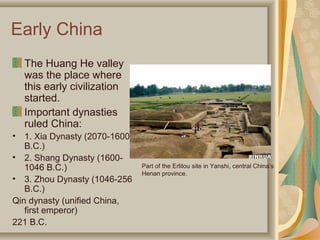
   1046 B.C.)                  Part of the Erlitou site in Yanshi, central China’s
                               Henan province.
• 3. Zhou Dynasty (1046-256
   B.C.)
Qin dynasty (unified China,
   first emperor)
221 B.C.
GOVERNMENT
 The Qin dynasty was the first of 17
 dynasties that ruled China during the
 Imperial period.
 During the first ancient dynasties, there
 was a king who was the religious leader as
 well.
 There were some priest who helped the
 king predict the future through scratching
 animal bones or tortoise shells.
 The Chinese believed in a principle called
 “Mandate of Heaven”.
ECONOMY
Its varied geography:
mountains, the Gobi desert,
the Pacific ocean, and 3
main rivers has affected its
economical development.
In the North China Plain
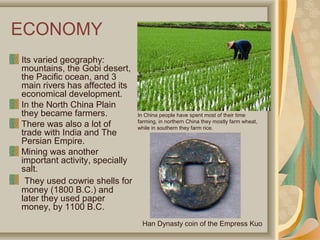
they became farmers.            In China people have spent most of their time
                                farming, in northern China they mostly farm wheat,
There was also a lot of         while in southern they farm rice.
trade with India and The
Persian Empire.
Mining was another
important activity, specially
salt.
 They used cowrie shells for
money (1800 B.C.) and
later they used paper
money, by 1100 B.C.
                                 Han Dynasty coin of the Empress Kuo
Religion
  It is known from
  written records that
  the Shang people
  believed in weather
  gods and sky gods
  and kings also
  performed religious
  duties:
• Communicate with
  nature deities
• Prayed, made
  offerings and
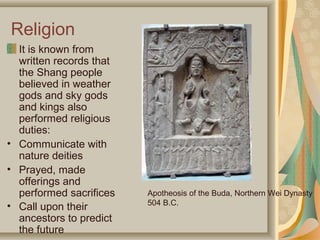
  performed sacrifices   Apotheosis of the Buda, Northern Wei Dynasty
                         504 B.C.
• Call upon their
  ancestors to predict
  the future
Writing and clothing


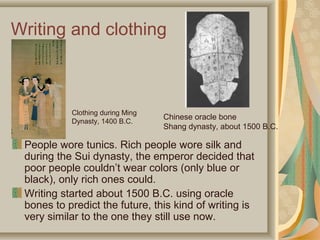
           Clothing during Ming
                                  Chinese oracle bone
           Dynasty, 1400 B.C.
                                  Shang dynasty, about 1500 B.C.

 People wore tunics. Rich people wore silk and
 during the Sui dynasty, the emperor decided that
 poor people couldn’t wear colors (only blue or
 black), only rich ones could.
 Writing started about 1500 B.C. using oracle
 bones to predict the future, this kind of writing is
 very similar to the one they still use now.
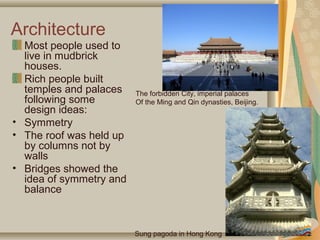
Architecture
  Most people used to
  live in mudbrick
  houses.
  Rich people built
  temples and palaces    The forbidden City, imperial palaces
  following some         Of the Ming and Qin dynasties, Beijing.
  design ideas:
• Symmetry
• The roof was held up
  by columns not by
  walls
• Bridges showed the
  idea of symmetry and
  balance


                         Sung pagoda in Hong Kong
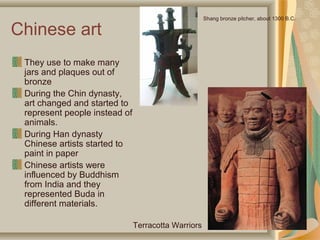
Shang bronze pitcher, about 1300 B.C.

Chinese art
 They use to make many
 jars and plaques out of
 bronze
 During the Chin dynasty,
 art changed and started to
 represent people instead of
 animals.
 During Han dynasty
 Chinese artists started to
 paint in paper
 Chinese artists were
 influenced by Buddhism
 from India and they
 represented Buda in
 different materials.

                               Terracotta Warriors
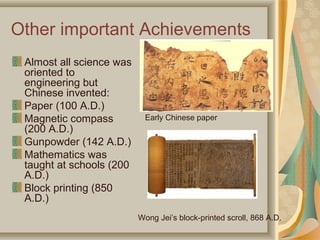
Other important Achievements
 Almost all science was
 oriented to
 engineering but
 Chinese invented:
 Paper (100 A.D.)
 Magnetic compass          Early Chinese paper
 (200 A.D.)
 Gunpowder (142 A.D.)
 Mathematics was
 taught at schools (200
 A.D.)
 Block printing (850
 A.D.)
                          Wong Jei’s block-printed scroll, 868 A.D.

ancient china

  • 1.
    Early China The Huang He valley was the place where this early civilization started. Important dynasties ruled China: • 1. Xia Dynasty (2070-1600 B.C.) • 2. Shang Dynasty (1600- 1046 B.C.) Part of the Erlitou site in Yanshi, central China’s Henan province. • 3. Zhou Dynasty (1046-256 B.C.) Qin dynasty (unified China, first emperor) 221 B.C.
  • 2.
    GOVERNMENT The Qindynasty was the first of 17 dynasties that ruled China during the Imperial period. During the first ancient dynasties, there was a king who was the religious leader as well. There were some priest who helped the king predict the future through scratching animal bones or tortoise shells. The Chinese believed in a principle called “Mandate of Heaven”.
  • 3.
    ECONOMY Its varied geography: mountains,the Gobi desert, the Pacific ocean, and 3 main rivers has affected its economical development. In the North China Plain they became farmers. In China people have spent most of their time farming, in northern China they mostly farm wheat, There was also a lot of while in southern they farm rice. trade with India and The Persian Empire. Mining was another important activity, specially salt. They used cowrie shells for money (1800 B.C.) and later they used paper money, by 1100 B.C. Han Dynasty coin of the Empress Kuo
  • 4.
    Religion Itis known from written records that the Shang people believed in weather gods and sky gods and kings also performed religious duties: • Communicate with nature deities • Prayed, made offerings and performed sacrifices Apotheosis of the Buda, Northern Wei Dynasty 504 B.C. • Call upon their ancestors to predict the future
  • 5.
    Writing and clothing Clothing during Ming Chinese oracle bone Dynasty, 1400 B.C. Shang dynasty, about 1500 B.C. People wore tunics. Rich people wore silk and during the Sui dynasty, the emperor decided that poor people couldn’t wear colors (only blue or black), only rich ones could. Writing started about 1500 B.C. using oracle bones to predict the future, this kind of writing is very similar to the one they still use now.
  • 6.
    Architecture Mostpeople used to live in mudbrick houses. Rich people built temples and palaces The forbidden City, imperial palaces following some Of the Ming and Qin dynasties, Beijing. design ideas: • Symmetry • The roof was held up by columns not by walls • Bridges showed the idea of symmetry and balance Sung pagoda in Hong Kong
  • 7.
    Shang bronze pitcher,about 1300 B.C. Chinese art They use to make many jars and plaques out of bronze During the Chin dynasty, art changed and started to represent people instead of animals. During Han dynasty Chinese artists started to paint in paper Chinese artists were influenced by Buddhism from India and they represented Buda in different materials. Terracotta Warriors
  • 8.
    Other important Achievements Almost all science was oriented to engineering but Chinese invented: Paper (100 A.D.) Magnetic compass Early Chinese paper (200 A.D.) Gunpowder (142 A.D.) Mathematics was taught at schools (200 A.D.) Block printing (850 A.D.) Wong Jei’s block-printed scroll, 868 A.D.