AncientAncient
ChineseChinese
CivilizationCivilization
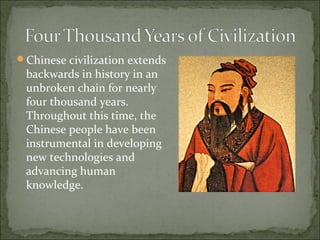
Chinese civilization extends
backwards in history in an
unbroken chain for nearly
four thousand years.
Throughout this time, the
Chinese people have been
instrumental in developing
new technologies and
advancing human
knowledge.
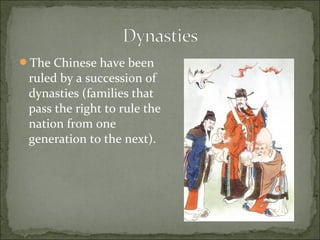
The Chinese have been
ruled by a succession of
dynasties (families that
pass the right to rule the
nation from one
generation to the next).
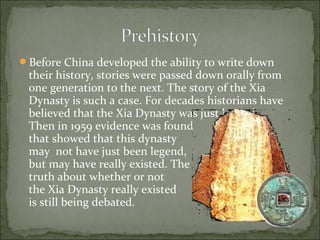
Before China developed the ability to write down
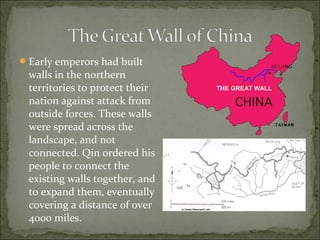
their history, stories were passed down orally from
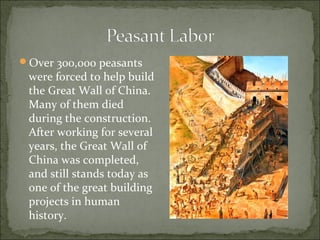
one generation to the next. The story of the Xia
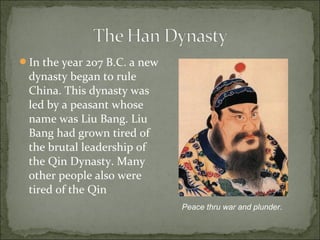
Dynasty is such a case. For decades historians have
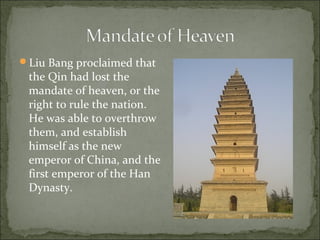
believed that the Xia Dynasty was just legend.
Then in 1959 evidence was found
that showed that this dynasty
may not have just been legend,
but may have really existed. The
truth about whether or not
the Xia Dynasty really existed
is still being debated.
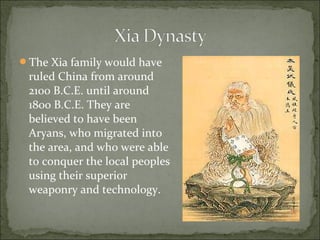
The Xia family would have
ruled China from around
2100 B.C.E. until around
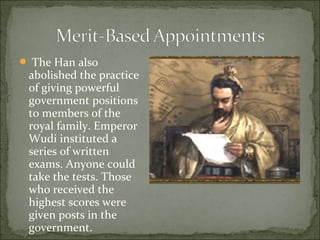
1800 B.C.E. They are
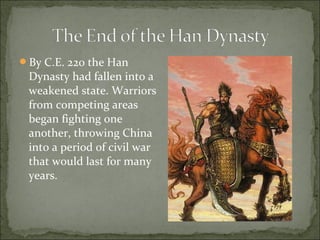
believed to have been
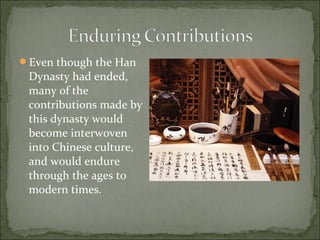
Aryans, who migrated into
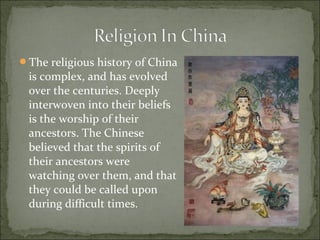
the area, and who were able
to conquer the local peoples
using their superior
weaponry and technology.
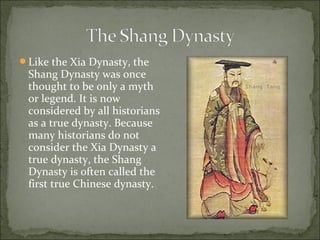
Like the Xia Dynasty, the
Shang Dynasty was once
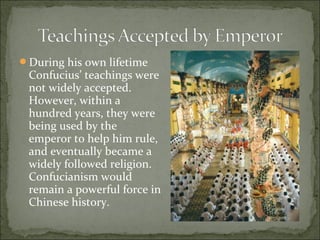
thought to be only a myth
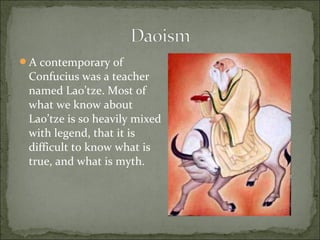
or legend. It is now
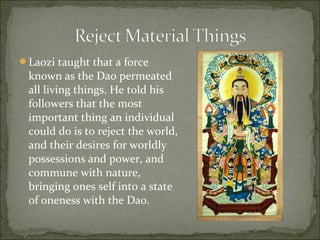
considered by all historians
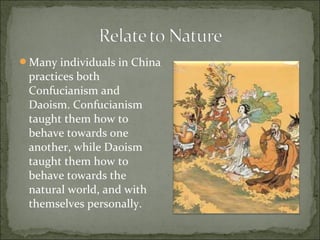
as a true dynasty. Because
many historians do not
consider the Xia Dynasty a
true dynasty, the Shang
Dynasty is often called the
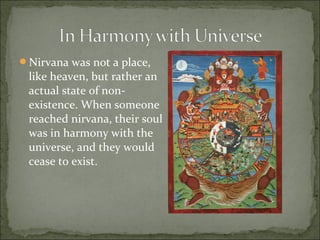
first true Chinese dynasty.
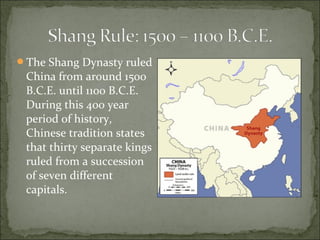
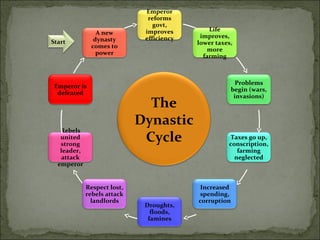
The Shang Dynasty ruled
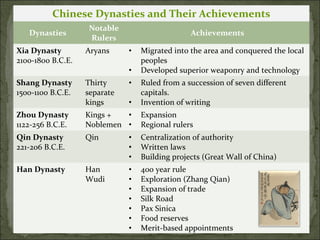
China from around 1500
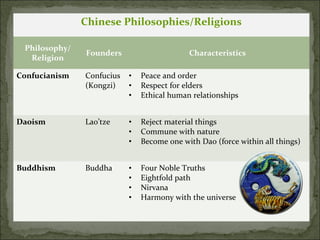
B.C.E. until 1100 B.C.E.
During this 400 year
period of history,
Chinese tradition states
that thirty separate kings
ruled from a succession
of seven different
capitals.
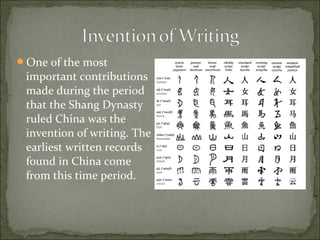
One of the most
important contributions
made during the period
that the Shang Dynasty
ruled China was the
invention of writing. The
earliest written records
found in China come
from this time period.
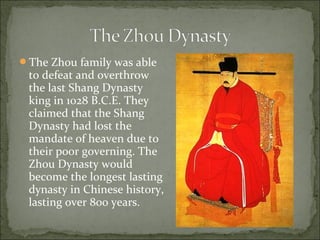
The Zhou family was able
to defeat and overthrow
the last Shang Dynasty
king in 1028 B.C.E. They
claimed that the Shang
Dynasty had lost the
mandate of heaven due to
their poor governing. The
Zhou Dynasty would
become the longest lasting
dynasty in Chinese history,
lasting over 800 years.
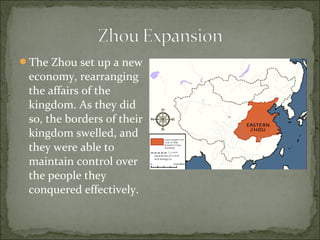
The Zhou set up a new
economy, rearranging
the affairs of the
kingdom. As they did
so, the borders of their
kingdom swelled, and
they were able to
maintain control over
the people they
conquered effectively.
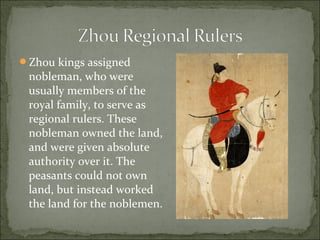
Zhou kings assigned
nobleman, who were
usually members of the
royal family, to serve as
regional rulers. These
nobleman owned the land,
and were given absolute
authority over it. The
peasants could not own
land, but instead worked
the land for the noblemen.
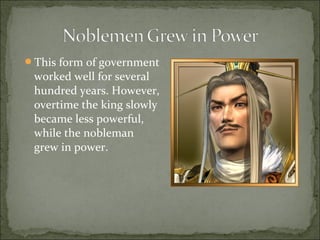
This form of government
worked well for several
hundred years. However,
overtime the king slowly
became less powerful,
while the nobleman
grew in power.
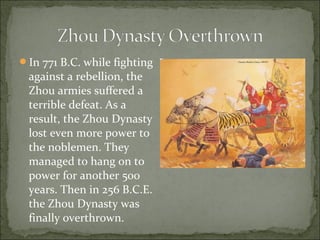
In 771 B.C. while fighting
against a rebellion, the
Zhou armies suffered a
terrible defeat. As a
result, the Zhou Dynasty
lost even more power to
the noblemen. They
managed to hang on to
power for another 500
years. Then in 256 B.C.E.
the Zhou Dynasty was
finally overthrown.
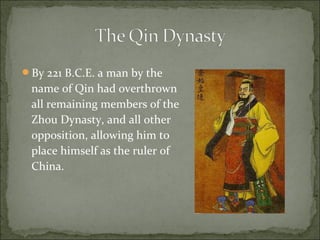
By 221 B.C.E. a man by the
name of Qin had overthrown
all remaining members of the
Zhou Dynasty, and all other
opposition, allowing him to
place himself as the ruler of
China.
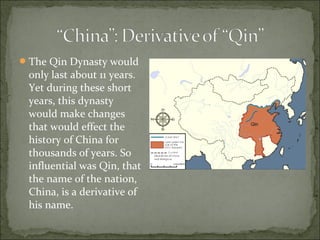
The Qin Dynasty would
only last about 11 years.
Yet during these short
years, this dynasty
would make changes
that would effect the
history of China for
thousands of years. So
influential was Qin, that
the name of the nation,
China, is a derivative of
his name.
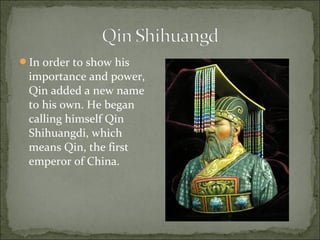
In order to show his
importance and power,
Qin added a new name
to his own. He began
calling himself Qin
Shihuangdi, which
means Qin, the first
emperor of China.
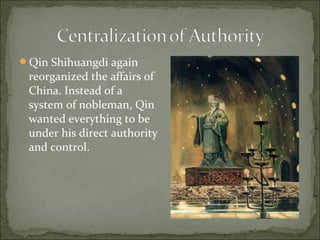
Qin Shihuangdi again
reorganized the affairs of
China. Instead of a
system of nobleman, Qin
wanted everything to be
under his direct authority
and control.
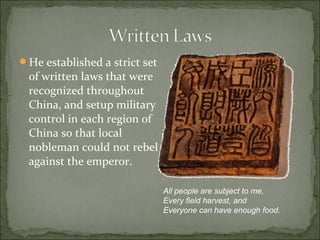
He established a strict set
of written laws that were
recognized throughout
China, and setup military
control in each region of
China so that local
nobleman could not rebel
against the emperor.
All people are subject to me,
Every field harvest, and
Everyone can have enough food.
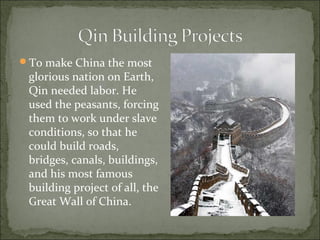
To make China the most
glorious nation on Earth,
Qin needed labor. He
used the peasants, forcing
them to work under slave
conditions, so that he
could build roads,
bridges, canals, buildings,
and his most famous
building project of all, the
Great Wall of China.
Early emperors had built
walls in the northern
territories to protect their
nation against attack from
outside forces. These walls
were spread across the
landscape, and not
connected. Qin ordered his
people to connect the
existing walls together, and
to expand them, eventually
covering a distance of over
4000 miles.
THE GREAT WALL
Over 300,000 peasants
were forced to help build
the Great Wall of China.
Many of them died
during the construction.
After working for several
years, the Great Wall of
China was completed,
and still stands today as
one of the great building
projects in human
history.
In the year 207 B.C. a new
dynasty began to rule
China. This dynasty was
led by a peasant whose
name was Liu Bang. Liu
Bang had grown tired of
the brutal leadership of
the Qin Dynasty. Many
other people also were
tired of the Qin
Peace thru war and plunder.
Liu Bang proclaimed that
the Qin had lost the
mandate of heaven, or the
right to rule the nation.
He was able to overthrow
them, and establish
himself as the new
emperor of China, and the
first emperor of the Han
Dynasty.
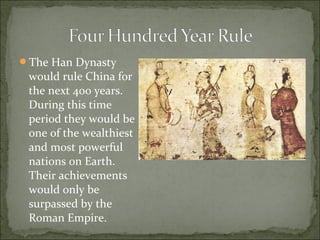
The Han Dynasty
would rule China for
the next 400 years.
During this time
period they would be
one of the wealthiest
and most powerful
nations on Earth.
Their achievements
would only be
surpassed by the
Roman Empire.
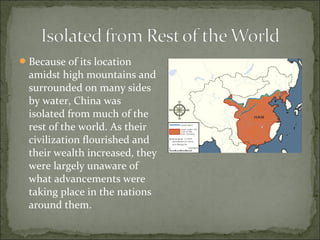
Because of its location
amidst high mountains and
surrounded on many sides
by water, China was
isolated from much of the
rest of the world. As their
civilization flourished and
their wealth increased, they
were largely unaware of
what advancements were
taking place in the nations
around them.
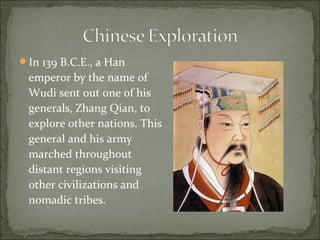
In 139 B.C.E., a Han
emperor by the name of
Wudi sent out one of his
generals, Zhang Qian, to
explore other nations. This
general and his army
marched throughout
distant regions visiting
other civilizations and
nomadic tribes.
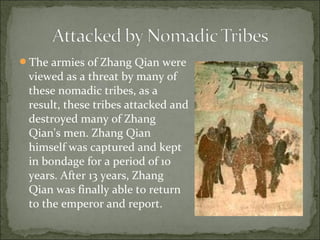
The armies of Zhang Qian were
viewed as a threat by many of
these nomadic tribes, as a
result, these tribes attacked and
destroyed many of Zhang
Qian's men. Zhang Qian
himself was captured and kept
in bondage for a period of 10
years. After 13 years, Zhang
Qian was finally able to return
to the emperor and report.
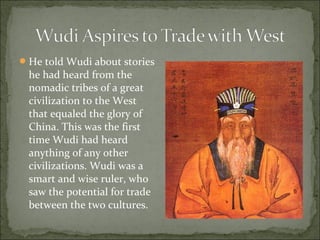
He told Wudi about stories
he had heard from the
nomadic tribes of a great
civilization to the West
that equaled the glory of
China. This was the first
time Wudi had heard
anything of any other
civilizations. Wudi was a
smart and wise ruler, who
saw the potential for trade
between the two cultures.
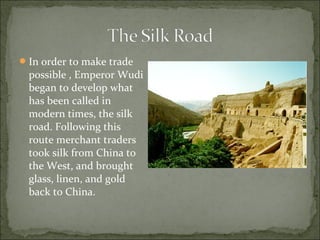
In order to make trade
possible , Emperor Wudi
began to develop what
has been called in
modern times, the silk
road. Following this
route merchant traders
took silk from China to
the West, and brought
glass, linen, and gold
back to China.
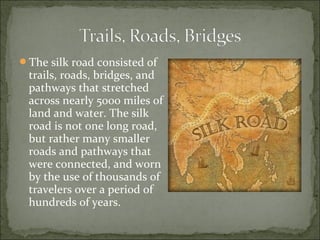
The silk road consisted of
trails, roads, bridges, and
pathways that stretched
across nearly 5000 miles of
land and water. The silk
road is not one long road,
but rather many smaller
roads and pathways that
were connected, and worn
by the use of thousands of
travelers over a period of
hundreds of years.
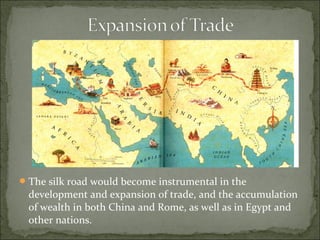
The silk road would become instrumental in the
development and expansion of trade, and the accumulation
of wealth in both China and Rome, as well as in Egypt and
other nations.
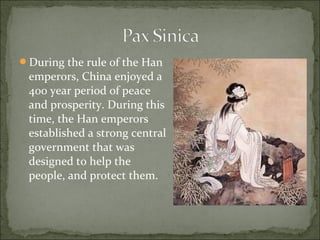
During the rule of the Han
emperors, China enjoyed a
400 year period of peace
and prosperity. During this
time, the Han emperors
established a strong central
government that was
designed to help the
people, and protect them.
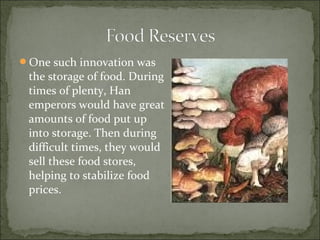
One such innovation was
the storage of food. During
times of plenty, Han
emperors would have great
amounts of food put up
into storage. Then during
difficult times, they would
sell these food stores,
helping to stabilize food
prices.
 The Han also
abolished the practice
of giving powerful
government positions
to members of the
royal family. Emperor
Wudi instituted a
series of written
exams. Anyone could
take the tests. Those
who received the
highest scores were
given posts in the
government.
By C.E. 220 the Han
Dynasty had fallen into a
weakened state. Warriors
from competing areas
began fighting one
another, throwing China
into a period of civil war
that would last for many
years.
Even though the Han
Dynasty had ended,
many of the
contributions made by
this dynasty would
become interwoven
into Chinese culture,
and would endure
through the ages to
modern times.
The religious history of China
is complex, and has evolved
over the centuries. Deeply
interwoven into their beliefs
is the worship of their
ancestors. The Chinese
believed that the spirits of
their ancestors were
watching over them, and that
they could be called upon
during difficult times.
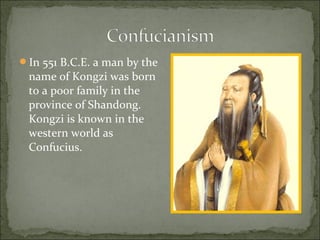
In 551 B.C.E. a man by the
name of Kongzi was born
to a poor family in the
province of Shandong.
Kongzi is known in the
western world as
Confucius.
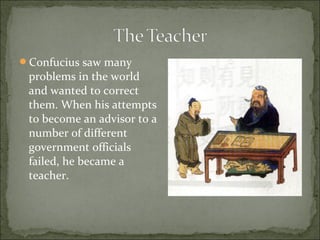
Confucius saw many
problems in the world
and wanted to correct
them. When his attempts
to become an advisor to a
number of different
government officials
failed, he became a
teacher.
The most important
things to Confucius were
peace, and order. He felt
that everyone had a
proper role in society,
and that if people were
willing to accept their
role, and fulfill it, that
peace and harmony
would abound.
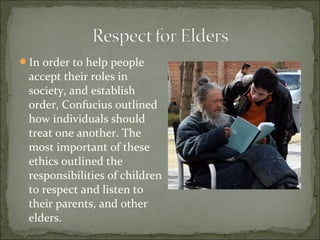
In order to help people
accept their roles in
society, and establish
order, Confucius outlined
how individuals should
treat one another. The
most important of these
ethics outlined the
responsibilities of children
to respect and listen to
their parents, and other
elders.
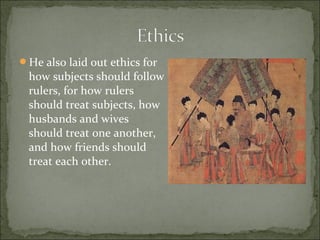
He also laid out ethics for
how subjects should follow
rulers, for how rulers
should treat subjects, how
husbands and wives
should treat one another,
and how friends should
treat each other.
During his own lifetime
Confucius’ teachings were
not widely accepted.
However, within a
hundred years, they were
being used by the
emperor to help him rule,
and eventually became a
widely followed religion.
Confucianism would
remain a powerful force in
Chinese history.
A contemporary of
Confucius was a teacher
named Lao’tze. Most of
what we know about
Lao’tze is so heavily mixed
with legend, that it is
difficult to know what is
true, and what is myth.
Laozi taught that a force
known as the Dao permeated
all living things. He told his
followers that the most
important thing an individual
could do is to reject the world,
and their desires for worldly
possessions and power, and
commune with nature,
bringing ones self into a state
of oneness with the Dao.
Many individuals in China
practices both
Confucianism and
Daoism. Confucianism
taught them how to
behave towards one
another, while Daoism
taught them how to
behave towards the
natural world, and with
themselves personally.
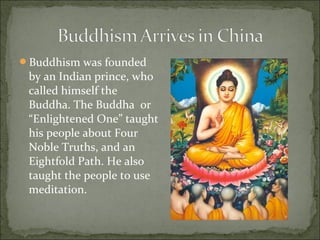
Buddhism was founded
by an Indian prince, who
called himself the
Buddha. The Buddha or
“Enlightened One” taught
his people about Four
Noble Truths, and an
Eightfold Path. He also
taught the people to use
meditation.
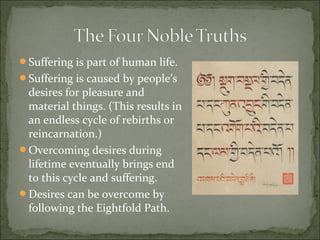
Suffering is part of human life.
Suffering is caused by people’s
desires for pleasure and
material things. (This results in
an endless cycle of rebirths or
reincarnation.)
Overcoming desires during
lifetime eventually brings end
to this cycle and suffering.
Desires can be overcome by
following the Eightfold Path.
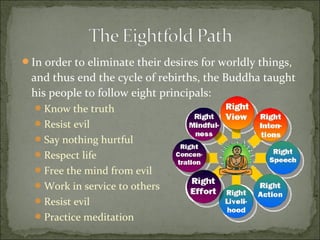
In order to eliminate their desires for worldly things,
and thus end the cycle of rebirths, the Buddha taught
his people to follow eight principals:
Know the truth
Resist evil
Say nothing hurtful
Respect life
Free the mind from evil
Work in service to others
Resist evil
Practice meditation
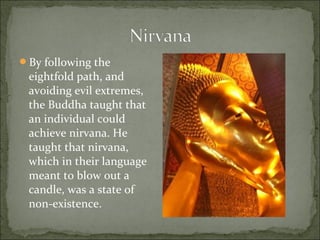
By following the
eightfold path, and
avoiding evil extremes,
the Buddha taught that
an individual could
achieve nirvana. He
taught that nirvana,
which in their language
meant to blow out a
candle, was a state of
non-existence.
Nirvana was not a place,
like heaven, but rather an
actual state of non-
existence. When someone
reached nirvana, their soul
was in harmony with the
universe, and they would
cease to exist.
Emperor
reforms
govt,
improves
efficiency
Life
improves,
lower taxes,
more
farming
Problems
begin (wars,
invasions)
Taxes go up,
conscription,
farming
neglected
Increased
spending,
corruption
Droughts,
floods,
famines
Respect lost,
rebels attack
landlords
Rebels
united
strong
leader,
attack
emperor
Emperor is
defeated
A new
dynasty
comes to
power
Start
The
Dynastic
Cycle
Chinese Dynasties and Their Achievements
Dynasties
Notable
Rulers
Achievements
Xia Dynasty
2100-1800 B.C.E.
Aryans • Migrated into the area and conquered the local
peoples
• Developed superior weaponry and technology
Shang Dynasty
1500-1100 B.C.E.
Thirty
separate
kings
• Ruled from a succession of seven different
capitals.
• Invention of writing
Zhou Dynasty
1122-256 B.C.E.
Kings +
Noblemen
• Expansion
• Regional rulers
Qin Dynasty
221-206 B.C.E.
Qin • Centralization of authority
• Written laws
• Building projects (Great Wall of China)
Han Dynasty Han
Wudi
• 400 year rule
• Exploration (Zhang Qian)
• Expansion of trade
• Silk Road
• Pax Sinica
• Food reserves
• Merit-based appointments
Chinese Philosophies/Religions
Philosophy/
Religion
Founders Characteristics
Confucianism Confucius
(Kongzi)
• Peace and order
• Respect for elders
• Ethical human relationships
Daoism Lao’tze • Reject material things
• Commune with nature
• Become one with Dao (force within all things)
Buddhism Buddha • Four Noble Truths
• Eightfold path
• Nirvana
• Harmony with the universe

Chinese civilization

  • 1.
  • 2.
    Chinese civilization extends backwardsin history in an unbroken chain for nearly four thousand years. Throughout this time, the Chinese people have been instrumental in developing new technologies and advancing human knowledge.
  • 3.
    The Chinese havebeen ruled by a succession of dynasties (families that pass the right to rule the nation from one generation to the next).
  • 4.
    Before China developedthe ability to write down their history, stories were passed down orally from one generation to the next. The story of the Xia Dynasty is such a case. For decades historians have believed that the Xia Dynasty was just legend. Then in 1959 evidence was found that showed that this dynasty may not have just been legend, but may have really existed. The truth about whether or not the Xia Dynasty really existed is still being debated.
  • 5.
    The Xia familywould have ruled China from around 2100 B.C.E. until around 1800 B.C.E. They are believed to have been Aryans, who migrated into the area, and who were able to conquer the local peoples using their superior weaponry and technology.
  • 6.
    Like the XiaDynasty, the Shang Dynasty was once thought to be only a myth or legend. It is now considered by all historians as a true dynasty. Because many historians do not consider the Xia Dynasty a true dynasty, the Shang Dynasty is often called the first true Chinese dynasty.
  • 7.
    The Shang Dynastyruled China from around 1500 B.C.E. until 1100 B.C.E. During this 400 year period of history, Chinese tradition states that thirty separate kings ruled from a succession of seven different capitals.
  • 8.
    One of themost important contributions made during the period that the Shang Dynasty ruled China was the invention of writing. The earliest written records found in China come from this time period.
  • 9.
    The Zhou familywas able to defeat and overthrow the last Shang Dynasty king in 1028 B.C.E. They claimed that the Shang Dynasty had lost the mandate of heaven due to their poor governing. The Zhou Dynasty would become the longest lasting dynasty in Chinese history, lasting over 800 years.
  • 10.
    The Zhou setup a new economy, rearranging the affairs of the kingdom. As they did so, the borders of their kingdom swelled, and they were able to maintain control over the people they conquered effectively.
  • 11.
    Zhou kings assigned nobleman,who were usually members of the royal family, to serve as regional rulers. These nobleman owned the land, and were given absolute authority over it. The peasants could not own land, but instead worked the land for the noblemen.
  • 12.
    This form ofgovernment worked well for several hundred years. However, overtime the king slowly became less powerful, while the nobleman grew in power.
  • 13.
    In 771 B.C.while fighting against a rebellion, the Zhou armies suffered a terrible defeat. As a result, the Zhou Dynasty lost even more power to the noblemen. They managed to hang on to power for another 500 years. Then in 256 B.C.E. the Zhou Dynasty was finally overthrown.
  • 14.
    By 221 B.C.E.a man by the name of Qin had overthrown all remaining members of the Zhou Dynasty, and all other opposition, allowing him to place himself as the ruler of China.
  • 15.
    The Qin Dynastywould only last about 11 years. Yet during these short years, this dynasty would make changes that would effect the history of China for thousands of years. So influential was Qin, that the name of the nation, China, is a derivative of his name.
  • 16.
    In order toshow his importance and power, Qin added a new name to his own. He began calling himself Qin Shihuangdi, which means Qin, the first emperor of China.
  • 17.
    Qin Shihuangdi again reorganizedthe affairs of China. Instead of a system of nobleman, Qin wanted everything to be under his direct authority and control.
  • 18.
    He established astrict set of written laws that were recognized throughout China, and setup military control in each region of China so that local nobleman could not rebel against the emperor. All people are subject to me, Every field harvest, and Everyone can have enough food.
  • 19.
    To make Chinathe most glorious nation on Earth, Qin needed labor. He used the peasants, forcing them to work under slave conditions, so that he could build roads, bridges, canals, buildings, and his most famous building project of all, the Great Wall of China.
  • 20.
    Early emperors hadbuilt walls in the northern territories to protect their nation against attack from outside forces. These walls were spread across the landscape, and not connected. Qin ordered his people to connect the existing walls together, and to expand them, eventually covering a distance of over 4000 miles. THE GREAT WALL
  • 21.
    Over 300,000 peasants wereforced to help build the Great Wall of China. Many of them died during the construction. After working for several years, the Great Wall of China was completed, and still stands today as one of the great building projects in human history.
  • 22.
    In the year207 B.C. a new dynasty began to rule China. This dynasty was led by a peasant whose name was Liu Bang. Liu Bang had grown tired of the brutal leadership of the Qin Dynasty. Many other people also were tired of the Qin Peace thru war and plunder.
  • 23.
    Liu Bang proclaimedthat the Qin had lost the mandate of heaven, or the right to rule the nation. He was able to overthrow them, and establish himself as the new emperor of China, and the first emperor of the Han Dynasty.
  • 24.
    The Han Dynasty wouldrule China for the next 400 years. During this time period they would be one of the wealthiest and most powerful nations on Earth. Their achievements would only be surpassed by the Roman Empire.
  • 25.
    Because of itslocation amidst high mountains and surrounded on many sides by water, China was isolated from much of the rest of the world. As their civilization flourished and their wealth increased, they were largely unaware of what advancements were taking place in the nations around them.
  • 26.
    In 139 B.C.E.,a Han emperor by the name of Wudi sent out one of his generals, Zhang Qian, to explore other nations. This general and his army marched throughout distant regions visiting other civilizations and nomadic tribes.
  • 27.
    The armies ofZhang Qian were viewed as a threat by many of these nomadic tribes, as a result, these tribes attacked and destroyed many of Zhang Qian's men. Zhang Qian himself was captured and kept in bondage for a period of 10 years. After 13 years, Zhang Qian was finally able to return to the emperor and report.
  • 28.
    He told Wudiabout stories he had heard from the nomadic tribes of a great civilization to the West that equaled the glory of China. This was the first time Wudi had heard anything of any other civilizations. Wudi was a smart and wise ruler, who saw the potential for trade between the two cultures.
  • 29.
    In order tomake trade possible , Emperor Wudi began to develop what has been called in modern times, the silk road. Following this route merchant traders took silk from China to the West, and brought glass, linen, and gold back to China.
  • 30.
    The silk roadconsisted of trails, roads, bridges, and pathways that stretched across nearly 5000 miles of land and water. The silk road is not one long road, but rather many smaller roads and pathways that were connected, and worn by the use of thousands of travelers over a period of hundreds of years.
  • 31.
    The silk roadwould become instrumental in the development and expansion of trade, and the accumulation of wealth in both China and Rome, as well as in Egypt and other nations.
  • 32.
    During the ruleof the Han emperors, China enjoyed a 400 year period of peace and prosperity. During this time, the Han emperors established a strong central government that was designed to help the people, and protect them.
  • 33.
    One such innovationwas the storage of food. During times of plenty, Han emperors would have great amounts of food put up into storage. Then during difficult times, they would sell these food stores, helping to stabilize food prices.
  • 34.
     The Hanalso abolished the practice of giving powerful government positions to members of the royal family. Emperor Wudi instituted a series of written exams. Anyone could take the tests. Those who received the highest scores were given posts in the government.
  • 35.
    By C.E. 220the Han Dynasty had fallen into a weakened state. Warriors from competing areas began fighting one another, throwing China into a period of civil war that would last for many years.
  • 36.
    Even though theHan Dynasty had ended, many of the contributions made by this dynasty would become interwoven into Chinese culture, and would endure through the ages to modern times.
  • 37.
    The religious historyof China is complex, and has evolved over the centuries. Deeply interwoven into their beliefs is the worship of their ancestors. The Chinese believed that the spirits of their ancestors were watching over them, and that they could be called upon during difficult times.
  • 38.
    In 551 B.C.E.a man by the name of Kongzi was born to a poor family in the province of Shandong. Kongzi is known in the western world as Confucius.
  • 39.
    Confucius saw many problemsin the world and wanted to correct them. When his attempts to become an advisor to a number of different government officials failed, he became a teacher.
  • 40.
    The most important thingsto Confucius were peace, and order. He felt that everyone had a proper role in society, and that if people were willing to accept their role, and fulfill it, that peace and harmony would abound.
  • 41.
    In order tohelp people accept their roles in society, and establish order, Confucius outlined how individuals should treat one another. The most important of these ethics outlined the responsibilities of children to respect and listen to their parents, and other elders.
  • 42.
    He also laidout ethics for how subjects should follow rulers, for how rulers should treat subjects, how husbands and wives should treat one another, and how friends should treat each other.
  • 43.
    During his ownlifetime Confucius’ teachings were not widely accepted. However, within a hundred years, they were being used by the emperor to help him rule, and eventually became a widely followed religion. Confucianism would remain a powerful force in Chinese history.
  • 44.
    A contemporary of Confuciuswas a teacher named Lao’tze. Most of what we know about Lao’tze is so heavily mixed with legend, that it is difficult to know what is true, and what is myth.
  • 45.
    Laozi taught thata force known as the Dao permeated all living things. He told his followers that the most important thing an individual could do is to reject the world, and their desires for worldly possessions and power, and commune with nature, bringing ones self into a state of oneness with the Dao.
  • 46.
    Many individuals inChina practices both Confucianism and Daoism. Confucianism taught them how to behave towards one another, while Daoism taught them how to behave towards the natural world, and with themselves personally.
  • 47.
    Buddhism was founded byan Indian prince, who called himself the Buddha. The Buddha or “Enlightened One” taught his people about Four Noble Truths, and an Eightfold Path. He also taught the people to use meditation.
  • 48.
    Suffering is partof human life. Suffering is caused by people’s desires for pleasure and material things. (This results in an endless cycle of rebirths or reincarnation.) Overcoming desires during lifetime eventually brings end to this cycle and suffering. Desires can be overcome by following the Eightfold Path.
  • 49.
    In order toeliminate their desires for worldly things, and thus end the cycle of rebirths, the Buddha taught his people to follow eight principals: Know the truth Resist evil Say nothing hurtful Respect life Free the mind from evil Work in service to others Resist evil Practice meditation
  • 50.
    By following the eightfoldpath, and avoiding evil extremes, the Buddha taught that an individual could achieve nirvana. He taught that nirvana, which in their language meant to blow out a candle, was a state of non-existence.
  • 51.
    Nirvana was nota place, like heaven, but rather an actual state of non- existence. When someone reached nirvana, their soul was in harmony with the universe, and they would cease to exist.
  • 52.
    Emperor reforms govt, improves efficiency Life improves, lower taxes, more farming Problems begin (wars, invasions) Taxesgo up, conscription, farming neglected Increased spending, corruption Droughts, floods, famines Respect lost, rebels attack landlords Rebels united strong leader, attack emperor Emperor is defeated A new dynasty comes to power Start The Dynastic Cycle
  • 53.
    Chinese Dynasties andTheir Achievements Dynasties Notable Rulers Achievements Xia Dynasty 2100-1800 B.C.E. Aryans • Migrated into the area and conquered the local peoples • Developed superior weaponry and technology Shang Dynasty 1500-1100 B.C.E. Thirty separate kings • Ruled from a succession of seven different capitals. • Invention of writing Zhou Dynasty 1122-256 B.C.E. Kings + Noblemen • Expansion • Regional rulers Qin Dynasty 221-206 B.C.E. Qin • Centralization of authority • Written laws • Building projects (Great Wall of China) Han Dynasty Han Wudi • 400 year rule • Exploration (Zhang Qian) • Expansion of trade • Silk Road • Pax Sinica • Food reserves • Merit-based appointments
  • 54.
    Chinese Philosophies/Religions Philosophy/ Religion Founders Characteristics ConfucianismConfucius (Kongzi) • Peace and order • Respect for elders • Ethical human relationships Daoism Lao’tze • Reject material things • Commune with nature • Become one with Dao (force within all things) Buddhism Buddha • Four Noble Truths • Eightfold path • Nirvana • Harmony with the universe