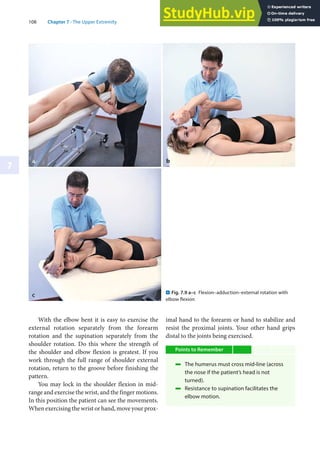






An Illustrated
Guide
PNF in Practice
Adler·Beckers· Buck
Fourth Edition
PNF in Practice
Susan S. Adler
Dominiek Beckers
Math Buck
PNF in Practice
An Illustrated Guide
Fourth fully revised edition
With 222 figures in 646 separate illustrations
123
Susan S. Adler
Chicago, IL, USA
Dominiek Beckers
Maasmechelen, Belgium
Math Buck
Beek, The Netherlands
ISBN-13 978-3-642-34987-4 ISBN 978-3-642-34988-1 (eBook)
DOI 10.1007/978-3-642-34988-1
Springer Medizin
© Springer-Verlag Berlin Heidelberg 1993, 2000, 2008, 2014
Library of Congress Control Number: 2013943281
This work is subject to copyright. All rights are reserved by the Publisher, whether the whole or part of
the material is concerned, specifically the rights of translation, reprinting, reuse of illustrations, recitation,
broadcasting, reproduction on microfilms or in any other physical way, and transmission or information storage
and retrieval, electronic adaptation, computer software, or by similar or dissimilar methodology now known
or hereafter developed. Exempted from this legal reservation are brief excerpts in connection with reviews or
scholarly analysis or material supplied specifically for the purpose of being entered and executed on a computer
system, for exclusive use by the purchaser of the work. Duplication of this publication or parts thereof is
permitted only under the provisions of the Copyright Law of the Publisher’s location, in its current version, and
permission for use must always be obtained from Springer. Permissions for use may be obtained through
RightsLink at the Copyright Clearance Center. Violations are liable to prosecution under the respective Copyright
Law.
The use of general descriptive names, registered names, trademarks, service marks, etc. in this publication does
not imply, even in the absence of a specific statement, that such names are exempt from the relevant protective
laws and regulations and therefore free for general use. While the advice and information in this book are be-
lieved to be true and accurate at the date of publication, neither the authors nor the editors nor the publisher
can accept any legal responsibility for any errors or omissions that may be made. The publisher makes no
warranty, express or implied, with respect to the material contained herein.
Editor: Marga Botsch, Heidelberg
Project Management: Birgit Wucher, Heidelberg
Copyediting: Isabella Athanassiou, Bonn
Project Coordination: Heidemarie Wolter, Heidelberg
Cover Design: deblik Berlin
Cover IIlustration: © Dominiek Beckers
Typesetting: Fotosatz-Service Köhler GmbH – Reinhold Schöberl, Würzburg
Printed on acid-free paper
Springer Medizin is brand of Springer
Springer is part of Springer Science+Business Media (www.springer.com)
V
Preface
Proprioceptive neuromuscular facilitation (PNF) is a philosophy and a concept of treatment.
The PNF philosophy is timeless, and the concept is a continuous process of growth. This
fourth edition of our book, with a complete review and full-color figures and photographs,
better user-friendly layout, and integration of the latest developments, aims to support this
growth. The first chapter is new and describes the position of the PNF concept within the
current holistic treatment spectrum.
PNF has been one of the most recognized treatment concepts in physical therapy since the
1940s. Dr. Kabat and Margaret (Maggie) Knott started and continued to expand and develop
the treatment techniques and procedures after their move to Vallejo, California, in 1947. After
Dorothy Voss joined the team in 1953, Maggie and Dorothy wrote the first PNF book, pub-
lished in 1956.
At first, mostly patients with multiple sclerosis and poliomyelitis were treated with this
method. With experience it became clear that this treatment approach was effective for
patients with a wide range of diagnoses. Today, patients with neurological, traumatic, as well
as orthopedic symptoms are treated with this concept.
The 3- and 6-month PNF courses in Vallejo began in the 1950s. Physical therapists from all
over the world came to Vallejo to learn the theoretical and practical aspects of the PNF con-
cept. In addition, Knott and Voss traveled in the United States and abroad to give introduc-
tory courses in the concept.
When Maggie Knott died in 1978 her work at Vallejo was carried on by Carolyn Oei Hvisten-
dahl. She was succeeded by Hink Mangold as director of the PNF program. Tim Josten is the
present program director. Sue Adler, Gregg Johnson, and Vicky Saliba have also continued
Maggie’s work as teachers of the PNF concept. Sue Adler designed the International PNF As-
sociation (IPNFA) Advanced and Instructor course programs.
The authors acknowledge their debt to these outstanding people, and also to all members of
the International PNF Association (IPNFA), and hope that this book will encourage others to
carry on the work.
Developments in the PNF concept are closely followed throughout the world. It is now pos-
sible to take recognized training courses in many countries given by qualified PNF instructors.
There are other excellent books dealing with the PNF method, but we felt there was a need for
a comprehensive coverage of the practical tools in text and illustrations. This book should thus
be seen as a practical guide and used in combination with existing textbooks.
This book covers the procedures, techniques, and patterns within PNF. Their application to
patient treatment is discussed throughout, with special attention on mat activities, gait, and self-
care. The emphasis within this book is twofold: developing an understanding of the principles
that underlie PNF, and showing through pictures rather than with words how to perform the
patterns and activities. Skill in applying the principles and practices of PNF to patient treatment
cannot be learned only from a book. We recommend that the learner combine reading with
classroom practice and patient treatment under the supervision of a skilled PNF practitioner.
VI Preface
Movement is our way to interact with our environment. Such interactions are directed by the
mechanism of motor learning. Integration of motor learning principles includes a progression
from hands-on to hands-off treatments; it includes goal-orientated functional activities and
independence. Based on the untapped existing potential of all patients, the therapist will al-
ways focus on mobilizing these reserves to reach the highest level of function. Especially in the
first and cognitive stage of motor control, the therapist’s manual facilitation will be a helpful
tool in reaching this goal. This includes goals on the level of body structures as well as on the
activity level and the participation level (ICF).
This fully revised fourth edition includes a description of how the principles of the Interna-
tional Classification of Functioning, Disability and Health (ICF), and aspects of motor learning
and motor control (from »hands-on« to »hands-off« management), are applied in modern PNF
evaluation and treatment. The chapter on »Activities of Daily Living« has been expanded with
new color photos and more in-depth text instructions. The new design and layout highlight the
clearly structured way in which the philosophy, basic procedures, and treatment patterns of PNF
are presented. Thus, this textbook provides a systematic and easily accessible guide to learning
and understanding PNF as a practical tool and using it to full effect in patient treatment.
A special note of thanks goes to the direction and physiotherapy colleagues of Adelante, our
Rehabilitation Centre in Hoensbroek (The Netherlands), our colleague Lisan Scheepers for
acting as a model, and Ben Eisermann for the drawings.
We would like to thank our colleague Laurie Boston, PNF instructor in Switzerland, for all her
support in correcting the translations and contents of this manuscript.
We are also grateful to all our colleagues, PNF instructors, and members of the IPNFA, for their
cooperation, their sharing of knowledge, their teaching, and for proceeding with this concept.
But most of all we are devoted and grateful to our patients; without them this work would not
be possible.
To Maggie Knott, teacher and friend.
Devoted to her patients,
dedicated to her students,
a pioneer in profession
Maggie Knott
S.S. Adler, D. Beckers, M. Buck
June 2013
VII
The Authors
Susan Adler
4 Certified as Physical Therapist at Northwestern University, Chicago,
Illinois
4 Master of Science in Physical Therapy at the University of Southern
California, Los Angeles
4 PNF education in 1962 at the Kaiser Foundation Rehabilitation Center
in Vallejo, California. Worked and taught with Maggie Knott
4 International PNF senior instructor of the IPNFA. Developed and led
PNF courses in the USA and Europe
Dominiek Beckers
4 Master of Physical Therapy, Movement Science and Rehabilitation
at the University of Leuven, Belgium, in 1975
4 Physical Therapist at the Rehabilitation Center of Hoensbroek,
The Netherlands, since 1975
4 International PNF senior instructor of the IPNFA
4 Instructor SCI Rehabilitation
4 Author of numerous books and articles
Math Buck
4 Certified as Physical Therapist at the Hoge School in Heerlen,
The Netherlands, in 1972
4 Physical Therapist at the Rehabilitation Center of Hoensbroek,
The Netherlands, since 1973
4 International PNF instructor of the IPNFA since 1984. Currently a senior
instructor and honorary member of the IPNFA
4 Coauthor of numerous books and articles
Table of Contents
1 Introduction . . . . . . . . . . . . . . . . . . . . . . . . . . . . . . . . . . . . . . . . . . . . . . . 1
M. Buck
1.1 The PNF Concept in Modern Holistic Treatment . . . . . . . . . . . . . . . . . . . . . . . . . 2
1.2 PNF: Definition, Philosophy, Neurophysiological Basics . . . . . . . . . . . . . . . . . . . . 11
1.3 Test Your Knowledge: Question . . . . . . . . . . . . . . . . . . . . . . . . . . . . . . . . . . . . 12
Further Reading . . . . . . . . . . . . . . . . . . . . . . . . . . . . . . . . . . . . . . . . . . . . . . 12
References . . . . . . . . . . . . . . . . . . . . . . . . . . . . . . . . . . . . . . . . . . . . . . . . . . 12
2 Basic Procedures for Facilitation . . . . . . . . . . . . . . . . . . . . . . . . . . . . . . . . . 15
M. Buck
2.1 Optimal Resistance . . . . . . . . . . . . . . . . . . . . . . . . . . . . . . . . . . . . . . . . . . . . 17
2.2 Irradiation and Reinforcement . . . . . . . . . . . . . . . . . . . . . . . . . . . . . . . . . . . . . 18
2.3 Tactile Stimulus (Manual Contact) . . . . . . . . . . . . . . . . . . . . . . . . . . . . . . . . . . 18
2.4 Body Position and Body Mechanics . . . . . . . . . . . . . . . . . . . . . . . . . . . . . . . . . 22
2.5 Verbal Stimulation (Commands) . . . . . . . . . . . . . . . . . . . . . . . . . . . . . . . . . . . 22
2.6 Visual Stimulus . . . . . . . . . . . . . . . . . . . . . . . . . . . . . . . . . . . . . . . . . . . . . . . 23
2.7 Traction and Approximation . . . . . . . . . . . . . . . . . . . . . . . . . . . . . . . . . . . . . . 24
2.8 Stretch . . . . . . . . . . . . . . . . . . . . . . . . . . . . . . . . . . . . . . . . . . . . . . . . . . . . 25
2.9 Timing . . . . . . . . . . . . . . . . . . . . . . . . . . . . . . . . . . . . . . . . . . . . . . . . . . . . 26
2.10 Patterns . . . . . . . . . . . . . . . . . . . . . . . . . . . . . . . . . . . . . . . . . . . . . . . . . . . 27
2.11 Test Your Knowledge: Questions . . . . . . . . . . . . . . . . . . . . . . . . . . . . . . . . . . . 27
Further Reading . . . . . . . . . . . . . . . . . . . . . . . . . . . . . . . . . . . . . . . . . . . . . . 30
References . . . . . . . . . . . . . . . . . . . . . . . . . . . . . . . . . . . . . . . . . . . . . . . . . . 30
3 Techniques . . . . . . . . . . . . . . . . . . . . . . . . . . . . . . . . . . . . . . . . . . . . . . . . 33
D. Beckers
3.1 Introduction . . . . . . . . . . . . . . . . . . . . . . . . . . . . . . . . . . . . . . . . . . . . . . . . . 34
3.2 Rhythmic Initiation . . . . . . . . . . . . . . . . . . . . . . . . . . . . . . . . . . . . . . . . . . . . 34
3.3 Combination of Isotonics . . . . . . . . . . . . . . . . . . . . . . . . . . . . . . . . . . . . . . . . 35
3.4 Reversal of Antagonists . . . . . . . . . . . . . . . . . . . . . . . . . . . . . . . . . . . . . . . . . 37
3.5 Repeated Stretch (Repeated Contractions) . . . . . . . . . . . . . . . . . . . . . . . . . . . . . 43
3.6 Contract–Relax . . . . . . . . . . . . . . . . . . . . . . . . . . . . . . . . . . . . . . . . . . . . . . . 45
3.7 Hold–Relax . . . . . . . . . . . . . . . . . . . . . . . . . . . . . . . . . . . . . . . . . . . . . . . . . 47
3.8 Replication . . . . . . . . . . . . . . . . . . . . . . . . . . . . . . . . . . . . . . . . . . . . . . . . . 49
3.9 PNF Techniques and Their Goals . . . . . . . . . . . . . . . . . . . . . . . . . . . . . . . . . . . . 49
3.10 Test Your Knowledge: Questions . . . . . . . . . . . . . . . . . . . . . . . . . . . . . . . . . . . 50
Further Reading . . . . . . . . . . . . . . . . . . . . . . . . . . . . . . . . . . . . . . . . . . . . . . 50
References . . . . . . . . . . . . . . . . . . . . . . . . . . . . . . . . . . . . . . . . . . . . . . . . . . 51
4 Patient Treatment . . . . . . . . . . . . . . . . . . . . . . . . . . . . . . . . . . . . . . . . . . . 53
M. Buck, D. Beckers
4.1 Introduction . . . . . . . . . . . . . . . . . . . . . . . . . . . . . . . . . . . . . . . . . . . . . . . . . 54
4.2 Assessment . . . . . . . . . . . . . . . . . . . . . . . . . . . . . . . . . . . . . . . . . . . . . . . . . 54
4.3 Hypothesis . . . . . . . . . . . . . . . . . . . . . . . . . . . . . . . . . . . . . . . . . . . . . . . . . 55
4.4 Tests for Causal Impairments and Activity Limitations . . . . . . . . . . . . . . . . . . . . . 55
IX
Table of Contents
4.5 Treatment Goals . . . . . . . . . . . . . . . . . . . . . . . . . . . . . . . . . . . . . . . . . . . . . . 55
4.6 Treatment Planning and Treatment Design . . . . . . . . . . . . . . . . . . . . . . . . . . . . 56
4.7 Re-Test for Causal Impairments and Activity Limitations . . . . . . . . . . . . . . . . . . . . 58
4.8 Treatment Examples . . . . . . . . . . . . . . . . . . . . . . . . . . . . . . . . . . . . . . . . . . . 58
4.9 Test Your Knowledge: Questions . . . . . . . . . . . . . . . . . . . . . . . . . . . . . . . . . . . 60
Further Reading . . . . . . . . . . . . . . . . . . . . . . . . . . . . . . . . . . . . . . . . . . . . . . 60
References . . . . . . . . . . . . . . . . . . . . . . . . . . . . . . . . . . . . . . . . . . . . . . . . . . 61
5 Patterns of Facilitation . . . . . . . . . . . . . . . . . . . . . . . . . . . . . . . . . . . . . . . . 63
D. Beckers
5.1 Introduction . . . . . . . . . . . . . . . . . . . . . . . . . . . . . . . . . . . . . . . . . . . . . . . . . 64
5.2 PNF Patterns . . . . . . . . . . . . . . . . . . . . . . . . . . . . . . . . . . . . . . . . . . . . . . . . 64
5.3 Test Your Knowledge: Questions . . . . . . . . . . . . . . . . . . . . . . . . . . . . . . . . . . . 66
Further Reading . . . . . . . . . . . . . . . . . . . . . . . . . . . . . . . . . . . . . . . . . . . . . . 68
References . . . . . . . . . . . . . . . . . . . . . . . . . . . . . . . . . . . . . . . . . . . . . . . . . . 68
6 The Scapula and Pelvis . . . . . . . . . . . . . . . . . . . . . . . . . . . . . . . . . . . . . . . . 69
M. Buck, D. Beckers
6.1 Introduction . . . . . . . . . . . . . . . . . . . . . . . . . . . . . . . . . . . . . . . . . . . . . . . . . 70
6.2 Applications . . . . . . . . . . . . . . . . . . . . . . . . . . . . . . . . . . . . . . . . . . . . . . . . . 70
6.3 Basic Procedures . . . . . . . . . . . . . . . . . . . . . . . . . . . . . . . . . . . . . . . . . . . . . . 70
6.4 Scapular Diagonals . . . . . . . . . . . . . . . . . . . . . . . . . . . . . . . . . . . . . . . . . . . . 72
6.5 Pelvic Diagonals . . . . . . . . . . . . . . . . . . . . . . . . . . . . . . . . . . . . . . . . . . . . . . 79
6.6 Symmetrical, Reciprocal, and Asymmetrical Exercises . . . . . . . . . . . . . . . . . . . . . 85
6.7 Test Your Knowledge: Questions . . . . . . . . . . . . . . . . . . . . . . . . . . . . . . . . . . . 88
Further Reading . . . . . . . . . . . . . . . . . . . . . . . . . . . . . . . . . . . . . . . . . . . . . . 88
Reference . . . . . . . . . . . . . . . . . . . . . . . . . . . . . . . . . . . . . . . . . . . . . . . . . . 88
7 The Upper Extremity . . . . . . . . . . . . . . . . . . . . . . . . . . . . . . . . . . . . . . . . . 89
D. Beckers
7.1 Introduction . . . . . . . . . . . . . . . . . . . . . . . . . . . . . . . . . . . . . . . . . . . . . . . . . 91
7.2 Basic Procedures . . . . . . . . . . . . . . . . . . . . . . . . . . . . . . . . . . . . . . . . . . . . . . 91
7.3 Flexion–Abduction–External Rotation . . . . . . . . . . . . . . . . . . . . . . . . . . . . . . . 93
7.4 Extension–Adduction–Internal Rotation . . . . . . . . . . . . . . . . . . . . . . . . . . . . . . 99
7.5 Flexion–Adduction–External Rotation . . . . . . . . . . . . . . . . . . . . . . . . . . . . . . . . 105
7.6 Extension–Abduction–Internal Rotation . . . . . . . . . . . . . . . . . . . . . . . . . . . . . . 111
7.7 Thrust and Withdrawal Combinations . . . . . . . . . . . . . . . . . . . . . . . . . . . . . . . . 117
7.8 Bilateral Arm Patterns . . . . . . . . . . . . . . . . . . . . . . . . . . . . . . . . . . . . . . . . . . 119
7.9 Changing the Patient’s Position . . . . . . . . . . . . . . . . . . . . . . . . . . . . . . . . . . . . 121
7.10 Test Your Knowledge: Questions . . . . . . . . . . . . . . . . . . . . . . . . . . . . . . . . . . . 125
Further Reading . . . . . . . . . . . . . . . . . . . . . . . . . . . . . . . . . . . . . . . . . . . . . . 125
8 The Lower Extremity . . . . . . . . . . . . . . . . . . . . . . . . . . . . . . . . . . . . . . . . . 127
M. Buck
8.1 Introduction . . . . . . . . . . . . . . . . . . . . . . . . . . . . . . . . . . . . . . . . . . . . . . . . . 128
8.2 Basic Procedures . . . . . . . . . . . . . . . . . . . . . . . . . . . . . . . . . . . . . . . . . . . . . . 128
8.3 Flexion–Abduction–Internal Rotation . . . . . . . . . . . . . . . . . . . . . . . . . . . . . . . . 130
8.4 Extension–Adduction–External Rotation . . . . . . . . . . . . . . . . . . . . . . . . . . . . . . 136
X Table of Contents
8.5 Flexion–Adduction–External Rotation . . . . . . . . . . . . . . . . . . . . . . . . . . . . . . . . 142
8.6 Extension–Abduction–Internal Rotation . . . . . . . . . . . . . . . . . . . . . . . . . . . . . . 146
8.7 Bilateral Leg Patterns . . . . . . . . . . . . . . . . . . . . . . . . . . . . . . . . . . . . . . . . . . . 152
8.8 Changing the Patient’s Position . . . . . . . . . . . . . . . . . . . . . . . . . . . . . . . . . . . . 155
8.9 Test Your Knowledge: Questions . . . . . . . . . . . . . . . . . . . . . . . . . . . . . . . . . . . 162
References . . . . . . . . . . . . . . . . . . . . . . . . . . . . . . . . . . . . . . . . . . . . . . . . . . 162
9 The Neck . . . . . . . . . . . . . . . . . . . . . . . . . . . . . . . . . . . . . . . . . . . . . . . . . . 163
D. Beckers
9.1 Introduction . . . . . . . . . . . . . . . . . . . . . . . . . . . . . . . . . . . . . . . . . . . . . . . . . 164
9.2 Basic Procedures . . . . . . . . . . . . . . . . . . . . . . . . . . . . . . . . . . . . . . . . . . . . . . 164
9.3 Indications . . . . . . . . . . . . . . . . . . . . . . . . . . . . . . . . . . . . . . . . . . . . . . . . . . 166
9.4 Flexion to the Left, Extension to the Right . . . . . . . . . . . . . . . . . . . . . . . . . . . . . 166
9.5 Neck for Trunk . . . . . . . . . . . . . . . . . . . . . . . . . . . . . . . . . . . . . . . . . . . . . . . 171
9.6 Test Your Knowledge: Questions . . . . . . . . . . . . . . . . . . . . . . . . . . . . . . . . . . . 175
References . . . . . . . . . . . . . . . . . . . . . . . . . . . . . . . . . . . . . . . . . . . . . . . . . . 176
10 The Trunk . . . . . . . . . . . . . . . . . . . . . . . . . . . . . . . . . . . . . . . . . . . . . . . . . . 177
D. Beckers
10.1 Introduction . . . . . . . . . . . . . . . . . . . . . . . . . . . . . . . . . . . . . . . . . . . . . . . . . 178
10.2 Treatment Procedures . . . . . . . . . . . . . . . . . . . . . . . . . . . . . . . . . . . . . . . . . . 178
10.3 Chopping and Lifting . . . . . . . . . . . . . . . . . . . . . . . . . . . . . . . . . . . . . . . . . . . 179
10.4 Bilateral Leg Patterns for the Trunk . . . . . . . . . . . . . . . . . . . . . . . . . . . . . . . . . . 185
10.5 Combining Patterns for the Trunk . . . . . . . . . . . . . . . . . . . . . . . . . . . . . . . . . . . 190
10.6 Test Your Knowledge: Question . . . . . . . . . . . . . . . . . . . . . . . . . . . . . . . . . . . . 190
References . . . . . . . . . . . . . . . . . . . . . . . . . . . . . . . . . . . . . . . . . . . . . . . . . . 192
11 Mat Activities . . . . . . . . . . . . . . . . . . . . . . . . . . . . . . . . . . . . . . . . . . . . . . . 193
M. Buck
11.1 Introduction: Why Do Mat Activities? . . . . . . . . . . . . . . . . . . . . . . . . . . . . . . . . 194
11.2 Basic Procedures . . . . . . . . . . . . . . . . . . . . . . . . . . . . . . . . . . . . . . . . . . . . . . 194
11.3 Techniques . . . . . . . . . . . . . . . . . . . . . . . . . . . . . . . . . . . . . . . . . . . . . . . . . 195
11.4 Mat Activities . . . . . . . . . . . . . . . . . . . . . . . . . . . . . . . . . . . . . . . . . . . . . . . . 195
11.5 Patient Cases in Mat Activities . . . . . . . . . . . . . . . . . . . . . . . . . . . . . . . . . . . . . 231
11.6 Test Your Knowledge: Question . . . . . . . . . . . . . . . . . . . . . . . . . . . . . . . . . . . . 236
Further Reading . . . . . . . . . . . . . . . . . . . . . . . . . . . . . . . . . . . . . . . . . . . . . . 236
Reference . . . . . . . . . . . . . . . . . . . . . . . . . . . . . . . . . . . . . . . . . . . . . . . . . . 236
12 Gait Training . . . . . . . . . . . . . . . . . . . . . . . . . . . . . . . . . . . . . . . . . . . . . . . 237
D. Beckers
12.1 Introduction: The Importance of Walking . . . . . . . . . . . . . . . . . . . . . . . . . . . . . . 238
12.2 Basics of Normal Gait . . . . . . . . . . . . . . . . . . . . . . . . . . . . . . . . . . . . . . . . . . . 238
12.3 Gait Analysis: Observation and Manual Evaluation . . . . . . . . . . . . . . . . . . . . . . . 242
12.4 The Theory of Gait Training . . . . . . . . . . . . . . . . . . . . . . . . . . . . . . . . . . . . . . . 243
12.5 The Procedures of Gait Training . . . . . . . . . . . . . . . . . . . . . . . . . . . . . . . . . . . . 244
12.6 Practical Gait Training . . . . . . . . . . . . . . . . . . . . . . . . . . . . . . . . . . . . . . . . . . 245
12.7 Patient Cases in Gait Training . . . . . . . . . . . . . . . . . . . . . . . . . . . . . . . . . . . . . 268
12.8 Test Your Knowledge: Questions . . . . . . . . . . . . . . . . . . . . . . . . . . . . . . . . . . . 274
XI
Table of Contents
Further Reading . . . . . . . . . . . . . . . . . . . . . . . . . . . . . . . . . . . . . . . . . . . . . . 274
References . . . . . . . . . . . . . . . . . . . . . . . . . . . . . . . . . . . . . . . . . . . . . . . . . . 274
13 Vital Functions . . . . . . . . . . . . . . . . . . . . . . . . . . . . . . . . . . . . . . . . . . . . . . 275
M. Buck
13.1 Introduction . . . . . . . . . . . . . . . . . . . . . . . . . . . . . . . . . . . . . . . . . . . . . . . . . 276
13.2 Facial Muscles . . . . . . . . . . . . . . . . . . . . . . . . . . . . . . . . . . . . . . . . . . . . . . . . 276
13.3 Tongue Movements . . . . . . . . . . . . . . . . . . . . . . . . . . . . . . . . . . . . . . . . . . . . 286
13.4 Swallowing . . . . . . . . . . . . . . . . . . . . . . . . . . . . . . . . . . . . . . . . . . . . . . . . . 286
13.5 Speech Disorders . . . . . . . . . . . . . . . . . . . . . . . . . . . . . . . . . . . . . . . . . . . . . 288
13.6 Breathing . . . . . . . . . . . . . . . . . . . . . . . . . . . . . . . . . . . . . . . . . . . . . . . . . . 288
13.7 Test Your Knowledge: Questions . . . . . . . . . . . . . . . . . . . . . . . . . . . . . . . . . . . 291
Further Reading . . . . . . . . . . . . . . . . . . . . . . . . . . . . . . . . . . . . . . . . . . . . . . 291
14 Activities of Daily Living . . . . . . . . . . . . . . . . . . . . . . . . . . . . . . . . . . . . . . . 293
D. Beckers, M. Buck
14.1 Introduction . . . . . . . . . . . . . . . . . . . . . . . . . . . . . . . . . . . . . . . . . . . . . . . . . 294
14.2 Transfers . . . . . . . . . . . . . . . . . . . . . . . . . . . . . . . . . . . . . . . . . . . . . . . . . . . 296
14.3 Dressing and Undressing . . . . . . . . . . . . . . . . . . . . . . . . . . . . . . . . . . . . . . . . 297
14.4 Test Your Knowledge: Question . . . . . . . . . . . . . . . . . . . . . . . . . . . . . . . . . . . . 300
Further Reading . . . . . . . . . . . . . . . . . . . . . . . . . . . . . . . . . . . . . . . . . . . . . . 300
15 Test Your knowledge: Questions and Answers . . . . . . . . . . . . . . . . . . . . . . 301
D. Beckers, M. Buck
Service Section . . . . . . . . . . . . . . . . . . . . . . . . . . . . . . . . . . . . . . . . . . . . . . . . . . . 307
Glossary . . . . . . . . . . . . . . . . . . . . . . . . . . . . . . . . . . . . . . . . . . . . . . . . . . . . . . . . . 308
Index . . . . . . . . . . . . . . . . . . . . . . . . . . . . . . . . . . . . . . . . . . . . . . . . . . . . . . . . . . . 310
1
S.S. Adler et al., PNF in practice,
DOI 10.1007/978-3-642-34988-1_1, © Springer-Verlag Berlin Heidelberg 2014
1
Introduction
M. Buck
1.1 The PNF Concept in Modern Holistic Treatment – 2
1.1.1 The ICF Model – 2
1.1.2 Treatment and the PNF Concept: Basic Principles
and Techniques – 4
1.1.3 Learning Phases – 6
1.1.4 Motor Control and Motor Learning – 6
1.2 PNF: Definition, Philosophy,
Neurophysiological Basics – 11
1.2.1 Definition – 11
1.2.2 Philosophy – 11
1.2.3 Basic Neurophysiological Principles – 11
1.3 Test Your Knowledge: Question – 12
Further Reading – 12
References – 12
2 Chapter 1 · Introduction
1
1.1 The PNF Concept in Modern
Holistic Treatment
In this chapter, we illustrate the position of the PNF
concept within the current holistic treatment spec-
trum. Furthermore, we show how the PNF concept
works in conjunction with the assessment and treat-
ment of our patients.
On the one hand, a detailed assessment of the
clinimetry findings (measurements) and the experi-
ence and expertise of the therapist are necessary for
making clinical decisions. On the other hand, scien-
tific knowledge about motor learning and motor
control plays an important role in determining
the treatment goals. A patient treatment plan is es-
tablished from the results of the assessment and
from following the criteria of »evidenced-based
practice.« In addition, social norms and cultural
models also influence the treatment. We will briefly
describe the factors determining the choice of
therapy and their integration into the PNF concept
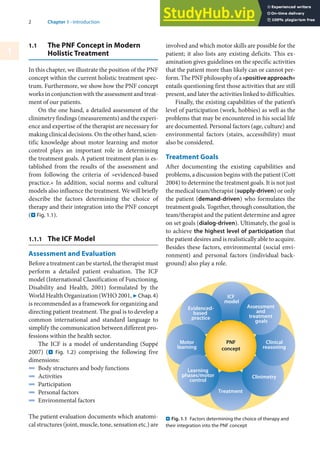
(. Fig. 1.1).
1.1.1 The ICF Model
Assessment and Evaluation
Before a treatment can be started, the therapist must
perform a detailed patient evaluation. The ICF
model (International Classification of Functioning,
Disability and Health, 2001) formulated by the
World Health Organization (WHO 2001, 7 Chap. 4)
is recommended as a framework for organizing and
directing patient treatment. The goal is to develop a
common international and standard language to
simplify the communication between different pro-
fessions within the health sector.
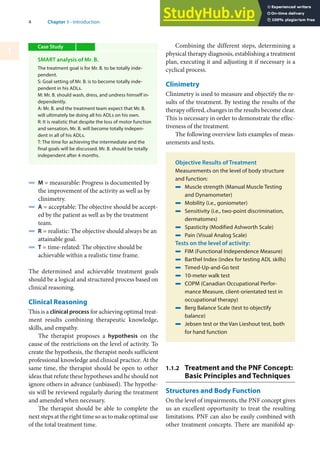
The ICF is a model of understanding (Suppé
2007) (. Fig. 1.2) comprising the following five
dimensions:
4 Body structures and body functions
4 Activities
4 Participation
4 Personal factors
4 Environmental factors
The patient evaluation documents which anatomi-
cal structures (joint, muscle, tone, sensation etc.) are
involved and which motor skills are possible for the
patient; it also lists any existing deficits. This ex-
amination gives guidelines on the specific activities
that the patient more than likely can or cannot per-
form.ThePNFphilosophyofa»positiveapproach«
entails questioning first those activities that are still
present, and later the activities linked to difficulties.
Finally, the existing capabilities of the patient’s
level of participation (work, hobbies) as well as the
problems that may be encountered in his social life
are documented. Personal factors (age, culture) and
environmental factors (stairs, accessibility) must
also be considered.
Treatment Goals
After documenting the existing capabilities and
problems, a discussion begins with the patient (Cott
2004) to determine the treatment goals. It is not just
the medical team/therapist (supply-driven) or only
the patient (demand-driven) who formulates the
treatment goals. Together, through consultation, the
team/therapist and the patient determine and agree
on set goals (dialog-driven). Ultimately, the goal is
to achieve the highest level of participation that
the patient desires and is realistically able to acquire.
Besides these factors, environmental (social envi-
ronment) and personal factors (individual back-
ground) also play a role.
. Fig. 1.1 Factors determining the choice of therapy and
their integration into the PNF concept
1
3
1.1 · The PNF Concept in Modern Holistic Treatment
Thetreatmentgoalsthatwereformulatedtogeth-
er with the patient are adjusted and redefined on an
ongoing basis. Thus, the patient becomes an active
member andafull-fledgeddiscussionpartnerwithin
the team, which consists of the rehabilitation doctor,
the physical, speech, and occupational therapist, the
nurse, the psychologist, social workers, and others.
After the jointly defined treatment goals are
clear, an objective should be formulated for each
goal using the SMART analysis.
SMART (Oosterhuis-Geers 2004; Scager 2004)
stands for:
4 S = specific: The objective is directed to the
patient’s individual target goal.
. Fig. 1.2 The five dimensions of the ICF model
Case Study
Patient example: Mr. B.
Mr. B, a 60-year-old man, has worked
as a supervising engineer in a multi-
national company and has suffered
from a severe form of Guillain-Barré
syndrome (his second episode).
After a long stay in the intensive
care unit (ICU) with intubation, we
note on the level of body function
and structure good joint mobility,
muscle strength (MFT 4), and stabili-
ty in the trunk. He is very motivated.
There is proximal 4 and distal 3 mus-
cle strength in the lower extremities.
There are no vegetative distur-
bances (we refer to these as auto-
nomic disorders). There have been
no autonomic disorders. Psycho-
logically, he is clear and oriented. He
is apprehensive about his future.
As impairments, we note serious
problems: general loss of strength
throughout the body including his
face, severe limitations in joint move-
ments of the upper extremities,
sensory disturbances (primarily in
the hands), pain, extensive edema in
the hands, and breathing problems.
On the level of activities, he can pro-
pel a wheelchair using his legs and
he can transfer himself indepen-
dently from the wheelchair to the
bed.
Limitations on the level of activity
are: initially, a loss of gait functions;
within the activities of daily living
(ADL), he is almost totally depen-
dent on assistance.
His pronunciation is difficult to un-
derstand because of bilateral facial
paralysis. Eating and drinking are
difficult. Driving and gardening are
not possible.
On the level of participation, Mr. B
can go to his own home on week-
ends where his children and grand-
children can visit him. Restrictions
on the level of participation are: he
is not able to work, he cannot visit
his children or grandchildren be-
cause of the long drive, and under
his current circumstances he avoids
going to restaurants for dining.
The following personal factors hin-
der him from attaining his goals: his
social status, his character, his age,
and the fact that this is the second
episode of the disease.
The external factors such as his so-
cial status, his work, and his hobbies
determine what is required for
restoring his physical functional
ability.
4 Chapter 1 · Introduction
1
4 M = measurable: Progress is documented by
the improvement of the activity as well as by
clinimetry.
4 A = acceptable: The objective should be accept-
ed by the patient as well as by the treatment
team.
4 R = realistic: The objective should always be an
attainable goal.
4 T = time-related: The objective should be
achievable within a realistic time frame.
The determined and achievable treatment goals
should be a logical and structured process based on
clinical reasoning.
Clinical Reasoning
This is a clinical process for achieving optimal treat-
ment results combining therapeutic knowledge,
skills, and empathy.
The therapist proposes a hypothesis on the
cause of the restrictions on the level of activity. To
create the hypothesis, the therapist needs sufficient
professional knowledge and clinical practice. At the
same time, the therapist should be open to other
ideas that refute these hypotheses and he should not
ignore others in advance (unbiased). The hypothe-
sis will be reviewed regularly during the treatment
and amended when necessary.
The therapist should be able to complete the
next steps at the right time so as to make optimal use
of the total treatment time.
Combining the different steps, determining a
physical therapy diagnosis, establishing a treatment
plan, executing it and adjusting it if necessary is a
cyclical process.
Clinimetry
Clinimetry is used to measure and objectify the re-
sults of the treatment. By testing the results of the
therapy offered, changes in the results become clear.
This is necessary in order to demonstrate the effec-
tiveness of the treatment.
The following overview lists examples of meas-
urements and tests.
Objective Results of Treatment
Measurements on the level of body structure
and function:
4 Muscle strength (Manual Muscle Testing
and Dynamometer)
4 Mobility (i.e., goniometer)
4 Sensitivity (i.e., two-point discrimination,
dermatomes)
4 Spasticity (Modified Ashworth Scale)
4 Pain (Visual Analog Scale)
Tests on the level of activity:
4 FIM (Functional Independence Measure)
4 Barthel Index (index for testing ADL skills)
4 Timed-Up-and-Go test
4 10-meter walk test
4 COPM (Canadian Occupational Perfor-
mance Measure, client-orientated test in
occupational therapy)
4 Berg Balance Scale (test to objectify
balance)
4 Jebsen test or the Van Lieshout test, both
for hand function
1.1.2 Treatment and the PNF Concept:
Basic Principles and Techniques
Structures and Body Function
On the level of impairments, the PNF concept gives
us an excellent opportunity to treat the resulting
limitations. PNF can also be easily combined with
other treatment concepts. There are manifold ap-
Case Study
SMART analysis of Mr. B.
The treatment goal is for Mr. B. to be totally inde-
pendent.
S: Goal setting of Mr. B. is to become totally inde-
pendent in his ADLs.
M: Mr. B. should wash, dress, and undress himself in-
dependently.
A: Mr. B. and the treatment team expect that Mr. B.
will ultimately be doing all his ADLs on his own.
R: It is realistic that despite the loss of motor function
and sensation, Mr. B. will become totally indepen-
dent in all of his ADLs.
T: The time for achieving the intermediate and the
final goals will be discussed. Mr. B. should be totally
independent after 4 months.
1
5
1.1 · The PNF Concept in Modern Holistic Treatment
principles such as resistance, verbal and visual in-
put, timing, approximation, stretch etc. in order to
achieve the desired goal.
> In training a patient to bring a glass to his
mouth, the PNF patterns of
4 flexion–adduction–external rotation
with elbow flexion
4 flexion–abduction–external rotation
with elbow flexion are not adequately
problem-oriented.
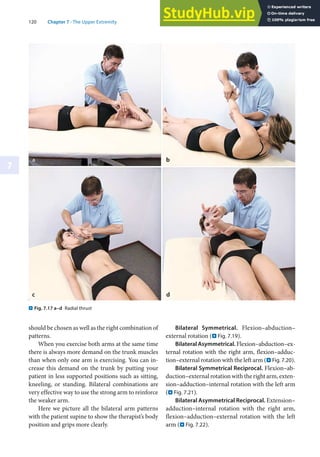
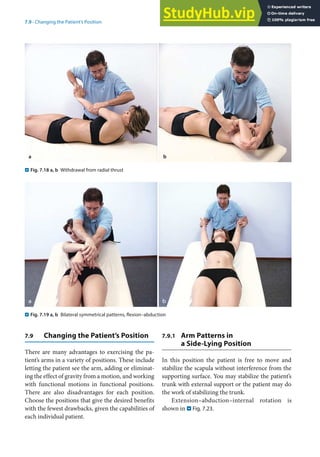
The reversal of radial thrust (Fig. 7.18 a, b) is prob-
ably the pattern that best matches this activity. One
would not facilitate complete flexion–abduction–
external rotation in the shoulder. The pronation of
the forearm in this pattern and palmar flexion (con-
centric-eccentric alternately) are identical to those
of functional activity.
The choice of the position of the patient during
treatment depends on the treatment goals and on
the capabilities of the patient. One does not always
follow normal motor development when choosing
starting positions. If the patient is already able to
walk but is not able to come to a side-lying position,
to sit up, or to transit from sitting to a standing posi-
tion (which we see with many neurological pa-
tients), we should treat this patient in the positions
where improvements are needed. For example,
treating also in side-lying (for turning), standing
(for walking), sitting, standing up etc.
Participation
The aim of the therapy is for the patient to achieve
the optimal functional ability on the level of par-
ticipation. Problems on the level of body function
and structure are solved as far as possible and the
activities that are important for the patient are
trained. In the end, the patient should be able to
perform all the activities needed in his everyday
environment, and without the presence of the ther-
apist. To prepare for this, everyday situations are
created that simulate closely the activities that are
needed. This is practiced both within the hospital
setting as well as outside the facility. The possibili-
ties for facilitation with the PNF concept at this
level (participation) can be the same as those used
for treating on the level of activities. Walking in the
clinic is very different than walking outside the clinic
plications of the basic principles and techniques of
the PNF approach, as we can see in the following
examples.
Example
1. Insufficient coordination
a. If the deficit is at the level of impairments,
the following basic principles can be imple-
mented:
5 Guidance resistance
5 Visual and auditory (feedforward) input
5 Approximation
5 Body position of the patient
b. Techniques to improve or to guide the coor-
dination:
5 Rhythmic initiation
5 Combination of isotonics
5 Replication
2. Muscle weakness
a. To improve muscle weakness, the following
basic principles can be used:
5 Optimal resistance
5 Approximation
5 Stretch
5 Verbal stimulus
5 PNF pattern
b. Useful techniques are:
5 Dynamic reversals
5 Combination of isotonics
Activities
Working on limitations of activity involves improv-
ing the activities of daily living (ADLs) such as
standing up, sitting down, walking, climbing stairs,
toileting, brushing teeth, shaving, dressing, and un-
dressing. Improved speaking and training activities
to be carried out and practical training of hobbies
are also examples of working on the level of activi-
ties.
The task of the therapist is to analyze the func-
tional limitations and to logically choose which
PNF principles and techniques can be used to effi-
ciently treat these problems. The PNF concept offers
many possibilities. One can deviate from the stand-
ard PNF patterns. If the functional activities do not
fit within a conventional PNF pattern as described
in this book, the activity should be practiced accord-
ing to the patient’s needs. One can use the basic
6 Chapter 1 · Introduction
1
or at home where the patient performs other activi-
ties simultaneously (dual task). The therapist should
bring the patient into a situation that resembles the
future situation or into his own social situation.
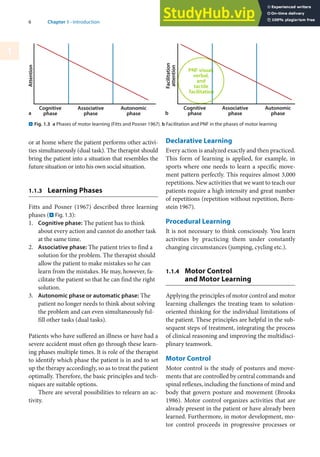
1.1.3 Learning Phases
Fitts and Posner (1967) described three learning
phases (. Fig. 1.3):
1. Cognitive phase: The patient has to think
about every action and cannot do another task
at the same time.
2. Associative phase: The patient tries to find a
solution for the problem. The therapist should
allow the patient to make mistakes so he can
learn from the mistakes. He may, however, fa-
cilitate the patient so that he can find the right
solution.
3. Autonomic phase or automatic phase: The
patient no longer needs to think about solving
the problem and can even simultaneously ful-
fill other tasks (dual tasks).
Patients who have suffered an illness or have had a
severe accident must often go through these learn-
ing phases multiple times. It is role of the therapist
to identify which phase the patient is in and to set
up the therapy accordingly, so as to treat the patient
optimally. Therefore, the basic principles and tech-
niques are suitable options.
There are several possibilities to relearn an ac-
tivity.
Declarative Learning
Every action is analyzed exactly and then practiced.
This form of learning is applied, for example, in
sports where one needs to learn a specific move-
ment pattern perfectly. This requires almost 3,000
repetitions. New activities that we want to teach our
patients require a high intensity and great number
of repetitions (repetition without repetition, Bern-
stein 1967).
Procedural Learning
It is not necessary to think consciously. You learn
activities by practicing them under constantly
changing circumstances (jumping, cycling etc.).
1.1.4 Motor Control
and Motor Learning
Applying the principles of motor control and motor
learning challenges the treating team to solution-
oriented thinking for the individual limitations of
the patient. These principles are helpful in the sub-
sequent steps of treatment, integrating the process
of clinical reasoning and improving the multidisci-
plinary teamwork.
Motor Control
Motor control is the study of postures and move-
ments that are controlled by central commands and
spinal reflexes, including the functions of mind and
body that govern posture and movement (Brooks
1986). Motor control organizes activities that are
already present in the patient or have already been
learned. Furthermore, in motor development, mo-
tor control proceeds in progressive processes or
. Fig. 1.3 a Phases of motor learning (Fitts and Posner 1967). b Facilitation and PNF in the phases of motor learning
a b
1
7
1.1 · The PNF Concept in Modern Holistic Treatment
planned steps. There are four progressive phases of
motor control, each having specific characteristics
(see overview below). The therapist should adjust
his goals and exercises within these phases. Thus, if
the patient lacks the necessary mobility or stability
for a particular activity, then these are trained first
before the actual activity can be performed (patient
example Mr. B.).
The therapist can use the following possible
phases to recognize the patient’s problems
and to structure the treatment:
1. Mobility: the ability to assume a posture
and to start a movement
2. Stability: stabilizing a new position and
controlling gravity
3. Controlled mobility/mobility on stability:
the movement can be controlled at each
point in a stable position
4. Skill: all movements are possible, all parts
of the body can move and be controlled in
all directions
During the treatment, the therapist adapts to
the capabilities and needs of the patient.
On the basis of the analysis of the scope of possi-
bilities and problems of the patient, the therapist
chooses a problem-orientated exercise and a patient
position. The phase of motor control is taken into
consideration and a specific exercise in a specific
body position is chosen which the patient is not yet
able to achieve or do alone. Feedforward can be
used. The therapist gives the patient the goal of the
activity, so that the patient can think about a move-
ment plan to qualitatively carry out the activity. The
execution of this activity is determined by:
4 The goal or target
4 The task of the activity
4 The patient himself
4 The situation in which the activity happens
The movement is facilitated by using PNF principles
and techniques.
4 To improve the stability, we can use resistance,
approximation, and verbal command. Rhyth-
mic Stabilization and Stabilizing Reversals are
the techniques we can use.
4 To improve the execution of the movement,
we can use resistance, verbal command, visual
input, manual contact, traction, and timing.
As techniques we can use Rhythmic Initiation,
Combining of Isotonics and Replication.
Determining which facilitation is to be applied de-
pends not only on the actual patient assessment
findings (before treatment began), but also on the
reactions during the treatment of the patient, which
play an important role.
After practicing, one can give the patient feed-
back about the end result of the activity (knowledge
of results). Additionally, tactile and verbal feedback
during the execution of the activity focused on the
quality of the performance (knowledge of perfor-
mance) can be stimulating.
Motor Learning
Motor learning is not a treatment approach, such as
the PNF concept, but rather a model of how the
Case Study
Patient example: Mr. B.
After receiving many treatments, the
active and passive motion in Mr. B.’s
shoulder increased. Raising actively
his right shoulder is possible, but he
can hold this position only briefly.
Therefore, the activities of putting
his glasses on and off, eating, and
drinking are not yet possible. The
central trunk stability is sufficient.
Sequence of treatment:
Phase 2 should be treated first: stabil-
ity of the shoulder in the desired po-
sition. Principles that are applicable
are approximation, resistance, verbal
command, and manual contact.
Techniques that can be applied are
Stabilizing Reversals, Combination of
Isotonics, and Rhythmic Stabilization.
Phase 3: Controlled mobility can be
achieved by controlling the stability
in the proximal joints, and then
moving the distal joints.
Phase 4: Finally, a skill can be prac-
ticed. At the end of the rehabilita-
tion, the patient is able to trim a tree
standing on a ladder.
8 Chapter 1 · Introduction
1
therapist plans his way of treatment. Motor learning
is a set of processes associated with practice or ex-
perience leading to relatively permanent changes in
the capability for responding (Schmidt and Wris-
berg 2004). This process consists of: perception–
cognition–action (Shumway-Cook and Woollacott
1995) (. Fig. 1.5).
Each task that the patient is given should have a
specific goal and a specific function. Performing the
task is determined by the capabilities and limita-
tions of the patient and by the given situation in
which the task is to be fulfilled. The way of complet-
ing a task, and the capability to do so, depends on
biomechanical, psychological, and neuropsycho-
logical factors. For a positive outcome of therapy,
the activities must be practiced by the patient
(Weinstein 1991) and the activities have to be mean-
ingful for the patient (law of effects). Only then will
the patient maintain his motivation. These activities
should be repeated many times under ever-chang-
ing circumstances (Bernstein 1967, repetition with-
out repetition) and should ultimately be implement-
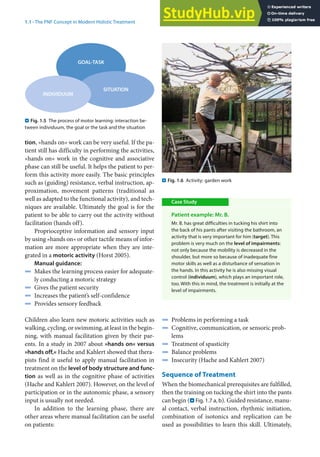
ed in everyday activities (participation) (. Fig. 1.6).
The learning process is more effective if the
therapist allows the patient to make mistakes, so
that the patient can learn from these errors. This
method of learning gives the patient the minimal
amount of input and guidance so that he can opti-
mally perform the activity.
Therapists who work with the PNF concept of-
ten apply tactile and verbal input, but this should
not always be the case. Ultimately, patients should
learn to perform this task by themselves. In the
treatment on the level of body structure and func-
a b
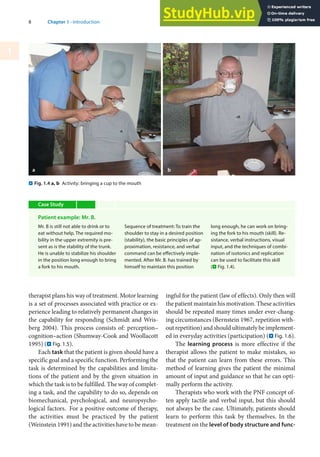
. Fig. 1.4 a, b Activity: bringing a cup to the mouth
Case Study
Patient example: Mr. B.
Mr. B is still not able to drink or to
eat without help. The required mo-
bility in the upper extremity is pre-
sent as is the stability of the trunk.
He is unable to stabilize his shoulder
in the position long enough to bring
a fork to his mouth.
Sequence of treatment: To train the
shoulder to stay in a desired position
(stability), the basic principles of ap-
proximation, resistance, and verbal
command can be effectively imple-
mented. After Mr. B. has trained by
himself to maintain this position
long enough, he can work on bring-
ing the fork to his mouth (skill). Re-
sistance, verbal instructions, visual
input, and the techniques of combi-
nation of isotonics and replication
can be used to facilitate this skill
(. Fig. 1.4).
1
9
1.1 · The PNF Concept in Modern Holistic Treatment
tion, »hands on« work can be very useful. If the pa-
tient still has difficulty in performing the activities,
»hands on« work in the cognitive and associative
phase can still be useful. It helps the patient to per-
form this activity more easily. The basic principles
such as (guiding) resistance, verbal instruction, ap-
proximation, movement patterns (traditional as
well as adapted to the functional activity), and tech-
niques are available. Ultimately the goal is for the
patient to be able to carry out the activity without
facilitation (hands off).
Proprioceptive information and sensory input
by using »hands on« or other tactile means of infor-
mation are more appropriate when they are inte-
grated in a motoric activity (Horst 2005).
Manual guidance:
4 Makes the learning process easier for adequate-
ly conducting a motoric strategy
4 Gives the patient security
4 Increases the patient’s self-confidence
4 Provides sensory feedback
Children also learn new motoric activities such as
walking, cycling, or swimming, at least in the begin-
ning, with manual facilitation given by their par-
ents. In a study in 2007 about »hands on« versus
»hands off,« Hache and Kahlert showed that thera-
pists find it useful to apply manual facilitation in
treatment on the level of body structure and func-
tion as well as in the cognitive phase of activities
(Hache and Kahlert 2007). However, on the level of
participation or in the autonomic phase, a sensory
input is usually not needed.
In addition to the learning phase, there are
other areas where manual facilitation can be useful
on patients:
4 Problems in performing a task
4 Cognitive, communication, or sensoric prob-
lems
4 Treatment of spasticity
4 Balance problems
4 Insecurity (Hache and Kahlert 2007)
Sequence of Treatment
When the biomechanical prerequisites are fulfilled,
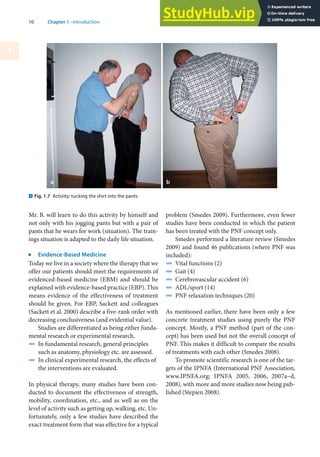
then the training on tucking the shirt into the pants
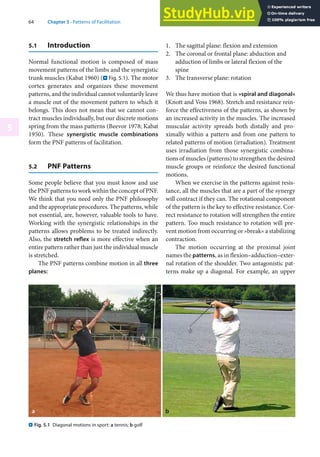
can begin (. Fig. 1.7 a, b). Guided resistance, manu-
al contact, verbal instruction, rhythmic initiation,
combination of isotonics and replication can be
used as possibilities to learn this skill. Ultimately,
. Fig. 1.5 The process of motor learning: interaction be-
tween individuum, the goal or the task and the situation
. Fig. 1.6 Activity: garden work
Case Study
Patient example: Mr. B.
Mr. B. has great difficulties in tucking his shirt into
the back of his pants after visiting the bathroom, an
activity that is very important for him (target). This
problem is very much on the level of impairments:
not only because the mobility is decreased in the
shoulder, but more so because of inadequate fine
motor skills as well as a disturbance of sensation in
the hands. In this activity he is also missing visual
control (individuum), which plays an important role,
too. With this in mind, the treatment is initially at the
level of impairments.
10 Chapter 1 · Introduction
1
Mr. B. will learn to do this activity by himself and
not only with his jogging pants but with a pair of
pants that he wears for work (situation). The train-
ings situation is adapted to the daily life situation.
j
Evidence-Based Medicine
Today we live in a society where the therapy that we
offer our patients should meet the requirements of
evidenced-based medicine (EBM) and should be
explained with evidence-based practice (EBP). This
means evidence of the effectiveness of treatment
should be given. For EBP, Sackett and colleagues
(Sackett et al. 2000) describe a five-rank order with
decreasing conclusiveness (and evidential value).
Studies are differentiated as being either funda-
mental research or experimental research.
4 In fundamental research, general principles
such as anatomy, physiology etc. are assessed.
4 In clinical experimental research, the effects of
the interventions are evaluated.
In physical therapy, many studies have been con-
ducted to document the effectiveness of strength,
mobility, coordination, etc., and as well as on the
level of activity such as getting up, walking, etc. Un-
fortunately, only a few studies have described the
exact treatment form that was effective for a typical
problem (Smedes 2009). Furthermore, even fewer
studies have been conducted in which the patient
has been treated with the PNF concept only.
Smedes performed a literature review (Smedes
2009) and found 46 publications (where PNF was
included):
4 Vital functions (2)
4 Gait (4)
4 Cerebrovascular accident (6)
4 ADL/sport (14)
4 PNF relaxation techniques (20)
As mentioned earlier, there have been only a few
concrete treatment studies using purely the PNF
concept. Mostly, a PNF method (part of the con-
cept) has been used but not the overall concept of
PNF. This makes it difficult to compare the results
of treatments with each other (Smedes 2008).
To promote scientific research is one of the tar-
gets of the IPNFA (International PNF Association,
www.IPNFA.org; IPNFA 2005, 2006, 2007a–d,
2008), with more and more studies now being pub-
lished (Stepien 2008).
. Fig. 1.7 Activity: tucking the shirt into the pants
1
11
1.2 · PNF: Definition, Philosophy, Neurophysiological Basics
1.2 PNF: Definition, Philosophy,
Neurophysiological Basics
1.2.1 Definition
Proprioceptive neuromuscular facilitation (PNF)
is a concept of treatment. Its underlying philosophy
is that all human beings, including those with dis-
abilities, have untapped existing potential (Kabat
1950).
Proprioceptive – Having to do with any of the sensory
receptors that give information concerning movement and
position of the body
Neuromuscular – Involving the nerves and the muscles
Facilitation – Making easier
1.2.2 Philosophy
In keeping with this definition, there are certain ba-
sics that are part of the PNF philosophy:
PNF is an integrated approach: Each treatment
is directed at the total human being, not just at a
specific problem or body segment.
Mobilizing reserves: Based on the untapped
existing potential of all patients, the therapist will
always focus on mobilizing the patient’s reserves.
Positive approach: The treatment approach is
always positive, reinforcing and using what the pa-
tient can do, on a physical and psychological level.
Highest level of function: The primary goal of
all treatments is to help patients achieve their high-
est level of function.
Motor learning and motor control: To reach
this highest level of function, the therapist integrates
principles of motor control and motor learning.
This includes treatment on the level of body struc-
tures, on the activity level, as well on the partici-
pation level (ICF, International Classification of
Functioning, WHO 1997).
The PNF philosophy incorporates certain basic
thoughts, which are anchored in the treatment con-
cept shown below.
The philosophy of the PNF treatment concept:
4 Positive approach: no pain, achievable
tasks, set up for success, direct and indirect
treatment, start with the strong
4 Highest functional level: functional ap-
proach and use ICF, include treatment of
impairments and activity levels
4 Mobilize potential by intensive active
training: active participation, motor learn-
ing, and self-training
4 Consider the total human being: the en-
tire person with his/her environmental,
personal, physical, and emotional factors
4 Use motor control and motor learning
principles: repetition in different context,
respect stages of motor control, variability
of practice
Movement is our way to interact with our environ-
ment. All sensory and cognitive processes may be
viewed as input that determines motor output.
There are some aspects of motor control and learn-
ing that are very important for rehabilitation
(Mulder and Hochstenbach 2004). A key element of
any interactive situation is the exchange of informa-
tion. This applies also to every type of therapy.
Without an exchange of information, patients are
severely limited in mastering new tasks. This is par-
ticularly important in the first stages of motor learn-
ing (. Fig. 1.3) as well as in the rehabilitation process
when, because of the damage, the patient can no
longer trust his or her internal information. In these
cases, the therapist using PNF as facilitation pro-
vides an important source of external information.
According to the authors, this positive function-
al approach is the best way to stimulate the patient
to attain excellent treatment results.
1.2.3 Basic Neurophysiological
Principles
The work of Sir Charles Sherrington was important
in the development of the procedures and tech-
niques of PNF. The following useful definitions
were abstracted from his work (Sherrington 1947):
12 Chapter 1 · Introduction
1
Damasio A (1999) The Feeling of What Happens. Harcourt
Brace & Co, New York
Harste U, Handrock A (2008) Das Patientengespräch. Buchner
& Partner, Schwentinental
Hedin-Anden S (1994) PNF-Grundverfahren und funk-
tionelles Training. Urban & Fischer, Munich
Horst R (2008) Therapiekonzepte in der Physiotherapie: PNF.
Thieme, Stuttgart
Luft, AR, Buitrago MM (2005) Stages of motor skill learning.
Mol Neurobiol. 52:205–216
Knott M, Voss D (1956) Proprioceptive Neuromuscular Facili-
tation, 2nd edn. Harper & Row, New York
Meyers JB, Lephart SM (2003) The role of the sensimotor
system in the athletic shoulder. J Athl Train 3:351–363
Mulder T (1991) A process-oriented model of human motor
behaviour: toward a theory-based rehabilitation ap-
proach. Phy Ther 2:82–89
Mulder T (2006) Das adaptive Gehirn. Thieme, Stuttgart
Sackett DL (1998) Getting research findings into practice.
BMJ 317:339–342
Sacket DL, Rosenberg WMC, Gray JAM, Haynes RB, Richard-
son WS (1996) Evidenced based medicine: What is it and
What isn’t? BMJ 312:71–72
Umphred D (2001) Neurological Rehabilitation, 4th edn.
Mosby, St. Louis MO
Voss DE, Ionta M, Meyers B (1985) Proprioceptive Neuromus-
cular Facilitation: Patterns and Techniques, 3rd edn.
Harper and Row, New York
References
Bernstein N (1967) The coordination and regulation of move-
ment. Pergamon, London
Brooks VB (1986) The Neural Basis of Motor Control. Oxford
University Press, New York/Oxford
Cott CA (2004) Client-centered rehabilitation: Client perspec-
tives. Disabil Rehabil 26:1411–1422
Fitts PM, Posner MI (1967) Human Performance. Brooks/Cole,
Belmont, CA
Hache M, Kahlert L (2007) Hands on versus hands off. Script
Physical Therapy, Heerlen
Horst R (2005) Motorisches Strategietraining und PNF.
Thieme, Stuttgart
IPNFA (2005) Results of the Meeting. Tokyo. Cited December
2009
IPNFA (2006) Results of the Meeting Ljubljana. Cited Decem-
ber 2009
IPNFA (2007a) International PNF Association. http://www.ip-
nfa. org. Cited December 2009
IPNFA (2007b) http://wwww.ipnfa.jp (Japan). Cited Decem-
ber 2009
IPNFA (2007c) http://www.pnf.or.kr (Korea). Cited December
2009
IPNFA (2007d) http://www.ipnfa.de (Germany). Cited Decem-
ber 2009
4 Afterdischarge: The effect of a stimulus con-
tinues after the stimulus stops. If the strength
and duration of the stimulus increase, the af-
terdischarge increases as well. The feeling of
increased power that comes after a maintained
static contraction is the result of afterdischarge.
4 Temporal summation: A succession of weak
stimuli (subliminal) occurring (summate) to
cause excitation.
4 Spatial summation: Weak stimuli applied si-
multaneously to different areas of the body re-
inforce each other (summate) to cause excita-
tion. Temporal and spatial summation can
combine for greater activity.
4 Irradiation: This is a spreading and increased
strength of a response. It occurs when either
the number of stimuli or the strength of the
stimuli is increased. The response may be ei-
ther excitation or inhibition.
4 Successive induction: An increased excitation
of the agonist muscle follows stimulation (con-
traction) of their antagonists. Techniques in-
volving reversal of agonists make use of this
property (Induction: stimulation, increased ex-
citability).
4 Reciprocal innervation (reciprocal inhibi-
tion): Contraction of muscles is accompanied
by simultaneous inhibition of their antagonists.
Reciprocal innervation is a necessary part of
coordinated motion. Relaxation techniques
make use of this property.
» The nervous system is continuous throughout
its extent – there are no isolated parts
(Sherrington 1947).
1.3 Test Your Knowledge: Question
4 The PNF philosophy has an important in-
fluence on your treatment. What are five im-
portant principles of the PNF philosophy?
Further Reading
de Barros Ribeiro Cilento M (2006) Evaluation of the efficacy
of training protocols for the sit to stand activity in elderly
women. Fisioterapi Brasil 6
1
13
References
IPNFA (2008) Results of the Meeting Hoensbroek. Cited
December 2009
Kabat H (1950) Studies on neuromuscular dysfunction, XIII:
New concepts and techniques of neuromuscular reedu-
cation For paralysis. Perm Found Med Bull 8:121–143
Mulder T, Hochstenbach J (2004) Motor control and learning:
Implications for neurological rehabilitation. Sint
Maartenskliniek-Research and Neurological Institute,
University of Nijmegen, The Netherlands, 2006
Oosterhuis-Geers J (2004) SMART, google.nl. Universität
Twente. Cited December 2009
Sacket DL, Straus SE, Richardson WS et al (2000) Evidence-
Based Medicine: How to Practice and Teach EBM, 2nd
edn. Churchill Livingstone, Edinburgh
Scager M (2004) SMART, google.nl. Hogeschool van Utrecht.
Cited December 2009
Schmidt RA, Wrisberg CA (2004) Motor learning and perfor-
mance, a problem based learning approach, 3rd edn.
Human Kinetics, Champaign
Sherrington C (1947) The integrated action of the nervous
system. Yale University Press, New Haven
Shumway-Cook AW, Woollacott M (1995) Motor control:
Theory and practical applications. Williams and Wilkins,
Baltimore
Smedes F (2006) Is there support for the PNF Concept? A lit-
erature search on electronic databases. www.ipnfa.org.
Cited December 2009
Smedes F (2007) Is there support for the PNF Concept? A lit-
erature search on electronic databases. www.ipnfa.org.
Cited December 2009
Stepien A (2008) Presentation of PNF and treatment of scolio-
sis. Doctoral thesis. Academy of Physical Education, War-
saw
Suppé B (2007) FBL Klein-Vogelbach Functional Kinetics: Die
Grundlagen. Bewegungsanalyse, Untersuchung, Behand-
lung. Springer, Berlin Heidelberg New York
WHO (1997) ICIDH-2-The international classification of im-
pairments, activities and participation: A manual of di-
mensions of disablement and functioning (Beta-1 draft
for field trials). World Health Organization, Geneva
WHO (2001) International classification of functioning, disa-
bility and health (ICF). www.who.int/classifications/icf/.
Cited December 2009
Weinstein CJ (1991) Knowledge of results and motor learn-
ing: Implications for physical therapy. Phys Ther 71:
140–149
15 2
Basic Procedures
for Facilitation
M. Buck, D. Beckers
2.1 Optimal Resistance – 17
2.2 Irradiation and Reinforcement – 18
2.3 Tactile Stimulus (Manual Contact) – 18
2.4 Body Position and Body Mechanics – 22
2.5 Verbal Stimulation (Commands) – 22
2.6 Visual Stimulus – 23
2.7 Traction and Approximation – 24
2.8 Stretch – 25
2.9 Timing – 26
2.10 Patterns – 27
2.11 Test Your Knowledge: Questions – 27
Further Reading – 30
References – 30
S.S. Adler et al., PNF in practice,
DOI 10.1007/978-3-642-34988-1_2, © Springer-Verlag Berlin Heidelberg 2014
16 Chapter 2 · Basic Procedures for Facilitation
2
Definition
The basic facilitation procedures, when used
correctly, provide tools for the therapist to use
in helping the patient gain efficient motor
function and increased motor control.
Therapeutic Goals
The basic facilitation procedures can be used to:
4 Increase the patient’s ability to move.
4 Increase the patient’s ability to remain stable.
4 Guide the motion by proper grips and appropri-
ate resistance.
4 Help the patient achieve coordinated motion
through timing.
4 Increase the patient’s stamina and avoid fatigue.
The individual facilitation procedures are not used
as isolated applications; rather, they overlap and
complement each other in their effectiveness. For
example, resistance is necessary to make the re-
sponse to a stretch effective (Gellhorn 1949). The
effect of resistance changes with the alignment of
the therapist’s body and the direction of the manual
contact. The timing of these procedures is impor-
tant to get an optimal response from the patient. For
example, a preparatory verbal command comes be-
fore the stretch reflex. Changing of the manual con-
tacts should be timed to cue the patient for a change
in the direction of motion.
We can use these basic procedures to treat pa-
tients with any diagnosis or condition, although a
patient’s condition may rule out the use of some of
them. The therapist should avoid causing or increas-
ing pain. Pain is an inhibitor of effective and coordi-
nated muscular performance and it can be a sign of
potential harm (Hislop 1960; Fisher 1967). Other
contraindications are mainly common sense: for ex-
ample,notusingapproximationonanextremitywith
an unhealed fracture. In the presence of unstable
joints,thetherapistshouldbeextremelycautiousand
deliberate when using traction or the stretch reflex.
The IPNFA made a distinction between »basic
principles« and »procedures« (IPNFA Instructor
Day, Tokyo 2005 and Ljubljana 2006).
Basic principles are:
4 Tactile stimulation
4 Visual stimulation
4 Resistance
4 Traction
4 Approximation
4 Stretch (stimulus or reflex)
4 Temporal and spatial summation
Procedures are:
4 Patterns
4 Timing
4 Body mechanics
4 Irradiation
The basic principles and procedures for facilita-
tion are:
4 Resistance: Used to aid muscle contraction
and motor control, to increase strength, aid
motor learning.
4 Irradiation and reinforcement: Used to spread
the response to stimulation.
4 Manual contact: Used to increase power and
guide motion or movement with proper grip
and pressure.
4 Body position and body mechanics: Proper
body mechanics and proper positioning of the
therapist enable him to provide a specific and
well-aimed guidance to better control motion,
movement, or stability.
4 Auditory stimulation (commands): Use of
words and the appropriate vocal volume to
direct the patient.
4 Visual stimulation: Use of vision to guide
motion and increase force. The visual feedback
simplifies motion. This is because the patient
tracks and controls movement and position
with his eyes. By having eye contact, the thera-
pist and the patient receive feedback about the
performed movement.
4 Traction or approximation: The elongation or
compression of the limbs and trunk to facilitate
motion and stability.
4 Stretch: The use of muscle elongation and
the stretch reflex to facilitate contraction and
decrease muscle fatigue.
4 Timing: Promote normal timing and increase
muscle contraction with proper inputs and
through »timing for emphasis.«
4 Patterns: Synergistic mass movements, com-
ponents of functional normal motion.
2
17
2.1 · Optimal Resistance
The therapist can combine these basic procedures to
get a maximal response from the patient. Each of the
basic procedures will be explained in detail. Their
definition, application, and treatment goals will be
summarized.
2.1 Optimal Resistance
Therapeutic Goals
Resistance is used in treatment to:
4 Facilitate the ability of the muscle to
contract.
4 Increase motor control and improve motor
learning.
4 Help the patient gain an awareness of motion
and its direction.
4 Increase strength.
4 Help the patient to relax the muscle (reciprocal
inhibition).
Most of the PNF techniques evolved from know-
ledge of the effects of resistance.
Definition
The intensity of resistance provided during an
activity is dependent on the capabilities of the
patient as well as on the goal of the activity.
This we call optimal resistance.
Example
4 The resistance for learning a functional activity
like standing up from a sitting position or
going down the stairs is mostly a guidance
resistance to teach the patients to control
these activities.
4 Resistance for irradiation or strengthening of
muscles is intensive.
Gellhorn showed that when a muscle contraction is
resisted, that muscle’s response to cortical stimula-
tion increases. The active muscle tension produced
by resistance is the most effective proprioceptive
facilitation. The magnitude of that facilitation
is related directly to the amount of resistance
(Gellhorn 1949; Loofbourrow and Gellhorn 1949).
Proprioceptive reflexes from contracting muscles
increase the response of synergistic muscles1 at the
same joint and associated synergists at neighboring
joints. This facilitation can spread from proximal to
distal and from distal to proximal. Antagonists of
the facilitated muscles are usually inhibited. If the
muscle activity in the agonists becomes intense,
there may be activity in the antagonistic muscle
groups as well (co-contraction). (Gellhorn 1947;
Loofbourrow and Gellhorn 1948).
How we give resistance depends on the kind of
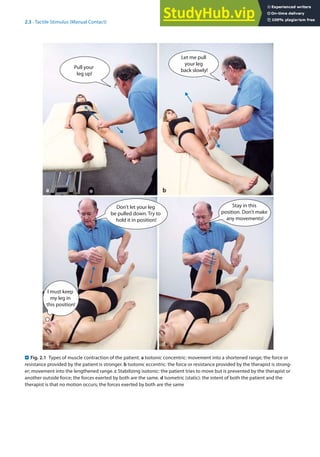
muscle contraction being resisted (. Fig. 2.1).
Definition
We define the types of muscle contraction as
follows (International PNF Association, unpub-
lished handout; Hedin-Andèn 2002):
4 Isotonic (dynamic): The intent of the
patient is to produce motion.
5 Concentric: Shortening of the agonist
produces motion.
5 Eccentric: An outside force, gravity or
resistance, produces the motion. The
motion is restrained by the controlled
lengthening of the agonist.
5 Stabilizing isotonic: The intent of
the patient is motion; the motion is
prevented by an outside force (usually
resistance).
4 Isometric (static): The intent of both the
patient and the therapist is that no motion
occurs.
The resistance to concentric or eccentric muscle
contractions should be adjusted so that motion can
occur in a smooth and coordinated manner. The
antagonists of the facilitated muscles allow a coor-
dinated activity and therefore they are sufficiently
inhibited to allow that activity. Resistance to a stabi-
lizing contraction must be controlled to maintain
the stabilized position. When resisting an isometric
contraction, the resistance should be increased and
decreased gradually so that no motion occurs.
It is important that the resistance does not cause
pain, unwanted fatigue, or unwanted irradiation in
1 Synergists are muscles which act with other muscles to
produce coordinated motion.
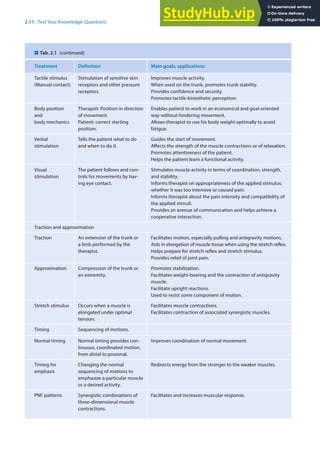
18 Chapter 2 · Basic Procedures for Facilitation
2
the wrong direction or into an undesired part of the
body. Both the therapist and the patient should
avoid breath-holding. Timed and controlled inhala-
tions and exhalations can increase the patient’s
strength and active range of motion.
2.2 Irradiation and Reinforcement
Properly applied resistance results in irradiation
and reinforcement.
Definition
Irradiation is defined as the spread of the
response of nerve impulses of a given stimula-
tion.
This response can be seen as increased facilitation
(contraction) or inhibition (relaxation) in the syn-
ergistic muscles and patterns of movement. The
response increases as the stimuli increase in inten-
sity or duration (Sherrington 1947). Kabat (1961)
wrote that it is resistance to motion that produces
irradiation, and the spread of the muscular activity
will occur in specific patterns. These patterns can be
different from patient to patient.
Definition
Reinforcement. Reinforce, as defined in
Webster’s Ninth New Collegiate Dictionary,
is »to strengthen by fresh addition, make
stronger.«
The therapist directs the reinforcement of the
weaker muscles by the amount of resistance
given to the strong muscles.
Increasing the amount of resistance will increase the
amount and extent of the muscular response.
Changing the movement that is resisted or the posi-
tion of the patient will also change the results. The
therapist adjusts the amount of resistance and type
of muscle contraction to suit (1) the condition of the
patient, for example, muscle strength, coordination,
muscle tone, pain, different body sizes and (2) the
goal of the treatment. Because each patient reacts
differently, it is not possible to give general instruc-
tions on how much resistance to give or which
movements to resist. By assessing the results of the
treatment, the therapist can determine the best uses
of resistance, irradiation, and reinforcement.
Example
Examples of the use of resistance in patient treat-
ment:
4 Resist muscle contractions in a sound limb to
produce contraction of the muscles in the immo-
bilized contralateral limb.
4 Resist hip flexion to cause contraction of the
trunk flexor muscles (. Fig. 2.2).
4 Resist supination of the forearm to facilitate con-
traction of the external rotators of that shoulder.
4 Resist hip flexion with adduction and external
rotation to facilitate the ipsilateral dorsiflexor
muscles to contract with inversion (. Fig. 2.3).
4 Resist neck flexion to stimulate trunk and hip
flexion. Resist neck extension to stimulate trunk
and hip extension.
2.3 Tactile Stimulus
(Manual Contact)
Therapeutic Goals
4 Pressure on a muscle to aid that muscle’s ability
to contract.
4 To give the patient security and confidence.
4 To promote tactile-kinesthetic perception.
4 Pressure that is opposite to the direction of
motion on any point of a moving limb stimulates
the synergistic limb muscles to reinforce the
movement.
4 Contact on the patient’s trunk to help the limb
motion indirectly by promoting trunk stability.
The therapist’s grip stimulates the patient’s skin re-
ceptors and other pressure receptors. This contact
gives the patient information about the proper
direction of motion. The therapist’s hand should be
placed to apply the pressure opposite the direction
of motion. The sides of the arm or leg are considered
neutral surfaces and may be held.
The tactile stimulation from the precise applica-
tion of the therapist’s hands has the following effects
on the stimulated structures:
2
19
2.3 · Tactile Stimulus (Manual Contact)
. Fig. 2.1 Types of muscle contraction of the patient. a Isotonic concentric: movement into a shortened range; the force or
resistance provided by the patient is stronger. b Isotonic eccentric: the force or resistance provided by the therapist is strong-
er; movement into the lengthened range. c Stabilizing isotonic: the patient tries to move but is prevented by the therapist or
another outside force; the forces exerted by both are the same. d Isometric (static): the intent of both the patient and the
therapist is that no motion occurs; the forces exerted by both are the same
20 Chapter 2 · Basic Procedures for Facilitation
2
4 The ability of a muscle contraction is increased
when a pressure is exerted on it.
4 The synergists are facilitated when a muscle is
given resistance against its movement. This
leads to reinforcement in regard to the motor
control.
4 Tactile stimuli promote the tactile-kinesthetic
perception during the performance of move-
ment.
To control movement and resist rotation the thera-
pist uses a lumbrical grip (. Fig. 2.4). In this grip the
pressure comes from flexion at the metacar-
pophalangeal joints, allowing the therapist’s fingers
to conform to the body part. The lumbrical grip
gives the therapist good control of the three-dimen-
. Fig. 2.1 (continued) e PNF receptors
e
. Fig. 2.2 Irradiation into the trunk flexor muscles when
doing bilateral leg patterns
2
21
2.3 · Tactile Stimulus (Manual Contact)
sional motion without causing the patient pain due
to squeezing or putting too much pressure on bony
body parts (. Fig. 2.5).
If the patient has no or decreased control over
an eccentric muscle activity, for example, going
from standing to a sitting position, the therapist
can give the patient the kinesthetic information for
this goal-oriented movement by putting his hands
on the top of the iliac crest and applying pressure
down and backward. If some muscles show too lit-
tle synergistic activity, we can facilitate the desired
muscle activity by giving a tactile stimulus. The
therapist should give tactile stimuli when and
where the patient needs it but only as long as
the patient needs it to increase the patient’s inde-
. Fig. 2.3 a Irradiation to dorsiflexion and inversion with the leg pattern flexion–adduction–external rotation; b Irradiation
for mid-stance support to the ipsilateral leg with the arm pattern into flexion-adduction-external rotation
. Fig. 2.4 The lumbrical grip
. Fig. 2.5 Lumbrical grips. a For the leg pattern flexion–adduction–external rotation. b For the arm pattern flexion–abduc-
tion–external rotation
22 Chapter 2 · Basic Procedures for Facilitation
2
pendence and promote motor learning. The goal
is for the patient to be able to control the activity
by himself. Normally the therapist has one hand
distally and the other hand also distally or proxi-
mally when treating patients with extremity activi-
ties. If it is necessary to solve the patient’s problem
in another way, the therapist can change the normal
grips.
2.4 Body Position and
Body Mechanics
> Proper body mechanics of the therapist:
4 Give the therapist effective control of
the patient’s motion.
4 Facilitate control of the direction of the
resistance.
4 Enable the therapist to give resistance
without provoking pain.
4 Ensure the therapist‘s movement will
be ergonomic and aimed correctly.
Johnson and Saliba first developed the material on
body position as presented here. They observed that
more effective control of the patient’s motion came
when the therapist was in the line of the desired mo-
tion, as presented here. As the therapist shifted posi-
tion, the direction of the resistance changed and the
patient’s movement changed with it. From this
knowledge they developed the following guidelines
for the therapist’s body position (G. Johnson and
V. Saliba, unpublished handout 1985):
4 The therapist’s body should be in line with the
desired motion or force. To line up properly,
the therapist’s shoulders and pelvis face the
direction of the motion. The arms and hands
also line up with the motion. If the therapist
cannot keep the proper body position, the
hands and arms maintain alignment with the
motion (. Fig. 2.6).
4 The resistance comes from the therapist’s body
while the hands and arms stay comparatively
relaxed. By using body weight the therapist can
give prolonged resistance without fatiguing.
The relaxed hands allow the therapist to feel
the patient’s responses.
Not only are the body position and body mechanics
of the therapist important, but also the position in
which the patient is treated. The treatment goal as
well other factors influence this position. The func-
tional activity that the patient needs, muscle tone,
muscle strength, pain, and stability of the patient
and therapist are some of the factors that need to be
considered when choosing the appropriate position
in which to treat patients. The patient sits or lies
comfortably and near the edge of the treatment
table. The therapist stands by the patient’s side,
where he can offer the patient adequate security and
stability (. Fig. 2.6).
Points to Remember
4 An optimal body position and body
mechanics from the therapist promote a
smooth and ergonomic movement from
the patient without having to give much
resistance.
4 By moving as much as possible in the
diagonal direction, the therapist gives the
patient nonverbal information regarding
the desired movement.
4 A good body position and movement of
the therapist gives the patient a secure
feeling.
4 A good body position enables the thera-
pist to use his body weight optimally
to provide the resistance and to avoid
fatiguing.
2.5 Verbal Stimulation (Commands)
Therapeutic Goals
4 Guide the start of movement or the muscle con-
tractions.
4 Affect the strength of the resulting muscle con-
tractions or affect relaxation.
4 Give the patient corrections. Correct commands
promote the attentiveness of the patient. A clear
and precise verbal command, without unneces-
sary words, is helpful for the patient to learn a
functional activity.
2
23
2.6 · Visual Stimulus
Definition
The verbal command tells the patient what to
do and when to do it.
The therapist must always bear in mind that the
command is given to the patient, not to the body
part being treated. Preparatory instructions need to
be clear and concise, without unnecessary words.
They may be combined with passive movement and
visual control from the patient to teach the desired
movement.
The timing of the command is important to co-
ordinate the patient’s reactions with the therapist’s
hands and resistance. It guides the start of move-
ment and muscle contractions. It helps give the
patient corrections for motion or stability.
Timing of the command is also very important
when using the stretch reflex. The initial command
should come immediately before the stretch the
muscle chain to coordinate the patient’s conscious
effort with the reflex response (Evarts and Tannji
1974). The action command is repeated to urge
greater effort or redirect the motion.
In reversal techniques, proper timing between
verbal commands and muscle activity is important
when we change the direction of the resistance. A
preparatory command should be given with the
therapist changing hand and an action command
should be given with the therapist applying resis-
tance in the new direction.
The volume with which the command is given
can affect the strength of the resulting muscle con-
tractions (Johansson et al. 1983). The therapist
should give a louder command when a strong
muscle contraction is desired and use a softer and
calmer tone when the goal is relaxation or relief of
pain.
The command is divided into three parts:
1. Preparation: readies the patient for action
2. Action: tells the patient to start the action
3. Correction: tells the patient how to correct and
modify the action.
The repetition, the type of command, as well as the
correction of the movement contribute to the at-
tentiveness of the patient. Furthermore, the patient
is inspired to exert more effort or correct his move-
ment. For example, the command for the lower ex-
tremity pattern of flexion–adduction–external rota-
tion with knee flexion might be [preparation]
»ready, and«; [action] »now pull your leg up and in«;
[correction] »keep pulling your toes up« (to correct
lack of dorsiflexion).
Points to Remember
For elderly patients, the visual input can be
more important than the verbal input (Gentile
1987; Lee and Lishman 1975).
2.6 Visual Stimulus
Definition
Visual feedback promotes muscular activity,
by helping with coordination, strength, and
stability.
Therapeutic Goals
4 The therapist receives visual information as to
whether the applied stimulus was appropriate for
the task, or whether it was too intensive or even
caused pain.
. Fig. 2.6 Positioning of the therapist’s body for the leg
pattern flexion–abduction–internal rotation
6
24 Chapter 2 · Basic Procedures for Facilitation
2
4 Visual input promotes a more powerful muscle
contraction.
4 Visual feedback helps the patient control and
correct position and motion.
4 Visual stimuli influence both the head and body
motion.
4 Visual stimuli provide an avenue of communi-
cation and help to ensure cooperative inter-
action.
The feedback (and -forward) system can promote a
much stronger muscle activity (Schmidt and Lee
1999). For example, when a patient looks at his
or her arm or leg while exercising it, a stronger
contraction is achieved. Using vision helps the
patient control and correct his or her position and
motion.
Moving the eyes will influence both the head
and body motion. For example, when patients
look in the direction they want to move, the head
follows the eye motion. The head motion in turn
will facilitate larger and stronger trunk motion
(. Fig. 2.7).
Eye contact between patient and therapist pro-
vides another avenue of communication and helps
to ensure cooperative interaction.
> The visual contact between the patient
and the therapist provides an important
nonverbal avenue of communication,
which can improve the patient’s motiva-
tion and coordination.
2.7 Traction and Approximation
Definition
Traction is the elongation of the trunk or an
extremity by the therapist.
Knott, Voss, and their colleagues theorized that the
therapeutic effects of traction are due to stimulation
of receptors in the joints (Knott and Voss 1968; Voss
et al. 1985). Traction also acts as a stretch stimulus
by elongating the muscles.
Apply the traction force gradually until the
desired result is achieved. The traction is main-
tained throughout the movement and combined
with appropriate resistance.
Therapeutic Goals
Traction is used to:
4 Facilitate motion, especially pulling and anti-
gravity motions.
4 Aid in elongation of muscle tissue when using
the stretch reflex.
4 Resist some part of the motion. For example,
use traction at the beginning of shoulder flexion
in order to counteract or to facilitate scapula
elevation.
Traction of the affected part is helpful when treating
patients with joint pain.
Definition
Approximation is the compression of the
trunk or an extremity.
The muscle contractions following the approxima-
tion are thought to be due to stimulation of joint
receptors (Knott and Voss 1968; Voss et al. 1985).
Another possible reason for the increased muscular
response is to counteract the disturbance of position
. Fig. 2.7 Visual control promotes motor learning
2
25
2.8 · Stretch
or posture caused by the approximation. Given
gradually and gently, approximation may aid in the
treatment of painful and unstable joints.
Therapeutic Goals
Approximation is used to:
4 Promote stabilization.
4 Facilitate weight-bearing and the contraction of
antigravity muscles.
4 Facilitate upright reactions.
4 Resist some component of motion. For example,
use approximation at the end of shoulder flexion
to resist scapula elevation and to increase the irra-
diation or reinforcement of other parts of the body.
There are three ways to apply the approximation:
4 Quick approximation: the force is applied
quickly to elicit a reflex-type response.
4 Slow approximation: the force is applied grad-
ually up to the patient’s tolerance.
4 Maintained approximation: After either a
quick or slow approximation, the pressure will
be maintained as long as necessary for the
muscles to build up the proper muscle tension.
The approximation force is always maintained,
whether the approximation is done quickly or slow-
ly. The therapist maintains the force and gives resis-
tance to the resulting muscular response. An appro-
priate command should be coordinated with the
application of the approximation, for example »hold
it« or »stand tall.« The patient’s joints should be
properly aligned and in a weight-bearing position
before the approximation is given.
When the therapist feels that the active muscle
contraction decreases, the approximation is repeat-
ed and resistance is given.
> Since traction usually facilitates motion
and approximation facilitates isometric or
stabilizing activity, the therapist should
use the one which is most effective. It is
also possible to use a maintained approxi-
mation during a motion.
For example, using PNF activities in an upright
position and combining them with approximation
together with concentric and eccentric muscle
activity may be the most effective treatment. Using
arm activities against gravity can be combined with
approximation instead of traction when this pro-
motes a better function.
2.8 Stretch
The response to a stretch of the muscle chain given
by the therapist can lead to a stretch reflex or only to
stimulation of these muscles. Giving a stretch to
muscles should only be done when the therapist
expects to facilitate the dynamic muscle activity.
Sometimes a stretch activity is contraindicated when
the muscles, tendons, bones, or joints are injured.
k
Stretch Stimulus
Therapeutic Goals
4 Facilitate muscle contractions.
4 Facilitate contraction of associated synergistic
muscles.
Definition
The stretch stimulus occurs when a muscle is
elongated under optimal tension.
Stretch stimulus is used during normal activities as
a preparatory motion to facilitate the muscle con-
tractions. The stimulus facilitates the elongated
muscle, synergistic muscles at the same joint, and
other associated synergistic muscles (Loofbourrow
and Gellhorn 1948). Greater facilitation comes from
lengthening all the synergistic muscles of a limb or
the trunk. For example, elongation of the anterior
tibial muscle facilitates that muscle and also facili-
tates the hip flexor–adductor–external rotator mus-
cle group. If just the hip flexor–adductor–external
rotator muscle group is elongated, the hip muscles
and the anterior tibial muscle share the increased
facilitation. If all the muscles of the hip and ankle are
lengthened simultaneously, the excitability in those
limb muscles increases further and spreads to the
synergistic trunk flexor muscles.
k
Stretch Reflex
Therapeutic Goals
How, why, and when to use the stretch reflex is
described in 7 Chap. 3 (7 Sect. 3.4).
26 Chapter 2 · Basic Procedures for Facilitation
2
Definition
The stretch reflex is elicited from muscles that
are under tension, either from elongation or
from contraction.
The reflex has two parts. The first is a short latency
spinalreflexthat produceslittleforceandmaynotbe
of functional significance. The second part, called
the functional stretch response, has a longer latency
but produces a more powerful and functional con-
traction (Conrad and Meyer-Lohmann 1980; Chan
1984). To be effective as a treatment, the muscular
contraction following the stretch must be resisted.
The strength of the muscular contraction pro-
duced by the stretch is affected by the intent of the
subject, and therefore, by prior instruction. Mon-
keys show changes in their motor cortex and strong-
er responses when they are instructed to resist the
stretch. The same increase in response has been
shown to happen in humans when they are told to
resist a muscle stretch (Hammond 1956; Evarts and
Tannji 1974; Chan 1984).
Points to Remember
In patients with increased tonus such as some-
one with spinal spasticity, a reflex is easily pro-
voked and can be used to initiate a movement.
Furthermore, it can be used to inhibit the spas-
ticity, by eliciting movement in the direction
opposite of the spastic pattern.
2.9 Timing
Therapeutic Goals
4 Normal timing provides continuous, coordinated
motion until a task is accomplished.
4 Timing for emphasis redirects the energy of a
strong contraction into weaker muscles.
Definition
Timing is the sequencing of motions.
Normal movement requires a smooth sequence of
activity, and coordinated movement requires pre-
cise timing of that sequence. Functional movement
requires continuous, coordinated motion until the
task is accomplished. However, first proximal stabil-
ity must be present before the distal movement can
begin.
Definition
In adults, normal timing of most coordinated
and efficient motions is from distal to proximal.
The evolution of control and coordination during
development proceeds from cranial to caudal and
from proximal to distal (Jacobs 1967). In infancy
the arm determines where the hand goes, but after
the grasp matures the hand directs the course of
the arm movements (Halvorson 1931). The small
motions that adults use to maintain standing
balance proceed from distal (foot) to proximal (hip
and trunk) (Nashner 1977). To restore normal
timing of motion may become a goal of the treat-
ment.
Normally the timing of an activity is from distal
to proximal. Moving an extremity presupposes
that the central part of the body is stabilized. Mov-
ing the leg forward in gait requires that the trunk
and opposite hip and leg have enough stability to
move the leg. Central stability is needed to move an
extremity. However, studies showed that timing can
be changed depending on the task (Dudel et al.
1996).
Definition
Timing for emphasis involves changing the
normal sequencing of motions to emphasize a
particular muscle or a desired activity.
Kabat (1947) wrote that prevention of motion in a
stronger synergist will redirect the energy of that
contraction into a weaker muscle. This alteration of
timing stimulates the proprioceptive reflexes in the
muscles by resistance and stretch. The best results
come when the strong muscles score at least »good«
in strength (Manual Muscle Test grade 4; Partridge
1954).
2
27
2.11 · Test Your Knowledge: Questions
. Fig. 2.8 Timing for emphasis by preventing motion. a, b Leg pattern flexion–abduction–internal rotation with knee flex-
ion. The strong motions of the hip and knee are blocked and the dorsiflexion–eversion of the ankle exercised using repeated
stretch reflex. c, d Arm pattern flexion–abduction–external rotation. The stronger shoulder motions are blocked while exer-
cising radial extension of the wrist
a b
There are two ways the therapist can alter the
normal timing for therapeutic purposes (. Fig. 2.8,
. Fig. 2.9):
4 By preventing all the motions of a pattern ex-
cept the one that is to be emphasized.
4 By resisting an isometric or maintained con-
traction of the strong motions in a pattern
while exercising the weaker muscles. This re-
sistance to the static contraction locks in that
segment, so resisting the contraction is called
»locking it in« (. Tab. 2.1).
Example
Timing for emphasis for the dorsiflexion–supination–
adduction of the foot: the therapist prevents the
movements in the hip and knee joint by giving ap-
propriate resistance to the flexion–adduction–exter-
nal rotation of the hip joint and the flexion in the
knee joint. Meanwhile, for stimulating the compo-
nents of dorsiflexion–supination–adduction he uses
the technique of repeated contractions or combining
of isotonics.
2.10 Patterns
The patterns of facilitation may be considered one
of the basic procedures of PNF. For greater clarity,
we discuss and illustrate them in 7 Chap. 5.
2.11 Test Your Knowledge:
Questions
Using the PNF procedures or principles enables the
therapist to activate the motor reserves of the pa-
tient and to help with motor learning.
6
28 Chapter 2 · Basic Procedures for Facilitation
2
. Fig. 2.9 Timing for emphasis using stabilizing contractions of strong muscles. a, b Exercising elbow flexion using the
pattern of flexion–adduction–external rotation with stabilizing contractions of the strong shoulder and wrist muscles,
c, d Exercising finger flexion using the pattern extension–adduction–internal rotation with stabilizing contraction of the
strong shoulder muscles
. Tab. 2.1 Basic principles of facilitation
Treatment Definition Main goals, applications
Optimal
resistance
The intensity of resistance
depends on the patient’s
capabilities and on the treat-
ment goal.
Promotes muscle contractility.
Improves motor learning.
Improves perception and control of movement.
Muscle strengthening.
Irradiation and reinforcement
Irradiation The spread of the response of
nerve impulses of a given
stimulation.
Facilitates muscle contractions (including the effect on the
contralateral side).
Reinforcement Increase stimulation by addi-
tion of new stimulus.
6
2
29
2.11 · Test Your Knowledge: Questions
. Tab. 2.1 (continued)
Treatment Definition Main goals, applications
Tactile stimulus
(Manual contact)
Stimulation of sensitive skin
receptors and other pressure
receptors.
Improves muscle activity.
When used on the trunk, promotes trunk stability.
Provides confidence and security.
Promotes tactile-kinesthetic perception.
Body position
and
body mechanics
Therapist: Position in direction
of movement.
Patient: correct starting
position.
Enables patient to work in an economical and goal-oriented
way without hindering movement.
Allows therapist to use his body weight optimally to avoid
fatigue.
Verbal
stimulation
Tells the patient what to do
and when to do it.
Guides the start of movement.
Affects the strength of the muscle contractions or of relaxation.
Promotes attentiveness of the patient.
Helps the patient learn a functional activity.
Visual
stimulation
The patient follows and con-
trols his movements by hav-
ing eye contact.
Stimulates muscle activity in terms of coordination, strength,
and stability.
Informs therapist on appropriateness of the applied stimulus;
whether it was too intensive or caused pain.
Informs therapist about the pain intensity and compatibility of
the applied stimuli.
Provides an avenue of communication and helps achieve a
cooperative interaction.
Traction and approximation
Traction An extension of the trunk or
a limb performed by the
therapist.
Facilitates motion, especially pulling and antigravity motions.
Aids in elongation of muscle tissue when using the stretch reflex.
Helps prepare for stretch reflex and stretch stimulus.
Provides relief of joint pain.
Approximation Compression of the trunk or
an extremity.
Promotes stabilization.
Facilitates weight-bearing and the contraction of antigravity
muscle.
Facilitate upright reactions.
Used to resist some component of motion.
Stretch stimulus Occurs when a muscle is
elongated under optimal
tension.
Facilitates muscle contractions.
Facilitates contraction of associated synergistic muscles.
Timing Sequencing of motions.
Normal timing Normal timing provides con-
tinuous, coordinated motion,
from distal to proximal.
Improves coordination of normal movement.
Timing for
emphasis
Changing the normal
sequencing of motions to
emphasize a particular muscle
or a desired activity.
Redirects energy from the stronger to the weaker muscles.
PNF patterns Synergistic combinations of
three-dimensional muscle
contractions.
Facilitates and increases muscular response.
30 Chapter 2 · Basic Procedures for Facilitation
2
4 Name at least ten different basic principles or
basic procedures and their main goals or
objective.
4 Why it is so important to combine basic princi-
ples?
Further Reading
k
General
Dietz V, Noth J (1978) Pre-innervation and stretch responses
of triceps brachii in man falling with and without visual
control. Brain Res 142: 576–579
Griffin JW (1974) Use of proprioceptive stimuli in therapeutic
exercise. Phys Ther 54 (10): 1072–1079
Hoessly M (1991) Use of eccentric contractions of muscle to
increase range of movement in the upper neuron syn-
drome. Physiotherapy Theory and Practice 7: 91–101&hf;
Hummelbein H (2000) Repetitives Üben in der Rehabilitation
zentraler Paresen. Zeitschrift für Physiotherapeuten 6
Hummelsheim H (1998) Neurologische Rehabilitation.
Springer, Berlin Heidelberg New York
Kandel ER, Schwartz JH, Jessell TM (1995) Neurowissenschaf-
ten – Eine Einführung. Spektrum Akademischer Verlag,
Heidelberg
Kandel ER, Schwartz JH, Jessell TM (2000) Principles of Neural
Science, 4th ed. McGraw Hill, New York, St. Louis, San
Fransisco
Lance JW (1980) The control of muscle tone, reflexes and
movement: M. Robert Wartenburg lecture. Neurology
30: 1303
Lee TD, Swanson LR, Hall AL (1991) What is repeated in a Rep-
etition? Effects of Practice, Conditions on Motor Skill Ac-
quisition. Physical Therapy 2: 150–156
Payton OD, Hirt S, Newton RA (eds) (1977) Scientific basis for
neuro-physiologic approaches to therapeutic exercise,
an anthology. FA Davis, Philadelphia, PA
Rosenbaum DA (1991) Human motor control. Academic
Press, San Diego
Schmidt R (1998) Motor and action perspectives on motor
behaviour: the motor action controversy. Elsevier, Am-
sterdam
Taub E, Miller NE, Novack TA, Cook EW, Friening WC, Nepomu-
ceno CS, Connell JS, Crago JE (1993) Technique to im-
prove chronic motor deficit after stroke. Arch Phys Med
Rehab 74 (4): 347–354
Umphred DA (2000) Neurologische Rehabilitation. Springer,
Berlin Heidelberg New York
Umphred DA (2001) Neurological rehabilitation. Mosby,
St. Louis
Wilmore JH, Costill DL (1994) Physiotherapy of Sport and
Exercise. Human Kinetics Champaign
k
Stretch
Burg D, Szumski AJ, Struppler A, Velho F (1974) Assessment of
fusimotor contribution to reflex reinforcement in hu-
mans. J Neuro Neurosurg P 37: 1012–1021
Cavagna GA, Dusman B, Margaria R (1968) Positive work
done by a previously stretched muscle. J Appl Phys 24
(1): 21–32
Chan CWY, Kearney RE (1982) Is the functional stretch re-
sponse servo controlled or preprogrammed. Electroen
Clin Neuro 53: 310–324
Chez C, Shinoda Y (1978) Spinal mechanisms of the function-
al stretch reflex. Exp Brain Res 32: 55–68
k
Resistance, Irradiation, and Reinforcement
Hellebrandt FA (1958) Application of the overload principle to
muscle training in man. Arch Phys Med Rehab 37: 278–283
Hellebrandt FA, Houtz SJ (1956) Mechanisms of muscle train-
ing in man: experimental demonstration of the overload
principle. Phys Ther 36 (6): 371–383
Hellebrandt FA, Houtz SJ (1958) Methods of muscle training:
the influence of pacing. Phys Ther 38: 319–322
Hellebrandt FA, Waterland JC (1962) Expansion of motor pat-
terning under exercise stress. Am J Phys Med 41: 56–66
Moore JC (1975) Excitation overflow: an electromyographic
investigation. Arch Phys Med Rehab 56 (March): 115–120
References
Brooks VB (1986). The neural basis of motor control. Oxford
University Press, New York
Chan CWY (1984) Neurophysiological basis underlying the
use of resistance to facilitate movement. Physiother Can-
ada 36 (6): 335–341
Conrad B, Meyer-Lohmann J (1980) The long-loop transcorti-
cal load compensating reflex. TINS 3: 269–272
Dudel JR, Menzel R, Schmidt RF (1996) Neurowissenschaft.
Springer, Berlin Heidelberg New York
Evarts EV, Tannji J (1974) Gating of motor cortex reflexes by
prior instruction. Brain Res 71: 479–494
Fischer E (1967) Factors affecting motor learning. Am J Phys
Med 46 (1): 511–519
Frank JS, Earl M (1990) Coordination o posture and move-
ment. Phys Ther (12): 109–117
Gellhorn E (1947) Patterns of muscular activity in man. Arch
Phys Med 28: 568–574
Gellhorn E (1949) Proprioception and the motor cortex. Brain
72: 35–62
Gentile AM (1987) Skill Acquisition: action, movement and
neuromotor processes. In: Carr JH, Sheperd RB (eds)
Movement science. Foundations for physical therapy in
rehabilitation. Aspen Publications, Rockville
Grzebellus M, Schäfer C (1998) Irradiation aus biomecha-
nischer Sicht. Krankengymnastik Zeitschrift für Physio-
therapeuten (9): 1489–1494
2
31
References
Halvorson HM (1931) An experimental study of prehension in
infants by means of systematic cinema records. Genet
Psychol Monogr 10: 279–289. Reprinted in: Jacobs MJ
(1967) Development of normal motor behavior. Am J
Phys Med 46 (1): 41–51
Hammond PH (1956) The influences of prior instruction to
the subject on an apparently involuntary neuromuscular
response. J Physiol (Lond) 132: 17P–18P
Hedin-Andèn S (2002) PNF-Grundverfahren und funk-
tionelles Training. Urban & Fischer, Stuttgart
Hislop HH (1960) Pain and exercise. Phys Ther Rev 40 (2): 98–
106. Reprinted in: Jacobs MJ (1967) Development of nor-
mal motor behavior. Am J Phys Med 46 (1): 41–51
Jacobs MJ (1967) Development of normal motor behavior.
Am J Phys Rehabil 46 (1): 41–51
Johansson CA, Kent BE, Shepard KF (1983) Relationship be-
tween verbal command volume and magnitude of mus-
cle contraction. Phys Ther 63 (8): 1260–1265
Johnson G, Saliba V (1985), nicht publiziert
Kabat H (1947) Studies on neuromuscular dysfunction, XI:
New principles of neuromuscular reeducation. Perm
Found Med Bull 5 (3): 111–123
Kabat H (1961) Proprioceptive facilitation in therapeutic exer-
cise. In: Licht S, Johnson EW (eds) Therapeutic exercise,
2nd ed. Waverly, Baltimore
Klein-Vogelbach S (2000) Funktionelle Bewegungslehre. Be-
wegung lehren und lernen, 5. Aufl. Rehabilitation und
Prävention 1. Springer, Berlin Heidelberg New York
Knott M, Voss DE (1968) Proprioceptive neuromuscular facili-
tation: patterns and techniques, 2nd ed. Harper and
Row, New York
Kofotolis N, Vrabas IS, Vamvakoudis E, Papanikolaou A,
Mandroukas K (2005) Proprioceptive neuromuscular fa-
cilitation training induced alterations in muscle fiber
type and cross sectional area. British Journal of Sports
Medicine (3): 11
Lee DN, Lishman JR (1975) Visual proprioceptive control of
stance. J Human movement Studies 1: 87–95
Lee DN,Young DS (1985) Visual timing in interceptive actions.
In: Ingle DJ et al. (eds) Brain Mechanisms and Spatial
Vision. Martinus Nijhoff, Dordrecht
Loofbourrow GN, Gellhorn E (1948) Proprioceptive modifica-
tion of reflex patterns. J Neurophysiol 12: 435–446
Loofbourrow GN, Gellhorn E (1948) Proprioceptively induced
reflex patterns. Am J Physiol 154: 433–438
Nashner LM (1977) Fixed patterns of rapid postural responses
among leg muscles during stance. Exp Brain Res 30:
13–24
Partridge MJ (1954) Electromyographic demonstration of fa-
cilitation. Phys Ther Rev 34 (5): 227–233
Schmidt RA, Lee TD (1999) Motor Control and Learning. A Be-
havioral Emphasis. Human Kinetics
Sherrington C (1947) The integrative action of the nervous
system, 2nd ed. Yale University Press, New Haven
Umphred DA (1995) Neurological Rehabilitation. Mosby, St.
Louis
Voss DE, Ionta M, Meyers B (1985) Proprioceptive neuromus-
cular facilitation: patterns and techniques, 3rd ed. Harper
and Row, New York
Webster’s Ninth New Collegiate Dictionary (1984). Merriam-
Webster, Springfield
33
S.S. Adler et al., PNF in practice,
DOI 10.1007/978-3-642-34988-1_3, © Springer-Verlag Berlin Heidelberg 2014
3
Techniques
D. Beckers
3.1 Introduction – 34
3.2 Rhythmic Initiation – 34
3.3 Combination of Isotonics – 35
3.4 Reversal of Antagonists – 37
3.4.1 Dynamic Reversals (Incorporates Slow Reversal) – 37
3.4.2 Stabilizing Reversals – 39
3.4.3 Rhythmic Stabilization – 41
3.5 Repeated Stretch (Repeated Contractions) – 43
3.5.1 Repeated Stretch from Beginning of Range
(Repeated Initial Stretch) – 43
3.5.2 Repeated Stretch Through Range (Old Name:
Repeated Contractions) – 43
3.6 Contract–Relax – 45
3.6.1 Contract–Relax: Direct Treatment – 45
3.6.2 Contract–Relax: Indirect Treatment – 46
3.7 Hold–Relax – 47
3.7.1 Hold–Relax: Direct Treatment – 47
3.7.2 Hold–Relax: Indirect Treatment – 47
3.8 Replication – 49
3.9 PNF Techniques and Their Goals – 49
3.10 Test Your Knowledge: Questions – 50
Further Reading – 50
References – 51
34 Chapter 3 · Techniques
3
3.1 Introduction
A PNF technique is a sequenced method of facilita-
tion, which aims at an improvement of body func-
tions or activities within the context of a treatment
goal. The goal of the PNF techniques is to promote
functional movement through facilitation, inhibi-
tion, strengthening, and relaxation of muscle
groups. The techniques use concentric, eccentric,
and static muscle contractions. These muscle con-
tractions with properly graded resistance and
suitable facilitatory procedures are combined and
adjusted to fit the needs of each patient.
4 To increase the range of motion and
strengthen the muscles in the newly gained
range of motion. Use a relaxation technique
such as Contract–Relax to increase range of
motion. Follow with a facilitatory technique
such as Dynamic Reversals (Slow Reversals) or
Combination of Isotonics to increase the
strength and control in the newly gained range
of motion.
4 To relieve muscle fatigue during strengthen-
ing exercises. After using a strengthening
technique such as Repeated Stretch (repeated
stretch reflex), go immediately into Dynamic
Reversals (Slow Reversals) to relieve fatigue in
the exercised muscles. The repeated stretch
reflex permits muscles to work longer without
fatiguing. Alternating contractions of the an-
tagonistic muscles relieves the fatigue that fol-
lows repeated exercise of one group of muscles.
We have grouped the PNF techniques so that those
with similar functions or actions are together.
Where new terminology is used, the name describes
the activity or type of muscle contraction involved.
When the terminology differs from that used by
Knott and Voss (1968), both names are given.
For example, Reversal of Antagonists is a gen-
eral class of techniques in which the patient first
contracts the agonistic muscles then contracts their
antagonists without pause or relaxation. Within that
class, Dynamic Reversal of Antagonist is an isotonic
technique where the patient first moves in one di-
rection and then in the opposite without stopping.
Rhythmic Stabilization involves isometric contrac-
tions of the antagonistic muscle groups. In this tech-
nique, motion is not intended by either the patient
or the therapist. We use both reversal techniques to
increase strength and range of motion.
Rhythmic Stabilization works to increase the pa-
tient’s ability to stabilize or hold a position as well.1
The techniques described are:
4 Rhythmic Initiation
4 Combination of Isotonics (G. Johnson and
V. Saliba, unpublished handout 1979) (also
called Reversal of Agonists; Sullivan et al.
1982)
4 Reversal of Antagonists
– Dynamic Reversal of Antagonists (incor-
porates Slow Reversal)
– Stabilizing Reversal
– Rhythmic Stabilization
4 Repeated Stretch (Repeated Contraction)
– Repeated Stretch from beginning of
range
– Repeated Stretch through range
4 Contract–Relax
4 Hold–Relax
4 Replication
In presenting each technique we give a short charac-
terization,thegoals,uses,andanycontraindications.
Following are full descriptions of each technique,
examples, and ways in which they may be modified.
3.2 Rhythmic Initiation
j
Characterization
Rhythmic motion of the limb or body through the
desired range, starting with passive motion and pro-
gressing to active resisted movement.
j
Goals
4 Aid in initiation of motion
4 Improve coordination and sense of motion
1 G. Johnson and V. Saliba were the first to use the terms
»stabilizing reversal of antagonists«, »dynamic reversal of
antagonist«, »combination of isotonics«, and »repeated
stretch« in an unpublished course handout at the Institute
of Physical Art (1979).
3
35
3.3 · Combination of Isotonics
4 Normalize the rate of motion, either increasing
or decreasing it
4 Teach the motion
4 Normalize muscle tension to help the patient
relax
j
Indications
4 Difficulties in initiating motion
4 Movement too slow or too fast
4 Uncoordinated or dysrhythmic motion, i.e.,
ataxia and rigidity
4 Regulate or normalize muscle tone
4 General tension
j
Description
4 The therapist starts by moving the patient pas-
sively through the range of motion, using the
speed of the verbal command to set the
rhythm. The intended goal of the movement
can be conveyed to the patient via verbal, visu-
al, and/or tactile inputs so that the patient can
take a cognitively active role during the passive
movement.
4 The patient is asked to begin to assist working
actively in the desired direction. The return
motion is done by the therapist.
4 The therapist resists the active movement,
maintaining the rhythm with the verbal com-
mands.
4 To finish the patient should make the motion
independently.
Example
Trunk extension in a sitting position:
4 Move the patient passively from trunk flexion
into extension and then back to the flexed
position. »Let me move you up straight. Good,
now let me move you back down and then up
again.«
4 When the patient is relaxed and moving easily,
ask for active assisted motion into the upright
trunk extension. »Help me a little coming up
straight. Now relax and let me bring you for-
ward.«
4 Then begin resisting the motion. »Push up
straight. Let me bring you forward. Now push up
straight again.«
4 Independent: »Now straighten up on your own.«
j
Modifications Combining Other Techniques
4 The technique can be finished by using eccen-
tric as well as concentric muscle contractions
(Combination of Isotonics).
4 The technique may be finished with active
motion in both directions (Reversal of Anta-
gonists).
Points to Remember
4 Use the speed of the verbal command to
set the rhythm.
4 At the end the patient should make the
motion independently.
4 The technique may be combined with
other techniques.
3.3 Combination of Isotonics
This technique was described by Gregg Johnson and
Vicky Saliba.
j
Characterization
Combined concentric, eccentric, and stabilizing
contractions of one group of muscles (agonists)
without relaxation. For treatment, start where
the patient has the most strength or best coordina-
tion.
j
Goals
4 Active control of motion
4 Coordination
4 Increase the active range of motion
4 Strengthen
4 Functional training in eccentric control of
movement
j
Indications
4 Decreased eccentric control
4 Lack of coordination or ability to move in a
desired direction
4 Decreased active range of motion
4 Lack of active motion within the available
range of motion
36 Chapter 3 · Techniques
3
j
Description
4 The therapist resists the patient’s moving
actively through a desired range of motion
(concentric contraction).
4 At the end of motion the therapist tells the
patient to stay in that position (stabilizing
contraction).
4 When stability is attained the therapist tells the
patient to allow the part to be moved slowly
back to the starting position (eccentric con-
traction).
4 There is no relaxation between the different
types of muscle activities and the therapist’s
hands remain on the same surface.
> The eccentric or stabilizing muscle con-
traction may come before the concentric
contraction.
Example
Trunk extension in a sitting position (. Fig. 3.1 a, b):
4 Resist the patient’s concentric contraction into
trunk extension. »Push back away from me.«
4 At the end of the patient’s active range of mo-
tion, tell the patient to stabilize in that position.
»Stop, stay there, don’t let me pull you forward.«
4 After the patient is stable, move the patient back
to the original position while he or she maintains
control with an eccentric contraction of the trunk
extensor muscles. »Now let me pull you forward,
but slowly.«
j
Modifications
4 The technique may be combined with Reversal
of Antagonists.
Example
Trunk flexion combined with trunk extension:
4 After repeating the above exercise a number
of times, tell the patient to move actively with
concentric contractions into trunk flexion.
4 Then you may repeat the exercise with trunk
flexion, using Combination of Isotonics, or
continue with Reversal of Antagonists for trunk
flexion and extension.
j
Modification
4 The technique can start at the end of the range of
motion and begin with eccentric contractions.
Example
Eccentric trunk extension in a sitting position
(. Fig. 3.1 a, b):
4 Start the exercise with the patient in trunk exten-
sion.
. Fig. 3.1 a, b Combination of Isotonics: coming forward with eccentric contraction of trunk extensor muscles
6 6
3
37
3.4 · Reversal of Antagonists
4 Move the patient from extension back to trunk
flexion while he or she maintains control with an
eccentric contraction of the trunk extension mus-
cles. »Now let me pull you forward, but slowly.«
j
Modifications
4 One type of muscle contraction can be
changed to another before completing the full
range of motion.
4 A change can be made from the concentric to
the eccentric muscle contraction without stop-
ping or stabilizing.
Example
Trunk flexion in a sitting position:
4 Resist the patient’s concentric contraction into
trunk flexion. »Push forward toward me.«
4 After the patient reaches the desired degree of
trunk flexion, move the patient back to the origi-
nal position while he or she maintains control
with an eccentric contraction of the trunk flexor
muscles. »Now let me push you back, but slowly.«
Points to Remember
4 Start where the patient has the most
strength or best coordination.
4 The stabilizing or eccentric muscle
contraction may come first.
4 To emphasize the end of the range, start
there with eccentric contractions.
3.4 Reversal of Antagonists
These techniques are based on Sherrington’s princi-
ples of successive induction and reciprocal inner-
vation (Sherrington 1961).
3.4.1 Dynamic Reversals
(Incorporates Slow Reversal)
j
Characterization
Active resisted and concentric motion changing
from one direction (agonist) to the opposite (an-
tagonist) without pause or relaxation. In normal life
we often see this kind of muscle activity: throwing a
ball, bicycling, walking etc.
j
Goals
4 Increase active range of motion
4 Increase strength
4 Develop coordination (smooth reversal of
motion)
4 Prevent or reduce fatigue
4 Increase endurance
4 Decrease muscle tone
j
Indications
4 Decreased active range of motion
4 Weakness of the agonistic muscles
4 Decreased ability to change direction of
motion
4 Exercised muscles begin to fatigue
4 Relaxation of hypertonic muscle groups
j
Description
4 The therapist resists the patient’s moving in
one direction, usually the stronger or better
direction (. Fig. 3.2 a).
4 As the end of the desired range of motion
approaches the therapist reverses one grip on
the moving segment and gives a command to
prepare for the change of direction.
4 At the end of the desired movement the thera-
pist gives the action command to reverse direc-
tion, without relaxation, and gives resistance to
the new motion starting with the distal part
(. Fig. 3.2 b).
4 When the patient begins moving in the
opposite direction the therapist reverses the
second grip so all resistance opposes the
new direction.
4 The reversals may be done as often as neces-
sary.
Normally we start with contraction of the stronger
pattern and finish with contraction of the weaker
pattern. However, don’t leave the patient with a limb
»in the air«.
38 Chapter 3 · Techniques
3
Example
Reversing lower extremity motion from flexion to
extension:
4 Resist the desired (stronger) pattern of lower
extremity flexion. »Foot up and lift your leg up.«
(. Fig. 3.3 a)
4 As the patient’s leg approaches the end of the
range, give a verbal cue (preparatory command)
to get the patient’s attention while you slide the
hand that was resisting on the dorsum of the foot
to the plantar surface (the dorsiflexor muscles are
still active by irradiation from the proximal grip) to
resist the patient’s foot during the reverse motion.
4 When you are ready for the patient to move in
the new direction give the action command
»Now push your foot down and kick your leg
down.« (. Fig. 3.3 b)
4 As the patient starts to move in the new direc-
tion, move your proximal hand so that it also re-
sists the new direction of motion (. Fig. 3.3 c).
j
Modifications
4 The technique of dynamic reversal must not
always move through the full range, the change
of direction can be used to emphasize a partic-
ular range of the motion.
5 For example, doing a dynamic reversal only
at the end of a range of movement, or at any
range in the movement where the control is
needed:
4 The speed used in one or both directions can
be varied.
4 The technique can begin with small motions in
each direction, increasing the range of motion
as the patient’s skill increases.
4 The range of motion can be decreased in each
direction until the patient is stabilized in both
directions.
4 The patient can be instructed to hold his or her
position or stabilize at any point in the range of
motion or at the end of the range. This can be
done before and after reversing direction.
Example
Reversing lower extremity motion from flexion into
extension with stabilization before the reversal.
4 When the patient reaches the end of the flexion
motion give a stabilizing command (»keep your
leg up there«).
4 After the leg is stabilized change the distal hand
and ask for the next motion (»kick down«).
Example
Reversing lower extremity motion from flexion into
extension with stabilization after the reversal.
. Fig. 3.2 Dynamic Reversal of the arm diagonal flexion–abduction into extension–adduction. First the proximal grip
changes to the distal hand, then the distal hand moves to the proximal grip. a Reaching the end of flexion–abduction.
b After changing the hands, resisting the movement into extension–adduction
6
3
39
3.4 · Reversal of Antagonists
4 After changing the distal hand to the plantar sur-
face of the foot give a stabilizing command (»keep
your leg there, don’t let me push it up any further«).
4 When the leg is stabilized, give a motion com-
mand to continue to exercise (»now kick down«).
4 The technique can begin with the stronger
direction to gain irradiation into the weaker
muscles after reversing.
4 A reversal should be done whenever the ago-
nistic muscles begin to fatigue.
4 If increasing strength is the goal the resistance
increases with each change and the command
asks for more power.
Points to Remember
4 Only use an initial stretch reflex. Do not
re-stretch when changing the direction
because the antagonist muscles are not
yet under tension.
4 Resist, don’t assist the patient when
changing the direction of motion.
4 Change the direction to emphasize a
particular range of the motion. When
using extremity pattern, make sure to first
initiate the opposite direction distally.
3.4.2 Stabilizing Reversals
j
Characterization
Alternating isotonic contractions opposed by
enough resistance to prevent motion. The com-
mand is a dynamic command (»push against my
hands«, or »don’t let me push you«) and the thera-
pist allows only a very small movement.
j
Goals
4 Improve stability and balance
4 Increase muscle strength
4 Improve coordination between agonist and an-
tagonist
j
Indications
4 Decreased stability
4 Weakness
4 Patient is unable to contract muscle isometri-
cally and still needs resistance in a one-way
direction
j
Description
4 The therapist gives resistance to the patient,
starting in the strongest direction, while asking
the patient to oppose the force. Very little mo-
. Fig. 3.3 Dynamic Reversal of the leg diagonal: flexion–
adduction with knee flexion into extension–abduction with
knee extension. a Resisting flexion adduction. b Distal grip
changed and motion into extension–abduction started.
c Resisting extension abduction
40 Chapter 3 · Techniques
3
tion is allowed. Approximation or traction
should be used to increase stability.
4 When the patient is fully resisting the force the
therapist moves one hand and begins to give
resistance in another direction.
4 After the patient responds to the new resis-
tance the therapist moves the other hand to
resist the new direction.
Example
Trunk stability (. Fig. 3.4 a):
4 Combine traction with resistance to the patient’s
trunk flexor muscles. »Don’t let me push you
backward.«
4 When the patient is contracting his or her trunk
flexor muscles, maintain the traction and resis-
tance with one hand while moving your other
hand to approximate and resist the patient’s
trunk extension. »Now don’t let me pull you
forward.«
4 As the patient responds to the new resistance,
move the hand that was still resisting trunk flex-
ion to resist trunk extension.
4 Reverse directions as often as needed until the
patient achieves the desired stability. »Now don’t
let me push you. Don’t let me pull you.«
j
Modifications
4 The technique can begin with slow reversals
and progress to smaller ranges until the patient
is stabilizing.
4 The stabilization should start with the stronger
muscle groups to facilitate the weaker muscles.
4 The resistance may be moved around the
patient so that all muscle groups are worked
(. Fig. 3.4 b).
Example
Trunk and neck stability:
4 After the upper trunk is stable, you may give re-
sistance at the pelvis to stabilize the lower trunk.
4 Next you may move one hand to resist neck ex-
tension.
> The speed of the reversal may be increased
or decreased.
Points to Remember
4 Starting working in the strongest direction.
4 You can begin with slow reversals and
decrease the range until the patient is
stabilizing.
. Fig. 3.4 Stabilizing Reversal for the trunk. a Stabilizing the upper trunk. b One hand continues resisting the upper trunk,
the therapist’s other hand changes to resist at the pelvis
3
41
3.4 · Reversal of Antagonists
3.4.3 Rhythmic Stabilization
j
Characterization
Alternating isometric contractions against resis-
tance, no motion intended.2
j
Goals
4 Increase active and passive range of motion
4 Increase strength
4 Improve stability and balance
4 Decrease pain
j
Indications and Contraindications
k
Indications
4 Limited range of motion
4 Pain, particularly when motion is attempted
4 Joint instability
4 Weakness in the antagonistic muscle group
4 Decreased balance
k
Contraindications
4 Rhythmic stabilization may be too difficult for
patients with cerebellar involvement (Kabat
1950)
4 The patient is unable to follow instructions due
to age, language difficulty, cerebral dysfunction
j
Description
4 The therapist resists an isometric contraction
of the agonistic muscle group. The patient
maintains the position of the part without try-
ing to move.
4 The resistance is increased slowly as the patient
builds a matching force.
4 When the patient is responding fully, the thera-
pist begins to change the resistance so that the
antagonistic motion is resisted. Neither the
therapist nor the patient relaxes as the resis-
tance changes (. Fig. 3.5).
4 The new resistance is built up slowly. When the
patient once again fully responds, the therapist
2 In the first and second editions of Proprioceptive Neuro-
muscular Facilitation, Knott and Voss describe this tech-
nique as resisting alternately the agonistic and antagonis-
tic patterns without relaxation. In the third edition (1985),
Voss et al. describe resisting the agonistic pattern distally
and the antagonistic pattern proximally.
begins to change his resistance so that the an-
tagonistic motion is resisted.
4 Use traction or approximation as indicated by
the patient’s condition.
4 The reversals are repeated as oft en as needed.
4 Use a static command. »Stay there.« »Don’t try
to move.«
Example
Trunk stability:
4 Resist an isometric contraction of the patient’s
trunk flexor muscles. »Stay still, match my resis-
tance in front.«
4 Next, take all the anterior resistance with one hand
and with you other hand begin to resist trunk ex-
tension. »Now start matching me in back, hold it.«
4 As the patient respond to the new resistance,
change again the resistance of one hand to resist
trunk flexion. »Stay still, match me again in the
front.«
4 The direction of contraction may be reversed as
often as necessary to reach the chosen goal.
»Now hold in front again. Stay still. Now start
matching me in the back.«
. Tab. 3.1 summarizes the differences between
stabilizing reversals and rhythmic stabilization.
j
Modifications
4 The technique should begin with the stronger
group of muscles for facilitation of the weaker
muscle group (successive induction).
4 The stabilizing activity can be followed by a
strengthening technique for the weak muscles.
4 To increase the range of motion the stabiliza-
tion may be followed by asking the patient to
move farther into the restricted range.
4 For relaxation the patient may be asked to relax
all muscles at the end of the technique.
4 To gain relaxation without pain the technique
may be done with muscles distant from the
painful area.
Example
Trunk stability and strengthening:
4 Resist alternate trunk flexion and extension until
the patient is stabile.
6
42 Chapter 3 · Techniques
3
4 When the trunk is stabile, give increased stabiliz-
ing resistance to the stronger direction (»Match
me in back« for extension).
4 Then ask for motion into the direction to be
strengthened (»Now push me forward as hard as
you can« to strengthen flexion).
Points to Remember
4 Use static commands because no motion is
intended.
4 The stabilization may be done with
muscles distant from a painful area.
4 Stabilization can be followed by a
strengthening technique.
. Tab. 3.1 Differences between stabilizing reversals and rhythmic stabilization
Stabilizing reversals Rhythmic stabilization
Isotonic muscle action Isometric muscle co-contraction, no movement allowed
Rhythmic stabilization requires concentration and may
be easier in a closed muscle chain
Intention to move No intention to move
Command: »Stay here, against me« Static command: »Stay still, don’t try to move«
Hand grip: changes with each change in direction. Change
from one part of the body to another part is allowed
Hand grip: May grip on both sides and change direction
of resistance slowly
Muscle activity: From agonist to antagonist to agonist to
antagonist
Muscle activity: Agonistic and antagonistic activity
together (possible co-contraction)
Patient needs one direction; to control both directions
together is too difficult
Patient is still able to control both directions
. Fig. 3.5 a Rhythmic Stabilization of the shoulder in the diagonal of flexion–abduction/extension–adduction. b Rhythmic
Stabilization of the stance leg with changing resistance on the swing leg and the other the part of the pelvis
3
43
3.5 · Repeated Stretch (Repeated Contractions)
3.5 Repeated Stretch
(Repeated Contractions)
3.5.1 Repeated Stretch from
Beginning of Range
(Repeated Initial Stretch)
j
Characterization
Repeated use of the stretch reflex to elicit active
muscle recruitment from muscles under the tension
of elongation.
> Only muscles should be under tension;
take care not to stretch the joint structures.
j
Goals
4 Facilitate initiation of motion
4 Increase active range of motion
4 Increase strength
4 Prevent or reduce fatigue
4 Guide motion in the desired direction
j
Indications and Contraindications
k
Indications
4 Weakness
4 Inability to initiate motion due to weakness
or rigidity
4 Fatigue
4 Decreased awareness of motion
k
Contraindications
4 Joint instability
4 Pain
4 Unstable bones due to fracture or osteo-
porosis
4 Damaged muscle or tendon
j
Description
4 Lengthened muscle tension = stretch stimulus
4 Lengthened muscle tension + tap = stretch
reflex
5 The therapist gives a preparatory command
while fully elongating the muscles in the
pattern. Pay particular attention to the
rotation.
5 Give a quick »tap« to lengthen (stretch) the
muscles further and evoke the stretch reflex.
5 At the same time as the stretch reflex, give
a command to link the patient’s voluntary
effort to contract the stretched muscles with
the reflex response.
5 Resist the resulting reflex and voluntary
muscle contraction.
Example
Stretch of the pattern of flexion–abduction–internal
rotation:
4 Place the foot in plantar flexion–inversion then
rotate the patient’s lower extremity into external
rotation and the hip into full extension, adduc-
tion, and external rotation.
4 When all the muscles of the flexion–abduction–
internal rotation pattern are taut, give the pre-
paratory command »Now!« while quickly elon-
gating (stretching) all the muscles farther.
4 Immediately after the stretch, give the command
»Pull up and out.«
4 When you feel the patient’s muscles contract,
give resistance to the entire pattern.
j
Modifications
4 The technique may be repeated, without stop-
ping, from the beginning of the range as soon
as the contraction weakens or stops.
4 The resistance may be modified so that only
some motions are allowed to occur (timing for
emphasis). For example, the therapist may
prevent any hip motion from occurring while
resisting the ankle dorsiflexion and eversion
through its range.
Points to Remember
4 Combine the stretch reflex with the
patient’s voluntary effort.
4 Wait for the resulting muscle contraction,
then resist.
3.5.2 Repeated Stretch Through
Range (Old Name:
Repeated Contractions)
j
Characterization
Repeated use of stretch reflex to elicit active muscle
recruitment from muscles under the tension of con-
traction (. Fig. 3.6).
44 Chapter 3 · Techniques
3
j
Goals
4 Increase active range of motion
4 Increase strength
4 Prevent or reduce fatigue
4 Guide motion in the desired direction
4 Normalize muscle tone
j
Indications and Contraindications
k
Indications
4 Weakness
4 Fatigue
4 Decreased awareness of desired motion
k
Contraindications
4 Joint instability
4 Pain
4 Unstable bones due to fracture or osteoporosis
4 Damaged muscle or tendon
j
Description
4 The therapist resists a pattern of motion so all
the muscles are contracting and tense. You can
start with an initial stretch reflex.
4 Next give a preparatory command to coordi-
nate the stretch reflex with a new and increased
effort by the patient.
4 At the same time you slightly elongate (stretch)
the muscles by momentarily increasing resis-
tance.
4 Resist this new and stronger muscle contrac-
tion.
4 The stretch reflex is repeated to strengthen the
contraction or redirect the motion as the pa-
tient moves through the range.
4 The patient must be allowed to move before
the next stretch reflex is given.
4 The patient must not relax or reverse direction
during the stretch.
Example
Repeated Stretch of the lower extremity pattern of
flexion–abduction–internal rotation
4 Resist the patient’s moving his or her lower ex-
tremity into flexion–abduction–internal rotation.
»Foot up, pull your leg up and out.«
. Fig. 3.6 Repeated Stretch through range: stretch reflex at the beginning of the range and repeated stretch reflex through
range. (Drawing by Eisermann)
6
3
45
3.6 · Contract–Relax
4 Give a preparatory command (»Now!«) while
slightly over-resisting the motion so that you
pull the patient’s leg a short distance back in the
direction of extension–adduction–external rota-
tion. The patient must maintain the contraction
of the stretched muscles.
4 Give the command »Pull again, harder« immedi-
ately after the stretch.
4 Give appropriate resistance to the increased con-
traction that follows the re-stretch of the muscles.
4 Repeat the stretch and resistance if you feel the
patient’s strength decreasing.
4 Repeat the stretch reflex if you feel the patient
start to move in the wrong direction.
4 Always allow a response to occur before giving
another re-stretch. A rule of thumb is three to
four re-stretches during one pattern.
j
Modifications
4 The therapist may ask for a stabilizing contrac-
tion of the pattern before re-stretching the
muscles. »Hold your leg here, don’t let me pull
it down. Now, pull it up harder.«
4 The therapist may resist a stabilizing contrac-
tion of the stronger muscles in the pattern
while re-stretching and resisting the weaker
muscles (timing for emphasis).
Example
Repeated contractions of ankle dorsiflexion and ever-
sion with the hip motion stabilized.
4 »Lock in« the hip motion by resisting a stabilizing
contraction of those muscles. »Hold your hip
there.«
4 The ankle motion of dorsiflexion and eversion is
re-stretched and the new contraction resisted
through range. »Pull your ankle up and out hard-
er.«
Points to Remember
4 A new and stronger muscle contraction
should follow each re-stretch.
4 The patient must be allowed to move be-
fore the next stretch reflex is given.
4 A rule of thumb is three to four re-stretch-
es during one pattern.
3.6 Contract–Relax
The authors refer to the restricting or contracted
muscles as »antagonists,« and the opposite patterns
or muscles as »agonists.«
3.6.1 Contract–Relax:
Direct Treatment
j
Characterization
Resisted isotonic contraction of the restricting
muscles (antagonists) followed by relaxation and
movement into the new increased range.
j
Goal
4 Increased passive range of motion
j
Indication
4 Decreased passive range of motion
j
Description
4 The therapist or the patient moves the joint or
body segment to the end of the passive range
of motion. Active motion or motion against a
little resistance is preferred (for the positive in-
fluence of reciprocal innervation).
4 The therapist asks the patient for a strong con-
traction of the restricting muscle or pattern
(antagonists). (The authors feel that the con-
traction should be held for at least 5–8 sec-
onds) (. Fig. 3.7 a)
4 A maximal contraction in the most lengthened
position of the muscle chain will provoke a
structural change in the actin–myosin complex
(Rothwell 1994).
4 Enough motion (minimal) is allowed for the
therapist to be certain that all the desired mus-
cles, particularly the rotators, are contracting.
4 After sufficient time, the therapist tells the
patient to relax.
4 Both the patient and the therapist relax.
4 The joint or body part is repositioned, either
actively by the patient or passively by the thera-
pist, to the new limit of the passive range. Ac-
tive motion is preferred and may be resisted.
4 The technique is repeated until no more range
is gained.
46 Chapter 3 · Techniques
3
4 Active resisted exercise of the agonistic and an-
tagonistic muscles in the new range of motion
finishes the activity.
Example
Increasing the range of shoulder flexion, abduction,
and external rotation.
4 The patient moves the arm to the end of the range
of flexion–abduction–external rotation. »Open
your hand and lift your arm up as high as you can.«
4 Resist an isotonic contraction of the pattern of
extension–adduction–internal rotation. »Squeeze
my hand and pull your arm down and across.
Keep turning your hand down.«
4 Allow enough motion to occur for both you and
the patient to know that all the muscles in the
pattern, particularly the rotators, are contracting.
»Keep pulling your arm down.«
4 After resisting the contraction (for a sufficient
amount of time), both you and the patient relax.
»Relax, let everything go loose.«
4 Now, resist the patient’s motion into the newly
gained range. »Open your hand and lift your arm
up farther.«
4 When no more range is gained, exercise the ago-
nistic and antagonistic patterns, either in the
new range or throughout the entire range of mo-
tion. »Squeeze and pull your arm down; now
open your hand and lift your arm up again.«
j
Modifications
4 The patient is asked to move immediately into
the desired range without any relaxation.
4 Alternating contractions (reversals) of agonis-
tic and antagonistic muscles may be done.
»Keep your arm still, don’t let me pull it up.
Now don’t let me push your arm down.«
3.6.2 Contract–Relax:
Indirect Treatment
j
Description
4 The technique uses contraction of the agonistic
muscles instead of the shortened muscles.
»Don’t let me push your arm down, keep push-
ing up.« (. Fig. 3.7 b).
j
Indication
4 Use the indirect method when the contraction
of the restricting muscles is too painful or too
weak to produce an effective contraction.
. Fig. 3.7 Hold–Relax or Contract–Relax. a Direct treatment for shortened shoulder extensor and adductor muscles.
b Indirect treatment for shortened shoulder extensor and adductor muscles
6
3
47
3.7 · Hold–Relax
Points to Remember
4 The technique is only to increase passive
range of motion.
4 The patient’s active motion is always pre-
ferred.
4 When the contraction of the restricting
(antagonist) muscles is painful or weak,
use the agonist.
3.7 Hold–Relax
The authors refer to restricting or contracted mus-
cles as »antagonists«, and the opposite patterns or
muscles as »agonists«.
3.7.1 Hold–Relax: Direct Treatment
j
Characterization
Resisted isometric contraction of the antagonistic
muscles (shortened muscles) followed by relaxation
(. Fig. 3.7 a).
j
Goals
4 Increase passive range of motion
4 Decrease pain
j
Indications and Contraindications
k
Indications
4 Decreased passive range of motion
4 Pain
4 The patient’s isotonic contractions are too
strong for the therapist to control
k
Contraindication
4 The patient is unable to do an isometric con-
traction
j
Description
For increasing range of motion
4 The therapist or patient moves the joint or
body segment to the end of the passive or
pain-free range of motion. Active motion is
preferred. The therapist may resist if that does
not cause pain.
> If this position is too painful the patient,
then moves slightly out of position until it
is no longer painful.
4 At the end of the possible range, the therapist
asks for an isometric contraction of the re-
stricting muscle or pattern (antagonists) with
emphasis on rotation. (The authors feel that
the contraction should be maintained for at
least 5–8 seconds)
4 The resistance is increased slowly.
4 No motion is intended by either the patient or
the therapist.
4 After holding the contraction for enough time
the therapist asks the patient to relax.
4 Both the therapist and the patient relax
gradually.
4 The joint or body part is repositioned either ac-
tively or passively to the new limit of range. Ac-
tive motion is preferred if it is pain-free. The mo-
tion may be resisted if that does not cause pain.
4 Repeat all steps in the new limit of range.
For decreasing pain:
4 The patient is in a position of comfort
4 The therapist resists an isometric contraction
of muscles affecting the painful segment
Points to Remember
4 The patient’s active motion is always
preferred.
4 Both the therapist and the patient must
relax.
4 Use breathing to improve relaxation.
3.7.2 Hold–Relax: Indirect Treatment
In the indirect treatment with Hold–Relax you resist
the synergists of the shortened or painful muscles
and not the painful muscles or painful motion. If
that still causes pain, resist the synergistic muscles
of the opposite pattern instead (. Fig. 3.7 b).
j
Indication
4 When the contraction of the restricted muscles
is too painful.
48 Chapter 3 · Techniques
3
j
Description
4 The patient is in a position of comfort.
4 The therapist resists isometric contractions of
synergistic muscles distant from the painful
segment.
4 The resistance is built up slowly and remains at
a level below that which causes pain.
4 During relaxation the resistance decreases
slowly.
Example
Indirect treatment for decreasing pain in the right
shoulder and relaxation of the shoulder internal rota-
tor muscles.
4 The patient lies with his or her right arm support-
ed in a comfortable position and the right elbow
flexed.
4 Hold the patient’s right hand and ask for an iso-
metric contraction of the ulnar flexor muscles of
the wrist. »Keep your hand and wrist right there.
Match my resistance.«
4 Resist an isometric contraction of the ulnar wrist
flexor muscles and forearm pronator muscles. Build
the resistance up slowly and keep it at a pain-free
level. »Keep holding, match my resistance.«
4 While maintaining the resistance, monitor muscle
activity in the patient’s right shoulder, particular-
ly the internal rotation.
4 Both you and the patient relax slowly and com-
pletely. »Now let go slowly all over.«
4 Both you and the patient breathe to improve
relaxation.
4 Repeat the technique in the same position to
gain more relaxation, or move the forearm into
more supination or pronation to change the
effect on the shoulder muscles.
j
Modifications
4 The technique may be done with contraction
of the synergistic muscles of the opposite
pattern, in this case resisting an isometric
contraction of the radial extensor muscles of
the wrist and the forearm supinator muscles.
4 Alternating isometric contractions or Rhyth-
mic Stabilization may be done.
4 If the patient is unable to do an isometric
contraction, carefully controlled stabilizing
contractions may be used. The therapist’s
resistance and the patient’s effort must stay at a
level that does not cause pain.
Points to Remember
4 Resist the synergists of the shortened or
painful muscle.
4 Both therapist and patient keep breathing.
4 The effort stays at a level that does not
cause pain.
The main differences between Contract–Relax and
Hold–Relax are presented in . Tab. 3.2.
. Tab. 3.2 Differences between Contract–Relax and Hold–Relax
Contract–Relax Hold–Relax
Targeted at increased A/P ROM, stretching and
relaxation, prevention of injury (sports)
Targeted at increased passive ROM, relaxation, decrease of pain,
decrease spasticity
No pain condition, good control by PT Painful condition or patient too strong for PT
Type of contraction: Isotonic, intention to move,
fast. Direct better than indirect
Type of contraction: Isometric, no intention to move, slowly.
Direct or indirect
Command: Strong, »push« »pull« Command: Soft, slow, »stay or hold here«
Fast relaxation, not limited by pain Relax: slower and PT matches with own relaxation
Move actively into the new ROM Move actively into the new pain-free range of motion. PT can
assist into the new range if painful
Strengthen the new range Strengthen new range if pain is acceptable
6
3
49
3.9 · PNF Techniques and Their Goals
3.8 Replication
j
Characterization
A technique to facilitate motor learning of func-
tional activities. Teaching the patient the outcome of
a movement or activity is important for functional
work (for example, sports) and self-care activities
(. Fig. 3.8).
j
Goals
4 Teach the patient the end position (outcome)
of the movement.
4 The therapist must be able to estimate what
skills and capabilities the patient has to sustain
a contraction of the agonist muscles, when he
has shortened restrictive muscles of the antag-
onist.
j
Description
4 Place the patient in the target position or in
the »end« position of the activity where all the
agonist muscles are shortened.
4 The patient holds that position while the thera-
pist resists all the components. Use all the basic
procedures to facilitate the patient’s muscles.
4 Ask the patient to relax. Move the patient,
passively a short distance back in the opposite
direction, then ask the patient to return to the
’end’ position.
4 For each replication of the movement start far-
ther toward the beginning of the movement to
challenge the patient through a greater range of
the motion.
4 At the end the patient should perform the ac-
tivity or motion alone, without facilitation or
manual contact by the therapist.
Points to Remember
4 Exercise or teach functional activities
4 Use all the Basic Procedures for facilitation
3.9 PNF Techniques and
Their Goals
Suggestions for PNF techniques that can be used to
achieve a particular goal are outlined below.
Points to Remember
1. Initiate motion
– Rhythmic Initiation
– Repeated Stretch from beginning of
range
. Fig. 3.8 Replication: patients learn step by step to execute the entire activity. Blue: passive or assistive movement by the
therapist in the opposite direction. Red: active return by the patient in the direction of the end range of the functional act.
(Drawing by Ben Eisermann)
6
50 Chapter 3 · Techniques
3
2. Learn a motion
– Rhythmic Initiation
– Combination of Isotonics
– Repeated Stretch from beginning of
range
– Repeated Stretch through range
– Replication
3. Change rate of motion
– Rhythmic Initiation
– Dynamic Reversals
– Repeated Stretch from beginning of
range
– Repeated Stretch through range
4. Increase strength
– Combination of Isotonics
– Dynamic Reversals
– Rhythmic Stabilization
– Stabilizing Reversals
– Repeated Stretch from beginning of
range
– Repeated Stretch through range
5. Increase stability
– Combination of Isotonics
– Stabilizing Reversals
– Rhythmic Stabilization
6. Increase coordination and control
– Combination of Isotonics
– Rhythmic Initiation
– Dynamic Reversals
– Stabilizing Reversals
– Rhythmic Stabilization
– Repeated Stretch from beginning of
range
– Replication
7. Increase endurance
– Dynamic Reversals
– Stabilizing Reversals
– Rhythmic Stabilization
– Repeated Stretch from beginning of
range
– Repeated Stretch through range
8. Increase range of motion
– Dynamic Reversals
– Stabilizing Reversals
– Rhythmic Stabilization
– Repeated Stretch from beginning of
range
– Contract–Relax
– Hold–Relax
9. Relaxation
– Rhythmic Initiation
– Rhythmic Stabilization
– Hold–Relax
10. Decrease pain
– Rhythmic Stabilization (or Stabilizing
Reversals)
– Hold–Relax
3.10 Test Your Knowledge: Questions
4 List four differences between the techniques
Rhythmic Stabilization and Stabilizing Rever-
sals.
4 Which techniques are important for treating
patients on the participation level?
Further Reading
Beradelli AH, Hallet JC, Rothwell R, Marsden CD (1996) Single
joint rapid arm movements in normal subjects and in pa-
tients with motor disorders. Brain 119: 661–664
Kandell ER, Schwarte JH, Gesell TM (2000) Principles of neural
science. McGraw-Hill, New York, St. Louis, San Fransisco
Markos PD (1979) Ipsilateral and contralateral effects of pro-
prioceptive neuromuscular facilitation techniques on
hip motion and electro-myographic activity. Phys Ther
59 (11): 1366–1373
Moore M, Kukulkan C (1988) Depression of H reflexes follow-
ing voluntary contraction. Phys Ther 68:862
Rose-Jacobs R, Gilberti N (1984) Effect of PNF and Rood re-
laxation techniques on muscle length. Phys Ther 64:725
Rothwell J (1994) Control of human voluntary movement.
Chapman and Hall, Cambridge
Sady SP, Wortman M, Blanke D (1982) Flexibility training:
ballistic, static or proprioceptive neuromuscular facilita-
tion? Arch Phys Med Rehabil 63:261–263
Sato A, Schmidt RF (1973) Somatosympathetic reflexes: affer-
ent fibers, central pathways, discharge characteristics.
Physiol Rev 53 (4): 916–947
Sherrington C (1961) The integrative action of the nervous
system. Yale University Press, New Haven
Tanigawa MC (1972) Comparison of the hold–relax proce-
dure and passive mobilization on increasing muscle
length. Phys Ther 52:725–735
6
3
51
References
References
Arai M (2001) Effects of the use of cross-education to the
affected side through various resistive exercises of the
sound side and settings of the length of the affected
muscles. Hiroshima J Med Sci (3): 65–73
Bonnar BP, Deivert RG, Gould TE (2004) The relationship be-
tween isometric contraction durations during holdrelax
stretching and improvement of hamstring flexibility.
J Sports Med Phys Fitness (3): 258–261
Carter AM, Kinzey SJ, Chitwood LF, Cole JL (2000) PNF decreas-
es muscle activity during the stretch reflex in selected
posterior thigh muscles. J Sport Rehab (9): 269–278
Chalmers G (2004) Re-examination of the possible role of
Golgi tendon organ and muscle spindle reflexes in pro-
prioceptive neuromuscular facilitation muscle stretch-
ing. Sports Biomechanics: (1) 159–183
Cornelius WL, Jensen RL, Odell ME (1995) Effects of PNF
stretching phases on acute arterial blood pressure. Can J
Appl Physiol (2): 222–229
Davis DS, Ashby PE, Mc Cale KL, Mc Quain JA, Wine JM (2005)
The effectiveness of 3 stretching techniques on ham-
string flexibility using consistent stretching parameters.
J Strength Conditioning Res (1):27–32
Deccicco PV, Fisher FM (2005) The effects of proprioceptive
neuromuscular facilitation stretching on shoulder range
of motion in overhand athletes. J Sports Med Phys
Fitness (2): 183–187
Feland JB, Marin HN (2004) Effect of sub maximal contraction
intensity in contract–relax proprioceptive neuromuscu-
lar facilitation stretching. Br J Sports Med. Vol 38 (4)
Ferber R, Gravelle DC, Osternig LR (2002) Effect of PNF stretch
techniques on trained and untrained older adults. J Ag-
ing Phys Activity (10): 132–142
Ferber R, Osternig LR, Gravelle DC (2002) Effect of PNF stretch
techniques on knee flexor muscle EMG activity in older
adults. J Electromyography Kinesiol (12): 391–397
Funk DC, Swank AM, Mikla BM, Fagan TA, Farr BK (2003) Impact
of prior exercise on hamstring flexibility: a comparison of
proprioceptive neuromuscular facilitation and static
stretching. J Strength Conditioning Res (3): 489–492
Kabat H (1950) Studies on neuromuscular dysfunction, XII:
Rhythmic stabilization; a new and more effective tech-
nique for treatment of paralysis through a cerebellar
mechanism. Perm Found Med Bull 8: 9–19
Knott M, Voss DE (1956) Proprioceptive neuromuscular facili-
tation: patterns and techniques. Harper and Row, New
York Knott M, Voss DE (1968) Proprioceptive neuromus-
cular facilitation: patterns and techniques. 2nd edn.
Harper and Row, New York
Kofotolis N, Eleftherios K (2006) Effects of two 4-week PNF
programs on muscle endurance, flexibility, and function-
al performance in women with CLBP. Phys Ther (7):
1001–1012
Marek SM (2005) Acute effects of static and PNF stretching on
muscle strength and power output. J Athletic Training
(2): 94–103
Moore MA, Kulkulka CG (1991) Depression of Hoffmann re-
flexes following voluntary contraction and implications
for proprioceptive neuromuscular facilitation therapy.
Phys Ther (4):321–329; discussion 329–33
Olivo SA, Magee DJ (2006) Electromyographic assessment of
the activity of the masticatory using the agonist contract
– antagonist relax technique (AC) and contract – relax
technique (CR). Manual Ther (2): 136–145
Rowlands AV, Marginson VF, Lee J (2003) Chronic flexibility
gains: effect of isometric contraction duration during
proprioceptive neuromuscular facilitation stretching
techniques. Res Quart Exercise Sports (1): 47–51
Sarburg PR, Schrader JW (1997) Proprioceptive neuromuscu-
lar facilitation techniques in sports medicine: a reassess-
ment. J Athletic Training (1): 34–39
Schuback B, Hooper J, Salisburg L (2004) A comparison of a
self stretch incorporating PNF components and a thera-
pist applied PNF technique on hamstring flexibility.
Physiother (3): 151–157
Sullivan PE, Markos PD, Minor MAD (1982) An integrated ap-
proach to therapeutic exercise. Reston, Virginia
Voss DE, Ionta M, Myer BT (1985) Proprioceptive neuromus-
cular facilitation, patterns and techniques. 3rd edn.
Harper and Row, New York
Weerapong P, Hume PA, Kolt GS (2004) Stretching: mecha-
nisms and benefits for sport performance and injury
prevention. Phys Ther Rev (9): 189–206
Wenos DL, Konin JG (2004) Controlled warm-up intensity
enhances hip range of motion. J Strength Conditioning
Res (3): 529–533
53
S.S. Adler et al., PNF in practice,
DOI 10.1007/978-3-642-34988-1_4, © Springer-Verlag Berlin Heidelberg 2014
4
Patient Treatment
M. Buck
4.1 Introduction – 54
4.2 Assessment – 54
4.2.1 Body Functions and Body Structure – 55
4.3 Hypothesis – 55
4.4 Tests for Causal Impairments and
Activity Limitations – 55
4.5 Treatment Goals – 55
4.6 Treatment Planning and Treatment Design – 56
4.6.1 Specific Patient Needs – 56
4.6.2 Designing the Treatment – 56
4.6.3 Direct and Indirect Treatment – 57
4.7 Re-Test for Causal Impairments
and Activity Limitations – 58
4.8 Treatment Examples – 58
4.9 Test Your Knowledge: Questions – 60
Further Reading – 60
References – 61
54 Chapter 4 · Patient Treatment
4
4.1 Introduction
Planning an individual treatment is a systematic
process to develop the most appropriate treatment
for each patient (Sullivan et al. 1982). Our treatment
seeks to help each patient gain the highest possible
level of participation.
Definition
The PNF philosophy is based on the idea that
the therapist mobilizes the patient’s reserves
and untapped potentials, with a holistic and
positive approach, during intensive functional
training.
An effective treatment depends on our doing a
complete and accurate evaluation to identify the
patient’s areas of function and dysfunction. On the
basis of this evaluation, we set general and specific
goals, both immediate and for the long term. We
also ascertain the patient’s personal goals. The
therapist designs a treatment plan that illustrates
how the goals will be achieved and this is then
shared with the patient. Continuous assessment
guides us in adjusting the treatment as the patient
progresses.
ICF Model
To make an exact evaluation, we should use the ICF
Model (International Classification of Function and
Activity and Participation, WHO 2001) (. Fig. 1.2).
4 Body functions are the physiological functions of
body systems (including psychological func-
tions).
4 Body structures are anatomical parts of the body
such as organs, limbs, and their components.
4 Impairments are problems in body function or
structure such as a significant deviation or loss.
4 Activity is the execution of a task or action by an
individual.
4 Participation is involvement in a life situation.
4 Activity limitations are difficulties an individual
may have in executing activities.
4 Participation restrictions are problems an indi-
vidual may experience in their involvement in life
situations.
4 Environmental factors make up the physical,
social, and attitudinal environment in which
people live and conduct their lives.
4 Personal factors are the background of the
person.
Patient Treatment Scheme
Evaluation of areas of function (activities)
(7 Sect. 4.2)
Evaluation of impairments and activity
limitations (7 Sect. 4.2)
Hypothesis of the causal impairments
(7 Sect. 4.3)
Test for causal impairment and deficits
(7 Sect. 4.4)
Treatment goals (7 Sect. 4.5)
Treatment planning (7 Sect. 4.5) and treat-
ment design (7 Sect. 4.6)
Re-test for causal impairment and activity
limitation (7 Sect. 4.7)
4.2 Assessment
Definition
The goal of the assessment is to identify the
patient’s areas of activities, to evaluate body
structures and functions as well as their limi-
tations, and to establish the capabilities of
participation.
Working within the PNF philosophy, we look first for
the patient’s areas of activity. We will use this knowl-
edge of the patient’s abilities, strong areas and the pa-
tient’s own goals to construct effective treatments.
Thetherapistasksforthepersonalgoalsofthepatient.
After the therapist has checked the existing ac-
tivities, he identifies and analyzes the patient’s prob-
lems of body function and structure (impairments).
The therapist must then determine whether they are
possibly responsible for the restrictions on the activ-
ity level.
Theactualbodyfunctionsalongwiththerecord-
ed impairments and limitations of activities together
form the starting point for the upcoming therapy.
6
4
55
4.5 · Treatment Goals
4.2.1 Body Functions and
Body Structure
4 Areas of function
5 Pain free
5 Strong
5 Able to move and stabilize
5 Motion is controlled and coordinated
4 Impairments
5 General (functional) loss
– Static: loss of the ability to maintain a
position
– Dynamic: loss of the ability to move or
control motion
5 Specific deficits (the reasons for the functio-
nal losses)
– Pain
– Decreased range of motion due to:
1. joint restrictions
2. muscle tightness or contracture
– Weakness
– Loss of sensation or proprioception
– Deficits in sight, hearing
– Deficient motor control
– Lack of endurance
4.3 Hypothesis
Hypotheses and conclusion of impairments and
activity limitations:
4 What is the hypothesis of the possible causes of
the limitations of the activity: which impair-
ments can be responsible for these limitations?
4 Different therapists can have different hypoth-
eses about the causes of the problem and about
the way of treatment. The therapist should be
open to other ideas.
4 Which clinical measurement tools do we use to
assess the changes in the level of impairments
and in the level of limitation of activities?
4 What is the clinical reasoning for choosing the
procedures to treat the patient’s dysfunctions?
4 What are the treatment goals of the patient?
4 What are the treatment goals of the therapist?
4.4 Tests for Causal
Impairments and
Activity Limitations
Measurements should be on the level of impair-
ments and on the level of activities. These measure-
ments should be done quickly and should be as sim-
ple as possible and reproducible.
Example
a. Examples for measurements on the structural
level:
5 Muscle strength test
5 Tests for joint mobility
5 Ashworth scale (muscle tone)
5 Two-point discrimination (sensitivity)
b. Examples for measuring activities:
5 Barthel Index (ADL activities)
5 FIM (Functional Independence Measure,
functional independent index)
5 Motor Assessment Scale (MAS, measures
motoric skills)
5 Jebsen test (test for hand function)
5 Timed-up-and-go-test
4.5 Treatment Goals
After the assessment, the therapist and patient set
treatment goals.
4 General goals are expressed as functional
activities. This is not dogmatic. They can be
changed or complemented. As the skills of the
patient change, the treatment goals also
change.
4 Specific goals are set for each treatment activi-
ty and for each treatment session.
> The general treatment goals should always
be adapted by the therapist when there
are positive or negative changes.
Example
General goals and one specific treatment goal for
three patient examples:
1. Static dysfunction: A patient who has difficulty
maintaining standing balance after suffering a
head injury.
6
56 Chapter 4 · Patient Treatment
4
5 General goal: The patient can stand without
support while doing functional upper extrem-
ity activities.
5 Specific treatment goal: The patient can main-
tain a steady bridging position without using
the arms for 30 seconds. (Begin treatment in a
more stable and less threatening position.)
2. Dynamic dysfunction due to pain: A patient
who has pain in his right knee after meniscus
injury.
5 General goal: The patient will be able to run
one mile (1.6 km) in less than 6 minutes with-
out pain in the knee.
5 Specific treatment goal: The patient can hold
a one-leg bridging position on the right leg
with the left leg extended for 30 seconds.
(Begin treatment with limited weight-bearing
on the right leg.)
3. Dynamic dysfunction due to the loss of ability
to move: A patient who has had a stroke with
resultant hemiplegia.
5 General goal: The patient will be able to walk
25 feet (8 m) in 2 minutes using a cane and an
ankle–foot orthosis.
5 Specific treatment goal: The patient can shift
weight from the right to the left ischial tuber-
osity while sitting without any support. (Begin
treatment with weight shifting in a stable
position.)
Each treatment goal should be (SMART analysis):
Specific: the goal is specific for each individual.
Measurable: the goal is measurable, for example,
distance of walking.
Acceptable: the therapist and the patient agree
on the goal.
Realistic: the goal is attainable by the patient
with his specific problem.
Time: the goal should be met within a reason-
able amount of time.
During the entire course of treatment, an ongoing
assessment occurs. The results achieved after each
treatment are documented. In so doing, the effects
and results of the treatment are clear. This form of
assessment requires objective testing. These tests
should be done on all levels: body function and
body structure, activity and participation.
4.6 Treatment Planning and
Treatment Design
In establishing the treatment plan, the treatment
measures must comply with the conditions and
requirements of the patient and the defined treat-
ment goals. PNF uses muscle contractions to affect
the body. If muscle contractions are not appropriate
for the patient’s condition or if their use does
not achieve the desired goals, the therapist should
use other methods. Modalities such as heat and
cold, passive joint motion, and soft tissue mobiliza-
tion may be combined with PNF for effective treat-
ment.
Selection of the most effective treatment de-
pends on the condition of the patient’s muscles
and joints and any existing medical problems.
The therapist combines and modifies the proce-
dures and the techniques to suit the needs of each
patient. Treatment should be intensive, mobilizing
the patient’s reserves without resulting in pain or
fatigue.
> The treatment should be intensive and
mobilize the reserves of the patient, with-
out exceeding his limits, causing pain, or
overburdening.
4.6.1 Specific Patient Needs
The therapist lists the patient’s needs. For example:
1. Decrease pain
2. Increase range of motion
3. Increase strength, coordination, and control of
motion
4. Develop a proper balance between motion and
stability
5. Increase endurance
4.6.2 Designing the Treatment
The therapist designs a treatment to meet the pa-
tient’s needs. Factors to be considered include:
1. Direct or indirect treatment
2. Appropriate activities
5 Movement or stability
5 What types of muscle contractions
4
57
4.6 · Treatment Planning and Treatment Design
3. The best position for the patient. Consider:
5 The patient’s comfort and security
5 The effect of gravity
5 The effect on two-joint muscles
5 Progression of treatment
5 Reflex facilitation
5 Use of vision
5 Closed chain or open chain muscle work
5 Position to decrease spasticity
4. Techniques and procedures
5. Patterns and combinations of patterns
6. Functional and goal oriented tasks.
The treatment of the therapist should always be:
Goal oriented: all the activities are focused on
the treatment goal.
Systematic: the treatment should be set up in a
logical way.
Process oriented: all aspect of the treatment
should be related to and influence each other.
Conscious: every application should be made
with a specific treatment goal in mind and if neces-
sary be adapted to it.
> The treatment goals should be clear, meas-
urable, and reachable within a realistic
timeframe.
4.6.3 Direct and Indirect Treatment
The authors distinguish between direct and indirect
treatment. The decision of the therapist to use the
direct or the indirect method depends mostly on the
specific problems of the patient.
j
Direct Treatment
Definition
In direct treatment, the therapist treats the af-
fected body part or area that is involved. For
example, the muscles near the joint or within a
certain problematic part of the movement.
Direct treatment may involve:
1. Use of treatment techniques on the affected
limb, muscle, or motion.
Example
To gain increased range in the shoulder motions
of flexion, abduction, and external rotation, the
therapist treats the involved shoulder using the
technique Contract–Relax on the tight pectoralis
major muscle.
2. Directing the patient’s attention to stabilizing
or moving the affected segment.
Example
While the patient stands on the involved leg, the
therapist gives approximation through the pelvis to
facilitate weight-bearing.
j
Indirect Treatment
Definition
In indirect treatment, the chosen facilitation is
applied to uninvolved or less involved parts of
the body. The indirect way of treatment uses
the principle of synergistic muscles.
Many studies have shown the effectiveness of indi-
rect treatment that begins on strong and pain-free
parts of the body.
Hellebrandt et al. (1947) reported the develop-
ment of muscle tension in unexercised parts of the
body during and after maximal exercise of one limb.
Other experiments have described electromyo-
graphic (EMG) activity in the agonistic and antago-
nistic muscles of the contralateral upper or lower
extremity during resisted isotonic and isometric
exercise (Moore 1975; Devine et al. 1981; Pink
1981). The trunk musculature can also be exercised
indirectly. For example, the abdominal muscles con-
tract synergistically when a person raises his arm.
This activity occurs in normal subjects and in pa-
tients suffering from central nervous system
disorders as well (Angel and Eppler 1967). An
increased passive range of motion can be gained in-
directly by using Contract–Relax on uninvolved
areas of the body (Markos 1979).
To give the patient maximum benefit from in-
direct treatment the therapist resists strong move-
ments or patterns. Maximum strengthening occurs
when the patient’s strong limbs work in combina-
58 Chapter 4 · Patient Treatment
4
tion with the weak ones. When pain is a presenting
symptom, treatment focuses on pain-free areas
of the body. Using carefully guided and controlled
irradiation the therapist can treat the affected limb
or joint without risk of increasing the pain or injury.
Indirect treatment may involve:
4 Use of the techniques on an unaffected or less
affected part of the body. The therapist directs
the irradiation into the affected area to achieve
the desired results.
Example
To gain range in shoulder flexion, abduction, and
external rotation.
4 The therapist resists an isometric contraction of
the ulnar wrist flexor and the pronator muscles of
the affected arm.
4 After resisting the contraction, the therapist and
the patient relax.
4 This use of Hold–Relax will produce a contraction
and relaxation of the ipsilateral pectoralis major
muscle. The treated arm need not be moved but
may remain in a position of comfort.
4 Directing the patient’s attention and effort to-
ward working with the less affected parts of the
body.
Example
To improve lower extremity weight-bearing.
4 While the patient sits with both feet on the floor,
the therapist resists the »lifting« pattern (trunk
extension) on the side of the involved lower ex-
tremity.
4 This produces contraction of the extensor mus-
cles in the lower extremities and increased
weight-bearing through the ipsilateral ischial tu-
berosity and the foot.
A further advantage of the indirect treatment is that
it gives the patient the opportunity to be treated
with no – or only minimal – pain. If the pain is
initially in the foreground, then the treatment is
generally performed in a pain-free area.
By selectively choosing and carefully using the
indirect treatment, the therapist can reach the in-
volved part of the body through irradiation without
triggering or increasing the intensity of pain.
Indirect treatment can also be applied when
the treatment goals are for strengthening. The
maximal strength can be reached when the the-
rapist combines patterns that are weak with pat-
terns that are strong. The patient is able to do more
in the treatment and can reach the highest possible
effects sooner when the stronger patterns are re-
sisted.
The process of patient evaluation and assess-
ment of treatment is continuous. By assessing
the results after each treatment, the therapist can
determine the effectiveness of both the treatment
activity and treatment session and can then modify
the treatment as necessary to achieve the stated
goals.
Treatment modifications may include:
1. Changing the treatment procedures or the
techniques
2. Increasing or decreasing facilitation by chang-
ing the use of:
5 Reflexes
5 Manual contact
5 Visual cues
5 Verbal cues
5 Traction and approximation
3. Increasing or decreasing the resistance given
4. Working with the patient in positions of func-
tion
5. Progressing to more complex activities
4.7 Re-Test for Causal Impairments
and Activity Limitations
At the end there will be a check of the changes ofim-
pairments and limitations on the activity level using
the same tests as at the beginning of the treatment.
These tests will be evaluated and compared.
4.8 Treatment Examples
The following examples of procedures, techniques,
and combinations to treat specific patient problems
should not be interpreted as definitive but only as
guidelines. Let your imagination and the patient’s
condition be your guides.
4
59
4.8 · Treatment Examples
1. Pain
a. Procedures
– Indirect treatment
– Resistance below that which produces
– pain or stress
– Isometric muscle contraction
– Bilateral work
– Traction
– Position for comfort
b. Techniques
– Rhythmic Stabilization
– Hold–Relax
– Stabilizing Reversals
c. Combinations
– Hold–Relax followed by Combination of
Isotonics
– Rhythmic Stabilization followed by Slow
Reversal (Dynamic Reversals) moving
first toward the painful range
2. Decreased strength and active range
of motion
a. Procedures
– Appropriate resistance
– Timing for emphasis
– Stretch
– Traction or approximation
– Patient position
b. Techniques
– Repeated Stretch from beginning of range
– Repeated Stretch through range (Repea-
ted Contractions)
– Combination of Isotonics
– Dynamic (slow) Reversal of Antagonists
1. Facilitation from stronger antagonists
2. Prevention and relief of fatigue
c. Combinations
– Dynamic Reversal of Antagonists com-
bined with Repeated Stretch through
range (Repeated Contractions) of the
weak pattern
– Rhythmic Stabilization at a strong point
in the range of motion followed by Re-
peated Contractions of the weak pattern
3. Decreased passive range of motion
a. Procedures
– Timing for emphasis
– Traction
– Appropriate resistance
b. Techniques
– Contract–Relax or Hold–Relax
– Stabilizing Reversal of Antagonists
– Rhythmic Stabilization
c. Combinations
– Contract–Relax followed by Combination
of Isotonics in the new range
– Contract–Relax followed by Slow Rever-
sals, beginning with motion into the new
range
– Rhythmic Stabilization or Stabilizing
Reversals followed by Dynamic Reversal
of Antagonists
4. Coordination and control
a. Procedures
– Patterns of facilitation
– Manual contact (grip)
– Vision
– Proper verbal cues, decreased cueing as
patient progresses
– Decreasing facilitation as the patient
progresses
b. Techniques
– Rhythmic Initiation
– Combination of Isotonics
– Dynamic Reversal of Antagonists
– Stabilizing Reversals
– Replication
c. Combinations
– Rhythmic Initiation, progressing to
Combination of Isotonics
– Rhythmic Initiation done as reversals,
progressing to Reversal of Antago-
nists
– Combination of Isotonics combined
with Stabilizing or Dynamic Reversal of
Antagonists
5. Stability and balance
a. Procedures
– Approximation
– Vision
– Manual contact (grip)
– Appropriate verbal commands
b. Techniques
– Stabilizing Reversals
– Combination of Isotonics
– Rhythmic Stabilization
60 Chapter 4 · Patient Treatment
4
c. Combinations
– Dynamic Reversal of Antagonists
progressing to Stabilizing Reversals
– Dynamic Reversals (eccentric) pro-
gressing to Stabilizing Reversals
6. Endurance
Increasing the patient’s general endurance is a part
of all treatments. Varying the activity or exercise be-
ing done and changing the activity to a different
muscle group or part of the body will enable the
patient to work longer and harder. Attention to
breathing while exercising as well as specific breath-
ing exercises work to increase endurance.
a. Procedure
– Stretch reflex
b. Technique
– Reversal of antagonists
– Repeated Stretch and Repeated Contrac-
tions
4.9 Test Your Knowledge: Questions
4 The evaluation is integrated in the treatment.
On which three levels should the therapist car-
ry out, plan, evaluate, and adapt his treatment
(see ICF Model)?
4 Imagine the assessment of a patient with a total
hip replacement. Which tests and re-tests are
possible for this patient on the three ICF levels?
Further Reading
k
Exercise
Engle RP, Canner GG (1989) Proprioceptive neuromuscular
facilitation (PNF) and modified procedures for anterior
cruciate ligament (ACL) instability. J Orthop Sports Phys
Ther 11:230–236
Hellebrandt FA (1951) Cross education: ipsilateral and contra-
lateral effects of unimanual training. J Appl Physiol
4:135–144
Hellebrandt FA, Hautz SJ (1950) Influence of bimanual
exercise on unilateral work capacity. J Appl Physiol 2:446–
452
Hellebrandt FA Houtz SJ (1958) Methods of muscle training:
the influence of pacing. Phys Ther 38:319–322
Hellebrandt FA, Houtz SJ, Eubank RN (1951) Influence of al-
ternate and reciprocal exercise on work capacity. Arch
Phys Med Rehabil 32:766–776
Hellebrandt FA, Houtz SJ, Hockman DE, Partridge MJ (1956)
Physiological effects of simultaneous static and dynamic
exercise. Am J Phys Med Rehabil 35:106–117
Nelson AG, Chambers RS, McGown CM, Penrose KW (1986)
Proprioceptive neuromuscular facilitation versus weight
training for enhancement of muscular strength and ath-
letic performance. J Orthop Sports Phys Ther 8:250–253
Nitz J, Burke B (2002) A study of facilitation of respiration in
myotonic dystrophy. Phys Res Int 4:228–238
Osternig LR, Robertson RN, Troxel RK, Hansen P (1990) Dif-
ferential responses to proprioceptive neuromuscular fa-
cilitation (PNF) stretch techniques. Med Sci Sports Exerc
22:106–111
Partridge MJ (1962) Repetitive resistance exercise: a method
of indirect muscle training. Phys Ther 42:233–239
Pink M (1981) Contralateral effects of upper extremity pro-
prioceptive neuromuscular facilitation patterns. Phys
Ther 61:1158–1162
Richardson C, Toppenberg R, Jull G (1990) An initial evalua-
tion of eight abdominal exercises for their ability to pro-
vide stabilization for the lumbar spine. Aust Physiother
36:6–11
k
Hemiplegia
Brodal A (1973) Self–observations and neuro-anatomical
considerations after a stroke. Brain 96:675–694
Duncan PW, Nelson SG (1983) Weakness – a primary motor
deficit in hemiplegia. Neurol Rep 7(1):3–4
Harro CC (1985) Implications of motor unit characteristics to
speed of movement in hemiplegia. Neurol Rep 9(3):
55–61
Tang A, Rymer WZ (1981) Abnormal force – EMG relations in
paretic limbs of hemiparetic human subjects. J Neurol
Neurosurg Psychiatry 44:690–698
Trueblood PR, Walker JM, Perry J, Gronley JK (1988) Pelvic ex-
ercise and gait in hemiplegia. Phys Ther 69:32–40
Whitley DA, Sahrmann SA, Norton BJ (1982) Patterns of mus-
cle activity in the hemiplegic upper extremity. Phys Ther
62:641
WHO (World Health Organization) (2001) ICF: International
Classification of Functioning, Disability, and Health.
http://www.int/classifications/icfen/
Winstein CJ, Jewell MJ, Montgomery J, Perry J, Thomas L
(1982) Short leg casts: an adjunct to gait training hemi-
plegics. Phys Ther 64:713–714
k
Motor Control and Motor Learning
APTA (1991) Movement science: an American Physical Thera-
py Association monograph. APTA, Alexandria VA
APTA (1991) Contemporary management of motor control
problems. Proceedings of the II Step conference. Foun-
dation for Physical Therapy, Alexandria VA
Hellebrandt FA (1958) Application of the overload principle
to muscle training in man. Arch Phys Med Rehabil
37:278–283
4
61
References
Light KE (1990) Information processing for motor perfor-
mance in aging adults. Phys Ther 70(12): 820–826
VanSant AF (1988) Rising from a supine position to erect
stance: description of adult movement and a develop-
mental hypothesis. Phys Ther 68 (2):185–192
VanSant AF (1990) Life-span development in functional tasks.
Phys Ther 70(12):788–798
k
Spasticity
Landau WM (1974) Spasticity: the fable of a neurological de-
mon and the emperor’s new therapy. Arch Neurol
31:217–219
Levine MG, Kabat H, Knott M, Voss DE (1954) Relaxation of
spasticity by physiological techniques. Arch Phys Med
Rehabil 35:214–223
Perry J (1980) Rehabilitation of spasticity. In: Felman RG,
Young JRR, Koella WP (eds) Spasticity: disordered motor
control. Year Book, Chicago
Sahrmann SA, Norton BJ (1977) The relationship of voluntary
movement to spasticity in the upper motor neuron syn-
drome. Ann Neurol 2:460–465
Young RR, Wiegner AW (1987) Spasticity. Clin Orthop 219:50–
62
k
Cold
Baker RJ, Bell GW (1991) The effect of therapeutic modalities
on blood flow in the human calf. J Orthop Sports Phys
Ther 13:23–27
Miglietta O (1964) Electromyographic characteristics of clo-
nus and influence of cold. Arch Phys Med Rehabil
45:508–512
Miglietta O (1962) Evaluation of cold in spasticity. Am J Phys
Med Rehabil 41:148–151
Olson JE, Stravino VD (1972) A review of cryotherapy. Phys
Ther 52:840–853
Prentice WE Jr (1982) An electromyographic analysis of the
effectiveness of heat or cold and stretching for inducing
relaxation in injured muscle. J Orthop Sports Phys Ther 3:
133–140
Sabbahi MA, Powers WR (1981) Topical anesthesia: a possible
treatment method for spasticity. Arch Phys Med Rehabil
62:310–314
References
Angel RW, Eppler WG Jr (1967) Synergy of contralateral
muscles in normal subjects and patients with neurologic
disease. Arch Phys Med Rehabil 48:233–239
Devine KL, LeVeau BF, Yack J (1981) Electromyographic activ-
ity recorded from an unexercised muscle during maxi-
mal isometric exercise of the contralateral agonists and
antagonist. Phys Ther 61:898–903
DIMDI (Deutsches Institut für Medizinische Dokumentation
und Information) (2004) ICF, Internationale Klassifikation
von Funktionsfähigkeit, Behinderung und Gesundheit
(vorläufige Endfassung). http://www.dimdi.de
Guymer (1988) In: Wells PE, Frampton V, Bowsher D (Eds) The
neuromuscular facilitation of movement. Pain, manage-
ment and control in physiotherapy. Heinemann, London,
pp. 55–70
Hellebrandt FA, Parrish AM, Houtz SJ (1947) Cross education,
the influence of unilateral exercise on the contralateral
limb. Arch Phys Med Rehabil 28:76–85
Markos PD (1979) Ipsilateral and contralateral effects of pro-
prioceptive neuromuscular facilitation techniques on
hip motion and electromyographic activity. Phys Ther
59(11):1366–1373
Moore JC (1975) Excitation overflow: an electromyographic
investigation. Arch Phys Med Rehabil 59:115–120
Pink M (1981) Contralateral effects of upper extremity pro-
prioceptive neuromuscular facilitation patterns. Phys
Ther 61(8):1158–1162
Post MWM, Witte LP de, Schrijvers AJP (1999) Quality of life
and the ICIDH: Towards an integrated conceptual model
for rehabilitation outcomes research. Clin Reha 13:5–15
Potney et al. (1984) Analysis of exercise overflow to preferred
and non-preferred limbs. Physio Therapy 64:749
Sullivan PE, Markos PD, Minor MAD (1982) An integrated
approach to therapeutic exercise, theory and clinical ap-
plication. Reston Publishing Company, Reston VA
63
S.S. Adler et al., PNF in practice,
DOI 10.1007/978-3-642-34988-1_5, © Springer-Verlag Berlin Heidelberg 2014
5
Patterns of Facilitation
D. Beckers
5.1 Introduction – 64
5.2 PNF Patterns – 64
5.3 Test Your Knowledge: Questions – 66
Further Reading – 68
References – 68
64 Chapter 5 · Patterns of Facilitation
5
5.1 Introduction
Normal functional motion is composed of mass
movement patterns of the limbs and the synergistic
trunk muscles (Kabat 1960) (. Fig. 5.1). The motor
cortex generates and organizes these movement
patterns, and the individual cannot voluntarily leave
a muscle out of the movement pattern to which it
belongs. This does not mean that we cannot con-
tract muscles individually, but our discrete motions
spring from the mass patterns (Beevor 1978; Kabat
1950). These synergistic muscle combinations
form the PNF patterns of facilitation.
5.2 PNF Patterns
Some people believe that you must know and use
the PNF patterns to work within the concept of PNF.
We think that you need only the PNF philosophy
and the appropriate procedures. The patterns, while
not essential, are, however, valuable tools to have.
Working with the synergistic relationships in the
patterns allows problems to be treated indirectly.
Also, the stretch reflex is more effective when an
entire pattern rather than just the individual muscle
is stretched.
The PNF patterns combine motion in all three
planes:
1. The sagittal plane: flexion and extension
2. The coronal or frontal plane: abduction and
adduction of limbs or lateral flexion of the
spine
3. The transverse plane: rotation
We thus have motion that is »spiral and diagonal«
(Knott and Voss 1968). Stretch and resistance rein-
force the effectiveness of the patterns, as shown by
an increased activity in the muscles. The increased
muscular activity spreads both distally and pro-
ximally within a pattern and from one pattern to
related patterns of motion (irradiation). Treatment
uses irradiation from those synergistic combina-
tions of muscles (patterns) to strengthen the desired
muscle groups or reinforce the desired functional
motions.
When we exercise in the patterns against resis-
tance, all the muscles that are a part of the synergy
will contract if they can. The rotational component
of the pattern is the key to effective resistance. Cor-
rect resistance to rotation will strengthen the entire
pattern. Too much resistance to rotation will pre-
vent motion from occurring or »break« a stabilizing
contraction.
The motion occurring at the proximal joint
names the patterns, as in flexion–adduction–exter-
nal rotation of the shoulder. Two antagonistic pat-
terns make up a diagonal. For example, an upper
. Fig. 5.1 Diagonal motions in sport: a tennis; b golf
5
65
5.2 · PNF Patterns
extremity diagonal contains shoulder flexion–
adduction–external rotation and the antagonist
pattern extension–abduction–internal rotation.
The proximal and distal joints of the limb are linked
in the pattern. The middle joint is free to flex, extend
or maintain its position. For example, finger flexion,
radial flexion of the wrist, and forearm supination
are integral parts of the pattern of shoulder flexion–
adduction–external rotation. The elbow, however,
may flex, extend, or remain in one position.
The trunk and limbs work together to form
complete synergies. For example, the pattern of
shoulder flexion–adduction–external rotation with
anterior elevation of the scapula combines with
trunk extension and rotation to the opposite side to
complete a total motion. If you know the synergistic
muscle combinations, you can work out the pat-
terns. If you know the pattern, you will know the
synergistic muscles. When an extremity is in its
fully lengthened position the synergistic trunk
muscles are also under tension. The therapist should
feel tension in both the limb and trunk muscles.
The groove of the pattern is that line drawn by
the hand or foot (distal component) as the limb
moves through its range. For the head and neck, the
groove is drawn by a plane through the nose, chin,
and crown of the head. The groove for the upper
trunk is drawn by the tip of the shoulder and for the
lower trunk by the hip bone. Because the trunk and
limbs work together, their grooves join or are paral-
lel (. Fig. 5.2). As discussed earlier, the therapist’s
body should be in line with or parallel to the rele-
vant groove. Pictures of the complete patterns with
the therapist in the proper position come in the fol-
lowing chapters.
To move concentrically through the entire range
of a pattern:
4 The limb is positioned in the »lengthened
range.«
5 All the associated muscles (agonists) are
lengthened.
5 There is no pain, and no joint stress.
5 The trunk does not rotate or roll.
4 The limb moves into the »shortened range.«
5 The end of the range of contraction of the
muscles (agonists) is reached.
5 The antagonistic muscle groups are length-
ened.
5 There is no pain and no joint stress.
5 The trunk did not rotate or roll.
> We can vary the pattern in several ways.
The normal timing of an extremity pattern is:
4 The distal part (hand and wrist or foot and an-
kle) moves through its full range first and
holds its position.
4 The other components move smoothly togeth-
er so that they complete their movement al-
most simultaneously.
4 Rotation is an integral part of the motion and
is resisted from the beginning to the end of the
motion.
We can vary the pattern in several ways:
4 By changing the activity of the middle joint in
the extremity pattern for function
Example: First, the pattern of shoulder flexion–
abduction–external rotation is done with the
elbow moving from extension to flexion. The
patient’s hand rubs his or her head. The next
time, the same pattern is done with the elbow
moving from a flexed to an extended position,
so the patient’s hand can reach for a high object.
4 By changing the activity of the middle joint in
the extremity pattern for the effect on two-
joint muscles.
. Fig. 5.2 Patterns are »spiral and diagonal.« (Modified
from Klein-Vogelbach 1990)
66 Chapter 5 · Patterns of Facilitation
5
Example: First, the pattern of hip flexion–
adduction–external rotation is done with the
knee moving from the extended to the flexed
position. In this combination, the hamstring
muscles shorten actively. Next time, the same
pattern is used with the knee staying straight.
This combination stretches the hamstring
muscles.
4 By changing the patient’s position to change
the effects of gravity.
Example: The pattern of hip extension–abduc-
tion–internal rotation is done in a side-lying
position so the abductor muscles work against
gravity.
4 By changing the patient’s position to a more
functional one.
Example: The upper extremity patterns are ex-
ercised in a sitting position and incorporate
functional activities such as eating or combing
the hair.
4 By changing the patient’s position to use visual
cues.
Example: Have the patient in a half-sitting posi-
tion so that he or she can see the foot and ankle
when exercising it.
We can combine the patterns in many ways. The
emphasis of treatment is on the arms or legs when
the limbs move independently. The emphasis is
on the trunk when the arms are joined by one
hand gripping the other arm or when the legs are
touching and move together. Choosing how to
combine the patterns for the greatest functional ef-
fect is a part of the assessment1 and treatment plan-
ning.
We name the pattern combinations according to
how the limb movements (arms, legs or both) relate
to each other:
4 Unilateral: one arm or one leg
4 Bilateral: both arms, both legs, or combina-
tions of arms and legs (. Fig. 5.3):
5 Symmetrical: the limbs move in the same
pattern (e. g., both move in flexion–abduc-
tion) (. Fig. 5.3 a)
1 To evaluate: to identify the patient’s areas of function and
dysfunction. To assess: to measure or judge the result of a
treatment procedure.
5 Asymmetrical: the limbs move in opposite
patterns (e. g., the right limb moves in flex-
ion–abduction, the left moves in flexion–
adduction) (. Fig. 5.3 b)
5 Symmetrical reciprocal: the limbs move in
the same diagonal but opposite directions
(e. g., the right limb moves in flexion–ab-
duction, the left in extension–adduction)
(. Fig. 5.3 c)
5 Asymmetrical reciprocal: the limbs move
in opposite diagonals and opposite direc-
tions (e. g., the right limb moves in flexion–
abduction, the left in extension–abduction)
(. Fig. 5.3 d)
The choice of the starting position depends on
many factors, which are selected by the therapist,
such as spasticity, pain, finding a comfortable (pain
free) position of the patient or the therapist, pro-
gression of the degree of difficulty in the treatment,
strength of the patient, and ratio of the strength be-
tween the therapist and the patient etc.
5.3 Test Your Knowledge: Questions
4 What is the greatest advantage of the PNF pat-
terns?
4 What is more important in gait or mat train-
ing: the pattern of movement or the functional
activity?
4 What are the advantages of using the patterns
of movement on the mats and in gait training?
4 Which of the following statements are not
true?
a. The PNF concept only allows using PNF
patterns in treatment
b. Normal movements are always identical
with PNF patterns
c. Normal ADL activities are always three-
dimensional
d. Each phase of gait is related to a PNF pattern
e. Using PNF patterns, you always use the full
range of motion in each joint
4 Name three advantages of using PNF patterns
during the treatment of patients.
5
67
5.3 · Test Your Knowledge: Questions
. Fig. 5.3 Bilateral patterns. a Symmetrical: both arms in flexion–abduction. b Asymmetrical: right arm in flexion–abduction
and left arm in flexion–adduction. c Symmetrical reciprocal: right arm in flexion–abduction and left arm in extension–adduc-
tion. d Asymmetrical reciprocal: right arm in flexion–abduction and left arm in extension–abduction
68 Chapter 5 · Patterns of Facilitation
5
Further Reading
Bosma JF, Gellhorn E (1946) Electromyographic studies of
muscular co-ordination on stimulation of motor cortex.
J Neurophysiol 9:263–274
Gellhorn E (1948) The influence of alterations in posture of
the limbs on cortically induced movements. Brain 71:
26–33
Klein-Vogelbach S (2007) FBL Klein-Vogelbach. Functional
Kinetics: Die Grundlagen, 6. Aufl. Springer, Berlin Heidel-
berg New York
References
Beevor CE (1978) The Croonian lectures on muscular move-
ments and their representation in the central nervous
system. In: Payton OD, Hirt S, Newton RA (eds) Scientific
basis for neurophysiologic approaches to therapeutic
exercise: an anthology. Davis, Philadelphia
Kabat H (1950) Studies on neuromuscular dysfunction,
XIII: new concepts and techniques of neuromuscular
reeducation for paralysis. Perm Found Med Bull 8(3):
121–143
Kabat H (1960) Central mechanisms for recovery of neuro-
muscular function. Science 112:23–24
Klein-Vogelbach S (1990) Functional Kinetics. Springer, Berlin
Heidelberg New York
Knott M, Voss DE (1968) Proprioceptive neuromuscular facili-
tation: patterns and techniques, 2nd edn. Harper and
Row, New York
69
S.S. Adler et al., PNF in practice,
DOI 10.1007/978-3-642-34988-1_6, © Springer-Verlag Berlin Heidelberg 2014
6
The Scapula and Pelvis
M. Buck, D. Beckers
6.1 Introduction – 70
6.2 Applications – 70
6.3 Basic Procedures – 70
6.4 Scapular Diagonals – 72
6.4.1 Specific Scapular Patterns – 72
6.4.2 Specific Uses for Scapular Patterns – 78
6.5 Pelvic Diagonals – 79
6.5.1 Specific Pelvic Patterns – 79
6.5.2 Specific Uses for Pelvic Patterns – 84
6.6 Symmetrical, Reciprocal, and Asymmetrical Exercises – 85
6.6.1 Symmetrical–Reciprocal Exercise – 86
6.6.2 Asymmetrical Exercise – 86
6.7 Test Your Knowledge: Questions – 88
Further Reading – 88
Reference – 88
70 Chapter 6 · The Scapula and Pelvis
6
6.1 Introduction
The pelvic girdle and the shoulder girdle are not
alike in their functions related to stabilization and
motion of the extremities.
In the shoulder girdle, the scapula and clavicle
work together as a unit. The scapula’s primary
support is muscles with only one attachment to the
axial skeleton, at the manubrium. The shoulder
girdle is dependent on muscular function and its
ability to adjust to the underlying rib cage. In its
normal function it is not a weight-bearing structure.
The scapular patterns are activated (whether for
motion or stabilization) within the upper extremity
patterns and all the upper extremity patterns and
scapular motions integrate together.
The pelvic girdle, consisting of the sacrum and
the innominate or coxal (ilium) bone, is directly
attached to the spine and is dependent mostly on
vertebral support. It is a weight-bearing structure.
The pelvic patterns do not always function in accord
with the lower extremity patterns because the pelvis
is truly divided in its function.
The sacrum is an extension of the lumbar spine
and functions in accordance with spinal function. It
is only involved in lower extremity function as an
extension of the innominate. The innominate bone
is clearly an extension of the lower extremity and in
the efficient state moves with each lower extremity
component. The sacro-iliac (SI) articulation is the
transition between the axial skeleton and the lower
extremity. Therefore, the pelvic patterns are direct-
ed through the sacrum to the lumbar spine while
the lower extremity patterns extend into the pelvic
girdle through the innominate. The lower extremity
motions are supported and complimented, whether
in weight-bearing or non-weight-bearing, by in-
nominate motions. The sacrum has the functional
role in the pelvic patterns. The innominate has only
a minor passive function unless the extremity is
added. That is why, for example, it is so important to
proceed to rolling as soon as the pelvic pattern is
developed (G. Johnson, personal communication,
1999).
6.2 Applications
Exercise of the scapula and pelvis is important for
treatment of the neck, the trunk, and the extremi-
ties. The scapular muscles control or influence the
function of the cervical and thoracic spine. Proper
function of the upper extremities requires both
motion and stability of the scapula. Pelvic motion
and stability are required for proper function of the
trunk and the lower extremities.
Exercise of the scapula and pelvis can have var-
ious goals:
Therapeutic Goals
4 Scapula
– Exercise the scapula independently for
motion and stability.
– Exercise trunk muscles by using timing for
emphasis and resistance for facilitation.
– Exercise functional activities such as rolling.
– Facilitate cervical motion and stability (by
resisting scapular motion and stabilization,
since the scapula and neck reinforce each
other).
– Facilitate arm motion and stability (by resis-
ting scapular motion and stabilization, since
the scapula and arm muscles reinforce each
other).
– Treat the lower trunk indirectly through irradi-
ation or continuing movements.
4 Pelvis
– Exercise the pelvis for motion and stability.
– Facilitate trunk motion and stability.
– Exercise functional activities such as rolling.
– Facilitate leg motion and stability.
– Treat the upper trunk and cervical areas in-
directly through irradiation or continuing
(propagating) movements.
6.3 Basic Procedures
j
Diagonal Motion
The scapular and pelvic patterns occur in two diago-
nals: anterior elevation–posterior depression and
posterior elevation–anterior depression. Movement
in the diagonals is an arc that follows the curve of the
patient’s torso. When the scapula or pelvis is moved
6
71
6.3 · Basic Procedures
within the diagonal, the patient will not roll forward
or back or rotate around one spinal segment.
Picture a patient lying on the left side (. Fig. 6.1).
Now imagine a clock with the 12 o’clock position
toward the patient’s head, the 6 o’clock position to-
ward the feet, the 3 o’clock position anterior and the
9 o’clock position posterior. When working with the
right scapula or pelvis, anterior elevation is toward
1 o’clock and posterior depression toward 7 o’clock.
Posterior elevation is toward 11 o’clock and anterior
depression toward 5 o’clock (. Fig. 6.1).
Now imagine that the patient is lying on the
right side. The 12 o’clock position is still toward the
patient’s head but the 3 o’clock position is posterior
and the 9 o’clock position anterior. Working with
the left scapula or pelvis, anterior elevation is to-
ward 11 o’clock and posterior depression toward
5 o’clock; posterior – elevation is toward 1 o’clock
and anterior depression toward 7 o’clock. In this
chapter we show all patterns being done on the pa-
tient’s left scapula or pelvis. All references are to mo-
tion of the left scapula or the left side of the pelvis.
j
Patient Position
The basic scapular and pelvic patterns are illustrated
with the patient side-lying on a treatment table. The
use of these patterns in other positions is illustrated
in later chapters.
The procedures start with the patient in a stable
side-lying position, the hips and knees flexed as
much as the activity needs to get an optimal result.
The patient should be positioned so that his or her
back is close to the edge of the treatment table. The
patient’s spine is maintained in a normal alignment
and the head and neck in as neutral a position as
possible, neither flexed nor extended. The patient’s
head is supported in line with the spine, avoiding
lateral bend.
Before beginning a scapula or pelvis pattern,
place the scapula or pelvis in a mid-position where
the line of the two diagonals cross. The scapula
should not be rotated, and the glenohumeral com-
plex should lie in the anteroposterior midline. The
pelvis should be in the middle, between anterior and
posterior tilt. You can use a pillow between the
knees when the pelvis is rotated. From this midline
position, the scapula or pelvis can then be moved
into the elongated range of the pattern.
j
Therapist Position
The therapist stands behind the patient, facing the
line of the scapular or pelvic diagonal and with arms
and hand aligned with the motion. All the grips
described in this chapter assume that the therapist
is in this position.
In an alternative position the patient lies facing
the edge of the treatment table. The therapist stands
in front of the patient in the line of the chosen di-
agonal. The hand placement on the patient’s body
remains the same but the grips use different areas of
the therapist’s hands (. Fig. 6.2).
The scapular and pelvic patterns can also be
done with the patient lying on the mats. In this posi-
tion, the therapist must kneel on the mats either in
front of or behind the patient. Weight shifting is
done by moving from the position of sitting on the
heels (kneeling down) to partial or fully upright
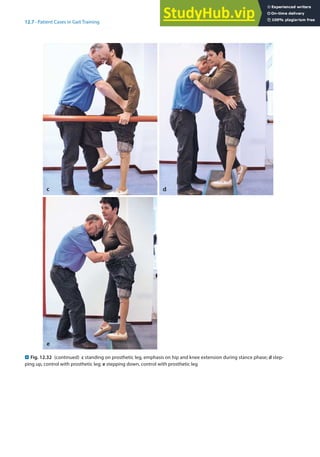
kneeling (kneeling up).
j
Grips
The grips follow the basic procedure for manual
contact, which is opposite the direction of move-
ment. This section describes the two-handed grips
used when the patient is side-lying and the therapist
. Fig. 6.1 Diagonal motion of the scapula and pelvis
72 Chapter 6 · The Scapula and Pelvis
6
is standing behind the patient. These grips are
modified when the therapist’s or patient’s position
is changed, and some modification is also needed
when the therapist can use only one hand while
the other hand controls another pattern or extrem-
ity.
j
Resistance
The direction of the resistance is an arc following
the contour of the patient’s body. The angle of the
therapist’s hands and arms changes as the scapula or
pelvis moves through this arc of diagonal motion
(. Fig. 6.3). As a result of the arc of the body, the
direction of the resistance changes constantly. These
are minimal changes that lead to a fluent diagonal
movement.
6.4 Scapular Diagonals
6.4.1 Specific Scapular Patterns
Scapular patterns can be done with the patient lying
on the treatment table, on mats, sitting, or standing.
The humerus must be free to move as the scapula
moves. Side-lying (illustrated) allows free motion of
the scapula and easy reinforcement of trunk activi-
ties. The main muscle components are as follows (ex-
trapolated from Kendall and McCreary 1993). We
know of no confirming electromyographic studies.
Scapular movements
Movement Muscles: principal components
Anterior
elevation
Levator scapulae, rhomboids, serratus
anterior, upper trapezius
Posterior
depression
Serratus anterior (lower), rhomboids,
latissimus dorsi, lower trapezius
Posterior
elevation
Trapezius, levator scapulae
Anterior
depression
Rhomboids, serratus anterior, pectoralis
minor and major
Anterior Elevation and Posterior
Depression (. Fig. 6.4 a–c)
The therapist stands behind the patient, facing up
toward the patient’s head.
. Fig. 6.2 Alternative position: the therapist is in front of
the patient (anterior elevation of the pelvis)
. Fig. 6.3 a, b. The direction of the resistance is an arc (posterior depression of the scapula)
6
73
6.4 · Scapular Diagonals
Anterior Elevation (. Fig. 6.4 b, . Fig. 6.5):
j
Grip
Place one hand on the anterior aspect of the gleno-
humeral joint and the acromion with your fingers
cupped. The other hand covers and supports the
first. Contact is with the fingers and not the palm of
the hand.
j
Elongated Position (. Fig. 6.5 a)
Pull the entire scapula down and back toward the
lower thoracic spine (posterior depression) with
the angulus inferior rotated toward the spine. Be
sure that the glenohumeral complex is positioned
posterior to the central anteroposterior line of the
body (midfrontal plane). You should see and feel
that the anterior muscles of the neck are taut. Do not
pull so far that you lift the patient’s head up. Contin-
ued pressure on the scapula should not cause the
patient to roll back or rotate the spine around one
segment.
j
Command
»Shrug your shoulder up toward your nose.« »Pull.«
j
Movement
The scapula moves up and forward in a line aimed
approximately at the patient’s nose. The inferior an-
gle moves away from the spine (. Fig. 6.4 b).
j
Body Mechanics
Stand behind the patient at the level of about the
waist. In stride position in line with the patient’s ear.
Keep the arms relaxed and let your body give the
resistance by shifting your weight from the back to
the front leg.
j
Resistance
The line of resistance is an arc following the curve
of the patient’s body. To resist the rotation compo-
nent, the therapist resists the angulus inferior in the
direction of the spine. Start with your elbows low
and your forearms parallel to the patient’s back. At
the end of the pattern, your elbows are extending
and you are lifting upward.
j
End Position (. Fig. 6.5 b)
The scapula is up and forward with the acromion
close to the patient’s nose. The angulus inferior is
moved away from the spine. In the end position, the
muscular activity moves the scapula in this direc-
tion. The scapular retractor and depressor muscles
are taut.
j
Functional Activities
This scapula pattern facilitates rolling forward,
reaching in front of the body, and gait-related phas-
es. The terminal stance on the ipsilateral side and
. Fig. 6.4 Scapula diagonal: anterior elevation/posterior depression. a Neutral position; b anterior elevation; c posterior
depression
74 Chapter 6 · The Scapula and Pelvis
6
the swing phase on the contralateral side are related
to this pattern.
Posterior Depression
(. Fig. 6.4 c, . Fig. 6.6)
j
Grip
Place the heels of your hands along the vertebral
border of the scapula with one hand just above
(cranial to) the other. Your fingers lie on the
scapula pointing toward the acromion. Try to keep
all pressure below (caudal to) the spine of the
scapula.
j
Elongated Position (. Fig. 6.6 a)
Push the scapula up and forward (anterior eleva-
tion) with the angulus inferior moved away from
the spine until you feel and see that the posterior
muscles below the spine of the scapula are tight.
Continued pressure should not cause the patient
to roll forward or rotate the spine around one seg-
ment.
j
Command
»Push your shoulder blade down to me.« »Push.«
j
Movement
The scapula moves down (caudal) and back (adduc-
tion), toward the lower thoracic spine, with the in-
ferior angle rotated toward the spine.
j
Therapist Position and Body Mechanics
The therapist position is the same as for the pattern
of anterior elevation. Upright and in stride position,
flex the elbows to keep your forearms parallel to
the line of resistance. During the movement, shift
the weight to the back foot and allow the elbows to
drop as the patient’s scapula moves down and back
(. Fig. 6.6 b).
j
Resistance
The line of resistance is an arc following the curve
of the patient’s body. To resist the rotation com-
ponent, the therapist resists the inferior angle in
the direction away from the spine. Start by lifting
the scapula up toward the patient’s nose. As the
scapula moves toward the anteroposterior midline,
the resistance is forward and almost parallel to
the supporting table. By the end of the motion the
resistance is forward and upward toward the ceiling
with a rotational resistance away from the spine.
. Fig. 6.5 a, b Resistance to scapular anterior elevation
6
75
6.4 · Scapular Diagonals
j
End Position (. Fig. 6.6 b)
The scapula is depressed and retracted with the gle-
nohumeral complex posterior to the central ante-
roposterior line of the trunk. The vertebral border
should lie flat and not wing out.
j
Functional Activities
This scapula pattern activates trunk extension,
rolling backward, using crutches while walking,
and pushing up with a straight trunk. When a
patient moves from a wheelchair to a bed, he/she
more than likely will use anterior depression of the
scapula.
Anterior Depression and Posterior
Elevation (. Fig. 6.7)
The therapist stands behind the patient’s head fac-
ing towards the patient’s bottom (right) hip.
Anterior Depression
(. Fig. 6.7 b, . Fig. 6.8)
j
Grip
Place one hand posteriorly with the fingers holding
the lateral (axillary) border of the scapula. The other
hand holds anteriorly on the axillary border of the
pectoralis major muscle and on the coracoid pro-
cess. The fingers of both hands point toward the
opposite ilium, and your arms are lined up in the
same direction.
j
Elongated Position (. Fig. 6.8 a)
Lift the entire scapula up and back toward the mid-
dle of the back of the head (posterior elevation). Be
sure that the glenohumeral complex is positioned
posterior to the central anteroposterior line of the
body (midfrontal plane). You should see and feel
that the abdominal area is taut from the ipsilateral
ribs to the contralateral pelvis. Continued pressure
on the scapula should not cause the patient to roll
back or rotate the spine around one segment.
j
Command
»Pull your shoulder blade down toward your navel.«
»Pull.«
j
Movement
The scapula moves down and forward, in a line
aimed at the opposite anterior iliac crest. The scap-
ula moves forward with the inferior angle in the
direction of the spine.
j
Body Mechanics
Stand behind the patient’s head facing toward the
underlying hip. Your arms and legs are slightly bent.
During the movement, you extend progressively
until at the end of the movement you are more or
less in an upright position. Let the resistance come
from your body weight as you shift from the back to
the front leg.
. Fig. 6.6 a, b Resistance to scapular posterior depression
76 Chapter 6 · The Scapula and Pelvis
6
j
Resistance
The resistance follows the curve of the patient’s
body. At the end of the pattern you are lifting in a
line parallel to the front of the patient’s thorax.
j
End Position (. Fig. 6.8 b)
The scapula is rotated forward, depressed, and ab-
ducted. The glenohumeral complex is anterior to
the central anteroposterior line of the body.
j
Functional Activities
Rolling forward, reaching forward, throwing a ball
in sport activities, reaching down to the feet to take
off socks and shoes.
Posterior Elevation
(. Fig. 6.7 c, . Fig. 6.9)
j
Grip
Place your hands posterior on the upper trapezius
muscle, staying above (superior to) the spine of the
scapula. Overlap your hands as necessary to stay
distal to the junction of the spine and first rib.
j
Elongated Position (. Fig. 6.9 a)
Round the scapula down and forward toward the
opposite ilium (anterior depression) with the angu-
lus inferior moving toward the spine until you feel
that the upper trapezius muscle is taut. Do not push
so far that you lift the patient’s head up. Continued
pressure should not cause the patient to roll forward
or rotate the spine around one segment.
j
Command
»Shrug your shoulder up.« »Push.«
j
Movement
The scapula shrugs up (cranially) and back (adduc-
tion) in a line aimed at the middle of the top of the
patient’s head with the angulus inferior rotating
away from the spine. The glenohumeral complex
moves posteriorly and rotates upward.
j
Body Mechanics
The therapist position corresponds to that of ante-
rior depression. Stand nearly upright in a stride
position. At the beginning, your elbows are more
or less extended and at the same level as the wrists.
During the movement, shift your weight from
the front to the back foot while slightly bending
the knees. By the end of the movement, your elbows
are flexed and the elbows are lower than the wrists,
as your forearms stay parallel to the line of resis-
tance.
. Fig. 6.7 Scapular diagonal: anterior depression/posterior elevation. a Neutral position; b anterior depression; c posterior
elevation
6
77
6.4 · Scapular Diagonals
j
Resistance
The resistance follows the curve of the patient’s
body. The resistance actually comes from the weight
shifting of the therapist’s body, which is forwarded
on to his/her arms and hands. At the end of the pat-
tern the scapula has moved around the thorax and
away from the top of the patient’s head.
j
End Position (. Fig. 6.9 b)
The scapula is elevated and adducted, the gleno-
humeral complex is posterior to the central anter-
oposterior line of the body.
j
Functional Activities
Moving backward, reaching out before throwing
something, and putting on a shirt are activities that
show these movements of the scapula.
. Fig. 6.8 a, b Resistance to scapular anterior depression
. Fig. 6.9 a, b Resistance to scapular posterior elevation
78 Chapter 6 · The Scapula and Pelvis
6
Points to Remember
4 When doing pure scapular patterns the
trunk does not roll or rotate.
4 The glenohumeral complex is part of the
scapular pattern. The humerus must be
free to move along.
6.4.2 Specific Uses for
Scapular Patterns
4 Exercise the scapula for motion and stability
(. Fig. 6.10)
4 Exercise trunk muscles
5 Using timing for emphasis, prevent scapular
motion at the beginning of the range until
you feel and see the trunk muscles contract.
When this occurs, change the resistance at
the scapula so that both the scapula and the
trunk motion are resisted.
5 At the end of the scapular range of motion,
»lock in« the scapula with a stabilizing con-
traction and exercise the trunk with repeat-
ed contractions.
5 Use Reversal of Antagonist techniques to
train coordination and prevent or reduce
fatigue of the scapular and trunk muscles.
4 Exercise functional activities such as
rolling.
5 After training the muscles of the scapula
and trunk, the therapist should extend their
action into such functional activities as roll-
ing forward or backward (7 Sect. 11.5.1).
Give a movement command such as
»roll forward« and resist the functional
activity using the stabilized scapula as the
handle.
5 Repeated Contractions of the functional
activity will reinforce both learning the
activity and the physical ability to do it.
4 Facilitate cervical motion as well as stability.
Since the scapula and neck muscles reinforce
each other, one can resist the scapula to target
a movement or for stabilization of the cervical
spine
5 The resistance can be given simultaneously
on the scapula as well as the head. The
resistance can vary depending on whether
the purpose is for movement or whether
stabilizing contraction is needed.
5 To stretch the involved muscles for in-
creased range of motion, stabilize the cervi-
cal spine and resist the appropriate scapular
motion. Depending on the goal of the treat-
ment, use either contract–relax or hold–
relax techniques.
. Fig. 6.10 Patient with right hemiplegia. a Combination of scapula (posterior depression) with arm motion. b Combination
of scapula (anterior elevation) with arm motion
6
79
6.5 · Pelvic Diagonals
4 Facilitate arm motion and stability: mutual
influence of scapular and arm motion (resis-
ting scapular movement or stabilization of
the scapula is necessary for facilitating either
the movement or stabilization of the arm;
. Fig. 6.10).
5 Scapular elevation patterns work with arm
flexion patterns.
5 Scapular depression patterns work with arm
extension patterns.
4 Treat the lower trunk indirectly through irradi-
ation. Give sustained maximal resistance to
stabilizing or isometric scapula patterns until
you see and feel contraction of the desired
lower trunk muscles.
Points to Remember
4 The scapular patterns work directly on the
spine as well.
4 When using scapular patterns for rolling,
the scapula is the handle that allows the
rolling to be exercised.
6.5 Pelvic Diagonals
6.5.1 Specific Pelvic Patterns
The pelvis is part of the trunk, so the range of mo-
tion in the pelvic patterns depends on the amount
of motion in the lower spine. Pelvic patterns can be
treated isolated from the trunk if no great increased
lumbar flexion or extension occurs. Biomechani-
cally, it is impossible to move the pelvis without mo-
tion in the spine because it is connected with the
spine. Pelvic patterns can be done with the patient
lying, sitting, quadruped, or standing. The side that
is moving must not be weight-bearing. Side-lying
(illustrated) allows free motion of the pelvis and
easy reinforcement of trunk and lower extremity
activities.
The movements and muscle components main-
ly involved are as follows (Kendall and McCready
1993):
Movement Muscles: principal components
Anterior
elevation
Internal and external oblique abdominal
muscles
Posterior
depression
Contralateral Internal and external oblique
abdominal muscles
Posterior
elevation
Ipsilateral quadratus lumborum, ipsilateral
latissimus dorsi, iliocostalis lumborum,
and longissimus thoracis
Anterior
depression
Contralateral quadratus lumborum,
iliocostalis lumborum, and longissimus
thoracis
Anterior Elevation and Posterior
Depression (. Fig. 6.11 a–c)
The therapist stands behind the patient facing up
toward the patient’s lower (right) shoulder.
Anterior Elevation
(. Fig. 6.11b; . Fig. 6.12;
. Fig. 12.27 e; . Fig. 12.28 a)
j
Grip
The fingers of one hand grip around the crest of the
ilium, on and just anterior to the midline. Your oth-
er hand overlaps the first.
j
Elongated Position (. Fig. 6.12 a)
Pull the crest of the pelvis back and down in
the direction of posterior depression. The pelvis
moves in a dorsal convex arc backward and down
(. Fig. 6.11). See and feel that the tissues stretching
from the crest of the ilium to the opposite rib cage
are taut. Continued pressure should not cause the
patient to roll backward or rotate the spine around
one segment.
j
Command
»Shrug your pelvis up.« »Pull.«
j
Movement
The pelvis moves up and forward with a small pos-
terior tilt to follow the arc movement.
There is an anterior shortening of the trunk on
that side (lateral flexion). At the same time, an elon-
gation on the contralateral side occurs.
j
Body Mechanics
Stand at the level of the patient’s thigh in an upright
stride position, standing in the direction toward the
80 Chapter 6 · The Scapula and Pelvis
6
contralateral shoulder. Start with your knees and
elbows flexed to pull the iliac crest down as well as
back. As the movement progresses, your elbows and
knees extend and your weight shifts from your back
to your front foot.
j
Resistance
The line of resistance curves following the patient’s
body. Start by pulling the pelvis back toward you
and down toward the table. As the pelvis moves to
the mid-position the line of the resistance is almost
straight back. At the end of the motion the resis-
tance is up toward the ceiling.
j
End Position (. Fig. 6.12 b)
The pelvis is up (elevated) and forward (anterior)
toward the lower shoulder with a small increase in
posterior tilt. The upper side (left) of the trunk is
shortened and laterally flexed with no change in
lumbar lordosis.
. Abb. 6.12 a, b Resistance to pelvic anterior elevation
. Fig. 6.11 Pelvic diagonal: a neutral position; b anterior elevation; c posterior depression
6
81
6.5 · Pelvic Diagonals
j
Functional Activities
This movement is seen in parts of the swing phase
in gait and in rolling forward.
Posterior Depression
(. Fig. 6.11 c, e; . Fig. 6.13)
j
Grip
Place the heel of one hand on the ischial tuberosity.
Overlap and reinforce the hold with your other
hand. The fingers of both hands point diagonally
forward.
j
Elongated Position (. Fig. 6.13 a)
Push the ischial tuberosity up and forward to bring
the iliac crest down closer to the opposite rib cage
(anterior elevation). Continued pressure should not
cause the patient to roll forward or rotate the spine
around one segment. The pelvis moves in a ventral
convex arc, ventral and up (see arc, . Fig. 6.11).
j
Command
»Sit into my hand.« »Push.«
j
Movement
The pelvis moves in an arc down and posteriorly.
T ere is an elongation of the trunk on that side with-
out a change in the lumbar lordosis.
j
Body Mechanics
The therapist is in the same position as in the pat-
tern of anterior elevation. Stand upright in stride
position with your elbows extended. Your elbows
flex as the patient’s pelvis moves downward and you
shift your weight from your front to your back foot.
j
Resistance
The resistance is always upward on the ischial tuber-
osity while pushing diagonally forward (anterior
and cranial).
j
End Position (. Fig. 6.13 b)
The pelvis is down and back (posterior) with a small
increase in the anterior tilt. The upper side (left) of
the trunk is elongated with no change in the lumbar
lordosis.
j
Functional Activities
We see this movement in terminal stance activities,
in jumping, walking stairs, making high steps.
Anterior Depression and Posterior
Elevation (. Fig. 6.15 a–c)
The therapist stands behind the patient, facing to-
ward a line representing about 25° of flexion of the
patient’s bottom (right) leg.
Anterior Depression
(. Fig. 6.14 b; . Fig. 6.15 a–c)
j
Grip
There are four possible grips:
1. Place the fingers of one hand on the greater
trochanter of the femur. The other hand may
reinforce the first hand (. Fig. 6.15 a) or you
may grip below the anterior inferior iliac
spine.
2. For a grip using the leg, place your right hand
on the patient’s anterior–inferior iliac spine
and your left hand on the patient’s left knee
(. Fig. 6.15 b, c) You must move the patient’s
. Fig. 6.13 a, b Resistance to pelvic posterior depression
82 Chapter 6 · The Scapula and Pelvis
6
leg until the femur is in the line of the pattern
(about 20° of hip flexion) (. Fig. 6.15 b).
3. Place the slightly flexed fingers of one hand on
the anterior iliac spine, the other hand rein-
forces the first hand.
4. The anterior hand is positioned as in example
3, while the ulnar side of the other hand is
placed in a lumbrical grip on the ischial tuber-
osity. Position the upper leg in external rota-
tion to get the correct arc (. Fig. 6.15 d).
j
Elongated Position (. Fig. 6.15 a, b)
Gently move the pelvis up (cranial) and back (dorsal)
towardthelowerthoracicspine(posteriorelevation).
Be careful not to rotate or compress spinal joints.
j
Command
»Pull down and forward.« (»Push your knee into my
hand.«)
j
Movement
The pelvis moves down and anteriorly; allow a small
amount of posterior tilting of the pelvis. There is an
elongation of the trunk on that side without a
change in the lumbar lordosis.
j
Body Mechanics
Stand upright with your knees slightly bent in stride
position behind the patient. Stand in line with the
underlying thigh that is positioned in about 25° of
flexion. Start with your elbows flexed to keep your
forearms parallel to the patients back. Shift your
weight to your front foot during the motion and
allow your elbows to extend.
j
Resistance
At the beginning of the movement, the resistance is
toward the patient’s lower thoracic spine. As the
motion continues, the line of the resistance follows
the curve of the body. At the end of the pattern the
resistance is diagonally back toward you and up
toward the ceiling.
j
End Position (. Fig. 6.15 c)
The pelvis is down and forward. The trunk is elon-
gated with no change in the lumbar lordosis.
j
Functional Activities
In daily activities we see this activity in an eccentric
way (going down stairs, terminal swing, loading
response). To facilitate these activities we place our
. Fig. 6.14 a–c Pelvic diagonal. a Neutral position; b anterior depression; c posterior elevation
6
83
6.5 · Pelvic Diagonals
hands as when facilitating posterior elevation of
the pelvis and give resistance to an eccentric con-
traction.
Posterior Elevation
(. Fig. 6.14 c; . Fig. 6.16)
j
Grip
Put the heel of one hand on the crest of the ilium, on
and just posterior to the midline. Your other hand
overlaps the first. There is no finger contact.
. Fig. 6.15 a–d Resistance to pelvic anterior depression. a The grip on the trochanter. b, c The grip on the anterior superior
iliac spine and the knee. d The grip on the anterior superior iliac spine and the ischial tuberosity. Position the left leg in exter-
nal rotation to get the correct arc
j
Elongated Position (. Fig. 6.16 a)
Gently push the pelvis down and forward until
you feel and see that the posterior lateral tissues on
that side are taut (anterior depression). Continued
pressure should not cause the patient to roll forward
or rotate the spine around one segment. The pelvis
is positioned in a direction of anterior depression.
The pelvis is moving in a dorsal convex arc.
84 Chapter 6 · The Scapula and Pelvis
6
j
Command
»Push your pelvis up and back – gently.«
j
Movement
The pelvis moves up (cranial) and back (dorsal) into
posterior elevation. There is a posterior shortening
of the trunk on that side (lateral flexion) with a
minimal amount of rotation in a dorsal convex arc.
j
Position of the Therapist and Body Mechanics
The therapist position is as it is in anterior depres-
sion. Standing upright in stride position, as the pel-
vis moves up and back, shift your weight to your
back foot. At the same time flex and drop your el-
bows so that they point down toward the table.
j
Resistance
The resistance begins by pushing the posterior iliac
crest around toward the front of the table. At the end
of the motion the resistance has made an arc around
the body and is now pushing the iliac crest up to-
ward the ceiling.
j
End Position (. Fig. 6.16 b)
The pelvis is up and back. The upper side (left) of
the trunk is shortened and laterally flexed with no
increase in lumbar lordosis.
j
Functional Activities
Walking backward, preparing to kick a ball.
. Fig. 6.17 a, b shows a pelvic diagonal used when
treating a patient with hemiplegia.
Points to Remember
4 Pure pelvic patterns do not change the
amount of pelvic tilt.
4 The pelvic motion comes from activity of
the trunk muscles. Do not allow the leg to
push the pelvis up.
4 The muscles involved in pelvic depression
are the contralateral pelvic elevating
muscles.
6.5.2 Specific Uses for Pelvic Patterns
The pelvis and lower extremities facilitate and rein-
force each other. Pelvic depression patterns work
with and facilitate weight-bearing motions of the
legs. Pelvic elevation patterns work with and facili-
tate stepping or leg lifting motions.
4 Exercise the pelvis for motion and stability
(. Fig. 6.17 a, b).
4 Facilitate trunk motion and stability by using
timing for emphasis and resistance for facilita-
tion.
5 Resist the pelvic patterns to exercise lower
trunk flexor, extensor, and lateral flexor
muscles The pelvis should not move further
into an anterior or posterior tilt during
these exercise.
1. Use Repeated Stretch from beginning of
range or through range to strengthen
these trunk muscles.
. Fig. 6.16 a, b Resistance to pelvic posterior elevation
6
85
6.6 · Symmetrical, Reciprocal, and Asymmetrical Exercises
2. Use Reversal of Antagonist techniques to
train coordination and prevent or reduce
fatigue of the working muscles.
5 Use Stabilizing Reversals or Rhythmic
Stabilization to facilitate lower trunk and
pelvic stability.
4 Exercise functional trunk activities.
5 Use a stabilizing contraction to lock in the
pelvis, then give a functional command
such as »roll« and resist the activity using
the stabilized pelvis as the handle (7 Sect.
11.3.1).
5 Use Repeated Contractions to strengthen
and reinforce learning of the functional
activity.
5 Use the technique Combination of Isotonics
to teach control of the trunk motions. Have
the patient control trunk motion with con-
centric and eccentric contractions while
maintaining the pelvic stabilization.
5 Use reversal techniques to prevent or relieve
muscular fatigue.
4 The pelvis and lower extremities facilitate and
reinforce each other.
5 Pelvic depression patterns work with and
facilitate weight-bearing motions of the legs.
Lock in pelvic posterior depression then
exercise extension motions of the ipsilateral
lower extremity.
5 Pelvic elevation patterns work with and
facilitate stepping or leg lifting motions.
Lock in pelvic anterior elevation then exer-
cise flexion motions of the ipsilateral lower
extremity.
4 Treat the upper trunk and cervical areas indi-
rectly through irradiation. Give sustained maxi-
mal resistance to stabilizing or isometric pelvic
patterns until you see and feel contraction of
the desired upper trunk and cervical muscles.
Points to Remember
4 Pelvic motions work with and facilitate
the leg motions, pelvic patterns do not
correspond exactly with lower extremity
patterns.
4 When using pelvic patterns for rolling,
the pelvis is the handle and the rolling is
exercised.
6.6 Symmetrical, Reciprocal,
and Asymmetrical Exercises
The treatment goals for these combinations are
mainly used to treat the trunk for strengthening,
mobilization, improving coordination, or normal-
. Fig. 6.17 Patient with right hemiplegia. a Resistance to pelvic anterior elevation. b Resistance to pelvic posterior depression
86 Chapter 6 · The Scapula and Pelvis
6
izing tone, or to work on functional goals such as
rolling.
In addition to the exercises carried out with one
body part in one direction (the scapula moving into
anterior elevation) and in both directions (the scap-
ula moving back and forth between anterior eleva-
tion and posterior depression), both scapulae or the
scapula and pelvis can be exercised simultaneously.
Any combination of scapular and pelvic patterns
may be used, depending on the goal of the treatment
and the abilities of the patient. Here the authors de-
scribe and illustrate two combinations. Use the basic
procedures (grip, command, resistance, timing, etc.)
and techniques when you use the symmetrical and
asymmetricalpatterncombinationsjustaswhenyou
work with single patterns in one direction.
6.6.1 Symmetrical–Reciprocal Exercise
Here the scapula and pelvis move in the same diago-
nal but in opposite patterns (. Fig. 6.18, . Fig. 6.19,
. Fig. 6.20). You position your body parallel to the
lines of the diagonals.
This combination of scapular and pelvic mo-
tions results in full trunk elongation and shortening
with counter rotation. The motion is an enlarged
version of the normal motion of scapula, pelvis, and
trunk during walking. Other functional activities
can be rolling, pushing something away from you,
reaching overhead.
. Fig. 6.18 shows scapular anterior elevation–
pelvic posterior depression. Scapular posterior
depression–pelvic anterior elevation is shown in
. Fig. 6.20. Trunk extension with rotation using a
symmetrical combination of scapula anterior eleva-
tion and pelvic posterior depression with extremity
motion is presented in . Fig. 6.19.
6.6.2 Asymmetrical Exercise
For the symmetrical and asymmetrical combina-
tions, all of the basic principles and techniques are
used, although with a single hand.
In this combination the scapula and pelvis move
in opposite diagonals and the diagonals are not par-
allel (. Fig. 6.21, . Fig. 6.22). Position your body in
the middle and align your forearms so that one is in
the line of each diagonal. You cannot use your body
weight for resistance with this combination.
When both the scapula and pelvis move in the
anterior patterns (forward toward each other) the
. Fig. 6.18 a, b Symmetrical–reciprocal exercise: the scapula moves in anterior elevation, the pelvis in posterior depression
. Fig. 6.19 Trunk extension with rotation: symmetrical
reciprocal combination of scapula and pelvis with extremity
motion
6
87
6.6 · Symmetrical, Reciprocal, and Asymmetrical Exercises
. Fig. 6.20 a, b Symmetrical–reciprocal exercise: the scapula moves in posterior depression, the pelvis in anterior elevation
. Fig. 6.21 a, b Asymmetrical exercise for trunk flexion: the scapula moves in anterior depression, the pelvis in anterior
elevation
. Fig. 6.22 a, b Asymmetrical exercise for trunk extension: the scapula moves in posterior elevation, the pelvis in posterior
depression
a b
88 Chapter 6 · The Scapula and Pelvis
6
result is mass trunk flexion (. Fig. 6.21, . Fig. 6.23).
When both move in the posterior patterns (back-
ward away from each) other) the result is mass
trunk extension with elongation (. Fig. 6.22).
j
Functional Activities
The patient can move from supine to prone position
and backward.
. Fig. 6.24 shows asymmetrical and sym-
metrical combinations used with a patient with
hemiplegia.
. Fig. 6.23 Trunk flexion: Asymmetrical combination of
scapula and pelvis with extremity motion
. Fig. 6.24 a, b Patient with right hemiplegia. a Mass trunk flexion: combination of scapular anterior depression and pelvic
anterior elevation. b Trunk rotation: combination of scapular posterior depression and pelvic anterior elevation
6.7 Test Your Knowledge: Questions
4 With which treatment goals can you use scapu-
la and pelvic patterns?
4 Which ipsilateral combinations of scapula and
pelvic patterns do you see in the following
phases of gait and in rolling?
5 1. Initial swing
5 2. Initial contact
5 3. Terminal stance
5 4. Rolling in an en bloc from supine to side-
lying
Further Reading
Magarey ME, Jones MA (2003) Dynamic evaluation and early
management of altered motor control around the shoul-
der complex. Manual Ther (4): 195–206
Myers JB, Lephart SM (2000) The role of the sensorimotor
system in the athletic shoulder. J Athletic Training (3):
351–363
Reference
Kendall FP, McCreary EK (1993) Muscles, testing and function.
Williams and Wilkins, Baltimore
89
S.S. Adler et al., PNF in practice,
DOI 10.1007/978-3-642-34988-1_7, © Springer-Verlag Berlin Heidelberg 2014
7
The Upper Extremity
D. Beckers
7.1 Introduction – 91
7.2 Basic Procedures – 91
7.3 Flexion–Abduction–External Rotation – 93
7.3.1 Flexion–Abduction–External Rotation
with Elbow Flexion – 95
7.3.2 Flexion–Abduction–External Rotation
with Elbow Extension – 98
7.4 Extension–Adduction–Internal Rotation – 99
7.4.1 Extension–Adduction–Internal Rotation
with Elbow Extension – 101
7.4.2 Extension–Adduction–Internal Rotation with Elbow Flexion – 103
7.5 Flexion–Adduction–External Rotation – 105
7.5.1 Flexion–Adduction–External Rotation with Elbow Flexion – 107
7.5.2 Flexion–Adduction–External Rotation with Elbow Extension – 109
7.6 Extension–Abduction–Internal Rotation – 111
7.6.1 Extension–Abduction–Internal Rotation
with Elbow Extension – 113
7.6.2 Extension–Abduction–Internal Rotation with Elbow Flexion – 116
7.7 Thrust and Withdrawal Combinations – 117
7.7.1 Ulnar Thrust and Withdrawal – 118
7.7.2 Radial Thrust and Withdrawal – 118
7.8 Bilateral Arm Patterns – 119
7.9 Changing the Patient’s Position – 121
7.9.1 Arm Patterns in a Side-Lying Position – 121
7.9.2 Arm Patterns Lying Prone on Elbows – 124
7.9.3 Arm Patterns in a Sitting Position – 124
7.9.4 Arm Patterns in a Quadruped Position – 125
7.9.5 Arm Patterns in a Kneeling Position – 125
7.10 Test Your Knowledge: Questions – 125
Further Reading – 125
7
91
7.2 · Basic Procedures
7.1 Introduction
Arm patterns are three-dimensional movements
with a spiral connection to the trunk. They are used
to treat dysfunction caused by neurologic problems,
muscular disorders or joint restrictions. These pat-
terns are also used to exercise the trunk. Resistance
to strong arm muscles produces irradiation to weak-
er muscles elsewhere in the body.
We can use all the techniques (7 Chap. 3) with
the arm patterns. The choice of individual tech-
niques or combinations of techniques will depend
on the patient’s condition and the treatment goals.
You can, for instance, combine Dynamic Reversals
with Combination of Isotonics, Repeated Contrac-
tions with Dynamic Reversals, or, Contract–Relax
or Hold–Relax with Combination of Isotonics and
Dynamic Reversals.
7.2 Basic Procedures
j
Diagonal Motion
The upper extremity has two diagonals:
1. Flexion–abduction–external rotation and
extension–adduction–internal rotation
2. Flexion–adduction–external rotation and
extension–abduction–internal rotation
The shoulder and the wrist–hand complex are tied
together in the pattern synergy. The elbow is free to
move into flexion, move into extension, or remain
motionless. Do not allow the arm to move laterally
out of the groove to compensate for any limitation
of shoulder motion.
Scapular motion is an integral part of each pat-
tern. For a description of the motions making up the
scapular patterns see 7 Chap. 6.
The basic patterns of the left arm with the sub-
ject supine are shown in . Fig. 7.1. All descriptions
refer to this arrangement. To work with the right
arm just change the word »left« to »right« in the
instructions. Variations of position are shown at the
end of this chapter.
j
Patient Position
> Position the patient close to the left edge
of the table.
Support the patient’s head and neck in a comfortable
position, as close to neutral as possible. Before
beginning an upper extremity pattern, visualize the
patient’s arm in a middle position where the lines of
the two diagonals cross. Starting with the shoulder
and forearm in neutral rotation, move the extremity
into the elongated range of the pattern with the pro-
per rotation, beginning with the wrist and fingers.
j
Therapist Position
> The therapist stands on the left side of the
table facing the line of the diagonal, arms
and hands aligned with the motion.
All grips described in the first part of each section
assume that the therapist is in this position.
We give the basic position and body mechanics
for exercising the straight arm pattern. When we
describe variations in the patterns we identify any
changes in position or body mechanics. The thera-
pist’s position can vary within the guidelines for
the basic procedures. Some of these variations are
illustrated at the end of the chapter.
j
Grips or Tactile Stimuli (7 Sect. 2.3)
The grips follow the basic procedures for manual
contact, opposite the direction of movement. The
first part of this chapter (7 Sect. 7.2) describes the
two-handed grip used when the therapist stands
next to the moving upper extremity. The basic grip
is described for each straight arm pattern. The grips
are modified when the therapist’s or patient’s posi-
tion is changed. The grips also change when the
therapist can use only one hand while the other
hand controls another extremity. The grip on the
hand contacts the active surface, dorsal or palmar,
and holds the sides of the hand to resist the rotary
components. Using the lumbrical grip will prevent
squeezing or pinching the patient’s hand. Remem-
ber, pain inhibits effective motion.
We recommend distal grips when the arm pat-
terns start straight and optimal elongation or stretch
is important. If the arm and elbow go from exten-
sion to flexion, change the proximal grip from the
forearm to the upper arm for better shoulder con-
trol. If the arm moves from flexion to extension, we
recommend starting with the proximal grip on the
humerus for better elongation of all scapula and
92 Chapter 7 · The Upper Extremity
7
shoulder muscles. If the strong arm is used to facili-
tate the trunk, the proximal hand can also be on the
scapula or on the active trunk muscles.
j
Resistance
The direction of the resistance is an arc back toward
the starting position. The angle of the therapist’s
hands and arms changes as the limb moves through
the pattern.
j
Traction and Approximation
Traction and approximation are an important part
of the resistance. Use traction at the beginning of the
motion in both flexion and extension. Use approxi-
mation at the end of the range to stabilize the arm
and scapula.
j
Normal Timing and Timing for Emphasis
k
Normal Timing
The hand and wrist (distal component) begin the
pattern, moving through their full range. Rotation
at the shoulder and forearm accompanies the rota-
tion (radial or ulnar deviation) of the wrist. After
the distal movement is completed, the scapula
moves together with the shoulder or shoulder and
elbow through their range. The arm moves through
the diagonals in a straight line with rotation occur-
ring smoothly throughout the motion.
k
Timing for Emphasis
In the sections on timing for emphasis we offer
some suggestions for exercising components of
the patterns. Any of the techniques may be used.
We have found that Repeated Stretch (Repeated
Contractions) and Combination of Isotonics work
well. Do not limit yourself to the exercises we sug-
gest in this section, use your imagination.
j
Stretch
In the arm patterns we use stretch-stimulus with or
without the stretch reflex to facilitate an easier or
stronger movement, or to start the motion.
Repeated Stretch (Repeated Contractions)
during the motion facilitates a stronger motion or
guides the motion into the desired direction. Re-
peated Stretch at the beginning of the pattern is used
. Fig. 7.1 Upper extremity diagonals: with each of the four patterns, the elbow can flex, extend or maintain a position
7
93
7.3 · Flexion–Abduction–External Rotation
when the patient has difficulty initiating the motion
and to guide the direction of the motion. To get the
stretch reflex the therapist must elongate both the
distal and proximal components. Be sure you do not
overstretch a muscle or put too much tension on
joint structure. This is particularly important with
the wrist joint.
j
Irradiation and Reinforcement
We can use strong arm patterns (single or bilateral)
to get irradiation into all other parts of our body.
The patient’s position in combination with the
amount of resistance controls the amount of irra-
diation. We use this irradiation to strengthen mus-
cles or mobilize joints in other parts of the body, to
relax muscle chains, and to facilitate a functional
activity such as rolling.
7.3 Flexion–Abduction–External
Rotation (. Fig. 7.2)
Joint Movement Muscles: principal
components (Kendall and
McCreary 1993)
Scapula Posterior
elevation
Trapezius, levator scapulae,
serratus anterior
Shoulder Flexion,
abduction,
external rotation
Deltoid (anterior), biceps
(long head), coracobrachia-
lis, supraspinatus, infraspi-
natus, teres minor
Elbow Extended (posi-
tion unchanged)
Triceps, anconeus
Forearm Supination Biceps, brachioradialis,
supinator
Wrist Radial extension Extensor carpi radialis
(longus and brevis)
Fingers Extension,
radial deviation
Extensor digitorum longus,
interossei
Thumb Extension,
abduction
Extensor pollicis (longus
and brevis), abductor
pollicis longus
j
Grip
k
Distal Hand
Your right hand grips the dorsal surface of the pa-
tient’s hand. Your fingers are on the radial side (1st
and 2nd metacarpal), your thumb gives counter-
pressure on the ulnar border (5th metacarpal).
There is no contact on the palm.
> Caution
Do not squeeze the hand.
k
Proximal Hand
From underneath the arm, hold the radial and ulnar
sidesofthepatient’sforearmproximaltothewrist.The
lumbricalgripallowsyoutoavoidplacinganypressure
on the anterior (palmar) surface of the forearm.
j
Alternative Grip
Toemphasizeshoulderorscapulamotions,movethe
proximal hand to grip the upper arm or the scapula
after the wrist completes its motion (. Fig. 7.2 d, e).
j
Elongated Position
Place the wrist in ulnar flexion and the forearm into
pronation. Maintain the wrist and hand in position
while you move the shoulder into extension and
adduction. You may use gentle traction to help
elongate the shoulder and scapula muscles. The
humerus crosses over the midline to the right and
the palm faces toward the right ilium. The traction
brings the scapula into anterior depression. A con-
tinuation of this motion would bring the patient
into trunk flexion to the right.
j
Body Mechanics
Stand in a stride position by or above the patient’s
shoulder with your left foot forward. Face the line of
motion. Start with the weight on your front foot and
let the patient’s motion push your weight to your
back foot. Turn and pivot to continue facing the line
of motion.
j
Stretch
Apply the stretch to the shoulder and hand simulta-
neously. Your proximal hand does a rapid traction
with rotation of the shoulder and scapula. Your
distal hand gives traction to the wrist.
> Caution
Traction the wrist in line with the metacar-
pal bones. Do not force the wrist into more
flexion.
j
Command
»Hand up, lift your arm.« »Lift!«
94 Chapter 7 · The Upper Extremity
7
. Fig. 7.2 Flexion–abduction–external rotation. a Starting
position; b mid-position; c end position; d emphasizing the
motion of the shoulder. e Patient with right hemiplegia.
Flexion–abduction–external rotation: proximal hand for
scapula posterior elevation and trunk elongation
7
95
7.3 · Flexion–Abduction–External Rotation
j
Movement
The fingers and thumb extend as the wrist moves
into radial extension. The radial side of the hand
leads as the shoulder moves into flexion with abduc-
tion and external rotation. The scapula moves into
posterior elevation. Continuation of this motion is
an upward reach with elongation of the left side of
the trunk.
j
Resistance
Your distal hand combines traction through the ex-
tended wrist with a rotary resistance for the radial
deviation. Resistance to the forearm supination and
shoulder external rotation and abduction comes
from the rotary resistance at the wrist. The traction
force resists the motions of wrist extension and
shoulder flexion.
Your proximal hand combines a traction force
with rotary resistance. The line of resistance is
back toward the starting position. Maintaining
the traction force will guide your resistance in the
proper arc.
Use approximation through the humerus at
the end of the shoulder range to resist the scapula
elevation and stabilize the shoulder.
j
End Position
The humerus is in full flexion (about three fingers
from the left ear), the palm facing about 45° to the
coronal (lateral) plane. The scapula is in posterior
elevation. The elbow remains extended. The wrist is
in full radial extension, fingers and thumb extended
toward the radial side.
j
Timing for Emphasis
You may prevent motion in the beginning of the
shoulder flexion or in the mid-range and exercise
the wrist, hand, or fingers.
Points to Remember
4 The stretch at the wrist is done with
traction, not more flexion.
4 Too much shoulder rotation limits the
scapular movement.
4 At the end of the pattern the trunk is in
elongation.
7.3.1 Flexion–Abduction–External
Rotation with Elbow Flexion
(. Fig. 7.3)
Joint Movement Muscles: principal
components (Kendall and
McCreary 1993)
Scapula Posterior
elevation
Trapezius, levator scapulae,
serratus anterior
Shoulder Flexion,
abduction,
external
rotation
Deltoid (anterior), biceps
(long head), coracobrachia-
lis, supraspinatus, infraspi-
natus, teres minor
Elbow Flexion Biceps, brachialis
Forearm Supination Biceps, brachioradialis,
supinator
Wrist Radial
extension
Extensor carpi radialis
(longus and brevis)
Fingers Extension,
radial deviation
Extensor digitorum longus,
interossei
Thumb Extension,
abduction
Extensor pollicis (longus
and brevis), abductor
pollicis longus
j
Grip
k
Distal Hand
Your distal grip is the same as described in 7 Sect. 7.3
for the straight arm pattern.
k
Proximal Hand
Your proximal hand may start with the grip used for
the straight arm pattern. As the shoulder and elbow
begin to flex, move this hand up to grip the humerus.
You wrap your hand around the humerus from the
medial side and use your fingers to give pressure op-
positethedirectionofmotion.Theresistancetorota-
tion comes from the line of your fingers and forearm.
j
Alternative Grip
The proximal hand may move to the scapula to
emphasize that motion.
j
Elongated Position
Position the limb as for the straight arm pattern.
j
Body Mechanics
Stand in the same stride position as for the straight
arm pattern. Allow the patient to push your weight
96 Chapter 7 · The Upper Extremity
7
. Fig. 7.3 a–f Flexion–abduction–external rotation with elbow flexion. a–c Usual position of the therapist; d, e alternative
position with therapist on the other side of the table. f Patient with hemiplegia, the patient is asked to touch his head
a
c
e
b
d
f
7
97
7.3 · Flexion–Abduction–External Rotation
from your front to your back foot. Face and follow
the line of motion.
j
Alternative Position
You may stand on the right side of the table facing
up toward the patient’s left shoulder. Put your left
hand on the patient’s hand, your right hand on the
humerus. Stand in a stride with your right leg for-
ward. As the patient’s arm moves up into flexion,
step forward with your left leg. If you choose this
position, move the patient to the right side of the
table (. Fig. 7.3 d, e).
j
Stretch
Use the same motions for the stretch reflex that you
used with the straight arm pattern.
> Caution
Traction the wrist in line with the metacar-
pal bones. Do not force the wrist into more
flexion.
j
Command
»Hand up, lift your arm and bend your elbow.«
»Lift!«
j
Movement
The fingers and thumb extend and the wrist moves
into radial extension as in the straight arm pattern.
The elbow and shoulder motions begin next. The
elbow flexion causes the hand and forearm to
move across the face as the shoulder completes its
flexion.
j
Resistance
Your distal hand resists the wrist and forearm as it
did in the straight arm pattern. Add resistance to the
elbow flexion by giving traction in and arc back
toward the starting position.
Your proximal hand combines rotary resistance
with traction through the humerus toward the start-
ing position. Give a separate force with each hand so
that the resistance is appropriate for the strength of
the shoulder and elbow.
j
End Position
The humerus is in full flexion with the scapula in
posterior elevation. The elbow is flexed, and the
patient’s forearm is touching the head. The wrist is
again in full radial extension, fingers and thumb
extended toward the radial side. The rotation in the
shoulder and forearm are the same as in the straight
arm pattern. If you extend the patient’s elbow, the
position is the same as in the straight arm pattern.
j
Timing for Emphasis
With three moving segments, shoulder, elbow and
wrist, you may lock in any two and exercise the
third.
With the elbow bent it is easy to exercise the
external rotation separately from the forearm rota-
tion, and the supination separately from the shoul-
der rotation. Do this exercise where the strength of
the shoulder and elbow is greatest. You may work
through the full range of shoulder external rotation
during these exercises but return to the groove be-
fore finishing the pattern.
When exercising the patient’s wrist or hand,
move your proximal hand to the forearm and give
resistance to the shoulder and elbow with that hand.
Your distal hand is now free to give appropriate re-
sistance to the wrist and hand motions. To exercise
the fingers and thumb, move your proximal hand to
give resistance just distal to the wrist. Your distal
hand can now exercise the fingers, jointly or indi-
vidually.
Prevent motion in the beginning or middle
range of shoulder flexion and exercise the elbow,
wrist, hand, or fingers.
Points to Remember
4 The stretch at the wrist is done with
traction, not more flexion.
4 Resist the elbow flexion with traction back
to the starting position.
4 Extend the patient’s elbow, the position is
the same as the straight arm pattern
4 Give a functional command such as »touch
the top of your head.«
98 Chapter 7 · The Upper Extremity
7
7.3.2 Flexion–Abduction–External
Rotation with Elbow Extension
(. Fig. 7.4)
Joint Movement Muscles: principal
components (Kendall and
McCreary 1993)
Scapula Posterior
elevation
Trapezius, levator scapulae,
serratus anterior
Shoulder Flexion,
abduction,
external
rotation
Deltoid (anterior), biceps
(long head), coracobrachialis,
supraspinatus, infraspinatus,
teres minor
Elbow Extension Triceps, anconeus
Forearm Supination Biceps, brachioradialis,
supinator
Wrist Radial
extension
Extensor carpi radialis (longus
and brevis)
Fingers Extension,
radial
deviation
Extensor digitorum longus,
interossei
Thumb Extension,
abduction
Extensor pollicis (longus and
brevis), abductor pollicis
longus
j
Grip
Your distal grip is the same as for the straight arm
pattern. Place your proximal hand in supination in
the elbow so that your fingers give pressure oppos-
ing the direction of motion (. Fig. 7.4 a).
j
Elongated Position
The position of the patient’s scapula, shoulder, fore-
arm, and wrist are the same as for the straight arm
pattern. The elbow is fully flexed.
j
Alternative Starting Position
The therapist can also stand close to the pelvis,
facing the patient. The left hand grips the humerus
and triceps under the forearm and tractions the
upper arm into extension, adduction and internal
rotation and the scapula into anterior depression.
j
Body Mechanics
Stand in the same stride position used for the
straight arm pattern. Shift your weight as you did for
the straight arm pattern.
j
Stretch
Apply the stretch to the shoulder, elbow, and hand
simultaneously. Your proximal hand stretches
the shoulder and scapula with a rapid traction and
rotation motion. Your distal hand continues giving
traction to the hand and wrist while stretching the
elbow extension.
> Caution
Traction the wrist, do not force it into more
flexion.
j
Command
»Hand up, push your arm up and straighten your
elbow as you go.« »Push!« »Reach up.«
j
Movement
The fingers and thumb extend and the wrist moves
into radial extension as before. The elbow and
shoulder motions begin next. The elbow extension
moves the hand and forearm in front of the face as
the shoulder flexes. The elbow reaches full exten-
sion as the shoulder and scapula complete their
motion.
j
Resistance
Your distal hand resists the wrist and forearm as
in the straight arm pattern. Give resistance to the
elbow extension by rotating the forearm and hand
back toward the starting position of elbow flexion.
Your proximal hand gives traction through the
humerus combined with rotary resistance back to-
ward the starting position.
Each of your hands uses the proper force to
make the resistance appropriate for the strength of
the elbow and the strength of the shoulder. Use
approximation through the humerus at the end of
the shoulder range to resist the scapula elevation
and stabilize the shoulder and elbow.
j
End Position
The end position is the same as the straight arm
pattern.
j
Timing for Emphasis
Prevent elbow extension at the beginning of the
range and exercise the shoulder. Lock in shoulder
flexion in mid-range and exercise the elbow exten-
sion with supination.
7
99
7.4 · Extension–Adduction–Internal Rotation
Points to Remember
4 The stretch at the wrist is done with
traction, not more flexion.
4 Use a rotary force back into pronation and
flexion to resist the elbow extension.
7.4 Extension–Adduction–Internal
Rotation (. Fig. 7.5)
Joint Movement Muscles: principal
components
(Kendall and McCreary 1993)
Scapula Anterior
depression
Serratus anterior (lower),
pectoralis minor, rhomboids
Shoulder Extension,
adduction,
internal
rotation
Pectoralis major, teres major,
subscapularis
Elbow Extended
(position
unchanged)
Triceps, anconeus
Forearm Pronation Brachioradialis, pronator
(teres and quadratus)
Wrist Ulnar flexion Flexor carpi ulnaris
Joint Movement Muscles: principal
components
(Kendall and McCreary 1993)
Fingers Flexion,
ulnar
deviation
Flexor digitorum (superficialis
and profundus), lumbricales,
interossei
Thumb Flexion,
adduction,
opposition
Flexor pollicis (longus and
brevis), adductor pollicis,
opponens pollicis
j
Grip
k
Distal Hand
Your left hand contacts the palmar surface of the
patient’s hand. Your fingers are on the radial side
(2nd metacarpal), your thumb gives counterpres-
sure on the ulnar border (5th metacarpal). There is
no contact on the dorsal surface.
> Caution
Do not squeeze the patient’s hand.
k
Proximal Hand
Your right hand comes from the radial side and
holds the patient’s forearm just proximal to the
wrist. Your fingers contact the ulnar border. Your
thumb is on the radial border.
j
Elongated Position
Place the wrist in radial extension and the forearm
into supination. Maintain the wrist and hand in po-
sition while you move the shoulder into flexion and
. Fig. 7.4 Flexion–abduction–external rotation with elbow extension. a, b Standard grips
a b
6
100 Chapter 7 · The Upper Extremity
7
abduction. You may use gentle traction to help
elongate the shoulder and scapula muscles. The
palm faces about 45° to the lateral plane. The trac-
tion brings the scapula into posterior elevation.
Continuation of the traction elongates the patient’s
trunk diagonally from left to right. Too much ab-
duction prevents trunk elongation. Too much exter-
nal rotation prevents the scapula from coming into
full posterior elevation.
If the patient has just completed the antagonistic
motion (flexion–abduction–external rotation), be-
gin at the end of that pattern.
j
Body Mechanics
Stand in a stride position above the patient’s shoul-
der with your left foot forward. Face the line of mo-
tion. Start with the weight on your back foot and let
the patient’s motion pull your weight to your front
foot. Turn and pivot to continue facing the line of
motion.
j
Stretch
Apply the stretch to the shoulder and hand simulta-
neously. Your proximal hand does a rapid traction
with rotation of the shoulder and scapula.
! Caution
Do not force the shoulder into more flexion.
Your distal hand gives traction to the wrist.
! Caution
Traction the wrist in line with the metacar-
pal bones. Do not force the wrist into more
extension.
j
Command
»Squeeze my hand, pull down and across.« »Squeeze
and pull!«
j
Movement
The fingers and thumb flex as the wrist moves into
ulnar flexion. The radial side of the hand leads as the
shoulder moves into extension with adduction and
internalrotationandthescapulaintoanteriordepres-
sion. Continuation of this motion brings the patient
into trunk flexion with neck flexion to the right.
j
Resistance
Your distal hand combines traction through the
flexedwristwithrotaryresistancetoulnardeviation.
The rotary resistance at the wrist provides resistance
to the forearm pronation and shoulder adduction
and internal rotation. The traction at the wrist resists
the wrist flexion and the shoulder extension.
Your proximal hand combines a traction force
with rotary resistance. The line of resistance is
back toward the starting position. Maintaining
the traction force will guide your resistance in the
proper arc.
. Fig. 7.5 Extension–adduction–internal rotation
a b
7
101
7.4 · Extension–Adduction–Internal Rotation
Your hands change from traction to approxima-
tion as the shoulder and scapula near the end of
their range. The approximation resists the scapula
depression and stabilizes the shoulder.
j
End Position
The scapula is in anterior depression. The shoulder
is in extension, adduction, and internal rotation
with the humerus crossing the midline to the
right. The forearm is pronated, the wrist and
fingers flexed with the palm facing toward the right
ilium.
j
Timing for Emphasis
You may prevent motion in the beginning range of
shoulder extension or allow the shoulder to reach
the mid-position and exercise the wrist, hand, and
fingers. To exercise the fingers and thumb, move
your proximal hand to give resistance just distal to
the wrist. Your distal hand can now exercise the
fingers, together or individually.
Points to Remember
4 The stretch at the wrist and shoulder is
done with traction, not more flexion.
4 Approximate at the end range to resist the
scapula and stabilize the shoulder.
4 The humerus crosses mid-line.
7.4.1 Extension–Adduction–Internal
Rotation with Elbow Extension
(. Fig. 7.6)
Joint Movement Muscles: principal components
(Kendall and McCreary 1993)
Scapula Anterior
depression
Serratus anterior (lower),
pectoralis minor, rhomboids
Shoulder Extension,
Adduction,
Internal
Rotation
Pectoralis major, teres major,
subscapularis
Elbow Extension Triceps, anconeus
Forearm Pronation Brachioradialis, pronator (teres
and quadratus)
Joint Movement Muscles: principal components
(Kendall and McCreary 1993)
Wrist Ulnar flexion Flexor carpi ulnaris
Fingers Flexion,
ulnar
deviation
Flexor digitorum (superficialis
and profundus), lumbricales,
interossei
Thumb Flexion,
adduction,
opposition
Flexor pollicis (longus and
brevis), adductor pollicis,
opponens pollicis
j
Grip
Your distal grip is the same as for the straight arm
pattern. Wrap your proximal hand around the
humerus from underneath so that your fingers can
give pressure opposite the direction of rotation.
During the starting position the therapist can give
resistance with the forearm against the forearm of
the patient on the palmar side (. Fig. 7.6 a).
j
Elongated Position
The humerus is in full flexion with the scapula
in posterior elevation. The elbow is flexed, and
the patient’s forearm is touching the head. The
wrist is in full radial extension with the fingers
extended.
j
Body Mechanics
Your body mechanics are the same as for the straight
arm pattern.
j
Stretch
Apply the stretch to the shoulder and hand simulta-
neously. Your proximal hand does a rapid traction
with rotation of the shoulder and scapula. Your
distal hand gives traction to the wrist. Usually the
patient’s forearm is touching the head, preventing
increased elbow flexion.
j
Command
»Squeeze my hand, push down and across, straight-
en your elbow.« »Squeeze and push!« »Reach for
your right hip.«
j
Movement
The fingers and thumb flex and the wrist moves into
ulnar flexion. The shoulder begins its motion into
extension–adduction, and then the elbow begins to
extend. The hand moves down toward the opposite
6
102 Chapter 7 · The Upper Extremity
7
hip. The elbow reaches full extension as the shoul-
der and scapula complete their motion.
j
Resistance
Your distal hand resists the wrist and forearm, as
in the straight arm pattern. Give resistance to the
elbow extension by rotating the forearm and hand
back toward the starting position of elbow flexion.
Give approximation to facilitate the elbow exten-
sion.
Your proximal hand gives traction through the
humerus combined with rotary resistance back
toward the starting position. Change from traction
to approximation as the shoulder and scapula pass
about halfway through their range.
Each of your hands uses the proper force to
make the resistance appropriate for the strength of
the elbow and the strength of the shoulder.
j
End Position
The end position is the same as the straight arm
pattern.
j
Timing for Emphasis
Prevent elbow extension at the beginning of the
range and exercise the shoulder. Lock in shoulder
. Fig. 7.6 a–c Extension–adduction–internal rotation with
elbow extension
7
103
7.4 · Extension–Adduction–Internal Rotation
extension in mid-range and exercise the elbow ex-
tension with pronation.
Points to Remember
4 The humerus crosses mid-line.
4 Normal timing: the elbow and shoulder
motion occur together.
7.4.2 Extension–Adduction–Internal
Rotation with Elbow Flexion
(. Fig. 7.7)
Joint Movement Muscles: principal
components (Kendall and
McCreary 1993)
Scapula Anterior
depression
Serratus anterior (lower),
pectoralis minor, rhomboids
Shoulder Extension,
Adduction,
Internal Rotation
Pectoralis major, teres
major, subscapularis
Elbow Flexion Biceps, brachialis
Forearm Pronation Brachioradialis, pronator
(teres and quadratus)
Wrist Ulnar flexion Flexor carpi ulnaris
Fingers Flexion, ulnar
deviation
Flexor digitorum (superfi-
cialis and profundus),
lumbricales, interossei
Thumb Flexion,
adduction,
opposition
Flexor pollicis (longus and
brevis), adductor pollicis,
opponens pollicis
j
Grip
Your distal and proximal grips are the same as those
used for extension–adduction–internal rotation
with elbow extension.
j
Alternative Grip
After the motion begins, the proximal hand may
move to the elbow or to the scapula to emphasize the
proximal motion (. Fig. 7.7 b).
j
Elongated Position
The position is the same as the straight arm pattern.
j
Stretch
The stretch is the same as for the straight arm
pattern.
j
Command
»Squeeze my hand, pull down and across and bend
your elbow.« »Squeeze and pull.«
j
Movement
The fingers and thumb flex and the wrist moves into
ulnar flexion. The shoulder starts into extension–
adduction and the elbow begins to flex. The elbow
reaches full flexion as the shoulder and scapula
complete their motion.
j
Resistance
Your distal hand resists the wrist and forearm, as in
the straight arm pattern. Give resistance to the
elbow flexion by rotating the forearm toward supi-
nation and back toward the starting position of
elbow extension.
Your proximal hand gives traction through the
humerus combined with rotary resistance back to-
ward the starting position. Change from traction to
approximation as the shoulder and scapula pass
about halfway through their range.
Each of your hands uses the proper force to
make the resistance appropriate for the strength of
the elbow and the strength of the shoulder.
j
End Position
The humerus is in extension with adduction, the
scapula in anterior depression. The elbow is fully
flexed. The wrist is in ulnar flexion and the hand
closed. The rotation in the shoulder and forearm is
the same as in the straight arm pattern. If you extend
the patient’s elbow, the position is the same as the
straight arm pattern.
j
Timing for Emphasis
With the three moving segments, shoulder, elbow
and wrist, you may again lock in any two and exer-
cise the third.
With the elbow bent it is easy to exercise the
internal rotation separately from the other motions.
Exercise this motion where the strength of shoulder
extension is greatest. You may work through the full
range of shoulder internal rotation during these ex-
104 Chapter 7 · The Upper Extremity
7
. Fig. 7.7 a–e Extension–adduction–internal rotation with
elbow flexion. a–c Standard grips; d, e grip variations
e
7
105
7.5 · Flexion–Adduction–External Rotation
ercises and return to the groove before finishing the
pattern.
When exercising the patient’s wrist or hand,
move your proximal hand to the forearm and give
resistance to the shoulder and elbow by pulling back
toward the starting position. Your distal hand is now
free to give appropriate resistance to the wrist and
hand. To exercise the fingers and thumb, move your
proximal stabilizing hand just distal to the wrist.
You may prevent motion in the beginning range
of shoulder extension and exercise the elbow, wrist,
hand, or fingers. In addition, you may lock in the
shoulder and elbow motion in mid-range to exercise
the wrist and hand. This places the hand where the
patient can see it as it moves.
Points to Remember
4 With the proper rotation the humerus will
cross mid-line.
4 Resist the elbow flexion with traction back
toward the starting position.
4 Normal timing: the elbow and shoulder
motion occur together.
7.5 Flexion–Adduction–
External Rotation (. Fig. 7.8)
Joint Movement Muscles: principal
components (Kendall and
McCreary 1993)
Scapula Anterior eleva-
tion
Serratus anterior (upper),
trapezius
Shoulder Flexion,
adduction,
external rotation
Pectoralis major (upper)
deltoid (anterior), biceps,
coracobrachialis
Elbow Extended (posi-
tion unchanged)
Triceps, anconeus
Forearm Supination Brachioradialis, supinator
Wrist Radial flexion Flexor carpi radialis
Fingers Flexion, radial
deviation
Flexor digitorum (superfi-
cialis and profundus),
lumbricales, interossei
Thumb Flexion,
adduction
opposition
Flexor pollicis (longus and
brevis), adductor pollicis,
opponens pollicis
j
Grip
k
Distal Hand
Your right hand contacts the palmar surface of the
patient’s hand. Your fingers are on the ulnar side
(5th metacarpal), your thumb gives counter pres-
sure on the radial side (2nd metacarpal). There is no
contact on the dorsal surface.
> Caution
Do not squeeze the hand.
k
Proximal Hand
Your left hand grips the patient’s forearm from un-
derneath just proximal to the wrist. Your fingers are
on the radial side, your thumb on the ulnar side.
j
Alternative Grip
To emphasize shoulder or scapula motions, move
the proximal hand to grip the upper arm or the
scapula after the shoulder begins its motion.
j
Elongated Position
Place the wrist in ulnar extension and the forearm
into pronation. Maintain the wrist and hand in
position while you move the shoulder into exten-
sion and abduction. The wrist is in about 45° dorsal
extension toward the body. The traction brings the
scapula into posterior depression. Continuation of
the traction shortens the left side of the patient’s
trunk. Too much shoulder abduction prevents the
trunk motion and pulls the scapula out of position.
Too much internal rotation tilts the scapula for-
ward.
j
Body Mechanics
Stand in a stride position by the patient’s elbow,
facing toward the patient’s feet. The patient’s motion
of flexion with external rotation pivots you around
so you face diagonally up toward the patient’s head.
Let the patient’s motion pull your weight from your
back to your front foot.
j
Stretch
Your proximal hand does a rapid traction with rota-
tion of the shoulder and scapula. At the same time
your distal hand gives traction to the wrist.
106 Chapter 7 · The Upper Extremity
7
> Caution
Traction the wrist in line with the metacar-
pal bones. Do not force the wrist into more
extension.
j
Command
»Squeeze my hand, pull up and across your nose.«
»Squeeze and pull.«
j
Movement
The fingers and thumb flex as the wrist moves into
radial flexion. The radial side of the hand leads
as the shoulder moves into flexion with adduc-
tion and external rotation and the scapula into
anterior elevation. Continuation of this motion
elongates the patient’s trunk with rotation toward
the right.
j
Resistance
Your distal hand combines traction through the
flexed wrist with rotary resistance to radial de-
viation. The rotary resistance at the wrist provides
resistance to the forearm supination and to the
shoulder adduction and external rotation. The trac-
tion force resists both the wrist flexion and shoulder
flexion. At the end of the movement you may need
to give approximation with the distal hand to stabi-
lize the elbow in extension.
Your proximal hand combines a traction force
with rotary resistance. The line of resistance is
back toward the starting position. Maintaining the
traction force guides your resistance in the proper
arc.
Use approximation at the end of the motion to
resist the scapula elevation and stabilize the shoul-
der and elbow.
j
End Position
The scapula is in anterior elevation, and the shoul-
der is in flexion and adduction with external rota-
tion, the humerus crosses the midline (over the
patient’s face). The forearm is supinated, the elbow
straight, and the wrist and fingers flexed. Continu-
ation of the motion will cause the patient’s trunk to
rotate and to elongate.
j
Timing for Emphasis
You may prevent motion in the beginning range
of shoulder flexion or allow the shoulder to reach
the mid-position and exercise the wrist, hand, or
fingers. Lock in the forearm rotation or allow it to
move with the wrist.
. Fig. 7.8 a, b Flexion–adduction–external rotation
7
107
7.5 · Flexion–Adduction–External Rotation
Points to Remember
4 The stretch at the wrist and shoulder is
done with traction, not more extension.
4 Approximate with the distal hand to stabi-
lize the elbow in extension at end range.
4 The humerus crosses mid-line (across the
nose if the patient’s head is not turned).
7.5.1 Flexion–Adduction–External
Rotation with Elbow Flexion
(. Fig. 7.9)
Joint Movement Muscles: principal components
(Kendall and McCreary 1993)
Scapula Anterior
elevation
Serratus anterior (upper),
trapezius
Shoulder Flexion,
adduction,
external
rotation
Pectoralis major (upper) deltoid
(anterior), biceps, coracobra-
chialis
Elbow Flexion Biceps, brachialis
Forearm Supination Brachioradialis, supinator
Wrist Radial
flexion
Flexor carpi radialis
Fingers Flexion,
radial
deviation
Flexor digitorum (superficialis
and profundus), lumbricales,
interossei
Thumb Flexion,
adduction
Flexor pollicis (longus and
brevis), adductor pollicis
j
Grip
Your distal grip is the same as used for the straight
arm pattern. Your proximal hand may start with the
grip for the straight arm pattern. As the shoulder
and elbow begin to flex, move this hand up to grip
the humerus. Wrap your hand around the humerus
from the medial side and use your fingers to give
pressure opposite the direction of motion. The re-
sistance to rotation comes from the line of your fin-
gers and forearm (. Fig. 7.9).
j
Alternative Grip
The proximal hand may move to the scapula to em-
phasize that motion.
j
Elongated Position
Position the limb as for the straight arm pattern.
j
Body Mechanics
Your body mechanics are the same as for the straight
arm pattern. Use your body weight for resistance.
j
Stretch
Use the same motions for the stretch reflex that you
used with the straight arm pattern.
> Caution
Traction the wrist in line with the metacar-
pal bones. Do not force the wrist into more
extension.
j
Command
»Squeeze my hand, pull up across your nose and
bend your elbow.« »Squeeze and pull.« »Touch your
right ear.«
j
Movement
After the wrist flexes and the forearm supinates, the
shoulder and elbow begin to flex. The shoulder and
elbow move at the same speed and complete their
movements at the same time.
j
Resistance
Your distal hand resists the wrist and forearm as in
the straight arm pattern. That rotary resistance plus
the traction back toward the starting position gives
the resistance to elbow flexion. Your proximal hand
rotates and gives traction to the humerus back to-
ward the starting position.
Give a separate force with each hand so that the
resistance is appropriate for the strength of the
shoulder and elbow.
j
End Position
The patient’s shoulder, forearm, and hand are posi-
tioned as in the straight arm pattern. The elbow is
flexed, and the patient’s fist may touch the right ear.
The rotation in the shoulder and forearm are the
same as in the straight arm pattern. Extend the el-
bow to check the amount of rotation.
j
Timing for Emphasis
With three moving segments, shoulder, elbow and
wrist,youmaylockinanytwoandexercisethethird.
108 Chapter 7 · The Upper Extremity
7
With the elbow bent it is easy to exercise the
external rotation separately from the forearm
rotation and the supination separately from the
shoulder rotation. Do this where the strength of
the shoulder and elbow flexion is greatest. If you
work through the full range of shoulder external
rotation, return to the groove before finishing the
pattern.
You may lock in the shoulder flexion in mid-
range and exercise the wrist, and the finger motions.
In this position the patient can see the movements.
When exercising the wrist or hand, move your prox-
imal hand to the forearm or hand to stabilize and
resist the proximal joints. Your other hand grips
distal to the joints being exercised.
Points to Remember
4 The humerus must cross mid-line (across
the nose if the patient’s head is not
turned).
4 Resistance to supination facilitates the
elbow motion.
. Fig. 7.9 a–c Flexion–adduction–external rotation with
elbow flexion
7
109
7.5 · Flexion–Adduction–External Rotation
7.5.2 Flexion–Adduction–External
Rotation with Elbow Extension
(Fig. 7.10)
Joint Movement Muscles: principal
components (Kendall and
McCreary 1993)
Scapula Anterior
elevation
Serratus anterior (upper),
trapezius
Shoulder Flexion,
adduction,
external rotation
Pectoralis major (upper)
deltoid (anterior), biceps,
coracobrachialis
Elbow Extension Triceps, anconeus
Forearm Supination Brachioradialis, supinator
Wrist Radial flexion Flexor carpi radialis
Fingers Flexion, radial
deviation
Flexor digitorum (super-
ficialis and profundus),
lumbricales, interossei
Thumb Flexion,
adduction
Flexor pollicis (longus and
brevis), adductor pollicis
j
Grip
k
Distal Hand
The distal grip is the same as used for the straight
arm pattern.
k
Proximal Hand
Your proximal hand starts with the grip on the fore-
armusedwiththestraightarmpattern.Astheshoul-
der begins to flex and the elbow to extend, you can
move your proximal hand up to grip the humerus.
Wrap your hand around the humerus from the
medial side and use your fingers to give pressure
opposite the direction of motion. You may use the
grip on the humerus from the start of the pattern.
j
Elongated Position
Start by positioning the limb as you did for the
straight arm pattern. Maintain traction on the
shoulder and scapula with your proximal hand
while you use that hand to flex the elbow. Your distal
hand tractions the wrist into ulnar extension. If you
begin with your left hand on the humerus, your
distal (right) hand flexes the elbow.
j
Body Mechanics
Your body mechanics are the same as for the straight
arm pattern. Use your body weight for resistance.
j
Stretch
Your proximal hand does a rapid traction with rota-
tion of the shoulder and scapula. At the same time
your distal hand gives traction to the wrist.
> Caution
Do not force the wrist into more extension.
j
Command
»Squeeze my hand, push up and across your nose
and straighten your elbow.« »Squeeze and push!«
»Reach up across your nose.«
j
Movement
First the wrist flexes and the forearm supinates.
Then the shoulder begins to flex and elbow to ex-
tend. The shoulder and elbow should complete their
motions at the same time.
j
Resistance
Your distal hand resists the wrist and forearm as in
the straight arm pattern. Added is the rotary resis-
tance to elbow extension.
Your proximal hand rotates and tractions the
humerus back toward the starting position.
Give a separate force with each hand so that
the resistance is appropriate for the strength of
the shoulder and elbow. Give approximation at the
end range to stabilize the elbow, shoulder and
scapula.
j
End Position
The patient’s shoulder, forearm, and hand are posi-
tioned as in the straight arm pattern.
j
Timing for Emphasis
The emphasis here is to teach the patient to combine
shoulder flexion with elbow extension in a smooth
motion.
j
Alternative Grip and Body Mechanics
The therapist can also stand on the head side of the
table in the line of the motion. The distal grip is the
same and the proximal grip is on the forearm on the
flexor muscle group (. Fig. 7.10 c–e).
110 Chapter 7 · The Upper Extremity
7
. Fig. 7.10 a–e Flexion–adduction–external rotation with
elbow extension. a, b The therapist is standing on the same
side of the table; c, d the therapist is standing on the other
side at the head of the table; e Flexion–adduction–external
rotation with elbow extension. Patient with right hemiple-
gia: the therapist’s proximal hand facilitates scapula anterior
elevation and trunk elongation
e
7
111
7.6 · Extension–Abduction–Internal Rotation
Points to Remember
4 Resistance to the elbow extension is rotary
and back toward the starting position.
4 Normal timing: the elbow and shoulder
motion occur together.
7.6 Extension–Abduction–Internal
Rotation (. Fig. 7.11)
Joint Movement Muscles: principal
components (Kendall and
McCreary 1993)
Scapula Posterior
depression
Rhomboids
Shoulder Extension,
Abduction,
Internal Rotation
Latissimus dorsi, deltoid
(middle, posterior), triceps,
teres major, subscapularis
Elbow Extended (posi-
tion unchanged)
Triceps, anconeus
Forearm Pronation Brachioradialis, pronator
(teres and quadratus)
Wrist Ulnar extension Extensor carpi ulnaris
Fingers Extension, ulnar
deviation
Extensor digitorum longus,
lumbricales, interossei
Thumb Palmar abduc-
tion, extension
Abductor pollicis (brevis),
Extensor pollicis
j
Grip
k
Distal Hand
Your left hand grips the dorsal surface of the pa-
tient’s hand. Your fingers are on the ulnar side (5th
metacarpal), your thumb gives counter-pressure on
the radial side (2nd metacarpal). There is no contact
on the palm.
> Caution
Do not squeeze the hand.
k
Proximal Hand
With your hand facing the ventral surface, use the
lumbrical grip to hold the radial and ulnar sides of
the patient’s forearm proximal to the wrist.
j
Alternative Grip
To emphasize shoulder or scapula motions, move
the proximal hand to the upper arm or to the scap-
ula after the shoulder begins to extend.
j
Elongated Position
Place the wrist in radial flexion and the forearm into
supination. Maintain the wrist and hand in position
while you move the shoulder into flexion and
adduction. Use gentle traction to bring the scapula
into anterior elevation and help elongate the shoul-
der muscles. The humerus crosses over the patient’s
nose and the palm faces toward the patient’s right
ear. A continuation of this motion would bring the
patient into trunk elongation with rotation to the
right.
If the patient has just completed the antagonistic
motion (flexion–adduction–external rotation), be-
gin at the end of that pattern.
j
Body Mechanics
Stand in a stride position in the line of the motion
facing toward the patient’s hand. Start with the
weight on your front foot and let the patient’s
motion push your weight to your back foot. Move
your trunk to the right to allow the arm motion and
to control the pronation with your distal grip. As the
patient’s arm nears the end of the range, turn and
pivot so that you face the patient’s feet.
j
Stretch
Apply the stretch to the shoulder and hand simulta-
neously. Your proximal hand does a rapid traction
with rotation of the shoulder and scapula. Combine
this motion with traction to the wrist with your
distal hand.
> Caution
Traction the wrist in line with the metacar-
pal bones. Do not force the wrist into more
flexion.
j
Command
»Hand back, push your arm down to your side.«
»Push!«
j
Movement
The fingers and thumb extend as the wrist moves
into ulnar extension. The ulnar side of the hand
leads as the shoulder moves into extension with
abduction and internal rotation. The scapula moves
into posterior depression. Continuation of this
motion is a downward reach toward the back of the
left heel with shortening of the left side of the trunk.
112 Chapter 7 · The Upper Extremity
7
j
Resistance
Your distal hand combines traction through the ex-
tended wrist with a rotary resistance for the ulnar
deviation. The resistance to the forearm pronation
and the shoulder internal rotation and abduction
comes from the rotary resistance at the wrist. The
traction force resists the motions of wrist and shoul-
der extension.
Your proximal hand combines a traction force
with rotary resistance. The line of resistance is back
toward the starting position.
As the patient’s arm nears the end of the range
of extension, both hands change from a traction to
an approximation force.
j
End Position
The scapula is in full posterior depression. The hu-
merus is in extension at the left side, the forearm is
pronated, and the palm is facing about 45° to the lat-
eral plane. The wrist is in ulnar extension, the fingers
are extended toward the ulnar side, and the thumb is
extended and abducted at right angles to the palm.
a b
c
. Fig. 7.11 a–c Extension–abduction–internal rotation
7
113
7.6 · Extension–Abduction–Internal Rotation
j
Timing for Emphasis
You may prevent motion in the beginning of the
shoulder extension and exercise the wrist, hand, or
fingers. This position puts the hand where the pa-
tient can see it during the exercise.
Points to Remember
4 Let the patient’s motion do the work of
pushing your weight to your back foot.
4 At the end of the range both hands change
their force from traction to approximation.
7.6.1 Extension–Abduction–Internal
Rotation with Elbow Extension
(. Fig. 7.12)
Joint Movement Muscles: principal
components
(Kendall and McCreary 1993)
Scapula Posterior
depression
Rhomboids
Shoulder Extension,
Abduction,
Internal
Rotation
Latissimus dorsi, deltoid
(middle, posterior), triceps,
teres major, subscapularis
Elbow Extension Triceps, anconeus
Forearm Pronation Brachioradialis, pronator
(teres and quadratus)
Wrist Ulnar
extension
Extensor carpi ulnaris
Fingers Extension,
ulnar
deviation
Extensor digitorum longus,
lumbricales, interossei
Thumb Palmar
abduction,
extension
Abductor pollicis (brevis),
Extensor pollicis
j
Grip
k
Distal Hand
Your distal grip is the same as used for the straight
arm pattern.
k
Proximal Hand
Wrap your hand around the humerus so your fin-
gers can give pressure opposite the direction of in-
ternal rotation.
j
Alternative Grip
The proximal hand may move to the scapula to
emphasize the posterior depression.
j
Elongated Position
The position of the scapula, shoulder, forearm, and
wrist are the same as for the straight arm pattern.
The patient’s elbow is fully flexed.
j
Body Mechanics
Your body mechanics are the same as for the straight
arm pattern.
j
Stretch
Apply the stretch to the shoulder, elbow, and
hand simultaneously. The stretch of the shoulder
comes from a rapid traction with rotation of
the shoulder and scapula by the proximal hand.
The distal hand continues giving traction to the
hand and wrist while increasing the elbow supina-
tion. Stretch the elbow into more flexion if there is
space.
> Caution
Traction the wrist; do not force it into more
flexion.
j
Command
»Hand up, push your arm down toward me and
straighten your elbow as you go.« »Push!«
j
Movement
The fingers extend and the wrist moves into ulnar
extension. The shoulder begins its motion into ex-
tension–abduction, and then the elbow begins to
extend. The elbow reaches full extension as the
shoulder and scapula complete their motion.
j
Resistance
Your distal hand resists the wrist and forearm as
in the straight arm pattern. Give resistance to the
elbow extension by rotating the forearm and
hand back toward the starting position of elbow
flexion.
Your proximal hand gives traction through the
humerus combined with rotary resistance back to-
ward the starting position. When the shoulder and
elbow near full extension, change from traction to
approximation.
114 Chapter 7 · The Upper Extremity
7
j
End Position
The end position is the same as the straight arm
pattern.
j
Timing for Emphasis
Prevent elbow extension at the beginning of the
range and exercise the shoulder. Prevent shoulder
extension at the beginning of the range and exercise
the elbow extension with pronation. Lock in the
shoulder extension in mid-range and exercise both
the elbow extension with pronation and the wrist
ulnar extension.
j
Alternative Grip and Body Mechanics
The therapist can also stand at the head of the table
on the opposite side. The distal grip is the same.
Grip with your proximal hand around the posterior
surface of the humerus from the lateral side. Face
the diagonal and use your body weight for resis-
tance.
. Fig. 7.12 a–d Extension–abduction–internal rotation with elbow extension. d Different proximal grip
7
115
7.6 · Extension–Abduction–Internal Rotation
Points to Remember
4 Normal timing: the shoulder and elbow
extend at the same rate.
4 The rotational resistance with your distal
hand facilitates the elbow and wrist
extension.
. Abb. 7.12 (continued) e–h Extension–abduction–internal rotation with elbow extension. e–g The therapist on the oppo-
site side of the table. h Patient with right hemiplegia: the therapist facilitates the scapula and trunk with his proximal hand
116 Chapter 7 · The Upper Extremity
7
7.6.2 Extension–Abduction–Internal
Rotation with Elbow Flexion
(. Fig. 7.13)
Joint Movement Muscles: principal
components (Kendall and
McCreary 1993)
Scapula Posterior
depression
Rhomboids
Shoulder Extension,
Abduction,
Internal Rotation
Latissimus dorsi, deltoid
(middle, posterior), triceps,
teres major, subscapularis
Elbow Flexion Biceps, brachialis
Forearm Pronation Brachioradialis, pronator
(teres and quadratus)
Wrist Ulnar extension Extensor carpi ulnaris
Fingers Extension, ulnar
deviation
Extensor digitorum longus,
lumbricales, interossei
Thumb Palmar abduc-
tion, extension
Abductor pollicis (brevis),
Extensor pollicis
j
Grip
k
Distal Hand
Your distal grip is the same as used for the straight
arm pattern.
k
Proximal Hand
Your proximal hand may start with the grip on the
forearm. As the shoulder and elbow motions begin,
wrap your proximal hand around the humerus from
underneath. Your fingers give pressure opposite the
direction of rotation and resist the shoulder exten-
sion.
j
Alternative Grip
You may also move your proximal hand to the scap-
ula to emphasize that motion.
j
Body Mechanics
These are the same as for the straight arm pattern.
j
Alternative Grip and Body Mechanics
You may stand on the opposite side and at the head
of the table. Face the diagonal and use your body
weight for resistance (. Fig. 7.14).
j
Elongated Position
The position is the same as for the straight arm
pattern.
j
Stretch
The stretch is the same as for the straight arm
pattern.
. Fig. 7.13 a, b Extension–abduction–internal rotation with elbow flexion
7
117
7.7 · Thrust and Withdrawal Combinations
j
Command
»Fingers and wrist back, push down and out and
bend your elbow.« »Push down and bend your
elbow.« If you are standing on the opposite side of
the table the command is »Pull down.«
j
Movement
The fingers extend and the wrist moves into ulnar
extension. The shoulder begins its motion into
extension–abduction, then the elbow begins to
flex. The elbow reaches full flexion as the shoulder
and scapula complete their motion.
j
Resistance
The distal hand gives the same resistance to the
shoulder movement as in the straight arm pattern
and a flexion resistance for the elbow.
At the start with the proximal hand on the fore-
arm, it gives the same resistance as with the straight
arm pattern. As soon as that hand moves to the up-
per arm, it gives resistance to rotation and shoulder
extension. Change the traction on the humerus into
approximation at the end of the movement.
j
End Position
The scapula is in posterior depression, the humerus
in extension with abduction. The elbow is fully
flexed. The wrist is again in ulnar extension and the
hand open. The rotation in the shoulder and fore-
arm are the same as in the straight arm pattern.
j
Timing for Emphasis
Lock in the wrist extension and elbow flexion,
then exercise the shoulder in hyperextension and
the scapula in posterior depression. When elbow
flexion is stronger than extension, use this combina-
tion to exercise the patient’s wrist and fingers.
Points to Remember
4 Normal timing: the shoulder and elbow
complete their movements at the same
time.
4 Extend the patient’s elbow, the position is
the same as the straight arm pattern.
4 Change the traction on the humerus to ap-
proximation at the end of the movement.
7.7 Thrust and Withdrawal
Combinations
In the upper extremity patterns certain combina-
tions of motions are fixed, stronger, and better for
motor learning (Kots and Syrovegin 1966). But be-
. Fig. 7.14 a, b Extension–abduction–internal rotation with elbow flexion: therapist at the head end of the table
118 Chapter 7 · The Upper Extremity
7
cause the hand requires much more adaptability in
function, the thrust and withdrawal combinations
add more possibilities for accommodation in a vari-
ety of activities. The shoulder and forearm rotate in
the same direction, supination occurs with external
rotation and pronation with internal rotation. Ex-
tension of the hand and wrist is combined with
shoulder abduction, flexion of the hand and wrist
with shoulder adduction. The elbow is free to move
in any direction or maintain its position.
Definition
Thrust and withdrawal combinations: Thrust
combinations are pushing movements associ-
ated with adduction, where the forearm, the
wrist, and the fingers make opposite directions
than by the classic patterns. Thrust withdrawals
are the reversals and are pulling movements.
The thrust combinations are associated with shoul-
der adduction. The fingers, the wrist and the elbow
extend. The shoulder and forearm rotate in oppo-
site directions from each other. In motor learning,
it is assumed that generally elbow extension accom-
panies dorsal extension of the wrist. The strong dor-
siflexors of the wrist are joined with radial deviation
(Kots and Syrovegin 1966).
Thrust reversal (withdrawal) combinations are
associated with shoulder abduction. The fingers,
the wrist and the elbow flex. The shoulder and fore-
arm rotate in opposite directions from each other.
Use these combinations when they are stronger
than the normal pattern or to emphasize variability
and selective motions of the forearm and hand.
j
Example
Use ulnar withdrawal to strengthen shoulder exten-
sion and scapular posterior depression when elbow
flexion with supination is stronger than elbow flex-
ion or extension with pronation.
j
Example
Shoulder flexion–adduction with elbow extension is
a good combination to facilitate rolling over from
supine to prone. Use the ulnar thrust when elbow
extension with pronation is more effective than
forearm supination.
j
Therapist Position
The therapist’s position remains in the line of the
motion. Because of the »pushing« and »pulling«
motions of the thrust–withdrawal diagonals, an
effective position is at the opposite side of the pa-
tient. This position is illustrated with both thrust
diagonals.
j
Grips
The distal and proximal grips are those used to
resist the same distal and proximal pattern move-
ments.
j
Timing
The sequencing of the movements is the same as it
is in the patterns. The hand and wrist complete their
motion, and then the elbow, shoulder and scapula
move through their ranges together.
j
Timing for Emphasis
The thrust and withdrawal variations are always
exercised as a unit. Do the variations singly or in
combinations. Lock in the strong arm to reinforce
the work of the weaker arm. Combination of Isoton-
ics and Dynamic Reversals (Slow Reversals) work
well with these patterns.
7.7.1 Ulnar Thrust and Withdrawal
j
Ulnar Thrust (. Fig. 7.15)
The wrist and fingers extend with ulnar deviation
and the elbow extends with forearm pronation. The
shoulder moves into flexion–adduction–external
rotation with scapular anterior elevation.
j
Withdrawal from Ulnar Thrust (. Fig. 7.16)
The wrist and fingers flex with radial deviation and
the elbow flexes with forearm supination. The
shoulder moves into extension–abduction–internal
rotation with scapular posterior depression.
7.7.2 Radial Thrust and Withdrawal
j
Radial Thrust (. Fig. 7.17)
The wrist and fingers extend with radial deviation
and the elbow extends with forearm supination. The
7
119
7.8 · Bilateral Arm Patterns
shoulder moves into extension–adduction–internal
rotation with scapular anterior depression.
j
Withdrawal from Radial Thrust (. Fig. 7.18)
The wrist and fingers flex with ulnar deviation and
the elbow flexes with forearm pronation. The shoul-
der moves into flexion–abduction–external rota-
tion with scapular posterior elevation.
7.8 Bilateral Arm Patterns
Bilateral arm work allows you to use irradiation
from the patient’s strong arm to facilitate weak
motions or muscles in the involved arm. You can use
any combination of patterns in any position. Work
with those that give you and the patient the greatest
advantage in strength and control. In order to ob-
tain optimal results, the correct patient position
. Fig. 7.15 a, b Ulnar thrust
. Fig. 7.16 a, b Withdrawal from ulnar thrust
120 Chapter 7 · The Upper Extremity
7
should be chosen as well as the right combination of
patterns.
When you exercise both arms at the same time
there is always more demand on the trunk muscles
than when only one arm is exercising. You can in-
crease this demand on the trunk by putting your
patient in less supported positions such as sitting,
kneeling, or standing. Bilateral combinations are
very effective way to use the strong arm to reinforce
the weaker arm.
Here we picture all the bilateral arm patterns
with the patient supine to show the therapist’s body
position and grips more clearly.
Bilateral Symmetrical. Flexion–abduction–
external rotation (. Fig. 7.19).
Bilateral Asymmetrical. Flexion–abduction–ex-
ternal rotation with the right arm, flexion–adduc-
tion–external rotation with the left arm (. Fig. 7.20).
Bilateral Symmetrical Reciprocal. Flexion–ab-
duction–external rotation with the right arm, exten-
sion–adduction–internal rotation with the left arm
(. Fig. 7.21).
Bilateral Asymmetrical Reciprocal. Extension–
adduction–internal rotation with the right arm,
flexion–adduction–external rotation with the left
arm (. Fig. 7.22).
. Fig. 7.17 a–d Radial thrust
7
121
7.9 · Changing the Patient’s Position
7.9 Changing the Patient’s Position
There are many advantages to exercising the pa-
tient’s arms in a variety of positions. These include
letting the patient see the arm, adding or eliminat-
ing the effect of gravity from a motion, and working
with functional motions in functional positions.
There are also disadvantages for each position.
Choose the positions that give the desired benefits
with the fewest drawbacks, given the capabilities of
each individual patient.
7.9.1 Arm Patterns in
a Side-Lying Position
In this position the patient is free to move and
stabilize the scapula without interference from the
supporting surface. You may stabilize the patient’s
trunk with external support or the patient may do
the work of stabilizing the trunk.
Extension–abduction–internal rotation is
shown in . Fig. 7.23.
a b
. Fig. 7.18 a, b Withdrawal from radial thrust
. Fig. 7.19 a, b Bilateral symmetrical patterns, flexion–abduction
122 Chapter 7 · The Upper Extremity
7
. Fig. 7.20 a, b Bilateral asymmetrical patterns, flexion–abduction on the right arm and flexion– adduction on the left arm
. Fig. 7.21 a, b Bilateral symmetrical reciprocal patterns, flexion–abduction on the right arm and extension–adduction on
the left arm
7
123
7.9 · Changing the Patient’s Position
. Fig. 7.22 a–c Bilateral asymmetrical reciprocal patterns,
extension–adduction on the right arm and flexion–adduc-
tion on the left arm
124 Chapter 7 · The Upper Extremity
7
7.9.2 Arm Patterns Lying Prone
on Elbows
Working with the patient in this position allows you
to exercise the end range of the shoulder abduction
patterns against gravity. The scapula is free to move
and stabilize without interference. The patient must
bear weight on the other shoulder and scapula and
maintain the head against gravity while exercising.
Flexion–abduction–external rotation at end
range is shown in . Fig. 7.24.
7.9.3 Arm Patterns in
a Sitting Position
In this position you can exercise the patient’s arms
through their full range or limit the work to func-
tional motions such as eating, reaching, dressing.
Bilateral arm patterns may be done to challenge the
patient’s balance and stability (. Fig. 7.25).
. Fig. 7.24 Prone on elbows, arm pattern flexion–
abduction–external rotation in the end position
. Fig. 7.25 Sitting position, arm pattern flexion–
abduction–external rotation with visual reinforcement
. Fig. 7.23 Extension–abduction–internal rotation in the side-lying position: a elongated position; b end position
a b
7
125
Further Reading
7.9.4 Arm Patterns in
a Quadruped Position
Working in this position, the patient must stabilize
the trunk and bear weight on one arm while moving
the other. As in the prone position, the shoulder
muscles work against gravity (. Fig. 7.26).
> Caution
Do not allow the spine to move into
undesired positions or postures.
7.9.5 Arm Patterns in
a Kneeling Position
Working in this position requires the patient to sta-
bilize the trunk, hips, and knees while doing arm
exercises (. Fig. 7.27). Because of the smaller base of
support, these positions are more unstable and can
lead to undesired compensated movements and
postures of the spine.
> Caution
Do not allow the spine to move into
undesired positions or postures.
. Fig. 7.26 Quadruped position, arm pattern extension–
abduction–internal rotation
. Fig. 7.27 Exercise in a kneeling position, irradiation from
the arm pattern flexion–abduction–external rotation for ex-
tension of the trunk and hip
7.10 Test Your Knowledge: Questions
4 The therapist can select Timing in order to em-
phasize individual weak parts of the arm pat-
terns. Explain this.
4 How can the therapist improve the scapulo-
humeral rhythm with PNF patterns?
Further Reading
Godges JJ, Matsen-Bell M, Thorpe D, Shah D (2003) The
immediate effects of soft tissue mobilization with pro-
prioceptive neuromuscular facilitation on glenohumeral
external rotation and overhead reach. J Orthop Sports
Phys Ther (12): 713–718
Kendal FP, McCreary EK (1993) Muscles, testing and function.
Williams and Wilkins, Baltimore
Kots YM, Syrovegin AV (1966) Fixed set of variants of interac-
tions of the muscles to two joints in execution of simple
voluntary movements. Biophysics (11): 1212–1219
Kraft GH, Fits SS, Hammond MC (1992) Techniques to im-
prove function of the arm and hand in chronic hemiple-
gic. Arch Phys Med Rehabil (3): 220–227
McMullen J, Uhl TL (2000) A kinetic chain approach for shoul-
der rehabilitation. J Athletic Training (3): 329–337
Shimura K, Kasai T (2002) Effects of proprioceptive neuro-
muscular facilitation on the initiation of voluntary
movement and motor evoked potentials in upper limb
muscles. Hum Movement Sci (1): 101–113
127
S.S. Adler et al., PNF in practice,
DOI 10.1007/978-3-642-34988-1_8, © Springer-Verlag Berlin Heidelberg 2014
8
The Lower Extremity
M. Buck
8.1 Introduction – 128
8.2 Basic Procedures – 128
8.3 Flexion–Abduction–Internal Rotation – 130
8.3.1 Flexion–Abduction–Internal Rotation with Knee Flexion – 132
8.3.2 Flexion–Abduction–Internal Rotation with Knee Extension – 134
8.4 Extension–Adduction–External Rotation – 136
8.4.1 Extension–Adduction–External Rotation with Knee Extension – 138
8.4.2 Extension–Adduction–External Rotation with Knee Flexion – 140
8.5 Flexion–Adduction–External Rotation – 142
8.5.1 Flexion–Adduction–External Rotation with Knee Flexion – 143
8.5.2 Flexion–Adduction–External Rotation with Knee Extension – 145
8.6 Extension–Abduction–Internal Rotation – 146
8.6.1 Extension–Abduction–Internal Rotation with Knee Extension – 149
8.6.2 Extension–Abduction–Internal Rotation with Knee Flexion – 150
8.7 Bilateral Leg Patterns – 152
8.8 Changing the Patient’s Position – 155
8.8.1 Leg Patterns in a Sitting Position – 155
8.8.2 Leg Patterns in a Prone Position – 155
8.8.3 Leg Patterns in a Side-Lying Position – 158
8.8.4 Leg Patterns in a Quadruped Position – 160
8.8.5 Leg Patterns in a Standing Position – 162
8.9 Test Your Knowledge: Questions – 162
References – 162
128 Chapter 8 · The Lower Extremity
8
8.1 Introduction
Lower extremity patterns are used on the level of
body structure and body function to treat dysfunc-
tions in the pelvis and leg caused by muscular weak-
ness, incoordination, and joint restrictions. These
leg patterns are used also on the level of activities for
treatment of functional problems in walking and
climbing up and down stairs, with activities such as
rolling, and moving in bed. Your imagination can
supply other examples. The leg patterns are also
used to exercise the trunk. Resistance to strong leg
muscles produces irradiation into weaker muscles
elsewhere in the body.
We can use all the techniques with the leg
patterns. The choice of individual techniques or
combinations of techniques will depend on the
patient’s condition and the treatment goals. You can,
for instance, combine Dynamic Reversals with
Combination of Isotonics, Repeated Contractions
with Dynamic Reversals or Contract–Relax or
Hold–Relax with Combination of Isotonics and
Dynamic Reversals.
8.2 Basic Procedures
j
Diagonal Motion
The lower extremity has two diagonals:
4 Flexion–abduction–internal rotation and
extension–adduction–external rotation
4 Flexion–adduction–external rotation and
extension–abduction–internal rotation
The hip and the ankle–foot complex are tied togeth-
er in the pattern synergy. The knee is free to move
intoflexion,moveintoextension,orremainmotion-
less. The leg moves through the diagonals in a
straight line with the rotation occurring smoothly
throughout the motion. In the normal timing of the
pattern, the toes, foot, and ankle move first, the oth-
er joints then move through their ranges together.
The basic patterns of the left leg with the subject
supine are shown (. Fig. 8.1). All descriptions refer
to this arrangement. To work with the right leg,
simply change the word »left« to »right« in the in-
structions. We should exercise leg patterns in differ-
ent functional positions: prone, supine, side lying,
quadruped, long sitting, side-sitting, and in stand-
ing. Choose the position depending on the abilities
of the patient, the treatment goals, the influence of
gravity, etc. Do not limit the treatment to the supine
position as it mainly addresses problems at the
structural level. Variations of position are shown
later in the chapter.
j
Patient Position
> Position the patient close to the edge of
the table.
The patient’s spine should be in a neutral position
without side-bending or rotation. Before beginning
a lower extremity pattern, visualize the patient’s leg
in a middle position where the lines of the two
diagonals cross. Starting with the hip in neutral ro-
tation, move the extremity into the elongated range
of the pattern with the proper rotation, beginning
with the foot and ankle.
j
Therapist Position
> The therapist stands on the left side of the
table with his or her pelvis facing the line
of the diagonal, arms and hands aligned
with the motion.
All grips described in the first part of each section
assume that you are in this position. We first give the
basic position and body mechanics for exercising
the straight leg pattern. When we describe varia-
tions in the patterns we identify any changes in posi-
tion or body mechanics. Some of these variations
are pictured at the end of the chapter.
j
Grips
The grips follow the basic procedures for manual
contact, that is, opposite the direction of movement.
The first part of this chapter (7 Sect. 8.2) describes
the two-handed grip used when the therapist stands
next to the moving lower extremity. The basic grip
is described for each straight leg pattern. The grips
are modified when the therapist’s or patient’s posi-
tion is changed. The grips also change when the
therapist uses only one hand while the other hand
controls another part of the body.
The grip on the foot contacts the active surface,
dorsal or plantar, and holds the sides of the foot
8
129
8.2 · Basic Procedures
to resist the rotary components. Using the lum-
brical grip will prevent squeezing or pinching the
patient’s foot. Remember, pain inhibits effective
motion.
j
Resistance
The direction of the resistance is in an arc back to-
ward the starting position. The angle of the thera-
pist’s hands and arms giving the resistance changes
as the limb moves through the pattern.
The leg patterns are associated with the pelvic
patterns, for example, Flexion–Adduction–External
rotation is associated with anterior elevation of the
pelvis.
Too much resistance to the leg can cause the pel-
vis to move into a posterior tilt instead of anterior
elevation. Therefore, be aware of the timing between
the pelvis and the leg movements.
j
Traction and Approximation
Traction and approximation are an important part
of the resistance. Use traction at the beginning of the
motion in both flexion and extension. Use approxi-
mation to stabilize the limb when it is in extension
and traction to stabilize the limb in flexion. Al-
though approximation is generally used for stabili-
zation, it can also be used to increase muscular
response in movement.
j
Normal Timing and Timing for Emphasis
k
Normal Timing
The foot and ankle (distal component) begin the
pattern by moving through their full range. Rota-
tion at the hip and knee accompanies the rotation
(eversion or inversion) of the foot. After the distal
movement is completed, the hip or hip and knee
move jointly through their range.
k
Timing for Emphasis
In the sections on timing for emphasis we offer
some suggestions for exercising components of the
patterns. Any of the techniques may be used. We
have found that Repeated Stretch (Repeated
Contractions) and Combination of Isotonics work
well. Do not limit yourself to the exercises we sug-
gest in this section, use your imagination.
. Fig. 8.1 Lower extremity diagonals (Courtesy of V. Jung): with all four patterns, the knee can flex, extend, or maintain a
position
130 Chapter 8 · The Lower Extremity
8
j
Stretch
As with some other basic principles, you only use
the stretch with a specific therapeutic goal. It is not
necessary to use this basic procedure each time, and
in some cases it is a contraindication to use it. Use it
only when it is needed to facilitate a movement. In
the leg patterns we can use the stretch-stimulus with
or without the stretch-reflex to facilitate an easier or
stronger movement, or to start the motion. When
stretching a pattern it is important to start with
elongation of the distal component. Maintain the
ankle and foot in its stretched position while you
elongate the rest of the synergistic muscles. Repeat-
ed Stretch (Repeated Contractions) during the
motion facilitates a stronger motion or guides the
motion into the desired direction. Repeated Stretch
at the beginning of the pattern is used when the
patient has difficulty initiating the motion and to
guide the direction of the motion. To get the stretch-
reflex the therapist must elongate both the distal and
proximal components. Be sure you do not over-
stretch a muscle or put too much tension on joint
structure. This is particularly important when the
hip is extended with the knee flexed.
j
Irradiation and Reinforcement
The stronger leg patterns (single or bilateral) can be
used to get irradiation into all other parts of the
body. The patient’s position in combination with the
amount of resistance will control the amount of
irradiation. We can use this irradiation to strength-
en or mobilize other parts of our body, to relax mus-
cle chains, or to facilitate a functional activity such
as rolling.
8.3 Flexion–Abduction–Internal
Rotation (. Fig. 8.2)
Joint Movement Muscles: principal
components (Kendall
and McCreary 1993)
Hip Flexion,
abduction,
internal rotation
Tensor fascia lata, rectus
femoris, gluteus medius
(anterior), gluteus minimus
Knee Extended (posi-
tion unchanged)
Quadriceps
Joint Movement Muscles: principal
components (Kendall
and McCreary 1993)
Ankle/foot Dorsiflexion,
eversion
Peroneus tertius
Toes Extension,
lateral deviation
Extensor hallucis,
extensor digitorum
j
Grip
k
Distal Hand
Your left hand grips the dorsum of the patient’s foot.
Your fingers are on the lateral border and your
thumb gives counter-pressure on the medial border.
Hold the sides of the foot but don’t put any contact
ontheplantarsurface.Toavoidblockingtoemotion,
keep your grip proximal to the metatarsal–phalan-
geal joints. Do not squeeze or pinch the foot.
k
Proximal Hand
Place your right hand on the anterior–lateral surface
of the thigh just proximal to the knee. The fingers
are on the top, the thumb on the lateral surface.
j
Elongated Position
Traction the entire limb while you move the foot
into plantar flexion and inversion. Continue the
traction and maintain the external rotation as you
place the hip into extension (touching the table) and
adduction. Elongate the leg parallel to the table, do
not push the leg into the table. The thigh crosses the
midline, and the left side of the trunk elongates. The
therapist needs to observe whether the pelvis is
doing a compensatory movement. If there is restric-
tion in the range of hip adduction or external rota-
tion the patient’s pelvis will move toward the right.
If the hip extension is restricted, the pelvis will move
into anterior tilt.
j
Therapist’s Position and Body Mechanics
Stand in a stride position by the patient’s left hip
withyourrightfootbehind.Facetowardthepatient’s
foot and align your body with the line of motion of
the pattern. Start with the weight on your front foot
and let the motion of the patient’s leg push you back
over your right leg. If the patient’s leg is long, you
may have to step back with your left foot as your
weight shift s farther back. Continue facing the line
of motion.
6
8
131
8.3 · Flexion–Abduction–Internal Rotation
j
Alternative Position
You may stand on the right side of the table facing
up toward the patient’s left hip. If you choose this
position, move the patient to the right side of the
table. Your right hand is on the patient’s foot, your
left hand on the thigh. Stand in a stride with your
right leg forward. As the patient’s leg moves up into
flexion, step forward with your left leg. This posi-
tion makes it easier to get a good elongation at the
beginning of the pattern. See . Fig. 8.3 for an illus-
tration of the alternative position.
j
Stretch
The response to the stretch comes from a rapid elon-
gation and rotation of the ankle, foot, and hip, by
both hands simultaneously.
j
Command
»Toes and foot up, lift your leg up and out.« »Lift
up!«
j
Movement
The toes extend as the foot and ankle move into
dorsiflexion and eversion. The eversion promotes
the hip internal rotation, and these motions occur
almost simultaneously. The fifth metatarsal leads as
the hip moves into flexion with abduction and inter-
nal rotation. Continuation of this motion produces
trunk flexion with left side-bending.
j
Resistance
k
Distal Hand
Your distal hand combines resistance to eversion
with traction through the dorsiflexed foot. The
resistance to the hip abduction and internal rotation
comes from resisting eversion. The traction resists
both the dorsiflexion and hip flexion.
k
Proximal Hand
Your proximal hand combines traction through the
line of the femur with a rotary force that resists the
internal rotation and abduction. Maintaining the
traction force will guide your resistance in the prop-
er arc. Too much resistance to the leg does not allow
the pelvis to move in the proper direction. Too
much resistance to the leg does not allow the pelvis
to move freely in the proper direction.
> Caution
Too much resistance to hip flexion may
result in strain on the spine.
j
End Position
The foot is in dorsiflexion with eversion. The knee
is in full extension and the hip in full flexion with
enough abduction and internal rotation to align the
knee and heel approximately with the lateral border
of the left shoulder.
. Fig. 8.2 a, b Flexion–abduction–internal rotation
132 Chapter 8 · The Lower Extremity
8
> Caution
The length of the hamstring muscles or
other posterior structures may limit the
hip motion. Do not allow the pelvis to
move into a posterior tilt.
j
Timing for Emphasis
Prevent motion in the beginning range of hip flex-
ion and exercise the foot and toes.
Points to Remember
4 Start with good elongation of the leg, the
thigh must start across mid-line.
4 Continuation of the elongation will
lengthen the trunk lateral flexors.
4 The lumbar spine must remain in neutral.
4 Internal rotation of the hip is necessary, do
not move only the foot.
4 Give traction to the femur during the motion.
4 Straight leg patterns are not as functional
as the patterns where the knee is either
flexing or extending. The straight leg
patterns are used to treat mainly at the
structural level when the knee is not able
or allowed to move.
8.3.1 Flexion–Abduction–Internal
Rotation with Knee Flexion
(. Fig. 8.3)
Joint Movement Muscles: principal
components (Kendall and
McCreary 1993)
Hip Flexion,
abduction,
internal rotation
Tensor fascia lata, rectus
femoris, gluteus medius
(anterior), gluteus minimus
Knee Flexion Hamstrings, gracilis,
gastrocnemius
Ankle/
foot
Dorsiflexion,
eversion
Peroneus tertius
Toes Extension, lateral
deviation
Extensor hallucis, extensor
digitorum
j
Grip
Your distal and proximal grips remain the same as
they were for the straight leg pattern (7 Sect. 8.3,
Flexion–Abduction–Internal Rotation).
j
Elongated Position
Position the limb as you did for the straight leg
pattern.
j
Body Mechanics
Stand in the same stride position by the patient’s hip
as for the straight leg pattern. Again, allow the
patient’s motion to shift your weight from the front
to the back foot. Face the line of motion.
j
Alternative Positions
You may use the same alternative position, standing
on the opposite side of the table, as you used for the
straight leg pattern (. Fig. 8.3 c, d).
j
Stretch
Use the same motions for the stretch that you used
with the straight leg pattern. Traction with the distal
hand will facilitate the knee flexors.
j
Command
»Toes and foot up, bend your knee up and out.«
»Bend up!«
j
Movement
The toes extend, the foot and ankle dorsiflex and
evert. The hip and knee motions begin next and
both joints reach their end ranges at the same time.
Continuation of this motion also causes trunk flex-
ion with lateral flexion to the left.
j
Resistance
Give traction with your proximal hand through the
line of the femur, adding a rotary force, to resist the
hip motion. Resist the foot and ankle motion as be-
fore with your distal hand. Resist the knee flexion by
applying traction through the tibia toward the start-
ing position. The resistance to knee flexion is crucial
to successful use of this combination for strengthen-
ing the hip and trunk.
j
End Position
The foot is in dorsiflexion with eversion. The hip
and knee are in full flexion with the heel close to the
lateral border of the buttock. The knee and heel are
aligned with each other and lined up approximately
with the lateral border of the left shoulder.
8
133
8.3 · Flexion–Abduction–Internal Rotation
> If you extend the patient’s knee, the posi-
tion is the same as the straight leg pattern.
j
Timing for Emphasis
With three moving segments, hip, knee, and foot,
you may lock in any two and exercise the third. With
the knee bent it is easy to exercise the internal rota-
tion separately from the other hip motions. Do these
exercises where the strength of the hip flexion is
greatest. You may work through the full range of hip
internal rotation during these exercises, but return
to the groove before finishing the pattern.
When exercising the patient’s foot, move your
proximal hand to a position on the tibia and give
resistance to the hip and knee with that hand. Your
distal hand is now free to give appropriate resistance
to the foot and ankle motions. To avoid fatigue of
the hip, allow the heel to rest on the table.
Points to Remember
4 End the pattern with maximal flexion in
the knee joint.
4 Resist the knee flexion with your distal
hand throughout the range of motion
so that no shear forces occur in the
knee.
4 The foot should move in alignment
with the knee and not move lateral to
the knee.
. Fig. 8.3 a–d Flexion–abduction–internal rotation with knee flexion. a, b Usual position of the therapist; c, d alternative
position on the opposite side of the table
a
c d
b
134 Chapter 8 · The Lower Extremity
8
8.3.2 Flexion–Abduction–Internal
Rotation with Knee Extension
(. Fig. 8.4)
Joint Movement Muscles: principal
components (Kendall and
McCreary 1993)
Hip Flexion,
abduction,
internal rotation
Tensor fascia lata, rectus
femoris, gluteus medius
(anterior), gluteus minimus
Knee Extension Quadriceps
Ankle/
foot
Dorsiflexion,
eversion
Peroneus tertius
Toes Extension,
lateral deviation
Extensor hallucis, extensor
digitorum
j
Position at Start
For this combination, place the patient toward the
end of the table so the knee can be flexed as fully as
possible.
j
Grip
Your distal and proximal grips remain the same as
they were for the straight leg pattern (7 Sect. 8.3,
Flexion–Abduction–Internal Rotation).
j
Elongated Position
Traction the entire limb as before, while you move
the foot into plantar flexion and inversion. Contin-
ue the traction while you flex the knee over the end
of the table and position the hip in extension with
adduction and external rotation. Tightness in the
anterior muscles that cross the hip and knee joints
may restrict full hip extension–adduction. Keep the
thigh in the diagonal and flex the knee only as much
as is possible without pain.
> Caution
Do not allow the pelvis to move to the
right or go into anterior tilt.
To protect the patient’s back, flex the right hip and
rest the foot on the end of the table or another sup-
port.
j
Body Mechanics
Stand in a stride position by the patient’s knee. Bend
from the hips as you reach down and flex the pa-
tient’s knee. As the patient lifts his leg with the knee
extending, the therapist erects his posture, shifts the
weight to his back leg, and then steps back.
j
Alternative Positions
Stand at the end of the table facing up toward the
patient’s left shoulder. Lean back so that your body
weight helps with the stretch of the hip. As the leg
moves into flexion, step forward with your back foot
(7 Sect. 8.3, Flexion–Abduction–Internal Rotation,
. Fig. 8.4 c, d).
j
Stretch
Apply the stretch to the foot, hip, and knee simulta-
neously. Stretch the hip with the proximal hand, us-
ing rapid traction and rotation. Stretch the foot and
ankle with your distal hand, using elongation and
rotation. Stretch the knee very gently by applying
only traction with your distal hand along the line of
the tibia.
j
Command
»Toes and foot up, bend your hip up and straighten
your knee as you go.«
j
Movement
The toes extend, foot and ankle dorsiflex and evert.
The hip motion begins next. When the hip has
moved through about 5° of flexion the knee begins
to extend. It is important that the hip and knee reach
their end ranges at the same time.
j
Resistance
Your distal hand resists the foot and ankle motion
with a rotary push. Using the stable foot as a handle,
resist the knee extension with a traction force
toward the starting position of knee flexion. The
rotary resistance at the foot resists the knee and hip
rotation as well.
Your proximal hand combines traction through
the line of the femur with a twist to resist internal
rotation.
> The knee takes more resistance than
the hip. Your two hands must work
separately.
j
End Position
The end position is the same as the straight leg
pattern.
8
135
8.3 · Flexion–Abduction–Internal Rotation
. Fig. 8.4 a–d Flexion–abduction–internal rotation with knee extension. a, b Usual position of the therapist; c, d alternative
position at the end of the table
b
136 Chapter 8 · The Lower Extremity
8
j
Timing for Emphasis
The emphasis here is to teach the patient to combine
hip flexion with knee extension in a smooth motion.
Points to Remember
4 Good elongation and rotation in the hip
are necessary to facilitate the hip motion.
4 Do not cause pain with the stretch of the
knee.
4 The hip and knee motions occur together,
the end position is a straight leg.
8.4 Extension–Adduction–External
Rotation (. Fig. 8.5)
Joint Movement Muscles: principal
components (Kendall and
McCreary 1993)
Hip Extension, ad-
duction, external
rotation
Adductor magnus, gluteus
maximus, hamstrings, lateral
rotators, external rotators
Knee Extended
(positions
unchanged)
Quadriceps
Ankle Plantar-flexion,
inversion
Gastrocnemius, soleus, tibialis
posterior
Toes Flexion, medial
deviation
Flexor hallucis,
flexor digitorum
j
Grip
Hold the plantar surface of the foot with the palm of
your left hand. Your thumb is at the base of the toes
to facilitate toe flexion. Be careful not to block the
flexion of the toes. Your fingers hold the medial bor-
der of the foot, the heel of your hand gives counter-
pressure along the lateral border.
> Caution
Do not squeeze or pinch the foot.
k
Proximal Hand
Your right hand comes underneath the thigh from
lateral to medial to hold on the posteromedial side.
j
Elongated Position
Traction the entire leg while moving the foot into
dorsiflexion and eversion. Continue the traction and
maintain the internal rotation as you lift the leg into
flexion and abduction. If the patient has just com-
pleted the antagonistic motion (flexion–abduction–
internal rotation), begin at the end of that pattern.
> Caution
Do not try to push the hip past the limitation
imposed by the hamstring length. Do not al-
low the pelvis to move into a posterior tilt.
j
Body Mechanics
Stand in a stride position by the patient’s left shoul-
der facing toward the lower right corner of the table.
Your inner foot (closest to the table) is in front. Your
weight is on the back foot. Allow the patient’s mo-
tion to pull you forward onto your front foot. When
your weight has shifted over the front foot, step for-
ward with your rear foot and continue the weight
shift forward.
j
Alternative Position
You may stand on the right side of the table facing
up toward the left hip. Your right hand is on the
plantar surface of the patient’s foot, your left hand
on the posterior thigh. Stand in a stride and allow
the patient to push your weight back as the leg kicks
down (. Fig. 8.5 d, e).
j
Stretch
Your proximal hand stretches the hip by giving a
quick traction to the thigh. Use the forearm of your
distal hand to traction up through the shin while
you stretch the patient’s foot farther into dorsi-
flexion and eversion.
> Caution
Do not force the hip into more flexion.
j
Command
»Point your toes, push your foot down and kick
down and in.« »Push!«
j
Movement
The toes flex and the foot and ankle plantar flex and
invert.Theinversionpromotesthehipexternalrota-
tion, and these motions occur at the same time. The
fifth metatarsal leads as the thigh moves down into
extension and adduction maintaining the external
rotation. Continuation of this motion causes exten-
sion with elongation of the left side of the trunk.
8
137
8.4 · Extension–Adduction–External Rotation
. Fig. 8.5 a–e Extension–adduction–external rotation. a, b Thera-
pist standing on the same side of the table; c same pattern with the
patient’s other leg flexed; d, e therapist standing on the opposite
side of the table
138 Chapter 8 · The Lower Extremity
8
j
Resistance
Your distal hand combines resistance to inversion
with approximation through the bottom of the foot.
The approximation resists both the plantar flexion
and the hip extension. Resisting inversion results in
resistance to the hip adduction and external rota-
tion as well. Your proximal hand lifts the thigh back
toward the starting position. The lift resists the hip
extension and adduction. The placement of your
hand, coming from lateral to medial, gives resis-
tance to the external rotation.
As the hip approaches full extension, continue
to give approximation through the foot with your
distal hand and approximate through the thigh with
your proximal hand.
j
End Position
The foot is in plantar flexion with inversion and the
toes are flexed. The knee remains in full extension.
The hip is in extension (touching the table) and
adduction while maintaining external rotation. The
thigh has crossed to the right side of the midline.
j
Timing for Emphasis
Lock in the hip at the end of the range and exercise
the foot and toes.
Points to Remember
4 The therapist’s proximal hand comes
from the lateral side of the thigh to the
posterior–medial surface.
4 Normal timing: to get the proper direct
movement into the pattern, instead of an
arcing movement, the foot must move into
its position first.
4 End position: the thigh crosses mid-line
and the lumbar spine remains in neutral
tilt and side bend.
4 The hip maintains external rotation as well
as adduction.
4 Straight leg patterns are not as functional
as the patterns where the knee is either
flexing or extending. The straight leg
patterns are used to treat mainly at the
structural level when the knee is not able
or allowed to move.
8.4.1 Extension–Adduction–External
Rotation with Knee Extension
(. Fig. 8.6)
Joint Movement Muscles: principal
components (Kendall and
McCreary 1993)
Hip Extension, ad-
duction, external
rotation
Adductor magnus, gluteus
maximus, hamstrings, lateral
rotators
Knee Extension Quadriceps
Ankle Plantar-flexion,
inversion
Gastrocnemius, soleus,
tibialis posterior
Toes Flexion, medial
deviation
Flexor hallucis,
flexor digitorum
j
Grip
Your distal and proximal grips are the same as the
ones used for the straight leg pattern (7 Sect. 8.4,
Extension–Adduction–External Rotation).
j
Elongated Position
The foot is in dorsiflexion with eversion. The hip
and knee are in full flexion with the heel close to the
lateral border of the buttock. The knee and heel are
aligned with each other and lined up approximately
with the lateral border of the left shoulder. The hip
has the same amount of rotation as it did in the
straight leg pattern. Straighten the knee to check the
rotation.
j
Body Mechanics
Your body mechanics are the same as for the straight
leg pattern.
j
Alternative Position
You may stand on the opposite side of the table
facing up toward the left hip (. Fig. 8.6 c, d).
j
Stretch
Apply the stretch to the hip, knee, and foot simulta-
neously. With your proximal (right) hand, combine
traction of the hip through the line of the femur with
a rotary motion to stretch the external rotation.
Your distal (left) hand stretches the foot farther into
dorsiflexion and eversion and stretches the knee ex-
tension by bringing the patient’s heel closer to his
buttock.
8
139
8.4 · Extension–Adduction–External Rotation
> Caution
Do not over-rotate the hip by pulling the
foot more lateral than the knee.
j
Command
»Curl your toes (flex toes). Push your foot down and
kick down and in.« »Kick!«
j
Movement
The foot and ankle plantar flex and invert. The hip
motion begins next. When the hip extension has
completed about 5° of motion the knee begins to
extend. It is important that the hip and knee reach
their end ranges at the same time.
j
Resistance
Your distal hand resists the foot and ankle motion
with a rotary push. The rotary resistance at the foot
also resists the rotation at the knee and hip. Using
the foot as a handle, resist the knee extension by
pushing the patient’s heel back toward the buttock.
The angle of this resistance will change as the knee
. Fig. 8.6 a–d Extension–adduction–external rotation with knee extension. a, b Usual position of the therapist; c, d alterna-
tive position on the other side of the table
140 Chapter 8 · The Lower Extremity
8
moves further into extension. The resistance to the
knee extension motion continues in the same direc-
tion (toward the patient’s buttock) when the knee is
fully extended.
Your proximal hand pulls the thigh back toward
the starting position. The pull resists the hip exten-
sion and adduction. The placement of your hand,
coming from lateral to medial, supplies the resis-
tance to the external rotation. Both hands work
separately from each other, allowing the therapist to
apply different resistances to different areas. For
example, more resistance for knee extension and
less for hip extension. As the hip and knee approach
full extension, give approximation through the foot
with your distal hand and approximate through the
thigh with your proximal hand.
> The knee takes more resistance than the
hip. Your two hands must work separately.
j
End Position
The end position is the same as the straight leg pat-
tern.
j
Timing for Emphasis
Prevent knee extension at the beginning of the range
and exercise the hip motions. Lock in hip extension
in mid-range and exercise the knee extension. Lock
in the knee before it is fully extended and exercise
the hip extension.
Points to Remember
4 Do not over-rotate the hip at the begin-
ning of the movement.
4 Resist the knee extension with your distal
hand throughout the range.
4 Resistance with your distal hand to
the knee extension at the beginning of
the motion will prevent over rotation of
the hip.
4 The movement ends with external rotation
in the hip, not just inversion of the foot.
8.4.2 Extension–Adduction–External
Rotation with Knee Flexion
(. Fig. 8.7)
Joint Movement Muscles: principal
components (Kendall and
McCreary 1993)
Hip Extension,
adduction,
external rotation
Adductor magnus, gluteus
maximus, lateral rotators
Knee Flexion Hamstrings, gracilis
Ankle Plantar-flexion,
inversion
Gastrocnemius, soleus,
tibialis posterior
Toes Flexion, medial
deviation
Flexor hallucis, flexor digi-
torum
j
Position at Start
For this combination place the patient toward the
end of the table so that the knee can flex as fully as
possible. This is the same placement you used to
begin the pattern of flexion–abduction–internal ro-
tation with knee extension (7 Sect. 8.2.2). To protect
the patient’s back flex the right hip and rest the foot
on the end of the table or another support.
j
Grip
Your distal and proximal grips are the same as those
used for the straight leg pattern (7 Sect. 8.4, Exten-
sion–Adduction–External Rotation).
j
Elongated Position
Position the limb as you did for the straight leg pat-
tern.
j
Body Mechanics
Use the same body mechanics as for the straight leg
pattern. As the pattern nears end range, bend at
your hips as you reach down to continue resisting
the knee flexion.
j
Stretch
The stretch comes from the rapid elongation and
rotation of the hip, ankle, and foot by both hands
simultaneously. With your distal hand you can give
increased traction to stretch the knee flexor muscles.
j
Command
»Push your foot and toes down; push your hip down
and bend your knee as you go.«
8
141
8.4 · Extension–Adduction–External Rotation
j
Movement
The foot and ankle plantar flex and invert. The hip
motion begins next. When the hip extension has
completed about 5° of motion the knee begins to
flex. It is important that the hip and knee reach their
end ranges at the same time.
j
Resistance
Your distal hand uses the resistance to the plantar
flexion and inversion to resist the knee flexion as
well. The pull is back toward the starting position of
knee extension and foot eversion. Your proximal
hand resists the hip motion as it did for the straight
leg pattern. As the hip approaches full extension ap-
proximate through the thigh with your proximal
hand.
j
End Position
The hip is extended with adduction and external
rotation. The knee is flexed over the end of the table
and the foot is in plantar flexion with inversion.
> Caution
Do not allow the pelvis to move to the
right or go into anterior tilt.
j
Timing for Emphasis
Lock in the hip extension at any point in the range
and exercise the knee flexion. Do not let the hip ac-
tion change from extension to flexion. Teach the
patient to combine hip extension with knee flexion
in a smooth motion, as is necessary in walking back-
ward.
Points to Remember
4 Resist the flexion of the knee as well as the
extension of the hip.
4 Normal timing: the knee flexes smoothly
during the entire motion.
4 Give traction to the femur during the
motion.
. Fig. 8.7 a, b Extension–adduction–external rotation with knee flexion
142 Chapter 8 · The Lower Extremity
8
8.5 Flexion–Adduction–External
Rotation (. Fig. 8.8)
Joint Movement Muscles: principal
components (Kendall
and McCreary 1993)
Hip Flexion, adduction,
External rotation
Psoas major, iliacus,
adductor muscles,
sartorius, pectineus,
rectus femoris
Knee Extended (position
unchanged)
Quadriceps
Ankle/
foot
Dorsiflexion,
inversion
Tibialis anterior
Toes Extension, medial
deviation
Extensor hallucis,
extensor digitorum
j
Grip
k
Distal Hand
Your left hand grips the patient’s foot with the
fingers on the medial border and the thumb giving
counter-pressure on the lateral border. Hold the
sides of the foot but do not put any contact on the
plantar surface. To avoid blocking toe motion, keep
your grip proximal to the metatarsal–phalangeal
joints. Do not squeeze or pinch the foot.
k
Proximal Hand
Place your right hand on the anterior–medial sur-
face of the thigh just proximal to the knee.
j
Elongated Position
Traction the entire limb while you move the foot
into plantar flexion and eversion. Continue the
traction and maintain the internal rotation as you
place the hip into hyperextension and abduction.
The trunk elongates diagonally from right to left.
> Caution
The therapist should observe what the
pelvis is doing. If the hip extension is
restricted, the pelvis will move into
anterior tilt. If the abduction is restricted,
the pelvis will move to the left.
j
Body Mechanics
Stand in a stride position with your inner foot (clos-
est to the table) behind and your outer foot (farthest
from the table) in front. Face toward the patient’s
right shoulder with your body aligned with the pat-
tern’s line of motion. Shift your weight from your
front foot to your back foot as you stretch. As the
patient moves, let the resistance shift your weight
forward over your front foot. If the patient’s leg is
. Fig. 8.8 a, b Flexion–adduction–external rotation
8
143
8.5 · Flexion–Adduction–External Rotation
long, you may have to take a step as your weight shift
s farther forward. Continue facing the line of motion.
j
Stretch
The response to the stretch comes from a rapid elon-
gation and rotation of the hip, ankle, and foot by
both hands simultaneously.
j
Command
»Toes and foot up, lift your leg up and in.« »Lift up!«
j
Movement
The toes extend as the foot and ankle move into
dorsiflexion and inversion. The inversion promotes
the hip external rotation, so these motions occur
simultaneously. The big toe leads as the hip moves
into flexion with adduction and external rotation.
Continuation of this motion produces trunk flexion
to the right.
j
Resistance
Your distal hand combines resistance to inversion
with traction through the dorsiflexed foot. The re-
sistance to the hip adduction and external rotation
comes from resisting the inversion. The traction
resists both the dorsiflexion and hip flexion. Your
proximal hand combines traction through the line
of the femur with a rotary force to resist the external
rotation and adduction. Maintaining the traction
force will guide your resistance in the proper arc.
> Caution
Too much resistance to hip flexion may
result in strain on the patient’s spine.
j
End Position
The foot is in dorsiflexion with inversion. The knee is
infullextension.Thehipisinfullflexionwithenough
adductionandexternalrotationtoplacethekneeand
heel in a diagonal line with the right shoulder.
> Caution
The length of the hamstring muscles or
other posterior structures may limit the
hip motion. Do not allow the pelvis to
move into a posterior tilt.
j
Timing for Emphasis
You may prevent motion in the beginning range of
hip flexion and exercise the foot and toes.
Points to Remember
4 Continuation of the lower extremity
elongation will tighten the trunk flexors
in the same diagonal direction.
4 The therapist’s body position remains
facing the line of motion.
4 Straight leg patterns are not as functional
as the patterns where the knee is either
flexing or extending. The straight leg
patterns are used to treat mainly at the
structural level when the knee is not able
or allowed to move.
8.5.1 Flexion–Adduction–External
Rotation with Knee Flexion
(. Fig. 8.9)
Joint Movement Muscles: principal
components (Kendall and
McCreary 1993)
Hip Flexion,
adduction,
external rotation
Psoas major, iliacus, adductor
muscles, sartorius, pectineus,
rectus femoris
Knee Flexion Hamstrings, gracilis,
gastrocnemius
Ankle/
foot
Dorsiflexion,
inversion
Tibialis anterior
Toes Extension, medial
deviation
Extensor hallucis, extensor
digitorum
j
Grip
Your grips are the same as those for the straight leg
pattern (7 Sect. 8.5, Flexion–Adduction–External
Rotation).
j
Elongated Position
Position the limb as you did for the straight leg pat-
tern.
j
Body Mechanics
Stand in the same stride position by the patient’s
foot as for the straight leg pattern. Again allow the
patient to shift your weight from the back to the
front foot. Face the line of motion (7 Sect. 8.5, Flex-
ion–Adduction–External Rotation).
144 Chapter 8 · The Lower Extremity
8
j
Stretch
The response to the stretch comes from a rapid
elongation and rotation of the ankle and foot and
the hip by both hands simultaneously. Traction with
the distal hand facilitates the knee flexors.
j
Command
»Toes and foot up, bend your leg up and across.«
»Bend up!«
j
Movement
The toes extend and the foot and ankle dorsiflex and
invert. The hip and knee flexion begin next, and
both joints reach their end ranges at the same time.
Continuation of this motion also causes trunk
flexion to the right.
> Be sure that the knee flexes smoothly and
continuously as the hip flexes.
j
Resistance
Give traction with your proximal hand through the
line of the femur, adding a rotary force, to resist the
hip motion. The resistance given by your distal hand
to the dorsiflexion and inversion will also resist the
hip adduction and external rotation. Your distal
hand now resists the knee flexion by applying trac-
tion through the tibia toward the starting position.
> The resistance to knee flexion is crucial
to successful use of this combination for
strengthening the hip and trunk.
j
End Position
The foot is in dorsiflexion with inversion, the hip
and knee are in full flexion. The adduction and ex-
ternal rotation cause the heel and knee to line up
with each other and with the left shoulder.
> An anteroposterior plane bisecting the
foot should also bisect the knee. If you
extend the patient’s knee, the position is
the same as the straight leg pattern.
j
Timing for Emphasis
With three moving segments, hip, knee and foot,
you may lock in any two and exercise the third.
With the knee bent it is easy to exercise the
external rotation separately from the other hip
motions. Do these exercises where the strength of
the hip flexion is greatest. You may work through
. Fig. 8.9 a–c Flexion–adduction–external rotation with
knee flexion (b middle position)
8
145
8.5 · Flexion–Adduction–External Rotation
the full range of hip external rotation during these
exercises. Return to the groove before finishing the
pattern.
When exercising the foot, move your proximal
hand to a position on the tibia and give resistance to
the hip and knee with that hand. Your distal hand is
now free to give appropriate resistance to the foot
and ankle motions. To avoid fatigue of the hip allow
the heel to rest on the table.
Points to Remember
4 Normal timing: the knee flexion matches
the hip flexion throughout the motion.
4 There is full flexion of the knee in the end
position.
4 The direction of resistance to the knee
flexion is back toward the starting position.
4 The resistance with the distal hand
controls the hip rotation.
8.5.2 Flexion–Adduction–External
Rotation with Knee Extension
(. Fig. 8.10)
Joint Movement Muscles: principal components
(Kendall and McCreary 1993)
Hip Flexion,
adduction,
External
rotation
Psoas major, iliacus, adductor
muscles, sartorius, pectineus,
rectus femoris
Knee Extension Quadriceps
Ankle/
foot
Dorsiflexion,
inversion
Tibialis anterior
Toes Extension,
medial
deviation
Extensor hallucis, extensor
digitorum
j
Position at Start
For this combination, place the patient closer to the
side of the table (. Fig. 8.10). An alternative place-
ment is toward the end of the table so that the knee
can flex as fully as possible. This is the same place-
ment you used to begin the pattern of flexion–ab-
duction–internal rotation with knee extension
(7 Sect. 8.2.2). To protect the patient’s back, flex the
right hip and rest the foot on the end of the table or
another support.
j
Grip
Your grips remain the same as those for the straight
leg pattern (7 Sect. 8.5, Flexion–Adduction–External
Rotation).
j
Elongated Position
Traction the entire limb as before, while you move
the foot into plantar flexion and eversion. Continue
the traction on the femur and flex the knee over the
side of the table as you position the hip in extension
with abduction and internal rotation. Tightness in
the anterior muscles that cross the hip and knee
joints may restrict full hip extension–abduction.
Keep the thigh in the diagonal and flex the knee as
much as possible.
> Caution
Do not allow the pelvis to move into
anterior tilt. To protect the patient’s back
flex the right hip and rest the foot on the
table or another support.
j
Body Mechanics
Stand in a stride position by the patient’s knee facing
the foot of the table. Bend from the hips to reach
down and flex the patient’s knee. Your weight shifts
forward, straighten up, turn, and pivot to face the
line of the pattern. Step forward as the patient lifts
his leg with the knee extending.
j
Stretch
Apply the stretch to the hip, knee, and foot simulta-
neously. Stretch the hip with the proximal hand us-
ing rapid traction and rotation. Stretch the ankle
and foot with your distal hand using elongation and
rotation. Stretch the knee very gently by applying
only traction with your distal hand along the line of
the tibia.
> Caution
Stretch for the knee is traction only. Do not
push the knee into more flexion.
j
Command
»Toes and foot up, bend your hip up and straighten
your knee as you go.«
146 Chapter 8 · The Lower Extremity
8
j
Movement
The foot and ankle dorsiflex and invert. The hip mo-
tion begins next. When the hip has moved through
about 5° of flexion the knee begins to extend. It is
important that the hip and knee reach their end
ranges at the same time.
j
Resistance
Your distal hand resists the foot and ankle motion
with a rotary force. Using the stable foot as a handle,
resist the knee extension with a traction force
toward the starting position of knee flexion. The
rotary resistance at the foot resists the knee and hip
rotation as well.
Your proximal hand combines traction through
the line of the femur with a twist to resist the exter-
nal rotation and adduction.
> The knee takes more resistance than the
hip. Your two hands must work separately.
j
End Position
The end position is the same as the straight leg
pattern.
j
Timing for Emphasis
The emphasis here is to teach the patient to com-
bine hip flexion with knee extension in a smooth
motion.
Points to Remember
4 Elongation in the hip is necessary to
facilitate the hip motion.
4 Do not cause pain with stretch of the knee.
4 The hip and knee motions occur together.
4 The end position is a straight leg with
adduction and external rotation.
8.6 Extension–Abduction–Internal
Rotation (. Fig. 8.11)
Joint Movement Muscles: principal
components (Kendall and
McCreary 1993)
Hip Extension,
abduction,
internal rotation
Gluteus medius, gluteus
maximus (upper),
hamstrings
Knee Extended (posi-
tions unchanged)
Quadriceps
Ankle Plantar-flexion,
eversion
Gastrocnemius, soleus,
peroneus longus and
brevis
Toes Flexion, lateral
deviation
Flexor hallucis,
flexor digitorum
. Fig. 8.10 a, b Flexion–adduction–external rotation with knee extension
8
147
8.6 · Extension–Abduction–Internal Rotation
j
Grip
k
Distal Hand
Hold the foot with the palm of your left hand along
the plantar surface. Your thumb is at the base of
the toes to facilitate toe flexion. Your fingers hold
the medial border of the foot while the heel of
your hand gives counter pressure along the lateral
border.
> Caution
Do not squeeze or pinch the foot.
k
Proximal Hand
Your right hand holds the posterior lateral side of
the thigh.
. Fig. 8.11 a–c Extension–abduction–internal rotation
148 Chapter 8 · The Lower Extremity
8
j
Elongated Position
Traction the entire leg while moving the foot into
dorsiflexion and inversion. Continue the traction
and maintain the external rotation as you lift the leg
into flexion and adduction.
> Caution
Do not try to push the hip past the
limitation imposed by hamstring length.
Do not allow the pelvis to move into a
posterior tilt.
If the patient has just completed the antagonistic
motion (flexion–adduction–external rotation), be-
gin at the end of that pattern.
j
Body Mechanics
Stand in a stride position facing the patient’s right
shoulder. Your weight is on the front foot. Allow
the patient to push you back onto your rear foot,
then step back and continue to shift your weight
backward. Keep your elbows close to your sides
so you can give the resistance with your body and
legs.
j
Stretch
The proximal hand gives a stretch by rapid traction
of the thigh. Use the forearm of your distal hand to
traction up through the shin while you stretch the
patient’s foot farther into dorsiflexion and inversion.
> Caution
Do not force the hip into more flexion.
j
Command
»Point your toes, push your foot down and kick
down and out.« »Push!«
j
Movement
The toes flex and the foot and ankle plantar flex and
evert. The eversion promotes the hip internal rota-
tion; these motions occur at the same time. The
thigh moves down into extension and abduction,
maintaining the internal rotation. Continuation of
this motion causes extension with left side bending
of the trunk.
j
Resistance
Your distal hand combines resistance to eversion
with approximation through the bottom of the foot.
The approximation resists both the plantar flexion
and the hip extension. The resistance to the hip
abduction and internal rotation comes from the
resisted eversion. Your proximal hand lifts the thigh
back toward the starting position. The lift resists the
hip extension and abduction. The placement of your
hand, coming from lateral to posterior, gives resis-
tance to the internal rotation.
As the hip approaches full extension, continue
to give approximation through the foot with your
distal hand and approximate through the thigh with
your proximal hand.
j
End Position
The foot is in plantar flexion with eversion and the
toes are flexed. The knee remains in full extension.
The hip is in as much hyperextension as possible
while maintaining the abduction and internal rota-
tion.
j
Timing for Emphasis
Use approximation with Repeated Contractions or
Combination of Isotonics to exercise the hyperex-
tension hip motion. Lock in the hip at the end of the
range and exercise the foot and toes.
Points to Remember
4 Resist the hip extension all the way
through the motion.
4 The lumbar spine remains in neutral tilt
and side-bend.
4 Straight leg patterns are not as functional
as the patterns where the knee is either
flexing or extending. The straight leg
patterns are used to treat mainly at the
structural level when the knee is not able
or allowed to move.
4 The femur crosses the midline.
8
149
8.6 · Extension–Abduction–Internal Rotation
8.6.1 Extension–Abduction–Internal
Rotation with Knee Extension
(. Fig. 8.12)
Joint Movement Muscles: principal
components (Kendall and
McCreary 1993)
Hip Extension,
abduction,
internal rotation
Gluteus medius,
gluteus maximus (upper),
hamstrings
Knee Extension Quadriceps
Ankle Plantar-flexion,
eversion
Gastrocnemius, soleus,
peroneus longus and
brevis
Toes Flexion, lateral
deviation
Flexor hallucis,
flexor digitorum
j
Grip
Your grips are the same as for the straight leg pat-
tern (7 Sect. 8.6, Extension–Abduction–Internal Ro-
tation).
j
Elongated Position
The foot is in dorsiflexion with inversion. The hip
and knee are in full flexion with the heel close to the
right buttock. The knee and heel are aligned with
each other and lined up approximately with the
right shoulder.
j
Body Mechanics
Your body mechanics are the same as for the straight
leg pattern.
j
Stretch
Apply the stretch to the hip, knee, and foot simulta-
neously. With your proximal hand combinetraction
of the hip through the line of the femur with a ro-
tary motion to stretch the internal rotation. Your
distal hand stretches the foot farther into dorsiflex-
ion and inversion as you stretch the knee extension
by bringing the patient’s heel closer to the buttock.
j
Command
»Push your foot down and kick down and out.«
»Kick!«
j
Movement
The foot and ankle plantar flex and evert. The hip
motion begins next. When the hip extension has
completed about 5° of motion the knee begins to
extend. It is important that the hip and knee reach
their end ranges at the same time.
. Fig. 8.12 a, b Extension–abduction–internal rotation with knee extension
a b
150 Chapter 8 · The Lower Extremity
8
j
Resistance
Your distal hand resists the foot and ankle motion
with a rotary push. Using the foot as a handle, resist
the knee extension by pushing the patient’s heel
back toward the buttock. The angle of this resistance
will change as the knee moves further into exten-
sion. The rotary resistance at the foot resists the
knee and hip rotation as well.
> The resistance to the knee extension
motion continues in the same direction
when the knee is fully extended.
Your proximal hand lifts the thigh back toward the
starting position. The lift resists the hip extension
and abduction. The placement of the hand from lat-
eral to posterior gives resistance to the internal rota-
tion. As the hip and knee approaches full extension,
give approximation through the foot with your dis-
tal hand and approximate through the thigh with
your proximal hand.
> The knee takes more resistance than the
hip. Your two hands must work separately.
j
End Position
The end position is the same as the straight leg
pattern.
j
Timing for Emphasis
Prevent knee extension at the beginning of the range
and exercise the hip motions. Lock in hip extension
in mid-range and exercise knee extension. Lock in
the knee before it is fully extended and exercise the
hip extension.
Points to Remember
4 Timing: The hip extends at the same rate as
the knee.
4 Your distal hand resists the extension of
the knee by pushing the heel toward the
buttock.
4 Resistance with your distal hand to the
knee extension at the beginning of the
motion will prevent over rotation of the
hip.
8.6.2 Extension–Abduction–Internal
Rotation with Knee Flexion
(. Fig. 8.13)
Joint Movement Muscles: principal
components (Kendall and
McCreary 1993)
Hip Extension,
abduction,
internal rotation
Gluteus medius, gluteus
maximus (upper)
Knee Flexion Hamstrings, gracilis
Ankle Plantar-flexion,
eversion
Soleus, peroneus longus
and brevis
Toes Flexion, lateral
deviation
Flexor hallucis,
flexor digitorum
j
Position at Start
For this combination place the patient closer to the
side of the table. This is the same position you used
to begin the pattern of flexion–adduction–external
rotation with knee extension (7 Sect. 8.5.2). To pro-
tect the patient’s back, flex the right hip and rest the
foot on the table.
j
Grip
Your grips are the same as those for the straight leg
pattern (7 Sect. 8.6, Extension–Abduction–Internal
Rotation).
j
Elongated Position
Position the limb as you did for the straight leg pat-
tern.
j
Body Mechanics
Use the same body mechanics as for the straight leg
pattern. As the pattern nears end range, bend at
your hips as you reach down to continue resisting
the knee flexion. You may turn your body to face
toward the foot of the table as the knee and hip reach
their end range.
j
Stretch
The response to the stretch comes from the rapid
elongation and rotation of the hip, ankle, and foot
by both hands simultaneously. You can give a little
extra traction movement to the knee with your dis-
tal hand to elongate the knee flexor muscles further.
8
151
8.6 · Extension–Abduction–Internal Rotation
j
Command
»Push your foot and toes down, push your hip
down, and bend your knee as you go.«
j
Movement
The foot and ankle plantar flex and evert. The hip
motion begins next. When the hip extension has
completed about 5° of motion the knee begins to
flex. It is important that the hip and knee reach their
end ranges at the same time.
j
Resistance
Your distal hand resists the plantar flexion and ever-
sion and uses that force to resist the knee flexion as
well. The force is back toward the starting position
of knee extension and foot inversion. Your proximal
hand resists the hip motion as it did for the straight
leg pattern. As the hip approaches full extension,
approximate through the thigh with your proximal
hand.
j
End Position
The hip is extended with abduction and internal
rotation. The knee is flexed over the side of the table
and the foot is in plantar flexion with eversion.
> Caution
Do not allow the pelvis to go into anterior
tilt.
j
Timing for Emphasis
Lock in the hip extension at any point in the range
and exercise the knee flexion.
> Caution
Do not let the hip action change from ex-
tension to flexion.
Teach the patient to combine hip extension with
knee flexion in a smooth motion.
Points to Remember
4 Timing: The foot moves first, then the knee
and hip move together.
4 End the movement with full hip extension
and as much knee flexion as possible with-
out causing lumbar hyperextension.
. Fig. 8.13 a, b Extension–abduction–internal rotation with knee flexion
a b
152 Chapter 8 · The Lower Extremity
8
8.7 Bilateral Leg Patterns
When you exercise both legs at the same time there is
always more demand on the trunk muscles than
when only one leg is exercising. To exercise the trunk
specifically you hold both the legs together. The leg
patternsfortrunkexercisearediscussedin7 Chap.10.
. Fig. 8.14 a, b Bilateral symmetrical pattern combination of flexion–abduction with knee extension in sitting
. Fig. 8.15 a, b Bilateral asymmetrical patterns, flexion–abduction with knee extension on the left, extension–abduction
with knee flexion on the right
When you hold the legs separately the emphasis
of the exercise is on the legs. Bilateral leg work al-
lows you to use irradiation from the patient’s strong
leg to facilitate weak motions or muscles in the in-
volved leg. You can use any combination of patterns
and techniques in any position. Work with those
patterns, techniques and positions that give you and
8
153
8.7 · Bilateral Leg Patterns
the patient the greatest advantage in strength and
control.
The most common positions for doing bilateral
leg patterns are supine, prone, and sitting. In sitting
we show two possible combinations. The first is a
bilateral symmetrical combination, flexion–abduc-
tion with knee extension (. Fig. 8.14), and the
second is a reciprocal asymmetrical combination,
left leg flexion–abduction with knee extension
combined with right leg extension–abduction with
knee flexion (. Fig. 8.15). In a supine position,
the symmetrical straight leg combinations of
flexion–abduction (. Fig. 8.16 a, b) and extension–
adduction (. Fig. 8.16 c, d), the reciprocal combina-
tion of left leg extension–abduction with right
leg flexion–abduction (. Fig. 8.17), and the
asymmetrical pattern of hip extension with knee
flexion (. Fig. 8.18) are shown. In the prone posi-
tion we show hip extension with knee flexion
(. Fig. 8.19).
. Fig. 8.16 Bilateral symmetrical combinations in a supine position. a, b Flexion– abduction; c, d extension–adduction
154 Chapter 8 · The Lower Extremity
8
. Fig. 8.17 a, b Bilateral asymmetrical reciprocal combination of left leg extension–abduction with right leg flexion–
abduction
. Fig. 8.18 a, b Bilateral asymmetrical combination of hip extension with knee flexion, left leg in abduction and right leg in
adduction
8
155
8.8 · Changing the Patient’s Position
Points to Remember
4 Bilateral straight leg patterns have treat-
ment goals on the structural level, such as
strengthening leg or trunk muscles.
8.8 Changing the Patient’s Position
Exercising in different positions is usually very
pleasant and motivating for the patient with positive
effects on the treatment results. There are many
advantages to exercising the patient in a variety of
positions. These include the patient’s ability to see
his or her leg, adding or eliminating the effect of
gravity from a motion, and putting two-joint mus-
cles on stretch. There are also disadvantages for each
position. Choose the positions that give the most
advantages with the fewest drawbacks. We illustrate
four of these positions.
8.8.1 Leg Patterns in a Sitting Position
The sitting position allows the therapist to work with
the legs when hip extension is restricted by an outside
force. This position lets the patient see the foot and
. Fig. 8.19 a, b Prone bilateral symmetrical combination, hip extension–adduction with external rotation and knee flexion
knee while exercising. In addition, working in this
position challenges the patient’s sitting balance and
stability.Usingtimingforemphasis,thisisaneasyway
tostabilizeonelegandexercisetheotherwithrecipro-
cal motions. The number of lower extremity exercises
that you can do with your patient in sitting is limited
only by the patient’s abilities and your imagination.
We have pictured three examples in . Fig. 8.20.
8.8.2 Leg Patterns in a Prone Position
(. Fig. 8.21 a–f)
Working with the patient in a prone position allows
you to exercise the hip extension against gravity.
This can be good position in which to exercise the
combination of hip extension with knee flexion
(. Fig. 8.21).
> Be careful to restrict the motion to the hip.
Do not allow the lumbar spine to hyper-
extend. To help stabilize the lumbar spine
you can position the patient with one leg
off the table, hip flexed and foot on the
floor (. Fig. 8.21 c).
156 Chapter 8 · The Lower Extremity
8
8
157
8.8 · Changing the Patient’s Position
. Fig. 8.21 a–g Patterns in prone. a, b Extension–adduction with external rotation. c One foot on the floor to stabilize the
lumbar spine.
9 . Fig. 8.20 a–f Leg patterns in sitting. a, b Extension–
adduction with knee flexion; c, d extension–abduction with
knee flexion; e, f flexion–adduction with knee extension
158 Chapter 8 · The Lower Extremity
8
The table can be used to resist hip flexion when ex-
ercising the knee extension with gravity assistance
(. Fig. 8.21 d, e).
To exercise hip flexion in a prone position the
patient must be positioned with the legs over the
end of the table (. Fig. 8.21 f, g).
. Abb. 8.21 (continued) d, e Flexion–adduction with knee extension. f, g Flexion–abduction with knee flexion of the left leg
with the right hip flexed and foot on the floor
8.8.3 Leg Patterns in a Side-Lying
Position (. Fig. 8.22)
When working with the patient in side lying, take
care that the patient does not substitute trunk
motion or pelvic rolling for the leg motions you
want to exercise. You may stabilize the patient’s
trunk with external support or let the patient do the
work of stabilizing the trunk independently. In this
position the abductor muscles of the upper leg and
the adductor muscles of the lower leg work against
8
159
8.8 · Changing the Patient’s Position
. Fig. 8.22 a–f Patterns in side lying. a, b Extension–abduction with straight knee; c, d flexion–adduction with knee flexion;
e, f extension–adduction with knee extension
160 Chapter 8 · The Lower Extremity
8
gravity. This position is also useful for exercising hip
hyperextension. Use approximation and resistance
to rotation to facilitate the motion. Resisted poste-
rior depression of the ipsilateral pelvis will help pre-
vent hyperextension of the lumbar spine.
8.8.4 Leg Patterns in a Quadruped
Position (. Fig. 8.23)
Working in this position requires that the patient
stabilizes the trunk and bears weight on the arms as
well as on the non-moving leg. As in the prone posi-
tion, the hip extensor muscles work against gravity.
. Fig. 8.23 a–h Leg patterns in quadruped. a, b Flexion–abduction–internal rotation with knee flexion; c, d Extension–
adduction–external rotation with knee extension
8
161
8.8 · Changing the Patient’s Position
. Abb. 8.23 (continued) e, f Flexion–adduction–external rotation with knee flexion. g, h Extension–abduction–internal rota-
tion with knee extension
162 Chapter 8 · The Lower Extremity
8
The hip flexion can move through its full range with
gravity eliminated.
> Caution
Do not allow the spine to move into
undesired positions or postures.
8.8.5 Leg Patterns in a Standing
Position (. Fig. 8.24)
Standing or a modified standing position in which
patients leans on their hands can be a good position
for working with the leg patterns. Resisting the
strong leg in flexion–abduction stimulates stability
in the hip and knee of the stance leg.
8.9 Test Your Knowledge: Questions
4 When is it useful to use straight leg patterns
despite the fact that they are not as functional
as the patterns with flexion or extension?
4 What does the therapist need to pay special
attention to when he facilitates hip extension
with knee extension?
References
Horst R (2005) Motorisches Strategietraining und PNF.
Thieme, Stuttgart
Kendall FP, McCreary EK (1993) Muscles, testing and function.
Williams and Wilkins, Baltimore
. Fig. 8.24 Leg exercise in standing
163
S.S. Adler et al., PNF in practice,
DOI 10.1007/978-3-642-34988-1_9, © Springer-Verlag Berlin Heidelberg 2014
9
The Neck
D. Beckers
9.1 Introduction – 164
9.2 Basic Procedures – 164
9.3 Indications – 166
9.4 Flexion to the Left, Extension to the Right – 166
9.4.1 Flexion/Left Lateral Flexion/Left Rotation – 166
9.4.2 Extension/Right Lateral Flexion/Right Rotation – 168
9.5 Neck for Trunk – 171
9.5.1 Neck for Trunk Flexion and Extension – 172
9.5.2 Neck for Trunk Lateral Flexion – 172
9.6 Test Your Knowledge: Questions – 175
References – 176
164 Chapter 9 · The Neck
9
9.1 Introduction
There are many reasons to exercise the neck pat-
terns. An optimal head control and a correct posi-
tioning and mobility of our cervical spine are neces-
sary for almost all activities of daily living. There-
fore, the neck patterns are applied to many different
patients with various symptoms.
Therapeutic Goals
4 Movement of the head and neck helps to guide
trunk motions.
4 Resistance to neck motion provides irradiation
for trunk muscle exercises.
4 You can use the neck patterns when you want to
treat dysfunctions in the cervical and thoracic
spine directly.
4 Stability of the head and neck are essential for
most everyday activities.
In this chapter, we cover the basic neck patterns and
the use of the neck for facilitation of trunk motions.
9.2 Basic Procedures
j
Diagonal Motion
The neck patterns include the same three motion
components (. Fig. 9.1e) as the other patterns:
flexion or extension, lateral flexion, and rotation. A
plane through the nose, the chin, and the crown of
the head defines the proper course of the pattern.
The distal component in the neck patterns is the
upper cervical spine. The motion is sometimes
called short neck flexion or short neck extension.
The proximal component is the lower cervical spine
and upper thoracic spine to T6. This motion is
sometimes termed long neck flexion or long neck
extension.
Movements of the head and eyes reinforce each
other. The range of neck motion will be limited if the
patient does not look in the direction of the head
movement. Giving the patient a specific spot to look
at guides the neck motion. Conversely, movement
of the head in the appropriate direction facilitates
eye motions (Lee 1975; Shumway-Cook 1990).
Jaw motion is associated with movement of the
head on the neck. Mouth opening and upper cervi-
cal flexion reinforce each other. Mouth closing and
upper cervical extension reinforce each other.
Irradiation from the neck flexion patterns
results in trunk flexion and from the neck extension
pattern in trunk elongation. Full neck rotation
facilitates trunk lateral flexion.
The neck flexion–extension diagonals are:
4 Flexion with right lateral flexion and right
rotation, extension with left lateral flexion and
left rotation.
4 Flexion with left lateral flexion and left rota-
tion, extension with right lateral flexion and
right rotation.
We suggest that you have your patient sitting when
you begin practicing the neck patterns.
j
Patient Position
Sitting (. Fig. 9.1) is a functional position for neck
motion and stability. In the prone on elbows posi-
tion (. Fig. 9.2, . Fig. 9.3) the neck extensor muscles
must work against gravity while neck flexion has
gravity assistance. In a supine position (. Fig. 9.4),
neck flexion will assist the patient in rolling and get-
ting to sitting. However, in that position the flexor
muscles must be strong enough to lift the head
against gravity. Side-lying (. Fig. 9.5) eliminates the
effects of gravity from the motions of flexion and
extension. In this position it is easy to use resisted
neck motion to facilitate rolling. Let the purpose of
the treatment and the strength of the patient’s neck
muscles guide you in choosing the correct position.
Avoid positions that cause neck pain or general dis-
comfort for the patient.
j
Therapist Position
Toseeandcontrolthepatient’sdiagonalneckmotion,
the best position is on the extension side of center.
For example, when the patient moves in the diagonal
of right flexion–left extension, stand on the patient’s
left. For the other diagonal, stand on the patient’s
right. When the patient is supine or side-lying, stand
behind the patient. When the patient is prone,
sitting, or standing, you may be either in front or
behind the patient. Wherever you stand, align your
arms and hands with the diagonal motion.
The therapist’s body mechanics are essential to
guide the head and neck in the right direction. Too
9
165
9.2 · Basic Procedures
little body motion, especially in the extension direc-
tion, may lead to decreased cervical extension
movement and possibly too much rotation.
j
Grips
The grips for neck patterns are on the chin and head.
The grip on the chin controls the upper (short) neck
flexion or extension and the rotation. Give the pres-
sure in the center of the chin to avoid side loads on
the temporomandibular joint. The grip on the head
controls the lower (long) neck flexion or extension,
the rotation, and the lateral motion. The grip is just
a little off center on the side of the lateral motion
and rotation with the fingers pointing in the direc-
tion of the desired motion.
We find that it is best to grip on the patient’s chin
with the hand that is on the side of extension. Your
other hand goes on the patient’s head. The reason
for this grip is to keep pressure off the side of the face
and the temporomandibular joint.
Example
The patient is sitting and moving in the diagonal of
left flexion–right extension. You stand behind the
patient on the right (the extension side). Use your
right hand on the chin, your left hand on the head.
Example
The patient is prone on elbows and moving in the
diagonal of left flexion–right extension. You are
standing in front on the patient’s right. Use your left
hand on the chin, your right hand on the head (Your
left hand is on the side of the patient’s neck exten-
sion because you are facing the patient).
j
Resistance
Keep the resistance to neck motion within the pa-
tient’s ability to move or hold without pain or strain.
Give resistance to the chin along the line of the man-
dible.Youtractionoutwardtoresistflexionandpush
in to resist extension while resisting the rotation.
. Tab. 9.1 Neck Flexion–-Lateral Flexion–Rotation
Movement Muscles: principal components (Kendall and McCreary 1993)
Upper cervical flexion Longus capitis, rectus capitis anterior, suprahyoid muscles (tuck chin), infrahyoid muscles
(stabilize hyoid)
Lower cervical flexion Longus colli, platysma, scalenus anterior, sternocleidomastoid
Rotation Contralateral: Scalenus (all), sternocleidomastoid Ipsilateral: Longus capitis and colli,
Rectus capitis anterior
Lateral flexion Longus colli, scalenus (all), sternocleidomastoid
. Tab. 9.2 Neck Extension–Lateral Flexion–Rotation
Movement Muscles: principal components (Kendall and McCreary 1993)
Upper cervical extension Iliocostalis and longissimus capitis, obliquus capitis (superior and inferior), rectus capitis
posterior (major and minor), semispinalis and splenius capitis, trapezius
Lower cervical extension Iliocostalis cervicis, longissimus and splenius cervicis, multifidi and rotatores, semispina-
lis and splenius cervicis, trapezius
Rotation Contralateral: Multifidi and rotatores, semispinalis capitis, upper trapezius Ipsilateral:
Obliquus capitis inferior, splenius cervicis and capitis
Lateral flexion Iliocostalis cervicis, intertransversarii (cervical), longissimus capitis, obliquus capitis
superior, splenius cervicis and capitis, trapezius
166 Chapter 9 · The Neck
9
Your proximal hand (on the head) resists the
rotation, lateral motion and the anterior or poste-
rior motion.
j
Normal Timing
The normal timing of the neck patterns is from distal
(chinmotion)toproximal(neckmotion).Intheflex-
ion and extension patterns, the head moves through
the diagonal in a straight line with rotation occurring
throughout the motion. The upper cervical spine
movesthechinthroughitsfullrangeofflexion(tuck-
ing) or extension (lifting) first. The other joints then
move the head through the remaining motion. The
rotation occurs smoothly throughout the motion.
9.3 Indications
We can use the neck patterns for problems of the
trunk (such as hemiplegia, back pain, weakness of
the trunk muscles due to various conditions), shoul-
der problems (such as shoulder–neck syndrome,
decreased shoulder range of motion) or for func-
tional problems in walking, rolling, etc.
Neck patterns are used to get irradiation to oth-
er parts of our body. For example, for the patient
with a total hip replacement resisted neck extension
patterns in the supine or prone position will result
in irradiation into hip extension and abduction. You
can find many ways to use the neck for irradiation
to all parts of the body.
You can use the neck patterns to directly treat
problems with the cervical spine. However, the PNF
philosophy would lead you to start with other stron-
ger and pain free parts of the body such as the pelvis,
lower trunk, lower extremities and, when the patient
is less acute, the scapula and upper extremities.
Points to Remember
4 Normal timing is distal (upper cervical) to
proximal (lower cervical).
4 Motion in the upper thoracic spine is an
essential part of the neck patterns.
4 Cervical rotation is an integral part of the
patterns. It occurs simultaneously with the
other motions.
9.4 Flexion to the Left, Extension to
the Right (. Fig. 9.1)
In this section we illustrate and describe the di-
agonal of flexion to the left, extension to the right
(. Fig. 9.1). To work with the other diagonal, reverse
the words »left« and »right« in the instructions.
9.4.1 Flexion/Left Lateral Flexion/Left
Rotation (. Fig. 9.1 c, d)
j
Patient Position
The patient is sitting. You are standing behind the
patient to the right of center.
j
Grip
Put the fingertips of your right hand under the pa-
tient’s chin. Hold the top of the patient’s head with
your left hand, just left of center. Your left hand and
fingers point in the line of the diagonal. Give the
resistance with the fingers and palm of that hand. To
apply traction with your proximal hand, hook the
carpal ridge of your left hand under the patient’s
occiput and lift in the line of the diagonal.
j
Elongated Position
The chin is elevated and the neck elongated. The
extension is evenly distributed among the cervical
and upper thoracic vertebrae. The head is rotated
and tilted to the right. The chin, nose, and crown of
the head are all on the right side of the patient’s mid-
line. You should see and feel that the anterior soft
tissues on the left side of the patient’s neck are taut.
None of the vertebral joints should be in a close-
pack position. If you give traction through the neck,
the patient’s trunk lengthens and rotates to the right.
j
Body Position and Mechanics
Stand behind the patient, slightly to the right. Your
shoulders and pelvis face the diagonal, your arms
are aligned with the motion. Allow the patient’s
motion to pull your weight forward. Allow your
body to move slightly forward.
j
Traction
Apply gentle traction by elongating the entire
pattern.
9
167
9.4 · Flexion to the Left, Extension to the Right
. Fig. 9.1 Diagonal of flexion to the left, extension to the right. a, b Active motion through range; c, d neck flexion to
the left
168 Chapter 9 · The Neck
9
j
Command
»Tuck your chin in. Bend you head down. Look at
your left hip.«
j
Movement
The patient’s mandible depresses as the chin tucks
with rotation toward the left. The neck flexes,
following the line of the mandible, bringing the
patient’s head down towards the chest.
j
Resistance
Your right hand on the patient’s chin gives traction
along the line of the mandible and resists the rota-
tion to the left. Your left hand on the patient’s head
gives a rotational force to the head back toward the
starting position.
To give traction with this hand, hook the carpal
ridge of your hand under the patient’s occiput.
j
End Position
The patient’s head, neck, and upper thoracic spine
are fully flexed. The rotation and lateral flexion
bring the nose, the chin, and the crown of the head
to the left of the midline. The patient’s nose points
towards the left hip.
j
Alternative Patient Position
The patient may be prone on the elbows with the
therapist standing behind (. Fig. 9.2), or with
the therapist standing in front (. Fig. 9.3), supine
(. Fig. 9.4), or in a side-lying position (. Fig. 9.5).
9.4.2 Extension/Right Lateral Flexion/
Right Rotation (. Fig. 9.6)
j
Patient Position
The patient is sitting. You are standing behind the
patient to the right of center.
j
Grip
Put your right thumb on the center of the patient’s
chin. Hold the top of the patient’s head with your left
hand, just right of center. Your left hand and fingers
point in the line of the diagonal. With this hold, give
the resistance with the palm and carpal ridge of your
hand. To traction with your proximal hand, hook
the carpal ridge under the occiput.
j
Elongated Position
The chin is tucked and the neck flexed. The head is
rotated and tilted to the left. The patient’s chin, nose,
and crown of the head are all on the left side of the
midline. You should see and feel that the posterior
soft tissues on the right side of the patient’s neck are
taut. None of the vertebral joints should be in a
close-pack position. If you give traction through the
neck, the patient’s trunk flexes and rotates to the left.
j
Body Position and Mechanics
Stand behind the patient, slightly to the right. Your
shoulders and pelvis face the diagonal, your arms
are aligned with the motion. Allow the patient’s mo-
tion to push your weight back, and allow your body
to move away from the patient.
j
Traction
Apply gentle traction to the skull to elongate the
neck. Gently compress on the chin through the line
of the mandible.
. Fig. 9.1 (continued) e Neck pattern
9
169
9.4 · Flexion to the Left, Extension to the Right
. Fig. 9.2 a, b Neck flexion to the left, prone on elbows
. Fig. 9.3 a, b Neck flexion to the left, prone on elbows with therapist in front
170 Chapter 9 · The Neck
9 . Fig. 9.4 a, b Neck flexion to the left, in supine
. Fig. 9.5 a, b Neck flexion to the left, lying on the left side
9
171
9.5 · Neck for Trunk
j
Command
»Lift your chin. Lift your head. Look up.«
j
Movement
The patient’s mandible protrudes and the chin lifts
with rotation toward the right. The neck and upper
thoracic spine extend, following the line of the man-
dible. The patient’s neck and upper spine elongate as
the head comes up.
j
Resistance
Your right hand on the patient’s chin compresses
along the line of the mandible and resists rotation to
the right. Your left hand on the patient’s head gives
a rotational force to the head back toward the start-
ing position. Use traction through the head during
the first part of the motion. As the neck approaches
the extended position, you may apply gentle com-
pression through the top of the patient’s head.
j
End Position
The patient’s head, neck, and upper thoracic spine
are extended with elongation. The rotation and lat-
eral flexion bring the nose, the chin, and the crown
of the head to the right of the midline.
. Fig. 9.6 a, b Neck extension to the right in sitting
> Caution
Do not allow excessive extension in the
mid-cervical area. The neck must elongate,
not shorten.
j
Alternative Patient Positions
The patient may be prone on the elbows with the
therapist standing behind (. Fig. 9.7) or standing in
front, supine, or in a side-lying position.
9.5 Neck for Trunk
When the neck is strong and pain-free you can use
it as a handle to exercise the trunk muscles. Both
static and dynamic techniques work well. If there is
a chance that motion will cause pain, pre-position
the neck in the desired end range and use static
contractions.
> The head and neck are the handle,
the action happens in the trunk.
When using neck flexion patterns, the main compo-
nentofresistanceistraction.Withextensionpatterns,
gentle compression through the crown of the head
will facilitate trunk elongation with the extension.
172 Chapter 9 · The Neck
9 . Fig. 9.7 a, b Neck extension to the right, prone on elbows
9.5.1 Neck for Trunk Flexion
and Extension
With the patient supine, use the neck to facilitate
rolling forward (. Fig. 9.8 a, b). If the patient has
good potential trunk strength use the neck to facili-
tate a supine-to-sitting motion. With the patient
side-lying or prone use neck extension to facilitate
rolling back (. Fig. 9.8 c). Resist static neck flexion
and extension patterns with the patient’s head in the
midline to facilitate static contractions of the trunk
muscles in sitting. To challenge the patient’s sitting
balance use reversal techniques, either static or with
small reversing motions.
When you exercise the patient in standing give
gentle resistance to the neck patterns. Combine this
with resistance at the shoulder or pelvis.
Points to Remember
4 The head and neck are the handle to
facilitate trunk activity
4 You can use one hand to resist the scapula
or pelvis
9.5.2 Neck for Trunk Lateral Flexion
This activity can be used in all positions. The short-
ening on the working side results in concurrent
lengthening on the other side. The trunk lateral
flexion is facilitated by the chin tuck (upper cervical
flexion), rotation, and lateral flexion. The head is
positioned actively by the patient. After the head is
in position all further motion occurs in the trunk.
This exercise can be done with a flexion or an exten-
sion bias.
Points to Remember
4 The head and neck are the handle to
facilitate the trunk activity (. Fig. 9.10 b).
4 The head and neck position are pain-free.
The basic combination of neck motions for trunk
lateral flexion are:
4 Full cervical rotation
4 Ipsilateral lateral flexion
4 Upper cervical (short neck) flexion
4 Lower cervical (long neck) extension
9
173
9.5 · Neck for Trunk
. Fig. 9.8 Neck for trunk flexion and extension. a, b Neck
flexion for rolling forward; c neck extension for rolling back-
ward
9
Neck for Right Lateral Trunk Flexion
with Flexion Bias (. Fig. 9.9 a–c)
Begin with the patient’s chin tucked and the head
turned so that the chin aims towards the front of the
right shoulder.
j
Body Position and Mechanics
Stand at the patient’s left side, opposite to the direc-
tion of rotation.
j
Grip
Place your right hand on the right side of the pa-
tient’s head (by the right ear). Put left hand under
the patient’s chin.
j
Alternative Body Position and Grip
Stand so the patient turns towards you. Put your left
hand by the patient’s right ear. Place the fingers of
your right hand under the patient’s chin.
j
Command (Preparation)
»Turn your head to the right and put your chin here
(touching the front of the right shoulder).«
j
Command
»Keep your chin on your shoulder, don’t let me
move your head.« »Now pull your chin farther to
your shoulder« »Now do it again.«
j
Resistance
Your distal hand (chin) resists upper (short) neck
flexion, rotation and lateral flexion. Your proximal
hand resists lower (long) neck extension, rotation
and lateral flexion.
j
Motion
The upper trunk side-bends to the right, the right
shoulder moves towards the right ilium. The motion
includes flexion and right rotation.
174 Chapter 9 · The Neck
9
. Fig. 9.9 Neck for trunk right lateral flexion. a–c In supine flexion bias; d–f in prone with extension
a b
c d
e f
9
175
9.6 · Test Your Knowledge: Questions
. Fig. 9.10 a, b Patient with incomplete tetraplegia after a traumatic fracture C2 and C6. a Flexion, lateral flexion and
rotation to the right. b Timing for emphasis with neck rotation to the left for good trunk extension to the left
Neck for Right Lateral Trunk Flexion
with Extension Bias (. Fig. 9.9 d–f)
Begin with the patient’s chin tucked and the head
turned so the chin aims toward the back of the right
shoulder.
j
Body Position and Mechanics
Stand at the patient’s left side opposite to the direc-
tion of rotation.
j
Grip
The grip is the same as before.
j
Alternative Body Position and Grip
These are the same as before.
j
Command (Preparation)
»Turn your head to the right and try to put your chin
behind your right shoulder.«
j
Command
»Keep your chin on your shoulder and your ear
back; don’t let me move your head.« »Now pull your
chin farther behind your shoulder.« »Now do it
again.«
j
Resistance
Your distal hand (chin) resists the upper (short)
neck flexion, rotation, and lateral flexion. Your
proximal hand resists lower (long) neck extension,
rotation, and lateral flexion.
> When your patient is prone, the rotational
resistance is away from you (toward the
front of the patient). Therefore, your left
hand grips the head, your right hand grips
the chin.
j
Motion
The upper trunk side-bends to the right with exten-
sion, the right shoulder moves toward the back of
the right ilium. The motion includes trunk exten-
sion and right rotation (. Fig. 9.9 d–f).
9.6 Test Your Knowledge:
Questions
4 How can you facilitate the trunk by using the
neck patterns?
4 Eye movements guide neck motions. How can
the therapist integrate this into the treatment?
176 Chapter 9 · The Neck
9
References
Kendall FP, McCreary EK (1993) Muscles, testing and function.
Williams and Wilkins, Baltimore
Lee DN, Lishman R (1975) Visual proprioceptive control of
stance. J Human Mov Studies 1: 87–95
Shumway-Cook A, Horak FB (1990) Rehabilitation strategies
for patients with vestibular deficits. Neurol Clin 8:
441–457
177
S.S. Adler et al., PNF in practice,
DOI 10.1007/978-3-642-34988-1_10, © Springer-Verlag Berlin Heidelberg 2014
10
The Trunk
D. Beckers
10.1 Introduction – 178
10.2 Treatment Procedures – 178
10.3 Chopping and Lifting – 179
10.3.1 Chopping – 179
10.3.2 Lifting – 182
10.4 Bilateral Leg Patterns for the Trunk – 185
10.4.1 Bilateral Lower Extremity Flexion, with Knee Flexion,
for Lower Trunk Flexion (Right) – 185
10.4.2 Bilateral Lower Extremity Extension, with Knee Extension,
for Lower Trunk Extension (Left) – 187
10.4.3 Trunk Lateral Flexion – 188
10.5 Combining Patterns for the Trunk – 190
10.6 Test Your Knowledge: Question – 190
References – 192
178 Chapter 10 · The Trunk
10
10.1 Introduction
A strong trunk activity is essential for good func-
tion. The trunk control is the base that supports
extremity motions. For example, supporting trunk
muscles contract synergistically with arm motions
(Angel and Eppler 1967; Dudel et al. 1996), or even
with anticipation of the arm movement. This is of-
ten clear in patients with neurologic problems.
When the trunk is unstable, normal movement in
the extremities is impossible. With the trunk able to
move and stabilize effectively, patients gain im-
proved control of their arms and legs (Davies 1995).
The emphasis is on the trunk when the arms are
joined by one hand gripping the other arm or when
the legs are touching and move together.
Strengthening the muscles of the trunk is only
one reason for using the trunk patterns in patient
treatment. Some other uses for these patterns are:
4 Resisting the lower trunk patterns provides
irradiation for indirect treatment of the neck
and scapular muscles.
4 Continuing the upper trunk patterns exercises
the patient’s hips by moving the pelvis on the
femur.
4 Resisted trunk activity will produce irradiation
into the other extremities. For example, when
you resist the lower extremities for trunk flex-
ion and extension, the patient’s arm muscles
work to help with stabilization.
Use of the scapula and pelvis to facilitate activity of
the trunk muscles is covered in 7 Chap. 6. 7 Chapter
9 describes using the neck to facilitate trunk motion.
In 7 Chap. 11 we describe some special trunk ac-
tivities in a sitting position (. Figs. 11.28–11.30).
Many of the positions and activities described in
7 Chap. 11 (Mat Activities) and 7 Chap. 12 (Gait)
influence the trunk or the trunk is the main goal in
the treatment. Bilateral arm patterns (7 Sect. 7.7)
and bilateral leg patterns (7 Sect. 8.6) involve
extremity activities as well as trunk activities. In this
chapter we focus on using the extremities to exercise
the trunk muscles.
10.2 Treatment Procedures
j
Diagonal Motion
The trunk flexion and extension patterns have the
same three motion components as the other pat-
terns: flexion or extension, lateral flexion, and rota-
tion. The axis of motion for the flexion and exten-
sion patterns runs approximately from the coracoid
process to the opposite anterior superior iliac spine
(ASIS). The lateral flexion (side-bending) patterns
have three components as well. The emphasis in this
activity is lateral trunk bending with accompanying
rotation and flexion or extension.
The authors consider the rotation to be of the
entire upper or lower trunk, not of the individual
spinalsegments.Therefore,uppertrunkleftrotation
is the motion of bringing the right shoulder toward
the left ilium. Left rotation of the lower trunk brings
the right ilium towards the left shoulder.
In this chapter we illustrate and describe the di-
agonal of flexion to the left, extension to the right.
Trunk Flexion to the Left–Left Lateral Flexion–Left
Rotation of the Trunk
Movement Muscles: principal components
(Kendall and McCreary 1993)
Chopping to the left Left external oblique, rectus ab-
dominis, right internal oblique
Bilateral lower extrem-
ity flexion to the left
Left internal oblique, rectus abdomi-
nis, right external oblique
Trunk Extension to the Right–Right Lateral Flexion–Right
Rotation of the Trunk
Movement Muscles: principal components
(Kendall and McCreary 1993)
Lifting to the right All the neck and back extensor
muscles, left multifidi and rotatores
Bilateral lower ex-
tremity extension to
the right
All the back and neck extensor
muscles, Right quadratus lumborum,
Left multifidi and rotatores
Trunk Lateral Flexion to the Right (Right Side-Bending)
Movement Muscles: principal components
(Kendall and McCreary 1993)
With extension bias Quadratus lumborum, iliocostalis
lumborum, Longissimus thoracis,
latissimus dorsi (when arm is fixed)
With flexion bias Right internal oblique, right external
oblique
10
179
10.3 · Chopping and Lifting
To work with the other diagonal, reverse the
words »left« and »right« in the instructions.
j
Patient Position
The patient can be in any position when exercising
the trunk muscles. We have found that the following
combinations give good results:
4 Supine: upper and lower trunk flexion and
extension, lateral flexion
4 Side-lying: upper and lower trunk flexion and
extension
4 Prone: upper trunk extension, lateral flexion
4 Sitting: upper trunk flexion and extension,
upper trunk side bending using the neck,
irradiation from the upper trunk into lower
trunk and hip motions
More positions are described in other sections
(7 Sect. 10.3.1, »Chopping,« Sect. 10.3.2, »Lifting,« and
Sect. 10.4.1, »Bilateral Leg Flexion Patterns with Knee
Flexion for Facilitation of the Lower Trunk«).
j
Resistance
Block the initial motion of the extremities until you
feel or see the patient’s trunk muscles contract. Then
allow the extremities to move, maintaining enough
resistance to keep the trunk muscles contracting.
j
Normal Timing
With these combination patterns, the extremities
start the motion while the trunk muscles stabilize.
After the extremities have moved through range, the
trunk completes its motion.
j
Timing for Emphasis
Lock in the extremities at the end of their range of
motion. Use them as a handle to exercise the trunk
motion.
10.3 Chopping and Lifting
These combination patterns use bilateral, asym-
metrical, upper extremity patterns combined with
neck patterns to exercise trunk muscles. The arms
are resisted as a unit. Successful use of these
combinations requires that at least one arm must
be strong.
> You may use any elbow motion with the
shoulder patterns. We have used the
straight arm patterns in these illustrations
(. Fig. 10.1, . Fig. 10.2, . Fig. 10.3).
10.3.1 Chopping
Bilateral asymmetrical upper extremity extension
with neck flexion isusedfortrunkflexion,asshown
here. Other uses for the chopping pattern are:
4 Facilitating functional motions such as rolling
forward or coming to sitting. To put the foot
rest up on the wheelchair (eccentric muscle
work from the trunk and hip extensors). To
facilitate rolling from a supine to a side-lying
position, it is better to use the reversal of lifting
(. Fig. 10.5).
4 Exercising hip flexion when the muscles of
trunk flexion are strong.
Chopping to the left is illustrated in . Fig. 10.1 and
. Fig. 10.2. Its components are:
4 Left arm (the lead arm): extension–abduction–
internal rotation.
4 Right arm (the following arm): extension–
adduction–internal rotation. The following
(right) hand grips the lead (left) wrist.
4 Neck: flexion to the left (includes the associat-
ed rotation and lateral flexion components).
j
Patient Position
The patient is supine and close to the left side of the
table.
j
Body Position and Mechanics
Stand in a stride position on the left side of the table
facing toward the patient’s hands. This is the same
position used to resist the single arm pattern of
extension–abduction–internal rotation. Let the
patient’s motion push your weight back. As the
patient’s arm nears the end of the range, turn your
body so you face the patient’s feet.
j
Grip
k
Distal Hand
Your left hand grips the patient’s left hand (leading
hand). Your left hand may be placed around the
180 Chapter 10 · The Trunk
10
wrist, thus protecting the joint when you apply ap-
proximation through this arm with a restretch to
facilitate trunk activity.
k
Proximal Hand
Place your right hand on the patient’s forehead with
your fingers pointing toward the crown.
j
Elongated Position
The patient’s left arm is in flexion–adduction–exter-
nal rotation. The right hand grips the left wrist with
. Fig. 10.2 a, b Chopping to the left in sitting; c reversal of
chopping
c
. Fig. 10.1 a, b Chopping to the left in supine
a
b
10
181
10.3 · Chopping and Lifting
the right arm in modified flexion–abduction–exter-
nal rotation. The patient looks at the left hand, put-
ting the neck in modified extension to the right
(. Fig. 10.1 a).
j
Stretch
Traction the left arm and scapula until you feel the
trunk muscles elongate. Continue the traction to
give stretch to the arms and the trunk.
j
Command
»Push your arms down to me, tuck your chin and
roll your head down. Now keep your arms down
here and push some more.« »Reach for your left
knee.«
j
Movement
The patient’s left arm moves through the pattern of
extension–abduction–internal rotation with the
right arm following into extension–adduction–in-
ternal rotation. The patient’s head and neck come
into flexion to the left. At the same time, the patient’s
upper trunk begins to move into flexion with rota-
tion and lateral flexion to the left.
j
Resistance
The major resistance is to the arm motion and
through the arms in the direction of the opposite
shoulder to facilitate the trunk. The resistance to
the head is light and serves mainly to guide the head
and neck motion.
Use resistance to hold back on the beginning
arm motion until you feel and see the abdominal
muscles begin to contract. Then allow the arms and
head to complete their motion against enough re-
sistance to keep the trunk flexor muscles contract-
ing. As the trunk begins to flex, add approximation
through the arms in the direction of the opposite
shoulder.
j
End Position
The left arm is extended by the patient’s side and the
patient’s neck is in flexion to the left. The upper
trunk is flexed to the left as far as the patient can go.
j
Normal Timing
The abdominal muscles begin to contract as soon as
the arms and head begin their motion. By the time
the arms and head have finished their movement,
the upper trunk is flexed with left rotation and left
lateral flexion.
j
Timing for Emphasis
Lock in the arms at their end range using approxi-
mation and rotational resistance. Using the stable
arms as a handle, exercise the trunk flexion.
j
Reversal of Chopping
This is different from the lifting pattern in that there
is no stopping to change grips or patterns. It is useful
when you wish to use a reversal technique such as
going from rolling forward to rolling backward. In
this way no stopping or relaxation occurs between
the movements.
> In the end position the arms and head are
the handle and do not move. Only the
trunk moves as you exercise it.
You can use timing for emphasis with various tech-
niques such as combination of isotonics and rever-
sal of antagonists. When working on the mats
use chopping and reversal of chopping to help the
patient roll forward and backward. Shift the angle of
resistance slightly to get the patient to roll.
Use chopping to help the patient go from supine
to sitting. The rotational resistance and approxi-
mation through the arms promote and resist the
patient’s movement to sitting.
j
Alternative Position
k
Sitting
Your goal can be flexion of the trunk with gravity
assistance or flexion of the hips with irradiation
from the arms and trunk. Use this position to train
the trunk and hip flexor muscles in eccentric work
(. Fig. 10.2 a, b).
Points to Remember
4 At the end of the pattern only the trunk
moves, the arms are the handle.
4 The proximal hand can resist the contra
lateral scapular motion of anterior-
depression.
182 Chapter 10 · The Trunk
10
10.3.2 Lifting
Bilateral asymmetrical upper extremity flexion
with neck extension (including rotation and lateral
flexion) is used for trunk extension, as shown here.
Other uses for the lifting pattern are:
4 Exercising hip extension when the trunk
extensor muscles are strong
4 Facilitating functional motions such as rolling
backward or coming to erect sitting or stand-
ing from a slumped position
Lifting to the left is illustrated in . Fig. 10.3 d, e. Its
components are:
4 Left arm (the lead arm): flexion–abduction–
external rotation
4 Right arm (the following arm): flexion–adduc-
tion–external rotation. The following (right)
hand grips the lead (left ) wrist
4 Neck: extension to the left
j
Patient Position
The patient is supine and close to the left side of the
table (. Fig. 10.3 a, b).
j
Body Position and Mechanics
Stand in a stride position at the head of the table on
the left side facing toward the patient’s hands. Let
the patient’s motion push your weight back. As the
patient’s arm nears the end of the range, step back in
the line of the diagonal.
j
Grip
k
Distal Hand
Your left hand grips the patient’s left hand (leading
hand). Use the normal distal grip for the pattern of
flexion–abduction–external rotation.
k
Proximal Hand
Place your right hand on the crown of the patient’s
head with your fingers pointing toward the left side
of the patient’s neck.
j
Elongated Position
The patient’s left arm is in extension–adduction–
internal rotation. The right hand grips the left
wrist with the right arm in modified extension–ab-
duction–internal rotation. The patient looks at the
left hand putting the neck in flexion to the right
(. Fig. 10.3 a).
j
Stretch
Traction the left arm and scapula until you feel the
arm and trunk muscles elongate. Continue the
traction to give stretch to the arms and the trunk.
Traction the patient’s head to elongate the neck ex-
tensor muscles.
j
Command
»Lift your arms up to me and push your head
back. Follow your hands with your eyes. Now keep
your arms and head back here and push some
more.«
j
Movement
The patient’s left arm moves through the pattern of
flexion–abduction–external rotation with the right
arm following into flexion–adduction–external
rotation. The patient’s head and neck come into
extension to the left. At the same time the patient’s
upper trunk begins to move into extension with
rotation and lateral flexion to the left.
j
Resistance
The resistance is to the arm and head motion and
through them into the trunk in the direction of the
opposite hip joint. Use resistance to hold back on
the beginning arm and head motion until you feel
and see the back extensor muscles begin to contract.
Then allow the arms and head to complete their
motion against enough resistance to keep the trunk
extensor muscles contracting.
j
End Position
The arms are fully flexed with the left arm by the
patient’s left ear. The patient’s head is extended to
the left. The trunk is extended and elongated to the
left. The extension continues down to the legs if the
patient’s strength permits.
j
Normal Timing
The back extensor muscles begin to contract as soon
as the arms and head begin their motion. By the
time the arms and head have finished their move-
ment the trunk is elongated to the left with left rota-
tion and slight left lateral flexion.
10
183
10.3 · Chopping and Lifting
j
Timing for Emphasis
Lock in the arms and head at their end range. Lock
in the arms using resistance to rotation and approx-
imation, the neck with resistance to rotation and
extension. Use the arms and head as a handle to
exercise the trunk extension (elongation). Neither
the arms nor the head should move while the trunk
is exercising. Use the reversal of lifting when the
patient is lying on the mat with the goal of rolling
forward (. Fig. 10.3 f).
j
Reversal of Lifting
This is different from the chopping pattern in that
there is no stopping to change grips or patterns.
It is useful when you wish to use a reversal tech-
nique such as going from rolling backward to rolling
forward. In this way no stopping or relaxation
occurs between the movements (. Fig. 10.3 f).
. Fig. 10.3 Lifting: a, b lifting to the left in supine; c lifting to the right in prone; d, e lifting to the left in sitting
184 Chapter 10 · The Trunk
10
j
Alternative Positions
k
Prone
Exercise in the end range against gravity. This posi-
tion is particularly good with stronger and heavier
patients (. Fig. 10.3 c).
k
Sitting
Your goal is elongation of the trunk. Do not allow
the patient to move into hyper lordosis in the cervi-
cal or lumbar spine.
Use lifting to facilitate moving from a bent
(flexed) to an upright (extended) position. Lifting is
also good for teaching the patient erect posture
(. Fig. 10.3 d, e).
Points to Remember
4 At the end of the pattern only the trunk
moves, the arms are the handle.
4 The desired activity is trunk elongation,
not lumbar spine hyperextension.
. Fig. 10.3 (continued) e lifting to the left in sitting.
f Reversal of lifting for rolling toward prone. g Lifting for
irradiation for trunk extension and stance phase
10
185
10.4 · Bilateral Leg Patterns for the Trunk
10.4 Bilateral Leg Patterns
for the Trunk
These combinations use bilateral, asymmetrical,
lower extremity patterns to exercise trunk muscles.
Hold the legs together and resist them as a unit.
Successful use of these combinations requires that at
least one leg be strong.
> You may use any knee motion with the hip
patterns. The typical combination is hip
flexion with knee flexion and hip exten-
sion with knee extension.
10.4.1 Bilateral Lower Extremity
Flexion, with Knee Flexion,
for Lower Trunk Flexion (Right)
(. Fig. 10.4)
j
Position at Start
Position the patient close to the edge of the table.
The patient’s legs are together with the left leg in
extension-abduction-internal rotation and the right
leg in extension-adduction-external rotation.
j
Body Mechanics
Stand in a stride facing the diagonal. Lean back to
elongate and stretch the pattern. As the patient’s legs
move up into flexion, step forward with your rear
leg. Use your body weight to resist the motion.
j
Grip
k
Distal Hand
Your left hand holds both of the patient’s feet with
contact on the dorsal and lateral surfaces of both
feet. Do not put your finger between the patient’s
feet. If the feet are too large for your grasp, cross
one foot partially over the other to decrease the
width.
k
Proximal Hand
Your right arm is underneath the patient’s thighs.
Hold the thighs together with this arm.
j
Elongated Position
The trunk is extended and elongated to the left with
left rotation and side-bending.
> Caution
Avoid hyperextension in the lumbar spine.
j
Stretch
Traction and rotate the legs to elongate and stretch
the lower extremity and trunk flexor muscles.
> Do not pull the lumbar spine into
hyperextension.
j
Command
»Feet up, bend your legs up and away. Bring your
knees to your right shoulder.«
j
Movement
As the feet dorsiflex the trunk flexor muscles begin
to contract. The legs flex together, the right leg into
flexion-abduction-internal rotation, the left leg into
flexion-adduction-external rotation. When the legs
reach the end of their range, the motion continues
as lower trunk flexion with rotation and side-bend-
ing to the right.
j
Resistance
k
Distal Hand
This hand resists the trunk and hip rotation with
traction back toward the starting position. Resist the
knee motion with this hand as you did with the
single leg patterns. If the knees remain straight, give
traction through the line of the tibia. If using knee
flexion, resistance to that motion will control the
trunk.
k
Proximal Hand
Continue to hold the thighs together with this arm.
Use your hand to resist rotation and lateral motion
with pressure on the lateral border of the thigh. Give
traction through the line of the femur.
> Caution
Too much resistance to hip flexion will
cause the lumbar spine to hyperextend.
j
End Position
The right leg is in full flexion–abduction–internal
rotation, the left leg in full flexion–adduction–
external rotation. The lower trunk is flexed with
rotation and lateral flexion to the right.
186 Chapter 10 · The Trunk
10
j
Normal Timing
As soon as or just before the feet begin to dorsiflex
the trunk flexor muscles contract. After the hips
have reached their end range, the motion continues
with lower trunk flexion. If the patient’s abdominals
are not strong enough to stabilize the pelvis in the
proper position, then begin from the position where
the hips are flexed (. Fig. 10.4 b).
> Caution
Do not allow the lumbar spine to be pulled
into hyperextension. Start with the legs
flexed if the trunk flexor muscles cannot
stabilize the pelvis at the beginning of
the motion.
. Fig. 10.4 a–d Bilateral lower extremity flexion with knee flexion for lower trunk flexion. a, b Supine; c, d sitting
a b
10
187
10.4 · Bilateral Leg Patterns for the Trunk
j
Timing for Emphasis
Lock in the lower extremities in their end position.
Use the legs as a handle to exercise the trunk mo-
tion. You may use static or dynamic exercises.
> In the end position the legs are the handle.
Only the pelvis moves while you exercise
the trunk. The pivot of emphasis can
be changed to trunk lateral flexion.
See 7 Sect. 10.3.3.
To exercise neck and upper trunk flexion, use pro-
longed static contraction of the legs and lower trunk
muscles. Using the legs and lower trunk in this way
works well when the patient’s arms are too weak to
use for upper trunk exercise. This combination is
also useful when the patient has pain in the neck or
upper trunk.
j
Alternative Positions
Use this lower extremity combination on the mats
to facilitate rolling from supine to side-lying or in
the short sitting position (. Fig. 10.4 c, d).
Points to Remember
4 The lumbar spine must not be pulled into
hyperextension.
4 The legs become the handle; only the
pelvis moves to exercise the trunk.
10.4.2 Bilateral Lower Extremity
Extension, with Knee Extension,
for Lower Trunk Extension (Left)
(. Fig. 10.5)
j
Position at Start
Position the patient close to the left side of the table.
j
Body Mechanics
Stand in a stride position facing the diagonal. Lean
forward to stretch the pattern. As the patient’s legs
move into extension, step back with your forward
leg. Use your body weight to resist the motion.
j
Grip
k
Distal Hand
Your left hand holds both of the patient’s feet with
contact on the plantar and lateral surfaces close to
the toes. If the feet are too large for your grasp, cross
one foot partially over the other to decrease the
width.
k
Proximal Hand
Your right arm is underneath the patient’s thighs.
Hold the thighs together with this arm.
j
Elongated Position
The patient’s legs are flexed to the right. The right
leg is in flexion–abduction–internal rotation with
knee flexion, the left leg in flexion–adduction–
external rotation with knee flexion. The lower trunk
is flexed with rotation and lateral flexion to the
right.
. Fig. 10.5 a, b. Bilateral lower extremity extension with knee extension for lower trunk extension
188 Chapter 10 · The Trunk
10
j
Stretch
Use traction with rotation through the thighs to in-
crease the trunk flexion to the right.
j
Command
»Toes down, kick down to me.«
j
Movement
As the feet plantar flex the trunk extensor muscles
begin to contract. The legs extend together, the left
leg into extension–abduction–internal rotation,
right leg into extension–adduction–external rota-
tion. When the legs reach the end of their range, the
motion continues as lower trunk elongation with
rotation and side-bending to the left.
j
Resistance
k
Distal Hand
Resist trunk and hip rotation with pressure on the
feet. Resist the knee extension with this hand as you
did with the single leg patterns by pushing the pa-
tient’s heels back toward the buttock. Resistance
with your distal hand to the knee extension at the
beginning of the motion will prevent over rotation
of the hips and trunk.
If the knees remain straight, give approximation
through the line of the tibia.
k
Proximal Hand
Continue to hold the thighs together with this arm
as you resist the hip and trunk motions.
j
End Position
The left leg is in full extension–abduction–internal
rotation, the right leg in full extension–adduction–
external rotation. The lower trunk is elongated with
rotation and lateral flexion to the left.
j
Normal Timing
The trunk extensor muscles contract as soon as or
just before the legs begin their motion. By the time
the leg motion is completed the trunk is in full elon-
gation.
> Caution
The end position is trunk elongation,
not lumbar spine hyperextension.
j
Timing for Emphasis
To exercise the neck and upper trunk extension, use
prolonged static contraction of the legs and lower
trunk muscles. Using the legs and lower trunk in
this way works well when the patient’s arms are
too weak to use for upper trunk exercise. This
combination is also useful when the patient has
pain in the neck or upper trunk. The pivot of
emphasis can be changed to trunk lateral flexion.
See 7 Sect. 10.4.3.
Timing for emphasis with extension of the legs
can also be done in prone position. The therapist
should pay special attention not to increase the load
on the lumbar spine.
j
Alternative Positions
Use this lower extremity combination on the mats to
facilitate rolling from side-lying or prone to supine.
Points to Remember
4 Resistance with your distal hand to the
knee extension controls the trunk activity.
4 The desired activity is trunk elongation,
not lumbar spine hyperextension.
10.4.3 Trunk Lateral Flexion
The lateral flexion pattern can be done with a trunk
flexion bias or an extension bias. To exercise the
motion, use the bilateral leg flexion or extension
patterns with full hip rotation.
Left Lateral Flexion with Flexion Bias
Begin at the shortened range of bilateral lower ex-
tremity flexion to the left. You may place the legs
here if the patient’s condition requires that.
j
Command
»Swing your feet away from me (to the left ).« If you
are working with straight leg patterns, a good
command is: »Turn your heels away from me.«
j
Resistance
With your proximal hand give traction through the
thighs to lock in the hip flexion. Lateral pressure
10
189
10.4 · Bilateral Leg Patterns for the Trunk
resists the lateral hip motion. With your distal
hand lock in the knees and feet and resist the hip
rotation.
j
Movement
The hips and knees are flexed to the left. As the hips
rotate left past the groove of the flexion pattern, the
lumbar spine side-bends to the left and the pelvis
moves up toward the ribs.
Points to Remember
4 Traction through the femurs locks in the
trunk flexor muscles.
4 It is the hip rotation that controls the trunk
side bend.
Right Lateral Flexion with Extension
Bias (. Fig. 10.6)
We can exercise this motion in the lengthened or the
shortened range of the leg patterns.
j
In the Lengthened Range
Begin with the patient’s legs in full flexion to the left
(the lengthened range of bilateral lower extremity
extension to the right) (. Fig. 10.6 a).
j
Body Mechanics
Stand in a stride position by the patient’s left shoul-
der. Use your body weight to resist the leg and trunk
motion.
j
Command
»Swing your feet to the right and push your legs
away.« If the legs are too strong then ask for a static
rather than a dynamic contraction of the hip and
knee extension (. Fig. 10.6).
j
Resistance
With your proximal hand resist the hip extension
and lateral motion. Your distal hand locks in the
knee and foot motion and resists the dynamic hip
rotation.
j
Motion
The hips rotate fully to the right. The lumbar spine
extends and side-bends right (. Fig. 10.6 b).
. Fig. 10.6 a–c Right lateral flexion with extension bias.
a, b Lateral flexion in the lengthened range. Resistance to
bilateral asymmetrical leg extension: motion of the rotatory
component results in the trunk lateral flexion. c Lateral
flexion in the shortened range
c
190 Chapter 10 · The Trunk
10
> Allow a few degrees of hip and knee
extension to the right.
j
In the Shortened Range
Position the legs in full extension to the right
(. Fig. 10.6 c).
j
Body Mechanics
Stand on the right and use your body as you did for
the pattern of trunk extension to the right.
j
Command
»Keep your legs down and turn your heels to me.«
j
Resistance
Give the same resistance as you did for trunk exten-
sion. Allow full hip rotation.
j
Motion
The patient’s legs extend to the right with full hip
rotation. The lumbar spine extends and side-bends
right (. Fig. 10.6).
Points to Remember
4 In the lengthened range traction through
the femurs locks in the trunk extensor
muscles.
4 It is the hip rotation that controls the trunk
side bend.
10.5 Combining Patterns
for the Trunk
You can combine the upper and lower trunk pat-
terns to suit the needs of the patient. When treating
an adult patient work in positions where you can
handle the patterns comfortably. You may preposi-
tion the patient’s arms and legs in the shortened
range of the patterns you are exercising. Choose
techniques suited to the patient’s needs and
strengths.
Trunk combinations:
4 Upper and lower trunk flexion:
– With counter-rotation of the trunk:
Chopping to the left with bilateral leg
flexion to the right (. Fig. 10.7)
– Without counter-rotation of the trunk:
Chopping to the left with bilateral leg
flexion to the left
4 Upper trunk flexion with lower trunk
extension:
– With trunk counter-rotation: Chopping
to the left with bilateral leg extension
to the right
– Without trunk counter-rotation:
Chopping to the left with bilateral leg
extension to the left
4 Upper and lower trunk extension:
– With counter-rotation of the trunk:
Lifting to the right with bilateral leg
extension to the left. Use a static
contraction of the lower extremity
extension pattern from the flexed
position (. Fig. 10.8)
– Without counter-rotation of the trunk:
Lifting to the left with bilateral leg ex-
tension to the left
> Use static contractions of the lower ex-
tremity extension pattern from the flexed
position.
4 Upper trunk extension with lower trunk
flexion:
– With trunk counter-rotation Lifting to
the left with bilateral leg flexion to the
right
– Without trunk counter-rotation Lifting
to the left with bilateral leg flexion to
the left (. Fig. 10.9)
10.6 Test Your Knowledge: Question
4 There are many possibilities to facilitate the
trunk with PNF. Mention seven.
10
191
10.6 · Test Your Knowledge: Question
. Fig. 10.8 Trunk combination: upper and lower trunk ex-
tension using lifting to the right and bilateral leg extension
to the left
. Fig. 10.9 Trunk combination: lifting to the left with
bilateral leg flexion to the left
. Fig. 10.7 a-c Trunk combination: chopping to the left
with bilateral leg flexion to the right
192 Chapter 10 · The Trunk
10
References
Angel RW, Eppler WG Jr (1967) Synergy of contralateral
muscles in normal subjects and patients with neurologic
disease. Arch Phys Med Rehabil 48:233–239
Davies PM (2000) Steps to follow. A guide to the treatment of
adult hemiplegia. Springer, Berlin Heidelberg New York
Dudel JR, Menzel R, Schmidt RF (1996) Neurowissenschaft.
Springer, Berlin Heidelberg New York
Johnson GS, Johnson VS (2002) The application of the princi-
ples and procedures of PNF for the care of lumbar spinal
instabilities. J Manual Manipulative Ther (2): 83–105
Kendall FP, McCreary EK (1993) Muscles, testing and function.
Williams and Wilkins, Baltimore
193
S.S. Adler et al., PNF in practice,
DOI 10.1007/978-3-642-34988-1_11, © Springer-Verlag Berlin Heidelberg 2014
11
Mat Activities
M. Buck
11.1 Introduction: Why Do Mat Activities? – 194
11.1.1 Treatment Goals – 194
11.2 Basic Procedures – 194
11.3 Techniques – 195
11.4 Mat Activities – 195
11.4.1 Rolling – 195
11.4.2 Prone on Elbows (Forearm Support) – 205
11.4.3 Side-Sitting – 207
11.4.4 Quadruped – 207
11.4.5 Kneeling – 213
11.4.6 Half-Kneeling – 219
11.4.7 From Hands-and-Feet Position (Arched Position on All Fours)
to Standing Position and Back to Hands-and-Feet Position – 221
11.4.8 Exercise in a Sitting Position – 221
11.4.9 Bridging – 225
11.5 Patient Cases in Mat Activities – 231
11.6 Test Your Knowledge: Question – 236
Further Reading – 236
Reference – 236
194 Chapter 11 · Mat Activities
11
11.1 Introduction:
Why Do Mat Activities?
The mat program involves the patient in activities
incorporating both movement and stability. They
range from single movements, such as unilateral
scapula motions, to complex combinations requiring
both stabilization and motion, such as crawling or
knee walking. The activities are done in different po-
sitions, for function and to vary the effects of reflexes
or gravity. The therapist also chooses positions that
can help control abnormal or undesired movements.
MattreatmentunitesallthepartsofthePNFphiloso-
phy. In this situation it is easy to begin with activities
that are strong and pain free and work toward im-
proving those functions that need improvement. Be-
cause the mat activities involve many parts of the
body, irradiation from the strong parts is easier to
achieve. Last (but not least) the work can be fun.
When working with an infant, it may be neces-
sary to progress treatment using activities that suit
the developmental level of the individual. With the
adult patient more mature or advanced activities can
beusedbeforethemorebasicactivities.Thetherapist
must keep in mind the changing ways in which we
accomplish physical tasks as we age (Van Sant 1991).
Functional goals direct the choice of mat activi-
ties. An activity, such as getting from supine to sit-
ting, is broken down and the parts practiced. As
there are many different ways in which a person can
accomplish any activity, treatments should include
a variety of movements. For example, to increase
trunk and leg strength, the patient may begin treat-
ment with resisted exercises in sitting and side-sit-
ting. The treatment then progresses to positions
involving more extremity weight-bearing. As the
patient’s abilities increase, exercises that combine
balance and motion in bridging, quadruped, and
kneeling positions are used. With all functional
activities, the patient learns:
1. Mobility: moving into a position or starting a
movement
2. Stability: stabilizing (balance) in that position
and controlling gravity
3. Mobility on stability: possibility to control a
movement in any position in a stable position
4. Skill: all movements are possible, all body parts
can be moved and controlled in all directions
Depending on the patient’s condition, you may start
the activities with stability or mobility. For example,
a patient with quadriplegia may need to practice
stability in the sitting position before working on
getting to sitting (mobility).
In every new position we can emphasize one or
more of these aspects of motor control, depending
on our treatment goals. To reach these goals we use
the PNF basic procedures and techniques.
Once patients achieve a reasonable degree of
competence in an activity they can safely practice on
the mats alone or with minimal supervision. Learn-
ing and practicing the skills necessary for self-care
and gait is easier for the patients when they feel
secure and comfortable. The mat activities are very
functional and dynamic and therefore they have a
motivational effect on the patient.
11.1.1 Treatment Goals
Therapeutic Goals
We can accomplish many functional treatment goals
with mat activities:
4 Teaching and practicing functional activity
such as rolling and moving from one position to
another
4 Training stability in different positions
4 Improving coordination
4 Strengthening functional activities
4 Gaining mobility in joints and muscles
4 Normalizing tone
11.2 Basic Procedures
The therapist should employ all the basic proce-
dures to heighten the patient’s capacity to work
effectively and with minimum fatigue. Approxima-
tion promotes stabilization and balance. Traction
and stretch (stimulus or reflex) increase the pa-
tient’s ability to move. Use of correct grips and
proper body position enables the therapist to guide
the patient’s motion. Resistance enhances and rein-
forces the learning of an activity. Properly graded
resistance strengthens the weaker motions. Resis-
ting strong motions provides irradiation into the
weaker motions or muscles. Timing for emphasis
11
195
11.4 · Mat Activities
enables the therapist to use strong motions to exer-
cise the weaker ones. Use patterns when appropri-
ate (from assessment) to improve performance of
functional activities. Commands should be clear
and relate to the functional goal: stabilization or
motion.
11.3 Techniques
Many of the techniques, which are described in
7 Chap. 3, are suitable for use with mat activities:
4 To emphasize Stability use: Stabilizing Rever-
sal, Rhythmic Stabilization
4 To emphasize Mobility use: Combination
of Isotonics, Rhythmic Initiation, Dynamic
Reversals, Repeated Stretch
4 To emphasize Skill use a combination of moving
and stabilizing techniques. For example, Stabi-
lizing Reversals to stabilize the trunk in sitting
combined with Combination of Isotonics for
controlled functional movement: for an arm
activity, leg, head, or any combination of these.
11.4 Mat Activities
In mat treatments, we can have prone, supine and
more upright activities, but there is much duplica-
tion of positions and activities. When necessary
teach the patient to stabilize in each new position.
The following examples of mat activities (see
. Tab. 11.1) and exercises are not an all-inclusive list
but are samples only. As you work with your patients
you will find many other positions and actions to
help them achieve their functional goals.
11.4.1 Rolling
Certain functional activities such as rolling nor-
mally have some concentric and some eccentric
components.
If the therapist wants to facilitate rolling from
the supine into the prone position, the first part of
the activity is a concentric action of the flexor chain
(trunk flexors, neck flexors and hip flexors) (see
. Fig. 11.2 a, b). When the patient rolls from the
mid-position (see . Fig. 11.3 b) into the prone posi-
tion, we see an eccentric activity of the extensor
chain (trunk extensors, neck extensors and hip
extensors). To facilitate this eccentric activity we
should move our hands to the ischial tuberosity
and posterior on the top of the shoulder to resist the
extensor chain. We ask the patient to let us push him
forward, but slowly.
Rolling is both a functional activity and an exer-
cise for the entire body. The therapist can learn a
great deal about patients by watching them roll.
Some people roll using flexion movements, others
use extension, and others push with an arm or a leg.
Some find it more difficult to roll in one direction
than in the other, or from one starting position. The
ideal is for individuals to adjust to any condition
placed upon them and still be able to roll easily.
Therapeutic Goals
The goal of rolling can be:
4 Strengthening of trunk muscles
4 Increasing the patient’s ability to roll
4 Mobilizing the trunk, scapula, shoulder or hip
4 Normalizing the muscle tone etc.
. Tab. 11.1 Examples of mat activities and exercises
Prone activities Supine activities
Roll from supine
to prone
Roll from prone to supine
Roll from prone to
side-lying
Roll from supine to side-lying
Prone on elbows From supine to side-sitting
Prone on hands Scooting in side-sitting
Quadruped From side-sitting to quadruped
Side-sitting From side-sitting to long-sitting
Sit on heels Scooting in long-sitting
Kneeling Short-sitting (legs over edge of
treatment table)
Half-kneeling Scooting in short-sitting
Hands-and-feet
(arched position)
Get to standing
Get to standing
196 Chapter 11 · Mat Activities
11
The therapist uses whatever combination of scapu-
la, pelvis, neck or extremity motions best facilitates
and reinforces the desired motions.
j
Scapula
Resistance to either of the anterior scapular patterns
facilitates forward rolling. Resisting the posterior
scapular patterns facilitates rolling back. Use the ap-
propriate grips for the chosen scapular pattern. To
get increased facilitation, tell the patient to move the
head in the same direction as the scapula.
The command given can be an explicit direction
or a simple action command. An explicit direction
for rolling using scapular anterior depression would
be »pull your shoulder down toward your opposite
hip, lift your head, and roll forward.« A simple ac-
tion command for the same motion is: »pull down.«
A simple command for rolling back using posterior
elevation is »push back« or »shrug.« The simple
command is always better. Telling the patient to
look in the direction of the scapula motion is a good
command for the head movement.
To start, place the scapula in the elongated range
to stretch the scapular muscles. To stretch the trunk
muscles, continue moving the scapula farther in the
same diagonal until the trunk muscles are elongat-
ed. Resist the initial contraction at the scapula
enough to hold back on the scapular motion until
you feel or see the patient’s trunk muscles contract.
When the trunk muscles begin to contract, allow
both the scapula and trunk to move. You can lock in
the scapula at the end of its range of motion by giv-
ing more resistance and either traction or approxi-
mation. Now exercise the trunk muscles and the
rolling motion with repeated contractions for the
trunk muscles.
k
Anterior Elevation
Roll forward with trunk rotation and extension.
Facilitate with neck extension and rotation in the
direction of the rolling motion (. Fig. 11.1 a).
k
Posterior Depression
Roll back with trunk extension, lateral flexion, and
rotation. Facilitate with neck lateral flexion and
full rotation in the direction of the rolling motion
(. Fig. 11.1 b).
k
Anterior Depression
Roll forward with trunk flexion. Facilitate with
neck flexion in the direction of the rolling motion
(. Fig. 11.1 c).
k
Posterior Elevation
Roll back with trunk extension. Facilitate with neck
extension in the direction of the rolling motion
(. Fig. 11.1 d).
j
Pelvis
Resistance to pelvic anterior patterns facilitates roll-
ing forward, resisting posterior patterns facilitates
rolling back. Use the appropriate grips for the cho-
sen pattern. Ask for neck flexion to reinforce rolling
forward, extension for rolling back.
The commands for pelvic motion are similar to
those for the scapula. For rolling forward using an-
terior elevation the explicit command would be
»pull your pelvis up and roll forward«. The simple
command for the same motion is »pull.« For rolling
back using posterior depression a specific com-
mand would be »sit down into my hand and roll
back.« The simple command for that action is
»push.« Facilitate with the appropriate neck motion.
To start, place the pelvis in its elongated range.
To stretch the trunk further, continue moving the
pelvis in the same diagonal until the trunk is com-
pletely elongated. Resist the initial contraction at the
pelvis until you feel or see all of the desired trunk
muscles contract. Then allow both the pelvis and
trunk to move. You can lock in the pelvis at the end
of its range of motion by giving more resistance and
by giving traction or approximation. Then exercise
the rolling motion with repeated contractions for
the trunk muscles.
k
Anterior Elevation
Roll forward with trunk flexion, facilitate with neck
flexion (. Fig. 11.2 a).
k
Posterior Depression
Roll back with trunk extension, facilitate with neck
extension (. Fig. 11.2 b).
k
Posterior Elevation
Roll back with lateral shortening of the trunk,
facilitate with neck rotation to the same side.
11
197
11.4 · Mat Activities
k
Anterior Depression
Roll forward with trunk extension and rotation, fa-
cilitate with neck extension and rotation into that
direction.
. Fig. 11.1 a–d Using the scapula for rolling: a forward with anterior elevation; b backward with posterior depression;
c forward with anterior depression; d backward with posterior elevation
a
c
b
d
Points to Remember
4 Rolling is the activity, the scapula and
pelvis are the handle.
4 The rolling should occur because of
facilitation from the scapula or pelvis.
198 Chapter 11 · Mat Activities
11
j
Scapula and Pelvis
A combination for rolling forward: the pelvis in an-
terior elevation, the scapula in anterior depression
(. Fig. 11.3).
A combination for rolling backward: the pelvis
in posterior depression, the scapula in posterior el-
evation (. Fig. 11.4).
j
Upper Extremities
When the patient has a strong arm, combine it with
the scapula to strengthen the trunk muscles and to
facilitate rolling in the same way as with the scapula
alone. Adduction (anterior) patterns facilitate roll-
ing forward. Abduction (posterior) patterns facili-
tate rolling back. The elbow may flex, extend or
remain in one position during the activity. Resist the
strongest elbow muscles for irradiation into the
. Fig. 11.2 a, b Using the pelvis for rolling: a forward with anterior elevation; b backward with posterior depression
. Fig. 11.3 a, b Rolling forward with pelvic anterior elevation and scapular anterior depression
11
199
11.4 · Mat Activities
trunk muscles. The patient’s head should move with
the arm.
Your distal grip is on the hand or distal forearm
and can control the entire extremity. Your proximal
grip can vary: a grip on or near the scapula is often
the most effective. Your proximal hand can also be
used to guide and resist the patient’s head motion.
The commands you use can be specific or sim-
ple. For rolling forward using the pattern of exten-
sion–adduction the specific command may be
»squeeze my hand and pull your arm down to your
opposite hip. Lift your head, and roll.« A simple
command would be »squeeze and pull, lift your
head.« For rolling back using the pattern of flexion–
abduction the specific command might be »wrist
back, lift your arm up and follow your hand with
your eyes. Roll back.« The simple command would
be »lift your arm up and look at your hand.«
Take the patient’s arm into the elongated range
and traction to stretch the arm and scapular mus-
cles. Further elongation with traction will elongate
or stretch the synergistic trunk muscles. Hold back
on the initial arm motion until you feel or see the
patient’s trunk muscles contract, then allow the arm
and trunk to move. You can lock in the patient’s arm
at any strong point in its range of motion, then ex-
ercise the trunk muscles and the rolling motion with
repeated contractions. The exercise is for the trunk
muscles and not for the shoulder muscles (change
the pivot). Approximation through the arm with
resistance to rotation works well to lock in the arm
toward the end of its range.
. Fig. 11.4 a, b Rolling backward with pelvic posterior depression and scapular posterior elevation
200 Chapter 11 · Mat Activities
11
k
Using One Arm
4 Rolling forward with trunk-extension, lateral
flexion and rotation. Facilitate with neck exten-
sion and rotation in the direction of the rolling.
5 Patterns: Flexion–adduction–external rota-
tion (. Fig. 11.5 a).
4 You can also use the ulnar thrust pattern
(. Fig. 11.5 g and 7 Sect. 7.7.1).
4 Rolling back with trunk extension, lateral
flexion, and rotation. Facilitate with neck later-
al flexion and full rotation in the direction of
the rolling motion.
5 Patterns: Extension–abduction–internal
rotation (. Fig. 11.5 b).
4 You can also use the ulnar withdrawal pattern
(7 Sect. 7.7.1).
4 Rolling forward with trunk flexion. Facilitate
with neck flexion in the direction of the rolling
motion.
5 Patterns: Extension–adduction–internal
rotation (. Fig. 11.5 c, d).
4 You can also use the radial thrust pattern
(7 Sect. 7.7.2).
4 Rolling back with trunk extension. Facilitate
with neck extension in the direction of the
rolling motion.
5 Pattern: Flexion–abduction (. Fig. 11.5 e, f).
. Fig. 11.5 a–g Using one arm for rolling: a forward with flexion–adduction; b backward with extension–abduction;
c, d forward with extension–adduction
a
c d
b
11
201
11.4 · Mat Activities
k
Using Bilateral Combinations
4 Rolling forward with trunk flexion: chopping
(. Fig. 11.6 a) or reversal of lifting
(. Fig. 11.6 d)
4 Rolling back with trunk extension: lifting
(. Fig. 11.6 c) or reversal of chopping
4 Use the reversals of chopping or lifting either
when using a reversal technique or when the
patient can grip with only one hand
Points to Remember
4 Rolling is the activity, the arm is the handle.
4 The techniques are applied to the trunk for
the rolling motion.
. Abb. 11.5 (continued) e, f backward with flexion–
abduction; g rolling forward with ulnar thrust
202 Chapter 11 · Mat Activities
11
. Fig. 11.6 a–e Using both arms for rolling: a forward
with chopping; b, c rolling backward with lifting;
d rolling forward with reversal of lifting; e rolling forward
with reversal of chopping
11
203
11.4 · Mat Activities
j
Lower Extremities
Use the patient’s leg to facilitate rolling and to
strengthen trunk muscles in the same way as with
the arm. The knee may flex, extend or remain in one
position. As with the elbow, resist the strongest knee
muscles to facilitate the rolling. Flexion (anterior)
patterns facilitate rolling forward, extension (poste-
rior) patterns facilitate rolling back. The patient’s
head will facilitate rolling forward by going into
flexion, and rolling back by going into extension.
Your distal grip is on the foot and can control the
entire extremity. To make the activity effective give
the principal resistance to the knee activity rather
than the hip. Your proximal grip may be on the
thigh or pelvis. When the pattern of flexion–abduc-
tion is used you may put your proximal hand on the
opposite iliac crest to facilitate trunk flexion.
The commands can be specific or simple. A spe-
cific command for rolling forward using flexion–
abduction is »foot up, pull your leg up and out and
roll away.« A simple command is »pull your leg up.«
For rolling back using the pattern of extension–ad-
duction the specific command is »push your foot
down, kick your leg back, and roll back toward me.«
A simple command may be »kick back.«
Bring the patient’s leg into the elongated range
of the pattern using traction to stretch the muscles
of the extremity and lower trunk. Hold back on the
leg motion until you see or feel the patient’s trunk
muscles contract then allow the leg and trunk to
move. Lock in the leg at any strong point in its range
of motion and exercise the trunk muscles and the
rolling motion with repeated contractions.
Points to Remember
4 Rolling is the activity, the leg is the handle.
4 The techniques are applied to the trunk for
the rolling motion.
k
Using One Leg
4 Flexion–adduction (. Fig. 11.7 a, b): Rolling
forward with trunk flexion
4 Extension–abduction (. Fig. 11.7 c, d): Rolling
back with trunk extension and elongation
4 Flexion–abduction (. Fig. 11.7 e): Rolling
forward with trunk lateral flexion, flexion, and
rotation
4 Extension–adduction (. Fig. 11.7 f): Rolling
back with trunk extension, elongation, and
rotation
k
Bilateral Combinations
4 Lower extremity flexion (. Fig. 11.8 a): Rolling
forward with trunk flexion
4 Lower extremity extension (. Fig. 11.8 b):
Rolling back with trunk extension
j
Neck Patterns (. Fig. 9.8)
The head and neck move with all the rolling
motions. If the patient does not have pain free or
strong motion in the scapula or arm it may be neces-
sary to use the neck alone to facilitate rolling. When
using neck flexion the main force is traction, for
neck extension use gentle compression.
4 Neck flexion: Rolling forward from supine to
side-lying (. Fig. 9.8 a, b)
4 Neck extension: Rolling backward from side-
lying to supine (. Fig. 9.8 c)
Points to Remember
4 Rolling is the activity, the neck is the handle.
4 For more sideways motion, allow more
neck rotation.
4 The techniques are applied to the trunk for
the rolling motion.
204 Chapter 11 · Mat Activities
11
. Fig. 11.7a–f Using one leg for rolling: a, b forward with flexion–adduction; c, d backward with extension–abduction;
e forward with flexion–abduction; f backward with extension–adduction
a
f
e
d
c
b
11
205
11.4 · Mat Activities
. Fig. 11.8 a, b Using both legs for rolling: a forward with flexion; b backward with extension
11.4.2 Prone on Elbows
(Forearm Support)
Lying prone on the elbows is an ideal position for
working on stability of the head, neck, and shoul-
ders. Resisted neck motions can be done effectively
and without pain in this position. Resisted arm mo-
tions will strengthen not only the moving arm but
also the shoulder and scapular muscles of the
weight-bearing arm. The position is also a good one
for exercising facial muscles and swallowing.
j
Mobility: Assuming the Position
The patient can get to prone on elbows from many
positions. The authors suggest three methods to
facilitate the patient who is not able to assume this
position independently.
4 From side-sitting
4 Rolling over from a supine position onto the
elbows
4 From a prone position (. Fig. 11.9 a–d)
Resist the patient’s concentric contractions if they
move against gravity into the position (e. g., moving
from prone to prone on elbows, . Fig. 11.9 c, d).
Resist eccentric control if the motion is gravity
assisted (e.g., moving from side-sitting to prone on
elbows).
j
Stabilizing
When the patient is secure in the position, begin
stabilization with approximation through the sca-
pula and resistance in diagonal and rotary directions.
It is important that patients maintain their scapulae
in a functional position. Do not allow their trunk to
sag. With the head and neck aligned with the trunk,
give gentle resistance at the head for stabilization
(. Fig. 11.9 e). Rhythmic Stabilization works well
here. Use Stabilizing Reversal with those patients
who cannot do isometric contractions.
206 Chapter 11 · Mat Activities
11
. Fig. 11.9 a–e Prone on elbows. a, b Moving from the
prone position using resisted arm patterns. c, d moving
from the prone position with facilitation of the scapula;
e stabilization
11
207
11.4 · Mat Activities
j
Motion: Controlled Mobility
With the patient prone on elbows you can exercise
the head, neck, upper trunk, and arms. A few exer-
cises are described here but let your imagination
help you discover others.
4 Head and neck motion: resist flexion, exten-
sion, and rotation. Try Dynamic Reversals and
Combination of Isotonics.
4 Upper trunk rotation: combine this motion
with head and neck rotation. Use Dynamic Re-
versals and resist at the scapula or scapula and
head (. Fig. 11.10 a, b).
4 Weight shift: shift weight completely to one
arm. Combine the techniques Combination of
Isotonics and Dynamic Reversals. Another
possible position is on the forearms and feet
(. Fig. 11.10 e).
4 Arm motion: after the weight shift, resist any
pattern of the free arm. Use Combination of
Isotonics followed by an active reversal to the
antagonistic pattern. Use Stabilizing Reversals
on the weight-bearing side (. Fig. 11.10 c, d).
Points to Remember
4 This is an active position. The patient
should not »hang« on the shoulder blades.
4 If the position causes back pain you can put
a support under the patient’s abdomen.
11.4.3 Side-Sitting
This is an intermediate position between lying
down and sitting. There is weight-bearing through
the arm, leg, and trunk on one side. The other arm
can be used for support or for functional activities.
For function the patient should learn mobility in
this position (scooting).
Side-sitting is a good position for exercising the
scapular and pelvic patterns. Movement in recipro-
cal scapular and pelvic combinations promotes
trunk mobility. Stabilizing contractions of the reci-
procal patterns promote trunk stability.
We list below some of the usual activities. Do
not restrict yourself only to those given; let your im-
agination guide you.
4 Assuming the position
5 From side-lying
5 From prone on elbows (. Fig. 11.11)
5 From sitting
5 From the quadruped position
4 Balancing
5 Scapula and pelvic motions
(. Fig. 11.12 a–d)
5 Upper extremity weight-bearing
(. Fig. 11.12 e)
4 Controlled mobility
5 Leg patterns (. Fig. 11.12 f)
5 Scooting (. Fig. 11.12 g, h)
5 Moving to sitting
5 Moving to prone on elbows
5 Moving to the quadruped position
11.4.4 Quadruped
In the quadruped position, patients can exercise
their trunk, hips, knees, and shoulders. The ability
to move on the floor is a functional reason for activi-
ty in this position. The patient can move to a piece
of furniture, to the wheelchair, or to another room.
Be sure that the scapular muscles are strong
enough to support the weight of the upper trunk.
There must be no knee pain. Because the spine is in
a non-weight-bearing position, when spinal pain or
stabilization is the problem, working in this position
will make many activities possible.
Use the techniques Stabilizing Reversals and
Rhythmic Stabilization to gain stability in the trunk
and extremity joints. Resist rocking motions in all
directions using Combination of Isotonics, Dynam-
ic Reversals (Slow Reversals) and a combination of
these techniques to exercise the extremities with
weight-bearing. Resisted crawling enhances the pa-
tient’s ability to combine motion with stability.
When the patient is assuming and working in
the quadruped position the therapist gives resis-
tance at scapula or pelvis, at the head and a combi-
nation of these areas.
4 Mobility: assuming the position
5 From prone on elbows (. Fig. 11.13 a–e)
5 From side-sitting (. Fig. 11.13 f, g)
4 Stability: balancing (. Fig. 11.14)
4 Trunk exercise (. Fig. 11.15)
208 Chapter 11 · Mat Activities
11
. Fig. 11.10 a–e Prone on the elbows: stability and motion.
a Reciprocal scapular patterns; b resistance to head and
scapula; c resistance to head and raised arm; d resistance to
raised arm and contralateral scapula; e support on forearms
and feet with resistance to the pelvis
11
209
11.4 · Mat Activities
. Fig. 11.11 a–e Moving from prone on elbows to side-
sitting. a Resisting weight shift to the left; b stabilising the
upper trunk and resisting moving forward of the right leg;
c–e Resistance at scapula and pelvis
210 Chapter 11 · Mat Activities
11
. Fig. 11.12 a–h Side-sitting. a, b Pelvic motion; c, d pelvic and scapula motion with emphasis on weight-bearing activity
on the left shoulder; e resistance to the left arm flexion–adduction and resistance for elongation of the left side of the trunk;
f hip extension–abduction
a
c
b
d
11
211
11.4 · Mat Activities
. Abb. 11.12 (continued) g, h Moving forward in side-sitting
. Fig. 11.13 a–g Moving to quadruped. a–c From prone on elbows, resistance at the pelvis; d from prone on elbows,
mid-position, resistance to the pelvis
a b
c d
212 Chapter 11 · Mat Activities
11
. Fig. 11.14 a, b Balancing in quadruped
. Fig. 11.13 (continued) e resistance to neck flexion;
f, g moving from side-sitting resistance at pelvis
e
f
g
11
213
11.4 · Mat Activities
4 Controlled mobility (. Fig. 11.16)
4 Arm and leg exercises (. Fig. 11.17)
4 Skill: crawling – in addition to giving resist-
ance to the scapula, pelvis, and neck, the thera-
pist also gives resistance
5 to leg motions (. Fig. 11.18)
5 to arm motions
11.4.5 Kneeling
In a kneeling position patients exercise their trunk,
hips and knees, while the arms are free or used for
support. For function patients go from the kneeling
position to standing, or move on the floor to a piece
of furniture such as a bed or sofa. If the patient
is unable to work in kneeling, for example because
of knee pain, most of the kneeling activities can
be done in the kneeling down (sitting on the feet)
position.
To increase trunk strength, coordination,
and stability resist at the scapula and pelvis
using Stabilizing Reversals or Rhythmic Stabiliza-
tion. To increase the strength, coordination, and
range of motion of the hips and knees exercise
the patient moving between kneeling and a side-
sitting position. Combination of Isotonics will
exercise the concentric and eccentric muscular
functions.
. Fig. 11.15 Quadruped, trunk lateral flexion
. Fig. 11.16 a–c Quadruped, rocking forward and back-
ward
214 Chapter 11 · Mat Activities
11
. Fig. 11.17 a, b Quadruped, arm and leg exercise
. Fig. 11.18 a, b Crawling, resisting leg motions
a b
11
215
11.4 · Mat Activities
. Fig. 11.19a–g Assuming the kneeling position. a, b Moving from side-sitting to kneeling; c, d moving from heel sitting to
kneeling, resistance at pelvis;
4 Mobility: assuming the position
5 From a side-sitting position (. Fig. 11.19 a, b)
or a kneeling-down (sitting on your feet)
(. Fig. 11.19 c–f)
5 From a quadruped position (. Fig. 11.19 g,
. Fig. 11.20)
4 Stability: balancing
5 Resistance at the scapula (. Fig. 11.21 a) and
head (. Fig. 11.21 b)
5 Resistance at the pelvis
5 Resistance at pelvis and scapula
(. Fig. 11.21 c)
5 Resistance at the trunk and head
(. Fig. 11.21 d)
5 Resistance to the arms sitting on your heels
(. Fig. 11.21 e, f)
4 Skill on the knees
5 Moving forward (. Fig. 11.22 a, b)
5 Moving backward (. Fig. 11.22 c)
5 Moving sideways (. Fig. 11.22 d, e)
216 Chapter 11 · Mat Activities
11
. Fig. 11.19 (continued) e, f resisted lifting to the left;
g kneeling for floor wheelchair transfer
. Fig. 11.20 a, b Moving from quadruped to kneeling
a
b
9
11
217
11.4 · Mat Activities
. Fig. 11.21 a–f Stabilization in kneeling and sitting on the heels. a Resistance at the scapula; b resistance at the head and
scapula; c resistance at the pelvis and scapula; d resistance to the sternum and head; stabilization in sitting on the heels.
e Bilateral asymmetrical reciprocal arm patterns; f bilateral symmetrical arm patterns
a
c
e
b
d
f
218 Chapter 11 · Mat Activities
11
. Fig. 11.22 a–e Walking on the knees: a, b forward;
c backward; d, e sideways
11
219
11.4 · Mat Activities
. Fig. 11.23 a, b Moving from kneeling to half-kneeling
11.4.6 Half-Kneeling
This is the last position in the kneeling to standing
sequence. To complete the work in this position the
patients should assume it with either leg forward.
Moving from kneeling to half-kneeling requires the
patient to shift weight from two to one leg and move
the non-weighted leg while maintaining balance.
This activity challenges the patient’s balance, coor-
dination, range of motion and strength. Use both
stabilizing and moving techniques to strengthen
trunk and lower extremity muscles. Shifting the
weight forward over the front foot promotes an in-
crease in ankle dorsiflexion range.
4 Mobility: assuming the position
5 From a kneeling position (. Fig. 11.23)
5 From standing
4 Stability: balancing (. Fig. 11.24 a, b)
4 Controlled mobility: weight shift over back leg
with trunk elongation (. Fig. 11.24 c)
5 Weight shift to front leg
5 Standing up (. Fig. 11.25)
220 Chapter 11 · Mat Activities
11
. Fig. 11.24 a–c Balancing and weight shift in half-kneel-
ing. a Resistance at the pelvis; b resistance at pelvis and for-
ward leg; c resistance at arm and head for trunk elongation
9
a
b
c
. Fig. 11.25 a, b Standing up from half-kneeling
a
b
11
221
11.4 · Mat Activities
11.4.7 From Hands-and-Feet Position
(Arched Position on All Fours)
to Standing Position and Back
to Hands-and-Feet Position
(. Fig. 11.26)
The people who use this activity for function are
most often those whose knees are maintained in ex-
tension. For example, patients wearing bilateral long
leg braces (KAFOs) or those with bilateral above-
knee prostheses can go from standing to the floor or
from the floor to standing. Younger children and
older people often use this method to stand up from
the floor. Use of this position requires full hamstring
muscle length. The therapist stands behind the pa-
tient and facilitates the weight shift. Only after the
patient has his full weight over both of his feet is he
able to take his hands away from the floor and
straighten up. The movement to hands and feet can
be practiced also from the quadruped position.
11.4.8 Exercise in a Sitting Position
j
Long-Sitting
This position is functional for bed activities, espe-
cially when a patient has to eat or to dress in bed.
Use all the stabilizing techniques to increase the pa-
tient’s balance in this position. Because the patient
can sit on the floor mats, this is a safe position for
independent balance work. Long-sitting is also a
good position for exercises to increase arm and
trunk strength. All the strengthening exercises are
appropriate here. Patients can practice all the lifts
used for transfers.
4 Mobility: assuming the position
5 From side-sitting
5 From supine
4 Stability with and without upper extremity
support (. Fig. 11.27 a)
. Fig. 11.26 a–c Moving to the floor and back up again.
a, b Resistance at the pelvis; c guidance at the pelvis, patient
with amputation of left leg
9
222 Chapter 11 · Mat Activities
11
. Fig. 11.27a–i Exercises in long-sitting. a Stabilization; b–c pushing up, resistance at pelvis; d pushing up, resistance at
scapulae
4 Controlled mobility: pushing up exercises
5 Resistance at the pelvis and shoulders
(. Fig. 11.27 b–d)
5 Resistance at the legs (. Fig. 11.27 e–h)
4 Skill: scooting forward (. Fig. 11.27 i) and
backward
j
Short-Sitting
To use their arms for other activities, patients need
as much trunk control as possible. To reach for dis-
tant objects they need to combine trunk stability
with trunk, hip, and arm motion. Those patients
with spinal problems can learn to stabilize their
back while moving at the hip when reaching with
their arms.
Patients need to exercise while sitting on the
side of the bed and in a chair as well as on the mats.
Static exercises in short-sitting will increase the pa-
tient’s trunk and hip stability. Dynamic exercises
will increase trunk and hip motion. Resisting the
11
223
11.4 · Mat Activities
. Fig. 11.27 (continued) e, f pushing up, resistance at the
legs; g, h pushing up, resistance to reciprocal leg patterns;
i scooting forward
224 Chapter 11 · Mat Activities
11
patient’s strong arms will provide irradiation to fa-
cilitate weaker trunk and hip muscles. Combining
static and dynamic techniques facilitate the patient’s
ability to combine balance and motion.
4 Mobility: assuming the position from side-
lying (. Fig. 11.28)
5 Resist the patient’s concentric contractions
while they move into sitting.
5 Resist the eccentric control as they lie down.
4 Stability: balancing
Use Stabilizing Reversals or Rhythmic Stabilization
to increase trunk stability. Resist at the shoulders,
pelvis, and head (. Fig. 11.29).
5 With and without upper extremity support
5 With and without lower extremity support
4 Controlled mobility: trunk exercises
. Fig. 11.28 a, b Moving from side-lying to short-sitting
a b
11
225
11.4 · Mat Activities
Use Dynamic Reversals (Slow Reversals) and
Combination of Isotonics to increase the patient’s
trunk strength and coordination. Resist at the
scapula (. Fig. 11.30 a, b) or use chopping (. Fig.
11.30 d) and lifting combinations to get added ir-
radiation.
5 Trunk flexion (. Fig. 11.30 c) and extension
5 Reaching forward and to the side with
return: this requires hip flexion, extension,
lateral motion, and rotation with the trunk
remaining stable
4 Skill: moving
. Fig. 11.29 a, b Stabilization in short-sitting; c Stabiliza-
tion on a Pezzi ball
a b
c
These activities teach mobility in sitting and exer-
cise pelvic and hip muscles.
5 Forward and back (. Fig. 11.30 e)
5 From side to side
11.4.9 Bridging
In the hook-lying position the patient exercises with
weight-bearing through the feet but without danger
of falling. Lifting the pelvis from the supporting sur-
face makes it easier for a person to move and dress
in bed.
226 Chapter 11 · Mat Activities
11
. Fig. 11.30 a–e Trunk exercise in short-sitting. a, b Resis-
tance at scapula; c flexion with traction through arms;
d chopping; e moving forward with resistance at pelvis
e
11
227
11.4 · Mat Activities
Working in the hook-lying position requires
some selective control of the lower trunk flexors and
thelegmuscles.Patientsmustkeeptheirkneesflexed
while extending their hips and pushing with their
feet. When patients push against the mats with their
arms, their upper trunk, neck, and upper extremity
muscles are exercised. Resist concentric, eccentric,
and stabilizing contractions to increase strength and
stability in the trunk and lower extremity.
4 Mobility: assuming the hook lying position
If the patient is unable to assume this position in-
dependently:
5 Move from a side-lying position with hips
and knees flexed. Facilitate at the knees,
pelvis or a combination of these
5 From supine, guide and resist the bilateral
pattern of hip flexion with knee flexion
4 Stability (. Fig. 11.31 a)
5 With approximation from the distal femurs
into the pelvis combined with stabilizing re-
sistance
5 With approximation from the distal femurs
into the feet combined with stabilizing re-
sistance
5 Stabilizing resistance without approximation
Use resistance with approximation at the legs to
facilitate lower extremity and trunk stability. Give
the resistance in all directions. Resistance in diago-
nals will recruit more trunk muscle activity. As the
patient gains strength, decrease the amount of ap-
proximation. Resist the legs together and separately.
Resist both legs in the same direction and in oppo-
site directions when working them separately.
4 Controlled mobility: lower trunk rotation in
the hook-lying position
The motion begins with the legs moving down
diagonally (distally) toward the floor. When the
hips have completed their rotation, the pelvis
rotates, followed by the spine. The abdominal
muscles prevent any increase in lumbar lordosis.
The return to upright requires a reverse timing
of the motion. The lumbar spine must de-rotate
first, then the pelvis, and then the legs. Correct
timing of this activity is important. Limit the
distance that the legs descend to the ability of
the patient to control the motion. . Fig. 11.31 b
shows resistance to returning to the upright
leg position with lower trunk rotation to the
right. You can use Combination of Isotonics and
Slow Reversals to teach and strengthen this ac-
tivity.
4 Bridging
5 Stabilize the pelvis in its neutral position with
resistance in all directions (. Fig. 11.32 a, b,
resisting from below; . Fig. 11.32 c, d, resis-
ting from above)
5 Lead with one side of the pelvis
5 Resist static and dynamic rotation of the
pelvis
5 Scoot the pelvis from side to side
Use Combination of Isotonics to strengthen the
patient’s antigravity control.
> Caution
Monitor and control the position of the
patient’s lumbar spine while the pelvis is
elevated.
228 Chapter 11 · Mat Activities
11
. Fig. 11.31 a, b Hook lying: a stabilization; b lower trunk rotation
. Fig. 11.32 a–d Bridging on two legs in supine position
a
c
b
d
11
229
11.4 · Mat Activities
4 Other bridging activities
5 Stepping in place
5 Walking the feet: apart, together, to the side,
away from the body (into extension) and
back
5 Bridge on one leg (. Fig. 11.33). The exer-
cise can be varied with the patient weight-
bearing only on his heels, or only on his
forefoot, or just on the lateral sides of his
feet. Increase the degree of difficulty by de-
creasing the base of support or by making
the surface more unstable, for example,
by using a ball or a therapy balance disc,
wobble board etc. The abdominal muscles
maintain the pelvis level and the hip mus-
cles on the supporting side work to prevent
lateral sway. The more the lifted leg moves
into extension or abduction, the harder the
supporting muscles must work
5 Bridge while bearing weight on the arms
(. Fig. 11.34, . Fig. 11.35, . Fig. 11.36).
Normally bridging is done from the supine
position. Increase the difficulty by doing the
exercise while weight-bearing on the fore-
arms or hands. There are many other possi-
ble variations that can be performed. The
therapist should be creative and try out oth-
er combinations.
. Fig. 11.34 a, b Bridging on the hands
. Fig. 11.33 Bridging on one leg
> In the described positions, you can mostly
use more variations as we listed previous-
ly. Therefore, the therapist can change and
adapt different possibilities.
230 Chapter 11 · Mat Activities
11
. Fig. 11.35 a, b Bridging on the elbows
. Fig. 11.36 a, b Bridging on the arms and one leg
11
231
11.5 · Patient Cases in Mat Activities
11.5 Patient Cases in Mat Activities
j
Patient I: Incomplete tetraplegia with limited motion in the right shoulder (. Fig. 11.37)
. Fig. 11.37 a–g Patient with incomplete tetraplegia. a Patient shows limited range of motion in his right shoulder.
b Contract–relax for the shortened shoulder extensors and scapular retractors. Resist arm pattern of Extension–Abduction–
Internal rotation with fixation of the scapula. c Mobilization of the right shoulder: indirect treatment; the lower trunk moves
against a fixed right shoulder. d Indirect mobilization of the shoulder into flexion by moving the pelvis down and back
232 Chapter 11 · Mat Activities
11
. Fig. 11.37 (continued) e Weight-bearing on the right
shoulder, resistance to the left arm provokes irradiation into
the involved shoulder. f Functional use of the right shoulder.
g Strengthening and mobilization in the direction of Exten-
sion, Internal Rotation in upright position
11
233
11.5 · Patient Cases in Mat Activities
j
Patient II: Incomplete paraplegia in the post-acute phase (. Fig. 11.38)
. Fig. 11.38 a–e Patient with complete paraplegia.
a, b Pushing up and weight shift; c–e transfer from the floor
into the wheelchair
234 Chapter 11 · Mat Activities
11
j
Patient III: Ankylosing spondylitis (Spondylitis ankylopoetica)1 (. Fig. 11.39)
1 Ankylosing spondylitis: The form of rheumatoid arthritis affecting the spine. It occurs predominantly in young males and
produces pain and stiffness as a result of inflammation of the sacroiliac, intervertebral, and costovertebral joints. Aetiology
is unknown. [On-line Medical Dictionary (OMD), Academic Medical Publishing & Cancer WEB 1997–1998].
. Fig. 11.39 a–c Bridging. b Bridging combined with lifting
to the right; c kneeling with lifting
a b
c
11
235
11.5 · Patient Cases in Mat Activities
. Fig. 11.40 a–d Patient with Guillain–Barré syndrome. a, b Side-lying and side-sitting. c, d Trunk stabilization in sitting
j
Patient IV: Incomplete tetraplegia after morbus Guillain–Barré syndrome with weakness of the
upper and lower extremities (. Fig. 11.40)
236 Chapter 11 · Mat Activities
11
11.6 Test Your Knowledge: Question
4 Which of the following statements are correct?
a. Mat activities should always follow normal
motor development.
b. It is important always to roll with mass flexion.
c. Rolling is not allowed when the pelvis moves
into posterior depression and the scapula into
anterior elevation.
d. The four stages of controlling activities are
only used in mat activities.
Further Reading
Portney LG, Sullivan PE, Schunk MC (1982) The EMG activity
of trunk-lower extremity muscles in bilateral-unilateral
bridging. Phys Ther 62:664
Schunk MC (1982) Electromyographic study of the peroneus
longus muscle during bridging activities. Phys Ther
62:970–975
Sullivan PE, Portney LG, Rich CH, Langham TA (1982) The EMG
activity of trunk and hip musculature during unresisted
and resisted bridging. Phys Ther 62:662
Reference
Van Sant AF (1991) Life-span motor development. In: Con-
temporary management of motor control problems.
Proceedings of the II Step Conference. Foundation for
Physical Therapy, Alexandria, VA
Sullivan PE, Portney LG, Troy L, Markos PD (1982) The EMG
activity of knee muscles during bridging with resistance
applied at three joints. Phys Ther 62:648
Troy L, Markos PD, Sullivan PE, Portney LG (1982) The EMG
activity of knee muscles during bilateral-unilateral
bridging at three knee angles. Phys Ther 62:662
237
S.S. Adler et al., PNF in practice,
DOI 10.1007/978-3-642-34988-1_12, © Springer-Verlag Berlin Heidelberg 2014
12
Gait Training
D. Beckers
12.1 Introduction: The Importance of Walking – 238
12.2 Basics of Normal Gait – 238
12.2.1 The Gait Cycle – 238
12.2.2 Trunk and Lower Extremity Joint Motion in Normal Gait – 239
12.2.3 Muscle Activity During Normal Gait (Perry 1992) – 241
12.3 Gait Analysis: Observation and Manual Evaluation – 242
12.4 The Theory of Gait Training – 243
12.5 The Procedures of Gait Training – 244
12.5.1 Approximation and Stretch – 244
12.5.2 Using Approximation and Stretch Reflex – 244
12.6 Practical Gait Training – 245
12.6.1 Preparatory Phase in Sitting – 245
12.6.2 Standing Up and Sitting Down – 250
12.6.3 Standing – 255
12.6.4 Walking – 261
12.6.5 Other Activities – 263
12.7 Patient Cases in Gait Training – 268
12.8 Test Your Knowledge: Questions – 274
Further Reading – 274
References – 274
238 Chapter 12 · Gait Training
12
12.1 Introduction:
The Importance of Walking
Walking is a major goal for most patients. Effective
walking requires the ability to change direction and
to walk backward and sideways as well as forward.
Being able to go up and down curbs, climb stairs and
hills, and open and close doors increases the utility
of the activity. To be totally functional the individu-
al should be able to get down onto the ground and
back up to standing again.
Walking must become a skill: it must be so au-
tomatic that the person can turn his or her attention
to the requirements of the environment, such as
traffic, while continuing to walk. For walking to be
safe, the individual must be able to recover balance
when disturbed, either by the act of walking or by
outside forces. To walk more than a few steps
requires gait that is as energy efficient as possible. To
get around the house in a reasonable time requires
less energy and speed than to walk around a super-
market or cross a street. The individual needs
enough endurance and skill to walk the necessary
distances at a practical speed (Lerner-Frankiel et al.
1986).
Knowing the elements of normal walking will
help to analyze pathological gait and to plan thera-
peutic exercises.
12.2 Basics of Normal Gait
12.2.1 The Gait Cycle
(. Fig. 12.1, . Fig. 12.2)
To understand normal gait, we must know the basic
terms associated with gait analysis. The gait cycle
repeats a basic sequence of motions. In the literature
we find the classic gait cycle (Inman, 1981) with
seven phases, but most widely used is the gait analy-
sis by Jacquelin Perry from Rancho Los Amigos
with eight gait phases. This system offers a good
overview for evaluating normal gait as well as path-
ological gait patterns (Perry 1992; Kirsten Götz-
Neumann 2003) (. Fig. 12.1, . Fig. 12.2, . Fig. 12.3).
This cycle of motions or gait cycle starts with heel
strike of one leg and ends when the same foot strikes
the ground again. It is divided in two major phases:
the stance phase and the swing phase. The stance
phase (. Fig.12.1a–e, . Fig.12.2a–e, . Fig.12.3a–e),
the period the limb is on the ground, takes 60% of
the cycle. The swing phase, the time when leg
comes off the ground and moves in front of the body
makes up the remaining 40% of the cycle.
The other divisions of the gait cycle are double
limb support, when both feet are in contact with the
floor, and single limb support, when only one foot
contacts the floor. There are two periods of double
support. The first occurs immediately after heel
strike, the second prior to toe off. This second pe-
riod of double limb support coincides with heel
strike on the other side (Perry 1992).
The stance phase, with five subphases, can be
divided into initial contact (IC) also called heel
strike (HS) when the heel contacts the floor first,
loading response (LR), mid-stance (Mst), terminal
stance (Tst), and pre-swing (Psw). Stance begins
with the initial contact of the foot to the floor. Load-
ing response begins immediately after foot contact.
The body weight begins to shift onto this foot in
preparation for the other leg to begin its swing
phase. During this time the leg must not only accept
the body weight but also maintain the forward mo-
tion of the body.
The next stance phases occur during the period
of single limb support. Mid-stance begins when the
other foot leaves the floor and continues through
the time when the body weight is centered over the
forefoot of the stance leg. Terminal stance begins
when the heel begins to rise and continues until the
other foot contacts the ground. During this time the
body weight is in front of the supporting foot.
The final segment of the stance phase is pre-
swing. The hip and knee are flexing, the ankle is
plantar flexed and the toe is still in contact with the
floor. The contralateral leg is now in contact with
the ground and accepting the body weight.
Theswingphases(. Fig. 12.1 f–h,. Fig. 12.2 f–h,
. Fig. 12.3 f–h)areinitialswing(IS),mid-swing(MS)
and terminal swing (TS) (Perry 1992). During initial
swing the foot of the swinging limb is lifted clear of
the floor by a combination of hip and knee flexion.
The leg moves forward from the behind the body to
a position opposite the supporting leg. During mid-
swing the leg advances forward from its position op-
posite the stance limb. At the end of this phase the
12
239
12.2 · Basics of Normal Gait
knee has started to extend, the tibia is vertical to the
floor, and the ankle has dorsiflexed to a neutral posi-
tion. In terminal swing the leg completes its forward
motion by extension of the knee. The swing phase
ends when the heel contacts the ground.
12.2.2 Trunk and Lower Extremity Joint
Motion in Normal Gait
The center of gravity (CG) of the walking person is
located in the pelvic area. During walking the CG
moves both up and down, and right and left. The
maximum upward excursion occurs at mid-stance
and from there the CG drops to its lowest position
during the phases of double support. The lateral
displacement is towards the stance leg. Energy
consumption during walking is partially controlled
by the amount of CG movement. The most efficient
motion is less than 10 cm (3 inches) of vertical and
lateral motion.
Trunk and pelvic motions are also very impor-
tant for an efficient gait pattern. During swing phase
the ipsilateral pelvis rotates 4° forward and drops
down just before the initial contact. By the end of
stance the ipsilateral pelvis has rotated back by the
. Fig. 12.1 a–h Perry’s gait cycle (right leg, lateral view). a–e Stance phase, f–h swing phase. a Heel strike or initial contact;
b loading response and foot flat; c mid-stance; d terminal stance; e pre-swing; f initial swing; g mid-swing; h terminal swing
240 Chapter 12 · Gait Training
12
same 4°. The rotation of the shoulder and the arm
swing is opposite to the direction of rotation of the
pelvis. Suppression of this counter rotation results
in increased energy consumption and an inability to
increase the velocity (Inman et al. 1981; Perry 1992).
j
Stance (. Fig. 12.1 a–e, . Fig. 12.2 a–e,
. Fig. 12.3 a–e)
At heel strike the ipsilateral pelvis is rotated
forward, the hip is in 25–30° flexion. The knee is
extended and the ankle is in neutral. For shock ab-
sorption at heel strike, eccentric contraction of the
. Fig. 12.2 a–h Perry’s gait cycle (right leg, frontal view). a–e Stance phase, f–h swing phase. a Heel strike or initial contact;
b loading response and foot flat; c mid-stance; d terminal stance; e pre-swing; f initial swing; g terminal swing; h mid-swing
a
e
b
f
c
g
d
h
ankle dorsiflexor muscles lower the forefoot to the
floor and the knee moves into 15–20° flexion.
By mid-stance the hip, the knee, and the ankle
have moved into neutral (0°). As the body continues
to progress forward the hip reaches a relative 15–20°
extension, due partially to the backward rotation
of the pelvis. During the terminal stance and
pre-swing, the hip and knee flex to prepare the
swing. At the same time the ankle moves from 15°
dorsal flexion at the start of heel-off to 20° plantar
flexion at toe off.
12
241
. Fig. 12.3 a–h Muscle activity during Perry’s cycle.
a–e Stance phase, e–h swing phase. a Initial contact; b foot
flat; c mid-stance; d terminal stance; e pre-swing until toe
off; f initial swing; g mid-swing; h terminal swing until initial
contact1
1 Drawing by Ben Eisermann, Hoensbroek, muscle activity
based on Perry J. (1992)
12.2 · Basics of Normal Gait
to decelerate the lower leg (shank) at the end of the
swing phase. They also assist the gluteus maximus
in hip extension. The quadriceps are active at the
end of swing and through the period of loading
response as shock absorbers and to counteract the
flexion torque during the loading response. Neither
the hamstrings nor the quadriceps are active during
mid-stance. Knee control during this time is man-
aged by the calf group. The rectus femoris becomes
active at the end of the stance phase together with
the iliopsoas to introduce the forward swing of
the leg.
The pre-tibial muscle group (dorsiflexors)
works during swing to raise the foot to neutral (0°)
and then switch to eccentric work to lower the fore-
foot to the floor after heel strike. The plantar flexor
muscles begin to work as soon as the foot is flat.
j
Swing (. Fig. 12.1 e–h, . Fig. 12.2 e–h,
. Fig. 12.3 e–h)
Just before mid-swing the knee is in its maximum
flexion of 65°, the hip is in 20° flexion and the ankle
is in neutral. During the deceleration of the leg in
terminal swing, the pelvis is rotated forward and is
descending, the hip reaches 25° of flexion, the knee
fully extends and the ankle remains in neutral.
12.2.3 Muscle Activity During Normal
Gait (Perry 1992) (. Fig. 12.3)
Muscle activity during forward walking works
largely either to stabilize or decelerate the body
segments. The momentum of the body as it moves
forward provides most of the work for motion.
The trunk flexor and extensor muscles work
throughout the gait cycle both to stabilize the trunk
and to give the hip muscles a secure base for their
work. The abdominals and the back extensor
muscles stabilize the trunk in all planes. The trunk
extensor muscles are more active after heel strike to
stabilize the trunk during weight acceptance. The
erector spinae are also active during the push off.
The abdominals help to introduce the swing phase.
The hip extensor muscles are most active from
the end of the swing phase, to decelerate the moving
limb. Their activity continues through the initial
contact and loading response as shock absorbers.
There is essentially no activity of these muscles dur-
ing mid-stance as the momentum of the body over
the fixed foot provides the extension of the hip. The
gluteus maximus is most active during heel strike
and acts as a shock absorber by controlling the hip
and knee extension and external rotation. During
terminal stance these hip extensor muscles become
active again to assist the propulsion.
The hip abductor muscles are active to stabilize
the pelvis in the frontal plane (prevent excessive pel-
vic drop on the swing side). The abductor group is
primarily active during heel strike and the early
stance phase. The tensor faciae latae contracts more
during the second part of stance.
The quadriceps and hamstring muscles also do
most of their work at the end of swing through the
beginning of stance. The hamstrings contract to as-
sist in knee flexion at the end of the stance phase and
242 Chapter 12 · Gait Training
12
First the soleus acts eccentrically to control the
tibia’s forward motion. The tibial control provides
passive knee extension and assists in hip extension.
As the body continues its motion forward over the
fixed foot the gastrocnemius contracts along
with the soleus. At the end of stance all the plantar
flexor muscles work to stabilize the ankle and
allow the heel to rise up. This ankle restraint also
aids the hip and knee flexion motion. During
push off they act concentrically to propel the body
forward.
12.3 Gait Analysis: Observation and
Manual Evaluation
Adequate joint range of motion in the hip, knee,
and ankle is needed for standing and walking to be
practical. Limitation of motion at these joints, im-
posed by joint restrictions or by orthoses, will inter-
fere with the normal swing and stance and decrease
walking efficiency (Murray et al. 1964).
The individual needs strength in the muscles of
the ankle, knee, hip, and trunk to stand up and walk
without external support. Correct timing of the
contraction and relaxation in these muscle groups is
required for practical balance and gait (Horak and
Nashner 1986; Eberhart et al. 1954). Exercises
on the mats and treatment table are used to help
bring the muscles to the level of strength needed for
function.
To analyze the gait pattern start with an inspec-
tion in all three planes. In stance look for the align-
ment of the head and neck, shoulders and upper
trunk, lumbar spine and pelvis, hips, knees and
feet (. Fig. 12.4). Inspection of the gait concen-
trates not only on the motion of the lower extremi-
ties but also on the symmetry of the leg and pelvic
motion, the rotation of the upper trunk, and the arm
swing. Check walking aids such as walkers, canes,
orthoses or prostheses, and observe abnormal wear
and tear on the shoes. Also note the velocity and
endurance and whether the patient can walk inde-
pendently.
Watch the patient’s gait from the front and
the back and from both sides. If possible have the
patient walk backward and sideways as well as
forward.
In the sagittal plane look for (. Fig. 12.1):
4 Excessive or decreased flexion and extension in
the trunk, the hip, the knee and the ankle.
4 Whether the right and left leg steps are of equal
length and time duration.
In the frontal plane (. Fig. 12.2) look for asymmetry
between the left and right sides:
4 Lateral trunk movement, pelvic tilting and
dropping
4 Reciprocal upper and lower trunk rotation and
the arm swing
4 The width of the gait base
4 Abduction, adduction or circumduction of the
hip
4 Medio-lateral stability of the knee and ankle
For a manual evaluation of gait, place your hands
on the person’s pelvis and feel what is happening
during unimpeded walking. Your hands go on the
iliac crest as though you were resisting pelvic eleva-
tion. When evaluating, do not resist or approximate,
just feel or assist if necessary (. Fig. 12.5). Gait anal-
ysis also includes an evaluation of posture control,
for example, equilibrium reactions and fall reac-
tions. We should always check whether the patient’s
gait performance is at the level of a skill: automatic
enough to turn his or her attention completely to the
a b c
. Fig. 12.4 a–c Static observation in stance. a, b Frontal
plane; c sagittal plane
12
243
12.4 · The Theory of Gait Training
environment and to carry out all kinds of double
tasks. Integration of double tasks is always a part of
gait training.
12.4 The Theory of Gait Training
We use all the basic procedures and many of the
techniques when working with our patients in
standing and walking. Resistance, appropriately
used, increases the patient’s ability to balance and
move. When the strong motions are resisted in
standing and walking, irradiation will facilitate con-
traction of weaker trunk and lower extremity mus-
cles. These weaker muscles will contract whether or
not braces or other supports are used. There are oc-
casions, however, when the patient’s medical or
physical condition does not allow successful work
against resistance. In those instances the therapist
gives whatever assistance is necessary but continues
to use all the appropriate basic procedures such as
voice, manual contact and even approximation if it
is effective.
As the patient’s ability increases he or she must
be allowed and encouraged to stand and walk as
independently as possible. During these practice
sessions, no verbal or physical cueing should be
given, and only the assistance necessary for safety.
Allow patients to solve problems and correct mis-
takes on their own. Alternate resisted gait training
with independent walking during a treatment ses-
sion. After an activity is mastered, resisted work is
used for strengthening.
Resisted gait activities can be used to treat spe-
cific joint and muscle dysfunctions in the upper and
lower extremities. For example, exercise the lateral
and medial ankle muscles by resisting sideways
stepping. The shoulder, elbow, wrist, and hand are
exercised when the patient holds the parallel bar
while balancing or moving against resistance.
The PNF techniques are useful when working
with the patient in gait. Rhythmic Initiation, Repli-
cation, and Combination of Isotonics help the pa-
tient to learn a new motion or to move to a position.
Use of Stabilizing Reversals and Rhythmic Stabili-
zation to facilitates stability. Using Dynamic Rever-
sals will reduce fatigue and promote coordination.
Use Relaxation techniques to improve functional
mobility.
. Fig. 12.5 a, b Manual evaluation of gait without resistance or approximation; patient with right hemiplegia
244 Chapter 12 · Gait Training
12
12.5 The Procedures of Gait Training
The primary emphasis in gait training is on the pa-
tient’s trunk. Approximation through the pelvis
during stance and stretch reflex to the pelvis during
swing facilitate the muscles of the lower extremities
and the trunk (S.S. Adler, unpublished, 1976). Prop-
er placement of the hands allows the therapist to
control the position of the patient’s pelvis, moving it
toward an anterior or posterior tilt as needed. When
pelvic motion and stability are facilitated, the legs
can function more efficiently. Our hands can also be
on the shoulder and on the head for stabilizing or
facilitating trunk rotation.
Resistance to balance and motion is most effec-
tive when given in a diagonal direction. The thera-
pist controls the direction of resistance by standing
in the chosen diagonal. The therapist’s body posi-
tion also allows the use of body weight for approxi-
mation and resistance.
Resisted gait activities are exaggerations of
normal motions. Large-amplitude body motions are
resisted during weight shifting. During walking the
pelvic motions are larger and the steps are higher.
Resistance to the large motions helps the patient
gain the strength and skill needed to stand and walk
functionally.
12.5.1 Approximation and Stretch
Approximation facilitates contraction of the exten-
sor muscles of the legs and promotes trunk stability.
Correct timing of approximation during the stance
phase is important. The first approximation comes
at or just after heel strike to promote weight ac-
ceptance. The approximation may be repeated at
any time during stance to maintain proper weight-
bearing.
To approximate, place the heel (carpal ridge) of
each hand on the anterior crest of the ilium, above
the anterior superior iliac spine (ASIS). Your fingers
point down and back in the direction of the force.
Keep the patient’s pelvis in a slight posterior tilt. The
direction of the approximation force should go
through the ischial tuberosities towards the patient’s
heels. Apply the approximation sharply and main-
tain it while adding resistance.
Precautions for the approximation:
4 Your wrists should be extended only a few
degrees past neutral to avoid wrist injury.
4 To avoid fatigue and shoulder pain, use your
body weight to give the approximation force.
Keep your elbows in a near-extended position
so the body weight can come down through
your arms (. Fig. 12.6 a).
4 Your hands should stay on the crest of the ili-
um to prevent pain and bruising of the tissues
of the abdomen and ASIS.
The stretch response facilitates contraction of the
abdominal muscles and the flexor muscles of the
swing leg. Correct timing of the stretch is when all
the weight is off the foot (toe off ).
To apply the stretch reflex at the pelvis, use the
same grip as used for approximation. When the
patient’s foot is unweighted, stretch the pelvis down
and back. The direction of the stretch is the same as
for the pattern of anterior elevation of the pelvis.
Precautions for the stretch:
4 Your hands should stay on the crest of the
ilium and not slip down to the ASIS.
4 The stretch should move the pelvis down and
back. Do not rotate the patient’s body around
the stance foot (. Fig. 12.21).
12.5.2 Using Approximation and
Stretch Reflex
j
Standing
Use approximation to facilitate balance and weight-
bearing. Give resistance immediately to the re-
sulting muscle contractions. The direction of the
resistance determines which muscles are empha-
sized:
4 Resistance directed diagonally backward facili-
tates and strengthens the anterior trunk and
limb muscles.
4 Resistance directed diagonally forward facili-
tates and strengthens the posterior trunk and
limb muscles.
4 Rotational resistance facilitates and strength-
ens all the trunk and limb muscles with an
emphasis on their rotational component.
12
245
12.6 · Practical Gait Training
Approximation with resistance through the shoul-
der girdle places more demand on the upper trunk
muscles. Put your hands on the top of the shoulder
girdle to give the approximation. Be sure that the
patient’s spine is properly aligned before giving any
downward pressure (. Fig. 12.6 b).
j
Walking
The walking descriptions below apply to walking
forward with the therapist in front of the patient.
The same principles hold true when the patient
walks backward or sideways. When the patient
walks backward, stand behind the patient and direct
your pressure down and forward. For sideways
balancing and walking stand to the side of the pa-
tient and direct your pressure down and laterally.
j
Swing Leg
Stretch and resistance to the upward and forward
motion of the pelvis promotes both the pelvic
motion and the hip flexion needed for swing. You
can further facilitate hip flexion with timing for em-
phasis. Do this by blocking the pelvic motion until
the hip begins to flex and the leg to swing forward.
In normal gait the pelvic tilt during the first part of
swing is minimal, but there has to be enough muscle
tone in the trunk and abdominals to control a
normal leg swing.
j
Stance Leg
Approximation combined with resistance to the for-
ward motion of the pelvis facilitates and strengthens
the extensor musculature. Give approximation in a
downward and backward direction to the stance leg
at or just after heel strike to promote weight accept-
ance. Approximate again at any time during the
stance phase to maintain proper weight-bearing.
12.6 Practical Gait Training
12.6.1 Preparatory Phase in Sitting
A necessary part of a patient’s gait training can be
learning to manage a wheelchair. These activities are
a part of both gait and daily living training. Use all
the basic procedures to help the patient gain skill in
these activities. Repetition combined with resist-
ance enables the patient to master the activities in
the shortest possible time.
. Fig. 12.6 a Approximation at the pelvis; b approximation at the scapula
a b
246 Chapter 12 · Gait Training
12
. Fig. 12.7 a–f Managing the wheelchair. a, b Wheeling forward
j
Managing the Wheelchair
The general activities are:
4 Wheeling the chair
5 Forward (. Fig. 12.7 a, b) and backward
(. Fig. 12.7 c, d) with resistance to the arms
5 Forward with resistance to the leg
(. Fig. 12.7 e, f)
4 Locking and unlocking the brakes (. Fig. 12.8)
4 Removing and replacing the arm rests
(. Fig. 12.9 a, b)
4 Managing the foot pedals (. Fig. 12.10)
j
Sitting
It is necessary for the patient to be able to sit upright
and move in a chair. Stretch and resistance at the
pelvis can guide the patient into the proper erect
posture with ischial weight-bearing. Approximation
and resistance at the scapula and head teaches and
strengthens trunk stability. Use stretch reflex and
resistance to the appropriate pelvic motions to teach
the patient to move forward and backward in the
chair. While working on these activities, evaluate
the patient’s strength and mobility. Treat any prob-
lems that limit function and reevaluate in a sitting
position after treatment.
Example
You cannot get the patient’s pelvis positioned for
proper ischial weight-bearing. Your evaluation shows
that there is a limitation in the range of pelvic
motion.
4 Put the patient on mats and assess pelvic
mobility using pelvic patterns.
4 Treat the limitations in range and strength with
exercises of pelvic and scapular patterns or a
combination of the exercises with joint and soft
tissue mobilization.
4 After treatment, put the patient back into the
wheelchair and reevaluate the pelvic position in
sitting.
j
Sitting Activities
k
Getting into the Upright Sitting Position
4 Use Combination of Isotonics with resistance
at the head and shoulders to get the upper
trunk into an erect position (. Fig. 12.11).
4 Use Rhythmic Initiation and stretch at the pel-
vis to achieve an anterior tilt.
k
Stabilizing in the Upright Position
Use Stabilizing Reversals (. Fig. 12.12 a, b)
4 At the head
4 At the shoulders
12
247
12.6 · Practical Gait Training
. Fig. 12.7 (continued) c, d wheeling backward; e, f wheeling forward with resistance on the leg
248 Chapter 12 · Gait Training
12
. Fig. 12.8 a–c Managing the brakes
12
249
12.6 · Practical Gait Training
. Fig. 12.9 a, b Managing the armrests
. Fig. 12.10 a, b Managing the legs, feet, and pedals
250 Chapter 12 · Gait Training
12
4 At the pelvis
4 A combination of all of these
k
Moving in the Chair
Use Repeated Stretch, Rhythmic Initiation, and Dy-
namic Reversals
4 Pelvic anterior elevation for moving forward
(. Fig. 12.13)
4 Pelvic posterior elevation for moving backward
(. Fig. 12.14)
12.6.2 Standing Up and
Sitting Down
The following sections are an artificial grouping of
activities. A treatment usually proceeds smoothly
through all activities in a functional progression.
The patient moves forward in the chair, stands up,
gets his or her balance, and walks. You break down
the activities as needed and work on those which are
not yet functional or smooth.
Standing up is both a functional activity and a
first stage in walking. The timed »stand up and go«
test is a perfect test to evaluate the patient’s progres-
sion (Podsiadlo 1991). The person should be able to
stand up and sit down on surfaces of different
heights. Although everyone varies in the way he or
shegetsfromsittingtostanding,thegeneralmotions
can be summarized as follows (Nuzik et al. 1986):
4 The first part of the activity (. Fig. 12.15 a–c):
5 The head, neck, and trunk move into
flexion.
5 The pelvis moves into a relative anterior tilt.
5 The knees begin to extend and move for-
ward over the base of support.
4 The last part (. Fig. 12.15 d)
5 The head, neck, and trunk extend back to-
ward a vertical position.
5 The pelvis goes from an anterior to a poste-
rior tilt.
5 The knees continue extending and move
backward as the trunk comes over the base
of support.
Until studies bring other information, we assume
that sitting down involves the reverse of these mo-
tions. Control comes from eccentric contraction of
the muscles used for standing up.
. Fig. 12.11 a, b Getting into an upright sitting position
12
251
12.6 · Practical Gait Training
. Fig. 12.12 a, b Stabilizing the sitting position. a Resistance at the pelvis and scapula; b resistance at head and scapula
. Fig. 12.13 a, b Moving forward in the chair
252 Chapter 12 · Gait Training
12
To increase the patient’s ability to stand up, place
your hands on the patient’s iliac crests (. Fig. 12.16
a), rock or stretch the pelvis into a posterior tilt, and
resist or assist as it moves into an anterior tilt.
Rhythmic Initiation works well with this activity.
Three repetitions of the motion are usually enough.
On the third repetition give the command to stand
up. Guide the pelvis up and into an anterior tilt as
the patient moves toward standing. Assist the mo-
tion if that is needed, but resist when the patient can
accomplish the act without help. As soon as the pa-
tient is upright guide the pelvis into the proper
amount of posterior tilt. Approximate through the
pelvis to promote weight-bearing.
j
Getting to Standing
4 Moving forward in chair: The same as practice
in sitting.
4 Placing hands: Use Rhythmic Initiation to
teach patients where to put their hands. Use
stabilizing contractions and Combination of
Isotonics to teach them how to assist with their
arms.
5 Using the parallel bars
5 Using the chair arms
4 Rocking the pelvis: use Rhythmic Initiation
and stretch to get the pelvis tilted forward
(. Fig. 12.16 a).
4 Coming to standing: guide and resist at the
pelvis (. Fig. 12.16, . Fig. 12.17). Guide and re-
sist at the shoulders if the patient cannot keep
the upper trunk in proper alignment.
j
Sitting Down
4 Placing hands to assist: Use the same tech-
niques as in standing up to teach patients
where to put their hands.
4 Sitting down: Use resistance at the pelvis or
pelvis and shoulders for eccentric control.
When the patient is able, use Combination of
Isotonics by having the patient stop part way
down and then stand again.
. Fig. 12.14 a, b Moving backward in the chair
12
253
12.6 · Practical Gait Training
. Fig. 12.15 a–d Standing up from a chair
254 Chapter 12 · Gait Training
12
. Fig. 12.16 a–c Getting to standing in parallel bars
12
255
12.6 · Practical Gait Training
12.6.3 Standing
Stand in a diagonal in front of the leg that is to take
the patient’s weight initially. Guide the patient to
that side and use approximation and stabilizing re-
sistance at the pelvis to promote weight-bearing on
that leg (. Fig. 12.17 b; . Fig. 12.16 c). If weight is to
be borne equally on both legs, stand directly in front
of the patient.
j
Weight Acceptance
4 Combine approximation through the pelvis on
the strong side with stabilizing resistance at the
pelvis.
4 Combine approximation through the pelvis on
the weaker side (knee blocked if necessary)
with stabilizing resistance at the pelvis.
j
Stabilization
4 Combine Approximation and Stabilizing Re-
versals at the pelvis for the lower trunk and
legs (. Fig. 12.18 a).
4 Combine Approximation and Stabilizing Re-
versals at the shoulders for the upper and lower
trunk (. Fig. 12.18 b).
4 Using Combination of Isotonics with small mo-
tions or Stabilizing Reversals, resist balance in all
directions. Work at the head, the shoulders, the
pelvis, and combination of these (. Fig. 12.18 c, d).
j
One-Leg Standing
Use this activity to promote weight-bearing in
stance and to facilitate pelvic and hip motion in
swing. The patient stands on one leg with the other
hip flexed. The flexed hip should be above 90° if
possible, to facilitate hip extension on the other leg.
If the patient is not able to hold up the flexed leg,
assist by placing the patient’s knee above your pelvis
and giving a compressive force to hold the leg in
place (. Fig. 12.19 b). Alternate the weight-bearing
leg frequently to avoid fatigue. The timed one-leg-
standing measurement is a good functional balance
test to evaluate the patient’s progression.
k
Emphasis on Stance Leg
4 Approximate through the pelvis to encourage
weight-bearing (. Fig. 12.19 a).
4 Use Combination of Isotonics with small
motions or Stabilizing Reversals at the pelvis to
resist balance in all directions.
. Fig. 12.17 a, b Standing up: patient with right hemiplegia
256 Chapter 12 · Gait Training
12
. Fig. 12.18 a, b Stabilization at the pelvis and on the shoulders; c, d stabilization of the knee in upright position
12
257
12.6 · Practical Gait Training
. Fig. 12.19 a–c Standing on one leg. a Emphasis on stand-
ing leg; b, c emphasis on swing leg
k
Emphasis on Swing Leg
4 Use Repeated Stretch with resistance to facili-
tate anterior elevation of the pelvis on that side
(. Fig. 12.19 b, c).
4 Use Combination of Isotonics to facilitate hip
flexion.
j
Weight Shifting
Use this activity both as a preliminary to stepping
and to exercise specific motions in the lower
extremity. Exaggerated weight shift forward or
laterally exercises the hip hyperextension and
lateral motions, knee stability, and ankle motion.
258 Chapter 12 · Gait Training
12
Start the weight shift activity by stabilizing
the patient on one leg. Then resist as he or she shift
s weight to the other leg. Using approximation
and resistance, stabilize the patient in the new
position. You can complete this exercise in one of
two ways:
4 By resisting eccentric contraction as the patient
allows you to push him or her slowly back over
the other leg.
4 By resisting concentric contractions while the
patient actively shifts weight to the other leg. In
this case, you must move your hands to give re-
sistance to the motion.
4 There are different ways to shift weight:
5 From side to side
5 Forward and backward
5 Repeated stepping
j
Weight Shift from Side to Side
4 Stabilizing resistance with weight on both
legs
4 Resistance to sideways weight shift
4 Approximation and resistance on weight-
bearing side
4 Resisted eccentric or concentric return:
5 Eccentric: keep your hands positioned to
resist the original weight shift.
5 Concentric: move your hands to the oppo-
site side of the pelvis; resist an antagonistic
weight shift.
j
Weight Shift Forward and Backward
(Stride Position) (. Fig. 12.20)
When working on this activity it is important for the
patient to shift the whole pelvis and trunk forward
and backward. Do not allow the patient to come for-
ward in a sideways position. Stand in front of the
patient to emphasize forward weight shift, and be-
hind to emphasize backward weight shift. As always,
stand in the line of the patient’s motion. The exam-
ple below is for shifting forward; reverse the direc-
tions for shifting backward.
k
Example of Weight Shift Forward
and Backward
The patient is standing with weight on the right leg
and the left leg forward. You stand in a diagonal
stride position in front of the patient’s left leg. Your
right foot is forward in front of the patient’s back
foot. Your weight is on your forward foot.
4 Stabilize: use approximation and resistance
to stabilize the patient on the back leg
(. Fig. 12.20 a)
4 Resist: give diagonal resistance as the patient’s
weight shift s from the back to the front leg. Let
the patient’s movement push you back over
your rear leg (. Fig. 12.20 b).
4 Stabilize: give approximation through the left
(front) leg combined with bilateral resistance
to stabilize the patient on the front leg. Use
your body weight to give the resistance.
4 Resist: give diagonal resistance to eccentric or
concentric work to return the patient’s weight
to his back leg:
5 Eccentric: keep your hands positioned on
the anterior superior iliac crests.
5 Concentric: move your hands to the poste-
rior superior iliac crests.
j
Repeated Stepping (Forward and Backward)
(. Fig. 12.20 c, d)
This activity goes with weight shifting. You may
have the patient shift weight three or four times be-
fore stepping or ask for a step following each weight
shift. As the patient steps, you shift your body to
place it in the line of the new stance leg. Use this
activity to exercise any part of swing or stance that
needs work. You may modify the activity to do
repeated stepping sideways.
k
Example of Repeated Stepping
4 Repeated stepping forward and back with the
right leg.
5 Stabilize on the back (right) leg.
5 Resist the weight shift to the forward (left)
leg.
5 Stabilize on the forward leg.
5 Stretch and resist: when the patient’s weight
is on the left leg, stretch the right side of the
pelvis down and back. Resist the upward
and forward motion of the pelvis to facili-
tate the forward step of the right leg. As the
patient steps with the right leg, you step
back with your left leg.
5 Stabilize on the forward leg.
4 Resist the weight shift back to the left leg:
12
259
12.6 · Practical Gait Training
. Fig. 12.20 a, b Shifting the weight forward; c, d stepping forward
260 Chapter 12 · Gait Training
12
. Fig. 12.21 a–e Forward gait. a, b Therapist in front of the patient; c–e therapist behind the patient
12
261
12.6 · Practical Gait Training
. Fig. 12.21 (continued)
e
5 Eccentric: maintain the same grip as you
push the patient slowly back over the left
leg.
5 Concentric: shift your grip to the posterior
pelvic crest and resist the patient shifting his
or her weight back over the left leg.
4 Resist a backward step with the right leg:
5 Eccentric: tell the patient to step back slowly
while you maintain the same grip and try to
push the pelvis and leg back rapidly.
5 Concentric: shift your grip to the posterior
pelvic crest, then stretch and resist an up-
ward and backward pelvic motion to facili-
tate a backward step with the right leg.
12.6.4 Walking
After weight shifting and repeated stepping, it is
time to put all the parts together and let the patient
walk. When the objective of the walk is evaluation
or function, give the patient just enough support to
maintain safety. When the objective is to strengthen
and reeducate, use approximation, stretch, and re-
sistance as you did with weight shift and repeated
stepping.
> Caution
resisted walking interrupts the
patient’s momentum and coordination
and decreases velocity.
j
Forward
k
Standing in Front of the Patient
Mirror the patient’s steps. As the patient steps for-
ward with the right leg you step back with your left.
Use the same procedures and techniques as you
used for repeated stepping (. Fig. 12.21 a, b).
k
Standing Behind the Patient (. Fig. 12.21 c–e)
Both you and the patient step with the same leg.
When standing behind, your fingers are on the iliac
crest. Your hands and forearms form a line that
points down through the ischial tuberosities to-
wards the patient’s heels. Your forearms press
against the patients gluteal muscles (. Fig. 12.21 c).
Standing behind is advantageous when:
4 The patient is much taller than you are: you are
squatting or standing low and can use your
body weight to pull down and back on the pel-
vis for approximation, stretch, and resistance.
4 You want to give the patient an unobstructed
view forward.
4 The patient is using a walker or other walking
aid.
j
Backward (. Fig. 12.22)
Walking backward is a necessary part of functional
walking. It requires trunk control and exercises hip
hyperextension in swing. Backward walking also
serves to facilitate forward walking by acting as the
technique Reversal of Antagonists.
4 Stand behind the patient. Place the heel of your
hand on the posterior superior iliac crest and
give pressure down and forward.
4 The patient must maintain an upright trunk
while walking backward.
j
Sideways (. Fig. 12.23, walking sideways;
. Fig. 12.24, braiding)
The ability to walk sideways is needed when maneu-
vering in narrow places. Walking sideways exercises
the lateral muscles of the trunk and legs: Stand best
so the patient walks toward you. Give approxima-
tion, stretch, and resistance through the pelvis. If the
262 Chapter 12 · Gait Training
12
. Fig. 12.22 a–c Walking backward
12
263
12.6 · Practical Gait Training
upper trunk needs stabilizing, place one hand on the
lateral aspect of the shoulder. If the hip abductors
need facilitation, one hand can be on the femur.
12.6.5 Other Activities
Here we illustrate some other activities we consider
important for the patient to master. Use the proce-
dures and techniques that are appropriate for each
situation.
4 Walking outside the bars (. Fig. 12.25).
4 Walking with crutches (. Fig. 12.26).
4 Going up and down stairs (. Fig. 12.27).
4 Going up and down curbs (. Fig. 12.28) Curbs
are one step without a railing.
4 Going down and getting up from the floor.
(We cover this activity in 7 Chap. 11, but also
consider it an important part of walking.)
. Fig. 12.23 a, b Walking sideways
264 Chapter 12 · Gait Training
12
. Fig. 12.24 a–d Braiding. a, b Forward and to the left with the right leg; c, d backward and to the left with the right leg
12
265
12.6 · Practical Gait Training
. Fig. 12.25 a–d Walking outside the parallel bars
266 Chapter 12 · Gait Training
12
. Fig. 12.26 a, b Walking with crutches
a
. Fig. 12.27 a–e Stairs. a, b Going down
b
12
267
12.6 · Practical Gait Training
. Fig. 12.27 (continued) c–d Patient with incomplete paraplegia; e going up
e
d
c
268 Chapter 12 · Gait Training
12
. Fig. 12.28 a, b Going up a curb
. Fig. 12.29 Patient with hemiplegia. a Getting to standing; b transfer from wheelchair to a chair
12.7 Patient Cases in Gait Training
j
Patient I: Patient with right hemiplegia (. Fig. 12.29 a–f)
12
269
12.7 · Patient Cases in Gait Training
. Fig. 12.29 (continued) c, d facilitation of the stance phase on the hemiplegic leg; e, f stance on the involved leg with
emphasis on hip extension and knee control
270 Chapter 12 · Gait Training
12
. Fig. 12.30 a–c Emphasis on total extension in neck, trunk
and hips
j
Patient II: Patient with ankylosing spondylitis (. Fig. 12.30 a–c)
12
271
12.7 · Patient Cases in Gait Training
. Fig. 12.31 a, b Standing up; c emphasis on hip extension; d stance leg with knee control
j
Patient III: Patient with amputation through left femur (. Fig. 12.31 a–f)
272 Chapter 12 · Gait Training
12
. Fig. 12.31 (continued) e backward gait; f fall training and standing up from the floor
. Fig. 12.32 a Standing up; b weight shift on the prosthesis with knee control
j
Patient IV: Patient with incomplete paraplegia and left below-knee amputation (. Fig. 12.32 a–e)
12
273
12.7 · Patient Cases in Gait Training
. Fig. 12.32 (continued) c standing on prosthetic leg, emphasis on hip and knee extension during stance phase; d step-
ping up, control with prosthetic leg; e stepping down, control with prosthetic leg
e
274 Chapter 12 · Gait Training
12
12.8 Test Your Knowledge: Questions
4 Which muscles are working eccentrically
during the loading response?
4 Why do we use exaggerated exercises in our
PNF gait training?
4 Give five examples of how to use different PNF
techniques in gait or in mat activities.
Further Reading
k
Posture Control and Movement
Finley FR, Cody KA (1969) Locomotive characteristics of
urban pedestrians. Arch Phys Med Rehabil 51:423–426
Gahery Y, Massion J (1981) Co-ordination between posture
and movement. Trends Neurosci 4:199–202
Nashner LM (1980) Balance adjustments of humans per-
turbed while walking. J Neurophysiol 44:650–664
Nashner LM (1982) Adaptation of human movement to
altered environments. Trends Neurosci 5:358–361
Nashner LM, Woollacott M (1979) The organization of rapid
postural adjustments of standing humans: an experi-
mental-conceptual model. In: Talbott RE, Humphrey DR
(eds) Posture and movement. Raven, New York
Woollacott MH, Shumway-Cook A (1990) Changes in posture
control across the life span – a systems approach. Phys
Ther 70:799–807
k
Gait
Göz-Neumann K (2003) Gehen verstehen, Ganganalyse in der
physiotherapie. Thieme Verlag, Stuttgart
Horst R (2005) Motorisches Strategietraining und PNF.
Thieme Verlag, Stuttgart
Inman VT, Ralston HJ, Todd F (1981) Human walking. Williams
and Wilkins, Baltimore
Kettelkamp DB, Johnson RJ, Schmidt GL, et al (1970) An elec-
trogoniometric study of knee motion in normal gait.
J Bone Joint Surg [A] 52:775–790
Lehmann JF (1990) Gait analysis, diagnosis and manage-
ment. In: Krusens handbook of physical medicine and
rehabilitation, Saunders, Philadelphia, pp 108–125
Lehmann JF (1990) Lower extremity orthotics. In: Krusens
Handbook of physical medicine and rehabilitation.
Saunders, Philadelphia, pp 602–646
Mann RA, Hagy JL, White V, Liddell D (1979) The initiation of
gait. J Bone Joint Surg [A] 61:232–239
McFadyen BJ, Winter DA (1988) An integrated biomechanical
analysis of normal stair ascent and descent. J Biomech
21:733–744
Murray MP, Kory RC, Sepic SB (1970) Walking patterns of
normal women. Arch Phys Med Rehabil 51:637–650
Murray MP, Drought AB, Kory RC (1964) Walking patterns of
normal men. J Bone Joint Surg [A] 46:335–360
Nashner LM (1976) Adapting reflexes controlling the human
posture. Exp Brain Res 26:59–72
Pohl M, Mehrholz J, Ritschel C, Rückriem S (2002) Speed de-
pendent treadmill training in ambulatory hemiparetic
stroke patients: A RCT. Stroke (33): 553–558
Smidt G (1990) Gait in rehabilitation. Churchill Livingstone,
New York
Sutherland DH (1966) An electromyographic study of the
plantar flexors of the ankle in normal walking on the
level. J Bone Joint Surg [A] 48:66–71
Sutherland DH, Cooper L, Daniel D (1980) The role of the an-
kle plantar flexors in normal walking. J Bone Joint Surg
[A] 62:354–363
Sutherland DH, Olshen R, Cooper L, Woo SLY (1980) The de-
velopment of mature gait. J Bone Joint Surg 62:336–353
Wang RY (1994) The effect of proprioceptive neuromuscular
facilitation in case of patients with hemiplegia of long
and short duration. Phys Ther 1994 (12): 25–32
Winter D (1989) The biomechanics and motor control of
human gait. University of Waterloo Press, Waterloo
Wittle M (1991) Gait analysis: an introduction. Butterworth-
Heinemann, Oxford
Yigiter K, Sener G, Erbahceci F, BayarK, Ülger ÖG, Akodogan S
(2002) A comparison of traditional prosthetic training
versus PNF resistive gait training with trans-femoral am-
putees. Prosthet Orthot Int (26): 213–217
References
Adler SS (1976) Influence of »Joint Approximation« on lower
extremity extensor muscles: an EMG study. Unpublished
thesis presented at APTA annual conference, New Orleans
Beckers D, Deckers J (1997) Ganganalyse und Gangschulung,
Springer Verlag, Berlin Heidelberg New York
Eberhart HD, Inman VT, Bresler B (1954) The principal elements
in human locomotion. In: Klopteg PE, Wilson PD (eds)
Human limbs and their substitutes. McGraw-Hill, New York
Horak FB, Nashner LM (1986) Central programming of pos-
tural movements: adaptation to altered support-surface
configurations. J Neurophysiol 55 (6):1369–1381
Inman VT, Ralston HJ, Todd F (1981) Human walking. Williams
& Wilkins, Baltimore
Lerner-Frankiel MB, Vargas S, Brown M, Krusell L (1986) Func-
tional community ambulation: what are your criteria?
Clin Management 6 (2):12–15
Murray MP, Drought AB, Kory RC (1964) Walking patterns of
normal men. J Bone Joint Surg [A]:335–360
Nuzik S, Lamb R, VanSant A, Hirt S (1986) Sit-to-stand move-
ment pattern, a kinematic study. Phys Ther 66 (11):
1708–1713
Perry J (1992) Gait analysis, normal and pathological func-
tion. Slack, NJ
Podsiadlo D et al (1991) The timed »Up and go«: a test of basic
functional mobility for elderly persons. American Geriat-
rics Society 39:142–148
275
S.S. Adler et al., PNF in practice,
DOI 10.1007/978-3-642-34988-1_13, © Springer-Verlag Berlin Heidelberg 2014
13
Vital Functions
M. Buck
13.1 Introduction – 276
13.1.1 Stimulation and Facilitation – 276
13.2 Facial Muscles – 276
13.3 Tongue Movements – 286
13.4 Swallowing – 286
13.5 Speech Disorders – 288
13.6 Breathing – 288
13.7 Test Your Knowledge: Questions – 291
Further Reading – 291
276 Chapter 13 · Vital Functions
13
13.1 Introduction
Therapy for the vital functions includes exercises for
the face, tongue, breathing, and swallowing. Treat-
ment of these areas is of particular importance when
facial weakness, swallowing, and respiratory diffi-
culties are involved. You can do breathing and facial
exercises anytime. Breathing exercises are particu-
larly useful for active recuperation when a patient
becomes fatigued from other activities and for
relaxation if the patient is tense or in pain.
13.1.1 Stimulation and Facilitation
We can use the same procedures and techniques
when treating problems in breathing, swallowing,
and facial motion as when treating other parts of
the body. Using the stretch reflex and resistance
promote muscle activity, increase strength, and im-
prove coordination. Proper grip and pressure will
guide and facilitate the movements. However,
depending on the patient’s diagnosis, we may have
to adapt some basic principles and techniques. Ad-
ditional facilitation can be achieved by using ice
when there is a hypotonic or flaccid paresis. Use two
or three quick, short strokes with the ice on the skin
overlying the muscles, on the tongue, or inside the
mouth. If the patient already has a hypertony on the
involved side (also after a peripheral lesion), you
should not use ice.
Use bilateral movements (both sides together)
when exercising the face. The treatment goal should
be to get more symmetry in the face. Contraction of
the muscles on the stronger or more mobile side will
facilitate and reinforce the action of the more in-
volved muscles. Timing for emphasis, by preventing
full motion on the stronger side, will further pro-
mote activity in the weaker muscles. However, many
patients have a hyperactivity in the non-involved
side as a compensation mechanism. Using timing
for emphasis can increase the disbalance between
the two sides. Rhythmic initiation, replication, com-
bining of isotonics, and relaxation techniques can
be very useful in the treatment.
In patients with peripheral facial palsy, we very
oft en see a pathological movement, a synkinesis.
This synkinesis can be very annoying during talking
and eating and should never be provoked. Synkine-
sis is caused by false sprouting after a facial palsy.
Proper grip and pressure will guide and facilitate the
movements. Using stretch, resistance, and irradia-
tion can promote muscle activity and increase
strength but can also increase the synkinesis. Use a
guiding resistance instead of a strong resistance and
do not use a stretch when there is already a synkine-
sis. Always avoid mass movements and facilitate
selective movements. You should also prevent too
much activity of the non-involved side, as it can
promote hypertony of this side. Resistance given in
the desired direction simultaneously with resistance
opposite to the synkinesis is a good problem-orient-
ed treatment (see . Fig. 13.16). After each activity
the patient should repeat the activity without man-
ual contact: hands off. Using a mirror during treat-
ment gives the patient the feedback he or she needs,
and the verbal command should always be a func-
tional command: »look like it smells bad.«
13.2 Facial Muscles
The muscles of the face have many functions, in-
cluding facial expression, jaw motion, protecting
the eyes, aiding in speech (. Fig. 13.1). The specific
actions of the facial muscles are not detailed here as
they are amply covered by books on muscle testing.
Co-treatment with a speech therapist, if available, is
recommended.
General principles for treating the face include:
4 Facial motions are exercised with functional
tasks: »Look surprised, it smells bad.« Diagonal
movements are not the first goals.
4 Gross motions are mass opening and mass
closing.
4 There are two general facial areas, the eyes and
forehead, and the mouth and jaw. The nose
works with both general areas.
4 Facial muscles are exercised in diagonal
patterns.
4 The face should be treated bilaterally: first of
all we should provoke more symmetry. In some
cases, the stronger side can reinforce motions
on the weaker side.
4 Strong motions in other parts of the body will
reinforce the facial muscles. You should only
13
277
13.2 · Facial Muscles
use it if you do not increase the asymmetry of
the face, increase the tonus in the non-involved
side or increase synkinesis. This occurs in our
everyday lives. For example, when trying with
effort to open a jar, you will unconsciously
contract your facial muscles.
. Fig. 13.1 a, b The facial muscles. Numbers correspond to the muscles on the following pages. 1, M. epicranius (frontalis);
2, M. corrugator; 3, M. orbicularis oculi; 4, M. levator palpebrae superioris; 5, M. procerus; 6, M. risorius, M. zygomaticus major;
7, M. orbicularis oris; 8, M. levator labii superioris; 9, M. depressor labii inferioris; 10, M. mentalis; 11, M. levator anguli oris;
12, M. depressor anguli oris; 13, M. buccinator; 14, M. masseter, M. temporalis; 15, M. platysma, M. infrahyoid and M. supra-
hyoid (from Feneis 1967, modified by Ben Eisermann)
4 Functionally, the facial muscles must work
against gravity; this must be considered when
choosing a position for treatment.
4 A mirror can help patients control their facial
movements (. Fig. 13.2).
. Fig. 13.2 a A mirror can help patients control their facial movements. b Bimanual facilitation: preventing a synkinesis of
mouth by make a kissing movement (orbicularis oris) and simultaneous facilitation of the m. corrugator: »look surprised«
a b
b
a
278 Chapter 13 · Vital Functions
13
j
M. Epicranius (Frontalis) (. Fig. 13.3, No. 1)
k
Command
»Lift your eyebrows up, look surprised, wrinkle
your forehead.«
Apply resistance to the forehead, pushing cau-
dally and medially.
This motion works with eye opening. It is rein-
forced with neck extension.
. Fig. 13.3 a, b Facilitation of m. epicranius (frontalis). »Look surprised«
a b
. Fig. 13.4 a, b Facilitation of m. corrugator. »Look angry«
a b
j
M. Corrugator (. Fig. 13.4, No. 2)
k
Command
»Frown. Look angry or worried. Pull your eyebrows
down.«
Give resistance just above the eyebrows diago-
nally in a cranial and lateral direction. This motion
works with eye closing.
13
279
13.2 · Facial Muscles
j
M. Orbicularis Oculi (. Fig. 13.5, No. 3)
k
Command
»Close your eyes.«
Use separate exercises for the upper and lower
eyelids. Give gentle diagonal resistance to the eye-
lids. Avoid putting pressure on the eyeballs.
The previous two motions are facilitated by neck
flexion.
. Fig. 13.5 a–d Facilitation of m. orbicularis oculi. »Close your eyes«
a
c
b
d
280 Chapter 13 · Vital Functions
13
j
M. Levator Palpebrae Superioris
(. Fig. 13.6, No. 4)
k
Command
»Open your eyes. Look up.«
Give resistance to the upper eyelids. Resistance
to eyebrow elevation will reinforce the action.
j
M. Procerus (. Fig. 13.7, No. 5)
k
Command
»Wrinkle your nose. It smells bad.«
Apply resistance next to the nose diagonally
down and out.
This muscle works with m. corrugator and with
eye closing.
. Fig. 13.6 a, b Facilitation of m. levator palpebrae superioris. »Open your eyes«
. Fig. 13.7 a, b Facilitation of m. procerus. »It smells bad«
13
281
13.2 · Facial Muscles
j
M. Risorius and M. Zygomaticus Major
(. Fig. 13.8, No. 6)
k
Command
»Smile.«
Apply resistance to the corners of the mouth
medially and slightly downward (caudally).
j
M. Orbicularis Oris (. Fig. 13.9, No. 7)
k
Command
»Purse your lips, whistle, say ›prunes‹, kiss.« Give
resistance laterally and upward to the upper lip, lat-
erally and downward to the lower lip.
. Fig. 13.8 a, b Facilitation of m. risorius and m. zygomaticus major. »Please smile«
. Fig. 13.9 a, b Facilitation of m. orbicularis oris. »Make a kissing movement«
282 Chapter 13 · Vital Functions
13
j
M. Levator Labii Superioris
(. Fig. 13.10, No. 8)
k
Command
»Show your upper teeth.«
Apply resistance to the upper lip, downward and
medially.
j
9. M. Depressor Labii Inferioris (No. 9)
k
Command
»Show me your lower teeth«
Apply resistance upward and medially to the
lower lip.
This muscle and the platysma work together.
j
M. Mentalis (. Fig. 13.11, No. 10)
k
Command
»Wrinkle your chin.«
Apply resistance down and out at the chin.
. Fig. 13.10 a, b Facilitation of m. levator labii superioris. »Show me your upper teeth«
. Fig. 13.11 a, b Facilitation of m. mentalis. »Make a pout«
a b
13
283
13.2 · Facial Muscles
. Fig. 13.12 a, b Facilitation of m. levator anguli oris. »Smile«
. Fig. 13.13 a, b Facilitation of m. depressor anguli oris. »Show me your lower teeth«
j
M. Levator Anguli Oris (. Fig. 13.12, No. 11)
k
Command
»Pull the corner of your mouth up, a small smile«.
Push down and in at the corner of the mouth.
j
M. Depressor Anguli Oris (. Fig. 13.13, No. 12)
k
Command
»Push the corners of your mouth down, look sad.«
Give resistance upwards and medially to the
corners of the mouth.
284 Chapter 13 · Vital Functions
13
. Fig. 13.14 a, b Facilitation of m. buccinator
. Fig. 13.15 a, b Facilitation of m. masseter and m. temporalis
j
M. Buccinator (. Fig. 13.14, No. 13)
k
Command
»Suck your cheeks in, pull in against the tongue
blade.«
Apply resistance on the inner surface of the
cheeks with your gloved fingers or a dampened
tongue blade. The resistance can be given diago-
nally upward or diagonally downward as well as
straight out.
j
M. Masseter Temporalis (. Fig. 13.15, No. 14)
k
Command
»Close your mouth, bite.«
Apply resistance to the lower jaw diagonally
downward to the right and to the left. Resist in
a caudal direction if diagonal resistance disturbs
the temporomandibular joint. Resistance to the
neck extensor muscles reinforces active jaw
closing.
13
285
13.2 · Facial Muscles
If the forces of the temperomandibular joint are
too high while applying diagonal resistance then
you only resist caudally.
j
M. Infrahyoid and M. Suprahyoid
(. Fig. 13.16, No. 15)
k
Command
»Open your mouth.«
Give resistance under the chin either diagonally
or in a straight direction (7 Chap. 9). Resistance to
c
. Fig. 13.16 a, b Facilitation of m. infrahyoidei and mm.
suprahyoid. c Playing clarinet with an adaptation for a weak
m. buccinator
the neck flexor muscles reinforces active jaw
opening.
> When exercising mouth opening and
closing, the skull remains still, the
mandible moves in relation to the skull.
286 Chapter 13 · Vital Functions
13
. Fig. 13.17 Exercising the platysma
j
M. Platysma (. Fig. 13.17, No. 15)
k
Command
»Pull your chin down.«
Give resistance under the chin to prevent the
mouth from opening.
Resistance may be diagonal or in a straight plane
as in . Fig. 13.17
Resisted neck flexion reinforces this muscle.
j
Intrinsic Eye Muscles
Eye motions are reinforced by resisted head and
trunk motion in the desired direction.
To reinforce eye motion down and to the right,
resist neck flexion to the right and ask the patient to
look in that direction. To reinforce lateral eye
motion resist full rotation of the head to that side
and tell the patient to look to that side. Give the pa-
tient a definite target to look at with your command.
Example: »Tuck your head down (to the right)
and look at your right knee.«
13.3 Tongue Movements
Use a tongue blade or your gloved fingers to stimu-
late and resist tongue movements. Wet the tongue
blade to make it less irritating to the tissues. Ice the
tongue to increase the stimulation. Sucking on an
ice cube permits patients to stimulate tongue and
mouth function on their own.
Wehaveillustratedthefollowingtongueexercises:
4 Sticking the tongue out straight (. Fig. 13.18 a)
4 Sticking the tongue out to the left and the right
(. Fig. 13.18 b)
4 Touching the nose with the tongue
(. Fig. 13.18 c)
4 Touching the chin with the tongue (. Fig. 13.18 d)
4 Rolling the tongue. (This motion is genetically
controlled. Not all people can do it.)
(. Fig. 13.18 e)
Other tongue motions which should be exercised
include:
4 Humping the tongue (needed to push food back
in the mouth in preparation for swallowing)
4 Moving the tongue laterally inside the mouth
4 Touching the tip of the tongue to the palate just
behind the front teeth
13.4 Swallowing
Swallowingisacomplexactivity,controlledpartlyby
voluntary action and partly by reflex activity (Kend-
all and McCreary 1993). Exercise can improve the
action of the muscles involved in the reflex portion
as well as in the voluntary portion of swallowing.
Sitting, the functional eating position, is a practical
position for exercising the muscles involved. An-
other good treatment position is prone on elbows.
Chewing is necessary to mix the food with saliva
and shape it for swallowing. The tongue moves the
food around within the mouth and then pushes the
chewed food back to the pharynx with humping
motions. To keep the food inside the mouth, pa-
tients must be able to hold their lips closed. Exercise
of these facial and tongue motions is covered in
7 Sects. 13.2 and 13.3.
A hyperactive gag reflex will hinder swallowing.
To help moderate this conditioned reflex, use pro-
longed gentle pressure on the tongue, preferably
with a cold object. Start the pressure at the front of
the tongue and work back toward the root. Simulta-
neous controlled breathing exercises will make the
treatment more effective.
When the food reaches the back of the mouth
and contacts the wall of the pharynx it triggers the
reflex that controls the next part of the swallowing
13
287
13.4 · Swallowing
. Fig. 13.18 a–e Tongue exercises
288 Chapter 13 · Vital Functions
13
. Fig. 13.19 Stimulation or relaxation of the throat
action. At the start of this phase the soft palate must
elevate to close off the nasal portion of the pharynx.
Facilitate this motion by stimulating the soft palate
or uvula with a dampened swab. You can do this
on both sides, or concentrate just on the weaker side.
As the swallowing activity continues, the hyoid
bone and the larynx move upward. To stimulate the
muscles that elevate the larynx use quick ice, ice
sticks and stretch reflex. Give the stretch reflex di-
agonally down to the right and then to the left. Treat
hyperactivity in these muscles with prolonged icing,
relaxation techniques, and controlled breathing.
13.5 Speech Disorders
For satisfactory speech a person needs both proper
motion of the face, mouth, and tongue and the abil-
ity to vary tone and control breathing. Patients who
have only high vocal tones are helped with relaxa-
tion by breathing exercises and ice over the laryn-
geal area. Patients with only low vocal tone benefit
from stimulation of the laryngeal muscles with
quick ice followed by stretch and resistance to the
motion of laryngeal elevation.
> To prevent compression of the larynx or
trachea apply pressure on only one side of
the throat at a time (. Fig. 13.19).
Promote controlled exhalation during speech with
resisted breathing exercises (7 Sect. 13.6). Use
Combination of Isotonics, starting with resisted
inhalation (concentric contraction), followed by
prolonged exhalation (resisted eccentric contrac-
tion of the muscles that enlarge the chest). During
exhalation the patient recites words or counts as
high as possible. Work on the patient’s control of
speech volume in the same way.
13.6 Breathing
Direct indications are breathing problems itself.
Breathing problems can involve both breathing in
(inhalation) and breathing out (exhalation). Treat
the sternal, costal, and diaphragmatic areas to im-
prove inspiration. Exercise the abdominal muscles
to strengthen forced exhalation.
Indirect indications are for chest mobilization,
trunk and shoulder mobility, active recuperation
after exercise, relief of pain, relaxation and to
decrease spasticity.
Alltheproceduresandtechniquesareusedinthis
area of care. Hand alignment is particularly impor-
tant to guide the force in line with normal chest mo-
tion. Use stretch to facilitate the initiation of inhala-
tion. Continue with Repeated Stretch through range
(Repeated Contractions) to facilitate an increase in
inspiratory volume. Appropriate resistance strength-
ens the muscles and guides the chest motion. Pre-
venting motion on the stronger or more mobile side
(timing for emphasis) will facilitate activity on the
restrictedorweakerside.CombinationofIsotonicsis
useful when working on breath control. The patient
should do breathing exercises in all positions. Em-
phasize treatment in functional positions.
j
Supine (. Fig. 13.20)
4 Place both hands on the sternum and apply
oblique downward pressure (caudal and dorsal,
towards the sacrum) (. Fig. 13.20 a).
4 Apply pressure on the lower ribs, diagonally in a
caudal and medial direction, with both hands.
Place your hands obliquely with the fingers fol-
lowing the line of the ribs (. Fig. 13.20 b). Exer-
cise the upper ribs in the same way, placing
your hands on the pectoralis major muscles.
13
289
13.6 · Breathing
j
Side-Lying (. Fig. 13.21)
4 Use one hand on the sternum, the other on the
back to stabilize and give counter pressure.
4 Ribs: Put your hands on the area of the chest
you wish to emphasize. Give the pressure diag-
onally in a caudal and medial direction to fol-
low the line of the ribs. Point your fingers point
in the same direction. In side-lying, the sup-
. Fig. 13.20 a, b Breathing in the supine position. a Pressure on the sternum; b pressure on the lower ribs
. Fig. 13.21 Breathing in a side-lying position . Fig. 13.22 Breathing in the prone position
porting surface will resist the motion of the
other side of the chest).
j
Prone (. Fig. 13.22)
4 Give pressure caudally along the line of the
ribs. Place your hands on each side of the rib
cage over the area to be emphasized. Your
fingers follow the line of the ribs.
290 Chapter 13 · Vital Functions
13
j
Prone on Elbows (. Fig. 13.23)
4 Place one hand on the sternum and give pres-
sure in a dorsal and caudal direction. Put your
other hand on the spine at the same level for
stabilizing pressure.
4 Use the prone position hand placement and
pressures.
j
Facilitation of the Diaphragm (. Fig. 13.24)
You can facilitate the diaphragm directly by pushing
upward and laterally with the thumbs or fingers
from below the rib cage (. Fig. 13.24 a, b). Apply
stretch and resist the downward motion of the con-
tracting diaphragm. The patient’s abdominal mus-
cles must be relaxed for you to reach the diaphragm.
If this is difficult, flex both hips to get more relaxa-
tion in the abdominal muscles and the hip flexor
muscles. To give indirect facilitation for diaphrag-
matic motion, place your hands over the abdomen
and ask the patient to inhale while pushing up into
the gentle pressure (. Fig. 13.24 c). The therapist can
also position his hands just above the symphysis and
press the contents of the abdomen against the dia-
. Fig. 13.23 Breathing in a prone position supported on
the forearms
. Fig. 13.24 a–c Facilitation of the diaphragm. a Stretch of
diaphragm at end of exhalation; b inspiration; c alternative
indirect facilitation
7
13
291
Further Reading
phragm. The patient breathes in against the main-
tained pressure of the therapist (. Fig. 13.24 c).
Teach your patients to do this facilitation on their
own (. Fig. 13.25).
13.7 Test Your Knowledge: Questions
4 What are the advantages of manual facilitation
(manual contact) in patients with facial palsy?
4 Breathing and PNF: Facilitation of breathing
can be stimulating, inhibition or relaxing, di-
rectly or indirectly. Give an example for each
application.
Further Reading
Beurskens CHG, van Gelder RS, Heymans PG et al (2005) The
facial palsies. Lemma Publishers, Utrecht
Beurskens CHG (2003) Mime therapy: rehabilitation of facial ex-
pression. Proefschrift, University of Nijmegen, Medische
Wetenschappen
Feneis H (1967) Anatomisches Bildwörterbuch, Thieme,
Stuttgart
Horst R (2005) Motorisches Strategietraining und PNF.
Thieme, Stuttgart
Kendall FP, McCreary EK (1993) Muscles, testing and function.
Williams and Wilkins, Baltimore
Lee DN, Young DS (1985) In: Ingle DJ et al (eds) Visual timing
in interceptive actions. Brain mechanisms and spatial
vision. Martinus Nijhoff, Dordrecht
Manni JJ, Beurskens CH, van de Velde C, Stokroos RJ (2001)
Reanimation of the paralyzed reconstruction face by in-
direct hypoglossal-facial nerve anastomosis. Am J Surg
182:268–73
Nitz, Burke B (2002) A study of the facilitation of respiration in
myotonic dystrophy. Physiother Res Int 4:228–238
Schmidt R, Lee T (1999) Motor control and learning, 3rd edn.
Human Kinetics, Champaign
Shumway-Cook AW, Woollacott M (2001) Motor control:
theory and practical applications. Williams and Wilkins,
Baltimore
. Fig. 13.25 a, b Stimulation of the diaphragm. Patient with complete tetraplegia and tracheostoma
293
S.S. Adler et al., PNF in practice,
DOI 10.1007/978-3-642-34988-1_14, © Springer-Verlag Berlin Heidelberg 2014
14
Activities of Daily Living
D. Beckers, M. Buck
14.1 Introduction – 294
14.2 Transfers – 296
14.3 Dressing and Undressing – 297
14.4 Test Your Knowledge: Question – 300
Further Reading – 300
294 Chapter 14 · Activities of Daily Living
14
14.1 Introduction
Our final treatment goal is to reach the highest
functional level and maximal independence in
activities of daily living (ADL), to increase the qual-
ity of life for each patient. On the level of participa-
tion (ICF: 7 Chap. 1), the patient should take part in
normal social activities again. The therapist should
always integrate principles of motor learning and
motor control in his PNF treatment to reach this
highest functional level.
The stages of motor control – mobility, stability,
mobility on top of stability (controlled mobility) –
and skills are described in 7 Chap. 1 (Introduction)
and 7 Chap. 11 (Mat Activities). Therapists should
always respect these stages in all ADL, such as eat-
ing, dressing, wheelchair driving, gait or walking up
stairs.
Give patients feedforward as well as feedback
concerning the desired activity and allow them to
make mistakes so they can learn from their trials
(Horst 2005). The PNF concept provides us with
many tools – such as verbal and visual input, tactile
information and techniques like rhythmic initia-
tion, combination of isotonics and replication – to
give the patient information about these activities.
The way patients choose their strategy to fulfill a
task depends on the goal of the activity, the environ-
ment and the patients themselves. At the (body)
structural level, we can treat a patient, in a supine
position on a table. But at the activity level, we have
to bring the patient to an environment that is optimal
for this activity. Only by practicing the activity in a
meaningful context, with and without feedback, with
and without repetition, and by variability in practice,
will the patient be able to reach an optimal function-
al performance of this activity. For example, to opti-
mize the positioning of the hand in space, the thera-
pist will vary this task with different grips, different
heights, and different objects in a logical context.
During the cognitive phase of learning (see also
7 Chap. 1) the therapist can give extensive proprio-
ceptive and exteroceptive input. In the associative
phase, the therapist gives less input to the patient,
changes the environments and allows some mis-
takes to be made. Mostly in the automatic phase, the
patient no longer needs input and is able to fulfill
double tasks at the same time.
The question is not »›hands on‹ or ›hands off ‹?,«
but rather »when does my patient need ›hands on‹
or ›hands off‹ treatment?«. Both are necessary and
possible, but the therapist has to decide when and
how much external information the patient needs.
With the PNF philosophy in mind, the therapist will
always offer the best facilitation. However, in the
end the patient has to fulfill all activities inde-
pendently and without our help.
Mastering the activities of daily living (ADL) is an
important step in the patient’s progress toward inde-
pendence. The previous chapters have described a
range of activities for achieving this goal: mat activi-
ties (rolling, bridging, crawling, kneeling, sitting),
standing, walking, head and neck exercises, facial ex-
ercises, breathing, and swallowing. In 7 Chap. 1 and
7 Chap. 4 wehavealreadyemphasizedtheICFmodel.
When the patient has mastered the fundamen-
tals needed for success in ADL, time may be spent
working on more advanced or difficult activities. All
the skills that a patient needs for independence can
be taught using the PNF treatment approach. Guid-
ance given by grip and resistance helps the patient
develop effective ways to perform these activities
(Klein 2002).
Shown here by a sequence of pictures are some
examples of practical activities that can be useful
and necessary for teaching our patients. As shown
in the previous chapters, the PNF patterns are one
of the important basic principles of our concept. In
training of ADLs, the exercise of patterns takes
second seat, the main goal is teaching and training
activities that are useful for the patient’s independ-
ence and for meeting his social needs. These goal-
oriented activities promote motor learning.
Even without patterns, we still facilitate with
most of the basic principles and techniques, such as
verbal commands, visual stimuli, resistance, manu-
al contact, rhythmic initiation, combination of iso-
tonics, stabilizing reversals, or replication.
. Fig. 14.1 a–f Transfers from wheelchair to and from bed:
guidance or resistance on pelvis
7
14
295
14.1 · Introduction
296 Chapter 14 · Activities of Daily Living
14
. Fig. 14.2 Transfer from wheelchair: a, b into the bathtub, c onto the toilet; d onto the bed
14.2 Transfers
Some of the practical activities are:
4 By transferring from the wheelchair to the bed
(. Fig. 14.1), the therapist gives a concentric
resistance on the pelvis during the push up
(and moving) phase (. Fig. 14.1 a, c, e).
4 In the downward phase, the patient makes an
eccentric movement and the therapist facili-
tates him to control this sitting down
(. Fig. 14.1 b, d, f).
4 By transferring from the wheelchair to the
bathtub (patient with paraplegia), the therapist
first resists the pelvic motion and he stabilizes
the sitting position on the border of the bath-
tub (. Fig. 14.2 a). Next, the patient brings her
leg into the bathtub, the therapist will secure
and stabilize this sitting position with one hand
and resist or guide the leg movement with his
other hand (. Fig. 14.2 b).
4 The transfers from the wheelchair to and from
the toilet, as well as to and from the bed, by a
14
297
14.3 · Dressing and Undressing
. Abb. 14.3 a–l Dressing and undressing. a–d Pullover off with resistance on the arms
patient with paraplegia, can be done also with
concentric and eccentric resistance (. Fig. 14.2
c; . Fig. 14.1 and . Fig. 14.2 d). When the
patient is still too weak for resistance during
transfers, the therapist can guide the pelvis
to support the movement of the transfer
activity.
14.3 Dressing and Undressing
When the patient tries to put her sweater on and
off, the therapist can resist the arm motions
(. Abb. 14.3 a–f) He adapts his resistance depending
on the capabilities of his patient and he can use
all the different basic principles to improve this
dressing skill.
298 Chapter 14 · Activities of Daily Living
14
. Abb. 14.3 (continued) e–h Dressing: e, f pullover on with facilitation; g, h pants on in sitting with facilitation
As the patient attempts to pull on her pants, the
therapist can resist the trunk for stability, as well as
resist the acting hand that is pulling on the pants
(. Abb. 14.3 g, h).
When the patient puts her pants on in supine
position with bridging, resistance can be given
against the bridge motion as well as against the arm
movement (. Abb. 14.3 i).
14
299
14.3 · Dressing and Undressing
. Abb. 14.3 (continued) i–l Dressing: i, j pants on in bridging; k guidance for dressing in stance; l stabilization on pelvis for
putting something in the closet
i
300 Chapter 14 · Activities of Daily Living
14
14.4 Test Your Knowledge: Question
4 What are the advantages of using the PNF
concept to learn, teach, or improve the patient’s
activities of daily living (ADL)?
Further Reading
Klein DA, Stone WJ (2002) PNF training and physical function
in assisted living older adults. J Aging Phys Activity (10):
476–488
Horst R (2005) Motorisches Strategietraining und PNF.Thieme,
Stuttgart
301
S.S. Adler et al., PNF in practice,
DOI 10.1007/978-3-642-34988-1_15, © Springer-Verlag Berlin Heidelberg 2014
15
Test Your knowledge:
Questions and Answers
D. Beckers, M. Buck
302 Chapter 15 · Test Your knowledge: Questions and Answers
15
j
Chapter 1
? The PNF philosophy has an important
influence on your treatment. What are five
important principles of the PNF philosophy?
v 4 Positive approach (no pain, possible tasks,
set up for success, start strong)
4 Highest functional level (functional ap-
proach, ICF: treatment on body structure
and activity level)
4 Mobilize potentials by intensive training
(active participation, ML, self-training)
4 Consider the total human being (whole
person with environmental as well as
personal, physical, and emotional factors)
4 Use of motor control and motor learning
principles (repetition without repetition;
respect stages of motor control, variability
of practice)
j
Chapter 2
? Using the goal-orientated PNF procedures and
principles enables the therapist to mobilize the
motor reserves of the patient and help with
motor learning.
4 Name at least ten different basic principles
and their main goals.
v The PNF procedures and principles are:
1. Optimal resistance
2. Irradiation
3. Tactile or manual stimulus
4. Body position and body mechanics
5. Verbal stimulus
6. Visual stimulus
7. Approximation or traction
8. Stretch
9. Timing
10. PNF patterns
? Why is it so important to combine basic
principles?
v Selectively combining the basic principles
leads to spatial and temporal summation,
which promotes more effective motor activity,
thereby enabling more efficient functional
skills in order to attain a targeted goal.
j
Chapter 3
? List four differences between the techniques
Rhythmic Stabilization and Stabilizing
Reversals.
v 4 Stabilizing Reversals is an isotonic
technique; Rhythmic Stabilization is an
isometric technique. Stabilizing Reversals
has a dynamic command; Rhythmic
Stabilization needs a static or isometric
command.
4 With Stabilizing Reversals the agonistic
contractions are followed by antagonistic
contractions; with Rhythmic Stabilization
we try to create a co-contraction of
agonists and antagonists.
4 Grips change with Stabilizing Reversals;
grips control both directions together with
Rhythmic Stabilization.
4 With Stabilizing Reversals the therapist
can change grips from one body part to
another. With Rhythmic Stabilization this
is not possible.
? Which techniques are important for treating
patients on the participation level?
v 4 Combinations of isotonics
4 Dynamic reversals
4 Stabilizing reversals
4 Replication
j
Chapter 4
? The evaluation is integrated in the treatment.
On which three levels should the therapist
carry out, plan, evaluate, and adapt his
treatment (see ICF Model)?
v It is important that the evaluation and the
treatment be implemented on the following
levels:
4 Body function and structure level: for
example, range of motion or strength
4 Level of activity: for example, walking or
dressing
4 Level of participation: for example, hobby
or sport
15
303
15 · Test Your knowledge: Questions and Answers
? Imagine the assessment of a patient with a
total hip replacement. Which tests and re-tests
are possible for this patient on the three ICF
levels?
v 4 Body function and structure: testing, for
example, the joint range of motion of the
hip
4 Level of activity: ability to go up and down
stairs or tie one’s shoelaces
4 Participation level: is the ability to ride a
bike relevant? Does he want to be able to
work in his garden?
j
Chapter 5
? What is the greatest advantage of using the
PNF patterns?
v The biggest advantage of using PNF patterns is
that it enables synergistic muscle work which
are directly associated with normal move-
ments. This permits for more variations in
the treatment, which could be very important
depending upon the targeted treatment
goal.
PNF patterns can be used very effectively, by
using stronger body components to facilitate
weaker body parts. All of the techniques when
optimally carried out in the patterns show
more effective results. Especially when using
stretch or the relaxation techniques.
? What is more important in gait or mat training:
the pattern of movement or the functional
activity? What are the advantages of the
patterns of movement on the mats and in gait
training?
v In gait and mat training the focus is on the
functional activity.
The advantages are that they enable the
weaker body parts to be trained as well as the
impaired functional activity.
? 4 Which of the following statements are not
true?
5 a. The PNF concept only allows using
PNF patterns in treatment
5 b. Normal movements are always
identical with PNF patterns
5 c. Normal ADL activities are always
three-dimensional
5 d. Each phase of gait can be traced
back to a PNF pattern
5 e. Using PNF patterns, you always use
the full range of motion in each joint
v Statements a, b, d, and e are not true.
? Name three advantages of using PNF patterns
during the treatment of patients.
v 1. The muscle response is greater when using
a PNF pattern and the movement is more
ergonomic.
2. Movement in PNF patterns leads to a bet-
ter irradiation.
3. Movement in PNF patterns when exagger-
ated can lead to better and faster results,
because of improved motor activity.
j
Chapter 6
? With which treatment goals can you use scap-
ula and pelvic patterns?
v 4 Improve the motion of the scapula and
pelvis by facilitating the associated
muscles.
4 Facilitate and improve the trunk with the
help of the scapula and pelvis.
4 Improve functional activities like rolling,
gait, or transitions of movement.
? Which ipsilateral combinations of scapula and
pelvic patterns do you see in the following
phases of gait and in rolling?
4 1. Initial swing
4 2. Initial contact
4 3. Terminal stance
4 4. Rolling in an en bloc from supine to
side-lying
304 Chapter 15 · Test Your knowledge: Questions and Answers
15
v 1. Anterior elevation of the pelvis with
posterior depression of the scapula
2. Anterior depression of the pelvis with
posterior elevation of the scapula
3. Posterior depression of the pelvis with
anterior elevation of the scapula
4. Anterior elevation of both the pelvis and
scapula
j
Chapter 7
? The therapist can select Timing in order to
emphasize individual weak parts of the arm
patterns. Explain this.
v By using the basic principle of TFE (timing for
emphasis), the therapist can »hold« the strong
synergistic muscles and exercise all individual
parts of the arm (7 Chap. 2).
? How can the therapist improve the scapulo-
humeral rhythm with PNF patterns?
v Also by using the basic principle of TFE (timing
for emphasis), by performing a hold in one
part (scapula) and exercising the other part
(arm) – or vice versa.
j
Chapter 8
? When is it useful to use straight leg patterns
despite the fact that they are not as functional
as the patterns with flexion or extension?
v When the knee is not allowed to flex.
To emphasize the hip extension/abduction, for
example, to strengthen for mid-stance.
? What does the therapist need to pay special
attention to when he facilitates hip extension
with knee extension?
v That the proper timing occurs, in that the distal
component comes in first so that he can resist
the knee extension (resistance of the foot to-
ward the ischial tuberosity) as well as facilitat-
ing the rotation component of the hip.
j
Chapter 9
? How you can facilitate the trunk by using the
neck patterns?
v Resistance on neck patterns facilitates the
trunk in the same direction and the same
diagonal.
? Eye movements guide neck motions. How can
the therapist integrate this into the treatment?
v By asking the patient to look in the direction of
the desired neck motion or pattern.
j
Chapter 10
? There are many possibilities to facilitate the
trunk with PNF. Mention seven.
v 1. Trunk pattern
2. Scapular and pelvic patterns
3. Bilateral arm and leg patterns
4. Neck pattern
5. Mat training
6. Gait training
7. Breathing
j
Chapter 11
? Which of the following statements are correct?
a. Mat activities should always follow the
normal motor development.
b. It is important always to roll with mass
flexion.
c. Rolling is not allowed when the pelvis
moves into posterior depression and the
scapula into anterior elevation.
d. You can only use the four stages of motor
control in mat activities.
v None of these answers is correct!
j
Chapter 12
? Which muscles are working eccentrically
during the loading response?
v The dorsiflexors and the quadriceps.
15
305
15 · Test Your knowledge: Questions and Answers
? Why do we use exaggerated exercises in our
PNF gait training?
v Because it stimulates motor learning and offers
better and faster results.
? Give five examples of how to use different PNF
techniques in gait or in mat activities.
v 4 Agonistic reversals (combination of
Isotonics) by standing up.
4 Stabilizing reversals in half kneeling.
4 Dynamic reversals for trunk in long sitting.
4 Rhythmic Stabilization in heel sitting
4 Hold Relax for the hip flexors in stride
standing.
j
Chapter 13
? What are the advantages of manual facilitation
(manual contact) in patients with facial palsy?
v Manual facilitation in facial palsy has the fol-
lowing advantages:
1. Through proper manual contact you can
more effectively stimulate or inhibit facial
muscles.
2. Stimulating bilateral facial muscles
promotes symmetry, and the stronger side
promotes facilitation to the weaker side.
3. Timing for emphasis can be easily done by
performing holds on the healthy side.
? Breathing and PNF: Facilitation of breathing
can be stimulating, inhibition or relaxing, di-
rectly or indirectly. Give an example for each
application.
v 1. Breathing can be stimulated or facilitated
by applying re-stretches.
2. Breathing has an inhibiting effect when
combined with relaxation techniques, for
example, in patients with spasticity.
3. The breathing techniques can be used in-
directly on patients with pain or patients
with shoulder problems, or for clients with
increased thoracic kyphosis to improve
trunk extension.
j
Chapter 14
? What are the advantages of using the PNF
concept to learn, teach, or improve the
patient’s activities of daily living (ADL)?
v The advantage of using the PNF concept in the
activities of daily living is that the movements
can be improved by using an adapted resis-
tance or guidance through manual facilitation.
The wide range of mat activities offers many
training opportunities. Also, forced use as well
as exaggerated training will offer better and
faster results.
307
Service Section
Glossary – 308
Index – 310
S.S. Adler et al., PNF in practice,
DOI 10.1007/978-3-642-34988-1, © Springer-Verlag Berlin Heidelberg 2014
308 Service Section
Glossary
Afterdischarge The effect of a stimulus, such as a muscle
contraction, continues after the stimulus has stopped. The
greater the stimulus, the longer the afterdischarge.
Approximation The compression of a segment or extremity
through the long axis. The effect is to stimulate a muscular
response and improve stability and postural muscle tonus.
Basic procedures (or principles) A combination of different
tools to facilitate and to increase the effectiveness of treat-
ment.
Bilateral On both body sides. Of both arms or both legs.
Bilateral asymmetrical Moving both arms or both legs in
opposite diagonals but in the same direction.
Example: right extremity, flexion–abduction; left extrem-
ity, flexion–adduction.
Bilateral symmetrical Moving both arms or legs in the
same diagonals and the same direction.
Example: right extremity, flexion–abduction; left extremity,
flexion–abduction.
Bilateral symmetrical reciprocal Moving both arms or legs
in the same diagonals but in opposite directions.
Example: right extremity, flexion–abduction; left extremity,
extension–adduction.
Bilateral asymmetrical reciprocal Moving both arms or
legs in opposite diagonals and in opposite directions.
Example: right extremity, flexion–adduction; left extremity,
extension–adduction.
Chopping Bilateral asymmetrical upper extremity exten-
sion with neck flexion to the same side to exercise the trunk
flexor muscles.
Elongated state The position in a pattern where all the
muscles are under tension of elongation. Usually the start-
ing position for the pattern.
Excitation Activation or stimulation of muscular contrac-
tions. Promoting or encouraging motor activities.
Groove/diagonal The line of movement in which a pattern
takes place. Resistance is applied in this line of movement.
The therapist’s arms and body line up in this groove or di-
agonal. In most cases this line runs from one shoulder to the
contralateral hip or is parallel to this line.
Hold An isometric muscle contraction. No motion is
attempted by the patient or the therapist.
Inhibition Suppressing muscle contractions or nerve
impulses.
Irradiation The spread or increased force of a response that
occurs when a stimulus is increased in strength or frequen-
cy. This ability is inherent to the neuromuscular system.
Lifting Bilateral asymmetrical upper extremity flexion
with neck extension to the same side to exercise trunk
extension.
Lumbrical grip A grip in which the lumbrical muscles are
the prime movers. The metacarpal-phalangeal (MCP) joints
flex and the proximal (PIP) and distal (DIP) interphalangeal
joints remain relatively extended. Traction and rotational
resistance are effectively applied with this hold.
Muscle contractions
5 Isotonic (dynamic): The intent of the patient is to
produce motion.
5 Concentric: shortening of the agonist produces
motion.
5 Eccentric: an outside force, gravity or resistance,
produces the motion. The motion is restrained by the
controlled lengthening of the agonist.
5 Stabilizing isotonic: the intent of the patient is
motion, the motion is prevented by an outside force
(usually resistance).
5 Isometric (static): the intent of both the patient and the
therapist is for no motion to occur.
Overflow The expansion of a response. In therapy we make
use of overflow from the stronger to the weaker parts of
a pattern or from stronger patterns to weaker patterns of
motion.
Pivot of action The joint or body section in which
movement takes place.
Reinforcement The strengthening of a weaker segment by
a stronger segment, which has been specially chosen for this
purpose. It can work within a pattern or the reinforcement
can come from another part of the body.
Repeated contractions Eliciting the stretch reflex repeated-
ly from an already contracting muscle or muscles to produce
stronger contractions.
Replication A PNF technique to learn a movement or
position.
Reversal An agonistic motion followed by an antagonistic
motion. This is an effective form of facilitation based on
reciprocal innervation and successive induction.
Reciprocal innervation Excitation of the agonist is coupled
with simultaneous inhibition of the antagonist. This pro-
vides a basis for coordinate movement.
Stretch Elongation of muscular tissue.
5 Stretch stimulus: increased excitation in muscles in the
elongated state.
5 Quick stretch: sharp stretch or tap on muscles under
tension. A quick stretch is required to get a stretch reflex.
5 Restretch: another quick stretch to a muscle that is under
the tension of contraction.
Successive induction Contraction of the antagonists is fol-
lowed by an intensified excitation of the agonist. This is a
basis for the reversal techniques.
Summation The joining of subliminal stimuli resulting in
excitation or a stronger contraction.
S.S. Adler et al., PNF in practice,
DOI 10.1007/978-3-642-34988-1, © Springer-Verlag Berlin Heidelberg 2014
309
Glossary
5 Spatial summation: simultaneous stimuli from different
parts of the body join to produce a stronger muscle
contraction.
5 Temporal summation: the combining of stimuli that
occur within a short time period to produce a stronger
muscle contraction or activate more motor units.
Technique Resisted muscle contractions combined with ap-
propriate facilitatory procedures to achieve specific objec-
tives. The techniques are combined to achieve the desired
results.
Timing The sequencing of movements.
5 Normal timing: the course or sequence of movements
that results in coordinate movement.
5 Timing for emphasis: changing the normal timing of
movements to emphasize some component within the
movement. This is especially effective when applying
optimal resistance to stronger components within the
movement.
Unilateral On one side of the body. Of only one leg or arm.
310 Service Section
Index
A
activities of daily living 5, 294
Activity 54
Afterdischarge 12
amputation 271
Ankylosing spondylitis 234, 270
Approximation 24, 25, 244
– Maintained approximation 25
– Quick approximation 25
– Slow approximation 25
Arm Patterns in a Kneeling Position
125
Arm Patterns in a Quadruped Position
125
Arm Patterns in a Side-Lying Position
121
Arm Patterns in a Sitting Position 124
Arm Patterns Lying Prone on Elbows
124
armrests 249
Assessment 54
Asymmetrical 66
Asymmetrical Exercise 86
Asymmetrical reciprocal 66
B
Basic principles 16
Basic Procedures 128
Bilateral 66
Bilateral Arm Patterns 119
Bilateral Asymmetrical 120
Bilateral Asymmetrical Reciprocal 120
Bilateral Leg Patterns 152
Bilateral Leg Patterns for the Trunk 185
Bilateral Symmetrical 120
Bilateral Symmetrical Reciprocal 120
Body functions 54
Body Mechanics 22
Body Position 22
Body structures 54
Breathing 288
Bridging 225
C
Chopping 179
Chopping and Lifting 179
Clinical Reasoning 4
Clinimetry 4
Flexion–Abduction–Internal Rotation
with Knee Extension 134
Flexion–Abduction–Internal Rotation
with Knee Flexion 132
Flexion–Adduction–External Rotation
105, 142
Flexion–Adduction–External Rotation
with Knee Extension 145
Flexion–Adduction–External Rotation
with Knee Flexion 143
Flexion/Left Lateral Flexion/Left
Rotation 166
Flexion to the Left, Extension to the
Right 166
frontal plane 242
G
gag reflex 286
Gait Analysis 242
getting up from the floor 263
H
Half-Kneeling 219
hamstrings 241
Hands-and-Feet Position 221
heel strike 238
hemiplegia 268
hip abductor 241
Hold–Relax 47, 48
hyoid bone 288
I
ICF Model 2, 54, 302
Impairments 54
incomplete paraplegia 272
Indirect Treatment 46, 47, 57
initial contact 238
Irradiation 12, 18
K
Kneeling 213
Combination of Isotonics 35
Combining Patterns for the Trunk
190
Contract–Relax 45, 46, 48
coronal or frontal plane 64
D
Declarative Learning 6
Diagonal Motion 91, 128
Diaphragm 290
Direct and Indirect Treatment 57
Direct Treatment 45, 47, 57
double limb support 238
Dressing and Undressing 297
Dynamic Reversals 37
E
eating 286
Environmental factors 54
Evidence-Based Medicine 10
exaggerated exercises 305
exaggerations 244
Extension–Abduction–Internal
Rotation 111, 146
Extension–Abduction–Internal
Rotation with Knee Extension 149
Extension–Abduction–Internal
Rotation with Knee Flexion 150
Extension–Adduction–External
Rotation 136
Extension–Adduction–External
Rotation with Knee Extension 138
Extension–Adduction–External
Rotation with Knee Flexion 140
Extension–Adduction–Internal
Rotation 99
Extension/Right Lateral Flexion/Right
Rotation 168
Eye Muscles 286
F
Facial Muscles 276, 277
Feedforward 7
Flexion–Abduction–External Rotation
93
Flexion–Abduction–Internal Rotation
130
S.S. Adler et al., PNF in practice,
DOI 10.1007/978-3-642-34988-1, © Springer-Verlag Berlin Heidelberg 2014
311
Index
A–S
L
larynx 288
Learning Phases 6
Left Lateral Flexion with Flexion Bias
188
Leg Patterns in a Prone Position 155
Leg Patterns in a Quadruped Position
160
Leg Patterns in a Side-Lying Position
158
Leg Patterns in a Sitting Position 155
Leg Patterns in a Standing Position
162
Lifting 182
limitations 54
literature review 10
Loading response 238
lumbrical grip 20
M
Managing the Wheelchair 246
manual facilitation 305
mat activities 194, 294
Mid-stance 238, 240
mirror 277
Mobility 194
Mobility on stability 194
morbus Guillain–Barré syndrome 235
Motor Control 6
Motor Learning 6, 7, 294, 305
Muscle Activity 241
Muscle contraction
– Isometric 17
– Isotonic 17
N
Neck for Trunk Flexion and Extension
172
Neck for Trunk Lateral Flexion 172
neck motions 304
Neck Patterns 203, 304
normal timing 26, 65
O
One-Leg Standing 255
Optimal Resistance 17
P
paraplegia 233
Participation 5, 54
Patient Cases in Mat Activities 231
pattern combinations 66
Patterns 27
pedals 249
Pelvic Diagonals 79
pelvic girdle 70
Pelvic Patterns 79
– Anterior Depression 81
– Anterior Elevation 79
– Posterior Depression 81
– Posterior Elevation 83
– Specific Uses 84
Pelvis 70, 196, 244
Perry‘s gait cycle 239
Personal factors 54
pharynx 286
plantar flexor muscles 241
PNF 11
– Basic Neurophysiological Principles
11
– Definition 11
– Philosophy 11
PNF Patterns 64, 303
PNF philosophy 54
PNF procedures and principles 302
pre-swing 238
pre-tibial muscle group 241
Procedural Learning 6
prolonged icing 288
Prone on Elbows 205
Q
quadriceps 241
Quadruped 207
R
Radial Thrust and Withdrawal 118
Reciprocal innervation 12
Reinforcement 18
Repeated Contractions 43
Repeated Initial Stretch 43
Repeated Stretch 43
Replication 49
Reversal of Antagonists 37
Rhythmic Initiation 34
Rhythmic Stabilization 41, 42
Right Lateral Flexion with Extension
Bias 189
Rolling 195
S
sacrum 70
sagittal plane 64, 242
Scapula 70, 196
Scapular Diagonals 72
Scapular Patterns 72
– Anterior Depression 75
– Anterior Elevation 73
– Posterior Depression 74
– Posterior Elevation 76
– Specific Uses 78
shoulder girdle 70
Side-Sitting 207
single limb support 238
Sitting 221, 246
– Long-Sitting 221
– Short-Sitting 222
Sitting Activities 246
Sitting Down 252
sitting position 250
Skill 194
SMART 3, 4, 56
Spatial summation 12
Specific Patient Needs 56
Speech Disorders 288
spiral and diagonal 65
Stability 194
Stabilization 256
Stabilizing Reversals 39, 42
Stairs 263, 266
Stance 240
Stance Leg 245
stance phase 238
Standing 221, 254, 255
Standing up 253
Standing Up and Sitting Down 250
Stretch 25
– Stretch Reflex 25
– Stretch Stimulus 25
stretch reflex 244
stretch response 244
Successive induction 12
swab 288
Swallowing 286, 288
Swing 241
Swing Leg 245
swing phase 238
Symmetrical 66
Symmetrical reciprocal 66
Symmetrical, Reciprocal, and Asymme-
trical Exercises 85
Symmetrical–Reciprocal Exercise 86
312 Service Section
T
Tactile Stimulus 18
techniques 34, 302
Temporal summation 12
Terminal stance 238
Tests 55
tetraplegia 231
The Gait Cycle 238
Thrust and Withdrawal Combinations
117
Timing 26
Timing for emphasis 26, 304
toe off 238
tones 288
Tongue Movements 286
Traction 24
Transfers 294
Transfers from wheelchair 294
transverse plane 64
Treatment Goals 2, 55
Treatment Planning and Treatment
Design 56
trunk 304
trunk activity 178
Trunk combinations 190
trunk control 178
Trunk Extension to the Right 178
Trunk Flexion to the Left 178
trunk flexor and extensor 241
Trunk Lateral Flexion 188
Trunk Lateral Flexion to the Right 178
U
Ulnar Thrust and Withdrawal 118
Unilateral 66
V
Verbal command 23
– Action 23
– Correction 23
– Preparation 23
Verbal Stimulation 22
Visual Stimulus 23
W
Walking 238, 261
– Backward 261
– braiding 261
– Forward 261
– Sideways 261
Walking with crutches 266
Weight Shifting 257
wheelchair to and from the toilet 296
wheelchair to the bathtub 296
wheelchair to the bed 296
Why Do Mat Activities 194

An Illustrated Guide PNF In Practice Fourth Edition

  • 1.
    An Illustrated Guide PNF inPractice Adler·Beckers· Buck Fourth Edition
  • 2.
  • 3.
    Susan S. Adler DominiekBeckers Math Buck PNF in Practice An Illustrated Guide Fourth fully revised edition With 222 figures in 646 separate illustrations 123
  • 4.
    Susan S. Adler Chicago,IL, USA Dominiek Beckers Maasmechelen, Belgium Math Buck Beek, The Netherlands ISBN-13 978-3-642-34987-4 ISBN 978-3-642-34988-1 (eBook) DOI 10.1007/978-3-642-34988-1 Springer Medizin © Springer-Verlag Berlin Heidelberg 1993, 2000, 2008, 2014 Library of Congress Control Number: 2013943281 This work is subject to copyright. All rights are reserved by the Publisher, whether the whole or part of the material is concerned, specifically the rights of translation, reprinting, reuse of illustrations, recitation, broadcasting, reproduction on microfilms or in any other physical way, and transmission or information storage and retrieval, electronic adaptation, computer software, or by similar or dissimilar methodology now known or hereafter developed. Exempted from this legal reservation are brief excerpts in connection with reviews or scholarly analysis or material supplied specifically for the purpose of being entered and executed on a computer system, for exclusive use by the purchaser of the work. Duplication of this publication or parts thereof is permitted only under the provisions of the Copyright Law of the Publisher’s location, in its current version, and permission for use must always be obtained from Springer. Permissions for use may be obtained through RightsLink at the Copyright Clearance Center. Violations are liable to prosecution under the respective Copyright Law. The use of general descriptive names, registered names, trademarks, service marks, etc. in this publication does not imply, even in the absence of a specific statement, that such names are exempt from the relevant protective laws and regulations and therefore free for general use. While the advice and information in this book are be- lieved to be true and accurate at the date of publication, neither the authors nor the editors nor the publisher can accept any legal responsibility for any errors or omissions that may be made. The publisher makes no warranty, express or implied, with respect to the material contained herein. Editor: Marga Botsch, Heidelberg Project Management: Birgit Wucher, Heidelberg Copyediting: Isabella Athanassiou, Bonn Project Coordination: Heidemarie Wolter, Heidelberg Cover Design: deblik Berlin Cover IIlustration: © Dominiek Beckers Typesetting: Fotosatz-Service Köhler GmbH – Reinhold Schöberl, Würzburg Printed on acid-free paper Springer Medizin is brand of Springer Springer is part of Springer Science+Business Media (www.springer.com)
  • 5.
    V Preface Proprioceptive neuromuscular facilitation(PNF) is a philosophy and a concept of treatment. The PNF philosophy is timeless, and the concept is a continuous process of growth. This fourth edition of our book, with a complete review and full-color figures and photographs, better user-friendly layout, and integration of the latest developments, aims to support this growth. The first chapter is new and describes the position of the PNF concept within the current holistic treatment spectrum. PNF has been one of the most recognized treatment concepts in physical therapy since the 1940s. Dr. Kabat and Margaret (Maggie) Knott started and continued to expand and develop the treatment techniques and procedures after their move to Vallejo, California, in 1947. After Dorothy Voss joined the team in 1953, Maggie and Dorothy wrote the first PNF book, pub- lished in 1956. At first, mostly patients with multiple sclerosis and poliomyelitis were treated with this method. With experience it became clear that this treatment approach was effective for patients with a wide range of diagnoses. Today, patients with neurological, traumatic, as well as orthopedic symptoms are treated with this concept. The 3- and 6-month PNF courses in Vallejo began in the 1950s. Physical therapists from all over the world came to Vallejo to learn the theoretical and practical aspects of the PNF con- cept. In addition, Knott and Voss traveled in the United States and abroad to give introduc- tory courses in the concept. When Maggie Knott died in 1978 her work at Vallejo was carried on by Carolyn Oei Hvisten- dahl. She was succeeded by Hink Mangold as director of the PNF program. Tim Josten is the present program director. Sue Adler, Gregg Johnson, and Vicky Saliba have also continued Maggie’s work as teachers of the PNF concept. Sue Adler designed the International PNF As- sociation (IPNFA) Advanced and Instructor course programs. The authors acknowledge their debt to these outstanding people, and also to all members of the International PNF Association (IPNFA), and hope that this book will encourage others to carry on the work. Developments in the PNF concept are closely followed throughout the world. It is now pos- sible to take recognized training courses in many countries given by qualified PNF instructors. There are other excellent books dealing with the PNF method, but we felt there was a need for a comprehensive coverage of the practical tools in text and illustrations. This book should thus be seen as a practical guide and used in combination with existing textbooks. This book covers the procedures, techniques, and patterns within PNF. Their application to patient treatment is discussed throughout, with special attention on mat activities, gait, and self- care. The emphasis within this book is twofold: developing an understanding of the principles that underlie PNF, and showing through pictures rather than with words how to perform the patterns and activities. Skill in applying the principles and practices of PNF to patient treatment cannot be learned only from a book. We recommend that the learner combine reading with classroom practice and patient treatment under the supervision of a skilled PNF practitioner.
  • 6.
    VI Preface Movement isour way to interact with our environment. Such interactions are directed by the mechanism of motor learning. Integration of motor learning principles includes a progression from hands-on to hands-off treatments; it includes goal-orientated functional activities and independence. Based on the untapped existing potential of all patients, the therapist will al- ways focus on mobilizing these reserves to reach the highest level of function. Especially in the first and cognitive stage of motor control, the therapist’s manual facilitation will be a helpful tool in reaching this goal. This includes goals on the level of body structures as well as on the activity level and the participation level (ICF). This fully revised fourth edition includes a description of how the principles of the Interna- tional Classification of Functioning, Disability and Health (ICF), and aspects of motor learning and motor control (from »hands-on« to »hands-off« management), are applied in modern PNF evaluation and treatment. The chapter on »Activities of Daily Living« has been expanded with new color photos and more in-depth text instructions. The new design and layout highlight the clearly structured way in which the philosophy, basic procedures, and treatment patterns of PNF are presented. Thus, this textbook provides a systematic and easily accessible guide to learning and understanding PNF as a practical tool and using it to full effect in patient treatment. A special note of thanks goes to the direction and physiotherapy colleagues of Adelante, our Rehabilitation Centre in Hoensbroek (The Netherlands), our colleague Lisan Scheepers for acting as a model, and Ben Eisermann for the drawings. We would like to thank our colleague Laurie Boston, PNF instructor in Switzerland, for all her support in correcting the translations and contents of this manuscript. We are also grateful to all our colleagues, PNF instructors, and members of the IPNFA, for their cooperation, their sharing of knowledge, their teaching, and for proceeding with this concept. But most of all we are devoted and grateful to our patients; without them this work would not be possible. To Maggie Knott, teacher and friend. Devoted to her patients, dedicated to her students, a pioneer in profession Maggie Knott S.S. Adler, D. Beckers, M. Buck June 2013
  • 7.
    VII The Authors Susan Adler 4Certified as Physical Therapist at Northwestern University, Chicago, Illinois 4 Master of Science in Physical Therapy at the University of Southern California, Los Angeles 4 PNF education in 1962 at the Kaiser Foundation Rehabilitation Center in Vallejo, California. Worked and taught with Maggie Knott 4 International PNF senior instructor of the IPNFA. Developed and led PNF courses in the USA and Europe Dominiek Beckers 4 Master of Physical Therapy, Movement Science and Rehabilitation at the University of Leuven, Belgium, in 1975 4 Physical Therapist at the Rehabilitation Center of Hoensbroek, The Netherlands, since 1975 4 International PNF senior instructor of the IPNFA 4 Instructor SCI Rehabilitation 4 Author of numerous books and articles Math Buck 4 Certified as Physical Therapist at the Hoge School in Heerlen, The Netherlands, in 1972 4 Physical Therapist at the Rehabilitation Center of Hoensbroek, The Netherlands, since 1973 4 International PNF instructor of the IPNFA since 1984. Currently a senior instructor and honorary member of the IPNFA 4 Coauthor of numerous books and articles
  • 8.
    Table of Contents 1Introduction . . . . . . . . . . . . . . . . . . . . . . . . . . . . . . . . . . . . . . . . . . . . . . . 1 M. Buck 1.1 The PNF Concept in Modern Holistic Treatment . . . . . . . . . . . . . . . . . . . . . . . . . 2 1.2 PNF: Definition, Philosophy, Neurophysiological Basics . . . . . . . . . . . . . . . . . . . . 11 1.3 Test Your Knowledge: Question . . . . . . . . . . . . . . . . . . . . . . . . . . . . . . . . . . . . 12 Further Reading . . . . . . . . . . . . . . . . . . . . . . . . . . . . . . . . . . . . . . . . . . . . . . 12 References . . . . . . . . . . . . . . . . . . . . . . . . . . . . . . . . . . . . . . . . . . . . . . . . . . 12 2 Basic Procedures for Facilitation . . . . . . . . . . . . . . . . . . . . . . . . . . . . . . . . . 15 M. Buck 2.1 Optimal Resistance . . . . . . . . . . . . . . . . . . . . . . . . . . . . . . . . . . . . . . . . . . . . 17 2.2 Irradiation and Reinforcement . . . . . . . . . . . . . . . . . . . . . . . . . . . . . . . . . . . . . 18 2.3 Tactile Stimulus (Manual Contact) . . . . . . . . . . . . . . . . . . . . . . . . . . . . . . . . . . 18 2.4 Body Position and Body Mechanics . . . . . . . . . . . . . . . . . . . . . . . . . . . . . . . . . 22 2.5 Verbal Stimulation (Commands) . . . . . . . . . . . . . . . . . . . . . . . . . . . . . . . . . . . 22 2.6 Visual Stimulus . . . . . . . . . . . . . . . . . . . . . . . . . . . . . . . . . . . . . . . . . . . . . . . 23 2.7 Traction and Approximation . . . . . . . . . . . . . . . . . . . . . . . . . . . . . . . . . . . . . . 24 2.8 Stretch . . . . . . . . . . . . . . . . . . . . . . . . . . . . . . . . . . . . . . . . . . . . . . . . . . . . 25 2.9 Timing . . . . . . . . . . . . . . . . . . . . . . . . . . . . . . . . . . . . . . . . . . . . . . . . . . . . 26 2.10 Patterns . . . . . . . . . . . . . . . . . . . . . . . . . . . . . . . . . . . . . . . . . . . . . . . . . . . 27 2.11 Test Your Knowledge: Questions . . . . . . . . . . . . . . . . . . . . . . . . . . . . . . . . . . . 27 Further Reading . . . . . . . . . . . . . . . . . . . . . . . . . . . . . . . . . . . . . . . . . . . . . . 30 References . . . . . . . . . . . . . . . . . . . . . . . . . . . . . . . . . . . . . . . . . . . . . . . . . . 30 3 Techniques . . . . . . . . . . . . . . . . . . . . . . . . . . . . . . . . . . . . . . . . . . . . . . . . 33 D. Beckers 3.1 Introduction . . . . . . . . . . . . . . . . . . . . . . . . . . . . . . . . . . . . . . . . . . . . . . . . . 34 3.2 Rhythmic Initiation . . . . . . . . . . . . . . . . . . . . . . . . . . . . . . . . . . . . . . . . . . . . 34 3.3 Combination of Isotonics . . . . . . . . . . . . . . . . . . . . . . . . . . . . . . . . . . . . . . . . 35 3.4 Reversal of Antagonists . . . . . . . . . . . . . . . . . . . . . . . . . . . . . . . . . . . . . . . . . 37 3.5 Repeated Stretch (Repeated Contractions) . . . . . . . . . . . . . . . . . . . . . . . . . . . . . 43 3.6 Contract–Relax . . . . . . . . . . . . . . . . . . . . . . . . . . . . . . . . . . . . . . . . . . . . . . . 45 3.7 Hold–Relax . . . . . . . . . . . . . . . . . . . . . . . . . . . . . . . . . . . . . . . . . . . . . . . . . 47 3.8 Replication . . . . . . . . . . . . . . . . . . . . . . . . . . . . . . . . . . . . . . . . . . . . . . . . . 49 3.9 PNF Techniques and Their Goals . . . . . . . . . . . . . . . . . . . . . . . . . . . . . . . . . . . . 49 3.10 Test Your Knowledge: Questions . . . . . . . . . . . . . . . . . . . . . . . . . . . . . . . . . . . 50 Further Reading . . . . . . . . . . . . . . . . . . . . . . . . . . . . . . . . . . . . . . . . . . . . . . 50 References . . . . . . . . . . . . . . . . . . . . . . . . . . . . . . . . . . . . . . . . . . . . . . . . . . 51 4 Patient Treatment . . . . . . . . . . . . . . . . . . . . . . . . . . . . . . . . . . . . . . . . . . . 53 M. Buck, D. Beckers 4.1 Introduction . . . . . . . . . . . . . . . . . . . . . . . . . . . . . . . . . . . . . . . . . . . . . . . . . 54 4.2 Assessment . . . . . . . . . . . . . . . . . . . . . . . . . . . . . . . . . . . . . . . . . . . . . . . . . 54 4.3 Hypothesis . . . . . . . . . . . . . . . . . . . . . . . . . . . . . . . . . . . . . . . . . . . . . . . . . 55 4.4 Tests for Causal Impairments and Activity Limitations . . . . . . . . . . . . . . . . . . . . . 55
  • 9.
    IX Table of Contents 4.5Treatment Goals . . . . . . . . . . . . . . . . . . . . . . . . . . . . . . . . . . . . . . . . . . . . . . 55 4.6 Treatment Planning and Treatment Design . . . . . . . . . . . . . . . . . . . . . . . . . . . . 56 4.7 Re-Test for Causal Impairments and Activity Limitations . . . . . . . . . . . . . . . . . . . . 58 4.8 Treatment Examples . . . . . . . . . . . . . . . . . . . . . . . . . . . . . . . . . . . . . . . . . . . 58 4.9 Test Your Knowledge: Questions . . . . . . . . . . . . . . . . . . . . . . . . . . . . . . . . . . . 60 Further Reading . . . . . . . . . . . . . . . . . . . . . . . . . . . . . . . . . . . . . . . . . . . . . . 60 References . . . . . . . . . . . . . . . . . . . . . . . . . . . . . . . . . . . . . . . . . . . . . . . . . . 61 5 Patterns of Facilitation . . . . . . . . . . . . . . . . . . . . . . . . . . . . . . . . . . . . . . . . 63 D. Beckers 5.1 Introduction . . . . . . . . . . . . . . . . . . . . . . . . . . . . . . . . . . . . . . . . . . . . . . . . . 64 5.2 PNF Patterns . . . . . . . . . . . . . . . . . . . . . . . . . . . . . . . . . . . . . . . . . . . . . . . . 64 5.3 Test Your Knowledge: Questions . . . . . . . . . . . . . . . . . . . . . . . . . . . . . . . . . . . 66 Further Reading . . . . . . . . . . . . . . . . . . . . . . . . . . . . . . . . . . . . . . . . . . . . . . 68 References . . . . . . . . . . . . . . . . . . . . . . . . . . . . . . . . . . . . . . . . . . . . . . . . . . 68 6 The Scapula and Pelvis . . . . . . . . . . . . . . . . . . . . . . . . . . . . . . . . . . . . . . . . 69 M. Buck, D. Beckers 6.1 Introduction . . . . . . . . . . . . . . . . . . . . . . . . . . . . . . . . . . . . . . . . . . . . . . . . . 70 6.2 Applications . . . . . . . . . . . . . . . . . . . . . . . . . . . . . . . . . . . . . . . . . . . . . . . . . 70 6.3 Basic Procedures . . . . . . . . . . . . . . . . . . . . . . . . . . . . . . . . . . . . . . . . . . . . . . 70 6.4 Scapular Diagonals . . . . . . . . . . . . . . . . . . . . . . . . . . . . . . . . . . . . . . . . . . . . 72 6.5 Pelvic Diagonals . . . . . . . . . . . . . . . . . . . . . . . . . . . . . . . . . . . . . . . . . . . . . . 79 6.6 Symmetrical, Reciprocal, and Asymmetrical Exercises . . . . . . . . . . . . . . . . . . . . . 85 6.7 Test Your Knowledge: Questions . . . . . . . . . . . . . . . . . . . . . . . . . . . . . . . . . . . 88 Further Reading . . . . . . . . . . . . . . . . . . . . . . . . . . . . . . . . . . . . . . . . . . . . . . 88 Reference . . . . . . . . . . . . . . . . . . . . . . . . . . . . . . . . . . . . . . . . . . . . . . . . . . 88 7 The Upper Extremity . . . . . . . . . . . . . . . . . . . . . . . . . . . . . . . . . . . . . . . . . 89 D. Beckers 7.1 Introduction . . . . . . . . . . . . . . . . . . . . . . . . . . . . . . . . . . . . . . . . . . . . . . . . . 91 7.2 Basic Procedures . . . . . . . . . . . . . . . . . . . . . . . . . . . . . . . . . . . . . . . . . . . . . . 91 7.3 Flexion–Abduction–External Rotation . . . . . . . . . . . . . . . . . . . . . . . . . . . . . . . 93 7.4 Extension–Adduction–Internal Rotation . . . . . . . . . . . . . . . . . . . . . . . . . . . . . . 99 7.5 Flexion–Adduction–External Rotation . . . . . . . . . . . . . . . . . . . . . . . . . . . . . . . . 105 7.6 Extension–Abduction–Internal Rotation . . . . . . . . . . . . . . . . . . . . . . . . . . . . . . 111 7.7 Thrust and Withdrawal Combinations . . . . . . . . . . . . . . . . . . . . . . . . . . . . . . . . 117 7.8 Bilateral Arm Patterns . . . . . . . . . . . . . . . . . . . . . . . . . . . . . . . . . . . . . . . . . . 119 7.9 Changing the Patient’s Position . . . . . . . . . . . . . . . . . . . . . . . . . . . . . . . . . . . . 121 7.10 Test Your Knowledge: Questions . . . . . . . . . . . . . . . . . . . . . . . . . . . . . . . . . . . 125 Further Reading . . . . . . . . . . . . . . . . . . . . . . . . . . . . . . . . . . . . . . . . . . . . . . 125 8 The Lower Extremity . . . . . . . . . . . . . . . . . . . . . . . . . . . . . . . . . . . . . . . . . 127 M. Buck 8.1 Introduction . . . . . . . . . . . . . . . . . . . . . . . . . . . . . . . . . . . . . . . . . . . . . . . . . 128 8.2 Basic Procedures . . . . . . . . . . . . . . . . . . . . . . . . . . . . . . . . . . . . . . . . . . . . . . 128 8.3 Flexion–Abduction–Internal Rotation . . . . . . . . . . . . . . . . . . . . . . . . . . . . . . . . 130 8.4 Extension–Adduction–External Rotation . . . . . . . . . . . . . . . . . . . . . . . . . . . . . . 136
  • 10.
    X Table ofContents 8.5 Flexion–Adduction–External Rotation . . . . . . . . . . . . . . . . . . . . . . . . . . . . . . . . 142 8.6 Extension–Abduction–Internal Rotation . . . . . . . . . . . . . . . . . . . . . . . . . . . . . . 146 8.7 Bilateral Leg Patterns . . . . . . . . . . . . . . . . . . . . . . . . . . . . . . . . . . . . . . . . . . . 152 8.8 Changing the Patient’s Position . . . . . . . . . . . . . . . . . . . . . . . . . . . . . . . . . . . . 155 8.9 Test Your Knowledge: Questions . . . . . . . . . . . . . . . . . . . . . . . . . . . . . . . . . . . 162 References . . . . . . . . . . . . . . . . . . . . . . . . . . . . . . . . . . . . . . . . . . . . . . . . . . 162 9 The Neck . . . . . . . . . . . . . . . . . . . . . . . . . . . . . . . . . . . . . . . . . . . . . . . . . . 163 D. Beckers 9.1 Introduction . . . . . . . . . . . . . . . . . . . . . . . . . . . . . . . . . . . . . . . . . . . . . . . . . 164 9.2 Basic Procedures . . . . . . . . . . . . . . . . . . . . . . . . . . . . . . . . . . . . . . . . . . . . . . 164 9.3 Indications . . . . . . . . . . . . . . . . . . . . . . . . . . . . . . . . . . . . . . . . . . . . . . . . . . 166 9.4 Flexion to the Left, Extension to the Right . . . . . . . . . . . . . . . . . . . . . . . . . . . . . 166 9.5 Neck for Trunk . . . . . . . . . . . . . . . . . . . . . . . . . . . . . . . . . . . . . . . . . . . . . . . 171 9.6 Test Your Knowledge: Questions . . . . . . . . . . . . . . . . . . . . . . . . . . . . . . . . . . . 175 References . . . . . . . . . . . . . . . . . . . . . . . . . . . . . . . . . . . . . . . . . . . . . . . . . . 176 10 The Trunk . . . . . . . . . . . . . . . . . . . . . . . . . . . . . . . . . . . . . . . . . . . . . . . . . . 177 D. Beckers 10.1 Introduction . . . . . . . . . . . . . . . . . . . . . . . . . . . . . . . . . . . . . . . . . . . . . . . . . 178 10.2 Treatment Procedures . . . . . . . . . . . . . . . . . . . . . . . . . . . . . . . . . . . . . . . . . . 178 10.3 Chopping and Lifting . . . . . . . . . . . . . . . . . . . . . . . . . . . . . . . . . . . . . . . . . . . 179 10.4 Bilateral Leg Patterns for the Trunk . . . . . . . . . . . . . . . . . . . . . . . . . . . . . . . . . . 185 10.5 Combining Patterns for the Trunk . . . . . . . . . . . . . . . . . . . . . . . . . . . . . . . . . . . 190 10.6 Test Your Knowledge: Question . . . . . . . . . . . . . . . . . . . . . . . . . . . . . . . . . . . . 190 References . . . . . . . . . . . . . . . . . . . . . . . . . . . . . . . . . . . . . . . . . . . . . . . . . . 192 11 Mat Activities . . . . . . . . . . . . . . . . . . . . . . . . . . . . . . . . . . . . . . . . . . . . . . . 193 M. Buck 11.1 Introduction: Why Do Mat Activities? . . . . . . . . . . . . . . . . . . . . . . . . . . . . . . . . 194 11.2 Basic Procedures . . . . . . . . . . . . . . . . . . . . . . . . . . . . . . . . . . . . . . . . . . . . . . 194 11.3 Techniques . . . . . . . . . . . . . . . . . . . . . . . . . . . . . . . . . . . . . . . . . . . . . . . . . 195 11.4 Mat Activities . . . . . . . . . . . . . . . . . . . . . . . . . . . . . . . . . . . . . . . . . . . . . . . . 195 11.5 Patient Cases in Mat Activities . . . . . . . . . . . . . . . . . . . . . . . . . . . . . . . . . . . . . 231 11.6 Test Your Knowledge: Question . . . . . . . . . . . . . . . . . . . . . . . . . . . . . . . . . . . . 236 Further Reading . . . . . . . . . . . . . . . . . . . . . . . . . . . . . . . . . . . . . . . . . . . . . . 236 Reference . . . . . . . . . . . . . . . . . . . . . . . . . . . . . . . . . . . . . . . . . . . . . . . . . . 236 12 Gait Training . . . . . . . . . . . . . . . . . . . . . . . . . . . . . . . . . . . . . . . . . . . . . . . 237 D. Beckers 12.1 Introduction: The Importance of Walking . . . . . . . . . . . . . . . . . . . . . . . . . . . . . . 238 12.2 Basics of Normal Gait . . . . . . . . . . . . . . . . . . . . . . . . . . . . . . . . . . . . . . . . . . . 238 12.3 Gait Analysis: Observation and Manual Evaluation . . . . . . . . . . . . . . . . . . . . . . . 242 12.4 The Theory of Gait Training . . . . . . . . . . . . . . . . . . . . . . . . . . . . . . . . . . . . . . . 243 12.5 The Procedures of Gait Training . . . . . . . . . . . . . . . . . . . . . . . . . . . . . . . . . . . . 244 12.6 Practical Gait Training . . . . . . . . . . . . . . . . . . . . . . . . . . . . . . . . . . . . . . . . . . 245 12.7 Patient Cases in Gait Training . . . . . . . . . . . . . . . . . . . . . . . . . . . . . . . . . . . . . 268 12.8 Test Your Knowledge: Questions . . . . . . . . . . . . . . . . . . . . . . . . . . . . . . . . . . . 274
  • 11.
    XI Table of Contents FurtherReading . . . . . . . . . . . . . . . . . . . . . . . . . . . . . . . . . . . . . . . . . . . . . . 274 References . . . . . . . . . . . . . . . . . . . . . . . . . . . . . . . . . . . . . . . . . . . . . . . . . . 274 13 Vital Functions . . . . . . . . . . . . . . . . . . . . . . . . . . . . . . . . . . . . . . . . . . . . . . 275 M. Buck 13.1 Introduction . . . . . . . . . . . . . . . . . . . . . . . . . . . . . . . . . . . . . . . . . . . . . . . . . 276 13.2 Facial Muscles . . . . . . . . . . . . . . . . . . . . . . . . . . . . . . . . . . . . . . . . . . . . . . . . 276 13.3 Tongue Movements . . . . . . . . . . . . . . . . . . . . . . . . . . . . . . . . . . . . . . . . . . . . 286 13.4 Swallowing . . . . . . . . . . . . . . . . . . . . . . . . . . . . . . . . . . . . . . . . . . . . . . . . . 286 13.5 Speech Disorders . . . . . . . . . . . . . . . . . . . . . . . . . . . . . . . . . . . . . . . . . . . . . 288 13.6 Breathing . . . . . . . . . . . . . . . . . . . . . . . . . . . . . . . . . . . . . . . . . . . . . . . . . . 288 13.7 Test Your Knowledge: Questions . . . . . . . . . . . . . . . . . . . . . . . . . . . . . . . . . . . 291 Further Reading . . . . . . . . . . . . . . . . . . . . . . . . . . . . . . . . . . . . . . . . . . . . . . 291 14 Activities of Daily Living . . . . . . . . . . . . . . . . . . . . . . . . . . . . . . . . . . . . . . . 293 D. Beckers, M. Buck 14.1 Introduction . . . . . . . . . . . . . . . . . . . . . . . . . . . . . . . . . . . . . . . . . . . . . . . . . 294 14.2 Transfers . . . . . . . . . . . . . . . . . . . . . . . . . . . . . . . . . . . . . . . . . . . . . . . . . . . 296 14.3 Dressing and Undressing . . . . . . . . . . . . . . . . . . . . . . . . . . . . . . . . . . . . . . . . 297 14.4 Test Your Knowledge: Question . . . . . . . . . . . . . . . . . . . . . . . . . . . . . . . . . . . . 300 Further Reading . . . . . . . . . . . . . . . . . . . . . . . . . . . . . . . . . . . . . . . . . . . . . . 300 15 Test Your knowledge: Questions and Answers . . . . . . . . . . . . . . . . . . . . . . 301 D. Beckers, M. Buck Service Section . . . . . . . . . . . . . . . . . . . . . . . . . . . . . . . . . . . . . . . . . . . . . . . . . . . 307 Glossary . . . . . . . . . . . . . . . . . . . . . . . . . . . . . . . . . . . . . . . . . . . . . . . . . . . . . . . . . 308 Index . . . . . . . . . . . . . . . . . . . . . . . . . . . . . . . . . . . . . . . . . . . . . . . . . . . . . . . . . . . 310
  • 12.
    1 S.S. Adler etal., PNF in practice, DOI 10.1007/978-3-642-34988-1_1, © Springer-Verlag Berlin Heidelberg 2014 1 Introduction M. Buck 1.1 The PNF Concept in Modern Holistic Treatment – 2 1.1.1 The ICF Model – 2 1.1.2 Treatment and the PNF Concept: Basic Principles and Techniques – 4 1.1.3 Learning Phases – 6 1.1.4 Motor Control and Motor Learning – 6 1.2 PNF: Definition, Philosophy, Neurophysiological Basics – 11 1.2.1 Definition – 11 1.2.2 Philosophy – 11 1.2.3 Basic Neurophysiological Principles – 11 1.3 Test Your Knowledge: Question – 12 Further Reading – 12 References – 12
  • 13.
    2 Chapter 1· Introduction 1 1.1 The PNF Concept in Modern Holistic Treatment In this chapter, we illustrate the position of the PNF concept within the current holistic treatment spec- trum. Furthermore, we show how the PNF concept works in conjunction with the assessment and treat- ment of our patients. On the one hand, a detailed assessment of the clinimetry findings (measurements) and the experi- ence and expertise of the therapist are necessary for making clinical decisions. On the other hand, scien- tific knowledge about motor learning and motor control plays an important role in determining the treatment goals. A patient treatment plan is es- tablished from the results of the assessment and from following the criteria of »evidenced-based practice.« In addition, social norms and cultural models also influence the treatment. We will briefly describe the factors determining the choice of therapy and their integration into the PNF concept (. Fig. 1.1). 1.1.1 The ICF Model Assessment and Evaluation Before a treatment can be started, the therapist must perform a detailed patient evaluation. The ICF model (International Classification of Functioning, Disability and Health, 2001) formulated by the World Health Organization (WHO 2001, 7 Chap. 4) is recommended as a framework for organizing and directing patient treatment. The goal is to develop a common international and standard language to simplify the communication between different pro- fessions within the health sector. The ICF is a model of understanding (Suppé 2007) (. Fig. 1.2) comprising the following five dimensions: 4 Body structures and body functions 4 Activities 4 Participation 4 Personal factors 4 Environmental factors The patient evaluation documents which anatomi- cal structures (joint, muscle, tone, sensation etc.) are involved and which motor skills are possible for the patient; it also lists any existing deficits. This ex- amination gives guidelines on the specific activities that the patient more than likely can or cannot per- form.ThePNFphilosophyofa»positiveapproach« entails questioning first those activities that are still present, and later the activities linked to difficulties. Finally, the existing capabilities of the patient’s level of participation (work, hobbies) as well as the problems that may be encountered in his social life are documented. Personal factors (age, culture) and environmental factors (stairs, accessibility) must also be considered. Treatment Goals After documenting the existing capabilities and problems, a discussion begins with the patient (Cott 2004) to determine the treatment goals. It is not just the medical team/therapist (supply-driven) or only the patient (demand-driven) who formulates the treatment goals. Together, through consultation, the team/therapist and the patient determine and agree on set goals (dialog-driven). Ultimately, the goal is to achieve the highest level of participation that the patient desires and is realistically able to acquire. Besides these factors, environmental (social envi- ronment) and personal factors (individual back- ground) also play a role. . Fig. 1.1 Factors determining the choice of therapy and their integration into the PNF concept
  • 14.
    1 3 1.1 · ThePNF Concept in Modern Holistic Treatment Thetreatmentgoalsthatwereformulatedtogeth- er with the patient are adjusted and redefined on an ongoing basis. Thus, the patient becomes an active member andafull-fledgeddiscussionpartnerwithin the team, which consists of the rehabilitation doctor, the physical, speech, and occupational therapist, the nurse, the psychologist, social workers, and others. After the jointly defined treatment goals are clear, an objective should be formulated for each goal using the SMART analysis. SMART (Oosterhuis-Geers 2004; Scager 2004) stands for: 4 S = specific: The objective is directed to the patient’s individual target goal. . Fig. 1.2 The five dimensions of the ICF model Case Study Patient example: Mr. B. Mr. B, a 60-year-old man, has worked as a supervising engineer in a multi- national company and has suffered from a severe form of Guillain-Barré syndrome (his second episode). After a long stay in the intensive care unit (ICU) with intubation, we note on the level of body function and structure good joint mobility, muscle strength (MFT 4), and stabili- ty in the trunk. He is very motivated. There is proximal 4 and distal 3 mus- cle strength in the lower extremities. There are no vegetative distur- bances (we refer to these as auto- nomic disorders). There have been no autonomic disorders. Psycho- logically, he is clear and oriented. He is apprehensive about his future. As impairments, we note serious problems: general loss of strength throughout the body including his face, severe limitations in joint move- ments of the upper extremities, sensory disturbances (primarily in the hands), pain, extensive edema in the hands, and breathing problems. On the level of activities, he can pro- pel a wheelchair using his legs and he can transfer himself indepen- dently from the wheelchair to the bed. Limitations on the level of activity are: initially, a loss of gait functions; within the activities of daily living (ADL), he is almost totally depen- dent on assistance. His pronunciation is difficult to un- derstand because of bilateral facial paralysis. Eating and drinking are difficult. Driving and gardening are not possible. On the level of participation, Mr. B can go to his own home on week- ends where his children and grand- children can visit him. Restrictions on the level of participation are: he is not able to work, he cannot visit his children or grandchildren be- cause of the long drive, and under his current circumstances he avoids going to restaurants for dining. The following personal factors hin- der him from attaining his goals: his social status, his character, his age, and the fact that this is the second episode of the disease. The external factors such as his so- cial status, his work, and his hobbies determine what is required for restoring his physical functional ability.
  • 15.
    4 Chapter 1· Introduction 1 4 M = measurable: Progress is documented by the improvement of the activity as well as by clinimetry. 4 A = acceptable: The objective should be accept- ed by the patient as well as by the treatment team. 4 R = realistic: The objective should always be an attainable goal. 4 T = time-related: The objective should be achievable within a realistic time frame. The determined and achievable treatment goals should be a logical and structured process based on clinical reasoning. Clinical Reasoning This is a clinical process for achieving optimal treat- ment results combining therapeutic knowledge, skills, and empathy. The therapist proposes a hypothesis on the cause of the restrictions on the level of activity. To create the hypothesis, the therapist needs sufficient professional knowledge and clinical practice. At the same time, the therapist should be open to other ideas that refute these hypotheses and he should not ignore others in advance (unbiased). The hypothe- sis will be reviewed regularly during the treatment and amended when necessary. The therapist should be able to complete the next steps at the right time so as to make optimal use of the total treatment time. Combining the different steps, determining a physical therapy diagnosis, establishing a treatment plan, executing it and adjusting it if necessary is a cyclical process. Clinimetry Clinimetry is used to measure and objectify the re- sults of the treatment. By testing the results of the therapy offered, changes in the results become clear. This is necessary in order to demonstrate the effec- tiveness of the treatment. The following overview lists examples of meas- urements and tests. Objective Results of Treatment Measurements on the level of body structure and function: 4 Muscle strength (Manual Muscle Testing and Dynamometer) 4 Mobility (i.e., goniometer) 4 Sensitivity (i.e., two-point discrimination, dermatomes) 4 Spasticity (Modified Ashworth Scale) 4 Pain (Visual Analog Scale) Tests on the level of activity: 4 FIM (Functional Independence Measure) 4 Barthel Index (index for testing ADL skills) 4 Timed-Up-and-Go test 4 10-meter walk test 4 COPM (Canadian Occupational Perfor- mance Measure, client-orientated test in occupational therapy) 4 Berg Balance Scale (test to objectify balance) 4 Jebsen test or the Van Lieshout test, both for hand function 1.1.2 Treatment and the PNF Concept: Basic Principles and Techniques Structures and Body Function On the level of impairments, the PNF concept gives us an excellent opportunity to treat the resulting limitations. PNF can also be easily combined with other treatment concepts. There are manifold ap- Case Study SMART analysis of Mr. B. The treatment goal is for Mr. B. to be totally inde- pendent. S: Goal setting of Mr. B. is to become totally inde- pendent in his ADLs. M: Mr. B. should wash, dress, and undress himself in- dependently. A: Mr. B. and the treatment team expect that Mr. B. will ultimately be doing all his ADLs on his own. R: It is realistic that despite the loss of motor function and sensation, Mr. B. will become totally indepen- dent in all of his ADLs. T: The time for achieving the intermediate and the final goals will be discussed. Mr. B. should be totally independent after 4 months.
  • 16.
    1 5 1.1 · ThePNF Concept in Modern Holistic Treatment principles such as resistance, verbal and visual in- put, timing, approximation, stretch etc. in order to achieve the desired goal. > In training a patient to bring a glass to his mouth, the PNF patterns of 4 flexion–adduction–external rotation with elbow flexion 4 flexion–abduction–external rotation with elbow flexion are not adequately problem-oriented. The reversal of radial thrust (Fig. 7.18 a, b) is prob- ably the pattern that best matches this activity. One would not facilitate complete flexion–abduction– external rotation in the shoulder. The pronation of the forearm in this pattern and palmar flexion (con- centric-eccentric alternately) are identical to those of functional activity. The choice of the position of the patient during treatment depends on the treatment goals and on the capabilities of the patient. One does not always follow normal motor development when choosing starting positions. If the patient is already able to walk but is not able to come to a side-lying position, to sit up, or to transit from sitting to a standing posi- tion (which we see with many neurological pa- tients), we should treat this patient in the positions where improvements are needed. For example, treating also in side-lying (for turning), standing (for walking), sitting, standing up etc. Participation The aim of the therapy is for the patient to achieve the optimal functional ability on the level of par- ticipation. Problems on the level of body function and structure are solved as far as possible and the activities that are important for the patient are trained. In the end, the patient should be able to perform all the activities needed in his everyday environment, and without the presence of the ther- apist. To prepare for this, everyday situations are created that simulate closely the activities that are needed. This is practiced both within the hospital setting as well as outside the facility. The possibili- ties for facilitation with the PNF concept at this level (participation) can be the same as those used for treating on the level of activities. Walking in the clinic is very different than walking outside the clinic plications of the basic principles and techniques of the PNF approach, as we can see in the following examples. Example 1. Insufficient coordination a. If the deficit is at the level of impairments, the following basic principles can be imple- mented: 5 Guidance resistance 5 Visual and auditory (feedforward) input 5 Approximation 5 Body position of the patient b. Techniques to improve or to guide the coor- dination: 5 Rhythmic initiation 5 Combination of isotonics 5 Replication 2. Muscle weakness a. To improve muscle weakness, the following basic principles can be used: 5 Optimal resistance 5 Approximation 5 Stretch 5 Verbal stimulus 5 PNF pattern b. Useful techniques are: 5 Dynamic reversals 5 Combination of isotonics Activities Working on limitations of activity involves improv- ing the activities of daily living (ADLs) such as standing up, sitting down, walking, climbing stairs, toileting, brushing teeth, shaving, dressing, and un- dressing. Improved speaking and training activities to be carried out and practical training of hobbies are also examples of working on the level of activi- ties. The task of the therapist is to analyze the func- tional limitations and to logically choose which PNF principles and techniques can be used to effi- ciently treat these problems. The PNF concept offers many possibilities. One can deviate from the stand- ard PNF patterns. If the functional activities do not fit within a conventional PNF pattern as described in this book, the activity should be practiced accord- ing to the patient’s needs. One can use the basic
  • 17.
    6 Chapter 1· Introduction 1 or at home where the patient performs other activi- ties simultaneously (dual task). The therapist should bring the patient into a situation that resembles the future situation or into his own social situation. 1.1.3 Learning Phases Fitts and Posner (1967) described three learning phases (. Fig. 1.3): 1. Cognitive phase: The patient has to think about every action and cannot do another task at the same time. 2. Associative phase: The patient tries to find a solution for the problem. The therapist should allow the patient to make mistakes so he can learn from the mistakes. He may, however, fa- cilitate the patient so that he can find the right solution. 3. Autonomic phase or automatic phase: The patient no longer needs to think about solving the problem and can even simultaneously ful- fill other tasks (dual tasks). Patients who have suffered an illness or have had a severe accident must often go through these learn- ing phases multiple times. It is role of the therapist to identify which phase the patient is in and to set up the therapy accordingly, so as to treat the patient optimally. Therefore, the basic principles and tech- niques are suitable options. There are several possibilities to relearn an ac- tivity. Declarative Learning Every action is analyzed exactly and then practiced. This form of learning is applied, for example, in sports where one needs to learn a specific move- ment pattern perfectly. This requires almost 3,000 repetitions. New activities that we want to teach our patients require a high intensity and great number of repetitions (repetition without repetition, Bern- stein 1967). Procedural Learning It is not necessary to think consciously. You learn activities by practicing them under constantly changing circumstances (jumping, cycling etc.). 1.1.4 Motor Control and Motor Learning Applying the principles of motor control and motor learning challenges the treating team to solution- oriented thinking for the individual limitations of the patient. These principles are helpful in the sub- sequent steps of treatment, integrating the process of clinical reasoning and improving the multidisci- plinary teamwork. Motor Control Motor control is the study of postures and move- ments that are controlled by central commands and spinal reflexes, including the functions of mind and body that govern posture and movement (Brooks 1986). Motor control organizes activities that are already present in the patient or have already been learned. Furthermore, in motor development, mo- tor control proceeds in progressive processes or . Fig. 1.3 a Phases of motor learning (Fitts and Posner 1967). b Facilitation and PNF in the phases of motor learning a b
  • 18.
    1 7 1.1 · ThePNF Concept in Modern Holistic Treatment planned steps. There are four progressive phases of motor control, each having specific characteristics (see overview below). The therapist should adjust his goals and exercises within these phases. Thus, if the patient lacks the necessary mobility or stability for a particular activity, then these are trained first before the actual activity can be performed (patient example Mr. B.). The therapist can use the following possible phases to recognize the patient’s problems and to structure the treatment: 1. Mobility: the ability to assume a posture and to start a movement 2. Stability: stabilizing a new position and controlling gravity 3. Controlled mobility/mobility on stability: the movement can be controlled at each point in a stable position 4. Skill: all movements are possible, all parts of the body can move and be controlled in all directions During the treatment, the therapist adapts to the capabilities and needs of the patient. On the basis of the analysis of the scope of possi- bilities and problems of the patient, the therapist chooses a problem-orientated exercise and a patient position. The phase of motor control is taken into consideration and a specific exercise in a specific body position is chosen which the patient is not yet able to achieve or do alone. Feedforward can be used. The therapist gives the patient the goal of the activity, so that the patient can think about a move- ment plan to qualitatively carry out the activity. The execution of this activity is determined by: 4 The goal or target 4 The task of the activity 4 The patient himself 4 The situation in which the activity happens The movement is facilitated by using PNF principles and techniques. 4 To improve the stability, we can use resistance, approximation, and verbal command. Rhyth- mic Stabilization and Stabilizing Reversals are the techniques we can use. 4 To improve the execution of the movement, we can use resistance, verbal command, visual input, manual contact, traction, and timing. As techniques we can use Rhythmic Initiation, Combining of Isotonics and Replication. Determining which facilitation is to be applied de- pends not only on the actual patient assessment findings (before treatment began), but also on the reactions during the treatment of the patient, which play an important role. After practicing, one can give the patient feed- back about the end result of the activity (knowledge of results). Additionally, tactile and verbal feedback during the execution of the activity focused on the quality of the performance (knowledge of perfor- mance) can be stimulating. Motor Learning Motor learning is not a treatment approach, such as the PNF concept, but rather a model of how the Case Study Patient example: Mr. B. After receiving many treatments, the active and passive motion in Mr. B.’s shoulder increased. Raising actively his right shoulder is possible, but he can hold this position only briefly. Therefore, the activities of putting his glasses on and off, eating, and drinking are not yet possible. The central trunk stability is sufficient. Sequence of treatment: Phase 2 should be treated first: stabil- ity of the shoulder in the desired po- sition. Principles that are applicable are approximation, resistance, verbal command, and manual contact. Techniques that can be applied are Stabilizing Reversals, Combination of Isotonics, and Rhythmic Stabilization. Phase 3: Controlled mobility can be achieved by controlling the stability in the proximal joints, and then moving the distal joints. Phase 4: Finally, a skill can be prac- ticed. At the end of the rehabilita- tion, the patient is able to trim a tree standing on a ladder.
  • 19.
    8 Chapter 1· Introduction 1 therapist plans his way of treatment. Motor learning is a set of processes associated with practice or ex- perience leading to relatively permanent changes in the capability for responding (Schmidt and Wris- berg 2004). This process consists of: perception– cognition–action (Shumway-Cook and Woollacott 1995) (. Fig. 1.5). Each task that the patient is given should have a specific goal and a specific function. Performing the task is determined by the capabilities and limita- tions of the patient and by the given situation in which the task is to be fulfilled. The way of complet- ing a task, and the capability to do so, depends on biomechanical, psychological, and neuropsycho- logical factors. For a positive outcome of therapy, the activities must be practiced by the patient (Weinstein 1991) and the activities have to be mean- ingful for the patient (law of effects). Only then will the patient maintain his motivation. These activities should be repeated many times under ever-chang- ing circumstances (Bernstein 1967, repetition with- out repetition) and should ultimately be implement- ed in everyday activities (participation) (. Fig. 1.6). The learning process is more effective if the therapist allows the patient to make mistakes, so that the patient can learn from these errors. This method of learning gives the patient the minimal amount of input and guidance so that he can opti- mally perform the activity. Therapists who work with the PNF concept of- ten apply tactile and verbal input, but this should not always be the case. Ultimately, patients should learn to perform this task by themselves. In the treatment on the level of body structure and func- a b . Fig. 1.4 a, b Activity: bringing a cup to the mouth Case Study Patient example: Mr. B. Mr. B is still not able to drink or to eat without help. The required mo- bility in the upper extremity is pre- sent as is the stability of the trunk. He is unable to stabilize his shoulder in the position long enough to bring a fork to his mouth. Sequence of treatment: To train the shoulder to stay in a desired position (stability), the basic principles of ap- proximation, resistance, and verbal command can be effectively imple- mented. After Mr. B. has trained by himself to maintain this position long enough, he can work on bring- ing the fork to his mouth (skill). Re- sistance, verbal instructions, visual input, and the techniques of combi- nation of isotonics and replication can be used to facilitate this skill (. Fig. 1.4).
  • 20.
    1 9 1.1 · ThePNF Concept in Modern Holistic Treatment tion, »hands on« work can be very useful. If the pa- tient still has difficulty in performing the activities, »hands on« work in the cognitive and associative phase can still be useful. It helps the patient to per- form this activity more easily. The basic principles such as (guiding) resistance, verbal instruction, ap- proximation, movement patterns (traditional as well as adapted to the functional activity), and tech- niques are available. Ultimately the goal is for the patient to be able to carry out the activity without facilitation (hands off). Proprioceptive information and sensory input by using »hands on« or other tactile means of infor- mation are more appropriate when they are inte- grated in a motoric activity (Horst 2005). Manual guidance: 4 Makes the learning process easier for adequate- ly conducting a motoric strategy 4 Gives the patient security 4 Increases the patient’s self-confidence 4 Provides sensory feedback Children also learn new motoric activities such as walking, cycling, or swimming, at least in the begin- ning, with manual facilitation given by their par- ents. In a study in 2007 about »hands on« versus »hands off,« Hache and Kahlert showed that thera- pists find it useful to apply manual facilitation in treatment on the level of body structure and func- tion as well as in the cognitive phase of activities (Hache and Kahlert 2007). However, on the level of participation or in the autonomic phase, a sensory input is usually not needed. In addition to the learning phase, there are other areas where manual facilitation can be useful on patients: 4 Problems in performing a task 4 Cognitive, communication, or sensoric prob- lems 4 Treatment of spasticity 4 Balance problems 4 Insecurity (Hache and Kahlert 2007) Sequence of Treatment When the biomechanical prerequisites are fulfilled, then the training on tucking the shirt into the pants can begin (. Fig. 1.7 a, b). Guided resistance, manu- al contact, verbal instruction, rhythmic initiation, combination of isotonics and replication can be used as possibilities to learn this skill. Ultimately, . Fig. 1.5 The process of motor learning: interaction be- tween individuum, the goal or the task and the situation . Fig. 1.6 Activity: garden work Case Study Patient example: Mr. B. Mr. B. has great difficulties in tucking his shirt into the back of his pants after visiting the bathroom, an activity that is very important for him (target). This problem is very much on the level of impairments: not only because the mobility is decreased in the shoulder, but more so because of inadequate fine motor skills as well as a disturbance of sensation in the hands. In this activity he is also missing visual control (individuum), which plays an important role, too. With this in mind, the treatment is initially at the level of impairments.
  • 21.
    10 Chapter 1· Introduction 1 Mr. B. will learn to do this activity by himself and not only with his jogging pants but with a pair of pants that he wears for work (situation). The train- ings situation is adapted to the daily life situation. j Evidence-Based Medicine Today we live in a society where the therapy that we offer our patients should meet the requirements of evidenced-based medicine (EBM) and should be explained with evidence-based practice (EBP). This means evidence of the effectiveness of treatment should be given. For EBP, Sackett and colleagues (Sackett et al. 2000) describe a five-rank order with decreasing conclusiveness (and evidential value). Studies are differentiated as being either funda- mental research or experimental research. 4 In fundamental research, general principles such as anatomy, physiology etc. are assessed. 4 In clinical experimental research, the effects of the interventions are evaluated. In physical therapy, many studies have been con- ducted to document the effectiveness of strength, mobility, coordination, etc., and as well as on the level of activity such as getting up, walking, etc. Un- fortunately, only a few studies have described the exact treatment form that was effective for a typical problem (Smedes 2009). Furthermore, even fewer studies have been conducted in which the patient has been treated with the PNF concept only. Smedes performed a literature review (Smedes 2009) and found 46 publications (where PNF was included): 4 Vital functions (2) 4 Gait (4) 4 Cerebrovascular accident (6) 4 ADL/sport (14) 4 PNF relaxation techniques (20) As mentioned earlier, there have been only a few concrete treatment studies using purely the PNF concept. Mostly, a PNF method (part of the con- cept) has been used but not the overall concept of PNF. This makes it difficult to compare the results of treatments with each other (Smedes 2008). To promote scientific research is one of the tar- gets of the IPNFA (International PNF Association, www.IPNFA.org; IPNFA 2005, 2006, 2007a–d, 2008), with more and more studies now being pub- lished (Stepien 2008). . Fig. 1.7 Activity: tucking the shirt into the pants
  • 22.
    1 11 1.2 · PNF:Definition, Philosophy, Neurophysiological Basics 1.2 PNF: Definition, Philosophy, Neurophysiological Basics 1.2.1 Definition Proprioceptive neuromuscular facilitation (PNF) is a concept of treatment. Its underlying philosophy is that all human beings, including those with dis- abilities, have untapped existing potential (Kabat 1950). Proprioceptive – Having to do with any of the sensory receptors that give information concerning movement and position of the body Neuromuscular – Involving the nerves and the muscles Facilitation – Making easier 1.2.2 Philosophy In keeping with this definition, there are certain ba- sics that are part of the PNF philosophy: PNF is an integrated approach: Each treatment is directed at the total human being, not just at a specific problem or body segment. Mobilizing reserves: Based on the untapped existing potential of all patients, the therapist will always focus on mobilizing the patient’s reserves. Positive approach: The treatment approach is always positive, reinforcing and using what the pa- tient can do, on a physical and psychological level. Highest level of function: The primary goal of all treatments is to help patients achieve their high- est level of function. Motor learning and motor control: To reach this highest level of function, the therapist integrates principles of motor control and motor learning. This includes treatment on the level of body struc- tures, on the activity level, as well on the partici- pation level (ICF, International Classification of Functioning, WHO 1997). The PNF philosophy incorporates certain basic thoughts, which are anchored in the treatment con- cept shown below. The philosophy of the PNF treatment concept: 4 Positive approach: no pain, achievable tasks, set up for success, direct and indirect treatment, start with the strong 4 Highest functional level: functional ap- proach and use ICF, include treatment of impairments and activity levels 4 Mobilize potential by intensive active training: active participation, motor learn- ing, and self-training 4 Consider the total human being: the en- tire person with his/her environmental, personal, physical, and emotional factors 4 Use motor control and motor learning principles: repetition in different context, respect stages of motor control, variability of practice Movement is our way to interact with our environ- ment. All sensory and cognitive processes may be viewed as input that determines motor output. There are some aspects of motor control and learn- ing that are very important for rehabilitation (Mulder and Hochstenbach 2004). A key element of any interactive situation is the exchange of informa- tion. This applies also to every type of therapy. Without an exchange of information, patients are severely limited in mastering new tasks. This is par- ticularly important in the first stages of motor learn- ing (. Fig. 1.3) as well as in the rehabilitation process when, because of the damage, the patient can no longer trust his or her internal information. In these cases, the therapist using PNF as facilitation pro- vides an important source of external information. According to the authors, this positive function- al approach is the best way to stimulate the patient to attain excellent treatment results. 1.2.3 Basic Neurophysiological Principles The work of Sir Charles Sherrington was important in the development of the procedures and tech- niques of PNF. The following useful definitions were abstracted from his work (Sherrington 1947):
  • 23.
    12 Chapter 1· Introduction 1 Damasio A (1999) The Feeling of What Happens. Harcourt Brace & Co, New York Harste U, Handrock A (2008) Das Patientengespräch. Buchner & Partner, Schwentinental Hedin-Anden S (1994) PNF-Grundverfahren und funk- tionelles Training. Urban & Fischer, Munich Horst R (2008) Therapiekonzepte in der Physiotherapie: PNF. Thieme, Stuttgart Luft, AR, Buitrago MM (2005) Stages of motor skill learning. Mol Neurobiol. 52:205–216 Knott M, Voss D (1956) Proprioceptive Neuromuscular Facili- tation, 2nd edn. Harper & Row, New York Meyers JB, Lephart SM (2003) The role of the sensimotor system in the athletic shoulder. J Athl Train 3:351–363 Mulder T (1991) A process-oriented model of human motor behaviour: toward a theory-based rehabilitation ap- proach. Phy Ther 2:82–89 Mulder T (2006) Das adaptive Gehirn. Thieme, Stuttgart Sackett DL (1998) Getting research findings into practice. BMJ 317:339–342 Sacket DL, Rosenberg WMC, Gray JAM, Haynes RB, Richard- son WS (1996) Evidenced based medicine: What is it and What isn’t? BMJ 312:71–72 Umphred D (2001) Neurological Rehabilitation, 4th edn. Mosby, St. Louis MO Voss DE, Ionta M, Meyers B (1985) Proprioceptive Neuromus- cular Facilitation: Patterns and Techniques, 3rd edn. Harper and Row, New York References Bernstein N (1967) The coordination and regulation of move- ment. Pergamon, London Brooks VB (1986) The Neural Basis of Motor Control. Oxford University Press, New York/Oxford Cott CA (2004) Client-centered rehabilitation: Client perspec- tives. Disabil Rehabil 26:1411–1422 Fitts PM, Posner MI (1967) Human Performance. Brooks/Cole, Belmont, CA Hache M, Kahlert L (2007) Hands on versus hands off. Script Physical Therapy, Heerlen Horst R (2005) Motorisches Strategietraining und PNF. Thieme, Stuttgart IPNFA (2005) Results of the Meeting. Tokyo. Cited December 2009 IPNFA (2006) Results of the Meeting Ljubljana. Cited Decem- ber 2009 IPNFA (2007a) International PNF Association. http://www.ip- nfa. org. Cited December 2009 IPNFA (2007b) http://wwww.ipnfa.jp (Japan). Cited Decem- ber 2009 IPNFA (2007c) http://www.pnf.or.kr (Korea). Cited December 2009 IPNFA (2007d) http://www.ipnfa.de (Germany). Cited Decem- ber 2009 4 Afterdischarge: The effect of a stimulus con- tinues after the stimulus stops. If the strength and duration of the stimulus increase, the af- terdischarge increases as well. The feeling of increased power that comes after a maintained static contraction is the result of afterdischarge. 4 Temporal summation: A succession of weak stimuli (subliminal) occurring (summate) to cause excitation. 4 Spatial summation: Weak stimuli applied si- multaneously to different areas of the body re- inforce each other (summate) to cause excita- tion. Temporal and spatial summation can combine for greater activity. 4 Irradiation: This is a spreading and increased strength of a response. It occurs when either the number of stimuli or the strength of the stimuli is increased. The response may be ei- ther excitation or inhibition. 4 Successive induction: An increased excitation of the agonist muscle follows stimulation (con- traction) of their antagonists. Techniques in- volving reversal of agonists make use of this property (Induction: stimulation, increased ex- citability). 4 Reciprocal innervation (reciprocal inhibi- tion): Contraction of muscles is accompanied by simultaneous inhibition of their antagonists. Reciprocal innervation is a necessary part of coordinated motion. Relaxation techniques make use of this property. » The nervous system is continuous throughout its extent – there are no isolated parts (Sherrington 1947). 1.3 Test Your Knowledge: Question 4 The PNF philosophy has an important in- fluence on your treatment. What are five im- portant principles of the PNF philosophy? Further Reading de Barros Ribeiro Cilento M (2006) Evaluation of the efficacy of training protocols for the sit to stand activity in elderly women. Fisioterapi Brasil 6
  • 24.
    1 13 References IPNFA (2008) Resultsof the Meeting Hoensbroek. Cited December 2009 Kabat H (1950) Studies on neuromuscular dysfunction, XIII: New concepts and techniques of neuromuscular reedu- cation For paralysis. Perm Found Med Bull 8:121–143 Mulder T, Hochstenbach J (2004) Motor control and learning: Implications for neurological rehabilitation. Sint Maartenskliniek-Research and Neurological Institute, University of Nijmegen, The Netherlands, 2006 Oosterhuis-Geers J (2004) SMART, google.nl. Universität Twente. Cited December 2009 Sacket DL, Straus SE, Richardson WS et al (2000) Evidence- Based Medicine: How to Practice and Teach EBM, 2nd edn. Churchill Livingstone, Edinburgh Scager M (2004) SMART, google.nl. Hogeschool van Utrecht. Cited December 2009 Schmidt RA, Wrisberg CA (2004) Motor learning and perfor- mance, a problem based learning approach, 3rd edn. Human Kinetics, Champaign Sherrington C (1947) The integrated action of the nervous system. Yale University Press, New Haven Shumway-Cook AW, Woollacott M (1995) Motor control: Theory and practical applications. Williams and Wilkins, Baltimore Smedes F (2006) Is there support for the PNF Concept? A lit- erature search on electronic databases. www.ipnfa.org. Cited December 2009 Smedes F (2007) Is there support for the PNF Concept? A lit- erature search on electronic databases. www.ipnfa.org. Cited December 2009 Stepien A (2008) Presentation of PNF and treatment of scolio- sis. Doctoral thesis. Academy of Physical Education, War- saw Suppé B (2007) FBL Klein-Vogelbach Functional Kinetics: Die Grundlagen. Bewegungsanalyse, Untersuchung, Behand- lung. Springer, Berlin Heidelberg New York WHO (1997) ICIDH-2-The international classification of im- pairments, activities and participation: A manual of di- mensions of disablement and functioning (Beta-1 draft for field trials). World Health Organization, Geneva WHO (2001) International classification of functioning, disa- bility and health (ICF). www.who.int/classifications/icf/. Cited December 2009 Weinstein CJ (1991) Knowledge of results and motor learn- ing: Implications for physical therapy. Phys Ther 71: 140–149
  • 25.
    15 2 Basic Procedures forFacilitation M. Buck, D. Beckers 2.1 Optimal Resistance – 17 2.2 Irradiation and Reinforcement – 18 2.3 Tactile Stimulus (Manual Contact) – 18 2.4 Body Position and Body Mechanics – 22 2.5 Verbal Stimulation (Commands) – 22 2.6 Visual Stimulus – 23 2.7 Traction and Approximation – 24 2.8 Stretch – 25 2.9 Timing – 26 2.10 Patterns – 27 2.11 Test Your Knowledge: Questions – 27 Further Reading – 30 References – 30 S.S. Adler et al., PNF in practice, DOI 10.1007/978-3-642-34988-1_2, © Springer-Verlag Berlin Heidelberg 2014
  • 26.
    16 Chapter 2· Basic Procedures for Facilitation 2 Definition The basic facilitation procedures, when used correctly, provide tools for the therapist to use in helping the patient gain efficient motor function and increased motor control. Therapeutic Goals The basic facilitation procedures can be used to: 4 Increase the patient’s ability to move. 4 Increase the patient’s ability to remain stable. 4 Guide the motion by proper grips and appropri- ate resistance. 4 Help the patient achieve coordinated motion through timing. 4 Increase the patient’s stamina and avoid fatigue. The individual facilitation procedures are not used as isolated applications; rather, they overlap and complement each other in their effectiveness. For example, resistance is necessary to make the re- sponse to a stretch effective (Gellhorn 1949). The effect of resistance changes with the alignment of the therapist’s body and the direction of the manual contact. The timing of these procedures is impor- tant to get an optimal response from the patient. For example, a preparatory verbal command comes be- fore the stretch reflex. Changing of the manual con- tacts should be timed to cue the patient for a change in the direction of motion. We can use these basic procedures to treat pa- tients with any diagnosis or condition, although a patient’s condition may rule out the use of some of them. The therapist should avoid causing or increas- ing pain. Pain is an inhibitor of effective and coordi- nated muscular performance and it can be a sign of potential harm (Hislop 1960; Fisher 1967). Other contraindications are mainly common sense: for ex- ample,notusingapproximationonanextremitywith an unhealed fracture. In the presence of unstable joints,thetherapistshouldbeextremelycautiousand deliberate when using traction or the stretch reflex. The IPNFA made a distinction between »basic principles« and »procedures« (IPNFA Instructor Day, Tokyo 2005 and Ljubljana 2006). Basic principles are: 4 Tactile stimulation 4 Visual stimulation 4 Resistance 4 Traction 4 Approximation 4 Stretch (stimulus or reflex) 4 Temporal and spatial summation Procedures are: 4 Patterns 4 Timing 4 Body mechanics 4 Irradiation The basic principles and procedures for facilita- tion are: 4 Resistance: Used to aid muscle contraction and motor control, to increase strength, aid motor learning. 4 Irradiation and reinforcement: Used to spread the response to stimulation. 4 Manual contact: Used to increase power and guide motion or movement with proper grip and pressure. 4 Body position and body mechanics: Proper body mechanics and proper positioning of the therapist enable him to provide a specific and well-aimed guidance to better control motion, movement, or stability. 4 Auditory stimulation (commands): Use of words and the appropriate vocal volume to direct the patient. 4 Visual stimulation: Use of vision to guide motion and increase force. The visual feedback simplifies motion. This is because the patient tracks and controls movement and position with his eyes. By having eye contact, the thera- pist and the patient receive feedback about the performed movement. 4 Traction or approximation: The elongation or compression of the limbs and trunk to facilitate motion and stability. 4 Stretch: The use of muscle elongation and the stretch reflex to facilitate contraction and decrease muscle fatigue. 4 Timing: Promote normal timing and increase muscle contraction with proper inputs and through »timing for emphasis.« 4 Patterns: Synergistic mass movements, com- ponents of functional normal motion.
  • 27.
    2 17 2.1 · OptimalResistance The therapist can combine these basic procedures to get a maximal response from the patient. Each of the basic procedures will be explained in detail. Their definition, application, and treatment goals will be summarized. 2.1 Optimal Resistance Therapeutic Goals Resistance is used in treatment to: 4 Facilitate the ability of the muscle to contract. 4 Increase motor control and improve motor learning. 4 Help the patient gain an awareness of motion and its direction. 4 Increase strength. 4 Help the patient to relax the muscle (reciprocal inhibition). Most of the PNF techniques evolved from know- ledge of the effects of resistance. Definition The intensity of resistance provided during an activity is dependent on the capabilities of the patient as well as on the goal of the activity. This we call optimal resistance. Example 4 The resistance for learning a functional activity like standing up from a sitting position or going down the stairs is mostly a guidance resistance to teach the patients to control these activities. 4 Resistance for irradiation or strengthening of muscles is intensive. Gellhorn showed that when a muscle contraction is resisted, that muscle’s response to cortical stimula- tion increases. The active muscle tension produced by resistance is the most effective proprioceptive facilitation. The magnitude of that facilitation is related directly to the amount of resistance (Gellhorn 1949; Loofbourrow and Gellhorn 1949). Proprioceptive reflexes from contracting muscles increase the response of synergistic muscles1 at the same joint and associated synergists at neighboring joints. This facilitation can spread from proximal to distal and from distal to proximal. Antagonists of the facilitated muscles are usually inhibited. If the muscle activity in the agonists becomes intense, there may be activity in the antagonistic muscle groups as well (co-contraction). (Gellhorn 1947; Loofbourrow and Gellhorn 1948). How we give resistance depends on the kind of muscle contraction being resisted (. Fig. 2.1). Definition We define the types of muscle contraction as follows (International PNF Association, unpub- lished handout; Hedin-Andèn 2002): 4 Isotonic (dynamic): The intent of the patient is to produce motion. 5 Concentric: Shortening of the agonist produces motion. 5 Eccentric: An outside force, gravity or resistance, produces the motion. The motion is restrained by the controlled lengthening of the agonist. 5 Stabilizing isotonic: The intent of the patient is motion; the motion is prevented by an outside force (usually resistance). 4 Isometric (static): The intent of both the patient and the therapist is that no motion occurs. The resistance to concentric or eccentric muscle contractions should be adjusted so that motion can occur in a smooth and coordinated manner. The antagonists of the facilitated muscles allow a coor- dinated activity and therefore they are sufficiently inhibited to allow that activity. Resistance to a stabi- lizing contraction must be controlled to maintain the stabilized position. When resisting an isometric contraction, the resistance should be increased and decreased gradually so that no motion occurs. It is important that the resistance does not cause pain, unwanted fatigue, or unwanted irradiation in 1 Synergists are muscles which act with other muscles to produce coordinated motion.
  • 28.
    18 Chapter 2· Basic Procedures for Facilitation 2 the wrong direction or into an undesired part of the body. Both the therapist and the patient should avoid breath-holding. Timed and controlled inhala- tions and exhalations can increase the patient’s strength and active range of motion. 2.2 Irradiation and Reinforcement Properly applied resistance results in irradiation and reinforcement. Definition Irradiation is defined as the spread of the response of nerve impulses of a given stimula- tion. This response can be seen as increased facilitation (contraction) or inhibition (relaxation) in the syn- ergistic muscles and patterns of movement. The response increases as the stimuli increase in inten- sity or duration (Sherrington 1947). Kabat (1961) wrote that it is resistance to motion that produces irradiation, and the spread of the muscular activity will occur in specific patterns. These patterns can be different from patient to patient. Definition Reinforcement. Reinforce, as defined in Webster’s Ninth New Collegiate Dictionary, is »to strengthen by fresh addition, make stronger.« The therapist directs the reinforcement of the weaker muscles by the amount of resistance given to the strong muscles. Increasing the amount of resistance will increase the amount and extent of the muscular response. Changing the movement that is resisted or the posi- tion of the patient will also change the results. The therapist adjusts the amount of resistance and type of muscle contraction to suit (1) the condition of the patient, for example, muscle strength, coordination, muscle tone, pain, different body sizes and (2) the goal of the treatment. Because each patient reacts differently, it is not possible to give general instruc- tions on how much resistance to give or which movements to resist. By assessing the results of the treatment, the therapist can determine the best uses of resistance, irradiation, and reinforcement. Example Examples of the use of resistance in patient treat- ment: 4 Resist muscle contractions in a sound limb to produce contraction of the muscles in the immo- bilized contralateral limb. 4 Resist hip flexion to cause contraction of the trunk flexor muscles (. Fig. 2.2). 4 Resist supination of the forearm to facilitate con- traction of the external rotators of that shoulder. 4 Resist hip flexion with adduction and external rotation to facilitate the ipsilateral dorsiflexor muscles to contract with inversion (. Fig. 2.3). 4 Resist neck flexion to stimulate trunk and hip flexion. Resist neck extension to stimulate trunk and hip extension. 2.3 Tactile Stimulus (Manual Contact) Therapeutic Goals 4 Pressure on a muscle to aid that muscle’s ability to contract. 4 To give the patient security and confidence. 4 To promote tactile-kinesthetic perception. 4 Pressure that is opposite to the direction of motion on any point of a moving limb stimulates the synergistic limb muscles to reinforce the movement. 4 Contact on the patient’s trunk to help the limb motion indirectly by promoting trunk stability. The therapist’s grip stimulates the patient’s skin re- ceptors and other pressure receptors. This contact gives the patient information about the proper direction of motion. The therapist’s hand should be placed to apply the pressure opposite the direction of motion. The sides of the arm or leg are considered neutral surfaces and may be held. The tactile stimulation from the precise applica- tion of the therapist’s hands has the following effects on the stimulated structures:
  • 29.
    2 19 2.3 · TactileStimulus (Manual Contact) . Fig. 2.1 Types of muscle contraction of the patient. a Isotonic concentric: movement into a shortened range; the force or resistance provided by the patient is stronger. b Isotonic eccentric: the force or resistance provided by the therapist is strong- er; movement into the lengthened range. c Stabilizing isotonic: the patient tries to move but is prevented by the therapist or another outside force; the forces exerted by both are the same. d Isometric (static): the intent of both the patient and the therapist is that no motion occurs; the forces exerted by both are the same
  • 30.
    20 Chapter 2· Basic Procedures for Facilitation 2 4 The ability of a muscle contraction is increased when a pressure is exerted on it. 4 The synergists are facilitated when a muscle is given resistance against its movement. This leads to reinforcement in regard to the motor control. 4 Tactile stimuli promote the tactile-kinesthetic perception during the performance of move- ment. To control movement and resist rotation the thera- pist uses a lumbrical grip (. Fig. 2.4). In this grip the pressure comes from flexion at the metacar- pophalangeal joints, allowing the therapist’s fingers to conform to the body part. The lumbrical grip gives the therapist good control of the three-dimen- . Fig. 2.1 (continued) e PNF receptors e . Fig. 2.2 Irradiation into the trunk flexor muscles when doing bilateral leg patterns
  • 31.
    2 21 2.3 · TactileStimulus (Manual Contact) sional motion without causing the patient pain due to squeezing or putting too much pressure on bony body parts (. Fig. 2.5). If the patient has no or decreased control over an eccentric muscle activity, for example, going from standing to a sitting position, the therapist can give the patient the kinesthetic information for this goal-oriented movement by putting his hands on the top of the iliac crest and applying pressure down and backward. If some muscles show too lit- tle synergistic activity, we can facilitate the desired muscle activity by giving a tactile stimulus. The therapist should give tactile stimuli when and where the patient needs it but only as long as the patient needs it to increase the patient’s inde- . Fig. 2.3 a Irradiation to dorsiflexion and inversion with the leg pattern flexion–adduction–external rotation; b Irradiation for mid-stance support to the ipsilateral leg with the arm pattern into flexion-adduction-external rotation . Fig. 2.4 The lumbrical grip . Fig. 2.5 Lumbrical grips. a For the leg pattern flexion–adduction–external rotation. b For the arm pattern flexion–abduc- tion–external rotation
  • 32.
    22 Chapter 2· Basic Procedures for Facilitation 2 pendence and promote motor learning. The goal is for the patient to be able to control the activity by himself. Normally the therapist has one hand distally and the other hand also distally or proxi- mally when treating patients with extremity activi- ties. If it is necessary to solve the patient’s problem in another way, the therapist can change the normal grips. 2.4 Body Position and Body Mechanics > Proper body mechanics of the therapist: 4 Give the therapist effective control of the patient’s motion. 4 Facilitate control of the direction of the resistance. 4 Enable the therapist to give resistance without provoking pain. 4 Ensure the therapist‘s movement will be ergonomic and aimed correctly. Johnson and Saliba first developed the material on body position as presented here. They observed that more effective control of the patient’s motion came when the therapist was in the line of the desired mo- tion, as presented here. As the therapist shifted posi- tion, the direction of the resistance changed and the patient’s movement changed with it. From this knowledge they developed the following guidelines for the therapist’s body position (G. Johnson and V. Saliba, unpublished handout 1985): 4 The therapist’s body should be in line with the desired motion or force. To line up properly, the therapist’s shoulders and pelvis face the direction of the motion. The arms and hands also line up with the motion. If the therapist cannot keep the proper body position, the hands and arms maintain alignment with the motion (. Fig. 2.6). 4 The resistance comes from the therapist’s body while the hands and arms stay comparatively relaxed. By using body weight the therapist can give prolonged resistance without fatiguing. The relaxed hands allow the therapist to feel the patient’s responses. Not only are the body position and body mechanics of the therapist important, but also the position in which the patient is treated. The treatment goal as well other factors influence this position. The func- tional activity that the patient needs, muscle tone, muscle strength, pain, and stability of the patient and therapist are some of the factors that need to be considered when choosing the appropriate position in which to treat patients. The patient sits or lies comfortably and near the edge of the treatment table. The therapist stands by the patient’s side, where he can offer the patient adequate security and stability (. Fig. 2.6). Points to Remember 4 An optimal body position and body mechanics from the therapist promote a smooth and ergonomic movement from the patient without having to give much resistance. 4 By moving as much as possible in the diagonal direction, the therapist gives the patient nonverbal information regarding the desired movement. 4 A good body position and movement of the therapist gives the patient a secure feeling. 4 A good body position enables the thera- pist to use his body weight optimally to provide the resistance and to avoid fatiguing. 2.5 Verbal Stimulation (Commands) Therapeutic Goals 4 Guide the start of movement or the muscle con- tractions. 4 Affect the strength of the resulting muscle con- tractions or affect relaxation. 4 Give the patient corrections. Correct commands promote the attentiveness of the patient. A clear and precise verbal command, without unneces- sary words, is helpful for the patient to learn a functional activity.
  • 33.
    2 23 2.6 · VisualStimulus Definition The verbal command tells the patient what to do and when to do it. The therapist must always bear in mind that the command is given to the patient, not to the body part being treated. Preparatory instructions need to be clear and concise, without unnecessary words. They may be combined with passive movement and visual control from the patient to teach the desired movement. The timing of the command is important to co- ordinate the patient’s reactions with the therapist’s hands and resistance. It guides the start of move- ment and muscle contractions. It helps give the patient corrections for motion or stability. Timing of the command is also very important when using the stretch reflex. The initial command should come immediately before the stretch the muscle chain to coordinate the patient’s conscious effort with the reflex response (Evarts and Tannji 1974). The action command is repeated to urge greater effort or redirect the motion. In reversal techniques, proper timing between verbal commands and muscle activity is important when we change the direction of the resistance. A preparatory command should be given with the therapist changing hand and an action command should be given with the therapist applying resis- tance in the new direction. The volume with which the command is given can affect the strength of the resulting muscle con- tractions (Johansson et al. 1983). The therapist should give a louder command when a strong muscle contraction is desired and use a softer and calmer tone when the goal is relaxation or relief of pain. The command is divided into three parts: 1. Preparation: readies the patient for action 2. Action: tells the patient to start the action 3. Correction: tells the patient how to correct and modify the action. The repetition, the type of command, as well as the correction of the movement contribute to the at- tentiveness of the patient. Furthermore, the patient is inspired to exert more effort or correct his move- ment. For example, the command for the lower ex- tremity pattern of flexion–adduction–external rota- tion with knee flexion might be [preparation] »ready, and«; [action] »now pull your leg up and in«; [correction] »keep pulling your toes up« (to correct lack of dorsiflexion). Points to Remember For elderly patients, the visual input can be more important than the verbal input (Gentile 1987; Lee and Lishman 1975). 2.6 Visual Stimulus Definition Visual feedback promotes muscular activity, by helping with coordination, strength, and stability. Therapeutic Goals 4 The therapist receives visual information as to whether the applied stimulus was appropriate for the task, or whether it was too intensive or even caused pain. . Fig. 2.6 Positioning of the therapist’s body for the leg pattern flexion–abduction–internal rotation 6
  • 34.
    24 Chapter 2· Basic Procedures for Facilitation 2 4 Visual input promotes a more powerful muscle contraction. 4 Visual feedback helps the patient control and correct position and motion. 4 Visual stimuli influence both the head and body motion. 4 Visual stimuli provide an avenue of communi- cation and help to ensure cooperative inter- action. The feedback (and -forward) system can promote a much stronger muscle activity (Schmidt and Lee 1999). For example, when a patient looks at his or her arm or leg while exercising it, a stronger contraction is achieved. Using vision helps the patient control and correct his or her position and motion. Moving the eyes will influence both the head and body motion. For example, when patients look in the direction they want to move, the head follows the eye motion. The head motion in turn will facilitate larger and stronger trunk motion (. Fig. 2.7). Eye contact between patient and therapist pro- vides another avenue of communication and helps to ensure cooperative interaction. > The visual contact between the patient and the therapist provides an important nonverbal avenue of communication, which can improve the patient’s motiva- tion and coordination. 2.7 Traction and Approximation Definition Traction is the elongation of the trunk or an extremity by the therapist. Knott, Voss, and their colleagues theorized that the therapeutic effects of traction are due to stimulation of receptors in the joints (Knott and Voss 1968; Voss et al. 1985). Traction also acts as a stretch stimulus by elongating the muscles. Apply the traction force gradually until the desired result is achieved. The traction is main- tained throughout the movement and combined with appropriate resistance. Therapeutic Goals Traction is used to: 4 Facilitate motion, especially pulling and anti- gravity motions. 4 Aid in elongation of muscle tissue when using the stretch reflex. 4 Resist some part of the motion. For example, use traction at the beginning of shoulder flexion in order to counteract or to facilitate scapula elevation. Traction of the affected part is helpful when treating patients with joint pain. Definition Approximation is the compression of the trunk or an extremity. The muscle contractions following the approxima- tion are thought to be due to stimulation of joint receptors (Knott and Voss 1968; Voss et al. 1985). Another possible reason for the increased muscular response is to counteract the disturbance of position . Fig. 2.7 Visual control promotes motor learning
  • 35.
    2 25 2.8 · Stretch orposture caused by the approximation. Given gradually and gently, approximation may aid in the treatment of painful and unstable joints. Therapeutic Goals Approximation is used to: 4 Promote stabilization. 4 Facilitate weight-bearing and the contraction of antigravity muscles. 4 Facilitate upright reactions. 4 Resist some component of motion. For example, use approximation at the end of shoulder flexion to resist scapula elevation and to increase the irra- diation or reinforcement of other parts of the body. There are three ways to apply the approximation: 4 Quick approximation: the force is applied quickly to elicit a reflex-type response. 4 Slow approximation: the force is applied grad- ually up to the patient’s tolerance. 4 Maintained approximation: After either a quick or slow approximation, the pressure will be maintained as long as necessary for the muscles to build up the proper muscle tension. The approximation force is always maintained, whether the approximation is done quickly or slow- ly. The therapist maintains the force and gives resis- tance to the resulting muscular response. An appro- priate command should be coordinated with the application of the approximation, for example »hold it« or »stand tall.« The patient’s joints should be properly aligned and in a weight-bearing position before the approximation is given. When the therapist feels that the active muscle contraction decreases, the approximation is repeat- ed and resistance is given. > Since traction usually facilitates motion and approximation facilitates isometric or stabilizing activity, the therapist should use the one which is most effective. It is also possible to use a maintained approxi- mation during a motion. For example, using PNF activities in an upright position and combining them with approximation together with concentric and eccentric muscle activity may be the most effective treatment. Using arm activities against gravity can be combined with approximation instead of traction when this pro- motes a better function. 2.8 Stretch The response to a stretch of the muscle chain given by the therapist can lead to a stretch reflex or only to stimulation of these muscles. Giving a stretch to muscles should only be done when the therapist expects to facilitate the dynamic muscle activity. Sometimes a stretch activity is contraindicated when the muscles, tendons, bones, or joints are injured. k Stretch Stimulus Therapeutic Goals 4 Facilitate muscle contractions. 4 Facilitate contraction of associated synergistic muscles. Definition The stretch stimulus occurs when a muscle is elongated under optimal tension. Stretch stimulus is used during normal activities as a preparatory motion to facilitate the muscle con- tractions. The stimulus facilitates the elongated muscle, synergistic muscles at the same joint, and other associated synergistic muscles (Loofbourrow and Gellhorn 1948). Greater facilitation comes from lengthening all the synergistic muscles of a limb or the trunk. For example, elongation of the anterior tibial muscle facilitates that muscle and also facili- tates the hip flexor–adductor–external rotator mus- cle group. If just the hip flexor–adductor–external rotator muscle group is elongated, the hip muscles and the anterior tibial muscle share the increased facilitation. If all the muscles of the hip and ankle are lengthened simultaneously, the excitability in those limb muscles increases further and spreads to the synergistic trunk flexor muscles. k Stretch Reflex Therapeutic Goals How, why, and when to use the stretch reflex is described in 7 Chap. 3 (7 Sect. 3.4).
  • 36.
    26 Chapter 2· Basic Procedures for Facilitation 2 Definition The stretch reflex is elicited from muscles that are under tension, either from elongation or from contraction. The reflex has two parts. The first is a short latency spinalreflexthat produceslittleforceandmaynotbe of functional significance. The second part, called the functional stretch response, has a longer latency but produces a more powerful and functional con- traction (Conrad and Meyer-Lohmann 1980; Chan 1984). To be effective as a treatment, the muscular contraction following the stretch must be resisted. The strength of the muscular contraction pro- duced by the stretch is affected by the intent of the subject, and therefore, by prior instruction. Mon- keys show changes in their motor cortex and strong- er responses when they are instructed to resist the stretch. The same increase in response has been shown to happen in humans when they are told to resist a muscle stretch (Hammond 1956; Evarts and Tannji 1974; Chan 1984). Points to Remember In patients with increased tonus such as some- one with spinal spasticity, a reflex is easily pro- voked and can be used to initiate a movement. Furthermore, it can be used to inhibit the spas- ticity, by eliciting movement in the direction opposite of the spastic pattern. 2.9 Timing Therapeutic Goals 4 Normal timing provides continuous, coordinated motion until a task is accomplished. 4 Timing for emphasis redirects the energy of a strong contraction into weaker muscles. Definition Timing is the sequencing of motions. Normal movement requires a smooth sequence of activity, and coordinated movement requires pre- cise timing of that sequence. Functional movement requires continuous, coordinated motion until the task is accomplished. However, first proximal stabil- ity must be present before the distal movement can begin. Definition In adults, normal timing of most coordinated and efficient motions is from distal to proximal. The evolution of control and coordination during development proceeds from cranial to caudal and from proximal to distal (Jacobs 1967). In infancy the arm determines where the hand goes, but after the grasp matures the hand directs the course of the arm movements (Halvorson 1931). The small motions that adults use to maintain standing balance proceed from distal (foot) to proximal (hip and trunk) (Nashner 1977). To restore normal timing of motion may become a goal of the treat- ment. Normally the timing of an activity is from distal to proximal. Moving an extremity presupposes that the central part of the body is stabilized. Mov- ing the leg forward in gait requires that the trunk and opposite hip and leg have enough stability to move the leg. Central stability is needed to move an extremity. However, studies showed that timing can be changed depending on the task (Dudel et al. 1996). Definition Timing for emphasis involves changing the normal sequencing of motions to emphasize a particular muscle or a desired activity. Kabat (1947) wrote that prevention of motion in a stronger synergist will redirect the energy of that contraction into a weaker muscle. This alteration of timing stimulates the proprioceptive reflexes in the muscles by resistance and stretch. The best results come when the strong muscles score at least »good« in strength (Manual Muscle Test grade 4; Partridge 1954).
  • 37.
    2 27 2.11 · TestYour Knowledge: Questions . Fig. 2.8 Timing for emphasis by preventing motion. a, b Leg pattern flexion–abduction–internal rotation with knee flex- ion. The strong motions of the hip and knee are blocked and the dorsiflexion–eversion of the ankle exercised using repeated stretch reflex. c, d Arm pattern flexion–abduction–external rotation. The stronger shoulder motions are blocked while exer- cising radial extension of the wrist a b There are two ways the therapist can alter the normal timing for therapeutic purposes (. Fig. 2.8, . Fig. 2.9): 4 By preventing all the motions of a pattern ex- cept the one that is to be emphasized. 4 By resisting an isometric or maintained con- traction of the strong motions in a pattern while exercising the weaker muscles. This re- sistance to the static contraction locks in that segment, so resisting the contraction is called »locking it in« (. Tab. 2.1). Example Timing for emphasis for the dorsiflexion–supination– adduction of the foot: the therapist prevents the movements in the hip and knee joint by giving ap- propriate resistance to the flexion–adduction–exter- nal rotation of the hip joint and the flexion in the knee joint. Meanwhile, for stimulating the compo- nents of dorsiflexion–supination–adduction he uses the technique of repeated contractions or combining of isotonics. 2.10 Patterns The patterns of facilitation may be considered one of the basic procedures of PNF. For greater clarity, we discuss and illustrate them in 7 Chap. 5. 2.11 Test Your Knowledge: Questions Using the PNF procedures or principles enables the therapist to activate the motor reserves of the pa- tient and to help with motor learning. 6
  • 38.
    28 Chapter 2· Basic Procedures for Facilitation 2 . Fig. 2.9 Timing for emphasis using stabilizing contractions of strong muscles. a, b Exercising elbow flexion using the pattern of flexion–adduction–external rotation with stabilizing contractions of the strong shoulder and wrist muscles, c, d Exercising finger flexion using the pattern extension–adduction–internal rotation with stabilizing contraction of the strong shoulder muscles . Tab. 2.1 Basic principles of facilitation Treatment Definition Main goals, applications Optimal resistance The intensity of resistance depends on the patient’s capabilities and on the treat- ment goal. Promotes muscle contractility. Improves motor learning. Improves perception and control of movement. Muscle strengthening. Irradiation and reinforcement Irradiation The spread of the response of nerve impulses of a given stimulation. Facilitates muscle contractions (including the effect on the contralateral side). Reinforcement Increase stimulation by addi- tion of new stimulus. 6
  • 39.
    2 29 2.11 · TestYour Knowledge: Questions . Tab. 2.1 (continued) Treatment Definition Main goals, applications Tactile stimulus (Manual contact) Stimulation of sensitive skin receptors and other pressure receptors. Improves muscle activity. When used on the trunk, promotes trunk stability. Provides confidence and security. Promotes tactile-kinesthetic perception. Body position and body mechanics Therapist: Position in direction of movement. Patient: correct starting position. Enables patient to work in an economical and goal-oriented way without hindering movement. Allows therapist to use his body weight optimally to avoid fatigue. Verbal stimulation Tells the patient what to do and when to do it. Guides the start of movement. Affects the strength of the muscle contractions or of relaxation. Promotes attentiveness of the patient. Helps the patient learn a functional activity. Visual stimulation The patient follows and con- trols his movements by hav- ing eye contact. Stimulates muscle activity in terms of coordination, strength, and stability. Informs therapist on appropriateness of the applied stimulus; whether it was too intensive or caused pain. Informs therapist about the pain intensity and compatibility of the applied stimuli. Provides an avenue of communication and helps achieve a cooperative interaction. Traction and approximation Traction An extension of the trunk or a limb performed by the therapist. Facilitates motion, especially pulling and antigravity motions. Aids in elongation of muscle tissue when using the stretch reflex. Helps prepare for stretch reflex and stretch stimulus. Provides relief of joint pain. Approximation Compression of the trunk or an extremity. Promotes stabilization. Facilitates weight-bearing and the contraction of antigravity muscle. Facilitate upright reactions. Used to resist some component of motion. Stretch stimulus Occurs when a muscle is elongated under optimal tension. Facilitates muscle contractions. Facilitates contraction of associated synergistic muscles. Timing Sequencing of motions. Normal timing Normal timing provides con- tinuous, coordinated motion, from distal to proximal. Improves coordination of normal movement. Timing for emphasis Changing the normal sequencing of motions to emphasize a particular muscle or a desired activity. Redirects energy from the stronger to the weaker muscles. PNF patterns Synergistic combinations of three-dimensional muscle contractions. Facilitates and increases muscular response.
  • 40.
    30 Chapter 2· Basic Procedures for Facilitation 2 4 Name at least ten different basic principles or basic procedures and their main goals or objective. 4 Why it is so important to combine basic princi- ples? Further Reading k General Dietz V, Noth J (1978) Pre-innervation and stretch responses of triceps brachii in man falling with and without visual control. Brain Res 142: 576–579 Griffin JW (1974) Use of proprioceptive stimuli in therapeutic exercise. Phys Ther 54 (10): 1072–1079 Hoessly M (1991) Use of eccentric contractions of muscle to increase range of movement in the upper neuron syn- drome. Physiotherapy Theory and Practice 7: 91–101&hf; Hummelbein H (2000) Repetitives Üben in der Rehabilitation zentraler Paresen. Zeitschrift für Physiotherapeuten 6 Hummelsheim H (1998) Neurologische Rehabilitation. Springer, Berlin Heidelberg New York Kandel ER, Schwartz JH, Jessell TM (1995) Neurowissenschaf- ten – Eine Einführung. Spektrum Akademischer Verlag, Heidelberg Kandel ER, Schwartz JH, Jessell TM (2000) Principles of Neural Science, 4th ed. McGraw Hill, New York, St. Louis, San Fransisco Lance JW (1980) The control of muscle tone, reflexes and movement: M. Robert Wartenburg lecture. Neurology 30: 1303 Lee TD, Swanson LR, Hall AL (1991) What is repeated in a Rep- etition? Effects of Practice, Conditions on Motor Skill Ac- quisition. Physical Therapy 2: 150–156 Payton OD, Hirt S, Newton RA (eds) (1977) Scientific basis for neuro-physiologic approaches to therapeutic exercise, an anthology. FA Davis, Philadelphia, PA Rosenbaum DA (1991) Human motor control. Academic Press, San Diego Schmidt R (1998) Motor and action perspectives on motor behaviour: the motor action controversy. Elsevier, Am- sterdam Taub E, Miller NE, Novack TA, Cook EW, Friening WC, Nepomu- ceno CS, Connell JS, Crago JE (1993) Technique to im- prove chronic motor deficit after stroke. Arch Phys Med Rehab 74 (4): 347–354 Umphred DA (2000) Neurologische Rehabilitation. Springer, Berlin Heidelberg New York Umphred DA (2001) Neurological rehabilitation. Mosby, St. Louis Wilmore JH, Costill DL (1994) Physiotherapy of Sport and Exercise. Human Kinetics Champaign k Stretch Burg D, Szumski AJ, Struppler A, Velho F (1974) Assessment of fusimotor contribution to reflex reinforcement in hu- mans. J Neuro Neurosurg P 37: 1012–1021 Cavagna GA, Dusman B, Margaria R (1968) Positive work done by a previously stretched muscle. J Appl Phys 24 (1): 21–32 Chan CWY, Kearney RE (1982) Is the functional stretch re- sponse servo controlled or preprogrammed. Electroen Clin Neuro 53: 310–324 Chez C, Shinoda Y (1978) Spinal mechanisms of the function- al stretch reflex. Exp Brain Res 32: 55–68 k Resistance, Irradiation, and Reinforcement Hellebrandt FA (1958) Application of the overload principle to muscle training in man. Arch Phys Med Rehab 37: 278–283 Hellebrandt FA, Houtz SJ (1956) Mechanisms of muscle train- ing in man: experimental demonstration of the overload principle. Phys Ther 36 (6): 371–383 Hellebrandt FA, Houtz SJ (1958) Methods of muscle training: the influence of pacing. Phys Ther 38: 319–322 Hellebrandt FA, Waterland JC (1962) Expansion of motor pat- terning under exercise stress. Am J Phys Med 41: 56–66 Moore JC (1975) Excitation overflow: an electromyographic investigation. Arch Phys Med Rehab 56 (March): 115–120 References Brooks VB (1986). The neural basis of motor control. Oxford University Press, New York Chan CWY (1984) Neurophysiological basis underlying the use of resistance to facilitate movement. Physiother Can- ada 36 (6): 335–341 Conrad B, Meyer-Lohmann J (1980) The long-loop transcorti- cal load compensating reflex. TINS 3: 269–272 Dudel JR, Menzel R, Schmidt RF (1996) Neurowissenschaft. Springer, Berlin Heidelberg New York Evarts EV, Tannji J (1974) Gating of motor cortex reflexes by prior instruction. Brain Res 71: 479–494 Fischer E (1967) Factors affecting motor learning. Am J Phys Med 46 (1): 511–519 Frank JS, Earl M (1990) Coordination o posture and move- ment. Phys Ther (12): 109–117 Gellhorn E (1947) Patterns of muscular activity in man. Arch Phys Med 28: 568–574 Gellhorn E (1949) Proprioception and the motor cortex. Brain 72: 35–62 Gentile AM (1987) Skill Acquisition: action, movement and neuromotor processes. In: Carr JH, Sheperd RB (eds) Movement science. Foundations for physical therapy in rehabilitation. Aspen Publications, Rockville Grzebellus M, Schäfer C (1998) Irradiation aus biomecha- nischer Sicht. Krankengymnastik Zeitschrift für Physio- therapeuten (9): 1489–1494
  • 41.
    2 31 References Halvorson HM (1931)An experimental study of prehension in infants by means of systematic cinema records. Genet Psychol Monogr 10: 279–289. Reprinted in: Jacobs MJ (1967) Development of normal motor behavior. Am J Phys Med 46 (1): 41–51 Hammond PH (1956) The influences of prior instruction to the subject on an apparently involuntary neuromuscular response. J Physiol (Lond) 132: 17P–18P Hedin-Andèn S (2002) PNF-Grundverfahren und funk- tionelles Training. Urban & Fischer, Stuttgart Hislop HH (1960) Pain and exercise. Phys Ther Rev 40 (2): 98– 106. Reprinted in: Jacobs MJ (1967) Development of nor- mal motor behavior. Am J Phys Med 46 (1): 41–51 Jacobs MJ (1967) Development of normal motor behavior. Am J Phys Rehabil 46 (1): 41–51 Johansson CA, Kent BE, Shepard KF (1983) Relationship be- tween verbal command volume and magnitude of mus- cle contraction. Phys Ther 63 (8): 1260–1265 Johnson G, Saliba V (1985), nicht publiziert Kabat H (1947) Studies on neuromuscular dysfunction, XI: New principles of neuromuscular reeducation. Perm Found Med Bull 5 (3): 111–123 Kabat H (1961) Proprioceptive facilitation in therapeutic exer- cise. In: Licht S, Johnson EW (eds) Therapeutic exercise, 2nd ed. Waverly, Baltimore Klein-Vogelbach S (2000) Funktionelle Bewegungslehre. Be- wegung lehren und lernen, 5. Aufl. Rehabilitation und Prävention 1. Springer, Berlin Heidelberg New York Knott M, Voss DE (1968) Proprioceptive neuromuscular facili- tation: patterns and techniques, 2nd ed. Harper and Row, New York Kofotolis N, Vrabas IS, Vamvakoudis E, Papanikolaou A, Mandroukas K (2005) Proprioceptive neuromuscular fa- cilitation training induced alterations in muscle fiber type and cross sectional area. British Journal of Sports Medicine (3): 11 Lee DN, Lishman JR (1975) Visual proprioceptive control of stance. J Human movement Studies 1: 87–95 Lee DN,Young DS (1985) Visual timing in interceptive actions. In: Ingle DJ et al. (eds) Brain Mechanisms and Spatial Vision. Martinus Nijhoff, Dordrecht Loofbourrow GN, Gellhorn E (1948) Proprioceptive modifica- tion of reflex patterns. J Neurophysiol 12: 435–446 Loofbourrow GN, Gellhorn E (1948) Proprioceptively induced reflex patterns. Am J Physiol 154: 433–438 Nashner LM (1977) Fixed patterns of rapid postural responses among leg muscles during stance. Exp Brain Res 30: 13–24 Partridge MJ (1954) Electromyographic demonstration of fa- cilitation. Phys Ther Rev 34 (5): 227–233 Schmidt RA, Lee TD (1999) Motor Control and Learning. A Be- havioral Emphasis. Human Kinetics Sherrington C (1947) The integrative action of the nervous system, 2nd ed. Yale University Press, New Haven Umphred DA (1995) Neurological Rehabilitation. Mosby, St. Louis Voss DE, Ionta M, Meyers B (1985) Proprioceptive neuromus- cular facilitation: patterns and techniques, 3rd ed. Harper and Row, New York Webster’s Ninth New Collegiate Dictionary (1984). Merriam- Webster, Springfield
  • 42.
    33 S.S. Adler etal., PNF in practice, DOI 10.1007/978-3-642-34988-1_3, © Springer-Verlag Berlin Heidelberg 2014 3 Techniques D. Beckers 3.1 Introduction – 34 3.2 Rhythmic Initiation – 34 3.3 Combination of Isotonics – 35 3.4 Reversal of Antagonists – 37 3.4.1 Dynamic Reversals (Incorporates Slow Reversal) – 37 3.4.2 Stabilizing Reversals – 39 3.4.3 Rhythmic Stabilization – 41 3.5 Repeated Stretch (Repeated Contractions) – 43 3.5.1 Repeated Stretch from Beginning of Range (Repeated Initial Stretch) – 43 3.5.2 Repeated Stretch Through Range (Old Name: Repeated Contractions) – 43 3.6 Contract–Relax – 45 3.6.1 Contract–Relax: Direct Treatment – 45 3.6.2 Contract–Relax: Indirect Treatment – 46 3.7 Hold–Relax – 47 3.7.1 Hold–Relax: Direct Treatment – 47 3.7.2 Hold–Relax: Indirect Treatment – 47 3.8 Replication – 49 3.9 PNF Techniques and Their Goals – 49 3.10 Test Your Knowledge: Questions – 50 Further Reading – 50 References – 51
  • 43.
    34 Chapter 3· Techniques 3 3.1 Introduction A PNF technique is a sequenced method of facilita- tion, which aims at an improvement of body func- tions or activities within the context of a treatment goal. The goal of the PNF techniques is to promote functional movement through facilitation, inhibi- tion, strengthening, and relaxation of muscle groups. The techniques use concentric, eccentric, and static muscle contractions. These muscle con- tractions with properly graded resistance and suitable facilitatory procedures are combined and adjusted to fit the needs of each patient. 4 To increase the range of motion and strengthen the muscles in the newly gained range of motion. Use a relaxation technique such as Contract–Relax to increase range of motion. Follow with a facilitatory technique such as Dynamic Reversals (Slow Reversals) or Combination of Isotonics to increase the strength and control in the newly gained range of motion. 4 To relieve muscle fatigue during strengthen- ing exercises. After using a strengthening technique such as Repeated Stretch (repeated stretch reflex), go immediately into Dynamic Reversals (Slow Reversals) to relieve fatigue in the exercised muscles. The repeated stretch reflex permits muscles to work longer without fatiguing. Alternating contractions of the an- tagonistic muscles relieves the fatigue that fol- lows repeated exercise of one group of muscles. We have grouped the PNF techniques so that those with similar functions or actions are together. Where new terminology is used, the name describes the activity or type of muscle contraction involved. When the terminology differs from that used by Knott and Voss (1968), both names are given. For example, Reversal of Antagonists is a gen- eral class of techniques in which the patient first contracts the agonistic muscles then contracts their antagonists without pause or relaxation. Within that class, Dynamic Reversal of Antagonist is an isotonic technique where the patient first moves in one di- rection and then in the opposite without stopping. Rhythmic Stabilization involves isometric contrac- tions of the antagonistic muscle groups. In this tech- nique, motion is not intended by either the patient or the therapist. We use both reversal techniques to increase strength and range of motion. Rhythmic Stabilization works to increase the pa- tient’s ability to stabilize or hold a position as well.1 The techniques described are: 4 Rhythmic Initiation 4 Combination of Isotonics (G. Johnson and V. Saliba, unpublished handout 1979) (also called Reversal of Agonists; Sullivan et al. 1982) 4 Reversal of Antagonists – Dynamic Reversal of Antagonists (incor- porates Slow Reversal) – Stabilizing Reversal – Rhythmic Stabilization 4 Repeated Stretch (Repeated Contraction) – Repeated Stretch from beginning of range – Repeated Stretch through range 4 Contract–Relax 4 Hold–Relax 4 Replication In presenting each technique we give a short charac- terization,thegoals,uses,andanycontraindications. Following are full descriptions of each technique, examples, and ways in which they may be modified. 3.2 Rhythmic Initiation j Characterization Rhythmic motion of the limb or body through the desired range, starting with passive motion and pro- gressing to active resisted movement. j Goals 4 Aid in initiation of motion 4 Improve coordination and sense of motion 1 G. Johnson and V. Saliba were the first to use the terms »stabilizing reversal of antagonists«, »dynamic reversal of antagonist«, »combination of isotonics«, and »repeated stretch« in an unpublished course handout at the Institute of Physical Art (1979).
  • 44.
    3 35 3.3 · Combinationof Isotonics 4 Normalize the rate of motion, either increasing or decreasing it 4 Teach the motion 4 Normalize muscle tension to help the patient relax j Indications 4 Difficulties in initiating motion 4 Movement too slow or too fast 4 Uncoordinated or dysrhythmic motion, i.e., ataxia and rigidity 4 Regulate or normalize muscle tone 4 General tension j Description 4 The therapist starts by moving the patient pas- sively through the range of motion, using the speed of the verbal command to set the rhythm. The intended goal of the movement can be conveyed to the patient via verbal, visu- al, and/or tactile inputs so that the patient can take a cognitively active role during the passive movement. 4 The patient is asked to begin to assist working actively in the desired direction. The return motion is done by the therapist. 4 The therapist resists the active movement, maintaining the rhythm with the verbal com- mands. 4 To finish the patient should make the motion independently. Example Trunk extension in a sitting position: 4 Move the patient passively from trunk flexion into extension and then back to the flexed position. »Let me move you up straight. Good, now let me move you back down and then up again.« 4 When the patient is relaxed and moving easily, ask for active assisted motion into the upright trunk extension. »Help me a little coming up straight. Now relax and let me bring you for- ward.« 4 Then begin resisting the motion. »Push up straight. Let me bring you forward. Now push up straight again.« 4 Independent: »Now straighten up on your own.« j Modifications Combining Other Techniques 4 The technique can be finished by using eccen- tric as well as concentric muscle contractions (Combination of Isotonics). 4 The technique may be finished with active motion in both directions (Reversal of Anta- gonists). Points to Remember 4 Use the speed of the verbal command to set the rhythm. 4 At the end the patient should make the motion independently. 4 The technique may be combined with other techniques. 3.3 Combination of Isotonics This technique was described by Gregg Johnson and Vicky Saliba. j Characterization Combined concentric, eccentric, and stabilizing contractions of one group of muscles (agonists) without relaxation. For treatment, start where the patient has the most strength or best coordina- tion. j Goals 4 Active control of motion 4 Coordination 4 Increase the active range of motion 4 Strengthen 4 Functional training in eccentric control of movement j Indications 4 Decreased eccentric control 4 Lack of coordination or ability to move in a desired direction 4 Decreased active range of motion 4 Lack of active motion within the available range of motion
  • 45.
    36 Chapter 3· Techniques 3 j Description 4 The therapist resists the patient’s moving actively through a desired range of motion (concentric contraction). 4 At the end of motion the therapist tells the patient to stay in that position (stabilizing contraction). 4 When stability is attained the therapist tells the patient to allow the part to be moved slowly back to the starting position (eccentric con- traction). 4 There is no relaxation between the different types of muscle activities and the therapist’s hands remain on the same surface. > The eccentric or stabilizing muscle con- traction may come before the concentric contraction. Example Trunk extension in a sitting position (. Fig. 3.1 a, b): 4 Resist the patient’s concentric contraction into trunk extension. »Push back away from me.« 4 At the end of the patient’s active range of mo- tion, tell the patient to stabilize in that position. »Stop, stay there, don’t let me pull you forward.« 4 After the patient is stable, move the patient back to the original position while he or she maintains control with an eccentric contraction of the trunk extensor muscles. »Now let me pull you forward, but slowly.« j Modifications 4 The technique may be combined with Reversal of Antagonists. Example Trunk flexion combined with trunk extension: 4 After repeating the above exercise a number of times, tell the patient to move actively with concentric contractions into trunk flexion. 4 Then you may repeat the exercise with trunk flexion, using Combination of Isotonics, or continue with Reversal of Antagonists for trunk flexion and extension. j Modification 4 The technique can start at the end of the range of motion and begin with eccentric contractions. Example Eccentric trunk extension in a sitting position (. Fig. 3.1 a, b): 4 Start the exercise with the patient in trunk exten- sion. . Fig. 3.1 a, b Combination of Isotonics: coming forward with eccentric contraction of trunk extensor muscles 6 6
  • 46.
    3 37 3.4 · Reversalof Antagonists 4 Move the patient from extension back to trunk flexion while he or she maintains control with an eccentric contraction of the trunk extension mus- cles. »Now let me pull you forward, but slowly.« j Modifications 4 One type of muscle contraction can be changed to another before completing the full range of motion. 4 A change can be made from the concentric to the eccentric muscle contraction without stop- ping or stabilizing. Example Trunk flexion in a sitting position: 4 Resist the patient’s concentric contraction into trunk flexion. »Push forward toward me.« 4 After the patient reaches the desired degree of trunk flexion, move the patient back to the origi- nal position while he or she maintains control with an eccentric contraction of the trunk flexor muscles. »Now let me push you back, but slowly.« Points to Remember 4 Start where the patient has the most strength or best coordination. 4 The stabilizing or eccentric muscle contraction may come first. 4 To emphasize the end of the range, start there with eccentric contractions. 3.4 Reversal of Antagonists These techniques are based on Sherrington’s princi- ples of successive induction and reciprocal inner- vation (Sherrington 1961). 3.4.1 Dynamic Reversals (Incorporates Slow Reversal) j Characterization Active resisted and concentric motion changing from one direction (agonist) to the opposite (an- tagonist) without pause or relaxation. In normal life we often see this kind of muscle activity: throwing a ball, bicycling, walking etc. j Goals 4 Increase active range of motion 4 Increase strength 4 Develop coordination (smooth reversal of motion) 4 Prevent or reduce fatigue 4 Increase endurance 4 Decrease muscle tone j Indications 4 Decreased active range of motion 4 Weakness of the agonistic muscles 4 Decreased ability to change direction of motion 4 Exercised muscles begin to fatigue 4 Relaxation of hypertonic muscle groups j Description 4 The therapist resists the patient’s moving in one direction, usually the stronger or better direction (. Fig. 3.2 a). 4 As the end of the desired range of motion approaches the therapist reverses one grip on the moving segment and gives a command to prepare for the change of direction. 4 At the end of the desired movement the thera- pist gives the action command to reverse direc- tion, without relaxation, and gives resistance to the new motion starting with the distal part (. Fig. 3.2 b). 4 When the patient begins moving in the opposite direction the therapist reverses the second grip so all resistance opposes the new direction. 4 The reversals may be done as often as neces- sary. Normally we start with contraction of the stronger pattern and finish with contraction of the weaker pattern. However, don’t leave the patient with a limb »in the air«.
  • 47.
    38 Chapter 3· Techniques 3 Example Reversing lower extremity motion from flexion to extension: 4 Resist the desired (stronger) pattern of lower extremity flexion. »Foot up and lift your leg up.« (. Fig. 3.3 a) 4 As the patient’s leg approaches the end of the range, give a verbal cue (preparatory command) to get the patient’s attention while you slide the hand that was resisting on the dorsum of the foot to the plantar surface (the dorsiflexor muscles are still active by irradiation from the proximal grip) to resist the patient’s foot during the reverse motion. 4 When you are ready for the patient to move in the new direction give the action command »Now push your foot down and kick your leg down.« (. Fig. 3.3 b) 4 As the patient starts to move in the new direc- tion, move your proximal hand so that it also re- sists the new direction of motion (. Fig. 3.3 c). j Modifications 4 The technique of dynamic reversal must not always move through the full range, the change of direction can be used to emphasize a partic- ular range of the motion. 5 For example, doing a dynamic reversal only at the end of a range of movement, or at any range in the movement where the control is needed: 4 The speed used in one or both directions can be varied. 4 The technique can begin with small motions in each direction, increasing the range of motion as the patient’s skill increases. 4 The range of motion can be decreased in each direction until the patient is stabilized in both directions. 4 The patient can be instructed to hold his or her position or stabilize at any point in the range of motion or at the end of the range. This can be done before and after reversing direction. Example Reversing lower extremity motion from flexion into extension with stabilization before the reversal. 4 When the patient reaches the end of the flexion motion give a stabilizing command (»keep your leg up there«). 4 After the leg is stabilized change the distal hand and ask for the next motion (»kick down«). Example Reversing lower extremity motion from flexion into extension with stabilization after the reversal. . Fig. 3.2 Dynamic Reversal of the arm diagonal flexion–abduction into extension–adduction. First the proximal grip changes to the distal hand, then the distal hand moves to the proximal grip. a Reaching the end of flexion–abduction. b After changing the hands, resisting the movement into extension–adduction 6
  • 48.
    3 39 3.4 · Reversalof Antagonists 4 After changing the distal hand to the plantar sur- face of the foot give a stabilizing command (»keep your leg there, don’t let me push it up any further«). 4 When the leg is stabilized, give a motion com- mand to continue to exercise (»now kick down«). 4 The technique can begin with the stronger direction to gain irradiation into the weaker muscles after reversing. 4 A reversal should be done whenever the ago- nistic muscles begin to fatigue. 4 If increasing strength is the goal the resistance increases with each change and the command asks for more power. Points to Remember 4 Only use an initial stretch reflex. Do not re-stretch when changing the direction because the antagonist muscles are not yet under tension. 4 Resist, don’t assist the patient when changing the direction of motion. 4 Change the direction to emphasize a particular range of the motion. When using extremity pattern, make sure to first initiate the opposite direction distally. 3.4.2 Stabilizing Reversals j Characterization Alternating isotonic contractions opposed by enough resistance to prevent motion. The com- mand is a dynamic command (»push against my hands«, or »don’t let me push you«) and the thera- pist allows only a very small movement. j Goals 4 Improve stability and balance 4 Increase muscle strength 4 Improve coordination between agonist and an- tagonist j Indications 4 Decreased stability 4 Weakness 4 Patient is unable to contract muscle isometri- cally and still needs resistance in a one-way direction j Description 4 The therapist gives resistance to the patient, starting in the strongest direction, while asking the patient to oppose the force. Very little mo- . Fig. 3.3 Dynamic Reversal of the leg diagonal: flexion– adduction with knee flexion into extension–abduction with knee extension. a Resisting flexion adduction. b Distal grip changed and motion into extension–abduction started. c Resisting extension abduction
  • 49.
    40 Chapter 3· Techniques 3 tion is allowed. Approximation or traction should be used to increase stability. 4 When the patient is fully resisting the force the therapist moves one hand and begins to give resistance in another direction. 4 After the patient responds to the new resis- tance the therapist moves the other hand to resist the new direction. Example Trunk stability (. Fig. 3.4 a): 4 Combine traction with resistance to the patient’s trunk flexor muscles. »Don’t let me push you backward.« 4 When the patient is contracting his or her trunk flexor muscles, maintain the traction and resis- tance with one hand while moving your other hand to approximate and resist the patient’s trunk extension. »Now don’t let me pull you forward.« 4 As the patient responds to the new resistance, move the hand that was still resisting trunk flex- ion to resist trunk extension. 4 Reverse directions as often as needed until the patient achieves the desired stability. »Now don’t let me push you. Don’t let me pull you.« j Modifications 4 The technique can begin with slow reversals and progress to smaller ranges until the patient is stabilizing. 4 The stabilization should start with the stronger muscle groups to facilitate the weaker muscles. 4 The resistance may be moved around the patient so that all muscle groups are worked (. Fig. 3.4 b). Example Trunk and neck stability: 4 After the upper trunk is stable, you may give re- sistance at the pelvis to stabilize the lower trunk. 4 Next you may move one hand to resist neck ex- tension. > The speed of the reversal may be increased or decreased. Points to Remember 4 Starting working in the strongest direction. 4 You can begin with slow reversals and decrease the range until the patient is stabilizing. . Fig. 3.4 Stabilizing Reversal for the trunk. a Stabilizing the upper trunk. b One hand continues resisting the upper trunk, the therapist’s other hand changes to resist at the pelvis
  • 50.
    3 41 3.4 · Reversalof Antagonists 3.4.3 Rhythmic Stabilization j Characterization Alternating isometric contractions against resis- tance, no motion intended.2 j Goals 4 Increase active and passive range of motion 4 Increase strength 4 Improve stability and balance 4 Decrease pain j Indications and Contraindications k Indications 4 Limited range of motion 4 Pain, particularly when motion is attempted 4 Joint instability 4 Weakness in the antagonistic muscle group 4 Decreased balance k Contraindications 4 Rhythmic stabilization may be too difficult for patients with cerebellar involvement (Kabat 1950) 4 The patient is unable to follow instructions due to age, language difficulty, cerebral dysfunction j Description 4 The therapist resists an isometric contraction of the agonistic muscle group. The patient maintains the position of the part without try- ing to move. 4 The resistance is increased slowly as the patient builds a matching force. 4 When the patient is responding fully, the thera- pist begins to change the resistance so that the antagonistic motion is resisted. Neither the therapist nor the patient relaxes as the resis- tance changes (. Fig. 3.5). 4 The new resistance is built up slowly. When the patient once again fully responds, the therapist 2 In the first and second editions of Proprioceptive Neuro- muscular Facilitation, Knott and Voss describe this tech- nique as resisting alternately the agonistic and antagonis- tic patterns without relaxation. In the third edition (1985), Voss et al. describe resisting the agonistic pattern distally and the antagonistic pattern proximally. begins to change his resistance so that the an- tagonistic motion is resisted. 4 Use traction or approximation as indicated by the patient’s condition. 4 The reversals are repeated as oft en as needed. 4 Use a static command. »Stay there.« »Don’t try to move.« Example Trunk stability: 4 Resist an isometric contraction of the patient’s trunk flexor muscles. »Stay still, match my resis- tance in front.« 4 Next, take all the anterior resistance with one hand and with you other hand begin to resist trunk ex- tension. »Now start matching me in back, hold it.« 4 As the patient respond to the new resistance, change again the resistance of one hand to resist trunk flexion. »Stay still, match me again in the front.« 4 The direction of contraction may be reversed as often as necessary to reach the chosen goal. »Now hold in front again. Stay still. Now start matching me in the back.« . Tab. 3.1 summarizes the differences between stabilizing reversals and rhythmic stabilization. j Modifications 4 The technique should begin with the stronger group of muscles for facilitation of the weaker muscle group (successive induction). 4 The stabilizing activity can be followed by a strengthening technique for the weak muscles. 4 To increase the range of motion the stabiliza- tion may be followed by asking the patient to move farther into the restricted range. 4 For relaxation the patient may be asked to relax all muscles at the end of the technique. 4 To gain relaxation without pain the technique may be done with muscles distant from the painful area. Example Trunk stability and strengthening: 4 Resist alternate trunk flexion and extension until the patient is stabile. 6
  • 51.
    42 Chapter 3· Techniques 3 4 When the trunk is stabile, give increased stabiliz- ing resistance to the stronger direction (»Match me in back« for extension). 4 Then ask for motion into the direction to be strengthened (»Now push me forward as hard as you can« to strengthen flexion). Points to Remember 4 Use static commands because no motion is intended. 4 The stabilization may be done with muscles distant from a painful area. 4 Stabilization can be followed by a strengthening technique. . Tab. 3.1 Differences between stabilizing reversals and rhythmic stabilization Stabilizing reversals Rhythmic stabilization Isotonic muscle action Isometric muscle co-contraction, no movement allowed Rhythmic stabilization requires concentration and may be easier in a closed muscle chain Intention to move No intention to move Command: »Stay here, against me« Static command: »Stay still, don’t try to move« Hand grip: changes with each change in direction. Change from one part of the body to another part is allowed Hand grip: May grip on both sides and change direction of resistance slowly Muscle activity: From agonist to antagonist to agonist to antagonist Muscle activity: Agonistic and antagonistic activity together (possible co-contraction) Patient needs one direction; to control both directions together is too difficult Patient is still able to control both directions . Fig. 3.5 a Rhythmic Stabilization of the shoulder in the diagonal of flexion–abduction/extension–adduction. b Rhythmic Stabilization of the stance leg with changing resistance on the swing leg and the other the part of the pelvis
  • 52.
    3 43 3.5 · RepeatedStretch (Repeated Contractions) 3.5 Repeated Stretch (Repeated Contractions) 3.5.1 Repeated Stretch from Beginning of Range (Repeated Initial Stretch) j Characterization Repeated use of the stretch reflex to elicit active muscle recruitment from muscles under the tension of elongation. > Only muscles should be under tension; take care not to stretch the joint structures. j Goals 4 Facilitate initiation of motion 4 Increase active range of motion 4 Increase strength 4 Prevent or reduce fatigue 4 Guide motion in the desired direction j Indications and Contraindications k Indications 4 Weakness 4 Inability to initiate motion due to weakness or rigidity 4 Fatigue 4 Decreased awareness of motion k Contraindications 4 Joint instability 4 Pain 4 Unstable bones due to fracture or osteo- porosis 4 Damaged muscle or tendon j Description 4 Lengthened muscle tension = stretch stimulus 4 Lengthened muscle tension + tap = stretch reflex 5 The therapist gives a preparatory command while fully elongating the muscles in the pattern. Pay particular attention to the rotation. 5 Give a quick »tap« to lengthen (stretch) the muscles further and evoke the stretch reflex. 5 At the same time as the stretch reflex, give a command to link the patient’s voluntary effort to contract the stretched muscles with the reflex response. 5 Resist the resulting reflex and voluntary muscle contraction. Example Stretch of the pattern of flexion–abduction–internal rotation: 4 Place the foot in plantar flexion–inversion then rotate the patient’s lower extremity into external rotation and the hip into full extension, adduc- tion, and external rotation. 4 When all the muscles of the flexion–abduction– internal rotation pattern are taut, give the pre- paratory command »Now!« while quickly elon- gating (stretching) all the muscles farther. 4 Immediately after the stretch, give the command »Pull up and out.« 4 When you feel the patient’s muscles contract, give resistance to the entire pattern. j Modifications 4 The technique may be repeated, without stop- ping, from the beginning of the range as soon as the contraction weakens or stops. 4 The resistance may be modified so that only some motions are allowed to occur (timing for emphasis). For example, the therapist may prevent any hip motion from occurring while resisting the ankle dorsiflexion and eversion through its range. Points to Remember 4 Combine the stretch reflex with the patient’s voluntary effort. 4 Wait for the resulting muscle contraction, then resist. 3.5.2 Repeated Stretch Through Range (Old Name: Repeated Contractions) j Characterization Repeated use of stretch reflex to elicit active muscle recruitment from muscles under the tension of con- traction (. Fig. 3.6).
  • 53.
    44 Chapter 3· Techniques 3 j Goals 4 Increase active range of motion 4 Increase strength 4 Prevent or reduce fatigue 4 Guide motion in the desired direction 4 Normalize muscle tone j Indications and Contraindications k Indications 4 Weakness 4 Fatigue 4 Decreased awareness of desired motion k Contraindications 4 Joint instability 4 Pain 4 Unstable bones due to fracture or osteoporosis 4 Damaged muscle or tendon j Description 4 The therapist resists a pattern of motion so all the muscles are contracting and tense. You can start with an initial stretch reflex. 4 Next give a preparatory command to coordi- nate the stretch reflex with a new and increased effort by the patient. 4 At the same time you slightly elongate (stretch) the muscles by momentarily increasing resis- tance. 4 Resist this new and stronger muscle contrac- tion. 4 The stretch reflex is repeated to strengthen the contraction or redirect the motion as the pa- tient moves through the range. 4 The patient must be allowed to move before the next stretch reflex is given. 4 The patient must not relax or reverse direction during the stretch. Example Repeated Stretch of the lower extremity pattern of flexion–abduction–internal rotation 4 Resist the patient’s moving his or her lower ex- tremity into flexion–abduction–internal rotation. »Foot up, pull your leg up and out.« . Fig. 3.6 Repeated Stretch through range: stretch reflex at the beginning of the range and repeated stretch reflex through range. (Drawing by Eisermann) 6
  • 54.
    3 45 3.6 · Contract–Relax 4Give a preparatory command (»Now!«) while slightly over-resisting the motion so that you pull the patient’s leg a short distance back in the direction of extension–adduction–external rota- tion. The patient must maintain the contraction of the stretched muscles. 4 Give the command »Pull again, harder« immedi- ately after the stretch. 4 Give appropriate resistance to the increased con- traction that follows the re-stretch of the muscles. 4 Repeat the stretch and resistance if you feel the patient’s strength decreasing. 4 Repeat the stretch reflex if you feel the patient start to move in the wrong direction. 4 Always allow a response to occur before giving another re-stretch. A rule of thumb is three to four re-stretches during one pattern. j Modifications 4 The therapist may ask for a stabilizing contrac- tion of the pattern before re-stretching the muscles. »Hold your leg here, don’t let me pull it down. Now, pull it up harder.« 4 The therapist may resist a stabilizing contrac- tion of the stronger muscles in the pattern while re-stretching and resisting the weaker muscles (timing for emphasis). Example Repeated contractions of ankle dorsiflexion and ever- sion with the hip motion stabilized. 4 »Lock in« the hip motion by resisting a stabilizing contraction of those muscles. »Hold your hip there.« 4 The ankle motion of dorsiflexion and eversion is re-stretched and the new contraction resisted through range. »Pull your ankle up and out hard- er.« Points to Remember 4 A new and stronger muscle contraction should follow each re-stretch. 4 The patient must be allowed to move be- fore the next stretch reflex is given. 4 A rule of thumb is three to four re-stretch- es during one pattern. 3.6 Contract–Relax The authors refer to the restricting or contracted muscles as »antagonists,« and the opposite patterns or muscles as »agonists.« 3.6.1 Contract–Relax: Direct Treatment j Characterization Resisted isotonic contraction of the restricting muscles (antagonists) followed by relaxation and movement into the new increased range. j Goal 4 Increased passive range of motion j Indication 4 Decreased passive range of motion j Description 4 The therapist or the patient moves the joint or body segment to the end of the passive range of motion. Active motion or motion against a little resistance is preferred (for the positive in- fluence of reciprocal innervation). 4 The therapist asks the patient for a strong con- traction of the restricting muscle or pattern (antagonists). (The authors feel that the con- traction should be held for at least 5–8 sec- onds) (. Fig. 3.7 a) 4 A maximal contraction in the most lengthened position of the muscle chain will provoke a structural change in the actin–myosin complex (Rothwell 1994). 4 Enough motion (minimal) is allowed for the therapist to be certain that all the desired mus- cles, particularly the rotators, are contracting. 4 After sufficient time, the therapist tells the patient to relax. 4 Both the patient and the therapist relax. 4 The joint or body part is repositioned, either actively by the patient or passively by the thera- pist, to the new limit of the passive range. Ac- tive motion is preferred and may be resisted. 4 The technique is repeated until no more range is gained.
  • 55.
    46 Chapter 3· Techniques 3 4 Active resisted exercise of the agonistic and an- tagonistic muscles in the new range of motion finishes the activity. Example Increasing the range of shoulder flexion, abduction, and external rotation. 4 The patient moves the arm to the end of the range of flexion–abduction–external rotation. »Open your hand and lift your arm up as high as you can.« 4 Resist an isotonic contraction of the pattern of extension–adduction–internal rotation. »Squeeze my hand and pull your arm down and across. Keep turning your hand down.« 4 Allow enough motion to occur for both you and the patient to know that all the muscles in the pattern, particularly the rotators, are contracting. »Keep pulling your arm down.« 4 After resisting the contraction (for a sufficient amount of time), both you and the patient relax. »Relax, let everything go loose.« 4 Now, resist the patient’s motion into the newly gained range. »Open your hand and lift your arm up farther.« 4 When no more range is gained, exercise the ago- nistic and antagonistic patterns, either in the new range or throughout the entire range of mo- tion. »Squeeze and pull your arm down; now open your hand and lift your arm up again.« j Modifications 4 The patient is asked to move immediately into the desired range without any relaxation. 4 Alternating contractions (reversals) of agonis- tic and antagonistic muscles may be done. »Keep your arm still, don’t let me pull it up. Now don’t let me push your arm down.« 3.6.2 Contract–Relax: Indirect Treatment j Description 4 The technique uses contraction of the agonistic muscles instead of the shortened muscles. »Don’t let me push your arm down, keep push- ing up.« (. Fig. 3.7 b). j Indication 4 Use the indirect method when the contraction of the restricting muscles is too painful or too weak to produce an effective contraction. . Fig. 3.7 Hold–Relax or Contract–Relax. a Direct treatment for shortened shoulder extensor and adductor muscles. b Indirect treatment for shortened shoulder extensor and adductor muscles 6
  • 56.
    3 47 3.7 · Hold–Relax Pointsto Remember 4 The technique is only to increase passive range of motion. 4 The patient’s active motion is always pre- ferred. 4 When the contraction of the restricting (antagonist) muscles is painful or weak, use the agonist. 3.7 Hold–Relax The authors refer to restricting or contracted mus- cles as »antagonists«, and the opposite patterns or muscles as »agonists«. 3.7.1 Hold–Relax: Direct Treatment j Characterization Resisted isometric contraction of the antagonistic muscles (shortened muscles) followed by relaxation (. Fig. 3.7 a). j Goals 4 Increase passive range of motion 4 Decrease pain j Indications and Contraindications k Indications 4 Decreased passive range of motion 4 Pain 4 The patient’s isotonic contractions are too strong for the therapist to control k Contraindication 4 The patient is unable to do an isometric con- traction j Description For increasing range of motion 4 The therapist or patient moves the joint or body segment to the end of the passive or pain-free range of motion. Active motion is preferred. The therapist may resist if that does not cause pain. > If this position is too painful the patient, then moves slightly out of position until it is no longer painful. 4 At the end of the possible range, the therapist asks for an isometric contraction of the re- stricting muscle or pattern (antagonists) with emphasis on rotation. (The authors feel that the contraction should be maintained for at least 5–8 seconds) 4 The resistance is increased slowly. 4 No motion is intended by either the patient or the therapist. 4 After holding the contraction for enough time the therapist asks the patient to relax. 4 Both the therapist and the patient relax gradually. 4 The joint or body part is repositioned either ac- tively or passively to the new limit of range. Ac- tive motion is preferred if it is pain-free. The mo- tion may be resisted if that does not cause pain. 4 Repeat all steps in the new limit of range. For decreasing pain: 4 The patient is in a position of comfort 4 The therapist resists an isometric contraction of muscles affecting the painful segment Points to Remember 4 The patient’s active motion is always preferred. 4 Both the therapist and the patient must relax. 4 Use breathing to improve relaxation. 3.7.2 Hold–Relax: Indirect Treatment In the indirect treatment with Hold–Relax you resist the synergists of the shortened or painful muscles and not the painful muscles or painful motion. If that still causes pain, resist the synergistic muscles of the opposite pattern instead (. Fig. 3.7 b). j Indication 4 When the contraction of the restricted muscles is too painful.
  • 57.
    48 Chapter 3· Techniques 3 j Description 4 The patient is in a position of comfort. 4 The therapist resists isometric contractions of synergistic muscles distant from the painful segment. 4 The resistance is built up slowly and remains at a level below that which causes pain. 4 During relaxation the resistance decreases slowly. Example Indirect treatment for decreasing pain in the right shoulder and relaxation of the shoulder internal rota- tor muscles. 4 The patient lies with his or her right arm support- ed in a comfortable position and the right elbow flexed. 4 Hold the patient’s right hand and ask for an iso- metric contraction of the ulnar flexor muscles of the wrist. »Keep your hand and wrist right there. Match my resistance.« 4 Resist an isometric contraction of the ulnar wrist flexor muscles and forearm pronator muscles. Build the resistance up slowly and keep it at a pain-free level. »Keep holding, match my resistance.« 4 While maintaining the resistance, monitor muscle activity in the patient’s right shoulder, particular- ly the internal rotation. 4 Both you and the patient relax slowly and com- pletely. »Now let go slowly all over.« 4 Both you and the patient breathe to improve relaxation. 4 Repeat the technique in the same position to gain more relaxation, or move the forearm into more supination or pronation to change the effect on the shoulder muscles. j Modifications 4 The technique may be done with contraction of the synergistic muscles of the opposite pattern, in this case resisting an isometric contraction of the radial extensor muscles of the wrist and the forearm supinator muscles. 4 Alternating isometric contractions or Rhyth- mic Stabilization may be done. 4 If the patient is unable to do an isometric contraction, carefully controlled stabilizing contractions may be used. The therapist’s resistance and the patient’s effort must stay at a level that does not cause pain. Points to Remember 4 Resist the synergists of the shortened or painful muscle. 4 Both therapist and patient keep breathing. 4 The effort stays at a level that does not cause pain. The main differences between Contract–Relax and Hold–Relax are presented in . Tab. 3.2. . Tab. 3.2 Differences between Contract–Relax and Hold–Relax Contract–Relax Hold–Relax Targeted at increased A/P ROM, stretching and relaxation, prevention of injury (sports) Targeted at increased passive ROM, relaxation, decrease of pain, decrease spasticity No pain condition, good control by PT Painful condition or patient too strong for PT Type of contraction: Isotonic, intention to move, fast. Direct better than indirect Type of contraction: Isometric, no intention to move, slowly. Direct or indirect Command: Strong, »push« »pull« Command: Soft, slow, »stay or hold here« Fast relaxation, not limited by pain Relax: slower and PT matches with own relaxation Move actively into the new ROM Move actively into the new pain-free range of motion. PT can assist into the new range if painful Strengthen the new range Strengthen new range if pain is acceptable 6
  • 58.
    3 49 3.9 · PNFTechniques and Their Goals 3.8 Replication j Characterization A technique to facilitate motor learning of func- tional activities. Teaching the patient the outcome of a movement or activity is important for functional work (for example, sports) and self-care activities (. Fig. 3.8). j Goals 4 Teach the patient the end position (outcome) of the movement. 4 The therapist must be able to estimate what skills and capabilities the patient has to sustain a contraction of the agonist muscles, when he has shortened restrictive muscles of the antag- onist. j Description 4 Place the patient in the target position or in the »end« position of the activity where all the agonist muscles are shortened. 4 The patient holds that position while the thera- pist resists all the components. Use all the basic procedures to facilitate the patient’s muscles. 4 Ask the patient to relax. Move the patient, passively a short distance back in the opposite direction, then ask the patient to return to the ’end’ position. 4 For each replication of the movement start far- ther toward the beginning of the movement to challenge the patient through a greater range of the motion. 4 At the end the patient should perform the ac- tivity or motion alone, without facilitation or manual contact by the therapist. Points to Remember 4 Exercise or teach functional activities 4 Use all the Basic Procedures for facilitation 3.9 PNF Techniques and Their Goals Suggestions for PNF techniques that can be used to achieve a particular goal are outlined below. Points to Remember 1. Initiate motion – Rhythmic Initiation – Repeated Stretch from beginning of range . Fig. 3.8 Replication: patients learn step by step to execute the entire activity. Blue: passive or assistive movement by the therapist in the opposite direction. Red: active return by the patient in the direction of the end range of the functional act. (Drawing by Ben Eisermann) 6
  • 59.
    50 Chapter 3· Techniques 3 2. Learn a motion – Rhythmic Initiation – Combination of Isotonics – Repeated Stretch from beginning of range – Repeated Stretch through range – Replication 3. Change rate of motion – Rhythmic Initiation – Dynamic Reversals – Repeated Stretch from beginning of range – Repeated Stretch through range 4. Increase strength – Combination of Isotonics – Dynamic Reversals – Rhythmic Stabilization – Stabilizing Reversals – Repeated Stretch from beginning of range – Repeated Stretch through range 5. Increase stability – Combination of Isotonics – Stabilizing Reversals – Rhythmic Stabilization 6. Increase coordination and control – Combination of Isotonics – Rhythmic Initiation – Dynamic Reversals – Stabilizing Reversals – Rhythmic Stabilization – Repeated Stretch from beginning of range – Replication 7. Increase endurance – Dynamic Reversals – Stabilizing Reversals – Rhythmic Stabilization – Repeated Stretch from beginning of range – Repeated Stretch through range 8. Increase range of motion – Dynamic Reversals – Stabilizing Reversals – Rhythmic Stabilization – Repeated Stretch from beginning of range – Contract–Relax – Hold–Relax 9. Relaxation – Rhythmic Initiation – Rhythmic Stabilization – Hold–Relax 10. Decrease pain – Rhythmic Stabilization (or Stabilizing Reversals) – Hold–Relax 3.10 Test Your Knowledge: Questions 4 List four differences between the techniques Rhythmic Stabilization and Stabilizing Rever- sals. 4 Which techniques are important for treating patients on the participation level? Further Reading Beradelli AH, Hallet JC, Rothwell R, Marsden CD (1996) Single joint rapid arm movements in normal subjects and in pa- tients with motor disorders. Brain 119: 661–664 Kandell ER, Schwarte JH, Gesell TM (2000) Principles of neural science. McGraw-Hill, New York, St. Louis, San Fransisco Markos PD (1979) Ipsilateral and contralateral effects of pro- prioceptive neuromuscular facilitation techniques on hip motion and electro-myographic activity. Phys Ther 59 (11): 1366–1373 Moore M, Kukulkan C (1988) Depression of H reflexes follow- ing voluntary contraction. Phys Ther 68:862 Rose-Jacobs R, Gilberti N (1984) Effect of PNF and Rood re- laxation techniques on muscle length. Phys Ther 64:725 Rothwell J (1994) Control of human voluntary movement. Chapman and Hall, Cambridge Sady SP, Wortman M, Blanke D (1982) Flexibility training: ballistic, static or proprioceptive neuromuscular facilita- tion? Arch Phys Med Rehabil 63:261–263 Sato A, Schmidt RF (1973) Somatosympathetic reflexes: affer- ent fibers, central pathways, discharge characteristics. Physiol Rev 53 (4): 916–947 Sherrington C (1961) The integrative action of the nervous system. Yale University Press, New Haven Tanigawa MC (1972) Comparison of the hold–relax proce- dure and passive mobilization on increasing muscle length. Phys Ther 52:725–735 6
  • 60.
    3 51 References References Arai M (2001)Effects of the use of cross-education to the affected side through various resistive exercises of the sound side and settings of the length of the affected muscles. Hiroshima J Med Sci (3): 65–73 Bonnar BP, Deivert RG, Gould TE (2004) The relationship be- tween isometric contraction durations during holdrelax stretching and improvement of hamstring flexibility. J Sports Med Phys Fitness (3): 258–261 Carter AM, Kinzey SJ, Chitwood LF, Cole JL (2000) PNF decreas- es muscle activity during the stretch reflex in selected posterior thigh muscles. J Sport Rehab (9): 269–278 Chalmers G (2004) Re-examination of the possible role of Golgi tendon organ and muscle spindle reflexes in pro- prioceptive neuromuscular facilitation muscle stretch- ing. Sports Biomechanics: (1) 159–183 Cornelius WL, Jensen RL, Odell ME (1995) Effects of PNF stretching phases on acute arterial blood pressure. Can J Appl Physiol (2): 222–229 Davis DS, Ashby PE, Mc Cale KL, Mc Quain JA, Wine JM (2005) The effectiveness of 3 stretching techniques on ham- string flexibility using consistent stretching parameters. J Strength Conditioning Res (1):27–32 Deccicco PV, Fisher FM (2005) The effects of proprioceptive neuromuscular facilitation stretching on shoulder range of motion in overhand athletes. J Sports Med Phys Fitness (2): 183–187 Feland JB, Marin HN (2004) Effect of sub maximal contraction intensity in contract–relax proprioceptive neuromuscu- lar facilitation stretching. Br J Sports Med. Vol 38 (4) Ferber R, Gravelle DC, Osternig LR (2002) Effect of PNF stretch techniques on trained and untrained older adults. J Ag- ing Phys Activity (10): 132–142 Ferber R, Osternig LR, Gravelle DC (2002) Effect of PNF stretch techniques on knee flexor muscle EMG activity in older adults. J Electromyography Kinesiol (12): 391–397 Funk DC, Swank AM, Mikla BM, Fagan TA, Farr BK (2003) Impact of prior exercise on hamstring flexibility: a comparison of proprioceptive neuromuscular facilitation and static stretching. J Strength Conditioning Res (3): 489–492 Kabat H (1950) Studies on neuromuscular dysfunction, XII: Rhythmic stabilization; a new and more effective tech- nique for treatment of paralysis through a cerebellar mechanism. Perm Found Med Bull 8: 9–19 Knott M, Voss DE (1956) Proprioceptive neuromuscular facili- tation: patterns and techniques. Harper and Row, New York Knott M, Voss DE (1968) Proprioceptive neuromus- cular facilitation: patterns and techniques. 2nd edn. Harper and Row, New York Kofotolis N, Eleftherios K (2006) Effects of two 4-week PNF programs on muscle endurance, flexibility, and function- al performance in women with CLBP. Phys Ther (7): 1001–1012 Marek SM (2005) Acute effects of static and PNF stretching on muscle strength and power output. J Athletic Training (2): 94–103 Moore MA, Kulkulka CG (1991) Depression of Hoffmann re- flexes following voluntary contraction and implications for proprioceptive neuromuscular facilitation therapy. Phys Ther (4):321–329; discussion 329–33 Olivo SA, Magee DJ (2006) Electromyographic assessment of the activity of the masticatory using the agonist contract – antagonist relax technique (AC) and contract – relax technique (CR). Manual Ther (2): 136–145 Rowlands AV, Marginson VF, Lee J (2003) Chronic flexibility gains: effect of isometric contraction duration during proprioceptive neuromuscular facilitation stretching techniques. Res Quart Exercise Sports (1): 47–51 Sarburg PR, Schrader JW (1997) Proprioceptive neuromuscu- lar facilitation techniques in sports medicine: a reassess- ment. J Athletic Training (1): 34–39 Schuback B, Hooper J, Salisburg L (2004) A comparison of a self stretch incorporating PNF components and a thera- pist applied PNF technique on hamstring flexibility. Physiother (3): 151–157 Sullivan PE, Markos PD, Minor MAD (1982) An integrated ap- proach to therapeutic exercise. Reston, Virginia Voss DE, Ionta M, Myer BT (1985) Proprioceptive neuromus- cular facilitation, patterns and techniques. 3rd edn. Harper and Row, New York Weerapong P, Hume PA, Kolt GS (2004) Stretching: mecha- nisms and benefits for sport performance and injury prevention. Phys Ther Rev (9): 189–206 Wenos DL, Konin JG (2004) Controlled warm-up intensity enhances hip range of motion. J Strength Conditioning Res (3): 529–533
  • 61.
    53 S.S. Adler etal., PNF in practice, DOI 10.1007/978-3-642-34988-1_4, © Springer-Verlag Berlin Heidelberg 2014 4 Patient Treatment M. Buck 4.1 Introduction – 54 4.2 Assessment – 54 4.2.1 Body Functions and Body Structure – 55 4.3 Hypothesis – 55 4.4 Tests for Causal Impairments and Activity Limitations – 55 4.5 Treatment Goals – 55 4.6 Treatment Planning and Treatment Design – 56 4.6.1 Specific Patient Needs – 56 4.6.2 Designing the Treatment – 56 4.6.3 Direct and Indirect Treatment – 57 4.7 Re-Test for Causal Impairments and Activity Limitations – 58 4.8 Treatment Examples – 58 4.9 Test Your Knowledge: Questions – 60 Further Reading – 60 References – 61
  • 62.
    54 Chapter 4· Patient Treatment 4 4.1 Introduction Planning an individual treatment is a systematic process to develop the most appropriate treatment for each patient (Sullivan et al. 1982). Our treatment seeks to help each patient gain the highest possible level of participation. Definition The PNF philosophy is based on the idea that the therapist mobilizes the patient’s reserves and untapped potentials, with a holistic and positive approach, during intensive functional training. An effective treatment depends on our doing a complete and accurate evaluation to identify the patient’s areas of function and dysfunction. On the basis of this evaluation, we set general and specific goals, both immediate and for the long term. We also ascertain the patient’s personal goals. The therapist designs a treatment plan that illustrates how the goals will be achieved and this is then shared with the patient. Continuous assessment guides us in adjusting the treatment as the patient progresses. ICF Model To make an exact evaluation, we should use the ICF Model (International Classification of Function and Activity and Participation, WHO 2001) (. Fig. 1.2). 4 Body functions are the physiological functions of body systems (including psychological func- tions). 4 Body structures are anatomical parts of the body such as organs, limbs, and their components. 4 Impairments are problems in body function or structure such as a significant deviation or loss. 4 Activity is the execution of a task or action by an individual. 4 Participation is involvement in a life situation. 4 Activity limitations are difficulties an individual may have in executing activities. 4 Participation restrictions are problems an indi- vidual may experience in their involvement in life situations. 4 Environmental factors make up the physical, social, and attitudinal environment in which people live and conduct their lives. 4 Personal factors are the background of the person. Patient Treatment Scheme Evaluation of areas of function (activities) (7 Sect. 4.2) Evaluation of impairments and activity limitations (7 Sect. 4.2) Hypothesis of the causal impairments (7 Sect. 4.3) Test for causal impairment and deficits (7 Sect. 4.4) Treatment goals (7 Sect. 4.5) Treatment planning (7 Sect. 4.5) and treat- ment design (7 Sect. 4.6) Re-test for causal impairment and activity limitation (7 Sect. 4.7) 4.2 Assessment Definition The goal of the assessment is to identify the patient’s areas of activities, to evaluate body structures and functions as well as their limi- tations, and to establish the capabilities of participation. Working within the PNF philosophy, we look first for the patient’s areas of activity. We will use this knowl- edge of the patient’s abilities, strong areas and the pa- tient’s own goals to construct effective treatments. Thetherapistasksforthepersonalgoalsofthepatient. After the therapist has checked the existing ac- tivities, he identifies and analyzes the patient’s prob- lems of body function and structure (impairments). The therapist must then determine whether they are possibly responsible for the restrictions on the activ- ity level. Theactualbodyfunctionsalongwiththerecord- ed impairments and limitations of activities together form the starting point for the upcoming therapy. 6
  • 63.
    4 55 4.5 · TreatmentGoals 4.2.1 Body Functions and Body Structure 4 Areas of function 5 Pain free 5 Strong 5 Able to move and stabilize 5 Motion is controlled and coordinated 4 Impairments 5 General (functional) loss – Static: loss of the ability to maintain a position – Dynamic: loss of the ability to move or control motion 5 Specific deficits (the reasons for the functio- nal losses) – Pain – Decreased range of motion due to: 1. joint restrictions 2. muscle tightness or contracture – Weakness – Loss of sensation or proprioception – Deficits in sight, hearing – Deficient motor control – Lack of endurance 4.3 Hypothesis Hypotheses and conclusion of impairments and activity limitations: 4 What is the hypothesis of the possible causes of the limitations of the activity: which impair- ments can be responsible for these limitations? 4 Different therapists can have different hypoth- eses about the causes of the problem and about the way of treatment. The therapist should be open to other ideas. 4 Which clinical measurement tools do we use to assess the changes in the level of impairments and in the level of limitation of activities? 4 What is the clinical reasoning for choosing the procedures to treat the patient’s dysfunctions? 4 What are the treatment goals of the patient? 4 What are the treatment goals of the therapist? 4.4 Tests for Causal Impairments and Activity Limitations Measurements should be on the level of impair- ments and on the level of activities. These measure- ments should be done quickly and should be as sim- ple as possible and reproducible. Example a. Examples for measurements on the structural level: 5 Muscle strength test 5 Tests for joint mobility 5 Ashworth scale (muscle tone) 5 Two-point discrimination (sensitivity) b. Examples for measuring activities: 5 Barthel Index (ADL activities) 5 FIM (Functional Independence Measure, functional independent index) 5 Motor Assessment Scale (MAS, measures motoric skills) 5 Jebsen test (test for hand function) 5 Timed-up-and-go-test 4.5 Treatment Goals After the assessment, the therapist and patient set treatment goals. 4 General goals are expressed as functional activities. This is not dogmatic. They can be changed or complemented. As the skills of the patient change, the treatment goals also change. 4 Specific goals are set for each treatment activi- ty and for each treatment session. > The general treatment goals should always be adapted by the therapist when there are positive or negative changes. Example General goals and one specific treatment goal for three patient examples: 1. Static dysfunction: A patient who has difficulty maintaining standing balance after suffering a head injury. 6
  • 64.
    56 Chapter 4· Patient Treatment 4 5 General goal: The patient can stand without support while doing functional upper extrem- ity activities. 5 Specific treatment goal: The patient can main- tain a steady bridging position without using the arms for 30 seconds. (Begin treatment in a more stable and less threatening position.) 2. Dynamic dysfunction due to pain: A patient who has pain in his right knee after meniscus injury. 5 General goal: The patient will be able to run one mile (1.6 km) in less than 6 minutes with- out pain in the knee. 5 Specific treatment goal: The patient can hold a one-leg bridging position on the right leg with the left leg extended for 30 seconds. (Begin treatment with limited weight-bearing on the right leg.) 3. Dynamic dysfunction due to the loss of ability to move: A patient who has had a stroke with resultant hemiplegia. 5 General goal: The patient will be able to walk 25 feet (8 m) in 2 minutes using a cane and an ankle–foot orthosis. 5 Specific treatment goal: The patient can shift weight from the right to the left ischial tuber- osity while sitting without any support. (Begin treatment with weight shifting in a stable position.) Each treatment goal should be (SMART analysis): Specific: the goal is specific for each individual. Measurable: the goal is measurable, for example, distance of walking. Acceptable: the therapist and the patient agree on the goal. Realistic: the goal is attainable by the patient with his specific problem. Time: the goal should be met within a reason- able amount of time. During the entire course of treatment, an ongoing assessment occurs. The results achieved after each treatment are documented. In so doing, the effects and results of the treatment are clear. This form of assessment requires objective testing. These tests should be done on all levels: body function and body structure, activity and participation. 4.6 Treatment Planning and Treatment Design In establishing the treatment plan, the treatment measures must comply with the conditions and requirements of the patient and the defined treat- ment goals. PNF uses muscle contractions to affect the body. If muscle contractions are not appropriate for the patient’s condition or if their use does not achieve the desired goals, the therapist should use other methods. Modalities such as heat and cold, passive joint motion, and soft tissue mobiliza- tion may be combined with PNF for effective treat- ment. Selection of the most effective treatment de- pends on the condition of the patient’s muscles and joints and any existing medical problems. The therapist combines and modifies the proce- dures and the techniques to suit the needs of each patient. Treatment should be intensive, mobilizing the patient’s reserves without resulting in pain or fatigue. > The treatment should be intensive and mobilize the reserves of the patient, with- out exceeding his limits, causing pain, or overburdening. 4.6.1 Specific Patient Needs The therapist lists the patient’s needs. For example: 1. Decrease pain 2. Increase range of motion 3. Increase strength, coordination, and control of motion 4. Develop a proper balance between motion and stability 5. Increase endurance 4.6.2 Designing the Treatment The therapist designs a treatment to meet the pa- tient’s needs. Factors to be considered include: 1. Direct or indirect treatment 2. Appropriate activities 5 Movement or stability 5 What types of muscle contractions
  • 65.
    4 57 4.6 · TreatmentPlanning and Treatment Design 3. The best position for the patient. Consider: 5 The patient’s comfort and security 5 The effect of gravity 5 The effect on two-joint muscles 5 Progression of treatment 5 Reflex facilitation 5 Use of vision 5 Closed chain or open chain muscle work 5 Position to decrease spasticity 4. Techniques and procedures 5. Patterns and combinations of patterns 6. Functional and goal oriented tasks. The treatment of the therapist should always be: Goal oriented: all the activities are focused on the treatment goal. Systematic: the treatment should be set up in a logical way. Process oriented: all aspect of the treatment should be related to and influence each other. Conscious: every application should be made with a specific treatment goal in mind and if neces- sary be adapted to it. > The treatment goals should be clear, meas- urable, and reachable within a realistic timeframe. 4.6.3 Direct and Indirect Treatment The authors distinguish between direct and indirect treatment. The decision of the therapist to use the direct or the indirect method depends mostly on the specific problems of the patient. j Direct Treatment Definition In direct treatment, the therapist treats the af- fected body part or area that is involved. For example, the muscles near the joint or within a certain problematic part of the movement. Direct treatment may involve: 1. Use of treatment techniques on the affected limb, muscle, or motion. Example To gain increased range in the shoulder motions of flexion, abduction, and external rotation, the therapist treats the involved shoulder using the technique Contract–Relax on the tight pectoralis major muscle. 2. Directing the patient’s attention to stabilizing or moving the affected segment. Example While the patient stands on the involved leg, the therapist gives approximation through the pelvis to facilitate weight-bearing. j Indirect Treatment Definition In indirect treatment, the chosen facilitation is applied to uninvolved or less involved parts of the body. The indirect way of treatment uses the principle of synergistic muscles. Many studies have shown the effectiveness of indi- rect treatment that begins on strong and pain-free parts of the body. Hellebrandt et al. (1947) reported the develop- ment of muscle tension in unexercised parts of the body during and after maximal exercise of one limb. Other experiments have described electromyo- graphic (EMG) activity in the agonistic and antago- nistic muscles of the contralateral upper or lower extremity during resisted isotonic and isometric exercise (Moore 1975; Devine et al. 1981; Pink 1981). The trunk musculature can also be exercised indirectly. For example, the abdominal muscles con- tract synergistically when a person raises his arm. This activity occurs in normal subjects and in pa- tients suffering from central nervous system disorders as well (Angel and Eppler 1967). An increased passive range of motion can be gained in- directly by using Contract–Relax on uninvolved areas of the body (Markos 1979). To give the patient maximum benefit from in- direct treatment the therapist resists strong move- ments or patterns. Maximum strengthening occurs when the patient’s strong limbs work in combina-
  • 66.
    58 Chapter 4· Patient Treatment 4 tion with the weak ones. When pain is a presenting symptom, treatment focuses on pain-free areas of the body. Using carefully guided and controlled irradiation the therapist can treat the affected limb or joint without risk of increasing the pain or injury. Indirect treatment may involve: 4 Use of the techniques on an unaffected or less affected part of the body. The therapist directs the irradiation into the affected area to achieve the desired results. Example To gain range in shoulder flexion, abduction, and external rotation. 4 The therapist resists an isometric contraction of the ulnar wrist flexor and the pronator muscles of the affected arm. 4 After resisting the contraction, the therapist and the patient relax. 4 This use of Hold–Relax will produce a contraction and relaxation of the ipsilateral pectoralis major muscle. The treated arm need not be moved but may remain in a position of comfort. 4 Directing the patient’s attention and effort to- ward working with the less affected parts of the body. Example To improve lower extremity weight-bearing. 4 While the patient sits with both feet on the floor, the therapist resists the »lifting« pattern (trunk extension) on the side of the involved lower ex- tremity. 4 This produces contraction of the extensor mus- cles in the lower extremities and increased weight-bearing through the ipsilateral ischial tu- berosity and the foot. A further advantage of the indirect treatment is that it gives the patient the opportunity to be treated with no – or only minimal – pain. If the pain is initially in the foreground, then the treatment is generally performed in a pain-free area. By selectively choosing and carefully using the indirect treatment, the therapist can reach the in- volved part of the body through irradiation without triggering or increasing the intensity of pain. Indirect treatment can also be applied when the treatment goals are for strengthening. The maximal strength can be reached when the the- rapist combines patterns that are weak with pat- terns that are strong. The patient is able to do more in the treatment and can reach the highest possible effects sooner when the stronger patterns are re- sisted. The process of patient evaluation and assess- ment of treatment is continuous. By assessing the results after each treatment, the therapist can determine the effectiveness of both the treatment activity and treatment session and can then modify the treatment as necessary to achieve the stated goals. Treatment modifications may include: 1. Changing the treatment procedures or the techniques 2. Increasing or decreasing facilitation by chang- ing the use of: 5 Reflexes 5 Manual contact 5 Visual cues 5 Verbal cues 5 Traction and approximation 3. Increasing or decreasing the resistance given 4. Working with the patient in positions of func- tion 5. Progressing to more complex activities 4.7 Re-Test for Causal Impairments and Activity Limitations At the end there will be a check of the changes ofim- pairments and limitations on the activity level using the same tests as at the beginning of the treatment. These tests will be evaluated and compared. 4.8 Treatment Examples The following examples of procedures, techniques, and combinations to treat specific patient problems should not be interpreted as definitive but only as guidelines. Let your imagination and the patient’s condition be your guides.
  • 67.
    4 59 4.8 · TreatmentExamples 1. Pain a. Procedures – Indirect treatment – Resistance below that which produces – pain or stress – Isometric muscle contraction – Bilateral work – Traction – Position for comfort b. Techniques – Rhythmic Stabilization – Hold–Relax – Stabilizing Reversals c. Combinations – Hold–Relax followed by Combination of Isotonics – Rhythmic Stabilization followed by Slow Reversal (Dynamic Reversals) moving first toward the painful range 2. Decreased strength and active range of motion a. Procedures – Appropriate resistance – Timing for emphasis – Stretch – Traction or approximation – Patient position b. Techniques – Repeated Stretch from beginning of range – Repeated Stretch through range (Repea- ted Contractions) – Combination of Isotonics – Dynamic (slow) Reversal of Antagonists 1. Facilitation from stronger antagonists 2. Prevention and relief of fatigue c. Combinations – Dynamic Reversal of Antagonists com- bined with Repeated Stretch through range (Repeated Contractions) of the weak pattern – Rhythmic Stabilization at a strong point in the range of motion followed by Re- peated Contractions of the weak pattern 3. Decreased passive range of motion a. Procedures – Timing for emphasis – Traction – Appropriate resistance b. Techniques – Contract–Relax or Hold–Relax – Stabilizing Reversal of Antagonists – Rhythmic Stabilization c. Combinations – Contract–Relax followed by Combination of Isotonics in the new range – Contract–Relax followed by Slow Rever- sals, beginning with motion into the new range – Rhythmic Stabilization or Stabilizing Reversals followed by Dynamic Reversal of Antagonists 4. Coordination and control a. Procedures – Patterns of facilitation – Manual contact (grip) – Vision – Proper verbal cues, decreased cueing as patient progresses – Decreasing facilitation as the patient progresses b. Techniques – Rhythmic Initiation – Combination of Isotonics – Dynamic Reversal of Antagonists – Stabilizing Reversals – Replication c. Combinations – Rhythmic Initiation, progressing to Combination of Isotonics – Rhythmic Initiation done as reversals, progressing to Reversal of Antago- nists – Combination of Isotonics combined with Stabilizing or Dynamic Reversal of Antagonists 5. Stability and balance a. Procedures – Approximation – Vision – Manual contact (grip) – Appropriate verbal commands b. Techniques – Stabilizing Reversals – Combination of Isotonics – Rhythmic Stabilization
  • 68.
    60 Chapter 4· Patient Treatment 4 c. Combinations – Dynamic Reversal of Antagonists progressing to Stabilizing Reversals – Dynamic Reversals (eccentric) pro- gressing to Stabilizing Reversals 6. Endurance Increasing the patient’s general endurance is a part of all treatments. Varying the activity or exercise be- ing done and changing the activity to a different muscle group or part of the body will enable the patient to work longer and harder. Attention to breathing while exercising as well as specific breath- ing exercises work to increase endurance. a. Procedure – Stretch reflex b. Technique – Reversal of antagonists – Repeated Stretch and Repeated Contrac- tions 4.9 Test Your Knowledge: Questions 4 The evaluation is integrated in the treatment. On which three levels should the therapist car- ry out, plan, evaluate, and adapt his treatment (see ICF Model)? 4 Imagine the assessment of a patient with a total hip replacement. Which tests and re-tests are possible for this patient on the three ICF levels? Further Reading k Exercise Engle RP, Canner GG (1989) Proprioceptive neuromuscular facilitation (PNF) and modified procedures for anterior cruciate ligament (ACL) instability. J Orthop Sports Phys Ther 11:230–236 Hellebrandt FA (1951) Cross education: ipsilateral and contra- lateral effects of unimanual training. J Appl Physiol 4:135–144 Hellebrandt FA, Hautz SJ (1950) Influence of bimanual exercise on unilateral work capacity. J Appl Physiol 2:446– 452 Hellebrandt FA Houtz SJ (1958) Methods of muscle training: the influence of pacing. Phys Ther 38:319–322 Hellebrandt FA, Houtz SJ, Eubank RN (1951) Influence of al- ternate and reciprocal exercise on work capacity. Arch Phys Med Rehabil 32:766–776 Hellebrandt FA, Houtz SJ, Hockman DE, Partridge MJ (1956) Physiological effects of simultaneous static and dynamic exercise. Am J Phys Med Rehabil 35:106–117 Nelson AG, Chambers RS, McGown CM, Penrose KW (1986) Proprioceptive neuromuscular facilitation versus weight training for enhancement of muscular strength and ath- letic performance. J Orthop Sports Phys Ther 8:250–253 Nitz J, Burke B (2002) A study of facilitation of respiration in myotonic dystrophy. Phys Res Int 4:228–238 Osternig LR, Robertson RN, Troxel RK, Hansen P (1990) Dif- ferential responses to proprioceptive neuromuscular fa- cilitation (PNF) stretch techniques. Med Sci Sports Exerc 22:106–111 Partridge MJ (1962) Repetitive resistance exercise: a method of indirect muscle training. Phys Ther 42:233–239 Pink M (1981) Contralateral effects of upper extremity pro- prioceptive neuromuscular facilitation patterns. Phys Ther 61:1158–1162 Richardson C, Toppenberg R, Jull G (1990) An initial evalua- tion of eight abdominal exercises for their ability to pro- vide stabilization for the lumbar spine. Aust Physiother 36:6–11 k Hemiplegia Brodal A (1973) Self–observations and neuro-anatomical considerations after a stroke. Brain 96:675–694 Duncan PW, Nelson SG (1983) Weakness – a primary motor deficit in hemiplegia. Neurol Rep 7(1):3–4 Harro CC (1985) Implications of motor unit characteristics to speed of movement in hemiplegia. Neurol Rep 9(3): 55–61 Tang A, Rymer WZ (1981) Abnormal force – EMG relations in paretic limbs of hemiparetic human subjects. J Neurol Neurosurg Psychiatry 44:690–698 Trueblood PR, Walker JM, Perry J, Gronley JK (1988) Pelvic ex- ercise and gait in hemiplegia. Phys Ther 69:32–40 Whitley DA, Sahrmann SA, Norton BJ (1982) Patterns of mus- cle activity in the hemiplegic upper extremity. Phys Ther 62:641 WHO (World Health Organization) (2001) ICF: International Classification of Functioning, Disability, and Health. http://www.int/classifications/icfen/ Winstein CJ, Jewell MJ, Montgomery J, Perry J, Thomas L (1982) Short leg casts: an adjunct to gait training hemi- plegics. Phys Ther 64:713–714 k Motor Control and Motor Learning APTA (1991) Movement science: an American Physical Thera- py Association monograph. APTA, Alexandria VA APTA (1991) Contemporary management of motor control problems. Proceedings of the II Step conference. Foun- dation for Physical Therapy, Alexandria VA Hellebrandt FA (1958) Application of the overload principle to muscle training in man. Arch Phys Med Rehabil 37:278–283
  • 69.
    4 61 References Light KE (1990)Information processing for motor perfor- mance in aging adults. Phys Ther 70(12): 820–826 VanSant AF (1988) Rising from a supine position to erect stance: description of adult movement and a develop- mental hypothesis. Phys Ther 68 (2):185–192 VanSant AF (1990) Life-span development in functional tasks. Phys Ther 70(12):788–798 k Spasticity Landau WM (1974) Spasticity: the fable of a neurological de- mon and the emperor’s new therapy. Arch Neurol 31:217–219 Levine MG, Kabat H, Knott M, Voss DE (1954) Relaxation of spasticity by physiological techniques. Arch Phys Med Rehabil 35:214–223 Perry J (1980) Rehabilitation of spasticity. In: Felman RG, Young JRR, Koella WP (eds) Spasticity: disordered motor control. Year Book, Chicago Sahrmann SA, Norton BJ (1977) The relationship of voluntary movement to spasticity in the upper motor neuron syn- drome. Ann Neurol 2:460–465 Young RR, Wiegner AW (1987) Spasticity. Clin Orthop 219:50– 62 k Cold Baker RJ, Bell GW (1991) The effect of therapeutic modalities on blood flow in the human calf. J Orthop Sports Phys Ther 13:23–27 Miglietta O (1964) Electromyographic characteristics of clo- nus and influence of cold. Arch Phys Med Rehabil 45:508–512 Miglietta O (1962) Evaluation of cold in spasticity. Am J Phys Med Rehabil 41:148–151 Olson JE, Stravino VD (1972) A review of cryotherapy. Phys Ther 52:840–853 Prentice WE Jr (1982) An electromyographic analysis of the effectiveness of heat or cold and stretching for inducing relaxation in injured muscle. J Orthop Sports Phys Ther 3: 133–140 Sabbahi MA, Powers WR (1981) Topical anesthesia: a possible treatment method for spasticity. Arch Phys Med Rehabil 62:310–314 References Angel RW, Eppler WG Jr (1967) Synergy of contralateral muscles in normal subjects and patients with neurologic disease. Arch Phys Med Rehabil 48:233–239 Devine KL, LeVeau BF, Yack J (1981) Electromyographic activ- ity recorded from an unexercised muscle during maxi- mal isometric exercise of the contralateral agonists and antagonist. Phys Ther 61:898–903 DIMDI (Deutsches Institut für Medizinische Dokumentation und Information) (2004) ICF, Internationale Klassifikation von Funktionsfähigkeit, Behinderung und Gesundheit (vorläufige Endfassung). http://www.dimdi.de Guymer (1988) In: Wells PE, Frampton V, Bowsher D (Eds) The neuromuscular facilitation of movement. Pain, manage- ment and control in physiotherapy. Heinemann, London, pp. 55–70 Hellebrandt FA, Parrish AM, Houtz SJ (1947) Cross education, the influence of unilateral exercise on the contralateral limb. Arch Phys Med Rehabil 28:76–85 Markos PD (1979) Ipsilateral and contralateral effects of pro- prioceptive neuromuscular facilitation techniques on hip motion and electromyographic activity. Phys Ther 59(11):1366–1373 Moore JC (1975) Excitation overflow: an electromyographic investigation. Arch Phys Med Rehabil 59:115–120 Pink M (1981) Contralateral effects of upper extremity pro- prioceptive neuromuscular facilitation patterns. Phys Ther 61(8):1158–1162 Post MWM, Witte LP de, Schrijvers AJP (1999) Quality of life and the ICIDH: Towards an integrated conceptual model for rehabilitation outcomes research. Clin Reha 13:5–15 Potney et al. (1984) Analysis of exercise overflow to preferred and non-preferred limbs. Physio Therapy 64:749 Sullivan PE, Markos PD, Minor MAD (1982) An integrated approach to therapeutic exercise, theory and clinical ap- plication. Reston Publishing Company, Reston VA
  • 70.
    63 S.S. Adler etal., PNF in practice, DOI 10.1007/978-3-642-34988-1_5, © Springer-Verlag Berlin Heidelberg 2014 5 Patterns of Facilitation D. Beckers 5.1 Introduction – 64 5.2 PNF Patterns – 64 5.3 Test Your Knowledge: Questions – 66 Further Reading – 68 References – 68
  • 71.
    64 Chapter 5· Patterns of Facilitation 5 5.1 Introduction Normal functional motion is composed of mass movement patterns of the limbs and the synergistic trunk muscles (Kabat 1960) (. Fig. 5.1). The motor cortex generates and organizes these movement patterns, and the individual cannot voluntarily leave a muscle out of the movement pattern to which it belongs. This does not mean that we cannot con- tract muscles individually, but our discrete motions spring from the mass patterns (Beevor 1978; Kabat 1950). These synergistic muscle combinations form the PNF patterns of facilitation. 5.2 PNF Patterns Some people believe that you must know and use the PNF patterns to work within the concept of PNF. We think that you need only the PNF philosophy and the appropriate procedures. The patterns, while not essential, are, however, valuable tools to have. Working with the synergistic relationships in the patterns allows problems to be treated indirectly. Also, the stretch reflex is more effective when an entire pattern rather than just the individual muscle is stretched. The PNF patterns combine motion in all three planes: 1. The sagittal plane: flexion and extension 2. The coronal or frontal plane: abduction and adduction of limbs or lateral flexion of the spine 3. The transverse plane: rotation We thus have motion that is »spiral and diagonal« (Knott and Voss 1968). Stretch and resistance rein- force the effectiveness of the patterns, as shown by an increased activity in the muscles. The increased muscular activity spreads both distally and pro- ximally within a pattern and from one pattern to related patterns of motion (irradiation). Treatment uses irradiation from those synergistic combina- tions of muscles (patterns) to strengthen the desired muscle groups or reinforce the desired functional motions. When we exercise in the patterns against resis- tance, all the muscles that are a part of the synergy will contract if they can. The rotational component of the pattern is the key to effective resistance. Cor- rect resistance to rotation will strengthen the entire pattern. Too much resistance to rotation will pre- vent motion from occurring or »break« a stabilizing contraction. The motion occurring at the proximal joint names the patterns, as in flexion–adduction–exter- nal rotation of the shoulder. Two antagonistic pat- terns make up a diagonal. For example, an upper . Fig. 5.1 Diagonal motions in sport: a tennis; b golf
  • 72.
    5 65 5.2 · PNFPatterns extremity diagonal contains shoulder flexion– adduction–external rotation and the antagonist pattern extension–abduction–internal rotation. The proximal and distal joints of the limb are linked in the pattern. The middle joint is free to flex, extend or maintain its position. For example, finger flexion, radial flexion of the wrist, and forearm supination are integral parts of the pattern of shoulder flexion– adduction–external rotation. The elbow, however, may flex, extend, or remain in one position. The trunk and limbs work together to form complete synergies. For example, the pattern of shoulder flexion–adduction–external rotation with anterior elevation of the scapula combines with trunk extension and rotation to the opposite side to complete a total motion. If you know the synergistic muscle combinations, you can work out the pat- terns. If you know the pattern, you will know the synergistic muscles. When an extremity is in its fully lengthened position the synergistic trunk muscles are also under tension. The therapist should feel tension in both the limb and trunk muscles. The groove of the pattern is that line drawn by the hand or foot (distal component) as the limb moves through its range. For the head and neck, the groove is drawn by a plane through the nose, chin, and crown of the head. The groove for the upper trunk is drawn by the tip of the shoulder and for the lower trunk by the hip bone. Because the trunk and limbs work together, their grooves join or are paral- lel (. Fig. 5.2). As discussed earlier, the therapist’s body should be in line with or parallel to the rele- vant groove. Pictures of the complete patterns with the therapist in the proper position come in the fol- lowing chapters. To move concentrically through the entire range of a pattern: 4 The limb is positioned in the »lengthened range.« 5 All the associated muscles (agonists) are lengthened. 5 There is no pain, and no joint stress. 5 The trunk does not rotate or roll. 4 The limb moves into the »shortened range.« 5 The end of the range of contraction of the muscles (agonists) is reached. 5 The antagonistic muscle groups are length- ened. 5 There is no pain and no joint stress. 5 The trunk did not rotate or roll. > We can vary the pattern in several ways. The normal timing of an extremity pattern is: 4 The distal part (hand and wrist or foot and an- kle) moves through its full range first and holds its position. 4 The other components move smoothly togeth- er so that they complete their movement al- most simultaneously. 4 Rotation is an integral part of the motion and is resisted from the beginning to the end of the motion. We can vary the pattern in several ways: 4 By changing the activity of the middle joint in the extremity pattern for function Example: First, the pattern of shoulder flexion– abduction–external rotation is done with the elbow moving from extension to flexion. The patient’s hand rubs his or her head. The next time, the same pattern is done with the elbow moving from a flexed to an extended position, so the patient’s hand can reach for a high object. 4 By changing the activity of the middle joint in the extremity pattern for the effect on two- joint muscles. . Fig. 5.2 Patterns are »spiral and diagonal.« (Modified from Klein-Vogelbach 1990)
  • 73.
    66 Chapter 5· Patterns of Facilitation 5 Example: First, the pattern of hip flexion– adduction–external rotation is done with the knee moving from the extended to the flexed position. In this combination, the hamstring muscles shorten actively. Next time, the same pattern is used with the knee staying straight. This combination stretches the hamstring muscles. 4 By changing the patient’s position to change the effects of gravity. Example: The pattern of hip extension–abduc- tion–internal rotation is done in a side-lying position so the abductor muscles work against gravity. 4 By changing the patient’s position to a more functional one. Example: The upper extremity patterns are ex- ercised in a sitting position and incorporate functional activities such as eating or combing the hair. 4 By changing the patient’s position to use visual cues. Example: Have the patient in a half-sitting posi- tion so that he or she can see the foot and ankle when exercising it. We can combine the patterns in many ways. The emphasis of treatment is on the arms or legs when the limbs move independently. The emphasis is on the trunk when the arms are joined by one hand gripping the other arm or when the legs are touching and move together. Choosing how to combine the patterns for the greatest functional ef- fect is a part of the assessment1 and treatment plan- ning. We name the pattern combinations according to how the limb movements (arms, legs or both) relate to each other: 4 Unilateral: one arm or one leg 4 Bilateral: both arms, both legs, or combina- tions of arms and legs (. Fig. 5.3): 5 Symmetrical: the limbs move in the same pattern (e. g., both move in flexion–abduc- tion) (. Fig. 5.3 a) 1 To evaluate: to identify the patient’s areas of function and dysfunction. To assess: to measure or judge the result of a treatment procedure. 5 Asymmetrical: the limbs move in opposite patterns (e. g., the right limb moves in flex- ion–abduction, the left moves in flexion– adduction) (. Fig. 5.3 b) 5 Symmetrical reciprocal: the limbs move in the same diagonal but opposite directions (e. g., the right limb moves in flexion–ab- duction, the left in extension–adduction) (. Fig. 5.3 c) 5 Asymmetrical reciprocal: the limbs move in opposite diagonals and opposite direc- tions (e. g., the right limb moves in flexion– abduction, the left in extension–abduction) (. Fig. 5.3 d) The choice of the starting position depends on many factors, which are selected by the therapist, such as spasticity, pain, finding a comfortable (pain free) position of the patient or the therapist, pro- gression of the degree of difficulty in the treatment, strength of the patient, and ratio of the strength be- tween the therapist and the patient etc. 5.3 Test Your Knowledge: Questions 4 What is the greatest advantage of the PNF pat- terns? 4 What is more important in gait or mat train- ing: the pattern of movement or the functional activity? 4 What are the advantages of using the patterns of movement on the mats and in gait training? 4 Which of the following statements are not true? a. The PNF concept only allows using PNF patterns in treatment b. Normal movements are always identical with PNF patterns c. Normal ADL activities are always three- dimensional d. Each phase of gait is related to a PNF pattern e. Using PNF patterns, you always use the full range of motion in each joint 4 Name three advantages of using PNF patterns during the treatment of patients.
  • 74.
    5 67 5.3 · TestYour Knowledge: Questions . Fig. 5.3 Bilateral patterns. a Symmetrical: both arms in flexion–abduction. b Asymmetrical: right arm in flexion–abduction and left arm in flexion–adduction. c Symmetrical reciprocal: right arm in flexion–abduction and left arm in extension–adduc- tion. d Asymmetrical reciprocal: right arm in flexion–abduction and left arm in extension–abduction
  • 75.
    68 Chapter 5· Patterns of Facilitation 5 Further Reading Bosma JF, Gellhorn E (1946) Electromyographic studies of muscular co-ordination on stimulation of motor cortex. J Neurophysiol 9:263–274 Gellhorn E (1948) The influence of alterations in posture of the limbs on cortically induced movements. Brain 71: 26–33 Klein-Vogelbach S (2007) FBL Klein-Vogelbach. Functional Kinetics: Die Grundlagen, 6. Aufl. Springer, Berlin Heidel- berg New York References Beevor CE (1978) The Croonian lectures on muscular move- ments and their representation in the central nervous system. In: Payton OD, Hirt S, Newton RA (eds) Scientific basis for neurophysiologic approaches to therapeutic exercise: an anthology. Davis, Philadelphia Kabat H (1950) Studies on neuromuscular dysfunction, XIII: new concepts and techniques of neuromuscular reeducation for paralysis. Perm Found Med Bull 8(3): 121–143 Kabat H (1960) Central mechanisms for recovery of neuro- muscular function. Science 112:23–24 Klein-Vogelbach S (1990) Functional Kinetics. Springer, Berlin Heidelberg New York Knott M, Voss DE (1968) Proprioceptive neuromuscular facili- tation: patterns and techniques, 2nd edn. Harper and Row, New York
  • 76.
    69 S.S. Adler etal., PNF in practice, DOI 10.1007/978-3-642-34988-1_6, © Springer-Verlag Berlin Heidelberg 2014 6 The Scapula and Pelvis M. Buck, D. Beckers 6.1 Introduction – 70 6.2 Applications – 70 6.3 Basic Procedures – 70 6.4 Scapular Diagonals – 72 6.4.1 Specific Scapular Patterns – 72 6.4.2 Specific Uses for Scapular Patterns – 78 6.5 Pelvic Diagonals – 79 6.5.1 Specific Pelvic Patterns – 79 6.5.2 Specific Uses for Pelvic Patterns – 84 6.6 Symmetrical, Reciprocal, and Asymmetrical Exercises – 85 6.6.1 Symmetrical–Reciprocal Exercise – 86 6.6.2 Asymmetrical Exercise – 86 6.7 Test Your Knowledge: Questions – 88 Further Reading – 88 Reference – 88
  • 77.
    70 Chapter 6· The Scapula and Pelvis 6 6.1 Introduction The pelvic girdle and the shoulder girdle are not alike in their functions related to stabilization and motion of the extremities. In the shoulder girdle, the scapula and clavicle work together as a unit. The scapula’s primary support is muscles with only one attachment to the axial skeleton, at the manubrium. The shoulder girdle is dependent on muscular function and its ability to adjust to the underlying rib cage. In its normal function it is not a weight-bearing structure. The scapular patterns are activated (whether for motion or stabilization) within the upper extremity patterns and all the upper extremity patterns and scapular motions integrate together. The pelvic girdle, consisting of the sacrum and the innominate or coxal (ilium) bone, is directly attached to the spine and is dependent mostly on vertebral support. It is a weight-bearing structure. The pelvic patterns do not always function in accord with the lower extremity patterns because the pelvis is truly divided in its function. The sacrum is an extension of the lumbar spine and functions in accordance with spinal function. It is only involved in lower extremity function as an extension of the innominate. The innominate bone is clearly an extension of the lower extremity and in the efficient state moves with each lower extremity component. The sacro-iliac (SI) articulation is the transition between the axial skeleton and the lower extremity. Therefore, the pelvic patterns are direct- ed through the sacrum to the lumbar spine while the lower extremity patterns extend into the pelvic girdle through the innominate. The lower extremity motions are supported and complimented, whether in weight-bearing or non-weight-bearing, by in- nominate motions. The sacrum has the functional role in the pelvic patterns. The innominate has only a minor passive function unless the extremity is added. That is why, for example, it is so important to proceed to rolling as soon as the pelvic pattern is developed (G. Johnson, personal communication, 1999). 6.2 Applications Exercise of the scapula and pelvis is important for treatment of the neck, the trunk, and the extremi- ties. The scapular muscles control or influence the function of the cervical and thoracic spine. Proper function of the upper extremities requires both motion and stability of the scapula. Pelvic motion and stability are required for proper function of the trunk and the lower extremities. Exercise of the scapula and pelvis can have var- ious goals: Therapeutic Goals 4 Scapula – Exercise the scapula independently for motion and stability. – Exercise trunk muscles by using timing for emphasis and resistance for facilitation. – Exercise functional activities such as rolling. – Facilitate cervical motion and stability (by resisting scapular motion and stabilization, since the scapula and neck reinforce each other). – Facilitate arm motion and stability (by resis- ting scapular motion and stabilization, since the scapula and arm muscles reinforce each other). – Treat the lower trunk indirectly through irradi- ation or continuing movements. 4 Pelvis – Exercise the pelvis for motion and stability. – Facilitate trunk motion and stability. – Exercise functional activities such as rolling. – Facilitate leg motion and stability. – Treat the upper trunk and cervical areas in- directly through irradiation or continuing (propagating) movements. 6.3 Basic Procedures j Diagonal Motion The scapular and pelvic patterns occur in two diago- nals: anterior elevation–posterior depression and posterior elevation–anterior depression. Movement in the diagonals is an arc that follows the curve of the patient’s torso. When the scapula or pelvis is moved
  • 78.
    6 71 6.3 · BasicProcedures within the diagonal, the patient will not roll forward or back or rotate around one spinal segment. Picture a patient lying on the left side (. Fig. 6.1). Now imagine a clock with the 12 o’clock position toward the patient’s head, the 6 o’clock position to- ward the feet, the 3 o’clock position anterior and the 9 o’clock position posterior. When working with the right scapula or pelvis, anterior elevation is toward 1 o’clock and posterior depression toward 7 o’clock. Posterior elevation is toward 11 o’clock and anterior depression toward 5 o’clock (. Fig. 6.1). Now imagine that the patient is lying on the right side. The 12 o’clock position is still toward the patient’s head but the 3 o’clock position is posterior and the 9 o’clock position anterior. Working with the left scapula or pelvis, anterior elevation is to- ward 11 o’clock and posterior depression toward 5 o’clock; posterior – elevation is toward 1 o’clock and anterior depression toward 7 o’clock. In this chapter we show all patterns being done on the pa- tient’s left scapula or pelvis. All references are to mo- tion of the left scapula or the left side of the pelvis. j Patient Position The basic scapular and pelvic patterns are illustrated with the patient side-lying on a treatment table. The use of these patterns in other positions is illustrated in later chapters. The procedures start with the patient in a stable side-lying position, the hips and knees flexed as much as the activity needs to get an optimal result. The patient should be positioned so that his or her back is close to the edge of the treatment table. The patient’s spine is maintained in a normal alignment and the head and neck in as neutral a position as possible, neither flexed nor extended. The patient’s head is supported in line with the spine, avoiding lateral bend. Before beginning a scapula or pelvis pattern, place the scapula or pelvis in a mid-position where the line of the two diagonals cross. The scapula should not be rotated, and the glenohumeral com- plex should lie in the anteroposterior midline. The pelvis should be in the middle, between anterior and posterior tilt. You can use a pillow between the knees when the pelvis is rotated. From this midline position, the scapula or pelvis can then be moved into the elongated range of the pattern. j Therapist Position The therapist stands behind the patient, facing the line of the scapular or pelvic diagonal and with arms and hand aligned with the motion. All the grips described in this chapter assume that the therapist is in this position. In an alternative position the patient lies facing the edge of the treatment table. The therapist stands in front of the patient in the line of the chosen di- agonal. The hand placement on the patient’s body remains the same but the grips use different areas of the therapist’s hands (. Fig. 6.2). The scapular and pelvic patterns can also be done with the patient lying on the mats. In this posi- tion, the therapist must kneel on the mats either in front of or behind the patient. Weight shifting is done by moving from the position of sitting on the heels (kneeling down) to partial or fully upright kneeling (kneeling up). j Grips The grips follow the basic procedure for manual contact, which is opposite the direction of move- ment. This section describes the two-handed grips used when the patient is side-lying and the therapist . Fig. 6.1 Diagonal motion of the scapula and pelvis
  • 79.
    72 Chapter 6· The Scapula and Pelvis 6 is standing behind the patient. These grips are modified when the therapist’s or patient’s position is changed, and some modification is also needed when the therapist can use only one hand while the other hand controls another pattern or extrem- ity. j Resistance The direction of the resistance is an arc following the contour of the patient’s body. The angle of the therapist’s hands and arms changes as the scapula or pelvis moves through this arc of diagonal motion (. Fig. 6.3). As a result of the arc of the body, the direction of the resistance changes constantly. These are minimal changes that lead to a fluent diagonal movement. 6.4 Scapular Diagonals 6.4.1 Specific Scapular Patterns Scapular patterns can be done with the patient lying on the treatment table, on mats, sitting, or standing. The humerus must be free to move as the scapula moves. Side-lying (illustrated) allows free motion of the scapula and easy reinforcement of trunk activi- ties. The main muscle components are as follows (ex- trapolated from Kendall and McCreary 1993). We know of no confirming electromyographic studies. Scapular movements Movement Muscles: principal components Anterior elevation Levator scapulae, rhomboids, serratus anterior, upper trapezius Posterior depression Serratus anterior (lower), rhomboids, latissimus dorsi, lower trapezius Posterior elevation Trapezius, levator scapulae Anterior depression Rhomboids, serratus anterior, pectoralis minor and major Anterior Elevation and Posterior Depression (. Fig. 6.4 a–c) The therapist stands behind the patient, facing up toward the patient’s head. . Fig. 6.2 Alternative position: the therapist is in front of the patient (anterior elevation of the pelvis) . Fig. 6.3 a, b. The direction of the resistance is an arc (posterior depression of the scapula)
  • 80.
    6 73 6.4 · ScapularDiagonals Anterior Elevation (. Fig. 6.4 b, . Fig. 6.5): j Grip Place one hand on the anterior aspect of the gleno- humeral joint and the acromion with your fingers cupped. The other hand covers and supports the first. Contact is with the fingers and not the palm of the hand. j Elongated Position (. Fig. 6.5 a) Pull the entire scapula down and back toward the lower thoracic spine (posterior depression) with the angulus inferior rotated toward the spine. Be sure that the glenohumeral complex is positioned posterior to the central anteroposterior line of the body (midfrontal plane). You should see and feel that the anterior muscles of the neck are taut. Do not pull so far that you lift the patient’s head up. Contin- ued pressure on the scapula should not cause the patient to roll back or rotate the spine around one segment. j Command »Shrug your shoulder up toward your nose.« »Pull.« j Movement The scapula moves up and forward in a line aimed approximately at the patient’s nose. The inferior an- gle moves away from the spine (. Fig. 6.4 b). j Body Mechanics Stand behind the patient at the level of about the waist. In stride position in line with the patient’s ear. Keep the arms relaxed and let your body give the resistance by shifting your weight from the back to the front leg. j Resistance The line of resistance is an arc following the curve of the patient’s body. To resist the rotation compo- nent, the therapist resists the angulus inferior in the direction of the spine. Start with your elbows low and your forearms parallel to the patient’s back. At the end of the pattern, your elbows are extending and you are lifting upward. j End Position (. Fig. 6.5 b) The scapula is up and forward with the acromion close to the patient’s nose. The angulus inferior is moved away from the spine. In the end position, the muscular activity moves the scapula in this direc- tion. The scapular retractor and depressor muscles are taut. j Functional Activities This scapula pattern facilitates rolling forward, reaching in front of the body, and gait-related phas- es. The terminal stance on the ipsilateral side and . Fig. 6.4 Scapula diagonal: anterior elevation/posterior depression. a Neutral position; b anterior elevation; c posterior depression
  • 81.
    74 Chapter 6· The Scapula and Pelvis 6 the swing phase on the contralateral side are related to this pattern. Posterior Depression (. Fig. 6.4 c, . Fig. 6.6) j Grip Place the heels of your hands along the vertebral border of the scapula with one hand just above (cranial to) the other. Your fingers lie on the scapula pointing toward the acromion. Try to keep all pressure below (caudal to) the spine of the scapula. j Elongated Position (. Fig. 6.6 a) Push the scapula up and forward (anterior eleva- tion) with the angulus inferior moved away from the spine until you feel and see that the posterior muscles below the spine of the scapula are tight. Continued pressure should not cause the patient to roll forward or rotate the spine around one seg- ment. j Command »Push your shoulder blade down to me.« »Push.« j Movement The scapula moves down (caudal) and back (adduc- tion), toward the lower thoracic spine, with the in- ferior angle rotated toward the spine. j Therapist Position and Body Mechanics The therapist position is the same as for the pattern of anterior elevation. Upright and in stride position, flex the elbows to keep your forearms parallel to the line of resistance. During the movement, shift the weight to the back foot and allow the elbows to drop as the patient’s scapula moves down and back (. Fig. 6.6 b). j Resistance The line of resistance is an arc following the curve of the patient’s body. To resist the rotation com- ponent, the therapist resists the inferior angle in the direction away from the spine. Start by lifting the scapula up toward the patient’s nose. As the scapula moves toward the anteroposterior midline, the resistance is forward and almost parallel to the supporting table. By the end of the motion the resistance is forward and upward toward the ceiling with a rotational resistance away from the spine. . Fig. 6.5 a, b Resistance to scapular anterior elevation
  • 82.
    6 75 6.4 · ScapularDiagonals j End Position (. Fig. 6.6 b) The scapula is depressed and retracted with the gle- nohumeral complex posterior to the central ante- roposterior line of the trunk. The vertebral border should lie flat and not wing out. j Functional Activities This scapula pattern activates trunk extension, rolling backward, using crutches while walking, and pushing up with a straight trunk. When a patient moves from a wheelchair to a bed, he/she more than likely will use anterior depression of the scapula. Anterior Depression and Posterior Elevation (. Fig. 6.7) The therapist stands behind the patient’s head fac- ing towards the patient’s bottom (right) hip. Anterior Depression (. Fig. 6.7 b, . Fig. 6.8) j Grip Place one hand posteriorly with the fingers holding the lateral (axillary) border of the scapula. The other hand holds anteriorly on the axillary border of the pectoralis major muscle and on the coracoid pro- cess. The fingers of both hands point toward the opposite ilium, and your arms are lined up in the same direction. j Elongated Position (. Fig. 6.8 a) Lift the entire scapula up and back toward the mid- dle of the back of the head (posterior elevation). Be sure that the glenohumeral complex is positioned posterior to the central anteroposterior line of the body (midfrontal plane). You should see and feel that the abdominal area is taut from the ipsilateral ribs to the contralateral pelvis. Continued pressure on the scapula should not cause the patient to roll back or rotate the spine around one segment. j Command »Pull your shoulder blade down toward your navel.« »Pull.« j Movement The scapula moves down and forward, in a line aimed at the opposite anterior iliac crest. The scap- ula moves forward with the inferior angle in the direction of the spine. j Body Mechanics Stand behind the patient’s head facing toward the underlying hip. Your arms and legs are slightly bent. During the movement, you extend progressively until at the end of the movement you are more or less in an upright position. Let the resistance come from your body weight as you shift from the back to the front leg. . Fig. 6.6 a, b Resistance to scapular posterior depression
  • 83.
    76 Chapter 6· The Scapula and Pelvis 6 j Resistance The resistance follows the curve of the patient’s body. At the end of the pattern you are lifting in a line parallel to the front of the patient’s thorax. j End Position (. Fig. 6.8 b) The scapula is rotated forward, depressed, and ab- ducted. The glenohumeral complex is anterior to the central anteroposterior line of the body. j Functional Activities Rolling forward, reaching forward, throwing a ball in sport activities, reaching down to the feet to take off socks and shoes. Posterior Elevation (. Fig. 6.7 c, . Fig. 6.9) j Grip Place your hands posterior on the upper trapezius muscle, staying above (superior to) the spine of the scapula. Overlap your hands as necessary to stay distal to the junction of the spine and first rib. j Elongated Position (. Fig. 6.9 a) Round the scapula down and forward toward the opposite ilium (anterior depression) with the angu- lus inferior moving toward the spine until you feel that the upper trapezius muscle is taut. Do not push so far that you lift the patient’s head up. Continued pressure should not cause the patient to roll forward or rotate the spine around one segment. j Command »Shrug your shoulder up.« »Push.« j Movement The scapula shrugs up (cranially) and back (adduc- tion) in a line aimed at the middle of the top of the patient’s head with the angulus inferior rotating away from the spine. The glenohumeral complex moves posteriorly and rotates upward. j Body Mechanics The therapist position corresponds to that of ante- rior depression. Stand nearly upright in a stride position. At the beginning, your elbows are more or less extended and at the same level as the wrists. During the movement, shift your weight from the front to the back foot while slightly bending the knees. By the end of the movement, your elbows are flexed and the elbows are lower than the wrists, as your forearms stay parallel to the line of resis- tance. . Fig. 6.7 Scapular diagonal: anterior depression/posterior elevation. a Neutral position; b anterior depression; c posterior elevation
  • 84.
    6 77 6.4 · ScapularDiagonals j Resistance The resistance follows the curve of the patient’s body. The resistance actually comes from the weight shifting of the therapist’s body, which is forwarded on to his/her arms and hands. At the end of the pat- tern the scapula has moved around the thorax and away from the top of the patient’s head. j End Position (. Fig. 6.9 b) The scapula is elevated and adducted, the gleno- humeral complex is posterior to the central anter- oposterior line of the body. j Functional Activities Moving backward, reaching out before throwing something, and putting on a shirt are activities that show these movements of the scapula. . Fig. 6.8 a, b Resistance to scapular anterior depression . Fig. 6.9 a, b Resistance to scapular posterior elevation
  • 85.
    78 Chapter 6· The Scapula and Pelvis 6 Points to Remember 4 When doing pure scapular patterns the trunk does not roll or rotate. 4 The glenohumeral complex is part of the scapular pattern. The humerus must be free to move along. 6.4.2 Specific Uses for Scapular Patterns 4 Exercise the scapula for motion and stability (. Fig. 6.10) 4 Exercise trunk muscles 5 Using timing for emphasis, prevent scapular motion at the beginning of the range until you feel and see the trunk muscles contract. When this occurs, change the resistance at the scapula so that both the scapula and the trunk motion are resisted. 5 At the end of the scapular range of motion, »lock in« the scapula with a stabilizing con- traction and exercise the trunk with repeat- ed contractions. 5 Use Reversal of Antagonist techniques to train coordination and prevent or reduce fatigue of the scapular and trunk muscles. 4 Exercise functional activities such as rolling. 5 After training the muscles of the scapula and trunk, the therapist should extend their action into such functional activities as roll- ing forward or backward (7 Sect. 11.5.1). Give a movement command such as »roll forward« and resist the functional activity using the stabilized scapula as the handle. 5 Repeated Contractions of the functional activity will reinforce both learning the activity and the physical ability to do it. 4 Facilitate cervical motion as well as stability. Since the scapula and neck muscles reinforce each other, one can resist the scapula to target a movement or for stabilization of the cervical spine 5 The resistance can be given simultaneously on the scapula as well as the head. The resistance can vary depending on whether the purpose is for movement or whether stabilizing contraction is needed. 5 To stretch the involved muscles for in- creased range of motion, stabilize the cervi- cal spine and resist the appropriate scapular motion. Depending on the goal of the treat- ment, use either contract–relax or hold– relax techniques. . Fig. 6.10 Patient with right hemiplegia. a Combination of scapula (posterior depression) with arm motion. b Combination of scapula (anterior elevation) with arm motion
  • 86.
    6 79 6.5 · PelvicDiagonals 4 Facilitate arm motion and stability: mutual influence of scapular and arm motion (resis- ting scapular movement or stabilization of the scapula is necessary for facilitating either the movement or stabilization of the arm; . Fig. 6.10). 5 Scapular elevation patterns work with arm flexion patterns. 5 Scapular depression patterns work with arm extension patterns. 4 Treat the lower trunk indirectly through irradi- ation. Give sustained maximal resistance to stabilizing or isometric scapula patterns until you see and feel contraction of the desired lower trunk muscles. Points to Remember 4 The scapular patterns work directly on the spine as well. 4 When using scapular patterns for rolling, the scapula is the handle that allows the rolling to be exercised. 6.5 Pelvic Diagonals 6.5.1 Specific Pelvic Patterns The pelvis is part of the trunk, so the range of mo- tion in the pelvic patterns depends on the amount of motion in the lower spine. Pelvic patterns can be treated isolated from the trunk if no great increased lumbar flexion or extension occurs. Biomechani- cally, it is impossible to move the pelvis without mo- tion in the spine because it is connected with the spine. Pelvic patterns can be done with the patient lying, sitting, quadruped, or standing. The side that is moving must not be weight-bearing. Side-lying (illustrated) allows free motion of the pelvis and easy reinforcement of trunk and lower extremity activities. The movements and muscle components main- ly involved are as follows (Kendall and McCready 1993): Movement Muscles: principal components Anterior elevation Internal and external oblique abdominal muscles Posterior depression Contralateral Internal and external oblique abdominal muscles Posterior elevation Ipsilateral quadratus lumborum, ipsilateral latissimus dorsi, iliocostalis lumborum, and longissimus thoracis Anterior depression Contralateral quadratus lumborum, iliocostalis lumborum, and longissimus thoracis Anterior Elevation and Posterior Depression (. Fig. 6.11 a–c) The therapist stands behind the patient facing up toward the patient’s lower (right) shoulder. Anterior Elevation (. Fig. 6.11b; . Fig. 6.12; . Fig. 12.27 e; . Fig. 12.28 a) j Grip The fingers of one hand grip around the crest of the ilium, on and just anterior to the midline. Your oth- er hand overlaps the first. j Elongated Position (. Fig. 6.12 a) Pull the crest of the pelvis back and down in the direction of posterior depression. The pelvis moves in a dorsal convex arc backward and down (. Fig. 6.11). See and feel that the tissues stretching from the crest of the ilium to the opposite rib cage are taut. Continued pressure should not cause the patient to roll backward or rotate the spine around one segment. j Command »Shrug your pelvis up.« »Pull.« j Movement The pelvis moves up and forward with a small pos- terior tilt to follow the arc movement. There is an anterior shortening of the trunk on that side (lateral flexion). At the same time, an elon- gation on the contralateral side occurs. j Body Mechanics Stand at the level of the patient’s thigh in an upright stride position, standing in the direction toward the
  • 87.
    80 Chapter 6· The Scapula and Pelvis 6 contralateral shoulder. Start with your knees and elbows flexed to pull the iliac crest down as well as back. As the movement progresses, your elbows and knees extend and your weight shifts from your back to your front foot. j Resistance The line of resistance curves following the patient’s body. Start by pulling the pelvis back toward you and down toward the table. As the pelvis moves to the mid-position the line of the resistance is almost straight back. At the end of the motion the resis- tance is up toward the ceiling. j End Position (. Fig. 6.12 b) The pelvis is up (elevated) and forward (anterior) toward the lower shoulder with a small increase in posterior tilt. The upper side (left) of the trunk is shortened and laterally flexed with no change in lumbar lordosis. . Abb. 6.12 a, b Resistance to pelvic anterior elevation . Fig. 6.11 Pelvic diagonal: a neutral position; b anterior elevation; c posterior depression
  • 88.
    6 81 6.5 · PelvicDiagonals j Functional Activities This movement is seen in parts of the swing phase in gait and in rolling forward. Posterior Depression (. Fig. 6.11 c, e; . Fig. 6.13) j Grip Place the heel of one hand on the ischial tuberosity. Overlap and reinforce the hold with your other hand. The fingers of both hands point diagonally forward. j Elongated Position (. Fig. 6.13 a) Push the ischial tuberosity up and forward to bring the iliac crest down closer to the opposite rib cage (anterior elevation). Continued pressure should not cause the patient to roll forward or rotate the spine around one segment. The pelvis moves in a ventral convex arc, ventral and up (see arc, . Fig. 6.11). j Command »Sit into my hand.« »Push.« j Movement The pelvis moves in an arc down and posteriorly. T ere is an elongation of the trunk on that side with- out a change in the lumbar lordosis. j Body Mechanics The therapist is in the same position as in the pat- tern of anterior elevation. Stand upright in stride position with your elbows extended. Your elbows flex as the patient’s pelvis moves downward and you shift your weight from your front to your back foot. j Resistance The resistance is always upward on the ischial tuber- osity while pushing diagonally forward (anterior and cranial). j End Position (. Fig. 6.13 b) The pelvis is down and back (posterior) with a small increase in the anterior tilt. The upper side (left) of the trunk is elongated with no change in the lumbar lordosis. j Functional Activities We see this movement in terminal stance activities, in jumping, walking stairs, making high steps. Anterior Depression and Posterior Elevation (. Fig. 6.15 a–c) The therapist stands behind the patient, facing to- ward a line representing about 25° of flexion of the patient’s bottom (right) leg. Anterior Depression (. Fig. 6.14 b; . Fig. 6.15 a–c) j Grip There are four possible grips: 1. Place the fingers of one hand on the greater trochanter of the femur. The other hand may reinforce the first hand (. Fig. 6.15 a) or you may grip below the anterior inferior iliac spine. 2. For a grip using the leg, place your right hand on the patient’s anterior–inferior iliac spine and your left hand on the patient’s left knee (. Fig. 6.15 b, c) You must move the patient’s . Fig. 6.13 a, b Resistance to pelvic posterior depression
  • 89.
    82 Chapter 6· The Scapula and Pelvis 6 leg until the femur is in the line of the pattern (about 20° of hip flexion) (. Fig. 6.15 b). 3. Place the slightly flexed fingers of one hand on the anterior iliac spine, the other hand rein- forces the first hand. 4. The anterior hand is positioned as in example 3, while the ulnar side of the other hand is placed in a lumbrical grip on the ischial tuber- osity. Position the upper leg in external rota- tion to get the correct arc (. Fig. 6.15 d). j Elongated Position (. Fig. 6.15 a, b) Gently move the pelvis up (cranial) and back (dorsal) towardthelowerthoracicspine(posteriorelevation). Be careful not to rotate or compress spinal joints. j Command »Pull down and forward.« (»Push your knee into my hand.«) j Movement The pelvis moves down and anteriorly; allow a small amount of posterior tilting of the pelvis. There is an elongation of the trunk on that side without a change in the lumbar lordosis. j Body Mechanics Stand upright with your knees slightly bent in stride position behind the patient. Stand in line with the underlying thigh that is positioned in about 25° of flexion. Start with your elbows flexed to keep your forearms parallel to the patients back. Shift your weight to your front foot during the motion and allow your elbows to extend. j Resistance At the beginning of the movement, the resistance is toward the patient’s lower thoracic spine. As the motion continues, the line of the resistance follows the curve of the body. At the end of the pattern the resistance is diagonally back toward you and up toward the ceiling. j End Position (. Fig. 6.15 c) The pelvis is down and forward. The trunk is elon- gated with no change in the lumbar lordosis. j Functional Activities In daily activities we see this activity in an eccentric way (going down stairs, terminal swing, loading response). To facilitate these activities we place our . Fig. 6.14 a–c Pelvic diagonal. a Neutral position; b anterior depression; c posterior elevation
  • 90.
    6 83 6.5 · PelvicDiagonals hands as when facilitating posterior elevation of the pelvis and give resistance to an eccentric con- traction. Posterior Elevation (. Fig. 6.14 c; . Fig. 6.16) j Grip Put the heel of one hand on the crest of the ilium, on and just posterior to the midline. Your other hand overlaps the first. There is no finger contact. . Fig. 6.15 a–d Resistance to pelvic anterior depression. a The grip on the trochanter. b, c The grip on the anterior superior iliac spine and the knee. d The grip on the anterior superior iliac spine and the ischial tuberosity. Position the left leg in exter- nal rotation to get the correct arc j Elongated Position (. Fig. 6.16 a) Gently push the pelvis down and forward until you feel and see that the posterior lateral tissues on that side are taut (anterior depression). Continued pressure should not cause the patient to roll forward or rotate the spine around one segment. The pelvis is positioned in a direction of anterior depression. The pelvis is moving in a dorsal convex arc.
  • 91.
    84 Chapter 6· The Scapula and Pelvis 6 j Command »Push your pelvis up and back – gently.« j Movement The pelvis moves up (cranial) and back (dorsal) into posterior elevation. There is a posterior shortening of the trunk on that side (lateral flexion) with a minimal amount of rotation in a dorsal convex arc. j Position of the Therapist and Body Mechanics The therapist position is as it is in anterior depres- sion. Standing upright in stride position, as the pel- vis moves up and back, shift your weight to your back foot. At the same time flex and drop your el- bows so that they point down toward the table. j Resistance The resistance begins by pushing the posterior iliac crest around toward the front of the table. At the end of the motion the resistance has made an arc around the body and is now pushing the iliac crest up to- ward the ceiling. j End Position (. Fig. 6.16 b) The pelvis is up and back. The upper side (left) of the trunk is shortened and laterally flexed with no increase in lumbar lordosis. j Functional Activities Walking backward, preparing to kick a ball. . Fig. 6.17 a, b shows a pelvic diagonal used when treating a patient with hemiplegia. Points to Remember 4 Pure pelvic patterns do not change the amount of pelvic tilt. 4 The pelvic motion comes from activity of the trunk muscles. Do not allow the leg to push the pelvis up. 4 The muscles involved in pelvic depression are the contralateral pelvic elevating muscles. 6.5.2 Specific Uses for Pelvic Patterns The pelvis and lower extremities facilitate and rein- force each other. Pelvic depression patterns work with and facilitate weight-bearing motions of the legs. Pelvic elevation patterns work with and facili- tate stepping or leg lifting motions. 4 Exercise the pelvis for motion and stability (. Fig. 6.17 a, b). 4 Facilitate trunk motion and stability by using timing for emphasis and resistance for facilita- tion. 5 Resist the pelvic patterns to exercise lower trunk flexor, extensor, and lateral flexor muscles The pelvis should not move further into an anterior or posterior tilt during these exercise. 1. Use Repeated Stretch from beginning of range or through range to strengthen these trunk muscles. . Fig. 6.16 a, b Resistance to pelvic posterior elevation
  • 92.
    6 85 6.6 · Symmetrical,Reciprocal, and Asymmetrical Exercises 2. Use Reversal of Antagonist techniques to train coordination and prevent or reduce fatigue of the working muscles. 5 Use Stabilizing Reversals or Rhythmic Stabilization to facilitate lower trunk and pelvic stability. 4 Exercise functional trunk activities. 5 Use a stabilizing contraction to lock in the pelvis, then give a functional command such as »roll« and resist the activity using the stabilized pelvis as the handle (7 Sect. 11.3.1). 5 Use Repeated Contractions to strengthen and reinforce learning of the functional activity. 5 Use the technique Combination of Isotonics to teach control of the trunk motions. Have the patient control trunk motion with con- centric and eccentric contractions while maintaining the pelvic stabilization. 5 Use reversal techniques to prevent or relieve muscular fatigue. 4 The pelvis and lower extremities facilitate and reinforce each other. 5 Pelvic depression patterns work with and facilitate weight-bearing motions of the legs. Lock in pelvic posterior depression then exercise extension motions of the ipsilateral lower extremity. 5 Pelvic elevation patterns work with and facilitate stepping or leg lifting motions. Lock in pelvic anterior elevation then exer- cise flexion motions of the ipsilateral lower extremity. 4 Treat the upper trunk and cervical areas indi- rectly through irradiation. Give sustained maxi- mal resistance to stabilizing or isometric pelvic patterns until you see and feel contraction of the desired upper trunk and cervical muscles. Points to Remember 4 Pelvic motions work with and facilitate the leg motions, pelvic patterns do not correspond exactly with lower extremity patterns. 4 When using pelvic patterns for rolling, the pelvis is the handle and the rolling is exercised. 6.6 Symmetrical, Reciprocal, and Asymmetrical Exercises The treatment goals for these combinations are mainly used to treat the trunk for strengthening, mobilization, improving coordination, or normal- . Fig. 6.17 Patient with right hemiplegia. a Resistance to pelvic anterior elevation. b Resistance to pelvic posterior depression
  • 93.
    86 Chapter 6· The Scapula and Pelvis 6 izing tone, or to work on functional goals such as rolling. In addition to the exercises carried out with one body part in one direction (the scapula moving into anterior elevation) and in both directions (the scap- ula moving back and forth between anterior eleva- tion and posterior depression), both scapulae or the scapula and pelvis can be exercised simultaneously. Any combination of scapular and pelvic patterns may be used, depending on the goal of the treatment and the abilities of the patient. Here the authors de- scribe and illustrate two combinations. Use the basic procedures (grip, command, resistance, timing, etc.) and techniques when you use the symmetrical and asymmetricalpatterncombinationsjustaswhenyou work with single patterns in one direction. 6.6.1 Symmetrical–Reciprocal Exercise Here the scapula and pelvis move in the same diago- nal but in opposite patterns (. Fig. 6.18, . Fig. 6.19, . Fig. 6.20). You position your body parallel to the lines of the diagonals. This combination of scapular and pelvic mo- tions results in full trunk elongation and shortening with counter rotation. The motion is an enlarged version of the normal motion of scapula, pelvis, and trunk during walking. Other functional activities can be rolling, pushing something away from you, reaching overhead. . Fig. 6.18 shows scapular anterior elevation– pelvic posterior depression. Scapular posterior depression–pelvic anterior elevation is shown in . Fig. 6.20. Trunk extension with rotation using a symmetrical combination of scapula anterior eleva- tion and pelvic posterior depression with extremity motion is presented in . Fig. 6.19. 6.6.2 Asymmetrical Exercise For the symmetrical and asymmetrical combina- tions, all of the basic principles and techniques are used, although with a single hand. In this combination the scapula and pelvis move in opposite diagonals and the diagonals are not par- allel (. Fig. 6.21, . Fig. 6.22). Position your body in the middle and align your forearms so that one is in the line of each diagonal. You cannot use your body weight for resistance with this combination. When both the scapula and pelvis move in the anterior patterns (forward toward each other) the . Fig. 6.18 a, b Symmetrical–reciprocal exercise: the scapula moves in anterior elevation, the pelvis in posterior depression . Fig. 6.19 Trunk extension with rotation: symmetrical reciprocal combination of scapula and pelvis with extremity motion
  • 94.
    6 87 6.6 · Symmetrical,Reciprocal, and Asymmetrical Exercises . Fig. 6.20 a, b Symmetrical–reciprocal exercise: the scapula moves in posterior depression, the pelvis in anterior elevation . Fig. 6.21 a, b Asymmetrical exercise for trunk flexion: the scapula moves in anterior depression, the pelvis in anterior elevation . Fig. 6.22 a, b Asymmetrical exercise for trunk extension: the scapula moves in posterior elevation, the pelvis in posterior depression a b
  • 95.
    88 Chapter 6· The Scapula and Pelvis 6 result is mass trunk flexion (. Fig. 6.21, . Fig. 6.23). When both move in the posterior patterns (back- ward away from each) other) the result is mass trunk extension with elongation (. Fig. 6.22). j Functional Activities The patient can move from supine to prone position and backward. . Fig. 6.24 shows asymmetrical and sym- metrical combinations used with a patient with hemiplegia. . Fig. 6.23 Trunk flexion: Asymmetrical combination of scapula and pelvis with extremity motion . Fig. 6.24 a, b Patient with right hemiplegia. a Mass trunk flexion: combination of scapular anterior depression and pelvic anterior elevation. b Trunk rotation: combination of scapular posterior depression and pelvic anterior elevation 6.7 Test Your Knowledge: Questions 4 With which treatment goals can you use scapu- la and pelvic patterns? 4 Which ipsilateral combinations of scapula and pelvic patterns do you see in the following phases of gait and in rolling? 5 1. Initial swing 5 2. Initial contact 5 3. Terminal stance 5 4. Rolling in an en bloc from supine to side- lying Further Reading Magarey ME, Jones MA (2003) Dynamic evaluation and early management of altered motor control around the shoul- der complex. Manual Ther (4): 195–206 Myers JB, Lephart SM (2000) The role of the sensorimotor system in the athletic shoulder. J Athletic Training (3): 351–363 Reference Kendall FP, McCreary EK (1993) Muscles, testing and function. Williams and Wilkins, Baltimore
  • 96.
    89 S.S. Adler etal., PNF in practice, DOI 10.1007/978-3-642-34988-1_7, © Springer-Verlag Berlin Heidelberg 2014 7 The Upper Extremity D. Beckers 7.1 Introduction – 91 7.2 Basic Procedures – 91 7.3 Flexion–Abduction–External Rotation – 93 7.3.1 Flexion–Abduction–External Rotation with Elbow Flexion – 95 7.3.2 Flexion–Abduction–External Rotation with Elbow Extension – 98 7.4 Extension–Adduction–Internal Rotation – 99 7.4.1 Extension–Adduction–Internal Rotation with Elbow Extension – 101 7.4.2 Extension–Adduction–Internal Rotation with Elbow Flexion – 103 7.5 Flexion–Adduction–External Rotation – 105 7.5.1 Flexion–Adduction–External Rotation with Elbow Flexion – 107 7.5.2 Flexion–Adduction–External Rotation with Elbow Extension – 109 7.6 Extension–Abduction–Internal Rotation – 111 7.6.1 Extension–Abduction–Internal Rotation with Elbow Extension – 113 7.6.2 Extension–Abduction–Internal Rotation with Elbow Flexion – 116 7.7 Thrust and Withdrawal Combinations – 117 7.7.1 Ulnar Thrust and Withdrawal – 118 7.7.2 Radial Thrust and Withdrawal – 118 7.8 Bilateral Arm Patterns – 119
  • 97.
    7.9 Changing thePatient’s Position – 121 7.9.1 Arm Patterns in a Side-Lying Position – 121 7.9.2 Arm Patterns Lying Prone on Elbows – 124 7.9.3 Arm Patterns in a Sitting Position – 124 7.9.4 Arm Patterns in a Quadruped Position – 125 7.9.5 Arm Patterns in a Kneeling Position – 125 7.10 Test Your Knowledge: Questions – 125 Further Reading – 125
  • 98.
    7 91 7.2 · BasicProcedures 7.1 Introduction Arm patterns are three-dimensional movements with a spiral connection to the trunk. They are used to treat dysfunction caused by neurologic problems, muscular disorders or joint restrictions. These pat- terns are also used to exercise the trunk. Resistance to strong arm muscles produces irradiation to weak- er muscles elsewhere in the body. We can use all the techniques (7 Chap. 3) with the arm patterns. The choice of individual tech- niques or combinations of techniques will depend on the patient’s condition and the treatment goals. You can, for instance, combine Dynamic Reversals with Combination of Isotonics, Repeated Contrac- tions with Dynamic Reversals, or, Contract–Relax or Hold–Relax with Combination of Isotonics and Dynamic Reversals. 7.2 Basic Procedures j Diagonal Motion The upper extremity has two diagonals: 1. Flexion–abduction–external rotation and extension–adduction–internal rotation 2. Flexion–adduction–external rotation and extension–abduction–internal rotation The shoulder and the wrist–hand complex are tied together in the pattern synergy. The elbow is free to move into flexion, move into extension, or remain motionless. Do not allow the arm to move laterally out of the groove to compensate for any limitation of shoulder motion. Scapular motion is an integral part of each pat- tern. For a description of the motions making up the scapular patterns see 7 Chap. 6. The basic patterns of the left arm with the sub- ject supine are shown in . Fig. 7.1. All descriptions refer to this arrangement. To work with the right arm just change the word »left« to »right« in the instructions. Variations of position are shown at the end of this chapter. j Patient Position > Position the patient close to the left edge of the table. Support the patient’s head and neck in a comfortable position, as close to neutral as possible. Before beginning an upper extremity pattern, visualize the patient’s arm in a middle position where the lines of the two diagonals cross. Starting with the shoulder and forearm in neutral rotation, move the extremity into the elongated range of the pattern with the pro- per rotation, beginning with the wrist and fingers. j Therapist Position > The therapist stands on the left side of the table facing the line of the diagonal, arms and hands aligned with the motion. All grips described in the first part of each section assume that the therapist is in this position. We give the basic position and body mechanics for exercising the straight arm pattern. When we describe variations in the patterns we identify any changes in position or body mechanics. The thera- pist’s position can vary within the guidelines for the basic procedures. Some of these variations are illustrated at the end of the chapter. j Grips or Tactile Stimuli (7 Sect. 2.3) The grips follow the basic procedures for manual contact, opposite the direction of movement. The first part of this chapter (7 Sect. 7.2) describes the two-handed grip used when the therapist stands next to the moving upper extremity. The basic grip is described for each straight arm pattern. The grips are modified when the therapist’s or patient’s posi- tion is changed. The grips also change when the therapist can use only one hand while the other hand controls another extremity. The grip on the hand contacts the active surface, dorsal or palmar, and holds the sides of the hand to resist the rotary components. Using the lumbrical grip will prevent squeezing or pinching the patient’s hand. Remem- ber, pain inhibits effective motion. We recommend distal grips when the arm pat- terns start straight and optimal elongation or stretch is important. If the arm and elbow go from exten- sion to flexion, change the proximal grip from the forearm to the upper arm for better shoulder con- trol. If the arm moves from flexion to extension, we recommend starting with the proximal grip on the humerus for better elongation of all scapula and
  • 99.
    92 Chapter 7· The Upper Extremity 7 shoulder muscles. If the strong arm is used to facili- tate the trunk, the proximal hand can also be on the scapula or on the active trunk muscles. j Resistance The direction of the resistance is an arc back toward the starting position. The angle of the therapist’s hands and arms changes as the limb moves through the pattern. j Traction and Approximation Traction and approximation are an important part of the resistance. Use traction at the beginning of the motion in both flexion and extension. Use approxi- mation at the end of the range to stabilize the arm and scapula. j Normal Timing and Timing for Emphasis k Normal Timing The hand and wrist (distal component) begin the pattern, moving through their full range. Rotation at the shoulder and forearm accompanies the rota- tion (radial or ulnar deviation) of the wrist. After the distal movement is completed, the scapula moves together with the shoulder or shoulder and elbow through their range. The arm moves through the diagonals in a straight line with rotation occur- ring smoothly throughout the motion. k Timing for Emphasis In the sections on timing for emphasis we offer some suggestions for exercising components of the patterns. Any of the techniques may be used. We have found that Repeated Stretch (Repeated Contractions) and Combination of Isotonics work well. Do not limit yourself to the exercises we sug- gest in this section, use your imagination. j Stretch In the arm patterns we use stretch-stimulus with or without the stretch reflex to facilitate an easier or stronger movement, or to start the motion. Repeated Stretch (Repeated Contractions) during the motion facilitates a stronger motion or guides the motion into the desired direction. Re- peated Stretch at the beginning of the pattern is used . Fig. 7.1 Upper extremity diagonals: with each of the four patterns, the elbow can flex, extend or maintain a position
  • 100.
    7 93 7.3 · Flexion–Abduction–ExternalRotation when the patient has difficulty initiating the motion and to guide the direction of the motion. To get the stretch reflex the therapist must elongate both the distal and proximal components. Be sure you do not overstretch a muscle or put too much tension on joint structure. This is particularly important with the wrist joint. j Irradiation and Reinforcement We can use strong arm patterns (single or bilateral) to get irradiation into all other parts of our body. The patient’s position in combination with the amount of resistance controls the amount of irra- diation. We use this irradiation to strengthen mus- cles or mobilize joints in other parts of the body, to relax muscle chains, and to facilitate a functional activity such as rolling. 7.3 Flexion–Abduction–External Rotation (. Fig. 7.2) Joint Movement Muscles: principal components (Kendall and McCreary 1993) Scapula Posterior elevation Trapezius, levator scapulae, serratus anterior Shoulder Flexion, abduction, external rotation Deltoid (anterior), biceps (long head), coracobrachia- lis, supraspinatus, infraspi- natus, teres minor Elbow Extended (posi- tion unchanged) Triceps, anconeus Forearm Supination Biceps, brachioradialis, supinator Wrist Radial extension Extensor carpi radialis (longus and brevis) Fingers Extension, radial deviation Extensor digitorum longus, interossei Thumb Extension, abduction Extensor pollicis (longus and brevis), abductor pollicis longus j Grip k Distal Hand Your right hand grips the dorsal surface of the pa- tient’s hand. Your fingers are on the radial side (1st and 2nd metacarpal), your thumb gives counter- pressure on the ulnar border (5th metacarpal). There is no contact on the palm. > Caution Do not squeeze the hand. k Proximal Hand From underneath the arm, hold the radial and ulnar sidesofthepatient’sforearmproximaltothewrist.The lumbricalgripallowsyoutoavoidplacinganypressure on the anterior (palmar) surface of the forearm. j Alternative Grip Toemphasizeshoulderorscapulamotions,movethe proximal hand to grip the upper arm or the scapula after the wrist completes its motion (. Fig. 7.2 d, e). j Elongated Position Place the wrist in ulnar flexion and the forearm into pronation. Maintain the wrist and hand in position while you move the shoulder into extension and adduction. You may use gentle traction to help elongate the shoulder and scapula muscles. The humerus crosses over the midline to the right and the palm faces toward the right ilium. The traction brings the scapula into anterior depression. A con- tinuation of this motion would bring the patient into trunk flexion to the right. j Body Mechanics Stand in a stride position by or above the patient’s shoulder with your left foot forward. Face the line of motion. Start with the weight on your front foot and let the patient’s motion push your weight to your back foot. Turn and pivot to continue facing the line of motion. j Stretch Apply the stretch to the shoulder and hand simulta- neously. Your proximal hand does a rapid traction with rotation of the shoulder and scapula. Your distal hand gives traction to the wrist. > Caution Traction the wrist in line with the metacar- pal bones. Do not force the wrist into more flexion. j Command »Hand up, lift your arm.« »Lift!«
  • 101.
    94 Chapter 7· The Upper Extremity 7 . Fig. 7.2 Flexion–abduction–external rotation. a Starting position; b mid-position; c end position; d emphasizing the motion of the shoulder. e Patient with right hemiplegia. Flexion–abduction–external rotation: proximal hand for scapula posterior elevation and trunk elongation
  • 102.
    7 95 7.3 · Flexion–Abduction–ExternalRotation j Movement The fingers and thumb extend as the wrist moves into radial extension. The radial side of the hand leads as the shoulder moves into flexion with abduc- tion and external rotation. The scapula moves into posterior elevation. Continuation of this motion is an upward reach with elongation of the left side of the trunk. j Resistance Your distal hand combines traction through the ex- tended wrist with a rotary resistance for the radial deviation. Resistance to the forearm supination and shoulder external rotation and abduction comes from the rotary resistance at the wrist. The traction force resists the motions of wrist extension and shoulder flexion. Your proximal hand combines a traction force with rotary resistance. The line of resistance is back toward the starting position. Maintaining the traction force will guide your resistance in the proper arc. Use approximation through the humerus at the end of the shoulder range to resist the scapula elevation and stabilize the shoulder. j End Position The humerus is in full flexion (about three fingers from the left ear), the palm facing about 45° to the coronal (lateral) plane. The scapula is in posterior elevation. The elbow remains extended. The wrist is in full radial extension, fingers and thumb extended toward the radial side. j Timing for Emphasis You may prevent motion in the beginning of the shoulder flexion or in the mid-range and exercise the wrist, hand, or fingers. Points to Remember 4 The stretch at the wrist is done with traction, not more flexion. 4 Too much shoulder rotation limits the scapular movement. 4 At the end of the pattern the trunk is in elongation. 7.3.1 Flexion–Abduction–External Rotation with Elbow Flexion (. Fig. 7.3) Joint Movement Muscles: principal components (Kendall and McCreary 1993) Scapula Posterior elevation Trapezius, levator scapulae, serratus anterior Shoulder Flexion, abduction, external rotation Deltoid (anterior), biceps (long head), coracobrachia- lis, supraspinatus, infraspi- natus, teres minor Elbow Flexion Biceps, brachialis Forearm Supination Biceps, brachioradialis, supinator Wrist Radial extension Extensor carpi radialis (longus and brevis) Fingers Extension, radial deviation Extensor digitorum longus, interossei Thumb Extension, abduction Extensor pollicis (longus and brevis), abductor pollicis longus j Grip k Distal Hand Your distal grip is the same as described in 7 Sect. 7.3 for the straight arm pattern. k Proximal Hand Your proximal hand may start with the grip used for the straight arm pattern. As the shoulder and elbow begin to flex, move this hand up to grip the humerus. You wrap your hand around the humerus from the medial side and use your fingers to give pressure op- positethedirectionofmotion.Theresistancetorota- tion comes from the line of your fingers and forearm. j Alternative Grip The proximal hand may move to the scapula to emphasize that motion. j Elongated Position Position the limb as for the straight arm pattern. j Body Mechanics Stand in the same stride position as for the straight arm pattern. Allow the patient to push your weight
  • 103.
    96 Chapter 7· The Upper Extremity 7 . Fig. 7.3 a–f Flexion–abduction–external rotation with elbow flexion. a–c Usual position of the therapist; d, e alternative position with therapist on the other side of the table. f Patient with hemiplegia, the patient is asked to touch his head a c e b d f
  • 104.
    7 97 7.3 · Flexion–Abduction–ExternalRotation from your front to your back foot. Face and follow the line of motion. j Alternative Position You may stand on the right side of the table facing up toward the patient’s left shoulder. Put your left hand on the patient’s hand, your right hand on the humerus. Stand in a stride with your right leg for- ward. As the patient’s arm moves up into flexion, step forward with your left leg. If you choose this position, move the patient to the right side of the table (. Fig. 7.3 d, e). j Stretch Use the same motions for the stretch reflex that you used with the straight arm pattern. > Caution Traction the wrist in line with the metacar- pal bones. Do not force the wrist into more flexion. j Command »Hand up, lift your arm and bend your elbow.« »Lift!« j Movement The fingers and thumb extend and the wrist moves into radial extension as in the straight arm pattern. The elbow and shoulder motions begin next. The elbow flexion causes the hand and forearm to move across the face as the shoulder completes its flexion. j Resistance Your distal hand resists the wrist and forearm as it did in the straight arm pattern. Add resistance to the elbow flexion by giving traction in and arc back toward the starting position. Your proximal hand combines rotary resistance with traction through the humerus toward the start- ing position. Give a separate force with each hand so that the resistance is appropriate for the strength of the shoulder and elbow. j End Position The humerus is in full flexion with the scapula in posterior elevation. The elbow is flexed, and the patient’s forearm is touching the head. The wrist is again in full radial extension, fingers and thumb extended toward the radial side. The rotation in the shoulder and forearm are the same as in the straight arm pattern. If you extend the patient’s elbow, the position is the same as in the straight arm pattern. j Timing for Emphasis With three moving segments, shoulder, elbow and wrist, you may lock in any two and exercise the third. With the elbow bent it is easy to exercise the external rotation separately from the forearm rota- tion, and the supination separately from the shoul- der rotation. Do this exercise where the strength of the shoulder and elbow is greatest. You may work through the full range of shoulder external rotation during these exercises but return to the groove be- fore finishing the pattern. When exercising the patient’s wrist or hand, move your proximal hand to the forearm and give resistance to the shoulder and elbow with that hand. Your distal hand is now free to give appropriate re- sistance to the wrist and hand motions. To exercise the fingers and thumb, move your proximal hand to give resistance just distal to the wrist. Your distal hand can now exercise the fingers, jointly or indi- vidually. Prevent motion in the beginning or middle range of shoulder flexion and exercise the elbow, wrist, hand, or fingers. Points to Remember 4 The stretch at the wrist is done with traction, not more flexion. 4 Resist the elbow flexion with traction back to the starting position. 4 Extend the patient’s elbow, the position is the same as the straight arm pattern 4 Give a functional command such as »touch the top of your head.«
  • 105.
    98 Chapter 7· The Upper Extremity 7 7.3.2 Flexion–Abduction–External Rotation with Elbow Extension (. Fig. 7.4) Joint Movement Muscles: principal components (Kendall and McCreary 1993) Scapula Posterior elevation Trapezius, levator scapulae, serratus anterior Shoulder Flexion, abduction, external rotation Deltoid (anterior), biceps (long head), coracobrachialis, supraspinatus, infraspinatus, teres minor Elbow Extension Triceps, anconeus Forearm Supination Biceps, brachioradialis, supinator Wrist Radial extension Extensor carpi radialis (longus and brevis) Fingers Extension, radial deviation Extensor digitorum longus, interossei Thumb Extension, abduction Extensor pollicis (longus and brevis), abductor pollicis longus j Grip Your distal grip is the same as for the straight arm pattern. Place your proximal hand in supination in the elbow so that your fingers give pressure oppos- ing the direction of motion (. Fig. 7.4 a). j Elongated Position The position of the patient’s scapula, shoulder, fore- arm, and wrist are the same as for the straight arm pattern. The elbow is fully flexed. j Alternative Starting Position The therapist can also stand close to the pelvis, facing the patient. The left hand grips the humerus and triceps under the forearm and tractions the upper arm into extension, adduction and internal rotation and the scapula into anterior depression. j Body Mechanics Stand in the same stride position used for the straight arm pattern. Shift your weight as you did for the straight arm pattern. j Stretch Apply the stretch to the shoulder, elbow, and hand simultaneously. Your proximal hand stretches the shoulder and scapula with a rapid traction and rotation motion. Your distal hand continues giving traction to the hand and wrist while stretching the elbow extension. > Caution Traction the wrist, do not force it into more flexion. j Command »Hand up, push your arm up and straighten your elbow as you go.« »Push!« »Reach up.« j Movement The fingers and thumb extend and the wrist moves into radial extension as before. The elbow and shoulder motions begin next. The elbow extension moves the hand and forearm in front of the face as the shoulder flexes. The elbow reaches full exten- sion as the shoulder and scapula complete their motion. j Resistance Your distal hand resists the wrist and forearm as in the straight arm pattern. Give resistance to the elbow extension by rotating the forearm and hand back toward the starting position of elbow flexion. Your proximal hand gives traction through the humerus combined with rotary resistance back to- ward the starting position. Each of your hands uses the proper force to make the resistance appropriate for the strength of the elbow and the strength of the shoulder. Use approximation through the humerus at the end of the shoulder range to resist the scapula elevation and stabilize the shoulder and elbow. j End Position The end position is the same as the straight arm pattern. j Timing for Emphasis Prevent elbow extension at the beginning of the range and exercise the shoulder. Lock in shoulder flexion in mid-range and exercise the elbow exten- sion with supination.
  • 106.
    7 99 7.4 · Extension–Adduction–InternalRotation Points to Remember 4 The stretch at the wrist is done with traction, not more flexion. 4 Use a rotary force back into pronation and flexion to resist the elbow extension. 7.4 Extension–Adduction–Internal Rotation (. Fig. 7.5) Joint Movement Muscles: principal components (Kendall and McCreary 1993) Scapula Anterior depression Serratus anterior (lower), pectoralis minor, rhomboids Shoulder Extension, adduction, internal rotation Pectoralis major, teres major, subscapularis Elbow Extended (position unchanged) Triceps, anconeus Forearm Pronation Brachioradialis, pronator (teres and quadratus) Wrist Ulnar flexion Flexor carpi ulnaris Joint Movement Muscles: principal components (Kendall and McCreary 1993) Fingers Flexion, ulnar deviation Flexor digitorum (superficialis and profundus), lumbricales, interossei Thumb Flexion, adduction, opposition Flexor pollicis (longus and brevis), adductor pollicis, opponens pollicis j Grip k Distal Hand Your left hand contacts the palmar surface of the patient’s hand. Your fingers are on the radial side (2nd metacarpal), your thumb gives counterpres- sure on the ulnar border (5th metacarpal). There is no contact on the dorsal surface. > Caution Do not squeeze the patient’s hand. k Proximal Hand Your right hand comes from the radial side and holds the patient’s forearm just proximal to the wrist. Your fingers contact the ulnar border. Your thumb is on the radial border. j Elongated Position Place the wrist in radial extension and the forearm into supination. Maintain the wrist and hand in po- sition while you move the shoulder into flexion and . Fig. 7.4 Flexion–abduction–external rotation with elbow extension. a, b Standard grips a b 6
  • 107.
    100 Chapter 7· The Upper Extremity 7 abduction. You may use gentle traction to help elongate the shoulder and scapula muscles. The palm faces about 45° to the lateral plane. The trac- tion brings the scapula into posterior elevation. Continuation of the traction elongates the patient’s trunk diagonally from left to right. Too much ab- duction prevents trunk elongation. Too much exter- nal rotation prevents the scapula from coming into full posterior elevation. If the patient has just completed the antagonistic motion (flexion–abduction–external rotation), be- gin at the end of that pattern. j Body Mechanics Stand in a stride position above the patient’s shoul- der with your left foot forward. Face the line of mo- tion. Start with the weight on your back foot and let the patient’s motion pull your weight to your front foot. Turn and pivot to continue facing the line of motion. j Stretch Apply the stretch to the shoulder and hand simulta- neously. Your proximal hand does a rapid traction with rotation of the shoulder and scapula. ! Caution Do not force the shoulder into more flexion. Your distal hand gives traction to the wrist. ! Caution Traction the wrist in line with the metacar- pal bones. Do not force the wrist into more extension. j Command »Squeeze my hand, pull down and across.« »Squeeze and pull!« j Movement The fingers and thumb flex as the wrist moves into ulnar flexion. The radial side of the hand leads as the shoulder moves into extension with adduction and internalrotationandthescapulaintoanteriordepres- sion. Continuation of this motion brings the patient into trunk flexion with neck flexion to the right. j Resistance Your distal hand combines traction through the flexedwristwithrotaryresistancetoulnardeviation. The rotary resistance at the wrist provides resistance to the forearm pronation and shoulder adduction and internal rotation. The traction at the wrist resists the wrist flexion and the shoulder extension. Your proximal hand combines a traction force with rotary resistance. The line of resistance is back toward the starting position. Maintaining the traction force will guide your resistance in the proper arc. . Fig. 7.5 Extension–adduction–internal rotation a b
  • 108.
    7 101 7.4 · Extension–Adduction–InternalRotation Your hands change from traction to approxima- tion as the shoulder and scapula near the end of their range. The approximation resists the scapula depression and stabilizes the shoulder. j End Position The scapula is in anterior depression. The shoulder is in extension, adduction, and internal rotation with the humerus crossing the midline to the right. The forearm is pronated, the wrist and fingers flexed with the palm facing toward the right ilium. j Timing for Emphasis You may prevent motion in the beginning range of shoulder extension or allow the shoulder to reach the mid-position and exercise the wrist, hand, and fingers. To exercise the fingers and thumb, move your proximal hand to give resistance just distal to the wrist. Your distal hand can now exercise the fingers, together or individually. Points to Remember 4 The stretch at the wrist and shoulder is done with traction, not more flexion. 4 Approximate at the end range to resist the scapula and stabilize the shoulder. 4 The humerus crosses mid-line. 7.4.1 Extension–Adduction–Internal Rotation with Elbow Extension (. Fig. 7.6) Joint Movement Muscles: principal components (Kendall and McCreary 1993) Scapula Anterior depression Serratus anterior (lower), pectoralis minor, rhomboids Shoulder Extension, Adduction, Internal Rotation Pectoralis major, teres major, subscapularis Elbow Extension Triceps, anconeus Forearm Pronation Brachioradialis, pronator (teres and quadratus) Joint Movement Muscles: principal components (Kendall and McCreary 1993) Wrist Ulnar flexion Flexor carpi ulnaris Fingers Flexion, ulnar deviation Flexor digitorum (superficialis and profundus), lumbricales, interossei Thumb Flexion, adduction, opposition Flexor pollicis (longus and brevis), adductor pollicis, opponens pollicis j Grip Your distal grip is the same as for the straight arm pattern. Wrap your proximal hand around the humerus from underneath so that your fingers can give pressure opposite the direction of rotation. During the starting position the therapist can give resistance with the forearm against the forearm of the patient on the palmar side (. Fig. 7.6 a). j Elongated Position The humerus is in full flexion with the scapula in posterior elevation. The elbow is flexed, and the patient’s forearm is touching the head. The wrist is in full radial extension with the fingers extended. j Body Mechanics Your body mechanics are the same as for the straight arm pattern. j Stretch Apply the stretch to the shoulder and hand simulta- neously. Your proximal hand does a rapid traction with rotation of the shoulder and scapula. Your distal hand gives traction to the wrist. Usually the patient’s forearm is touching the head, preventing increased elbow flexion. j Command »Squeeze my hand, push down and across, straight- en your elbow.« »Squeeze and push!« »Reach for your right hip.« j Movement The fingers and thumb flex and the wrist moves into ulnar flexion. The shoulder begins its motion into extension–adduction, and then the elbow begins to extend. The hand moves down toward the opposite 6
  • 109.
    102 Chapter 7· The Upper Extremity 7 hip. The elbow reaches full extension as the shoul- der and scapula complete their motion. j Resistance Your distal hand resists the wrist and forearm, as in the straight arm pattern. Give resistance to the elbow extension by rotating the forearm and hand back toward the starting position of elbow flexion. Give approximation to facilitate the elbow exten- sion. Your proximal hand gives traction through the humerus combined with rotary resistance back toward the starting position. Change from traction to approximation as the shoulder and scapula pass about halfway through their range. Each of your hands uses the proper force to make the resistance appropriate for the strength of the elbow and the strength of the shoulder. j End Position The end position is the same as the straight arm pattern. j Timing for Emphasis Prevent elbow extension at the beginning of the range and exercise the shoulder. Lock in shoulder . Fig. 7.6 a–c Extension–adduction–internal rotation with elbow extension
  • 110.
    7 103 7.4 · Extension–Adduction–InternalRotation extension in mid-range and exercise the elbow ex- tension with pronation. Points to Remember 4 The humerus crosses mid-line. 4 Normal timing: the elbow and shoulder motion occur together. 7.4.2 Extension–Adduction–Internal Rotation with Elbow Flexion (. Fig. 7.7) Joint Movement Muscles: principal components (Kendall and McCreary 1993) Scapula Anterior depression Serratus anterior (lower), pectoralis minor, rhomboids Shoulder Extension, Adduction, Internal Rotation Pectoralis major, teres major, subscapularis Elbow Flexion Biceps, brachialis Forearm Pronation Brachioradialis, pronator (teres and quadratus) Wrist Ulnar flexion Flexor carpi ulnaris Fingers Flexion, ulnar deviation Flexor digitorum (superfi- cialis and profundus), lumbricales, interossei Thumb Flexion, adduction, opposition Flexor pollicis (longus and brevis), adductor pollicis, opponens pollicis j Grip Your distal and proximal grips are the same as those used for extension–adduction–internal rotation with elbow extension. j Alternative Grip After the motion begins, the proximal hand may move to the elbow or to the scapula to emphasize the proximal motion (. Fig. 7.7 b). j Elongated Position The position is the same as the straight arm pattern. j Stretch The stretch is the same as for the straight arm pattern. j Command »Squeeze my hand, pull down and across and bend your elbow.« »Squeeze and pull.« j Movement The fingers and thumb flex and the wrist moves into ulnar flexion. The shoulder starts into extension– adduction and the elbow begins to flex. The elbow reaches full flexion as the shoulder and scapula complete their motion. j Resistance Your distal hand resists the wrist and forearm, as in the straight arm pattern. Give resistance to the elbow flexion by rotating the forearm toward supi- nation and back toward the starting position of elbow extension. Your proximal hand gives traction through the humerus combined with rotary resistance back to- ward the starting position. Change from traction to approximation as the shoulder and scapula pass about halfway through their range. Each of your hands uses the proper force to make the resistance appropriate for the strength of the elbow and the strength of the shoulder. j End Position The humerus is in extension with adduction, the scapula in anterior depression. The elbow is fully flexed. The wrist is in ulnar flexion and the hand closed. The rotation in the shoulder and forearm is the same as in the straight arm pattern. If you extend the patient’s elbow, the position is the same as the straight arm pattern. j Timing for Emphasis With the three moving segments, shoulder, elbow and wrist, you may again lock in any two and exer- cise the third. With the elbow bent it is easy to exercise the internal rotation separately from the other motions. Exercise this motion where the strength of shoulder extension is greatest. You may work through the full range of shoulder internal rotation during these ex-
  • 111.
    104 Chapter 7· The Upper Extremity 7 . Fig. 7.7 a–e Extension–adduction–internal rotation with elbow flexion. a–c Standard grips; d, e grip variations e
  • 112.
    7 105 7.5 · Flexion–Adduction–ExternalRotation ercises and return to the groove before finishing the pattern. When exercising the patient’s wrist or hand, move your proximal hand to the forearm and give resistance to the shoulder and elbow by pulling back toward the starting position. Your distal hand is now free to give appropriate resistance to the wrist and hand. To exercise the fingers and thumb, move your proximal stabilizing hand just distal to the wrist. You may prevent motion in the beginning range of shoulder extension and exercise the elbow, wrist, hand, or fingers. In addition, you may lock in the shoulder and elbow motion in mid-range to exercise the wrist and hand. This places the hand where the patient can see it as it moves. Points to Remember 4 With the proper rotation the humerus will cross mid-line. 4 Resist the elbow flexion with traction back toward the starting position. 4 Normal timing: the elbow and shoulder motion occur together. 7.5 Flexion–Adduction– External Rotation (. Fig. 7.8) Joint Movement Muscles: principal components (Kendall and McCreary 1993) Scapula Anterior eleva- tion Serratus anterior (upper), trapezius Shoulder Flexion, adduction, external rotation Pectoralis major (upper) deltoid (anterior), biceps, coracobrachialis Elbow Extended (posi- tion unchanged) Triceps, anconeus Forearm Supination Brachioradialis, supinator Wrist Radial flexion Flexor carpi radialis Fingers Flexion, radial deviation Flexor digitorum (superfi- cialis and profundus), lumbricales, interossei Thumb Flexion, adduction opposition Flexor pollicis (longus and brevis), adductor pollicis, opponens pollicis j Grip k Distal Hand Your right hand contacts the palmar surface of the patient’s hand. Your fingers are on the ulnar side (5th metacarpal), your thumb gives counter pres- sure on the radial side (2nd metacarpal). There is no contact on the dorsal surface. > Caution Do not squeeze the hand. k Proximal Hand Your left hand grips the patient’s forearm from un- derneath just proximal to the wrist. Your fingers are on the radial side, your thumb on the ulnar side. j Alternative Grip To emphasize shoulder or scapula motions, move the proximal hand to grip the upper arm or the scapula after the shoulder begins its motion. j Elongated Position Place the wrist in ulnar extension and the forearm into pronation. Maintain the wrist and hand in position while you move the shoulder into exten- sion and abduction. The wrist is in about 45° dorsal extension toward the body. The traction brings the scapula into posterior depression. Continuation of the traction shortens the left side of the patient’s trunk. Too much shoulder abduction prevents the trunk motion and pulls the scapula out of position. Too much internal rotation tilts the scapula for- ward. j Body Mechanics Stand in a stride position by the patient’s elbow, facing toward the patient’s feet. The patient’s motion of flexion with external rotation pivots you around so you face diagonally up toward the patient’s head. Let the patient’s motion pull your weight from your back to your front foot. j Stretch Your proximal hand does a rapid traction with rota- tion of the shoulder and scapula. At the same time your distal hand gives traction to the wrist.
  • 113.
    106 Chapter 7· The Upper Extremity 7 > Caution Traction the wrist in line with the metacar- pal bones. Do not force the wrist into more extension. j Command »Squeeze my hand, pull up and across your nose.« »Squeeze and pull.« j Movement The fingers and thumb flex as the wrist moves into radial flexion. The radial side of the hand leads as the shoulder moves into flexion with adduc- tion and external rotation and the scapula into anterior elevation. Continuation of this motion elongates the patient’s trunk with rotation toward the right. j Resistance Your distal hand combines traction through the flexed wrist with rotary resistance to radial de- viation. The rotary resistance at the wrist provides resistance to the forearm supination and to the shoulder adduction and external rotation. The trac- tion force resists both the wrist flexion and shoulder flexion. At the end of the movement you may need to give approximation with the distal hand to stabi- lize the elbow in extension. Your proximal hand combines a traction force with rotary resistance. The line of resistance is back toward the starting position. Maintaining the traction force guides your resistance in the proper arc. Use approximation at the end of the motion to resist the scapula elevation and stabilize the shoul- der and elbow. j End Position The scapula is in anterior elevation, and the shoul- der is in flexion and adduction with external rota- tion, the humerus crosses the midline (over the patient’s face). The forearm is supinated, the elbow straight, and the wrist and fingers flexed. Continu- ation of the motion will cause the patient’s trunk to rotate and to elongate. j Timing for Emphasis You may prevent motion in the beginning range of shoulder flexion or allow the shoulder to reach the mid-position and exercise the wrist, hand, or fingers. Lock in the forearm rotation or allow it to move with the wrist. . Fig. 7.8 a, b Flexion–adduction–external rotation
  • 114.
    7 107 7.5 · Flexion–Adduction–ExternalRotation Points to Remember 4 The stretch at the wrist and shoulder is done with traction, not more extension. 4 Approximate with the distal hand to stabi- lize the elbow in extension at end range. 4 The humerus crosses mid-line (across the nose if the patient’s head is not turned). 7.5.1 Flexion–Adduction–External Rotation with Elbow Flexion (. Fig. 7.9) Joint Movement Muscles: principal components (Kendall and McCreary 1993) Scapula Anterior elevation Serratus anterior (upper), trapezius Shoulder Flexion, adduction, external rotation Pectoralis major (upper) deltoid (anterior), biceps, coracobra- chialis Elbow Flexion Biceps, brachialis Forearm Supination Brachioradialis, supinator Wrist Radial flexion Flexor carpi radialis Fingers Flexion, radial deviation Flexor digitorum (superficialis and profundus), lumbricales, interossei Thumb Flexion, adduction Flexor pollicis (longus and brevis), adductor pollicis j Grip Your distal grip is the same as used for the straight arm pattern. Your proximal hand may start with the grip for the straight arm pattern. As the shoulder and elbow begin to flex, move this hand up to grip the humerus. Wrap your hand around the humerus from the medial side and use your fingers to give pressure opposite the direction of motion. The re- sistance to rotation comes from the line of your fin- gers and forearm (. Fig. 7.9). j Alternative Grip The proximal hand may move to the scapula to em- phasize that motion. j Elongated Position Position the limb as for the straight arm pattern. j Body Mechanics Your body mechanics are the same as for the straight arm pattern. Use your body weight for resistance. j Stretch Use the same motions for the stretch reflex that you used with the straight arm pattern. > Caution Traction the wrist in line with the metacar- pal bones. Do not force the wrist into more extension. j Command »Squeeze my hand, pull up across your nose and bend your elbow.« »Squeeze and pull.« »Touch your right ear.« j Movement After the wrist flexes and the forearm supinates, the shoulder and elbow begin to flex. The shoulder and elbow move at the same speed and complete their movements at the same time. j Resistance Your distal hand resists the wrist and forearm as in the straight arm pattern. That rotary resistance plus the traction back toward the starting position gives the resistance to elbow flexion. Your proximal hand rotates and gives traction to the humerus back to- ward the starting position. Give a separate force with each hand so that the resistance is appropriate for the strength of the shoulder and elbow. j End Position The patient’s shoulder, forearm, and hand are posi- tioned as in the straight arm pattern. The elbow is flexed, and the patient’s fist may touch the right ear. The rotation in the shoulder and forearm are the same as in the straight arm pattern. Extend the el- bow to check the amount of rotation. j Timing for Emphasis With three moving segments, shoulder, elbow and wrist,youmaylockinanytwoandexercisethethird.
  • 115.
    108 Chapter 7· The Upper Extremity 7 With the elbow bent it is easy to exercise the external rotation separately from the forearm rotation and the supination separately from the shoulder rotation. Do this where the strength of the shoulder and elbow flexion is greatest. If you work through the full range of shoulder external rotation, return to the groove before finishing the pattern. You may lock in the shoulder flexion in mid- range and exercise the wrist, and the finger motions. In this position the patient can see the movements. When exercising the wrist or hand, move your prox- imal hand to the forearm or hand to stabilize and resist the proximal joints. Your other hand grips distal to the joints being exercised. Points to Remember 4 The humerus must cross mid-line (across the nose if the patient’s head is not turned). 4 Resistance to supination facilitates the elbow motion. . Fig. 7.9 a–c Flexion–adduction–external rotation with elbow flexion
  • 116.
    7 109 7.5 · Flexion–Adduction–ExternalRotation 7.5.2 Flexion–Adduction–External Rotation with Elbow Extension (Fig. 7.10) Joint Movement Muscles: principal components (Kendall and McCreary 1993) Scapula Anterior elevation Serratus anterior (upper), trapezius Shoulder Flexion, adduction, external rotation Pectoralis major (upper) deltoid (anterior), biceps, coracobrachialis Elbow Extension Triceps, anconeus Forearm Supination Brachioradialis, supinator Wrist Radial flexion Flexor carpi radialis Fingers Flexion, radial deviation Flexor digitorum (super- ficialis and profundus), lumbricales, interossei Thumb Flexion, adduction Flexor pollicis (longus and brevis), adductor pollicis j Grip k Distal Hand The distal grip is the same as used for the straight arm pattern. k Proximal Hand Your proximal hand starts with the grip on the fore- armusedwiththestraightarmpattern.Astheshoul- der begins to flex and the elbow to extend, you can move your proximal hand up to grip the humerus. Wrap your hand around the humerus from the medial side and use your fingers to give pressure opposite the direction of motion. You may use the grip on the humerus from the start of the pattern. j Elongated Position Start by positioning the limb as you did for the straight arm pattern. Maintain traction on the shoulder and scapula with your proximal hand while you use that hand to flex the elbow. Your distal hand tractions the wrist into ulnar extension. If you begin with your left hand on the humerus, your distal (right) hand flexes the elbow. j Body Mechanics Your body mechanics are the same as for the straight arm pattern. Use your body weight for resistance. j Stretch Your proximal hand does a rapid traction with rota- tion of the shoulder and scapula. At the same time your distal hand gives traction to the wrist. > Caution Do not force the wrist into more extension. j Command »Squeeze my hand, push up and across your nose and straighten your elbow.« »Squeeze and push!« »Reach up across your nose.« j Movement First the wrist flexes and the forearm supinates. Then the shoulder begins to flex and elbow to ex- tend. The shoulder and elbow should complete their motions at the same time. j Resistance Your distal hand resists the wrist and forearm as in the straight arm pattern. Added is the rotary resis- tance to elbow extension. Your proximal hand rotates and tractions the humerus back toward the starting position. Give a separate force with each hand so that the resistance is appropriate for the strength of the shoulder and elbow. Give approximation at the end range to stabilize the elbow, shoulder and scapula. j End Position The patient’s shoulder, forearm, and hand are posi- tioned as in the straight arm pattern. j Timing for Emphasis The emphasis here is to teach the patient to combine shoulder flexion with elbow extension in a smooth motion. j Alternative Grip and Body Mechanics The therapist can also stand on the head side of the table in the line of the motion. The distal grip is the same and the proximal grip is on the forearm on the flexor muscle group (. Fig. 7.10 c–e).
  • 117.
    110 Chapter 7· The Upper Extremity 7 . Fig. 7.10 a–e Flexion–adduction–external rotation with elbow extension. a, b The therapist is standing on the same side of the table; c, d the therapist is standing on the other side at the head of the table; e Flexion–adduction–external rotation with elbow extension. Patient with right hemiple- gia: the therapist’s proximal hand facilitates scapula anterior elevation and trunk elongation e
  • 118.
    7 111 7.6 · Extension–Abduction–InternalRotation Points to Remember 4 Resistance to the elbow extension is rotary and back toward the starting position. 4 Normal timing: the elbow and shoulder motion occur together. 7.6 Extension–Abduction–Internal Rotation (. Fig. 7.11) Joint Movement Muscles: principal components (Kendall and McCreary 1993) Scapula Posterior depression Rhomboids Shoulder Extension, Abduction, Internal Rotation Latissimus dorsi, deltoid (middle, posterior), triceps, teres major, subscapularis Elbow Extended (posi- tion unchanged) Triceps, anconeus Forearm Pronation Brachioradialis, pronator (teres and quadratus) Wrist Ulnar extension Extensor carpi ulnaris Fingers Extension, ulnar deviation Extensor digitorum longus, lumbricales, interossei Thumb Palmar abduc- tion, extension Abductor pollicis (brevis), Extensor pollicis j Grip k Distal Hand Your left hand grips the dorsal surface of the pa- tient’s hand. Your fingers are on the ulnar side (5th metacarpal), your thumb gives counter-pressure on the radial side (2nd metacarpal). There is no contact on the palm. > Caution Do not squeeze the hand. k Proximal Hand With your hand facing the ventral surface, use the lumbrical grip to hold the radial and ulnar sides of the patient’s forearm proximal to the wrist. j Alternative Grip To emphasize shoulder or scapula motions, move the proximal hand to the upper arm or to the scap- ula after the shoulder begins to extend. j Elongated Position Place the wrist in radial flexion and the forearm into supination. Maintain the wrist and hand in position while you move the shoulder into flexion and adduction. Use gentle traction to bring the scapula into anterior elevation and help elongate the shoul- der muscles. The humerus crosses over the patient’s nose and the palm faces toward the patient’s right ear. A continuation of this motion would bring the patient into trunk elongation with rotation to the right. If the patient has just completed the antagonistic motion (flexion–adduction–external rotation), be- gin at the end of that pattern. j Body Mechanics Stand in a stride position in the line of the motion facing toward the patient’s hand. Start with the weight on your front foot and let the patient’s motion push your weight to your back foot. Move your trunk to the right to allow the arm motion and to control the pronation with your distal grip. As the patient’s arm nears the end of the range, turn and pivot so that you face the patient’s feet. j Stretch Apply the stretch to the shoulder and hand simulta- neously. Your proximal hand does a rapid traction with rotation of the shoulder and scapula. Combine this motion with traction to the wrist with your distal hand. > Caution Traction the wrist in line with the metacar- pal bones. Do not force the wrist into more flexion. j Command »Hand back, push your arm down to your side.« »Push!« j Movement The fingers and thumb extend as the wrist moves into ulnar extension. The ulnar side of the hand leads as the shoulder moves into extension with abduction and internal rotation. The scapula moves into posterior depression. Continuation of this motion is a downward reach toward the back of the left heel with shortening of the left side of the trunk.
  • 119.
    112 Chapter 7· The Upper Extremity 7 j Resistance Your distal hand combines traction through the ex- tended wrist with a rotary resistance for the ulnar deviation. The resistance to the forearm pronation and the shoulder internal rotation and abduction comes from the rotary resistance at the wrist. The traction force resists the motions of wrist and shoul- der extension. Your proximal hand combines a traction force with rotary resistance. The line of resistance is back toward the starting position. As the patient’s arm nears the end of the range of extension, both hands change from a traction to an approximation force. j End Position The scapula is in full posterior depression. The hu- merus is in extension at the left side, the forearm is pronated, and the palm is facing about 45° to the lat- eral plane. The wrist is in ulnar extension, the fingers are extended toward the ulnar side, and the thumb is extended and abducted at right angles to the palm. a b c . Fig. 7.11 a–c Extension–abduction–internal rotation
  • 120.
    7 113 7.6 · Extension–Abduction–InternalRotation j Timing for Emphasis You may prevent motion in the beginning of the shoulder extension and exercise the wrist, hand, or fingers. This position puts the hand where the pa- tient can see it during the exercise. Points to Remember 4 Let the patient’s motion do the work of pushing your weight to your back foot. 4 At the end of the range both hands change their force from traction to approximation. 7.6.1 Extension–Abduction–Internal Rotation with Elbow Extension (. Fig. 7.12) Joint Movement Muscles: principal components (Kendall and McCreary 1993) Scapula Posterior depression Rhomboids Shoulder Extension, Abduction, Internal Rotation Latissimus dorsi, deltoid (middle, posterior), triceps, teres major, subscapularis Elbow Extension Triceps, anconeus Forearm Pronation Brachioradialis, pronator (teres and quadratus) Wrist Ulnar extension Extensor carpi ulnaris Fingers Extension, ulnar deviation Extensor digitorum longus, lumbricales, interossei Thumb Palmar abduction, extension Abductor pollicis (brevis), Extensor pollicis j Grip k Distal Hand Your distal grip is the same as used for the straight arm pattern. k Proximal Hand Wrap your hand around the humerus so your fin- gers can give pressure opposite the direction of in- ternal rotation. j Alternative Grip The proximal hand may move to the scapula to emphasize the posterior depression. j Elongated Position The position of the scapula, shoulder, forearm, and wrist are the same as for the straight arm pattern. The patient’s elbow is fully flexed. j Body Mechanics Your body mechanics are the same as for the straight arm pattern. j Stretch Apply the stretch to the shoulder, elbow, and hand simultaneously. The stretch of the shoulder comes from a rapid traction with rotation of the shoulder and scapula by the proximal hand. The distal hand continues giving traction to the hand and wrist while increasing the elbow supina- tion. Stretch the elbow into more flexion if there is space. > Caution Traction the wrist; do not force it into more flexion. j Command »Hand up, push your arm down toward me and straighten your elbow as you go.« »Push!« j Movement The fingers extend and the wrist moves into ulnar extension. The shoulder begins its motion into ex- tension–abduction, and then the elbow begins to extend. The elbow reaches full extension as the shoulder and scapula complete their motion. j Resistance Your distal hand resists the wrist and forearm as in the straight arm pattern. Give resistance to the elbow extension by rotating the forearm and hand back toward the starting position of elbow flexion. Your proximal hand gives traction through the humerus combined with rotary resistance back to- ward the starting position. When the shoulder and elbow near full extension, change from traction to approximation.
  • 121.
    114 Chapter 7· The Upper Extremity 7 j End Position The end position is the same as the straight arm pattern. j Timing for Emphasis Prevent elbow extension at the beginning of the range and exercise the shoulder. Prevent shoulder extension at the beginning of the range and exercise the elbow extension with pronation. Lock in the shoulder extension in mid-range and exercise both the elbow extension with pronation and the wrist ulnar extension. j Alternative Grip and Body Mechanics The therapist can also stand at the head of the table on the opposite side. The distal grip is the same. Grip with your proximal hand around the posterior surface of the humerus from the lateral side. Face the diagonal and use your body weight for resis- tance. . Fig. 7.12 a–d Extension–abduction–internal rotation with elbow extension. d Different proximal grip
  • 122.
    7 115 7.6 · Extension–Abduction–InternalRotation Points to Remember 4 Normal timing: the shoulder and elbow extend at the same rate. 4 The rotational resistance with your distal hand facilitates the elbow and wrist extension. . Abb. 7.12 (continued) e–h Extension–abduction–internal rotation with elbow extension. e–g The therapist on the oppo- site side of the table. h Patient with right hemiplegia: the therapist facilitates the scapula and trunk with his proximal hand
  • 123.
    116 Chapter 7· The Upper Extremity 7 7.6.2 Extension–Abduction–Internal Rotation with Elbow Flexion (. Fig. 7.13) Joint Movement Muscles: principal components (Kendall and McCreary 1993) Scapula Posterior depression Rhomboids Shoulder Extension, Abduction, Internal Rotation Latissimus dorsi, deltoid (middle, posterior), triceps, teres major, subscapularis Elbow Flexion Biceps, brachialis Forearm Pronation Brachioradialis, pronator (teres and quadratus) Wrist Ulnar extension Extensor carpi ulnaris Fingers Extension, ulnar deviation Extensor digitorum longus, lumbricales, interossei Thumb Palmar abduc- tion, extension Abductor pollicis (brevis), Extensor pollicis j Grip k Distal Hand Your distal grip is the same as used for the straight arm pattern. k Proximal Hand Your proximal hand may start with the grip on the forearm. As the shoulder and elbow motions begin, wrap your proximal hand around the humerus from underneath. Your fingers give pressure opposite the direction of rotation and resist the shoulder exten- sion. j Alternative Grip You may also move your proximal hand to the scap- ula to emphasize that motion. j Body Mechanics These are the same as for the straight arm pattern. j Alternative Grip and Body Mechanics You may stand on the opposite side and at the head of the table. Face the diagonal and use your body weight for resistance (. Fig. 7.14). j Elongated Position The position is the same as for the straight arm pattern. j Stretch The stretch is the same as for the straight arm pattern. . Fig. 7.13 a, b Extension–abduction–internal rotation with elbow flexion
  • 124.
    7 117 7.7 · Thrustand Withdrawal Combinations j Command »Fingers and wrist back, push down and out and bend your elbow.« »Push down and bend your elbow.« If you are standing on the opposite side of the table the command is »Pull down.« j Movement The fingers extend and the wrist moves into ulnar extension. The shoulder begins its motion into extension–abduction, then the elbow begins to flex. The elbow reaches full flexion as the shoulder and scapula complete their motion. j Resistance The distal hand gives the same resistance to the shoulder movement as in the straight arm pattern and a flexion resistance for the elbow. At the start with the proximal hand on the fore- arm, it gives the same resistance as with the straight arm pattern. As soon as that hand moves to the up- per arm, it gives resistance to rotation and shoulder extension. Change the traction on the humerus into approximation at the end of the movement. j End Position The scapula is in posterior depression, the humerus in extension with abduction. The elbow is fully flexed. The wrist is again in ulnar extension and the hand open. The rotation in the shoulder and fore- arm are the same as in the straight arm pattern. j Timing for Emphasis Lock in the wrist extension and elbow flexion, then exercise the shoulder in hyperextension and the scapula in posterior depression. When elbow flexion is stronger than extension, use this combina- tion to exercise the patient’s wrist and fingers. Points to Remember 4 Normal timing: the shoulder and elbow complete their movements at the same time. 4 Extend the patient’s elbow, the position is the same as the straight arm pattern. 4 Change the traction on the humerus to ap- proximation at the end of the movement. 7.7 Thrust and Withdrawal Combinations In the upper extremity patterns certain combina- tions of motions are fixed, stronger, and better for motor learning (Kots and Syrovegin 1966). But be- . Fig. 7.14 a, b Extension–abduction–internal rotation with elbow flexion: therapist at the head end of the table
  • 125.
    118 Chapter 7· The Upper Extremity 7 cause the hand requires much more adaptability in function, the thrust and withdrawal combinations add more possibilities for accommodation in a vari- ety of activities. The shoulder and forearm rotate in the same direction, supination occurs with external rotation and pronation with internal rotation. Ex- tension of the hand and wrist is combined with shoulder abduction, flexion of the hand and wrist with shoulder adduction. The elbow is free to move in any direction or maintain its position. Definition Thrust and withdrawal combinations: Thrust combinations are pushing movements associ- ated with adduction, where the forearm, the wrist, and the fingers make opposite directions than by the classic patterns. Thrust withdrawals are the reversals and are pulling movements. The thrust combinations are associated with shoul- der adduction. The fingers, the wrist and the elbow extend. The shoulder and forearm rotate in oppo- site directions from each other. In motor learning, it is assumed that generally elbow extension accom- panies dorsal extension of the wrist. The strong dor- siflexors of the wrist are joined with radial deviation (Kots and Syrovegin 1966). Thrust reversal (withdrawal) combinations are associated with shoulder abduction. The fingers, the wrist and the elbow flex. The shoulder and fore- arm rotate in opposite directions from each other. Use these combinations when they are stronger than the normal pattern or to emphasize variability and selective motions of the forearm and hand. j Example Use ulnar withdrawal to strengthen shoulder exten- sion and scapular posterior depression when elbow flexion with supination is stronger than elbow flex- ion or extension with pronation. j Example Shoulder flexion–adduction with elbow extension is a good combination to facilitate rolling over from supine to prone. Use the ulnar thrust when elbow extension with pronation is more effective than forearm supination. j Therapist Position The therapist’s position remains in the line of the motion. Because of the »pushing« and »pulling« motions of the thrust–withdrawal diagonals, an effective position is at the opposite side of the pa- tient. This position is illustrated with both thrust diagonals. j Grips The distal and proximal grips are those used to resist the same distal and proximal pattern move- ments. j Timing The sequencing of the movements is the same as it is in the patterns. The hand and wrist complete their motion, and then the elbow, shoulder and scapula move through their ranges together. j Timing for Emphasis The thrust and withdrawal variations are always exercised as a unit. Do the variations singly or in combinations. Lock in the strong arm to reinforce the work of the weaker arm. Combination of Isoton- ics and Dynamic Reversals (Slow Reversals) work well with these patterns. 7.7.1 Ulnar Thrust and Withdrawal j Ulnar Thrust (. Fig. 7.15) The wrist and fingers extend with ulnar deviation and the elbow extends with forearm pronation. The shoulder moves into flexion–adduction–external rotation with scapular anterior elevation. j Withdrawal from Ulnar Thrust (. Fig. 7.16) The wrist and fingers flex with radial deviation and the elbow flexes with forearm supination. The shoulder moves into extension–abduction–internal rotation with scapular posterior depression. 7.7.2 Radial Thrust and Withdrawal j Radial Thrust (. Fig. 7.17) The wrist and fingers extend with radial deviation and the elbow extends with forearm supination. The
  • 126.
    7 119 7.8 · BilateralArm Patterns shoulder moves into extension–adduction–internal rotation with scapular anterior depression. j Withdrawal from Radial Thrust (. Fig. 7.18) The wrist and fingers flex with ulnar deviation and the elbow flexes with forearm pronation. The shoul- der moves into flexion–abduction–external rota- tion with scapular posterior elevation. 7.8 Bilateral Arm Patterns Bilateral arm work allows you to use irradiation from the patient’s strong arm to facilitate weak motions or muscles in the involved arm. You can use any combination of patterns in any position. Work with those that give you and the patient the greatest advantage in strength and control. In order to ob- tain optimal results, the correct patient position . Fig. 7.15 a, b Ulnar thrust . Fig. 7.16 a, b Withdrawal from ulnar thrust
  • 127.
    120 Chapter 7· The Upper Extremity 7 should be chosen as well as the right combination of patterns. When you exercise both arms at the same time there is always more demand on the trunk muscles than when only one arm is exercising. You can in- crease this demand on the trunk by putting your patient in less supported positions such as sitting, kneeling, or standing. Bilateral combinations are very effective way to use the strong arm to reinforce the weaker arm. Here we picture all the bilateral arm patterns with the patient supine to show the therapist’s body position and grips more clearly. Bilateral Symmetrical. Flexion–abduction– external rotation (. Fig. 7.19). Bilateral Asymmetrical. Flexion–abduction–ex- ternal rotation with the right arm, flexion–adduc- tion–external rotation with the left arm (. Fig. 7.20). Bilateral Symmetrical Reciprocal. Flexion–ab- duction–external rotation with the right arm, exten- sion–adduction–internal rotation with the left arm (. Fig. 7.21). Bilateral Asymmetrical Reciprocal. Extension– adduction–internal rotation with the right arm, flexion–adduction–external rotation with the left arm (. Fig. 7.22). . Fig. 7.17 a–d Radial thrust
  • 128.
    7 121 7.9 · Changingthe Patient’s Position 7.9 Changing the Patient’s Position There are many advantages to exercising the pa- tient’s arms in a variety of positions. These include letting the patient see the arm, adding or eliminat- ing the effect of gravity from a motion, and working with functional motions in functional positions. There are also disadvantages for each position. Choose the positions that give the desired benefits with the fewest drawbacks, given the capabilities of each individual patient. 7.9.1 Arm Patterns in a Side-Lying Position In this position the patient is free to move and stabilize the scapula without interference from the supporting surface. You may stabilize the patient’s trunk with external support or the patient may do the work of stabilizing the trunk. Extension–abduction–internal rotation is shown in . Fig. 7.23. a b . Fig. 7.18 a, b Withdrawal from radial thrust . Fig. 7.19 a, b Bilateral symmetrical patterns, flexion–abduction
  • 129.
    122 Chapter 7· The Upper Extremity 7 . Fig. 7.20 a, b Bilateral asymmetrical patterns, flexion–abduction on the right arm and flexion– adduction on the left arm . Fig. 7.21 a, b Bilateral symmetrical reciprocal patterns, flexion–abduction on the right arm and extension–adduction on the left arm
  • 130.
    7 123 7.9 · Changingthe Patient’s Position . Fig. 7.22 a–c Bilateral asymmetrical reciprocal patterns, extension–adduction on the right arm and flexion–adduc- tion on the left arm
  • 131.
    124 Chapter 7· The Upper Extremity 7 7.9.2 Arm Patterns Lying Prone on Elbows Working with the patient in this position allows you to exercise the end range of the shoulder abduction patterns against gravity. The scapula is free to move and stabilize without interference. The patient must bear weight on the other shoulder and scapula and maintain the head against gravity while exercising. Flexion–abduction–external rotation at end range is shown in . Fig. 7.24. 7.9.3 Arm Patterns in a Sitting Position In this position you can exercise the patient’s arms through their full range or limit the work to func- tional motions such as eating, reaching, dressing. Bilateral arm patterns may be done to challenge the patient’s balance and stability (. Fig. 7.25). . Fig. 7.24 Prone on elbows, arm pattern flexion– abduction–external rotation in the end position . Fig. 7.25 Sitting position, arm pattern flexion– abduction–external rotation with visual reinforcement . Fig. 7.23 Extension–abduction–internal rotation in the side-lying position: a elongated position; b end position a b
  • 132.
    7 125 Further Reading 7.9.4 ArmPatterns in a Quadruped Position Working in this position, the patient must stabilize the trunk and bear weight on one arm while moving the other. As in the prone position, the shoulder muscles work against gravity (. Fig. 7.26). > Caution Do not allow the spine to move into undesired positions or postures. 7.9.5 Arm Patterns in a Kneeling Position Working in this position requires the patient to sta- bilize the trunk, hips, and knees while doing arm exercises (. Fig. 7.27). Because of the smaller base of support, these positions are more unstable and can lead to undesired compensated movements and postures of the spine. > Caution Do not allow the spine to move into undesired positions or postures. . Fig. 7.26 Quadruped position, arm pattern extension– abduction–internal rotation . Fig. 7.27 Exercise in a kneeling position, irradiation from the arm pattern flexion–abduction–external rotation for ex- tension of the trunk and hip 7.10 Test Your Knowledge: Questions 4 The therapist can select Timing in order to em- phasize individual weak parts of the arm pat- terns. Explain this. 4 How can the therapist improve the scapulo- humeral rhythm with PNF patterns? Further Reading Godges JJ, Matsen-Bell M, Thorpe D, Shah D (2003) The immediate effects of soft tissue mobilization with pro- prioceptive neuromuscular facilitation on glenohumeral external rotation and overhead reach. J Orthop Sports Phys Ther (12): 713–718 Kendal FP, McCreary EK (1993) Muscles, testing and function. Williams and Wilkins, Baltimore Kots YM, Syrovegin AV (1966) Fixed set of variants of interac- tions of the muscles to two joints in execution of simple voluntary movements. Biophysics (11): 1212–1219 Kraft GH, Fits SS, Hammond MC (1992) Techniques to im- prove function of the arm and hand in chronic hemiple- gic. Arch Phys Med Rehabil (3): 220–227 McMullen J, Uhl TL (2000) A kinetic chain approach for shoul- der rehabilitation. J Athletic Training (3): 329–337 Shimura K, Kasai T (2002) Effects of proprioceptive neuro- muscular facilitation on the initiation of voluntary movement and motor evoked potentials in upper limb muscles. Hum Movement Sci (1): 101–113
  • 133.
    127 S.S. Adler etal., PNF in practice, DOI 10.1007/978-3-642-34988-1_8, © Springer-Verlag Berlin Heidelberg 2014 8 The Lower Extremity M. Buck 8.1 Introduction – 128 8.2 Basic Procedures – 128 8.3 Flexion–Abduction–Internal Rotation – 130 8.3.1 Flexion–Abduction–Internal Rotation with Knee Flexion – 132 8.3.2 Flexion–Abduction–Internal Rotation with Knee Extension – 134 8.4 Extension–Adduction–External Rotation – 136 8.4.1 Extension–Adduction–External Rotation with Knee Extension – 138 8.4.2 Extension–Adduction–External Rotation with Knee Flexion – 140 8.5 Flexion–Adduction–External Rotation – 142 8.5.1 Flexion–Adduction–External Rotation with Knee Flexion – 143 8.5.2 Flexion–Adduction–External Rotation with Knee Extension – 145 8.6 Extension–Abduction–Internal Rotation – 146 8.6.1 Extension–Abduction–Internal Rotation with Knee Extension – 149 8.6.2 Extension–Abduction–Internal Rotation with Knee Flexion – 150 8.7 Bilateral Leg Patterns – 152 8.8 Changing the Patient’s Position – 155 8.8.1 Leg Patterns in a Sitting Position – 155 8.8.2 Leg Patterns in a Prone Position – 155 8.8.3 Leg Patterns in a Side-Lying Position – 158 8.8.4 Leg Patterns in a Quadruped Position – 160 8.8.5 Leg Patterns in a Standing Position – 162 8.9 Test Your Knowledge: Questions – 162 References – 162
  • 134.
    128 Chapter 8· The Lower Extremity 8 8.1 Introduction Lower extremity patterns are used on the level of body structure and body function to treat dysfunc- tions in the pelvis and leg caused by muscular weak- ness, incoordination, and joint restrictions. These leg patterns are used also on the level of activities for treatment of functional problems in walking and climbing up and down stairs, with activities such as rolling, and moving in bed. Your imagination can supply other examples. The leg patterns are also used to exercise the trunk. Resistance to strong leg muscles produces irradiation into weaker muscles elsewhere in the body. We can use all the techniques with the leg patterns. The choice of individual techniques or combinations of techniques will depend on the patient’s condition and the treatment goals. You can, for instance, combine Dynamic Reversals with Combination of Isotonics, Repeated Contractions with Dynamic Reversals or Contract–Relax or Hold–Relax with Combination of Isotonics and Dynamic Reversals. 8.2 Basic Procedures j Diagonal Motion The lower extremity has two diagonals: 4 Flexion–abduction–internal rotation and extension–adduction–external rotation 4 Flexion–adduction–external rotation and extension–abduction–internal rotation The hip and the ankle–foot complex are tied togeth- er in the pattern synergy. The knee is free to move intoflexion,moveintoextension,orremainmotion- less. The leg moves through the diagonals in a straight line with the rotation occurring smoothly throughout the motion. In the normal timing of the pattern, the toes, foot, and ankle move first, the oth- er joints then move through their ranges together. The basic patterns of the left leg with the subject supine are shown (. Fig. 8.1). All descriptions refer to this arrangement. To work with the right leg, simply change the word »left« to »right« in the in- structions. We should exercise leg patterns in differ- ent functional positions: prone, supine, side lying, quadruped, long sitting, side-sitting, and in stand- ing. Choose the position depending on the abilities of the patient, the treatment goals, the influence of gravity, etc. Do not limit the treatment to the supine position as it mainly addresses problems at the structural level. Variations of position are shown later in the chapter. j Patient Position > Position the patient close to the edge of the table. The patient’s spine should be in a neutral position without side-bending or rotation. Before beginning a lower extremity pattern, visualize the patient’s leg in a middle position where the lines of the two diagonals cross. Starting with the hip in neutral ro- tation, move the extremity into the elongated range of the pattern with the proper rotation, beginning with the foot and ankle. j Therapist Position > The therapist stands on the left side of the table with his or her pelvis facing the line of the diagonal, arms and hands aligned with the motion. All grips described in the first part of each section assume that you are in this position. We first give the basic position and body mechanics for exercising the straight leg pattern. When we describe varia- tions in the patterns we identify any changes in posi- tion or body mechanics. Some of these variations are pictured at the end of the chapter. j Grips The grips follow the basic procedures for manual contact, that is, opposite the direction of movement. The first part of this chapter (7 Sect. 8.2) describes the two-handed grip used when the therapist stands next to the moving lower extremity. The basic grip is described for each straight leg pattern. The grips are modified when the therapist’s or patient’s posi- tion is changed. The grips also change when the therapist uses only one hand while the other hand controls another part of the body. The grip on the foot contacts the active surface, dorsal or plantar, and holds the sides of the foot
  • 135.
    8 129 8.2 · BasicProcedures to resist the rotary components. Using the lum- brical grip will prevent squeezing or pinching the patient’s foot. Remember, pain inhibits effective motion. j Resistance The direction of the resistance is in an arc back to- ward the starting position. The angle of the thera- pist’s hands and arms giving the resistance changes as the limb moves through the pattern. The leg patterns are associated with the pelvic patterns, for example, Flexion–Adduction–External rotation is associated with anterior elevation of the pelvis. Too much resistance to the leg can cause the pel- vis to move into a posterior tilt instead of anterior elevation. Therefore, be aware of the timing between the pelvis and the leg movements. j Traction and Approximation Traction and approximation are an important part of the resistance. Use traction at the beginning of the motion in both flexion and extension. Use approxi- mation to stabilize the limb when it is in extension and traction to stabilize the limb in flexion. Al- though approximation is generally used for stabili- zation, it can also be used to increase muscular response in movement. j Normal Timing and Timing for Emphasis k Normal Timing The foot and ankle (distal component) begin the pattern by moving through their full range. Rota- tion at the hip and knee accompanies the rotation (eversion or inversion) of the foot. After the distal movement is completed, the hip or hip and knee move jointly through their range. k Timing for Emphasis In the sections on timing for emphasis we offer some suggestions for exercising components of the patterns. Any of the techniques may be used. We have found that Repeated Stretch (Repeated Contractions) and Combination of Isotonics work well. Do not limit yourself to the exercises we sug- gest in this section, use your imagination. . Fig. 8.1 Lower extremity diagonals (Courtesy of V. Jung): with all four patterns, the knee can flex, extend, or maintain a position
  • 136.
    130 Chapter 8· The Lower Extremity 8 j Stretch As with some other basic principles, you only use the stretch with a specific therapeutic goal. It is not necessary to use this basic procedure each time, and in some cases it is a contraindication to use it. Use it only when it is needed to facilitate a movement. In the leg patterns we can use the stretch-stimulus with or without the stretch-reflex to facilitate an easier or stronger movement, or to start the motion. When stretching a pattern it is important to start with elongation of the distal component. Maintain the ankle and foot in its stretched position while you elongate the rest of the synergistic muscles. Repeat- ed Stretch (Repeated Contractions) during the motion facilitates a stronger motion or guides the motion into the desired direction. Repeated Stretch at the beginning of the pattern is used when the patient has difficulty initiating the motion and to guide the direction of the motion. To get the stretch- reflex the therapist must elongate both the distal and proximal components. Be sure you do not over- stretch a muscle or put too much tension on joint structure. This is particularly important when the hip is extended with the knee flexed. j Irradiation and Reinforcement The stronger leg patterns (single or bilateral) can be used to get irradiation into all other parts of the body. The patient’s position in combination with the amount of resistance will control the amount of irradiation. We can use this irradiation to strength- en or mobilize other parts of our body, to relax mus- cle chains, or to facilitate a functional activity such as rolling. 8.3 Flexion–Abduction–Internal Rotation (. Fig. 8.2) Joint Movement Muscles: principal components (Kendall and McCreary 1993) Hip Flexion, abduction, internal rotation Tensor fascia lata, rectus femoris, gluteus medius (anterior), gluteus minimus Knee Extended (posi- tion unchanged) Quadriceps Joint Movement Muscles: principal components (Kendall and McCreary 1993) Ankle/foot Dorsiflexion, eversion Peroneus tertius Toes Extension, lateral deviation Extensor hallucis, extensor digitorum j Grip k Distal Hand Your left hand grips the dorsum of the patient’s foot. Your fingers are on the lateral border and your thumb gives counter-pressure on the medial border. Hold the sides of the foot but don’t put any contact ontheplantarsurface.Toavoidblockingtoemotion, keep your grip proximal to the metatarsal–phalan- geal joints. Do not squeeze or pinch the foot. k Proximal Hand Place your right hand on the anterior–lateral surface of the thigh just proximal to the knee. The fingers are on the top, the thumb on the lateral surface. j Elongated Position Traction the entire limb while you move the foot into plantar flexion and inversion. Continue the traction and maintain the external rotation as you place the hip into extension (touching the table) and adduction. Elongate the leg parallel to the table, do not push the leg into the table. The thigh crosses the midline, and the left side of the trunk elongates. The therapist needs to observe whether the pelvis is doing a compensatory movement. If there is restric- tion in the range of hip adduction or external rota- tion the patient’s pelvis will move toward the right. If the hip extension is restricted, the pelvis will move into anterior tilt. j Therapist’s Position and Body Mechanics Stand in a stride position by the patient’s left hip withyourrightfootbehind.Facetowardthepatient’s foot and align your body with the line of motion of the pattern. Start with the weight on your front foot and let the motion of the patient’s leg push you back over your right leg. If the patient’s leg is long, you may have to step back with your left foot as your weight shift s farther back. Continue facing the line of motion. 6
  • 137.
    8 131 8.3 · Flexion–Abduction–InternalRotation j Alternative Position You may stand on the right side of the table facing up toward the patient’s left hip. If you choose this position, move the patient to the right side of the table. Your right hand is on the patient’s foot, your left hand on the thigh. Stand in a stride with your right leg forward. As the patient’s leg moves up into flexion, step forward with your left leg. This posi- tion makes it easier to get a good elongation at the beginning of the pattern. See . Fig. 8.3 for an illus- tration of the alternative position. j Stretch The response to the stretch comes from a rapid elon- gation and rotation of the ankle, foot, and hip, by both hands simultaneously. j Command »Toes and foot up, lift your leg up and out.« »Lift up!« j Movement The toes extend as the foot and ankle move into dorsiflexion and eversion. The eversion promotes the hip internal rotation, and these motions occur almost simultaneously. The fifth metatarsal leads as the hip moves into flexion with abduction and inter- nal rotation. Continuation of this motion produces trunk flexion with left side-bending. j Resistance k Distal Hand Your distal hand combines resistance to eversion with traction through the dorsiflexed foot. The resistance to the hip abduction and internal rotation comes from resisting eversion. The traction resists both the dorsiflexion and hip flexion. k Proximal Hand Your proximal hand combines traction through the line of the femur with a rotary force that resists the internal rotation and abduction. Maintaining the traction force will guide your resistance in the prop- er arc. Too much resistance to the leg does not allow the pelvis to move in the proper direction. Too much resistance to the leg does not allow the pelvis to move freely in the proper direction. > Caution Too much resistance to hip flexion may result in strain on the spine. j End Position The foot is in dorsiflexion with eversion. The knee is in full extension and the hip in full flexion with enough abduction and internal rotation to align the knee and heel approximately with the lateral border of the left shoulder. . Fig. 8.2 a, b Flexion–abduction–internal rotation
  • 138.
    132 Chapter 8· The Lower Extremity 8 > Caution The length of the hamstring muscles or other posterior structures may limit the hip motion. Do not allow the pelvis to move into a posterior tilt. j Timing for Emphasis Prevent motion in the beginning range of hip flex- ion and exercise the foot and toes. Points to Remember 4 Start with good elongation of the leg, the thigh must start across mid-line. 4 Continuation of the elongation will lengthen the trunk lateral flexors. 4 The lumbar spine must remain in neutral. 4 Internal rotation of the hip is necessary, do not move only the foot. 4 Give traction to the femur during the motion. 4 Straight leg patterns are not as functional as the patterns where the knee is either flexing or extending. The straight leg patterns are used to treat mainly at the structural level when the knee is not able or allowed to move. 8.3.1 Flexion–Abduction–Internal Rotation with Knee Flexion (. Fig. 8.3) Joint Movement Muscles: principal components (Kendall and McCreary 1993) Hip Flexion, abduction, internal rotation Tensor fascia lata, rectus femoris, gluteus medius (anterior), gluteus minimus Knee Flexion Hamstrings, gracilis, gastrocnemius Ankle/ foot Dorsiflexion, eversion Peroneus tertius Toes Extension, lateral deviation Extensor hallucis, extensor digitorum j Grip Your distal and proximal grips remain the same as they were for the straight leg pattern (7 Sect. 8.3, Flexion–Abduction–Internal Rotation). j Elongated Position Position the limb as you did for the straight leg pattern. j Body Mechanics Stand in the same stride position by the patient’s hip as for the straight leg pattern. Again, allow the patient’s motion to shift your weight from the front to the back foot. Face the line of motion. j Alternative Positions You may use the same alternative position, standing on the opposite side of the table, as you used for the straight leg pattern (. Fig. 8.3 c, d). j Stretch Use the same motions for the stretch that you used with the straight leg pattern. Traction with the distal hand will facilitate the knee flexors. j Command »Toes and foot up, bend your knee up and out.« »Bend up!« j Movement The toes extend, the foot and ankle dorsiflex and evert. The hip and knee motions begin next and both joints reach their end ranges at the same time. Continuation of this motion also causes trunk flex- ion with lateral flexion to the left. j Resistance Give traction with your proximal hand through the line of the femur, adding a rotary force, to resist the hip motion. Resist the foot and ankle motion as be- fore with your distal hand. Resist the knee flexion by applying traction through the tibia toward the start- ing position. The resistance to knee flexion is crucial to successful use of this combination for strengthen- ing the hip and trunk. j End Position The foot is in dorsiflexion with eversion. The hip and knee are in full flexion with the heel close to the lateral border of the buttock. The knee and heel are aligned with each other and lined up approximately with the lateral border of the left shoulder.
  • 139.
    8 133 8.3 · Flexion–Abduction–InternalRotation > If you extend the patient’s knee, the posi- tion is the same as the straight leg pattern. j Timing for Emphasis With three moving segments, hip, knee, and foot, you may lock in any two and exercise the third. With the knee bent it is easy to exercise the internal rota- tion separately from the other hip motions. Do these exercises where the strength of the hip flexion is greatest. You may work through the full range of hip internal rotation during these exercises, but return to the groove before finishing the pattern. When exercising the patient’s foot, move your proximal hand to a position on the tibia and give resistance to the hip and knee with that hand. Your distal hand is now free to give appropriate resistance to the foot and ankle motions. To avoid fatigue of the hip, allow the heel to rest on the table. Points to Remember 4 End the pattern with maximal flexion in the knee joint. 4 Resist the knee flexion with your distal hand throughout the range of motion so that no shear forces occur in the knee. 4 The foot should move in alignment with the knee and not move lateral to the knee. . Fig. 8.3 a–d Flexion–abduction–internal rotation with knee flexion. a, b Usual position of the therapist; c, d alternative position on the opposite side of the table a c d b
  • 140.
    134 Chapter 8· The Lower Extremity 8 8.3.2 Flexion–Abduction–Internal Rotation with Knee Extension (. Fig. 8.4) Joint Movement Muscles: principal components (Kendall and McCreary 1993) Hip Flexion, abduction, internal rotation Tensor fascia lata, rectus femoris, gluteus medius (anterior), gluteus minimus Knee Extension Quadriceps Ankle/ foot Dorsiflexion, eversion Peroneus tertius Toes Extension, lateral deviation Extensor hallucis, extensor digitorum j Position at Start For this combination, place the patient toward the end of the table so the knee can be flexed as fully as possible. j Grip Your distal and proximal grips remain the same as they were for the straight leg pattern (7 Sect. 8.3, Flexion–Abduction–Internal Rotation). j Elongated Position Traction the entire limb as before, while you move the foot into plantar flexion and inversion. Contin- ue the traction while you flex the knee over the end of the table and position the hip in extension with adduction and external rotation. Tightness in the anterior muscles that cross the hip and knee joints may restrict full hip extension–adduction. Keep the thigh in the diagonal and flex the knee only as much as is possible without pain. > Caution Do not allow the pelvis to move to the right or go into anterior tilt. To protect the patient’s back, flex the right hip and rest the foot on the end of the table or another sup- port. j Body Mechanics Stand in a stride position by the patient’s knee. Bend from the hips as you reach down and flex the pa- tient’s knee. As the patient lifts his leg with the knee extending, the therapist erects his posture, shifts the weight to his back leg, and then steps back. j Alternative Positions Stand at the end of the table facing up toward the patient’s left shoulder. Lean back so that your body weight helps with the stretch of the hip. As the leg moves into flexion, step forward with your back foot (7 Sect. 8.3, Flexion–Abduction–Internal Rotation, . Fig. 8.4 c, d). j Stretch Apply the stretch to the foot, hip, and knee simulta- neously. Stretch the hip with the proximal hand, us- ing rapid traction and rotation. Stretch the foot and ankle with your distal hand, using elongation and rotation. Stretch the knee very gently by applying only traction with your distal hand along the line of the tibia. j Command »Toes and foot up, bend your hip up and straighten your knee as you go.« j Movement The toes extend, foot and ankle dorsiflex and evert. The hip motion begins next. When the hip has moved through about 5° of flexion the knee begins to extend. It is important that the hip and knee reach their end ranges at the same time. j Resistance Your distal hand resists the foot and ankle motion with a rotary push. Using the stable foot as a handle, resist the knee extension with a traction force toward the starting position of knee flexion. The rotary resistance at the foot resists the knee and hip rotation as well. Your proximal hand combines traction through the line of the femur with a twist to resist internal rotation. > The knee takes more resistance than the hip. Your two hands must work separately. j End Position The end position is the same as the straight leg pattern.
  • 141.
    8 135 8.3 · Flexion–Abduction–InternalRotation . Fig. 8.4 a–d Flexion–abduction–internal rotation with knee extension. a, b Usual position of the therapist; c, d alternative position at the end of the table b
  • 142.
    136 Chapter 8· The Lower Extremity 8 j Timing for Emphasis The emphasis here is to teach the patient to combine hip flexion with knee extension in a smooth motion. Points to Remember 4 Good elongation and rotation in the hip are necessary to facilitate the hip motion. 4 Do not cause pain with the stretch of the knee. 4 The hip and knee motions occur together, the end position is a straight leg. 8.4 Extension–Adduction–External Rotation (. Fig. 8.5) Joint Movement Muscles: principal components (Kendall and McCreary 1993) Hip Extension, ad- duction, external rotation Adductor magnus, gluteus maximus, hamstrings, lateral rotators, external rotators Knee Extended (positions unchanged) Quadriceps Ankle Plantar-flexion, inversion Gastrocnemius, soleus, tibialis posterior Toes Flexion, medial deviation Flexor hallucis, flexor digitorum j Grip Hold the plantar surface of the foot with the palm of your left hand. Your thumb is at the base of the toes to facilitate toe flexion. Be careful not to block the flexion of the toes. Your fingers hold the medial bor- der of the foot, the heel of your hand gives counter- pressure along the lateral border. > Caution Do not squeeze or pinch the foot. k Proximal Hand Your right hand comes underneath the thigh from lateral to medial to hold on the posteromedial side. j Elongated Position Traction the entire leg while moving the foot into dorsiflexion and eversion. Continue the traction and maintain the internal rotation as you lift the leg into flexion and abduction. If the patient has just com- pleted the antagonistic motion (flexion–abduction– internal rotation), begin at the end of that pattern. > Caution Do not try to push the hip past the limitation imposed by the hamstring length. Do not al- low the pelvis to move into a posterior tilt. j Body Mechanics Stand in a stride position by the patient’s left shoul- der facing toward the lower right corner of the table. Your inner foot (closest to the table) is in front. Your weight is on the back foot. Allow the patient’s mo- tion to pull you forward onto your front foot. When your weight has shifted over the front foot, step for- ward with your rear foot and continue the weight shift forward. j Alternative Position You may stand on the right side of the table facing up toward the left hip. Your right hand is on the plantar surface of the patient’s foot, your left hand on the posterior thigh. Stand in a stride and allow the patient to push your weight back as the leg kicks down (. Fig. 8.5 d, e). j Stretch Your proximal hand stretches the hip by giving a quick traction to the thigh. Use the forearm of your distal hand to traction up through the shin while you stretch the patient’s foot farther into dorsi- flexion and eversion. > Caution Do not force the hip into more flexion. j Command »Point your toes, push your foot down and kick down and in.« »Push!« j Movement The toes flex and the foot and ankle plantar flex and invert.Theinversionpromotesthehipexternalrota- tion, and these motions occur at the same time. The fifth metatarsal leads as the thigh moves down into extension and adduction maintaining the external rotation. Continuation of this motion causes exten- sion with elongation of the left side of the trunk.
  • 143.
    8 137 8.4 · Extension–Adduction–ExternalRotation . Fig. 8.5 a–e Extension–adduction–external rotation. a, b Thera- pist standing on the same side of the table; c same pattern with the patient’s other leg flexed; d, e therapist standing on the opposite side of the table
  • 144.
    138 Chapter 8· The Lower Extremity 8 j Resistance Your distal hand combines resistance to inversion with approximation through the bottom of the foot. The approximation resists both the plantar flexion and the hip extension. Resisting inversion results in resistance to the hip adduction and external rota- tion as well. Your proximal hand lifts the thigh back toward the starting position. The lift resists the hip extension and adduction. The placement of your hand, coming from lateral to medial, gives resis- tance to the external rotation. As the hip approaches full extension, continue to give approximation through the foot with your distal hand and approximate through the thigh with your proximal hand. j End Position The foot is in plantar flexion with inversion and the toes are flexed. The knee remains in full extension. The hip is in extension (touching the table) and adduction while maintaining external rotation. The thigh has crossed to the right side of the midline. j Timing for Emphasis Lock in the hip at the end of the range and exercise the foot and toes. Points to Remember 4 The therapist’s proximal hand comes from the lateral side of the thigh to the posterior–medial surface. 4 Normal timing: to get the proper direct movement into the pattern, instead of an arcing movement, the foot must move into its position first. 4 End position: the thigh crosses mid-line and the lumbar spine remains in neutral tilt and side bend. 4 The hip maintains external rotation as well as adduction. 4 Straight leg patterns are not as functional as the patterns where the knee is either flexing or extending. The straight leg patterns are used to treat mainly at the structural level when the knee is not able or allowed to move. 8.4.1 Extension–Adduction–External Rotation with Knee Extension (. Fig. 8.6) Joint Movement Muscles: principal components (Kendall and McCreary 1993) Hip Extension, ad- duction, external rotation Adductor magnus, gluteus maximus, hamstrings, lateral rotators Knee Extension Quadriceps Ankle Plantar-flexion, inversion Gastrocnemius, soleus, tibialis posterior Toes Flexion, medial deviation Flexor hallucis, flexor digitorum j Grip Your distal and proximal grips are the same as the ones used for the straight leg pattern (7 Sect. 8.4, Extension–Adduction–External Rotation). j Elongated Position The foot is in dorsiflexion with eversion. The hip and knee are in full flexion with the heel close to the lateral border of the buttock. The knee and heel are aligned with each other and lined up approximately with the lateral border of the left shoulder. The hip has the same amount of rotation as it did in the straight leg pattern. Straighten the knee to check the rotation. j Body Mechanics Your body mechanics are the same as for the straight leg pattern. j Alternative Position You may stand on the opposite side of the table facing up toward the left hip (. Fig. 8.6 c, d). j Stretch Apply the stretch to the hip, knee, and foot simulta- neously. With your proximal (right) hand, combine traction of the hip through the line of the femur with a rotary motion to stretch the external rotation. Your distal (left) hand stretches the foot farther into dorsiflexion and eversion and stretches the knee ex- tension by bringing the patient’s heel closer to his buttock.
  • 145.
    8 139 8.4 · Extension–Adduction–ExternalRotation > Caution Do not over-rotate the hip by pulling the foot more lateral than the knee. j Command »Curl your toes (flex toes). Push your foot down and kick down and in.« »Kick!« j Movement The foot and ankle plantar flex and invert. The hip motion begins next. When the hip extension has completed about 5° of motion the knee begins to extend. It is important that the hip and knee reach their end ranges at the same time. j Resistance Your distal hand resists the foot and ankle motion with a rotary push. The rotary resistance at the foot also resists the rotation at the knee and hip. Using the foot as a handle, resist the knee extension by pushing the patient’s heel back toward the buttock. The angle of this resistance will change as the knee . Fig. 8.6 a–d Extension–adduction–external rotation with knee extension. a, b Usual position of the therapist; c, d alterna- tive position on the other side of the table
  • 146.
    140 Chapter 8· The Lower Extremity 8 moves further into extension. The resistance to the knee extension motion continues in the same direc- tion (toward the patient’s buttock) when the knee is fully extended. Your proximal hand pulls the thigh back toward the starting position. The pull resists the hip exten- sion and adduction. The placement of your hand, coming from lateral to medial, supplies the resis- tance to the external rotation. Both hands work separately from each other, allowing the therapist to apply different resistances to different areas. For example, more resistance for knee extension and less for hip extension. As the hip and knee approach full extension, give approximation through the foot with your distal hand and approximate through the thigh with your proximal hand. > The knee takes more resistance than the hip. Your two hands must work separately. j End Position The end position is the same as the straight leg pat- tern. j Timing for Emphasis Prevent knee extension at the beginning of the range and exercise the hip motions. Lock in hip extension in mid-range and exercise the knee extension. Lock in the knee before it is fully extended and exercise the hip extension. Points to Remember 4 Do not over-rotate the hip at the begin- ning of the movement. 4 Resist the knee extension with your distal hand throughout the range. 4 Resistance with your distal hand to the knee extension at the beginning of the motion will prevent over rotation of the hip. 4 The movement ends with external rotation in the hip, not just inversion of the foot. 8.4.2 Extension–Adduction–External Rotation with Knee Flexion (. Fig. 8.7) Joint Movement Muscles: principal components (Kendall and McCreary 1993) Hip Extension, adduction, external rotation Adductor magnus, gluteus maximus, lateral rotators Knee Flexion Hamstrings, gracilis Ankle Plantar-flexion, inversion Gastrocnemius, soleus, tibialis posterior Toes Flexion, medial deviation Flexor hallucis, flexor digi- torum j Position at Start For this combination place the patient toward the end of the table so that the knee can flex as fully as possible. This is the same placement you used to begin the pattern of flexion–abduction–internal ro- tation with knee extension (7 Sect. 8.2.2). To protect the patient’s back flex the right hip and rest the foot on the end of the table or another support. j Grip Your distal and proximal grips are the same as those used for the straight leg pattern (7 Sect. 8.4, Exten- sion–Adduction–External Rotation). j Elongated Position Position the limb as you did for the straight leg pat- tern. j Body Mechanics Use the same body mechanics as for the straight leg pattern. As the pattern nears end range, bend at your hips as you reach down to continue resisting the knee flexion. j Stretch The stretch comes from the rapid elongation and rotation of the hip, ankle, and foot by both hands simultaneously. With your distal hand you can give increased traction to stretch the knee flexor muscles. j Command »Push your foot and toes down; push your hip down and bend your knee as you go.«
  • 147.
    8 141 8.4 · Extension–Adduction–ExternalRotation j Movement The foot and ankle plantar flex and invert. The hip motion begins next. When the hip extension has completed about 5° of motion the knee begins to flex. It is important that the hip and knee reach their end ranges at the same time. j Resistance Your distal hand uses the resistance to the plantar flexion and inversion to resist the knee flexion as well. The pull is back toward the starting position of knee extension and foot eversion. Your proximal hand resists the hip motion as it did for the straight leg pattern. As the hip approaches full extension ap- proximate through the thigh with your proximal hand. j End Position The hip is extended with adduction and external rotation. The knee is flexed over the end of the table and the foot is in plantar flexion with inversion. > Caution Do not allow the pelvis to move to the right or go into anterior tilt. j Timing for Emphasis Lock in the hip extension at any point in the range and exercise the knee flexion. Do not let the hip ac- tion change from extension to flexion. Teach the patient to combine hip extension with knee flexion in a smooth motion, as is necessary in walking back- ward. Points to Remember 4 Resist the flexion of the knee as well as the extension of the hip. 4 Normal timing: the knee flexes smoothly during the entire motion. 4 Give traction to the femur during the motion. . Fig. 8.7 a, b Extension–adduction–external rotation with knee flexion
  • 148.
    142 Chapter 8· The Lower Extremity 8 8.5 Flexion–Adduction–External Rotation (. Fig. 8.8) Joint Movement Muscles: principal components (Kendall and McCreary 1993) Hip Flexion, adduction, External rotation Psoas major, iliacus, adductor muscles, sartorius, pectineus, rectus femoris Knee Extended (position unchanged) Quadriceps Ankle/ foot Dorsiflexion, inversion Tibialis anterior Toes Extension, medial deviation Extensor hallucis, extensor digitorum j Grip k Distal Hand Your left hand grips the patient’s foot with the fingers on the medial border and the thumb giving counter-pressure on the lateral border. Hold the sides of the foot but do not put any contact on the plantar surface. To avoid blocking toe motion, keep your grip proximal to the metatarsal–phalangeal joints. Do not squeeze or pinch the foot. k Proximal Hand Place your right hand on the anterior–medial sur- face of the thigh just proximal to the knee. j Elongated Position Traction the entire limb while you move the foot into plantar flexion and eversion. Continue the traction and maintain the internal rotation as you place the hip into hyperextension and abduction. The trunk elongates diagonally from right to left. > Caution The therapist should observe what the pelvis is doing. If the hip extension is restricted, the pelvis will move into anterior tilt. If the abduction is restricted, the pelvis will move to the left. j Body Mechanics Stand in a stride position with your inner foot (clos- est to the table) behind and your outer foot (farthest from the table) in front. Face toward the patient’s right shoulder with your body aligned with the pat- tern’s line of motion. Shift your weight from your front foot to your back foot as you stretch. As the patient moves, let the resistance shift your weight forward over your front foot. If the patient’s leg is . Fig. 8.8 a, b Flexion–adduction–external rotation
  • 149.
    8 143 8.5 · Flexion–Adduction–ExternalRotation long, you may have to take a step as your weight shift s farther forward. Continue facing the line of motion. j Stretch The response to the stretch comes from a rapid elon- gation and rotation of the hip, ankle, and foot by both hands simultaneously. j Command »Toes and foot up, lift your leg up and in.« »Lift up!« j Movement The toes extend as the foot and ankle move into dorsiflexion and inversion. The inversion promotes the hip external rotation, so these motions occur simultaneously. The big toe leads as the hip moves into flexion with adduction and external rotation. Continuation of this motion produces trunk flexion to the right. j Resistance Your distal hand combines resistance to inversion with traction through the dorsiflexed foot. The re- sistance to the hip adduction and external rotation comes from resisting the inversion. The traction resists both the dorsiflexion and hip flexion. Your proximal hand combines traction through the line of the femur with a rotary force to resist the external rotation and adduction. Maintaining the traction force will guide your resistance in the proper arc. > Caution Too much resistance to hip flexion may result in strain on the patient’s spine. j End Position The foot is in dorsiflexion with inversion. The knee is infullextension.Thehipisinfullflexionwithenough adductionandexternalrotationtoplacethekneeand heel in a diagonal line with the right shoulder. > Caution The length of the hamstring muscles or other posterior structures may limit the hip motion. Do not allow the pelvis to move into a posterior tilt. j Timing for Emphasis You may prevent motion in the beginning range of hip flexion and exercise the foot and toes. Points to Remember 4 Continuation of the lower extremity elongation will tighten the trunk flexors in the same diagonal direction. 4 The therapist’s body position remains facing the line of motion. 4 Straight leg patterns are not as functional as the patterns where the knee is either flexing or extending. The straight leg patterns are used to treat mainly at the structural level when the knee is not able or allowed to move. 8.5.1 Flexion–Adduction–External Rotation with Knee Flexion (. Fig. 8.9) Joint Movement Muscles: principal components (Kendall and McCreary 1993) Hip Flexion, adduction, external rotation Psoas major, iliacus, adductor muscles, sartorius, pectineus, rectus femoris Knee Flexion Hamstrings, gracilis, gastrocnemius Ankle/ foot Dorsiflexion, inversion Tibialis anterior Toes Extension, medial deviation Extensor hallucis, extensor digitorum j Grip Your grips are the same as those for the straight leg pattern (7 Sect. 8.5, Flexion–Adduction–External Rotation). j Elongated Position Position the limb as you did for the straight leg pat- tern. j Body Mechanics Stand in the same stride position by the patient’s foot as for the straight leg pattern. Again allow the patient to shift your weight from the back to the front foot. Face the line of motion (7 Sect. 8.5, Flex- ion–Adduction–External Rotation).
  • 150.
    144 Chapter 8· The Lower Extremity 8 j Stretch The response to the stretch comes from a rapid elongation and rotation of the ankle and foot and the hip by both hands simultaneously. Traction with the distal hand facilitates the knee flexors. j Command »Toes and foot up, bend your leg up and across.« »Bend up!« j Movement The toes extend and the foot and ankle dorsiflex and invert. The hip and knee flexion begin next, and both joints reach their end ranges at the same time. Continuation of this motion also causes trunk flexion to the right. > Be sure that the knee flexes smoothly and continuously as the hip flexes. j Resistance Give traction with your proximal hand through the line of the femur, adding a rotary force, to resist the hip motion. The resistance given by your distal hand to the dorsiflexion and inversion will also resist the hip adduction and external rotation. Your distal hand now resists the knee flexion by applying trac- tion through the tibia toward the starting position. > The resistance to knee flexion is crucial to successful use of this combination for strengthening the hip and trunk. j End Position The foot is in dorsiflexion with inversion, the hip and knee are in full flexion. The adduction and ex- ternal rotation cause the heel and knee to line up with each other and with the left shoulder. > An anteroposterior plane bisecting the foot should also bisect the knee. If you extend the patient’s knee, the position is the same as the straight leg pattern. j Timing for Emphasis With three moving segments, hip, knee and foot, you may lock in any two and exercise the third. With the knee bent it is easy to exercise the external rotation separately from the other hip motions. Do these exercises where the strength of the hip flexion is greatest. You may work through . Fig. 8.9 a–c Flexion–adduction–external rotation with knee flexion (b middle position)
  • 151.
    8 145 8.5 · Flexion–Adduction–ExternalRotation the full range of hip external rotation during these exercises. Return to the groove before finishing the pattern. When exercising the foot, move your proximal hand to a position on the tibia and give resistance to the hip and knee with that hand. Your distal hand is now free to give appropriate resistance to the foot and ankle motions. To avoid fatigue of the hip allow the heel to rest on the table. Points to Remember 4 Normal timing: the knee flexion matches the hip flexion throughout the motion. 4 There is full flexion of the knee in the end position. 4 The direction of resistance to the knee flexion is back toward the starting position. 4 The resistance with the distal hand controls the hip rotation. 8.5.2 Flexion–Adduction–External Rotation with Knee Extension (. Fig. 8.10) Joint Movement Muscles: principal components (Kendall and McCreary 1993) Hip Flexion, adduction, External rotation Psoas major, iliacus, adductor muscles, sartorius, pectineus, rectus femoris Knee Extension Quadriceps Ankle/ foot Dorsiflexion, inversion Tibialis anterior Toes Extension, medial deviation Extensor hallucis, extensor digitorum j Position at Start For this combination, place the patient closer to the side of the table (. Fig. 8.10). An alternative place- ment is toward the end of the table so that the knee can flex as fully as possible. This is the same place- ment you used to begin the pattern of flexion–ab- duction–internal rotation with knee extension (7 Sect. 8.2.2). To protect the patient’s back, flex the right hip and rest the foot on the end of the table or another support. j Grip Your grips remain the same as those for the straight leg pattern (7 Sect. 8.5, Flexion–Adduction–External Rotation). j Elongated Position Traction the entire limb as before, while you move the foot into plantar flexion and eversion. Continue the traction on the femur and flex the knee over the side of the table as you position the hip in extension with abduction and internal rotation. Tightness in the anterior muscles that cross the hip and knee joints may restrict full hip extension–abduction. Keep the thigh in the diagonal and flex the knee as much as possible. > Caution Do not allow the pelvis to move into anterior tilt. To protect the patient’s back flex the right hip and rest the foot on the table or another support. j Body Mechanics Stand in a stride position by the patient’s knee facing the foot of the table. Bend from the hips to reach down and flex the patient’s knee. Your weight shifts forward, straighten up, turn, and pivot to face the line of the pattern. Step forward as the patient lifts his leg with the knee extending. j Stretch Apply the stretch to the hip, knee, and foot simulta- neously. Stretch the hip with the proximal hand us- ing rapid traction and rotation. Stretch the ankle and foot with your distal hand using elongation and rotation. Stretch the knee very gently by applying only traction with your distal hand along the line of the tibia. > Caution Stretch for the knee is traction only. Do not push the knee into more flexion. j Command »Toes and foot up, bend your hip up and straighten your knee as you go.«
  • 152.
    146 Chapter 8· The Lower Extremity 8 j Movement The foot and ankle dorsiflex and invert. The hip mo- tion begins next. When the hip has moved through about 5° of flexion the knee begins to extend. It is important that the hip and knee reach their end ranges at the same time. j Resistance Your distal hand resists the foot and ankle motion with a rotary force. Using the stable foot as a handle, resist the knee extension with a traction force toward the starting position of knee flexion. The rotary resistance at the foot resists the knee and hip rotation as well. Your proximal hand combines traction through the line of the femur with a twist to resist the exter- nal rotation and adduction. > The knee takes more resistance than the hip. Your two hands must work separately. j End Position The end position is the same as the straight leg pattern. j Timing for Emphasis The emphasis here is to teach the patient to com- bine hip flexion with knee extension in a smooth motion. Points to Remember 4 Elongation in the hip is necessary to facilitate the hip motion. 4 Do not cause pain with stretch of the knee. 4 The hip and knee motions occur together. 4 The end position is a straight leg with adduction and external rotation. 8.6 Extension–Abduction–Internal Rotation (. Fig. 8.11) Joint Movement Muscles: principal components (Kendall and McCreary 1993) Hip Extension, abduction, internal rotation Gluteus medius, gluteus maximus (upper), hamstrings Knee Extended (posi- tions unchanged) Quadriceps Ankle Plantar-flexion, eversion Gastrocnemius, soleus, peroneus longus and brevis Toes Flexion, lateral deviation Flexor hallucis, flexor digitorum . Fig. 8.10 a, b Flexion–adduction–external rotation with knee extension
  • 153.
    8 147 8.6 · Extension–Abduction–InternalRotation j Grip k Distal Hand Hold the foot with the palm of your left hand along the plantar surface. Your thumb is at the base of the toes to facilitate toe flexion. Your fingers hold the medial border of the foot while the heel of your hand gives counter pressure along the lateral border. > Caution Do not squeeze or pinch the foot. k Proximal Hand Your right hand holds the posterior lateral side of the thigh. . Fig. 8.11 a–c Extension–abduction–internal rotation
  • 154.
    148 Chapter 8· The Lower Extremity 8 j Elongated Position Traction the entire leg while moving the foot into dorsiflexion and inversion. Continue the traction and maintain the external rotation as you lift the leg into flexion and adduction. > Caution Do not try to push the hip past the limitation imposed by hamstring length. Do not allow the pelvis to move into a posterior tilt. If the patient has just completed the antagonistic motion (flexion–adduction–external rotation), be- gin at the end of that pattern. j Body Mechanics Stand in a stride position facing the patient’s right shoulder. Your weight is on the front foot. Allow the patient to push you back onto your rear foot, then step back and continue to shift your weight backward. Keep your elbows close to your sides so you can give the resistance with your body and legs. j Stretch The proximal hand gives a stretch by rapid traction of the thigh. Use the forearm of your distal hand to traction up through the shin while you stretch the patient’s foot farther into dorsiflexion and inversion. > Caution Do not force the hip into more flexion. j Command »Point your toes, push your foot down and kick down and out.« »Push!« j Movement The toes flex and the foot and ankle plantar flex and evert. The eversion promotes the hip internal rota- tion; these motions occur at the same time. The thigh moves down into extension and abduction, maintaining the internal rotation. Continuation of this motion causes extension with left side bending of the trunk. j Resistance Your distal hand combines resistance to eversion with approximation through the bottom of the foot. The approximation resists both the plantar flexion and the hip extension. The resistance to the hip abduction and internal rotation comes from the resisted eversion. Your proximal hand lifts the thigh back toward the starting position. The lift resists the hip extension and abduction. The placement of your hand, coming from lateral to posterior, gives resis- tance to the internal rotation. As the hip approaches full extension, continue to give approximation through the foot with your distal hand and approximate through the thigh with your proximal hand. j End Position The foot is in plantar flexion with eversion and the toes are flexed. The knee remains in full extension. The hip is in as much hyperextension as possible while maintaining the abduction and internal rota- tion. j Timing for Emphasis Use approximation with Repeated Contractions or Combination of Isotonics to exercise the hyperex- tension hip motion. Lock in the hip at the end of the range and exercise the foot and toes. Points to Remember 4 Resist the hip extension all the way through the motion. 4 The lumbar spine remains in neutral tilt and side-bend. 4 Straight leg patterns are not as functional as the patterns where the knee is either flexing or extending. The straight leg patterns are used to treat mainly at the structural level when the knee is not able or allowed to move. 4 The femur crosses the midline.
  • 155.
    8 149 8.6 · Extension–Abduction–InternalRotation 8.6.1 Extension–Abduction–Internal Rotation with Knee Extension (. Fig. 8.12) Joint Movement Muscles: principal components (Kendall and McCreary 1993) Hip Extension, abduction, internal rotation Gluteus medius, gluteus maximus (upper), hamstrings Knee Extension Quadriceps Ankle Plantar-flexion, eversion Gastrocnemius, soleus, peroneus longus and brevis Toes Flexion, lateral deviation Flexor hallucis, flexor digitorum j Grip Your grips are the same as for the straight leg pat- tern (7 Sect. 8.6, Extension–Abduction–Internal Ro- tation). j Elongated Position The foot is in dorsiflexion with inversion. The hip and knee are in full flexion with the heel close to the right buttock. The knee and heel are aligned with each other and lined up approximately with the right shoulder. j Body Mechanics Your body mechanics are the same as for the straight leg pattern. j Stretch Apply the stretch to the hip, knee, and foot simulta- neously. With your proximal hand combinetraction of the hip through the line of the femur with a ro- tary motion to stretch the internal rotation. Your distal hand stretches the foot farther into dorsiflex- ion and inversion as you stretch the knee extension by bringing the patient’s heel closer to the buttock. j Command »Push your foot down and kick down and out.« »Kick!« j Movement The foot and ankle plantar flex and evert. The hip motion begins next. When the hip extension has completed about 5° of motion the knee begins to extend. It is important that the hip and knee reach their end ranges at the same time. . Fig. 8.12 a, b Extension–abduction–internal rotation with knee extension a b
  • 156.
    150 Chapter 8· The Lower Extremity 8 j Resistance Your distal hand resists the foot and ankle motion with a rotary push. Using the foot as a handle, resist the knee extension by pushing the patient’s heel back toward the buttock. The angle of this resistance will change as the knee moves further into exten- sion. The rotary resistance at the foot resists the knee and hip rotation as well. > The resistance to the knee extension motion continues in the same direction when the knee is fully extended. Your proximal hand lifts the thigh back toward the starting position. The lift resists the hip extension and abduction. The placement of the hand from lat- eral to posterior gives resistance to the internal rota- tion. As the hip and knee approaches full extension, give approximation through the foot with your dis- tal hand and approximate through the thigh with your proximal hand. > The knee takes more resistance than the hip. Your two hands must work separately. j End Position The end position is the same as the straight leg pattern. j Timing for Emphasis Prevent knee extension at the beginning of the range and exercise the hip motions. Lock in hip extension in mid-range and exercise knee extension. Lock in the knee before it is fully extended and exercise the hip extension. Points to Remember 4 Timing: The hip extends at the same rate as the knee. 4 Your distal hand resists the extension of the knee by pushing the heel toward the buttock. 4 Resistance with your distal hand to the knee extension at the beginning of the motion will prevent over rotation of the hip. 8.6.2 Extension–Abduction–Internal Rotation with Knee Flexion (. Fig. 8.13) Joint Movement Muscles: principal components (Kendall and McCreary 1993) Hip Extension, abduction, internal rotation Gluteus medius, gluteus maximus (upper) Knee Flexion Hamstrings, gracilis Ankle Plantar-flexion, eversion Soleus, peroneus longus and brevis Toes Flexion, lateral deviation Flexor hallucis, flexor digitorum j Position at Start For this combination place the patient closer to the side of the table. This is the same position you used to begin the pattern of flexion–adduction–external rotation with knee extension (7 Sect. 8.5.2). To pro- tect the patient’s back, flex the right hip and rest the foot on the table. j Grip Your grips are the same as those for the straight leg pattern (7 Sect. 8.6, Extension–Abduction–Internal Rotation). j Elongated Position Position the limb as you did for the straight leg pat- tern. j Body Mechanics Use the same body mechanics as for the straight leg pattern. As the pattern nears end range, bend at your hips as you reach down to continue resisting the knee flexion. You may turn your body to face toward the foot of the table as the knee and hip reach their end range. j Stretch The response to the stretch comes from the rapid elongation and rotation of the hip, ankle, and foot by both hands simultaneously. You can give a little extra traction movement to the knee with your dis- tal hand to elongate the knee flexor muscles further.
  • 157.
    8 151 8.6 · Extension–Abduction–InternalRotation j Command »Push your foot and toes down, push your hip down, and bend your knee as you go.« j Movement The foot and ankle plantar flex and evert. The hip motion begins next. When the hip extension has completed about 5° of motion the knee begins to flex. It is important that the hip and knee reach their end ranges at the same time. j Resistance Your distal hand resists the plantar flexion and ever- sion and uses that force to resist the knee flexion as well. The force is back toward the starting position of knee extension and foot inversion. Your proximal hand resists the hip motion as it did for the straight leg pattern. As the hip approaches full extension, approximate through the thigh with your proximal hand. j End Position The hip is extended with abduction and internal rotation. The knee is flexed over the side of the table and the foot is in plantar flexion with eversion. > Caution Do not allow the pelvis to go into anterior tilt. j Timing for Emphasis Lock in the hip extension at any point in the range and exercise the knee flexion. > Caution Do not let the hip action change from ex- tension to flexion. Teach the patient to combine hip extension with knee flexion in a smooth motion. Points to Remember 4 Timing: The foot moves first, then the knee and hip move together. 4 End the movement with full hip extension and as much knee flexion as possible with- out causing lumbar hyperextension. . Fig. 8.13 a, b Extension–abduction–internal rotation with knee flexion a b
  • 158.
    152 Chapter 8· The Lower Extremity 8 8.7 Bilateral Leg Patterns When you exercise both legs at the same time there is always more demand on the trunk muscles than when only one leg is exercising. To exercise the trunk specifically you hold both the legs together. The leg patternsfortrunkexercisearediscussedin7 Chap.10. . Fig. 8.14 a, b Bilateral symmetrical pattern combination of flexion–abduction with knee extension in sitting . Fig. 8.15 a, b Bilateral asymmetrical patterns, flexion–abduction with knee extension on the left, extension–abduction with knee flexion on the right When you hold the legs separately the emphasis of the exercise is on the legs. Bilateral leg work al- lows you to use irradiation from the patient’s strong leg to facilitate weak motions or muscles in the in- volved leg. You can use any combination of patterns and techniques in any position. Work with those patterns, techniques and positions that give you and
  • 159.
    8 153 8.7 · BilateralLeg Patterns the patient the greatest advantage in strength and control. The most common positions for doing bilateral leg patterns are supine, prone, and sitting. In sitting we show two possible combinations. The first is a bilateral symmetrical combination, flexion–abduc- tion with knee extension (. Fig. 8.14), and the second is a reciprocal asymmetrical combination, left leg flexion–abduction with knee extension combined with right leg extension–abduction with knee flexion (. Fig. 8.15). In a supine position, the symmetrical straight leg combinations of flexion–abduction (. Fig. 8.16 a, b) and extension– adduction (. Fig. 8.16 c, d), the reciprocal combina- tion of left leg extension–abduction with right leg flexion–abduction (. Fig. 8.17), and the asymmetrical pattern of hip extension with knee flexion (. Fig. 8.18) are shown. In the prone posi- tion we show hip extension with knee flexion (. Fig. 8.19). . Fig. 8.16 Bilateral symmetrical combinations in a supine position. a, b Flexion– abduction; c, d extension–adduction
  • 160.
    154 Chapter 8· The Lower Extremity 8 . Fig. 8.17 a, b Bilateral asymmetrical reciprocal combination of left leg extension–abduction with right leg flexion– abduction . Fig. 8.18 a, b Bilateral asymmetrical combination of hip extension with knee flexion, left leg in abduction and right leg in adduction
  • 161.
    8 155 8.8 · Changingthe Patient’s Position Points to Remember 4 Bilateral straight leg patterns have treat- ment goals on the structural level, such as strengthening leg or trunk muscles. 8.8 Changing the Patient’s Position Exercising in different positions is usually very pleasant and motivating for the patient with positive effects on the treatment results. There are many advantages to exercising the patient in a variety of positions. These include the patient’s ability to see his or her leg, adding or eliminating the effect of gravity from a motion, and putting two-joint mus- cles on stretch. There are also disadvantages for each position. Choose the positions that give the most advantages with the fewest drawbacks. We illustrate four of these positions. 8.8.1 Leg Patterns in a Sitting Position The sitting position allows the therapist to work with the legs when hip extension is restricted by an outside force. This position lets the patient see the foot and . Fig. 8.19 a, b Prone bilateral symmetrical combination, hip extension–adduction with external rotation and knee flexion knee while exercising. In addition, working in this position challenges the patient’s sitting balance and stability.Usingtimingforemphasis,thisisaneasyway tostabilizeonelegandexercisetheotherwithrecipro- cal motions. The number of lower extremity exercises that you can do with your patient in sitting is limited only by the patient’s abilities and your imagination. We have pictured three examples in . Fig. 8.20. 8.8.2 Leg Patterns in a Prone Position (. Fig. 8.21 a–f) Working with the patient in a prone position allows you to exercise the hip extension against gravity. This can be good position in which to exercise the combination of hip extension with knee flexion (. Fig. 8.21). > Be careful to restrict the motion to the hip. Do not allow the lumbar spine to hyper- extend. To help stabilize the lumbar spine you can position the patient with one leg off the table, hip flexed and foot on the floor (. Fig. 8.21 c).
  • 162.
    156 Chapter 8· The Lower Extremity 8
  • 163.
    8 157 8.8 · Changingthe Patient’s Position . Fig. 8.21 a–g Patterns in prone. a, b Extension–adduction with external rotation. c One foot on the floor to stabilize the lumbar spine. 9 . Fig. 8.20 a–f Leg patterns in sitting. a, b Extension– adduction with knee flexion; c, d extension–abduction with knee flexion; e, f flexion–adduction with knee extension
  • 164.
    158 Chapter 8· The Lower Extremity 8 The table can be used to resist hip flexion when ex- ercising the knee extension with gravity assistance (. Fig. 8.21 d, e). To exercise hip flexion in a prone position the patient must be positioned with the legs over the end of the table (. Fig. 8.21 f, g). . Abb. 8.21 (continued) d, e Flexion–adduction with knee extension. f, g Flexion–abduction with knee flexion of the left leg with the right hip flexed and foot on the floor 8.8.3 Leg Patterns in a Side-Lying Position (. Fig. 8.22) When working with the patient in side lying, take care that the patient does not substitute trunk motion or pelvic rolling for the leg motions you want to exercise. You may stabilize the patient’s trunk with external support or let the patient do the work of stabilizing the trunk independently. In this position the abductor muscles of the upper leg and the adductor muscles of the lower leg work against
  • 165.
    8 159 8.8 · Changingthe Patient’s Position . Fig. 8.22 a–f Patterns in side lying. a, b Extension–abduction with straight knee; c, d flexion–adduction with knee flexion; e, f extension–adduction with knee extension
  • 166.
    160 Chapter 8· The Lower Extremity 8 gravity. This position is also useful for exercising hip hyperextension. Use approximation and resistance to rotation to facilitate the motion. Resisted poste- rior depression of the ipsilateral pelvis will help pre- vent hyperextension of the lumbar spine. 8.8.4 Leg Patterns in a Quadruped Position (. Fig. 8.23) Working in this position requires that the patient stabilizes the trunk and bears weight on the arms as well as on the non-moving leg. As in the prone posi- tion, the hip extensor muscles work against gravity. . Fig. 8.23 a–h Leg patterns in quadruped. a, b Flexion–abduction–internal rotation with knee flexion; c, d Extension– adduction–external rotation with knee extension
  • 167.
    8 161 8.8 · Changingthe Patient’s Position . Abb. 8.23 (continued) e, f Flexion–adduction–external rotation with knee flexion. g, h Extension–abduction–internal rota- tion with knee extension
  • 168.
    162 Chapter 8· The Lower Extremity 8 The hip flexion can move through its full range with gravity eliminated. > Caution Do not allow the spine to move into undesired positions or postures. 8.8.5 Leg Patterns in a Standing Position (. Fig. 8.24) Standing or a modified standing position in which patients leans on their hands can be a good position for working with the leg patterns. Resisting the strong leg in flexion–abduction stimulates stability in the hip and knee of the stance leg. 8.9 Test Your Knowledge: Questions 4 When is it useful to use straight leg patterns despite the fact that they are not as functional as the patterns with flexion or extension? 4 What does the therapist need to pay special attention to when he facilitates hip extension with knee extension? References Horst R (2005) Motorisches Strategietraining und PNF. Thieme, Stuttgart Kendall FP, McCreary EK (1993) Muscles, testing and function. Williams and Wilkins, Baltimore . Fig. 8.24 Leg exercise in standing
  • 169.
    163 S.S. Adler etal., PNF in practice, DOI 10.1007/978-3-642-34988-1_9, © Springer-Verlag Berlin Heidelberg 2014 9 The Neck D. Beckers 9.1 Introduction – 164 9.2 Basic Procedures – 164 9.3 Indications – 166 9.4 Flexion to the Left, Extension to the Right – 166 9.4.1 Flexion/Left Lateral Flexion/Left Rotation – 166 9.4.2 Extension/Right Lateral Flexion/Right Rotation – 168 9.5 Neck for Trunk – 171 9.5.1 Neck for Trunk Flexion and Extension – 172 9.5.2 Neck for Trunk Lateral Flexion – 172 9.6 Test Your Knowledge: Questions – 175 References – 176
  • 170.
    164 Chapter 9· The Neck 9 9.1 Introduction There are many reasons to exercise the neck pat- terns. An optimal head control and a correct posi- tioning and mobility of our cervical spine are neces- sary for almost all activities of daily living. There- fore, the neck patterns are applied to many different patients with various symptoms. Therapeutic Goals 4 Movement of the head and neck helps to guide trunk motions. 4 Resistance to neck motion provides irradiation for trunk muscle exercises. 4 You can use the neck patterns when you want to treat dysfunctions in the cervical and thoracic spine directly. 4 Stability of the head and neck are essential for most everyday activities. In this chapter, we cover the basic neck patterns and the use of the neck for facilitation of trunk motions. 9.2 Basic Procedures j Diagonal Motion The neck patterns include the same three motion components (. Fig. 9.1e) as the other patterns: flexion or extension, lateral flexion, and rotation. A plane through the nose, the chin, and the crown of the head defines the proper course of the pattern. The distal component in the neck patterns is the upper cervical spine. The motion is sometimes called short neck flexion or short neck extension. The proximal component is the lower cervical spine and upper thoracic spine to T6. This motion is sometimes termed long neck flexion or long neck extension. Movements of the head and eyes reinforce each other. The range of neck motion will be limited if the patient does not look in the direction of the head movement. Giving the patient a specific spot to look at guides the neck motion. Conversely, movement of the head in the appropriate direction facilitates eye motions (Lee 1975; Shumway-Cook 1990). Jaw motion is associated with movement of the head on the neck. Mouth opening and upper cervi- cal flexion reinforce each other. Mouth closing and upper cervical extension reinforce each other. Irradiation from the neck flexion patterns results in trunk flexion and from the neck extension pattern in trunk elongation. Full neck rotation facilitates trunk lateral flexion. The neck flexion–extension diagonals are: 4 Flexion with right lateral flexion and right rotation, extension with left lateral flexion and left rotation. 4 Flexion with left lateral flexion and left rota- tion, extension with right lateral flexion and right rotation. We suggest that you have your patient sitting when you begin practicing the neck patterns. j Patient Position Sitting (. Fig. 9.1) is a functional position for neck motion and stability. In the prone on elbows posi- tion (. Fig. 9.2, . Fig. 9.3) the neck extensor muscles must work against gravity while neck flexion has gravity assistance. In a supine position (. Fig. 9.4), neck flexion will assist the patient in rolling and get- ting to sitting. However, in that position the flexor muscles must be strong enough to lift the head against gravity. Side-lying (. Fig. 9.5) eliminates the effects of gravity from the motions of flexion and extension. In this position it is easy to use resisted neck motion to facilitate rolling. Let the purpose of the treatment and the strength of the patient’s neck muscles guide you in choosing the correct position. Avoid positions that cause neck pain or general dis- comfort for the patient. j Therapist Position Toseeandcontrolthepatient’sdiagonalneckmotion, the best position is on the extension side of center. For example, when the patient moves in the diagonal of right flexion–left extension, stand on the patient’s left. For the other diagonal, stand on the patient’s right. When the patient is supine or side-lying, stand behind the patient. When the patient is prone, sitting, or standing, you may be either in front or behind the patient. Wherever you stand, align your arms and hands with the diagonal motion. The therapist’s body mechanics are essential to guide the head and neck in the right direction. Too
  • 171.
    9 165 9.2 · BasicProcedures little body motion, especially in the extension direc- tion, may lead to decreased cervical extension movement and possibly too much rotation. j Grips The grips for neck patterns are on the chin and head. The grip on the chin controls the upper (short) neck flexion or extension and the rotation. Give the pres- sure in the center of the chin to avoid side loads on the temporomandibular joint. The grip on the head controls the lower (long) neck flexion or extension, the rotation, and the lateral motion. The grip is just a little off center on the side of the lateral motion and rotation with the fingers pointing in the direc- tion of the desired motion. We find that it is best to grip on the patient’s chin with the hand that is on the side of extension. Your other hand goes on the patient’s head. The reason for this grip is to keep pressure off the side of the face and the temporomandibular joint. Example The patient is sitting and moving in the diagonal of left flexion–right extension. You stand behind the patient on the right (the extension side). Use your right hand on the chin, your left hand on the head. Example The patient is prone on elbows and moving in the diagonal of left flexion–right extension. You are standing in front on the patient’s right. Use your left hand on the chin, your right hand on the head (Your left hand is on the side of the patient’s neck exten- sion because you are facing the patient). j Resistance Keep the resistance to neck motion within the pa- tient’s ability to move or hold without pain or strain. Give resistance to the chin along the line of the man- dible.Youtractionoutwardtoresistflexionandpush in to resist extension while resisting the rotation. . Tab. 9.1 Neck Flexion–-Lateral Flexion–Rotation Movement Muscles: principal components (Kendall and McCreary 1993) Upper cervical flexion Longus capitis, rectus capitis anterior, suprahyoid muscles (tuck chin), infrahyoid muscles (stabilize hyoid) Lower cervical flexion Longus colli, platysma, scalenus anterior, sternocleidomastoid Rotation Contralateral: Scalenus (all), sternocleidomastoid Ipsilateral: Longus capitis and colli, Rectus capitis anterior Lateral flexion Longus colli, scalenus (all), sternocleidomastoid . Tab. 9.2 Neck Extension–Lateral Flexion–Rotation Movement Muscles: principal components (Kendall and McCreary 1993) Upper cervical extension Iliocostalis and longissimus capitis, obliquus capitis (superior and inferior), rectus capitis posterior (major and minor), semispinalis and splenius capitis, trapezius Lower cervical extension Iliocostalis cervicis, longissimus and splenius cervicis, multifidi and rotatores, semispina- lis and splenius cervicis, trapezius Rotation Contralateral: Multifidi and rotatores, semispinalis capitis, upper trapezius Ipsilateral: Obliquus capitis inferior, splenius cervicis and capitis Lateral flexion Iliocostalis cervicis, intertransversarii (cervical), longissimus capitis, obliquus capitis superior, splenius cervicis and capitis, trapezius
  • 172.
    166 Chapter 9· The Neck 9 Your proximal hand (on the head) resists the rotation, lateral motion and the anterior or poste- rior motion. j Normal Timing The normal timing of the neck patterns is from distal (chinmotion)toproximal(neckmotion).Intheflex- ion and extension patterns, the head moves through the diagonal in a straight line with rotation occurring throughout the motion. The upper cervical spine movesthechinthroughitsfullrangeofflexion(tuck- ing) or extension (lifting) first. The other joints then move the head through the remaining motion. The rotation occurs smoothly throughout the motion. 9.3 Indications We can use the neck patterns for problems of the trunk (such as hemiplegia, back pain, weakness of the trunk muscles due to various conditions), shoul- der problems (such as shoulder–neck syndrome, decreased shoulder range of motion) or for func- tional problems in walking, rolling, etc. Neck patterns are used to get irradiation to oth- er parts of our body. For example, for the patient with a total hip replacement resisted neck extension patterns in the supine or prone position will result in irradiation into hip extension and abduction. You can find many ways to use the neck for irradiation to all parts of the body. You can use the neck patterns to directly treat problems with the cervical spine. However, the PNF philosophy would lead you to start with other stron- ger and pain free parts of the body such as the pelvis, lower trunk, lower extremities and, when the patient is less acute, the scapula and upper extremities. Points to Remember 4 Normal timing is distal (upper cervical) to proximal (lower cervical). 4 Motion in the upper thoracic spine is an essential part of the neck patterns. 4 Cervical rotation is an integral part of the patterns. It occurs simultaneously with the other motions. 9.4 Flexion to the Left, Extension to the Right (. Fig. 9.1) In this section we illustrate and describe the di- agonal of flexion to the left, extension to the right (. Fig. 9.1). To work with the other diagonal, reverse the words »left« and »right« in the instructions. 9.4.1 Flexion/Left Lateral Flexion/Left Rotation (. Fig. 9.1 c, d) j Patient Position The patient is sitting. You are standing behind the patient to the right of center. j Grip Put the fingertips of your right hand under the pa- tient’s chin. Hold the top of the patient’s head with your left hand, just left of center. Your left hand and fingers point in the line of the diagonal. Give the resistance with the fingers and palm of that hand. To apply traction with your proximal hand, hook the carpal ridge of your left hand under the patient’s occiput and lift in the line of the diagonal. j Elongated Position The chin is elevated and the neck elongated. The extension is evenly distributed among the cervical and upper thoracic vertebrae. The head is rotated and tilted to the right. The chin, nose, and crown of the head are all on the right side of the patient’s mid- line. You should see and feel that the anterior soft tissues on the left side of the patient’s neck are taut. None of the vertebral joints should be in a close- pack position. If you give traction through the neck, the patient’s trunk lengthens and rotates to the right. j Body Position and Mechanics Stand behind the patient, slightly to the right. Your shoulders and pelvis face the diagonal, your arms are aligned with the motion. Allow the patient’s motion to pull your weight forward. Allow your body to move slightly forward. j Traction Apply gentle traction by elongating the entire pattern.
  • 173.
    9 167 9.4 · Flexionto the Left, Extension to the Right . Fig. 9.1 Diagonal of flexion to the left, extension to the right. a, b Active motion through range; c, d neck flexion to the left
  • 174.
    168 Chapter 9· The Neck 9 j Command »Tuck your chin in. Bend you head down. Look at your left hip.« j Movement The patient’s mandible depresses as the chin tucks with rotation toward the left. The neck flexes, following the line of the mandible, bringing the patient’s head down towards the chest. j Resistance Your right hand on the patient’s chin gives traction along the line of the mandible and resists the rota- tion to the left. Your left hand on the patient’s head gives a rotational force to the head back toward the starting position. To give traction with this hand, hook the carpal ridge of your hand under the patient’s occiput. j End Position The patient’s head, neck, and upper thoracic spine are fully flexed. The rotation and lateral flexion bring the nose, the chin, and the crown of the head to the left of the midline. The patient’s nose points towards the left hip. j Alternative Patient Position The patient may be prone on the elbows with the therapist standing behind (. Fig. 9.2), or with the therapist standing in front (. Fig. 9.3), supine (. Fig. 9.4), or in a side-lying position (. Fig. 9.5). 9.4.2 Extension/Right Lateral Flexion/ Right Rotation (. Fig. 9.6) j Patient Position The patient is sitting. You are standing behind the patient to the right of center. j Grip Put your right thumb on the center of the patient’s chin. Hold the top of the patient’s head with your left hand, just right of center. Your left hand and fingers point in the line of the diagonal. With this hold, give the resistance with the palm and carpal ridge of your hand. To traction with your proximal hand, hook the carpal ridge under the occiput. j Elongated Position The chin is tucked and the neck flexed. The head is rotated and tilted to the left. The patient’s chin, nose, and crown of the head are all on the left side of the midline. You should see and feel that the posterior soft tissues on the right side of the patient’s neck are taut. None of the vertebral joints should be in a close-pack position. If you give traction through the neck, the patient’s trunk flexes and rotates to the left. j Body Position and Mechanics Stand behind the patient, slightly to the right. Your shoulders and pelvis face the diagonal, your arms are aligned with the motion. Allow the patient’s mo- tion to push your weight back, and allow your body to move away from the patient. j Traction Apply gentle traction to the skull to elongate the neck. Gently compress on the chin through the line of the mandible. . Fig. 9.1 (continued) e Neck pattern
  • 175.
    9 169 9.4 · Flexionto the Left, Extension to the Right . Fig. 9.2 a, b Neck flexion to the left, prone on elbows . Fig. 9.3 a, b Neck flexion to the left, prone on elbows with therapist in front
  • 176.
    170 Chapter 9· The Neck 9 . Fig. 9.4 a, b Neck flexion to the left, in supine . Fig. 9.5 a, b Neck flexion to the left, lying on the left side
  • 177.
    9 171 9.5 · Neckfor Trunk j Command »Lift your chin. Lift your head. Look up.« j Movement The patient’s mandible protrudes and the chin lifts with rotation toward the right. The neck and upper thoracic spine extend, following the line of the man- dible. The patient’s neck and upper spine elongate as the head comes up. j Resistance Your right hand on the patient’s chin compresses along the line of the mandible and resists rotation to the right. Your left hand on the patient’s head gives a rotational force to the head back toward the start- ing position. Use traction through the head during the first part of the motion. As the neck approaches the extended position, you may apply gentle com- pression through the top of the patient’s head. j End Position The patient’s head, neck, and upper thoracic spine are extended with elongation. The rotation and lat- eral flexion bring the nose, the chin, and the crown of the head to the right of the midline. . Fig. 9.6 a, b Neck extension to the right in sitting > Caution Do not allow excessive extension in the mid-cervical area. The neck must elongate, not shorten. j Alternative Patient Positions The patient may be prone on the elbows with the therapist standing behind (. Fig. 9.7) or standing in front, supine, or in a side-lying position. 9.5 Neck for Trunk When the neck is strong and pain-free you can use it as a handle to exercise the trunk muscles. Both static and dynamic techniques work well. If there is a chance that motion will cause pain, pre-position the neck in the desired end range and use static contractions. > The head and neck are the handle, the action happens in the trunk. When using neck flexion patterns, the main compo- nentofresistanceistraction.Withextensionpatterns, gentle compression through the crown of the head will facilitate trunk elongation with the extension.
  • 178.
    172 Chapter 9· The Neck 9 . Fig. 9.7 a, b Neck extension to the right, prone on elbows 9.5.1 Neck for Trunk Flexion and Extension With the patient supine, use the neck to facilitate rolling forward (. Fig. 9.8 a, b). If the patient has good potential trunk strength use the neck to facili- tate a supine-to-sitting motion. With the patient side-lying or prone use neck extension to facilitate rolling back (. Fig. 9.8 c). Resist static neck flexion and extension patterns with the patient’s head in the midline to facilitate static contractions of the trunk muscles in sitting. To challenge the patient’s sitting balance use reversal techniques, either static or with small reversing motions. When you exercise the patient in standing give gentle resistance to the neck patterns. Combine this with resistance at the shoulder or pelvis. Points to Remember 4 The head and neck are the handle to facilitate trunk activity 4 You can use one hand to resist the scapula or pelvis 9.5.2 Neck for Trunk Lateral Flexion This activity can be used in all positions. The short- ening on the working side results in concurrent lengthening on the other side. The trunk lateral flexion is facilitated by the chin tuck (upper cervical flexion), rotation, and lateral flexion. The head is positioned actively by the patient. After the head is in position all further motion occurs in the trunk. This exercise can be done with a flexion or an exten- sion bias. Points to Remember 4 The head and neck are the handle to facilitate the trunk activity (. Fig. 9.10 b). 4 The head and neck position are pain-free. The basic combination of neck motions for trunk lateral flexion are: 4 Full cervical rotation 4 Ipsilateral lateral flexion 4 Upper cervical (short neck) flexion 4 Lower cervical (long neck) extension
  • 179.
    9 173 9.5 · Neckfor Trunk . Fig. 9.8 Neck for trunk flexion and extension. a, b Neck flexion for rolling forward; c neck extension for rolling back- ward 9 Neck for Right Lateral Trunk Flexion with Flexion Bias (. Fig. 9.9 a–c) Begin with the patient’s chin tucked and the head turned so that the chin aims towards the front of the right shoulder. j Body Position and Mechanics Stand at the patient’s left side, opposite to the direc- tion of rotation. j Grip Place your right hand on the right side of the pa- tient’s head (by the right ear). Put left hand under the patient’s chin. j Alternative Body Position and Grip Stand so the patient turns towards you. Put your left hand by the patient’s right ear. Place the fingers of your right hand under the patient’s chin. j Command (Preparation) »Turn your head to the right and put your chin here (touching the front of the right shoulder).« j Command »Keep your chin on your shoulder, don’t let me move your head.« »Now pull your chin farther to your shoulder« »Now do it again.« j Resistance Your distal hand (chin) resists upper (short) neck flexion, rotation and lateral flexion. Your proximal hand resists lower (long) neck extension, rotation and lateral flexion. j Motion The upper trunk side-bends to the right, the right shoulder moves towards the right ilium. The motion includes flexion and right rotation.
  • 180.
    174 Chapter 9· The Neck 9 . Fig. 9.9 Neck for trunk right lateral flexion. a–c In supine flexion bias; d–f in prone with extension a b c d e f
  • 181.
    9 175 9.6 · TestYour Knowledge: Questions . Fig. 9.10 a, b Patient with incomplete tetraplegia after a traumatic fracture C2 and C6. a Flexion, lateral flexion and rotation to the right. b Timing for emphasis with neck rotation to the left for good trunk extension to the left Neck for Right Lateral Trunk Flexion with Extension Bias (. Fig. 9.9 d–f) Begin with the patient’s chin tucked and the head turned so the chin aims toward the back of the right shoulder. j Body Position and Mechanics Stand at the patient’s left side opposite to the direc- tion of rotation. j Grip The grip is the same as before. j Alternative Body Position and Grip These are the same as before. j Command (Preparation) »Turn your head to the right and try to put your chin behind your right shoulder.« j Command »Keep your chin on your shoulder and your ear back; don’t let me move your head.« »Now pull your chin farther behind your shoulder.« »Now do it again.« j Resistance Your distal hand (chin) resists the upper (short) neck flexion, rotation, and lateral flexion. Your proximal hand resists lower (long) neck extension, rotation, and lateral flexion. > When your patient is prone, the rotational resistance is away from you (toward the front of the patient). Therefore, your left hand grips the head, your right hand grips the chin. j Motion The upper trunk side-bends to the right with exten- sion, the right shoulder moves toward the back of the right ilium. The motion includes trunk exten- sion and right rotation (. Fig. 9.9 d–f). 9.6 Test Your Knowledge: Questions 4 How can you facilitate the trunk by using the neck patterns? 4 Eye movements guide neck motions. How can the therapist integrate this into the treatment?
  • 182.
    176 Chapter 9· The Neck 9 References Kendall FP, McCreary EK (1993) Muscles, testing and function. Williams and Wilkins, Baltimore Lee DN, Lishman R (1975) Visual proprioceptive control of stance. J Human Mov Studies 1: 87–95 Shumway-Cook A, Horak FB (1990) Rehabilitation strategies for patients with vestibular deficits. Neurol Clin 8: 441–457
  • 183.
    177 S.S. Adler etal., PNF in practice, DOI 10.1007/978-3-642-34988-1_10, © Springer-Verlag Berlin Heidelberg 2014 10 The Trunk D. Beckers 10.1 Introduction – 178 10.2 Treatment Procedures – 178 10.3 Chopping and Lifting – 179 10.3.1 Chopping – 179 10.3.2 Lifting – 182 10.4 Bilateral Leg Patterns for the Trunk – 185 10.4.1 Bilateral Lower Extremity Flexion, with Knee Flexion, for Lower Trunk Flexion (Right) – 185 10.4.2 Bilateral Lower Extremity Extension, with Knee Extension, for Lower Trunk Extension (Left) – 187 10.4.3 Trunk Lateral Flexion – 188 10.5 Combining Patterns for the Trunk – 190 10.6 Test Your Knowledge: Question – 190 References – 192
  • 184.
    178 Chapter 10· The Trunk 10 10.1 Introduction A strong trunk activity is essential for good func- tion. The trunk control is the base that supports extremity motions. For example, supporting trunk muscles contract synergistically with arm motions (Angel and Eppler 1967; Dudel et al. 1996), or even with anticipation of the arm movement. This is of- ten clear in patients with neurologic problems. When the trunk is unstable, normal movement in the extremities is impossible. With the trunk able to move and stabilize effectively, patients gain im- proved control of their arms and legs (Davies 1995). The emphasis is on the trunk when the arms are joined by one hand gripping the other arm or when the legs are touching and move together. Strengthening the muscles of the trunk is only one reason for using the trunk patterns in patient treatment. Some other uses for these patterns are: 4 Resisting the lower trunk patterns provides irradiation for indirect treatment of the neck and scapular muscles. 4 Continuing the upper trunk patterns exercises the patient’s hips by moving the pelvis on the femur. 4 Resisted trunk activity will produce irradiation into the other extremities. For example, when you resist the lower extremities for trunk flex- ion and extension, the patient’s arm muscles work to help with stabilization. Use of the scapula and pelvis to facilitate activity of the trunk muscles is covered in 7 Chap. 6. 7 Chapter 9 describes using the neck to facilitate trunk motion. In 7 Chap. 11 we describe some special trunk ac- tivities in a sitting position (. Figs. 11.28–11.30). Many of the positions and activities described in 7 Chap. 11 (Mat Activities) and 7 Chap. 12 (Gait) influence the trunk or the trunk is the main goal in the treatment. Bilateral arm patterns (7 Sect. 7.7) and bilateral leg patterns (7 Sect. 8.6) involve extremity activities as well as trunk activities. In this chapter we focus on using the extremities to exercise the trunk muscles. 10.2 Treatment Procedures j Diagonal Motion The trunk flexion and extension patterns have the same three motion components as the other pat- terns: flexion or extension, lateral flexion, and rota- tion. The axis of motion for the flexion and exten- sion patterns runs approximately from the coracoid process to the opposite anterior superior iliac spine (ASIS). The lateral flexion (side-bending) patterns have three components as well. The emphasis in this activity is lateral trunk bending with accompanying rotation and flexion or extension. The authors consider the rotation to be of the entire upper or lower trunk, not of the individual spinalsegments.Therefore,uppertrunkleftrotation is the motion of bringing the right shoulder toward the left ilium. Left rotation of the lower trunk brings the right ilium towards the left shoulder. In this chapter we illustrate and describe the di- agonal of flexion to the left, extension to the right. Trunk Flexion to the Left–Left Lateral Flexion–Left Rotation of the Trunk Movement Muscles: principal components (Kendall and McCreary 1993) Chopping to the left Left external oblique, rectus ab- dominis, right internal oblique Bilateral lower extrem- ity flexion to the left Left internal oblique, rectus abdomi- nis, right external oblique Trunk Extension to the Right–Right Lateral Flexion–Right Rotation of the Trunk Movement Muscles: principal components (Kendall and McCreary 1993) Lifting to the right All the neck and back extensor muscles, left multifidi and rotatores Bilateral lower ex- tremity extension to the right All the back and neck extensor muscles, Right quadratus lumborum, Left multifidi and rotatores Trunk Lateral Flexion to the Right (Right Side-Bending) Movement Muscles: principal components (Kendall and McCreary 1993) With extension bias Quadratus lumborum, iliocostalis lumborum, Longissimus thoracis, latissimus dorsi (when arm is fixed) With flexion bias Right internal oblique, right external oblique
  • 185.
    10 179 10.3 · Choppingand Lifting To work with the other diagonal, reverse the words »left« and »right« in the instructions. j Patient Position The patient can be in any position when exercising the trunk muscles. We have found that the following combinations give good results: 4 Supine: upper and lower trunk flexion and extension, lateral flexion 4 Side-lying: upper and lower trunk flexion and extension 4 Prone: upper trunk extension, lateral flexion 4 Sitting: upper trunk flexion and extension, upper trunk side bending using the neck, irradiation from the upper trunk into lower trunk and hip motions More positions are described in other sections (7 Sect. 10.3.1, »Chopping,« Sect. 10.3.2, »Lifting,« and Sect. 10.4.1, »Bilateral Leg Flexion Patterns with Knee Flexion for Facilitation of the Lower Trunk«). j Resistance Block the initial motion of the extremities until you feel or see the patient’s trunk muscles contract. Then allow the extremities to move, maintaining enough resistance to keep the trunk muscles contracting. j Normal Timing With these combination patterns, the extremities start the motion while the trunk muscles stabilize. After the extremities have moved through range, the trunk completes its motion. j Timing for Emphasis Lock in the extremities at the end of their range of motion. Use them as a handle to exercise the trunk motion. 10.3 Chopping and Lifting These combination patterns use bilateral, asym- metrical, upper extremity patterns combined with neck patterns to exercise trunk muscles. The arms are resisted as a unit. Successful use of these combinations requires that at least one arm must be strong. > You may use any elbow motion with the shoulder patterns. We have used the straight arm patterns in these illustrations (. Fig. 10.1, . Fig. 10.2, . Fig. 10.3). 10.3.1 Chopping Bilateral asymmetrical upper extremity extension with neck flexion isusedfortrunkflexion,asshown here. Other uses for the chopping pattern are: 4 Facilitating functional motions such as rolling forward or coming to sitting. To put the foot rest up on the wheelchair (eccentric muscle work from the trunk and hip extensors). To facilitate rolling from a supine to a side-lying position, it is better to use the reversal of lifting (. Fig. 10.5). 4 Exercising hip flexion when the muscles of trunk flexion are strong. Chopping to the left is illustrated in . Fig. 10.1 and . Fig. 10.2. Its components are: 4 Left arm (the lead arm): extension–abduction– internal rotation. 4 Right arm (the following arm): extension– adduction–internal rotation. The following (right) hand grips the lead (left) wrist. 4 Neck: flexion to the left (includes the associat- ed rotation and lateral flexion components). j Patient Position The patient is supine and close to the left side of the table. j Body Position and Mechanics Stand in a stride position on the left side of the table facing toward the patient’s hands. This is the same position used to resist the single arm pattern of extension–abduction–internal rotation. Let the patient’s motion push your weight back. As the patient’s arm nears the end of the range, turn your body so you face the patient’s feet. j Grip k Distal Hand Your left hand grips the patient’s left hand (leading hand). Your left hand may be placed around the
  • 186.
    180 Chapter 10· The Trunk 10 wrist, thus protecting the joint when you apply ap- proximation through this arm with a restretch to facilitate trunk activity. k Proximal Hand Place your right hand on the patient’s forehead with your fingers pointing toward the crown. j Elongated Position The patient’s left arm is in flexion–adduction–exter- nal rotation. The right hand grips the left wrist with . Fig. 10.2 a, b Chopping to the left in sitting; c reversal of chopping c . Fig. 10.1 a, b Chopping to the left in supine a b
  • 187.
    10 181 10.3 · Choppingand Lifting the right arm in modified flexion–abduction–exter- nal rotation. The patient looks at the left hand, put- ting the neck in modified extension to the right (. Fig. 10.1 a). j Stretch Traction the left arm and scapula until you feel the trunk muscles elongate. Continue the traction to give stretch to the arms and the trunk. j Command »Push your arms down to me, tuck your chin and roll your head down. Now keep your arms down here and push some more.« »Reach for your left knee.« j Movement The patient’s left arm moves through the pattern of extension–abduction–internal rotation with the right arm following into extension–adduction–in- ternal rotation. The patient’s head and neck come into flexion to the left. At the same time, the patient’s upper trunk begins to move into flexion with rota- tion and lateral flexion to the left. j Resistance The major resistance is to the arm motion and through the arms in the direction of the opposite shoulder to facilitate the trunk. The resistance to the head is light and serves mainly to guide the head and neck motion. Use resistance to hold back on the beginning arm motion until you feel and see the abdominal muscles begin to contract. Then allow the arms and head to complete their motion against enough re- sistance to keep the trunk flexor muscles contract- ing. As the trunk begins to flex, add approximation through the arms in the direction of the opposite shoulder. j End Position The left arm is extended by the patient’s side and the patient’s neck is in flexion to the left. The upper trunk is flexed to the left as far as the patient can go. j Normal Timing The abdominal muscles begin to contract as soon as the arms and head begin their motion. By the time the arms and head have finished their movement, the upper trunk is flexed with left rotation and left lateral flexion. j Timing for Emphasis Lock in the arms at their end range using approxi- mation and rotational resistance. Using the stable arms as a handle, exercise the trunk flexion. j Reversal of Chopping This is different from the lifting pattern in that there is no stopping to change grips or patterns. It is useful when you wish to use a reversal technique such as going from rolling forward to rolling backward. In this way no stopping or relaxation occurs between the movements. > In the end position the arms and head are the handle and do not move. Only the trunk moves as you exercise it. You can use timing for emphasis with various tech- niques such as combination of isotonics and rever- sal of antagonists. When working on the mats use chopping and reversal of chopping to help the patient roll forward and backward. Shift the angle of resistance slightly to get the patient to roll. Use chopping to help the patient go from supine to sitting. The rotational resistance and approxi- mation through the arms promote and resist the patient’s movement to sitting. j Alternative Position k Sitting Your goal can be flexion of the trunk with gravity assistance or flexion of the hips with irradiation from the arms and trunk. Use this position to train the trunk and hip flexor muscles in eccentric work (. Fig. 10.2 a, b). Points to Remember 4 At the end of the pattern only the trunk moves, the arms are the handle. 4 The proximal hand can resist the contra lateral scapular motion of anterior- depression.
  • 188.
    182 Chapter 10· The Trunk 10 10.3.2 Lifting Bilateral asymmetrical upper extremity flexion with neck extension (including rotation and lateral flexion) is used for trunk extension, as shown here. Other uses for the lifting pattern are: 4 Exercising hip extension when the trunk extensor muscles are strong 4 Facilitating functional motions such as rolling backward or coming to erect sitting or stand- ing from a slumped position Lifting to the left is illustrated in . Fig. 10.3 d, e. Its components are: 4 Left arm (the lead arm): flexion–abduction– external rotation 4 Right arm (the following arm): flexion–adduc- tion–external rotation. The following (right) hand grips the lead (left ) wrist 4 Neck: extension to the left j Patient Position The patient is supine and close to the left side of the table (. Fig. 10.3 a, b). j Body Position and Mechanics Stand in a stride position at the head of the table on the left side facing toward the patient’s hands. Let the patient’s motion push your weight back. As the patient’s arm nears the end of the range, step back in the line of the diagonal. j Grip k Distal Hand Your left hand grips the patient’s left hand (leading hand). Use the normal distal grip for the pattern of flexion–abduction–external rotation. k Proximal Hand Place your right hand on the crown of the patient’s head with your fingers pointing toward the left side of the patient’s neck. j Elongated Position The patient’s left arm is in extension–adduction– internal rotation. The right hand grips the left wrist with the right arm in modified extension–ab- duction–internal rotation. The patient looks at the left hand putting the neck in flexion to the right (. Fig. 10.3 a). j Stretch Traction the left arm and scapula until you feel the arm and trunk muscles elongate. Continue the traction to give stretch to the arms and the trunk. Traction the patient’s head to elongate the neck ex- tensor muscles. j Command »Lift your arms up to me and push your head back. Follow your hands with your eyes. Now keep your arms and head back here and push some more.« j Movement The patient’s left arm moves through the pattern of flexion–abduction–external rotation with the right arm following into flexion–adduction–external rotation. The patient’s head and neck come into extension to the left. At the same time the patient’s upper trunk begins to move into extension with rotation and lateral flexion to the left. j Resistance The resistance is to the arm and head motion and through them into the trunk in the direction of the opposite hip joint. Use resistance to hold back on the beginning arm and head motion until you feel and see the back extensor muscles begin to contract. Then allow the arms and head to complete their motion against enough resistance to keep the trunk extensor muscles contracting. j End Position The arms are fully flexed with the left arm by the patient’s left ear. The patient’s head is extended to the left. The trunk is extended and elongated to the left. The extension continues down to the legs if the patient’s strength permits. j Normal Timing The back extensor muscles begin to contract as soon as the arms and head begin their motion. By the time the arms and head have finished their move- ment the trunk is elongated to the left with left rota- tion and slight left lateral flexion.
  • 189.
    10 183 10.3 · Choppingand Lifting j Timing for Emphasis Lock in the arms and head at their end range. Lock in the arms using resistance to rotation and approx- imation, the neck with resistance to rotation and extension. Use the arms and head as a handle to exercise the trunk extension (elongation). Neither the arms nor the head should move while the trunk is exercising. Use the reversal of lifting when the patient is lying on the mat with the goal of rolling forward (. Fig. 10.3 f). j Reversal of Lifting This is different from the chopping pattern in that there is no stopping to change grips or patterns. It is useful when you wish to use a reversal tech- nique such as going from rolling backward to rolling forward. In this way no stopping or relaxation occurs between the movements (. Fig. 10.3 f). . Fig. 10.3 Lifting: a, b lifting to the left in supine; c lifting to the right in prone; d, e lifting to the left in sitting
  • 190.
    184 Chapter 10· The Trunk 10 j Alternative Positions k Prone Exercise in the end range against gravity. This posi- tion is particularly good with stronger and heavier patients (. Fig. 10.3 c). k Sitting Your goal is elongation of the trunk. Do not allow the patient to move into hyper lordosis in the cervi- cal or lumbar spine. Use lifting to facilitate moving from a bent (flexed) to an upright (extended) position. Lifting is also good for teaching the patient erect posture (. Fig. 10.3 d, e). Points to Remember 4 At the end of the pattern only the trunk moves, the arms are the handle. 4 The desired activity is trunk elongation, not lumbar spine hyperextension. . Fig. 10.3 (continued) e lifting to the left in sitting. f Reversal of lifting for rolling toward prone. g Lifting for irradiation for trunk extension and stance phase
  • 191.
    10 185 10.4 · BilateralLeg Patterns for the Trunk 10.4 Bilateral Leg Patterns for the Trunk These combinations use bilateral, asymmetrical, lower extremity patterns to exercise trunk muscles. Hold the legs together and resist them as a unit. Successful use of these combinations requires that at least one leg be strong. > You may use any knee motion with the hip patterns. The typical combination is hip flexion with knee flexion and hip exten- sion with knee extension. 10.4.1 Bilateral Lower Extremity Flexion, with Knee Flexion, for Lower Trunk Flexion (Right) (. Fig. 10.4) j Position at Start Position the patient close to the edge of the table. The patient’s legs are together with the left leg in extension-abduction-internal rotation and the right leg in extension-adduction-external rotation. j Body Mechanics Stand in a stride facing the diagonal. Lean back to elongate and stretch the pattern. As the patient’s legs move up into flexion, step forward with your rear leg. Use your body weight to resist the motion. j Grip k Distal Hand Your left hand holds both of the patient’s feet with contact on the dorsal and lateral surfaces of both feet. Do not put your finger between the patient’s feet. If the feet are too large for your grasp, cross one foot partially over the other to decrease the width. k Proximal Hand Your right arm is underneath the patient’s thighs. Hold the thighs together with this arm. j Elongated Position The trunk is extended and elongated to the left with left rotation and side-bending. > Caution Avoid hyperextension in the lumbar spine. j Stretch Traction and rotate the legs to elongate and stretch the lower extremity and trunk flexor muscles. > Do not pull the lumbar spine into hyperextension. j Command »Feet up, bend your legs up and away. Bring your knees to your right shoulder.« j Movement As the feet dorsiflex the trunk flexor muscles begin to contract. The legs flex together, the right leg into flexion-abduction-internal rotation, the left leg into flexion-adduction-external rotation. When the legs reach the end of their range, the motion continues as lower trunk flexion with rotation and side-bend- ing to the right. j Resistance k Distal Hand This hand resists the trunk and hip rotation with traction back toward the starting position. Resist the knee motion with this hand as you did with the single leg patterns. If the knees remain straight, give traction through the line of the tibia. If using knee flexion, resistance to that motion will control the trunk. k Proximal Hand Continue to hold the thighs together with this arm. Use your hand to resist rotation and lateral motion with pressure on the lateral border of the thigh. Give traction through the line of the femur. > Caution Too much resistance to hip flexion will cause the lumbar spine to hyperextend. j End Position The right leg is in full flexion–abduction–internal rotation, the left leg in full flexion–adduction– external rotation. The lower trunk is flexed with rotation and lateral flexion to the right.
  • 192.
    186 Chapter 10· The Trunk 10 j Normal Timing As soon as or just before the feet begin to dorsiflex the trunk flexor muscles contract. After the hips have reached their end range, the motion continues with lower trunk flexion. If the patient’s abdominals are not strong enough to stabilize the pelvis in the proper position, then begin from the position where the hips are flexed (. Fig. 10.4 b). > Caution Do not allow the lumbar spine to be pulled into hyperextension. Start with the legs flexed if the trunk flexor muscles cannot stabilize the pelvis at the beginning of the motion. . Fig. 10.4 a–d Bilateral lower extremity flexion with knee flexion for lower trunk flexion. a, b Supine; c, d sitting a b
  • 193.
    10 187 10.4 · BilateralLeg Patterns for the Trunk j Timing for Emphasis Lock in the lower extremities in their end position. Use the legs as a handle to exercise the trunk mo- tion. You may use static or dynamic exercises. > In the end position the legs are the handle. Only the pelvis moves while you exercise the trunk. The pivot of emphasis can be changed to trunk lateral flexion. See 7 Sect. 10.3.3. To exercise neck and upper trunk flexion, use pro- longed static contraction of the legs and lower trunk muscles. Using the legs and lower trunk in this way works well when the patient’s arms are too weak to use for upper trunk exercise. This combination is also useful when the patient has pain in the neck or upper trunk. j Alternative Positions Use this lower extremity combination on the mats to facilitate rolling from supine to side-lying or in the short sitting position (. Fig. 10.4 c, d). Points to Remember 4 The lumbar spine must not be pulled into hyperextension. 4 The legs become the handle; only the pelvis moves to exercise the trunk. 10.4.2 Bilateral Lower Extremity Extension, with Knee Extension, for Lower Trunk Extension (Left) (. Fig. 10.5) j Position at Start Position the patient close to the left side of the table. j Body Mechanics Stand in a stride position facing the diagonal. Lean forward to stretch the pattern. As the patient’s legs move into extension, step back with your forward leg. Use your body weight to resist the motion. j Grip k Distal Hand Your left hand holds both of the patient’s feet with contact on the plantar and lateral surfaces close to the toes. If the feet are too large for your grasp, cross one foot partially over the other to decrease the width. k Proximal Hand Your right arm is underneath the patient’s thighs. Hold the thighs together with this arm. j Elongated Position The patient’s legs are flexed to the right. The right leg is in flexion–abduction–internal rotation with knee flexion, the left leg in flexion–adduction– external rotation with knee flexion. The lower trunk is flexed with rotation and lateral flexion to the right. . Fig. 10.5 a, b. Bilateral lower extremity extension with knee extension for lower trunk extension
  • 194.
    188 Chapter 10· The Trunk 10 j Stretch Use traction with rotation through the thighs to in- crease the trunk flexion to the right. j Command »Toes down, kick down to me.« j Movement As the feet plantar flex the trunk extensor muscles begin to contract. The legs extend together, the left leg into extension–abduction–internal rotation, right leg into extension–adduction–external rota- tion. When the legs reach the end of their range, the motion continues as lower trunk elongation with rotation and side-bending to the left. j Resistance k Distal Hand Resist trunk and hip rotation with pressure on the feet. Resist the knee extension with this hand as you did with the single leg patterns by pushing the pa- tient’s heels back toward the buttock. Resistance with your distal hand to the knee extension at the beginning of the motion will prevent over rotation of the hips and trunk. If the knees remain straight, give approximation through the line of the tibia. k Proximal Hand Continue to hold the thighs together with this arm as you resist the hip and trunk motions. j End Position The left leg is in full extension–abduction–internal rotation, the right leg in full extension–adduction– external rotation. The lower trunk is elongated with rotation and lateral flexion to the left. j Normal Timing The trunk extensor muscles contract as soon as or just before the legs begin their motion. By the time the leg motion is completed the trunk is in full elon- gation. > Caution The end position is trunk elongation, not lumbar spine hyperextension. j Timing for Emphasis To exercise the neck and upper trunk extension, use prolonged static contraction of the legs and lower trunk muscles. Using the legs and lower trunk in this way works well when the patient’s arms are too weak to use for upper trunk exercise. This combination is also useful when the patient has pain in the neck or upper trunk. The pivot of emphasis can be changed to trunk lateral flexion. See 7 Sect. 10.4.3. Timing for emphasis with extension of the legs can also be done in prone position. The therapist should pay special attention not to increase the load on the lumbar spine. j Alternative Positions Use this lower extremity combination on the mats to facilitate rolling from side-lying or prone to supine. Points to Remember 4 Resistance with your distal hand to the knee extension controls the trunk activity. 4 The desired activity is trunk elongation, not lumbar spine hyperextension. 10.4.3 Trunk Lateral Flexion The lateral flexion pattern can be done with a trunk flexion bias or an extension bias. To exercise the motion, use the bilateral leg flexion or extension patterns with full hip rotation. Left Lateral Flexion with Flexion Bias Begin at the shortened range of bilateral lower ex- tremity flexion to the left. You may place the legs here if the patient’s condition requires that. j Command »Swing your feet away from me (to the left ).« If you are working with straight leg patterns, a good command is: »Turn your heels away from me.« j Resistance With your proximal hand give traction through the thighs to lock in the hip flexion. Lateral pressure
  • 195.
    10 189 10.4 · BilateralLeg Patterns for the Trunk resists the lateral hip motion. With your distal hand lock in the knees and feet and resist the hip rotation. j Movement The hips and knees are flexed to the left. As the hips rotate left past the groove of the flexion pattern, the lumbar spine side-bends to the left and the pelvis moves up toward the ribs. Points to Remember 4 Traction through the femurs locks in the trunk flexor muscles. 4 It is the hip rotation that controls the trunk side bend. Right Lateral Flexion with Extension Bias (. Fig. 10.6) We can exercise this motion in the lengthened or the shortened range of the leg patterns. j In the Lengthened Range Begin with the patient’s legs in full flexion to the left (the lengthened range of bilateral lower extremity extension to the right) (. Fig. 10.6 a). j Body Mechanics Stand in a stride position by the patient’s left shoul- der. Use your body weight to resist the leg and trunk motion. j Command »Swing your feet to the right and push your legs away.« If the legs are too strong then ask for a static rather than a dynamic contraction of the hip and knee extension (. Fig. 10.6). j Resistance With your proximal hand resist the hip extension and lateral motion. Your distal hand locks in the knee and foot motion and resists the dynamic hip rotation. j Motion The hips rotate fully to the right. The lumbar spine extends and side-bends right (. Fig. 10.6 b). . Fig. 10.6 a–c Right lateral flexion with extension bias. a, b Lateral flexion in the lengthened range. Resistance to bilateral asymmetrical leg extension: motion of the rotatory component results in the trunk lateral flexion. c Lateral flexion in the shortened range c
  • 196.
    190 Chapter 10· The Trunk 10 > Allow a few degrees of hip and knee extension to the right. j In the Shortened Range Position the legs in full extension to the right (. Fig. 10.6 c). j Body Mechanics Stand on the right and use your body as you did for the pattern of trunk extension to the right. j Command »Keep your legs down and turn your heels to me.« j Resistance Give the same resistance as you did for trunk exten- sion. Allow full hip rotation. j Motion The patient’s legs extend to the right with full hip rotation. The lumbar spine extends and side-bends right (. Fig. 10.6). Points to Remember 4 In the lengthened range traction through the femurs locks in the trunk extensor muscles. 4 It is the hip rotation that controls the trunk side bend. 10.5 Combining Patterns for the Trunk You can combine the upper and lower trunk pat- terns to suit the needs of the patient. When treating an adult patient work in positions where you can handle the patterns comfortably. You may preposi- tion the patient’s arms and legs in the shortened range of the patterns you are exercising. Choose techniques suited to the patient’s needs and strengths. Trunk combinations: 4 Upper and lower trunk flexion: – With counter-rotation of the trunk: Chopping to the left with bilateral leg flexion to the right (. Fig. 10.7) – Without counter-rotation of the trunk: Chopping to the left with bilateral leg flexion to the left 4 Upper trunk flexion with lower trunk extension: – With trunk counter-rotation: Chopping to the left with bilateral leg extension to the right – Without trunk counter-rotation: Chopping to the left with bilateral leg extension to the left 4 Upper and lower trunk extension: – With counter-rotation of the trunk: Lifting to the right with bilateral leg extension to the left. Use a static contraction of the lower extremity extension pattern from the flexed position (. Fig. 10.8) – Without counter-rotation of the trunk: Lifting to the left with bilateral leg ex- tension to the left > Use static contractions of the lower ex- tremity extension pattern from the flexed position. 4 Upper trunk extension with lower trunk flexion: – With trunk counter-rotation Lifting to the left with bilateral leg flexion to the right – Without trunk counter-rotation Lifting to the left with bilateral leg flexion to the left (. Fig. 10.9) 10.6 Test Your Knowledge: Question 4 There are many possibilities to facilitate the trunk with PNF. Mention seven.
  • 197.
    10 191 10.6 · TestYour Knowledge: Question . Fig. 10.8 Trunk combination: upper and lower trunk ex- tension using lifting to the right and bilateral leg extension to the left . Fig. 10.9 Trunk combination: lifting to the left with bilateral leg flexion to the left . Fig. 10.7 a-c Trunk combination: chopping to the left with bilateral leg flexion to the right
  • 198.
    192 Chapter 10· The Trunk 10 References Angel RW, Eppler WG Jr (1967) Synergy of contralateral muscles in normal subjects and patients with neurologic disease. Arch Phys Med Rehabil 48:233–239 Davies PM (2000) Steps to follow. A guide to the treatment of adult hemiplegia. Springer, Berlin Heidelberg New York Dudel JR, Menzel R, Schmidt RF (1996) Neurowissenschaft. Springer, Berlin Heidelberg New York Johnson GS, Johnson VS (2002) The application of the princi- ples and procedures of PNF for the care of lumbar spinal instabilities. J Manual Manipulative Ther (2): 83–105 Kendall FP, McCreary EK (1993) Muscles, testing and function. Williams and Wilkins, Baltimore
  • 199.
    193 S.S. Adler etal., PNF in practice, DOI 10.1007/978-3-642-34988-1_11, © Springer-Verlag Berlin Heidelberg 2014 11 Mat Activities M. Buck 11.1 Introduction: Why Do Mat Activities? – 194 11.1.1 Treatment Goals – 194 11.2 Basic Procedures – 194 11.3 Techniques – 195 11.4 Mat Activities – 195 11.4.1 Rolling – 195 11.4.2 Prone on Elbows (Forearm Support) – 205 11.4.3 Side-Sitting – 207 11.4.4 Quadruped – 207 11.4.5 Kneeling – 213 11.4.6 Half-Kneeling – 219 11.4.7 From Hands-and-Feet Position (Arched Position on All Fours) to Standing Position and Back to Hands-and-Feet Position – 221 11.4.8 Exercise in a Sitting Position – 221 11.4.9 Bridging – 225 11.5 Patient Cases in Mat Activities – 231 11.6 Test Your Knowledge: Question – 236 Further Reading – 236 Reference – 236
  • 200.
    194 Chapter 11· Mat Activities 11 11.1 Introduction: Why Do Mat Activities? The mat program involves the patient in activities incorporating both movement and stability. They range from single movements, such as unilateral scapula motions, to complex combinations requiring both stabilization and motion, such as crawling or knee walking. The activities are done in different po- sitions, for function and to vary the effects of reflexes or gravity. The therapist also chooses positions that can help control abnormal or undesired movements. MattreatmentunitesallthepartsofthePNFphiloso- phy. In this situation it is easy to begin with activities that are strong and pain free and work toward im- proving those functions that need improvement. Be- cause the mat activities involve many parts of the body, irradiation from the strong parts is easier to achieve. Last (but not least) the work can be fun. When working with an infant, it may be neces- sary to progress treatment using activities that suit the developmental level of the individual. With the adult patient more mature or advanced activities can beusedbeforethemorebasicactivities.Thetherapist must keep in mind the changing ways in which we accomplish physical tasks as we age (Van Sant 1991). Functional goals direct the choice of mat activi- ties. An activity, such as getting from supine to sit- ting, is broken down and the parts practiced. As there are many different ways in which a person can accomplish any activity, treatments should include a variety of movements. For example, to increase trunk and leg strength, the patient may begin treat- ment with resisted exercises in sitting and side-sit- ting. The treatment then progresses to positions involving more extremity weight-bearing. As the patient’s abilities increase, exercises that combine balance and motion in bridging, quadruped, and kneeling positions are used. With all functional activities, the patient learns: 1. Mobility: moving into a position or starting a movement 2. Stability: stabilizing (balance) in that position and controlling gravity 3. Mobility on stability: possibility to control a movement in any position in a stable position 4. Skill: all movements are possible, all body parts can be moved and controlled in all directions Depending on the patient’s condition, you may start the activities with stability or mobility. For example, a patient with quadriplegia may need to practice stability in the sitting position before working on getting to sitting (mobility). In every new position we can emphasize one or more of these aspects of motor control, depending on our treatment goals. To reach these goals we use the PNF basic procedures and techniques. Once patients achieve a reasonable degree of competence in an activity they can safely practice on the mats alone or with minimal supervision. Learn- ing and practicing the skills necessary for self-care and gait is easier for the patients when they feel secure and comfortable. The mat activities are very functional and dynamic and therefore they have a motivational effect on the patient. 11.1.1 Treatment Goals Therapeutic Goals We can accomplish many functional treatment goals with mat activities: 4 Teaching and practicing functional activity such as rolling and moving from one position to another 4 Training stability in different positions 4 Improving coordination 4 Strengthening functional activities 4 Gaining mobility in joints and muscles 4 Normalizing tone 11.2 Basic Procedures The therapist should employ all the basic proce- dures to heighten the patient’s capacity to work effectively and with minimum fatigue. Approxima- tion promotes stabilization and balance. Traction and stretch (stimulus or reflex) increase the pa- tient’s ability to move. Use of correct grips and proper body position enables the therapist to guide the patient’s motion. Resistance enhances and rein- forces the learning of an activity. Properly graded resistance strengthens the weaker motions. Resis- ting strong motions provides irradiation into the weaker motions or muscles. Timing for emphasis
  • 201.
    11 195 11.4 · MatActivities enables the therapist to use strong motions to exer- cise the weaker ones. Use patterns when appropri- ate (from assessment) to improve performance of functional activities. Commands should be clear and relate to the functional goal: stabilization or motion. 11.3 Techniques Many of the techniques, which are described in 7 Chap. 3, are suitable for use with mat activities: 4 To emphasize Stability use: Stabilizing Rever- sal, Rhythmic Stabilization 4 To emphasize Mobility use: Combination of Isotonics, Rhythmic Initiation, Dynamic Reversals, Repeated Stretch 4 To emphasize Skill use a combination of moving and stabilizing techniques. For example, Stabi- lizing Reversals to stabilize the trunk in sitting combined with Combination of Isotonics for controlled functional movement: for an arm activity, leg, head, or any combination of these. 11.4 Mat Activities In mat treatments, we can have prone, supine and more upright activities, but there is much duplica- tion of positions and activities. When necessary teach the patient to stabilize in each new position. The following examples of mat activities (see . Tab. 11.1) and exercises are not an all-inclusive list but are samples only. As you work with your patients you will find many other positions and actions to help them achieve their functional goals. 11.4.1 Rolling Certain functional activities such as rolling nor- mally have some concentric and some eccentric components. If the therapist wants to facilitate rolling from the supine into the prone position, the first part of the activity is a concentric action of the flexor chain (trunk flexors, neck flexors and hip flexors) (see . Fig. 11.2 a, b). When the patient rolls from the mid-position (see . Fig. 11.3 b) into the prone posi- tion, we see an eccentric activity of the extensor chain (trunk extensors, neck extensors and hip extensors). To facilitate this eccentric activity we should move our hands to the ischial tuberosity and posterior on the top of the shoulder to resist the extensor chain. We ask the patient to let us push him forward, but slowly. Rolling is both a functional activity and an exer- cise for the entire body. The therapist can learn a great deal about patients by watching them roll. Some people roll using flexion movements, others use extension, and others push with an arm or a leg. Some find it more difficult to roll in one direction than in the other, or from one starting position. The ideal is for individuals to adjust to any condition placed upon them and still be able to roll easily. Therapeutic Goals The goal of rolling can be: 4 Strengthening of trunk muscles 4 Increasing the patient’s ability to roll 4 Mobilizing the trunk, scapula, shoulder or hip 4 Normalizing the muscle tone etc. . Tab. 11.1 Examples of mat activities and exercises Prone activities Supine activities Roll from supine to prone Roll from prone to supine Roll from prone to side-lying Roll from supine to side-lying Prone on elbows From supine to side-sitting Prone on hands Scooting in side-sitting Quadruped From side-sitting to quadruped Side-sitting From side-sitting to long-sitting Sit on heels Scooting in long-sitting Kneeling Short-sitting (legs over edge of treatment table) Half-kneeling Scooting in short-sitting Hands-and-feet (arched position) Get to standing Get to standing
  • 202.
    196 Chapter 11· Mat Activities 11 The therapist uses whatever combination of scapu- la, pelvis, neck or extremity motions best facilitates and reinforces the desired motions. j Scapula Resistance to either of the anterior scapular patterns facilitates forward rolling. Resisting the posterior scapular patterns facilitates rolling back. Use the ap- propriate grips for the chosen scapular pattern. To get increased facilitation, tell the patient to move the head in the same direction as the scapula. The command given can be an explicit direction or a simple action command. An explicit direction for rolling using scapular anterior depression would be »pull your shoulder down toward your opposite hip, lift your head, and roll forward.« A simple ac- tion command for the same motion is: »pull down.« A simple command for rolling back using posterior elevation is »push back« or »shrug.« The simple command is always better. Telling the patient to look in the direction of the scapula motion is a good command for the head movement. To start, place the scapula in the elongated range to stretch the scapular muscles. To stretch the trunk muscles, continue moving the scapula farther in the same diagonal until the trunk muscles are elongat- ed. Resist the initial contraction at the scapula enough to hold back on the scapular motion until you feel or see the patient’s trunk muscles contract. When the trunk muscles begin to contract, allow both the scapula and trunk to move. You can lock in the scapula at the end of its range of motion by giv- ing more resistance and either traction or approxi- mation. Now exercise the trunk muscles and the rolling motion with repeated contractions for the trunk muscles. k Anterior Elevation Roll forward with trunk rotation and extension. Facilitate with neck extension and rotation in the direction of the rolling motion (. Fig. 11.1 a). k Posterior Depression Roll back with trunk extension, lateral flexion, and rotation. Facilitate with neck lateral flexion and full rotation in the direction of the rolling motion (. Fig. 11.1 b). k Anterior Depression Roll forward with trunk flexion. Facilitate with neck flexion in the direction of the rolling motion (. Fig. 11.1 c). k Posterior Elevation Roll back with trunk extension. Facilitate with neck extension in the direction of the rolling motion (. Fig. 11.1 d). j Pelvis Resistance to pelvic anterior patterns facilitates roll- ing forward, resisting posterior patterns facilitates rolling back. Use the appropriate grips for the cho- sen pattern. Ask for neck flexion to reinforce rolling forward, extension for rolling back. The commands for pelvic motion are similar to those for the scapula. For rolling forward using an- terior elevation the explicit command would be »pull your pelvis up and roll forward«. The simple command for the same motion is »pull.« For rolling back using posterior depression a specific com- mand would be »sit down into my hand and roll back.« The simple command for that action is »push.« Facilitate with the appropriate neck motion. To start, place the pelvis in its elongated range. To stretch the trunk further, continue moving the pelvis in the same diagonal until the trunk is com- pletely elongated. Resist the initial contraction at the pelvis until you feel or see all of the desired trunk muscles contract. Then allow both the pelvis and trunk to move. You can lock in the pelvis at the end of its range of motion by giving more resistance and by giving traction or approximation. Then exercise the rolling motion with repeated contractions for the trunk muscles. k Anterior Elevation Roll forward with trunk flexion, facilitate with neck flexion (. Fig. 11.2 a). k Posterior Depression Roll back with trunk extension, facilitate with neck extension (. Fig. 11.2 b). k Posterior Elevation Roll back with lateral shortening of the trunk, facilitate with neck rotation to the same side.
  • 203.
    11 197 11.4 · MatActivities k Anterior Depression Roll forward with trunk extension and rotation, fa- cilitate with neck extension and rotation into that direction. . Fig. 11.1 a–d Using the scapula for rolling: a forward with anterior elevation; b backward with posterior depression; c forward with anterior depression; d backward with posterior elevation a c b d Points to Remember 4 Rolling is the activity, the scapula and pelvis are the handle. 4 The rolling should occur because of facilitation from the scapula or pelvis.
  • 204.
    198 Chapter 11· Mat Activities 11 j Scapula and Pelvis A combination for rolling forward: the pelvis in an- terior elevation, the scapula in anterior depression (. Fig. 11.3). A combination for rolling backward: the pelvis in posterior depression, the scapula in posterior el- evation (. Fig. 11.4). j Upper Extremities When the patient has a strong arm, combine it with the scapula to strengthen the trunk muscles and to facilitate rolling in the same way as with the scapula alone. Adduction (anterior) patterns facilitate roll- ing forward. Abduction (posterior) patterns facili- tate rolling back. The elbow may flex, extend or remain in one position during the activity. Resist the strongest elbow muscles for irradiation into the . Fig. 11.2 a, b Using the pelvis for rolling: a forward with anterior elevation; b backward with posterior depression . Fig. 11.3 a, b Rolling forward with pelvic anterior elevation and scapular anterior depression
  • 205.
    11 199 11.4 · MatActivities trunk muscles. The patient’s head should move with the arm. Your distal grip is on the hand or distal forearm and can control the entire extremity. Your proximal grip can vary: a grip on or near the scapula is often the most effective. Your proximal hand can also be used to guide and resist the patient’s head motion. The commands you use can be specific or sim- ple. For rolling forward using the pattern of exten- sion–adduction the specific command may be »squeeze my hand and pull your arm down to your opposite hip. Lift your head, and roll.« A simple command would be »squeeze and pull, lift your head.« For rolling back using the pattern of flexion– abduction the specific command might be »wrist back, lift your arm up and follow your hand with your eyes. Roll back.« The simple command would be »lift your arm up and look at your hand.« Take the patient’s arm into the elongated range and traction to stretch the arm and scapular mus- cles. Further elongation with traction will elongate or stretch the synergistic trunk muscles. Hold back on the initial arm motion until you feel or see the patient’s trunk muscles contract, then allow the arm and trunk to move. You can lock in the patient’s arm at any strong point in its range of motion, then ex- ercise the trunk muscles and the rolling motion with repeated contractions. The exercise is for the trunk muscles and not for the shoulder muscles (change the pivot). Approximation through the arm with resistance to rotation works well to lock in the arm toward the end of its range. . Fig. 11.4 a, b Rolling backward with pelvic posterior depression and scapular posterior elevation
  • 206.
    200 Chapter 11· Mat Activities 11 k Using One Arm 4 Rolling forward with trunk-extension, lateral flexion and rotation. Facilitate with neck exten- sion and rotation in the direction of the rolling. 5 Patterns: Flexion–adduction–external rota- tion (. Fig. 11.5 a). 4 You can also use the ulnar thrust pattern (. Fig. 11.5 g and 7 Sect. 7.7.1). 4 Rolling back with trunk extension, lateral flexion, and rotation. Facilitate with neck later- al flexion and full rotation in the direction of the rolling motion. 5 Patterns: Extension–abduction–internal rotation (. Fig. 11.5 b). 4 You can also use the ulnar withdrawal pattern (7 Sect. 7.7.1). 4 Rolling forward with trunk flexion. Facilitate with neck flexion in the direction of the rolling motion. 5 Patterns: Extension–adduction–internal rotation (. Fig. 11.5 c, d). 4 You can also use the radial thrust pattern (7 Sect. 7.7.2). 4 Rolling back with trunk extension. Facilitate with neck extension in the direction of the rolling motion. 5 Pattern: Flexion–abduction (. Fig. 11.5 e, f). . Fig. 11.5 a–g Using one arm for rolling: a forward with flexion–adduction; b backward with extension–abduction; c, d forward with extension–adduction a c d b
  • 207.
    11 201 11.4 · MatActivities k Using Bilateral Combinations 4 Rolling forward with trunk flexion: chopping (. Fig. 11.6 a) or reversal of lifting (. Fig. 11.6 d) 4 Rolling back with trunk extension: lifting (. Fig. 11.6 c) or reversal of chopping 4 Use the reversals of chopping or lifting either when using a reversal technique or when the patient can grip with only one hand Points to Remember 4 Rolling is the activity, the arm is the handle. 4 The techniques are applied to the trunk for the rolling motion. . Abb. 11.5 (continued) e, f backward with flexion– abduction; g rolling forward with ulnar thrust
  • 208.
    202 Chapter 11· Mat Activities 11 . Fig. 11.6 a–e Using both arms for rolling: a forward with chopping; b, c rolling backward with lifting; d rolling forward with reversal of lifting; e rolling forward with reversal of chopping
  • 209.
    11 203 11.4 · MatActivities j Lower Extremities Use the patient’s leg to facilitate rolling and to strengthen trunk muscles in the same way as with the arm. The knee may flex, extend or remain in one position. As with the elbow, resist the strongest knee muscles to facilitate the rolling. Flexion (anterior) patterns facilitate rolling forward, extension (poste- rior) patterns facilitate rolling back. The patient’s head will facilitate rolling forward by going into flexion, and rolling back by going into extension. Your distal grip is on the foot and can control the entire extremity. To make the activity effective give the principal resistance to the knee activity rather than the hip. Your proximal grip may be on the thigh or pelvis. When the pattern of flexion–abduc- tion is used you may put your proximal hand on the opposite iliac crest to facilitate trunk flexion. The commands can be specific or simple. A spe- cific command for rolling forward using flexion– abduction is »foot up, pull your leg up and out and roll away.« A simple command is »pull your leg up.« For rolling back using the pattern of extension–ad- duction the specific command is »push your foot down, kick your leg back, and roll back toward me.« A simple command may be »kick back.« Bring the patient’s leg into the elongated range of the pattern using traction to stretch the muscles of the extremity and lower trunk. Hold back on the leg motion until you see or feel the patient’s trunk muscles contract then allow the leg and trunk to move. Lock in the leg at any strong point in its range of motion and exercise the trunk muscles and the rolling motion with repeated contractions. Points to Remember 4 Rolling is the activity, the leg is the handle. 4 The techniques are applied to the trunk for the rolling motion. k Using One Leg 4 Flexion–adduction (. Fig. 11.7 a, b): Rolling forward with trunk flexion 4 Extension–abduction (. Fig. 11.7 c, d): Rolling back with trunk extension and elongation 4 Flexion–abduction (. Fig. 11.7 e): Rolling forward with trunk lateral flexion, flexion, and rotation 4 Extension–adduction (. Fig. 11.7 f): Rolling back with trunk extension, elongation, and rotation k Bilateral Combinations 4 Lower extremity flexion (. Fig. 11.8 a): Rolling forward with trunk flexion 4 Lower extremity extension (. Fig. 11.8 b): Rolling back with trunk extension j Neck Patterns (. Fig. 9.8) The head and neck move with all the rolling motions. If the patient does not have pain free or strong motion in the scapula or arm it may be neces- sary to use the neck alone to facilitate rolling. When using neck flexion the main force is traction, for neck extension use gentle compression. 4 Neck flexion: Rolling forward from supine to side-lying (. Fig. 9.8 a, b) 4 Neck extension: Rolling backward from side- lying to supine (. Fig. 9.8 c) Points to Remember 4 Rolling is the activity, the neck is the handle. 4 For more sideways motion, allow more neck rotation. 4 The techniques are applied to the trunk for the rolling motion.
  • 210.
    204 Chapter 11· Mat Activities 11 . Fig. 11.7a–f Using one leg for rolling: a, b forward with flexion–adduction; c, d backward with extension–abduction; e forward with flexion–abduction; f backward with extension–adduction a f e d c b
  • 211.
    11 205 11.4 · MatActivities . Fig. 11.8 a, b Using both legs for rolling: a forward with flexion; b backward with extension 11.4.2 Prone on Elbows (Forearm Support) Lying prone on the elbows is an ideal position for working on stability of the head, neck, and shoul- ders. Resisted neck motions can be done effectively and without pain in this position. Resisted arm mo- tions will strengthen not only the moving arm but also the shoulder and scapular muscles of the weight-bearing arm. The position is also a good one for exercising facial muscles and swallowing. j Mobility: Assuming the Position The patient can get to prone on elbows from many positions. The authors suggest three methods to facilitate the patient who is not able to assume this position independently. 4 From side-sitting 4 Rolling over from a supine position onto the elbows 4 From a prone position (. Fig. 11.9 a–d) Resist the patient’s concentric contractions if they move against gravity into the position (e. g., moving from prone to prone on elbows, . Fig. 11.9 c, d). Resist eccentric control if the motion is gravity assisted (e.g., moving from side-sitting to prone on elbows). j Stabilizing When the patient is secure in the position, begin stabilization with approximation through the sca- pula and resistance in diagonal and rotary directions. It is important that patients maintain their scapulae in a functional position. Do not allow their trunk to sag. With the head and neck aligned with the trunk, give gentle resistance at the head for stabilization (. Fig. 11.9 e). Rhythmic Stabilization works well here. Use Stabilizing Reversal with those patients who cannot do isometric contractions.
  • 212.
    206 Chapter 11· Mat Activities 11 . Fig. 11.9 a–e Prone on elbows. a, b Moving from the prone position using resisted arm patterns. c, d moving from the prone position with facilitation of the scapula; e stabilization
  • 213.
    11 207 11.4 · MatActivities j Motion: Controlled Mobility With the patient prone on elbows you can exercise the head, neck, upper trunk, and arms. A few exer- cises are described here but let your imagination help you discover others. 4 Head and neck motion: resist flexion, exten- sion, and rotation. Try Dynamic Reversals and Combination of Isotonics. 4 Upper trunk rotation: combine this motion with head and neck rotation. Use Dynamic Re- versals and resist at the scapula or scapula and head (. Fig. 11.10 a, b). 4 Weight shift: shift weight completely to one arm. Combine the techniques Combination of Isotonics and Dynamic Reversals. Another possible position is on the forearms and feet (. Fig. 11.10 e). 4 Arm motion: after the weight shift, resist any pattern of the free arm. Use Combination of Isotonics followed by an active reversal to the antagonistic pattern. Use Stabilizing Reversals on the weight-bearing side (. Fig. 11.10 c, d). Points to Remember 4 This is an active position. The patient should not »hang« on the shoulder blades. 4 If the position causes back pain you can put a support under the patient’s abdomen. 11.4.3 Side-Sitting This is an intermediate position between lying down and sitting. There is weight-bearing through the arm, leg, and trunk on one side. The other arm can be used for support or for functional activities. For function the patient should learn mobility in this position (scooting). Side-sitting is a good position for exercising the scapular and pelvic patterns. Movement in recipro- cal scapular and pelvic combinations promotes trunk mobility. Stabilizing contractions of the reci- procal patterns promote trunk stability. We list below some of the usual activities. Do not restrict yourself only to those given; let your im- agination guide you. 4 Assuming the position 5 From side-lying 5 From prone on elbows (. Fig. 11.11) 5 From sitting 5 From the quadruped position 4 Balancing 5 Scapula and pelvic motions (. Fig. 11.12 a–d) 5 Upper extremity weight-bearing (. Fig. 11.12 e) 4 Controlled mobility 5 Leg patterns (. Fig. 11.12 f) 5 Scooting (. Fig. 11.12 g, h) 5 Moving to sitting 5 Moving to prone on elbows 5 Moving to the quadruped position 11.4.4 Quadruped In the quadruped position, patients can exercise their trunk, hips, knees, and shoulders. The ability to move on the floor is a functional reason for activi- ty in this position. The patient can move to a piece of furniture, to the wheelchair, or to another room. Be sure that the scapular muscles are strong enough to support the weight of the upper trunk. There must be no knee pain. Because the spine is in a non-weight-bearing position, when spinal pain or stabilization is the problem, working in this position will make many activities possible. Use the techniques Stabilizing Reversals and Rhythmic Stabilization to gain stability in the trunk and extremity joints. Resist rocking motions in all directions using Combination of Isotonics, Dynam- ic Reversals (Slow Reversals) and a combination of these techniques to exercise the extremities with weight-bearing. Resisted crawling enhances the pa- tient’s ability to combine motion with stability. When the patient is assuming and working in the quadruped position the therapist gives resis- tance at scapula or pelvis, at the head and a combi- nation of these areas. 4 Mobility: assuming the position 5 From prone on elbows (. Fig. 11.13 a–e) 5 From side-sitting (. Fig. 11.13 f, g) 4 Stability: balancing (. Fig. 11.14) 4 Trunk exercise (. Fig. 11.15)
  • 214.
    208 Chapter 11· Mat Activities 11 . Fig. 11.10 a–e Prone on the elbows: stability and motion. a Reciprocal scapular patterns; b resistance to head and scapula; c resistance to head and raised arm; d resistance to raised arm and contralateral scapula; e support on forearms and feet with resistance to the pelvis
  • 215.
    11 209 11.4 · MatActivities . Fig. 11.11 a–e Moving from prone on elbows to side- sitting. a Resisting weight shift to the left; b stabilising the upper trunk and resisting moving forward of the right leg; c–e Resistance at scapula and pelvis
  • 216.
    210 Chapter 11· Mat Activities 11 . Fig. 11.12 a–h Side-sitting. a, b Pelvic motion; c, d pelvic and scapula motion with emphasis on weight-bearing activity on the left shoulder; e resistance to the left arm flexion–adduction and resistance for elongation of the left side of the trunk; f hip extension–abduction a c b d
  • 217.
    11 211 11.4 · MatActivities . Abb. 11.12 (continued) g, h Moving forward in side-sitting . Fig. 11.13 a–g Moving to quadruped. a–c From prone on elbows, resistance at the pelvis; d from prone on elbows, mid-position, resistance to the pelvis a b c d
  • 218.
    212 Chapter 11· Mat Activities 11 . Fig. 11.14 a, b Balancing in quadruped . Fig. 11.13 (continued) e resistance to neck flexion; f, g moving from side-sitting resistance at pelvis e f g
  • 219.
    11 213 11.4 · MatActivities 4 Controlled mobility (. Fig. 11.16) 4 Arm and leg exercises (. Fig. 11.17) 4 Skill: crawling – in addition to giving resist- ance to the scapula, pelvis, and neck, the thera- pist also gives resistance 5 to leg motions (. Fig. 11.18) 5 to arm motions 11.4.5 Kneeling In a kneeling position patients exercise their trunk, hips and knees, while the arms are free or used for support. For function patients go from the kneeling position to standing, or move on the floor to a piece of furniture such as a bed or sofa. If the patient is unable to work in kneeling, for example because of knee pain, most of the kneeling activities can be done in the kneeling down (sitting on the feet) position. To increase trunk strength, coordination, and stability resist at the scapula and pelvis using Stabilizing Reversals or Rhythmic Stabiliza- tion. To increase the strength, coordination, and range of motion of the hips and knees exercise the patient moving between kneeling and a side- sitting position. Combination of Isotonics will exercise the concentric and eccentric muscular functions. . Fig. 11.15 Quadruped, trunk lateral flexion . Fig. 11.16 a–c Quadruped, rocking forward and back- ward
  • 220.
    214 Chapter 11· Mat Activities 11 . Fig. 11.17 a, b Quadruped, arm and leg exercise . Fig. 11.18 a, b Crawling, resisting leg motions a b
  • 221.
    11 215 11.4 · MatActivities . Fig. 11.19a–g Assuming the kneeling position. a, b Moving from side-sitting to kneeling; c, d moving from heel sitting to kneeling, resistance at pelvis; 4 Mobility: assuming the position 5 From a side-sitting position (. Fig. 11.19 a, b) or a kneeling-down (sitting on your feet) (. Fig. 11.19 c–f) 5 From a quadruped position (. Fig. 11.19 g, . Fig. 11.20) 4 Stability: balancing 5 Resistance at the scapula (. Fig. 11.21 a) and head (. Fig. 11.21 b) 5 Resistance at the pelvis 5 Resistance at pelvis and scapula (. Fig. 11.21 c) 5 Resistance at the trunk and head (. Fig. 11.21 d) 5 Resistance to the arms sitting on your heels (. Fig. 11.21 e, f) 4 Skill on the knees 5 Moving forward (. Fig. 11.22 a, b) 5 Moving backward (. Fig. 11.22 c) 5 Moving sideways (. Fig. 11.22 d, e)
  • 222.
    216 Chapter 11· Mat Activities 11 . Fig. 11.19 (continued) e, f resisted lifting to the left; g kneeling for floor wheelchair transfer . Fig. 11.20 a, b Moving from quadruped to kneeling a b 9
  • 223.
    11 217 11.4 · MatActivities . Fig. 11.21 a–f Stabilization in kneeling and sitting on the heels. a Resistance at the scapula; b resistance at the head and scapula; c resistance at the pelvis and scapula; d resistance to the sternum and head; stabilization in sitting on the heels. e Bilateral asymmetrical reciprocal arm patterns; f bilateral symmetrical arm patterns a c e b d f
  • 224.
    218 Chapter 11· Mat Activities 11 . Fig. 11.22 a–e Walking on the knees: a, b forward; c backward; d, e sideways
  • 225.
    11 219 11.4 · MatActivities . Fig. 11.23 a, b Moving from kneeling to half-kneeling 11.4.6 Half-Kneeling This is the last position in the kneeling to standing sequence. To complete the work in this position the patients should assume it with either leg forward. Moving from kneeling to half-kneeling requires the patient to shift weight from two to one leg and move the non-weighted leg while maintaining balance. This activity challenges the patient’s balance, coor- dination, range of motion and strength. Use both stabilizing and moving techniques to strengthen trunk and lower extremity muscles. Shifting the weight forward over the front foot promotes an in- crease in ankle dorsiflexion range. 4 Mobility: assuming the position 5 From a kneeling position (. Fig. 11.23) 5 From standing 4 Stability: balancing (. Fig. 11.24 a, b) 4 Controlled mobility: weight shift over back leg with trunk elongation (. Fig. 11.24 c) 5 Weight shift to front leg 5 Standing up (. Fig. 11.25)
  • 226.
    220 Chapter 11· Mat Activities 11 . Fig. 11.24 a–c Balancing and weight shift in half-kneel- ing. a Resistance at the pelvis; b resistance at pelvis and for- ward leg; c resistance at arm and head for trunk elongation 9 a b c . Fig. 11.25 a, b Standing up from half-kneeling a b
  • 227.
    11 221 11.4 · MatActivities 11.4.7 From Hands-and-Feet Position (Arched Position on All Fours) to Standing Position and Back to Hands-and-Feet Position (. Fig. 11.26) The people who use this activity for function are most often those whose knees are maintained in ex- tension. For example, patients wearing bilateral long leg braces (KAFOs) or those with bilateral above- knee prostheses can go from standing to the floor or from the floor to standing. Younger children and older people often use this method to stand up from the floor. Use of this position requires full hamstring muscle length. The therapist stands behind the pa- tient and facilitates the weight shift. Only after the patient has his full weight over both of his feet is he able to take his hands away from the floor and straighten up. The movement to hands and feet can be practiced also from the quadruped position. 11.4.8 Exercise in a Sitting Position j Long-Sitting This position is functional for bed activities, espe- cially when a patient has to eat or to dress in bed. Use all the stabilizing techniques to increase the pa- tient’s balance in this position. Because the patient can sit on the floor mats, this is a safe position for independent balance work. Long-sitting is also a good position for exercises to increase arm and trunk strength. All the strengthening exercises are appropriate here. Patients can practice all the lifts used for transfers. 4 Mobility: assuming the position 5 From side-sitting 5 From supine 4 Stability with and without upper extremity support (. Fig. 11.27 a) . Fig. 11.26 a–c Moving to the floor and back up again. a, b Resistance at the pelvis; c guidance at the pelvis, patient with amputation of left leg 9
  • 228.
    222 Chapter 11· Mat Activities 11 . Fig. 11.27a–i Exercises in long-sitting. a Stabilization; b–c pushing up, resistance at pelvis; d pushing up, resistance at scapulae 4 Controlled mobility: pushing up exercises 5 Resistance at the pelvis and shoulders (. Fig. 11.27 b–d) 5 Resistance at the legs (. Fig. 11.27 e–h) 4 Skill: scooting forward (. Fig. 11.27 i) and backward j Short-Sitting To use their arms for other activities, patients need as much trunk control as possible. To reach for dis- tant objects they need to combine trunk stability with trunk, hip, and arm motion. Those patients with spinal problems can learn to stabilize their back while moving at the hip when reaching with their arms. Patients need to exercise while sitting on the side of the bed and in a chair as well as on the mats. Static exercises in short-sitting will increase the pa- tient’s trunk and hip stability. Dynamic exercises will increase trunk and hip motion. Resisting the
  • 229.
    11 223 11.4 · MatActivities . Fig. 11.27 (continued) e, f pushing up, resistance at the legs; g, h pushing up, resistance to reciprocal leg patterns; i scooting forward
  • 230.
    224 Chapter 11· Mat Activities 11 patient’s strong arms will provide irradiation to fa- cilitate weaker trunk and hip muscles. Combining static and dynamic techniques facilitate the patient’s ability to combine balance and motion. 4 Mobility: assuming the position from side- lying (. Fig. 11.28) 5 Resist the patient’s concentric contractions while they move into sitting. 5 Resist the eccentric control as they lie down. 4 Stability: balancing Use Stabilizing Reversals or Rhythmic Stabilization to increase trunk stability. Resist at the shoulders, pelvis, and head (. Fig. 11.29). 5 With and without upper extremity support 5 With and without lower extremity support 4 Controlled mobility: trunk exercises . Fig. 11.28 a, b Moving from side-lying to short-sitting a b
  • 231.
    11 225 11.4 · MatActivities Use Dynamic Reversals (Slow Reversals) and Combination of Isotonics to increase the patient’s trunk strength and coordination. Resist at the scapula (. Fig. 11.30 a, b) or use chopping (. Fig. 11.30 d) and lifting combinations to get added ir- radiation. 5 Trunk flexion (. Fig. 11.30 c) and extension 5 Reaching forward and to the side with return: this requires hip flexion, extension, lateral motion, and rotation with the trunk remaining stable 4 Skill: moving . Fig. 11.29 a, b Stabilization in short-sitting; c Stabiliza- tion on a Pezzi ball a b c These activities teach mobility in sitting and exer- cise pelvic and hip muscles. 5 Forward and back (. Fig. 11.30 e) 5 From side to side 11.4.9 Bridging In the hook-lying position the patient exercises with weight-bearing through the feet but without danger of falling. Lifting the pelvis from the supporting sur- face makes it easier for a person to move and dress in bed.
  • 232.
    226 Chapter 11· Mat Activities 11 . Fig. 11.30 a–e Trunk exercise in short-sitting. a, b Resis- tance at scapula; c flexion with traction through arms; d chopping; e moving forward with resistance at pelvis e
  • 233.
    11 227 11.4 · MatActivities Working in the hook-lying position requires some selective control of the lower trunk flexors and thelegmuscles.Patientsmustkeeptheirkneesflexed while extending their hips and pushing with their feet. When patients push against the mats with their arms, their upper trunk, neck, and upper extremity muscles are exercised. Resist concentric, eccentric, and stabilizing contractions to increase strength and stability in the trunk and lower extremity. 4 Mobility: assuming the hook lying position If the patient is unable to assume this position in- dependently: 5 Move from a side-lying position with hips and knees flexed. Facilitate at the knees, pelvis or a combination of these 5 From supine, guide and resist the bilateral pattern of hip flexion with knee flexion 4 Stability (. Fig. 11.31 a) 5 With approximation from the distal femurs into the pelvis combined with stabilizing re- sistance 5 With approximation from the distal femurs into the feet combined with stabilizing re- sistance 5 Stabilizing resistance without approximation Use resistance with approximation at the legs to facilitate lower extremity and trunk stability. Give the resistance in all directions. Resistance in diago- nals will recruit more trunk muscle activity. As the patient gains strength, decrease the amount of ap- proximation. Resist the legs together and separately. Resist both legs in the same direction and in oppo- site directions when working them separately. 4 Controlled mobility: lower trunk rotation in the hook-lying position The motion begins with the legs moving down diagonally (distally) toward the floor. When the hips have completed their rotation, the pelvis rotates, followed by the spine. The abdominal muscles prevent any increase in lumbar lordosis. The return to upright requires a reverse timing of the motion. The lumbar spine must de-rotate first, then the pelvis, and then the legs. Correct timing of this activity is important. Limit the distance that the legs descend to the ability of the patient to control the motion. . Fig. 11.31 b shows resistance to returning to the upright leg position with lower trunk rotation to the right. You can use Combination of Isotonics and Slow Reversals to teach and strengthen this ac- tivity. 4 Bridging 5 Stabilize the pelvis in its neutral position with resistance in all directions (. Fig. 11.32 a, b, resisting from below; . Fig. 11.32 c, d, resis- ting from above) 5 Lead with one side of the pelvis 5 Resist static and dynamic rotation of the pelvis 5 Scoot the pelvis from side to side Use Combination of Isotonics to strengthen the patient’s antigravity control. > Caution Monitor and control the position of the patient’s lumbar spine while the pelvis is elevated.
  • 234.
    228 Chapter 11· Mat Activities 11 . Fig. 11.31 a, b Hook lying: a stabilization; b lower trunk rotation . Fig. 11.32 a–d Bridging on two legs in supine position a c b d
  • 235.
    11 229 11.4 · MatActivities 4 Other bridging activities 5 Stepping in place 5 Walking the feet: apart, together, to the side, away from the body (into extension) and back 5 Bridge on one leg (. Fig. 11.33). The exer- cise can be varied with the patient weight- bearing only on his heels, or only on his forefoot, or just on the lateral sides of his feet. Increase the degree of difficulty by de- creasing the base of support or by making the surface more unstable, for example, by using a ball or a therapy balance disc, wobble board etc. The abdominal muscles maintain the pelvis level and the hip mus- cles on the supporting side work to prevent lateral sway. The more the lifted leg moves into extension or abduction, the harder the supporting muscles must work 5 Bridge while bearing weight on the arms (. Fig. 11.34, . Fig. 11.35, . Fig. 11.36). Normally bridging is done from the supine position. Increase the difficulty by doing the exercise while weight-bearing on the fore- arms or hands. There are many other possi- ble variations that can be performed. The therapist should be creative and try out oth- er combinations. . Fig. 11.34 a, b Bridging on the hands . Fig. 11.33 Bridging on one leg > In the described positions, you can mostly use more variations as we listed previous- ly. Therefore, the therapist can change and adapt different possibilities.
  • 236.
    230 Chapter 11· Mat Activities 11 . Fig. 11.35 a, b Bridging on the elbows . Fig. 11.36 a, b Bridging on the arms and one leg
  • 237.
    11 231 11.5 · PatientCases in Mat Activities 11.5 Patient Cases in Mat Activities j Patient I: Incomplete tetraplegia with limited motion in the right shoulder (. Fig. 11.37) . Fig. 11.37 a–g Patient with incomplete tetraplegia. a Patient shows limited range of motion in his right shoulder. b Contract–relax for the shortened shoulder extensors and scapular retractors. Resist arm pattern of Extension–Abduction– Internal rotation with fixation of the scapula. c Mobilization of the right shoulder: indirect treatment; the lower trunk moves against a fixed right shoulder. d Indirect mobilization of the shoulder into flexion by moving the pelvis down and back
  • 238.
    232 Chapter 11· Mat Activities 11 . Fig. 11.37 (continued) e Weight-bearing on the right shoulder, resistance to the left arm provokes irradiation into the involved shoulder. f Functional use of the right shoulder. g Strengthening and mobilization in the direction of Exten- sion, Internal Rotation in upright position
  • 239.
    11 233 11.5 · PatientCases in Mat Activities j Patient II: Incomplete paraplegia in the post-acute phase (. Fig. 11.38) . Fig. 11.38 a–e Patient with complete paraplegia. a, b Pushing up and weight shift; c–e transfer from the floor into the wheelchair
  • 240.
    234 Chapter 11· Mat Activities 11 j Patient III: Ankylosing spondylitis (Spondylitis ankylopoetica)1 (. Fig. 11.39) 1 Ankylosing spondylitis: The form of rheumatoid arthritis affecting the spine. It occurs predominantly in young males and produces pain and stiffness as a result of inflammation of the sacroiliac, intervertebral, and costovertebral joints. Aetiology is unknown. [On-line Medical Dictionary (OMD), Academic Medical Publishing & Cancer WEB 1997–1998]. . Fig. 11.39 a–c Bridging. b Bridging combined with lifting to the right; c kneeling with lifting a b c
  • 241.
    11 235 11.5 · PatientCases in Mat Activities . Fig. 11.40 a–d Patient with Guillain–Barré syndrome. a, b Side-lying and side-sitting. c, d Trunk stabilization in sitting j Patient IV: Incomplete tetraplegia after morbus Guillain–Barré syndrome with weakness of the upper and lower extremities (. Fig. 11.40)
  • 242.
    236 Chapter 11· Mat Activities 11 11.6 Test Your Knowledge: Question 4 Which of the following statements are correct? a. Mat activities should always follow normal motor development. b. It is important always to roll with mass flexion. c. Rolling is not allowed when the pelvis moves into posterior depression and the scapula into anterior elevation. d. The four stages of controlling activities are only used in mat activities. Further Reading Portney LG, Sullivan PE, Schunk MC (1982) The EMG activity of trunk-lower extremity muscles in bilateral-unilateral bridging. Phys Ther 62:664 Schunk MC (1982) Electromyographic study of the peroneus longus muscle during bridging activities. Phys Ther 62:970–975 Sullivan PE, Portney LG, Rich CH, Langham TA (1982) The EMG activity of trunk and hip musculature during unresisted and resisted bridging. Phys Ther 62:662 Reference Van Sant AF (1991) Life-span motor development. In: Con- temporary management of motor control problems. Proceedings of the II Step Conference. Foundation for Physical Therapy, Alexandria, VA Sullivan PE, Portney LG, Troy L, Markos PD (1982) The EMG activity of knee muscles during bridging with resistance applied at three joints. Phys Ther 62:648 Troy L, Markos PD, Sullivan PE, Portney LG (1982) The EMG activity of knee muscles during bilateral-unilateral bridging at three knee angles. Phys Ther 62:662
  • 243.
    237 S.S. Adler etal., PNF in practice, DOI 10.1007/978-3-642-34988-1_12, © Springer-Verlag Berlin Heidelberg 2014 12 Gait Training D. Beckers 12.1 Introduction: The Importance of Walking – 238 12.2 Basics of Normal Gait – 238 12.2.1 The Gait Cycle – 238 12.2.2 Trunk and Lower Extremity Joint Motion in Normal Gait – 239 12.2.3 Muscle Activity During Normal Gait (Perry 1992) – 241 12.3 Gait Analysis: Observation and Manual Evaluation – 242 12.4 The Theory of Gait Training – 243 12.5 The Procedures of Gait Training – 244 12.5.1 Approximation and Stretch – 244 12.5.2 Using Approximation and Stretch Reflex – 244 12.6 Practical Gait Training – 245 12.6.1 Preparatory Phase in Sitting – 245 12.6.2 Standing Up and Sitting Down – 250 12.6.3 Standing – 255 12.6.4 Walking – 261 12.6.5 Other Activities – 263 12.7 Patient Cases in Gait Training – 268 12.8 Test Your Knowledge: Questions – 274 Further Reading – 274 References – 274
  • 244.
    238 Chapter 12· Gait Training 12 12.1 Introduction: The Importance of Walking Walking is a major goal for most patients. Effective walking requires the ability to change direction and to walk backward and sideways as well as forward. Being able to go up and down curbs, climb stairs and hills, and open and close doors increases the utility of the activity. To be totally functional the individu- al should be able to get down onto the ground and back up to standing again. Walking must become a skill: it must be so au- tomatic that the person can turn his or her attention to the requirements of the environment, such as traffic, while continuing to walk. For walking to be safe, the individual must be able to recover balance when disturbed, either by the act of walking or by outside forces. To walk more than a few steps requires gait that is as energy efficient as possible. To get around the house in a reasonable time requires less energy and speed than to walk around a super- market or cross a street. The individual needs enough endurance and skill to walk the necessary distances at a practical speed (Lerner-Frankiel et al. 1986). Knowing the elements of normal walking will help to analyze pathological gait and to plan thera- peutic exercises. 12.2 Basics of Normal Gait 12.2.1 The Gait Cycle (. Fig. 12.1, . Fig. 12.2) To understand normal gait, we must know the basic terms associated with gait analysis. The gait cycle repeats a basic sequence of motions. In the literature we find the classic gait cycle (Inman, 1981) with seven phases, but most widely used is the gait analy- sis by Jacquelin Perry from Rancho Los Amigos with eight gait phases. This system offers a good overview for evaluating normal gait as well as path- ological gait patterns (Perry 1992; Kirsten Götz- Neumann 2003) (. Fig. 12.1, . Fig. 12.2, . Fig. 12.3). This cycle of motions or gait cycle starts with heel strike of one leg and ends when the same foot strikes the ground again. It is divided in two major phases: the stance phase and the swing phase. The stance phase (. Fig.12.1a–e, . Fig.12.2a–e, . Fig.12.3a–e), the period the limb is on the ground, takes 60% of the cycle. The swing phase, the time when leg comes off the ground and moves in front of the body makes up the remaining 40% of the cycle. The other divisions of the gait cycle are double limb support, when both feet are in contact with the floor, and single limb support, when only one foot contacts the floor. There are two periods of double support. The first occurs immediately after heel strike, the second prior to toe off. This second pe- riod of double limb support coincides with heel strike on the other side (Perry 1992). The stance phase, with five subphases, can be divided into initial contact (IC) also called heel strike (HS) when the heel contacts the floor first, loading response (LR), mid-stance (Mst), terminal stance (Tst), and pre-swing (Psw). Stance begins with the initial contact of the foot to the floor. Load- ing response begins immediately after foot contact. The body weight begins to shift onto this foot in preparation for the other leg to begin its swing phase. During this time the leg must not only accept the body weight but also maintain the forward mo- tion of the body. The next stance phases occur during the period of single limb support. Mid-stance begins when the other foot leaves the floor and continues through the time when the body weight is centered over the forefoot of the stance leg. Terminal stance begins when the heel begins to rise and continues until the other foot contacts the ground. During this time the body weight is in front of the supporting foot. The final segment of the stance phase is pre- swing. The hip and knee are flexing, the ankle is plantar flexed and the toe is still in contact with the floor. The contralateral leg is now in contact with the ground and accepting the body weight. Theswingphases(. Fig. 12.1 f–h,. Fig. 12.2 f–h, . Fig. 12.3 f–h)areinitialswing(IS),mid-swing(MS) and terminal swing (TS) (Perry 1992). During initial swing the foot of the swinging limb is lifted clear of the floor by a combination of hip and knee flexion. The leg moves forward from the behind the body to a position opposite the supporting leg. During mid- swing the leg advances forward from its position op- posite the stance limb. At the end of this phase the
  • 245.
    12 239 12.2 · Basicsof Normal Gait knee has started to extend, the tibia is vertical to the floor, and the ankle has dorsiflexed to a neutral posi- tion. In terminal swing the leg completes its forward motion by extension of the knee. The swing phase ends when the heel contacts the ground. 12.2.2 Trunk and Lower Extremity Joint Motion in Normal Gait The center of gravity (CG) of the walking person is located in the pelvic area. During walking the CG moves both up and down, and right and left. The maximum upward excursion occurs at mid-stance and from there the CG drops to its lowest position during the phases of double support. The lateral displacement is towards the stance leg. Energy consumption during walking is partially controlled by the amount of CG movement. The most efficient motion is less than 10 cm (3 inches) of vertical and lateral motion. Trunk and pelvic motions are also very impor- tant for an efficient gait pattern. During swing phase the ipsilateral pelvis rotates 4° forward and drops down just before the initial contact. By the end of stance the ipsilateral pelvis has rotated back by the . Fig. 12.1 a–h Perry’s gait cycle (right leg, lateral view). a–e Stance phase, f–h swing phase. a Heel strike or initial contact; b loading response and foot flat; c mid-stance; d terminal stance; e pre-swing; f initial swing; g mid-swing; h terminal swing
  • 246.
    240 Chapter 12· Gait Training 12 same 4°. The rotation of the shoulder and the arm swing is opposite to the direction of rotation of the pelvis. Suppression of this counter rotation results in increased energy consumption and an inability to increase the velocity (Inman et al. 1981; Perry 1992). j Stance (. Fig. 12.1 a–e, . Fig. 12.2 a–e, . Fig. 12.3 a–e) At heel strike the ipsilateral pelvis is rotated forward, the hip is in 25–30° flexion. The knee is extended and the ankle is in neutral. For shock ab- sorption at heel strike, eccentric contraction of the . Fig. 12.2 a–h Perry’s gait cycle (right leg, frontal view). a–e Stance phase, f–h swing phase. a Heel strike or initial contact; b loading response and foot flat; c mid-stance; d terminal stance; e pre-swing; f initial swing; g terminal swing; h mid-swing a e b f c g d h ankle dorsiflexor muscles lower the forefoot to the floor and the knee moves into 15–20° flexion. By mid-stance the hip, the knee, and the ankle have moved into neutral (0°). As the body continues to progress forward the hip reaches a relative 15–20° extension, due partially to the backward rotation of the pelvis. During the terminal stance and pre-swing, the hip and knee flex to prepare the swing. At the same time the ankle moves from 15° dorsal flexion at the start of heel-off to 20° plantar flexion at toe off.
  • 247.
    12 241 . Fig. 12.3a–h Muscle activity during Perry’s cycle. a–e Stance phase, e–h swing phase. a Initial contact; b foot flat; c mid-stance; d terminal stance; e pre-swing until toe off; f initial swing; g mid-swing; h terminal swing until initial contact1 1 Drawing by Ben Eisermann, Hoensbroek, muscle activity based on Perry J. (1992) 12.2 · Basics of Normal Gait to decelerate the lower leg (shank) at the end of the swing phase. They also assist the gluteus maximus in hip extension. The quadriceps are active at the end of swing and through the period of loading response as shock absorbers and to counteract the flexion torque during the loading response. Neither the hamstrings nor the quadriceps are active during mid-stance. Knee control during this time is man- aged by the calf group. The rectus femoris becomes active at the end of the stance phase together with the iliopsoas to introduce the forward swing of the leg. The pre-tibial muscle group (dorsiflexors) works during swing to raise the foot to neutral (0°) and then switch to eccentric work to lower the fore- foot to the floor after heel strike. The plantar flexor muscles begin to work as soon as the foot is flat. j Swing (. Fig. 12.1 e–h, . Fig. 12.2 e–h, . Fig. 12.3 e–h) Just before mid-swing the knee is in its maximum flexion of 65°, the hip is in 20° flexion and the ankle is in neutral. During the deceleration of the leg in terminal swing, the pelvis is rotated forward and is descending, the hip reaches 25° of flexion, the knee fully extends and the ankle remains in neutral. 12.2.3 Muscle Activity During Normal Gait (Perry 1992) (. Fig. 12.3) Muscle activity during forward walking works largely either to stabilize or decelerate the body segments. The momentum of the body as it moves forward provides most of the work for motion. The trunk flexor and extensor muscles work throughout the gait cycle both to stabilize the trunk and to give the hip muscles a secure base for their work. The abdominals and the back extensor muscles stabilize the trunk in all planes. The trunk extensor muscles are more active after heel strike to stabilize the trunk during weight acceptance. The erector spinae are also active during the push off. The abdominals help to introduce the swing phase. The hip extensor muscles are most active from the end of the swing phase, to decelerate the moving limb. Their activity continues through the initial contact and loading response as shock absorbers. There is essentially no activity of these muscles dur- ing mid-stance as the momentum of the body over the fixed foot provides the extension of the hip. The gluteus maximus is most active during heel strike and acts as a shock absorber by controlling the hip and knee extension and external rotation. During terminal stance these hip extensor muscles become active again to assist the propulsion. The hip abductor muscles are active to stabilize the pelvis in the frontal plane (prevent excessive pel- vic drop on the swing side). The abductor group is primarily active during heel strike and the early stance phase. The tensor faciae latae contracts more during the second part of stance. The quadriceps and hamstring muscles also do most of their work at the end of swing through the beginning of stance. The hamstrings contract to as- sist in knee flexion at the end of the stance phase and
  • 248.
    242 Chapter 12· Gait Training 12 First the soleus acts eccentrically to control the tibia’s forward motion. The tibial control provides passive knee extension and assists in hip extension. As the body continues its motion forward over the fixed foot the gastrocnemius contracts along with the soleus. At the end of stance all the plantar flexor muscles work to stabilize the ankle and allow the heel to rise up. This ankle restraint also aids the hip and knee flexion motion. During push off they act concentrically to propel the body forward. 12.3 Gait Analysis: Observation and Manual Evaluation Adequate joint range of motion in the hip, knee, and ankle is needed for standing and walking to be practical. Limitation of motion at these joints, im- posed by joint restrictions or by orthoses, will inter- fere with the normal swing and stance and decrease walking efficiency (Murray et al. 1964). The individual needs strength in the muscles of the ankle, knee, hip, and trunk to stand up and walk without external support. Correct timing of the contraction and relaxation in these muscle groups is required for practical balance and gait (Horak and Nashner 1986; Eberhart et al. 1954). Exercises on the mats and treatment table are used to help bring the muscles to the level of strength needed for function. To analyze the gait pattern start with an inspec- tion in all three planes. In stance look for the align- ment of the head and neck, shoulders and upper trunk, lumbar spine and pelvis, hips, knees and feet (. Fig. 12.4). Inspection of the gait concen- trates not only on the motion of the lower extremi- ties but also on the symmetry of the leg and pelvic motion, the rotation of the upper trunk, and the arm swing. Check walking aids such as walkers, canes, orthoses or prostheses, and observe abnormal wear and tear on the shoes. Also note the velocity and endurance and whether the patient can walk inde- pendently. Watch the patient’s gait from the front and the back and from both sides. If possible have the patient walk backward and sideways as well as forward. In the sagittal plane look for (. Fig. 12.1): 4 Excessive or decreased flexion and extension in the trunk, the hip, the knee and the ankle. 4 Whether the right and left leg steps are of equal length and time duration. In the frontal plane (. Fig. 12.2) look for asymmetry between the left and right sides: 4 Lateral trunk movement, pelvic tilting and dropping 4 Reciprocal upper and lower trunk rotation and the arm swing 4 The width of the gait base 4 Abduction, adduction or circumduction of the hip 4 Medio-lateral stability of the knee and ankle For a manual evaluation of gait, place your hands on the person’s pelvis and feel what is happening during unimpeded walking. Your hands go on the iliac crest as though you were resisting pelvic eleva- tion. When evaluating, do not resist or approximate, just feel or assist if necessary (. Fig. 12.5). Gait anal- ysis also includes an evaluation of posture control, for example, equilibrium reactions and fall reac- tions. We should always check whether the patient’s gait performance is at the level of a skill: automatic enough to turn his or her attention completely to the a b c . Fig. 12.4 a–c Static observation in stance. a, b Frontal plane; c sagittal plane
  • 249.
    12 243 12.4 · TheTheory of Gait Training environment and to carry out all kinds of double tasks. Integration of double tasks is always a part of gait training. 12.4 The Theory of Gait Training We use all the basic procedures and many of the techniques when working with our patients in standing and walking. Resistance, appropriately used, increases the patient’s ability to balance and move. When the strong motions are resisted in standing and walking, irradiation will facilitate con- traction of weaker trunk and lower extremity mus- cles. These weaker muscles will contract whether or not braces or other supports are used. There are oc- casions, however, when the patient’s medical or physical condition does not allow successful work against resistance. In those instances the therapist gives whatever assistance is necessary but continues to use all the appropriate basic procedures such as voice, manual contact and even approximation if it is effective. As the patient’s ability increases he or she must be allowed and encouraged to stand and walk as independently as possible. During these practice sessions, no verbal or physical cueing should be given, and only the assistance necessary for safety. Allow patients to solve problems and correct mis- takes on their own. Alternate resisted gait training with independent walking during a treatment ses- sion. After an activity is mastered, resisted work is used for strengthening. Resisted gait activities can be used to treat spe- cific joint and muscle dysfunctions in the upper and lower extremities. For example, exercise the lateral and medial ankle muscles by resisting sideways stepping. The shoulder, elbow, wrist, and hand are exercised when the patient holds the parallel bar while balancing or moving against resistance. The PNF techniques are useful when working with the patient in gait. Rhythmic Initiation, Repli- cation, and Combination of Isotonics help the pa- tient to learn a new motion or to move to a position. Use of Stabilizing Reversals and Rhythmic Stabili- zation to facilitates stability. Using Dynamic Rever- sals will reduce fatigue and promote coordination. Use Relaxation techniques to improve functional mobility. . Fig. 12.5 a, b Manual evaluation of gait without resistance or approximation; patient with right hemiplegia
  • 250.
    244 Chapter 12· Gait Training 12 12.5 The Procedures of Gait Training The primary emphasis in gait training is on the pa- tient’s trunk. Approximation through the pelvis during stance and stretch reflex to the pelvis during swing facilitate the muscles of the lower extremities and the trunk (S.S. Adler, unpublished, 1976). Prop- er placement of the hands allows the therapist to control the position of the patient’s pelvis, moving it toward an anterior or posterior tilt as needed. When pelvic motion and stability are facilitated, the legs can function more efficiently. Our hands can also be on the shoulder and on the head for stabilizing or facilitating trunk rotation. Resistance to balance and motion is most effec- tive when given in a diagonal direction. The thera- pist controls the direction of resistance by standing in the chosen diagonal. The therapist’s body posi- tion also allows the use of body weight for approxi- mation and resistance. Resisted gait activities are exaggerations of normal motions. Large-amplitude body motions are resisted during weight shifting. During walking the pelvic motions are larger and the steps are higher. Resistance to the large motions helps the patient gain the strength and skill needed to stand and walk functionally. 12.5.1 Approximation and Stretch Approximation facilitates contraction of the exten- sor muscles of the legs and promotes trunk stability. Correct timing of approximation during the stance phase is important. The first approximation comes at or just after heel strike to promote weight ac- ceptance. The approximation may be repeated at any time during stance to maintain proper weight- bearing. To approximate, place the heel (carpal ridge) of each hand on the anterior crest of the ilium, above the anterior superior iliac spine (ASIS). Your fingers point down and back in the direction of the force. Keep the patient’s pelvis in a slight posterior tilt. The direction of the approximation force should go through the ischial tuberosities towards the patient’s heels. Apply the approximation sharply and main- tain it while adding resistance. Precautions for the approximation: 4 Your wrists should be extended only a few degrees past neutral to avoid wrist injury. 4 To avoid fatigue and shoulder pain, use your body weight to give the approximation force. Keep your elbows in a near-extended position so the body weight can come down through your arms (. Fig. 12.6 a). 4 Your hands should stay on the crest of the ili- um to prevent pain and bruising of the tissues of the abdomen and ASIS. The stretch response facilitates contraction of the abdominal muscles and the flexor muscles of the swing leg. Correct timing of the stretch is when all the weight is off the foot (toe off ). To apply the stretch reflex at the pelvis, use the same grip as used for approximation. When the patient’s foot is unweighted, stretch the pelvis down and back. The direction of the stretch is the same as for the pattern of anterior elevation of the pelvis. Precautions for the stretch: 4 Your hands should stay on the crest of the ilium and not slip down to the ASIS. 4 The stretch should move the pelvis down and back. Do not rotate the patient’s body around the stance foot (. Fig. 12.21). 12.5.2 Using Approximation and Stretch Reflex j Standing Use approximation to facilitate balance and weight- bearing. Give resistance immediately to the re- sulting muscle contractions. The direction of the resistance determines which muscles are empha- sized: 4 Resistance directed diagonally backward facili- tates and strengthens the anterior trunk and limb muscles. 4 Resistance directed diagonally forward facili- tates and strengthens the posterior trunk and limb muscles. 4 Rotational resistance facilitates and strength- ens all the trunk and limb muscles with an emphasis on their rotational component.
  • 251.
    12 245 12.6 · PracticalGait Training Approximation with resistance through the shoul- der girdle places more demand on the upper trunk muscles. Put your hands on the top of the shoulder girdle to give the approximation. Be sure that the patient’s spine is properly aligned before giving any downward pressure (. Fig. 12.6 b). j Walking The walking descriptions below apply to walking forward with the therapist in front of the patient. The same principles hold true when the patient walks backward or sideways. When the patient walks backward, stand behind the patient and direct your pressure down and forward. For sideways balancing and walking stand to the side of the pa- tient and direct your pressure down and laterally. j Swing Leg Stretch and resistance to the upward and forward motion of the pelvis promotes both the pelvic motion and the hip flexion needed for swing. You can further facilitate hip flexion with timing for em- phasis. Do this by blocking the pelvic motion until the hip begins to flex and the leg to swing forward. In normal gait the pelvic tilt during the first part of swing is minimal, but there has to be enough muscle tone in the trunk and abdominals to control a normal leg swing. j Stance Leg Approximation combined with resistance to the for- ward motion of the pelvis facilitates and strengthens the extensor musculature. Give approximation in a downward and backward direction to the stance leg at or just after heel strike to promote weight accept- ance. Approximate again at any time during the stance phase to maintain proper weight-bearing. 12.6 Practical Gait Training 12.6.1 Preparatory Phase in Sitting A necessary part of a patient’s gait training can be learning to manage a wheelchair. These activities are a part of both gait and daily living training. Use all the basic procedures to help the patient gain skill in these activities. Repetition combined with resist- ance enables the patient to master the activities in the shortest possible time. . Fig. 12.6 a Approximation at the pelvis; b approximation at the scapula a b
  • 252.
    246 Chapter 12· Gait Training 12 . Fig. 12.7 a–f Managing the wheelchair. a, b Wheeling forward j Managing the Wheelchair The general activities are: 4 Wheeling the chair 5 Forward (. Fig. 12.7 a, b) and backward (. Fig. 12.7 c, d) with resistance to the arms 5 Forward with resistance to the leg (. Fig. 12.7 e, f) 4 Locking and unlocking the brakes (. Fig. 12.8) 4 Removing and replacing the arm rests (. Fig. 12.9 a, b) 4 Managing the foot pedals (. Fig. 12.10) j Sitting It is necessary for the patient to be able to sit upright and move in a chair. Stretch and resistance at the pelvis can guide the patient into the proper erect posture with ischial weight-bearing. Approximation and resistance at the scapula and head teaches and strengthens trunk stability. Use stretch reflex and resistance to the appropriate pelvic motions to teach the patient to move forward and backward in the chair. While working on these activities, evaluate the patient’s strength and mobility. Treat any prob- lems that limit function and reevaluate in a sitting position after treatment. Example You cannot get the patient’s pelvis positioned for proper ischial weight-bearing. Your evaluation shows that there is a limitation in the range of pelvic motion. 4 Put the patient on mats and assess pelvic mobility using pelvic patterns. 4 Treat the limitations in range and strength with exercises of pelvic and scapular patterns or a combination of the exercises with joint and soft tissue mobilization. 4 After treatment, put the patient back into the wheelchair and reevaluate the pelvic position in sitting. j Sitting Activities k Getting into the Upright Sitting Position 4 Use Combination of Isotonics with resistance at the head and shoulders to get the upper trunk into an erect position (. Fig. 12.11). 4 Use Rhythmic Initiation and stretch at the pel- vis to achieve an anterior tilt. k Stabilizing in the Upright Position Use Stabilizing Reversals (. Fig. 12.12 a, b) 4 At the head 4 At the shoulders
  • 253.
    12 247 12.6 · PracticalGait Training . Fig. 12.7 (continued) c, d wheeling backward; e, f wheeling forward with resistance on the leg
  • 254.
    248 Chapter 12· Gait Training 12 . Fig. 12.8 a–c Managing the brakes
  • 255.
    12 249 12.6 · PracticalGait Training . Fig. 12.9 a, b Managing the armrests . Fig. 12.10 a, b Managing the legs, feet, and pedals
  • 256.
    250 Chapter 12· Gait Training 12 4 At the pelvis 4 A combination of all of these k Moving in the Chair Use Repeated Stretch, Rhythmic Initiation, and Dy- namic Reversals 4 Pelvic anterior elevation for moving forward (. Fig. 12.13) 4 Pelvic posterior elevation for moving backward (. Fig. 12.14) 12.6.2 Standing Up and Sitting Down The following sections are an artificial grouping of activities. A treatment usually proceeds smoothly through all activities in a functional progression. The patient moves forward in the chair, stands up, gets his or her balance, and walks. You break down the activities as needed and work on those which are not yet functional or smooth. Standing up is both a functional activity and a first stage in walking. The timed »stand up and go« test is a perfect test to evaluate the patient’s progres- sion (Podsiadlo 1991). The person should be able to stand up and sit down on surfaces of different heights. Although everyone varies in the way he or shegetsfromsittingtostanding,thegeneralmotions can be summarized as follows (Nuzik et al. 1986): 4 The first part of the activity (. Fig. 12.15 a–c): 5 The head, neck, and trunk move into flexion. 5 The pelvis moves into a relative anterior tilt. 5 The knees begin to extend and move for- ward over the base of support. 4 The last part (. Fig. 12.15 d) 5 The head, neck, and trunk extend back to- ward a vertical position. 5 The pelvis goes from an anterior to a poste- rior tilt. 5 The knees continue extending and move backward as the trunk comes over the base of support. Until studies bring other information, we assume that sitting down involves the reverse of these mo- tions. Control comes from eccentric contraction of the muscles used for standing up. . Fig. 12.11 a, b Getting into an upright sitting position
  • 257.
    12 251 12.6 · PracticalGait Training . Fig. 12.12 a, b Stabilizing the sitting position. a Resistance at the pelvis and scapula; b resistance at head and scapula . Fig. 12.13 a, b Moving forward in the chair
  • 258.
    252 Chapter 12· Gait Training 12 To increase the patient’s ability to stand up, place your hands on the patient’s iliac crests (. Fig. 12.16 a), rock or stretch the pelvis into a posterior tilt, and resist or assist as it moves into an anterior tilt. Rhythmic Initiation works well with this activity. Three repetitions of the motion are usually enough. On the third repetition give the command to stand up. Guide the pelvis up and into an anterior tilt as the patient moves toward standing. Assist the mo- tion if that is needed, but resist when the patient can accomplish the act without help. As soon as the pa- tient is upright guide the pelvis into the proper amount of posterior tilt. Approximate through the pelvis to promote weight-bearing. j Getting to Standing 4 Moving forward in chair: The same as practice in sitting. 4 Placing hands: Use Rhythmic Initiation to teach patients where to put their hands. Use stabilizing contractions and Combination of Isotonics to teach them how to assist with their arms. 5 Using the parallel bars 5 Using the chair arms 4 Rocking the pelvis: use Rhythmic Initiation and stretch to get the pelvis tilted forward (. Fig. 12.16 a). 4 Coming to standing: guide and resist at the pelvis (. Fig. 12.16, . Fig. 12.17). Guide and re- sist at the shoulders if the patient cannot keep the upper trunk in proper alignment. j Sitting Down 4 Placing hands to assist: Use the same tech- niques as in standing up to teach patients where to put their hands. 4 Sitting down: Use resistance at the pelvis or pelvis and shoulders for eccentric control. When the patient is able, use Combination of Isotonics by having the patient stop part way down and then stand again. . Fig. 12.14 a, b Moving backward in the chair
  • 259.
    12 253 12.6 · PracticalGait Training . Fig. 12.15 a–d Standing up from a chair
  • 260.
    254 Chapter 12· Gait Training 12 . Fig. 12.16 a–c Getting to standing in parallel bars
  • 261.
    12 255 12.6 · PracticalGait Training 12.6.3 Standing Stand in a diagonal in front of the leg that is to take the patient’s weight initially. Guide the patient to that side and use approximation and stabilizing re- sistance at the pelvis to promote weight-bearing on that leg (. Fig. 12.17 b; . Fig. 12.16 c). If weight is to be borne equally on both legs, stand directly in front of the patient. j Weight Acceptance 4 Combine approximation through the pelvis on the strong side with stabilizing resistance at the pelvis. 4 Combine approximation through the pelvis on the weaker side (knee blocked if necessary) with stabilizing resistance at the pelvis. j Stabilization 4 Combine Approximation and Stabilizing Re- versals at the pelvis for the lower trunk and legs (. Fig. 12.18 a). 4 Combine Approximation and Stabilizing Re- versals at the shoulders for the upper and lower trunk (. Fig. 12.18 b). 4 Using Combination of Isotonics with small mo- tions or Stabilizing Reversals, resist balance in all directions. Work at the head, the shoulders, the pelvis, and combination of these (. Fig. 12.18 c, d). j One-Leg Standing Use this activity to promote weight-bearing in stance and to facilitate pelvic and hip motion in swing. The patient stands on one leg with the other hip flexed. The flexed hip should be above 90° if possible, to facilitate hip extension on the other leg. If the patient is not able to hold up the flexed leg, assist by placing the patient’s knee above your pelvis and giving a compressive force to hold the leg in place (. Fig. 12.19 b). Alternate the weight-bearing leg frequently to avoid fatigue. The timed one-leg- standing measurement is a good functional balance test to evaluate the patient’s progression. k Emphasis on Stance Leg 4 Approximate through the pelvis to encourage weight-bearing (. Fig. 12.19 a). 4 Use Combination of Isotonics with small motions or Stabilizing Reversals at the pelvis to resist balance in all directions. . Fig. 12.17 a, b Standing up: patient with right hemiplegia
  • 262.
    256 Chapter 12· Gait Training 12 . Fig. 12.18 a, b Stabilization at the pelvis and on the shoulders; c, d stabilization of the knee in upright position
  • 263.
    12 257 12.6 · PracticalGait Training . Fig. 12.19 a–c Standing on one leg. a Emphasis on stand- ing leg; b, c emphasis on swing leg k Emphasis on Swing Leg 4 Use Repeated Stretch with resistance to facili- tate anterior elevation of the pelvis on that side (. Fig. 12.19 b, c). 4 Use Combination of Isotonics to facilitate hip flexion. j Weight Shifting Use this activity both as a preliminary to stepping and to exercise specific motions in the lower extremity. Exaggerated weight shift forward or laterally exercises the hip hyperextension and lateral motions, knee stability, and ankle motion.
  • 264.
    258 Chapter 12· Gait Training 12 Start the weight shift activity by stabilizing the patient on one leg. Then resist as he or she shift s weight to the other leg. Using approximation and resistance, stabilize the patient in the new position. You can complete this exercise in one of two ways: 4 By resisting eccentric contraction as the patient allows you to push him or her slowly back over the other leg. 4 By resisting concentric contractions while the patient actively shifts weight to the other leg. In this case, you must move your hands to give re- sistance to the motion. 4 There are different ways to shift weight: 5 From side to side 5 Forward and backward 5 Repeated stepping j Weight Shift from Side to Side 4 Stabilizing resistance with weight on both legs 4 Resistance to sideways weight shift 4 Approximation and resistance on weight- bearing side 4 Resisted eccentric or concentric return: 5 Eccentric: keep your hands positioned to resist the original weight shift. 5 Concentric: move your hands to the oppo- site side of the pelvis; resist an antagonistic weight shift. j Weight Shift Forward and Backward (Stride Position) (. Fig. 12.20) When working on this activity it is important for the patient to shift the whole pelvis and trunk forward and backward. Do not allow the patient to come for- ward in a sideways position. Stand in front of the patient to emphasize forward weight shift, and be- hind to emphasize backward weight shift. As always, stand in the line of the patient’s motion. The exam- ple below is for shifting forward; reverse the direc- tions for shifting backward. k Example of Weight Shift Forward and Backward The patient is standing with weight on the right leg and the left leg forward. You stand in a diagonal stride position in front of the patient’s left leg. Your right foot is forward in front of the patient’s back foot. Your weight is on your forward foot. 4 Stabilize: use approximation and resistance to stabilize the patient on the back leg (. Fig. 12.20 a) 4 Resist: give diagonal resistance as the patient’s weight shift s from the back to the front leg. Let the patient’s movement push you back over your rear leg (. Fig. 12.20 b). 4 Stabilize: give approximation through the left (front) leg combined with bilateral resistance to stabilize the patient on the front leg. Use your body weight to give the resistance. 4 Resist: give diagonal resistance to eccentric or concentric work to return the patient’s weight to his back leg: 5 Eccentric: keep your hands positioned on the anterior superior iliac crests. 5 Concentric: move your hands to the poste- rior superior iliac crests. j Repeated Stepping (Forward and Backward) (. Fig. 12.20 c, d) This activity goes with weight shifting. You may have the patient shift weight three or four times be- fore stepping or ask for a step following each weight shift. As the patient steps, you shift your body to place it in the line of the new stance leg. Use this activity to exercise any part of swing or stance that needs work. You may modify the activity to do repeated stepping sideways. k Example of Repeated Stepping 4 Repeated stepping forward and back with the right leg. 5 Stabilize on the back (right) leg. 5 Resist the weight shift to the forward (left) leg. 5 Stabilize on the forward leg. 5 Stretch and resist: when the patient’s weight is on the left leg, stretch the right side of the pelvis down and back. Resist the upward and forward motion of the pelvis to facili- tate the forward step of the right leg. As the patient steps with the right leg, you step back with your left leg. 5 Stabilize on the forward leg. 4 Resist the weight shift back to the left leg:
  • 265.
    12 259 12.6 · PracticalGait Training . Fig. 12.20 a, b Shifting the weight forward; c, d stepping forward
  • 266.
    260 Chapter 12· Gait Training 12 . Fig. 12.21 a–e Forward gait. a, b Therapist in front of the patient; c–e therapist behind the patient
  • 267.
    12 261 12.6 · PracticalGait Training . Fig. 12.21 (continued) e 5 Eccentric: maintain the same grip as you push the patient slowly back over the left leg. 5 Concentric: shift your grip to the posterior pelvic crest and resist the patient shifting his or her weight back over the left leg. 4 Resist a backward step with the right leg: 5 Eccentric: tell the patient to step back slowly while you maintain the same grip and try to push the pelvis and leg back rapidly. 5 Concentric: shift your grip to the posterior pelvic crest, then stretch and resist an up- ward and backward pelvic motion to facili- tate a backward step with the right leg. 12.6.4 Walking After weight shifting and repeated stepping, it is time to put all the parts together and let the patient walk. When the objective of the walk is evaluation or function, give the patient just enough support to maintain safety. When the objective is to strengthen and reeducate, use approximation, stretch, and re- sistance as you did with weight shift and repeated stepping. > Caution resisted walking interrupts the patient’s momentum and coordination and decreases velocity. j Forward k Standing in Front of the Patient Mirror the patient’s steps. As the patient steps for- ward with the right leg you step back with your left. Use the same procedures and techniques as you used for repeated stepping (. Fig. 12.21 a, b). k Standing Behind the Patient (. Fig. 12.21 c–e) Both you and the patient step with the same leg. When standing behind, your fingers are on the iliac crest. Your hands and forearms form a line that points down through the ischial tuberosities to- wards the patient’s heels. Your forearms press against the patients gluteal muscles (. Fig. 12.21 c). Standing behind is advantageous when: 4 The patient is much taller than you are: you are squatting or standing low and can use your body weight to pull down and back on the pel- vis for approximation, stretch, and resistance. 4 You want to give the patient an unobstructed view forward. 4 The patient is using a walker or other walking aid. j Backward (. Fig. 12.22) Walking backward is a necessary part of functional walking. It requires trunk control and exercises hip hyperextension in swing. Backward walking also serves to facilitate forward walking by acting as the technique Reversal of Antagonists. 4 Stand behind the patient. Place the heel of your hand on the posterior superior iliac crest and give pressure down and forward. 4 The patient must maintain an upright trunk while walking backward. j Sideways (. Fig. 12.23, walking sideways; . Fig. 12.24, braiding) The ability to walk sideways is needed when maneu- vering in narrow places. Walking sideways exercises the lateral muscles of the trunk and legs: Stand best so the patient walks toward you. Give approxima- tion, stretch, and resistance through the pelvis. If the
  • 268.
    262 Chapter 12· Gait Training 12 . Fig. 12.22 a–c Walking backward
  • 269.
    12 263 12.6 · PracticalGait Training upper trunk needs stabilizing, place one hand on the lateral aspect of the shoulder. If the hip abductors need facilitation, one hand can be on the femur. 12.6.5 Other Activities Here we illustrate some other activities we consider important for the patient to master. Use the proce- dures and techniques that are appropriate for each situation. 4 Walking outside the bars (. Fig. 12.25). 4 Walking with crutches (. Fig. 12.26). 4 Going up and down stairs (. Fig. 12.27). 4 Going up and down curbs (. Fig. 12.28) Curbs are one step without a railing. 4 Going down and getting up from the floor. (We cover this activity in 7 Chap. 11, but also consider it an important part of walking.) . Fig. 12.23 a, b Walking sideways
  • 270.
    264 Chapter 12· Gait Training 12 . Fig. 12.24 a–d Braiding. a, b Forward and to the left with the right leg; c, d backward and to the left with the right leg
  • 271.
    12 265 12.6 · PracticalGait Training . Fig. 12.25 a–d Walking outside the parallel bars
  • 272.
    266 Chapter 12· Gait Training 12 . Fig. 12.26 a, b Walking with crutches a . Fig. 12.27 a–e Stairs. a, b Going down b
  • 273.
    12 267 12.6 · PracticalGait Training . Fig. 12.27 (continued) c–d Patient with incomplete paraplegia; e going up e d c
  • 274.
    268 Chapter 12· Gait Training 12 . Fig. 12.28 a, b Going up a curb . Fig. 12.29 Patient with hemiplegia. a Getting to standing; b transfer from wheelchair to a chair 12.7 Patient Cases in Gait Training j Patient I: Patient with right hemiplegia (. Fig. 12.29 a–f)
  • 275.
    12 269 12.7 · PatientCases in Gait Training . Fig. 12.29 (continued) c, d facilitation of the stance phase on the hemiplegic leg; e, f stance on the involved leg with emphasis on hip extension and knee control
  • 276.
    270 Chapter 12· Gait Training 12 . Fig. 12.30 a–c Emphasis on total extension in neck, trunk and hips j Patient II: Patient with ankylosing spondylitis (. Fig. 12.30 a–c)
  • 277.
    12 271 12.7 · PatientCases in Gait Training . Fig. 12.31 a, b Standing up; c emphasis on hip extension; d stance leg with knee control j Patient III: Patient with amputation through left femur (. Fig. 12.31 a–f)
  • 278.
    272 Chapter 12· Gait Training 12 . Fig. 12.31 (continued) e backward gait; f fall training and standing up from the floor . Fig. 12.32 a Standing up; b weight shift on the prosthesis with knee control j Patient IV: Patient with incomplete paraplegia and left below-knee amputation (. Fig. 12.32 a–e)
  • 279.
    12 273 12.7 · PatientCases in Gait Training . Fig. 12.32 (continued) c standing on prosthetic leg, emphasis on hip and knee extension during stance phase; d step- ping up, control with prosthetic leg; e stepping down, control with prosthetic leg e
  • 280.
    274 Chapter 12· Gait Training 12 12.8 Test Your Knowledge: Questions 4 Which muscles are working eccentrically during the loading response? 4 Why do we use exaggerated exercises in our PNF gait training? 4 Give five examples of how to use different PNF techniques in gait or in mat activities. Further Reading k Posture Control and Movement Finley FR, Cody KA (1969) Locomotive characteristics of urban pedestrians. Arch Phys Med Rehabil 51:423–426 Gahery Y, Massion J (1981) Co-ordination between posture and movement. Trends Neurosci 4:199–202 Nashner LM (1980) Balance adjustments of humans per- turbed while walking. J Neurophysiol 44:650–664 Nashner LM (1982) Adaptation of human movement to altered environments. Trends Neurosci 5:358–361 Nashner LM, Woollacott M (1979) The organization of rapid postural adjustments of standing humans: an experi- mental-conceptual model. In: Talbott RE, Humphrey DR (eds) Posture and movement. Raven, New York Woollacott MH, Shumway-Cook A (1990) Changes in posture control across the life span – a systems approach. Phys Ther 70:799–807 k Gait Göz-Neumann K (2003) Gehen verstehen, Ganganalyse in der physiotherapie. Thieme Verlag, Stuttgart Horst R (2005) Motorisches Strategietraining und PNF. Thieme Verlag, Stuttgart Inman VT, Ralston HJ, Todd F (1981) Human walking. Williams and Wilkins, Baltimore Kettelkamp DB, Johnson RJ, Schmidt GL, et al (1970) An elec- trogoniometric study of knee motion in normal gait. J Bone Joint Surg [A] 52:775–790 Lehmann JF (1990) Gait analysis, diagnosis and manage- ment. In: Krusens handbook of physical medicine and rehabilitation, Saunders, Philadelphia, pp 108–125 Lehmann JF (1990) Lower extremity orthotics. In: Krusens Handbook of physical medicine and rehabilitation. Saunders, Philadelphia, pp 602–646 Mann RA, Hagy JL, White V, Liddell D (1979) The initiation of gait. J Bone Joint Surg [A] 61:232–239 McFadyen BJ, Winter DA (1988) An integrated biomechanical analysis of normal stair ascent and descent. J Biomech 21:733–744 Murray MP, Kory RC, Sepic SB (1970) Walking patterns of normal women. Arch Phys Med Rehabil 51:637–650 Murray MP, Drought AB, Kory RC (1964) Walking patterns of normal men. J Bone Joint Surg [A] 46:335–360 Nashner LM (1976) Adapting reflexes controlling the human posture. Exp Brain Res 26:59–72 Pohl M, Mehrholz J, Ritschel C, Rückriem S (2002) Speed de- pendent treadmill training in ambulatory hemiparetic stroke patients: A RCT. Stroke (33): 553–558 Smidt G (1990) Gait in rehabilitation. Churchill Livingstone, New York Sutherland DH (1966) An electromyographic study of the plantar flexors of the ankle in normal walking on the level. J Bone Joint Surg [A] 48:66–71 Sutherland DH, Cooper L, Daniel D (1980) The role of the an- kle plantar flexors in normal walking. J Bone Joint Surg [A] 62:354–363 Sutherland DH, Olshen R, Cooper L, Woo SLY (1980) The de- velopment of mature gait. J Bone Joint Surg 62:336–353 Wang RY (1994) The effect of proprioceptive neuromuscular facilitation in case of patients with hemiplegia of long and short duration. Phys Ther 1994 (12): 25–32 Winter D (1989) The biomechanics and motor control of human gait. University of Waterloo Press, Waterloo Wittle M (1991) Gait analysis: an introduction. Butterworth- Heinemann, Oxford Yigiter K, Sener G, Erbahceci F, BayarK, Ülger ÖG, Akodogan S (2002) A comparison of traditional prosthetic training versus PNF resistive gait training with trans-femoral am- putees. Prosthet Orthot Int (26): 213–217 References Adler SS (1976) Influence of »Joint Approximation« on lower extremity extensor muscles: an EMG study. Unpublished thesis presented at APTA annual conference, New Orleans Beckers D, Deckers J (1997) Ganganalyse und Gangschulung, Springer Verlag, Berlin Heidelberg New York Eberhart HD, Inman VT, Bresler B (1954) The principal elements in human locomotion. In: Klopteg PE, Wilson PD (eds) Human limbs and their substitutes. McGraw-Hill, New York Horak FB, Nashner LM (1986) Central programming of pos- tural movements: adaptation to altered support-surface configurations. J Neurophysiol 55 (6):1369–1381 Inman VT, Ralston HJ, Todd F (1981) Human walking. Williams & Wilkins, Baltimore Lerner-Frankiel MB, Vargas S, Brown M, Krusell L (1986) Func- tional community ambulation: what are your criteria? Clin Management 6 (2):12–15 Murray MP, Drought AB, Kory RC (1964) Walking patterns of normal men. J Bone Joint Surg [A]:335–360 Nuzik S, Lamb R, VanSant A, Hirt S (1986) Sit-to-stand move- ment pattern, a kinematic study. Phys Ther 66 (11): 1708–1713 Perry J (1992) Gait analysis, normal and pathological func- tion. Slack, NJ Podsiadlo D et al (1991) The timed »Up and go«: a test of basic functional mobility for elderly persons. American Geriat- rics Society 39:142–148
  • 281.
    275 S.S. Adler etal., PNF in practice, DOI 10.1007/978-3-642-34988-1_13, © Springer-Verlag Berlin Heidelberg 2014 13 Vital Functions M. Buck 13.1 Introduction – 276 13.1.1 Stimulation and Facilitation – 276 13.2 Facial Muscles – 276 13.3 Tongue Movements – 286 13.4 Swallowing – 286 13.5 Speech Disorders – 288 13.6 Breathing – 288 13.7 Test Your Knowledge: Questions – 291 Further Reading – 291
  • 282.
    276 Chapter 13· Vital Functions 13 13.1 Introduction Therapy for the vital functions includes exercises for the face, tongue, breathing, and swallowing. Treat- ment of these areas is of particular importance when facial weakness, swallowing, and respiratory diffi- culties are involved. You can do breathing and facial exercises anytime. Breathing exercises are particu- larly useful for active recuperation when a patient becomes fatigued from other activities and for relaxation if the patient is tense or in pain. 13.1.1 Stimulation and Facilitation We can use the same procedures and techniques when treating problems in breathing, swallowing, and facial motion as when treating other parts of the body. Using the stretch reflex and resistance promote muscle activity, increase strength, and im- prove coordination. Proper grip and pressure will guide and facilitate the movements. However, depending on the patient’s diagnosis, we may have to adapt some basic principles and techniques. Ad- ditional facilitation can be achieved by using ice when there is a hypotonic or flaccid paresis. Use two or three quick, short strokes with the ice on the skin overlying the muscles, on the tongue, or inside the mouth. If the patient already has a hypertony on the involved side (also after a peripheral lesion), you should not use ice. Use bilateral movements (both sides together) when exercising the face. The treatment goal should be to get more symmetry in the face. Contraction of the muscles on the stronger or more mobile side will facilitate and reinforce the action of the more in- volved muscles. Timing for emphasis, by preventing full motion on the stronger side, will further pro- mote activity in the weaker muscles. However, many patients have a hyperactivity in the non-involved side as a compensation mechanism. Using timing for emphasis can increase the disbalance between the two sides. Rhythmic initiation, replication, com- bining of isotonics, and relaxation techniques can be very useful in the treatment. In patients with peripheral facial palsy, we very oft en see a pathological movement, a synkinesis. This synkinesis can be very annoying during talking and eating and should never be provoked. Synkine- sis is caused by false sprouting after a facial palsy. Proper grip and pressure will guide and facilitate the movements. Using stretch, resistance, and irradia- tion can promote muscle activity and increase strength but can also increase the synkinesis. Use a guiding resistance instead of a strong resistance and do not use a stretch when there is already a synkine- sis. Always avoid mass movements and facilitate selective movements. You should also prevent too much activity of the non-involved side, as it can promote hypertony of this side. Resistance given in the desired direction simultaneously with resistance opposite to the synkinesis is a good problem-orient- ed treatment (see . Fig. 13.16). After each activity the patient should repeat the activity without man- ual contact: hands off. Using a mirror during treat- ment gives the patient the feedback he or she needs, and the verbal command should always be a func- tional command: »look like it smells bad.« 13.2 Facial Muscles The muscles of the face have many functions, in- cluding facial expression, jaw motion, protecting the eyes, aiding in speech (. Fig. 13.1). The specific actions of the facial muscles are not detailed here as they are amply covered by books on muscle testing. Co-treatment with a speech therapist, if available, is recommended. General principles for treating the face include: 4 Facial motions are exercised with functional tasks: »Look surprised, it smells bad.« Diagonal movements are not the first goals. 4 Gross motions are mass opening and mass closing. 4 There are two general facial areas, the eyes and forehead, and the mouth and jaw. The nose works with both general areas. 4 Facial muscles are exercised in diagonal patterns. 4 The face should be treated bilaterally: first of all we should provoke more symmetry. In some cases, the stronger side can reinforce motions on the weaker side. 4 Strong motions in other parts of the body will reinforce the facial muscles. You should only
  • 283.
    13 277 13.2 · FacialMuscles use it if you do not increase the asymmetry of the face, increase the tonus in the non-involved side or increase synkinesis. This occurs in our everyday lives. For example, when trying with effort to open a jar, you will unconsciously contract your facial muscles. . Fig. 13.1 a, b The facial muscles. Numbers correspond to the muscles on the following pages. 1, M. epicranius (frontalis); 2, M. corrugator; 3, M. orbicularis oculi; 4, M. levator palpebrae superioris; 5, M. procerus; 6, M. risorius, M. zygomaticus major; 7, M. orbicularis oris; 8, M. levator labii superioris; 9, M. depressor labii inferioris; 10, M. mentalis; 11, M. levator anguli oris; 12, M. depressor anguli oris; 13, M. buccinator; 14, M. masseter, M. temporalis; 15, M. platysma, M. infrahyoid and M. supra- hyoid (from Feneis 1967, modified by Ben Eisermann) 4 Functionally, the facial muscles must work against gravity; this must be considered when choosing a position for treatment. 4 A mirror can help patients control their facial movements (. Fig. 13.2). . Fig. 13.2 a A mirror can help patients control their facial movements. b Bimanual facilitation: preventing a synkinesis of mouth by make a kissing movement (orbicularis oris) and simultaneous facilitation of the m. corrugator: »look surprised« a b b a
  • 284.
    278 Chapter 13· Vital Functions 13 j M. Epicranius (Frontalis) (. Fig. 13.3, No. 1) k Command »Lift your eyebrows up, look surprised, wrinkle your forehead.« Apply resistance to the forehead, pushing cau- dally and medially. This motion works with eye opening. It is rein- forced with neck extension. . Fig. 13.3 a, b Facilitation of m. epicranius (frontalis). »Look surprised« a b . Fig. 13.4 a, b Facilitation of m. corrugator. »Look angry« a b j M. Corrugator (. Fig. 13.4, No. 2) k Command »Frown. Look angry or worried. Pull your eyebrows down.« Give resistance just above the eyebrows diago- nally in a cranial and lateral direction. This motion works with eye closing.
  • 285.
    13 279 13.2 · FacialMuscles j M. Orbicularis Oculi (. Fig. 13.5, No. 3) k Command »Close your eyes.« Use separate exercises for the upper and lower eyelids. Give gentle diagonal resistance to the eye- lids. Avoid putting pressure on the eyeballs. The previous two motions are facilitated by neck flexion. . Fig. 13.5 a–d Facilitation of m. orbicularis oculi. »Close your eyes« a c b d
  • 286.
    280 Chapter 13· Vital Functions 13 j M. Levator Palpebrae Superioris (. Fig. 13.6, No. 4) k Command »Open your eyes. Look up.« Give resistance to the upper eyelids. Resistance to eyebrow elevation will reinforce the action. j M. Procerus (. Fig. 13.7, No. 5) k Command »Wrinkle your nose. It smells bad.« Apply resistance next to the nose diagonally down and out. This muscle works with m. corrugator and with eye closing. . Fig. 13.6 a, b Facilitation of m. levator palpebrae superioris. »Open your eyes« . Fig. 13.7 a, b Facilitation of m. procerus. »It smells bad«
  • 287.
    13 281 13.2 · FacialMuscles j M. Risorius and M. Zygomaticus Major (. Fig. 13.8, No. 6) k Command »Smile.« Apply resistance to the corners of the mouth medially and slightly downward (caudally). j M. Orbicularis Oris (. Fig. 13.9, No. 7) k Command »Purse your lips, whistle, say ›prunes‹, kiss.« Give resistance laterally and upward to the upper lip, lat- erally and downward to the lower lip. . Fig. 13.8 a, b Facilitation of m. risorius and m. zygomaticus major. »Please smile« . Fig. 13.9 a, b Facilitation of m. orbicularis oris. »Make a kissing movement«
  • 288.
    282 Chapter 13· Vital Functions 13 j M. Levator Labii Superioris (. Fig. 13.10, No. 8) k Command »Show your upper teeth.« Apply resistance to the upper lip, downward and medially. j 9. M. Depressor Labii Inferioris (No. 9) k Command »Show me your lower teeth« Apply resistance upward and medially to the lower lip. This muscle and the platysma work together. j M. Mentalis (. Fig. 13.11, No. 10) k Command »Wrinkle your chin.« Apply resistance down and out at the chin. . Fig. 13.10 a, b Facilitation of m. levator labii superioris. »Show me your upper teeth« . Fig. 13.11 a, b Facilitation of m. mentalis. »Make a pout« a b
  • 289.
    13 283 13.2 · FacialMuscles . Fig. 13.12 a, b Facilitation of m. levator anguli oris. »Smile« . Fig. 13.13 a, b Facilitation of m. depressor anguli oris. »Show me your lower teeth« j M. Levator Anguli Oris (. Fig. 13.12, No. 11) k Command »Pull the corner of your mouth up, a small smile«. Push down and in at the corner of the mouth. j M. Depressor Anguli Oris (. Fig. 13.13, No. 12) k Command »Push the corners of your mouth down, look sad.« Give resistance upwards and medially to the corners of the mouth.
  • 290.
    284 Chapter 13· Vital Functions 13 . Fig. 13.14 a, b Facilitation of m. buccinator . Fig. 13.15 a, b Facilitation of m. masseter and m. temporalis j M. Buccinator (. Fig. 13.14, No. 13) k Command »Suck your cheeks in, pull in against the tongue blade.« Apply resistance on the inner surface of the cheeks with your gloved fingers or a dampened tongue blade. The resistance can be given diago- nally upward or diagonally downward as well as straight out. j M. Masseter Temporalis (. Fig. 13.15, No. 14) k Command »Close your mouth, bite.« Apply resistance to the lower jaw diagonally downward to the right and to the left. Resist in a caudal direction if diagonal resistance disturbs the temporomandibular joint. Resistance to the neck extensor muscles reinforces active jaw closing.
  • 291.
    13 285 13.2 · FacialMuscles If the forces of the temperomandibular joint are too high while applying diagonal resistance then you only resist caudally. j M. Infrahyoid and M. Suprahyoid (. Fig. 13.16, No. 15) k Command »Open your mouth.« Give resistance under the chin either diagonally or in a straight direction (7 Chap. 9). Resistance to c . Fig. 13.16 a, b Facilitation of m. infrahyoidei and mm. suprahyoid. c Playing clarinet with an adaptation for a weak m. buccinator the neck flexor muscles reinforces active jaw opening. > When exercising mouth opening and closing, the skull remains still, the mandible moves in relation to the skull.
  • 292.
    286 Chapter 13· Vital Functions 13 . Fig. 13.17 Exercising the platysma j M. Platysma (. Fig. 13.17, No. 15) k Command »Pull your chin down.« Give resistance under the chin to prevent the mouth from opening. Resistance may be diagonal or in a straight plane as in . Fig. 13.17 Resisted neck flexion reinforces this muscle. j Intrinsic Eye Muscles Eye motions are reinforced by resisted head and trunk motion in the desired direction. To reinforce eye motion down and to the right, resist neck flexion to the right and ask the patient to look in that direction. To reinforce lateral eye motion resist full rotation of the head to that side and tell the patient to look to that side. Give the pa- tient a definite target to look at with your command. Example: »Tuck your head down (to the right) and look at your right knee.« 13.3 Tongue Movements Use a tongue blade or your gloved fingers to stimu- late and resist tongue movements. Wet the tongue blade to make it less irritating to the tissues. Ice the tongue to increase the stimulation. Sucking on an ice cube permits patients to stimulate tongue and mouth function on their own. Wehaveillustratedthefollowingtongueexercises: 4 Sticking the tongue out straight (. Fig. 13.18 a) 4 Sticking the tongue out to the left and the right (. Fig. 13.18 b) 4 Touching the nose with the tongue (. Fig. 13.18 c) 4 Touching the chin with the tongue (. Fig. 13.18 d) 4 Rolling the tongue. (This motion is genetically controlled. Not all people can do it.) (. Fig. 13.18 e) Other tongue motions which should be exercised include: 4 Humping the tongue (needed to push food back in the mouth in preparation for swallowing) 4 Moving the tongue laterally inside the mouth 4 Touching the tip of the tongue to the palate just behind the front teeth 13.4 Swallowing Swallowingisacomplexactivity,controlledpartlyby voluntary action and partly by reflex activity (Kend- all and McCreary 1993). Exercise can improve the action of the muscles involved in the reflex portion as well as in the voluntary portion of swallowing. Sitting, the functional eating position, is a practical position for exercising the muscles involved. An- other good treatment position is prone on elbows. Chewing is necessary to mix the food with saliva and shape it for swallowing. The tongue moves the food around within the mouth and then pushes the chewed food back to the pharynx with humping motions. To keep the food inside the mouth, pa- tients must be able to hold their lips closed. Exercise of these facial and tongue motions is covered in 7 Sects. 13.2 and 13.3. A hyperactive gag reflex will hinder swallowing. To help moderate this conditioned reflex, use pro- longed gentle pressure on the tongue, preferably with a cold object. Start the pressure at the front of the tongue and work back toward the root. Simulta- neous controlled breathing exercises will make the treatment more effective. When the food reaches the back of the mouth and contacts the wall of the pharynx it triggers the reflex that controls the next part of the swallowing
  • 293.
    13 287 13.4 · Swallowing .Fig. 13.18 a–e Tongue exercises
  • 294.
    288 Chapter 13· Vital Functions 13 . Fig. 13.19 Stimulation or relaxation of the throat action. At the start of this phase the soft palate must elevate to close off the nasal portion of the pharynx. Facilitate this motion by stimulating the soft palate or uvula with a dampened swab. You can do this on both sides, or concentrate just on the weaker side. As the swallowing activity continues, the hyoid bone and the larynx move upward. To stimulate the muscles that elevate the larynx use quick ice, ice sticks and stretch reflex. Give the stretch reflex di- agonally down to the right and then to the left. Treat hyperactivity in these muscles with prolonged icing, relaxation techniques, and controlled breathing. 13.5 Speech Disorders For satisfactory speech a person needs both proper motion of the face, mouth, and tongue and the abil- ity to vary tone and control breathing. Patients who have only high vocal tones are helped with relaxa- tion by breathing exercises and ice over the laryn- geal area. Patients with only low vocal tone benefit from stimulation of the laryngeal muscles with quick ice followed by stretch and resistance to the motion of laryngeal elevation. > To prevent compression of the larynx or trachea apply pressure on only one side of the throat at a time (. Fig. 13.19). Promote controlled exhalation during speech with resisted breathing exercises (7 Sect. 13.6). Use Combination of Isotonics, starting with resisted inhalation (concentric contraction), followed by prolonged exhalation (resisted eccentric contrac- tion of the muscles that enlarge the chest). During exhalation the patient recites words or counts as high as possible. Work on the patient’s control of speech volume in the same way. 13.6 Breathing Direct indications are breathing problems itself. Breathing problems can involve both breathing in (inhalation) and breathing out (exhalation). Treat the sternal, costal, and diaphragmatic areas to im- prove inspiration. Exercise the abdominal muscles to strengthen forced exhalation. Indirect indications are for chest mobilization, trunk and shoulder mobility, active recuperation after exercise, relief of pain, relaxation and to decrease spasticity. Alltheproceduresandtechniquesareusedinthis area of care. Hand alignment is particularly impor- tant to guide the force in line with normal chest mo- tion. Use stretch to facilitate the initiation of inhala- tion. Continue with Repeated Stretch through range (Repeated Contractions) to facilitate an increase in inspiratory volume. Appropriate resistance strength- ens the muscles and guides the chest motion. Pre- venting motion on the stronger or more mobile side (timing for emphasis) will facilitate activity on the restrictedorweakerside.CombinationofIsotonicsis useful when working on breath control. The patient should do breathing exercises in all positions. Em- phasize treatment in functional positions. j Supine (. Fig. 13.20) 4 Place both hands on the sternum and apply oblique downward pressure (caudal and dorsal, towards the sacrum) (. Fig. 13.20 a). 4 Apply pressure on the lower ribs, diagonally in a caudal and medial direction, with both hands. Place your hands obliquely with the fingers fol- lowing the line of the ribs (. Fig. 13.20 b). Exer- cise the upper ribs in the same way, placing your hands on the pectoralis major muscles.
  • 295.
    13 289 13.6 · Breathing j Side-Lying(. Fig. 13.21) 4 Use one hand on the sternum, the other on the back to stabilize and give counter pressure. 4 Ribs: Put your hands on the area of the chest you wish to emphasize. Give the pressure diag- onally in a caudal and medial direction to fol- low the line of the ribs. Point your fingers point in the same direction. In side-lying, the sup- . Fig. 13.20 a, b Breathing in the supine position. a Pressure on the sternum; b pressure on the lower ribs . Fig. 13.21 Breathing in a side-lying position . Fig. 13.22 Breathing in the prone position porting surface will resist the motion of the other side of the chest). j Prone (. Fig. 13.22) 4 Give pressure caudally along the line of the ribs. Place your hands on each side of the rib cage over the area to be emphasized. Your fingers follow the line of the ribs.
  • 296.
    290 Chapter 13· Vital Functions 13 j Prone on Elbows (. Fig. 13.23) 4 Place one hand on the sternum and give pres- sure in a dorsal and caudal direction. Put your other hand on the spine at the same level for stabilizing pressure. 4 Use the prone position hand placement and pressures. j Facilitation of the Diaphragm (. Fig. 13.24) You can facilitate the diaphragm directly by pushing upward and laterally with the thumbs or fingers from below the rib cage (. Fig. 13.24 a, b). Apply stretch and resist the downward motion of the con- tracting diaphragm. The patient’s abdominal mus- cles must be relaxed for you to reach the diaphragm. If this is difficult, flex both hips to get more relaxa- tion in the abdominal muscles and the hip flexor muscles. To give indirect facilitation for diaphrag- matic motion, place your hands over the abdomen and ask the patient to inhale while pushing up into the gentle pressure (. Fig. 13.24 c). The therapist can also position his hands just above the symphysis and press the contents of the abdomen against the dia- . Fig. 13.23 Breathing in a prone position supported on the forearms . Fig. 13.24 a–c Facilitation of the diaphragm. a Stretch of diaphragm at end of exhalation; b inspiration; c alternative indirect facilitation 7
  • 297.
    13 291 Further Reading phragm. Thepatient breathes in against the main- tained pressure of the therapist (. Fig. 13.24 c). Teach your patients to do this facilitation on their own (. Fig. 13.25). 13.7 Test Your Knowledge: Questions 4 What are the advantages of manual facilitation (manual contact) in patients with facial palsy? 4 Breathing and PNF: Facilitation of breathing can be stimulating, inhibition or relaxing, di- rectly or indirectly. Give an example for each application. Further Reading Beurskens CHG, van Gelder RS, Heymans PG et al (2005) The facial palsies. Lemma Publishers, Utrecht Beurskens CHG (2003) Mime therapy: rehabilitation of facial ex- pression. Proefschrift, University of Nijmegen, Medische Wetenschappen Feneis H (1967) Anatomisches Bildwörterbuch, Thieme, Stuttgart Horst R (2005) Motorisches Strategietraining und PNF. Thieme, Stuttgart Kendall FP, McCreary EK (1993) Muscles, testing and function. Williams and Wilkins, Baltimore Lee DN, Young DS (1985) In: Ingle DJ et al (eds) Visual timing in interceptive actions. Brain mechanisms and spatial vision. Martinus Nijhoff, Dordrecht Manni JJ, Beurskens CH, van de Velde C, Stokroos RJ (2001) Reanimation of the paralyzed reconstruction face by in- direct hypoglossal-facial nerve anastomosis. Am J Surg 182:268–73 Nitz, Burke B (2002) A study of the facilitation of respiration in myotonic dystrophy. Physiother Res Int 4:228–238 Schmidt R, Lee T (1999) Motor control and learning, 3rd edn. Human Kinetics, Champaign Shumway-Cook AW, Woollacott M (2001) Motor control: theory and practical applications. Williams and Wilkins, Baltimore . Fig. 13.25 a, b Stimulation of the diaphragm. Patient with complete tetraplegia and tracheostoma
  • 298.
    293 S.S. Adler etal., PNF in practice, DOI 10.1007/978-3-642-34988-1_14, © Springer-Verlag Berlin Heidelberg 2014 14 Activities of Daily Living D. Beckers, M. Buck 14.1 Introduction – 294 14.2 Transfers – 296 14.3 Dressing and Undressing – 297 14.4 Test Your Knowledge: Question – 300 Further Reading – 300
  • 299.
    294 Chapter 14· Activities of Daily Living 14 14.1 Introduction Our final treatment goal is to reach the highest functional level and maximal independence in activities of daily living (ADL), to increase the qual- ity of life for each patient. On the level of participa- tion (ICF: 7 Chap. 1), the patient should take part in normal social activities again. The therapist should always integrate principles of motor learning and motor control in his PNF treatment to reach this highest functional level. The stages of motor control – mobility, stability, mobility on top of stability (controlled mobility) – and skills are described in 7 Chap. 1 (Introduction) and 7 Chap. 11 (Mat Activities). Therapists should always respect these stages in all ADL, such as eat- ing, dressing, wheelchair driving, gait or walking up stairs. Give patients feedforward as well as feedback concerning the desired activity and allow them to make mistakes so they can learn from their trials (Horst 2005). The PNF concept provides us with many tools – such as verbal and visual input, tactile information and techniques like rhythmic initia- tion, combination of isotonics and replication – to give the patient information about these activities. The way patients choose their strategy to fulfill a task depends on the goal of the activity, the environ- ment and the patients themselves. At the (body) structural level, we can treat a patient, in a supine position on a table. But at the activity level, we have to bring the patient to an environment that is optimal for this activity. Only by practicing the activity in a meaningful context, with and without feedback, with and without repetition, and by variability in practice, will the patient be able to reach an optimal function- al performance of this activity. For example, to opti- mize the positioning of the hand in space, the thera- pist will vary this task with different grips, different heights, and different objects in a logical context. During the cognitive phase of learning (see also 7 Chap. 1) the therapist can give extensive proprio- ceptive and exteroceptive input. In the associative phase, the therapist gives less input to the patient, changes the environments and allows some mis- takes to be made. Mostly in the automatic phase, the patient no longer needs input and is able to fulfill double tasks at the same time. The question is not »›hands on‹ or ›hands off ‹?,« but rather »when does my patient need ›hands on‹ or ›hands off‹ treatment?«. Both are necessary and possible, but the therapist has to decide when and how much external information the patient needs. With the PNF philosophy in mind, the therapist will always offer the best facilitation. However, in the end the patient has to fulfill all activities inde- pendently and without our help. Mastering the activities of daily living (ADL) is an important step in the patient’s progress toward inde- pendence. The previous chapters have described a range of activities for achieving this goal: mat activi- ties (rolling, bridging, crawling, kneeling, sitting), standing, walking, head and neck exercises, facial ex- ercises, breathing, and swallowing. In 7 Chap. 1 and 7 Chap. 4 wehavealreadyemphasizedtheICFmodel. When the patient has mastered the fundamen- tals needed for success in ADL, time may be spent working on more advanced or difficult activities. All the skills that a patient needs for independence can be taught using the PNF treatment approach. Guid- ance given by grip and resistance helps the patient develop effective ways to perform these activities (Klein 2002). Shown here by a sequence of pictures are some examples of practical activities that can be useful and necessary for teaching our patients. As shown in the previous chapters, the PNF patterns are one of the important basic principles of our concept. In training of ADLs, the exercise of patterns takes second seat, the main goal is teaching and training activities that are useful for the patient’s independ- ence and for meeting his social needs. These goal- oriented activities promote motor learning. Even without patterns, we still facilitate with most of the basic principles and techniques, such as verbal commands, visual stimuli, resistance, manu- al contact, rhythmic initiation, combination of iso- tonics, stabilizing reversals, or replication. . Fig. 14.1 a–f Transfers from wheelchair to and from bed: guidance or resistance on pelvis 7
  • 300.
  • 301.
    296 Chapter 14· Activities of Daily Living 14 . Fig. 14.2 Transfer from wheelchair: a, b into the bathtub, c onto the toilet; d onto the bed 14.2 Transfers Some of the practical activities are: 4 By transferring from the wheelchair to the bed (. Fig. 14.1), the therapist gives a concentric resistance on the pelvis during the push up (and moving) phase (. Fig. 14.1 a, c, e). 4 In the downward phase, the patient makes an eccentric movement and the therapist facili- tates him to control this sitting down (. Fig. 14.1 b, d, f). 4 By transferring from the wheelchair to the bathtub (patient with paraplegia), the therapist first resists the pelvic motion and he stabilizes the sitting position on the border of the bath- tub (. Fig. 14.2 a). Next, the patient brings her leg into the bathtub, the therapist will secure and stabilize this sitting position with one hand and resist or guide the leg movement with his other hand (. Fig. 14.2 b). 4 The transfers from the wheelchair to and from the toilet, as well as to and from the bed, by a
  • 302.
    14 297 14.3 · Dressingand Undressing . Abb. 14.3 a–l Dressing and undressing. a–d Pullover off with resistance on the arms patient with paraplegia, can be done also with concentric and eccentric resistance (. Fig. 14.2 c; . Fig. 14.1 and . Fig. 14.2 d). When the patient is still too weak for resistance during transfers, the therapist can guide the pelvis to support the movement of the transfer activity. 14.3 Dressing and Undressing When the patient tries to put her sweater on and off, the therapist can resist the arm motions (. Abb. 14.3 a–f) He adapts his resistance depending on the capabilities of his patient and he can use all the different basic principles to improve this dressing skill.
  • 303.
    298 Chapter 14· Activities of Daily Living 14 . Abb. 14.3 (continued) e–h Dressing: e, f pullover on with facilitation; g, h pants on in sitting with facilitation As the patient attempts to pull on her pants, the therapist can resist the trunk for stability, as well as resist the acting hand that is pulling on the pants (. Abb. 14.3 g, h). When the patient puts her pants on in supine position with bridging, resistance can be given against the bridge motion as well as against the arm movement (. Abb. 14.3 i).
  • 304.
    14 299 14.3 · Dressingand Undressing . Abb. 14.3 (continued) i–l Dressing: i, j pants on in bridging; k guidance for dressing in stance; l stabilization on pelvis for putting something in the closet i
  • 305.
    300 Chapter 14· Activities of Daily Living 14 14.4 Test Your Knowledge: Question 4 What are the advantages of using the PNF concept to learn, teach, or improve the patient’s activities of daily living (ADL)? Further Reading Klein DA, Stone WJ (2002) PNF training and physical function in assisted living older adults. J Aging Phys Activity (10): 476–488 Horst R (2005) Motorisches Strategietraining und PNF.Thieme, Stuttgart
  • 306.
    301 S.S. Adler etal., PNF in practice, DOI 10.1007/978-3-642-34988-1_15, © Springer-Verlag Berlin Heidelberg 2014 15 Test Your knowledge: Questions and Answers D. Beckers, M. Buck
  • 307.
    302 Chapter 15· Test Your knowledge: Questions and Answers 15 j Chapter 1 ? The PNF philosophy has an important influence on your treatment. What are five important principles of the PNF philosophy? v 4 Positive approach (no pain, possible tasks, set up for success, start strong) 4 Highest functional level (functional ap- proach, ICF: treatment on body structure and activity level) 4 Mobilize potentials by intensive training (active participation, ML, self-training) 4 Consider the total human being (whole person with environmental as well as personal, physical, and emotional factors) 4 Use of motor control and motor learning principles (repetition without repetition; respect stages of motor control, variability of practice) j Chapter 2 ? Using the goal-orientated PNF procedures and principles enables the therapist to mobilize the motor reserves of the patient and help with motor learning. 4 Name at least ten different basic principles and their main goals. v The PNF procedures and principles are: 1. Optimal resistance 2. Irradiation 3. Tactile or manual stimulus 4. Body position and body mechanics 5. Verbal stimulus 6. Visual stimulus 7. Approximation or traction 8. Stretch 9. Timing 10. PNF patterns ? Why is it so important to combine basic principles? v Selectively combining the basic principles leads to spatial and temporal summation, which promotes more effective motor activity, thereby enabling more efficient functional skills in order to attain a targeted goal. j Chapter 3 ? List four differences between the techniques Rhythmic Stabilization and Stabilizing Reversals. v 4 Stabilizing Reversals is an isotonic technique; Rhythmic Stabilization is an isometric technique. Stabilizing Reversals has a dynamic command; Rhythmic Stabilization needs a static or isometric command. 4 With Stabilizing Reversals the agonistic contractions are followed by antagonistic contractions; with Rhythmic Stabilization we try to create a co-contraction of agonists and antagonists. 4 Grips change with Stabilizing Reversals; grips control both directions together with Rhythmic Stabilization. 4 With Stabilizing Reversals the therapist can change grips from one body part to another. With Rhythmic Stabilization this is not possible. ? Which techniques are important for treating patients on the participation level? v 4 Combinations of isotonics 4 Dynamic reversals 4 Stabilizing reversals 4 Replication j Chapter 4 ? The evaluation is integrated in the treatment. On which three levels should the therapist carry out, plan, evaluate, and adapt his treatment (see ICF Model)? v It is important that the evaluation and the treatment be implemented on the following levels: 4 Body function and structure level: for example, range of motion or strength 4 Level of activity: for example, walking or dressing 4 Level of participation: for example, hobby or sport
  • 308.
    15 303 15 · TestYour knowledge: Questions and Answers ? Imagine the assessment of a patient with a total hip replacement. Which tests and re-tests are possible for this patient on the three ICF levels? v 4 Body function and structure: testing, for example, the joint range of motion of the hip 4 Level of activity: ability to go up and down stairs or tie one’s shoelaces 4 Participation level: is the ability to ride a bike relevant? Does he want to be able to work in his garden? j Chapter 5 ? What is the greatest advantage of using the PNF patterns? v The biggest advantage of using PNF patterns is that it enables synergistic muscle work which are directly associated with normal move- ments. This permits for more variations in the treatment, which could be very important depending upon the targeted treatment goal. PNF patterns can be used very effectively, by using stronger body components to facilitate weaker body parts. All of the techniques when optimally carried out in the patterns show more effective results. Especially when using stretch or the relaxation techniques. ? What is more important in gait or mat training: the pattern of movement or the functional activity? What are the advantages of the patterns of movement on the mats and in gait training? v In gait and mat training the focus is on the functional activity. The advantages are that they enable the weaker body parts to be trained as well as the impaired functional activity. ? 4 Which of the following statements are not true? 5 a. The PNF concept only allows using PNF patterns in treatment 5 b. Normal movements are always identical with PNF patterns 5 c. Normal ADL activities are always three-dimensional 5 d. Each phase of gait can be traced back to a PNF pattern 5 e. Using PNF patterns, you always use the full range of motion in each joint v Statements a, b, d, and e are not true. ? Name three advantages of using PNF patterns during the treatment of patients. v 1. The muscle response is greater when using a PNF pattern and the movement is more ergonomic. 2. Movement in PNF patterns leads to a bet- ter irradiation. 3. Movement in PNF patterns when exagger- ated can lead to better and faster results, because of improved motor activity. j Chapter 6 ? With which treatment goals can you use scap- ula and pelvic patterns? v 4 Improve the motion of the scapula and pelvis by facilitating the associated muscles. 4 Facilitate and improve the trunk with the help of the scapula and pelvis. 4 Improve functional activities like rolling, gait, or transitions of movement. ? Which ipsilateral combinations of scapula and pelvic patterns do you see in the following phases of gait and in rolling? 4 1. Initial swing 4 2. Initial contact 4 3. Terminal stance 4 4. Rolling in an en bloc from supine to side-lying
  • 309.
    304 Chapter 15· Test Your knowledge: Questions and Answers 15 v 1. Anterior elevation of the pelvis with posterior depression of the scapula 2. Anterior depression of the pelvis with posterior elevation of the scapula 3. Posterior depression of the pelvis with anterior elevation of the scapula 4. Anterior elevation of both the pelvis and scapula j Chapter 7 ? The therapist can select Timing in order to emphasize individual weak parts of the arm patterns. Explain this. v By using the basic principle of TFE (timing for emphasis), the therapist can »hold« the strong synergistic muscles and exercise all individual parts of the arm (7 Chap. 2). ? How can the therapist improve the scapulo- humeral rhythm with PNF patterns? v Also by using the basic principle of TFE (timing for emphasis), by performing a hold in one part (scapula) and exercising the other part (arm) – or vice versa. j Chapter 8 ? When is it useful to use straight leg patterns despite the fact that they are not as functional as the patterns with flexion or extension? v When the knee is not allowed to flex. To emphasize the hip extension/abduction, for example, to strengthen for mid-stance. ? What does the therapist need to pay special attention to when he facilitates hip extension with knee extension? v That the proper timing occurs, in that the distal component comes in first so that he can resist the knee extension (resistance of the foot to- ward the ischial tuberosity) as well as facilitat- ing the rotation component of the hip. j Chapter 9 ? How you can facilitate the trunk by using the neck patterns? v Resistance on neck patterns facilitates the trunk in the same direction and the same diagonal. ? Eye movements guide neck motions. How can the therapist integrate this into the treatment? v By asking the patient to look in the direction of the desired neck motion or pattern. j Chapter 10 ? There are many possibilities to facilitate the trunk with PNF. Mention seven. v 1. Trunk pattern 2. Scapular and pelvic patterns 3. Bilateral arm and leg patterns 4. Neck pattern 5. Mat training 6. Gait training 7. Breathing j Chapter 11 ? Which of the following statements are correct? a. Mat activities should always follow the normal motor development. b. It is important always to roll with mass flexion. c. Rolling is not allowed when the pelvis moves into posterior depression and the scapula into anterior elevation. d. You can only use the four stages of motor control in mat activities. v None of these answers is correct! j Chapter 12 ? Which muscles are working eccentrically during the loading response? v The dorsiflexors and the quadriceps.
  • 310.
    15 305 15 · TestYour knowledge: Questions and Answers ? Why do we use exaggerated exercises in our PNF gait training? v Because it stimulates motor learning and offers better and faster results. ? Give five examples of how to use different PNF techniques in gait or in mat activities. v 4 Agonistic reversals (combination of Isotonics) by standing up. 4 Stabilizing reversals in half kneeling. 4 Dynamic reversals for trunk in long sitting. 4 Rhythmic Stabilization in heel sitting 4 Hold Relax for the hip flexors in stride standing. j Chapter 13 ? What are the advantages of manual facilitation (manual contact) in patients with facial palsy? v Manual facilitation in facial palsy has the fol- lowing advantages: 1. Through proper manual contact you can more effectively stimulate or inhibit facial muscles. 2. Stimulating bilateral facial muscles promotes symmetry, and the stronger side promotes facilitation to the weaker side. 3. Timing for emphasis can be easily done by performing holds on the healthy side. ? Breathing and PNF: Facilitation of breathing can be stimulating, inhibition or relaxing, di- rectly or indirectly. Give an example for each application. v 1. Breathing can be stimulated or facilitated by applying re-stretches. 2. Breathing has an inhibiting effect when combined with relaxation techniques, for example, in patients with spasticity. 3. The breathing techniques can be used in- directly on patients with pain or patients with shoulder problems, or for clients with increased thoracic kyphosis to improve trunk extension. j Chapter 14 ? What are the advantages of using the PNF concept to learn, teach, or improve the patient’s activities of daily living (ADL)? v The advantage of using the PNF concept in the activities of daily living is that the movements can be improved by using an adapted resis- tance or guidance through manual facilitation. The wide range of mat activities offers many training opportunities. Also, forced use as well as exaggerated training will offer better and faster results.
  • 311.
    307 Service Section Glossary –308 Index – 310 S.S. Adler et al., PNF in practice, DOI 10.1007/978-3-642-34988-1, © Springer-Verlag Berlin Heidelberg 2014
  • 312.
    308 Service Section Glossary AfterdischargeThe effect of a stimulus, such as a muscle contraction, continues after the stimulus has stopped. The greater the stimulus, the longer the afterdischarge. Approximation The compression of a segment or extremity through the long axis. The effect is to stimulate a muscular response and improve stability and postural muscle tonus. Basic procedures (or principles) A combination of different tools to facilitate and to increase the effectiveness of treat- ment. Bilateral On both body sides. Of both arms or both legs. Bilateral asymmetrical Moving both arms or both legs in opposite diagonals but in the same direction. Example: right extremity, flexion–abduction; left extrem- ity, flexion–adduction. Bilateral symmetrical Moving both arms or legs in the same diagonals and the same direction. Example: right extremity, flexion–abduction; left extremity, flexion–abduction. Bilateral symmetrical reciprocal Moving both arms or legs in the same diagonals but in opposite directions. Example: right extremity, flexion–abduction; left extremity, extension–adduction. Bilateral asymmetrical reciprocal Moving both arms or legs in opposite diagonals and in opposite directions. Example: right extremity, flexion–adduction; left extremity, extension–adduction. Chopping Bilateral asymmetrical upper extremity exten- sion with neck flexion to the same side to exercise the trunk flexor muscles. Elongated state The position in a pattern where all the muscles are under tension of elongation. Usually the start- ing position for the pattern. Excitation Activation or stimulation of muscular contrac- tions. Promoting or encouraging motor activities. Groove/diagonal The line of movement in which a pattern takes place. Resistance is applied in this line of movement. The therapist’s arms and body line up in this groove or di- agonal. In most cases this line runs from one shoulder to the contralateral hip or is parallel to this line. Hold An isometric muscle contraction. No motion is attempted by the patient or the therapist. Inhibition Suppressing muscle contractions or nerve impulses. Irradiation The spread or increased force of a response that occurs when a stimulus is increased in strength or frequen- cy. This ability is inherent to the neuromuscular system. Lifting Bilateral asymmetrical upper extremity flexion with neck extension to the same side to exercise trunk extension. Lumbrical grip A grip in which the lumbrical muscles are the prime movers. The metacarpal-phalangeal (MCP) joints flex and the proximal (PIP) and distal (DIP) interphalangeal joints remain relatively extended. Traction and rotational resistance are effectively applied with this hold. Muscle contractions 5 Isotonic (dynamic): The intent of the patient is to produce motion. 5 Concentric: shortening of the agonist produces motion. 5 Eccentric: an outside force, gravity or resistance, produces the motion. The motion is restrained by the controlled lengthening of the agonist. 5 Stabilizing isotonic: the intent of the patient is motion, the motion is prevented by an outside force (usually resistance). 5 Isometric (static): the intent of both the patient and the therapist is for no motion to occur. Overflow The expansion of a response. In therapy we make use of overflow from the stronger to the weaker parts of a pattern or from stronger patterns to weaker patterns of motion. Pivot of action The joint or body section in which movement takes place. Reinforcement The strengthening of a weaker segment by a stronger segment, which has been specially chosen for this purpose. It can work within a pattern or the reinforcement can come from another part of the body. Repeated contractions Eliciting the stretch reflex repeated- ly from an already contracting muscle or muscles to produce stronger contractions. Replication A PNF technique to learn a movement or position. Reversal An agonistic motion followed by an antagonistic motion. This is an effective form of facilitation based on reciprocal innervation and successive induction. Reciprocal innervation Excitation of the agonist is coupled with simultaneous inhibition of the antagonist. This pro- vides a basis for coordinate movement. Stretch Elongation of muscular tissue. 5 Stretch stimulus: increased excitation in muscles in the elongated state. 5 Quick stretch: sharp stretch or tap on muscles under tension. A quick stretch is required to get a stretch reflex. 5 Restretch: another quick stretch to a muscle that is under the tension of contraction. Successive induction Contraction of the antagonists is fol- lowed by an intensified excitation of the agonist. This is a basis for the reversal techniques. Summation The joining of subliminal stimuli resulting in excitation or a stronger contraction. S.S. Adler et al., PNF in practice, DOI 10.1007/978-3-642-34988-1, © Springer-Verlag Berlin Heidelberg 2014
  • 313.
    309 Glossary 5 Spatial summation:simultaneous stimuli from different parts of the body join to produce a stronger muscle contraction. 5 Temporal summation: the combining of stimuli that occur within a short time period to produce a stronger muscle contraction or activate more motor units. Technique Resisted muscle contractions combined with ap- propriate facilitatory procedures to achieve specific objec- tives. The techniques are combined to achieve the desired results. Timing The sequencing of movements. 5 Normal timing: the course or sequence of movements that results in coordinate movement. 5 Timing for emphasis: changing the normal timing of movements to emphasize some component within the movement. This is especially effective when applying optimal resistance to stronger components within the movement. Unilateral On one side of the body. Of only one leg or arm.
  • 314.
    310 Service Section Index A activitiesof daily living 5, 294 Activity 54 Afterdischarge 12 amputation 271 Ankylosing spondylitis 234, 270 Approximation 24, 25, 244 – Maintained approximation 25 – Quick approximation 25 – Slow approximation 25 Arm Patterns in a Kneeling Position 125 Arm Patterns in a Quadruped Position 125 Arm Patterns in a Side-Lying Position 121 Arm Patterns in a Sitting Position 124 Arm Patterns Lying Prone on Elbows 124 armrests 249 Assessment 54 Asymmetrical 66 Asymmetrical Exercise 86 Asymmetrical reciprocal 66 B Basic principles 16 Basic Procedures 128 Bilateral 66 Bilateral Arm Patterns 119 Bilateral Asymmetrical 120 Bilateral Asymmetrical Reciprocal 120 Bilateral Leg Patterns 152 Bilateral Leg Patterns for the Trunk 185 Bilateral Symmetrical 120 Bilateral Symmetrical Reciprocal 120 Body functions 54 Body Mechanics 22 Body Position 22 Body structures 54 Breathing 288 Bridging 225 C Chopping 179 Chopping and Lifting 179 Clinical Reasoning 4 Clinimetry 4 Flexion–Abduction–Internal Rotation with Knee Extension 134 Flexion–Abduction–Internal Rotation with Knee Flexion 132 Flexion–Adduction–External Rotation 105, 142 Flexion–Adduction–External Rotation with Knee Extension 145 Flexion–Adduction–External Rotation with Knee Flexion 143 Flexion/Left Lateral Flexion/Left Rotation 166 Flexion to the Left, Extension to the Right 166 frontal plane 242 G gag reflex 286 Gait Analysis 242 getting up from the floor 263 H Half-Kneeling 219 hamstrings 241 Hands-and-Feet Position 221 heel strike 238 hemiplegia 268 hip abductor 241 Hold–Relax 47, 48 hyoid bone 288 I ICF Model 2, 54, 302 Impairments 54 incomplete paraplegia 272 Indirect Treatment 46, 47, 57 initial contact 238 Irradiation 12, 18 K Kneeling 213 Combination of Isotonics 35 Combining Patterns for the Trunk 190 Contract–Relax 45, 46, 48 coronal or frontal plane 64 D Declarative Learning 6 Diagonal Motion 91, 128 Diaphragm 290 Direct and Indirect Treatment 57 Direct Treatment 45, 47, 57 double limb support 238 Dressing and Undressing 297 Dynamic Reversals 37 E eating 286 Environmental factors 54 Evidence-Based Medicine 10 exaggerated exercises 305 exaggerations 244 Extension–Abduction–Internal Rotation 111, 146 Extension–Abduction–Internal Rotation with Knee Extension 149 Extension–Abduction–Internal Rotation with Knee Flexion 150 Extension–Adduction–External Rotation 136 Extension–Adduction–External Rotation with Knee Extension 138 Extension–Adduction–External Rotation with Knee Flexion 140 Extension–Adduction–Internal Rotation 99 Extension/Right Lateral Flexion/Right Rotation 168 Eye Muscles 286 F Facial Muscles 276, 277 Feedforward 7 Flexion–Abduction–External Rotation 93 Flexion–Abduction–Internal Rotation 130 S.S. Adler et al., PNF in practice, DOI 10.1007/978-3-642-34988-1, © Springer-Verlag Berlin Heidelberg 2014
  • 315.
    311 Index A–S L larynx 288 Learning Phases6 Left Lateral Flexion with Flexion Bias 188 Leg Patterns in a Prone Position 155 Leg Patterns in a Quadruped Position 160 Leg Patterns in a Side-Lying Position 158 Leg Patterns in a Sitting Position 155 Leg Patterns in a Standing Position 162 Lifting 182 limitations 54 literature review 10 Loading response 238 lumbrical grip 20 M Managing the Wheelchair 246 manual facilitation 305 mat activities 194, 294 Mid-stance 238, 240 mirror 277 Mobility 194 Mobility on stability 194 morbus Guillain–Barré syndrome 235 Motor Control 6 Motor Learning 6, 7, 294, 305 Muscle Activity 241 Muscle contraction – Isometric 17 – Isotonic 17 N Neck for Trunk Flexion and Extension 172 Neck for Trunk Lateral Flexion 172 neck motions 304 Neck Patterns 203, 304 normal timing 26, 65 O One-Leg Standing 255 Optimal Resistance 17 P paraplegia 233 Participation 5, 54 Patient Cases in Mat Activities 231 pattern combinations 66 Patterns 27 pedals 249 Pelvic Diagonals 79 pelvic girdle 70 Pelvic Patterns 79 – Anterior Depression 81 – Anterior Elevation 79 – Posterior Depression 81 – Posterior Elevation 83 – Specific Uses 84 Pelvis 70, 196, 244 Perry‘s gait cycle 239 Personal factors 54 pharynx 286 plantar flexor muscles 241 PNF 11 – Basic Neurophysiological Principles 11 – Definition 11 – Philosophy 11 PNF Patterns 64, 303 PNF philosophy 54 PNF procedures and principles 302 pre-swing 238 pre-tibial muscle group 241 Procedural Learning 6 prolonged icing 288 Prone on Elbows 205 Q quadriceps 241 Quadruped 207 R Radial Thrust and Withdrawal 118 Reciprocal innervation 12 Reinforcement 18 Repeated Contractions 43 Repeated Initial Stretch 43 Repeated Stretch 43 Replication 49 Reversal of Antagonists 37 Rhythmic Initiation 34 Rhythmic Stabilization 41, 42 Right Lateral Flexion with Extension Bias 189 Rolling 195 S sacrum 70 sagittal plane 64, 242 Scapula 70, 196 Scapular Diagonals 72 Scapular Patterns 72 – Anterior Depression 75 – Anterior Elevation 73 – Posterior Depression 74 – Posterior Elevation 76 – Specific Uses 78 shoulder girdle 70 Side-Sitting 207 single limb support 238 Sitting 221, 246 – Long-Sitting 221 – Short-Sitting 222 Sitting Activities 246 Sitting Down 252 sitting position 250 Skill 194 SMART 3, 4, 56 Spatial summation 12 Specific Patient Needs 56 Speech Disorders 288 spiral and diagonal 65 Stability 194 Stabilization 256 Stabilizing Reversals 39, 42 Stairs 263, 266 Stance 240 Stance Leg 245 stance phase 238 Standing 221, 254, 255 Standing up 253 Standing Up and Sitting Down 250 Stretch 25 – Stretch Reflex 25 – Stretch Stimulus 25 stretch reflex 244 stretch response 244 Successive induction 12 swab 288 Swallowing 286, 288 Swing 241 Swing Leg 245 swing phase 238 Symmetrical 66 Symmetrical reciprocal 66 Symmetrical, Reciprocal, and Asymme- trical Exercises 85 Symmetrical–Reciprocal Exercise 86
  • 316.
    312 Service Section T TactileStimulus 18 techniques 34, 302 Temporal summation 12 Terminal stance 238 Tests 55 tetraplegia 231 The Gait Cycle 238 Thrust and Withdrawal Combinations 117 Timing 26 Timing for emphasis 26, 304 toe off 238 tones 288 Tongue Movements 286 Traction 24 Transfers 294 Transfers from wheelchair 294 transverse plane 64 Treatment Goals 2, 55 Treatment Planning and Treatment Design 56 trunk 304 trunk activity 178 Trunk combinations 190 trunk control 178 Trunk Extension to the Right 178 Trunk Flexion to the Left 178 trunk flexor and extensor 241 Trunk Lateral Flexion 188 Trunk Lateral Flexion to the Right 178 U Ulnar Thrust and Withdrawal 118 Unilateral 66 V Verbal command 23 – Action 23 – Correction 23 – Preparation 23 Verbal Stimulation 22 Visual Stimulus 23 W Walking 238, 261 – Backward 261 – braiding 261 – Forward 261 – Sideways 261 Walking with crutches 266 Weight Shifting 257 wheelchair to and from the toilet 296 wheelchair to the bathtub 296 wheelchair to the bed 296 Why Do Mat Activities 194