


Neurodynamics
Part-I
Radhika Chintamani
Contents
Definition
Principles/Concepts by Butler
Principles/Concepts by Shacklock
Neurodynamic Sequencing
Force Application
Neuropathodynamics
Definition
Neurodynamics is the science of the relationships
between mechanics and physiology of the nervous
system.
Concepts of
Neurodynamics by Butler
1. The nervous system is a continuum A mechanical, electrical and
chemical continuum exists in the nervous system.
2. Structural differentiation The neural continuum allows a
differentiation between neural and non-neural tissues.
3. Neural relations to joint axes dictates load: The nervous system is
usually behind, in front, or to the side of joint axes of movement. This
means that the physical loading on the nervous system will be dictated
by joint position.
4. Pinch and tension -the key role of neighboring structures: Most
neurodynamic tests are tests of the ability of the nervous system to
elongate. The neighboring structures (e.g. joint and muscle) which
'contain' the nervous system can sometimes pinch it.
5. Sliders and tensioners: A tensioner can be various techniques which 'pulls from
both ends of the nervous system. A slider is a 'flossing' movement where tension is
placed at one end of the system and slack at the other.
Sliders provide a large amount of neural movement and are a neurally nonaggressive
movement for anxious patients.
6. Recording: Abbrevations such as PF/IN/SLR inform the order and kind of
movement, thus ankle plantar flexion first, then inversion and then Straight Leg
Raise. The 'In:Did' system is also used. For example, In: HF/LR Did: KE means
that in the hip flexion and lateral rotation position, knee extension was performed.
7. Don't forget the brain: Remember that responses to these tests may not always be
due to physical health issues in the nervous system. In some patients the sensitivity
evoked during testing may be due to changes in the central nervous system.
Concepts of Neurodynamics
by Shacklock
1. Three part system: Consists of Mechanical interface, neural
structure and innervated tissue.
a. Mechanical Interface: musculoskeletal system presents a
mechanical interface to the nervous system. The mechanical
interface can also be called the nerve bed and consists of anything
that resides next to the nervous system, such as tendon, muscle,
bone, intervertebral discs, ligaments, fascia and blood vessels.
b. Neural structures: The neural structures are simply those that
constitute the nervous system. Included are the brain, cranial nerves
and spinal cord, nerve rootlets, nerve roots and peripheral nerves
(including the sympathetic trunks) and all their related connective
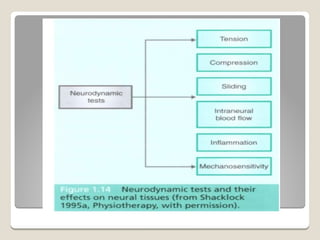
tissues. The primary mechanical functions in the nerves are tension,
movement and compression and the key physiological functions are
intraneural blood flow, impulse conduction, axonal transport,
inflammation and mechanosensitivity.
c. Innervated tissues: Innervated tissues are simply any tissues that are
innervated by the nervous system.
2. Tensioner and Slider:
Tension:
 The joints are a key site at which the nerves are elongated.
 The perineurium is the primary guardian against excessive tension and is
effectively the cabling in the peripheral nerve. It allows peripheral nerves
to withstand approximately 18-22% strain before failure.
Sliding:
 The movement of the neural structures relative to their adjacent tissues.
This is also called excursion, or sliding, and occurs in the nerves
longitudinally and transversely.
 Excursion is an essential aspect of neural function because it serves to
dissipate tension in the nervous system.
Two types of sliding:
a. Longitudinal Sliding: The sliding of nerves down the tension gradient
enables them to lend their tissue toward the part at which elongation is
initiated. This way, tension is distributed along the nervous system more
evenly, rather than it building up too much at one particular location.
b. Transverse Sliding: Transverse sliding is also essential because it helps
to dissipate tension and pressure in the nerves. Transverse excursion
occurs in two ways: The first is to enable the nerves to take the shortest
course between two points when tension is applied, The second means
by which transverse movement occurs is when nerves are subjected to
sideways pressure by neighboring structures, such as tendons and
muscles.
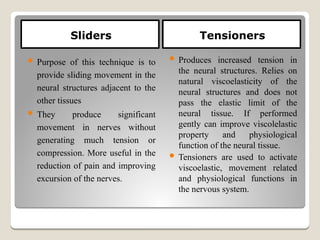
Sliders Tensioners
 Purpose of this technique is to
provide sliding movement in the
neural structures adjacent to the
other tissues
 They produce significant
movement in nerves without
generating much tension or
compression. More useful in the
reduction of pain and improving
excursion of the nerves.
 Produces increased tension in
the neural structures. Relies on
natural viscoelasticity of the
neural structures and does not
pass the elastic limit of the
neural tissue. If performed
gently can improve viscolelastic
property and physiological
function of the neural tissue.
 Tensioners are used to activate
viscoelastic, movement related
and physiological functions in
the nervous system.
3. Compression:
Third primary mechanical function of the nervous system. Neural structures can distort
in many ways, including the changing of shape according to the pressure exerted on
them. A clinical example of compression exerted by the mechanical interface is wrist
flexion pressing on the median nerve at the wrist in Phalen's sign. Bone and tendon
combined with muscle and fascia are what press on the nerve.
4. Movement of nerves:
a. At joint:
If nerve is present on convex side of the joint: it lengthens and if on concave side of the
joint it shortens.
If one joint moves: the tension induced in the nerve is less but, the nerve can slide:: if
several contiguous joints are moved: the tension induced within the nerve is more and
sliding movement decreases.
Convergence :The point where displacement of nerve tissue relative to bone reaches
zero. It occurs at C4-CC5 at cervical and L3-L4 at lumbar spine. Convergence appears
to be a universal neurodynamic event and occurs opposite joints that are moved or, if
several joints are moved, convergence will be most evident adjacent the joint that moves
the most.
b. Nerve Bending:
 Same convex and concave rule mentioned above applies to nerve bending.
 Nerve bending induces rise in neural tension by two mechanism: During
tension; nerve chooses shortest route to maintain the internal pressure so that
pain is not evoked, structures around the never gets compressed by
surrounding structures i.e. nerve bed, The third is by an increase in tension in
the nerve producing approximation of its fascicles, Fourth by the nerve being
on the convex side of the joint makes it take a longer course around the joint
than if it were on the concave side and Fifth, the bending of the nerve produces
more tension in the part of the nerve that is furthest from the joint axis. Hence,
even within the nerve, different parts undergo different events, depending on
the local intricacies.
c. Movement of innervated structures:
 the innervated tissues can be used to produce such events. For instance, in the
lower limb, dorsiflexion of the foot and toes can be used to apply tension to
the sciatic nerve as this movement is combined with the straight leg raise or
slump tests.
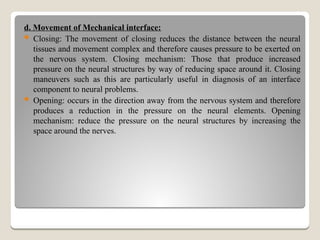
d. Movement of Mechanical interface:
 Closing: The movement of closing reduces the distance between the neural
tissues and movement complex and therefore causes pressure to be exerted on
the nervous system. Closing mechanism: Those that produce increased
pressure on the neural structures by way of reducing space around it. Closing
maneuvers such as this are particularly useful in diagnosis of an interface
component to neural problems.
 Opening: occurs in the direction away from the nervous system and therefore
produces a reduction in the pressure on the neural elements. Opening
mechanism: reduce the pressure on the neural structures by increasing the
space around the nerves.
Neurodynamic Sequencing
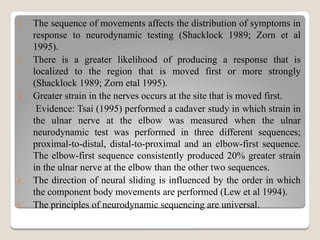
1. The sequence of movements affects the distribution of symptoms in
response to neurodynamic testing (Shacklock 1989; Zorn et al
1995).
2. There is a greater likelihood of producing a response that is
localized to the region that is moved first or more strongly
(Shacklock 1989; Zorn etal 1995).
3. Greater strain in the nerves occurs at the site that is moved first.
Evidence: Tsai (1995) performed a cadaver study in which strain in
the ulnar nerve at the elbow was measured when the ulnar
neurodynamic test was performed in three different sequences;
proximal-to-distal, distal-to-proximal and an elbow-first sequence.
The elbow-first sequence consistently produced 20% greater strain
in the ulnar nerve at the elbow than the other two sequences.
4. The direction of neural sliding is influenced by the order in which
the component body movements are performed (Lew et al 1994).
5. The principles of neurodynamic sequencing are universal.
Force Application
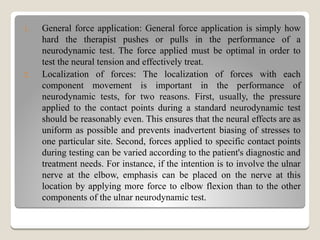
1. General force application: General force application is simply how
hard the therapist pushes or pulls in the performance of a
neurodynamic test. The force applied must be optimal in order to
test the neural tension and effectively treat.
2. Localization of forces: The localization of forces with each
component movement is important in the performance of
neurodynamic tests, for two reasons. First, usually, the pressure
applied to the contact points during a standard neurodynamic test
should be reasonably even. This ensures that the neural effects are as
uniform as possible and prevents inadvertent biasing of stresses to
one particular site. Second, forces applied to specific contact points
during testing can be varied according to the patient's diagnostic and
treatment needs. For instance, if the intention is to involve the ulnar
nerve at the elbow, emphasis can be placed on the nerve at this
location by applying more force to elbow flexion than to the other
components of the ulnar neurodynamic test.
4. Resistance to movement: the perception of resistance is what the
therapist feels. Frequently, the resistance experienced by the
therapist is provided by muscle contraction. It may be a protective
response towards the pain induced while tension test.
5. Extent of movement: the most common cause of provocation of
symptoms with testing is that the therapist has taken the nervous
system too far into a provoking movement. This may lead to pain
aggravation instead of reduction. Initially when a patient comes its
better to start with a smaller range and gradually progressing the
extent of the range.
6. Duration of testing: the longer a manoeuvre that increases
intraneural tension or compression is held, the greater is the chance
of producing neural ischaemia and changes in conduction. The time
between elongation to a value such as 12% and the onset of
conduction changes is as short as several seconds (Wall et al 1992)
and the changes are substantial within one minute in patients with
neuropathy. (10 seconds of stretch with 5-8 repetitions).
Neuropathodynamics:
1. Mechanical Interface dysfunction:
Forces exerted by nervous system by interfacing movement complex are abnormal are
called so.
Types are:
Closing dysfunction:
Alteration in the closing mechanism of movement complex around the nervous system
producing abnormal forces on the adjacent neural component.
Reduced closing: occurs when movement complex lacks during appropriate movement in
the closing direction.
Excessive closing: More or excessive movement in the closing direction.
Opening dysfunction:
Alteration in the opening mechanism of movement complex around the nervous system
producing abnormal forces on the adjacent neural component.
Reduced opening: does not open sufficiently or in a desirable manner. Impairment or
reduction in pressure may produce lack of recovery of the neural structure to normal
pressure.
Excessive opening: opens excessively.
2. Pathoanatomical dysfunction: interfacing structure here is of abnormal
shape and size which is exerting abnormal excessive pressure on the
adjacent neural structures.
3. Pathophysiological Dysfunction: occurs when pathophysiological
changes in the mechanical interface produces pathodynamic in adjacent
neural tissues.
4. Neural dysfunction:
 Neural sliding dysfunction: reduced excursion compared with normal or
hypersensitivity towards the sliding maneuver.
 Neural Tension dysfunction: tension dynamics are abnormal or
hypersensitive giving rise to abnormal tension in neural structures.
 Neural hypermobility- Instability: excursion of neural segments is greater
than normal or undesirable.
5. Innervated tissue dysfunction:
 Motor control dysfunction: Motor control dysfunction is very important in
relation to the nervous system because, if the musculoskeletal system does
not move optimally, forces exerted on the nervous system by the
mechanical interface will become disadvantageous.
 Protective muscle hyperactivity dysfunction: abnormally increased muscle
contraction as a pattern of protecting the neural structures.
 Muscle imbalance dysfunction:
 Localized muscle hyperactivity dysfunction (Trigger points): increased
activity of muscle d/t increased efferent action in the nervous system.
 Muscle hypoactivity dysfunction: activity in muscle is reduced d/t
decreased activity in the efferent action by the CNS.
 Inflammation dysfunction: Neurogenic inflammation: release of
inflammatory mediators, Stimulation of inflammation from neural
structures.
Reference
Clinical Neurodynamics, Shacklock. M and
Buttler
Thank You

Neurodynamics- I

  • 1.
  • 2.
    Contents Definition Principles/Concepts by Butler Principles/Conceptsby Shacklock Neurodynamic Sequencing Force Application Neuropathodynamics
  • 3.
    Definition Neurodynamics is thescience of the relationships between mechanics and physiology of the nervous system.
  • 4.
  • 5.
    1. The nervoussystem is a continuum A mechanical, electrical and chemical continuum exists in the nervous system. 2. Structural differentiation The neural continuum allows a differentiation between neural and non-neural tissues. 3. Neural relations to joint axes dictates load: The nervous system is usually behind, in front, or to the side of joint axes of movement. This means that the physical loading on the nervous system will be dictated by joint position. 4. Pinch and tension -the key role of neighboring structures: Most neurodynamic tests are tests of the ability of the nervous system to elongate. The neighboring structures (e.g. joint and muscle) which 'contain' the nervous system can sometimes pinch it.
  • 6.
    5. Sliders andtensioners: A tensioner can be various techniques which 'pulls from both ends of the nervous system. A slider is a 'flossing' movement where tension is placed at one end of the system and slack at the other. Sliders provide a large amount of neural movement and are a neurally nonaggressive movement for anxious patients. 6. Recording: Abbrevations such as PF/IN/SLR inform the order and kind of movement, thus ankle plantar flexion first, then inversion and then Straight Leg Raise. The 'In:Did' system is also used. For example, In: HF/LR Did: KE means that in the hip flexion and lateral rotation position, knee extension was performed. 7. Don't forget the brain: Remember that responses to these tests may not always be due to physical health issues in the nervous system. In some patients the sensitivity evoked during testing may be due to changes in the central nervous system.
  • 7.
  • 8.
    1. Three partsystem: Consists of Mechanical interface, neural structure and innervated tissue. a. Mechanical Interface: musculoskeletal system presents a mechanical interface to the nervous system. The mechanical interface can also be called the nerve bed and consists of anything that resides next to the nervous system, such as tendon, muscle, bone, intervertebral discs, ligaments, fascia and blood vessels. b. Neural structures: The neural structures are simply those that constitute the nervous system. Included are the brain, cranial nerves and spinal cord, nerve rootlets, nerve roots and peripheral nerves (including the sympathetic trunks) and all their related connective tissues. The primary mechanical functions in the nerves are tension, movement and compression and the key physiological functions are intraneural blood flow, impulse conduction, axonal transport, inflammation and mechanosensitivity. c. Innervated tissues: Innervated tissues are simply any tissues that are innervated by the nervous system.
  • 9.
    2. Tensioner andSlider: Tension:  The joints are a key site at which the nerves are elongated.  The perineurium is the primary guardian against excessive tension and is effectively the cabling in the peripheral nerve. It allows peripheral nerves to withstand approximately 18-22% strain before failure. Sliding:  The movement of the neural structures relative to their adjacent tissues. This is also called excursion, or sliding, and occurs in the nerves longitudinally and transversely.  Excursion is an essential aspect of neural function because it serves to dissipate tension in the nervous system.
  • 10.
    Two types ofsliding: a. Longitudinal Sliding: The sliding of nerves down the tension gradient enables them to lend their tissue toward the part at which elongation is initiated. This way, tension is distributed along the nervous system more evenly, rather than it building up too much at one particular location. b. Transverse Sliding: Transverse sliding is also essential because it helps to dissipate tension and pressure in the nerves. Transverse excursion occurs in two ways: The first is to enable the nerves to take the shortest course between two points when tension is applied, The second means by which transverse movement occurs is when nerves are subjected to sideways pressure by neighboring structures, such as tendons and muscles.
  • 11.
    Sliders Tensioners  Purposeof this technique is to provide sliding movement in the neural structures adjacent to the other tissues  They produce significant movement in nerves without generating much tension or compression. More useful in the reduction of pain and improving excursion of the nerves.  Produces increased tension in the neural structures. Relies on natural viscoelasticity of the neural structures and does not pass the elastic limit of the neural tissue. If performed gently can improve viscolelastic property and physiological function of the neural tissue.  Tensioners are used to activate viscoelastic, movement related and physiological functions in the nervous system.
  • 12.
    3. Compression: Third primarymechanical function of the nervous system. Neural structures can distort in many ways, including the changing of shape according to the pressure exerted on them. A clinical example of compression exerted by the mechanical interface is wrist flexion pressing on the median nerve at the wrist in Phalen's sign. Bone and tendon combined with muscle and fascia are what press on the nerve. 4. Movement of nerves: a. At joint: If nerve is present on convex side of the joint: it lengthens and if on concave side of the joint it shortens. If one joint moves: the tension induced in the nerve is less but, the nerve can slide:: if several contiguous joints are moved: the tension induced within the nerve is more and sliding movement decreases. Convergence :The point where displacement of nerve tissue relative to bone reaches zero. It occurs at C4-CC5 at cervical and L3-L4 at lumbar spine. Convergence appears to be a universal neurodynamic event and occurs opposite joints that are moved or, if several joints are moved, convergence will be most evident adjacent the joint that moves the most.
  • 13.
    b. Nerve Bending: Same convex and concave rule mentioned above applies to nerve bending.  Nerve bending induces rise in neural tension by two mechanism: During tension; nerve chooses shortest route to maintain the internal pressure so that pain is not evoked, structures around the never gets compressed by surrounding structures i.e. nerve bed, The third is by an increase in tension in the nerve producing approximation of its fascicles, Fourth by the nerve being on the convex side of the joint makes it take a longer course around the joint than if it were on the concave side and Fifth, the bending of the nerve produces more tension in the part of the nerve that is furthest from the joint axis. Hence, even within the nerve, different parts undergo different events, depending on the local intricacies. c. Movement of innervated structures:  the innervated tissues can be used to produce such events. For instance, in the lower limb, dorsiflexion of the foot and toes can be used to apply tension to the sciatic nerve as this movement is combined with the straight leg raise or slump tests.
  • 14.
    d. Movement ofMechanical interface:  Closing: The movement of closing reduces the distance between the neural tissues and movement complex and therefore causes pressure to be exerted on the nervous system. Closing mechanism: Those that produce increased pressure on the neural structures by way of reducing space around it. Closing maneuvers such as this are particularly useful in diagnosis of an interface component to neural problems.  Opening: occurs in the direction away from the nervous system and therefore produces a reduction in the pressure on the neural elements. Opening mechanism: reduce the pressure on the neural structures by increasing the space around the nerves.
  • 15.
  • 16.
    1. The sequenceof movements affects the distribution of symptoms in response to neurodynamic testing (Shacklock 1989; Zorn et al 1995). 2. There is a greater likelihood of producing a response that is localized to the region that is moved first or more strongly (Shacklock 1989; Zorn etal 1995). 3. Greater strain in the nerves occurs at the site that is moved first. Evidence: Tsai (1995) performed a cadaver study in which strain in the ulnar nerve at the elbow was measured when the ulnar neurodynamic test was performed in three different sequences; proximal-to-distal, distal-to-proximal and an elbow-first sequence. The elbow-first sequence consistently produced 20% greater strain in the ulnar nerve at the elbow than the other two sequences. 4. The direction of neural sliding is influenced by the order in which the component body movements are performed (Lew et al 1994). 5. The principles of neurodynamic sequencing are universal.
  • 17.
  • 18.
    1. General forceapplication: General force application is simply how hard the therapist pushes or pulls in the performance of a neurodynamic test. The force applied must be optimal in order to test the neural tension and effectively treat. 2. Localization of forces: The localization of forces with each component movement is important in the performance of neurodynamic tests, for two reasons. First, usually, the pressure applied to the contact points during a standard neurodynamic test should be reasonably even. This ensures that the neural effects are as uniform as possible and prevents inadvertent biasing of stresses to one particular site. Second, forces applied to specific contact points during testing can be varied according to the patient's diagnostic and treatment needs. For instance, if the intention is to involve the ulnar nerve at the elbow, emphasis can be placed on the nerve at this location by applying more force to elbow flexion than to the other components of the ulnar neurodynamic test.
  • 19.
    4. Resistance tomovement: the perception of resistance is what the therapist feels. Frequently, the resistance experienced by the therapist is provided by muscle contraction. It may be a protective response towards the pain induced while tension test. 5. Extent of movement: the most common cause of provocation of symptoms with testing is that the therapist has taken the nervous system too far into a provoking movement. This may lead to pain aggravation instead of reduction. Initially when a patient comes its better to start with a smaller range and gradually progressing the extent of the range. 6. Duration of testing: the longer a manoeuvre that increases intraneural tension or compression is held, the greater is the chance of producing neural ischaemia and changes in conduction. The time between elongation to a value such as 12% and the onset of conduction changes is as short as several seconds (Wall et al 1992) and the changes are substantial within one minute in patients with neuropathy. (10 seconds of stretch with 5-8 repetitions).
  • 21.
    Neuropathodynamics: 1. Mechanical Interfacedysfunction: Forces exerted by nervous system by interfacing movement complex are abnormal are called so. Types are: Closing dysfunction: Alteration in the closing mechanism of movement complex around the nervous system producing abnormal forces on the adjacent neural component. Reduced closing: occurs when movement complex lacks during appropriate movement in the closing direction. Excessive closing: More or excessive movement in the closing direction. Opening dysfunction: Alteration in the opening mechanism of movement complex around the nervous system producing abnormal forces on the adjacent neural component. Reduced opening: does not open sufficiently or in a desirable manner. Impairment or reduction in pressure may produce lack of recovery of the neural structure to normal pressure. Excessive opening: opens excessively.
  • 22.
    2. Pathoanatomical dysfunction:interfacing structure here is of abnormal shape and size which is exerting abnormal excessive pressure on the adjacent neural structures. 3. Pathophysiological Dysfunction: occurs when pathophysiological changes in the mechanical interface produces pathodynamic in adjacent neural tissues. 4. Neural dysfunction:  Neural sliding dysfunction: reduced excursion compared with normal or hypersensitivity towards the sliding maneuver.  Neural Tension dysfunction: tension dynamics are abnormal or hypersensitive giving rise to abnormal tension in neural structures.  Neural hypermobility- Instability: excursion of neural segments is greater than normal or undesirable.
  • 23.
    5. Innervated tissuedysfunction:  Motor control dysfunction: Motor control dysfunction is very important in relation to the nervous system because, if the musculoskeletal system does not move optimally, forces exerted on the nervous system by the mechanical interface will become disadvantageous.  Protective muscle hyperactivity dysfunction: abnormally increased muscle contraction as a pattern of protecting the neural structures.  Muscle imbalance dysfunction:  Localized muscle hyperactivity dysfunction (Trigger points): increased activity of muscle d/t increased efferent action in the nervous system.  Muscle hypoactivity dysfunction: activity in muscle is reduced d/t decreased activity in the efferent action by the CNS.  Inflammation dysfunction: Neurogenic inflammation: release of inflammatory mediators, Stimulation of inflammation from neural structures.
  • 24.
  • 25.