Dr. Quazi Ibtesaam Huma
MPT Neurosciences
Assistant Professor
Proprioceptive Neuromuscular
Facilitation
DEFINITION
• Proprioceptive: having to do with any
of the sensory receptors that give
information concerning movement and
position of the body
• Neuromuscular: involving the nerves
and muscles
• Facilitation: making easier
DEFINITION
• PNF is an approach to therapeutic exercise that
combines functionally based diagonal patterns
of movement with techniques of neuromuscular
facilitation to evoke motor responses and
improve neuromuscular control and function
• PNF techniques can be
muscular strength and endurance; to facilitate
stability, mobility, neuromuscular control, and
coordinated movements; and to lay a foundation
for the restoration of function
Definitions of PNF:
Therefore, PNF can be defined as, methods of
promoting or hastening the response of the
neuromuscular mechanism through stimulation
of the proprioceptors.
Principles:
• Patient must be taught the pattern.
• Have the patient watch the moving limb moved
passively.
• The patient must give proper verbal
command.
• Manual contact with appropriate pressure is very
important.
PNF MAIN
FEATURES
(Hallmarks)
• ---
these are the patterns needed
during
functional
activities
• The application of
– Proprioceptive
– Cutaneous
–
Stronger muscle group
of a diagonal pattern
will
Physiology
- PNF exercises are based on the stretch reflex
which is caused by stimulation of the Golgi
tendon and muscle spindles.
- This stimulation results in impulses being sent to
the brain, which leads to the contraction and
relaxation of muscles.
-When a body part is injured, there is a delay in the
stimulation of the muscle spindles and Golgi
tendons resulting in weakness of the muscle.
PNF exercises help to re-educate the motor units
which are lost due to the injury
• :
– Neurorehabilitation
– Musculoskeletal
conditions
–
–
– PNF can be used in active and passive
ROM, and to improve flexibility
• PNF techniques are useful through
the
:
/ isometric techniques
/ high speed diagonal
movement performed against maximum
resistance
The method of PNF:
Greatest emphasis was placed on the application
of maximal resistance throughout the
range of motion using many combinations of
motions, which allowed for two component
actions at two or more joints.
BASIC PROCEDURES
1. Resistance
2. Irradiation and reinforcement
3. Manual contact
4. Body positioning and body mechanics
5. Verbal commands
6. Visual cues
7. Traction and approximation
8. Stretch
9. Timing
10. Patterns
RESISTANCE
The amount of resistance provided during an activity must
be correct for the patient’s condition and the goal of the
activity. This is called optimal resistance.
Resistance is used in the treatment to:
Facilitate the ability of the muscle to contract
Increase motor control
Help the patient gain an awareness of motion and its
direction
Increase strength
IRRADIATION & REINFORCEMENT
Irradiation : the spread of response to stimulation
Reinforcement : means “to strengthen, make stronger”
IRRADIATION & REINFORCEMENT
Increasing the amount of resistance will increase
the amount and extent of the muscular response.
Examples:
Resist muscle activity of the sound limb to produce
contraction of the muscles in the immobilized
contralateral limb.
Resist supination of the forearm to facilitate contraction
of the external rotators of that shoulder
MANUAL CONTACT
This refers to how and where the therapist’
hands are placed on the patient.
Effects:
Stimulates the muscle’s extroceptores
Stimulates the synergistic muscle to
reinforce the movement
BODY POSTION & BODY MECHANICS
• The therapist body should be in line of
motion
• Shoulder and pelvis face the direction
of motion.
• Therapist stands in walk standing
position.
• The resistance comes from the
therapist’s body weight, while the hands
and arms stay comparatively relaxed.
VERBAL STIMULATION (COMMANDS)
Tells the patient what to do and when to do
Instructions need to be clear and concise without the use
of unnecessary words.
May be combined with passive movement to teach the
patient the desired motion
The timing of the command is very important
The volume with which the command is given affects the
strength of resulting muscle contraction.
Louder command when strong muscle contraction is
required.
Softer and calmer tone when the goal is relaxation and
relief of pain.
VISUAL CUES
The feedback from visual sensory system can
promote a more powerful muscle contraction
Helps the patient to control and correct his
position and motion
Moving the eyes will influence both the head and
body motion
Eye contact between patient and therapist provides
a mode of communication
TRACTION & APPROXIMATION
The therapeutic effects of traction and
approximation is due to stimulation of joint
receptors.
Traction is applied when the movement is
occurring against the gravity
Approximation is applied when the movement
occurs in the direction of gravitational pull
APPROXIMATION
Compression through a joint stimulate
receptors
joint
Facilitate stability
The approximation is always maintained, whether
done quickly or slowly
When the therapist feels that the active muscle
contraction decreases the approximation is
repeated and resistance is given
STRETCH
The stretch stimulus occurs when the muscle is
elongated
The lengthened position of the muscle is the
starting position of each pattern and the stretch is
maintained throughout the movement.
All the components of a pattern must be stretched
simultaneously
Stretching will Stimulate the activity of muscle
spindle
TIMINGS
Timing is the sequencing of motions
Normal timing of most coordinated and efficient
motions is from distal to proximal
DIAGONAL
• Patterns of movement associated with
PNF are:
– Multiplanner, diagonal, rotational
of extremities, trunk and neck
– Two pairs of diagonal patterns are associated
for the upper and lower extremities; diagonal
1 (D1), diagonal 2 (D2)
•
1
.
•
Each pattern has three dimension
– Flexion or extension
2. Abduction or adduction
3. Rotation
Movement occurs in a straight line,
in diagonal direction with a rotatory
component
•
•
•
•
•
are associated for
the upper and lower extremities; diagonal 1 (D1),
diagonal 2 (D2)
Each of these
patterns can be performed in either flexion or
extension
Terminology used D1
flexion; D1 extension; D2 flexion; D2 extension
Patterns are
identified by the motion that occurs at the
proximal pivot points (hips or shoulders)
Pattern is named by
the ending position of the hip or the shoulder
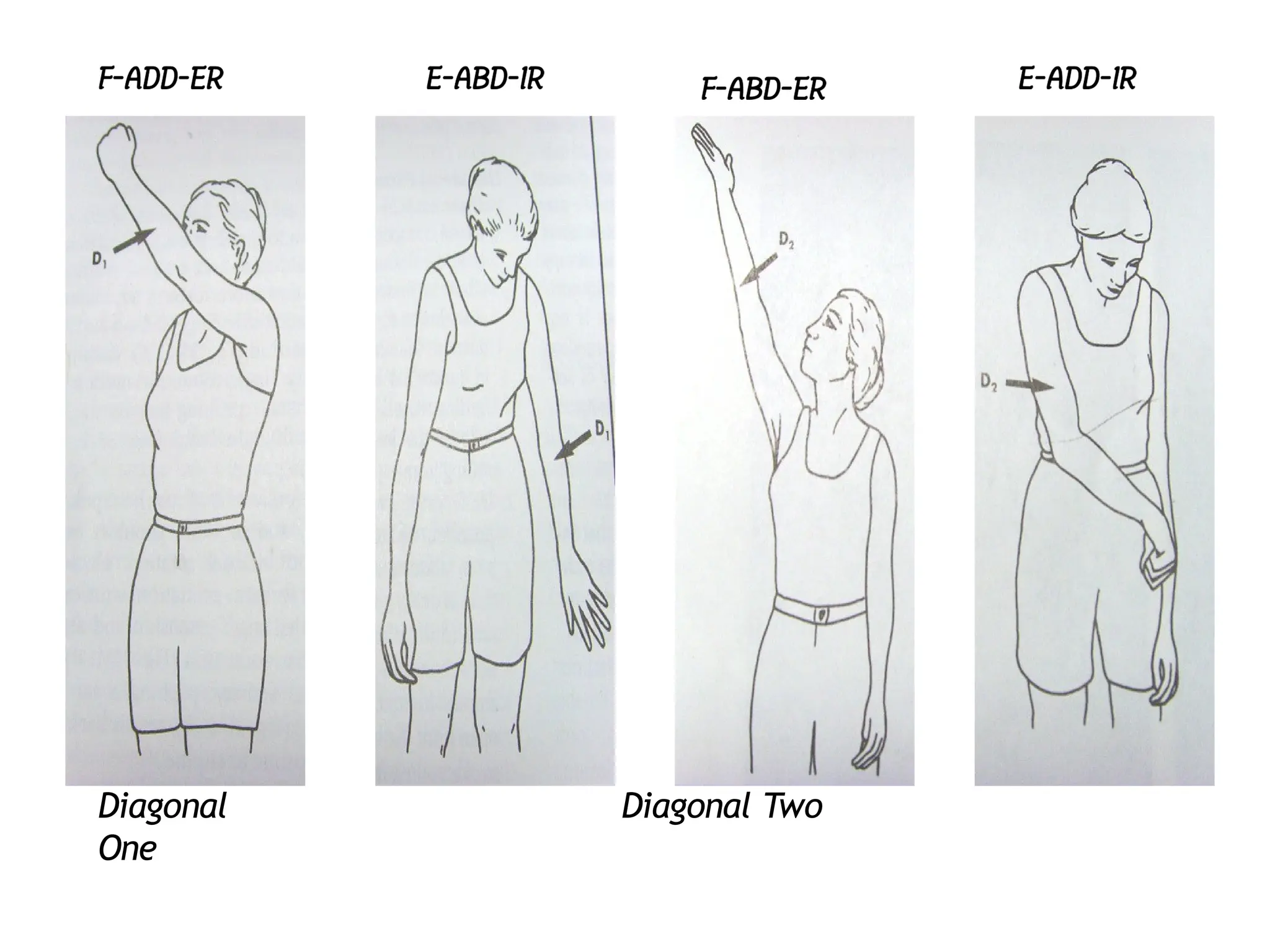
UPPER EXTREMITY
PATTERNS
Shoulder FLEX, ADD,
ER Forearm - Sup
Wrist - Rad.
Flexion Fingers -
flexion
Shoulder FLEX,
ABD, ER
Forearm - Sup
Wrist - Rad.
Flexion Fingers -
Extension
Shoulder EXT, ABD,
IR Forearm - Pro
Wrist - Ulnar. extension
Fingers - Extension
Shoulder EXT, ADD, IR
Forearm - Pro
Wrist - Ulnar
ext. Fingers -
Diagonal
One
Diagonal Two
LOWER EXTREMITY
LOWER EXTREMITY
Thank you!!!!!!!!!

PNF Approach and Techniques!!!!!!! .pptx

  • 1.
    Dr. Quazi IbtesaamHuma MPT Neurosciences Assistant Professor Proprioceptive Neuromuscular Facilitation
  • 3.
    DEFINITION • Proprioceptive: havingto do with any of the sensory receptors that give information concerning movement and position of the body • Neuromuscular: involving the nerves and muscles • Facilitation: making easier
  • 4.
    DEFINITION • PNF isan approach to therapeutic exercise that combines functionally based diagonal patterns of movement with techniques of neuromuscular facilitation to evoke motor responses and improve neuromuscular control and function • PNF techniques can be muscular strength and endurance; to facilitate stability, mobility, neuromuscular control, and coordinated movements; and to lay a foundation for the restoration of function
  • 5.
    Definitions of PNF: Therefore,PNF can be defined as, methods of promoting or hastening the response of the neuromuscular mechanism through stimulation of the proprioceptors. Principles: • Patient must be taught the pattern. • Have the patient watch the moving limb moved passively. • The patient must give proper verbal command. • Manual contact with appropriate pressure is very important.
  • 6.
    PNF MAIN FEATURES (Hallmarks) • --- theseare the patterns needed during functional activities • The application of – Proprioceptive – Cutaneous – Stronger muscle group of a diagonal pattern will
  • 7.
    Physiology - PNF exercisesare based on the stretch reflex which is caused by stimulation of the Golgi tendon and muscle spindles. - This stimulation results in impulses being sent to the brain, which leads to the contraction and relaxation of muscles. -When a body part is injured, there is a delay in the stimulation of the muscle spindles and Golgi tendons resulting in weakness of the muscle. PNF exercises help to re-educate the motor units which are lost due to the injury
  • 8.
    • : – Neurorehabilitation –Musculoskeletal conditions
  • 9.
    – – – PNF canbe used in active and passive ROM, and to improve flexibility • PNF techniques are useful through the : / isometric techniques / high speed diagonal movement performed against maximum resistance
  • 10.
    The method ofPNF: Greatest emphasis was placed on the application of maximal resistance throughout the range of motion using many combinations of motions, which allowed for two component actions at two or more joints.
  • 11.
    BASIC PROCEDURES 1. Resistance 2.Irradiation and reinforcement 3. Manual contact 4. Body positioning and body mechanics 5. Verbal commands 6. Visual cues 7. Traction and approximation 8. Stretch 9. Timing 10. Patterns
  • 12.
    RESISTANCE The amount ofresistance provided during an activity must be correct for the patient’s condition and the goal of the activity. This is called optimal resistance. Resistance is used in the treatment to: Facilitate the ability of the muscle to contract Increase motor control Help the patient gain an awareness of motion and its direction Increase strength
  • 13.
    IRRADIATION & REINFORCEMENT Irradiation: the spread of response to stimulation Reinforcement : means “to strengthen, make stronger”
  • 14.
    IRRADIATION & REINFORCEMENT Increasingthe amount of resistance will increase the amount and extent of the muscular response. Examples: Resist muscle activity of the sound limb to produce contraction of the muscles in the immobilized contralateral limb. Resist supination of the forearm to facilitate contraction of the external rotators of that shoulder
  • 15.
    MANUAL CONTACT This refersto how and where the therapist’ hands are placed on the patient. Effects: Stimulates the muscle’s extroceptores Stimulates the synergistic muscle to reinforce the movement
  • 16.
    BODY POSTION &BODY MECHANICS • The therapist body should be in line of motion • Shoulder and pelvis face the direction of motion. • Therapist stands in walk standing position. • The resistance comes from the therapist’s body weight, while the hands and arms stay comparatively relaxed.
  • 17.
    VERBAL STIMULATION (COMMANDS) Tellsthe patient what to do and when to do Instructions need to be clear and concise without the use of unnecessary words. May be combined with passive movement to teach the patient the desired motion The timing of the command is very important The volume with which the command is given affects the strength of resulting muscle contraction. Louder command when strong muscle contraction is required. Softer and calmer tone when the goal is relaxation and relief of pain.
  • 18.
    VISUAL CUES The feedbackfrom visual sensory system can promote a more powerful muscle contraction Helps the patient to control and correct his position and motion Moving the eyes will influence both the head and body motion Eye contact between patient and therapist provides a mode of communication
  • 19.
    TRACTION & APPROXIMATION Thetherapeutic effects of traction and approximation is due to stimulation of joint receptors. Traction is applied when the movement is occurring against the gravity Approximation is applied when the movement occurs in the direction of gravitational pull
  • 20.
    APPROXIMATION Compression through ajoint stimulate receptors joint Facilitate stability The approximation is always maintained, whether done quickly or slowly When the therapist feels that the active muscle contraction decreases the approximation is repeated and resistance is given
  • 21.
    STRETCH The stretch stimulusoccurs when the muscle is elongated The lengthened position of the muscle is the starting position of each pattern and the stretch is maintained throughout the movement. All the components of a pattern must be stretched simultaneously Stretching will Stimulate the activity of muscle spindle
  • 22.
    TIMINGS Timing is thesequencing of motions Normal timing of most coordinated and efficient motions is from distal to proximal
  • 23.
    DIAGONAL • Patterns ofmovement associated with PNF are: – Multiplanner, diagonal, rotational of extremities, trunk and neck – Two pairs of diagonal patterns are associated for the upper and lower extremities; diagonal 1 (D1), diagonal 2 (D2)
  • 24.
    • 1 . • Each pattern hasthree dimension – Flexion or extension 2. Abduction or adduction 3. Rotation Movement occurs in a straight line, in diagonal direction with a rotatory component
  • 25.
    • • • • • are associated for theupper and lower extremities; diagonal 1 (D1), diagonal 2 (D2) Each of these patterns can be performed in either flexion or extension Terminology used D1 flexion; D1 extension; D2 flexion; D2 extension Patterns are identified by the motion that occurs at the proximal pivot points (hips or shoulders) Pattern is named by the ending position of the hip or the shoulder
  • 26.
  • 27.
    PATTERNS Shoulder FLEX, ADD, ERForearm - Sup Wrist - Rad. Flexion Fingers - flexion Shoulder FLEX, ABD, ER Forearm - Sup Wrist - Rad. Flexion Fingers - Extension Shoulder EXT, ABD, IR Forearm - Pro Wrist - Ulnar. extension Fingers - Extension Shoulder EXT, ADD, IR Forearm - Pro Wrist - Ulnar ext. Fingers -
  • 28.
  • 29.
  • 30.
  • 35.