PROPRIOCEPTIVE NEUROMUSCULAR
FASCILITATION
QANDEEL HAMIDULLAH KHAN
LETS BEGIN
history
• Proprioceptive Neuromuscular Facilitation (PNF)
is an approach to patient care, which as
originated in the 1940's by Herman Kabat, M.D.
Maggie Knott joined him in his efforts to discover
and define the approach in the late 1940's.
• They soon began to teach PNF to graduate
physical therapists from all over the world.
Dorothy Voss was one of the first students in this
program and upon completion of the program,
she joined Maggie's staff and together they wrote
the first edition of the PNF book.
Basic principles to PNF:-
• PNF is an integrated approach: each treatment is directed at a total
human being, not just at a specific problem or body segment.
• Based on the untapped existing potential of all patients, the
therapist will always focus on mobilizing the patient’s reserves.
• The treatment approach is always positive, reinforcing and using
that, which the patient can do, on a physical and psychological level.
• The primary goal of all treatment is to help patients achieve their
highest level of function.
• To reach this highest level of function, the therapist integrates
principles of motor control and motor learning. This includes
treatment on the level of body structures, on the activity level as
well as on the participation level (ICF, International Classification of
Functioning, WHO).
Definition and PNF Philosophy
• Proprioceptive: Having to do with any of the sensory
receptors that give information concerning movement
and position of the body
• Neuromuscular: Involving the nerves and muscles
• Facilitation: Making easier
• Proprioceptive Neuromuscular Facilitation (PNF) is a
concept of treatment. Its underlying philosophy is that
all human beings, including those with disabilities,
have untapped existing potential (Kabat 1950).
PNF philosophy
• 1. Positive approach: no pain, achievable tasks, set up for
success, direct and indirect treatment, strong start.
• 2. Highest functional level: functional approach, ICF, include
treatment on body structure level and activity level.
• 3. Mobilize potential by intensive training: active
participation, motor learning, and self training.
• 4. Consider the total human being: whole person with
his/her environmental, personal, physical, and emotional
factors.
• 5. Use of motor control and motor learning principles:
repetition in a different context; respect stages of motor
control, variability of practice.
Basic neurophysiologic principles
• The work of Sir Charles Sherrington was
important in the development of the
procedures and techniques of PNF. The
following useful definitions were abstracted
from his work (Sherrington 1947):
• After discharge: The effect of a stimulus continues after the
stimulus stops. If the strength and duration of the stimulus
increase, the after discharge increases also. The feeling of
increased power that comes after a maintained static contraction
is a result of after discharge.
• Temporal summation: A succession of weak stimuli (subliminal)
occurring within a certain (short) period of time combine
(summate) to cause excitation.
• Spatial summation: Weak stimuli applied simultaneously to
different areas of the body reinforce each other (summate) to
cause excitation. Temporal and spatial summation can combine
for greater activity.
• Irradiation: This is a spreading and increased strength of a response. It
occurs when either the number of stimuli or the strength of the stimuli is
increased. The response may be either excitation or inhibition.
• Successive induction: An increased excitation of the agonist muscles
follows stimulation (contraction) of their antagonists. Techniques
involving reversal of antagonists make use of this property (Induction:
stimulation, increased excitability.).
• Reciprocal innervation (reciprocal inhibition): Contraction of muscles is
accompanied by simultaneous inhibition of their antagonists. Reciprocal
innervation is a necessary part of coordinated motion. Relaxation
techniques make use of this property.
• “The nervous system is continuous throughout its extent – there are no
isolated parts.”
Irradiation
• is the spread of the response to stimulation.
• This response can be seen as increased
facilitation (contraction) or inhibition (relaxation)
in the synergistic muscles and patterns of
movement. The response increases as the stimuli
increase in intensity or duration (Sherrington
1947). Kabat (1961) wrote that it is resistance to
motion that produces irradiation, and the spread
of the muscular activity will occur in specific
patterns.
Reinforcement/Reinforce,
• as defined in Webster’s Ninth New Collegiate
Dictionary, is “to strengthen by fresh addition,
make stronger.”
• The therapist directs the reinforcement of the
weaker muscles by the amount of resistance
given to the strong muscles.
• Increasing the amount of resistance will increase
the amount and extent of the muscular response.
Traction
• Traction is the elongation of the trunk or an
extremity.
• Knott, Voss, and their colleagues theorized that the
therapeutic effects of traction are due to stimulation of
receptors in the joints (Knott and Voss 1968; Voss et al.
1985). Traction also acts as a stretch stimulus by
elongating the muscles.
• Apply the traction force gradually until the desired
result is achieved. The traction is maintained
throughout the movement and combined with
appropriate resistance.
• Traction is used to:-
• Facilitate motion, especially pulling and antigravity
motions.
• Aid in elongation of muscle tissue when using the
stretch reflex.
• Resist some part of the motion. For example, use
traction at the beginning of shoulder flexion to resist
scapula elevation.
• Traction of the affected part is helpful when treating
patients with joint pain.
Approximation
• is the compression of the trunk or an extremity.
• The muscle contractions following the approximation
are thought to be due to stimulation of joint receptors
(Knott and Voss 1968; Voss et al. 1985). Another
possible reason for the
• increased muscular response is to counteract the
disturbance of position or posture caused by the
approximation. Given gradually and gently,
approximation may aid in the treatment of painful and
unstable joints.
• Approximation is used to:-
• Promote stabilization
• Facilitate weight-bearing and the contraction of
antigravity muscles
• Facilitate upright reactions
• Resist some component of motion. For example,
use approximation at the end of shoulder flexion
to resist scapula elevation.
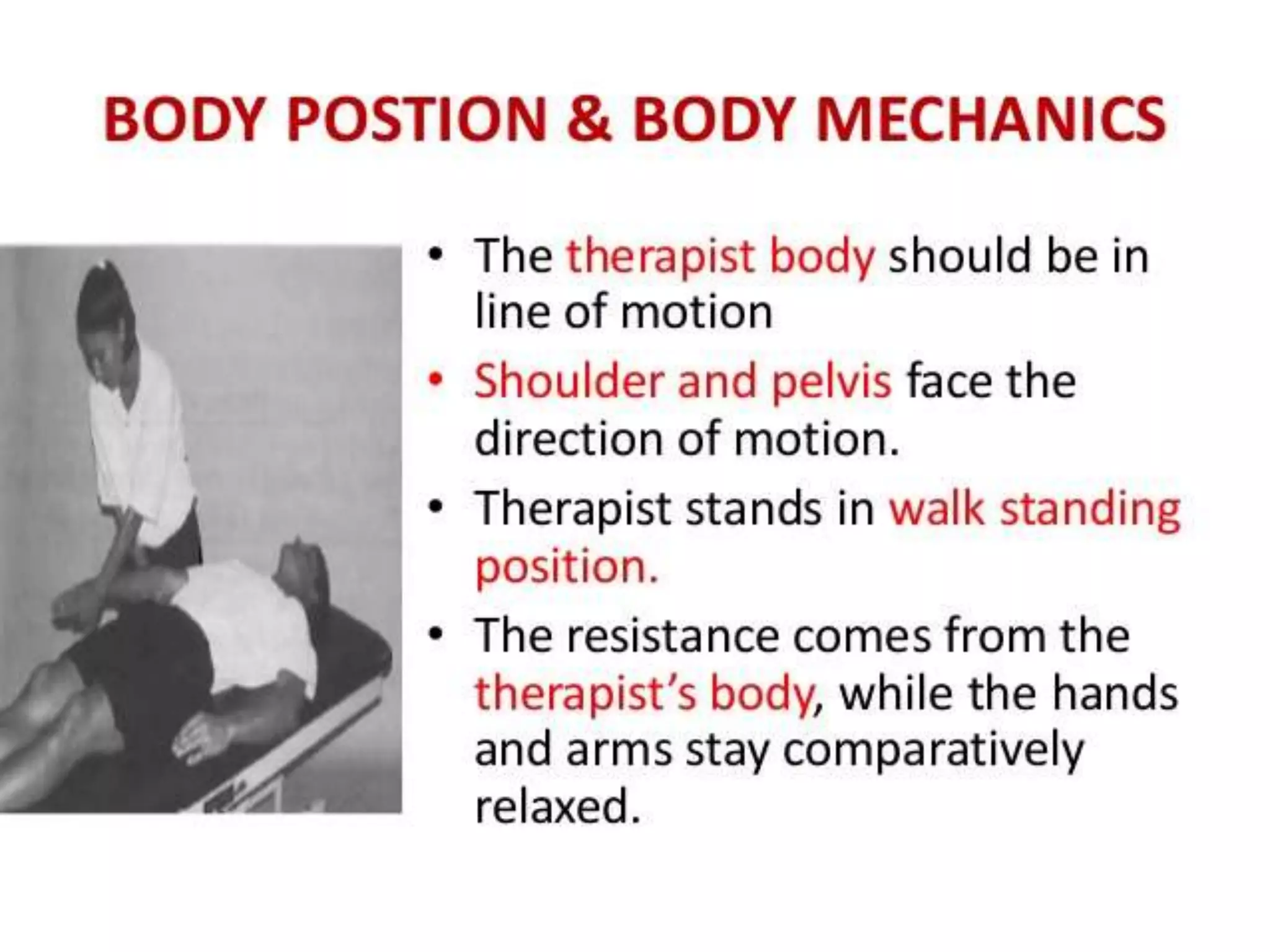
Body Position and Body Mechanics
• Give the therapist effective control of the
patient’s motion.
• Facilitate control of the direction of the
resistance.
• Enable the therapist to give resistance without
fatiguing.
• Johnson and Saliba first developed the material
on body position
PNF
PNF
PNF
PNF
PNF
PNF
PNF
PNF
PNF
PNF
PNF
PNF
PNF
PNF
PNF
PNF
PNF
PNF
PNF
PNF
PNF
PNF
PNF
PNF
PNF
PNF

PNF

  • 2.
  • 3.
  • 4.
    history • Proprioceptive NeuromuscularFacilitation (PNF) is an approach to patient care, which as originated in the 1940's by Herman Kabat, M.D. Maggie Knott joined him in his efforts to discover and define the approach in the late 1940's. • They soon began to teach PNF to graduate physical therapists from all over the world. Dorothy Voss was one of the first students in this program and upon completion of the program, she joined Maggie's staff and together they wrote the first edition of the PNF book.
  • 5.
    Basic principles toPNF:- • PNF is an integrated approach: each treatment is directed at a total human being, not just at a specific problem or body segment. • Based on the untapped existing potential of all patients, the therapist will always focus on mobilizing the patient’s reserves. • The treatment approach is always positive, reinforcing and using that, which the patient can do, on a physical and psychological level. • The primary goal of all treatment is to help patients achieve their highest level of function. • To reach this highest level of function, the therapist integrates principles of motor control and motor learning. This includes treatment on the level of body structures, on the activity level as well as on the participation level (ICF, International Classification of Functioning, WHO).
  • 6.
    Definition and PNFPhilosophy • Proprioceptive: Having to do with any of the sensory receptors that give information concerning movement and position of the body • Neuromuscular: Involving the nerves and muscles • Facilitation: Making easier • Proprioceptive Neuromuscular Facilitation (PNF) is a concept of treatment. Its underlying philosophy is that all human beings, including those with disabilities, have untapped existing potential (Kabat 1950).
  • 7.
    PNF philosophy • 1.Positive approach: no pain, achievable tasks, set up for success, direct and indirect treatment, strong start. • 2. Highest functional level: functional approach, ICF, include treatment on body structure level and activity level. • 3. Mobilize potential by intensive training: active participation, motor learning, and self training. • 4. Consider the total human being: whole person with his/her environmental, personal, physical, and emotional factors. • 5. Use of motor control and motor learning principles: repetition in a different context; respect stages of motor control, variability of practice.
  • 8.
    Basic neurophysiologic principles •The work of Sir Charles Sherrington was important in the development of the procedures and techniques of PNF. The following useful definitions were abstracted from his work (Sherrington 1947):
  • 9.
    • After discharge:The effect of a stimulus continues after the stimulus stops. If the strength and duration of the stimulus increase, the after discharge increases also. The feeling of increased power that comes after a maintained static contraction is a result of after discharge. • Temporal summation: A succession of weak stimuli (subliminal) occurring within a certain (short) period of time combine (summate) to cause excitation. • Spatial summation: Weak stimuli applied simultaneously to different areas of the body reinforce each other (summate) to cause excitation. Temporal and spatial summation can combine for greater activity.
  • 10.
    • Irradiation: Thisis a spreading and increased strength of a response. It occurs when either the number of stimuli or the strength of the stimuli is increased. The response may be either excitation or inhibition. • Successive induction: An increased excitation of the agonist muscles follows stimulation (contraction) of their antagonists. Techniques involving reversal of antagonists make use of this property (Induction: stimulation, increased excitability.). • Reciprocal innervation (reciprocal inhibition): Contraction of muscles is accompanied by simultaneous inhibition of their antagonists. Reciprocal innervation is a necessary part of coordinated motion. Relaxation techniques make use of this property. • “The nervous system is continuous throughout its extent – there are no isolated parts.”
  • 16.
    Irradiation • is thespread of the response to stimulation. • This response can be seen as increased facilitation (contraction) or inhibition (relaxation) in the synergistic muscles and patterns of movement. The response increases as the stimuli increase in intensity or duration (Sherrington 1947). Kabat (1961) wrote that it is resistance to motion that produces irradiation, and the spread of the muscular activity will occur in specific patterns.
  • 17.
    Reinforcement/Reinforce, • as definedin Webster’s Ninth New Collegiate Dictionary, is “to strengthen by fresh addition, make stronger.” • The therapist directs the reinforcement of the weaker muscles by the amount of resistance given to the strong muscles. • Increasing the amount of resistance will increase the amount and extent of the muscular response.
  • 23.
    Traction • Traction isthe elongation of the trunk or an extremity. • Knott, Voss, and their colleagues theorized that the therapeutic effects of traction are due to stimulation of receptors in the joints (Knott and Voss 1968; Voss et al. 1985). Traction also acts as a stretch stimulus by elongating the muscles. • Apply the traction force gradually until the desired result is achieved. The traction is maintained throughout the movement and combined with appropriate resistance.
  • 24.
    • Traction isused to:- • Facilitate motion, especially pulling and antigravity motions. • Aid in elongation of muscle tissue when using the stretch reflex. • Resist some part of the motion. For example, use traction at the beginning of shoulder flexion to resist scapula elevation. • Traction of the affected part is helpful when treating patients with joint pain.
  • 25.
    Approximation • is thecompression of the trunk or an extremity. • The muscle contractions following the approximation are thought to be due to stimulation of joint receptors (Knott and Voss 1968; Voss et al. 1985). Another possible reason for the • increased muscular response is to counteract the disturbance of position or posture caused by the approximation. Given gradually and gently, approximation may aid in the treatment of painful and unstable joints.
  • 26.
    • Approximation isused to:- • Promote stabilization • Facilitate weight-bearing and the contraction of antigravity muscles • Facilitate upright reactions • Resist some component of motion. For example, use approximation at the end of shoulder flexion to resist scapula elevation.
  • 32.
    Body Position andBody Mechanics • Give the therapist effective control of the patient’s motion. • Facilitate control of the direction of the resistance. • Enable the therapist to give resistance without fatiguing. • Johnson and Saliba first developed the material on body position