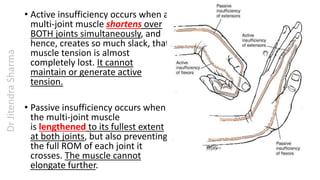
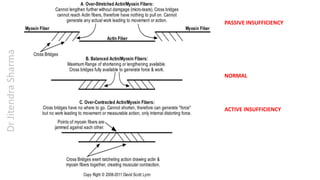
This document discusses active and passive insufficiency in muscles. Active insufficiency occurs when a multi-joint muscle shortens over both joints simultaneously, losing tension. Passive insufficiency occurs when a multi-joint muscle is lengthened to its fullest extent at both joints, preventing full range of motion. Examples given are the rectus femoris causing active insufficiency in hip flexion and knee extension together, and the flexor digitorum profundus losing the ability to make a tight fist when the wrist is flexed. The relationship between them is that when the agonist contracts, the antagonist relaxes or lengthens, so the extensibility of the antagonist can limit the agonist's capability,