PNF techniques
Presented to : Dr. Binash Afzal
Facilitation Techniques
• Facilitation and enhancement of muscle activity to achieve improved
motor control are the key tenants to many of the techniques used in
neurological rehabilitation, many of which also utilise neuroplasticity
• The Rood Approach, theoretically based on the Reflex and Hierarchical
Model of Motor Control, developed by Margaret Rood in the 1950s,
provides the origin for many of the facilitation techniques used today in
neurological rehabilitation today. Rood developed a system of
therapeutic exercises enhanced by cutaneous stimulation for patients
with neuromuscular dysfunctions
• In addition to proprioceptive maneuvres such as positioning, joint
compression, joint distraction and the general use of reflexes, stretch,
and resistance, the greatest emphasis is given on exteroceptive
applications such as stroking, brushing, icing, warmth, pressure, and
vibration in order to achieve optimal muscular action.
Proprioception Neuromuscular Facilitation
Developed by “Herman Kabat”
Proprioceptive Neuromuscular Facilitation (PNF) is a set of stretching techniques commonly used in clinical
environments to enhance both active and passive range of motion in order to improve motor performance
and aid rehabilitation.
PNF helps to restore normal movement by focusing on the developing sequence of movement and how
the agonist and antagonist muscles work together to produce volitional movement.
PNF uses reflexive movement as a basis for learning more volitional movement. The idea is that one must
be able to roll before he can crawl and crawl before he walks
It relies mainly on stimulation of proprioceptors for increasing the demand made on neuromuscular
mechanism to obtain and facilitate its response.c
PNF
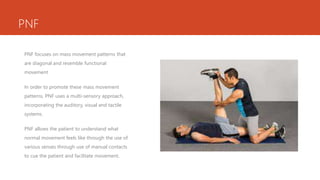
PNF focuses on mass movement patterns that
are diagonal and resemble functional
movement
In order to promote these mass movement
patterns, PNF uses a multi-sensory approach,
incorporating the auditory, visual and tactile
systems.
PNF allows the patient to understand what
normal movement feels like through the use of
various senses through use of manual contacts
to cue the patient and facilitate movement.
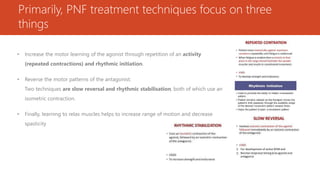
Primarily, PNF treatment techniques focus on three
things
• Increase the motor learning of the agonist through repetition of an activity
(repeated contractions) and rhythmic initiation.
• Reverse the motor patterns of the antagonist.
Two techniques are slow reversal and rhythmic stabilisation, both of which use an
isometric contraction.
• Finally, learning to relax muscles helps to increase range of motion and decrease
spasticity
Theoretical Mechanisms
Four theoretical physiological mechanisms for increasing ROM were identified
• autogenic inhibition
Autogenic Inhibition is what occurs in a contracted or stretched muscle in the form of a decrease in the excitability because of inhibitory signals sent from
the GTOs of the same muscle
• reciprocal inhibition
Reciprocal inhibition is what occurs in the TM when the opposing muscle is contracted voluntarily in the form of decreased neural activity in the TM .
• stress relaxation
Stress relaxation is what occurs when the musculotendinous unit (MTU), which involves the muscles and the connected tendons, is under a constant stress
• the gate control theory
The gate control theory is what occurs when two kinds of stimuli, such as pain and pressure, activate their respective receptors at the same time. The
inhibition of the pain signals happens in the dorsal horn when the large fibers transmit signals
Basic Principles
PowerPoint 2013
Intuitively design beautiful presentations,
easily share and work together with others
and give a professional performance with
advanced presenting tools.
Find out more at the PowerPoint Getting Started Center

PNF techniques.pptx

  • 1.
    PNF techniques Presented to: Dr. Binash Afzal
  • 2.
    Facilitation Techniques • Facilitationand enhancement of muscle activity to achieve improved motor control are the key tenants to many of the techniques used in neurological rehabilitation, many of which also utilise neuroplasticity • The Rood Approach, theoretically based on the Reflex and Hierarchical Model of Motor Control, developed by Margaret Rood in the 1950s, provides the origin for many of the facilitation techniques used today in neurological rehabilitation today. Rood developed a system of therapeutic exercises enhanced by cutaneous stimulation for patients with neuromuscular dysfunctions • In addition to proprioceptive maneuvres such as positioning, joint compression, joint distraction and the general use of reflexes, stretch, and resistance, the greatest emphasis is given on exteroceptive applications such as stroking, brushing, icing, warmth, pressure, and vibration in order to achieve optimal muscular action.
  • 3.
    Proprioception Neuromuscular Facilitation Developedby “Herman Kabat” Proprioceptive Neuromuscular Facilitation (PNF) is a set of stretching techniques commonly used in clinical environments to enhance both active and passive range of motion in order to improve motor performance and aid rehabilitation. PNF helps to restore normal movement by focusing on the developing sequence of movement and how the agonist and antagonist muscles work together to produce volitional movement. PNF uses reflexive movement as a basis for learning more volitional movement. The idea is that one must be able to roll before he can crawl and crawl before he walks It relies mainly on stimulation of proprioceptors for increasing the demand made on neuromuscular mechanism to obtain and facilitate its response.c
  • 4.
    PNF PNF focuses onmass movement patterns that are diagonal and resemble functional movement In order to promote these mass movement patterns, PNF uses a multi-sensory approach, incorporating the auditory, visual and tactile systems. PNF allows the patient to understand what normal movement feels like through the use of various senses through use of manual contacts to cue the patient and facilitate movement.
  • 5.
    Primarily, PNF treatmenttechniques focus on three things • Increase the motor learning of the agonist through repetition of an activity (repeated contractions) and rhythmic initiation. • Reverse the motor patterns of the antagonist. Two techniques are slow reversal and rhythmic stabilisation, both of which use an isometric contraction. • Finally, learning to relax muscles helps to increase range of motion and decrease spasticity
  • 6.
    Theoretical Mechanisms Four theoreticalphysiological mechanisms for increasing ROM were identified • autogenic inhibition Autogenic Inhibition is what occurs in a contracted or stretched muscle in the form of a decrease in the excitability because of inhibitory signals sent from the GTOs of the same muscle • reciprocal inhibition Reciprocal inhibition is what occurs in the TM when the opposing muscle is contracted voluntarily in the form of decreased neural activity in the TM . • stress relaxation Stress relaxation is what occurs when the musculotendinous unit (MTU), which involves the muscles and the connected tendons, is under a constant stress • the gate control theory The gate control theory is what occurs when two kinds of stimuli, such as pain and pressure, activate their respective receptors at the same time. The inhibition of the pain signals happens in the dorsal horn when the large fibers transmit signals
  • 7.
  • 23.
    PowerPoint 2013 Intuitively designbeautiful presentations, easily share and work together with others and give a professional performance with advanced presenting tools. Find out more at the PowerPoint Getting Started Center

Editor's Notes

  • #4 Neuromuscular facilitation is the process by which the response of NM mechanism(neuromuscular mechanism inititaes and achieves movemett is response to demand for activity) is made easy
  • #6 REPEATED CONTRACTION : MOVES isotonically against max resistance repeatedly until fatigue is evident. Stretch at that point facilitates the weaker muscle Used to develop strength and endurancne
  • #7 Each of these theoretical mechanisms are reflexes that occur when the Golgi tendon organs (GTOs) in the tendons of the TM, or in the antagonist muscle to the TM, detect harmful stimuli (such as a stretching sensation or during a contraction) This tension causes activation of Ib afferent fibers within the GTOs. Afferent fibers send signals to the spinal cord where the stimulus causes the activation of inhibitory interneurons within the spinal cord. These interneurons place an inhibitory stimulus upon the alpha motoneuron, decreasing the nerves’ excitability and decreasing the muscles’ efferent motor drive It occurs when an opposing muscle is contracted in order to maximize its contraction force, in this case, the TM relaxes. This relaxation of the TM is a result of the decrease in the neural activity, and the increase of inhibition of proprioceptive structures in the TM
  • #24 In Slide Show mode, click the arrow to enter the PowerPoint Getting Started Center.