Joint Mobilization ReviewCasey Christy, MA, ATC, CSCS
PrinciplesUse Grades I and II to reduce pain.Use Grades III and IV to increase mobility.Begin and end all mobilization sessions with Grade I and II mobilizations to facilitate relaxation and to relieve pain.Initial mobilization techniques should be performed in the loose-packed position.
PrinciplesPerform 2 to 3 oscillations per second for 20-60 seconds for joint tightness, 1-2 minutes for pain.Sustained joint mobilization techniques: 10 second hold for painful joints; 10-30 sec hold for joint tightness. Repeat 3-5 times.Understand the indications and contraindications of joint mobilization before implementing any techniques.
Convex-Concave RuleFixed concave surface, moving convex surfaceGlide occurs in opposite directionExample: glenohumeral jointFixed concave glenoidfossa, moving convex humeral headAs the glenohumeral joint abducts, the humeral head glides inferiorlyMobilize humeral head in inferior direction to increase abduction ROM
Convex-Concave RuleFixed convex surface, moving concave surfaceGlide occurs in same directionExample: tibiofemoral (knee) jointFixed convex femoral condyles, moving concave tibialplateauAs the knee extends the tibia glides anteriorlyMobilize tibia in anterior direction to increase extension ROM; posterior direction to increase flexion ROM
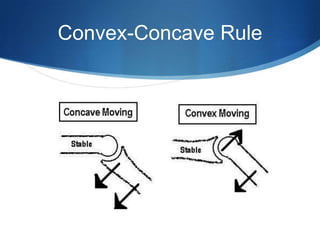
Convex-Concave Rule
Convex-Concave RuleJoints with fixed concave and moving convex surfaces:GlenohumeralHip jointTalocrural (ankle)Subtalar (concave inferior talus, convex calcaneus)RadiocarpalApply glide in opposite direction
Convex-Concave RuleJoints with fixed convex and moving concave surfaces:Knee (tibiofemoral joint)Elbow (humeral-radial joint, humeral-ulnar joint)MCP and IP joints of thefingers and toesApply glide in same direction
Grades of MovementGrade I: Small amplitude movement performed at the beginning of the available ROM.Grade II: Large amplitude movement through the middle of the ROM.Grade III: Large amplitude movement performed from the middle to the limit of the ROM.Grade IV: Small amplitude movement performed at the end of the ROM.Grade V: Small amplitude, manipulative movement performed beyond the end range of motion. Manipulation requires advanced training and is not commonly used by athletic trainers.
Open-Packed PositionsSubtalar joint: NeutralTalocrural joint: 10 degrees plantar flexionKnee: 25 degrees of flexion for tibiofemoral joint; full extension for patellofemoral jointHip: 30 degrees hip flexion, 30 degrees hip abduction, slight external rotation
Open-Packed PositionsElbow joint: humeral–ulnar joint: elbow flexed 70 degrees, forearm supinated 10 degrees; humeral-radial joint: full extension, supinationShoulder joint: 55 degrees abduction, horizontally adducted 30 degrees, rotated so forearm is in horizontal planeWrist: neutral for radiocarpal jointMCP and IP joints of the hand and fingers: slight flexionMCP joint of thumb: midway between flexion and extension; midway between abduction and adduction
Treatment GlidesTo improve glenohumeral flexion: apply posterior glideTo improve glenohumeral extension: apply anterior glideTo improve glenohumeral internal rotation: apply posterior glideTo improve glenohumeral external rotation: apply anterior glideTo improve glenohumeral abduction: apply inferior glide
Treatment GlidesTo improve tibiofemoral flexion: apply posterior glideTo improvetibiofemoral extension: apply anterior glidePatellofemoral glides: apply superior glide to improve extension; inferior glide to improve flexion
Treatment GlidesTo improve ankle plantarflexion: apply anterior glide (talocrural joint)To improve ankle dorsiflexion: apply posterior glide (talocrural joint)To improve inversion: apply lateral glide (subtalar joint)To improveeversion: apply medial glide (subtalar joint)
Treatment GlidesTo improve wrist flexion: apply dorsal (posterior) glideTo improve wrist extension: applyvolar (anterior)To improve radial deviation: apply medial glideTo improveulnar deviation: apply lateral glide
Treatment GlidesTo improve elbow flexion: apply humeral-ulnar distal glide (scooping motion)To improve elbow extension: apply humeral-radial posterior glide
A Unique JointSterno-clavicular JointThe proximal articulating surface of the clavicle is convex superiorly/inferiorly; concave anteriorly/posteriorlyMobilize clavicle inferiorly to improve abduction ROMMobilize clavicle posteriorly to improve retraction ROM
ReferenceKisner and Colby. Therapeutic Exercise: Foundations and Techniques, 4th ed.

Joint Mobilization Review

  • 1.
    Joint Mobilization ReviewCaseyChristy, MA, ATC, CSCS
  • 2.
    PrinciplesUse Grades Iand II to reduce pain.Use Grades III and IV to increase mobility.Begin and end all mobilization sessions with Grade I and II mobilizations to facilitate relaxation and to relieve pain.Initial mobilization techniques should be performed in the loose-packed position.
  • 3.
    PrinciplesPerform 2 to3 oscillations per second for 20-60 seconds for joint tightness, 1-2 minutes for pain.Sustained joint mobilization techniques: 10 second hold for painful joints; 10-30 sec hold for joint tightness. Repeat 3-5 times.Understand the indications and contraindications of joint mobilization before implementing any techniques.
  • 4.
    Convex-Concave RuleFixed concavesurface, moving convex surfaceGlide occurs in opposite directionExample: glenohumeral jointFixed concave glenoidfossa, moving convex humeral headAs the glenohumeral joint abducts, the humeral head glides inferiorlyMobilize humeral head in inferior direction to increase abduction ROM
  • 5.
    Convex-Concave RuleFixed convexsurface, moving concave surfaceGlide occurs in same directionExample: tibiofemoral (knee) jointFixed convex femoral condyles, moving concave tibialplateauAs the knee extends the tibia glides anteriorlyMobilize tibia in anterior direction to increase extension ROM; posterior direction to increase flexion ROM
  • 6.
  • 7.
    Convex-Concave RuleJoints withfixed concave and moving convex surfaces:GlenohumeralHip jointTalocrural (ankle)Subtalar (concave inferior talus, convex calcaneus)RadiocarpalApply glide in opposite direction
  • 8.
    Convex-Concave RuleJoints withfixed convex and moving concave surfaces:Knee (tibiofemoral joint)Elbow (humeral-radial joint, humeral-ulnar joint)MCP and IP joints of thefingers and toesApply glide in same direction
  • 9.
    Grades of MovementGradeI: Small amplitude movement performed at the beginning of the available ROM.Grade II: Large amplitude movement through the middle of the ROM.Grade III: Large amplitude movement performed from the middle to the limit of the ROM.Grade IV: Small amplitude movement performed at the end of the ROM.Grade V: Small amplitude, manipulative movement performed beyond the end range of motion. Manipulation requires advanced training and is not commonly used by athletic trainers.
  • 10.
    Open-Packed PositionsSubtalar joint:NeutralTalocrural joint: 10 degrees plantar flexionKnee: 25 degrees of flexion for tibiofemoral joint; full extension for patellofemoral jointHip: 30 degrees hip flexion, 30 degrees hip abduction, slight external rotation
  • 11.
    Open-Packed PositionsElbow joint:humeral–ulnar joint: elbow flexed 70 degrees, forearm supinated 10 degrees; humeral-radial joint: full extension, supinationShoulder joint: 55 degrees abduction, horizontally adducted 30 degrees, rotated so forearm is in horizontal planeWrist: neutral for radiocarpal jointMCP and IP joints of the hand and fingers: slight flexionMCP joint of thumb: midway between flexion and extension; midway between abduction and adduction
  • 12.
    Treatment GlidesTo improveglenohumeral flexion: apply posterior glideTo improve glenohumeral extension: apply anterior glideTo improve glenohumeral internal rotation: apply posterior glideTo improve glenohumeral external rotation: apply anterior glideTo improve glenohumeral abduction: apply inferior glide
  • 13.
    Treatment GlidesTo improvetibiofemoral flexion: apply posterior glideTo improvetibiofemoral extension: apply anterior glidePatellofemoral glides: apply superior glide to improve extension; inferior glide to improve flexion
  • 14.
    Treatment GlidesTo improveankle plantarflexion: apply anterior glide (talocrural joint)To improve ankle dorsiflexion: apply posterior glide (talocrural joint)To improve inversion: apply lateral glide (subtalar joint)To improveeversion: apply medial glide (subtalar joint)
  • 15.
    Treatment GlidesTo improvewrist flexion: apply dorsal (posterior) glideTo improve wrist extension: applyvolar (anterior)To improve radial deviation: apply medial glideTo improveulnar deviation: apply lateral glide
  • 16.
    Treatment GlidesTo improveelbow flexion: apply humeral-ulnar distal glide (scooping motion)To improve elbow extension: apply humeral-radial posterior glide
  • 17.
    A Unique JointSterno-clavicularJointThe proximal articulating surface of the clavicle is convex superiorly/inferiorly; concave anteriorly/posteriorlyMobilize clavicle inferiorly to improve abduction ROMMobilize clavicle posteriorly to improve retraction ROM
  • 18.
    ReferenceKisner and Colby.Therapeutic Exercise: Foundations and Techniques, 4th ed.