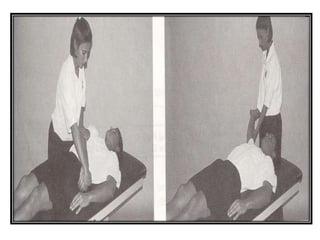
PROPRIOCEPTIVE NEUROMUSCULAR
FACILITATION
Includes
โ€ข PNF definition
โ€ข Neurophysiologic basis of PNF
โ€ข Uses of PNF
โ€ข 9 basic principles of PNF
โ€ข Techniques of PNF
โ€ข PNF stretching
โ€ข Patterns of PNF
DEFINITION
โ€ข Proprioceptive: sensory receptors that give
information concerning movement and
position of the body
โ€ข Neuromuscular: involving the nerves and
muscles
โ€ข Facilitation: making easier
Proprioceptors
Proprioception means "sense of selfโ€œ
Types
โ€ข The muscle spindle is one type of proprioceptor that
provides information about changes in muscle length.
โ€ข The Golgi tendon organ is another type of
proprioceptor that provides information about changes
in muscle tension.
โ€ข The joint kinesthetic receptor monitor stretch in
synovial fluids and sends information to cerebellum
and spinal reflex arc
โ€ข Proprioceptive neuromuscular facilitation is
exercise based on the principles of functional
human anatomy and neurophysiology.
FUNCTIONAL HUMAN-ANATOMICAL
BASIS OF PNF
โ€ข It uses
โ€“ Proprioceptive
โ€“ Cutaneous
โ€“ Auditory input
to produce functional improvement in motor output
and can be a vital element in the rehabilitation
process of sports related injuries.
NEUROPHYSIOLOGICAL BASIS OF PNF
โ€ข Sherrington..
โ€“ Concepts of facilitation and inhibition
โ€“ Stretch reflex
โ€“ Neurophysiological phenomena
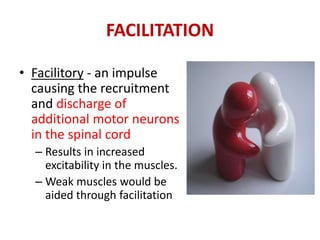
FACILITATION
โ€ข Facilitory - an impulse
causing the recruitment
and discharge of
additional motor neurons
in the spinal cord
โ€“ Results in increased
excitability in the muscles.
โ€“ Weak muscles would be
aided through facilitation
INHIBITION
โ€ข Inhibitory - any stimulus
that causes motor
neurons to drop away
from the discharge zone
and away from the spinal
cord.
โ€“ Inhibition results in
decreased excitability of
motor neurons.
โ€“ Muscle spasticity can be
decreased
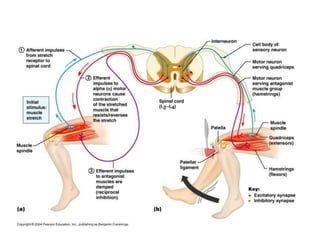
STRETCH REFLEX
โ€ข The stretch reflex involves two types of
receptors
๏ถMuscle spindles
๏ถGolgi tendon organs
NEUROPHYSIOLOGICAL PHENOMENA
โ€ข RECIPROCAL INHIBITION
โ€ข AUTOGENIC INHIBITION
Reciprocal inhibition
โ€ข Is the second
mechanism
which deals
with the
relationships
of the agonist
and
antagonist
muscles
Autogenic Inhibition
โ€ข Autogenic inhibition reflex is a sudden
relaxation of muscle upon development of
high tension.
โ€ข It is a self-induced, inhibitory, negative
feedback lengthening reaction that protects
against muscle tear.
โ€ข Golgi tendon organs are receptors for the
reflex.
USES OF PNF
โ€ข 1. PNF treatment has been used to increase
strength, flexibility, coordination and
functional mobility.
โ€ข 2. The main goal of treatment is to facilitate
the patient in achieving a movement or
posture.
โ€ข 3. Stretches as well as diagonals and rotational
exercise patterns are used to improve ADLโ€™s
functional mobility and athletic performance
โ€ข 4. It is mainly used in orthopedic
rehabilitation for musculoskeletal injuries and
in neurological rehab.
โ€ข 5. PNF can be used for any condition, however
the patient condition level may require
modifications.
BASIC PRINCIPLES OF PNF
1. Resistance
2. Irradiation and reinforcement
3. Manual contact
4. Stretch
5. Verbal commands
6. Traction and approximation
7. Timing
8. Body positioning and body mechanics
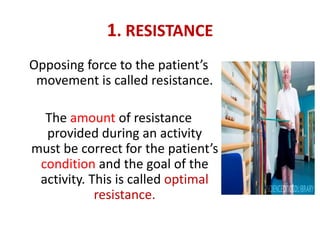
1. RESISTANCE
Opposing force to the patientโ€™s
movement is called resistance.
The amount of resistance
provided during an activity
must be correct for the patientโ€™s
condition and the goal of the
activity. This is called optimal
resistance.
1. RESISTANCE
Resistance is used in the treatment to:
1. Facilitate the ability of the muscle to contract
2. Increase motor control
3. Help the patient gain an awareness of motion
and its direction
4. Increase strength
IRRADIATION & REINFORCEMENT
DEFINITIONS
โ€ข Irradiation : the spread of response to
stimulation is called irradiation.
โ€ข Reinforcement : means โ€œto strengthen by
fresh addition, make strongerโ€
IRRADIATION & REINFORCEMENT
Effects :
โ€ข Maximal resistance may be used to cause
irradiation or overflow from stronger patterns
to weaker patterns or from stronger groups of
muscles within a pattern to weaker groups
within the same pattern.
MANUAL CONTACT
Effects:
1. Stimulates the muscle
2. Stimulates the synergistic muscle to reinforce
the movement
3. Promotes trunk stabilization and indirectly
helps the limb motion
4. Prevents confusion
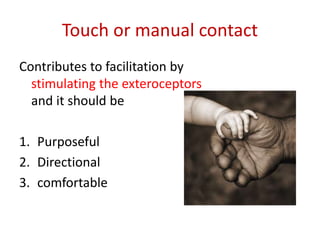
Touch or manual contact
Contributes to facilitation by
stimulating the exteroceptors
and it should be
1. Purposeful
2. Directional
3. comfortable
STRETCH
โ€ข The stretch stimulus occurs when the muscle
is elongated
โ€ข The lengthened position of the muscle is the
starting position of each pattern and the
stretch is maintained throughout the
movement.
โ€ข All the components of a pattern must be
stretched simultaneously
STRETCH
Effects:
1. Stimulates the activity of muscle spindle
2. Any contraction of muscle on stretch will
result in movement and the brain knows not
of muscles but of movement.
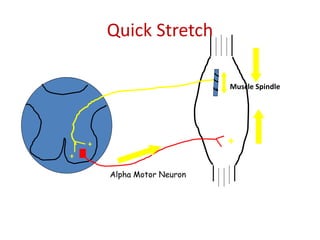
Alpha Motor Neuron
Quick Stretch
+
Muscle Spindle
+
+
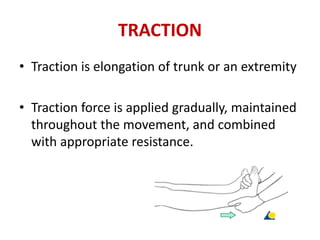
TRACTION
โ€ข Traction is elongation of trunk or an extremity
โ€ข Traction force is applied gradually, maintained
throughout the movement, and combined
with appropriate resistance.
TRACTION
โ€ข Joint separation stimulates joint receptors
โ€ข Muscle stretch stimulates muscle spindle
stretch receptor
โ€ข Facilitates Alpha Motor Neuron
โ€ข Facilitates Strength
APPROXIMATION
โ€ข Definition:
Approximation is the
compression of the trunk or an
extremity.
โ€ข Compression through a joint
stimulate joint receptors
โ€ข Facilitate alpha motor neuron
โ€ข Facilitate stability
APPROXIMATION
Uses:
1. Promote stabilization
2. Facilitate weight bearing and contraction of
postural muscles
3. Facilitate upright reactions
4. Resist some component of motion. E.g., use
approximation at the end of shoulder flexion
to resist scapula elevation
(11)
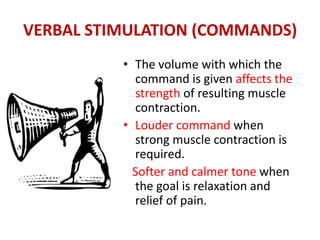
VERBAL STIMULATION (COMMANDS)
โ€ข The volume with which the
command is given affects the
strength of resulting muscle
contraction.
โ€ข Louder command when
strong muscle contraction is
required.
Softer and calmer tone when
the goal is relaxation and
relief of pain.
VERBAL STIMULATION (COMMANDS)
โ€ข The command is divided into three parts:
1. Preparation: readies the pt for action.
โ€œreadyโ€
2. Action: tells the pt to start the action. โ€œnow
pull your leg up and inโ€
3. Correction: tells the pt how to correct and
modify the action. โ€œkeep pulling your toes
upโ€
Commmads
used
โ€ข HOLD
โ€ข PULL/PUSH
โ€ข RELAX
TIMINGS
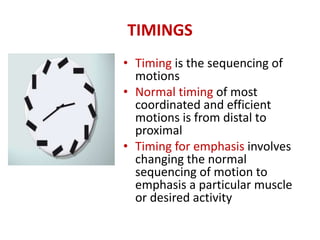
โ€ข Timing is the sequencing of
motions
โ€ข Normal timing of most
coordinated and efficient
motions is from distal to
proximal
โ€ข Timing for emphasis involves
changing the normal
sequencing of motion to
emphasis a particular muscle
or desired activity
BODY POSTION & BODY MECHANICS
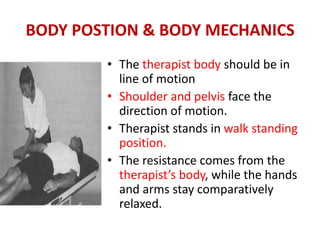
โ€ข The therapist body should be in
line of motion
โ€ข Shoulder and pelvis face the
direction of motion.
โ€ข Therapist stands in walk standing
position.
โ€ข The resistance comes from the
therapistโ€™s body, while the hands
and arms stay comparatively
relaxed.
TECHNIQUES OF PNF
REPEATED CONTRATION
โ€ข Patient move isotonically against maximum
resistance repeatedly until fatigue is evidenced
โ€ข When fatigue is evident then a stretch at that
point in the range should facilitate the weaker
muscles and results in coordinated movement.
โ€ข USED
โ€ข To develop strength and endurance.
SLOW REVERSAL
โ€ข Involves isotonic contraction of the agonist
followed immediately by an isotonic contraction
of the antagonist.
โ€ข USED
1. For development of active ROM and
2. Normal reciprocal timing b/w agonist and
antagonist
RHYTHMIC STABILIZATION
โ€ข Uses an isometric contraction of the agonist,
followed by an isometric contraction of the
antagonist.
โ€ข USED
โ€ข To increase strength and endurance
HOLD RELAX
โ€ข Begins with isometric contraction of the
antagonist against resistance, followed by
concentric contraction of the agonist muscle.
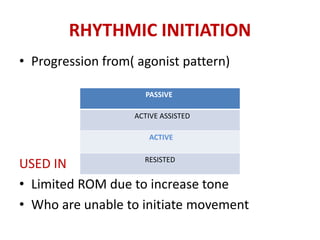
RHYTHMIC INITIATION
โ€ข Progression from( agonist pattern)
USED IN
โ€ข Limited ROM due to increase tone
โ€ข Who are unable to initiate movement
PASSIVE
ACTIVE ASSISTED
ACTIVE
RESISTED
PNF PATTERNS
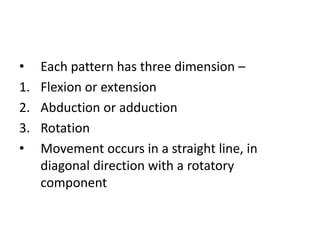
โ€ข Each pattern has three dimension โ€“
1. Flexion or extension
2. Abduction or adduction
3. Rotation
โ€ข Movement occurs in a straight line, in
diagonal direction with a rotatory
component
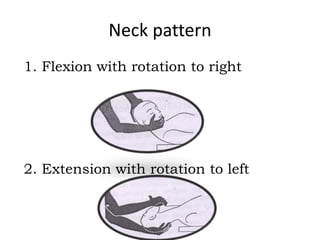
Neck pattern
1. Flexion with rotation to right
2. Extension with rotation to left
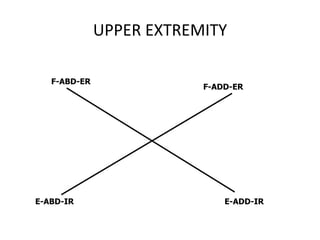
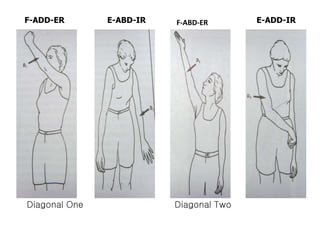
UPPER EXTREMITY
F-ABD-ER
F-ADD-ER
E-ABD-IR E-ADD-IR
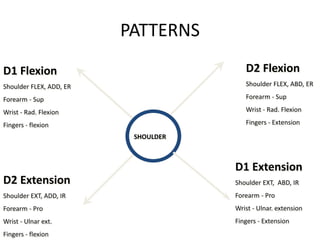
PATTERNS
SHOULDER
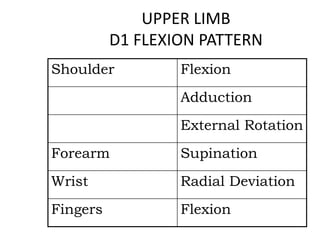
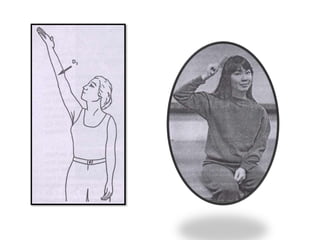
D1 Flexion
Shoulder FLEX, ADD, ER
Forearm - Sup
Wrist - Rad. Flexion
Fingers - flexion
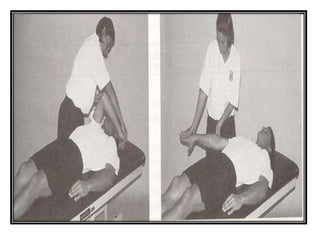
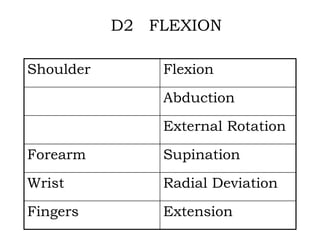
D2 Flexion
Shoulder FLEX, ABD, ER
Forearm - Sup
Wrist - Rad. Flexion
Fingers - Extension
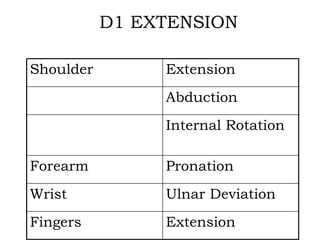
D1 Extension
Shoulder EXT, ABD, IR
Forearm - Pro
Wrist - Ulnar. extension
Fingers - Extension
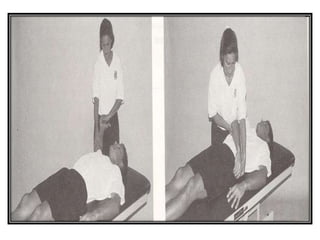
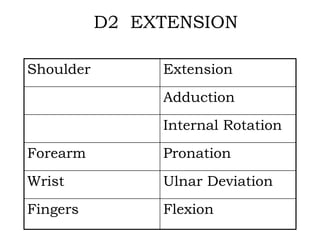
D2 Extension
Shoulder EXT, ADD, IR
Forearm - Pro
Wrist - Ulnar ext.
Fingers - flexion
Diagonal One Diagonal Two
F-ABD-ER E-ADD-IR
F-ADD-ER E-ABD-IR
UPPER LIMB
D1 FLEXION PATTERN
Shoulder Flexion
Adduction
External Rotation
Forearm Supination
Wrist Radial Deviation
Fingers Flexion
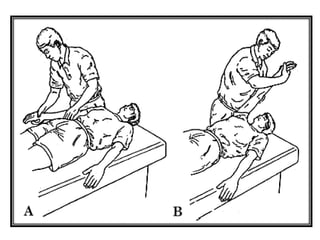
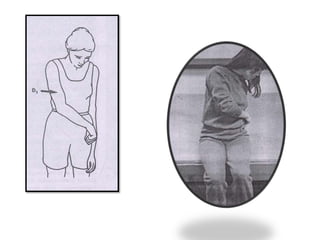
D1 EXTENSION
Shoulder Extension
Abduction
Internal Rotation
Forearm Pronation
Wrist Ulnar Deviation
Fingers Extension
D2 FLEXION
Shoulder Flexion
Abduction
External Rotation
Forearm Supination
Wrist Radial Deviation
Fingers Extension
D2 EXTENSION
Shoulder Extension
Adduction
Internal Rotation
Forearm Pronation
Wrist Ulnar Deviation
Fingers Flexion
Unilateral patterns
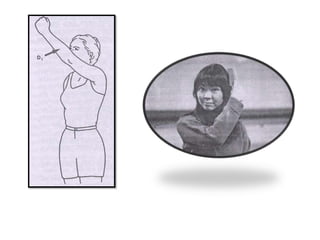
โ€ข UE D1 flexion: hand-to-mouth motion in
feeding, combing hair on right side with
left hand
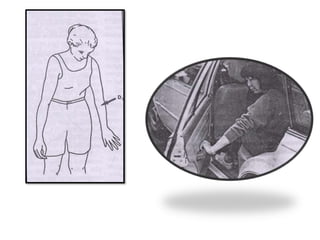
โ€ข UE D1 extension: pushing a car door to
open from inside
โ€ข UE D2 flexion: combing hair on right side
with right hand
โ€ข UE D2 extension: pitching a baseball
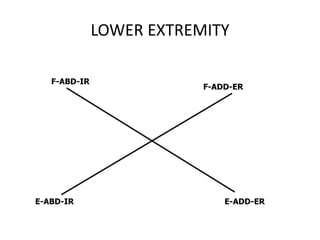
LOWER EXTREMITY
F-ABD-IR
F-ADD-ER
E-ABD-IR E-ADD-ER
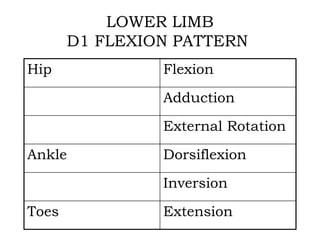
LOWER LIMB
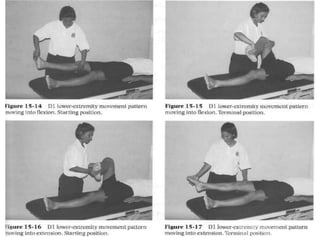
D1 FLEXION PATTERN
Hip Flexion
Adduction
External Rotation
Ankle Dorsiflexion
Inversion
Toes Extension
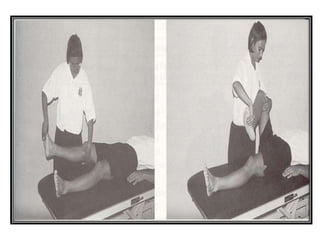
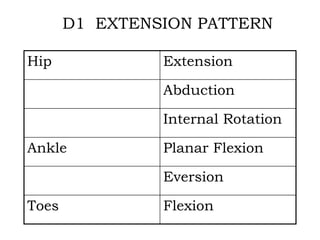
D1 EXTENSION PATTERN
Hip Extension
Abduction
Internal Rotation
Ankle Planar Flexion
Eversion
Toes Flexion
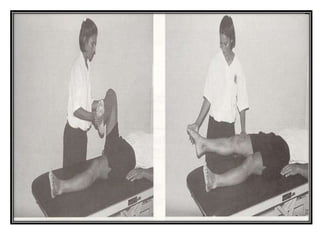
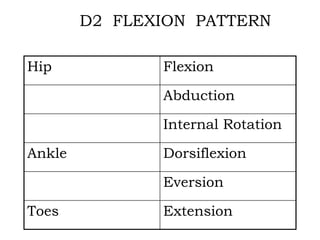
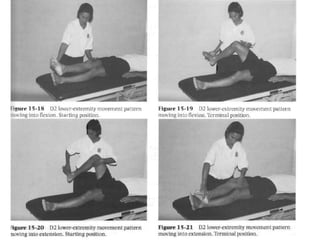
D2 FLEXION PATTERN
Hip Flexion
Abduction
Internal Rotation
Ankle Dorsiflexion
Eversion
Toes Extension
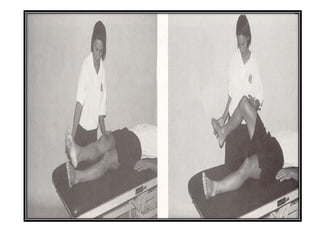
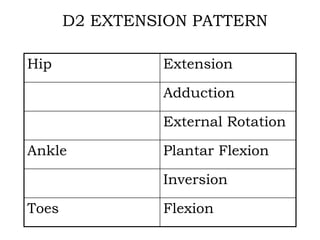
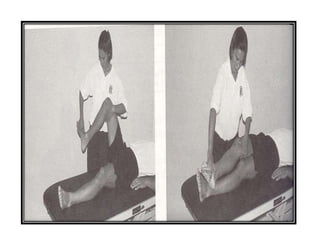
D2 EXTENSION PATTERN
Hip Extension
Adduction
External Rotation
Ankle Plantar Flexion
Inversion
Toes Flexion
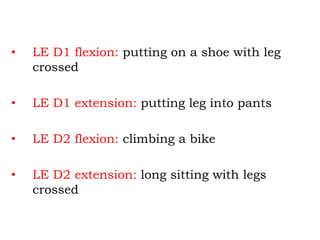
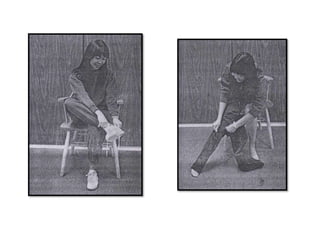
โ€ข LE D1 flexion: putting on a shoe with leg
crossed
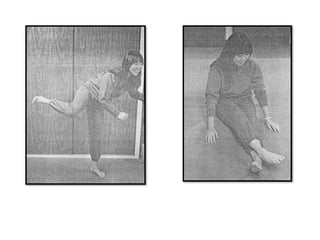
โ€ข LE D1 extension: putting leg into pants
โ€ข LE D2 flexion: climbing a bike
โ€ข LE D2 extension: long sitting with legs
crossed
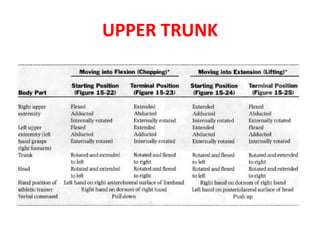
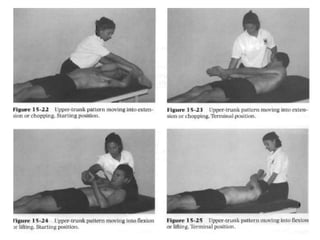
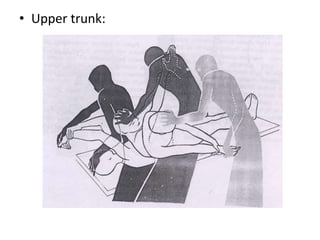
UPPER TRUNK
โ€ข Upper trunk:
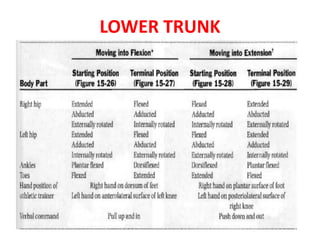
LOWER TRUNK
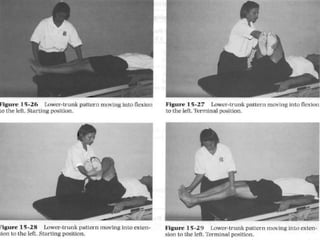
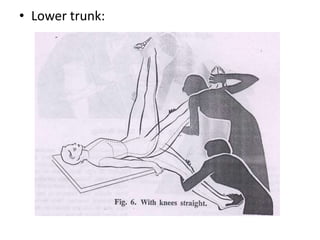
โ€ข Lower trunk:
PNF IN SPORTS
โ€ข Here are some other general guidelines when completing PNF
stretching:
โ€ข 1. Leave 48 hours between PNF stretching routines.
โ€ข 2. Perform only one exercise per muscle group in a session.
โ€ข 3. For each muscle group complete 2-5 sets of the chosen exercise.
โ€ข 4. Each set should consist of one stretch held for up to 30 seconds
after the contracting phase.
โ€ข 5. PNF stretching is not recommended for anyone under the age of
18.
โ€ข 6. If PNF stretching is to be performed as a separate exercise
session, a thorough warm up consisting of 5-10 minutes of light
aerobic exercise and some dynamic stretches must precede it.
โ€ข JOURNEL OF ATHLETIC TRAINING
โ€ข PNF techniques are most frequently applied during
rehabilitation of the knee, shoulder, and hip, ankle
rehabilitation has increased.
โ€ข The most frequently used techniques were contract-
relax and hold-relax
โ€ข The use of PNF techniques in the muscle re-
education phase of rehabilitation
PNF.pptx
PNF.pptx

PNF.pptx

  • 1.
  • 2.
    Includes โ€ข PNF definition โ€ขNeurophysiologic basis of PNF โ€ข Uses of PNF โ€ข 9 basic principles of PNF โ€ข Techniques of PNF โ€ข PNF stretching โ€ข Patterns of PNF
  • 3.
    DEFINITION โ€ข Proprioceptive: sensoryreceptors that give information concerning movement and position of the body โ€ข Neuromuscular: involving the nerves and muscles โ€ข Facilitation: making easier
  • 4.
    Proprioceptors Proprioception means "senseof selfโ€œ Types โ€ข The muscle spindle is one type of proprioceptor that provides information about changes in muscle length. โ€ข The Golgi tendon organ is another type of proprioceptor that provides information about changes in muscle tension. โ€ข The joint kinesthetic receptor monitor stretch in synovial fluids and sends information to cerebellum and spinal reflex arc
  • 5.
    โ€ข Proprioceptive neuromuscularfacilitation is exercise based on the principles of functional human anatomy and neurophysiology.
  • 6.
    FUNCTIONAL HUMAN-ANATOMICAL BASIS OFPNF โ€ข It uses โ€“ Proprioceptive โ€“ Cutaneous โ€“ Auditory input to produce functional improvement in motor output and can be a vital element in the rehabilitation process of sports related injuries.
  • 7.
    NEUROPHYSIOLOGICAL BASIS OFPNF โ€ข Sherrington.. โ€“ Concepts of facilitation and inhibition โ€“ Stretch reflex โ€“ Neurophysiological phenomena
  • 8.
    FACILITATION โ€ข Facilitory -an impulse causing the recruitment and discharge of additional motor neurons in the spinal cord โ€“ Results in increased excitability in the muscles. โ€“ Weak muscles would be aided through facilitation
  • 9.
    INHIBITION โ€ข Inhibitory -any stimulus that causes motor neurons to drop away from the discharge zone and away from the spinal cord. โ€“ Inhibition results in decreased excitability of motor neurons. โ€“ Muscle spasticity can be decreased
  • 10.
    STRETCH REFLEX โ€ข Thestretch reflex involves two types of receptors ๏ถMuscle spindles ๏ถGolgi tendon organs
  • 12.
    NEUROPHYSIOLOGICAL PHENOMENA โ€ข RECIPROCALINHIBITION โ€ข AUTOGENIC INHIBITION
  • 13.
    Reciprocal inhibition โ€ข Isthe second mechanism which deals with the relationships of the agonist and antagonist muscles
  • 14.
    Autogenic Inhibition โ€ข Autogenicinhibition reflex is a sudden relaxation of muscle upon development of high tension. โ€ข It is a self-induced, inhibitory, negative feedback lengthening reaction that protects against muscle tear. โ€ข Golgi tendon organs are receptors for the reflex.
  • 16.
    USES OF PNF โ€ข1. PNF treatment has been used to increase strength, flexibility, coordination and functional mobility. โ€ข 2. The main goal of treatment is to facilitate the patient in achieving a movement or posture. โ€ข 3. Stretches as well as diagonals and rotational exercise patterns are used to improve ADLโ€™s functional mobility and athletic performance
  • 17.
    โ€ข 4. Itis mainly used in orthopedic rehabilitation for musculoskeletal injuries and in neurological rehab. โ€ข 5. PNF can be used for any condition, however the patient condition level may require modifications.
  • 18.
    BASIC PRINCIPLES OFPNF 1. Resistance 2. Irradiation and reinforcement 3. Manual contact 4. Stretch 5. Verbal commands 6. Traction and approximation 7. Timing 8. Body positioning and body mechanics
  • 19.
    1. RESISTANCE Opposing forceto the patientโ€™s movement is called resistance. The amount of resistance provided during an activity must be correct for the patientโ€™s condition and the goal of the activity. This is called optimal resistance.
  • 20.
    1. RESISTANCE Resistance isused in the treatment to: 1. Facilitate the ability of the muscle to contract 2. Increase motor control 3. Help the patient gain an awareness of motion and its direction 4. Increase strength
  • 21.
    IRRADIATION & REINFORCEMENT DEFINITIONS โ€ขIrradiation : the spread of response to stimulation is called irradiation. โ€ข Reinforcement : means โ€œto strengthen by fresh addition, make strongerโ€
  • 22.
    IRRADIATION & REINFORCEMENT Effects: โ€ข Maximal resistance may be used to cause irradiation or overflow from stronger patterns to weaker patterns or from stronger groups of muscles within a pattern to weaker groups within the same pattern.
  • 23.
    MANUAL CONTACT Effects: 1. Stimulatesthe muscle 2. Stimulates the synergistic muscle to reinforce the movement 3. Promotes trunk stabilization and indirectly helps the limb motion 4. Prevents confusion
  • 24.
    Touch or manualcontact Contributes to facilitation by stimulating the exteroceptors and it should be 1. Purposeful 2. Directional 3. comfortable
  • 25.
    STRETCH โ€ข The stretchstimulus occurs when the muscle is elongated โ€ข The lengthened position of the muscle is the starting position of each pattern and the stretch is maintained throughout the movement. โ€ข All the components of a pattern must be stretched simultaneously
  • 26.
    STRETCH Effects: 1. Stimulates theactivity of muscle spindle 2. Any contraction of muscle on stretch will result in movement and the brain knows not of muscles but of movement.
  • 27.
    Alpha Motor Neuron QuickStretch + Muscle Spindle + +
  • 28.
    TRACTION โ€ข Traction iselongation of trunk or an extremity โ€ข Traction force is applied gradually, maintained throughout the movement, and combined with appropriate resistance.
  • 29.
    TRACTION โ€ข Joint separationstimulates joint receptors โ€ข Muscle stretch stimulates muscle spindle stretch receptor โ€ข Facilitates Alpha Motor Neuron โ€ข Facilitates Strength
  • 30.
    APPROXIMATION โ€ข Definition: Approximation isthe compression of the trunk or an extremity. โ€ข Compression through a joint stimulate joint receptors โ€ข Facilitate alpha motor neuron โ€ข Facilitate stability
  • 31.
    APPROXIMATION Uses: 1. Promote stabilization 2.Facilitate weight bearing and contraction of postural muscles 3. Facilitate upright reactions 4. Resist some component of motion. E.g., use approximation at the end of shoulder flexion to resist scapula elevation (11)
  • 32.
    VERBAL STIMULATION (COMMANDS) โ€ขThe volume with which the command is given affects the strength of resulting muscle contraction. โ€ข Louder command when strong muscle contraction is required. Softer and calmer tone when the goal is relaxation and relief of pain.
  • 33.
    VERBAL STIMULATION (COMMANDS) โ€ขThe command is divided into three parts: 1. Preparation: readies the pt for action. โ€œreadyโ€ 2. Action: tells the pt to start the action. โ€œnow pull your leg up and inโ€ 3. Correction: tells the pt how to correct and modify the action. โ€œkeep pulling your toes upโ€
  • 34.
  • 35.
    TIMINGS โ€ข Timing isthe sequencing of motions โ€ข Normal timing of most coordinated and efficient motions is from distal to proximal โ€ข Timing for emphasis involves changing the normal sequencing of motion to emphasis a particular muscle or desired activity
  • 36.
    BODY POSTION &BODY MECHANICS โ€ข The therapist body should be in line of motion โ€ข Shoulder and pelvis face the direction of motion. โ€ข Therapist stands in walk standing position. โ€ข The resistance comes from the therapistโ€™s body, while the hands and arms stay comparatively relaxed.
  • 37.
  • 38.
    REPEATED CONTRATION โ€ข Patientmove isotonically against maximum resistance repeatedly until fatigue is evidenced โ€ข When fatigue is evident then a stretch at that point in the range should facilitate the weaker muscles and results in coordinated movement. โ€ข USED โ€ข To develop strength and endurance.
  • 39.
    SLOW REVERSAL โ€ข Involvesisotonic contraction of the agonist followed immediately by an isotonic contraction of the antagonist. โ€ข USED 1. For development of active ROM and 2. Normal reciprocal timing b/w agonist and antagonist
  • 40.
    RHYTHMIC STABILIZATION โ€ข Usesan isometric contraction of the agonist, followed by an isometric contraction of the antagonist. โ€ข USED โ€ข To increase strength and endurance
  • 41.
    HOLD RELAX โ€ข Beginswith isometric contraction of the antagonist against resistance, followed by concentric contraction of the agonist muscle.
  • 42.
    RHYTHMIC INITIATION โ€ข Progressionfrom( agonist pattern) USED IN โ€ข Limited ROM due to increase tone โ€ข Who are unable to initiate movement PASSIVE ACTIVE ASSISTED ACTIVE RESISTED
  • 43.
  • 44.
    โ€ข Each patternhas three dimension โ€“ 1. Flexion or extension 2. Abduction or adduction 3. Rotation โ€ข Movement occurs in a straight line, in diagonal direction with a rotatory component
  • 45.
    Neck pattern 1. Flexionwith rotation to right 2. Extension with rotation to left
  • 46.
  • 47.
    PATTERNS SHOULDER D1 Flexion Shoulder FLEX,ADD, ER Forearm - Sup Wrist - Rad. Flexion Fingers - flexion D2 Flexion Shoulder FLEX, ABD, ER Forearm - Sup Wrist - Rad. Flexion Fingers - Extension D1 Extension Shoulder EXT, ABD, IR Forearm - Pro Wrist - Ulnar. extension Fingers - Extension D2 Extension Shoulder EXT, ADD, IR Forearm - Pro Wrist - Ulnar ext. Fingers - flexion
  • 48.
    Diagonal One DiagonalTwo F-ABD-ER E-ADD-IR F-ADD-ER E-ABD-IR
  • 49.
    UPPER LIMB D1 FLEXIONPATTERN Shoulder Flexion Adduction External Rotation Forearm Supination Wrist Radial Deviation Fingers Flexion
  • 51.
    D1 EXTENSION Shoulder Extension Abduction InternalRotation Forearm Pronation Wrist Ulnar Deviation Fingers Extension
  • 53.
    D2 FLEXION Shoulder Flexion Abduction ExternalRotation Forearm Supination Wrist Radial Deviation Fingers Extension
  • 55.
    D2 EXTENSION Shoulder Extension Adduction InternalRotation Forearm Pronation Wrist Ulnar Deviation Fingers Flexion
  • 57.
    Unilateral patterns โ€ข UED1 flexion: hand-to-mouth motion in feeding, combing hair on right side with left hand โ€ข UE D1 extension: pushing a car door to open from inside โ€ข UE D2 flexion: combing hair on right side with right hand โ€ข UE D2 extension: pitching a baseball
  • 62.
  • 63.
    LOWER LIMB D1 FLEXIONPATTERN Hip Flexion Adduction External Rotation Ankle Dorsiflexion Inversion Toes Extension
  • 65.
    D1 EXTENSION PATTERN HipExtension Abduction Internal Rotation Ankle Planar Flexion Eversion Toes Flexion
  • 67.
    D2 FLEXION PATTERN HipFlexion Abduction Internal Rotation Ankle Dorsiflexion Eversion Toes Extension
  • 69.
    D2 EXTENSION PATTERN HipExtension Adduction External Rotation Ankle Plantar Flexion Inversion Toes Flexion
  • 71.
    โ€ข LE D1flexion: putting on a shoe with leg crossed โ€ข LE D1 extension: putting leg into pants โ€ข LE D2 flexion: climbing a bike โ€ข LE D2 extension: long sitting with legs crossed
  • 76.
  • 78.
  • 79.
  • 81.
  • 82.
    PNF IN SPORTS โ€ขHere are some other general guidelines when completing PNF stretching: โ€ข 1. Leave 48 hours between PNF stretching routines. โ€ข 2. Perform only one exercise per muscle group in a session. โ€ข 3. For each muscle group complete 2-5 sets of the chosen exercise. โ€ข 4. Each set should consist of one stretch held for up to 30 seconds after the contracting phase. โ€ข 5. PNF stretching is not recommended for anyone under the age of 18. โ€ข 6. If PNF stretching is to be performed as a separate exercise session, a thorough warm up consisting of 5-10 minutes of light aerobic exercise and some dynamic stretches must precede it.
  • 83.
    โ€ข JOURNEL OFATHLETIC TRAINING โ€ข PNF techniques are most frequently applied during rehabilitation of the knee, shoulder, and hip, ankle rehabilitation has increased. โ€ข The most frequently used techniques were contract- relax and hold-relax โ€ข The use of PNF techniques in the muscle re- education phase of rehabilitation

Editor's Notes

  • #5ย In the limbs, the proprioceptors are sensors that provide information about joint angle, muscle length, and muscle tension, which is integrated to give information about the position of the limb in space.ย