Presented by,
Konok Chandra Barman
BSc in physiotherapy
3rd
year
Session: 2018-19
Roll : 28
BANGLADESH HEALTH PROFESSIONS INSTITUTE
Presented to –
Md. Ershad Ali
Lecturer, Department of physiotherapy, BHPI
Topic : Proprioceptive Neuromuscular
Facilitation (PNF) procedures and techniques
with abidance.
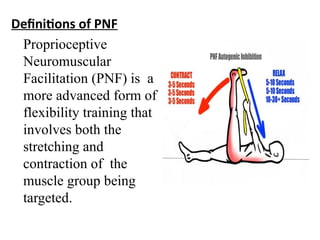
Definitions of PNF
Proprioceptive
Neuromuscular
Facilitation (PNF) is a
more advanced form of
flexibility training that
involves both the
stretching and
contraction of the
muscle group being
targeted.
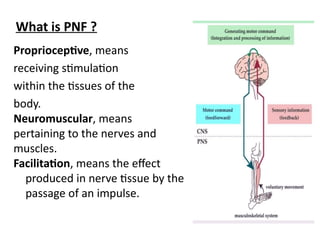
What is PNF ?
Proprioceptive, means
receiving stimulation
within the tissues of the
body.
Neuromuscular, means
pertaining to the nerves and
muscles.
Facilitation, means the effect
produced in nerve tissue by the
passage of an impulse.
Physiology of PNF
- PNF exercises are based on the stretch reflex
which is caused by stimulation of the Golgi
tendon and muscle spindles.
- This stimulation results in impulses being sent to
the brain, which leads to the contraction and
relaxation of muscles.
-When a body part is injured, there is a delay in the
stimulation of the muscle spindles and Golgi
tendons resulting in weakness of the muscle.
PNF exercises help to re-educate the motor units
which are lost due to the injury
Principles:
❑Patient must be taught the pattern.
❑Have the patient watch the moving limb moved
passively.
❑The patient must give proper verbal command.
❑Manual contact with appropriate pressure is very
important.
❑ Contraction of the muscle group is facilitated by hand
placement.
❑ Apply maximal resistance throughout ROM.
❑ Resistance will change.
❑ Rotation of movement will change throughout ROM.
❑ Distal movement should occur first.
Techniques of PNF
The techniques described are:
❖ Rhythmic Initiation
❖ Combination of Isotonics
❖ Reversal of Antagonists
- Dynamic Reversal of Antagonists (incorporates
Slow Reversal)
-Stabilizing Reversal
-Rhythmic Stabilization
Continue…
❖Repeated Stretch (Repeated Contraction)
-Repeated Stretch from beginning of range
-Repeated Stretch through range
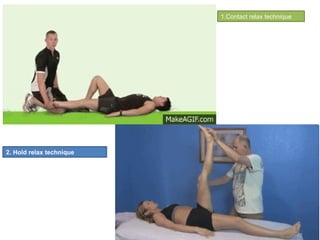
❖ Contract-Relax
❖ Hold-Relax
❖ Replication
2. Hold relax technique
1.Contact relax technique
The basic procedures for facilitation are:
1. Resistance: To aid muscle contraction and motor
control, to increase strength, aid motor learning.
2. Irradiation and reinforcement: Use of the spread
of the response to stimulation.
3. Manual contact: To increase power and guide
motion with grip and pressure.
4. Body position and body mechanics: Guidance
and control of motion or stability.
5. Verbal (commands): Use of words and the
appropriate
vocal volume to direct the patient.
6. Vision: Use of vision to guide motion and increase
force.
7. Traction or approximation: The elongation or
compression of the limbs and trunk to facilitate
motion and stability.
8. Stretch: The use of muscle elongation and the
stretch reflex to facilitate contraction and decrease
muscle fatigue.
9. Timing: Promote normal timing and increase
muscle contraction through “timing for emphasis”.
10.Patterns: Synergistic mass movements, components
of functional normal motion.
Continue…..
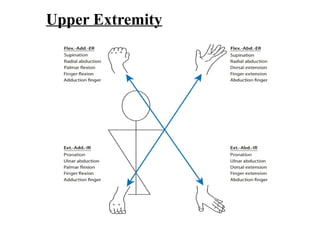
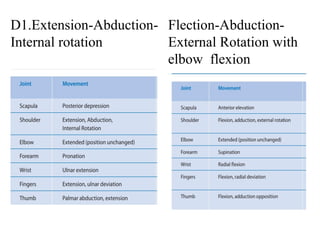
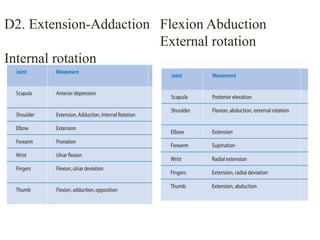
Upper Extremity
D1.Extension-Abduction-
Internal rotation
Flection-Abduction-
External Rotation with
elbow flexion
D2. Extension-Addaction
Internal rotation
Flexion Abduction
External rotation
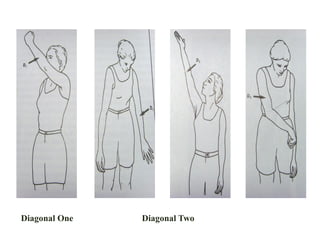
Diagonal One Diagonal Two
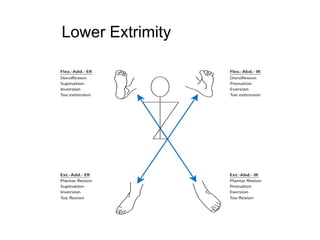
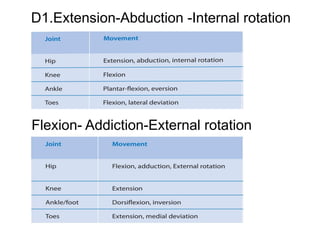
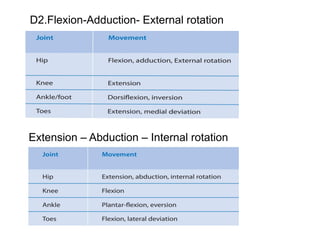
Lower Extrimity
Flexion- Addiction-External rotation
D1.Extension-Abduction -Internal rotation
Extension – Abduction – Internal rotation
D2.Flexion-Adduction- External rotation
PNF techniques and procedures (presentation) .pptx

PNF techniques and procedures (presentation) .pptx

  • 1.
    Presented by, Konok ChandraBarman BSc in physiotherapy 3rd year Session: 2018-19 Roll : 28 BANGLADESH HEALTH PROFESSIONS INSTITUTE Presented to – Md. Ershad Ali Lecturer, Department of physiotherapy, BHPI
  • 2.
    Topic : ProprioceptiveNeuromuscular Facilitation (PNF) procedures and techniques with abidance.
  • 3.
    Definitions of PNF Proprioceptive Neuromuscular Facilitation(PNF) is a more advanced form of flexibility training that involves both the stretching and contraction of the muscle group being targeted.
  • 4.
    What is PNF? Proprioceptive, means receiving stimulation within the tissues of the body. Neuromuscular, means pertaining to the nerves and muscles. Facilitation, means the effect produced in nerve tissue by the passage of an impulse.
  • 5.
    Physiology of PNF -PNF exercises are based on the stretch reflex which is caused by stimulation of the Golgi tendon and muscle spindles. - This stimulation results in impulses being sent to the brain, which leads to the contraction and relaxation of muscles. -When a body part is injured, there is a delay in the stimulation of the muscle spindles and Golgi tendons resulting in weakness of the muscle. PNF exercises help to re-educate the motor units which are lost due to the injury
  • 6.
    Principles: ❑Patient must betaught the pattern. ❑Have the patient watch the moving limb moved passively. ❑The patient must give proper verbal command. ❑Manual contact with appropriate pressure is very important. ❑ Contraction of the muscle group is facilitated by hand placement. ❑ Apply maximal resistance throughout ROM. ❑ Resistance will change. ❑ Rotation of movement will change throughout ROM. ❑ Distal movement should occur first.
  • 7.
    Techniques of PNF Thetechniques described are: ❖ Rhythmic Initiation ❖ Combination of Isotonics ❖ Reversal of Antagonists - Dynamic Reversal of Antagonists (incorporates Slow Reversal) -Stabilizing Reversal -Rhythmic Stabilization
  • 8.
    Continue… ❖Repeated Stretch (RepeatedContraction) -Repeated Stretch from beginning of range -Repeated Stretch through range ❖ Contract-Relax ❖ Hold-Relax ❖ Replication
  • 9.
    2. Hold relaxtechnique 1.Contact relax technique
  • 10.
    The basic proceduresfor facilitation are: 1. Resistance: To aid muscle contraction and motor control, to increase strength, aid motor learning. 2. Irradiation and reinforcement: Use of the spread of the response to stimulation. 3. Manual contact: To increase power and guide motion with grip and pressure. 4. Body position and body mechanics: Guidance and control of motion or stability. 5. Verbal (commands): Use of words and the appropriate vocal volume to direct the patient.
  • 11.
    6. Vision: Useof vision to guide motion and increase force. 7. Traction or approximation: The elongation or compression of the limbs and trunk to facilitate motion and stability. 8. Stretch: The use of muscle elongation and the stretch reflex to facilitate contraction and decrease muscle fatigue. 9. Timing: Promote normal timing and increase muscle contraction through “timing for emphasis”. 10.Patterns: Synergistic mass movements, components of functional normal motion. Continue…..
  • 12.
  • 13.
  • 14.
  • 15.
  • 16.
  • 17.
  • 18.
    Extension – Abduction– Internal rotation D2.Flexion-Adduction- External rotation