DR. NIRAJ KUMAR , PT
BPT, MPT MHA & Ph. D (PHYSIOTHERAPY)
ORTHOPEDICS*.
HOD/ASSOCIATE PROFESSOR
PHYSIOTHERAPY DEPT.
Shri Guru Rai Institute Of Paramedical Sciences
MANUAL THERAPY
Introduction to Manual Therapy
• There are evidence in History of treatment by
Passive stretching techniques.
• Over past 30-40 years many therapists have
worked to identify and learn the techniques which
are are more suitable and effective for the patient’s
problem.
• Joint mobilisations and manipulations techniques
are used to safely stretch or snap structures to
restore normal joint mechanics with less trauma.
• To effectively use joint mobilization for
therapeutic purpose ,the practitioner must
know and be able to evaluate the
– Anatomy of bone and joint
– Arthrokinematics
– Pathology of the neuromusculoskeletal system.
Manual Therapy : Study of different concepts :
• Cyriax
• Meckenzie
• Mulligan
• Maitland
Orthopaedic Medicine
(CYRIAX)
• Orthopaedic Medicine was founded upon
the structural (anatomic or morphological)
disturbances of the neuromusculoskeletal
system as defined by James Cyriax.
• Orthopaedic Medicine may be seen as the
natural consequence of the application of
the disease-illness model to orthopaedic
derangements that come under the province
of the physician.
• Cyriax (1969) envisaged derangements of
the intervertebral disc as the primary spinal
pathology to account for the vast majority
of "simple" back pain and nerve root pain.
• He described the capsular and non-capsular
patterns of articular disturbances at
peripheral joints, and devised selective
tissue tension tests to differentiate between
articular, ligamentous, contractile and
neural lesions.
• Orthopaedic Medicine became recognized as the
application of a unique systematized clinical evaluation
(including inspection, active movements, passive
movements, resisted muscle contraction, and palpation) to
the soft tissues of the locomotor system.
• Predicated primarily on pathomorphology (such as
degenerative, histopathologic, inflammatory, neoplastic or
infective lesions) with a relatively simple view of loss of
function (pain, weakness, loss of movement), terminology
accorded to the disease-illness model of scientific
modernism & Specific diagnoses such as tendinitis,
bursitis, ligament sprains and peripheral nerve entrapment
replaced fibrositis and associated syndromes.
• According to Cyriax, the principal challenges to
osteopathy were the basic morphological concepts of
annular disc tear, nuclear disc prolapse and dural tension as
the pathologies underlying the vast majority of spinal
derangements.
MULLIGAN CONCEPT
• This Concept was introduced by Brian R
Mulligan.
• Brian R Mulligan qualified as a registered
Physiotherapist in 1954 and gained his
diploma of Manipulative Therapy in 1974.
• He has been teaching Manual Therapy
internationally since 1972 and his course
have always proved popular.
Maitland’s Concept
• This concept was introduced by G.D.Maitland.
• According to G.D.Maitland the central theme of
the concept is a positive personal commitment to
understand what pateint is enduring, Listening and
believing the patient in order to encourage the
feeling of confidence and trust.
• Other aspects of maitland’s concepts are :
– Clinician’s particular mode of thinking, interpreting ,
planning and acting which is used to reach the
conclusions related to diagnosis, management of
treatment and prognosis of patient’s disorder.
– Use of appropriate and understandable words and
phrases.
– Three most Important aspects of this concept is :
• Examination
• Techniques
• Assessment
• It is open mindedness , Mental agility and mental
discipline linked with logical and methodical process of
assessing cause and effect which are the demand of the
Concept
Mckenzie Method
• This method was introduced by Robin Mckenzie.
• In 1956 he observed by chance a remarkable event
w ich has changed worldwide ,the nature of
treatment administered for the alleviation of back
pain.
• For more than 40 years Robin Mckenzie has
beenrefining an perfecting the procedures which
have made the Mckenzie self treatmnt system
unique.
• According to Mr.Robin Mckenzie : The disabling
and recurrent disorders that affect the spin can
produc disability and mental anguish in all who
experience the problem. It is estimated that over
80% of the world’s population will at same stage
of thir lives develop at least one episode of severe
back pain necessitating bed rest.
• According to him the only possible chance of
influencing the course of the disorder is to teach
each and every patient as much as is possible
about his own particular disorder.
Mobilisations :
• A passive movement performed by the
therapist slow enough that patient can stop
it.
• The technique may be applied with an
oscillatory motion or a sustained stretch
intended to decrease pain or increase
mobility.
• Technique may use Physiologic movement
or accessory movement.
Physiologic Movement :
• These movements can be voluntarily performed by the
patient.
• Osteokinematics : Physiologic movement of the bones.
Accessory Movement :
• These are small repetitive rhythmical oscillatory localized
accessory or functional movements.
• Can only be performed by therapist , always accompany
the physiologic movement and cannot be isolated
volntarily by patient.
• Arthrokinematics : accessory movment of the bone
surfaces within the joint e.g. – glidding, rolling etc
Manipulations:
• These are localised quick decesive
movements of small amplitude and high
velocity completed before patient can stop
it.
• It can be High Velocity Thrust or
Manipulation under anesthesia.
Effects of joint Mobilisation
• Stimulates biologic activity by moving
synovial fluid, which brings nutrients to the
avascular cartilage and intra-articular
fibrocartilage of meniscii.
• Maintains extensibility an tensile strength of
articular and peri-articular tissues.
• Provide awareness of position and motion
through afferent nerve impulses.
(Propioceptive feedback).
• Joint motion provide sensory input relative
to :
– Static position and sense speed of movement
(Type I receptors of joint capsule).
– Change of Speed of movement (type II
receptors of joint capsule and articular fat pad)
– Sense of direction of movement (Type I, II &
III receptors)
– Regulation of muscle tone (Type I, II & III
receptors)
– Nonciceptive receptors (type IV receptors of
joint capsule, lagaments, fat pads, periosteum,
walls of blood vessels).
INDICATIONS
AND
CONTRAINDICATIONS
OF
MANUAL THERAPY
Indication for manipulative physiotherapy as a treatment of
choice in
neuromusculoskeletal conditions is governed by:
• History including medical history and medications
• Subjective examination
• Assessment and evaluation of the examination
• Radiological investigations
• Laboratory investigations
• Practitioner opinion
• Medical opinion
• Patient opinion
• Overall assessment
In general terms manipulative physiotherapy is indicated when a
condition
appears to be of a mechanical nature. That is the symptoms are
aggravated
by activity or sustained posture and relieved by rest or easing
postures or
Indications
• When a neuromusculoskeletal condition
behaves in a mechanical way with
respect to both signs and symptoms.
• Muscle guarding
• Muscle Spasm
• Reversible joint hypomobility
• Progressive limitations
• Functional limitations
Limitations
• Cannot change the disease process of
disorders.
• Skill of the therapist .
Contraindications
There are many instances when all
techniques of manipulative
physiotherapy are contraindicated and
many instances when precaution is
indicated.
• Hypermobility
• Joint Effusion
• Inflammation
Procedures for Applying Joint
Mobilisation Techniques
• Proper Evaluation and assessment of the
joint to be mobilised.
• Accuracy of Diagnosis / Correct Diagnosis.
• Proper and comfortable positioning of the
patient and joint to be mobilised.
• Proper Stabilisation.
• Efficient treatment force.
• Proper Selection of methods and grades.
Grades of Mobilisation
Two systems of grading dosages of
mobilization are used :
• Graded oscillation techniques
• Sustained translatory joint play techniques.
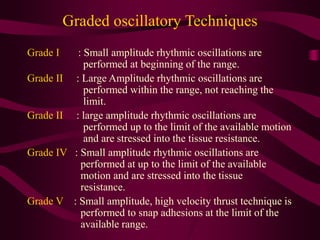
Graded oscillatory Techniques
Grade I : Small amplitude rhythmic oscillations are
performed at beginning of the range.
Grade II : Large Amplitude rhythmic oscillations are
performed within the range, not reaching the
limit.
Grade II : large amplitude rhythmic oscillations are
performed up to the limit of the available motion
and are stressed into the tissue resistance.
Grade IV : Small amplitude rhythmic oscillations are
performed at up to the limit of the available
motion and are stressed into the tissue
resistance.
Grade V : Small amplitude, high velocity thrust technique is
performed to snap adhesions at the limit of the
available range.
Uses :
• Grade I & II : Pain
• Grade III & IV : Stretching maneuvers
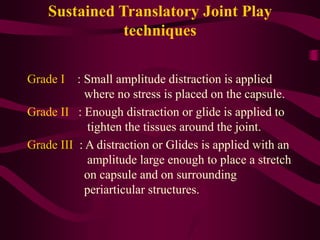
Sustained Translatory Joint Play
techniques
Grade I : Small amplitude distraction is applied
where no stress is placed on the capsule.
Grade II : Enough distraction or glide is applied to
tighten the tissues around the joint.
Grade III : A distraction or Glides is applied with an
amplitude large enough to place a stretch
on capsule and on surrounding
periarticular structures.
Uses :
• Grade I : pain relif
• Grade II : Initial treatment to determine the
joint sensitivity and maintain joint range of
motion.
• Grade III : Stretch the joint and thus
increase the range.
Mobilization
of
Peripheral Joints
Shoulder Joint
Physical examination
1. STANDING :
Observation - posture
• From in front : Symmetry, muscle tone and bulk
• From behind : Spinal curves, muscle tone and bulk
postvertebral, trapezius, supraspinatus,
infraspinatus, levator scapulae,
rhomboids, deltoid etc), shoulder girdle and
limb position
• From side : Relative position of the head to the neck,
cervical lordosis, cervico-thoracic angle,
thoracic spine posture (kyphosis etc),
scapulae position, relative position of
humerus to scapula.
Active movements
Observation for range of movement as well as quality
and control of scapula and cervical spine movement
etc.
• flexion / extension
• abduction
• lateral rotation
• hand behind back
• horizontal flexion & horizontal extension
Differentiation tests : Screening tests for neural tissue
Static muscle tests
• for pain and weakness
- abduction, lateral rotation, medial rotation,
elbow flexion
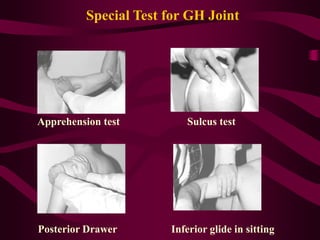
Special Test for GH Joint
Apprehension test Sulcus test
Posterior Drawer Inferior glide in sitting
• Impingement Test :
1. Allingham’s Dynamic Impingement test
2. Neere & Walsh
3. Hawkins & Kennedy
• Other Tests :
1. Empty Cane or Supraspinatus test
• Stability test for Glenohumeral Joint :
1. Inferior Capsule
2. Clunke Test
3. Test for Posterior Capsule
2. SITTING
Palpation
• temperature changes
• swelling
• rotator cuff tendons
Scapulo- thoracic movement
• elevation / depression
• retraction / protraction
Tests for other joints
• cervical spine
3.SUPINE
Palpation
• muscles
• tendons
• Coracoacromial ligament, capsule of glenohumeral
joint
• joint margins
• Subacromial space
Passive physiological movements
• flexion
• abduction
• medial rotation/lateral rotation
• horizontal flexion/extension
• quadrant
Passive accessory movements
Glenohumeral joint :
- In neutral
• PA / AP
• longitudinal caudad
• lateral distraction
- In 90 degrees abduction
• PA / AP
• longitudinal caudad
- In flexion
• PA
• longitudinal caudad
• lateral distraction
Acromioclavicular joint :
• PA / AP
• Traction
Sternoclavicular joint :
• AP
• Traction
4. SIDE LYING
Passive physiological movements
Scapulothoracic joint :
• elevation
• depression
• protraction
• retraction
Passive accessory movements
Scapulothoracic joint :
• distraction
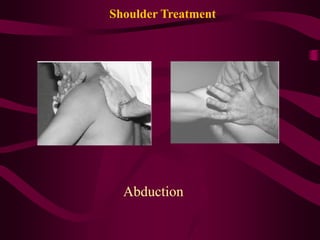
Shoulder Treatment
Abduction
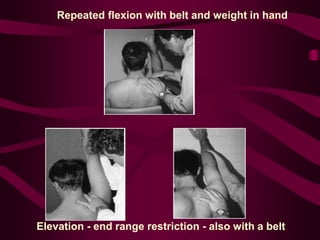
Repeated flexion with belt and weight in hand
Elevation - end range restriction - also with a belt
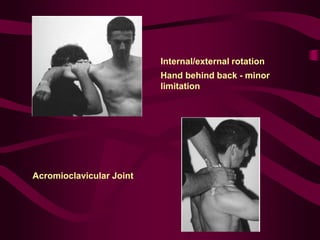
Internal/external rotation
Hand behind back - minor
limitation
Acromioclavicular Joint
Gross limitation of shoulder movement -
distraction with a belt
Accessory mobilisation techniques
• AP, PA, distraction with the arm by
the side or in direction of
restriction
Elbow Joint Examination
Standing :
Inspection :
• Anterior aspect
• Posterior aspect
• Carrying angle
Active movements :
• Flexion
• Extension
Range of motion :
• Flexion
• Extension
2. SITTING
Palpation :
• temperature changes
• swelling
• rotator cuff tendons
Muscle Testing :
• Flexors
• Extensors
Special Test :
• Valgus Stress test
• Varus Stress Test
• Pivot Shift Test / posterolateral rotatory instability test
Passive accessory movements :
• Dorsal / volar glide
• Joint compression
• Joint distraction
Wrist Joint
Hip Joint Examination
1. STANDING
Observation
• From in front : ASIS, lumbar spine, rotation of femur,
knee varus/valgus, muscle bulk
anterior thigh, Q angle, level of patellae,
foot position (pro/sup).
• From behind : Lumbar spine position, PSIS, Iliac
crest height, gluteal bulk, leg
length (symmetry of folds), tibia
varum/valgum, excessive
pronation.
• From side : Pelvic /lumbar spine relationship
(anterior / posterior
sway/hyperlordosis), pelvic tilt and rotation,
knee hyperextension or flexion.
Functional tests :
• gait
• walking backward, sideways
• hip flexion in standing
• crossing legs in sitting
• sit to stand
• squat - may add overpressure
• one leg squat - look for rotation or drop of pelvis
• one leg stance - look for pelvic drop
• single leg rotation - differentiation test
• functional complaint
Tests for other joints :
• lumbar spine active and combined movements
• SI Joint
2. SITTING
Neural Tissue Provocation Tests
• slump
3. SUPINE LYING
Observation :
• lower limb rotation
• swelling
Palpation :
• temperature changes
• swelling and thickening
• anterior tenderness
Active Movements
• flexion
• abduction
• adduction
• lateral rotation in neutral
• medial rotation in neutral
• lateral rotation in 90˚ flexion
• medial rotation in 90˚ flexion
• flexion/abduction/external rotation
(FABER)
Passive movements
• flexion
• abduction/adduction - neutral and 90˚
flexion
• lateral rotation/ medial rotation - neutral
and 90˚ flexion
Combined Movements
• flexion/adduction (90 - 140˚ flexion)
• faber
Resisted or static muscle tests
• flexion
• abduction/adduction
• lateral rotation/medial rotation in 90˚ hip flexion
Tests for other joints
• eg sacroiliac joints
Passive Accessory Movements
• longitudinal distraction - 0 and 90˚ flexion
• lateral distraction in 90˚ flexion or any combined
position
Muscle function
• muscle length (Thomas test)
SIDE LYING
Neural Tissue Provocation Tests :
• femoral nerve
PRONE LYING
Active Movements :
• Extension
• Medial rotation/lateral rotation
Passive Movements :
• Extension
• Medial rotation/lateral rotation
Tests for other regions and structures :
• Lumbar spine palpation
• Sacroiliac joints palpation
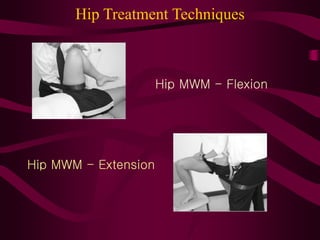
Hip Treatment Techniques
Hip MWM - Flexion
Hip MWM - Extension
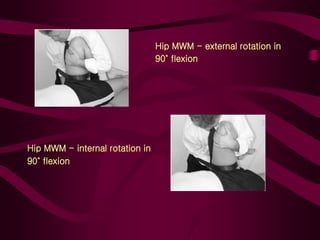
Hip MWM - external rotation in
90˚ flexion
Hip MWM - internal rotation in
90˚ flexion
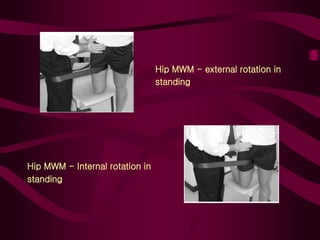
Hip MWM - external rotation in
standing
Hip MWM - Internal rotation in
standing
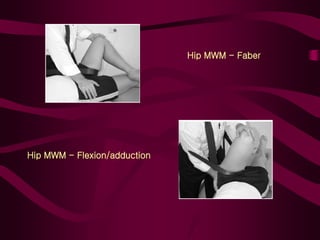
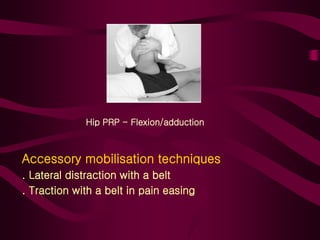
Hip MWM - Faber
Hip MWM - Flexion/adduction
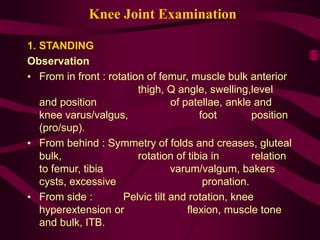
Hip PRP - Flexion/adduction
Accessory mobilisation techniques
. Lateral distraction with a belt
. Traction with a belt in pain easing
Knee Joint Examination
1. STANDING
Observation
• From in front : rotation of femur, muscle bulk anterior
thigh, Q angle, swelling,level
and position of patellae, ankle and
knee varus/valgus, foot position
(pro/sup).
• From behind : Symmetry of folds and creases, gluteal
bulk, rotation of tibia in relation
to femur, tibia varum/valgum, bakers
cysts, excessive pronation.
• From side : Pelvic tilt and rotation, knee
hyperextension or flexion, muscle tone
and bulk, ITB.
Functional Tests :
• gait
• walking backward
• stairs
• squat - may add overpressure
• Knee extension
• one leg squat
• one leg stance - look for pelvic drop
• running
• functional complaint
Tests for other joints :
• lumbar spine
• Hip
2. SITTING
Neural Tissue Provocation Tests
• slump
Muscle Function
• muscle length
• muscle strength
Active Movements
• active knee extension
Resisted Movements
• Isometric or through range quadriceps or
hamstring contraction
- If pain of patellofemoral origin is suspected, isometric knee
extension may be performed in 30 & 60 degrees knee extension
as appropriate. If pain is reproduced, the patella should be held
or taped in a medial position possibly with some rotation to
determine whether or not symptoms can be relieved by alteration
in patella alignment.
3. SUPINE LYING
Observation
• lower limb rotation and swelling
Palpation
• temperature changes
• swelling and thickening
• effusion tests - Milking, tap, and ballotable
• tenderness
Active Movements
• flexion
• extension
Passive Movements
• flexion
• extension (overpressure applied to femur, joint
line and tibia)
• Internal rotation/external rotation
Combined Movements :
• flexion/adduction
• flexion/abduction
• extension/adduction
• extension/abduction
Passive Accessory Movements :
Tibiofemoral joint - (in varying degree of
flexion/extension)
• PA tibia
• AP tibia
• Medial glide/lateral glide
Patellofemoral joint -
• medial glide/lateral glide
• longitudinal cephalad
Superior tibiofibular joint -
Muscle Function :
• muscle length (eg Thomas test)
• muscle strength (eg VMO)
Palpation :
• ligaments/retinaculum/Menisci
SIDE LYING :
Neural Tissue Provocation Tests
• femoral nerve
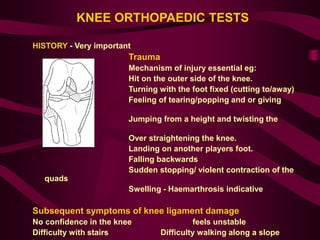
KNEE ORTHOPAEDIC TESTS
HISTORY - Very important
Trauma
Mechanism of injury essential eg:
Hit on the outer side of the knee.
Turning with the foot fixed (cutting to/away)
Feeling of tearing/popping and or giving
way.
Jumping from a height and twisting the
knee.
Over straightening the knee.
Landing on another players foot.
Falling backwards
Sudden stopping/ violent contraction of the
quads
Swelling - Haemarthrosis indicative
Subsequent symptoms of knee ligament damage
No confidence in the knee feels unstable
Difficulty with stairs Difficulty walking along a slope
Meniscus
Medial
• History: If chronic history then repeated episodes with minor
cause. Injured with valgus- flexion & ext rot or hyperflexion.
Posterior horn or bucket handle tear. During flexion the medial
meniscus is drawn posteriorly by the semimembranosus, during
extension the menisco - patellar fibres together with the tibial
plateau draws the anterior horn of the medial meniscus anteriorly.
• Valgus draws the medial meniscus laterally and ext rot draws the
posterior horn posteriorly and compresses the tibiofemoral joint.
• The medial meniscus is drawn under the convex femoral condyle.
• Anterior horn may also be injured with violent extension eg
kicking
• Posterior horn tear or transverse tear is much more common than
an anterior horn tear.
Lateral
• Injured by varus- flexion and internal rotation or hyper flexion.
Longitudinal tear.
• Compression of the lateral compartment with rotation whilst
flexed - horizontal tear.
• Lateral glide while the knee is in extension - horizontal tear.
• Forced rotation - oblique tear (combined horizontal +
Diagnosis
From the history and the physical examination findings :
- Joint line tenderness is very diagnostic. Tenderness follows the
meniscal movement of the tibia.
- Mild effusion - not haemarthrosis (unless peripheral tear)
- McMurrays - Most accurate for posterior horn tears. 20% false
negative, 33% false positive (plica)
Medial - Start in flexion, ext rot, valgus to replicate the mechanism
of injury. Extend the knee (ext rot compresses the tib/fem joint)
Feel for a click and pain at the joint line.
Lateral - Start in flexion, internal rot and varus to replicate the
mechanism of injury. - Extend the knee. Feel for a click and pain
at the joint line.
- Duncans
Anterior horn test describes a C shape for medial or lateral
meniscus, less common than the posterior horn or transverse
tear.
- Apleys
Not very accurate. ? differentiate between the menisci and
ANTERIOR & POSTERIOR CRUCIATE LIGAMENTS
• Important stabilisers of internal rotation of the knee.
Functional stability of the knee depends on the intact
structures of the ACL>PCL.
• Different types of tear.
• Mechanism of injury: ACL - mostly without impact.
1. Flex to Ext with varus and int rot. ("cutting to
support leg")
2. Flex to Ext with valgus and ext rot. ("cutting away
from support leg") Also injures MCL, med meniscus.
3. Hyperextension. (ACL + PCL)
• History - sudden pain or give way. May pseudo-lock.
Immediate effusion. Haemarthrosis (very diagnostic –
75-80% chance). Postero lateral pain with diffuse
joint line tenderness. Diffuse ache whole knee.
Differential diagnosis for osteochondral # - slower
bleeds
ACL :
Lachmans 15 -30 degrees flex. End feel very
important.
- Hyper extension (recurvatum test)
- No touch test, 30 degrees flex. Anterior translation
with quads contraction.
- Anterior draw - tends to test different fibres of ACL
Beware false negatives
- Pivot shift. (Lemaire test). The pivot shift tests look
for reduction of the lateral tibial condyle onto
the lateral femoral condyle as move through flexion
(flex - ext or ext - flex). Assumes normal anatomical
position through congruence of joint surfaces and ITB
change from flex to ext. Anterolateral rotatory
PCL
• Tighter with internal rotation. Resists the anterior
glide of the femur during weight bearing. Works with
the ACL to resist hyperextension.
• Mechanism of injury
– Direct blow to anterior tibia on flexed knee eg falling on the
ground - MVA dashboard
• History very important.
• Presentation - often no effusion, may have posterior
capsule tear at the same time. May mimic calf tear.
recurvatum.
• Posterior sag of the tibial condyle.
• Posterior draw +ve.
• Test - 90/90 test with quads contraction.
- Posterior draw test - beware false negative
COLLATERAL LIGAMENTS
• Direct trauma.
MEDIAL COLLATERAL
• Mechanism of injury : Moderate valgus strain or
external rotation force.
• Test - Valgus strain in ext and 30 degrees flex -
laxity in full extension indicates more serious trauma
eg ACL
LATERAL COLLATERAL
• Mechanism of injury : Moderate varus strain.
• Test - Varus strain in ext and 30 degrees flex.
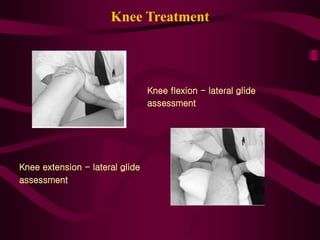
Knee Treatment
Knee flexion - lateral glide
assessment
Knee extension - lateral glide
assessment
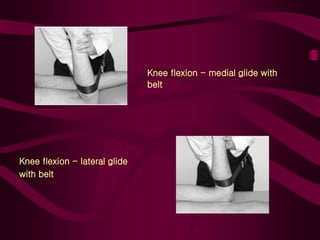
Knee flexion - medial glide with
belt
Knee flexion - lateral glide
with belt
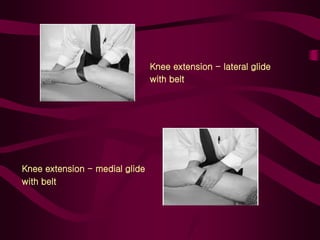
Knee extension - lateral glide
with belt
Knee extension - medial glide
with belt
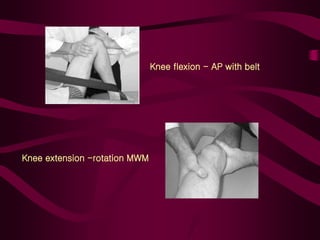
Knee flexion - AP with belt
Knee extension -rotation MWM
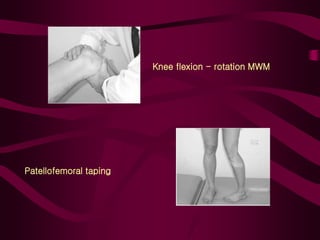
Knee flexion - rotation MWM
Patellofemoral taping
Ankle Joint
SPINAL MANUAL THERAPY
Introduction
Epidemiology of LBP
• Life time prevalence of 60-80% are widely reported
80-85% LBP is regarded as “non-specific” - ?
method of classification
• Episodes of LBP persisting for more than 2 weeks
have a much lower life time prevalence of 14%
• Pain of short duration is difficult to diagnose hence
reports of high incidence of NSLBP.
• In these cases a segmental diagnosis should be
made on clinical grounds & further investigation
may identify a specific treatable pain source.
• “90% recover within 2 months” - short term follow
up (<6 months) of patients may give false
interpretation - 12 months more revealing.
• Up to 80% of patients remain disabled to some
degree at 12 months - although perhaps only 10-
15% will be highly disabled.
• The median time to recovery is about 7 weeks -
relapses are common When patients do not return
for treatment or follow up they have not necessarily
recovered. In fact, it is likely that they have not
recovered and simply don’t return.
Classification of Spinal Pain
• Area of Pain
• Patho-anatomical - Response to pain
blockade
• Movement dysfunction
• Muscle dysfunction
• Neural dysfunction
• Joint
Manipulative Therapy
• Articular
• Neural tissue
• Muscle/fascia/soft tissue
• Psychological/emotional
• Assessment
• – Determine dysfunction and relate to subjective
• complaint
• Diagnosis
• Management
The Subjective Examination
The aims of the subjective examination are:
• To establish the type of problem or disorder in
the patients terms.
• To determine the type and stage of pathology
and to determine the type of onset.
• To determine the behaviour of the pain.
• To determine the "irritability" of the condition.
• To obtain a precise current and past history.
• To help determine the individuals pain
threshold.
• To help determine if caution or modification of
the physical examination is indicated.
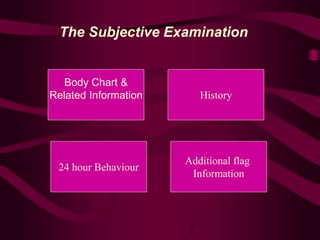
The Subjective Examination
Body Chart &
Related Information History
24 hour Behaviour
Additional flag
Information
KIND OF DISORDER
• The first question to ask the patient is to find out why
the patient is requesting treatment or
• why they have been referred to you.
• "As far as you are concerned what is your main
problem at this stage ?"
• This question will usually elicit a description of pain or
dysfunction. Other possibilities may
• be "giving way", "instability", "loss of function", "post-
trauma", "post-surgery", etc.
• Once you have an understanding of why the patient
has sought treatment you can go onto the
• body chart section.
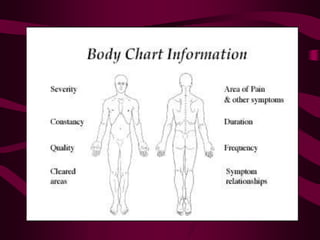
BODY CHART
• Area(s) of pain
• Define precise area and boundaries of pain.
"Show me where you feel the pain"
"Does it extend above/below here ?"
• Name the areas marked to allow easy reference later in the
current history (eg PL may be pain the lumbar area, PS may be
pain in the scapula area)
• Ask specifically about other relevant areas that may be painful.
Generally check joints above and below the painful region, and
structures that are able to refer symptoms to the painful site.
• Clear specific areas with closed questions.
"Do you have pain in your ....?" etc
• All areas of pain must be charted. Tick regions on the body chart
which are pain free.
Area(s) of paraesthesia
• Paraesthesia is an indication of possible neurological
involvement and as such must be regarded with
caution. An area of paraesthesia or numbness may
be related to the pain that a patient complains of or it
may be an indicator of a separate medical problem.
• Chart areas of paraesthesia on the body chart.
"Do you have any pins and needles or other strange
sensations ?"
"Do you have any areas of numbness?"
Constancy
• Mechanical pain may be constant or intermittent. If mechanical
pain is constant it may vary with movement and position, but will
never completely disappear. If pain is intermittent there will be a
movement or a position that will totally abolish it and activities
and positions that
will ease it.
• If pain is defined as constant, then there is no time of day or
night when it is not present.Constant pain may sometimes be
present in the first 48 hours post trauma (produced by chemical
irritation or mechanical deformation). Pain of chemical origin is
usually constant and no mechanical procedure can significantly
reduce it. Chemical pain following trauma reduces steadily as
healing takes place.
• If constant pain commences for no apparent reason, and is
gradually insidiously worsening, particularly if the patient looks
and/or feels unwell, then serious pathology should be
suspected.
Severity
"How severe is the pain in the .....?"
• Different descriptors (such as mild, moderate, and
severe) or verbal scales (1-10) may be used. A visual
analogue scale (VAS), length 10cm, as shown below
may be a useful measure of chronic pain.
• No pain ________________________ Worst pain
possible
• If several pains are present and the patient is unable
to describe the severity ask:
"Which is your worst pain?"
Nature
"How would you describe your pain?"
• Follow up with suggestions only if the patient has
trouble describing the pain.
"Is it aching, throbbing, sharp, shooting ..." etc
• The nature of the patients pain may give some
tentative clues to possible pathology.
Depth of pain
• Determine whether the pain is perceived as being
deep inside or on the surface.
"Is the pain deep inside or on the surface?"
• Superficial pain is more likely to be from localised soft
tissue. The more superficial a soft tissue structure
lies, the more precise is its associated perceived
pain. referred pain may be in a dermatomal,
scleratomal or myotomal pattern.
• Deep pain may be indicative of referred pain. This
should be suspected if any deep pain extends over a
large area with indefinite or vague boundaries. The
deep structures of the body do not localise stimuli
accurately.
Relationships
• This section is important if there are two or more
symptomatic sites. Symptomatic areas may
• or may not be related.
• Pains may be regarded as related subjectively if,
when questioned, the patient describes some sort of
relationship between them. In other words, the
patient perceives that a change in one pain is
accompanied by a change in the other pain(s).
• If pain is intermittent
"Do all pains come on at the same time?"
"Which pain comes first"
• If pain is constant
"If this pain gets worse, does that pain get worse?"
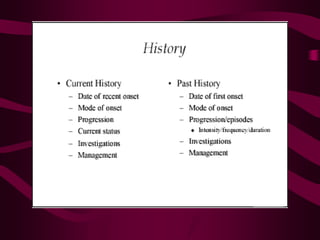
CURRENT HISTORY
"The pain that you have now, when did it start?"
• This question relates to the present episode only. Duration of
symptoms will give an indication of whether the condition is
acute, sub-acute, or chronic, and may be a guide to the amount
of vigour that can be used in the examination.
• Some patients can relate a specific incident to how their pain
started, but many cannot. If this is the case try to establish a
predisposing factor. Often a patient is unaware of the
significance of certain activities or positions that they may have
performed or adopted in the days, weeks, or months prior to the
onset of symptoms.
It may be very useful to find the predisposing
factors:
• As a clue to possible objective findings.
• To establish the presence of a related underlying
disease, illness or pathology.
• So that for treatment, certain activities and positions
can be modified or avoided.
• To help in determining methods to prevent a
recurrence.
The location and severity of the pain can change
rapidly from the time of onset. As a condition
becomes worse, pain may become more severe and
spread. The spread of pain may be due to
involvement of more tissues, or the spread of pain
may be because of changes to the central nervous
• "Did it start suddenly?" "Or come on gradually?"
• If an injury "What happened?" If spontaneous "What
did you notice first"
• Note the mechanism of injury in detail "Was there an
injury prior to this?"
• "Can you think of anything that may have started it?
(virus, stress, unaccustomed activities or posture)?"
• "Where was the pain initially?"
• "How severe was the pain when it first started?"
• "How has it changed since then?"
• "Have you had any treatment since this
happened/started?"
• "What effect did it have?"
Current status
• "Over the past few days how has the pain altered?"
(Better, same or worse)This question obviously
indicates the course of the condition. A gradually
worsening condition will be harder to treat than a
condition improving on its own.
• After taking the current history and establishing the
behaviour of pain over the preceding days, relate all
information pertaining to the severity of symptoms to
the injury sustained or the mode of onset
• Serious pathology may be suspected if:
- Severe symptoms were caused by minor strain.
- Pain commenced for no apparent reason and has
been gradually insidiously worsening.
PAST HISTORY
This section should also provide information on the
severity and behaviour of previous symptoms and the
effect of various treatments in the past. This may help
in the planning of treatment.If a previous treatment
method, modality or technique has been successful
for the same condition and presentation, then the
same approach may assist in the selection of
treatment.
It is possible that the symptoms resulting from the
current episode may overlay symptoms from a
previous injury, confusing the presentation.
Information on successive recurrences may indicate
whether a condition is becoming progressively more
serious, and is occurring more easily. If this is the
case, regarding treatment, a great deal of emphasis
"Have you had this pain before?"
• If the response was "yes" follow up with :
"When was the first time?"
• Then ask specifically about area, cause duration,
severity and treatment.
• Successive recurrences
"Is it occurring more frequently?"
"Does it come on more easily?"
• Ask about recovery rate and treatment.
• Check for significant history of problems with joints
and areas that may be related to the site of pain.
Other Precautionary Questions :
• Sustained positions : stading, sitting & lying
• General Health
• Spinal imaging
• Cough / sneeze
• Weight loss
• Steroids
• Any other medication
* Red & * Yellow Flags
• Red flags
– Valuable information can be obtained from all
parts of the subjective not just “special questions”
– Some conditions pose an immediate threat to the
patients health eg tumours and infections
– Some conditions may pose a threat to the
integrity of the patients spine and CNS eg fractures
* Yellow Flags
• Use to describe psychosocial risk factors
- Research has shown that predictors of poor
outcome are factors such as patient’s beliefs and
their cognitive appraisal for their low back pain -
fear of pain, passive coping strategies are both
associated with poor outcome
- Eg alerted by excessive/exaggerated pain
descriptors
• Failure of recognition can lead to treatment failure
attributed incorrectly to patient malingering or poor
physiotherapist skill in performing treatment
Combined Movement
Combined Movements
• Developed by Brian Edwards
• Based on normal function
• Biomechanical model of movement
• Broad range of application for patients with spinal pain
• Promotes an understanding of the patients condition
• Enhances clinical reasoning
• Job satisfaction and effective patient management
Biomechanics
• Coupled movement : An involuntary movement that
occurs at the motion segment during physiological
motion
• Combined movements : Movements imposed on the
spine as directed and controlled by the therapist
*Coupled Movement : Lumbar Spine
• Somewhat controversial but consensus is:
• In extension - sideflexion and rotation occur in
opposite directions
• In flexion - sideflexion and rotation occur in the
• same direction
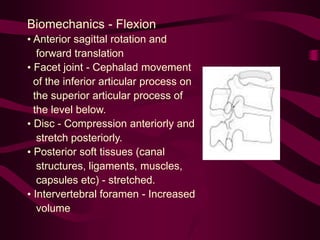
Biomechanics - Flexion
• Anterior sagittal rotation and
forward translation
• Facet joint - Cephalad movement
of the inferior articular process on
the superior articular process of
the level below.
• Disc - Compression anteriorly and
stretch posteriorly.
• Posterior soft tissues (canal
structures, ligaments, muscles,
capsules etc) - stretched.
• Intervertebral foramen - Increased
volume
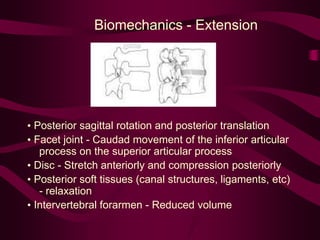
Biomechanics - Extension
• Posterior sagittal rotation and posterior translation
• Facet joint - Caudad movement of the inferior articular
process on the superior articular process
• Disc - Stretch anteriorly and compression posteriorly
• Posterior soft tissues (canal structures, ligaments, etc)
- relaxation
• Intervertebral forarmen - Reduced volume
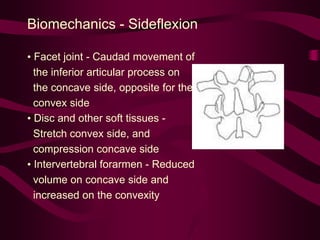
Biomechanics - Sideflexion
• Facet joint - Caudad movement of
the inferior articular process on
the concave side, opposite for the
convex side
• Disc and other soft tissues -
Stretch convex side, and
compression concave side
• Intervertebral forarmen - Reduced
volume on concave side and
increased on the convexity
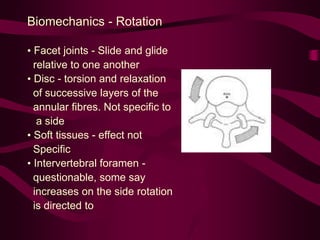
Biomechanics - Rotation
• Facet joints - Slide and glide
relative to one another
• Disc - torsion and relaxation
of successive layers of the
annular fibres. Not specific to
a side
• Soft tissues - effect not
Specific
• Intervertebral foramen -
questionable, some say
increases on the side rotation
is directed to
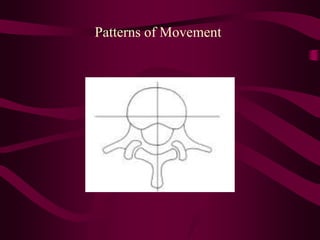
Patterns of Movement
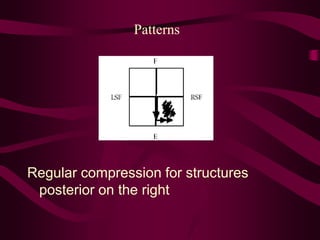
Patterns
Regular compression for structures
posterior on the right
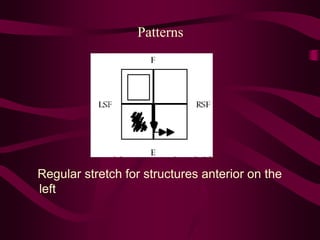
Patterns
Regular stretch for structures anterior on the
left
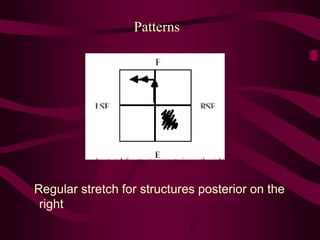
Patterns
Regular stretch for structures posterior on the
right
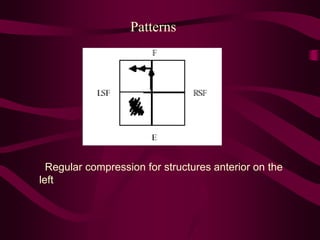
Patterns
Regular compression for structures anterior on the
left
SIN
• Severity of the pain
- Mild, moderate or severe
• Irritability of the disorder
- Non, moderate or high
• Nature of the disorder
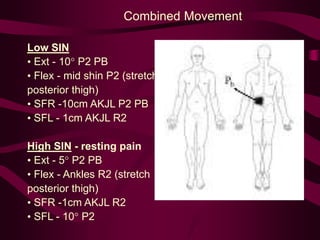
Combined Movement
Low SIN
• Ext - 10° P2 PB
• Flex - mid shin P2 (stretch
posterior thigh)
• SFR -10cm AKJL P2 PB
• SFL - 1cm AKJL R2
High SIN - resting pain
• Ext - 5° P2 PB
• Flex - Ankles R2 (stretch
posterior thigh)
• SFR -1cm AKJL R2
• SFL - 10° P2
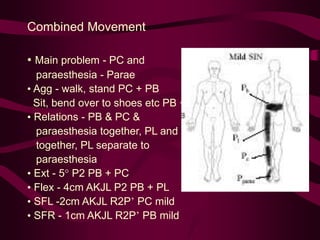
Combined Movement
• Main problem - PC and
paraesthesia - Parae
• Agg - walk, stand PC + PB
Sit, bend over to shoes etc PB +
• Relations - PB & PC &
paraesthesia together, PL and PB
together, PL separate to
paraesthesia
• Ext - 5° P2 PB + PC
• Flex - 4cm AKJL P2 PB + PL
• SFL -2cm AKJL R2P’ PC mild
• SFR - 1cm AKJL R2P’ PB mild
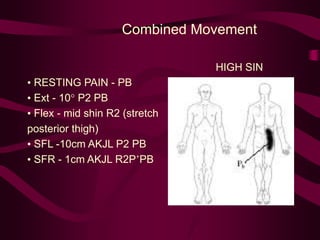
Combined Movement
HIGH SIN
• RESTING PAIN - PB
• Ext - 10° P2 PB
• Flex - mid shin R2 (stretch
posterior thigh)
• SFL -10cm AKJL P2 PB
• SFR - 1cm AKJL R2P’PB
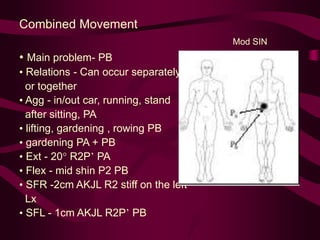
Combined Movement
Mod SIN
• Main problem- PB
• Relations - Can occur separately
or together
• Agg - in/out car, running, stand
after sitting, PA
• lifting, gardening , rowing PB
• gardening PA + PB
• Ext - 20° R2P’ PA
• Flex - mid shin P2 PB
• SFR -2cm AKJL R2 stiff on the left
Lx
• SFL - 1cm AKJL R2P’ PB
Neural Tissue Physical Examination
Pain
Nociceptive
– that which arises from chemically or mechanically
induced impulses from non-neural structures
• Local
• Visceral referred
• Somatic referred
Neuropathic
– That which arises from neural structures
CERVICAL SPINE
Cervical Spine Physical Examination
STANDING :
- Observation
• From in front
Symmetry, muscle tone and bulk (prevertebral
muscles)
Respiratory pattern
• From behind
Spinal curves, muscle tone and bulk
(postvertebral, trapezius etc),shoulder girdle and limb
position
• From side
Relative position of the head to the neck, cervical
lordosis, cervicothoracic angle, thoracic spine posture
(kyphosis etc), scapulae position.
Active movements of the shoulder girdle
• Abduction
• Flexion
• Hand behind back
Differentiation tests
• Neural tissue sensitising manoeuvres for median,
radial or ulnar nerve as appropriate
Muscle Function
Muscle strength/recruitment/endurance tests
• Tests for dynamic cervical stability
SITTING :
• Observation – posture
- As standing
• Active physiological movements
- Flexion
- Extension
- Rotation to left
- Rotation to right
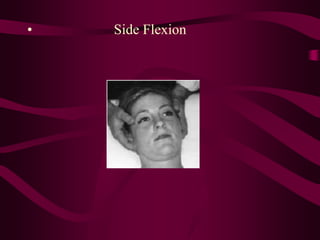
- Side flexion to left
- Side flexion to right
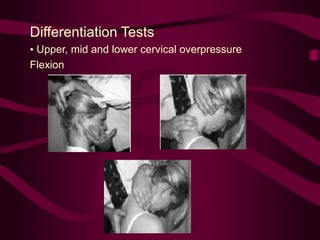
Differentiation Tests
• Upper, mid and lower cervical overpressure
Flexion
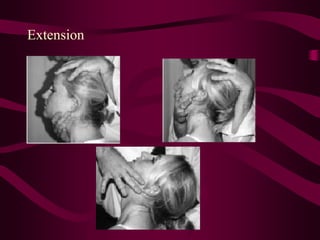
Extension
Vertebral artery Tests
Craniovertebral Stress Tests
• Transverse ligament
• Alar ligaments
• Tectorial membrane
Combined Movements
Repeated Movements
Sustained Movements
3. SUPINE LYING
Observation
• General posture/muscle tone/relative mobility
Neurological Examination
• Sensation
• Muscle power/reflexes
Craniovertebral Stress Tests
• Transverse ligament
• Tectorial membrane
Muscle Function
1. Muscle length tests
• Trapezius
• Scaleni
• Sternocleidomastoid
• Levator Scapulae
• Upper cervical extensors
• Pectoralis minor
2. Muscle strength/recruitment/endurance
tests
• Deep neck flexors
Neural Tissue Provocation Tests
• Median, Radial, & Ulnar bias
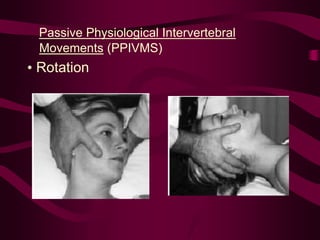
Passive Physiological Intervertebral
Movements (PPIVMS)
• Rotation
• Side Flexion
PRONE LYING
Palpation :
• Temperature changes, Sweating
• Swelling and thickening/soft tissue changes
• Bony alignment
• Nerve trunk palpation
Passive Accessory Movements (PAVMS)
• Central PA’s
• Unilateral PA’s
• Transverse pressures
• Combined positions
Muscle Function
• Muscle strength/recruitment/endurance tests
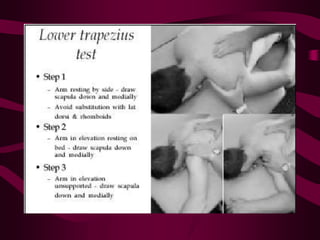
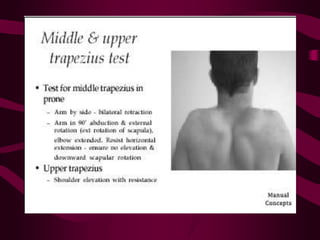
• Lower and middle trapezius
• Serratus anterior
SIDE LYING
Passive Physiological Intervertebral Movements
(PPIVMS)
• Flexion/Extension
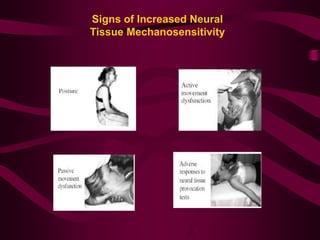
Physical Signs of Neural Tissue
Involvement
1. Antalgic posture
2. Active movement dysfunction
3. Passive movement dysfunction which correlates with the
degree of active movement dysfunction.
4. Adverse responses to neural tissue provocation tests, which
must relate specifically and anatomically to 2 and 3.
5. Mechanical allodynia in response to palpation of specific
nerve trunks, which relate specifically and anatomically to
2 and 4.
6. Evidence from the physical examination of a local cause of
the neurogenic pain, which would involve the neural tissue
showing the responses in 4 and 5.
7. History consistent with the physical examination findings
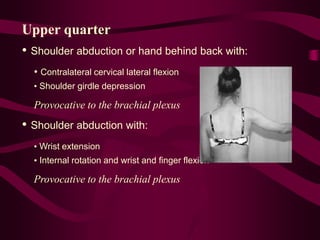
Upper quarter
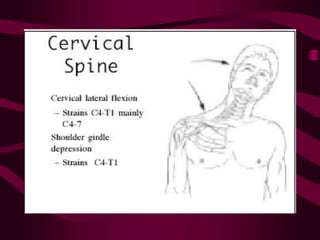
• Shoulder abduction or hand behind back with:
• Contralateral cervical lateral flexion
• Shoulder girdle depression
Provocative to the brachial plexus
• Shoulder abduction with:
• Wrist extension
• Internal rotation and wrist and finger flexion
Provocative to the brachial plexus
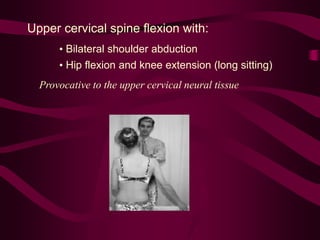
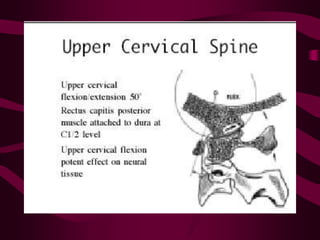
Upper cervical spine flexion with:
• Bilateral shoulder abduction
• Hip flexion and knee extension (long sitting)
Provocative to the upper cervical neural tissue
Passive movement dysfunction
• It is obvious that both active and passive movement
would have the same or similar mechanical stimulus
effect on neural tissues.
• The quadrant position of the shoulder is an important
passive movement test of the shoulder joint.
Shoulder quadrant
• The addition of contralateral cervical flexion and
elbow extension will have an increased provocative
effect on the neurovascular bundle in the axilla and
can be used to differentiate between a local shoulder
dysfunction and neural tissue sensitization.
Adverse responses to neural tissue provocation tests
• Provocation tests are passive tests that are applied in
a manner to selectively stress different neural tissues
in order to assess their sensitivity to mechanical
provocation.
• Provocation tests can only be carried out within the
available ranges of passive movement, which are
governed by the severity of pain associated with the
disorder being evaluated.
• The following is a methodological approach to neural
tissue provocation tests for the upper quarter. The
suggested approach incorporates provocative
manoeuvres directed to the median, radial and ulnar
nerve trunks from a proximal to distal direction and
vice versa. In all cases subject is supine
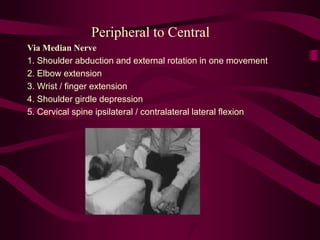
Peripheral to Central
Via Median Nerve
1. Shoulder abduction and external rotation in one movement
2. Elbow extension
3. Wrist / finger extension
4. Shoulder girdle depression
5. Cervical spine ipsilateral / contralateral lateral flexion
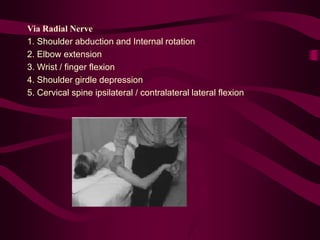
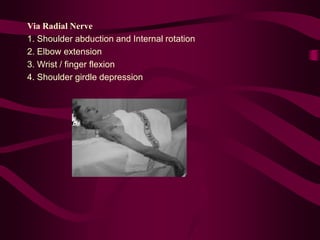
Via Radial Nerve
1. Shoulder abduction and Internal rotation
2. Elbow extension
3. Wrist / finger flexion
4. Shoulder girdle depression
5. Cervical spine ipsilateral / contralateral lateral flexion
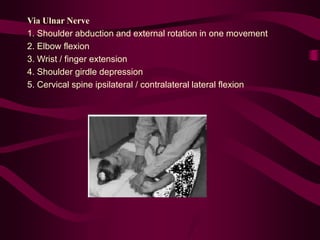
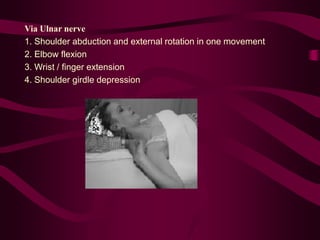
Via Ulnar Nerve
1. Shoulder abduction and external rotation in one movement
2. Elbow flexion
3. Wrist / finger extension
4. Shoulder girdle depression
5. Cervical spine ipsilateral / contralateral lateral flexion
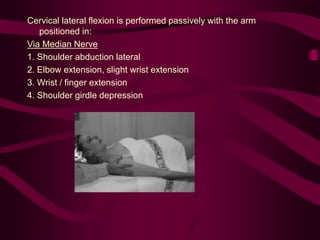
Cervical lateral flexion is performed passively with the arm
positioned in:
Via Median Nerve
1. Shoulder abduction lateral
2. Elbow extension, slight wrist extension
3. Wrist / finger extension
4. Shoulder girdle depression
Via Radial Nerve
1. Shoulder abduction and Internal rotation
2. Elbow extension
3. Wrist / finger flexion
4. Shoulder girdle depression
Via Ulnar nerve
1. Shoulder abduction and external rotation in one movement
2. Elbow flexion
3. Wrist / finger extension
4. Shoulder girdle depression
NEUROLOGICAL EXAMINATION UPPER LIMB
1. Symptoms and area 2. Muscle strength
3. Reflexes 4. Sensation
Special Inquiry
• Abnormality of gait or unusual plantar sensation on foot contact.
Tingling or unusual
• sensations in the hands and/or feet. requires medical
practitioner communication/referral.
• Upper motor neurone involvement.
1. Symptoms
• Observation and interpretation.
• Type of symptoms. eg. Pain, ache, burning, tingling, pins and
needles, numbness etc.
• Area refers to dermatome, myotome, sclerotome, or peripheral
sensory nerve.
2. Muscle strength
Specific muscle testing related to spinal level of
innervation. Examine tone and strength to maximal
contraction but with due regard to pain.
• C1 and 2 Occipital flexion/extension
• C2 and 3 Cervical flexion/extension
• C3 and 4 Shoulder girdle elevation
• C5 Shoulder abduction
• C5 and 6 Elbow flexion
• C6 Wrist extension/abduction
• C7 Elbow extension
• C8 Thumb distal phalanx extension
• T1 5th finger abduction
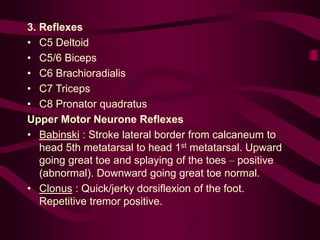
3. Reflexes
• C5 Deltoid
• C5/6 Biceps
• C6 Brachioradialis
• C7 Triceps
• C8 Pronator quadratus
Upper Motor Neurone Reflexes
• Babinski : Stroke lateral border from calcaneum to
head 5th metatarsal to head 1st metatarsal. Upward
going great toe and splaying of the toes – positive
(abnormal). Downward going great toe normal.
• Clonus : Quick/jerky dorsiflexion of the foot.
Repetitive tremor positive.
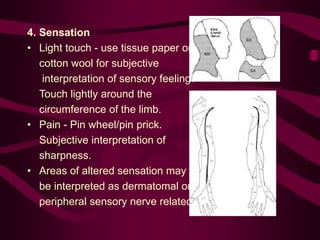
4. Sensation
• Light touch - use tissue paper or
cotton wool for subjective
interpretation of sensory feeling.
Touch lightly around the
circumference of the limb.
• Pain - Pin wheel/pin prick.
Subjective interpretation of
sharpness.
• Areas of altered sensation may
be interpreted as dermatomal or
peripheral sensory nerve related.
Vascular Changes
Routine observation during neurological examination.
1. Colouration - white/blanched - arterial-
cyanosed/bluish - venous
2. Engorgement of limb superficial veins - venous
3. Slow response to nail pressure - arterial
All may require immediate medical referral or
communication.
Craniovertebral Stability Tests
• Symptoms of instability include those normally
associated with compromise of the vertebrobasilar
arterial complex such as paraesthesia in the lips, and
tongue, dizziness, loss of balance or drop attacks,
diplopia, double vision, cerebellar ataxia, and
nystagmus.
• Signs of instability include an increase in accessory
motion on the following stability tests as well as
reproduction of the above symptoms during the test
or nystagmus usually lateral.
• The following tests are designed to test the
longitudinal, sagittal, transverse, and coronal stability
of the craniovertebral ligament complex.
Transverse ligament
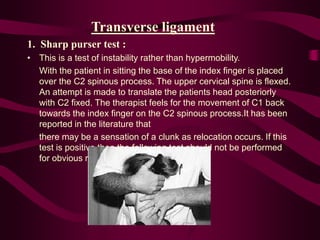
1. Sharp purser test :
• This is a test of instability rather than hypermobility.
With the patient in sitting the base of the index finger is placed
over the C2 spinous process. The upper cervical spine is flexed.
An attempt is made to translate the patients head posteriorly
with C2 fixed. The therapist feels for the movement of C1 back
towards the index finger on the C2 spinous process.It has been
reported in the literature that
there may be a sensation of a clunk as relocation occurs. If this
test is positive then the following test should not be performed
for obvious reasons.
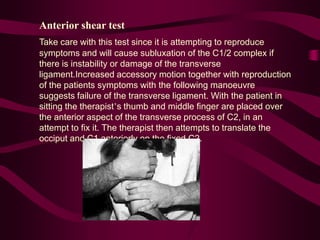
Anterior shear test
Take care with this test since it is attempting to reproduce
symptoms and will cause subluxation of the C1/2 complex if
there is instability or damage of the transverse
ligament.Increased accessory motion together with reproduction
of the patients symptoms with the following manoeuvre
suggests failure of the transverse ligament. With the patient in
sitting the therapist’s thumb and middle finger are placed over
the anterior aspect of the transverse process of C2, in an
attempt to fix it. The therapist then attempts to translate the
occiput and C1 anteriorly on the fixed C2.
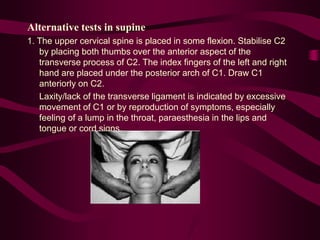
Alternative tests in supine
1. The upper cervical spine is placed in some flexion. Stabilise C2
by placing both thumbs over the anterior aspect of the
transverse process of C2. The index fingers of the left and right
hand are placed under the posterior arch of C1. Draw C1
anteriorly on C2.
Laxity/lack of the transverse ligament is indicated by excessive
movement of C1 or by reproduction of symptoms, especially
feeling of a lump in the throat, paraesthesia in the lips and
tongue or cord signs.
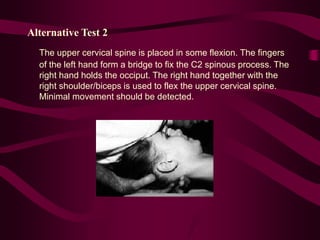
Alternative Test 2
The upper cervical spine is placed in some flexion. The fingers
of the left hand form a bridge to fix the C2 spinous process. The
right hand holds the occiput. The right hand together with the
right shoulder/biceps is used to flex the upper cervical spine.
Minimal movement should be detected.
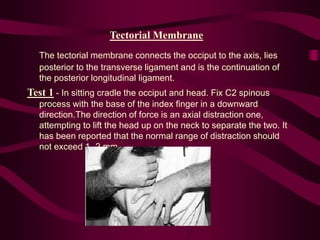
Tectorial Membrane
The tectorial membrane connects the occiput to the axis, lies
posterior to the transverse ligament and is the continuation of
the posterior longitudinal ligament.
Test 1 - In sitting cradle the occiput and head. Fix C2 spinous
process with the base of the index finger in a downward
direction.The direction of force is an axial distraction one,
attempting to lift the head up on the neck to separate the two. It
has been reported that the normal range of distraction should
not exceed 1 -2 mm.
Test 2 –
In supine similar hold as with the transverse ligament
test in lying. Fix C2 spinous process and pull the
occiput longitudinally.
• Both tests must be performed in upper cervical
flexion and extension as well as neutral to test the
various ligament fibre directions.
Alar ligaments
The alar ligaments have a complicated arrangement
and are quite variable in their anatomical disposition.
• The primary function of the alar ligament complex is
to limit axial rotation in the upper cervical spine (C0/1
& C1/2).
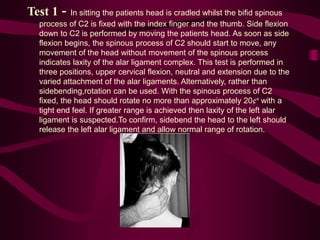
Test 1 - In sitting the patients head is cradled whilst the bifid spinous
process of C2 is fixed with the index finger and the thumb. Side flexion
down to C2 is performed by moving the patients head. As soon as side
flexion begins, the spinous process of C2 should start to move, any
movement of the head without movement of the spinous process
indicates laxity of the alar ligament complex. This test is performed in
three positions, upper cervical flexion, neutral and extension due to the
varied attachment of the alar ligaments. Alternatively, rather than
sidebending,rotation can be used. With the spinous process of C2
fixed, the head should rotate no more than approximately 20¢ª with a
tight end feel. If greater range is achieved then laxity of the left alar
ligament is suspected.To confirm, sidebend the head to the left should
release the left alar ligament and allow normal range of rotation.
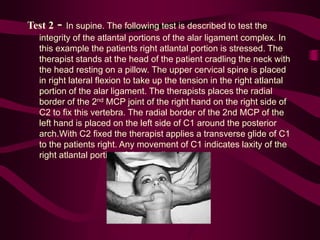
Test 2 - In supine. The following test is described to test the
integrity of the atlantal portions of the alar ligament complex. In
this example the patients right atlantal portion is stressed. The
therapist stands at the head of the patient cradling the neck with
the head resting on a pillow. The upper cervical spine is placed
in right lateral flexion to take up the tension in the right atlantal
portion of the alar ligament. The therapists places the radial
border of the 2nd MCP joint of the right hand on the right side of
C2 to fix this vertebra. The radial border of the 2nd MCP of the
left hand is placed on the left side of C1 around the posterior
arch.With C2 fixed the therapist applies a transverse glide of C1
to the patients right. Any movement of C1 indicates laxity of the
right atlantal portion of the alar ligament.
The Vertebral Artery
All patients with cervical symptoms must be
questioned thoroughly regarding possible vertebral
artery symptoms. All patients with upper cervical
signs or symptoms must be questioned and tested for
possible vertebral artery compromise prior to
manipulation and it would be advisable to do so prior
to upper cervical combined movement testing.
• The vertebral artery normally enters the cervical
spine at C6 and passes through the foramen in the
transverse processes where it is closely
approximated posterolaterally to the apophyseal
joints. Rotation and extension of the cervical spine
may temporarily impair blood flow by traction or
impingement.
Subjective Examination
Possible symptoms of vertebral artery compromise usually
associated with neck movements or neck positions which should
be asked for are:
• Dizziness/Lightheadedness
• Dysarthria
• Diplopia/Disturbance of vision
• Drop attacks
• Tinnitus
• Tongue / facial paraesthesia
• Nausea/vomiting
If present these signs should then be related to:
• The history of dizziness onset and behaviour in relation to
neck symptoms
• Any aggravation of dizziness by neck or head movements
• Any aggravation by head or neck postures
Record both negative and positive results or subjective questioning
Physical Examination
• The following are the clinical guidelines for
Pre-manipulative procedures for the cervical
spine as proposed by the Australian
Physiotherapy Association in April 2000.
• Be aware that dizziness, like pain, may be
latent. Continue to monitor the patient during
cervical assessment and treatment
particulary rotatory techniques or PAIVM’s in
combined positions.
Procedure
• In every patient in whom treatment of the cervical
spine is to be performed, routine physical
examination of the cervical spine must be
undertaken, including movement to the end of
available physiological ranges with overpressure
where applicable with respect to irritability and
severity of symptoms. During and between each
movement the therapist must enquire about the
presence of any symptoms associated with VBI.
• Tests should be performed in supine lying or sitting
as indicated by the patients history or subjective
presentation.If dizziness or symptoms are provoked
in either of the positions, the test should be repeated
in the alternative position.
Mimimum testing required:
• Sustained end range rotation to the left and the right
• The position or movement which provokes symptoms as
described by the patient.
• All tests are held for 10 seconds with a 10 second rest period
between tests.
• During testing ask for dizziness (symptoms complained of) and
watch for nystagmus.
• Cease testing if symptoms are reproduced.
• Additional tests to further test collateral circulation or the
presence of symptoms potentially associated with VBI could
include:
• Cervical extension
• Cervical rotation combined with extension
• Simulated manipulation position
• Quick movement of the head through available range of
movement when the patient relates symptoms to quick
movements rather than head postures or positions.
Cervical Spine Treatment
Physiological techniques
In supine
• Generalised rotation and side flexion
• Manual traction
(can be applied with a manual therapy belt)
In sitting
• Localised rotation and side flexion
(can be applied in combined positions)
• Mulligan techniques
• Snags
• MWM”s
Accessory Techniques
In prone
• Posteroanterior pressures
(can be applied in combined positions)
• Transverse pressures
(can be applied in combined positions)
In sitting
• Mulligan techniques
• Nags (can be applied with traction)
• Reverse Nags
• Localised posteroanterior pressures
(can be applied in combined positions or used in conjunction with
a physiological movement)
High Velocity Thrust techniques
• Cradle hold upslope and lateral gap
Neural Tissue Treatment Techniques
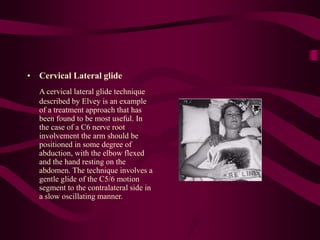
• Cervical Lateral glide
A cervical lateral glide technique
described by Elvey is an example
of a treatment approach that has
been found to be most useful. In
the case of a C6 nerve root
involvement the arm should be
positioned in some degree of
abduction, with the elbow flexed
and the hand resting on the
abdomen. The technique involves a
gentle glide of the C5/6 motion
segment to the contralateral side in
a slow oscillating manner.
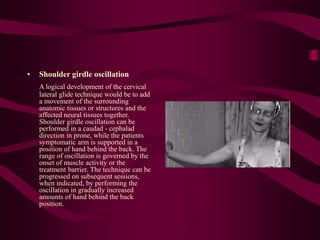
• Shoulder girdle oscillation
A logical development of the cervical
lateral glide technique would be to add
a movement of the surrounding
anatomic tissues or structures and the
affected neural tissues together.
Shoulder girdle oscillation can be
performed in a caudad - cephalad
direction in prone, while the patients
symptomatic arm is supported in a
position of hand behind the back. The
range of oscillation is governed by the
onset of muscle activity or the
treatment barrier. The technique can be
progressed on subsequent sessions,
when indicated, by performing the
oscillation in gradually increased
amounts of hand behind the back
position.
Upper Cervical Spine Treatment
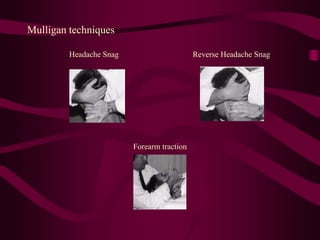
Mulligan techniques
Headache Snag Reverse Headache Snag
Forearm traction
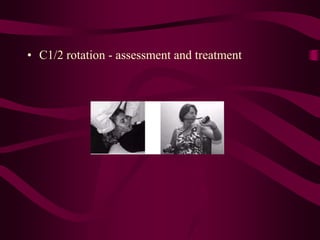
• C1/2 rotation - assessment and treatment
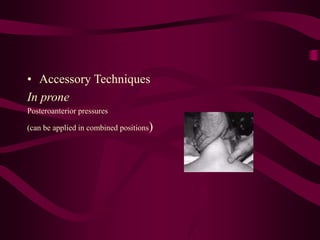
• Accessory Techniques
In prone
Posteroanterior pressures
(can be applied in combined positions)
The Lumbar Spine
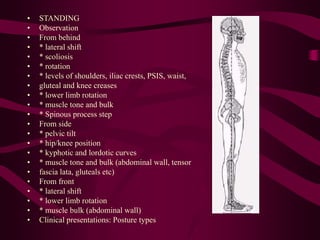
• STANDING
• Observation
• From behind
• * lateral shift
• * scoliosis
• * rotation
• * levels of shoulders, iliac crests, PSIS, waist,
• gluteal and knee creases
• * lower limb rotation
• * muscle tone and bulk
• * Spinous process step
• From side
• * pelvic tilt
• * hip/knee position
• * kyphotic and lordotic curves
• * muscle tone and bulk (abdominal wall, tensor
• fascia lata, gluteals etc)
• From front
• * lateral shift
• * lower limb rotation
• * muscle bulk (abdominal wall)
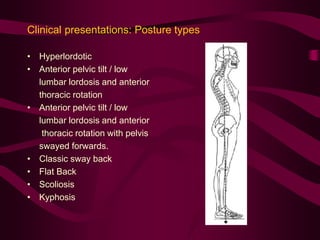
• Clinical presentations: Posture types
Clinical presentations: Posture types
• Hyperlordotic
• Anterior pelvic tilt / low
lumbar lordosis and anterior
thoracic rotation
• Anterior pelvic tilt / low
lumbar lordosis and anterior
thoracic rotation with pelvis
swayed forwards.
• Classic sway back
• Flat Back
• Scoliosis
• Kyphosis
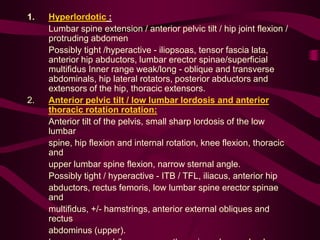
1. Hyperlordotic :
Lumbar spine extension / anterior pelvic tilt / hip joint flexion /
protruding abdomen
Possibly tight /hyperactive - iliopsoas, tensor fascia lata,
anterior hip abductors, lumbar erector spinae/superficial
multifidus Inner range weak/long - oblique and transverse
abdominals, hip lateral rotators, posterior abductors and
extensors of the hip, thoracic extensors.
2. Anterior pelvic tilt / low lumbar lordosis and anterior
thoracic rotation rotation:
Anterior tilt of the pelvis, small sharp lordosis of the low
lumbar
spine, hip flexion and internal rotation, knee flexion, thoracic
and
upper lumbar spine flexion, narrow sternal angle.
Possibly tight / hyperactive - ITB / TFL, iliacus, anterior hip
abductors, rectus femoris, low lumbar spine erector spinae
and
multifidus, +/- hamstrings, anterior external obliques and
rectus
abdominus (upper).
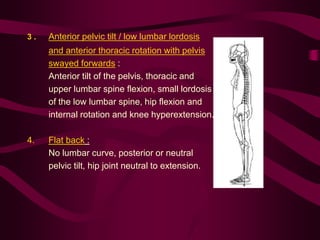
3 . Anterior pelvic tilt / low lumbar lordosis
and anterior thoracic rotation with pelvis
swayed forwards :
Anterior tilt of the pelvis, thoracic and
upper lumbar spine flexion, small lordosis
of the low lumbar spine, hip flexion and
internal rotation and knee hyperextension.
4. Flat back :
No lumbar curve, posterior or neutral
pelvic tilt, hip joint neutral to extension.
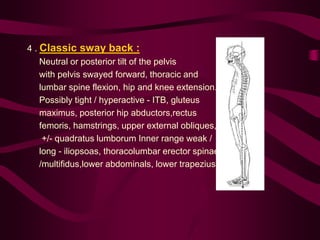
4 . Classic sway back :
Neutral or posterior tilt of the pelvis
with pelvis swayed forward, thoracic and
lumbar spine flexion, hip and knee extension.
Possibly tight / hyperactive - ITB, gluteus
maximus, posterior hip abductors,rectus
femoris, hamstrings, upper external obliques,
+/- quadratus lumborum Inner range weak /
long - iliopsoas, thoracolumbar erector spinae
/multifidus,lower abdominals, lower trapezius.
6. Kyphosis
Rigid long thoracic kyphosis, slight lower or no
lumbar lordosis, no or slight anterior pelvic tilt,
anteriorly rotated thoracic cage. Possibly tight /
hyperactive - anterior external obliques, rectus
abdominis,tight pectoral group and internal rotators of
the GHJ.
Inner range weak / long - Lateral external obliques,
thoracolumbar erector spinae, lower trapezius.
7. Scoliosis
Variable presentation. Trendelenberg or lateral trunk
shift pattern.
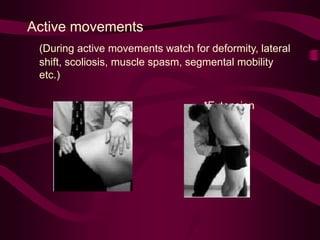
Active movements
(During active movements watch for deformity, lateral
shift, scoliosis, muscle spasm, segmental mobility
etc.)
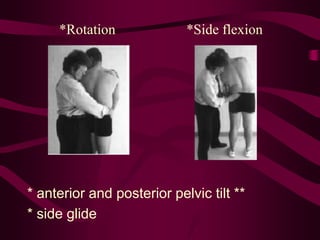
* flexion *Extension
*Rotation *Side flexion
* anterior and posterior pelvic tilt **
* side glide
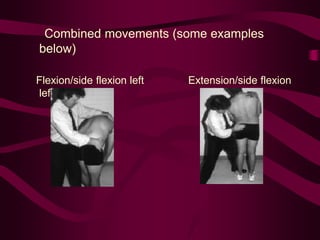
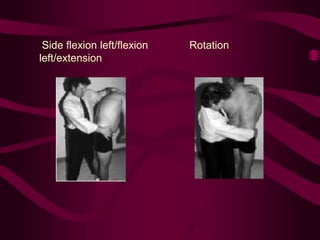
Combined movements (some examples
below)
Flexion/side flexion left Extension/side flexion
left
Side flexion left/flexion Rotation
left/extension
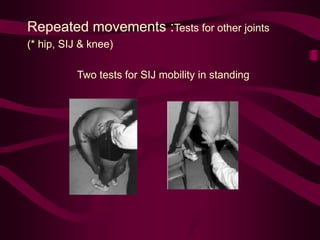
Repeated movements :Tests for other joints
(* hip, SIJ & knee)
Two tests for SIJ mobility in standing
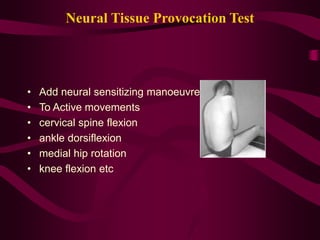
Neural Tissue Provocation Test
• Add neural sensitizing manoeuvres
• To Active movements
• cervical spine flexion
• ankle dorsiflexion
• medial hip rotation
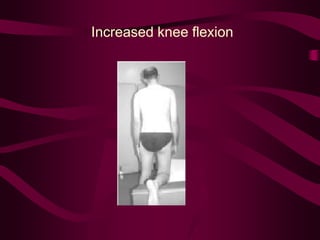
• knee flexion etc
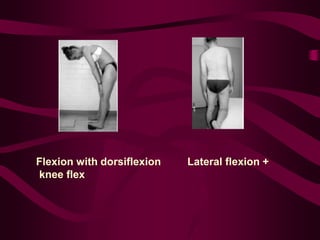
Flexion with dorsiflexion Lateral flexion +
knee flex
Increased knee flexion
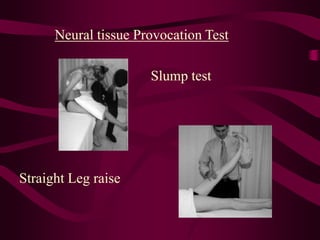
Neural tissue Provocation Test
Slump test
Straight Leg raise
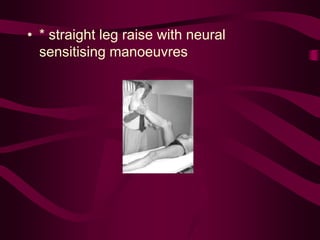
• * straight leg raise with neural
sensitising manoeuvres
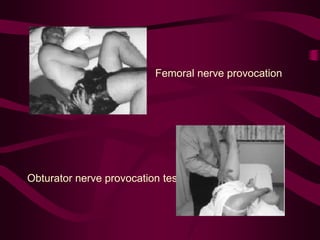
Femoral nerve provocation
test
Obturator nerve provocation test
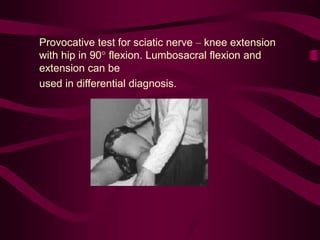
Provocative test for sciatic nerve – knee extension
with hip in 90° flexion. Lumbosacral flexion and
extension can be
used in differential diagnosis.
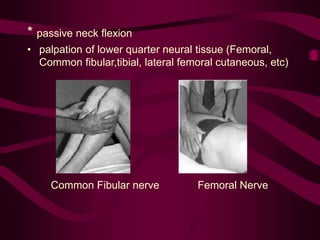
* passive neck flexion
• palpation of lower quarter neural tissue (Femoral,
Common fibular,tibial, lateral femoral cutaneous, etc)
Common Fibular nerve Femoral Nerve
Muscle function :
* muscle length
* muscle strength
* dynamic control
Neurological examination :
* muscle power
* reflexes
* sensation
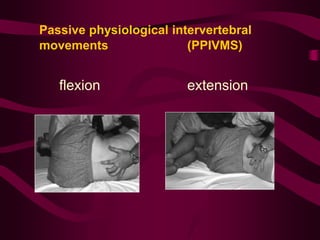
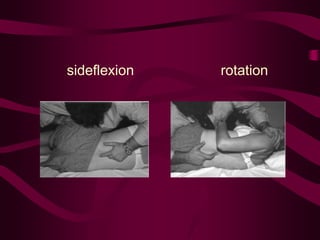
Passive physiological intervertebral
movements (PPIVMS)
flexion extension
sideflexion rotation
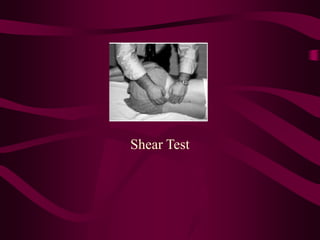
Shear Test
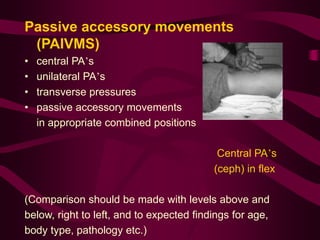
Passive accessory movements
(PAIVMS)
• central PA’s
• unilateral PA’s
• transverse pressures
• passive accessory movements
in appropriate combined positions
Central PA’s
(ceph) in flex
(Comparison should be made with levels above and
below, right to left, and to expected findings for age,
body type, pathology etc.)
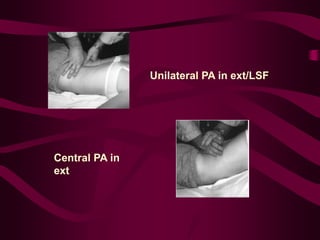
Unilateral PA in ext/LSF
Central PA in
ext
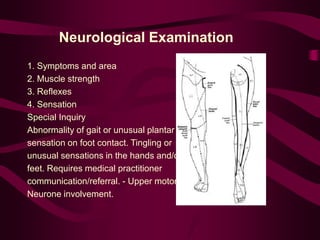
Neurological Examination
1. Symptoms and area
2. Muscle strength
3. Reflexes
4. Sensation
Special Inquiry
Abnormality of gait or unusual plantar
sensation on foot contact. Tingling or
unusual sensations in the hands and/or
feet. Requires medical practitioner
communication/referral. - Upper motor
Neurone involvement.
1. Symptoms
• Observation and interpretation.
• Type of symptoms. eg. Pain, ache, burning,
tingling,pins and needles, numbness etc.
• Area refers to dermatome, myotome,
sclerotome, or peripheral sensory nerve.
2. Muscle strength
Specific muscle testing related to spinal level of
innervation. Examine tone and strength to maximal
contraction but with due regard to pain.
• L2 Hip flexion - Psoas
• L3 and 4 Knee extension - Quadriceps
• L4 Ankle dorsiflexion/inversion - Tibialis anterior
• L5 Great toe extension - Extensor hallucis longus
• S1 Ankle plantarflexion - Gastrocnemius/Soleus
• S2 Toe flexion - Flexor digitorum longus
3. Reflexes :
• L1 Cremasteric - stimulate skin medial side of the
thigh
• L2 Deep tendon reflex - Adductor magnus.
• L3 Deep tendon reflex - Quadriceps
• L4 Deep tendon reflex - Gluteus minimus
• L5 Deep tendon reflex -
Semimembranosus/tendinosis
• S1 Deep tendon reflex - Gastrocnemius
• S2 Plantar skin stimulation reflex - toe flexors
Upper Motor Neurone Reflexes
• Babinski - Stroke lateral border from calcaneum to
head 5th metatarsal to head 1st metatarsal.Upward
going great toe and splaying of the toes - positive
(abnormal) Downward going great toe normal.
• Clonus - Quick/jerky dorsiflexion of the foot.
Repetitive tremor positive.
4. Sensation
• Light touch - use tissue paper or cotton wool for
subjective interpretation of sensory feeling.Touch
lightly around the circumference of the limb.
• Pain - Pin wheel/pin prick. Subjective interpretation of
sharpness.
• Areas of altered sensation may be interpreted as
dermatomal or peripheral sensory nerve related.
Vascular Changes
• Routine observation during neurological examination.
1. Colouration - white/blanched - arterial-
cyanosed/bluish - venous
2. Engorgement of limb superficial veins - venous
3. Slow response to nail pressure - arterial
• Assess arterial pulses - dorsalis pedis and posterior
tibial.
• All may require immediate medical referral or
communication.
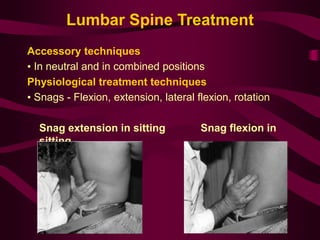
Lumbar Spine Treatment
Accessory techniques
• In neutral and in combined positions
Physiological treatment techniques
• Snags - Flexion, extension, lateral flexion, rotation
Snag extension in sitting Snag flexion in
sitting
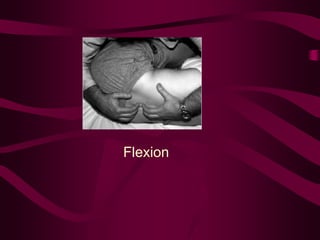
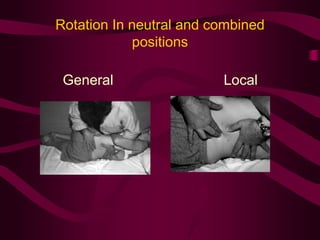
Flexion
Rotation In neutral and combined
positions
General Local
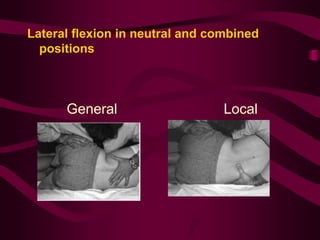
Lateral flexion in neutral and combined
positions
General Local
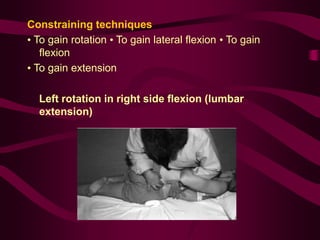
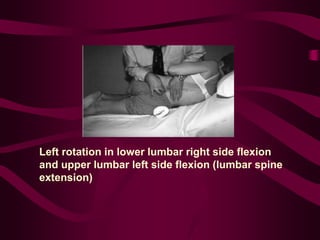
Constraining techniques
• To gain rotation • To gain lateral flexion • To gain
flexion
• To gain extension
Left rotation in right side flexion (lumbar
extension)
Left rotation in lower lumbar right side flexion
and upper lumbar left side flexion (lumbar spine
extension)
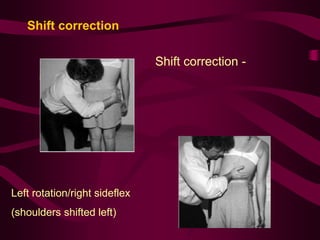
Shift correction
Shift correction -
standing
Left rotation/right sideflex
(shoulders shifted left)
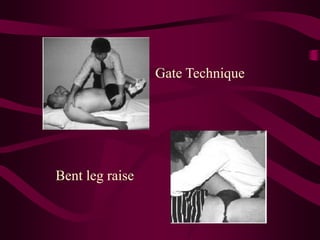
Gate Technique
Bent leg raise
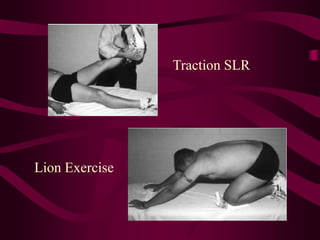
Traction SLR
Lion Exercise
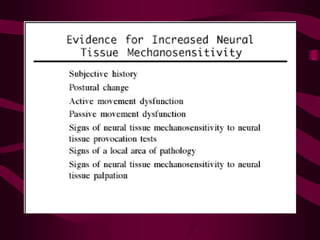
Signs of Increased Neural
Tissue Mechanosensitivity
Upper Quarter Functional
& Muscle Tests
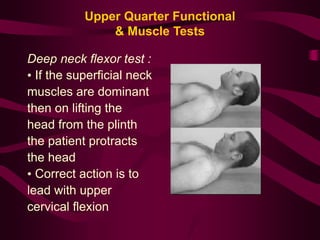
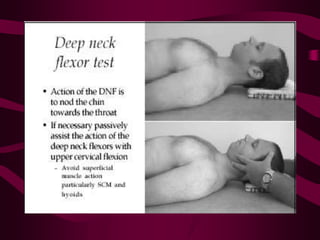
Deep neck flexor test :
• If the superficial neck
muscles are dominant
then on lifting the
head from the plinth
the patient protracts
the head
• Correct action is to
lead with upper
cervical flexion
Manual therapy.pps
Manual therapy.pps
Manual therapy.pps
Manual therapy.pps
Manual therapy.pps

Manual therapy.pps

  • 1.
    DR. NIRAJ KUMAR, PT BPT, MPT MHA & Ph. D (PHYSIOTHERAPY) ORTHOPEDICS*. HOD/ASSOCIATE PROFESSOR PHYSIOTHERAPY DEPT. Shri Guru Rai Institute Of Paramedical Sciences MANUAL THERAPY
  • 2.
    Introduction to ManualTherapy • There are evidence in History of treatment by Passive stretching techniques. • Over past 30-40 years many therapists have worked to identify and learn the techniques which are are more suitable and effective for the patient’s problem. • Joint mobilisations and manipulations techniques are used to safely stretch or snap structures to restore normal joint mechanics with less trauma.
  • 3.
    • To effectivelyuse joint mobilization for therapeutic purpose ,the practitioner must know and be able to evaluate the – Anatomy of bone and joint – Arthrokinematics – Pathology of the neuromusculoskeletal system.
  • 4.
    Manual Therapy :Study of different concepts : • Cyriax • Meckenzie • Mulligan • Maitland
  • 5.
    Orthopaedic Medicine (CYRIAX) • OrthopaedicMedicine was founded upon the structural (anatomic or morphological) disturbances of the neuromusculoskeletal system as defined by James Cyriax. • Orthopaedic Medicine may be seen as the natural consequence of the application of the disease-illness model to orthopaedic derangements that come under the province of the physician.
  • 6.
    • Cyriax (1969)envisaged derangements of the intervertebral disc as the primary spinal pathology to account for the vast majority of "simple" back pain and nerve root pain. • He described the capsular and non-capsular patterns of articular disturbances at peripheral joints, and devised selective tissue tension tests to differentiate between articular, ligamentous, contractile and neural lesions.
  • 7.
    • Orthopaedic Medicinebecame recognized as the application of a unique systematized clinical evaluation (including inspection, active movements, passive movements, resisted muscle contraction, and palpation) to the soft tissues of the locomotor system. • Predicated primarily on pathomorphology (such as degenerative, histopathologic, inflammatory, neoplastic or infective lesions) with a relatively simple view of loss of function (pain, weakness, loss of movement), terminology accorded to the disease-illness model of scientific modernism & Specific diagnoses such as tendinitis, bursitis, ligament sprains and peripheral nerve entrapment replaced fibrositis and associated syndromes. • According to Cyriax, the principal challenges to osteopathy were the basic morphological concepts of annular disc tear, nuclear disc prolapse and dural tension as the pathologies underlying the vast majority of spinal derangements.
  • 8.
    MULLIGAN CONCEPT • ThisConcept was introduced by Brian R Mulligan. • Brian R Mulligan qualified as a registered Physiotherapist in 1954 and gained his diploma of Manipulative Therapy in 1974. • He has been teaching Manual Therapy internationally since 1972 and his course have always proved popular.
  • 9.
    Maitland’s Concept • Thisconcept was introduced by G.D.Maitland. • According to G.D.Maitland the central theme of the concept is a positive personal commitment to understand what pateint is enduring, Listening and believing the patient in order to encourage the feeling of confidence and trust.
  • 10.
    • Other aspectsof maitland’s concepts are : – Clinician’s particular mode of thinking, interpreting , planning and acting which is used to reach the conclusions related to diagnosis, management of treatment and prognosis of patient’s disorder. – Use of appropriate and understandable words and phrases. – Three most Important aspects of this concept is : • Examination • Techniques • Assessment • It is open mindedness , Mental agility and mental discipline linked with logical and methodical process of assessing cause and effect which are the demand of the Concept
  • 11.
    Mckenzie Method • Thismethod was introduced by Robin Mckenzie. • In 1956 he observed by chance a remarkable event w ich has changed worldwide ,the nature of treatment administered for the alleviation of back pain. • For more than 40 years Robin Mckenzie has beenrefining an perfecting the procedures which have made the Mckenzie self treatmnt system unique.
  • 12.
    • According toMr.Robin Mckenzie : The disabling and recurrent disorders that affect the spin can produc disability and mental anguish in all who experience the problem. It is estimated that over 80% of the world’s population will at same stage of thir lives develop at least one episode of severe back pain necessitating bed rest. • According to him the only possible chance of influencing the course of the disorder is to teach each and every patient as much as is possible about his own particular disorder.
  • 13.
    Mobilisations : • Apassive movement performed by the therapist slow enough that patient can stop it. • The technique may be applied with an oscillatory motion or a sustained stretch intended to decrease pain or increase mobility. • Technique may use Physiologic movement or accessory movement.
  • 14.
    Physiologic Movement : •These movements can be voluntarily performed by the patient. • Osteokinematics : Physiologic movement of the bones. Accessory Movement : • These are small repetitive rhythmical oscillatory localized accessory or functional movements. • Can only be performed by therapist , always accompany the physiologic movement and cannot be isolated volntarily by patient. • Arthrokinematics : accessory movment of the bone surfaces within the joint e.g. – glidding, rolling etc
  • 15.
    Manipulations: • These arelocalised quick decesive movements of small amplitude and high velocity completed before patient can stop it. • It can be High Velocity Thrust or Manipulation under anesthesia.
  • 16.
    Effects of jointMobilisation • Stimulates biologic activity by moving synovial fluid, which brings nutrients to the avascular cartilage and intra-articular fibrocartilage of meniscii. • Maintains extensibility an tensile strength of articular and peri-articular tissues. • Provide awareness of position and motion through afferent nerve impulses. (Propioceptive feedback).
  • 17.
    • Joint motionprovide sensory input relative to : – Static position and sense speed of movement (Type I receptors of joint capsule). – Change of Speed of movement (type II receptors of joint capsule and articular fat pad) – Sense of direction of movement (Type I, II & III receptors) – Regulation of muscle tone (Type I, II & III receptors) – Nonciceptive receptors (type IV receptors of joint capsule, lagaments, fat pads, periosteum, walls of blood vessels).
  • 18.
  • 19.
    Indication for manipulativephysiotherapy as a treatment of choice in neuromusculoskeletal conditions is governed by: • History including medical history and medications • Subjective examination • Assessment and evaluation of the examination • Radiological investigations • Laboratory investigations • Practitioner opinion • Medical opinion • Patient opinion • Overall assessment In general terms manipulative physiotherapy is indicated when a condition appears to be of a mechanical nature. That is the symptoms are aggravated by activity or sustained posture and relieved by rest or easing postures or
  • 20.
    Indications • When aneuromusculoskeletal condition behaves in a mechanical way with respect to both signs and symptoms. • Muscle guarding • Muscle Spasm • Reversible joint hypomobility • Progressive limitations • Functional limitations
  • 21.
    Limitations • Cannot changethe disease process of disorders. • Skill of the therapist .
  • 22.
    Contraindications There are manyinstances when all techniques of manipulative physiotherapy are contraindicated and many instances when precaution is indicated. • Hypermobility • Joint Effusion • Inflammation
  • 23.
    Procedures for ApplyingJoint Mobilisation Techniques • Proper Evaluation and assessment of the joint to be mobilised. • Accuracy of Diagnosis / Correct Diagnosis. • Proper and comfortable positioning of the patient and joint to be mobilised. • Proper Stabilisation. • Efficient treatment force. • Proper Selection of methods and grades.
  • 24.
    Grades of Mobilisation Twosystems of grading dosages of mobilization are used : • Graded oscillation techniques • Sustained translatory joint play techniques.
  • 25.
    Graded oscillatory Techniques GradeI : Small amplitude rhythmic oscillations are performed at beginning of the range. Grade II : Large Amplitude rhythmic oscillations are performed within the range, not reaching the limit. Grade II : large amplitude rhythmic oscillations are performed up to the limit of the available motion and are stressed into the tissue resistance. Grade IV : Small amplitude rhythmic oscillations are performed at up to the limit of the available motion and are stressed into the tissue resistance. Grade V : Small amplitude, high velocity thrust technique is performed to snap adhesions at the limit of the available range.
  • 26.
    Uses : • GradeI & II : Pain • Grade III & IV : Stretching maneuvers
  • 27.
    Sustained Translatory JointPlay techniques Grade I : Small amplitude distraction is applied where no stress is placed on the capsule. Grade II : Enough distraction or glide is applied to tighten the tissues around the joint. Grade III : A distraction or Glides is applied with an amplitude large enough to place a stretch on capsule and on surrounding periarticular structures.
  • 28.
    Uses : • GradeI : pain relif • Grade II : Initial treatment to determine the joint sensitivity and maintain joint range of motion. • Grade III : Stretch the joint and thus increase the range.
  • 29.
  • 30.
    Shoulder Joint Physical examination 1.STANDING : Observation - posture • From in front : Symmetry, muscle tone and bulk • From behind : Spinal curves, muscle tone and bulk postvertebral, trapezius, supraspinatus, infraspinatus, levator scapulae, rhomboids, deltoid etc), shoulder girdle and limb position • From side : Relative position of the head to the neck, cervical lordosis, cervico-thoracic angle, thoracic spine posture (kyphosis etc), scapulae position, relative position of humerus to scapula.
  • 31.
    Active movements Observation forrange of movement as well as quality and control of scapula and cervical spine movement etc. • flexion / extension • abduction • lateral rotation • hand behind back • horizontal flexion & horizontal extension Differentiation tests : Screening tests for neural tissue Static muscle tests • for pain and weakness - abduction, lateral rotation, medial rotation, elbow flexion
  • 32.
    Special Test forGH Joint Apprehension test Sulcus test Posterior Drawer Inferior glide in sitting
  • 33.
    • Impingement Test: 1. Allingham’s Dynamic Impingement test 2. Neere & Walsh 3. Hawkins & Kennedy • Other Tests : 1. Empty Cane or Supraspinatus test
  • 34.
    • Stability testfor Glenohumeral Joint : 1. Inferior Capsule 2. Clunke Test 3. Test for Posterior Capsule
  • 35.
    2. SITTING Palpation • temperaturechanges • swelling • rotator cuff tendons Scapulo- thoracic movement • elevation / depression • retraction / protraction Tests for other joints • cervical spine
  • 36.
    3.SUPINE Palpation • muscles • tendons •Coracoacromial ligament, capsule of glenohumeral joint • joint margins • Subacromial space Passive physiological movements • flexion • abduction • medial rotation/lateral rotation • horizontal flexion/extension • quadrant
  • 37.
    Passive accessory movements Glenohumeraljoint : - In neutral • PA / AP • longitudinal caudad • lateral distraction - In 90 degrees abduction • PA / AP • longitudinal caudad - In flexion • PA • longitudinal caudad • lateral distraction
  • 38.
    Acromioclavicular joint : •PA / AP • Traction Sternoclavicular joint : • AP • Traction
  • 39.
    4. SIDE LYING Passivephysiological movements Scapulothoracic joint : • elevation • depression • protraction • retraction Passive accessory movements Scapulothoracic joint : • distraction
  • 40.
  • 41.
    Repeated flexion withbelt and weight in hand Elevation - end range restriction - also with a belt
  • 42.
    Internal/external rotation Hand behindback - minor limitation Acromioclavicular Joint
  • 43.
    Gross limitation ofshoulder movement - distraction with a belt Accessory mobilisation techniques • AP, PA, distraction with the arm by the side or in direction of restriction
  • 44.
    Elbow Joint Examination Standing: Inspection : • Anterior aspect • Posterior aspect • Carrying angle Active movements : • Flexion • Extension Range of motion : • Flexion • Extension
  • 45.
    2. SITTING Palpation : •temperature changes • swelling • rotator cuff tendons Muscle Testing : • Flexors • Extensors
  • 46.
    Special Test : •Valgus Stress test • Varus Stress Test • Pivot Shift Test / posterolateral rotatory instability test Passive accessory movements : • Dorsal / volar glide • Joint compression • Joint distraction
  • 47.
  • 48.
    Hip Joint Examination 1.STANDING Observation • From in front : ASIS, lumbar spine, rotation of femur, knee varus/valgus, muscle bulk anterior thigh, Q angle, level of patellae, foot position (pro/sup). • From behind : Lumbar spine position, PSIS, Iliac crest height, gluteal bulk, leg length (symmetry of folds), tibia varum/valgum, excessive pronation. • From side : Pelvic /lumbar spine relationship (anterior / posterior sway/hyperlordosis), pelvic tilt and rotation, knee hyperextension or flexion.
  • 49.
    Functional tests : •gait • walking backward, sideways • hip flexion in standing • crossing legs in sitting • sit to stand • squat - may add overpressure • one leg squat - look for rotation or drop of pelvis • one leg stance - look for pelvic drop • single leg rotation - differentiation test • functional complaint Tests for other joints : • lumbar spine active and combined movements • SI Joint
  • 50.
    2. SITTING Neural TissueProvocation Tests • slump 3. SUPINE LYING Observation : • lower limb rotation • swelling Palpation : • temperature changes • swelling and thickening • anterior tenderness
  • 51.
    Active Movements • flexion •abduction • adduction • lateral rotation in neutral • medial rotation in neutral • lateral rotation in 90˚ flexion • medial rotation in 90˚ flexion • flexion/abduction/external rotation (FABER)
  • 52.
    Passive movements • flexion •abduction/adduction - neutral and 90˚ flexion • lateral rotation/ medial rotation - neutral and 90˚ flexion Combined Movements • flexion/adduction (90 - 140˚ flexion) • faber
  • 53.
    Resisted or staticmuscle tests • flexion • abduction/adduction • lateral rotation/medial rotation in 90˚ hip flexion Tests for other joints • eg sacroiliac joints Passive Accessory Movements • longitudinal distraction - 0 and 90˚ flexion • lateral distraction in 90˚ flexion or any combined position Muscle function • muscle length (Thomas test)
  • 54.
    SIDE LYING Neural TissueProvocation Tests : • femoral nerve PRONE LYING Active Movements : • Extension • Medial rotation/lateral rotation Passive Movements : • Extension • Medial rotation/lateral rotation Tests for other regions and structures : • Lumbar spine palpation • Sacroiliac joints palpation
  • 55.
    Hip Treatment Techniques HipMWM - Flexion Hip MWM - Extension
  • 56.
    Hip MWM -external rotation in 90˚ flexion Hip MWM - internal rotation in 90˚ flexion
  • 57.
    Hip MWM -external rotation in standing Hip MWM - Internal rotation in standing
  • 58.
    Hip MWM -Faber Hip MWM - Flexion/adduction
  • 59.
    Hip PRP -Flexion/adduction Accessory mobilisation techniques . Lateral distraction with a belt . Traction with a belt in pain easing
  • 60.
    Knee Joint Examination 1.STANDING Observation • From in front : rotation of femur, muscle bulk anterior thigh, Q angle, swelling,level and position of patellae, ankle and knee varus/valgus, foot position (pro/sup). • From behind : Symmetry of folds and creases, gluteal bulk, rotation of tibia in relation to femur, tibia varum/valgum, bakers cysts, excessive pronation. • From side : Pelvic tilt and rotation, knee hyperextension or flexion, muscle tone and bulk, ITB.
  • 61.
    Functional Tests : •gait • walking backward • stairs • squat - may add overpressure • Knee extension • one leg squat • one leg stance - look for pelvic drop • running • functional complaint Tests for other joints : • lumbar spine • Hip
  • 62.
    2. SITTING Neural TissueProvocation Tests • slump Muscle Function • muscle length • muscle strength Active Movements • active knee extension Resisted Movements • Isometric or through range quadriceps or hamstring contraction - If pain of patellofemoral origin is suspected, isometric knee extension may be performed in 30 & 60 degrees knee extension as appropriate. If pain is reproduced, the patella should be held or taped in a medial position possibly with some rotation to determine whether or not symptoms can be relieved by alteration in patella alignment.
  • 63.
    3. SUPINE LYING Observation •lower limb rotation and swelling Palpation • temperature changes • swelling and thickening • effusion tests - Milking, tap, and ballotable • tenderness Active Movements • flexion • extension Passive Movements • flexion • extension (overpressure applied to femur, joint line and tibia) • Internal rotation/external rotation
  • 64.
    Combined Movements : •flexion/adduction • flexion/abduction • extension/adduction • extension/abduction Passive Accessory Movements : Tibiofemoral joint - (in varying degree of flexion/extension) • PA tibia • AP tibia • Medial glide/lateral glide Patellofemoral joint - • medial glide/lateral glide • longitudinal cephalad Superior tibiofibular joint -
  • 65.
    Muscle Function : •muscle length (eg Thomas test) • muscle strength (eg VMO) Palpation : • ligaments/retinaculum/Menisci SIDE LYING : Neural Tissue Provocation Tests • femoral nerve
  • 66.
    KNEE ORTHOPAEDIC TESTS HISTORY- Very important Trauma Mechanism of injury essential eg: Hit on the outer side of the knee. Turning with the foot fixed (cutting to/away) Feeling of tearing/popping and or giving way. Jumping from a height and twisting the knee. Over straightening the knee. Landing on another players foot. Falling backwards Sudden stopping/ violent contraction of the quads Swelling - Haemarthrosis indicative Subsequent symptoms of knee ligament damage No confidence in the knee feels unstable Difficulty with stairs Difficulty walking along a slope
  • 67.
    Meniscus Medial • History: Ifchronic history then repeated episodes with minor cause. Injured with valgus- flexion & ext rot or hyperflexion. Posterior horn or bucket handle tear. During flexion the medial meniscus is drawn posteriorly by the semimembranosus, during extension the menisco - patellar fibres together with the tibial plateau draws the anterior horn of the medial meniscus anteriorly. • Valgus draws the medial meniscus laterally and ext rot draws the posterior horn posteriorly and compresses the tibiofemoral joint. • The medial meniscus is drawn under the convex femoral condyle. • Anterior horn may also be injured with violent extension eg kicking • Posterior horn tear or transverse tear is much more common than an anterior horn tear. Lateral • Injured by varus- flexion and internal rotation or hyper flexion. Longitudinal tear. • Compression of the lateral compartment with rotation whilst flexed - horizontal tear. • Lateral glide while the knee is in extension - horizontal tear. • Forced rotation - oblique tear (combined horizontal +
  • 68.
    Diagnosis From the historyand the physical examination findings : - Joint line tenderness is very diagnostic. Tenderness follows the meniscal movement of the tibia. - Mild effusion - not haemarthrosis (unless peripheral tear) - McMurrays - Most accurate for posterior horn tears. 20% false negative, 33% false positive (plica) Medial - Start in flexion, ext rot, valgus to replicate the mechanism of injury. Extend the knee (ext rot compresses the tib/fem joint) Feel for a click and pain at the joint line. Lateral - Start in flexion, internal rot and varus to replicate the mechanism of injury. - Extend the knee. Feel for a click and pain at the joint line. - Duncans Anterior horn test describes a C shape for medial or lateral meniscus, less common than the posterior horn or transverse tear. - Apleys Not very accurate. ? differentiate between the menisci and
  • 69.
    ANTERIOR & POSTERIORCRUCIATE LIGAMENTS • Important stabilisers of internal rotation of the knee. Functional stability of the knee depends on the intact structures of the ACL>PCL. • Different types of tear. • Mechanism of injury: ACL - mostly without impact. 1. Flex to Ext with varus and int rot. ("cutting to support leg") 2. Flex to Ext with valgus and ext rot. ("cutting away from support leg") Also injures MCL, med meniscus. 3. Hyperextension. (ACL + PCL) • History - sudden pain or give way. May pseudo-lock. Immediate effusion. Haemarthrosis (very diagnostic – 75-80% chance). Postero lateral pain with diffuse joint line tenderness. Diffuse ache whole knee. Differential diagnosis for osteochondral # - slower bleeds
  • 70.
    ACL : Lachmans 15-30 degrees flex. End feel very important. - Hyper extension (recurvatum test) - No touch test, 30 degrees flex. Anterior translation with quads contraction. - Anterior draw - tends to test different fibres of ACL Beware false negatives - Pivot shift. (Lemaire test). The pivot shift tests look for reduction of the lateral tibial condyle onto the lateral femoral condyle as move through flexion (flex - ext or ext - flex). Assumes normal anatomical position through congruence of joint surfaces and ITB change from flex to ext. Anterolateral rotatory
  • 71.
    PCL • Tighter withinternal rotation. Resists the anterior glide of the femur during weight bearing. Works with the ACL to resist hyperextension. • Mechanism of injury – Direct blow to anterior tibia on flexed knee eg falling on the ground - MVA dashboard • History very important. • Presentation - often no effusion, may have posterior capsule tear at the same time. May mimic calf tear. recurvatum. • Posterior sag of the tibial condyle. • Posterior draw +ve. • Test - 90/90 test with quads contraction. - Posterior draw test - beware false negative
  • 72.
    COLLATERAL LIGAMENTS • Directtrauma. MEDIAL COLLATERAL • Mechanism of injury : Moderate valgus strain or external rotation force. • Test - Valgus strain in ext and 30 degrees flex - laxity in full extension indicates more serious trauma eg ACL LATERAL COLLATERAL • Mechanism of injury : Moderate varus strain. • Test - Varus strain in ext and 30 degrees flex.
  • 73.
    Knee Treatment Knee flexion- lateral glide assessment Knee extension - lateral glide assessment
  • 74.
    Knee flexion -medial glide with belt Knee flexion - lateral glide with belt
  • 75.
    Knee extension -lateral glide with belt Knee extension - medial glide with belt
  • 76.
    Knee flexion -AP with belt Knee extension -rotation MWM
  • 77.
    Knee flexion -rotation MWM Patellofemoral taping
  • 78.
  • 79.
  • 80.
    Epidemiology of LBP •Life time prevalence of 60-80% are widely reported 80-85% LBP is regarded as “non-specific” - ? method of classification • Episodes of LBP persisting for more than 2 weeks have a much lower life time prevalence of 14% • Pain of short duration is difficult to diagnose hence reports of high incidence of NSLBP. • In these cases a segmental diagnosis should be made on clinical grounds & further investigation may identify a specific treatable pain source.
  • 81.
    • “90% recoverwithin 2 months” - short term follow up (<6 months) of patients may give false interpretation - 12 months more revealing. • Up to 80% of patients remain disabled to some degree at 12 months - although perhaps only 10- 15% will be highly disabled. • The median time to recovery is about 7 weeks - relapses are common When patients do not return for treatment or follow up they have not necessarily recovered. In fact, it is likely that they have not recovered and simply don’t return.
  • 82.
    Classification of SpinalPain • Area of Pain • Patho-anatomical - Response to pain blockade • Movement dysfunction • Muscle dysfunction • Neural dysfunction • Joint
  • 83.
    Manipulative Therapy • Articular •Neural tissue • Muscle/fascia/soft tissue • Psychological/emotional • Assessment • – Determine dysfunction and relate to subjective • complaint • Diagnosis • Management
  • 84.
    The Subjective Examination Theaims of the subjective examination are: • To establish the type of problem or disorder in the patients terms. • To determine the type and stage of pathology and to determine the type of onset. • To determine the behaviour of the pain. • To determine the "irritability" of the condition. • To obtain a precise current and past history. • To help determine the individuals pain threshold. • To help determine if caution or modification of the physical examination is indicated.
  • 85.
    The Subjective Examination BodyChart & Related Information History 24 hour Behaviour Additional flag Information
  • 86.
    KIND OF DISORDER •The first question to ask the patient is to find out why the patient is requesting treatment or • why they have been referred to you. • "As far as you are concerned what is your main problem at this stage ?" • This question will usually elicit a description of pain or dysfunction. Other possibilities may • be "giving way", "instability", "loss of function", "post- trauma", "post-surgery", etc. • Once you have an understanding of why the patient has sought treatment you can go onto the • body chart section.
  • 88.
    BODY CHART • Area(s)of pain • Define precise area and boundaries of pain. "Show me where you feel the pain" "Does it extend above/below here ?" • Name the areas marked to allow easy reference later in the current history (eg PL may be pain the lumbar area, PS may be pain in the scapula area) • Ask specifically about other relevant areas that may be painful. Generally check joints above and below the painful region, and structures that are able to refer symptoms to the painful site. • Clear specific areas with closed questions. "Do you have pain in your ....?" etc • All areas of pain must be charted. Tick regions on the body chart which are pain free.
  • 89.
    Area(s) of paraesthesia •Paraesthesia is an indication of possible neurological involvement and as such must be regarded with caution. An area of paraesthesia or numbness may be related to the pain that a patient complains of or it may be an indicator of a separate medical problem. • Chart areas of paraesthesia on the body chart. "Do you have any pins and needles or other strange sensations ?" "Do you have any areas of numbness?"
  • 90.
    Constancy • Mechanical painmay be constant or intermittent. If mechanical pain is constant it may vary with movement and position, but will never completely disappear. If pain is intermittent there will be a movement or a position that will totally abolish it and activities and positions that will ease it. • If pain is defined as constant, then there is no time of day or night when it is not present.Constant pain may sometimes be present in the first 48 hours post trauma (produced by chemical irritation or mechanical deformation). Pain of chemical origin is usually constant and no mechanical procedure can significantly reduce it. Chemical pain following trauma reduces steadily as healing takes place. • If constant pain commences for no apparent reason, and is gradually insidiously worsening, particularly if the patient looks and/or feels unwell, then serious pathology should be suspected.
  • 91.
    Severity "How severe isthe pain in the .....?" • Different descriptors (such as mild, moderate, and severe) or verbal scales (1-10) may be used. A visual analogue scale (VAS), length 10cm, as shown below may be a useful measure of chronic pain. • No pain ________________________ Worst pain possible • If several pains are present and the patient is unable to describe the severity ask: "Which is your worst pain?"
  • 92.
    Nature "How would youdescribe your pain?" • Follow up with suggestions only if the patient has trouble describing the pain. "Is it aching, throbbing, sharp, shooting ..." etc • The nature of the patients pain may give some tentative clues to possible pathology.
  • 93.
    Depth of pain •Determine whether the pain is perceived as being deep inside or on the surface. "Is the pain deep inside or on the surface?" • Superficial pain is more likely to be from localised soft tissue. The more superficial a soft tissue structure lies, the more precise is its associated perceived pain. referred pain may be in a dermatomal, scleratomal or myotomal pattern. • Deep pain may be indicative of referred pain. This should be suspected if any deep pain extends over a large area with indefinite or vague boundaries. The deep structures of the body do not localise stimuli accurately.
  • 94.
    Relationships • This sectionis important if there are two or more symptomatic sites. Symptomatic areas may • or may not be related. • Pains may be regarded as related subjectively if, when questioned, the patient describes some sort of relationship between them. In other words, the patient perceives that a change in one pain is accompanied by a change in the other pain(s). • If pain is intermittent "Do all pains come on at the same time?" "Which pain comes first" • If pain is constant "If this pain gets worse, does that pain get worse?"
  • 97.
    CURRENT HISTORY "The painthat you have now, when did it start?" • This question relates to the present episode only. Duration of symptoms will give an indication of whether the condition is acute, sub-acute, or chronic, and may be a guide to the amount of vigour that can be used in the examination. • Some patients can relate a specific incident to how their pain started, but many cannot. If this is the case try to establish a predisposing factor. Often a patient is unaware of the significance of certain activities or positions that they may have performed or adopted in the days, weeks, or months prior to the onset of symptoms.
  • 98.
    It may bevery useful to find the predisposing factors: • As a clue to possible objective findings. • To establish the presence of a related underlying disease, illness or pathology. • So that for treatment, certain activities and positions can be modified or avoided. • To help in determining methods to prevent a recurrence. The location and severity of the pain can change rapidly from the time of onset. As a condition becomes worse, pain may become more severe and spread. The spread of pain may be due to involvement of more tissues, or the spread of pain may be because of changes to the central nervous
  • 99.
    • "Did itstart suddenly?" "Or come on gradually?" • If an injury "What happened?" If spontaneous "What did you notice first" • Note the mechanism of injury in detail "Was there an injury prior to this?" • "Can you think of anything that may have started it? (virus, stress, unaccustomed activities or posture)?" • "Where was the pain initially?" • "How severe was the pain when it first started?" • "How severe was the pain when it first started?" • "How has it changed since then?" • "Have you had any treatment since this happened/started?" • "What effect did it have?"
  • 100.
    Current status • "Overthe past few days how has the pain altered?" (Better, same or worse)This question obviously indicates the course of the condition. A gradually worsening condition will be harder to treat than a condition improving on its own. • After taking the current history and establishing the behaviour of pain over the preceding days, relate all information pertaining to the severity of symptoms to the injury sustained or the mode of onset • Serious pathology may be suspected if: - Severe symptoms were caused by minor strain. - Pain commenced for no apparent reason and has been gradually insidiously worsening.
  • 101.
    PAST HISTORY This sectionshould also provide information on the severity and behaviour of previous symptoms and the effect of various treatments in the past. This may help in the planning of treatment.If a previous treatment method, modality or technique has been successful for the same condition and presentation, then the same approach may assist in the selection of treatment. It is possible that the symptoms resulting from the current episode may overlay symptoms from a previous injury, confusing the presentation. Information on successive recurrences may indicate whether a condition is becoming progressively more serious, and is occurring more easily. If this is the case, regarding treatment, a great deal of emphasis
  • 102.
    "Have you hadthis pain before?" • If the response was "yes" follow up with : "When was the first time?" • Then ask specifically about area, cause duration, severity and treatment. • Successive recurrences "Is it occurring more frequently?" "Does it come on more easily?" • Ask about recovery rate and treatment. • Check for significant history of problems with joints and areas that may be related to the site of pain.
  • 106.
    Other Precautionary Questions: • Sustained positions : stading, sitting & lying • General Health • Spinal imaging • Cough / sneeze • Weight loss • Steroids • Any other medication
  • 107.
    * Red &* Yellow Flags • Red flags – Valuable information can be obtained from all parts of the subjective not just “special questions” – Some conditions pose an immediate threat to the patients health eg tumours and infections – Some conditions may pose a threat to the integrity of the patients spine and CNS eg fractures
  • 108.
    * Yellow Flags •Use to describe psychosocial risk factors - Research has shown that predictors of poor outcome are factors such as patient’s beliefs and their cognitive appraisal for their low back pain - fear of pain, passive coping strategies are both associated with poor outcome - Eg alerted by excessive/exaggerated pain descriptors • Failure of recognition can lead to treatment failure attributed incorrectly to patient malingering or poor physiotherapist skill in performing treatment
  • 114.
  • 115.
    Combined Movements • Developedby Brian Edwards • Based on normal function • Biomechanical model of movement • Broad range of application for patients with spinal pain • Promotes an understanding of the patients condition • Enhances clinical reasoning • Job satisfaction and effective patient management
  • 116.
    Biomechanics • Coupled movement: An involuntary movement that occurs at the motion segment during physiological motion • Combined movements : Movements imposed on the spine as directed and controlled by the therapist *Coupled Movement : Lumbar Spine • Somewhat controversial but consensus is: • In extension - sideflexion and rotation occur in opposite directions • In flexion - sideflexion and rotation occur in the • same direction
  • 117.
    Biomechanics - Flexion •Anterior sagittal rotation and forward translation • Facet joint - Cephalad movement of the inferior articular process on the superior articular process of the level below. • Disc - Compression anteriorly and stretch posteriorly. • Posterior soft tissues (canal structures, ligaments, muscles, capsules etc) - stretched. • Intervertebral foramen - Increased volume
  • 118.
    Biomechanics - Extension •Posterior sagittal rotation and posterior translation • Facet joint - Caudad movement of the inferior articular process on the superior articular process • Disc - Stretch anteriorly and compression posteriorly • Posterior soft tissues (canal structures, ligaments, etc) - relaxation • Intervertebral forarmen - Reduced volume
  • 119.
    Biomechanics - Sideflexion •Facet joint - Caudad movement of the inferior articular process on the concave side, opposite for the convex side • Disc and other soft tissues - Stretch convex side, and compression concave side • Intervertebral forarmen - Reduced volume on concave side and increased on the convexity
  • 120.
    Biomechanics - Rotation •Facet joints - Slide and glide relative to one another • Disc - torsion and relaxation of successive layers of the annular fibres. Not specific to a side • Soft tissues - effect not Specific • Intervertebral foramen - questionable, some say increases on the side rotation is directed to
  • 121.
  • 122.
    Patterns Regular compression forstructures posterior on the right
  • 123.
    Patterns Regular stretch forstructures anterior on the left
  • 124.
    Patterns Regular stretch forstructures posterior on the right
  • 125.
    Patterns Regular compression forstructures anterior on the left
  • 126.
    SIN • Severity ofthe pain - Mild, moderate or severe • Irritability of the disorder - Non, moderate or high • Nature of the disorder
  • 127.
    Combined Movement Low SIN •Ext - 10° P2 PB • Flex - mid shin P2 (stretch posterior thigh) • SFR -10cm AKJL P2 PB • SFL - 1cm AKJL R2 High SIN - resting pain • Ext - 5° P2 PB • Flex - Ankles R2 (stretch posterior thigh) • SFR -1cm AKJL R2 • SFL - 10° P2
  • 128.
    Combined Movement • Mainproblem - PC and paraesthesia - Parae • Agg - walk, stand PC + PB Sit, bend over to shoes etc PB + • Relations - PB & PC & paraesthesia together, PL and PB together, PL separate to paraesthesia • Ext - 5° P2 PB + PC • Flex - 4cm AKJL P2 PB + PL • SFL -2cm AKJL R2P’ PC mild • SFR - 1cm AKJL R2P’ PB mild
  • 129.
    Combined Movement HIGH SIN •RESTING PAIN - PB • Ext - 10° P2 PB • Flex - mid shin R2 (stretch posterior thigh) • SFL -10cm AKJL P2 PB • SFR - 1cm AKJL R2P’PB
  • 130.
    Combined Movement Mod SIN •Main problem- PB • Relations - Can occur separately or together • Agg - in/out car, running, stand after sitting, PA • lifting, gardening , rowing PB • gardening PA + PB • Ext - 20° R2P’ PA • Flex - mid shin P2 PB • SFR -2cm AKJL R2 stiff on the left Lx • SFL - 1cm AKJL R2P’ PB
  • 131.
  • 132.
    Pain Nociceptive – that whicharises from chemically or mechanically induced impulses from non-neural structures • Local • Visceral referred • Somatic referred Neuropathic – That which arises from neural structures
  • 133.
  • 134.
    Cervical Spine PhysicalExamination STANDING : - Observation • From in front Symmetry, muscle tone and bulk (prevertebral muscles) Respiratory pattern • From behind Spinal curves, muscle tone and bulk (postvertebral, trapezius etc),shoulder girdle and limb position • From side Relative position of the head to the neck, cervical lordosis, cervicothoracic angle, thoracic spine posture (kyphosis etc), scapulae position.
  • 135.
    Active movements ofthe shoulder girdle • Abduction • Flexion • Hand behind back Differentiation tests • Neural tissue sensitising manoeuvres for median, radial or ulnar nerve as appropriate Muscle Function Muscle strength/recruitment/endurance tests • Tests for dynamic cervical stability
  • 136.
    SITTING : • Observation– posture - As standing • Active physiological movements - Flexion - Extension - Rotation to left - Rotation to right - Side flexion to left - Side flexion to right
  • 137.
    Differentiation Tests • Upper,mid and lower cervical overpressure Flexion
  • 138.
  • 139.
    Vertebral artery Tests CraniovertebralStress Tests • Transverse ligament • Alar ligaments • Tectorial membrane Combined Movements Repeated Movements Sustained Movements
  • 140.
    3. SUPINE LYING Observation •General posture/muscle tone/relative mobility Neurological Examination • Sensation • Muscle power/reflexes Craniovertebral Stress Tests • Transverse ligament • Tectorial membrane
  • 141.
    Muscle Function 1. Musclelength tests • Trapezius • Scaleni • Sternocleidomastoid • Levator Scapulae • Upper cervical extensors • Pectoralis minor 2. Muscle strength/recruitment/endurance tests • Deep neck flexors Neural Tissue Provocation Tests • Median, Radial, & Ulnar bias
  • 142.
  • 143.
  • 144.
    PRONE LYING Palpation : •Temperature changes, Sweating • Swelling and thickening/soft tissue changes • Bony alignment • Nerve trunk palpation Passive Accessory Movements (PAVMS) • Central PA’s • Unilateral PA’s • Transverse pressures • Combined positions
  • 145.
    Muscle Function • Musclestrength/recruitment/endurance tests • Lower and middle trapezius • Serratus anterior SIDE LYING Passive Physiological Intervertebral Movements (PPIVMS) • Flexion/Extension
  • 146.
    Physical Signs ofNeural Tissue Involvement 1. Antalgic posture 2. Active movement dysfunction 3. Passive movement dysfunction which correlates with the degree of active movement dysfunction. 4. Adverse responses to neural tissue provocation tests, which must relate specifically and anatomically to 2 and 3. 5. Mechanical allodynia in response to palpation of specific nerve trunks, which relate specifically and anatomically to 2 and 4. 6. Evidence from the physical examination of a local cause of the neurogenic pain, which would involve the neural tissue showing the responses in 4 and 5. 7. History consistent with the physical examination findings
  • 147.
    Upper quarter • Shoulderabduction or hand behind back with: • Contralateral cervical lateral flexion • Shoulder girdle depression Provocative to the brachial plexus • Shoulder abduction with: • Wrist extension • Internal rotation and wrist and finger flexion Provocative to the brachial plexus
  • 148.
    Upper cervical spineflexion with: • Bilateral shoulder abduction • Hip flexion and knee extension (long sitting) Provocative to the upper cervical neural tissue
  • 149.
    Passive movement dysfunction •It is obvious that both active and passive movement would have the same or similar mechanical stimulus effect on neural tissues. • The quadrant position of the shoulder is an important passive movement test of the shoulder joint. Shoulder quadrant • The addition of contralateral cervical flexion and elbow extension will have an increased provocative effect on the neurovascular bundle in the axilla and can be used to differentiate between a local shoulder dysfunction and neural tissue sensitization.
  • 150.
    Adverse responses toneural tissue provocation tests • Provocation tests are passive tests that are applied in a manner to selectively stress different neural tissues in order to assess their sensitivity to mechanical provocation. • Provocation tests can only be carried out within the available ranges of passive movement, which are governed by the severity of pain associated with the disorder being evaluated. • The following is a methodological approach to neural tissue provocation tests for the upper quarter. The suggested approach incorporates provocative manoeuvres directed to the median, radial and ulnar nerve trunks from a proximal to distal direction and vice versa. In all cases subject is supine
  • 151.
    Peripheral to Central ViaMedian Nerve 1. Shoulder abduction and external rotation in one movement 2. Elbow extension 3. Wrist / finger extension 4. Shoulder girdle depression 5. Cervical spine ipsilateral / contralateral lateral flexion
  • 152.
    Via Radial Nerve 1.Shoulder abduction and Internal rotation 2. Elbow extension 3. Wrist / finger flexion 4. Shoulder girdle depression 5. Cervical spine ipsilateral / contralateral lateral flexion
  • 153.
    Via Ulnar Nerve 1.Shoulder abduction and external rotation in one movement 2. Elbow flexion 3. Wrist / finger extension 4. Shoulder girdle depression 5. Cervical spine ipsilateral / contralateral lateral flexion
  • 154.
    Cervical lateral flexionis performed passively with the arm positioned in: Via Median Nerve 1. Shoulder abduction lateral 2. Elbow extension, slight wrist extension 3. Wrist / finger extension 4. Shoulder girdle depression
  • 155.
    Via Radial Nerve 1.Shoulder abduction and Internal rotation 2. Elbow extension 3. Wrist / finger flexion 4. Shoulder girdle depression
  • 156.
    Via Ulnar nerve 1.Shoulder abduction and external rotation in one movement 2. Elbow flexion 3. Wrist / finger extension 4. Shoulder girdle depression
  • 157.
    NEUROLOGICAL EXAMINATION UPPERLIMB 1. Symptoms and area 2. Muscle strength 3. Reflexes 4. Sensation Special Inquiry • Abnormality of gait or unusual plantar sensation on foot contact. Tingling or unusual • sensations in the hands and/or feet. requires medical practitioner communication/referral. • Upper motor neurone involvement. 1. Symptoms • Observation and interpretation. • Type of symptoms. eg. Pain, ache, burning, tingling, pins and needles, numbness etc. • Area refers to dermatome, myotome, sclerotome, or peripheral sensory nerve.
  • 158.
    2. Muscle strength Specificmuscle testing related to spinal level of innervation. Examine tone and strength to maximal contraction but with due regard to pain. • C1 and 2 Occipital flexion/extension • C2 and 3 Cervical flexion/extension • C3 and 4 Shoulder girdle elevation • C5 Shoulder abduction • C5 and 6 Elbow flexion • C6 Wrist extension/abduction • C7 Elbow extension • C8 Thumb distal phalanx extension • T1 5th finger abduction
  • 159.
    3. Reflexes • C5Deltoid • C5/6 Biceps • C6 Brachioradialis • C7 Triceps • C8 Pronator quadratus Upper Motor Neurone Reflexes • Babinski : Stroke lateral border from calcaneum to head 5th metatarsal to head 1st metatarsal. Upward going great toe and splaying of the toes – positive (abnormal). Downward going great toe normal. • Clonus : Quick/jerky dorsiflexion of the foot. Repetitive tremor positive.
  • 160.
    4. Sensation • Lighttouch - use tissue paper or cotton wool for subjective interpretation of sensory feeling. Touch lightly around the circumference of the limb. • Pain - Pin wheel/pin prick. Subjective interpretation of sharpness. • Areas of altered sensation may be interpreted as dermatomal or peripheral sensory nerve related.
  • 161.
    Vascular Changes Routine observationduring neurological examination. 1. Colouration - white/blanched - arterial- cyanosed/bluish - venous 2. Engorgement of limb superficial veins - venous 3. Slow response to nail pressure - arterial All may require immediate medical referral or communication.
  • 162.
    Craniovertebral Stability Tests •Symptoms of instability include those normally associated with compromise of the vertebrobasilar arterial complex such as paraesthesia in the lips, and tongue, dizziness, loss of balance or drop attacks, diplopia, double vision, cerebellar ataxia, and nystagmus. • Signs of instability include an increase in accessory motion on the following stability tests as well as reproduction of the above symptoms during the test or nystagmus usually lateral. • The following tests are designed to test the longitudinal, sagittal, transverse, and coronal stability of the craniovertebral ligament complex.
  • 163.
    Transverse ligament 1. Sharppurser test : • This is a test of instability rather than hypermobility. With the patient in sitting the base of the index finger is placed over the C2 spinous process. The upper cervical spine is flexed. An attempt is made to translate the patients head posteriorly with C2 fixed. The therapist feels for the movement of C1 back towards the index finger on the C2 spinous process.It has been reported in the literature that there may be a sensation of a clunk as relocation occurs. If this test is positive then the following test should not be performed for obvious reasons.
  • 164.
    Anterior shear test Takecare with this test since it is attempting to reproduce symptoms and will cause subluxation of the C1/2 complex if there is instability or damage of the transverse ligament.Increased accessory motion together with reproduction of the patients symptoms with the following manoeuvre suggests failure of the transverse ligament. With the patient in sitting the therapist’s thumb and middle finger are placed over the anterior aspect of the transverse process of C2, in an attempt to fix it. The therapist then attempts to translate the occiput and C1 anteriorly on the fixed C2.
  • 165.
    Alternative tests insupine 1. The upper cervical spine is placed in some flexion. Stabilise C2 by placing both thumbs over the anterior aspect of the transverse process of C2. The index fingers of the left and right hand are placed under the posterior arch of C1. Draw C1 anteriorly on C2. Laxity/lack of the transverse ligament is indicated by excessive movement of C1 or by reproduction of symptoms, especially feeling of a lump in the throat, paraesthesia in the lips and tongue or cord signs.
  • 166.
    Alternative Test 2 Theupper cervical spine is placed in some flexion. The fingers of the left hand form a bridge to fix the C2 spinous process. The right hand holds the occiput. The right hand together with the right shoulder/biceps is used to flex the upper cervical spine. Minimal movement should be detected.
  • 167.
    Tectorial Membrane The tectorialmembrane connects the occiput to the axis, lies posterior to the transverse ligament and is the continuation of the posterior longitudinal ligament. Test 1 - In sitting cradle the occiput and head. Fix C2 spinous process with the base of the index finger in a downward direction.The direction of force is an axial distraction one, attempting to lift the head up on the neck to separate the two. It has been reported that the normal range of distraction should not exceed 1 -2 mm.
  • 168.
    Test 2 – Insupine similar hold as with the transverse ligament test in lying. Fix C2 spinous process and pull the occiput longitudinally. • Both tests must be performed in upper cervical flexion and extension as well as neutral to test the various ligament fibre directions.
  • 169.
    Alar ligaments The alarligaments have a complicated arrangement and are quite variable in their anatomical disposition. • The primary function of the alar ligament complex is to limit axial rotation in the upper cervical spine (C0/1 & C1/2).
  • 170.
    Test 1 -In sitting the patients head is cradled whilst the bifid spinous process of C2 is fixed with the index finger and the thumb. Side flexion down to C2 is performed by moving the patients head. As soon as side flexion begins, the spinous process of C2 should start to move, any movement of the head without movement of the spinous process indicates laxity of the alar ligament complex. This test is performed in three positions, upper cervical flexion, neutral and extension due to the varied attachment of the alar ligaments. Alternatively, rather than sidebending,rotation can be used. With the spinous process of C2 fixed, the head should rotate no more than approximately 20¢ª with a tight end feel. If greater range is achieved then laxity of the left alar ligament is suspected.To confirm, sidebend the head to the left should release the left alar ligament and allow normal range of rotation.
  • 171.
    Test 2 -In supine. The following test is described to test the integrity of the atlantal portions of the alar ligament complex. In this example the patients right atlantal portion is stressed. The therapist stands at the head of the patient cradling the neck with the head resting on a pillow. The upper cervical spine is placed in right lateral flexion to take up the tension in the right atlantal portion of the alar ligament. The therapists places the radial border of the 2nd MCP joint of the right hand on the right side of C2 to fix this vertebra. The radial border of the 2nd MCP of the left hand is placed on the left side of C1 around the posterior arch.With C2 fixed the therapist applies a transverse glide of C1 to the patients right. Any movement of C1 indicates laxity of the right atlantal portion of the alar ligament.
  • 172.
    The Vertebral Artery Allpatients with cervical symptoms must be questioned thoroughly regarding possible vertebral artery symptoms. All patients with upper cervical signs or symptoms must be questioned and tested for possible vertebral artery compromise prior to manipulation and it would be advisable to do so prior to upper cervical combined movement testing. • The vertebral artery normally enters the cervical spine at C6 and passes through the foramen in the transverse processes where it is closely approximated posterolaterally to the apophyseal joints. Rotation and extension of the cervical spine may temporarily impair blood flow by traction or impingement.
  • 173.
    Subjective Examination Possible symptomsof vertebral artery compromise usually associated with neck movements or neck positions which should be asked for are: • Dizziness/Lightheadedness • Dysarthria • Diplopia/Disturbance of vision • Drop attacks • Tinnitus • Tongue / facial paraesthesia • Nausea/vomiting If present these signs should then be related to: • The history of dizziness onset and behaviour in relation to neck symptoms • Any aggravation of dizziness by neck or head movements • Any aggravation by head or neck postures Record both negative and positive results or subjective questioning
  • 174.
    Physical Examination • Thefollowing are the clinical guidelines for Pre-manipulative procedures for the cervical spine as proposed by the Australian Physiotherapy Association in April 2000. • Be aware that dizziness, like pain, may be latent. Continue to monitor the patient during cervical assessment and treatment particulary rotatory techniques or PAIVM’s in combined positions.
  • 175.
    Procedure • In everypatient in whom treatment of the cervical spine is to be performed, routine physical examination of the cervical spine must be undertaken, including movement to the end of available physiological ranges with overpressure where applicable with respect to irritability and severity of symptoms. During and between each movement the therapist must enquire about the presence of any symptoms associated with VBI. • Tests should be performed in supine lying or sitting as indicated by the patients history or subjective presentation.If dizziness or symptoms are provoked in either of the positions, the test should be repeated in the alternative position.
  • 176.
    Mimimum testing required: •Sustained end range rotation to the left and the right • The position or movement which provokes symptoms as described by the patient. • All tests are held for 10 seconds with a 10 second rest period between tests. • During testing ask for dizziness (symptoms complained of) and watch for nystagmus. • Cease testing if symptoms are reproduced. • Additional tests to further test collateral circulation or the presence of symptoms potentially associated with VBI could include: • Cervical extension • Cervical rotation combined with extension • Simulated manipulation position • Quick movement of the head through available range of movement when the patient relates symptoms to quick movements rather than head postures or positions.
  • 177.
    Cervical Spine Treatment Physiologicaltechniques In supine • Generalised rotation and side flexion • Manual traction (can be applied with a manual therapy belt) In sitting • Localised rotation and side flexion (can be applied in combined positions) • Mulligan techniques • Snags • MWM”s
  • 178.
    Accessory Techniques In prone •Posteroanterior pressures (can be applied in combined positions) • Transverse pressures (can be applied in combined positions) In sitting • Mulligan techniques • Nags (can be applied with traction) • Reverse Nags • Localised posteroanterior pressures (can be applied in combined positions or used in conjunction with a physiological movement) High Velocity Thrust techniques • Cradle hold upslope and lateral gap
  • 179.
  • 180.
    • Cervical Lateralglide A cervical lateral glide technique described by Elvey is an example of a treatment approach that has been found to be most useful. In the case of a C6 nerve root involvement the arm should be positioned in some degree of abduction, with the elbow flexed and the hand resting on the abdomen. The technique involves a gentle glide of the C5/6 motion segment to the contralateral side in a slow oscillating manner.
  • 181.
    • Shoulder girdleoscillation A logical development of the cervical lateral glide technique would be to add a movement of the surrounding anatomic tissues or structures and the affected neural tissues together. Shoulder girdle oscillation can be performed in a caudad - cephalad direction in prone, while the patients symptomatic arm is supported in a position of hand behind the back. The range of oscillation is governed by the onset of muscle activity or the treatment barrier. The technique can be progressed on subsequent sessions, when indicated, by performing the oscillation in gradually increased amounts of hand behind the back position.
  • 182.
  • 183.
    Mulligan techniques Headache SnagReverse Headache Snag Forearm traction
  • 184.
    • C1/2 rotation- assessment and treatment
  • 185.
    • Accessory Techniques Inprone Posteroanterior pressures (can be applied in combined positions)
  • 186.
  • 187.
    • STANDING • Observation •From behind • * lateral shift • * scoliosis • * rotation • * levels of shoulders, iliac crests, PSIS, waist, • gluteal and knee creases • * lower limb rotation • * muscle tone and bulk • * Spinous process step • From side • * pelvic tilt • * hip/knee position • * kyphotic and lordotic curves • * muscle tone and bulk (abdominal wall, tensor • fascia lata, gluteals etc) • From front • * lateral shift • * lower limb rotation • * muscle bulk (abdominal wall) • Clinical presentations: Posture types
  • 188.
    Clinical presentations: Posturetypes • Hyperlordotic • Anterior pelvic tilt / low lumbar lordosis and anterior thoracic rotation • Anterior pelvic tilt / low lumbar lordosis and anterior thoracic rotation with pelvis swayed forwards. • Classic sway back • Flat Back • Scoliosis • Kyphosis
  • 189.
    1. Hyperlordotic : Lumbarspine extension / anterior pelvic tilt / hip joint flexion / protruding abdomen Possibly tight /hyperactive - iliopsoas, tensor fascia lata, anterior hip abductors, lumbar erector spinae/superficial multifidus Inner range weak/long - oblique and transverse abdominals, hip lateral rotators, posterior abductors and extensors of the hip, thoracic extensors. 2. Anterior pelvic tilt / low lumbar lordosis and anterior thoracic rotation rotation: Anterior tilt of the pelvis, small sharp lordosis of the low lumbar spine, hip flexion and internal rotation, knee flexion, thoracic and upper lumbar spine flexion, narrow sternal angle. Possibly tight / hyperactive - ITB / TFL, iliacus, anterior hip abductors, rectus femoris, low lumbar spine erector spinae and multifidus, +/- hamstrings, anterior external obliques and rectus abdominus (upper).
  • 190.
    3 . Anteriorpelvic tilt / low lumbar lordosis and anterior thoracic rotation with pelvis swayed forwards : Anterior tilt of the pelvis, thoracic and upper lumbar spine flexion, small lordosis of the low lumbar spine, hip flexion and internal rotation and knee hyperextension. 4. Flat back : No lumbar curve, posterior or neutral pelvic tilt, hip joint neutral to extension.
  • 191.
    4 . Classicsway back : Neutral or posterior tilt of the pelvis with pelvis swayed forward, thoracic and lumbar spine flexion, hip and knee extension. Possibly tight / hyperactive - ITB, gluteus maximus, posterior hip abductors,rectus femoris, hamstrings, upper external obliques, +/- quadratus lumborum Inner range weak / long - iliopsoas, thoracolumbar erector spinae /multifidus,lower abdominals, lower trapezius.
  • 192.
    6. Kyphosis Rigid longthoracic kyphosis, slight lower or no lumbar lordosis, no or slight anterior pelvic tilt, anteriorly rotated thoracic cage. Possibly tight / hyperactive - anterior external obliques, rectus abdominis,tight pectoral group and internal rotators of the GHJ. Inner range weak / long - Lateral external obliques, thoracolumbar erector spinae, lower trapezius. 7. Scoliosis Variable presentation. Trendelenberg or lateral trunk shift pattern.
  • 193.
    Active movements (During activemovements watch for deformity, lateral shift, scoliosis, muscle spasm, segmental mobility etc.) * flexion *Extension
  • 194.
    *Rotation *Side flexion *anterior and posterior pelvic tilt ** * side glide
  • 195.
    Combined movements (someexamples below) Flexion/side flexion left Extension/side flexion left
  • 196.
    Side flexion left/flexionRotation left/extension
  • 197.
    Repeated movements :Testsfor other joints (* hip, SIJ & knee) Two tests for SIJ mobility in standing
  • 198.
    Neural Tissue ProvocationTest • Add neural sensitizing manoeuvres • To Active movements • cervical spine flexion • ankle dorsiflexion • medial hip rotation • knee flexion etc
  • 199.
    Flexion with dorsiflexionLateral flexion + knee flex
  • 200.
  • 201.
    Neural tissue ProvocationTest Slump test Straight Leg raise
  • 202.
    • * straightleg raise with neural sensitising manoeuvres
  • 203.
  • 204.
    Provocative test forsciatic nerve – knee extension with hip in 90° flexion. Lumbosacral flexion and extension can be used in differential diagnosis.
  • 205.
    * passive neckflexion • palpation of lower quarter neural tissue (Femoral, Common fibular,tibial, lateral femoral cutaneous, etc) Common Fibular nerve Femoral Nerve
  • 206.
    Muscle function : *muscle length * muscle strength * dynamic control Neurological examination : * muscle power * reflexes * sensation
  • 207.
  • 208.
  • 209.
  • 210.
    Passive accessory movements (PAIVMS) •central PA’s • unilateral PA’s • transverse pressures • passive accessory movements in appropriate combined positions Central PA’s (ceph) in flex (Comparison should be made with levels above and below, right to left, and to expected findings for age, body type, pathology etc.)
  • 211.
    Unilateral PA inext/LSF Central PA in ext
  • 212.
    Neurological Examination 1. Symptomsand area 2. Muscle strength 3. Reflexes 4. Sensation Special Inquiry Abnormality of gait or unusual plantar sensation on foot contact. Tingling or unusual sensations in the hands and/or feet. Requires medical practitioner communication/referral. - Upper motor Neurone involvement.
  • 213.
    1. Symptoms • Observationand interpretation. • Type of symptoms. eg. Pain, ache, burning, tingling,pins and needles, numbness etc. • Area refers to dermatome, myotome, sclerotome, or peripheral sensory nerve.
  • 214.
    2. Muscle strength Specificmuscle testing related to spinal level of innervation. Examine tone and strength to maximal contraction but with due regard to pain. • L2 Hip flexion - Psoas • L3 and 4 Knee extension - Quadriceps • L4 Ankle dorsiflexion/inversion - Tibialis anterior • L5 Great toe extension - Extensor hallucis longus • S1 Ankle plantarflexion - Gastrocnemius/Soleus • S2 Toe flexion - Flexor digitorum longus
  • 215.
    3. Reflexes : •L1 Cremasteric - stimulate skin medial side of the thigh • L2 Deep tendon reflex - Adductor magnus. • L3 Deep tendon reflex - Quadriceps • L4 Deep tendon reflex - Gluteus minimus • L5 Deep tendon reflex - Semimembranosus/tendinosis • S1 Deep tendon reflex - Gastrocnemius • S2 Plantar skin stimulation reflex - toe flexors
  • 216.
    Upper Motor NeuroneReflexes • Babinski - Stroke lateral border from calcaneum to head 5th metatarsal to head 1st metatarsal.Upward going great toe and splaying of the toes - positive (abnormal) Downward going great toe normal. • Clonus - Quick/jerky dorsiflexion of the foot. Repetitive tremor positive. 4. Sensation • Light touch - use tissue paper or cotton wool for subjective interpretation of sensory feeling.Touch lightly around the circumference of the limb. • Pain - Pin wheel/pin prick. Subjective interpretation of sharpness. • Areas of altered sensation may be interpreted as dermatomal or peripheral sensory nerve related.
  • 217.
    Vascular Changes • Routineobservation during neurological examination. 1. Colouration - white/blanched - arterial- cyanosed/bluish - venous 2. Engorgement of limb superficial veins - venous 3. Slow response to nail pressure - arterial • Assess arterial pulses - dorsalis pedis and posterior tibial. • All may require immediate medical referral or communication.
  • 218.
    Lumbar Spine Treatment Accessorytechniques • In neutral and in combined positions Physiological treatment techniques • Snags - Flexion, extension, lateral flexion, rotation Snag extension in sitting Snag flexion in sitting
  • 219.
  • 220.
    Rotation In neutraland combined positions General Local
  • 221.
    Lateral flexion inneutral and combined positions General Local
  • 222.
    Constraining techniques • Togain rotation • To gain lateral flexion • To gain flexion • To gain extension Left rotation in right side flexion (lumbar extension)
  • 223.
    Left rotation inlower lumbar right side flexion and upper lumbar left side flexion (lumbar spine extension)
  • 224.
    Shift correction Shift correction- standing Left rotation/right sideflex (shoulders shifted left)
  • 225.
  • 226.
  • 230.
    Signs of IncreasedNeural Tissue Mechanosensitivity
  • 231.
    Upper Quarter Functional &Muscle Tests Deep neck flexor test : • If the superficial neck muscles are dominant then on lifting the head from the plinth the patient protracts the head • Correct action is to lead with upper cervical flexion