PROPRIOCEPTIVE
NEUROMUSCULAR FACILITATION
INTRODUCTION
• Proprioceptive Neuromuscular Facilitation (PNF) is a set of
stretching techniques commonly used in clinical environments to
enhance both active and passive range of motion .
• PNF is considered an optimal stretching method when the aim is to
increase range of motion .
• Herman Kabat developed proprioceptive neuromuscular facilitation
(PNF) in the 1940s and further developed Dorothy Voss and
Margaret Knott.
DEFINITION
•Proprioceptive: having to do with any of the sensory
receptors that give information concerning movement
and position of the body
• Neuromuscular: involving the nerves and. Muscles
• Facilitation: making easier
Techniques of proprioceptive neuromuscular facilitation
may be defined as "Methods of promoting or hastening
the response of the neuromuscular mechanism through
stimulation of the proprioceptors".
PRINCIPLE
• PNF focuses on mass movement patterns that are diagonal and
resemble functional movement. The body does not work in parts,
but instead as a whole. In order to promote these mass movement
patterns, PNF uses a multi-sensory approach, incorporating the
auditory, visual and tactile systems.
• PNF allows the patient to understand what normal movement feels
like through the use of various senses through use of manual
contacts to cue the patient and facilitate movement.
BASIC PRINCIPLES OF PNF
• 1. Resistance
• 2. Irradiation and reinforcement
• 3. Manual contact
• 4. Stretch
• 5. Verbal commands
• 6. Traction and approximation
• 7. Timing
• 8. Body positioning and body mechanics
Primarily, PNF treatment techniques focus on
three things :
• 1. Increase the motor learning of the agonist through repetition of
an activity (repeated contractions) and rhythmic initiation.
• 2. Reverse the motor patterns of the antagonist.Two techniques are
slow reversal and rhythmic stabilisation, both of which use an
isometric contraction.
• 3. Finally, learning to relax muggles helps Back to top to increase
range of motion and decrease spasticity.
USES OF PNF
• 1. PNF treatment has been used to increase strength, flexibility,
coordination and functional mobility..
• 2. The main goal of treatment is to facilitate the patient in achieving
a movement or posture .
• 3. Stretches as well as diagonals and rational exercise patterns are
used to improve ADL's functional mobility and athletic performance
CONDITIONS WHERE WE CAN USE PNF !
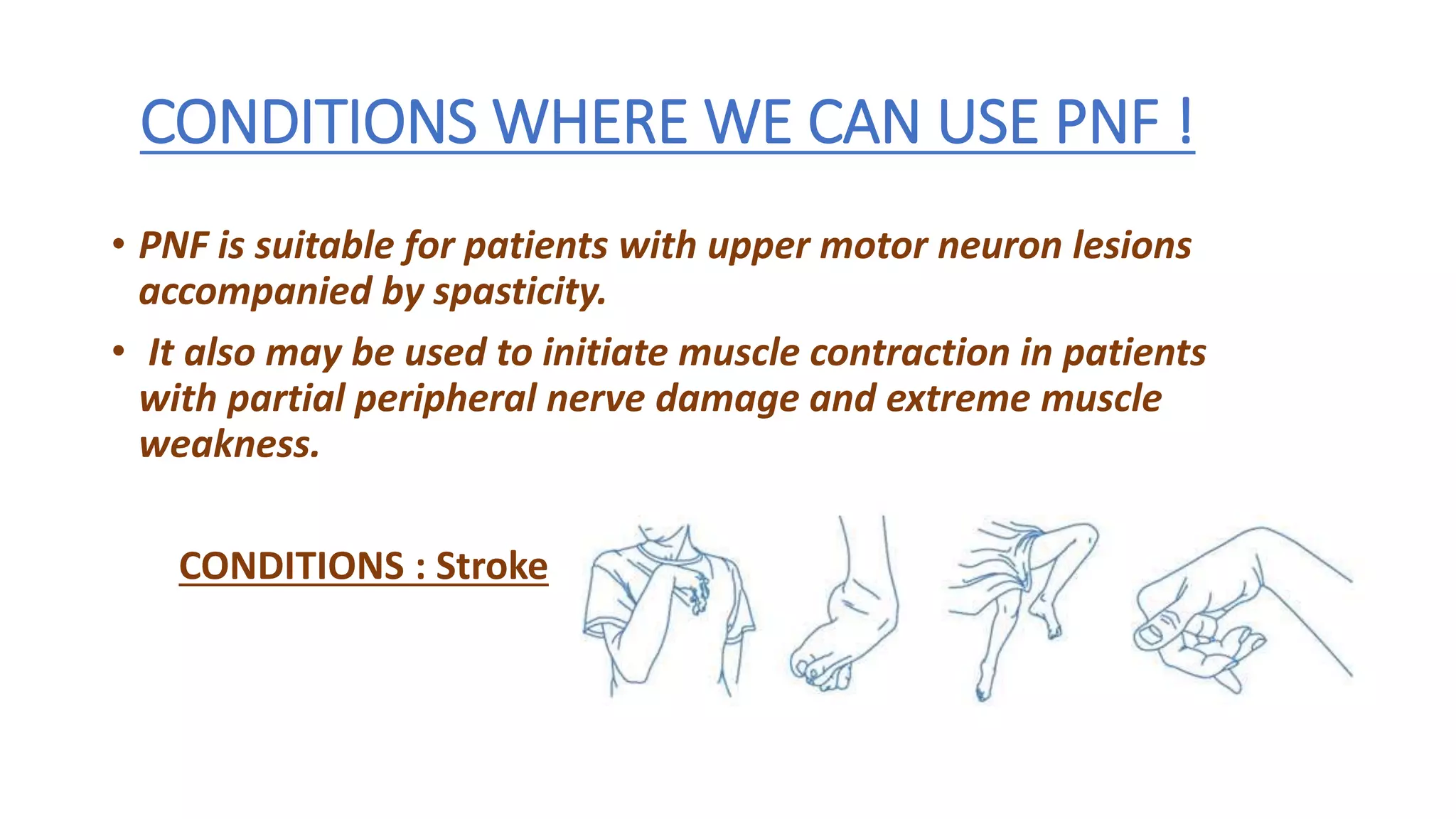
• PNF is suitable for patients with upper motor neuron lesions
accompanied by spasticity.
• It also may be used to initiate muscle contraction in patients
with partial peripheral nerve damage and extreme muscle
weakness.
CONDITIONS : Stroke
PNF TECHNIQUES
STRENGTHENING TECHNIQUES
•Rhythmic initiation
•Repeated contraction
•Slow reversal
•Slow reversal-hold
• Rhythmic stabilization
STRETCHING TECHNIQUES
•Contract relax
•Hold relax
STRENGTHENING TECHNIQUES
RHYTHMIC INITIATION
• Progression from(agonist pattern)
PASSIVE
◇
ACTIVE ASSISTED
◇
ACTIVE
USED IN
• Limited ROM due to increase tone
• Who are unable to initiate movement
REPEATED CONTRATION
• Patient move isotonically against maximumresistance
repeatedly until fatigue is evidenced
• When fatigue is evident then a stretch at that point in the
range should facilitate the weaker muscles and results in
coordinated movement.
USED
• To develop strength and endurance.
SLOW REVERSAL
• Involves isotonic contraction of the agonist followed
immediately by an isotonic contraction of the antagonist.
• USED
1. For development of active ROM and
2. 2. Normal reciprocal timing b/w agonist and antagonist
SLOW REVERSAL HOLD
• Involves isotonic contraction of the agonist followed
immediately by an isometric contraction, with a hold
command given at the end of each active movement.
• USED
• In developing strength at a specific point in the range of
motion.
RHYTHMIC STABILIZATION
• Uses an isometric contraction of the agonist, followed by an
isometric contraction of the antagonist.
• USED
• To increase strength and endurance
STRETCHING TECHNIQUES/PNF STRETCHING
• It is often a combination of passive stretching and isometrics
contractions.
• encourage flexibility and coordination throughout thelimb's entire
range of motion.
• PNF is used to supplement daily stretching and is employed to make
quick gains in range of motion to help athletes improve performance.
•Good range of motion makes better biomechanics, reducesfatigue
and helps prevent overuse injuries.
CONTRACT-RELAX
• Moves the body part passively into the
agonistpattern.
• Patient is instructed to push by contracting the
antagonist isotonically against the resistance.
• USED
• When ROM is limited by muscle tightness.
HOLD RELAX
• Begins with isometric contraction of the
antagonist against resistance, followed by
concentric contraction of the agonist
muscle.
PATTERNS OF PNF
• The patterns of movement associated with PNF are composed of
multijoint, multiplanar, diagonal, and rotational movements of the
extremities, trunk & neck.
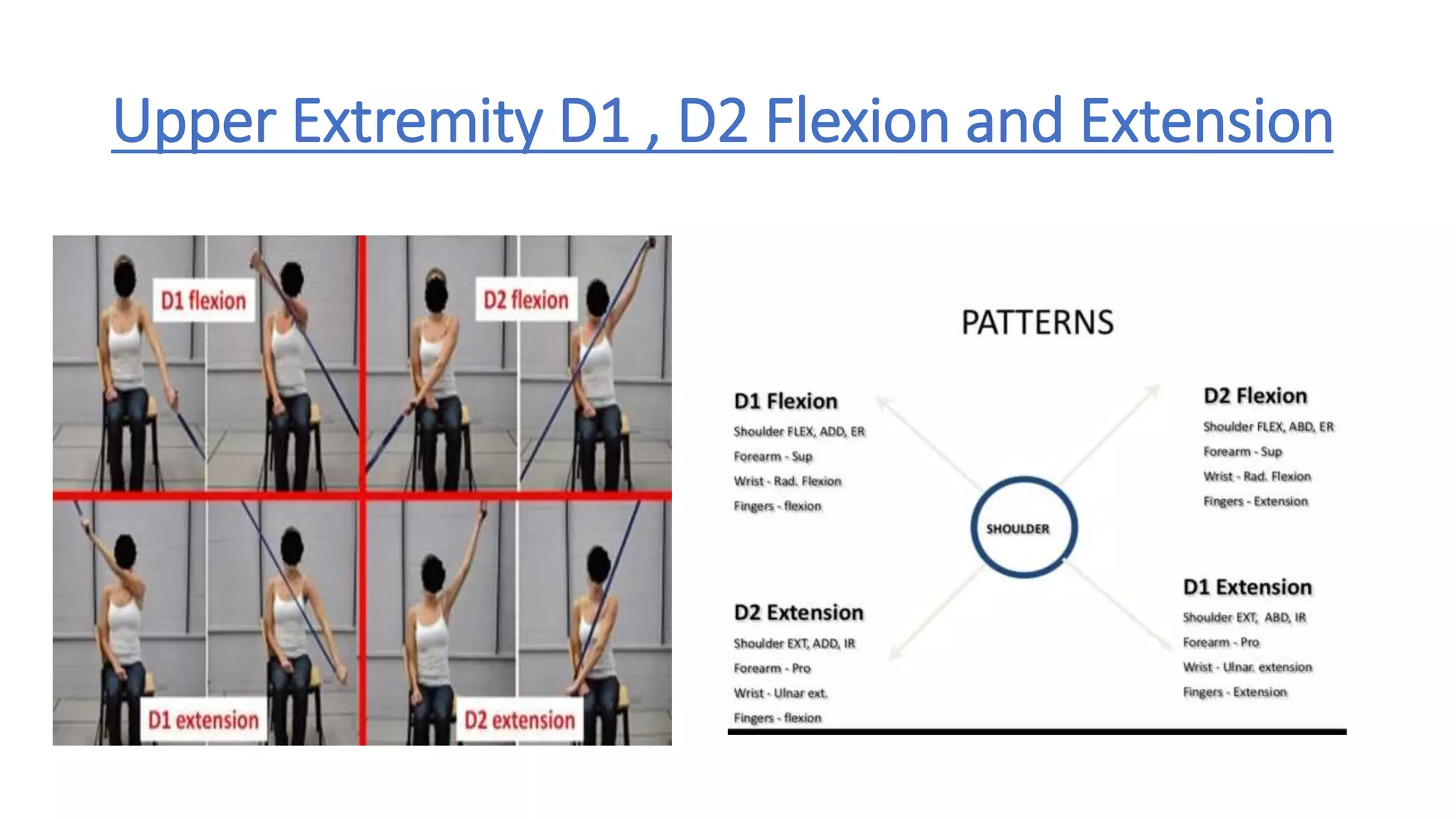
• There are 2 pairs of foundational movements for the upper
extremities;
• UE D1 flexion & extension, UE D2 flexion & extension.
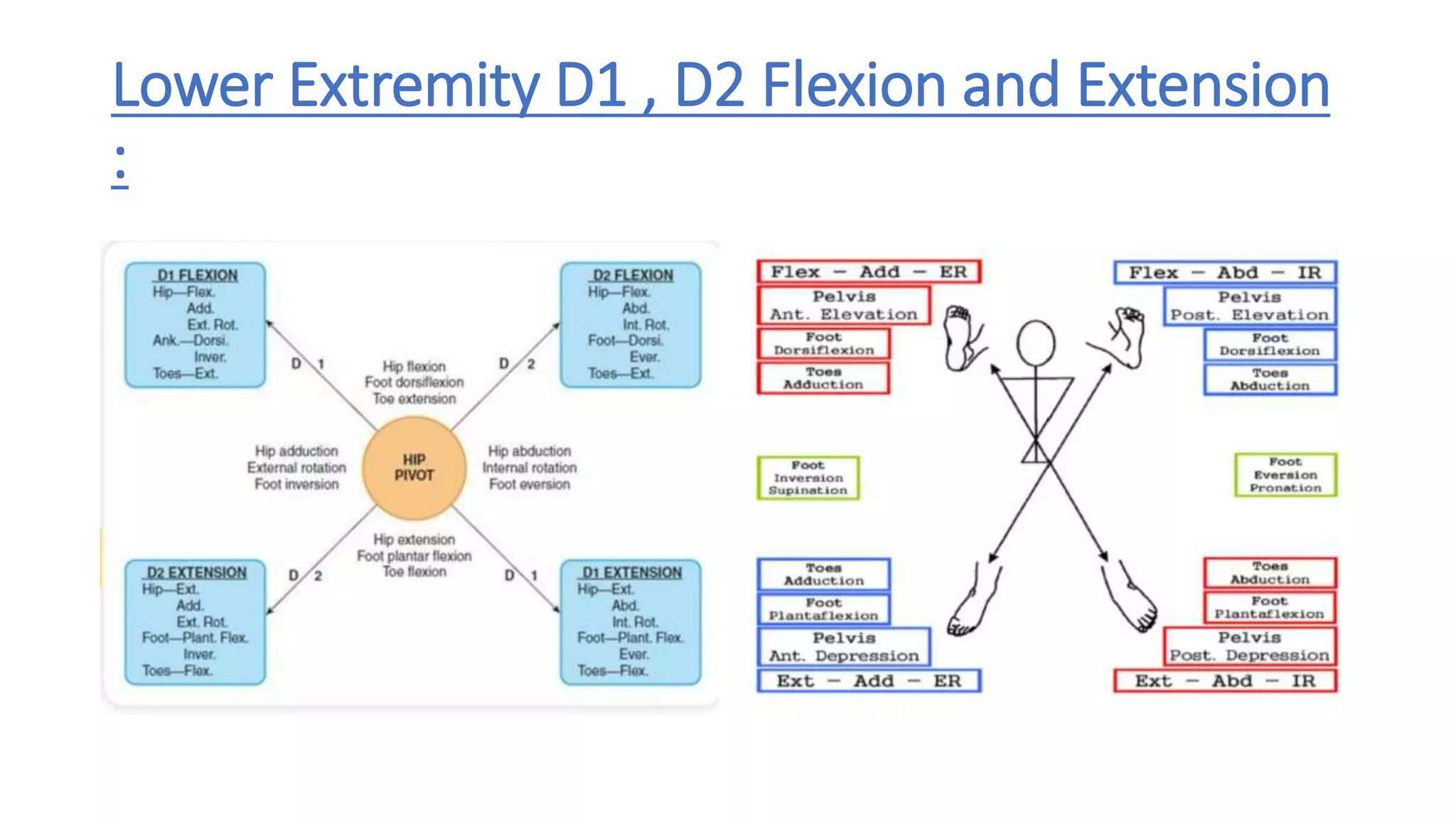
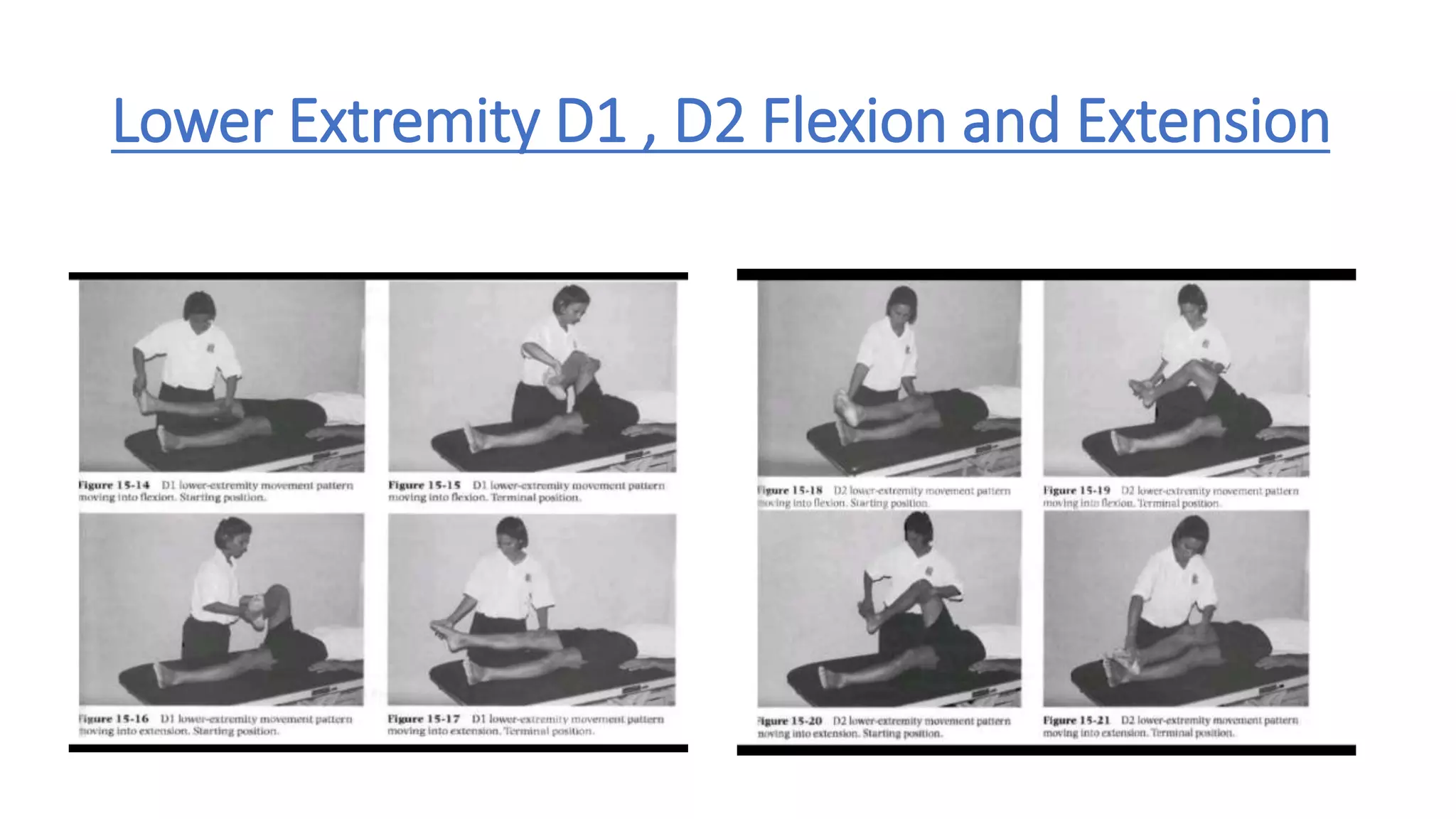
• There are also 2 pairs of foundational movements for the lower
extremities; LE D1 flexion & extension, LE D2 flexion & extension.
PNF PATTERNS
PNF patterning is used for the upper and lower
extremities and is broken into to D1 (Diagonal 1) and D2
(Diagonal 2) patterns.
The upper extremity pattern encompasses the shoulder,
elbow, wrist and fingers.
Similarly, the lower extremity pattern encompasses the
hip, knee, ankle and toes
Upper Extremity D1 , D2 Flexion and Extension
Lower Extremity D1 , D2 Flexion and Extension
:
Lower Extremity D1 , D2 Flexion and Extension
THANK YOU !

Presentation (3).pptx

  • 1.
  • 2.
    INTRODUCTION • Proprioceptive NeuromuscularFacilitation (PNF) is a set of stretching techniques commonly used in clinical environments to enhance both active and passive range of motion . • PNF is considered an optimal stretching method when the aim is to increase range of motion . • Herman Kabat developed proprioceptive neuromuscular facilitation (PNF) in the 1940s and further developed Dorothy Voss and Margaret Knott.
  • 3.
    DEFINITION •Proprioceptive: having todo with any of the sensory receptors that give information concerning movement and position of the body • Neuromuscular: involving the nerves and. Muscles • Facilitation: making easier Techniques of proprioceptive neuromuscular facilitation may be defined as "Methods of promoting or hastening the response of the neuromuscular mechanism through stimulation of the proprioceptors".
  • 4.
    PRINCIPLE • PNF focuseson mass movement patterns that are diagonal and resemble functional movement. The body does not work in parts, but instead as a whole. In order to promote these mass movement patterns, PNF uses a multi-sensory approach, incorporating the auditory, visual and tactile systems. • PNF allows the patient to understand what normal movement feels like through the use of various senses through use of manual contacts to cue the patient and facilitate movement.
  • 5.
    BASIC PRINCIPLES OFPNF • 1. Resistance • 2. Irradiation and reinforcement • 3. Manual contact • 4. Stretch • 5. Verbal commands • 6. Traction and approximation • 7. Timing • 8. Body positioning and body mechanics
  • 6.
    Primarily, PNF treatmenttechniques focus on three things : • 1. Increase the motor learning of the agonist through repetition of an activity (repeated contractions) and rhythmic initiation. • 2. Reverse the motor patterns of the antagonist.Two techniques are slow reversal and rhythmic stabilisation, both of which use an isometric contraction. • 3. Finally, learning to relax muggles helps Back to top to increase range of motion and decrease spasticity.
  • 7.
    USES OF PNF •1. PNF treatment has been used to increase strength, flexibility, coordination and functional mobility.. • 2. The main goal of treatment is to facilitate the patient in achieving a movement or posture . • 3. Stretches as well as diagonals and rational exercise patterns are used to improve ADL's functional mobility and athletic performance
  • 8.
    CONDITIONS WHERE WECAN USE PNF ! • PNF is suitable for patients with upper motor neuron lesions accompanied by spasticity. • It also may be used to initiate muscle contraction in patients with partial peripheral nerve damage and extreme muscle weakness. CONDITIONS : Stroke
  • 9.
    PNF TECHNIQUES STRENGTHENING TECHNIQUES •Rhythmicinitiation •Repeated contraction •Slow reversal •Slow reversal-hold • Rhythmic stabilization STRETCHING TECHNIQUES •Contract relax •Hold relax
  • 10.
  • 11.
    RHYTHMIC INITIATION • Progressionfrom(agonist pattern) PASSIVE ◇ ACTIVE ASSISTED ◇ ACTIVE USED IN • Limited ROM due to increase tone • Who are unable to initiate movement
  • 12.
    REPEATED CONTRATION • Patientmove isotonically against maximumresistance repeatedly until fatigue is evidenced • When fatigue is evident then a stretch at that point in the range should facilitate the weaker muscles and results in coordinated movement. USED • To develop strength and endurance.
  • 13.
    SLOW REVERSAL • Involvesisotonic contraction of the agonist followed immediately by an isotonic contraction of the antagonist. • USED 1. For development of active ROM and 2. 2. Normal reciprocal timing b/w agonist and antagonist
  • 14.
    SLOW REVERSAL HOLD •Involves isotonic contraction of the agonist followed immediately by an isometric contraction, with a hold command given at the end of each active movement. • USED • In developing strength at a specific point in the range of motion.
  • 15.
    RHYTHMIC STABILIZATION • Usesan isometric contraction of the agonist, followed by an isometric contraction of the antagonist. • USED • To increase strength and endurance
  • 16.
    STRETCHING TECHNIQUES/PNF STRETCHING •It is often a combination of passive stretching and isometrics contractions. • encourage flexibility and coordination throughout thelimb's entire range of motion. • PNF is used to supplement daily stretching and is employed to make quick gains in range of motion to help athletes improve performance. •Good range of motion makes better biomechanics, reducesfatigue and helps prevent overuse injuries.
  • 17.
    CONTRACT-RELAX • Moves thebody part passively into the agonistpattern. • Patient is instructed to push by contracting the antagonist isotonically against the resistance. • USED • When ROM is limited by muscle tightness.
  • 18.
    HOLD RELAX • Beginswith isometric contraction of the antagonist against resistance, followed by concentric contraction of the agonist muscle.
  • 19.
    PATTERNS OF PNF •The patterns of movement associated with PNF are composed of multijoint, multiplanar, diagonal, and rotational movements of the extremities, trunk & neck. • There are 2 pairs of foundational movements for the upper extremities; • UE D1 flexion & extension, UE D2 flexion & extension. • There are also 2 pairs of foundational movements for the lower extremities; LE D1 flexion & extension, LE D2 flexion & extension.
  • 20.
    PNF PATTERNS PNF patterningis used for the upper and lower extremities and is broken into to D1 (Diagonal 1) and D2 (Diagonal 2) patterns. The upper extremity pattern encompasses the shoulder, elbow, wrist and fingers. Similarly, the lower extremity pattern encompasses the hip, knee, ankle and toes
  • 21.
    Upper Extremity D1, D2 Flexion and Extension
  • 22.
    Lower Extremity D1, D2 Flexion and Extension :
  • 23.
    Lower Extremity D1, D2 Flexion and Extension
  • 24.