By:Dentaltutor.in
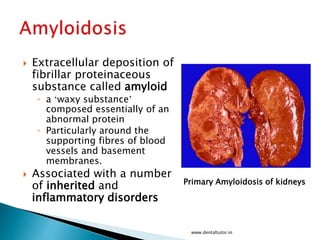
 Extracellular deposition of
fibrillar proteinaceous
substance called amyloid
◦ a ‘waxy substance’
composed essentially of an
abnormal protein
◦ Particularly around the
supporting fibres of blood
vessels and basement
membranes.
 Associated with a number
of inherited and
inflammatory disorders
www.dentaltutor.in
Primary Amyloidosis of kidneys
www.dentaltutor.in
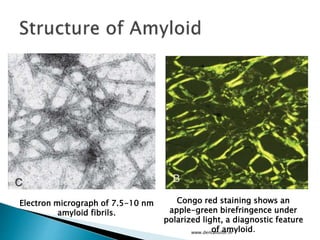
Electron micrograph of 7.5-10 nm
amyloid fibrils.
Congo red staining shows an
apple-green birefringence under
polarized light, a diagnostic feature
of amyloid.
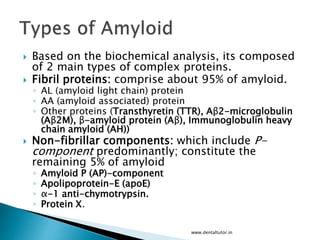
 Based on the biochemical analysis, its composed
of 2 main types of complex proteins.
 Fibril proteins: comprise about 95% of amyloid.
◦ AL (amyloid light chain) protein
◦ AA (amyloid associated) protein
◦ Other proteins (Transthyretin (TTR), Aβ2-microglobulin
(Aβ2M), β-amyloid protein (Aβ), Immunoglobulin heavy
chain amyloid (AH))
 Non-fibrillar components: which include P-
component predominantly; constitute the
remaining 5% of amyloid
◦ Amyloid P (AP)-component
◦ Apolipoprotein-E (apoE)
◦ α-1 anti-chymotrypsin.
◦ Protein X.
www.dentaltutor.in
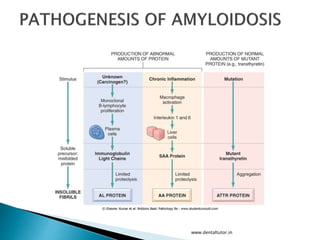
 Result of immunologic mechanisms.
 Multifactorial and that different
mechanisms are involved in different
types of amyloid.
 Fundamentally a disorder of protein
misfolding.
 More than 20 (at last count, 23)
different proteins can aggregate and
form fibrils with the appearance of
amyloid
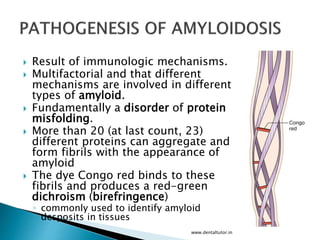
 The dye Congo red binds to these
fibrils and produces a red-green
dichroism (birefringence)
◦ commonly used to identify amyloid
desposits in tissues
www.dentaltutor.in
www.dentaltutor.in
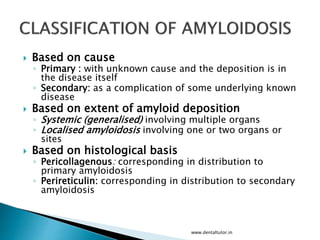
 Based on cause
◦ Primary : with unknown cause and the deposition is in
the disease itself
◦ Secondary: as a complication of some underlying known
disease
 Based on extent of amyloid deposition
◦ Systemic (generalised) involving multiple organs
◦ Localised amyloidosis involving one or two organs or
sites
 Based on histological basis
◦ Pericollagenous: corresponding in distribution to
primary amyloidosis
◦ Perireticulin: corresponding in distribution to secondary
amyloidosis
www.dentaltutor.in
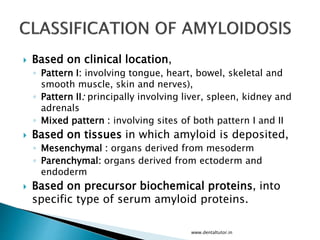
 Based on clinical location,
◦ Pattern I: involving tongue, heart, bowel, skeletal and
smooth muscle, skin and nerves),
◦ Pattern II: principally involving liver, spleen, kidney and
adrenals
◦ Mixed pattern : involving sites of both pattern I and II
 Based on tissues in which amyloid is deposited,
◦ Mesenchymal : organs derived from mesoderm
◦ Parenchymal: organs derived from ectoderm and
endoderm
 Based on precursor biochemical proteins, into
specific type of serum amyloid proteins.
www.dentaltutor.in
www.dentaltutor.in
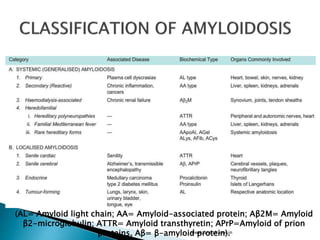
(AL= Amyloid light chain; AA= Amyloid-associated protein; Aβ2M= Amyloid
β2-microglobulin; ATTR= Amyloid transthyretin; APrP=Amyloid of prion
proteins, Aβ= β-amyloid protein).
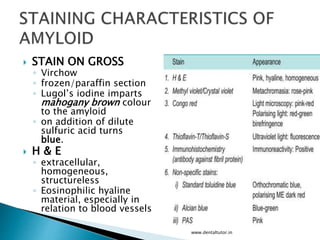
 STAIN ON GROSS
◦ Virchow
◦ frozen/paraffin section
◦ Lugol’s iodine imparts
mahogany brown colour
to the amyloid
◦ on addition of dilute
sulfuric acid turns
blue.
 H & E
◦ extracellular,
homogeneous,
structureless
◦ Eosinophilic hyaline
material, especially in
relation to blood vessels
www.dentaltutor.in
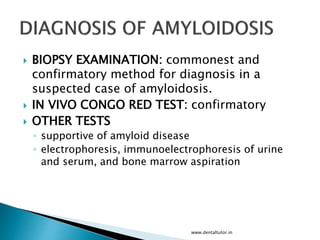
 BIOPSY EXAMINATION: commonest and
confirmatory method for diagnosis in a
suspected case of amyloidosis.
 IN VIVO CONGO RED TEST: confirmatory
 OTHER TESTS
◦ supportive of amyloid disease
◦ electrophoresis, immunoelectrophoresis of urine
and serum, and bone marrow aspiration
www.dentaltutor.in
www.dentaltutor.in
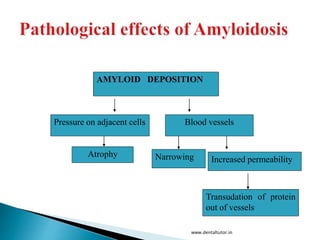
AMYLOID DEPOSITION
Pressure on adjacent cells Blood vessels
Atrophy Narrowing Increased permeability
Transudation of protein
out of vessels
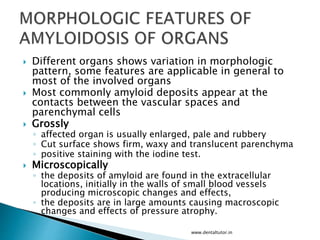
 Different organs shows variation in morphologic
pattern, some features are applicable in general to
most of the involved organs
 Most commonly amyloid deposits appear at the
contacts between the vascular spaces and
parenchymal cells
 Grossly
◦ affected organ is usually enlarged, pale and rubbery
◦ Cut surface shows firm, waxy and translucent parenchyma
◦ positive staining with the iodine test.
 Microscopically
◦ the deposits of amyloid are found in the extracellular
locations, initially in the walls of small blood vessels
producing microscopic changes and effects,
◦ the deposits are in large amounts causing macroscopic
changes and effects of pressure atrophy.
www.dentaltutor.in
www.dentaltutor.in
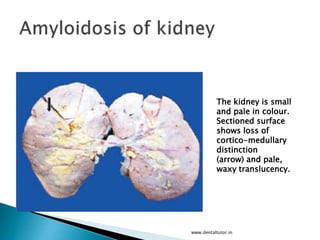
The kidney is small
and pale in colour.
Sectioned surface
shows loss of
cortico-medullary
distinction
(arrow) and pale,
waxy translucency.
www.dentaltutor.in
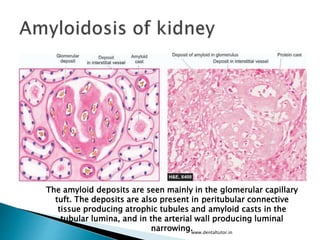
The amyloid deposits are seen mainly in the glomerular capillary
tuft. The deposits are also present in peritubular connective
tissue producing atrophic tubules and amyloid casts in the
tubular lumina, and in the arterial wall producing luminal
narrowing.
www.dentaltutor.in
www.dentaltutor.in
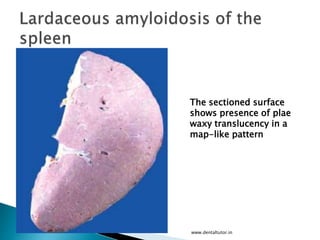
The sectioned surface
shows presence of plae
waxy translucency in a
map-like pattern
www.dentaltutor.in
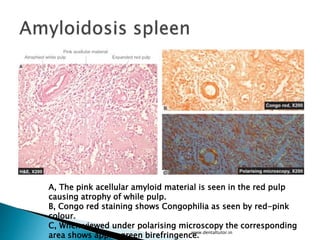
A, The pink acellular amyloid material is seen in the red pulp
causing atrophy of while pulp.
B, Congo red staining shows Congophilia as seen by red-pink
colour.
C, When viewed under polarising microscopy the corresponding
area shows apple-green birefringence.
www.dentaltutor.in
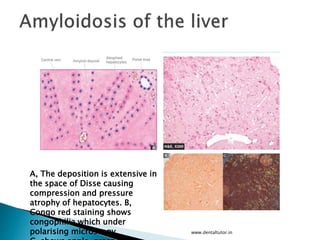
A, The deposition is extensive in
the space of Disse causing
compression and pressure
atrophy of hepatocytes. B,
Congo red staining shows
congophilia which under
polarising microscopy.
 Robbinson's basic pathology 8 ed
 Harsh Mohan - Textbook of Pathology 6th Ed.
 Color atlas of pathology
www.dentaltutor.in
Like, share and comment on
https://www.facebook.com/notesdental
http://www.slideshare.net/DeepakKumarGupta2
www.dentaltutor.in

Amyloidosis

  • 1.
  • 2.
     Extracellular depositionof fibrillar proteinaceous substance called amyloid ◦ a ‘waxy substance’ composed essentially of an abnormal protein ◦ Particularly around the supporting fibres of blood vessels and basement membranes.  Associated with a number of inherited and inflammatory disorders www.dentaltutor.in Primary Amyloidosis of kidneys
  • 3.
    www.dentaltutor.in Electron micrograph of7.5-10 nm amyloid fibrils. Congo red staining shows an apple-green birefringence under polarized light, a diagnostic feature of amyloid.
  • 4.
     Based onthe biochemical analysis, its composed of 2 main types of complex proteins.  Fibril proteins: comprise about 95% of amyloid. ◦ AL (amyloid light chain) protein ◦ AA (amyloid associated) protein ◦ Other proteins (Transthyretin (TTR), Aβ2-microglobulin (Aβ2M), β-amyloid protein (Aβ), Immunoglobulin heavy chain amyloid (AH))  Non-fibrillar components: which include P- component predominantly; constitute the remaining 5% of amyloid ◦ Amyloid P (AP)-component ◦ Apolipoprotein-E (apoE) ◦ α-1 anti-chymotrypsin. ◦ Protein X. www.dentaltutor.in
  • 5.
     Result ofimmunologic mechanisms.  Multifactorial and that different mechanisms are involved in different types of amyloid.  Fundamentally a disorder of protein misfolding.  More than 20 (at last count, 23) different proteins can aggregate and form fibrils with the appearance of amyloid  The dye Congo red binds to these fibrils and produces a red-green dichroism (birefringence) ◦ commonly used to identify amyloid desposits in tissues www.dentaltutor.in
  • 6.
  • 7.
     Based oncause ◦ Primary : with unknown cause and the deposition is in the disease itself ◦ Secondary: as a complication of some underlying known disease  Based on extent of amyloid deposition ◦ Systemic (generalised) involving multiple organs ◦ Localised amyloidosis involving one or two organs or sites  Based on histological basis ◦ Pericollagenous: corresponding in distribution to primary amyloidosis ◦ Perireticulin: corresponding in distribution to secondary amyloidosis www.dentaltutor.in
  • 8.
     Based onclinical location, ◦ Pattern I: involving tongue, heart, bowel, skeletal and smooth muscle, skin and nerves), ◦ Pattern II: principally involving liver, spleen, kidney and adrenals ◦ Mixed pattern : involving sites of both pattern I and II  Based on tissues in which amyloid is deposited, ◦ Mesenchymal : organs derived from mesoderm ◦ Parenchymal: organs derived from ectoderm and endoderm  Based on precursor biochemical proteins, into specific type of serum amyloid proteins. www.dentaltutor.in
  • 9.
    www.dentaltutor.in (AL= Amyloid lightchain; AA= Amyloid-associated protein; Aβ2M= Amyloid β2-microglobulin; ATTR= Amyloid transthyretin; APrP=Amyloid of prion proteins, Aβ= β-amyloid protein).
  • 10.
     STAIN ONGROSS ◦ Virchow ◦ frozen/paraffin section ◦ Lugol’s iodine imparts mahogany brown colour to the amyloid ◦ on addition of dilute sulfuric acid turns blue.  H & E ◦ extracellular, homogeneous, structureless ◦ Eosinophilic hyaline material, especially in relation to blood vessels www.dentaltutor.in
  • 11.
     BIOPSY EXAMINATION:commonest and confirmatory method for diagnosis in a suspected case of amyloidosis.  IN VIVO CONGO RED TEST: confirmatory  OTHER TESTS ◦ supportive of amyloid disease ◦ electrophoresis, immunoelectrophoresis of urine and serum, and bone marrow aspiration www.dentaltutor.in
  • 12.
    www.dentaltutor.in AMYLOID DEPOSITION Pressure onadjacent cells Blood vessels Atrophy Narrowing Increased permeability Transudation of protein out of vessels
  • 13.
     Different organsshows variation in morphologic pattern, some features are applicable in general to most of the involved organs  Most commonly amyloid deposits appear at the contacts between the vascular spaces and parenchymal cells  Grossly ◦ affected organ is usually enlarged, pale and rubbery ◦ Cut surface shows firm, waxy and translucent parenchyma ◦ positive staining with the iodine test.  Microscopically ◦ the deposits of amyloid are found in the extracellular locations, initially in the walls of small blood vessels producing microscopic changes and effects, ◦ the deposits are in large amounts causing macroscopic changes and effects of pressure atrophy. www.dentaltutor.in
  • 14.
    www.dentaltutor.in The kidney issmall and pale in colour. Sectioned surface shows loss of cortico-medullary distinction (arrow) and pale, waxy translucency.
  • 15.
    www.dentaltutor.in The amyloid depositsare seen mainly in the glomerular capillary tuft. The deposits are also present in peritubular connective tissue producing atrophic tubules and amyloid casts in the tubular lumina, and in the arterial wall producing luminal narrowing.
  • 16.
  • 17.
    www.dentaltutor.in The sectioned surface showspresence of plae waxy translucency in a map-like pattern
  • 18.
    www.dentaltutor.in A, The pinkacellular amyloid material is seen in the red pulp causing atrophy of while pulp. B, Congo red staining shows Congophilia as seen by red-pink colour. C, When viewed under polarising microscopy the corresponding area shows apple-green birefringence.
  • 19.
    www.dentaltutor.in A, The depositionis extensive in the space of Disse causing compression and pressure atrophy of hepatocytes. B, Congo red staining shows congophilia which under polarising microscopy.
  • 20.
     Robbinson's basicpathology 8 ed  Harsh Mohan - Textbook of Pathology 6th Ed.  Color atlas of pathology www.dentaltutor.in
  • 21.
    Like, share andcomment on https://www.facebook.com/notesdental http://www.slideshare.net/DeepakKumarGupta2 www.dentaltutor.in