“The world in which you were 
born is just one model of reality. 
Other cultures are not failed 
attempts at being you; they are 
unique manifestations of the 
human spirit, Just like you!” 
-- Wade Davis Antrhopologist
Pathology of 
Neoplasia 
Dr. Venkatesh M. Shashidhar. 
A/Prof. & Head of Pathology
Neoplasia 
Neoplasia: 
• Neo + Plasia  New + Growth. 
• Tumour  Swelling  any swelling* 
• Clinically tumour = neoplasm (technically incorrect..!) 
• Willis definition: 
“A neoplasm is an abnormal mass of tissue, the growth 
of which exceeds and is uncoordinated with that of the 
normal tissue and persists in the same manner after 
cessation of the stimuli which evoked the change” 
• “Cell division without control” 
• Irreversible DNA damage, resulting in 
autonomous growth of abnormal cells *
Neoplasia 
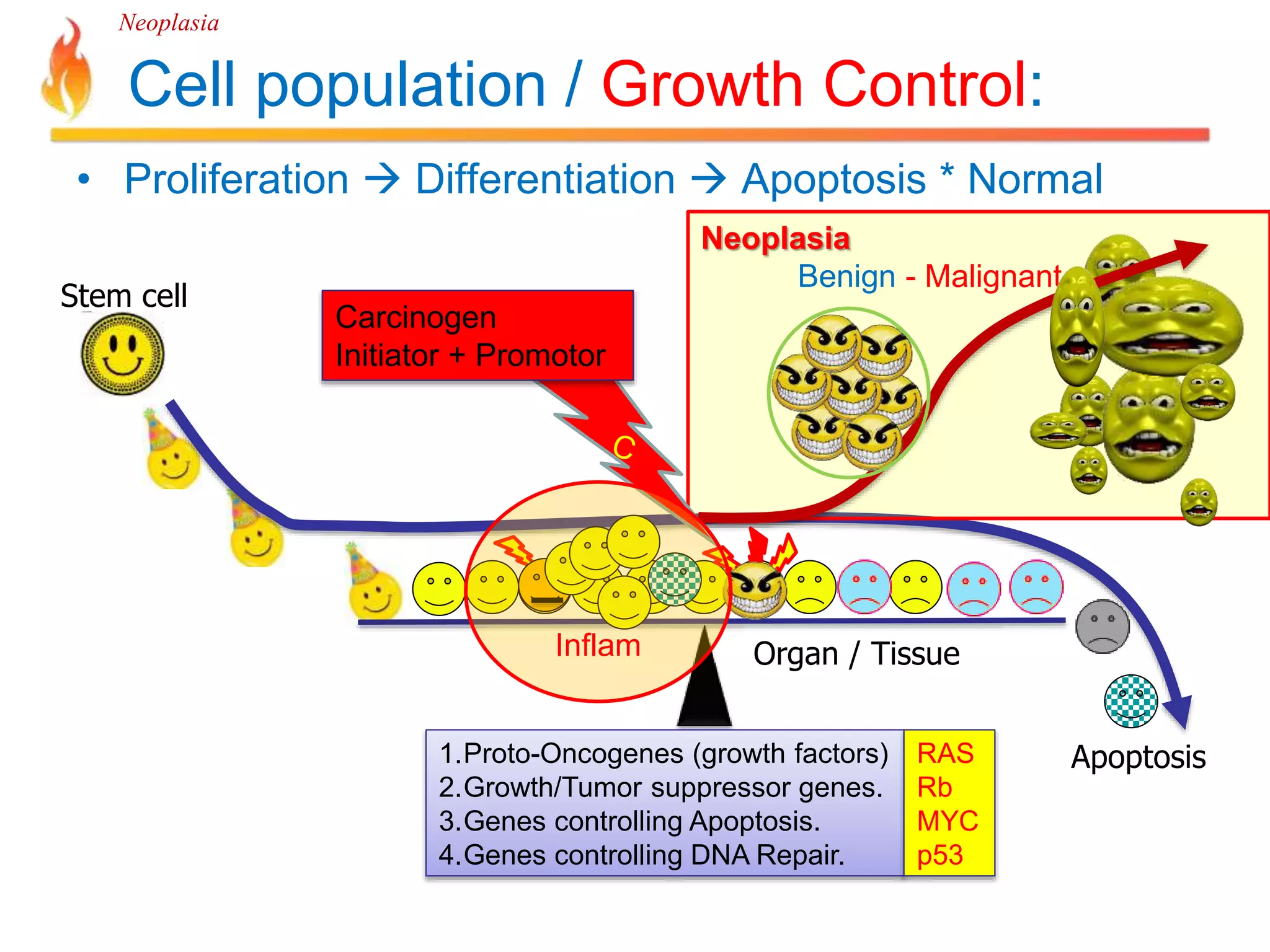
Cell population / Growth Control: 
• Proliferation  Differentiation  Apoptosis * Normal 
Stem cell 
Apoptosis 
Neoplasia 
Benign - Malignant 
Organ / Tissue 
Carcinogen 
Initiator + Promotor 
Inflam 
1.Proto-Oncogenes (growth factors) 
2.Growth/Tumor suppressor genes. 
3.Genes controlling Apoptosis. 
4.Genes controlling DNA Repair. 
RAS 
Rb 
MYC 
p53
Neoplasia 
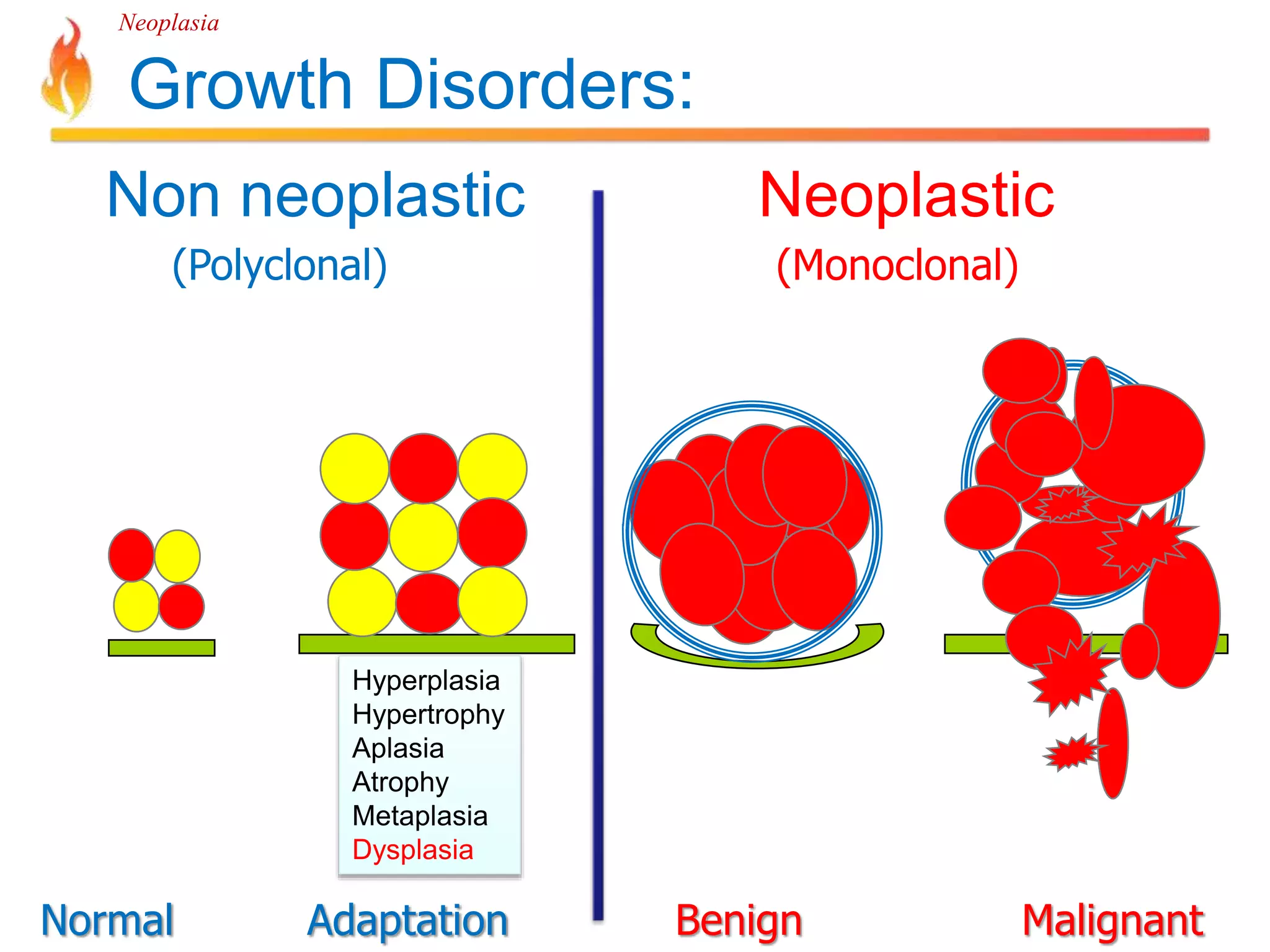
Growth Disorders: 
Non neoplastic Neoplastic 
(Polyclonal) (Monoclonal) 
Hyperplasia 
Hypertrophy 
Aplasia 
Atrophy 
Metaplasia 
Dysplasia 
Normal Adaptation Benign Malignant
Neoplasia 
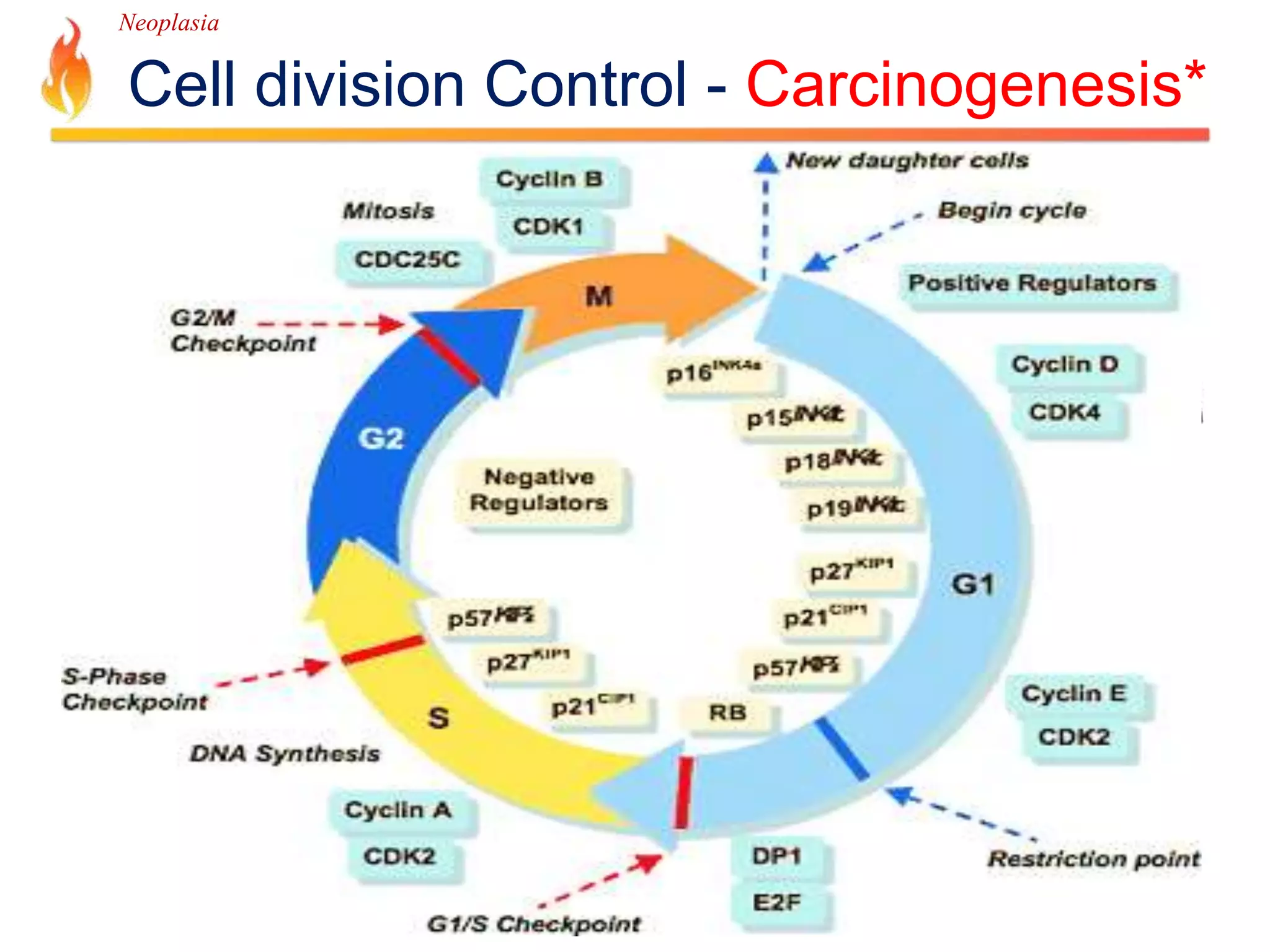
Cell division Control - Carcinogenesis*
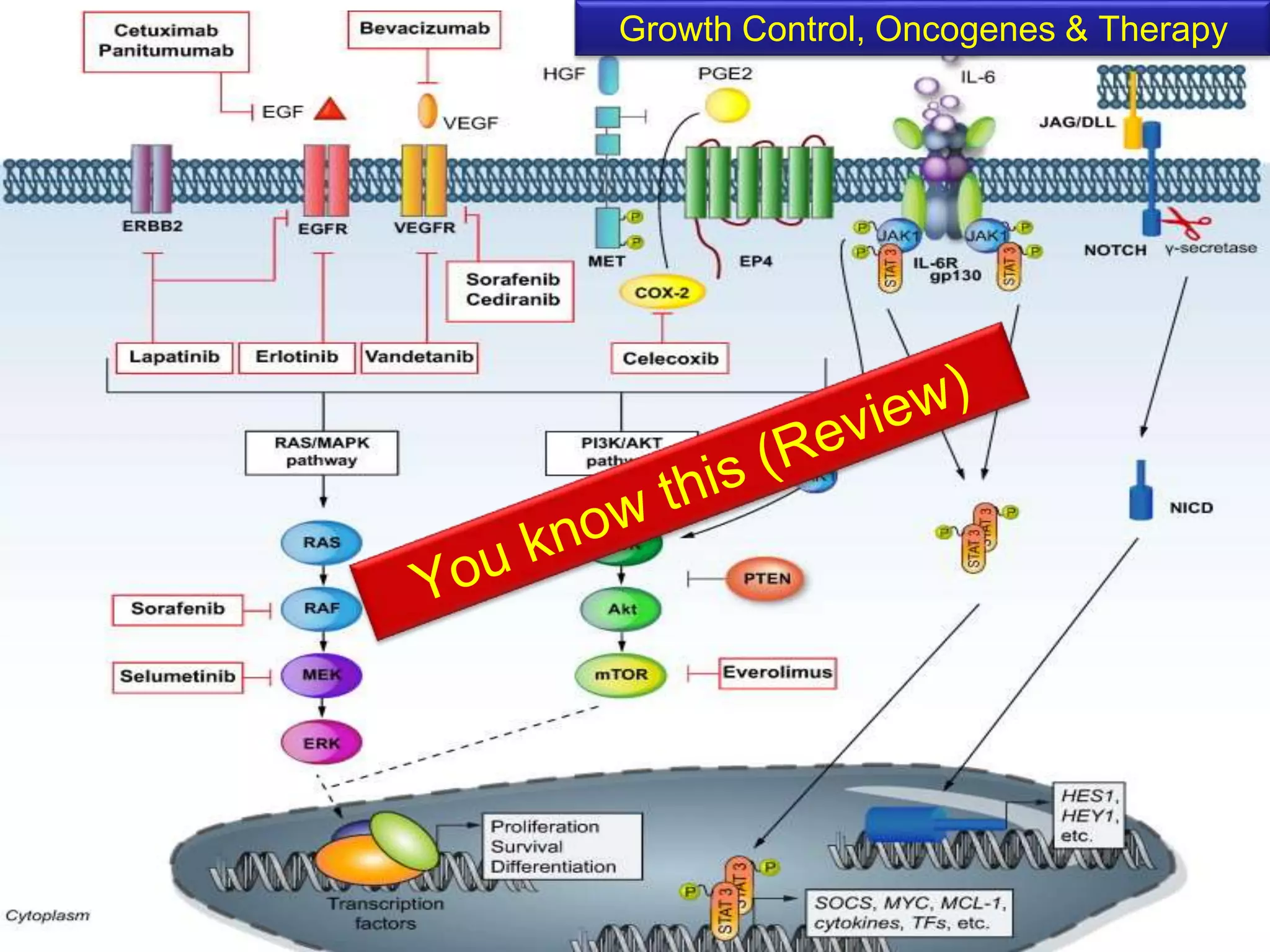
Growth Control, Oncogenes & Therapy
The mind is everything. 
What you think you become! 
-- Buddha
Neoplasia 
Clinical Pathology 
• Etiology (Carcinogenesis) 
• Pathogenesis 
• Morphology 
• Clinical Features 
(Cancer Biology)
Neoplasia 
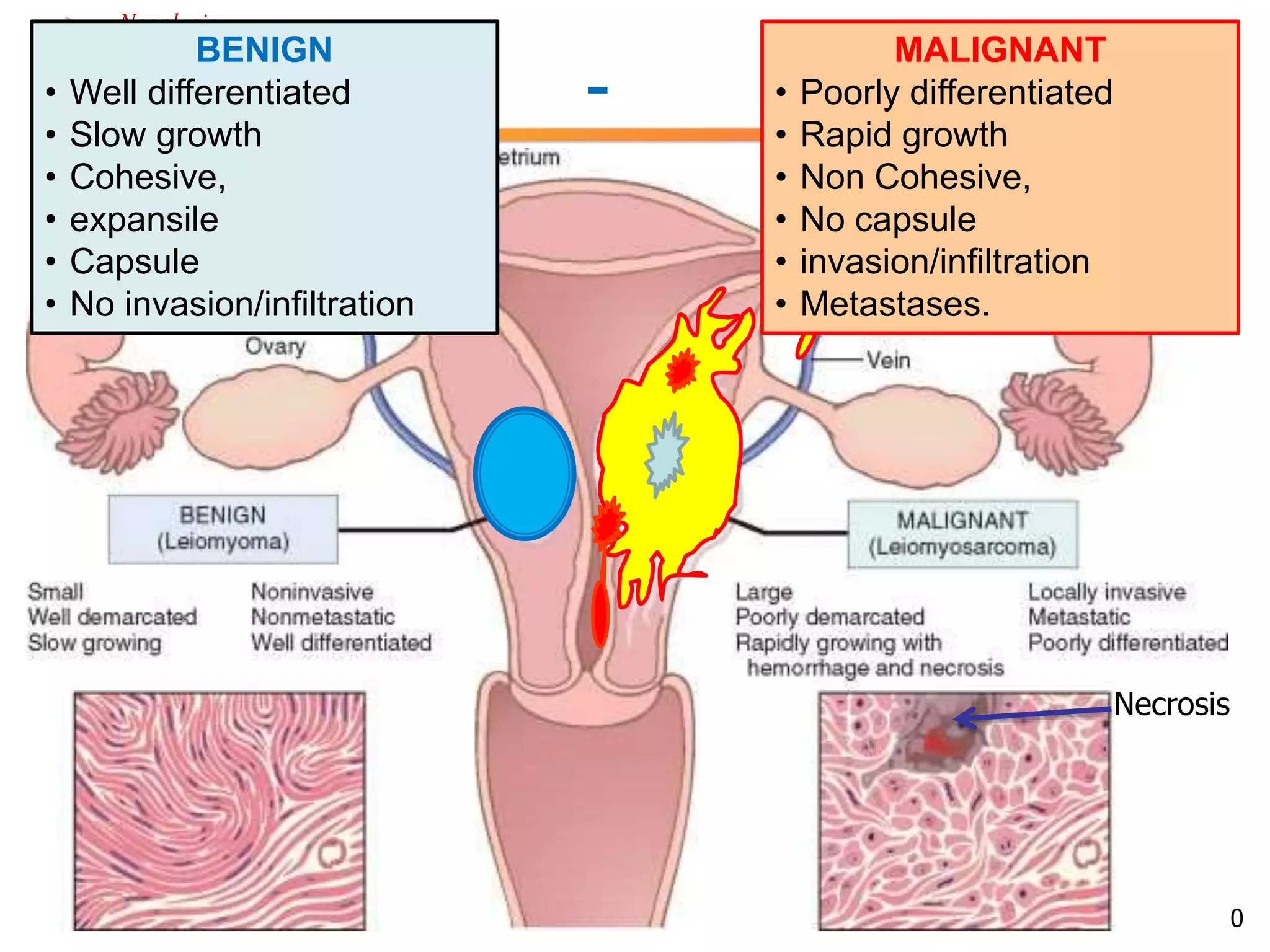
Benign - Malignant 
Necrosis 
10 
BENIGN 
• Well differentiated 
• Slow growth 
• Cohesive, 
• expansile 
• Capsule 
• No invasion/infiltration 
MALIGNANT 
• Poorly differentiated 
• Rapid growth 
• Non Cohesive, 
• No capsule 
• invasion/infiltration 
• Metastases.
Neoplasia 
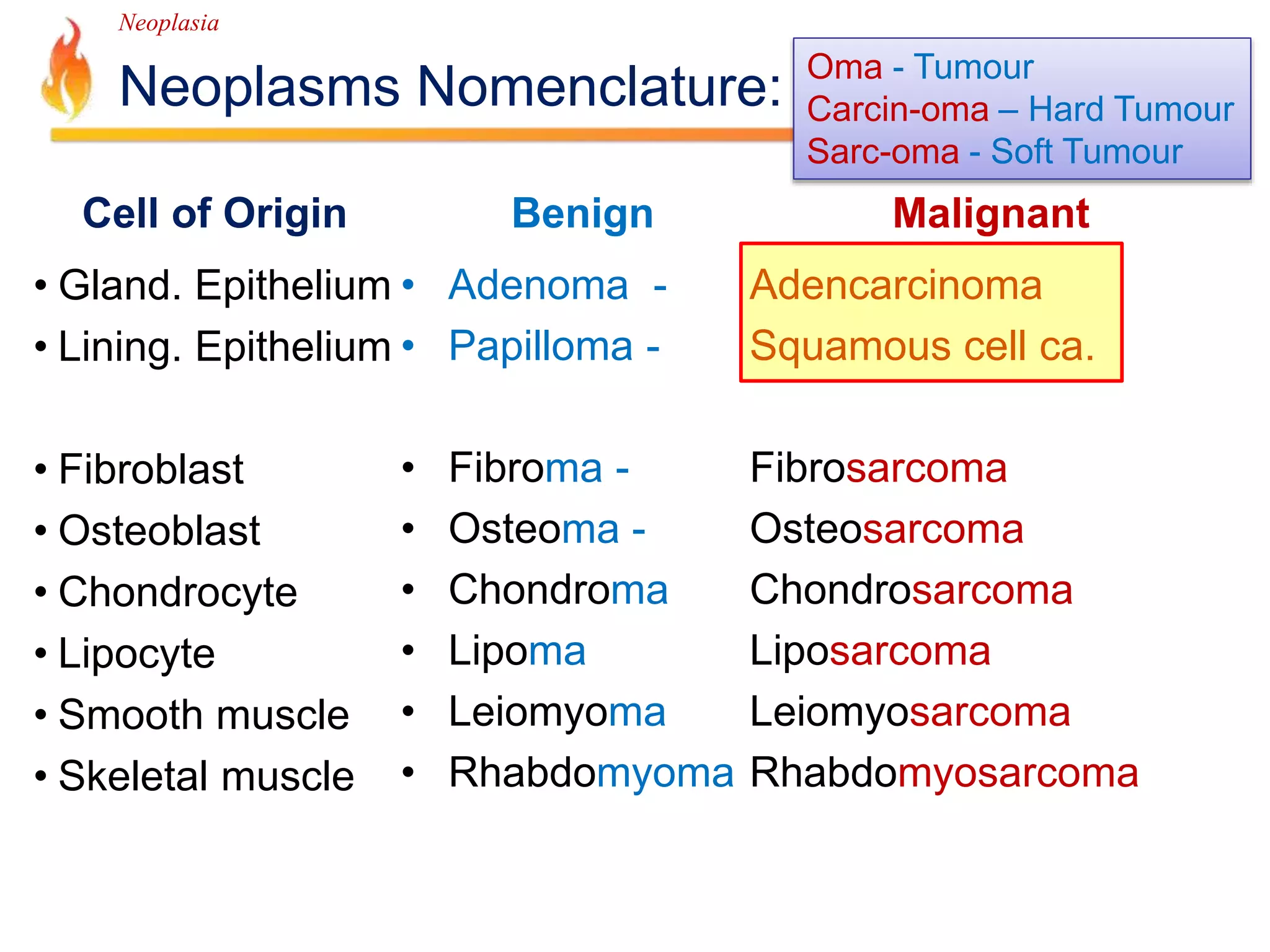
Neoplasms Nomenclature: 
Oma - Tumour 
Carcin-oma – Hard Tumour 
Sarc-oma - Soft Tumour 
Benign Malignant 
• Adenoma - Adencarcinoma 
• Papilloma - Squamous cell ca. 
• Fibroma - Fibrosarcoma 
• Osteoma - Osteosarcoma 
• Chondroma Chondrosarcoma 
• Lipoma Liposarcoma 
• Leiomyoma Leiomyosarcoma 
• Rhabdomyoma Rhabdomyosarcoma 
Cell of Origin 
• Gland. Epithelium 
• Lining. Epithelium 
• Fibroblast 
• Osteoblast 
• Chondrocyte 
• Lipocyte 
• Smooth muscle 
• Skeletal muscle
Neoplasia 
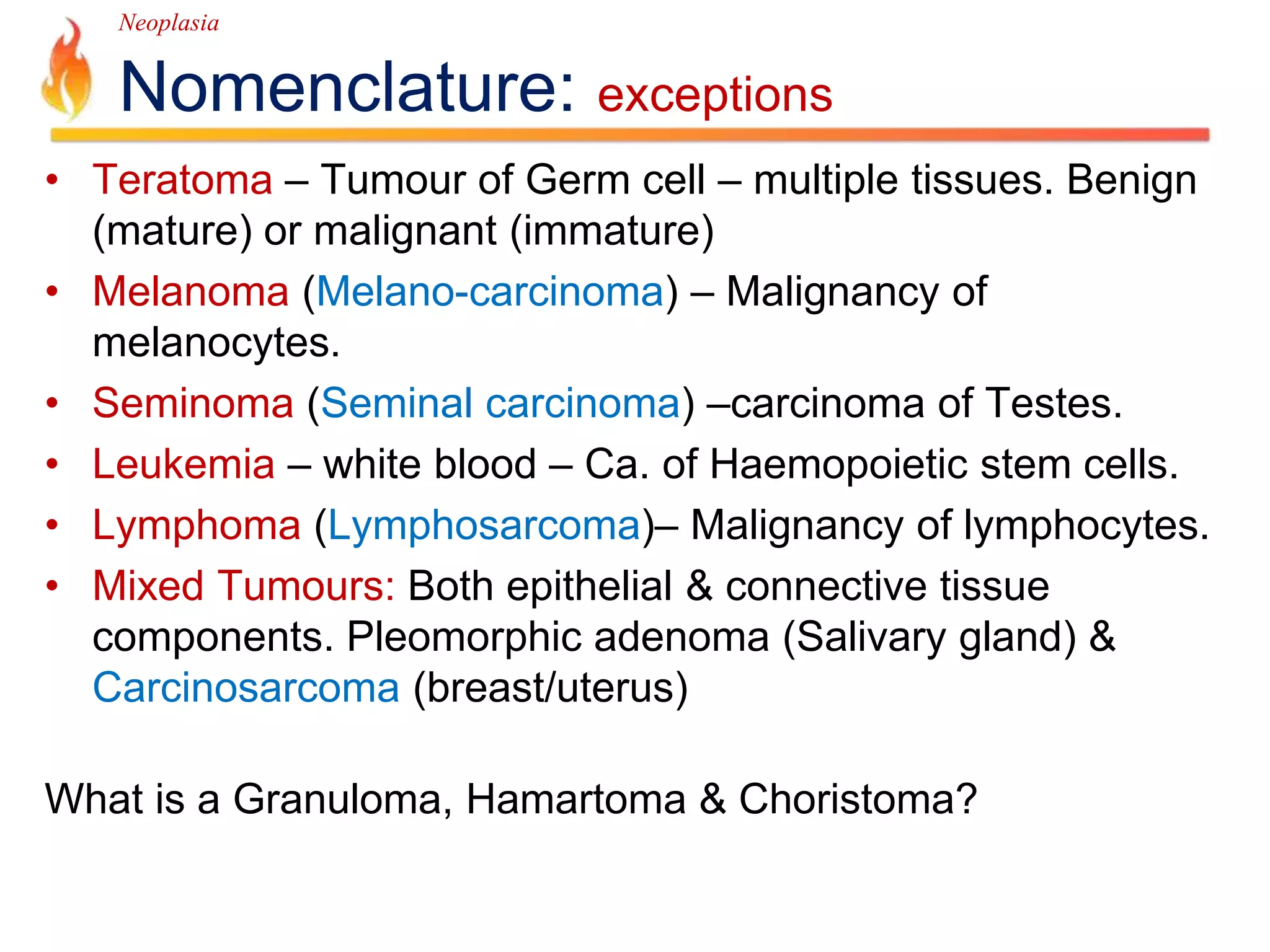
Nomenclature: exceptions 
• Teratoma – Tumour of Germ cell – multiple tissues. Benign 
(mature) or malignant (immature) 
• Melanoma (Melano-carcinoma) – Malignancy of 
melanocytes. 
• Seminoma (Seminal carcinoma) –carcinoma of Testes. 
• Leukemia – white blood – Ca. of Haemopoietic stem cells. 
• Lymphoma (Lymphosarcoma)– Malignancy of lymphocytes. 
• Mixed Tumours: Both epithelial & connective tissue 
components. Pleomorphic adenoma (Salivary gland) & 
Carcinosarcoma (breast/uterus) 
What is a Granuloma, Hamartoma & Choristoma?
The searching out and thorough 
investigation of truth ought to 
be the primary study of man. 
-- Cicero
Cancer Clinical Features 
Cancer Biology
Neoplasia 
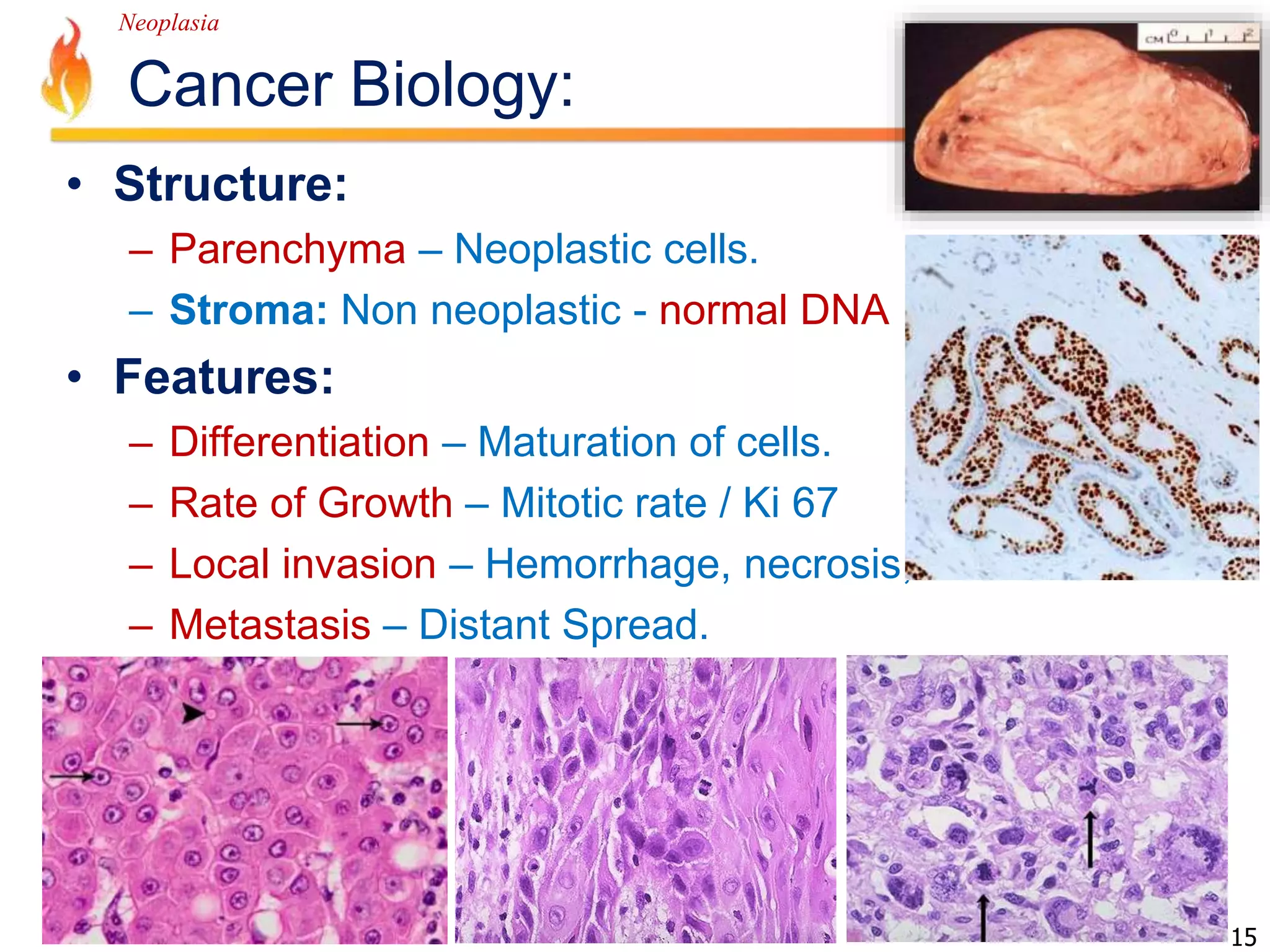
Cancer Biology: 
• Structure: 
– Parenchyma – Neoplastic cells. 
– Stroma: Non neoplastic - normal DNA 
• Features: 
– Differentiation – Maturation of cells. 
– Rate of Growth – Mitotic rate / Ki 67 
– Local invasion – Hemorrhage, necrosis, destruction 
– Metastasis – Distant Spread. 
15
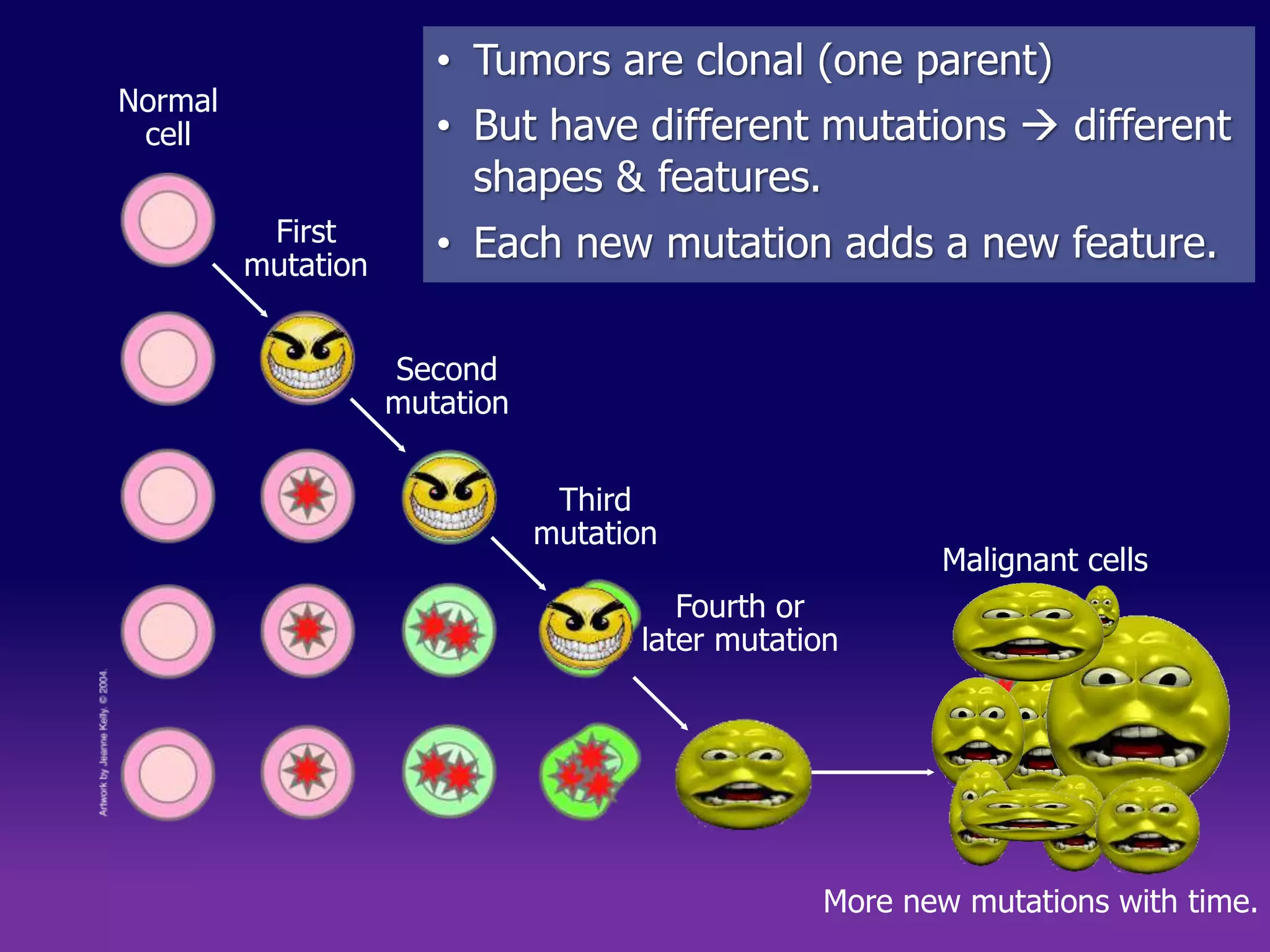
• Tumors are clonal (one parent) 
• But have different mutations  different 
shapes & features. 
• Each new mutation adds a new feature. 
Malignant cells 
Normal 
cell 
Fourth or 
Third 
mutation 
later mutation 
Second 
mutation 
First 
mutation 
More new mutations with time.
Neoplasia 
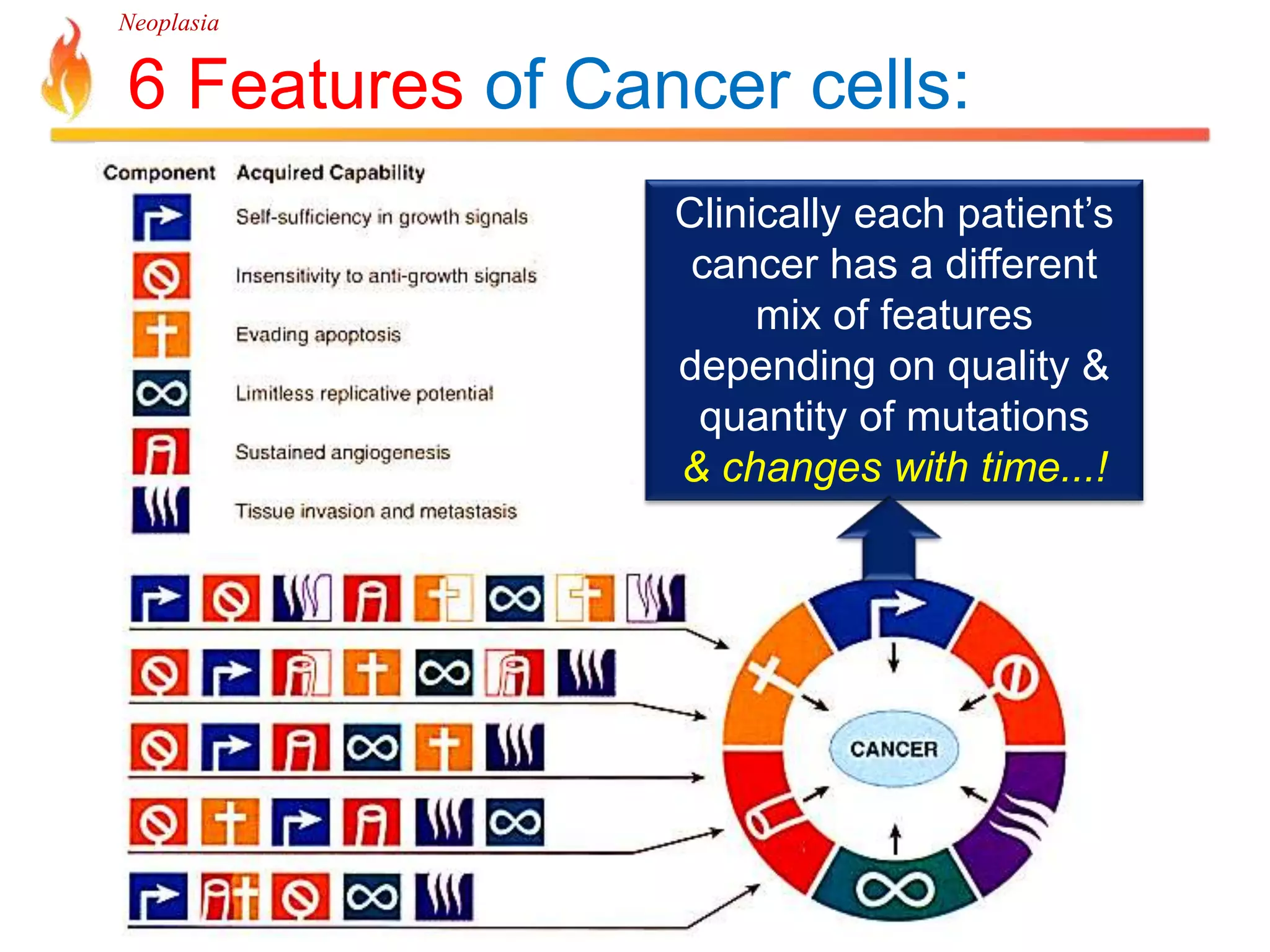
6 Features of Cancer cells: 
Clinically each patient’s 
cancer has a different 
mix of features 
depending on quality & 
quantity of mutations 
& changes with time...!
Neoplasia 
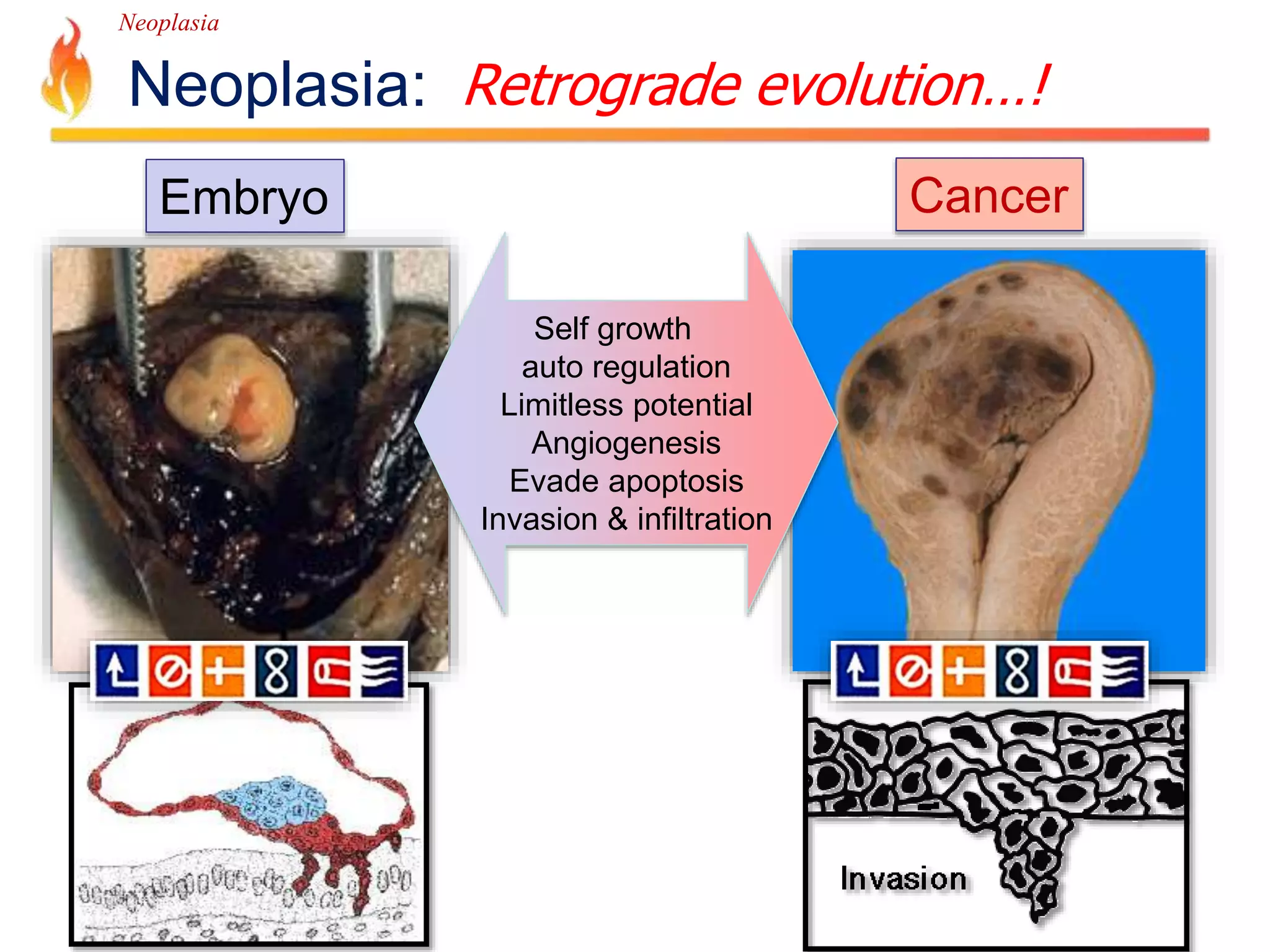
Neoplasia: 
Retrograde evolution…! 
Embryo Cancer 
Self growth 
auto regulation 
Limitless potential 
Angiogenesis 
Evade apoptosis 
Invasion & infiltration
Neoplasia 
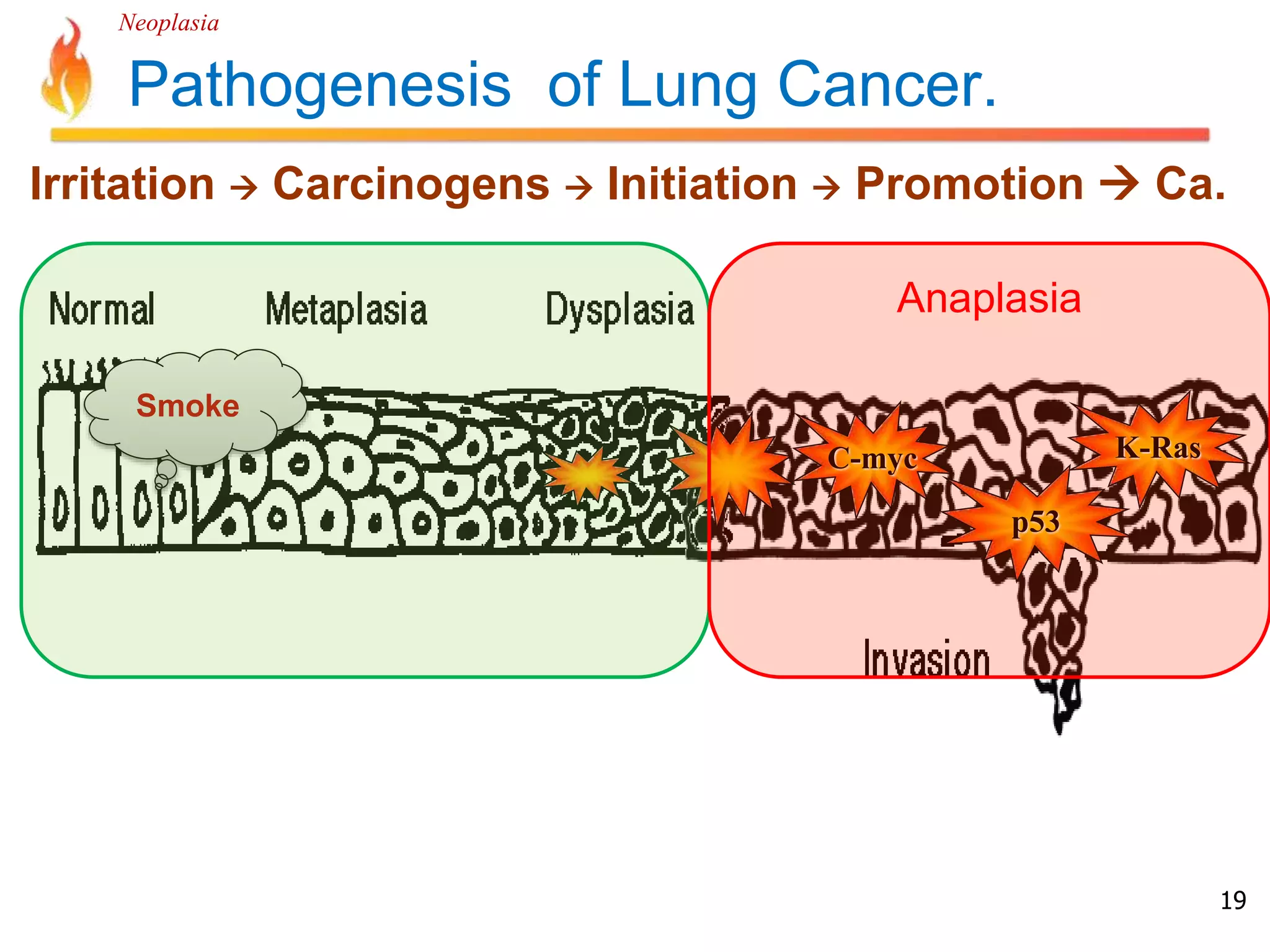
Irritation  Carcinogens  Initiation  Promotion  Ca. 
19 
Pathogenesis of Lung Cancer. 
C-myc K-Ras 
p53 
Smoke 
Anaplasia
Neoplasia 
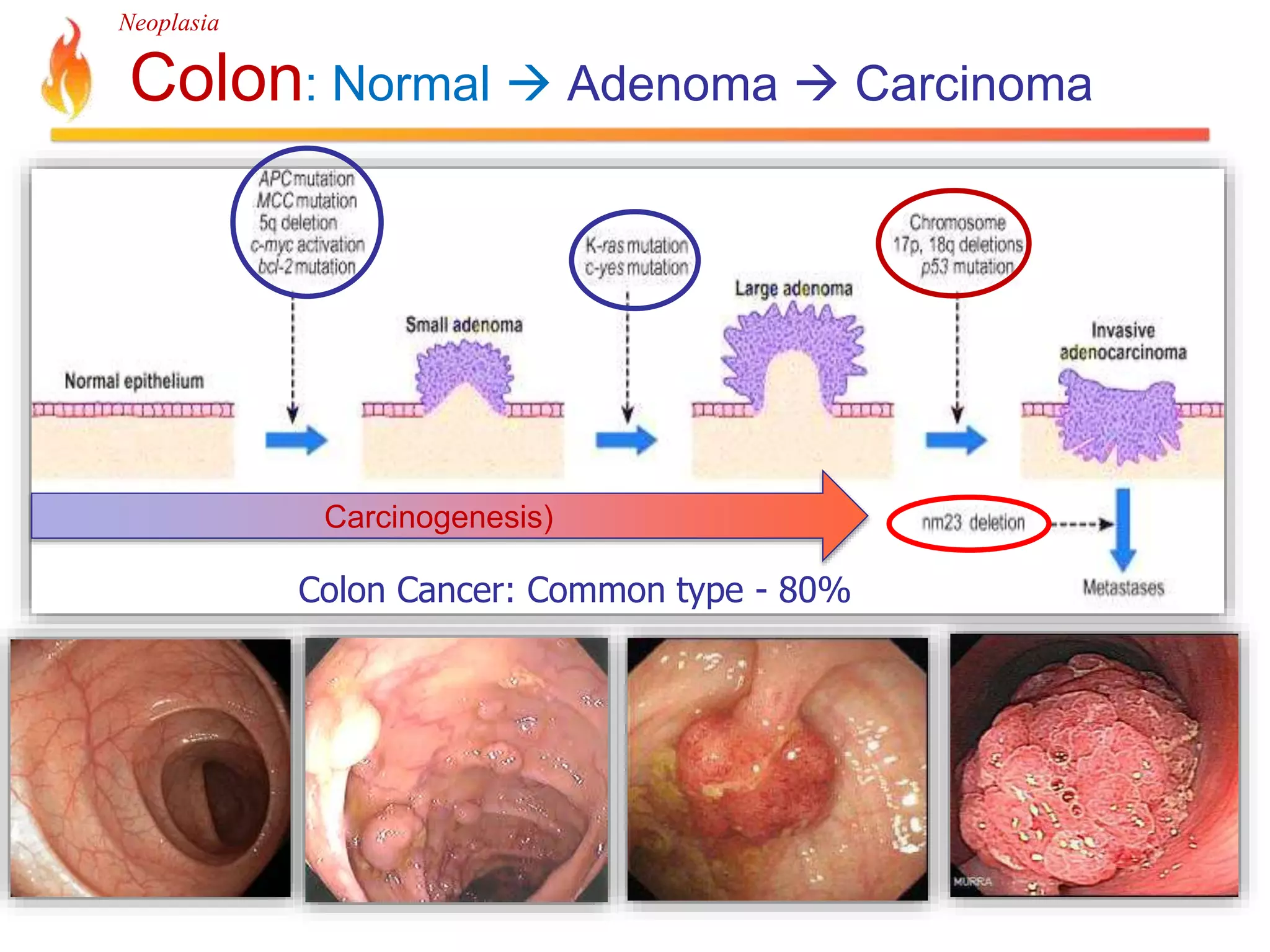
Colon: Normal  Adenoma  Carcinoma 
Carcinogenesis) 
Colon Cancer: Common type - 80%
Neoplasia 
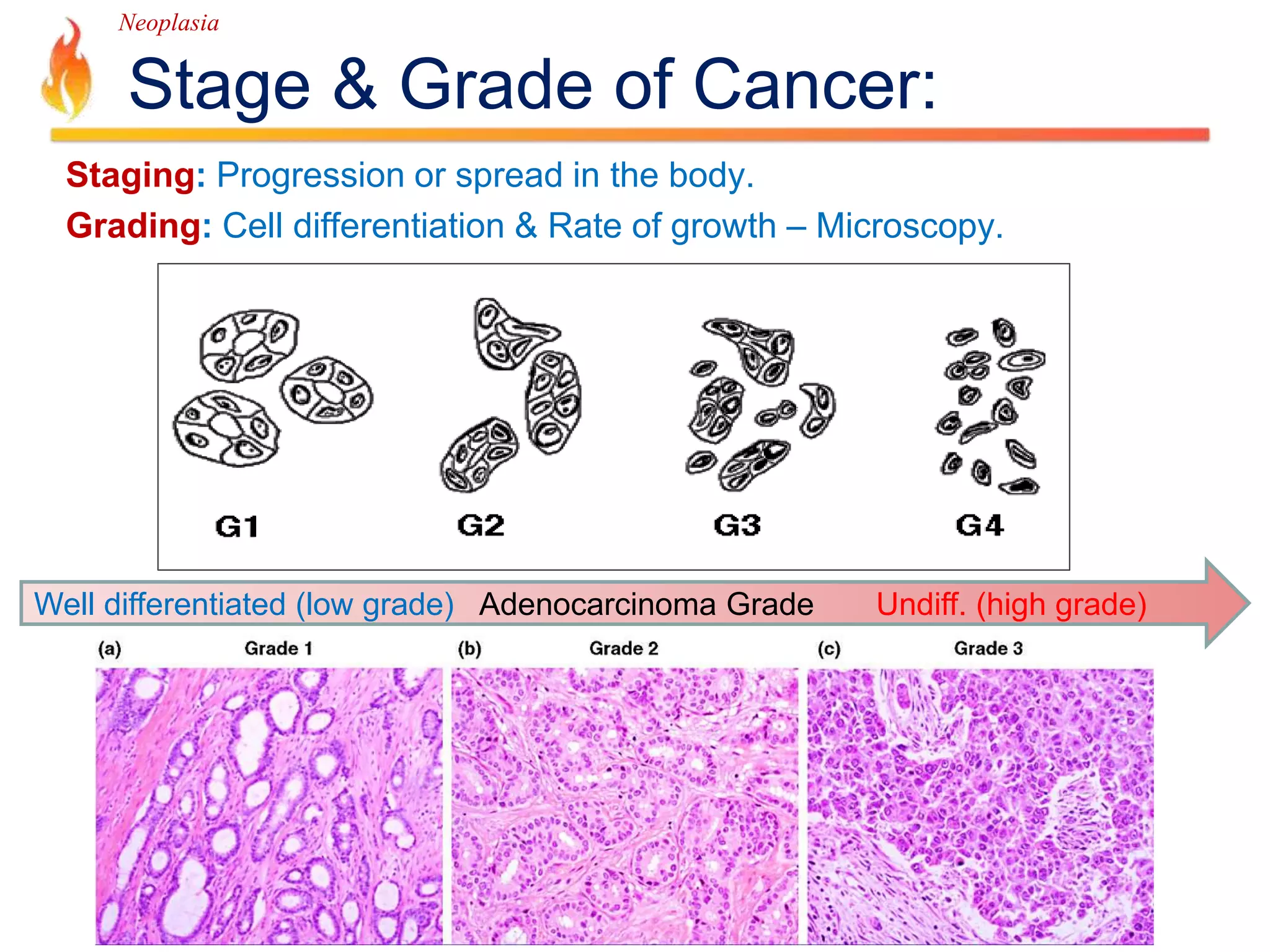
Stage & Grade of Cancer: 
Staging: Progression or spread in the body. 
Grading: Cell differentiation & Rate of growth – Microscopy. 
Well differentiated (low grade) Adenocarcinoma Grade Undiff. (high grade)
Neoplasia 
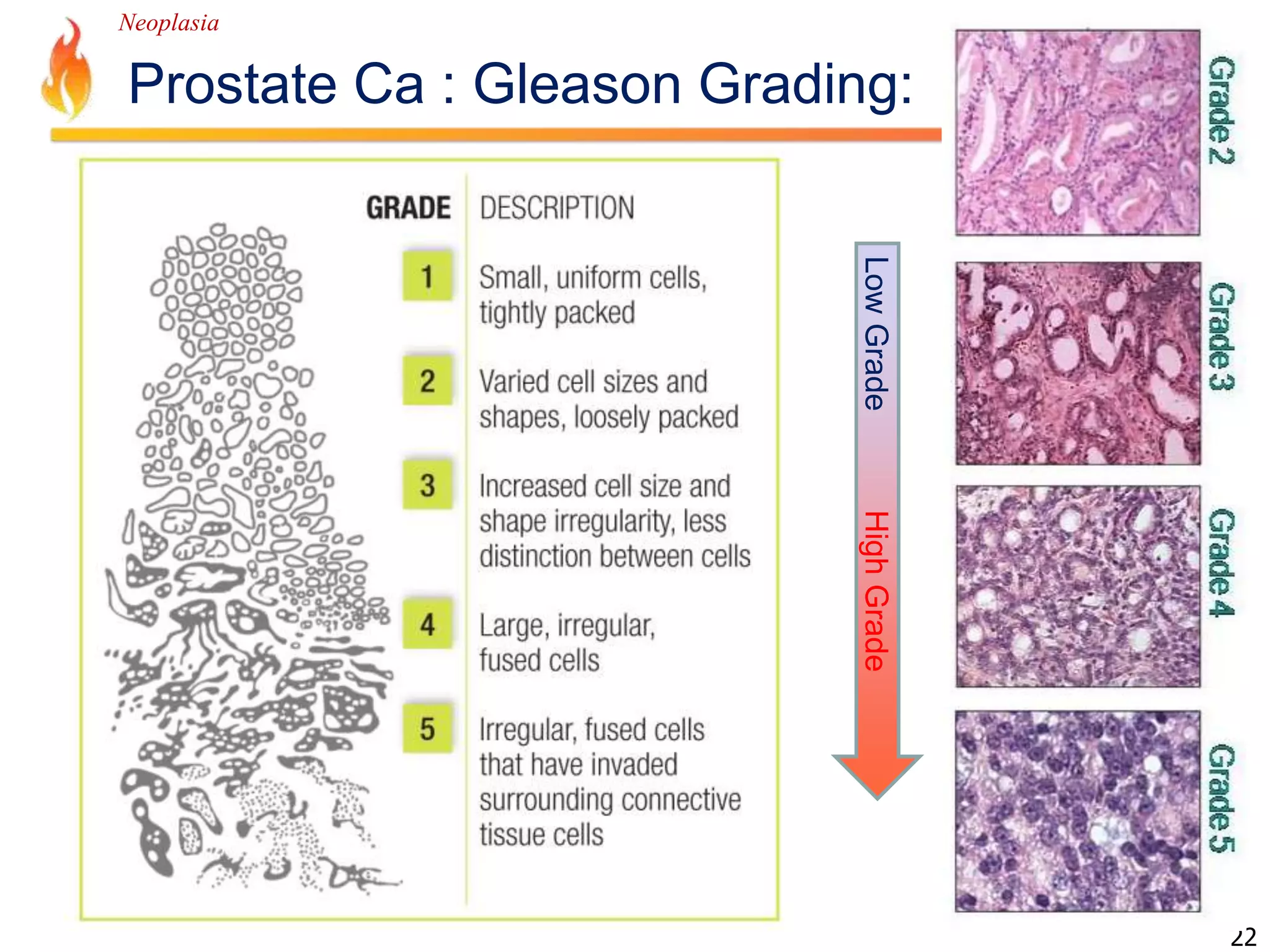
Prostate Ca : Gleason Grading: 
22 
Low Grade High Grade
“Beware of this world, for 
it is sweet and tempting.” 
Control your desires. 
— alsunna
Neoplasia 
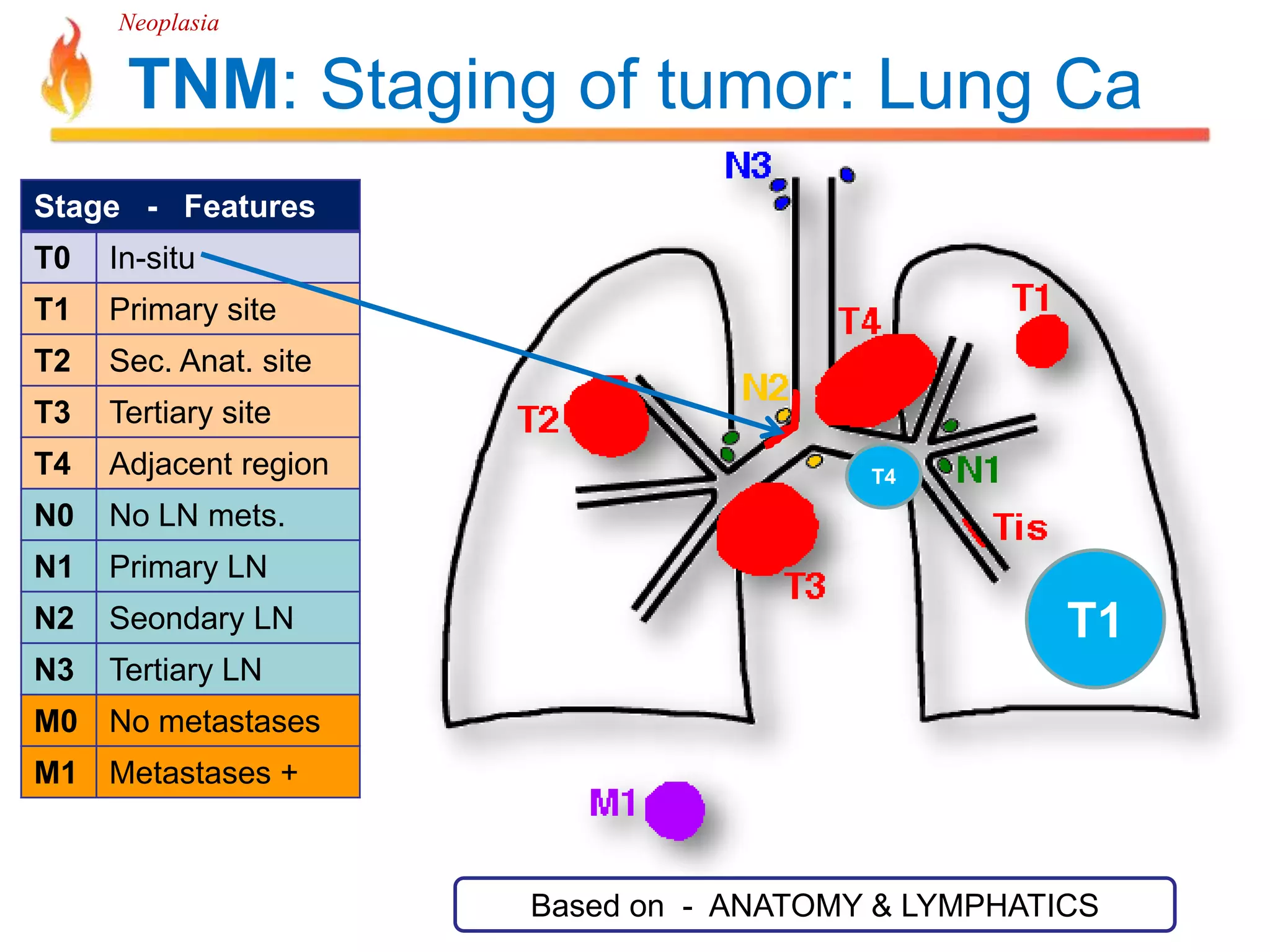
TNM: Staging of tumor: Lung Ca 
Stage - Features 
T0 In-situ 
T1 Primary site 
T2 Sec. Anat. site 
T3 Tertiary site 
T4 Adjacent region 
N0 No LN mets. 
N1 Primary LN 
N2 Seondary LN 
N3 Tertiary LN 
M0 No metastases 
M1 Metastases + 
T1 
T4 
Based on - ANATOMY & LYMPHATICS
Neoplasia 
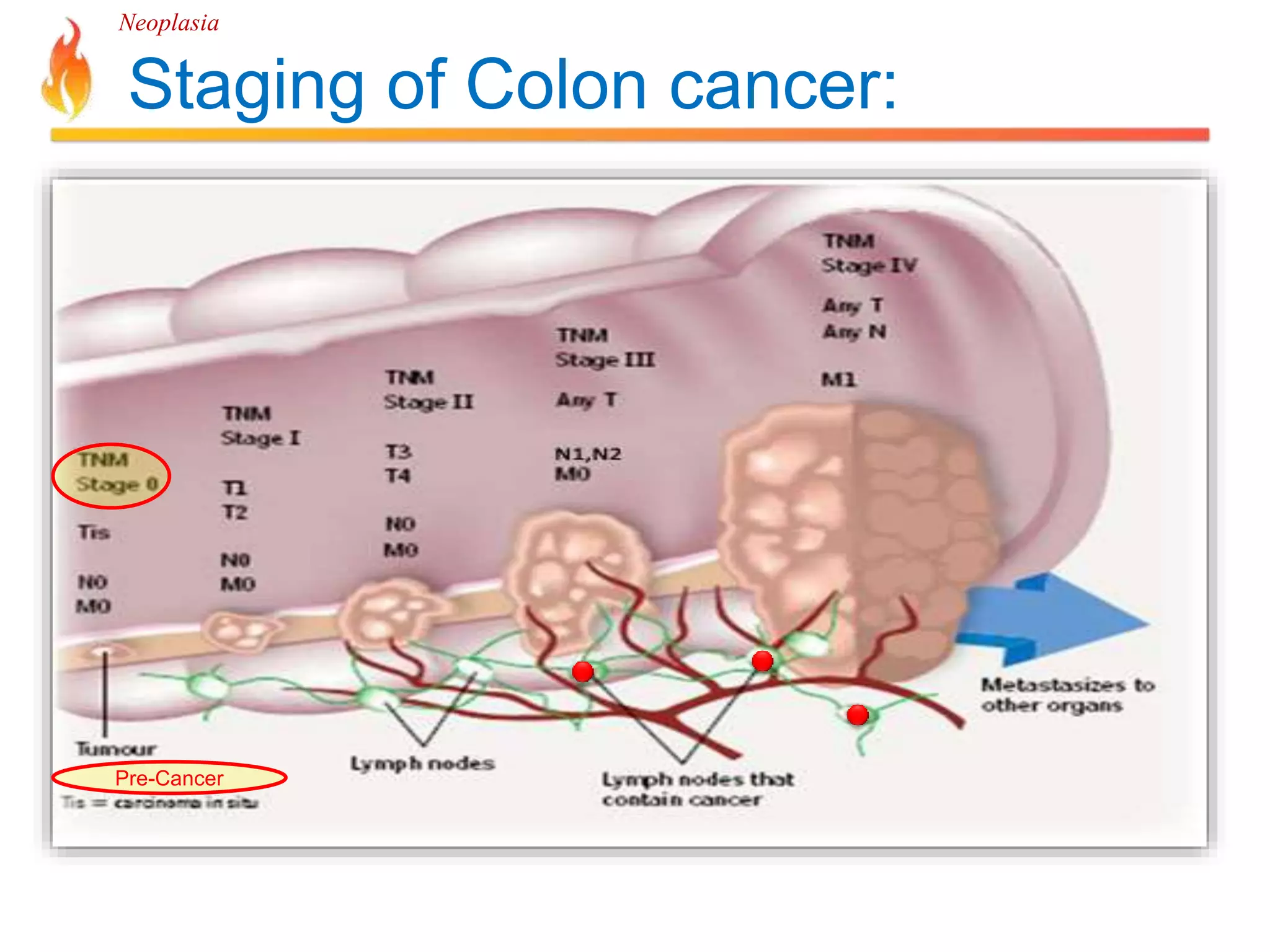
Staging of Colon cancer: 
Pre-Cancer
Neoplasia 
26 
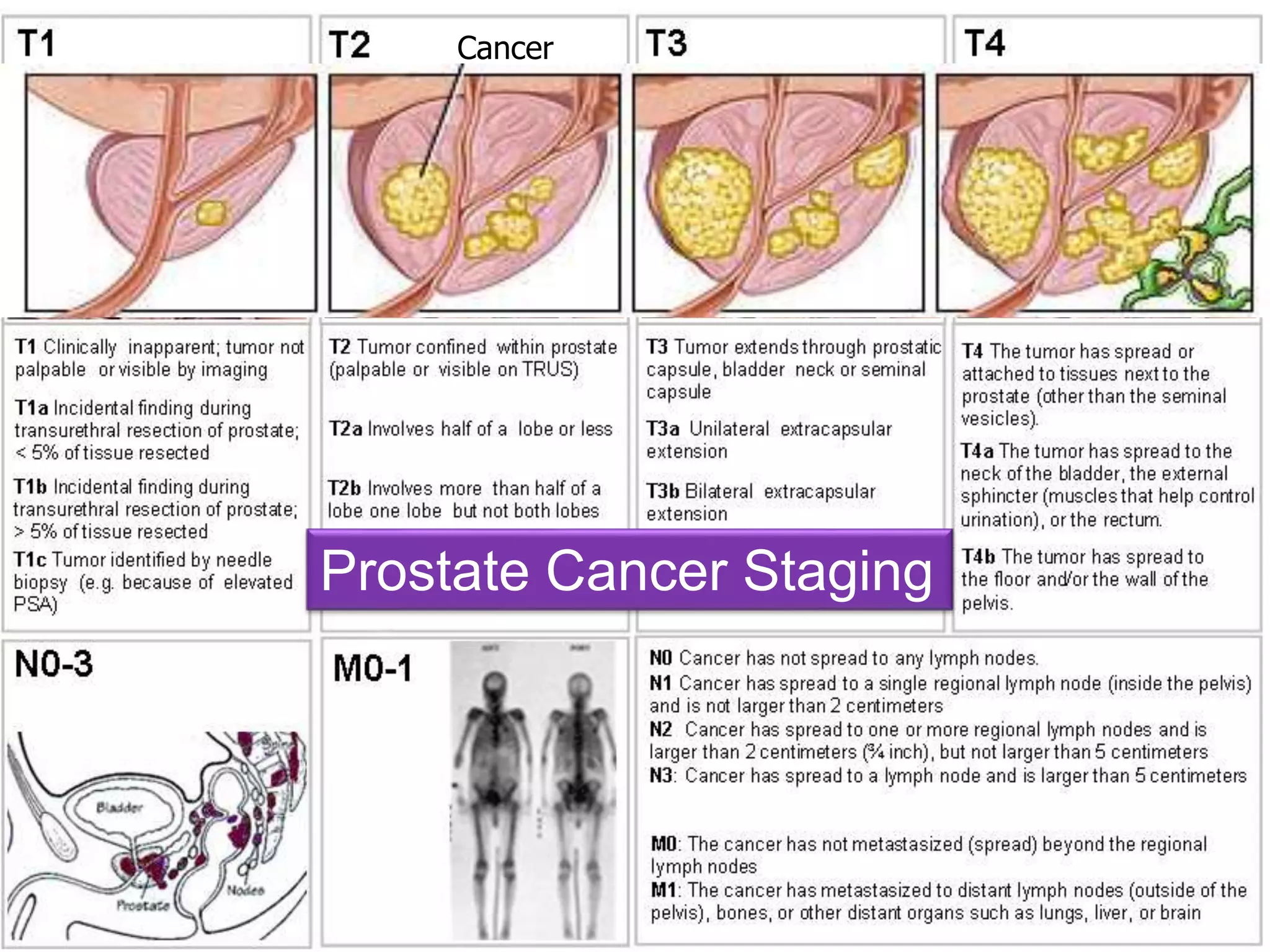
Cancer 
Prostate Cancer Staging
Neoplasia 
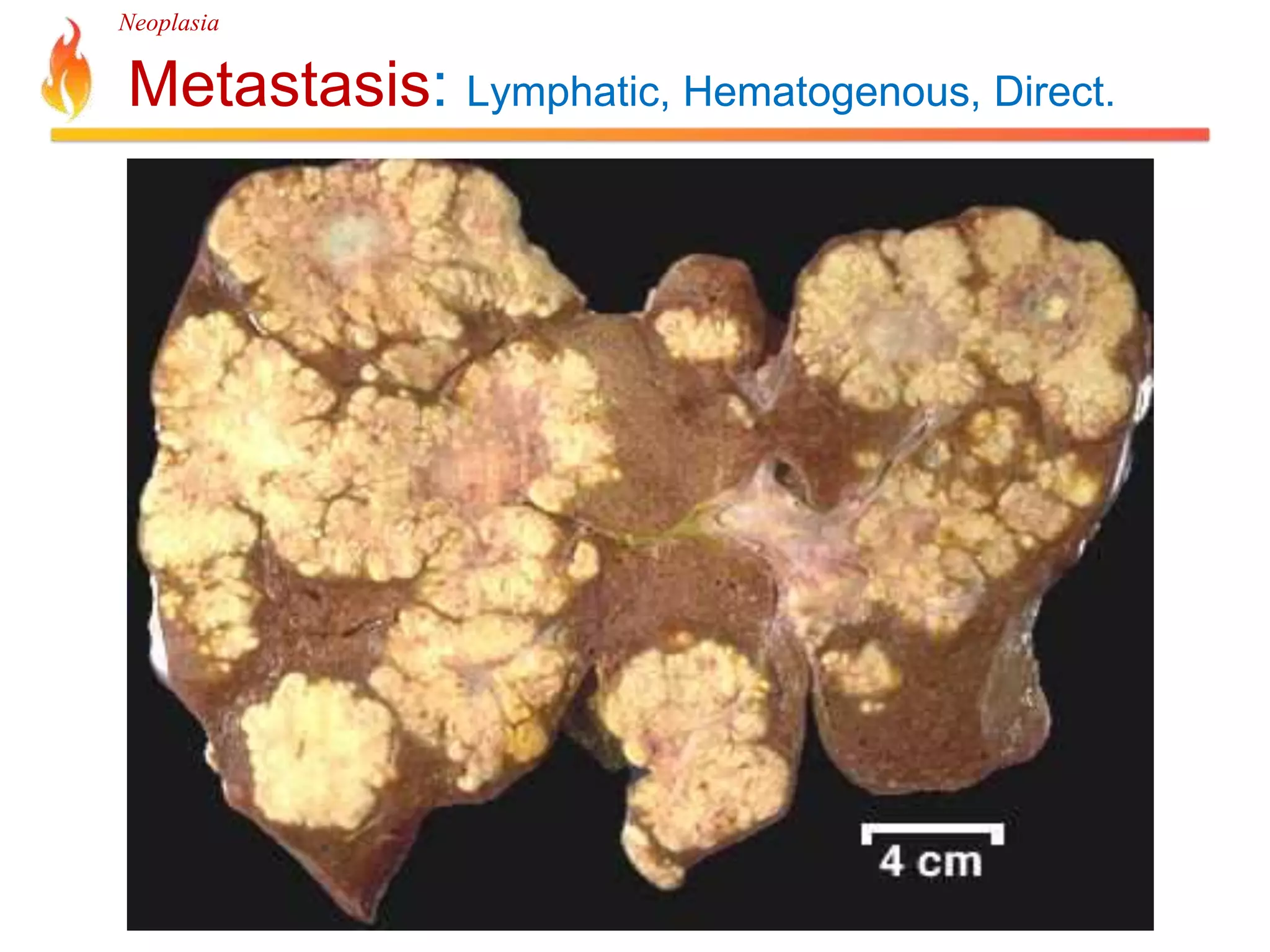
Metastasis: Lymphatic, Hematogenous, Direct.
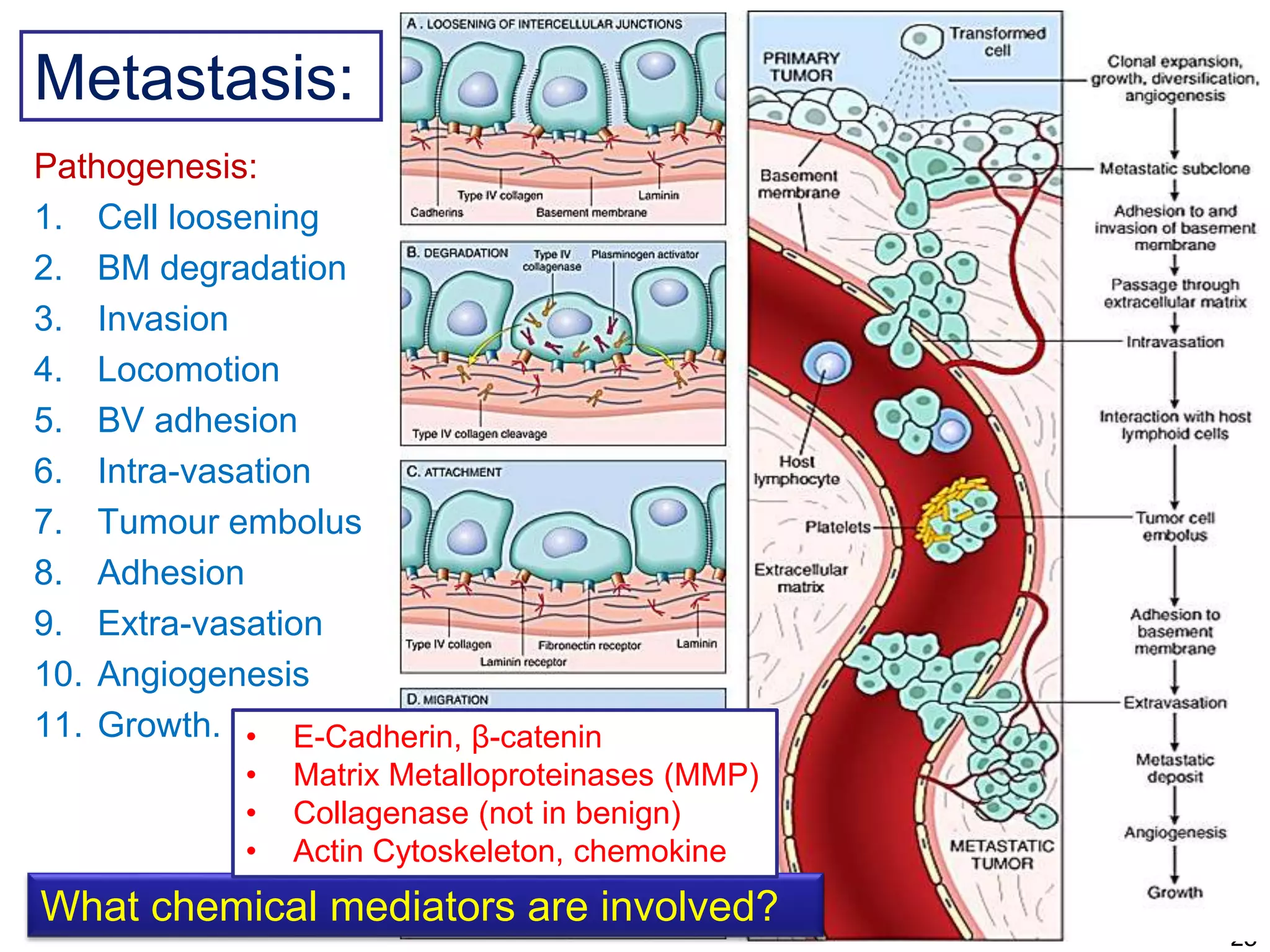
Metastasis: 
Pathogenesis: 
1. Cell loosening 
2. BM degradation 
3. Invasion 
4. Locomotion 
5. BV adhesion 
6. Intra-vasation 
7. Tumour embolus 
8. Adhesion 
9. Extra-vasation 
10. Angiogenesis 
11. Growth. 
28 
• E-Cadherin, β-catenin 
• Matrix Metalloproteinases (MMP) 
• Collagenase (not in benign) 
• Actin Cytoskeleton, chemokine 
What chemical mediators are involved?
Neoplasia 
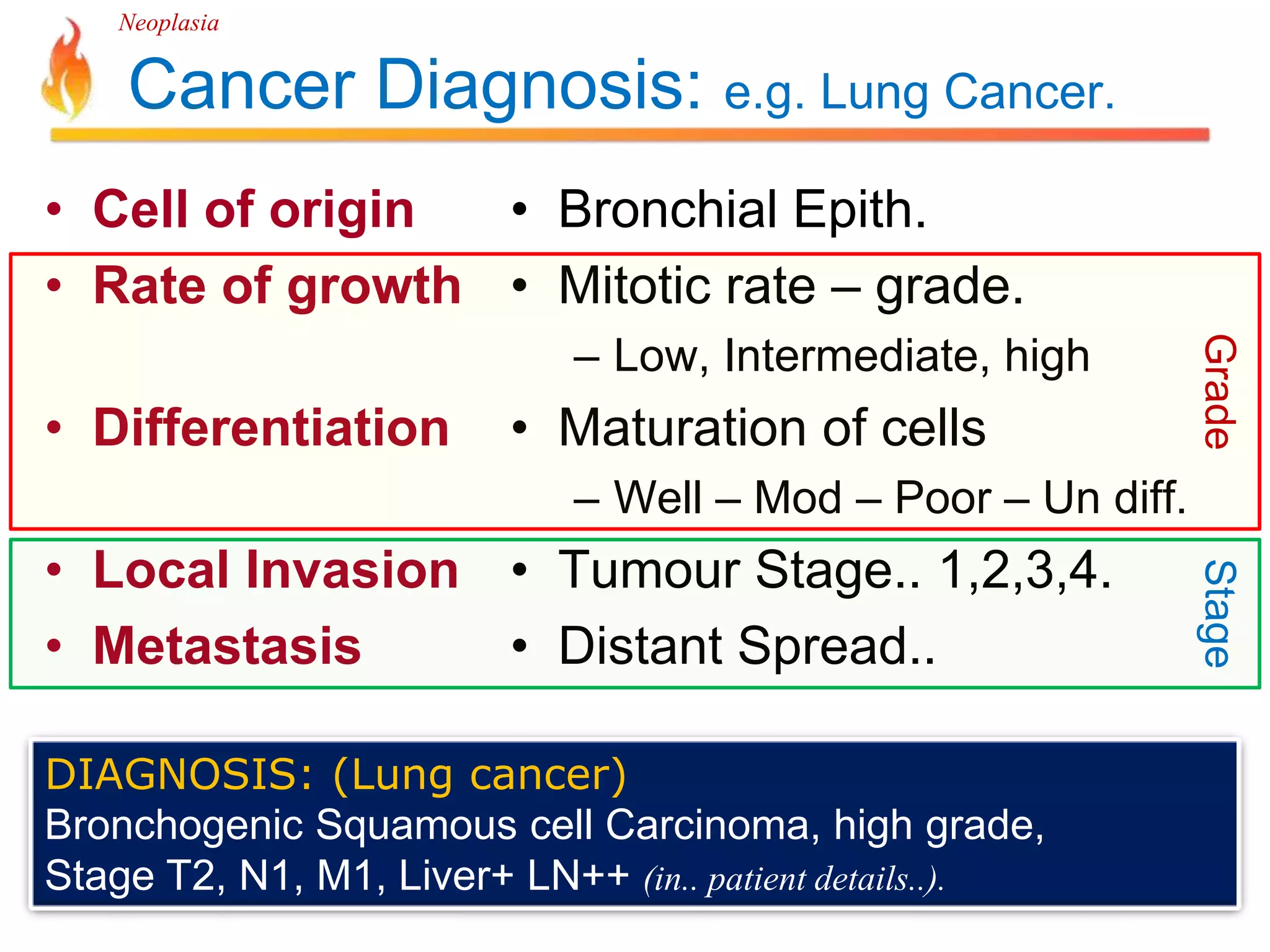
Cancer Diagnosis: e.g. Lung Cancer. 
• Cell of origin 
• Rate of growth 
• Differentiation 
• Local Invasion 
• Metastasis 
• Bronchial Epith. 
• Mitotic rate – grade. 
– Low, Intermediate, high 
• Maturation of cells 
– Well – Mod – Poor – Un diff. 
• Tumour Stage.. 1,2,3,4. 
• Distant Spread.. 
DIAGNOSIS: (Lung cancer) 
Bronchogenic Squamous cell Carcinoma, high grade, 
Stage T2, N1, M1, Liver+ LN++ (in.. patient details..). 
Grade Stage
“Our character is but the 
stamp on our souls of the free 
choices of good and evil we 
have made through life. 
-- John C. Geikie
“Good & Evil, Happiness and Misery, 
Merit and sin depend on our actions. 
As is the action, so is the result. It is 
easy & fun to indulge in sinful deeds 
but it is extremely painful to bear the 
results they yield” 
Karma - You reap what you sow! 
-- Baba
If diversity is a source of wonder, its opposite..! 
“Cultural supremacy, indeed, is a fire burning 
over the earth, taking with it plants and animals, 
cultures, languages, ancient skills and visionary 
wisdom. Quelling this flame, and re-inventing the 
poetry of diversity is perhaps the most important 
challenge of our times.” 
― Wade Davis

Pathology Lecture - Neoplasia

  • 1.
    “The world inwhich you were born is just one model of reality. Other cultures are not failed attempts at being you; they are unique manifestations of the human spirit, Just like you!” -- Wade Davis Antrhopologist
  • 2.
    Pathology of Neoplasia Dr. Venkatesh M. Shashidhar. A/Prof. & Head of Pathology
  • 3.
    Neoplasia Neoplasia: •Neo + Plasia  New + Growth. • Tumour  Swelling  any swelling* • Clinically tumour = neoplasm (technically incorrect..!) • Willis definition: “A neoplasm is an abnormal mass of tissue, the growth of which exceeds and is uncoordinated with that of the normal tissue and persists in the same manner after cessation of the stimuli which evoked the change” • “Cell division without control” • Irreversible DNA damage, resulting in autonomous growth of abnormal cells *
  • 4.
    Neoplasia Cell population/ Growth Control: • Proliferation  Differentiation  Apoptosis * Normal Stem cell Apoptosis Neoplasia Benign - Malignant Organ / Tissue Carcinogen Initiator + Promotor Inflam 1.Proto-Oncogenes (growth factors) 2.Growth/Tumor suppressor genes. 3.Genes controlling Apoptosis. 4.Genes controlling DNA Repair. RAS Rb MYC p53
  • 5.
    Neoplasia Growth Disorders: Non neoplastic Neoplastic (Polyclonal) (Monoclonal) Hyperplasia Hypertrophy Aplasia Atrophy Metaplasia Dysplasia Normal Adaptation Benign Malignant
  • 6.
    Neoplasia Cell divisionControl - Carcinogenesis*
  • 7.
  • 8.
    The mind iseverything. What you think you become! -- Buddha
  • 9.
    Neoplasia Clinical Pathology • Etiology (Carcinogenesis) • Pathogenesis • Morphology • Clinical Features (Cancer Biology)
  • 10.
    Neoplasia Benign -Malignant Necrosis 10 BENIGN • Well differentiated • Slow growth • Cohesive, • expansile • Capsule • No invasion/infiltration MALIGNANT • Poorly differentiated • Rapid growth • Non Cohesive, • No capsule • invasion/infiltration • Metastases.
  • 11.
    Neoplasia Neoplasms Nomenclature: Oma - Tumour Carcin-oma – Hard Tumour Sarc-oma - Soft Tumour Benign Malignant • Adenoma - Adencarcinoma • Papilloma - Squamous cell ca. • Fibroma - Fibrosarcoma • Osteoma - Osteosarcoma • Chondroma Chondrosarcoma • Lipoma Liposarcoma • Leiomyoma Leiomyosarcoma • Rhabdomyoma Rhabdomyosarcoma Cell of Origin • Gland. Epithelium • Lining. Epithelium • Fibroblast • Osteoblast • Chondrocyte • Lipocyte • Smooth muscle • Skeletal muscle
  • 12.
    Neoplasia Nomenclature: exceptions • Teratoma – Tumour of Germ cell – multiple tissues. Benign (mature) or malignant (immature) • Melanoma (Melano-carcinoma) – Malignancy of melanocytes. • Seminoma (Seminal carcinoma) –carcinoma of Testes. • Leukemia – white blood – Ca. of Haemopoietic stem cells. • Lymphoma (Lymphosarcoma)– Malignancy of lymphocytes. • Mixed Tumours: Both epithelial & connective tissue components. Pleomorphic adenoma (Salivary gland) & Carcinosarcoma (breast/uterus) What is a Granuloma, Hamartoma & Choristoma?
  • 13.
    The searching outand thorough investigation of truth ought to be the primary study of man. -- Cicero
  • 14.
    Cancer Clinical Features Cancer Biology
  • 15.
    Neoplasia Cancer Biology: • Structure: – Parenchyma – Neoplastic cells. – Stroma: Non neoplastic - normal DNA • Features: – Differentiation – Maturation of cells. – Rate of Growth – Mitotic rate / Ki 67 – Local invasion – Hemorrhage, necrosis, destruction – Metastasis – Distant Spread. 15
  • 16.
    • Tumors areclonal (one parent) • But have different mutations  different shapes & features. • Each new mutation adds a new feature. Malignant cells Normal cell Fourth or Third mutation later mutation Second mutation First mutation More new mutations with time.
  • 17.
    Neoplasia 6 Featuresof Cancer cells: Clinically each patient’s cancer has a different mix of features depending on quality & quantity of mutations & changes with time...!
  • 18.
    Neoplasia Neoplasia: Retrogradeevolution…! Embryo Cancer Self growth auto regulation Limitless potential Angiogenesis Evade apoptosis Invasion & infiltration
  • 19.
    Neoplasia Irritation Carcinogens  Initiation  Promotion  Ca. 19 Pathogenesis of Lung Cancer. C-myc K-Ras p53 Smoke Anaplasia
  • 20.
    Neoplasia Colon: Normal Adenoma  Carcinoma Carcinogenesis) Colon Cancer: Common type - 80%
  • 21.
    Neoplasia Stage &Grade of Cancer: Staging: Progression or spread in the body. Grading: Cell differentiation & Rate of growth – Microscopy. Well differentiated (low grade) Adenocarcinoma Grade Undiff. (high grade)
  • 22.
    Neoplasia Prostate Ca: Gleason Grading: 22 Low Grade High Grade
  • 23.
    “Beware of thisworld, for it is sweet and tempting.” Control your desires. — alsunna
  • 24.
    Neoplasia TNM: Stagingof tumor: Lung Ca Stage - Features T0 In-situ T1 Primary site T2 Sec. Anat. site T3 Tertiary site T4 Adjacent region N0 No LN mets. N1 Primary LN N2 Seondary LN N3 Tertiary LN M0 No metastases M1 Metastases + T1 T4 Based on - ANATOMY & LYMPHATICS
  • 25.
    Neoplasia Staging ofColon cancer: Pre-Cancer
  • 26.
    Neoplasia 26 Cancer Prostate Cancer Staging
  • 27.
    Neoplasia Metastasis: Lymphatic,Hematogenous, Direct.
  • 28.
    Metastasis: Pathogenesis: 1.Cell loosening 2. BM degradation 3. Invasion 4. Locomotion 5. BV adhesion 6. Intra-vasation 7. Tumour embolus 8. Adhesion 9. Extra-vasation 10. Angiogenesis 11. Growth. 28 • E-Cadherin, β-catenin • Matrix Metalloproteinases (MMP) • Collagenase (not in benign) • Actin Cytoskeleton, chemokine What chemical mediators are involved?
  • 29.
    Neoplasia Cancer Diagnosis:e.g. Lung Cancer. • Cell of origin • Rate of growth • Differentiation • Local Invasion • Metastasis • Bronchial Epith. • Mitotic rate – grade. – Low, Intermediate, high • Maturation of cells – Well – Mod – Poor – Un diff. • Tumour Stage.. 1,2,3,4. • Distant Spread.. DIAGNOSIS: (Lung cancer) Bronchogenic Squamous cell Carcinoma, high grade, Stage T2, N1, M1, Liver+ LN++ (in.. patient details..). Grade Stage
  • 30.
    “Our character isbut the stamp on our souls of the free choices of good and evil we have made through life. -- John C. Geikie
  • 31.
    “Good & Evil,Happiness and Misery, Merit and sin depend on our actions. As is the action, so is the result. It is easy & fun to indulge in sinful deeds but it is extremely painful to bear the results they yield” Karma - You reap what you sow! -- Baba
  • 32.
    If diversity isa source of wonder, its opposite..! “Cultural supremacy, indeed, is a fire burning over the earth, taking with it plants and animals, cultures, languages, ancient skills and visionary wisdom. Quelling this flame, and re-inventing the poetry of diversity is perhaps the most important challenge of our times.” ― Wade Davis