AMYLOIDOSIS
INRODUCTION
 Amyloidosis is a condition associated with a number
of disorders in which extracellular deposits of fibrillar
proteins are responsible for tissue damage and
functional compromise.
 These abnormal fibrils are produced by the
aggregation of improperly folded proteins.
 The fibrillar deposits bind a variety of proteoglycans
and glycosaminoglycans, which contain charged
sugar groups that give the deposits staining
properties characteristic of starch (amylose).
STRUCTURE OF AMYLOID
 Amyloids are formed of long unbranched fibres that
are characterized by a cross-beta sheet quaternary
structure in which antiparallel chains of β-stranded
peptides are arranged in an orientation perpendicular
to the axis of the fibre.
 Each individual fibre may be 7.5 to 10 nanometres in
width and a few micrometres in length.
 The fibrils may appear singly, , in laterally aggregated
bundles, or in an interlocking meshwork.
 In addition to these fibrils, P component is also
present. It is pentagonal, doughnut shaped and has
an external diameter of 9nm & an internal diameter of
 The P component constitutes nearly 10% of the
amyloid substance & is somewhat identical to alpha1
serum glycoprotein.
 It also has a striking structural homology with C
reactive protein, an acute phase reactant.
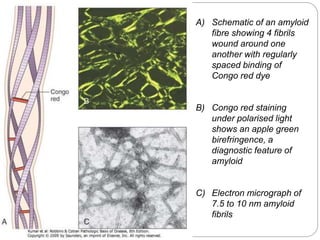
A) Schematic of an amyloid
fibre showing 4 fibrils
wound around one
another with regularly
spaced binding of
Congo red dye
B) Congo red staining
under polarised light
shows an apple green
birefringence, a
diagnostic feature of
amyloid
C) Electron micrograph of
7.5 to 10 nm amyloid
fibrils
PATHOGENESIS OF AMYLOD
DEPOSITION
 Amyloid deposits can occur in a variety of conditions ,
in each of which the protein composition is different.
 It is said that at least 30 different proteins can
aggregate to form fibrils with the appearance of
amyloid.
 Though the amyloid deposits have same morphologic
appearance, they are biochemically heterogeneous.
 95% of amyloid material consists of fibril proteins
while the remaining 5% consists of various
glycoproteins.
 The 3 most common forms of amyloid are:
 AL (amyloid light chain) amyloid is made up of
complete immunoglobulin light chains, the amino-
terminal fragments of light chains, or both.
 AA (amyloid associated) amyloid is composed of a
protein derived from a larger precursor in the blood
called SAA protein that is synthesised in the liver.
 Beta amyloid protein is a peptide that is derived by
proteolysis of Amyloid precursor protein.
CLASSIFICATION OF AMYLOIDOSIS &
MECHANISMS OF AMYLOID
FORMATION
 Amyloidosis results from abnormal folding of proteins,
which assume a beta pleated conformation,
aggregate, & deposit as fibrils in the extracellular
tissues.
 Usually these misfolded proteins are degraded by
proteasomes but in amyloidosis this mechanism fails
resulting in the extracellular deposition.
 The proteins that form amyloid fall into two categories:
 Normal proteins that have an inherent tendency to
associate & form fibrils when produced in
increased amounts.
 Amyloid may be systematic, involving several organ
systems or it may be localised to a single organ.
 On clinical grounds the systemic pattern is further
sub classified into:
 Primary Amyloidosis when it is associated with a
clonal plasma cell proliferation.
 Secondary Amyloidosis when it occurs as a
complication of an underlying chronic inflammation.
 Haemodialysis-associated Amyloidosis when
there is chronic renal failure.
 Hereditary or familial Amyloidosis constitutes a
separate, heterogeneous group with distinctive
pattern of organ involvement.
PRIMARY AMYLOIDOSIS / PLASMA
CELL PROLIFERATONS ASSOCIATED
WITH AMYLOIDOSIS
 Most common.
 AL type & systemic in distribution.
 Caused by clonal proliferation of plasma cells that
synthesize abnormal Ig molecules.
 Occurs in 5% to 15% of individuals associated with
multiple myeloma wherein the free, unpaired kappa or
lambda light chains are prone to aggregating &
depositing in tissues as amyloid.
 The possibility of lambda chains depositing is 6 times
that of the kappa chains.
REACTIVE SYSTEMIC AMYLOIOSIS /
SECONADRY AMYLOIDOSIS
 AA type & systemic in distribution.
 Secondary to an associated inflammatory
condition.
 Some of the conditions complicated are tuberculosis,
bronchiectasis, chronic osteomyelitis, rheumatoid
arthritis, ankylosing spondylitis, Crohn’s disease,
Renal cell carcinoma, Hodgkin lymphoma & ulcerative
colitis.
 Heroin abusers also have a high rate of occurrence.
 SAA synthesis is stimulated by IL-6 & IL-1
HAEMODIALYSIS-ASSOCIATED
AMYLOIDOSIS
 Patients on long term haemodialysis for renal failure
can develop amyloid deposits derived from beta2-
microglobulin which is present in high
concentrations in the serum of such individuals.
 This protein is present in high concentrations in the
serum of patients with renal disease & in the past it
was retained in circulation because it could not be
filtered through dialysis membranes.
 Classical features of this form of amyloidosis are:
 Scapulohumeral periarthritis
 Carpal Tunnel Syndrome
HEREDOFAMILIAL AMYLOIDOSIS
 AA type
 Most are rare & occur in limited geographical areas.
 The most common is an autosomal recessive
condition called Familial Mediterranean Fever. It is
an auto inflammatory syndrome associated with
excessive production of IL-1 in response to
inflammatory stimuli.
 It is characterised by attacks of fever accompanied
by peritonitis, pleuritis & synovitis.
 The genes for this encodes a protein called pyrin that
 In contrast, a group of autosomal dominant disorders
is characterised by deposition of amyloid derived
from mutant transthyretin.
 Such mutant polypeptides tend to deposit as amyloid
in various organs, sometimes in the peripheral nerves
(Familial Amyloidotic Polyneuropathies) & even in
the heart.
 Cardiomyopathy is seen in both homozygous &
heterozygous patients.
LOCALISED AMYLOIDOSIS
 Amyloid deposits are limited to a single organ or
tissue.
 The deposits may produce grossly visible nodular
masses or may be detectable only on microscopic
examination.
 The usual sites are the lungs, larynx, skin, urinary
bladder, etc.
 Frequently, there are lymphocytes & plasma cells
associated with these amyloid bodies.
 In some cases the amyloid consists of AL protein.
ENDOCRINE AMYLOID
 Microscopic deposits of localised amyloid are seen in
medullary carcinoma of the thyroid gland, islet
tumors of the pancreas, pheochromocytomas,
undifferentiated carcinomas of stomach & in the
Islets of Langerhans in individuals with type 2 DM,
etc.
 Here the amyloidogenic proteins are either derived
from the polypeptide hormones (medullary carcinoma)
or from unique proteins (islet amyloid polypeptide).
AMYLOID OF AGING
 Senile systemic amyloidosis refers to the systemic
deposition of amyloid in elderly patients.
 Due the dominant involvement & related dysfunction
of the heart, the above is also referred to as Senile
Cardiac Amyloidosis.
 Patients often present with restrictive cardiac
myopathy & arrhythmias.
 The amyloid is derived from normal TTR.
MORPHOLOGY
 There are no consistent or distinctive patterns of
organ or tissue distribution of amyloid deposits in any
of the categories cited.
 AA Amyloidosis – kidneys, liver, spleen, adrenals,
thyroid, lymph nodes
 AL Amyloidosis – heart, GIT, respiratory tract,
peripheral nerves, skin
 Familial Mediterranean Fever – kidneys, blood
vessels, spleen, respiratory tract.
 Macroscopically, the organ is enlarged & the tissue
appears gray and has a waxy, firm consistency.
 Histologically, the amyloid deposition is always
extracellular & begins between cells, often closely
adjacent to basement membranes.
 As the amyloid accumulates, it encroaches on the
cells, in time surrounding & destroying them.
 In the form associated with plasma cell proliferations,
perivascular & vascular deposits are common.
 KIDNEY
 Most common & potentially the most serious.
 Macroscopically, they may be of normal size &
colour, or in advanced cases, they may be shrunken
due to ischemia caused by vascular narrowing.
 Histologically, deposition is primarily in the
glomeruli, but the peritubular tissues & arteries are
also affected.
 Initially, the deposits appear as subtle thickenings
of mesangium accompanied by uneven widening
of the basement membrane.
 In time, these deposits along with the basement
membrane cause capillary narrowing & distortion.
 SPLEEN
 Inapparent grossly or may cause moderate to marked
splenomegaly.
 2 distinct patterns of deposition are seen:
 Sago spleen – deposits are largely limited to the
splenic follicles, producing tapioca-like granules on
gross inspection.
 Lardaceous spleen – amyloid involves the wall of the
splenic sinuses & connective tissue framework in the
red pulp. Fusion of early deposits gives rise to large,
maple-like areas of amyloidosis.
 LIVER
 Inapparent grossly & may cause moderate to marked
hepatomegaly.
 First appears in the Space of Disse & then
progressively encroaches on the adjacent
parenchymal cells and sinusoids.
 In time, deformity, pressure atrophy &
disappearance of hepatocytes occur leading to
complete replacement of the liver parenchyma.
 Vascular involvement & deposits is Kupffer cells are
frequent.
 Liver function is usually preserved.
 HEART
 Can occur in any form of systemic amyloidosis.
 Major organ involved in Senile Systemic Amyloidosis.
 Heart may be enlarged & firm but often shows no
change in appearance.
 Histologically, the deposits begin as focal
subendothelial accumulations & within the
myocardium in between the muscle fibres.
 Expansion eventually causes pressure atrophy.
 The conduction system may also be damaged & ECG
 OTHER ORGANS
 Nodular deposits in the tongue may cause
macroglossia – tumor-forming amyloid of the tongue.
 The respiratory tract may be involved focally or
diffusely from the larynx down to the smallest
bronchiole.
 A distinct form of amyloid is found in the brains of
patients with Alzheimer’s Disease.
 Amyloidosis of peripheral & autonomic nerves is
common in many forms of familial amyloidotic
neuropathies.
Amyloidosis of GIT Amyloidosis of
peripheral
CLINICAL FEATURES
 The symptoms depend on the magnitude of the
deposits & on the sites or organs involved.
 Initially, the symptoms are non specific – weakness,
light headedness, syncope, etc. Later, the
symptoms are more often related to renal, cardiac &
gastrointestinal involvement.
 Renal involvement gives rise to proteinuria that
may be severe enough to cause Nephrotic
Syndrome. Progressive obliteration of the glomeruli
in advanced cases leads to renal failure (common
cause of death) & uraemia.
 Cardiac amyloidosis may present as congestive
cardiac failure. The most serious aspects are
conduction disturbances & arrhythmias.
Restrictive cardiomyopathy & chronic constrictive
pericarditis is also seen.
 Gastrointestinal amyloidosis may be asymptomatic,
or it may be present in a variety of ways.
 Amyloidosis of the tongue – hampering of speech &
swallowing.
 Depositions in the stomach & intestine –
malabsorption, diarrhoea, digestive disturbances.
 Vascular amyloidosis may lead to bleeding. AL
amyloid binds & inactivates factor X leading to a life
threatening bleeding disorder.
DIAGNOSIS
 Depends on the histological demonstration of
amyloid deposits in tissues.
 The most common sites biopsied are kidney (when
renal manifestations are present) or rectal/gingival
tissues (systemic amyloidosis)
 In H&E stains, the amyloid appears as an
amorphous, eosinophilic, hyaline, extracellular
substance.
 Under ordinary light, Congo Red stain gives a pink
or red colour to tissue deposits while in polarising
 Examination of abdominal fat aspirates stained with
Congo Red is used for the diagnosis of systemic
amyloidosis.
 Serum & urine protein electrophoresis and
immunophoresis should be performed for suspected
cases of AL amyloidosis. Bone marrow aspirates in
such cases also show a monoclonal population of
plasma cells.
 Scintigraphy with radio labelled serum amyloid P
(SAP) component is a rapid & specific test. It also
gives a measure of the extent of amyloidosis & can be
used to follow patients undergoing treatment.
 Mass spectroscopy is also a useful tool for the
A) Congo red staining – pink red
deposits of amyloid
B) Yellow green
birefringence under a
polarising microscope
TREATMENT
 There is no cure for amyloidosis. But treatment can
help manage signs and symptoms and limit further
production of amyloid protein.
 Specific treatments depend on the type of amyloidosis
and target the source of the amyloid production.
 AL amyloidosis: Many of the same chemotherapy
medications that treat multiple myeloma are used in
AL amyloidosis to stop the growth of abnormal cells
that produce amyloid.
 Autologous blood stem cell transplant (ASCT) offers
an additional treatment option in some cases. This
procedure involves collecting stem cells from the
blood and storing them for a short time while on high-
 AA amyloidosis: Treatments target the underlying
condition — for example, an anti-inflammatory
medication to treat rheumatoid arthritis.
 Hereditary amyloidosis: Liver transplantation may
be an option because the protein that causes this
form of amyloidosis is made in the liver.
 Dialysis-related amyloidosis: Treatments include
changing your mode of dialysis or having a kidney
transplant.
 Apart from this supportive care can also be provided
– pain medication, low salt diet, blood thinning
medication, medications to control the heart rate, etc.
PROGNOSIS
 Poor prognosis for generalised amyloidosis.
 Very poor prognosis for myeloma associated
amyloidosis.
 Patients with AL amyloidosis have a median survival of
2 years after diagnosis.
 Somewhat better prognosis for patients with reactive
systemic amyloidosis.
 Resorption of amyloid after treatment is a rare occurrence.
 Therapeutic strategies aimed at correcting protein
misfolding & inhibiting fibrillogenesis are being
THANK YOU

Amyloidosis

  • 1.
  • 2.
    INRODUCTION  Amyloidosis isa condition associated with a number of disorders in which extracellular deposits of fibrillar proteins are responsible for tissue damage and functional compromise.  These abnormal fibrils are produced by the aggregation of improperly folded proteins.  The fibrillar deposits bind a variety of proteoglycans and glycosaminoglycans, which contain charged sugar groups that give the deposits staining properties characteristic of starch (amylose).
  • 3.
    STRUCTURE OF AMYLOID Amyloids are formed of long unbranched fibres that are characterized by a cross-beta sheet quaternary structure in which antiparallel chains of β-stranded peptides are arranged in an orientation perpendicular to the axis of the fibre.  Each individual fibre may be 7.5 to 10 nanometres in width and a few micrometres in length.  The fibrils may appear singly, , in laterally aggregated bundles, or in an interlocking meshwork.  In addition to these fibrils, P component is also present. It is pentagonal, doughnut shaped and has an external diameter of 9nm & an internal diameter of
  • 4.
     The Pcomponent constitutes nearly 10% of the amyloid substance & is somewhat identical to alpha1 serum glycoprotein.  It also has a striking structural homology with C reactive protein, an acute phase reactant.
  • 5.
    A) Schematic ofan amyloid fibre showing 4 fibrils wound around one another with regularly spaced binding of Congo red dye B) Congo red staining under polarised light shows an apple green birefringence, a diagnostic feature of amyloid C) Electron micrograph of 7.5 to 10 nm amyloid fibrils
  • 6.
    PATHOGENESIS OF AMYLOD DEPOSITION Amyloid deposits can occur in a variety of conditions , in each of which the protein composition is different.  It is said that at least 30 different proteins can aggregate to form fibrils with the appearance of amyloid.  Though the amyloid deposits have same morphologic appearance, they are biochemically heterogeneous.  95% of amyloid material consists of fibril proteins while the remaining 5% consists of various glycoproteins.
  • 7.
     The 3most common forms of amyloid are:  AL (amyloid light chain) amyloid is made up of complete immunoglobulin light chains, the amino- terminal fragments of light chains, or both.  AA (amyloid associated) amyloid is composed of a protein derived from a larger precursor in the blood called SAA protein that is synthesised in the liver.  Beta amyloid protein is a peptide that is derived by proteolysis of Amyloid precursor protein.
  • 9.
    CLASSIFICATION OF AMYLOIDOSIS& MECHANISMS OF AMYLOID FORMATION  Amyloidosis results from abnormal folding of proteins, which assume a beta pleated conformation, aggregate, & deposit as fibrils in the extracellular tissues.  Usually these misfolded proteins are degraded by proteasomes but in amyloidosis this mechanism fails resulting in the extracellular deposition.  The proteins that form amyloid fall into two categories:  Normal proteins that have an inherent tendency to associate & form fibrils when produced in increased amounts.
  • 10.
     Amyloid maybe systematic, involving several organ systems or it may be localised to a single organ.  On clinical grounds the systemic pattern is further sub classified into:  Primary Amyloidosis when it is associated with a clonal plasma cell proliferation.  Secondary Amyloidosis when it occurs as a complication of an underlying chronic inflammation.  Haemodialysis-associated Amyloidosis when there is chronic renal failure.  Hereditary or familial Amyloidosis constitutes a separate, heterogeneous group with distinctive pattern of organ involvement.
  • 12.
    PRIMARY AMYLOIDOSIS /PLASMA CELL PROLIFERATONS ASSOCIATED WITH AMYLOIDOSIS  Most common.  AL type & systemic in distribution.  Caused by clonal proliferation of plasma cells that synthesize abnormal Ig molecules.  Occurs in 5% to 15% of individuals associated with multiple myeloma wherein the free, unpaired kappa or lambda light chains are prone to aggregating & depositing in tissues as amyloid.  The possibility of lambda chains depositing is 6 times that of the kappa chains.
  • 13.
    REACTIVE SYSTEMIC AMYLOIOSIS/ SECONADRY AMYLOIDOSIS  AA type & systemic in distribution.  Secondary to an associated inflammatory condition.  Some of the conditions complicated are tuberculosis, bronchiectasis, chronic osteomyelitis, rheumatoid arthritis, ankylosing spondylitis, Crohn’s disease, Renal cell carcinoma, Hodgkin lymphoma & ulcerative colitis.  Heroin abusers also have a high rate of occurrence.  SAA synthesis is stimulated by IL-6 & IL-1
  • 14.
    HAEMODIALYSIS-ASSOCIATED AMYLOIDOSIS  Patients onlong term haemodialysis for renal failure can develop amyloid deposits derived from beta2- microglobulin which is present in high concentrations in the serum of such individuals.  This protein is present in high concentrations in the serum of patients with renal disease & in the past it was retained in circulation because it could not be filtered through dialysis membranes.  Classical features of this form of amyloidosis are:  Scapulohumeral periarthritis  Carpal Tunnel Syndrome
  • 15.
    HEREDOFAMILIAL AMYLOIDOSIS  AAtype  Most are rare & occur in limited geographical areas.  The most common is an autosomal recessive condition called Familial Mediterranean Fever. It is an auto inflammatory syndrome associated with excessive production of IL-1 in response to inflammatory stimuli.  It is characterised by attacks of fever accompanied by peritonitis, pleuritis & synovitis.  The genes for this encodes a protein called pyrin that
  • 16.
     In contrast,a group of autosomal dominant disorders is characterised by deposition of amyloid derived from mutant transthyretin.  Such mutant polypeptides tend to deposit as amyloid in various organs, sometimes in the peripheral nerves (Familial Amyloidotic Polyneuropathies) & even in the heart.  Cardiomyopathy is seen in both homozygous & heterozygous patients.
  • 17.
    LOCALISED AMYLOIDOSIS  Amyloiddeposits are limited to a single organ or tissue.  The deposits may produce grossly visible nodular masses or may be detectable only on microscopic examination.  The usual sites are the lungs, larynx, skin, urinary bladder, etc.  Frequently, there are lymphocytes & plasma cells associated with these amyloid bodies.  In some cases the amyloid consists of AL protein.
  • 18.
    ENDOCRINE AMYLOID  Microscopicdeposits of localised amyloid are seen in medullary carcinoma of the thyroid gland, islet tumors of the pancreas, pheochromocytomas, undifferentiated carcinomas of stomach & in the Islets of Langerhans in individuals with type 2 DM, etc.  Here the amyloidogenic proteins are either derived from the polypeptide hormones (medullary carcinoma) or from unique proteins (islet amyloid polypeptide).
  • 19.
    AMYLOID OF AGING Senile systemic amyloidosis refers to the systemic deposition of amyloid in elderly patients.  Due the dominant involvement & related dysfunction of the heart, the above is also referred to as Senile Cardiac Amyloidosis.  Patients often present with restrictive cardiac myopathy & arrhythmias.  The amyloid is derived from normal TTR.
  • 20.
    MORPHOLOGY  There areno consistent or distinctive patterns of organ or tissue distribution of amyloid deposits in any of the categories cited.  AA Amyloidosis – kidneys, liver, spleen, adrenals, thyroid, lymph nodes  AL Amyloidosis – heart, GIT, respiratory tract, peripheral nerves, skin  Familial Mediterranean Fever – kidneys, blood vessels, spleen, respiratory tract.  Macroscopically, the organ is enlarged & the tissue appears gray and has a waxy, firm consistency.
  • 21.
     Histologically, theamyloid deposition is always extracellular & begins between cells, often closely adjacent to basement membranes.  As the amyloid accumulates, it encroaches on the cells, in time surrounding & destroying them.  In the form associated with plasma cell proliferations, perivascular & vascular deposits are common.
  • 22.
     KIDNEY  Mostcommon & potentially the most serious.  Macroscopically, they may be of normal size & colour, or in advanced cases, they may be shrunken due to ischemia caused by vascular narrowing.  Histologically, deposition is primarily in the glomeruli, but the peritubular tissues & arteries are also affected.  Initially, the deposits appear as subtle thickenings of mesangium accompanied by uneven widening of the basement membrane.  In time, these deposits along with the basement membrane cause capillary narrowing & distortion.
  • 24.
     SPLEEN  Inapparentgrossly or may cause moderate to marked splenomegaly.  2 distinct patterns of deposition are seen:  Sago spleen – deposits are largely limited to the splenic follicles, producing tapioca-like granules on gross inspection.  Lardaceous spleen – amyloid involves the wall of the splenic sinuses & connective tissue framework in the red pulp. Fusion of early deposits gives rise to large, maple-like areas of amyloidosis.
  • 26.
     LIVER  Inapparentgrossly & may cause moderate to marked hepatomegaly.  First appears in the Space of Disse & then progressively encroaches on the adjacent parenchymal cells and sinusoids.  In time, deformity, pressure atrophy & disappearance of hepatocytes occur leading to complete replacement of the liver parenchyma.  Vascular involvement & deposits is Kupffer cells are frequent.  Liver function is usually preserved.
  • 28.
     HEART  Canoccur in any form of systemic amyloidosis.  Major organ involved in Senile Systemic Amyloidosis.  Heart may be enlarged & firm but often shows no change in appearance.  Histologically, the deposits begin as focal subendothelial accumulations & within the myocardium in between the muscle fibres.  Expansion eventually causes pressure atrophy.  The conduction system may also be damaged & ECG
  • 30.
     OTHER ORGANS Nodular deposits in the tongue may cause macroglossia – tumor-forming amyloid of the tongue.  The respiratory tract may be involved focally or diffusely from the larynx down to the smallest bronchiole.  A distinct form of amyloid is found in the brains of patients with Alzheimer’s Disease.  Amyloidosis of peripheral & autonomic nerves is common in many forms of familial amyloidotic neuropathies.
  • 31.
    Amyloidosis of GITAmyloidosis of peripheral
  • 32.
    CLINICAL FEATURES  Thesymptoms depend on the magnitude of the deposits & on the sites or organs involved.  Initially, the symptoms are non specific – weakness, light headedness, syncope, etc. Later, the symptoms are more often related to renal, cardiac & gastrointestinal involvement.  Renal involvement gives rise to proteinuria that may be severe enough to cause Nephrotic Syndrome. Progressive obliteration of the glomeruli in advanced cases leads to renal failure (common cause of death) & uraemia.
  • 33.
     Cardiac amyloidosismay present as congestive cardiac failure. The most serious aspects are conduction disturbances & arrhythmias. Restrictive cardiomyopathy & chronic constrictive pericarditis is also seen.  Gastrointestinal amyloidosis may be asymptomatic, or it may be present in a variety of ways.  Amyloidosis of the tongue – hampering of speech & swallowing.  Depositions in the stomach & intestine – malabsorption, diarrhoea, digestive disturbances.  Vascular amyloidosis may lead to bleeding. AL amyloid binds & inactivates factor X leading to a life threatening bleeding disorder.
  • 34.
    DIAGNOSIS  Depends onthe histological demonstration of amyloid deposits in tissues.  The most common sites biopsied are kidney (when renal manifestations are present) or rectal/gingival tissues (systemic amyloidosis)  In H&E stains, the amyloid appears as an amorphous, eosinophilic, hyaline, extracellular substance.  Under ordinary light, Congo Red stain gives a pink or red colour to tissue deposits while in polarising
  • 35.
     Examination ofabdominal fat aspirates stained with Congo Red is used for the diagnosis of systemic amyloidosis.  Serum & urine protein electrophoresis and immunophoresis should be performed for suspected cases of AL amyloidosis. Bone marrow aspirates in such cases also show a monoclonal population of plasma cells.  Scintigraphy with radio labelled serum amyloid P (SAP) component is a rapid & specific test. It also gives a measure of the extent of amyloidosis & can be used to follow patients undergoing treatment.  Mass spectroscopy is also a useful tool for the
  • 36.
    A) Congo redstaining – pink red deposits of amyloid B) Yellow green birefringence under a polarising microscope
  • 37.
    TREATMENT  There isno cure for amyloidosis. But treatment can help manage signs and symptoms and limit further production of amyloid protein.  Specific treatments depend on the type of amyloidosis and target the source of the amyloid production.  AL amyloidosis: Many of the same chemotherapy medications that treat multiple myeloma are used in AL amyloidosis to stop the growth of abnormal cells that produce amyloid.  Autologous blood stem cell transplant (ASCT) offers an additional treatment option in some cases. This procedure involves collecting stem cells from the blood and storing them for a short time while on high-
  • 38.
     AA amyloidosis:Treatments target the underlying condition — for example, an anti-inflammatory medication to treat rheumatoid arthritis.  Hereditary amyloidosis: Liver transplantation may be an option because the protein that causes this form of amyloidosis is made in the liver.  Dialysis-related amyloidosis: Treatments include changing your mode of dialysis or having a kidney transplant.  Apart from this supportive care can also be provided – pain medication, low salt diet, blood thinning medication, medications to control the heart rate, etc.
  • 39.
    PROGNOSIS  Poor prognosisfor generalised amyloidosis.  Very poor prognosis for myeloma associated amyloidosis.  Patients with AL amyloidosis have a median survival of 2 years after diagnosis.  Somewhat better prognosis for patients with reactive systemic amyloidosis.  Resorption of amyloid after treatment is a rare occurrence.  Therapeutic strategies aimed at correcting protein misfolding & inhibiting fibrillogenesis are being
  • 40.