Amyloidosis
Lecture - 45
Learning Objectives
Know about composition of amyloid material
Describe pathogenesis of amyloid deposition
Classify amyloidosis
Explain systemic and localized types of amyloidosis
Demonstrate how to diagnose amyloid in a biopsy tissue
Amyloidosis
Is a condition in which extracellular deposition of proteins aggregate occurs
forming insoluble fibrils called amyloid
Approximately 95% of the amyloid material consists of fibril proteins, the
remaining 5% non-fibrillar components being various glycoproteins
Amyloidosis - Pathogenesis
At least 30 different proteins can aggregate to form non branching
fibrils , each formed of intertwined polypeptides in a β pleated
sheet conformation
Deposition of these proteins may result from:
• Excessive production of proteins that are prone to aggregation
• Mutations that produce proteins that cannot fold properly and
tend to aggregate
• Defective or incomplete proteolytic degradation of extracellular
proteins
Amyloid deposits cause tissue injury and impair normal function
by causing pressure on cells and tissues without initiating
inflammatory reaction
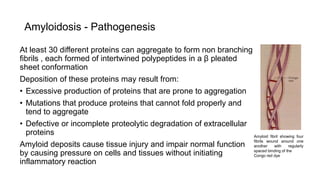
Amyloid fibril showing four
fibrils wound around one
another with regularly
spaced binding of the
Congo red dye
The three most common forms of amyloid are;
AL (amyloid light chain) amyloid is made up of complete immunoglobulin
light chains
AA (amyloid-associated) amyloid derived by proteolysis from a larger
precursor in the blood called SAA (serum amyloid associated) protein, which
is synthesized in the liver
β-amyloid protein (Aβ) derived by proteolysis from a much larger
transmembrane glycoprotein, called amyloid precursor protein
Classification of Amyloidosis
Clinicopathologic Category Associated Diseases Major Fibril
Protein
Chemically Related
Precursor Protein
Organs Commonly Involved
SYSTEMIC (GENERALIZED) AMYLOIDOSIS
Primary Amyloidosis Multiple myeloma & monoclonal
plasma cell proliferations
AL Immunoglobulin light
chains, chiefly λ type
Heart, bowel, skin, nerves and kidney
Secondary (Reactive) Amyloidosis -Chronic inflammation e.g TB, RA
-Cancers
AA SAA Liver, spleen, kidneys, adrenals
Hemodialysis-associated amyloidosis Chronic renal failure Aβ2m β2-microglobulin Synovium, joints, tendon sheaths
HEREDITARY AMYLOIDOSIS
Familial Mediterranean fever AA SAA Liver, spleen, kidneys, adrenals
Familial amyloidotic neuropathies ATTR Transthyretin Peripheral & autonomic nerves, Heart
Systemic senile amyloidosis ATTR Transthyretin Systemic amyloidosis
LOCALIZED AMYLOIDOSIS
Senile cerebral Alzheimer disease Aβ APP Cerebral vessels, plaques,
neurofibrillary tangles
Endocrine Type 2 diabetes Proinsulin Islets of Langerhans
Medullary carcinoma of thyroid A Cal Calcitonin Thyroid
Islets of Langerhans AIAPP Islet amyloid peptide
Senile cardiac -Asymptomatic type
-Restrictive cardiomyopathy
AANF
ATTR
-Atrial natriuretic factor
-Transthyretin
-Isolated atrial amyloidosis
-Atrium and ventricle
Nodular mass forming amyloid Lungs, larynx, skin, urinary
bladder, tongue, eye
AL Respective anatomic location
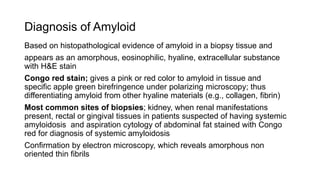
Diagnosis of Amyloid
Based on histopathological evidence of amyloid in a biopsy tissue and
appears as an amorphous, eosinophilic, hyaline, extracellular substance
with H&E stain
Congo red stain; gives a pink or red color to amyloid in tissue and
specific apple green birefringence under polarizing microscopy; thus
differentiating amyloid from other hyaline materials (e.g., collagen, fibrin)
Most common sites of biopsies; kidney, when renal manifestations
present, rectal or gingival tissues in patients suspected of having systemic
amyloidosis and aspiration cytology of abdominal fat stained with Congo
red for diagnosis of systemic amyloidosis
Confirmation by electron microscopy, which reveals amorphous non
oriented thin fibrils
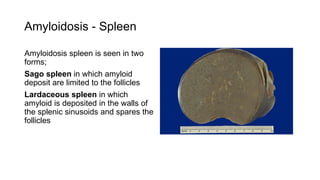
Amyloidosis - Spleen
Amyloidosis spleen is seen in two
forms;
Sago spleen in which amyloid
deposit are limited to the follicles
Lardaceous spleen in which
amyloid is deposited in the walls of
the splenic sinusoids and spares the
follicles
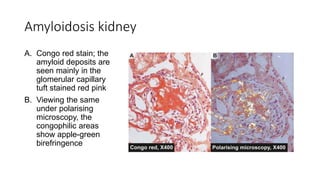
Amyloidosis kidney
A. Congo red stain; the
amyloid deposits are
seen mainly in the
glomerular capillary
tuft stained red pink
B. Viewing the same
under polarising
microscopy, the
congophilic areas
show apple-green
birefringence
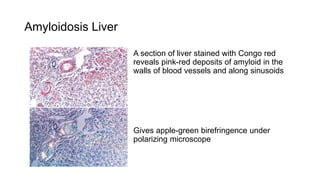
Amyloidosis Liver
A section of liver stained with Congo red
reveals pink-red deposits of amyloid in the
walls of blood vessels and along sinusoids
Gives apple-green birefringence under
polarizing microscope
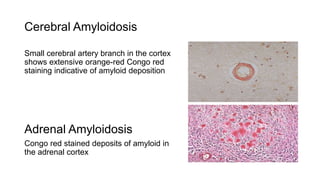
Cerebral Amyloidosis
Small cerebral artery branch in the cortex
shows extensive orange-red Congo red
staining indicative of amyloid deposition
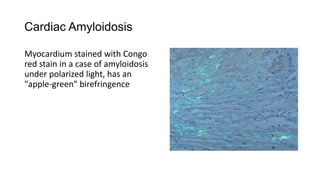
Adrenal Amyloidosis
Congo red stained deposits of amyloid in
the adrenal cortex
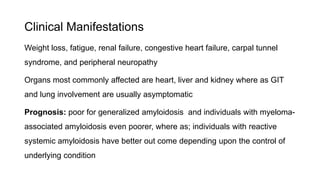
Cardiac Amyloidosis
Myocardium stained with Congo
red stain in a case of amyloidosis
under polarized light, has an
"apple-green" birefringence
Clinical Manifestations
Weight loss, fatigue, renal failure, congestive heart failure, carpal tunnel
syndrome, and peripheral neuropathy
Organs most commonly affected are heart, liver and kidney where as GIT
and lung involvement are usually asymptomatic
Prognosis: poor for generalized amyloidosis and individuals with myeloma-
associated amyloidosis even poorer, where as; individuals with reactive
systemic amyloidosis have better out come depending upon the control of
underlying condition
Case Scenario
A 46-years-old male is admitted to medical ward with history of shortness of breath, loss of
weight and appetite, and low grade fever, all for the last one month. He has been smoking
bidis for 25 years, and gives history of having productive cough with foul smelling
expectoration for 15 years, interspersed with haemoptysis off and on. During these years,
he had two episodes of bronchopneumonia.
On examination, he is poorly built and poorly nourished. His pulse rate is 90 per minute,
respiratory rate 45 per minute, and blood pressure 130/90 mmHg. He has pallor ++, icterus
+, pedal oedema +, and grade II clubbing of fingers. On auscultation of chest, rhonchi and
crepts are heard.
1. Discuss the clinical correlation with pathogenesis of the features.
2. What is the probable diagnosis?
3. How will you investigate and confirm the diagnosis?
References
Robbins Basic Pathology 10th edition 2018 Page 182-187
www.webpath.com

Amyloidosis

  • 1.
  • 2.
    Learning Objectives Know aboutcomposition of amyloid material Describe pathogenesis of amyloid deposition Classify amyloidosis Explain systemic and localized types of amyloidosis Demonstrate how to diagnose amyloid in a biopsy tissue
  • 3.
    Amyloidosis Is a conditionin which extracellular deposition of proteins aggregate occurs forming insoluble fibrils called amyloid Approximately 95% of the amyloid material consists of fibril proteins, the remaining 5% non-fibrillar components being various glycoproteins
  • 4.
    Amyloidosis - Pathogenesis Atleast 30 different proteins can aggregate to form non branching fibrils , each formed of intertwined polypeptides in a β pleated sheet conformation Deposition of these proteins may result from: • Excessive production of proteins that are prone to aggregation • Mutations that produce proteins that cannot fold properly and tend to aggregate • Defective or incomplete proteolytic degradation of extracellular proteins Amyloid deposits cause tissue injury and impair normal function by causing pressure on cells and tissues without initiating inflammatory reaction Amyloid fibril showing four fibrils wound around one another with regularly spaced binding of the Congo red dye
  • 5.
    The three mostcommon forms of amyloid are; AL (amyloid light chain) amyloid is made up of complete immunoglobulin light chains AA (amyloid-associated) amyloid derived by proteolysis from a larger precursor in the blood called SAA (serum amyloid associated) protein, which is synthesized in the liver β-amyloid protein (Aβ) derived by proteolysis from a much larger transmembrane glycoprotein, called amyloid precursor protein
  • 8.
    Classification of Amyloidosis ClinicopathologicCategory Associated Diseases Major Fibril Protein Chemically Related Precursor Protein Organs Commonly Involved SYSTEMIC (GENERALIZED) AMYLOIDOSIS Primary Amyloidosis Multiple myeloma & monoclonal plasma cell proliferations AL Immunoglobulin light chains, chiefly λ type Heart, bowel, skin, nerves and kidney Secondary (Reactive) Amyloidosis -Chronic inflammation e.g TB, RA -Cancers AA SAA Liver, spleen, kidneys, adrenals Hemodialysis-associated amyloidosis Chronic renal failure Aβ2m β2-microglobulin Synovium, joints, tendon sheaths HEREDITARY AMYLOIDOSIS Familial Mediterranean fever AA SAA Liver, spleen, kidneys, adrenals Familial amyloidotic neuropathies ATTR Transthyretin Peripheral & autonomic nerves, Heart Systemic senile amyloidosis ATTR Transthyretin Systemic amyloidosis LOCALIZED AMYLOIDOSIS Senile cerebral Alzheimer disease Aβ APP Cerebral vessels, plaques, neurofibrillary tangles Endocrine Type 2 diabetes Proinsulin Islets of Langerhans Medullary carcinoma of thyroid A Cal Calcitonin Thyroid Islets of Langerhans AIAPP Islet amyloid peptide Senile cardiac -Asymptomatic type -Restrictive cardiomyopathy AANF ATTR -Atrial natriuretic factor -Transthyretin -Isolated atrial amyloidosis -Atrium and ventricle Nodular mass forming amyloid Lungs, larynx, skin, urinary bladder, tongue, eye AL Respective anatomic location
  • 9.
    Diagnosis of Amyloid Basedon histopathological evidence of amyloid in a biopsy tissue and appears as an amorphous, eosinophilic, hyaline, extracellular substance with H&E stain Congo red stain; gives a pink or red color to amyloid in tissue and specific apple green birefringence under polarizing microscopy; thus differentiating amyloid from other hyaline materials (e.g., collagen, fibrin) Most common sites of biopsies; kidney, when renal manifestations present, rectal or gingival tissues in patients suspected of having systemic amyloidosis and aspiration cytology of abdominal fat stained with Congo red for diagnosis of systemic amyloidosis Confirmation by electron microscopy, which reveals amorphous non oriented thin fibrils
  • 10.
    Amyloidosis - Spleen Amyloidosisspleen is seen in two forms; Sago spleen in which amyloid deposit are limited to the follicles Lardaceous spleen in which amyloid is deposited in the walls of the splenic sinusoids and spares the follicles
  • 11.
    Amyloidosis kidney A. Congored stain; the amyloid deposits are seen mainly in the glomerular capillary tuft stained red pink B. Viewing the same under polarising microscopy, the congophilic areas show apple-green birefringence
  • 12.
    Amyloidosis Liver A sectionof liver stained with Congo red reveals pink-red deposits of amyloid in the walls of blood vessels and along sinusoids Gives apple-green birefringence under polarizing microscope
  • 13.
    Cerebral Amyloidosis Small cerebralartery branch in the cortex shows extensive orange-red Congo red staining indicative of amyloid deposition Adrenal Amyloidosis Congo red stained deposits of amyloid in the adrenal cortex
  • 14.
    Cardiac Amyloidosis Myocardium stainedwith Congo red stain in a case of amyloidosis under polarized light, has an "apple-green" birefringence
  • 15.
    Clinical Manifestations Weight loss,fatigue, renal failure, congestive heart failure, carpal tunnel syndrome, and peripheral neuropathy Organs most commonly affected are heart, liver and kidney where as GIT and lung involvement are usually asymptomatic Prognosis: poor for generalized amyloidosis and individuals with myeloma- associated amyloidosis even poorer, where as; individuals with reactive systemic amyloidosis have better out come depending upon the control of underlying condition
  • 16.
    Case Scenario A 46-years-oldmale is admitted to medical ward with history of shortness of breath, loss of weight and appetite, and low grade fever, all for the last one month. He has been smoking bidis for 25 years, and gives history of having productive cough with foul smelling expectoration for 15 years, interspersed with haemoptysis off and on. During these years, he had two episodes of bronchopneumonia. On examination, he is poorly built and poorly nourished. His pulse rate is 90 per minute, respiratory rate 45 per minute, and blood pressure 130/90 mmHg. He has pallor ++, icterus +, pedal oedema +, and grade II clubbing of fingers. On auscultation of chest, rhonchi and crepts are heard. 1. Discuss the clinical correlation with pathogenesis of the features. 2. What is the probable diagnosis? 3. How will you investigate and confirm the diagnosis?
  • 17.
    References Robbins Basic Pathology10th edition 2018 Page 182-187 www.webpath.com