Michael Duplessie MD.
6000 Executive Blvd, Suite 525
N. Bethesda MD 20852
301.493.6404
Sutureless Approach of Amniotic Membrane
Transplantation for Common Diseases
Disclosure and Acknowledgment
• Cryopreserved amniotic membrane (AmnioGraft®) is
obtained from Bio-Tissue.
• Amniotic membrane transplantation for ocular surface
reconstruction using AmnioGraft® is the ONLY one
approved by FDA in 2001, and by Medicare for hospitals
in Jan 2004 (CPT #65780) and for ASCs in July 2005.
• Development of ProKera®, a sutureless AmnioGraft®,
is supported by a SBIR grant from NIH, NEI, approved by
FDA as a type II Device in Dec 2003, and is launched by
Bio-Tissue in April 2005.
AMT Indications
Corneal Other Diseases,
262, 8%Conjunctivochalasis,
257, 8%
Bullous Keratopahty,
229, 7%
Conjunctival/Caruncle
Lesion, 208, 6%
Symblepharon, 132, 4%
Limbal Stem Cell
Deficiency, 100, 3%
Glaucoma/Bleb
Problems, 70, 2%
Socket Problems , 60,
2%
Lid Problems, 48, 1%
Implant Problems, 36, 1%
Scleral Diseases, 35, 1%
Limbal Lesion Removal,
30, 1%
With other Surgical
Procedures, 11, 0%
Corneal Defect and
Ulceration, 724, 22%
Pterygium &
Pseudoterygium, 1152,
34%
Pterygium & Pseudoterygium
Corneal Defect and Ulceration
Corneal Other Diseases
Conjunctivochalasis
Bullous Keratopahty
Conjunctival/Caruncle Lesion
Symblepharon
Limbal Stem Cell Deficiency
Glaucoma/Bleb Problems
Socket Problems
Lid Problems
Implant Problems
Scleral Diseases
Limbal Lesion Removal
With other Surgical Procedures
N = 3,354 Data Source: Bio-Tissue, Inc. (2002)
Papilloma of the conjunctiva
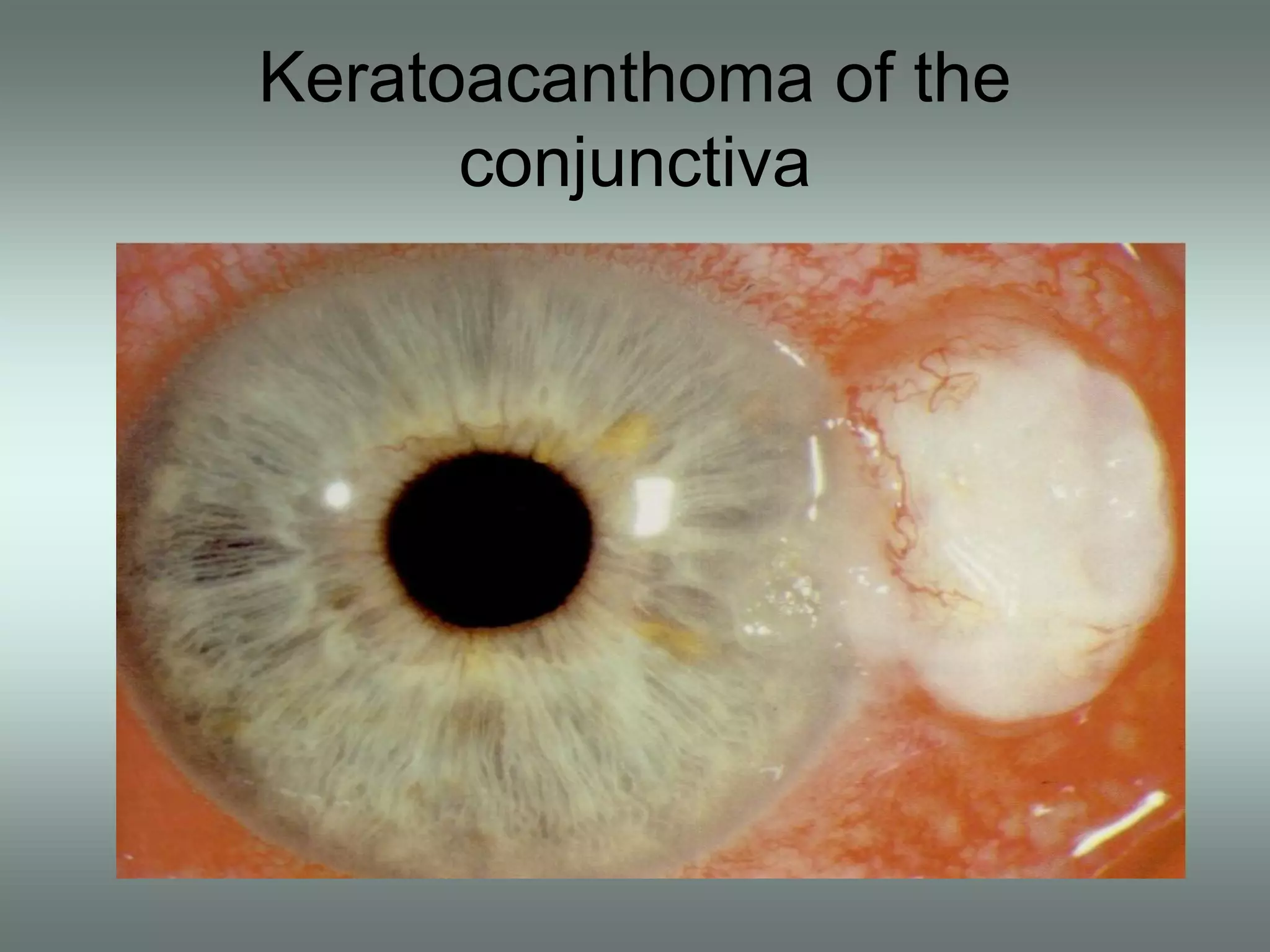
Keratoacanthoma of the
conjunctiva
 Provide a New Basement
Membrane
 Anti-inflammation
 Anti-scarring
 Anti-angiogenesis
Amniotic Membrane: A New Strategy for Tissue
Reconstruction and Engineering
The ONLY FDA-
approved AM graft
A
B
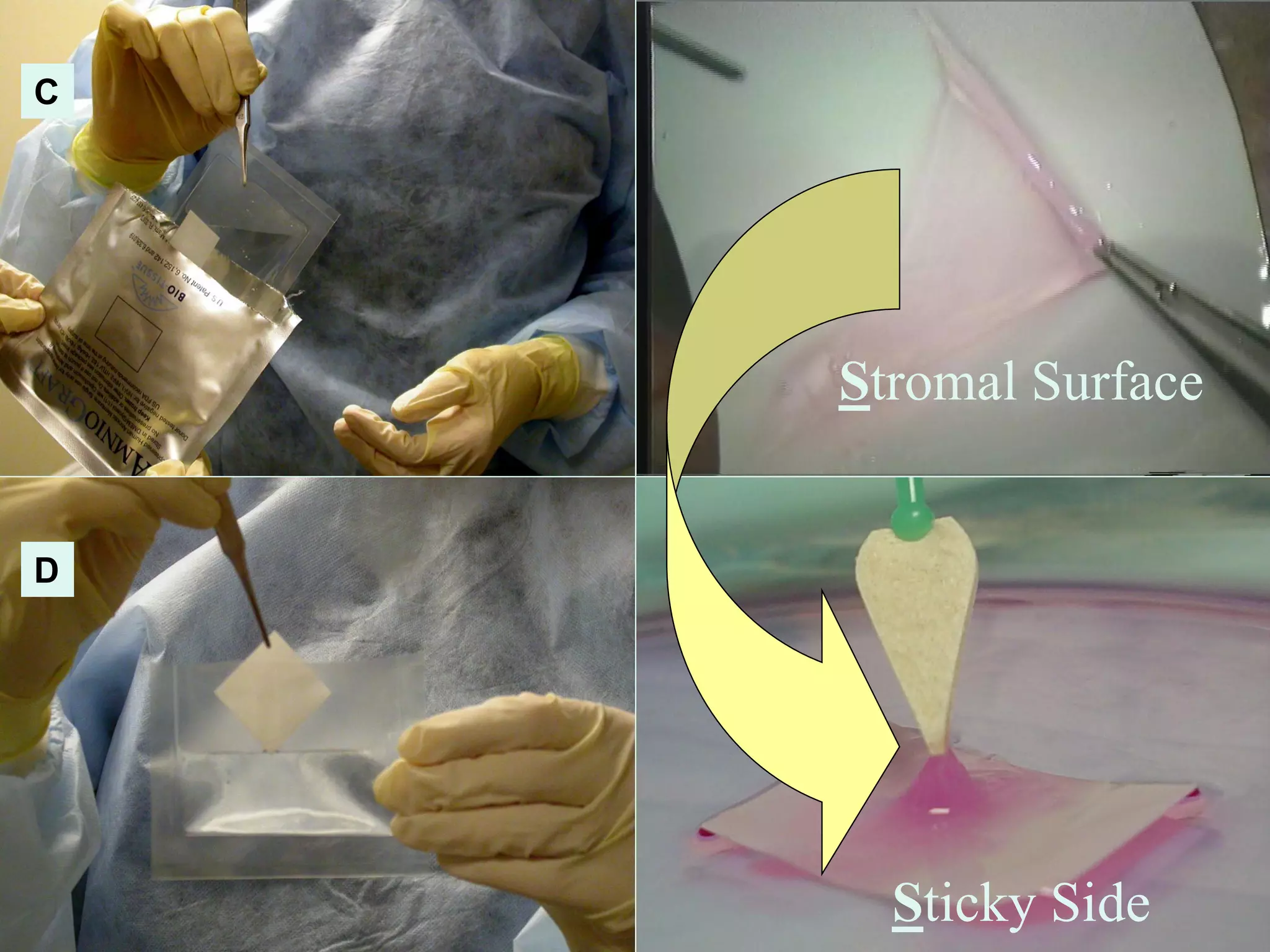
Stromal Surface
Sticky Side
C
D
Two Major Modes of AMT
 AM either dissolves or
removed after healing
 Time of AM dissolution
coincides with healing
 If AM dissolves in one week,
suspect “exposure” problem
 Suture (10-0 nylon) purse-
string running perilimbal
sclera
 Prokera™ without sutures
 IOP by Tonopen and
fluorescein staining without
removing Prokera™
As a Temporary Graft
(bandage or patch)
 AM does not dissolve but
integrates into the host tissue
(cornea or conjunctiva)
 One or multiple layers to fill in
stromal defect as a filler for
any irregular shape (the
orientation matters only for the
top layer with sticky side
down)
 Suture (10-0 nylon) interrupted
(bulbar) and 8-0 Vicryl over
fornix,
 Fibrin Glue without sutures
As a Permanent Graft
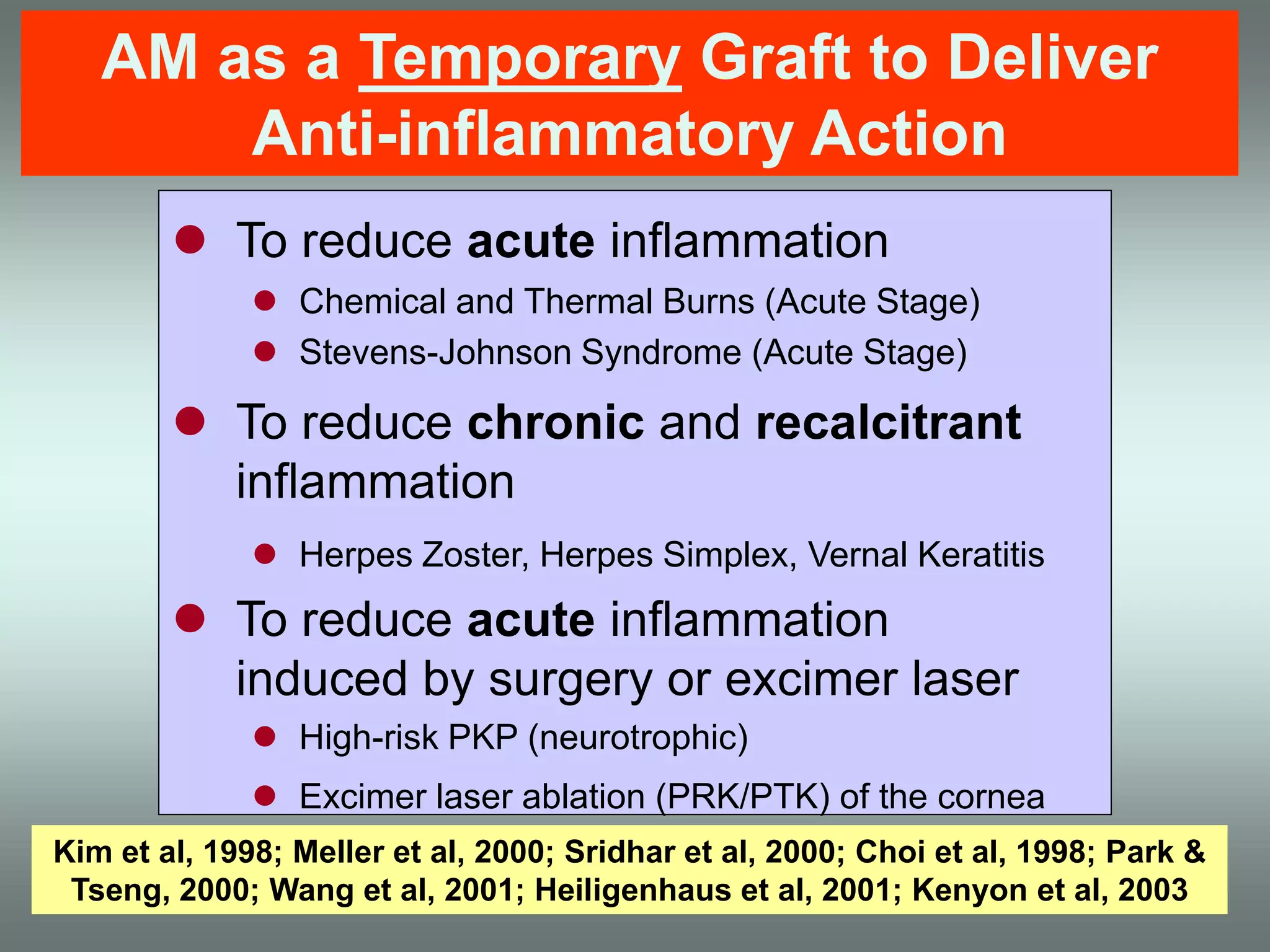
 To reduce acute inflammation
 Chemical and Thermal Burns (Acute Stage)
 Stevens-Johnson Syndrome (Acute Stage)
 To reduce chronic and recalcitrant
inflammation
 Herpes Zoster, Herpes Simplex, Vernal Keratitis
 To reduce acute inflammation
induced by surgery or excimer laser
 High-risk PKP (neurotrophic)
 Excimer laser ablation (PRK/PTK) of the cornea
AM as a Temporary Graft to Deliver
Anti-inflammatory Action
Kim et al, 1998; Meller et al, 2000; Sridhar et al, 2000; Choi et al, 1998; Park &
Tseng, 2000; Wang et al, 2001; Heiligenhaus et al, 2001; Kenyon et al, 2003
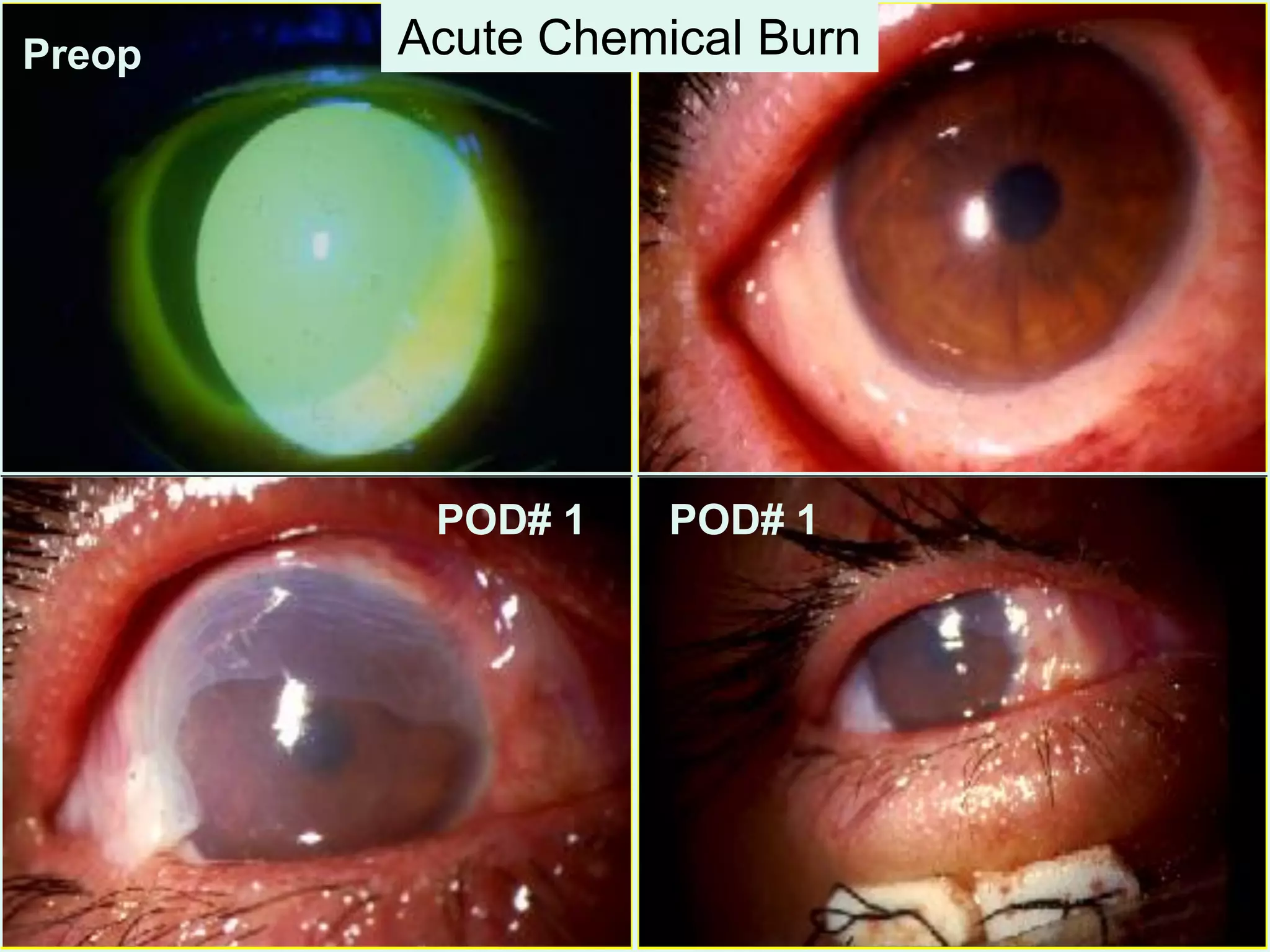
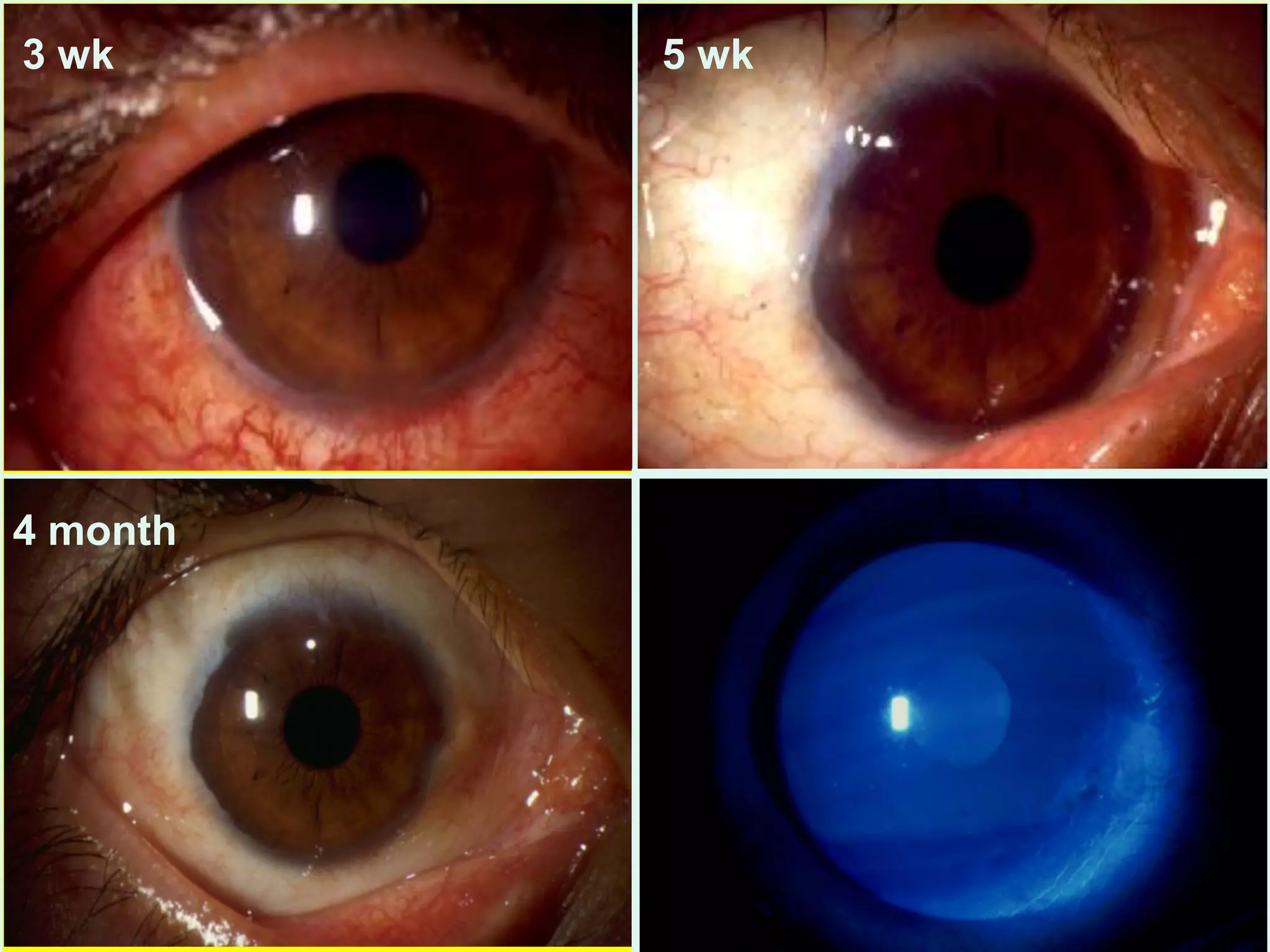
 AMT for Acute Chemical Burns
& Acute SJS/TENS
Kim et al, EER 70:329, 1998
Meller et al, Ophthalmology 107:980, 2000
John et al, Ophthalmology 109:351, 2002
Preop
POD# 1 POD# 1
Acute Chemical Burn
1 wk
2 wk2 wk
1 wk
4 month
3 wk
5 wk
5 wk
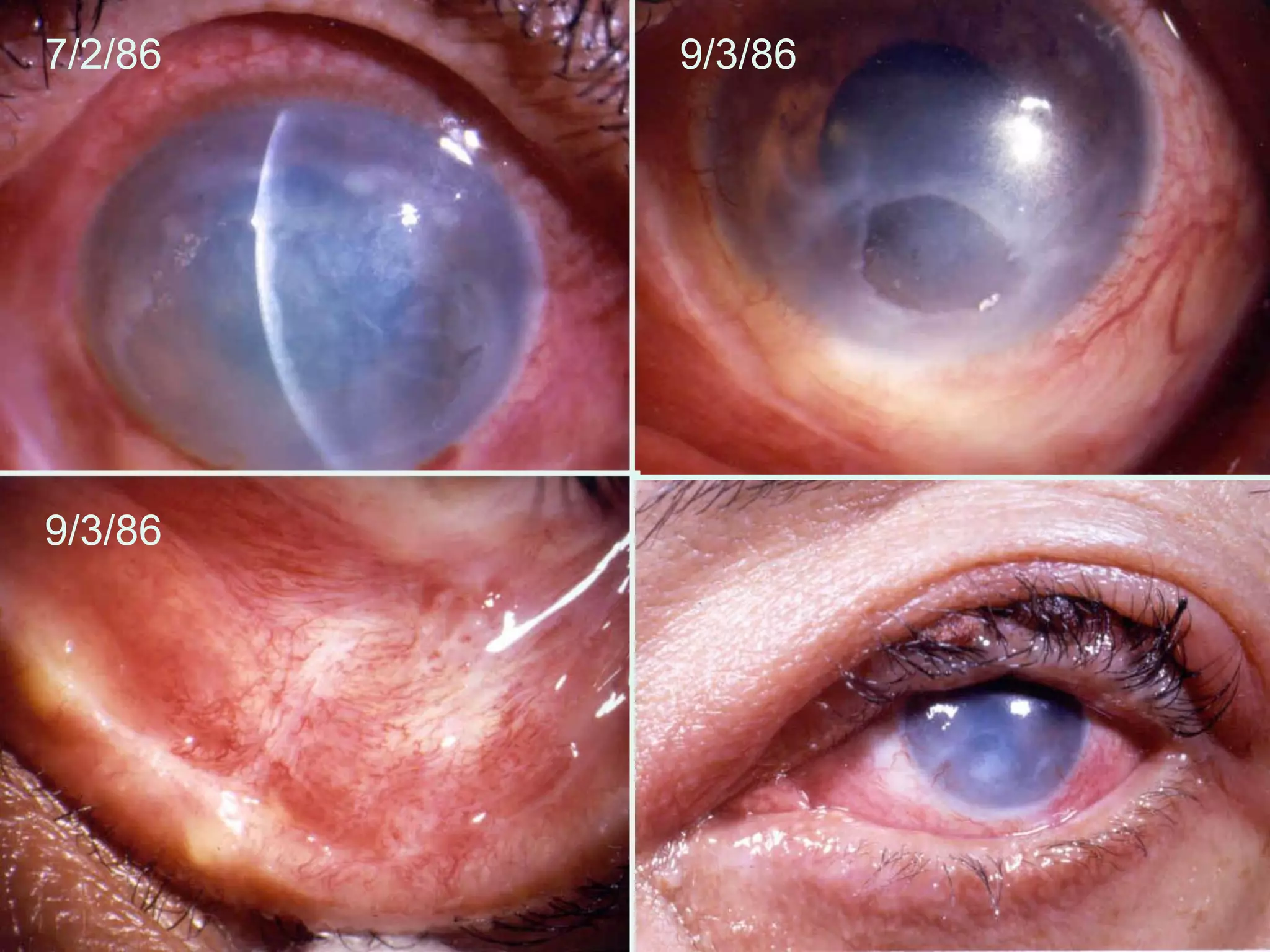
7/2/86 9/3/86
9/3/86
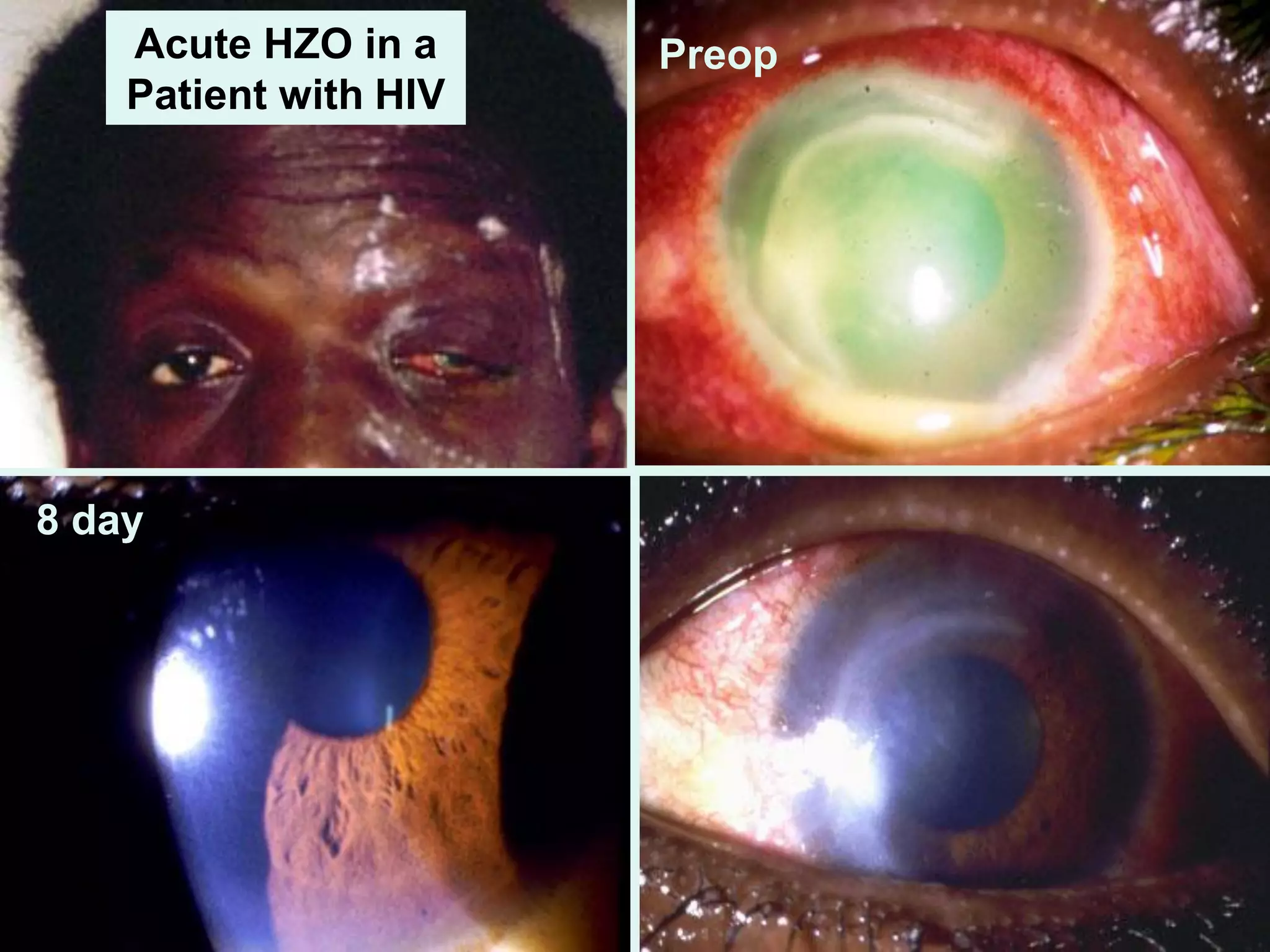
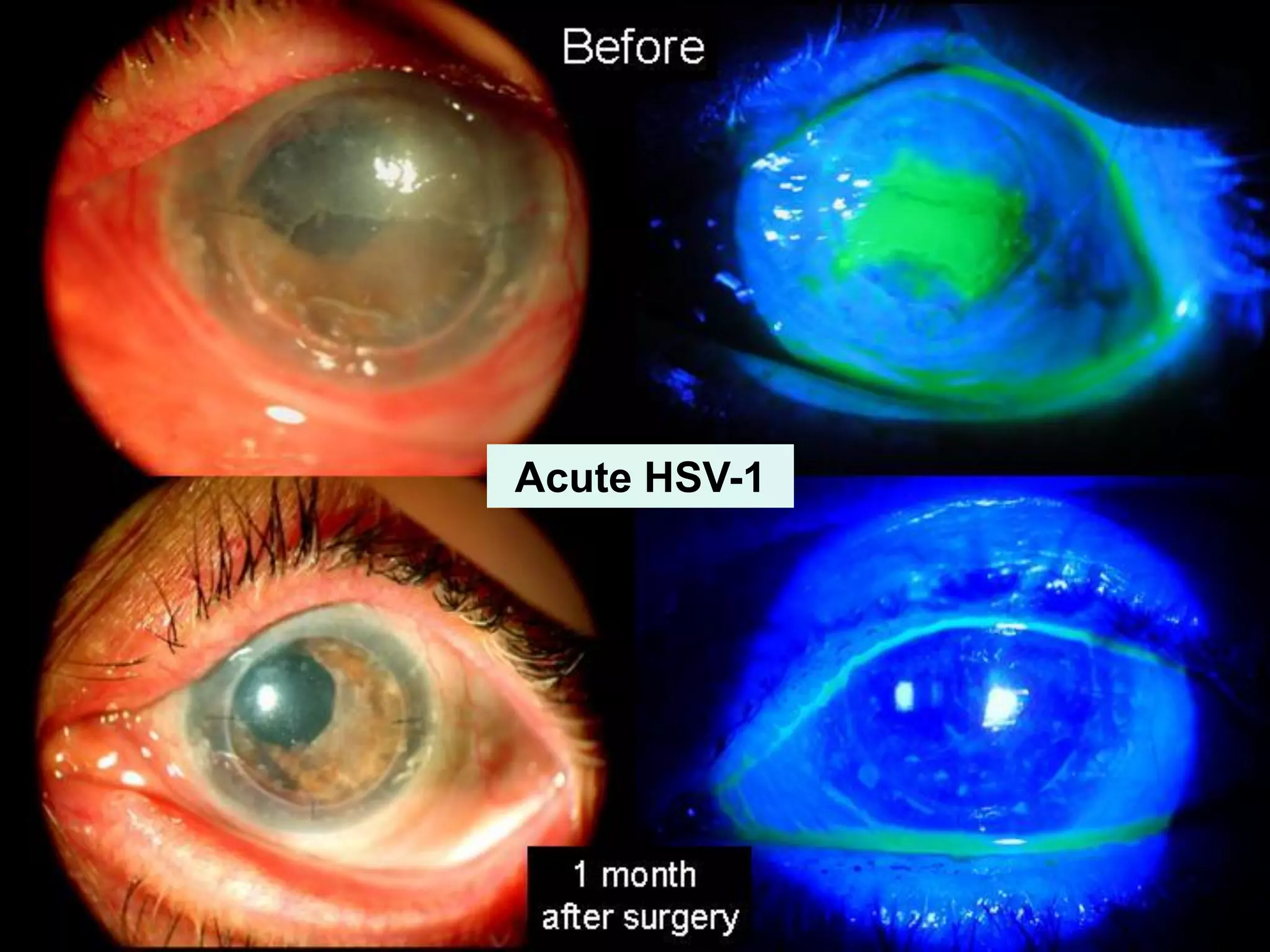
Acute HZO in a
Patient with HIV
Preop
8 day
Acute HSV-1
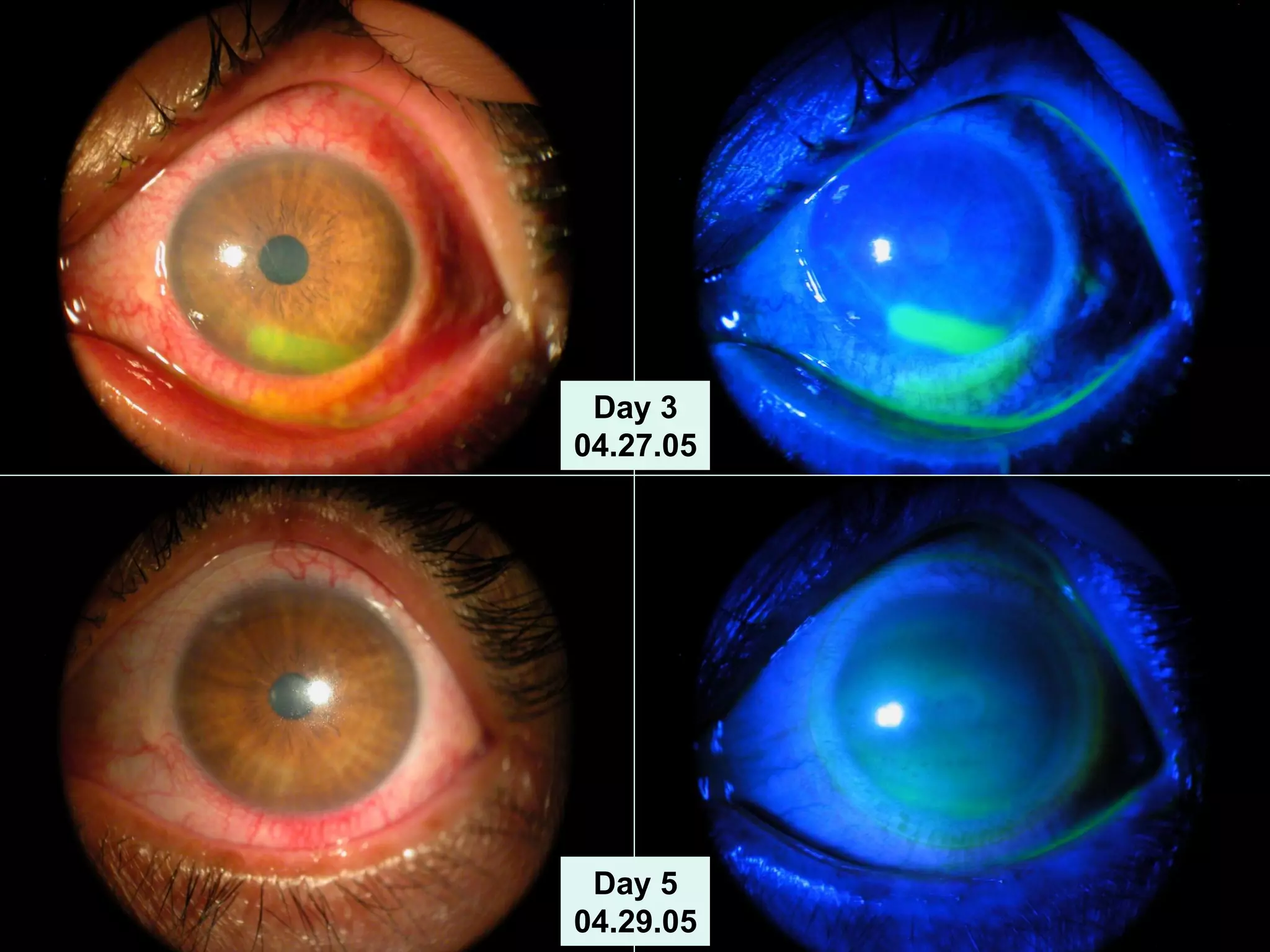
Sutureless ProKera®
04.24.05
Day 1
04.25.05
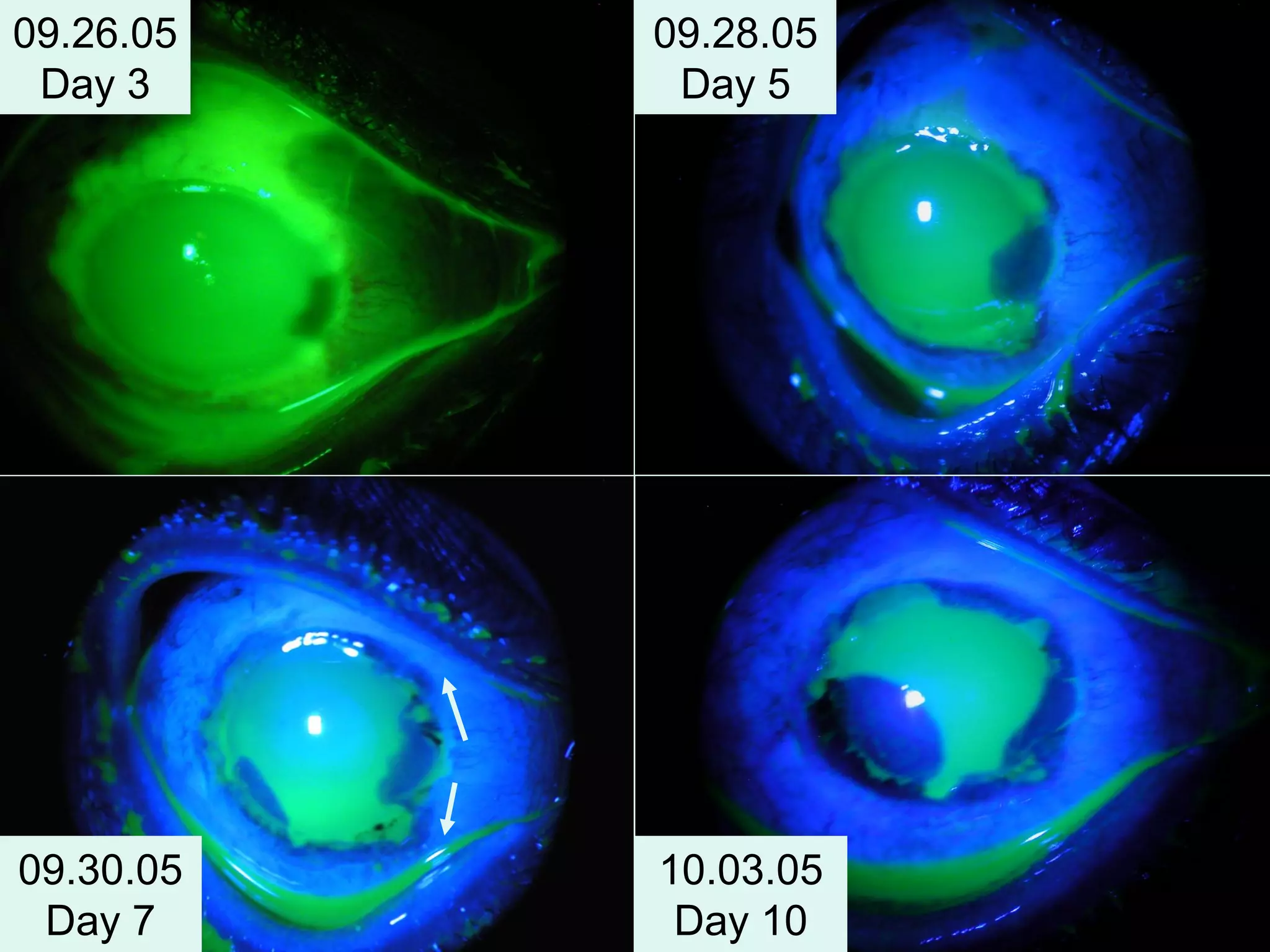
Chemical Burn
Day 3
04.27.05
OS
Day 5
04.29.05
OS04.24.05
06.06.05
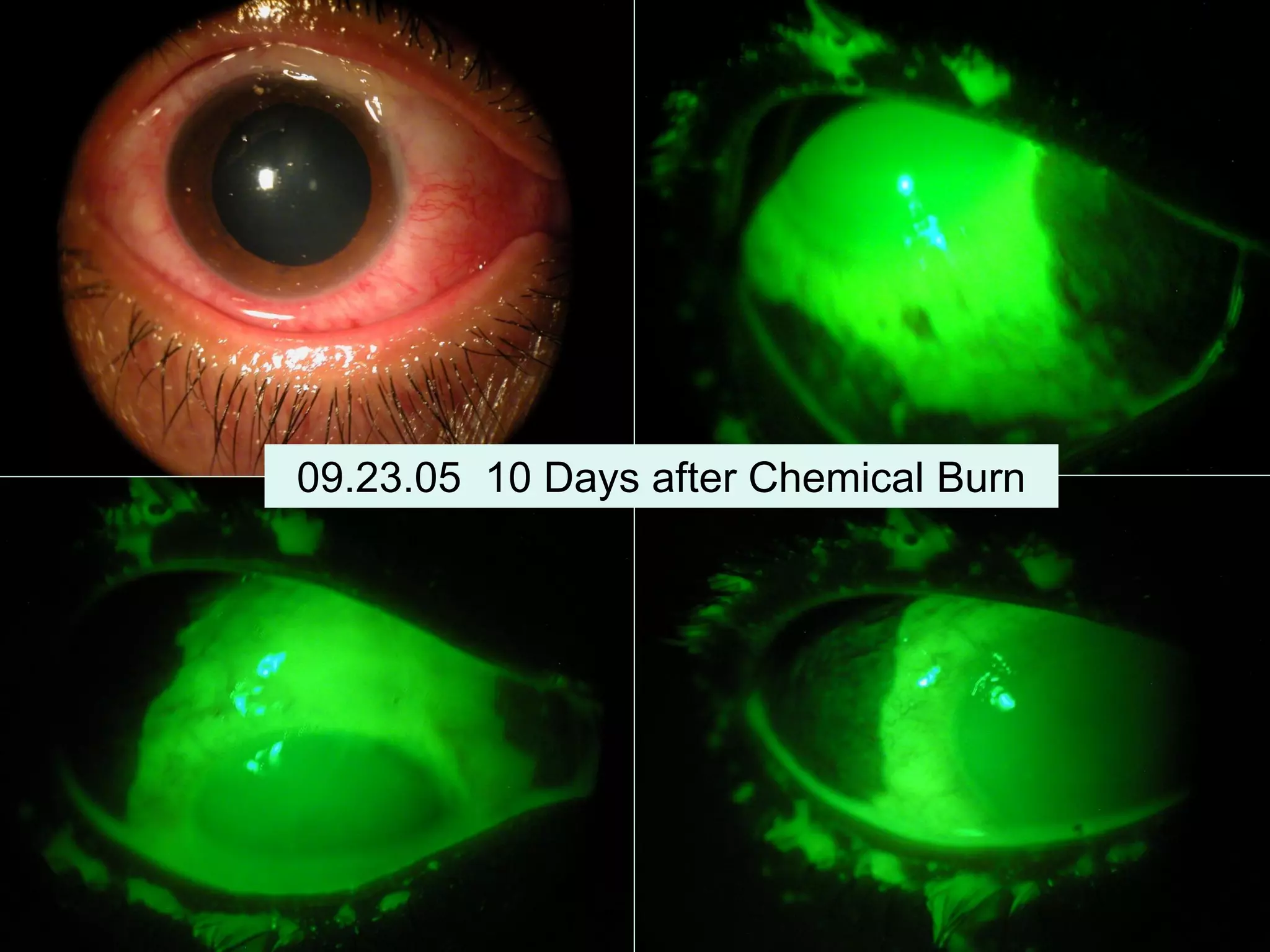
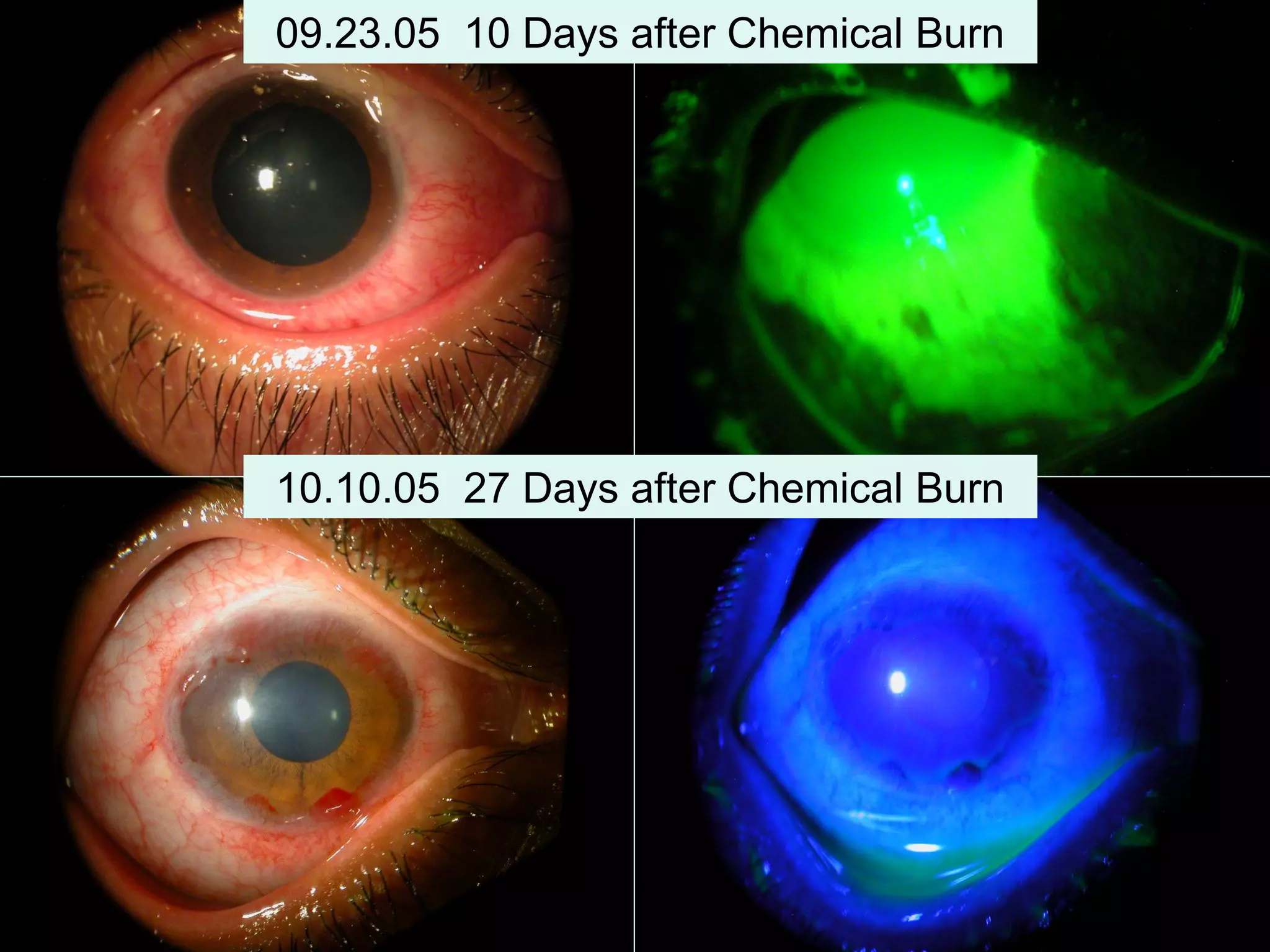
09.23.05 10 Days after Chemical Burn
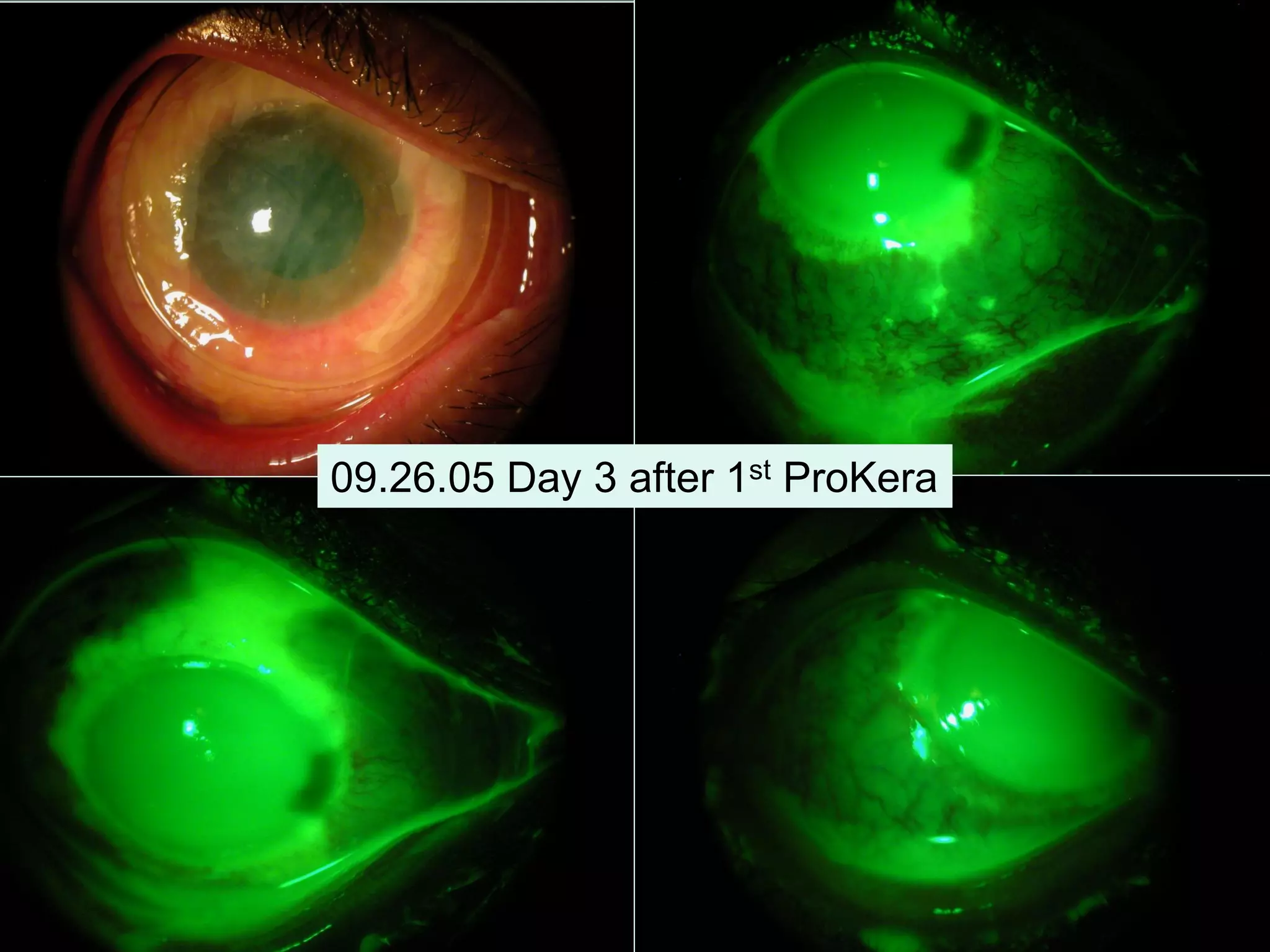
09.26.05 Day 3 after 1st ProKera
09.26.05
Day 3
09.28.05
Day 5
09.30.05
Day 7
10.03.05
Day 10
10.03.05
Day 10
10.05.05
Day 12
10.08.05
Day 15
10.10.05
Day 17
Switcht
to BCL
09.23.05 10 Days after Chemical Burn
10.10.05 27 Days after Chemical Burn
09.23.05
Day 0
09.26.05
Day 3
10.03.05
Day 10
10.05.05
Day 12
What Happened
in the
Conjunctiva
beyond
ProKera?
10.10.05
Day 17
10.08.05
Day 15
10.03.05
Day 10
10.12.05
Day 19Inject
Kenalog
 To reduce acute inflammation
 Chemical and Thermal Burns (Acute Stage)
 Stevens-Johnson Syndrome (Acute Stage)
 To reduce chronic and recalcitrant
inflammation
 Herpes Zoster, Herpes Simplex, Vernal Keratitis
 To reduce acute inflammation
induced by surgery or excimer laser
 High-risk PKP (neurotrophic)
 Excimer laser ablation (PRK/PTK) of the cornea
AM as a Temporary Graft to Deliver
Anti-inflammatory Action
Kim et al, 1998; Meller et al, 2000; Sridhar et al, 2000; Choi et al, 1998; Park &
Tseng, 2000; Wang et al, 2001; Heiligenhaus et al, 2001; Kenyon et al, 2003
Two Major Modes of AMT
 AM either dissolves or
removed after healing
 Time of AM dissolution
coincides with healing
 If AM dissolves in one week,
suspect “exposure” problem
 Suture (10-0 nylon) purse-
string running perilimbal
sclera
 Prokera™ without sutures
 IOP by Tonopen and
fluorescein staining without
removing Prokera™
As a Temporary Graft
(bandage or patch)
 AM does not dissolve but
integrates into the host tissue
(cornea or conjunctiva)
 One or multiple layers to fill in
stromal defect as a filler for
any irregular shape (the
orientation matters only for the
top layer with sticky side
down)
 Suture (10-0 nylon) interrupted
(bulbar) and 8-0 Vicryl over
fornix,
 Fibrin Glue without sutures
As a Permanent Graft
To Restore Corneal Integrity
AM as a Permanent Graft
(one or multiple layers)
 Persistent epithelial defect, ulcer,
descemetocele, and perforation
 Painful bullous keratopathy
 Band keratopathy
 Recurrent corneal erosion
 Superficial keratectomy
Lee et al, 1997; Kruse et al, 1999; Azuara-Blanco et al, 1999; Chen et
al; 2000; Hanada et al, 2001; Letko et al, 2001; Su & Lin, 2000; Pires
et al, 1999; Anderson et al, 2001; Kenyon et al, 2003
HSV-1 Deep Ulcer
Restore
stromal
thickness
CF
20/70
Preop 1 Week
2 Week 7 Month
20/70
Decemetocele following Pseudomonas
Infection and Glaucoma Drainage Implant
Solomon et al, Ophthalmology 109:694-703, 2002
OD 06.14.05
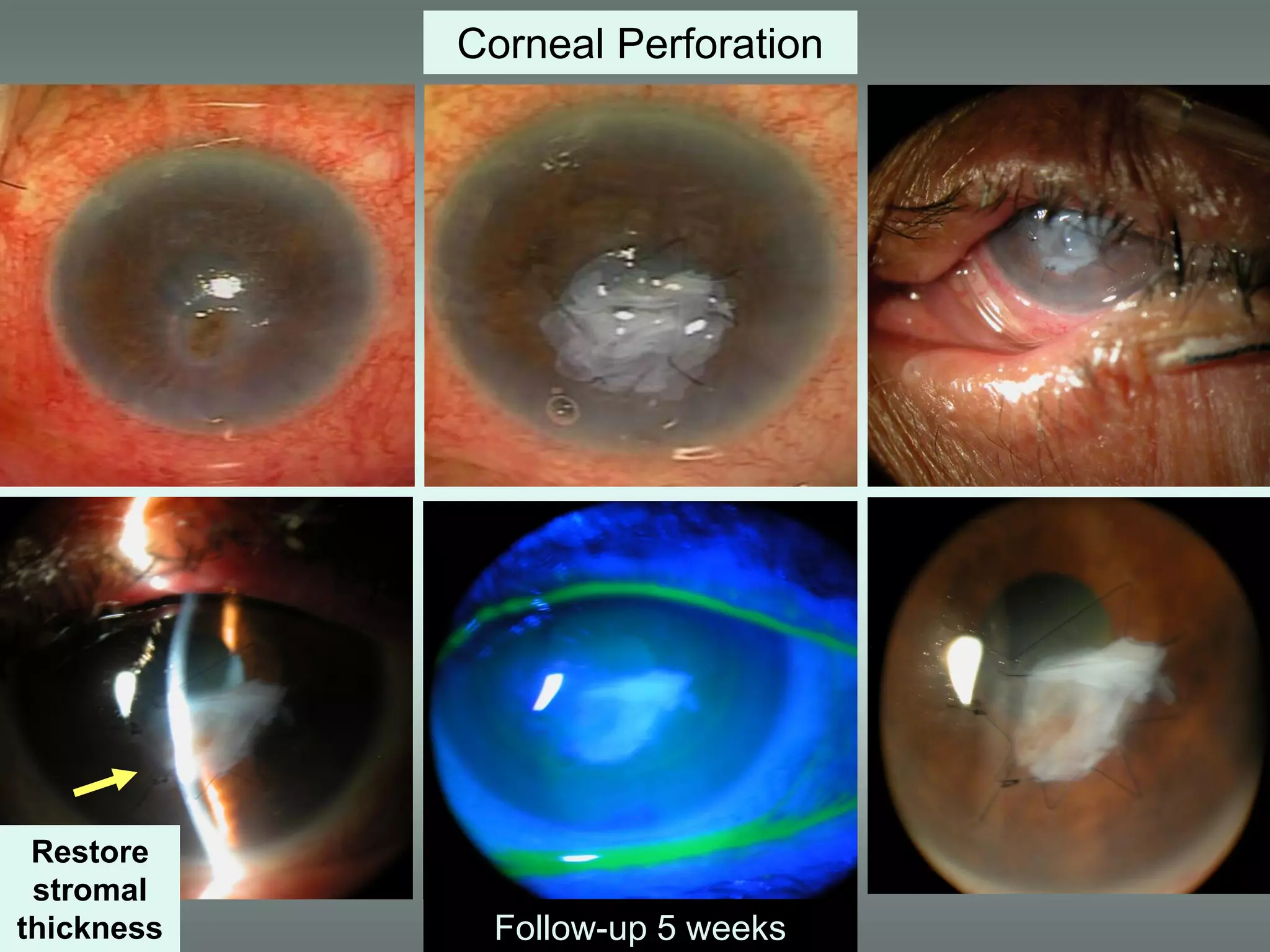
Corneal Perforation
Follow-up 5 weeks
Corneal Perforation
Restore
stromal
thickness
Before
Band Keratopathy with PED
75 days28 days
OS
PRE-OP
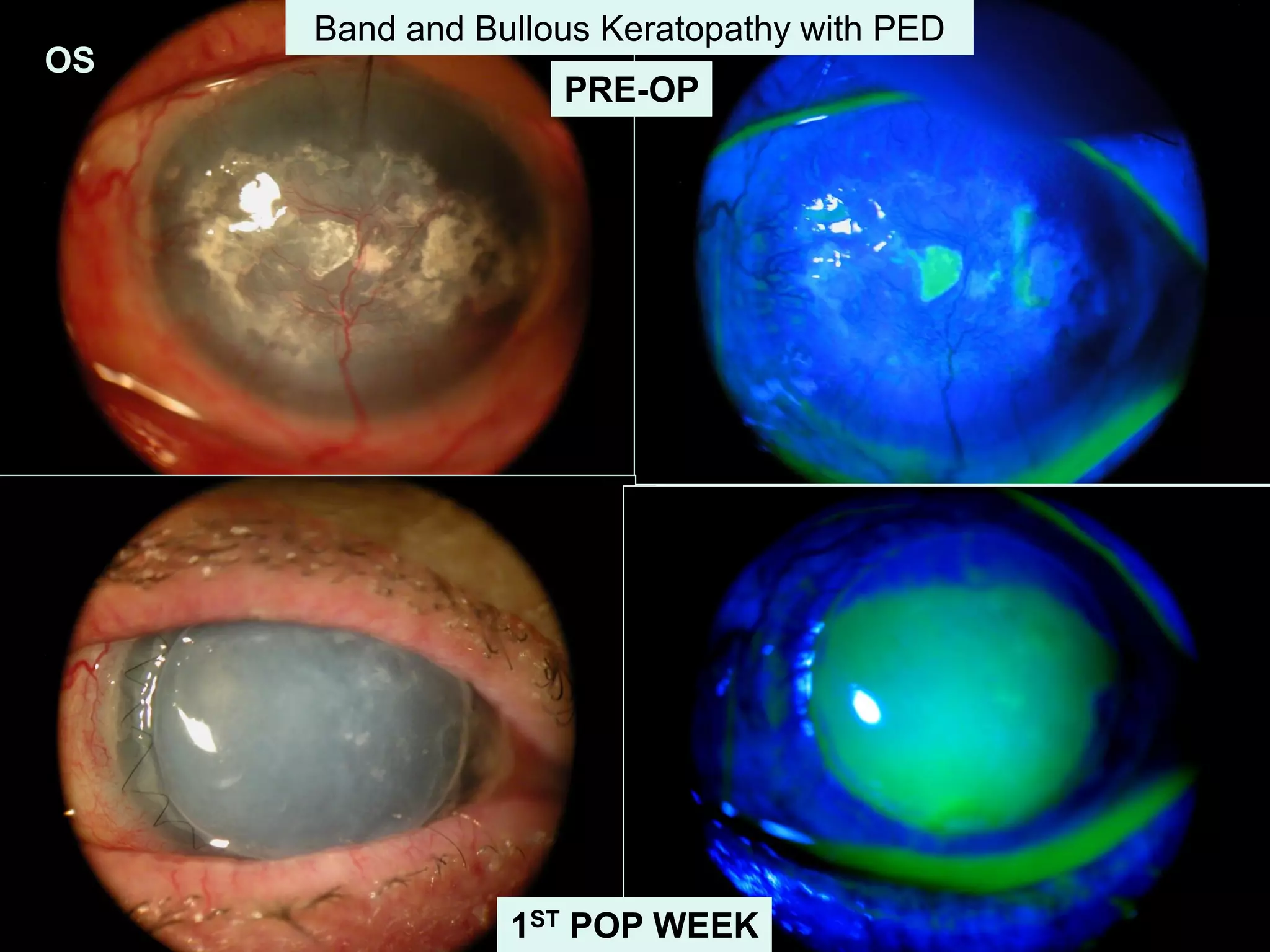
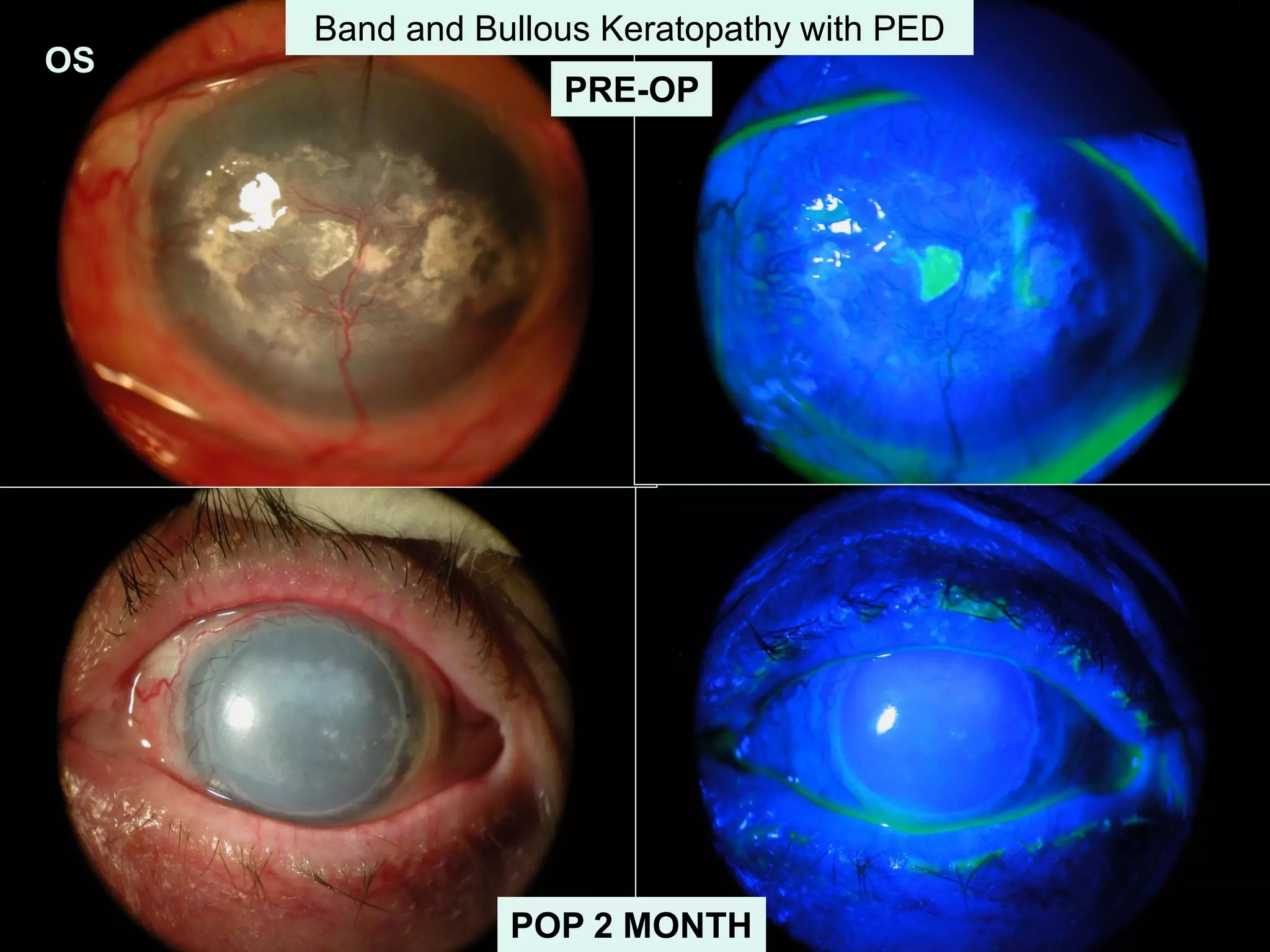
Band and Bullous Keratopathy with PED
1ST POP WEEK
OS
PRE-OP
Band and Bullous Keratopathy with PED
POP 2 MONTH
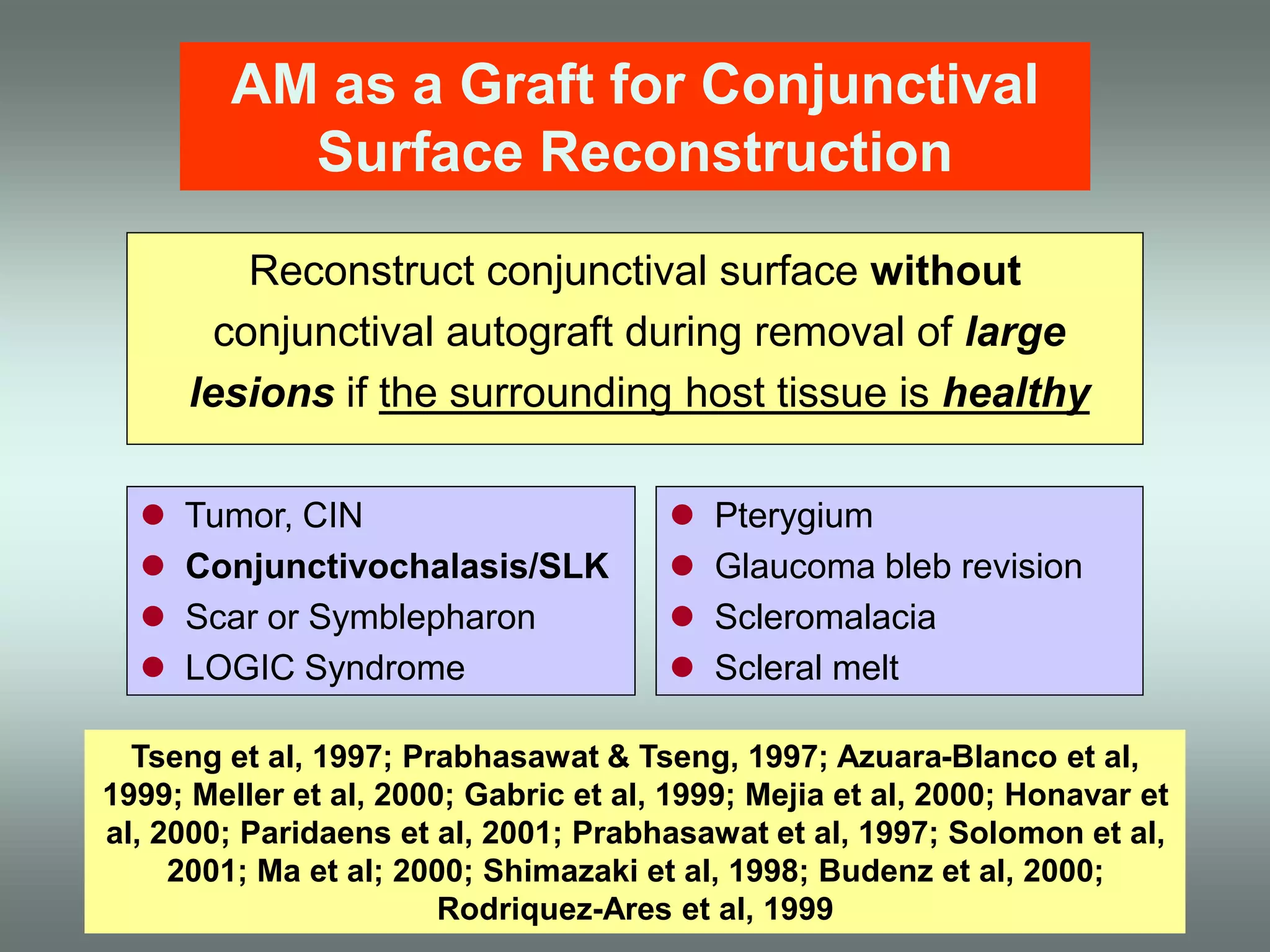
Reconstruct conjunctival surface without
conjunctival autograft during removal of large
lesions if the surrounding host tissue is healthy
AM as a Graft for Conjunctival
Surface Reconstruction
 Tumor, CIN
 Conjunctivochalasis/SLK
 Scar or Symblepharon
 LOGIC Syndrome
 Pterygium
 Glaucoma bleb revision
 Scleromalacia
 Scleral melt
Tseng et al, 1997; Prabhasawat & Tseng, 1997; Azuara-Blanco et al,
1999; Meller et al, 2000; Gabric et al, 1999; Mejia et al, 2000; Honavar et
al, 2000; Paridaens et al, 2001; Prabhasawat et al, 1997; Solomon et al,
2001; Ma et al; 2000; Shimazaki et al, 1998; Budenz et al, 2000;
Rodriquez-Ares et al, 1999
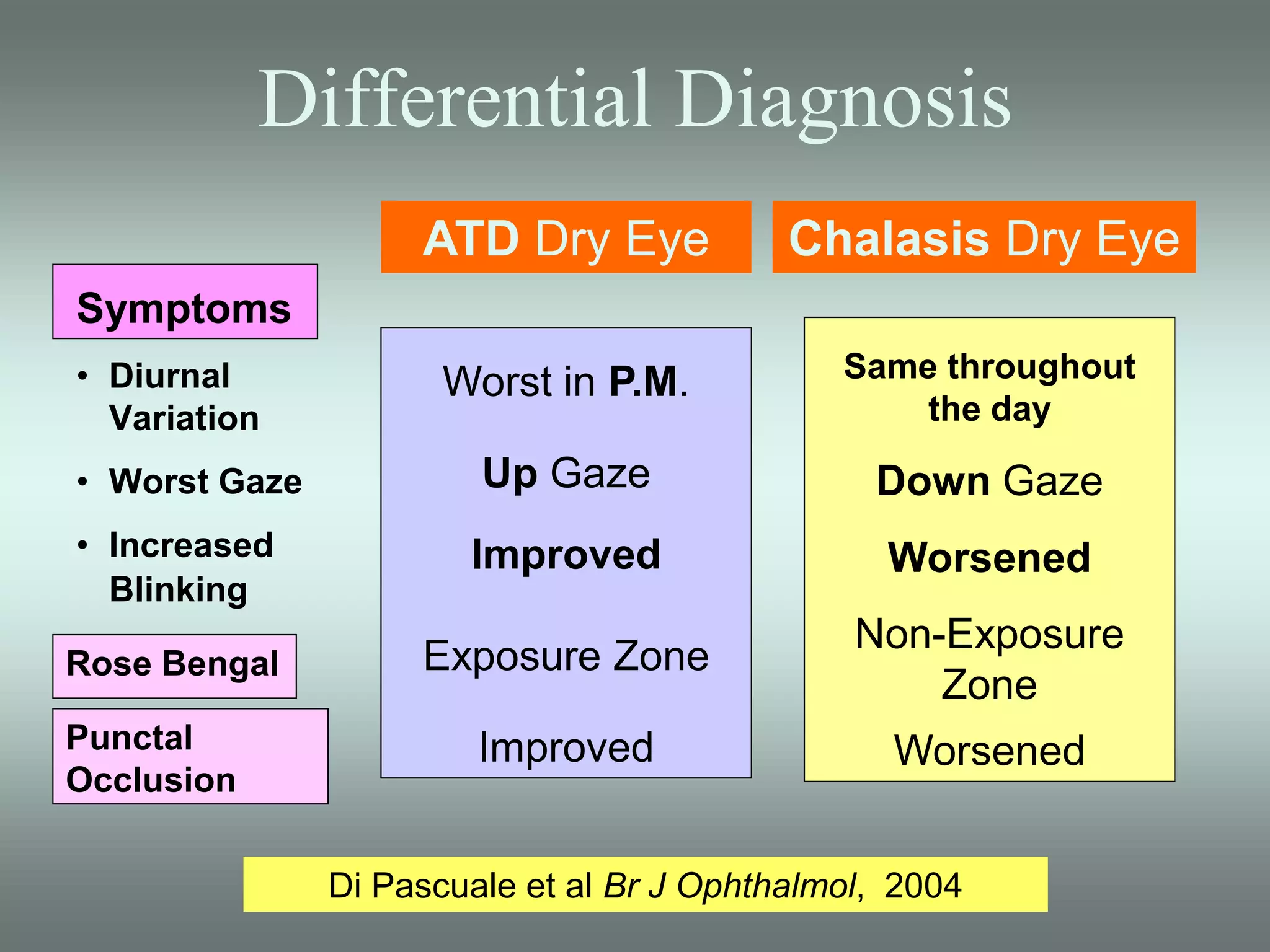
Differential Diagnosis
Symptoms
• Diurnal
Variation
• Worst Gaze
• Increased
Blinking
ATD Dry Eye
Worst in P.M.
Up Gaze
Improved
Exposure Zone
Improved
Chalasis Dry Eye
Same throughout
the day
Down Gaze
Worsened
Non-Exposure
Zone
Worsened
Di Pascuale et al Br J Ophthalmol, 2004
Rose Bengal
Punctal
Occlusion
Di Pascuale et al Br J Ophthalmol, 2004
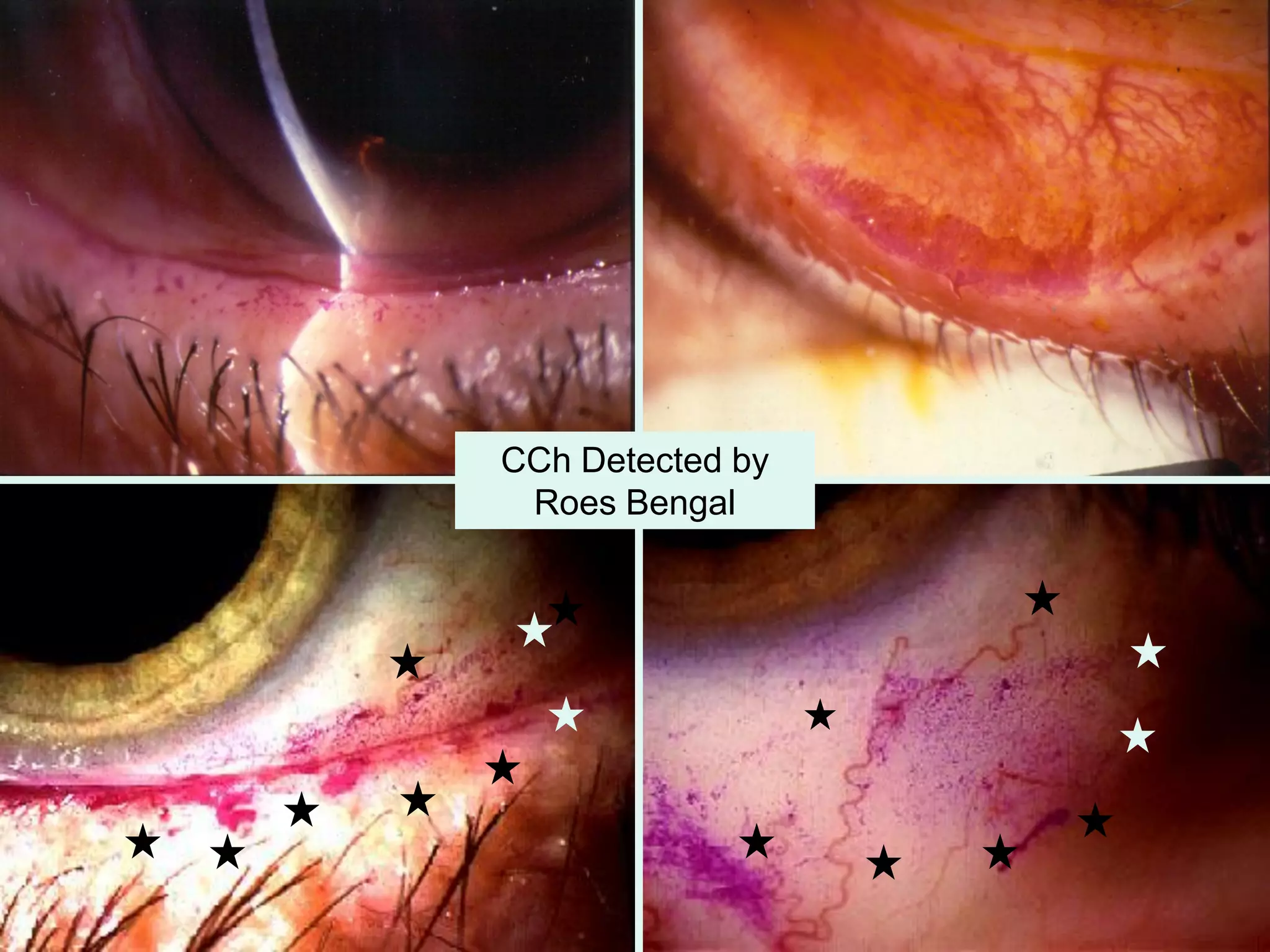
CCh Detected by
Fluorescein
CCh Detected by
Roes Bengal
Anterior Migration of Mucocutaneous Junction
and Regional “Blepharitis”
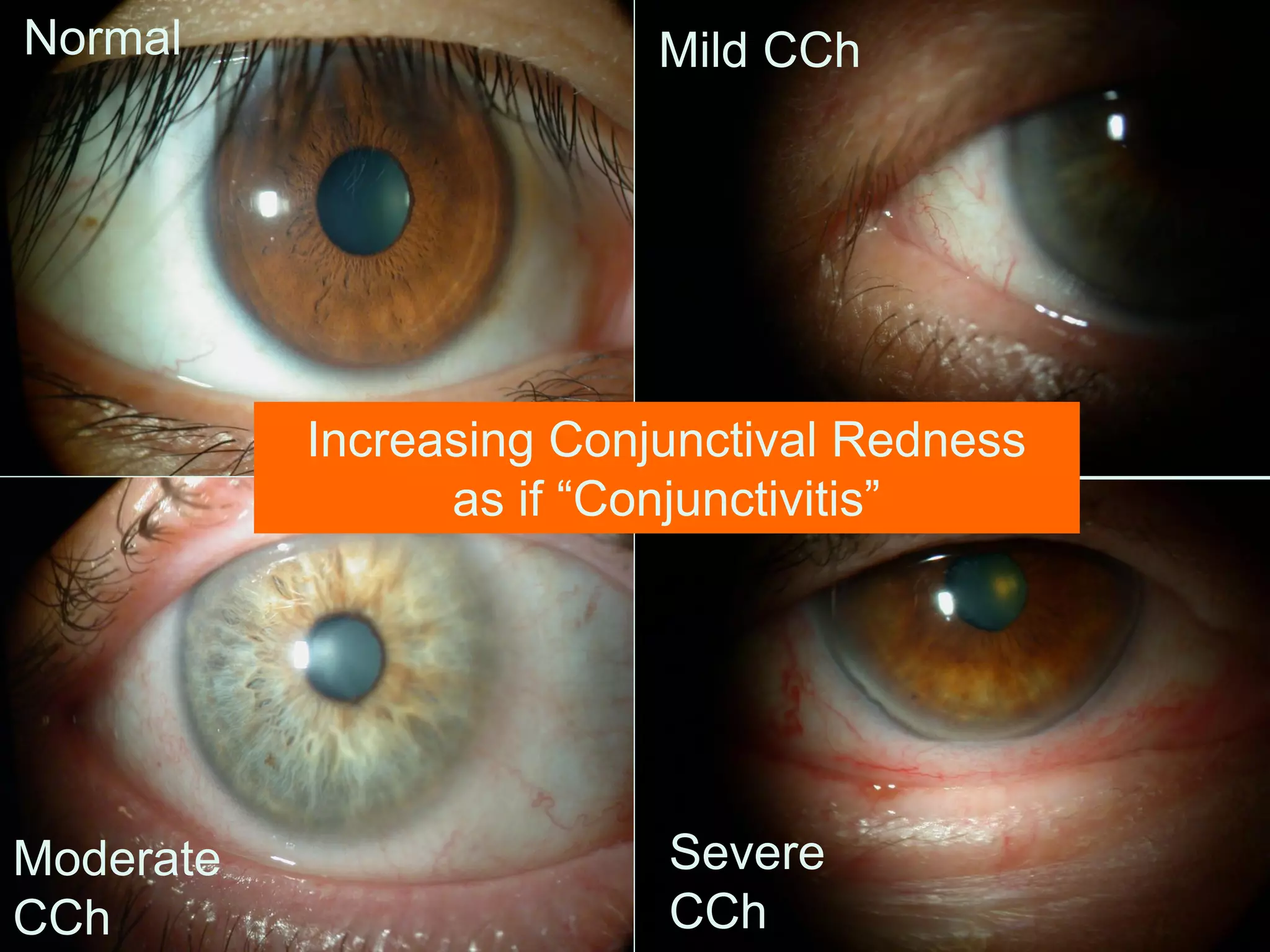
Normal Mild CCh
Moderate
CCh
Severe
CCh
Increasing Conjunctival Redness
as if “Conjunctivitis”
Vigorous
Blinking
under Slit
Lamp
Finger
Compress
the Lids
against the
Globe
10.29.03
01.12.04
Conjunctivochalasis
After AMT
1/14/05
3/18/05
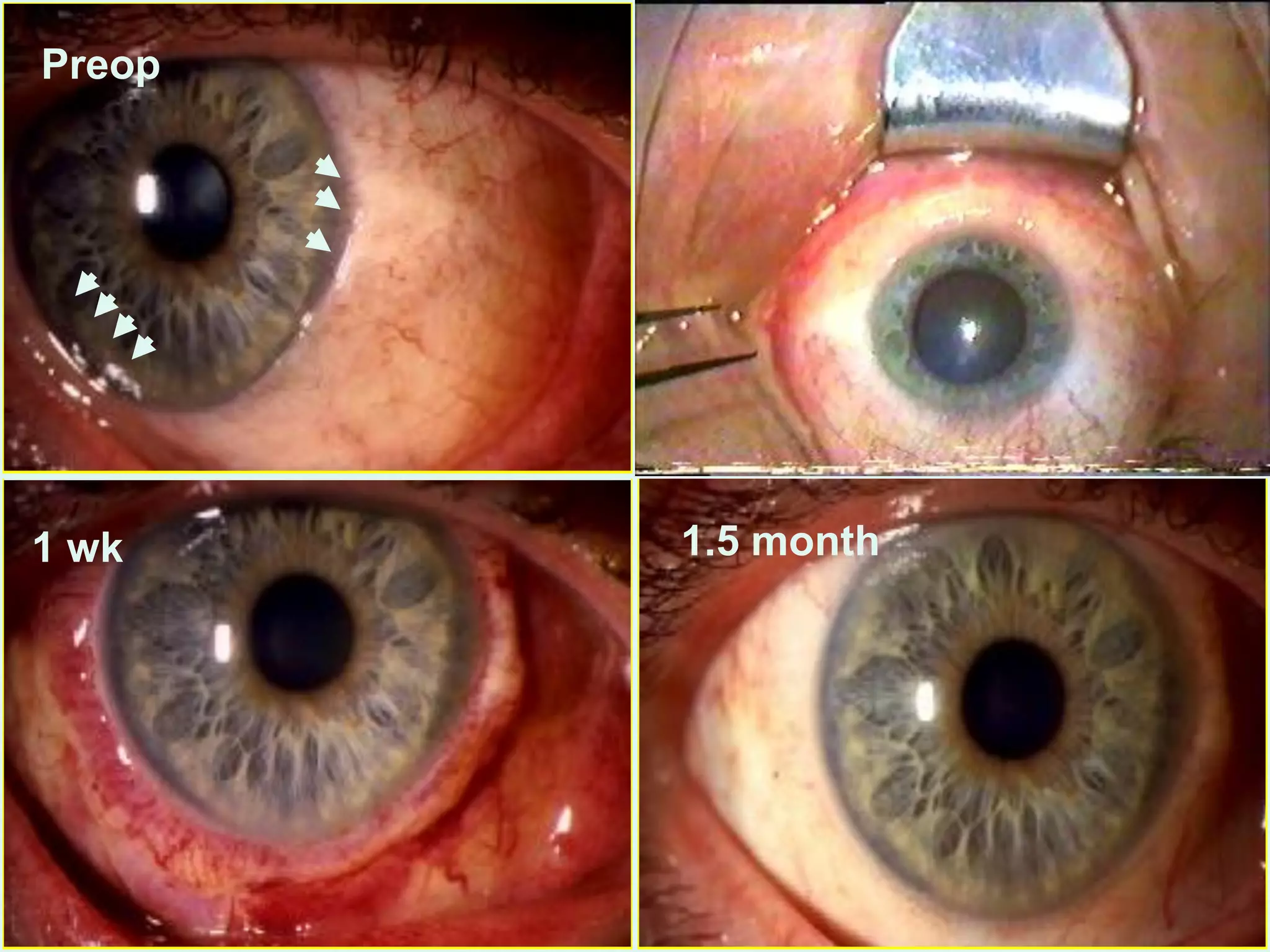
Conjunctivochalasis
Preop
1 wk 1.5 month
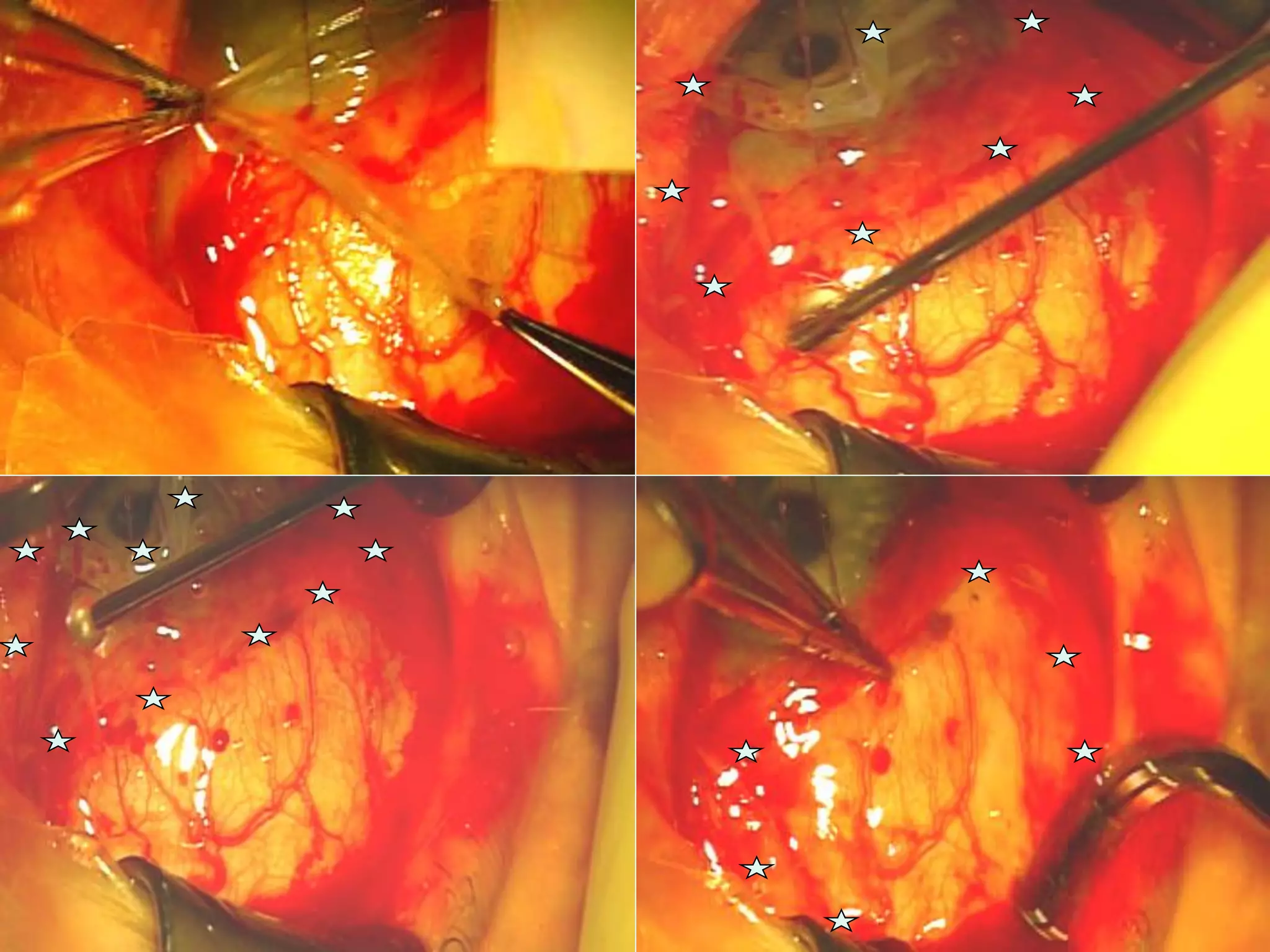
Tenon’s Capsule Reinforcement
and Replacement by AM
“Tenting” Effect Created by Forceps
under Topical Anesthesia
OSOD Superior Limbic
Keratoconjunctivitis
3/11/05
09/21/04
Reconstruct conjunctival surface with or without
conjunctival autograft and intraoperative
application of 0.04% MMC to fornix if the
surrounding host tissue is not healthy
AM as a Graft for Conjunctival
Surface Reconstruction
 Tumor, CIN
 Conjunctivochalasis
 Scar or Symblepharon
 LOGIC Syndrome
 Pterygium
 Glaucoma bleb revision
 Scleral melt
 Exposed implants
Tseng et al, 1997; Prabhasawat & Tseng, 1997; Azuara-Blanco et al,
1999; Meller et al, 2000; Gabric et al, 1999; Mejia et al, 2000; Honavar et
al, 2000; Paridaens et al, 2001; Prabhasawat et al, 1997; Solomon et al,
2001; Ma et al; 2000; Shimazaki et al, 1998; Budenz et al, 2000;
Rodriquez-Ares et al, 1999
Primary Pterygium
Recurrent Pterygium
OD OS
PRE OP
4th POP WEEK
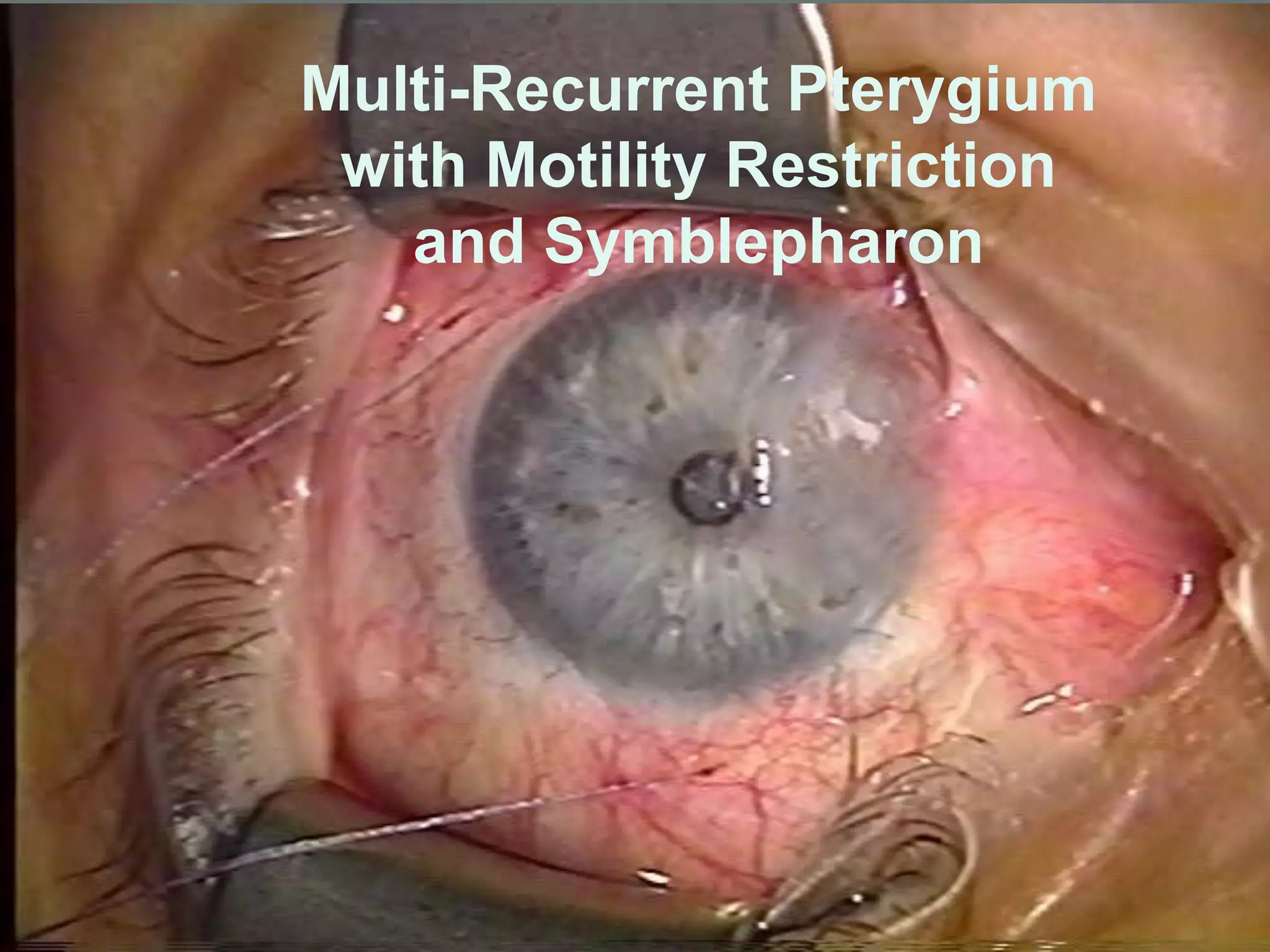
Multi-Recurrent Pterygium
with Motility Restriction
and Symblepharon
09.29.03
09.29.03
OS
10.29.03
10.29.0311.12.0311.12.03
OD
20/30
02.11.04
20/15
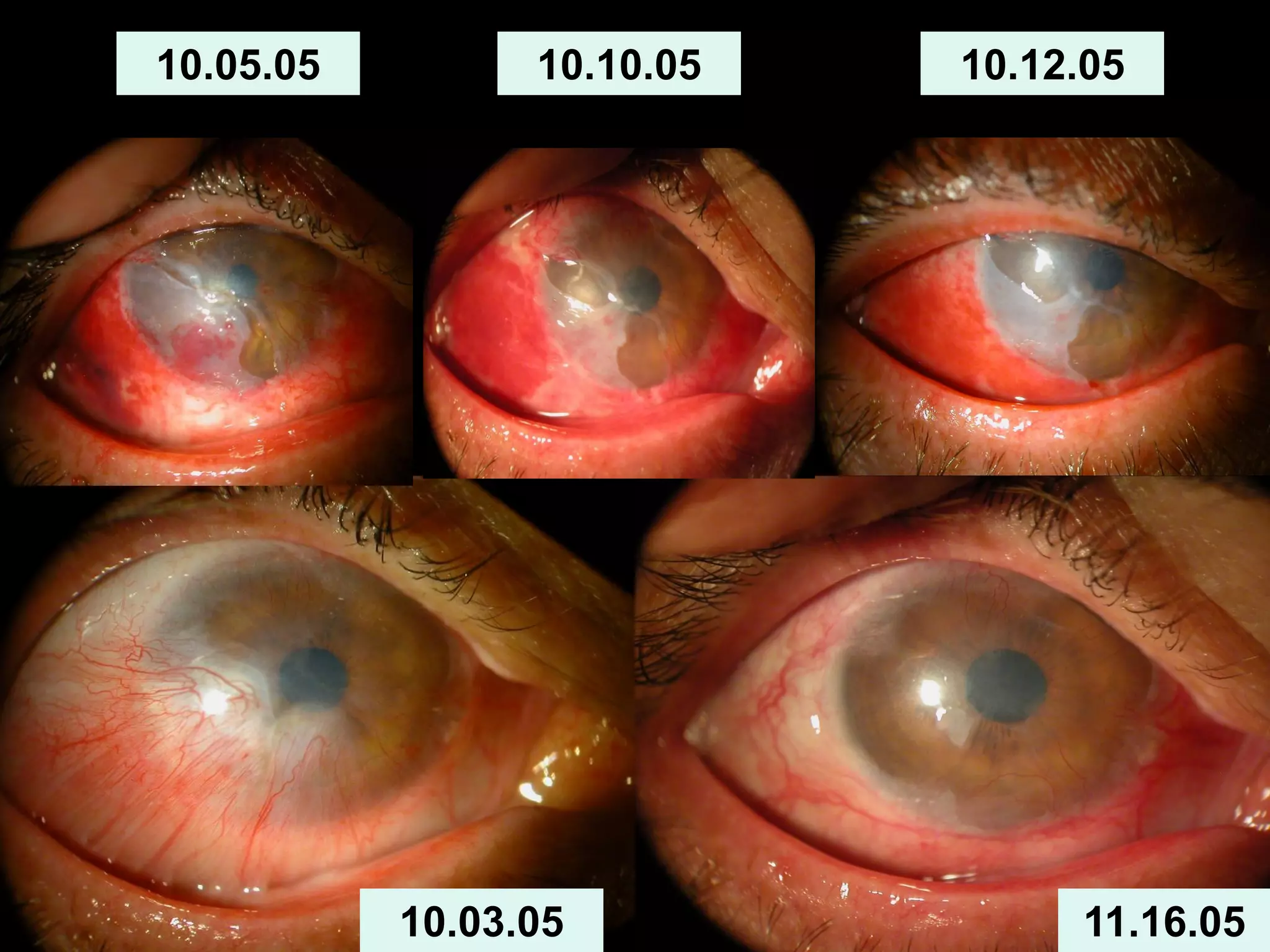
10.03.05
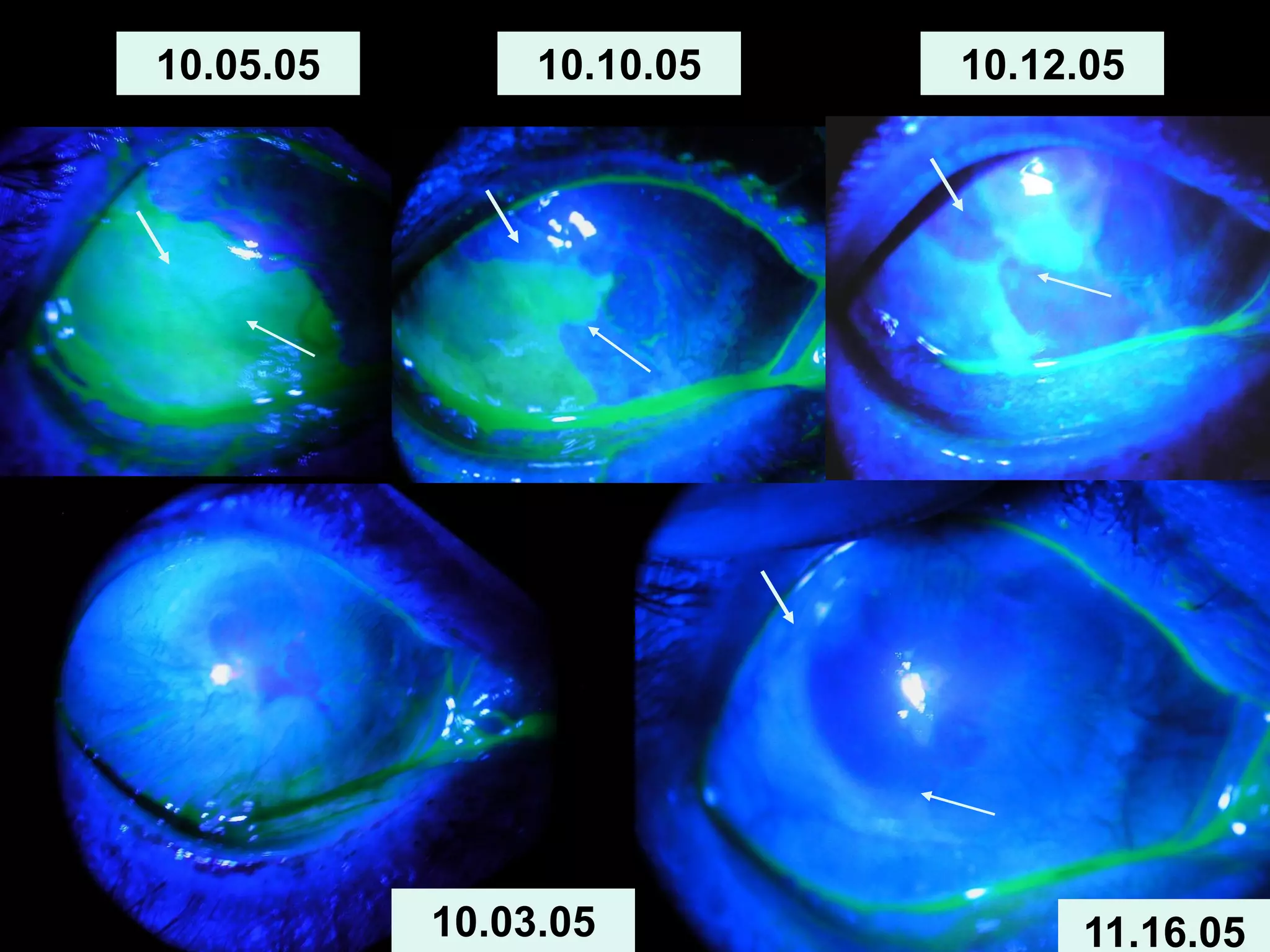
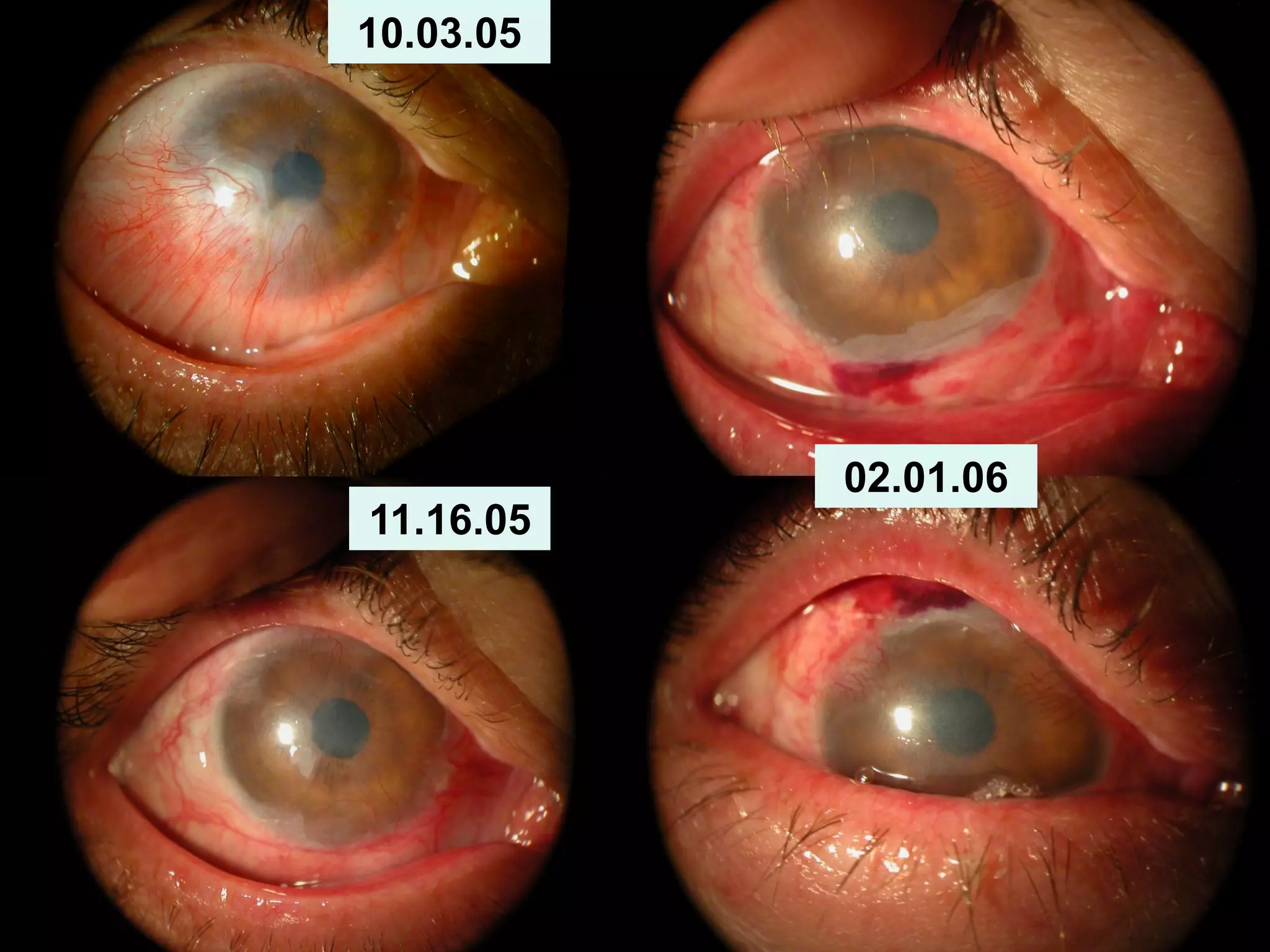
OD Chemical Burn
10.05.05
10.03.05
10.10.05 10.12.05
11.16.05
10.05.05
10.03.05
10.10.05 10.12.05
11.16.05
10.03.05 11.16.05
11.16.05
10.03.05
02.01.06
 Ocular surface reconstruction can be augmented by AMT to restore
a stroma with an intact basement membrane and reduced
inflammation and scarring.
 AMNIOGRAFT® can be used as a permanent graft to restore the
corneal and conjunctival integrity if the surrounding host cells
(including stem cells) are normal.
 AMNIOGRAFT® can be used in conjunction with intraoperative
application of MMC to restore conjunctival surface with abnormal
inflamed host tissue.
 AMNIOGRAFT® can be used to restore stem cell stromal substrate or
“niche” and help promote epithelial stem cell expansion in vivo and
ex vivo.
 Fibrin glue simplifies AMNIOGRAFT® use as a “sutureless”
permanent graft,
 PROKERA™ simplifies AMNIOGRAFT® ’s use as a “sutureless”
temporary graft.
Conclusion

Sutureless amniotic membrane transplantation for common disease

  • 1.
    Michael Duplessie MD. 6000Executive Blvd, Suite 525 N. Bethesda MD 20852 301.493.6404 Sutureless Approach of Amniotic Membrane Transplantation for Common Diseases
  • 2.
    Disclosure and Acknowledgment •Cryopreserved amniotic membrane (AmnioGraft®) is obtained from Bio-Tissue. • Amniotic membrane transplantation for ocular surface reconstruction using AmnioGraft® is the ONLY one approved by FDA in 2001, and by Medicare for hospitals in Jan 2004 (CPT #65780) and for ASCs in July 2005. • Development of ProKera®, a sutureless AmnioGraft®, is supported by a SBIR grant from NIH, NEI, approved by FDA as a type II Device in Dec 2003, and is launched by Bio-Tissue in April 2005.
  • 3.
    AMT Indications Corneal OtherDiseases, 262, 8%Conjunctivochalasis, 257, 8% Bullous Keratopahty, 229, 7% Conjunctival/Caruncle Lesion, 208, 6% Symblepharon, 132, 4% Limbal Stem Cell Deficiency, 100, 3% Glaucoma/Bleb Problems, 70, 2% Socket Problems , 60, 2% Lid Problems, 48, 1% Implant Problems, 36, 1% Scleral Diseases, 35, 1% Limbal Lesion Removal, 30, 1% With other Surgical Procedures, 11, 0% Corneal Defect and Ulceration, 724, 22% Pterygium & Pseudoterygium, 1152, 34% Pterygium & Pseudoterygium Corneal Defect and Ulceration Corneal Other Diseases Conjunctivochalasis Bullous Keratopahty Conjunctival/Caruncle Lesion Symblepharon Limbal Stem Cell Deficiency Glaucoma/Bleb Problems Socket Problems Lid Problems Implant Problems Scleral Diseases Limbal Lesion Removal With other Surgical Procedures N = 3,354 Data Source: Bio-Tissue, Inc. (2002)
  • 4.
    Papilloma of theconjunctiva
  • 5.
  • 6.
     Provide aNew Basement Membrane  Anti-inflammation  Anti-scarring  Anti-angiogenesis Amniotic Membrane: A New Strategy for Tissue Reconstruction and Engineering
  • 7.
  • 8.
  • 9.
    Two Major Modesof AMT  AM either dissolves or removed after healing  Time of AM dissolution coincides with healing  If AM dissolves in one week, suspect “exposure” problem  Suture (10-0 nylon) purse- string running perilimbal sclera  Prokera™ without sutures  IOP by Tonopen and fluorescein staining without removing Prokera™ As a Temporary Graft (bandage or patch)  AM does not dissolve but integrates into the host tissue (cornea or conjunctiva)  One or multiple layers to fill in stromal defect as a filler for any irregular shape (the orientation matters only for the top layer with sticky side down)  Suture (10-0 nylon) interrupted (bulbar) and 8-0 Vicryl over fornix,  Fibrin Glue without sutures As a Permanent Graft
  • 10.
     To reduceacute inflammation  Chemical and Thermal Burns (Acute Stage)  Stevens-Johnson Syndrome (Acute Stage)  To reduce chronic and recalcitrant inflammation  Herpes Zoster, Herpes Simplex, Vernal Keratitis  To reduce acute inflammation induced by surgery or excimer laser  High-risk PKP (neurotrophic)  Excimer laser ablation (PRK/PTK) of the cornea AM as a Temporary Graft to Deliver Anti-inflammatory Action Kim et al, 1998; Meller et al, 2000; Sridhar et al, 2000; Choi et al, 1998; Park & Tseng, 2000; Wang et al, 2001; Heiligenhaus et al, 2001; Kenyon et al, 2003
  • 11.
     AMT forAcute Chemical Burns & Acute SJS/TENS Kim et al, EER 70:329, 1998 Meller et al, Ophthalmology 107:980, 2000 John et al, Ophthalmology 109:351, 2002
  • 12.
    Preop POD# 1 POD#1 Acute Chemical Burn
  • 13.
    1 wk 2 wk2wk 1 wk
  • 14.
  • 15.
  • 16.
    Acute HZO ina Patient with HIV Preop 8 day
  • 17.
  • 18.
  • 19.
  • 20.
  • 21.
  • 22.
    09.23.05 10 Daysafter Chemical Burn
  • 23.
    09.26.05 Day 3after 1st ProKera
  • 24.
  • 25.
    10.03.05 Day 10 10.05.05 Day 12 10.08.05 Day15 10.10.05 Day 17 Switcht to BCL
  • 26.
    09.23.05 10 Daysafter Chemical Burn 10.10.05 27 Days after Chemical Burn
  • 27.
    09.23.05 Day 0 09.26.05 Day 3 10.03.05 Day10 10.05.05 Day 12 What Happened in the Conjunctiva beyond ProKera?
  • 28.
    10.10.05 Day 17 10.08.05 Day 15 10.03.05 Day10 10.12.05 Day 19Inject Kenalog
  • 29.
     To reduceacute inflammation  Chemical and Thermal Burns (Acute Stage)  Stevens-Johnson Syndrome (Acute Stage)  To reduce chronic and recalcitrant inflammation  Herpes Zoster, Herpes Simplex, Vernal Keratitis  To reduce acute inflammation induced by surgery or excimer laser  High-risk PKP (neurotrophic)  Excimer laser ablation (PRK/PTK) of the cornea AM as a Temporary Graft to Deliver Anti-inflammatory Action Kim et al, 1998; Meller et al, 2000; Sridhar et al, 2000; Choi et al, 1998; Park & Tseng, 2000; Wang et al, 2001; Heiligenhaus et al, 2001; Kenyon et al, 2003
  • 30.
    Two Major Modesof AMT  AM either dissolves or removed after healing  Time of AM dissolution coincides with healing  If AM dissolves in one week, suspect “exposure” problem  Suture (10-0 nylon) purse- string running perilimbal sclera  Prokera™ without sutures  IOP by Tonopen and fluorescein staining without removing Prokera™ As a Temporary Graft (bandage or patch)  AM does not dissolve but integrates into the host tissue (cornea or conjunctiva)  One or multiple layers to fill in stromal defect as a filler for any irregular shape (the orientation matters only for the top layer with sticky side down)  Suture (10-0 nylon) interrupted (bulbar) and 8-0 Vicryl over fornix,  Fibrin Glue without sutures As a Permanent Graft
  • 31.
    To Restore CornealIntegrity AM as a Permanent Graft (one or multiple layers)  Persistent epithelial defect, ulcer, descemetocele, and perforation  Painful bullous keratopathy  Band keratopathy  Recurrent corneal erosion  Superficial keratectomy Lee et al, 1997; Kruse et al, 1999; Azuara-Blanco et al, 1999; Chen et al; 2000; Hanada et al, 2001; Letko et al, 2001; Su & Lin, 2000; Pires et al, 1999; Anderson et al, 2001; Kenyon et al, 2003
  • 32.
  • 33.
    Preop 1 Week 2Week 7 Month 20/70 Decemetocele following Pseudomonas Infection and Glaucoma Drainage Implant Solomon et al, Ophthalmology 109:694-703, 2002
  • 34.
  • 35.
    Follow-up 5 weeks CornealPerforation Restore stromal thickness
  • 36.
    Before Band Keratopathy withPED 75 days28 days
  • 37.
    OS PRE-OP Band and BullousKeratopathy with PED 1ST POP WEEK
  • 38.
    OS PRE-OP Band and BullousKeratopathy with PED POP 2 MONTH
  • 39.
    Reconstruct conjunctival surfacewithout conjunctival autograft during removal of large lesions if the surrounding host tissue is healthy AM as a Graft for Conjunctival Surface Reconstruction  Tumor, CIN  Conjunctivochalasis/SLK  Scar or Symblepharon  LOGIC Syndrome  Pterygium  Glaucoma bleb revision  Scleromalacia  Scleral melt Tseng et al, 1997; Prabhasawat & Tseng, 1997; Azuara-Blanco et al, 1999; Meller et al, 2000; Gabric et al, 1999; Mejia et al, 2000; Honavar et al, 2000; Paridaens et al, 2001; Prabhasawat et al, 1997; Solomon et al, 2001; Ma et al; 2000; Shimazaki et al, 1998; Budenz et al, 2000; Rodriquez-Ares et al, 1999
  • 40.
    Differential Diagnosis Symptoms • Diurnal Variation •Worst Gaze • Increased Blinking ATD Dry Eye Worst in P.M. Up Gaze Improved Exposure Zone Improved Chalasis Dry Eye Same throughout the day Down Gaze Worsened Non-Exposure Zone Worsened Di Pascuale et al Br J Ophthalmol, 2004 Rose Bengal Punctal Occlusion
  • 41.
    Di Pascuale etal Br J Ophthalmol, 2004 CCh Detected by Fluorescein
  • 42.
  • 43.
    Anterior Migration ofMucocutaneous Junction and Regional “Blepharitis”
  • 44.
    Normal Mild CCh Moderate CCh Severe CCh IncreasingConjunctival Redness as if “Conjunctivitis”
  • 45.
  • 46.
  • 47.
  • 48.
  • 49.
    Tenon’s Capsule Reinforcement andReplacement by AM “Tenting” Effect Created by Forceps under Topical Anesthesia
  • 50.
  • 51.
    Reconstruct conjunctival surfacewith or without conjunctival autograft and intraoperative application of 0.04% MMC to fornix if the surrounding host tissue is not healthy AM as a Graft for Conjunctival Surface Reconstruction  Tumor, CIN  Conjunctivochalasis  Scar or Symblepharon  LOGIC Syndrome  Pterygium  Glaucoma bleb revision  Scleral melt  Exposed implants Tseng et al, 1997; Prabhasawat & Tseng, 1997; Azuara-Blanco et al, 1999; Meller et al, 2000; Gabric et al, 1999; Mejia et al, 2000; Honavar et al, 2000; Paridaens et al, 2001; Prabhasawat et al, 1997; Solomon et al, 2001; Ma et al; 2000; Shimazaki et al, 1998; Budenz et al, 2000; Rodriquez-Ares et al, 1999
  • 54.
  • 55.
  • 56.
    Multi-Recurrent Pterygium with MotilityRestriction and Symblepharon
  • 57.
  • 58.
  • 59.
  • 60.
  • 61.
  • 62.
  • 63.
     Ocular surfacereconstruction can be augmented by AMT to restore a stroma with an intact basement membrane and reduced inflammation and scarring.  AMNIOGRAFT® can be used as a permanent graft to restore the corneal and conjunctival integrity if the surrounding host cells (including stem cells) are normal.  AMNIOGRAFT® can be used in conjunction with intraoperative application of MMC to restore conjunctival surface with abnormal inflamed host tissue.  AMNIOGRAFT® can be used to restore stem cell stromal substrate or “niche” and help promote epithelial stem cell expansion in vivo and ex vivo.  Fibrin glue simplifies AMNIOGRAFT® use as a “sutureless” permanent graft,  PROKERA™ simplifies AMNIOGRAFT® ’s use as a “sutureless” temporary graft. Conclusion