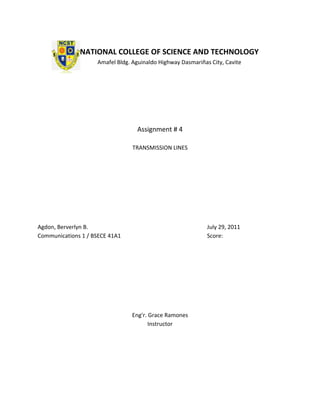
NATIONAL COLLEGE OF SCIENCE AND TECHNOLOGY
                    Amafel Bldg. Aguinaldo Highway Dasmariñas City, Cavite


                                  Assignment # 4

                                 TRANSMISSION LINES


Agdon, Berverlyn B.                                          July 29, 2011
Communications 1 / BSECE 41A1                                Score:


                                Eng'r. Grace Ramones
                                       Instructor
WHAT IS AM, AMPLITUDE MODULATION (AM)?
Amplitude modulation is a type of modulation where the amplitude of the carrier signal is varied in
accordance with the information bearing signal.
The envelope, or boundary, of the amplitude modulated signal embeds the information bearing signal. A
nonlinear device is used to combine the carrier and the modulating signal to generate an amplitude
modulated signal. The output of the nonlinear device consists of discrete upper and lower sidebands.
The output of a nonlinear device does not vary in direct proportion with the input.
AM or amplitude modulation is used for modulating a radio signal to carry sound or other information.
In order that a steady radio signal or "radio carrier" can carry information it must be changed or
modulated in one way so that the information can be conveyed from one place to another. There are a
number of ways in which a carrier can be modulated to carry a signal - often an audio signal and the
most obvious way is to vary its amplitude.
Amplitude modulation, AM is the oldest form of analogue modulation. It was first used at the beginning
the twentieth century and it is still in use today. Currently amplitude modulation is primarily used for
broadcasting, but it is still used for some forms of two way radio communications. Its main radio
communications use is for local aviation related VHF two way radio links. It is sued for ground to air
radio communications as well as two way radio links for ground staff as well.


Amplitude modulation basics
When amplitude modulated signal is created, the amplitude of the signal is varied in line with the
variations in intensity of the sound wave. In this way the overall amplitude or envelope of the carrier is
modulated to carry the audio signal. Here the envelope of the carrier can be seen to change in line with
the modulating signal.
Amplitude modulation, AM is the most straightforward way of modulating a signal. Demodulation or the
process where the radio frequency signal is converted into an audio frequency signal is also very simple.
It only requires a simple diode detector circuit. The circuit that is commonly used has a diode that
rectifies the signal, only allowing the one half of the alternating radio frequency waveform through. A
capacitor is used to remove the radio frequency parts of the signal, leaving the audio waveform. This can
be fed into an amplifier after which it can be used to drive a loudspeaker. As the circuit used for
demodulating AM is very cheap, it enables the cost of radio receivers for AM to be kept low.
TYPES OF AMPLITUDE MODULATION
In amplitude modulation, the amplitude of the carrier signal is varied by the modulating signal. There
are mainly three basic types of amplitude modulation schemes as described below:
     1. Double Sideband Full Carrier (DSB- LC)
     This type of Amplitude modulation is also known as 'Full AM' or 'Standard AM'.
     Here the frequency sepectrum of th AM will have the carrier frequency, Upper sideband and the
     Lower Sideband. Therefore the DSB-LC signal may be written as

     v(t) = Vcsin   ct   +    cos (   c   -       m)t   -           cos(   c+   m)t

     The bandwidth of the modulated wave is twice that of the information signal bandwidth.
     2. Double Sideband- Suppressed Carrier (DSB-SC)
     In this type of amplitude modulation, both the sidebands namely Lower sideband and Upper
     sideband are present in the frequency spectrum but the carrier component is suppressed, hence
     the name Double Sideband suppressed Carrier. The Carrier does not contain any information, so it
     is suppressed during modulation to obtain a better Power Efficiency.
     The DSB-SC signal may be written as

     v(t) = VUSB(t) + VLSB(t) =           cos (         m   +   c   )t +         cos (   c   -   m)   t
     Bandwidth of the modulated wave is twice that of the information signal bandwidth.
     3. Single sideband- Suppressed Carrier (SSB-SC)
     In this type of amplitude modulation, the carrier is suppressed and it is either the Upper sideband
     (USB) or the Lower Sideband ( LSB) that gets transmitted. In DSC-SC the basic information is
     transmitted twice, once in each sideband. This is not required and so SSB-SC has an upper hand.
     The SSB-SC signal may be written as

     v(t) = VUSB(t) =         cos (       m   +    c   ) t 'OR'

     v(t) = LSB(t) =         cos ( c - m) t
     Either the Upper sideband or the Lower Sideband is transmitted. Here the bandwidth bandwidth is
     equal to the information signal bandwidth.


Apart from these three, the other types of amplitude modulations are:
     4. Single sideband Full Carrier. This could be used as compatible AM broadcasting system with
     DSB-FC receivers.
     5. Single Sideband - Reduced Carrier: Here an attenuated carrier is reinserted into the SSB signal,
     to facilitate receiver tuning and demodulation. This method is steadily replaced by SSB-SC.
     6. Independent Sideband Emission: Two independent sidebands, with a carrier that is most
     commonly suppressed or attenuated is used here. It is used in HF point-to -point radiotelephony,
     in which more than one channel is required.
     7. Vestigial Sideband: Here a vestige or trace of the unwanted sideband is transmitted, usually
     with the full carrier. This is used in video transmission.
     8. Lincompex: This is an acronym that stands for 'linked compressor and expander'. it is used
     commercial HF radio telephony.
POWER IN AMPLITUDE MODULATION
        During the modulation process the carrier power remains constant. It is only needed as a
reference during the demodulation process. This means that the sideband power is the useful section of
the signal, and this corresponds to (50 / 150) x 100%, or only 33% of the total power transmitted.

        The total power of the transmitted signal varies with the modulating signal, whereas the carrier
power remains constant.

        In AM wave the transmission carriers contain most of the power

        The utilisation of power by an amplitude modulated signal is very poor. When the carrier is
modulated sidebands appear at either side of the carrier in its frequency spectrum. Each sideband
contains the information about the audio modulation. To look at how the signal is made up and the
relative powers take the simplified case where the 1 kHz tone is modulating the carrier. In this case two
signals will be found 1 kHz either side of the main carrier. When the carrier is fully modulated i.e. 100%
the amplitude of the modulation is equal to half that of the main carrier, i.e. the sum of the powers of
the sidebands is equal to half that of the carrier. This means that each sideband is just a quarter of the
total power. In other words for a transmitter with a 100 watt carrier, the total sideband power would be
50 watts and each individual sideband would be 25 watts.
MODULATION INDEX
It is often necessary to define the level of modulation that is applied to a signal. A factor or index known
as the modulation index is used for this. When expressed as a percentage it is the same as the depth of
modulation. In other words it can be expressed as:
M = (RMS value of modulating signal) / (RMS value of unmodulated signal)
The value of the modulation index must not be allowed to exceed one (i.e. 100 % in terms of the depth
of modulation) otherwise the envelope becomes distorted and the signal will "splatter" either side of
the wanted channel, causing interference and annoyance to other users.
Amplitude modulation requires a high frequency constant carrier and a low frequency modulation
signal.
A sine wave carrier is of the form
A sine wave modulation signal is of the form
The high frequency carrier takes on the shape of the lower frequency modulation signal, forming what is
called a modulation envelope.

Am1

  • 1.
    NATIONAL COLLEGE OFSCIENCE AND TECHNOLOGY Amafel Bldg. Aguinaldo Highway Dasmariñas City, Cavite Assignment # 4 TRANSMISSION LINES Agdon, Berverlyn B. July 29, 2011 Communications 1 / BSECE 41A1 Score: Eng'r. Grace Ramones Instructor
  • 2.
    WHAT IS AM,AMPLITUDE MODULATION (AM)? Amplitude modulation is a type of modulation where the amplitude of the carrier signal is varied in accordance with the information bearing signal. The envelope, or boundary, of the amplitude modulated signal embeds the information bearing signal. A nonlinear device is used to combine the carrier and the modulating signal to generate an amplitude modulated signal. The output of the nonlinear device consists of discrete upper and lower sidebands. The output of a nonlinear device does not vary in direct proportion with the input. AM or amplitude modulation is used for modulating a radio signal to carry sound or other information. In order that a steady radio signal or "radio carrier" can carry information it must be changed or modulated in one way so that the information can be conveyed from one place to another. There are a number of ways in which a carrier can be modulated to carry a signal - often an audio signal and the most obvious way is to vary its amplitude. Amplitude modulation, AM is the oldest form of analogue modulation. It was first used at the beginning the twentieth century and it is still in use today. Currently amplitude modulation is primarily used for broadcasting, but it is still used for some forms of two way radio communications. Its main radio communications use is for local aviation related VHF two way radio links. It is sued for ground to air radio communications as well as two way radio links for ground staff as well. Amplitude modulation basics When amplitude modulated signal is created, the amplitude of the signal is varied in line with the variations in intensity of the sound wave. In this way the overall amplitude or envelope of the carrier is modulated to carry the audio signal. Here the envelope of the carrier can be seen to change in line with the modulating signal. Amplitude modulation, AM is the most straightforward way of modulating a signal. Demodulation or the process where the radio frequency signal is converted into an audio frequency signal is also very simple. It only requires a simple diode detector circuit. The circuit that is commonly used has a diode that rectifies the signal, only allowing the one half of the alternating radio frequency waveform through. A capacitor is used to remove the radio frequency parts of the signal, leaving the audio waveform. This can be fed into an amplifier after which it can be used to drive a loudspeaker. As the circuit used for demodulating AM is very cheap, it enables the cost of radio receivers for AM to be kept low.
  • 3.
    TYPES OF AMPLITUDEMODULATION In amplitude modulation, the amplitude of the carrier signal is varied by the modulating signal. There are mainly three basic types of amplitude modulation schemes as described below: 1. Double Sideband Full Carrier (DSB- LC) This type of Amplitude modulation is also known as 'Full AM' or 'Standard AM'. Here the frequency sepectrum of th AM will have the carrier frequency, Upper sideband and the Lower Sideband. Therefore the DSB-LC signal may be written as v(t) = Vcsin ct + cos ( c - m)t - cos( c+ m)t The bandwidth of the modulated wave is twice that of the information signal bandwidth. 2. Double Sideband- Suppressed Carrier (DSB-SC) In this type of amplitude modulation, both the sidebands namely Lower sideband and Upper sideband are present in the frequency spectrum but the carrier component is suppressed, hence the name Double Sideband suppressed Carrier. The Carrier does not contain any information, so it is suppressed during modulation to obtain a better Power Efficiency. The DSB-SC signal may be written as v(t) = VUSB(t) + VLSB(t) = cos ( m + c )t + cos ( c - m) t Bandwidth of the modulated wave is twice that of the information signal bandwidth. 3. Single sideband- Suppressed Carrier (SSB-SC) In this type of amplitude modulation, the carrier is suppressed and it is either the Upper sideband (USB) or the Lower Sideband ( LSB) that gets transmitted. In DSC-SC the basic information is transmitted twice, once in each sideband. This is not required and so SSB-SC has an upper hand. The SSB-SC signal may be written as v(t) = VUSB(t) = cos ( m + c ) t 'OR' v(t) = LSB(t) = cos ( c - m) t Either the Upper sideband or the Lower Sideband is transmitted. Here the bandwidth bandwidth is equal to the information signal bandwidth. Apart from these three, the other types of amplitude modulations are: 4. Single sideband Full Carrier. This could be used as compatible AM broadcasting system with DSB-FC receivers. 5. Single Sideband - Reduced Carrier: Here an attenuated carrier is reinserted into the SSB signal, to facilitate receiver tuning and demodulation. This method is steadily replaced by SSB-SC. 6. Independent Sideband Emission: Two independent sidebands, with a carrier that is most commonly suppressed or attenuated is used here. It is used in HF point-to -point radiotelephony, in which more than one channel is required. 7. Vestigial Sideband: Here a vestige or trace of the unwanted sideband is transmitted, usually with the full carrier. This is used in video transmission. 8. Lincompex: This is an acronym that stands for 'linked compressor and expander'. it is used commercial HF radio telephony.
  • 4.
    POWER IN AMPLITUDEMODULATION During the modulation process the carrier power remains constant. It is only needed as a reference during the demodulation process. This means that the sideband power is the useful section of the signal, and this corresponds to (50 / 150) x 100%, or only 33% of the total power transmitted. The total power of the transmitted signal varies with the modulating signal, whereas the carrier power remains constant. In AM wave the transmission carriers contain most of the power The utilisation of power by an amplitude modulated signal is very poor. When the carrier is modulated sidebands appear at either side of the carrier in its frequency spectrum. Each sideband contains the information about the audio modulation. To look at how the signal is made up and the relative powers take the simplified case where the 1 kHz tone is modulating the carrier. In this case two signals will be found 1 kHz either side of the main carrier. When the carrier is fully modulated i.e. 100% the amplitude of the modulation is equal to half that of the main carrier, i.e. the sum of the powers of the sidebands is equal to half that of the carrier. This means that each sideband is just a quarter of the total power. In other words for a transmitter with a 100 watt carrier, the total sideband power would be 50 watts and each individual sideband would be 25 watts.
  • 5.
    MODULATION INDEX It isoften necessary to define the level of modulation that is applied to a signal. A factor or index known as the modulation index is used for this. When expressed as a percentage it is the same as the depth of modulation. In other words it can be expressed as: M = (RMS value of modulating signal) / (RMS value of unmodulated signal) The value of the modulation index must not be allowed to exceed one (i.e. 100 % in terms of the depth of modulation) otherwise the envelope becomes distorted and the signal will "splatter" either side of the wanted channel, causing interference and annoyance to other users. Amplitude modulation requires a high frequency constant carrier and a low frequency modulation signal. A sine wave carrier is of the form A sine wave modulation signal is of the form The high frequency carrier takes on the shape of the lower frequency modulation signal, forming what is called a modulation envelope.