NATIONAL COLLEGE OF SCIENCE AND TECHNOLOGY
               Amafel Bldg. Aguinaldo Highway Dasmariñas City, Cavite


                           Assignment # 2
                      AMPLITUDE MODULATION
                        (Types of Amplitude Modulation)
                        (Power in Amplitude Modulation)
                              (Modulation Index)


Alido, Ronald                                             June 29,2011
Communications 1 / BSECE 41A1                                   Score:


                            Eng'r. Grace Ramones
                                   Instructor
Amplitude Modulation

Varying the voltage of a carrier or a direct current in order to transmit analog or digital
data. Amplitude modulation (AM) is the oldest method of transmitting human voice
electronically. In an analog telephone conversation, the voice waves on both sides are
modulating the voltage of the direct current loop connected to them by the telephone
company.

Modulate a Carrier

Amplitude modulation (AM) is also widely used to alter a carrier wave to transmit data.
For example, in AM radio, the voltage (amplitude) of a carrier with a fixed center
frequency (the station's channel) is varied (modulated) by the analog audio signal.

AM is also used for digital data. In quadrature amplitude modulation (QAM), both
amplitude and phase modulation are used to create different binary states for
transmission (see QAM). AM is also used to modulate light waves in optical fibers.

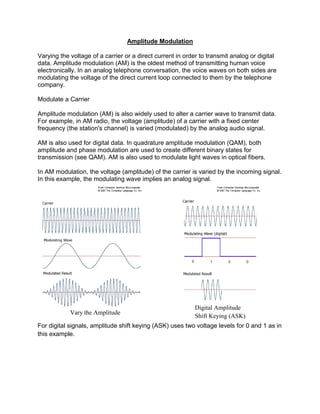
In AM modulation, the voltage (amplitude) of the carrier is varied by the incoming signal.
In this example, the modulating wave implies an analog signal.


                                                           Digital Amplitude
            Vary the Amplitude
                                                           Shift Keying (ASK)
For digital signals, amplitude shift keying (ASK) uses two voltage levels for 0 and 1 as in
this example.
Types of amplitude modulation

In radio communication, a continuous wave radio-frequency signal (a sinusoidal carrier
wave) has its amplitude modulated by an audio waveform before being transmitted.

In the frequency domain, amplitude modulation produces a signal with power
concentrated at the carrier frequency and in two adjacent sidebands. Each sideband is
equal in bandwidth to that of the modulating signal and is a mirror image of the other.
Amplitude modulation that results in two sidebands and a carrier is often called double-
sideband amplitude modulation (DSB-AM). Amplitude modulation is inefficient in terms
of power usage. At least two-thirds of the power is concentrated in the carrier signal,
which carries no useful information (beyond the fact that a signal is present).

To increase transmitter efficiency, the carrier can be removed (suppressed) from the
AM signal. This produces a reduced-carrier transmission or double-sideband
suppressed-carrier (DSBSC) signal. A suppressed-carrier amplitude modulation
scheme is three times more power-efficient than traditional DSB-AM. If the carrier is
only partially suppressed, a double-sideband reduced-carrier (DSBRC) signal results.
DSBSC and DSBRC signals need their carrier to be regenerated (by a beat frequency
oscillator, for instance) to be demodulated using conventional techniques.

Improved bandwidth efficiency is achieved—at the expense of increased transmitter and
receiver complexity—by completely suppressing both the carrier and one of the
sidebands. This is single-sideband modulation, widely used in amateur radio due to its
efficient use of both power and bandwidth.

A simple form of AM often used for digital communications is on-off keying, a type of
amplitude-shift keying by which binary data is represented as the presence or absence
of a carrier wave. This is commonly used at radio frequencies to transmit Morse code,
referred to as continuous wave (CW) operation.

ITU designations

In 1982, the International Telecommunication Union (ITU) designated the various types
of amplitude modulation as follows:

Designation                            Description
A3E         double-sideband full-carrier - the basic AM modulation scheme
R3E         single-sideband reduced-carrier
H3E         single-sideband full-carrier
J3E         single-sideband suppressed-carrier
B8E         independent-sideband emission
C3F         vestigial-sideband
Lincompex linked compressor and expander
Power in Amplitude Modulation

o The envelope, or boundary, of the amplitude modulated signal embeds the
  information bearing signal.
o The total power of the transmitted signal varies with the modulating signal,
  whereas the carrier power remains constant.
o The total wave power which varies in amplitude, and not the carrier power. The
  carrier power in an amplitude modulated system remains constant.
Modulation index

It can be defined as the measure of extent of amplitude variation about an unmodulated
maximum carrier. As with other modulation indices, in AM, this quantity, also called
modulation depth, indicates by how much the modulated variable varies around its
'original' level. For AM, it relates to the variations in the carrier amplitude and is defined
as:


                                               where      and    were introduced above.

So if h = 0.5, the carrier amplitude varies by 50% above and below its unmodulated
level, and for h = 1.0 it varies by 100%. To avoid distortion in the A3E transmission
mode, modulation depth greater than 100% must be avoided. Practical transmitter
systems will usually incorporate some kind of limiter circuit, such as a VOGAD, to
ensure this. However, AM demodulators can be designed to detect the inversion (or 180
degree phase reversal) that occurs when modulation exceeds 100% and automatically
correct for this effect.[citation needed]

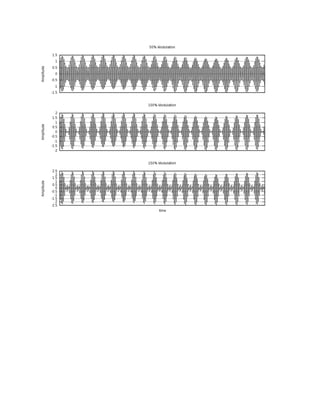
Variations of modulated signal with percentage modulation are shown below. In each
image, the maximum amplitude is higher than in the previous image. Note that the scale
changes from one image to the next.
Am5

Am5

  • 1.
    NATIONAL COLLEGE OFSCIENCE AND TECHNOLOGY Amafel Bldg. Aguinaldo Highway Dasmariñas City, Cavite Assignment # 2 AMPLITUDE MODULATION (Types of Amplitude Modulation) (Power in Amplitude Modulation) (Modulation Index) Alido, Ronald June 29,2011 Communications 1 / BSECE 41A1 Score: Eng'r. Grace Ramones Instructor
  • 2.
    Amplitude Modulation Varying thevoltage of a carrier or a direct current in order to transmit analog or digital data. Amplitude modulation (AM) is the oldest method of transmitting human voice electronically. In an analog telephone conversation, the voice waves on both sides are modulating the voltage of the direct current loop connected to them by the telephone company. Modulate a Carrier Amplitude modulation (AM) is also widely used to alter a carrier wave to transmit data. For example, in AM radio, the voltage (amplitude) of a carrier with a fixed center frequency (the station's channel) is varied (modulated) by the analog audio signal. AM is also used for digital data. In quadrature amplitude modulation (QAM), both amplitude and phase modulation are used to create different binary states for transmission (see QAM). AM is also used to modulate light waves in optical fibers. In AM modulation, the voltage (amplitude) of the carrier is varied by the incoming signal. In this example, the modulating wave implies an analog signal. Digital Amplitude Vary the Amplitude Shift Keying (ASK) For digital signals, amplitude shift keying (ASK) uses two voltage levels for 0 and 1 as in this example.
  • 3.
    Types of amplitudemodulation In radio communication, a continuous wave radio-frequency signal (a sinusoidal carrier wave) has its amplitude modulated by an audio waveform before being transmitted. In the frequency domain, amplitude modulation produces a signal with power concentrated at the carrier frequency and in two adjacent sidebands. Each sideband is equal in bandwidth to that of the modulating signal and is a mirror image of the other. Amplitude modulation that results in two sidebands and a carrier is often called double- sideband amplitude modulation (DSB-AM). Amplitude modulation is inefficient in terms of power usage. At least two-thirds of the power is concentrated in the carrier signal, which carries no useful information (beyond the fact that a signal is present). To increase transmitter efficiency, the carrier can be removed (suppressed) from the AM signal. This produces a reduced-carrier transmission or double-sideband suppressed-carrier (DSBSC) signal. A suppressed-carrier amplitude modulation scheme is three times more power-efficient than traditional DSB-AM. If the carrier is only partially suppressed, a double-sideband reduced-carrier (DSBRC) signal results. DSBSC and DSBRC signals need their carrier to be regenerated (by a beat frequency oscillator, for instance) to be demodulated using conventional techniques. Improved bandwidth efficiency is achieved—at the expense of increased transmitter and receiver complexity—by completely suppressing both the carrier and one of the sidebands. This is single-sideband modulation, widely used in amateur radio due to its efficient use of both power and bandwidth. A simple form of AM often used for digital communications is on-off keying, a type of amplitude-shift keying by which binary data is represented as the presence or absence of a carrier wave. This is commonly used at radio frequencies to transmit Morse code, referred to as continuous wave (CW) operation. ITU designations In 1982, the International Telecommunication Union (ITU) designated the various types of amplitude modulation as follows: Designation Description A3E double-sideband full-carrier - the basic AM modulation scheme R3E single-sideband reduced-carrier H3E single-sideband full-carrier J3E single-sideband suppressed-carrier B8E independent-sideband emission C3F vestigial-sideband Lincompex linked compressor and expander
  • 4.
    Power in AmplitudeModulation o The envelope, or boundary, of the amplitude modulated signal embeds the information bearing signal. o The total power of the transmitted signal varies with the modulating signal, whereas the carrier power remains constant. o The total wave power which varies in amplitude, and not the carrier power. The carrier power in an amplitude modulated system remains constant.
  • 5.
    Modulation index It canbe defined as the measure of extent of amplitude variation about an unmodulated maximum carrier. As with other modulation indices, in AM, this quantity, also called modulation depth, indicates by how much the modulated variable varies around its 'original' level. For AM, it relates to the variations in the carrier amplitude and is defined as: where and were introduced above. So if h = 0.5, the carrier amplitude varies by 50% above and below its unmodulated level, and for h = 1.0 it varies by 100%. To avoid distortion in the A3E transmission mode, modulation depth greater than 100% must be avoided. Practical transmitter systems will usually incorporate some kind of limiter circuit, such as a VOGAD, to ensure this. However, AM demodulators can be designed to detect the inversion (or 180 degree phase reversal) that occurs when modulation exceeds 100% and automatically correct for this effect.[citation needed] Variations of modulated signal with percentage modulation are shown below. In each image, the maximum amplitude is higher than in the previous image. Note that the scale changes from one image to the next.